Rita Zambori – Brooklyn, New York

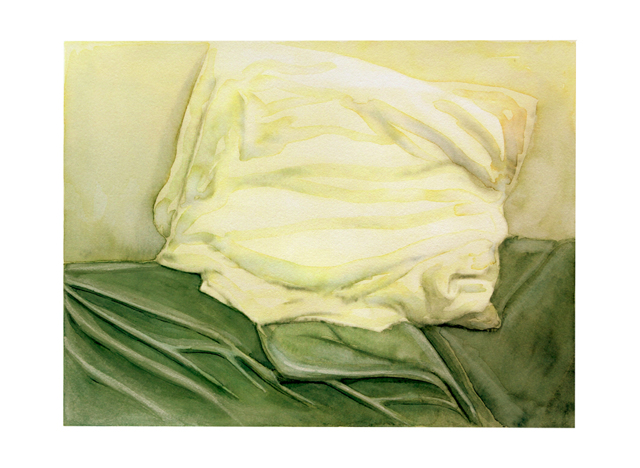
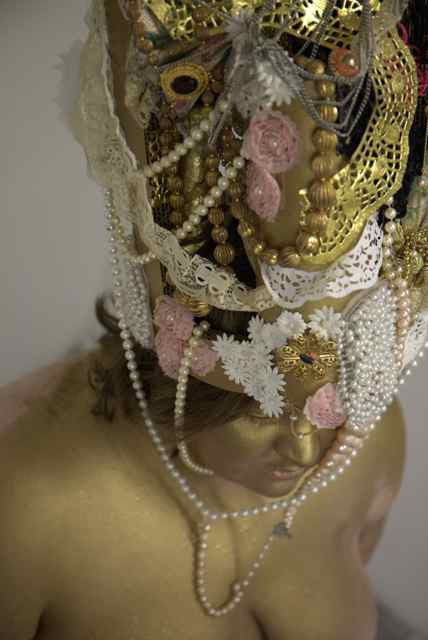
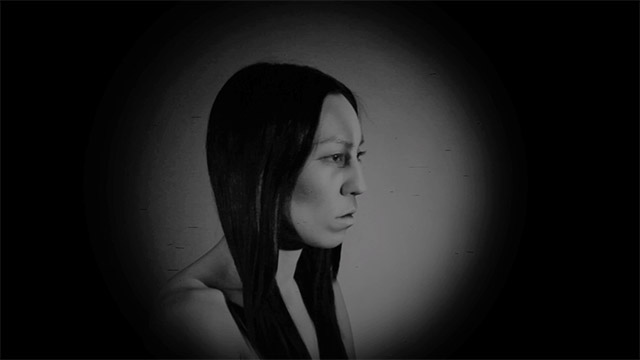
Still from Luella Video, 2013

Still from Luella
Video, 2013

Briefly describe the work you do.

My video and installation work focuses on performance and the mind. Each piece explores notions of self-identity within the context of the soul or psyche. In my performances, I reinterpret thoughts by mimicking its movements in time and space. I perform to not only define a mental space, but to also establish an energy that is innate to every individual conscious.

Tell us a little about your background and how that influences you as an artist.

Having always been an introspective person has affected the way I produce and think about my art.

While in graduate school, I was reflecting a lot on past and current relationships that have shaped who I am as an individual. For me, I know that there are gestures from moments in each relationship that have been quite impressionable.

And while just brushing the surface of psychoanalytic theory in one of my classes, I grew more curious about certain specifics about the functioning of the mind so much that it became motivation for Kerry, Imprecion, Sam. Lacan’s idea of the mirror stage is a concept that resonated with me. It is a way of identification; I assumed the images of my friend, mom, and significant other.

My background is also in makeup artistry. Makeup is transformative and I knew that I wanted to develop the physical identity of each character through not only make-up, but also self-crafted costumes. It was in fact how I came to figure the performance, then the text and sound.

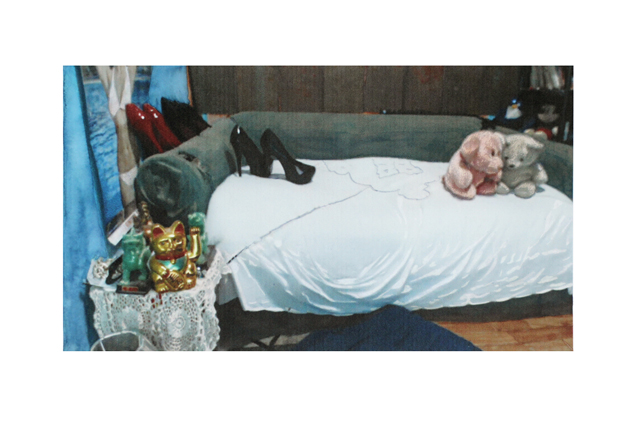
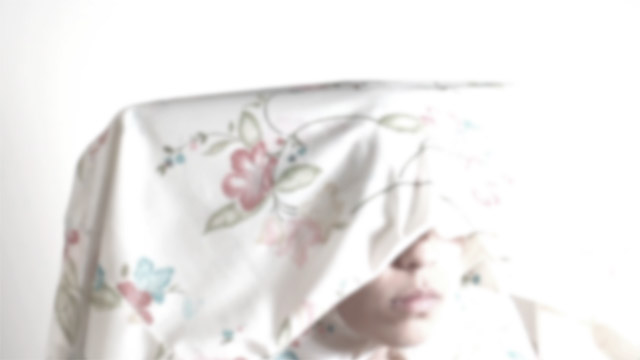
Still from Untitled Video, 2013

Still from Untitled
Video, 2013

The concept of the “artist studio” has a broad range of meanings, especially in contemporary practice. The idea of the artist toiling away alone in a room may not necessarily reflect what many artists do from day to day anymore. Describe your studio practice and how it differs from (or is the same as) traditional notions of “being in the studio.”

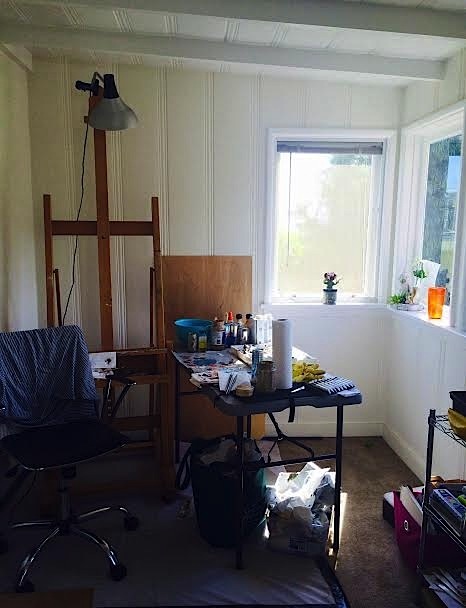
I think my studio practice is similar to “toiling away alone in a room”. However, I I’m very much aware when I need to change my environment so I can bring a new perspective to my work, which I’ve learned, is a huge part of making art. As much as I love being confined in my working space, I try to regularly see a variety of art. More importantly though, I always try to remain curious and active in seeking out answers to what I don’t know. I think that dictates my practice more than anything.

What unique roles do you see yourself as the artist playing that you may not have envisioned yourself in when you first started making art?

I think there are a few that come to mind: actress, dancer, and writer. That’s not to say, though, that I am any one of these in real life, but I definitely have assumed the role of each of them to at least make art or inform people about my art.

When do you find is the best time of day to make art? Do you have time set aside every day, every week or do you just work whenever you can? 

I try to do something everyday. Even if all I do is sit, think, and write for a few hours, I’m satisfied. I am more alert during the day, so that’s the best time for me to focus on art whether that’s working on my computer or sprawled out on my floor with a notebook. However, I never resist an urge to work. If anything, I at least have to write down the idea to get it out of my brain, even if it comes to me at midnight. Then, I can revisit it in the morning.

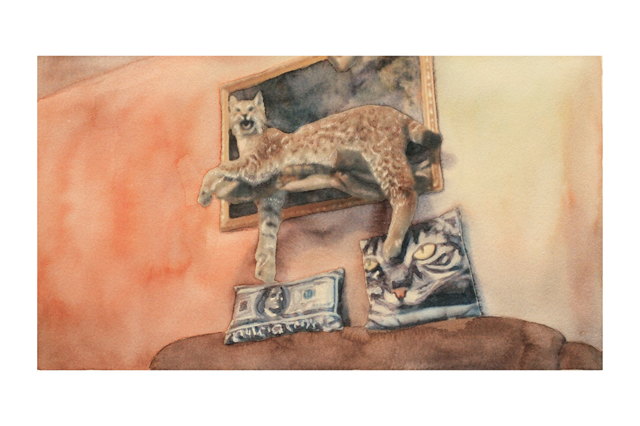
Kerry, Imprecion, Sam Video Installation, 2014

Kerry, Imprecion, Sam
Video Installation, 2014

How has your work changed in the last five years? How is it the same?

Five years ago I only made photographs and before that, I only drew and painted. The mediums have changed or have come together in some way, but my interests have remained pretty consistent throughout the years. Now, I make work not only with the moving image, but also through the use of textiles and make-up.

Are there people such as family, friends, writers, philosophers or even pop icons that have had an impact on the work you do?

I have always been fascinated with people and my relationships/exchanges with them. To this end, this curiosity will always impact the work I do. More specifically, I’ve grown a strong interest in the Buddhist philosophy. I can’t speak much about the Buddha as I’m still learning, but from what I have grasped, I know that his teachings have already informed my current work.

If you had an occupation outside of being an artist, what would that be and why?

I would love to be a Fromager. The reason is simply because of my love for cheese at a very young age. I love everything about it, from the different kinds, taste, texture, smell, and process. I can only imagine that cheese making requires the same love, attention, and care that making art requires.

About

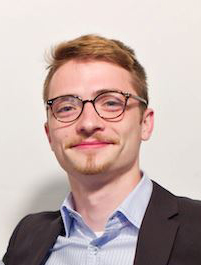
headshotRita Zambori currently resides and makes work in Brooklyn, NY. She holds a BFA in Photography from Indiana University and an MFA in Photography, Video and Related Media from the School of Visual Arts. Kerry, Imprecion, Sam has been installed in Manhattan and Brooklyn as well as screened in St. Louis, Missouri. Also this year, she will be featured with her piece in Stigmart10 Videobiennale. 

working

www.ritazambori.com

All images copyright of the artist and used with their permission.  


Posted in Video | Tagged , , , , | Leave a comment

Pierre Chaumont – Montréal, QC, Canada

Thank You For The Love You've Brought My Way(Sexy Candy) Chimera Print,  2013 21.59 x 27.94 cm

Thank You For The Love You’ve Brought My Way(Sexy Candy), Chimera Print,
2013, 21.59 x 27.94 cm

Briefly describe the work you do.

My conceptual work revolves around the notion of the stranger. I try to find distinct structures that either conceptually or physically exists and operate inside a bigger establishment.

Tell us a little about your background and how that influences you as an artist

My parents were taxidermists so I was surrounded by a lot of animal sculptures when I was a child but it was only when I was 17 that I really discovered Art. At that time, I took an Art History class as a specialization because I admired one of the teachers. I quickly realized that I wanted to be part of this history of cultures as a creator more than a theoretician so I decided to become an artist.

You're My Spark Of Nature's Fire(SweetNaughtyBoy) Chimera Print,  2014 21.59 x 27.94 cm

You’re My Spark Of Nature’s Fire(SweetNaughtyBoy)
Chimera Print,, 2014
21.59 x 27.94 cm

The concept of the “artist studio” has a broad range of meanings, especially in contemporary practice. The idea of the artist toiling away alone in a room may not necessarily reflect what many artists do from day to day anymore. Describe your studio practice and how it differs from (or is the same as) traditional notions of “being in the studio.”

I am from that line of artists such as Gabriel Orozco who consciously decided not to have a studio. Because most of my exhibitions are abroad, I had to find a way to create anywhere in any conditions and I naturally leaned toward works on paper so that it was easy for me to make, carry and send works no matter where I’d have to go. The only problem with this is that there is no boundary between Art and your personal life, so you are constantly working either by making or thinking about how to make something. There is no punching in or out of the studio, you are always in it creating physically or conceptually which can be difficult for people around you.

What unique roles do you see yourself as the artist playing that you may not have envisioned yourself in when you first started making art?

I am always amazed to see that artists are creating culture. We usually have the notion that culture is still and that it is something that was relayed to us to perpetuate but when you see artists putting their own little rock (no matter how insignificant or magnificent) on this great mountain, I feel a great privilege to be part of it.

When do you find is the best time of day to make art? Do you have time set aside every day, every week or do you just work whenever you can?

Because the Art/Life separation doesn’t really exists in my practice, I mostly follow my instinct. I can be for months without creating anything and then suddenly I could be working on 3 different series at the same time. I also developed a system that allows me to create artworks really fast so this helps me not to stress too much if I don’t produce as steadily as other artists.

Thank You For That Smile Upon Your Face (Princess18) Chimera Print,  2014 21.59 x 27.94 cm

Thank You For That Smile Upon Your Face (Princess18), Chimera Print,
2014, 21.59 x 27.94 cm

How has your work changed in the last five years? How is it the same?

I think one of the great things in being an artist is that you constantly fail. I think that failure is the greatest teacher you can ever have: you know if you want to do this career professionally or as a hobby, it shows you your flaws in a brutally honest way and it also keeps your head on your shoulders. So in the last five years what changed was that I became a more professional artist because of so many failures but at the same time none of my goals changed, now I just know what I need to work on to get there.

Are there people such as family, friends, writers, philosophers or even pop icons that have had an impact on the work you do? 

Many people influenced me and many others are influencing me but I think in the end that influence is a projection of what you already believe into someone or something that can translate it better than you.

If you had an occupation outside of being an artist, what would that be and why?

I don’t know, really. Maybe a builder because I like the fact that people live in such a big sculpture.

About

portraitPierre Chaumont was born in 1987 in Libourne (France): he lives and works in Montréal (Canada). Bachelor in Visual Art from University of Quebec in Montréal, He spends his time between Montréal and Tokyo. His artworks were shown in United States, China, Japan, Slovenia and Canada.

He is part of the  collection of the Museum of Contemporary Art in Laurentians, The Loto-Québec Collection The Museum of Art in Lendava, Slovenia and in many private collections.

workplace

www.pierrechaumont.com

All images copyright of the artist and used with their permission.  

Posted in Conceptual Art | Tagged , , , , | Leave a comment

Kassandra Mattia – Laguna Beach, California

TITLE: Suspended MEDIUM: Oil and caulk on panel SIZE: 16" x 16" YEAR: 2014

TITLE: Suspended
MEDIUM: Oil and caulk on panel
SIZE: 16″ x 16″
YEAR: 2014

Briefly describe the work you do.

I make paintings and drawings that are inspired by imagery from my childhood in rural Wisconsin and are informed by my undergraduate training in physics.  In general, I do my best to foster a spirit of experimentation and discovery in the studio.  In trying to keep my practice as open-minded as possible, I allow myself to change my mind about the direction of my work throughout the creative process. When I begin a work, I always have a vision for it, but many of my best pieces have developed from letting go of that original vision and embracing a discovery or change of perspective I gain through the process of making.

I am particularly attracted to oil paint as a medium because of its long drying time.  For me, the long drying time allows me greater opportunities to work with my subconscious and to imagine alternate realities for the painting. It’s during drying time that I will often think to paint over an old idea, or to sand down a painting to the panel and start over.

As a result of playing with my subconscious while I paint or draw, images from separate layers of the work are revealed to the surface, interacting with each other to create the final work. In this way, the meaning of the work can only be gleaned by piecing together clues from an otherwise hidden history of layers.  I like to think of this process of piecing together as a metaphor for how we create meaning in our own lives and for how we, as observers, build reality together.

TITLE: Elaine (In Mae's House) MEDIUM: Oil on panel SIZE: 40" x 30" YEAR: 2014

TITLE: Elaine (In Mae’s House)
MEDIUM: Oil on panel
SIZE: 40″ x 30″
YEAR: 2014

Tell us a little about your background and how that influences you as an artist.

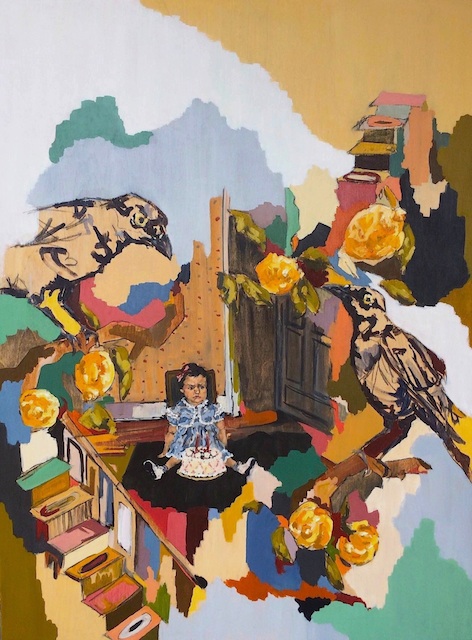
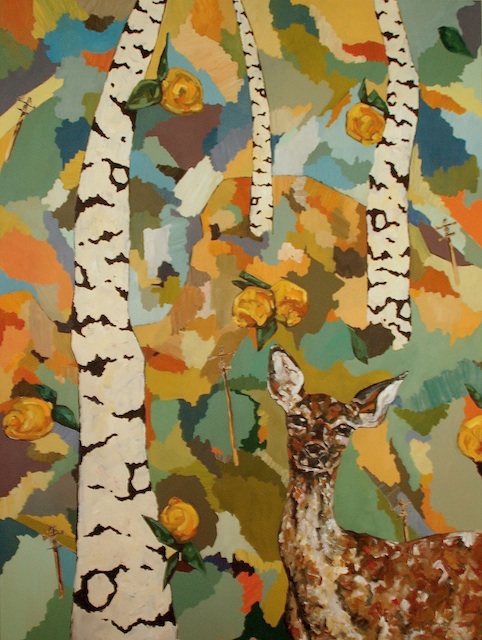
As a remnant from my training in physics, my current body of work investigates possible connections between the psychology of experience and physical conceptions of what it means to observe. Expanding from the quantum mechanical notion that observation is interactive, my art practice applies aspects of physicist John Wheeler’s “participatory universe” to the private, emotional and interpersonal realm; in doing so, my work questions the fundamental nature of knowledge and perception.

My visual language is most often inspired by images that are highly familiar to me.  Most of the figures in my work are lifted from old family photos, and the deer, birch trees, branches, dead animals and birds that repeat throughout my work are largely inspired by the visual landscape of my childhood in northeast Wisconsin. In practice, I find myself painting these highly familiar images into imagined environments, sometimes juxtaposing them with unrelated images. As a result, I confuse what I think I know about an image with potentially entirely new meanings for that image.  By marrying the planned with the unplanned, the figurative with the abstract, the new with the old, my work helps me explore the intersection of imagination, expectation, memory, and reality. 

The concept of the “artist studio” has a broad range of meanings, especially in contemporary practice. The idea of the artist toiling away alone in a room may not necessarily reflect what many artists do from day to day anymore. Describe your studio practice and how it differs from (or is the same as) traditional notions of “being in the studio.”

My studio practice actually does tend to involve a lot of toiling away alone in a room.  I did a fair amount of research in an optics lab in undergraduate school, and I find myself recreating the solitude and space of that experience in my studio.  I can get stuck in the studio, and I often have to leave it to come up with my best ideas, but once I’ve got something in mind, it’s necessary for me to have a “lab” space to test the ideas out in.

In my case, I my current “lab” is a room in my house.  I enjoy having my studio in my home because its proximity doesn’t give me any excuses not to work, but it can also be overwhelming.  My studio space and house are both small, so a lot of my work finds its way into the living room, which can make it hard for me to turn my brain off of art when I’m not working. 

What unique roles do you see yourself as the artist playing that you may not have envisioned yourself in when you first started making art?

I’m not sure I ever would have guessed how much I’d have to write about my work.  I’ve been particularly swamped lately because I just finished applying to graduate school, so for the past month or so about 80% of my practice has been writing about it.  In general though, I often appreciate the break that filling out applications and proposals gives me.  I love the solitude and quiet that painting provides, but it can also be nice to reflect on what I’m doing when I get really caught up in the non-verbalness of making.

When do you find is the best time of day to make art? Do you have time set aside every day, every week or do you just work whenever you can? 

Because my studio is in my house, I can work almost every day.  I try to be present about what I’m capable of doing each day.  Some days are detail days, some days are idea days, and some days I just need to power through and paint a huge section.  I find that if I force myself into the wrong kind of day, it can be really counterproductive.  Typically, I do the most work in the early mornings and late afternoons.  I usually don’t paint or draw at night because I like working in natural light. 

TITLE: Encounter MEDIUM: Oil on panel SIZE: 48" x 36" YEAR: 2014

TITLE: Encounter
MEDIUM: Oil on panel
SIZE: 48″ x 36″
YEAR: 2014

How has your work changed in the last five years? How is it the same?

Since graduating from undergrad I’ve been developing my voice as an artist, and I’ve been feeling freer to rely on my intuition and open up lines of thinking that have a lot of unknowns.  I’ve also been increasingly thinking about my work more as an ongoing story and less as individual statements. Also, since moving to southern California, I’ve been using much brighter colors in my work.  I wouldn’t have anticipated that change, but it’s been exciting.  Though, for the most part, the more things change with my work, the more they’ve stayed the same.  I was just at my parents’ place for the holidays and my mom found some art I made in kindergarten…it’s all birch trees and birds. 

Are there people such as family, friends, writers, philosophers or even pop icons that have had an impact on the work you do?

Oh, definitely. I find a lot of inspiration from conversations with my family and friends.  I find myself borrowing concepts from alchemy, psychology, and physics to think about my work.  In particular, Carl Jung’s Synchronicity and physicist John Wheeler’s work have been great influences on my creative thinking.  I am also influenced by music, especially songs that are highly narrative.  Josh Ritter is always a go-to musician for me.

If you had an occupation outside of being an artist, what would that be and why?

I’m not really sure.  I could see myself doing some sort of research or working outside.  I’d have to do something that involves quiet and beauty.

About

HeadshotKassandra Mattia is a painter whose work explores connections between observation, experience, and reality.  She is a recent graduate of Santa Clara University’s physics program and is currently working from her studio in Laguna Beach, California.   

studio_365

www.kassandramattia.com 

All images copyright of the artist and used with their permission.  

Posted in Drawing, Painting | Tagged , , , , | Leave a comment

Hoda Zarbaf – Toronto, Canada

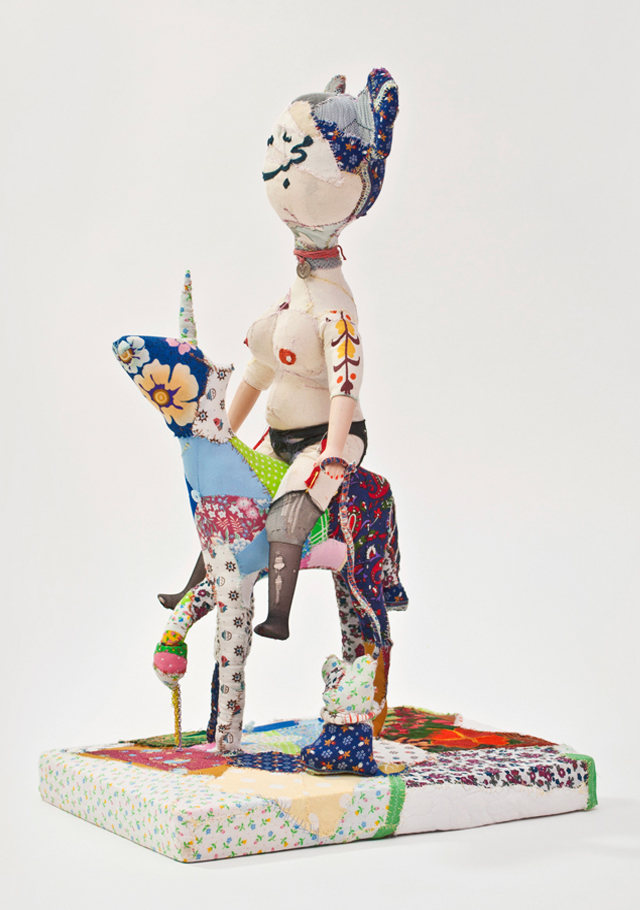
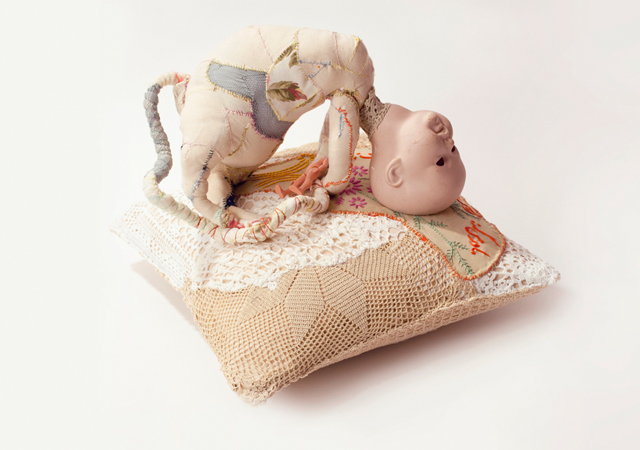
The Mistress, her Baby and the Ejaculating Unicorn 2014 | 41 x 64 x 30 cm | Wood, found Objects, Recycled textiles, Pre- owned Toy parts, Fibre Stuffing *Farsi text Translation: Affection (front), And the rest of the stories (back)

The Mistress, her Baby and the Ejaculating Unicorn
2014 | 41 x 64 x 30 cm | Wood, found Objects, Recycled textiles, Pre- owned Toy parts, Fibre Stuffing
*Farsi text Translation: Affection (front), And the rest of the stories (back)

Briefly describe the work you do.

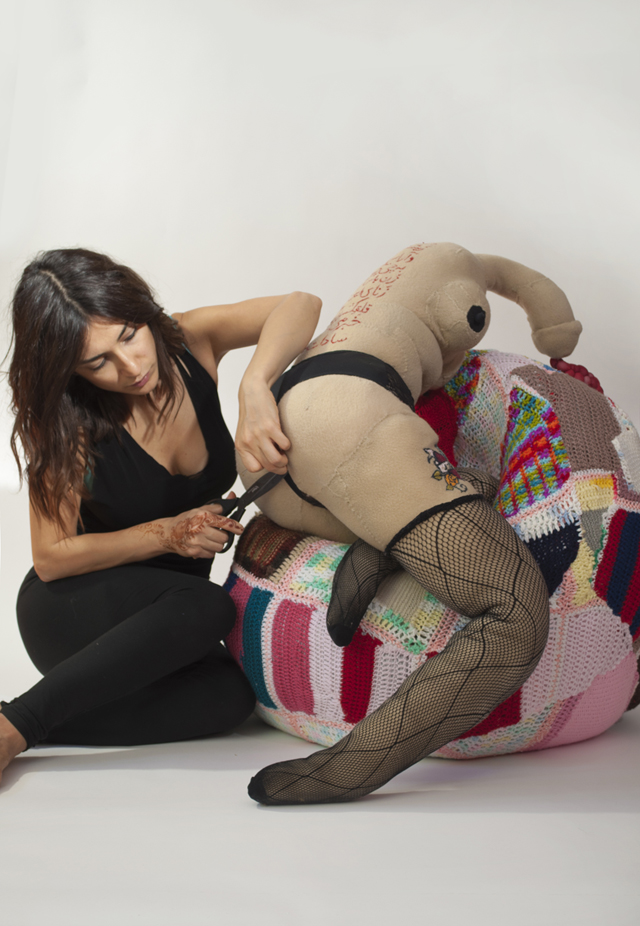
I make mixed media figurative sculptures using upcycled textiles, old furniture and used clothing. I generally hand-sew my work without the use of adhesives or other tools. Most of the time I find myself gravitating towards life-size pieces.

Tell us a little about your background and how that influences you as an artist.

I grew up in Tehran, where I did my BFA in painting as well as an MA in animation. I moved to Canada in 2008 to begin my MFA. Although I mainly consider myself a painter, although, I have worked equally with various other media, such as video, photography, and installation art. I have recently started working with textile, which is a completely new medium for me. I didn’t have any background in sewing, but I’m learning as I go. I generally don’t start my work with a sketch or a plan. I have a rough image in my mind and I just go for it. I drift toward what’s calling me from inside. I think it’s a healthy process.

Being a woman shapes a lot of my curiosities and inspirations. I’m infatuated with women, their bodies and their visual qualities. My work is in a way a longing for intimacy. I like to show the desires of the body being exposed. I want to focus on the oddness of the body, with all its dysfunctions.

Overall, I can say the human body, and more specifically the female body, are my main artistic stimulants.

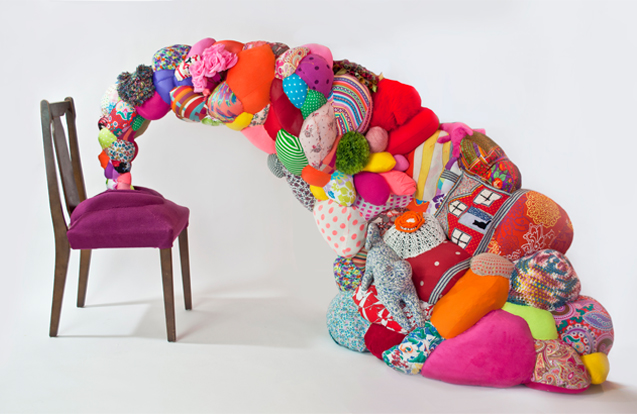
Vaginal Rapture 2014 | 222 x 116 x 118 cm | Old Furniture, Recycled clothes, Fibre Stuffing

Vaginal Rapture
2014 | 222 x 116 x 118 cm | Old Furniture, Recycled clothes, Fibre Stuffing

The concept of the “artist studio” has a broad range of meanings, especially in contemporary practice. The idea of the artist toiling away alone in a room may not necessarily reflect what many artists do from day to day anymore. Describe your studio practice and how it differs from (or is the same as) traditional notions of “being in the studio.”

I live and work in the same space. It’s really difficult for me to separate them, both conceptually and physically. Un-attaching my art from where my food and clothes are, always feels unnatural to me. I think my art is an extension of my personal life. I know a lot of artist peers work much better with the forced discipline that comes with a divided studio. But that really just drags me out of my element. Besides, the nature of my work is in some ways very domestic. Patching and stitching are folk practices traditionally performed by women in the comfort of their living space, which I consider quite therapeutic as well.

What unique roles do you see yourself as the artist playing that you may not have envisioned yourself in when you first started making art?

The role of being an “artist” is unique in itself. Artists play this role very differently depending how comfortable they are with themselves or depending on the level of their career. I often find the ‘role’ of networking and self-marketing irritating in some ways. When this happens naturally, it’s great; but often artists have to actively engage and promote themselves socially if they want to keep up with the game. I find myself playing this role or game too sometimes, which is, frankly, very odd for me.

When do you find is the best time of day to make art? Do you have time set aside every day, every week or do you just work whenever you can? 

I am quite sharp and open-minded in the mornings. Normally after doing my daily online duties (!) I get right at it. But I mostly just try to go with the flow. I tend to have a rough schedule in mind of how much time I’d like to spend on making each day, and then work towards that throughout the day. I definitely sleep better when I achieve my target.

Revolving Birth 2014 | 38 x 32 x 40 cm | Recycled Fabrics /Crochet, Old doll parts, Fiber Stuffing *Farsi text translation: " My mother says, women in our family give super-easy birth"

Revolving Birth
2014 | 38 x 32 x 40 cm | Recycled Fabrics /Crochet, Old doll parts, Fiber Stuffing *Farsi text translation: ” My mother says, women in our family give super-easy birth”

How has your work changed in the last five years? How is it the same?

I like to think that I have evolved both artistically and personally in the past five years. I think as an artist you should always search for new means and media through which to express. I have experimented with various techniques and avenues in the past few years, but I find my new sculpture series “soft soul” to be closer to my heart than anything I have done in recent years. Regardless of all that, my interests and concerns remain similar. My art has almost continually been about opposites: hard vs. soft, perfect vs. imperfect. The human body has remained my context, whether I use it in video, painting or textile.

Are there people such as family, friends, writers, philosophers or even pop icons that have had an impact on the work you do?

Absolutely. People are my greatest artistic inspiration. I ask non-artist friends for their opinions on my work constantly. I think they can be the most reliable critiques. Great minds have always intellectually aroused me. I think a major portion of the consciousness of a visual artist is shaped by what they read, listen to, or watch. These days I really enjoy a good fiction. Decent stories provoke imagination in me the most.

If you had an occupation outside of being an artist, what would that be and why?

I like psychology. I care about people a lot. I am intrigued by their weaknesses, their challenges, and their sadness. I can definitely relate to all of that. Although I know to be functional as a psychologist, you need to be permeable and let other people’s problems just go through you, and I may be the opposite of that. I usually keep all that in.

About

Hoda Zarbaf was born in Tehran, where she completed her BFA in painting. She moved to Canada in 2008 to start an MFA at University of Windsor. Throughout her creative career – as an artist dwelling in diverse places – she has formed a peculiar language of affection alongside solitude. She is infatuated with bodily exposures and displays. Her work has steadily been a display of social, emotional, and gender dualities.

Hoda uses pre-owned clothing, upcycled everyday fabrics, and old furniture to make her fantastical figurative sculptures. Collecting the abandoned clothes, which have been intimately in touch with anonymous humans’ bodies, and uniting them artistically in her work, is Hoda’s struggle to reconnect with the past and yearning for a missing intimacy.

Hoda AZrbaf in her studio

Hoda AZrbaf in her studio

 www.hodazarbaf.com

All images copyright of the artist and used with their permission.  

Posted in Fiber Art, Sculpture | Tagged , , , , | 1 Comment

Carlo Fantin – Oakland, California

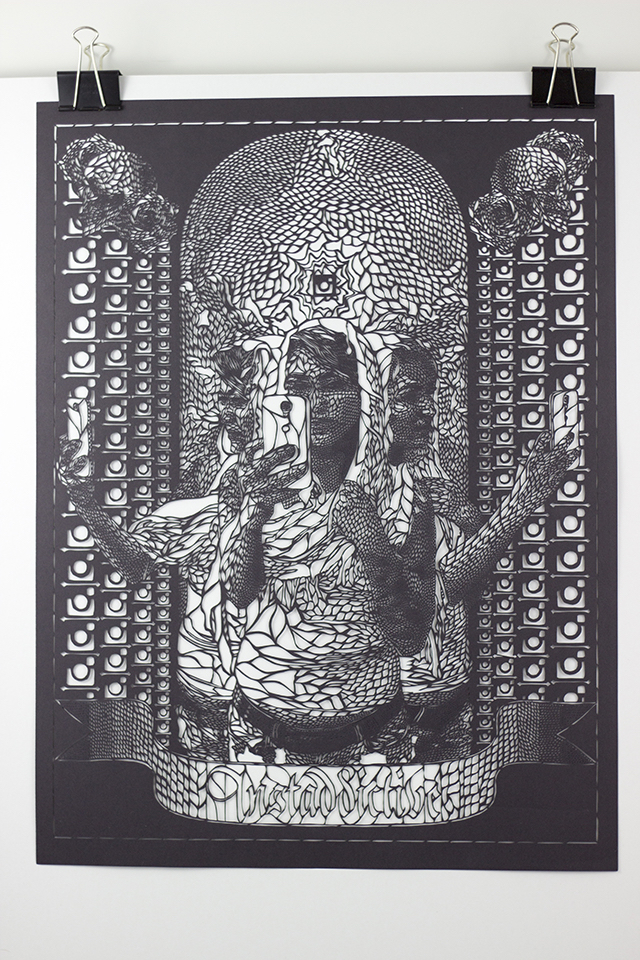
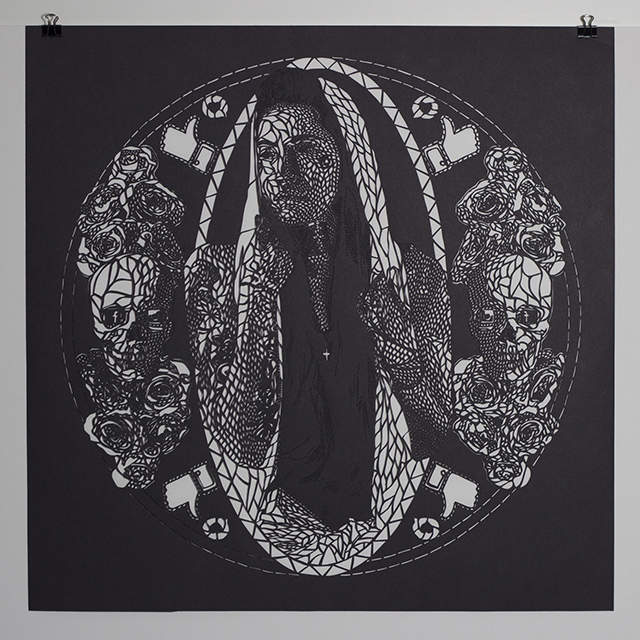
Instaddictive, hand cut paper, 27_x20_,2014

Instaddictive, hand cut paper,   27″ x 20″ ,2014

Briefly describe the work you do.

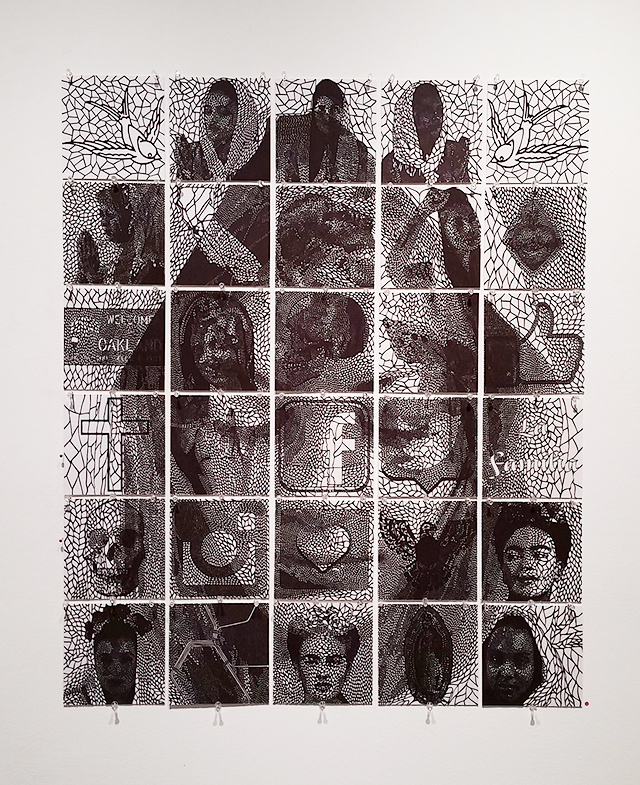
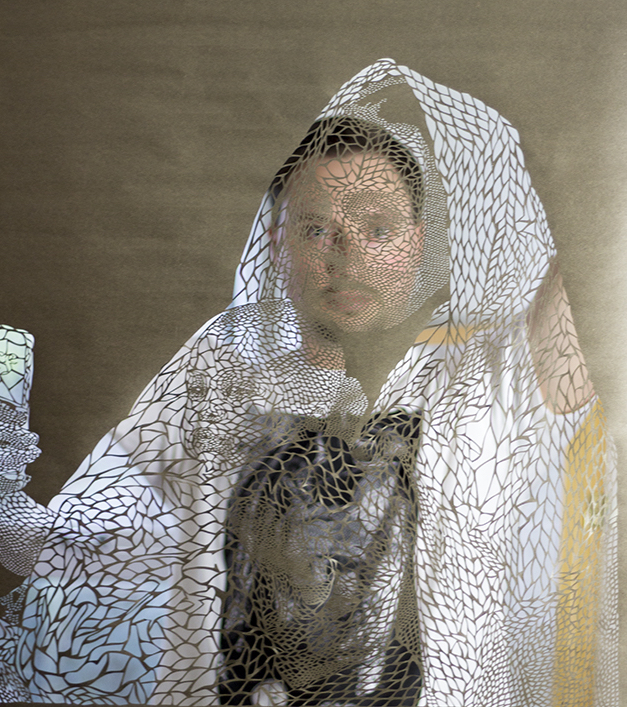
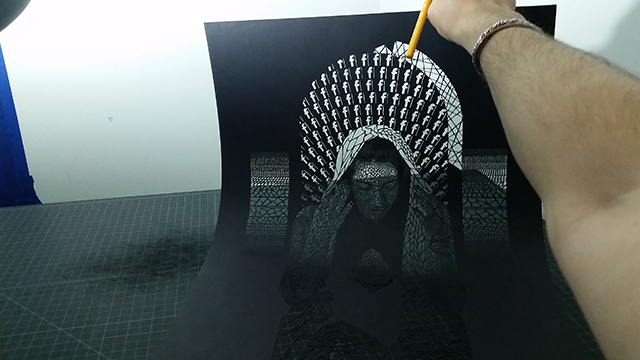
I hand-cut portraits out of black construction paper. In my art, I depict saint-like figures surrounded by Catholic iconography and popular media symbols, blending internet culture and religious worship. I manipulate negative space by cutting the paper into a net of squares that vary in size to reveal the form like a re-imagined stained-glass window design.

Tell us a little about your background and how that influences you as an artist.

I grew up in Venice, Italy and lived there for most of my life. My first encounter with art was at early age, when my mother would take me to church. I would lose myself looking at the depictions of icons, saints and demons. I have always loved the simplicity of the design and correlation between symbolism and inner-meaning. My approach to art making is similar, as I represent figures in classic poses and everything within the image has a symbolic meaning.

Collective Imagery, hand cut paper, 37.5"  x 31" ,2014

Collective Imagery, hand cut paper, 37.5″ x 31″ ,2014

The concept of the “artist studio” has a broad range of meanings, especially in contemporary practice. The idea of the artist toiling away alone in a room may not necessarily reflect what many artists do from day to day anymore. Describe your studio practice and how it differs from (or is the same as) traditional notions of “being in the studio.”

I feel very lucky because my studio is in my house and I can be there whenever I have time, at any time of the day and night. My studio work consist of photo-shooting and editing, sketching and hand cutting, experimenting with new materials and new techniques.

What unique roles do you see yourself as the artist playing that you may not have envisioned yourself in when you first started making art?

The role of Sales Agent/Marketing. I always thought that being an artist was about making art, 100 percent of the time. Today the business of art is not just relegated to making it but it includes promoting it, marketing it, and selling it. 

When do you find is the best time of day to make art? Do you have time set aside every day, every week or do you just work whenever you can?

I find myself being more productive when I work in the morning. I, for now, set aside two days a week where I work all day in the studio, but it never seems to be enough time to accomplish everything. Many times when getting ready for a show or a commission work, I end up working weekends and nights. I do research and work on the computer whenever I can fit it in to my schedule so that I am prepared for my dedicated studio time.

(work2) Maria de las Cholas, hand cut paper, 20_x20_,2014

Maria de las Cholas, hand cut paper, 20″ x 20″ ,2014

How has your work changed in the last five years? How is it the same?

My work has evolved from simple and classic portraiture to more elaborate use of symbolisms with much richer inner meaning. A constant in my work is the representation of the human figure.

Are there people such as family, friends, writers, philosophers or even pop icons that have had an impact on the work you do?

My wife has been my biggest supporter, harshest critic, favorite muse and biggest source of inspiration. I probably would have never pursued art if it wasn’t for her encouragement.  

If you had an occupation outside of being an artist, what would that be and why.

I would be making furniture. I earned a certificate in woodworking some time ago because I have always been fascinated with designing furniture and working with wood. I see furniture design as a functional type of art.

About

headshot 2After artistic explorations in drawing, sculpting, ceramics, and painting, I began experimenting with the art of paper cutting. While paper — a common and easy to relate to material — is often used as a medium to present literary works, I attempt to use it to show my subjects and their stories. Each of my pieces is hand cut, using a craft knife from one layer of construction paper. 

The composition in my pieces is inspired by the Roman Catholic iconographic tradition. Growing up in Italy, my earliest memories of art were of the stained-glass windows and paintings of icons, saints and demons in Basilica di San Marco in Venice. I incorporate symbols from today’s culture along with Catholic images in my paper-cutting.

studio work

studio work

All images copyright of the artist and used with their permission.  

Posted in Cut Paper | Tagged , , , , | Leave a comment

Ralph Pàquin – Spartanburg, South Carolina

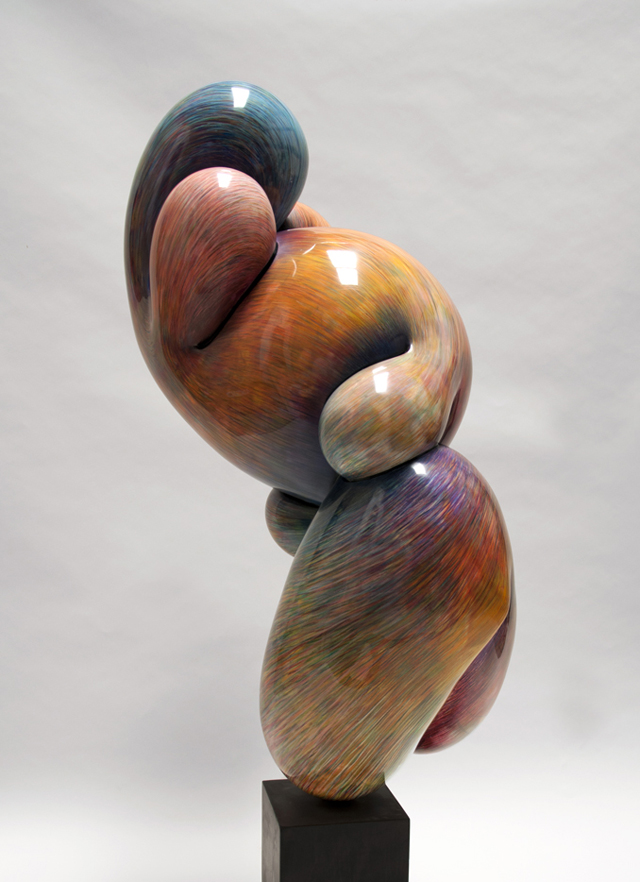
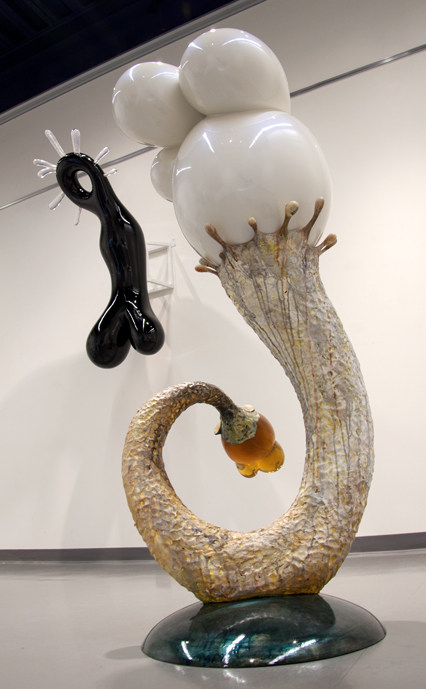
“Morpheus”, conte on cast polymer media, lacquer, 61”h x 24”w x 34”d, 2014.

“Morpheus”, conte on cast polymer media, lacquer, 61”h x 24”w x 34”d, 2014.

Briefly describe the work you do.

On and off for the past 30 years, I have been creating biomorphic forms.  For the past eight years, the driving force behind the sculptures has become more about the microscopic world of genetics.  They are invented forms of genes and chromosomes that are abstract, figurative and gender-ridden in a playful, but eloquent manor in a minimal and essential way.  They are bent, folded voluptuous forms full of life.  Some forms are inspired by fused multiple living things and then put onto a microscope slide.  Others are meant to bring together the primordial and futuristic.  The near perfect surface of most of the works in this series is intentional suggesting “otherworldly”.  The sculptures range in size a height of 24” all the way to over 9’.

Tell us a little about your background and how that influences you as an artist.

When I was young, I began copying illustrations from my Mother’s anatomy and biology textbooks.  I can still remember some of the grotesque pictures.  However, it was not until later that I became fully aware of how devastating and torturous diseases can be when I lost a family member to complications from a long battle with illness.  This tragic event had a tremendous effect on the always present; yet underlying core focus and transcendent nature of my artwork.  It was this exposure to the imperfect human body; disease, dysfunction, and witnessing the end of life that charted my artwork on a course consumed with what I refer to as “the human condition”.

I attended UMass Dartmouth for undergrad and received a BFA in Sculpture, and then attended Cranbrook for graduate school and received a MFA in Ceramics.  Fortunately, I was exposed to wonderful mentors and artists that broadened my artistic concepts and philosophies at both institutions.
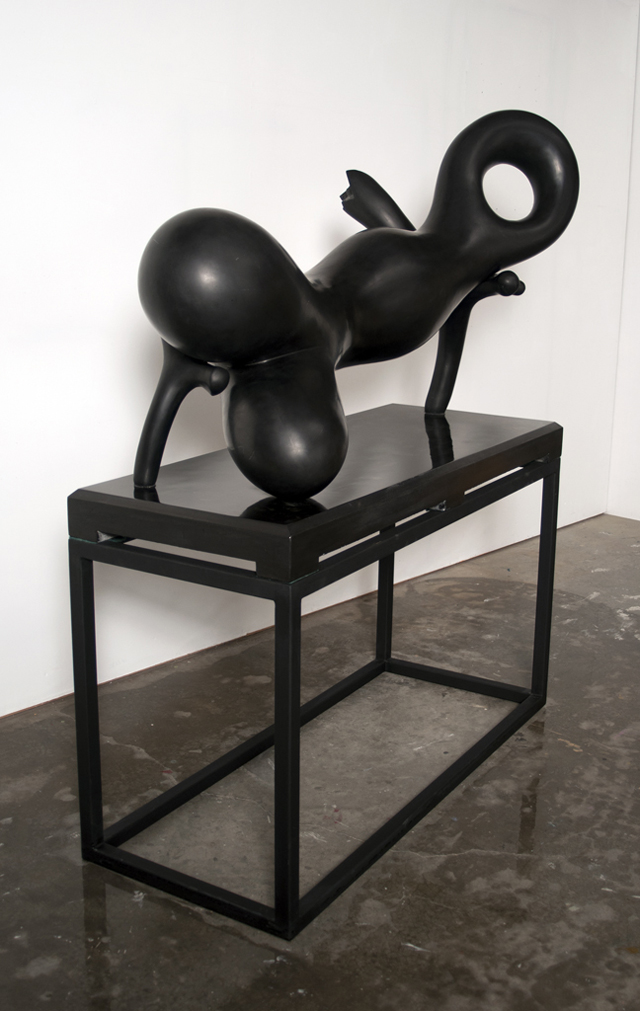
“Era End”, pigmented gypsum composite, polished polymer media, 70”h x 55”w x 22.5”d, 2012.

“Era End”, pigmented gypsum composite, polished polymer media, 70”h x 55”w x 22.5”d, 2012.

The concept of the “artist studio” has a broad range of meanings, especially in contemporary practice. The idea of the artist toiling away alone in a room may not necessarily reflect what many artists do from day to day anymore. Describe your studio practice and how it differs from (or is the same as) traditional notions of “being in the studio.”

True.  The life style of many artists and the notion of what it means to be “in studio” can be more of a state of mind/place; especially for those involved with digital processes.   For me, “studio practices” are those times when I am working at a foundry, a factory, a mold making facility, or even a workshop.  “In studio” can extend to the location of an installation in a museum, gallery or temporary site.  Whereas when I am “being in the studio”, I am in my environment, with my tools and many works in progress.  My studio environment creates an alchemy that has become an extension of all my art, labors and my brain.  I currently have works in progress at three different studio locations.  I have a couple rooms where I live to work on small projects and flat works.  It also serves as the studio office space.  The 4,000 s.f. main studio is located a few miles away from where I live.  The open floor plan and exterior concrete pad make this building ideal to do most of the mold making, casting, and the production of sculptures and large drawings.  The third location of my studio is where I teach.  It is one room studio area that I use to make small clay models in between classes or when I don’t have a meeting to attend.

What unique roles do you see yourself as the artist playing that you may not have envisioned yourself in when you first started making art?

Ever since I had a sandbox, I loved making stuff.  Early on we called it playing.  Right?  We all played.  Now as grown up artists we call it creativity, expression, inventing.  I like to call it “meaningful play”.  So play has turned into meaningful play and meaningful play has turned into meaningful slavery TO art.  I am now an art slave and there is no turning back.  It is how I developed and it will be how I pass.   The notion of seeing yourself as an artist is one I can’t fully comprehend… I still don’t know my exact role.  Sometimes I struggle and have to work for it, and sometimes I just see myself as a messenger in the form of an artist’s body.

When do you find is the best time of day to make art? Do you have time set aside every day, every week or do you just work whenever you can? 

I work on my artwork whenever I can.  Ideas, creative energies and general problem solving seem to come in the early mornings.  Although, creative energy comes any time, even in my dreams.  Afternoons and early evenings are usually times spent physically working on art.  Nighttime is usually used as a good time to gather research, purchase materials or take care of office matters.  I try to get to the studio early every day and can easily work all day if time allows.  I was recently on a 6 month sabbatical from teaching, which allowed me time to research and work in the studio nearly every single day.  Now that I’m back to the grind of a real workweek, I will get to the studio early before I have to be at work, and depending on the day and processes, I may return after work as well.
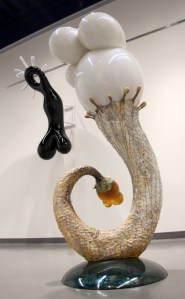
“Diva Code”, cast & polished polymer media, metal, resin, 73”h x 28”w x 28”d, 2013.

“Diva Code”, cast & polished polymer media, metal, resin, 73”h x 28”w x 28”d, 2013.

How has your work changed in the last five years? How is it the same?

The work expands and contracts.  It has evolved and changed as I have.  Technology is always evolving, therefore new concepts and considerations are added into the mix, but the fundamental baseline of my artwork, which I refer to as “the human condition” has not changed.  I suppose the most notable change in my work has been a change in media.  Ten years ago, as propane and natural gas prices continued to rise I was priced out of my familiar ceramic medium.  The forms that I am called to make are more natural for me to make out of malleable materials and processes that can give way to permanent organic forms.  So it took me two years of research and drawing to discover the full potential of polymer technology as I began to make and cast from molds.  I have continued to work figuratively, but my focus has become on a more molecular level; yet, still large-scale.  I still single handedly make every piece of my work.

Are there people such as family, friends, writers, philosophers or even pop icons that have had an impact on the work you do?

Of course!  While at Cranbrook I was fortunate to have the guidance and mentorship of world-renowned ceramic artist Jun Kaneko.  Essence and eloquence also became key factors driving my sculptures as I paid attention to what other artists like Henry Moore, Tony Cragg, Louise Bourgeois, Kiki Smith, and Isamu Noguchi were making and what mediums they used for creating their artworks.  As these masters influenced my concepts of creation, the significance of material usage and message became evermore important and personal in my works.  Early on, I read and was heavily influenced by Jean Tinguely’s writings on kinetic art.  It made me become serious and organized about creating and exhibiting experimental performance installations and for a period of 8 years I had collaborative shows throughout the country.  

I am also addicted to documentaries that enlighten me about issues such as faith and science or astronomy.  Basically, I am a vacuum for any information pertaining to the birth of mankind.  Music and composed sounds are other big inspirations for me.  I am always listening to music, and the combinations of sounds in the music allow me to visualize forms and landscapes in my head.  I feel that the frequency of sounds, heard and unheard, are a contributing factor to the making and origin of all organic matter.

If you had an occupation outside of being an artist, what would that be and why?

It is hard to think outside of THAT box.  The wild story of Charlie and the Chocolate Factory comes to mind.  Perhaps I’d be the owner, inventor, and worker for a “Factory for Man”.  A factory that makes things that remind all human beings to feel how related we are to each other.  However, I suppose I would have to invent, own, and work at the “Factory for Unman” so that there would be some degree of balance and the universe could remain intact.

About

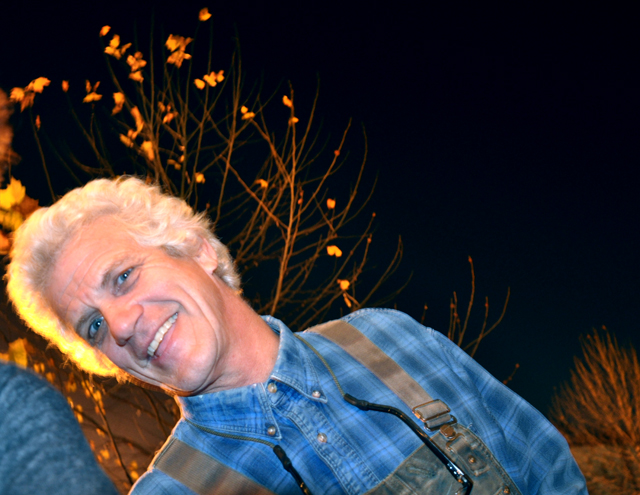
Paquin_Ralph_headshotRalph Pàquin was born in Newport, Rhode Island, in 1954. During his adolescence, he studied with craftsmen and artists in California, Nebraska, Virginia, Florida and Rhode Island. He received a BFA in Sculpture at the University of Massachusetts at Dartmouth, where he studied under New York painter, Edward Togneri; Italian sculptor, Dominick Angelo; and Chicago ceramic artist, Harvey Goldman. In 1980, he attended Cranbrook Academy of Art to study and work with world-renowned ceramic artist Jun Kaneko and sculptor Michael Hall. After Cranbrook, Pàquin shifted into large-scale artworks conceptually based on “the human condition”. In the following years, Pàquin held residences and teaching positions at MIT, Ohio State University, Furman University and Presbyterian College, where he currently teaches.

From 1984–2004, Pàquin’s ceramic art shifted from object to multi-media installation/performance using mechanical objects, sound, and light. For the next eight years, he collaborated on large-scale installation projects with artist Ann Stoddard at a number of venues including MIT, MediaLab, and Artist’s Space Gallery in NYC. Following the decline of NEA and other public funding sources, Pàquin left the collaborations and returned to creating large-scale ceramic sculpture. During the next ten years, he dedicated most of his studio practice to making the figurative ceramic works titled “The Distraught Series.” The series attracted the attention of New York City art critic, Donald Kuspit, who visited Paquin’s studio to write about his artwork.

The 2003-04 escalation in prices for natural gas, materials and shipping costs resulted in a major change of media choices for producing sculpture. Researching new media and processes, Pàquin’s sculpture and works on paper moved dramatically toward anthropomorphically reduced forms and shapes. This new body of over-simplified artwork consisting of sculptures and drawing continues to evolve into “essential forms” fueled by the science of genetics.

Pàquin currently maintains a 3000 square foot sculpture and drawing studio in Spartanburg, South Carolina, where he lives.
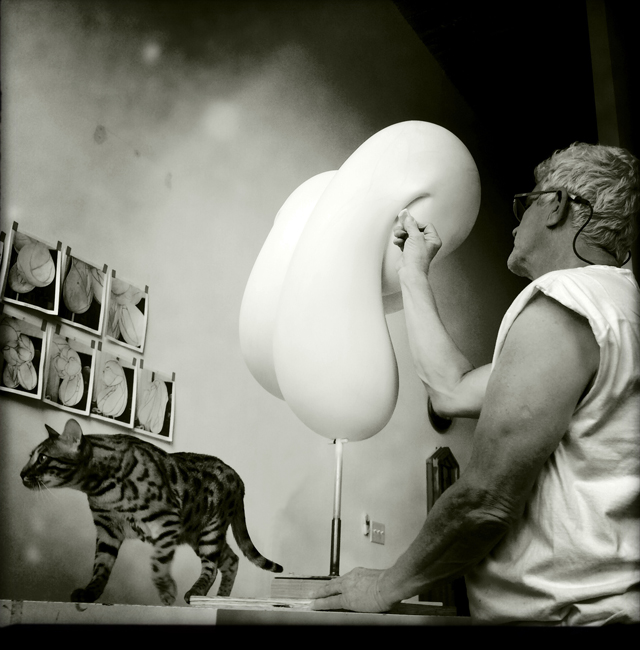
In the Studio

In the Studio

www.ralphpaquin.com

www.facebook.com/rpaquinart

All images copyright of the artist and used with their permission.  

Posted in Sculpture | Tagged , , , , | Leave a comment

Kaitlin Botts – Raleigh, North Carolina

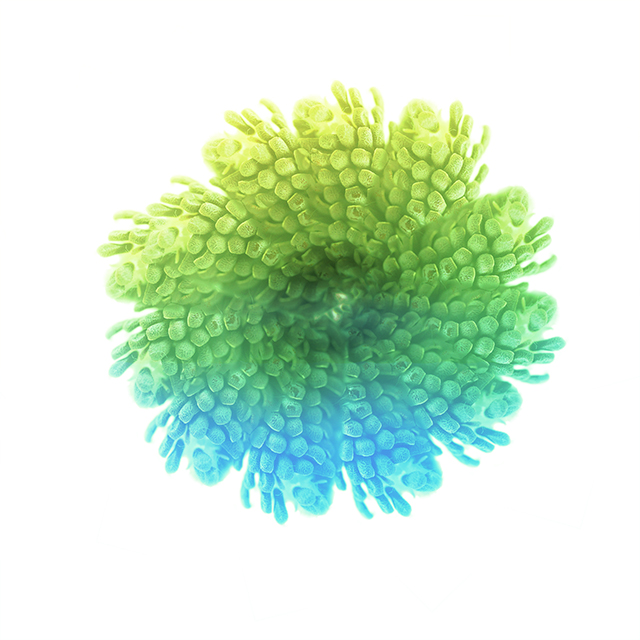
Untitled Botanical #44, All the Shine, Archival Inkjet Print, 35in x 35in, 2014

Untitled Botanical #44, All the Shine, Archival Inkjet Print, 35in x 35in, 2014

Briefly describe the work you do.

I am a graphic designer, a photographer, an artist, and a writer. None of these dilenations stay neatly contained within their own category, instead my work in one area bleeds into another. My design work balances the beauty of white space with the excitement of color and typefaces, sometimes veering off into the fine art realm, subverting it’s intention to communicate. My photographic work focuses on representations of the botanical in unexpected forms that occasionally transform into graphic interpretations. My personal artwork does the same, blurring the lines between text and mage, making them into some unusual hybrid of the two, no clear line where one ends and one begins.

Tell us a little about your background and how that influences you as an artist.

Whenever I am posed this question I always think about my childhood. My mom is a graphic designer and my father is a photographer and educator. I grew up with a heightened awareness of art and design, my Sundays were spent going to museums in Washington, DC, our house was filled with art and photography books, strange plants, pieces of art, bones, smooth stones, found objects, my mom’s paintings. This background has influenced me strongly in the regard that I oftentimes am more interested in transgressing the lines between art and design, than following within the preconceptions that these fields entail. I am interested in where they overlap and blur. A lot of my work when I was younger literally collaged elements of design and photography together, now my work blurs the distinctions between the two through making design work that plays with intentionality and photographic work that becomes graphic representations. 

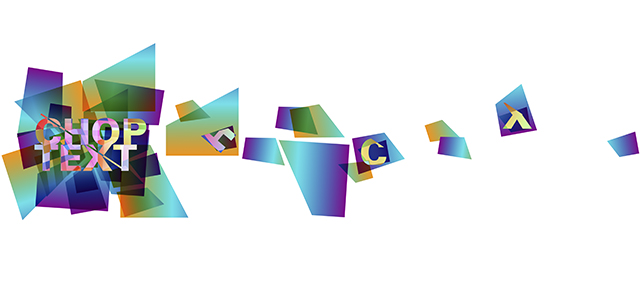
Choptext, Archival Inkjet Print, 44in x 12in, 2014

Choptext, Archival Inkjet Print, 44in x 12in, 2014

The concept of the “artist studio” has a broad range of meanings, especially in contemporary practice. The idea of the artist toiling away alone in a room may not necessarily reflect what many artists do from day to day anymore. Describe your studio practice and how it differs from (or is the same as) traditional notions of “being in the studio.”

My studio practice is mainly digital, which allows me to work wherever I can. My studio moves with me wherever I am, which I think is a unique way of working in today’s world. I am not attached to any specific place or setting, instead it is a malleable space that I create when I begin working. This can entail playing music, drinking tea, making lists on a pad of paper around me. I build my studio around me instead of being tied to a specific physical space.

What unique roles do you see yourself as the artist playing that you may not have envisioned yourself in when you first started making art?

I am a design educator, I teach at the college level at a small, liberal arts college. Although the role of educator is one that I anticipated when I decided to go into education, I didn’t realize how I would also continually be a student in my own classes. For example, each year I teach a 2D Design course. The semester I teach it, I see a recipricole relationship between the concepts I teach in class and the work I create during that semester. Even though I am teaching the most basic principles, I find that I learn them in different ways each semester, I find different, more complex ways of applying them, of considering them as an artist.

When do you find is the best time of day to make art? Do you have time set aside every day, every week or do you just work whenever you can? 

I work full time as an educator and I have a two-year-old daughter so I find every spare moment that I can to make art. I have always tended to work the best in the morning, I can’t work at night or when I’m overly tired. I find moments inbetween projects or when I have a lull in the classroom and can do some quick work in Photoshop or Illustrator. 

Untitled Botanical #71, All the Shine, Archival Inkjet Print, 35in x 35in, 2014

Untitled Botanical #71, All the Shine, Archival Inkjet Print, 35in x 35in, 2014

How has your work changed in the last five years? How is it the same?

This is a really interesting question for me because I’ve seen a significant change in my work just in the past year. The new work I’ve been engaged with focuses very specifically on color and form. Color is a whole new world for me at the moment,  I’m trying to surround myself with it as much as possible. I look for vibrant, intense color combinations and methods for applying color gradients and transitions. Previously, my work was very dark and muted, both literally and metaphorically. 

Are there people such as family, friends, writers, philosophers or even pop icons that have had an impact on the work you do?

Family has always had a huge impact on my work. So much so that I have created an entire photographic body of work that focuses on the concept of “home”. This summer I had a wonderful experience collaborating with my husband, who is a musician. I created a series of graphics for his songs simultaneously as he created the songs that the graphics were based on. As a song changed, the graphic would change. It was really exciting, refreshing work that paved the way for my current body of work, All the Shine

If you had an occupation outside of being an artist, what would that be and why?

I couldn’t be anything besides a creative, I’ve found that I really struggle with anything that doesn’t allow me to stretch myself creatively. 

About

Botts_headshotKaitlin Botts is a graphic designer, fine art photographer, arts educator, and mixed media artist working in northeast Georgia and Raleigh, NC. 

She holds a BA in Studio Art with a concentration in Graphic Design from Meredith College, Raleigh, NC and an MFA in Imaging Arts from the Rochester Institute of Technology, Rochester, NY. 

She has exhibited and published both nationally and internationally. Her fine art work focuses on the botanical realm as a space to manipulate and transform. She has given numerous lectures and workshops on both photography and graphic design. 

She is an Associate Professor of Art at Piedmont College in Demorest, Georgia. She is the coordinator of the graphic design and fine art photography programs. She has previously taught in the first year photography program in the School of Photographic Arts and Sciences at the Rochester Institute of Technology (RIT). In addition, she also taught in the School of Design and in the New Media program at RIT.

Botts_studio

All images copyright of the artist and used with their permission. 
 

Posted in Digital Media, Photography | Tagged , , , | Leave a comment

Leslie Robison – Saint Augustine, Florida

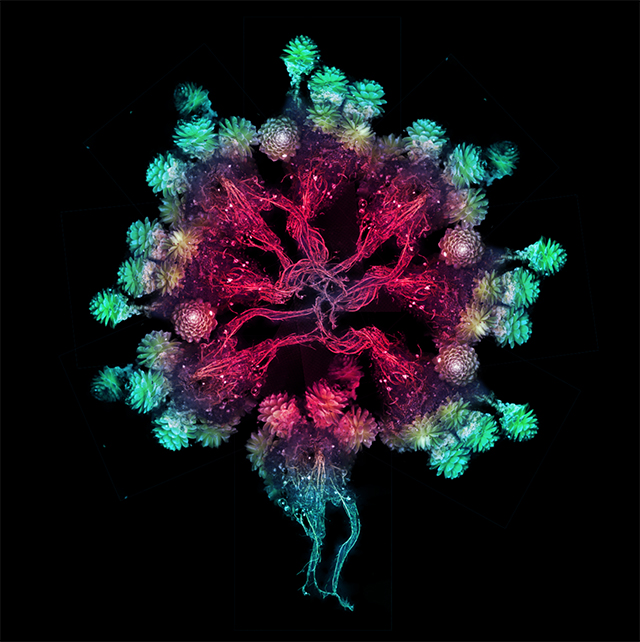
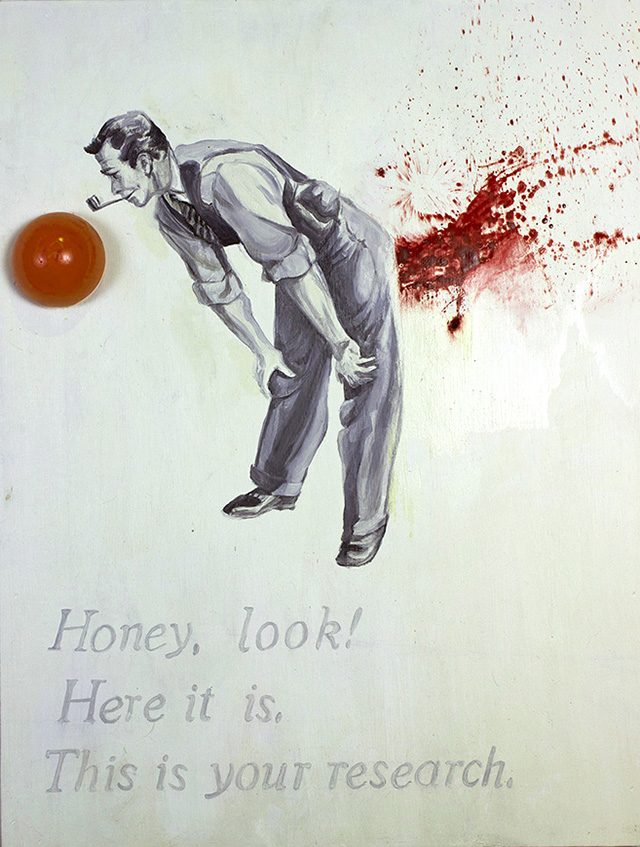
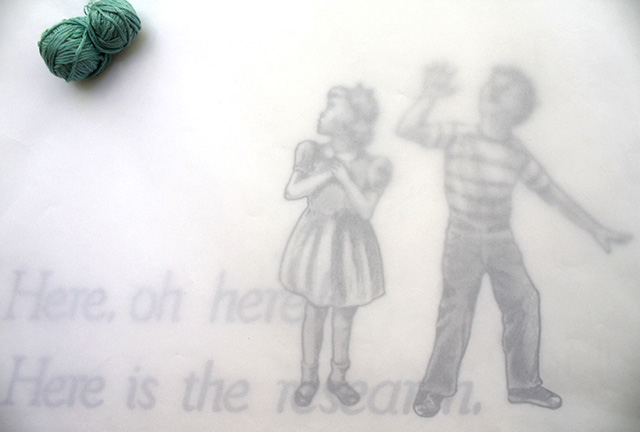
 Your Research, 2013     oil and plastic on wood             18” x 23 ¾”

Your Research, 2013
oil and plastic on wood
18” x 23 ¾”

Briefly describe the work you do.

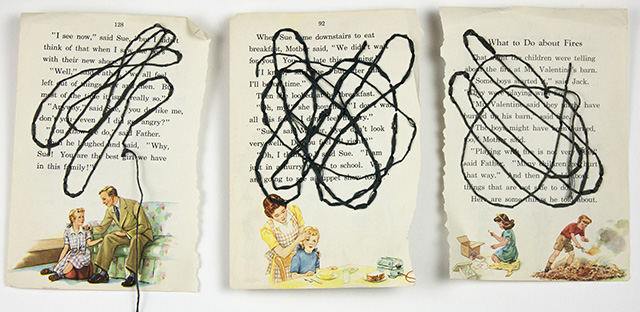
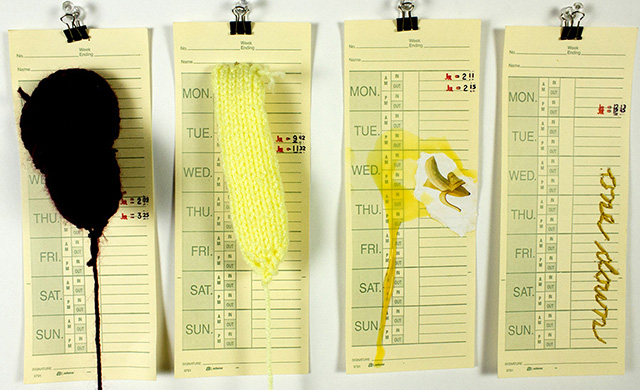
I use primarily mixed media drawing but also some painting, video, and still photography as a means to examine the framework that defines my identities as artist, academic, wife, mother, etc. I’m interested in how language and expectations, written or unwritten, guide behavior and performance in work.  As a result of this, I do some of my work by punching into a time clock I’ve installed in my studio, or labeling my drawings as “research.”  I also practice more traditional crafts like knitting.  In every drawing I execute, there is always some whole or partial breakdown of written language or figurative imagery, usually manifesting as scribbles, marks, or spills.  While these marks are part of the accepted language of art, they disrupt other types of discourse.
While I am partially using my current practice to defy institutional definitions about work, I am also trying to dismantle my own assumptions about how to behave.  As a good student, I never sat at the back of the classroom scribbling in my textbook.  The work I’m making now is reminiscent of those subtle forms of resistance.

 Book Scribble with Fire, 2014             embroidery thread and found textbook pages             each page measures 5 3/8” x 7 5/8”

Book Scribble with Fire, 2014
embroidery thread and found textbook pages
each page measures 5 3/8” x 7 5/8”

Tell us a little about your background and how that influences you as an artist.

My father was an academic and both of my parents encouraged each of their children to do something they loved. My husband was also supportive in that he moved with me across the U.S. for graduate school and my current teaching position.  While these things encouraged me to continue on the path toward becoming an artist, the forces that influence what I do as an artist have more to do with the politics of being an academic and the imbalances it often causes in my life as artist and family member.

The concept of the “artist studio” has a broad range of meanings, especially in contemporary practice. The idea of the artist toiling away alone in a room may not necessarily reflect what many artists do from day to day anymore. Describe your studio practice and how it differs from (or is the same as) traditional notions of “being in the studio.”

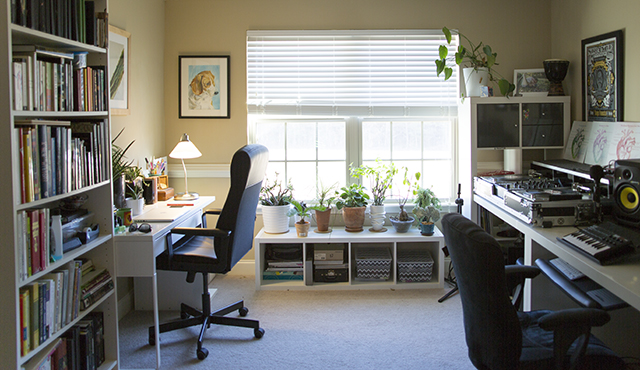
My studio space is in my own home and, over the years, it has doubled as a band room and storage space as well.  This limits what I can actually do in the space.  I’ll execute paintings or medium-sized drawings in there, but a lot of work is done elsewhere- I’ll punch a time card in the studio but then sit on my bed to draw on it, or I’ll do embroidery or knitting on my lap in front of the television with my kids.  Later, I’ll gather these bits and pieces together and spend time in the studio making connections and arrangements from them.  So my studio is larger than one room in that I work around the house, but it is also smaller in that I do not have a space that is exclusively dedicated to my practice.
This contrasts with how I work at school since I also work collaboratively with my students in socially engaged projects.  For this, we work out in the community so a youth detention center or a nursing home might be the physical space we inhabit and the “studio” is the time spent with its inhabitants.

What unique roles do you see yourself as the artist playing that you may not have envisioned yourself in when you first started making art?

I’m one of those people who always drew as a child and got attention for it, so for a long time craft, proficiency, and verisimilitude were my goals and seemed to be reason enough for making art.  I was an adult before I realized that artists are visual philosophers.  I mean, I thought that the pours and strokes on a Pollock canvas were beautiful and masterful and that their physical presence was the only thing that justified their existence.  It may sound silly now, but that late-blooming realization allowed me to question my own thinking and to take risks for the first time.  So, to answer the question, I guess I’d say that to act in the role of constant critic and philosopher, of the world and of myself, was not what I anticipated but it is thrilling and empowering at the same time.

When do you find is the best time of day to make art? Do you have time set aside every day, every week or do you just work whenever you can?

Mostly, I’d say I work whenever I can but that fluctuates over the course of the school year.  During summer and other vacations, I will spend some time every day making short trips into the studio, but I’m a night person, so the bulk of my activity happens late at night and into the early morning.  The piecemeal lap-work I described above is what I do most of the time during a semester, and that happens any time during the day that I can fit it in.

Banana, from the Time Cards Series, 2014             yarn, embroidery thread, wood glue, and found image on time cards

Banana, from the Time Cards Series, 2014
yarn, embroidery thread, wood glue, and found image on time cards

How has your work changed in the last five years? How is it the same?

Five years ago, I was making large-scale charcoal drawings from found photographs and experimenting with video.  I didn’t start truly examining the framework of my own life and making work about that until 2011.  But then I made a video about being in academia and the rest of my work changed, too.  The layered drawings with educational references started sometime after that and I bought a time clock and started punching in during the summer of 2012.

Are there people such as family, friends, writers, philosophers or even pop icons that have had an impact on the work you do?

There are so many people and writers I could name.  In trying to make this brief, I’ll just list three that immediately come to mind: reading Michel Foucault influences my outlook, collaborations with my colleague Laura Mongiovi influence my relationship with the materials I use, and the games and jokes between my son Otis and I continue to inspire the content of my work.

If you had an occupation outside of being an artist, what would that be and why?

That’s a dangerous question!  I foster dogs for a local rescue and there are plenty of times I’ve thought about packing up this whole life and trading it for a life of rescuing animals. But dogs don’t appreciate art, so I’d probably get resentful.

About

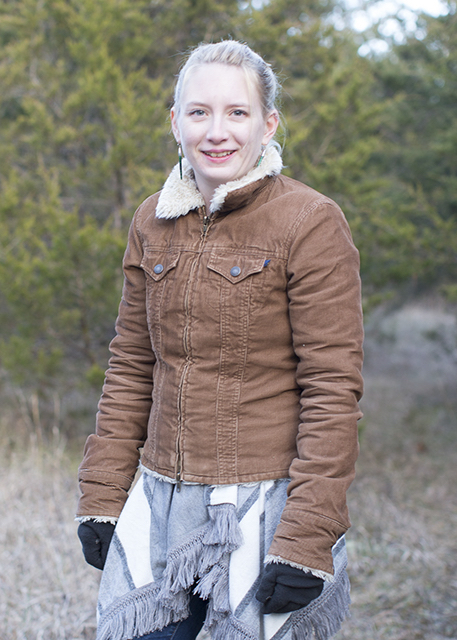
04_Robison_HeadshotLeslie Robison lives in St. Augustine, Florida where she serves as an Associate Professor and Chair of the Department of Art & Design at Flagler College.  She received her MFA from the University of Florida and her BFA from Washington State University.
Robison’s work has been featured in solo and group shows throughout Florida.  Her drawings, paintings, and videos have also been included in national exhibitions as well as in Canada, and Europe.  A believer in collaborative experiences and social engagement, Robison has contributed to participatory initiatives in Atlanta and New York while also pursuing community-based projects with her students in St. Augustine.

Detail of  Research Drawing #4, 2011             Graphite and yarn on layered drafting vellum             19” x 25”

Detail of Research Drawing #4, 2011
Graphite and yarn on layered drafting vellum
19” x 25”

www.leslierobison.us

All images copyright of the artist and used with their permission. 
Posted in Drawing, mixed media, Painting | Tagged , , , , | Leave a comment

Derek Cote – Detroit, Michigan

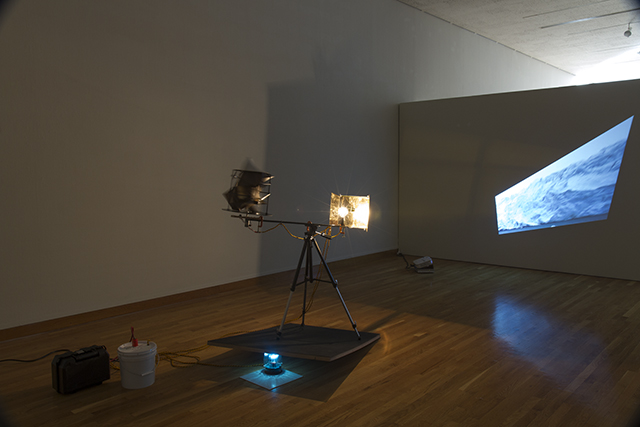
Terra Nullius, 2013 mixed media with HD video loop variable to 10ft high

Terra Nullius, 2013
mixed media with HD video loop
variable to 10ft high

Briefly describe the work you do.

My practice is interdisciplinary with an emphasis on installation with objects and video

Tell us a little about your background and how that influences you as an artist.

I grew up in Canada with parents that managed remote fishing lodges in the northern interior of British Columbia. Living in such isolated conditions afforded me a lot of freedom as a kid. Encountering a bear or falling through the ice on the lake was more of a concern than say kidnapping or being hit by a car. I later attended high school and college in Washington State where I continued to nurture a deep relationship with the outdoors – hiking, skiing, camping, etc. after getting my BFA I moved to Brooklyn at age twenty four and remember asking myself “How did I end up here?” It was a long way from where I came from. Seven years later I moved to Richmond, Virginia, to earn my MFA, then moved to Nashville, Tennessee. After spending over ten years in the south I realized how much I missed all things winter. I think that’s part of what ignited my interest in the Arctic – it was like going from one extreme to another. All this moving around has definitely seeped into the work I do. Most of my research revolves around place and identity.

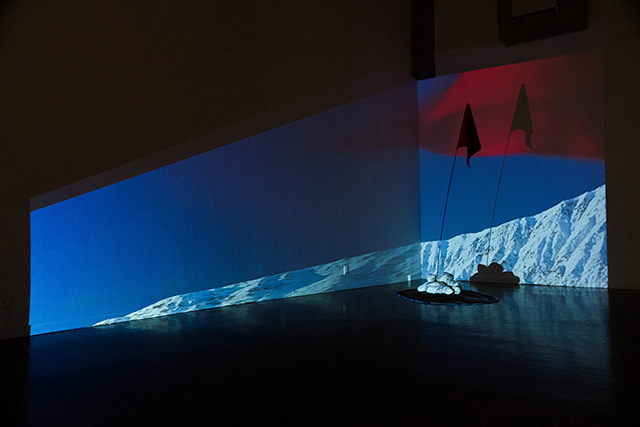
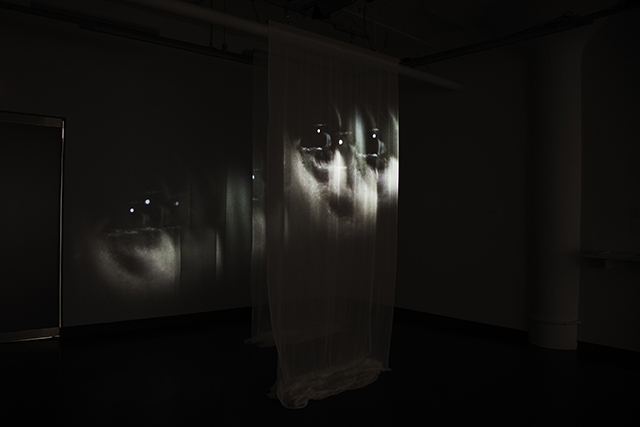
Liminal Observation System 1.0, 2013 mixed media with analog timer, DC motor, HD video projection variable to 40"high

Liminal Observation System 1.0, 2013
mixed media with analog timer, DC motor, HD video projection
variable to 40″high

The concept of the “artist studio” has a broad range of meanings, especially in contemporary practice. The idea of the artist toiling away alone in a room may not necessarily reflect what many artists do from day to day anymore. Describe your studio practice and how it differs from (or is the same as) traditional notions of “being in the studio.”

While I definitely spend time in the studio “toiling away,” it almost always follows a period of extended research. Lately that has meant expeditions to remote Arctic locations to investigate and explore topics place and identity as a function of socio/political transformation related to receding ice sheets. Earlier work was also about place and identity but in relation to past experiences based on memory – this was a lot easier and cheaper. Lately I have been planning elaborate (and expensive) expeditions to hard-to-reach places. I think this satisfies two different personalities within me – the kid that misses the freedom of exploring the woods and the artist who is interested in conceptually deconstructing the evolution of identity.

What unique roles do you see yourself as the artist playing that you may not have envisioned yourself in when you first started making art?

When I began making art I thought my audience was confined within the walls of the gallery. The goal was to make work and exhibit in a gallery, that’s it. I still want to exhibit the work I make, that’s how a dialogue is created. However, I think moving to New York demystified a lot of the process and helped clarify the reasons for making and showing art. As a sculptor it was a lot more difficult to get galleries to sign on. I once had a dealer ask me what sort of work I made and then proceeded with “Sculpture… that’s the hardest shit to sell”. That’s when my focus changed. I think my practice has also changed. I have learned how to sustain myself without relying on my work for income and compromising what I wanted to say with my work. This has freed my mind tremendously and has ironically led to some unorthodox opportunities. I think the role of the artist has changed in a lot of ways since I began making art. I always say that to do my work I need to be able to act – at least minimally – as anthropologist, sociologist, geographer, psychologist, scientist, fund raiser, lawyer and marketer. It’s the hardest job I’ve ever had and I’ve had some doozies over the years. 

When do you find is the best time of day to make art? Do you have time set aside every day, every week or do you just work whenever you can? 

I am more productive in the morning, before my mind gets too cluttered with daily responsibilities. And though I try to keep a regular schedule it usually falls apart. I’ve also worked through the night when necessary, which has a completely different dynamic. The night has an air of quiet solitude and I appreciate the way things sound at night – muffled and peaceful. I now have a three-year-old son and that adds a whole new layer of scheduling. In some ways this makes me even more focused when I am in the studio.

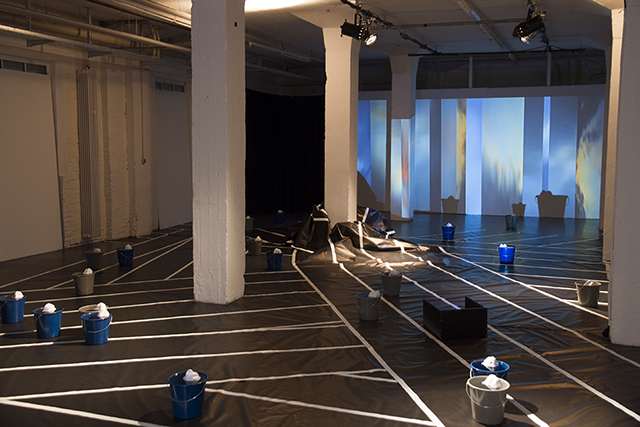
Float, 2014, thermoformed Styrene, buckets, water, paper, tape, HD video loop variable dims

Float, 2014,
thermoformed Styrene, buckets, water, paper, tape, HD video loop
variable dims

How has your work changed in the last five years? How is it the same?

My work seems to get larger, more ambitious and complicated as the years pass. I don’t know if this is due to increasing confidence, the desire to challenge myself or if it’s just a natural progression. I do tend to get bored with things quickly, which is probably why I never make the same thing twice. Once the problem is solved there’s no point in repeating it.

Are there people such as family, friends, writers, philosophers or even pop icons that have had an impact on the work you do?

I have my favorite artists who somehow excel at everything they do. But I wouldn’t say that I am influenced or inspired by any one person or icon. I really appreciate artists who have managed to build practices that evolve dynamically. These are the artists that remain relevant over decades.

If you had an occupation outside of being an artist, what would that be and why?

I’ve always been fascinated with early explorers who would travel for years, risking everything they had, including their lives, to be the first to see something. I like the idea of seeking places on the absolute fringe and finding out what is there. So if I had to blend adventure and enlightenment I would say perhaps an independent journalist/documentarian.

 About

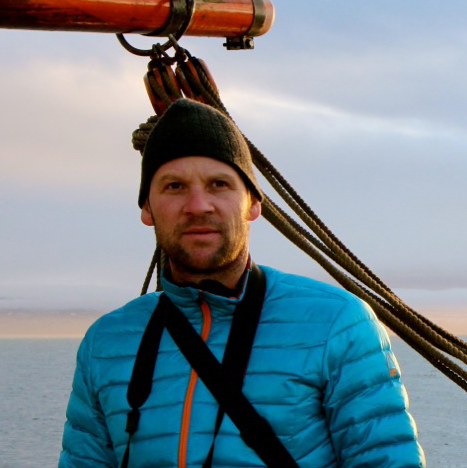
Cote_arctic2Québec, Canada. Lives in Detroit, MI.

As a frustrated architect, explorer, and aspiring social examiner, Derek Coté received his MFA in sculpture and extended media at Virginia Commonwealth University. He has exhibited nationally and internationally including exhibitions at the Brooklyn Museum of Art, Tacoma Art Museum, Art Museum of the University of Memphis, Houston Center for Photography, Exit Art, AC Institute and Roebling Hall in New York City, Marmara University in Istanbul, Marc DePuechredon Gallery in Basel and Kunsthaus Rhenania in Cologne. Coté has received a professional artist fellowship from the Virginia Museum of Fine Arts, research and support grants from the Canada Council for the Arts, the Pollock Krasner Foundation, the Adolph and Esther Gottlieb Foundation and the Foundation for Contemporary Art. Additionally Coté and has been a resident artist at the Bemis Center for Contemporary Art, The Arctic Circle expedition and the Anchorage Museum’s Polar Lab.

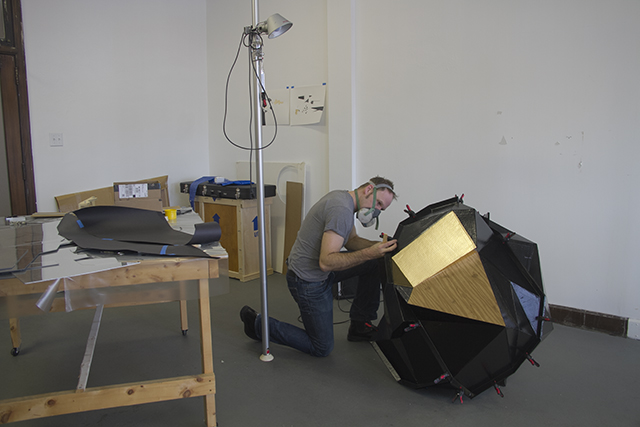
Cote_WorkInProgress

derekcote.com

All images copyright of the artist and used with their permission.  
Posted in Interdisciplinary | Tagged , , , , | 1 Comment

Katie Hovencamp – Bangor, Pennsylvania

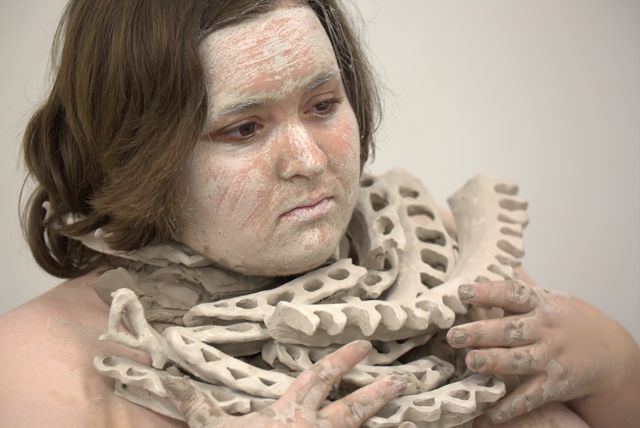
"Seize" Performance with clay, 2014. Photo credit Liz Arenberg Metcalf

“Seize” Performance with clay, 2014. Photo credit Liz Arenberg Metcalf

Briefly describe the work you do.

For some time fairy tales and fantasy have inspired my imagination and curiosity about their effects on women’s roles and the construction of their identities. In my work, I fracture cultural constructs such as gender, beauty, and the body politic to expose, examine, and critique their social and historical assumptions. To do this I work in mediums, such as performance, sculpture, video, drawing, and installation.

Tell us a little about your background and how that influences you as an artist.

I grew up in the Pocono Mountains of Pennsylvania and I went to private school for twelve years. During this time, I was expected to wear a uniform and we, the pupils were taught to be proper ladies and gentlemen. The idea of becoming a proper lady was instilled in me at a very early age, which meant being polished and very feminine. However, my parents didn’t subscribe to that mentality.. I grew up playing with Teenage Mutant Ninja Turtles alongside my dolls. The first Halloween costume I remember was an angel with an orange Michelangelo (the Teenage Mutant Ninja Turtle) mask. Looking back, moments like these taught me how to observe gender roles and what was associated with them. As I grew older I began to question the societal definitions of the female gender more. When I am in the studio I ask myself these questions. What makes a woman proper? How does this make them a better woman? How does one become a better woman? Is it by becoming more beautiful? What is beautiful?

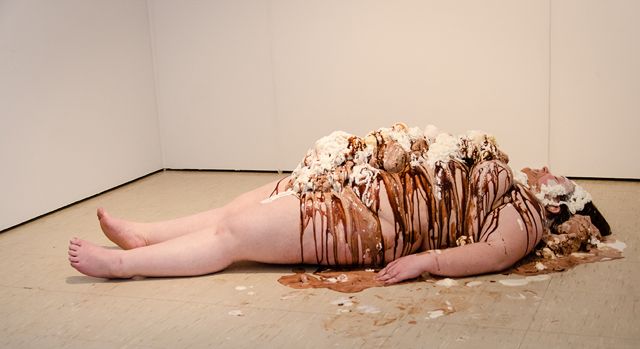
"Last Course" Performance with ice cream, 2014. Photo credit Anna Margush

“Last Course” Performance with ice cream, 2014. Photo credit Anna Margush

The concept of the “artist studio” has a broad range of meanings, especially in contemporary practice. The idea of the artist toiling away alone in a room may not necessarily reflect what many artists do from day to day anymore. Describe your studio practice and how it differs from (or is the same as) traditional notions of “being in the studio.”

 My process of creating art emerges from complex and contradictory circumstances, materials, and objects, and their multiple encounters. My live performances and sculptural works often lead to the creation of supplementary drawings, installations, and videos, to constitute a complex body of work. This method of working is one that doesn’t necessarily keep me in a physical studio. Aspects such as location and process dictate the way I work.

What unique roles do you see yourself as the artist playing that you may not have envisioned yourself in when you first started making art?

Many of the roles I play as an artist are ones that I didn’t expect to play. Initially, I was intrigued by process and the thrill of making drawings and objects. It wasn’t until I realized that my art could make a statement and promote change, I became open to accepting unacceptable roles of the past. This caused me to take on multiple roles in my work. The first is the role I play is an activist. I use my body to critique constructs of fantasy, beauty, body politics, and gender politics. Second, is the piece itself. A lot of my work involves performance and self portraiture which forces me to be removed from my own inhibitions and become a piece of living art.

When do you find is the best time of day to make art? Do you have time set aside every day, every week or do you just work whenever you can? 

I feel more productive working in the morning and I will work through until the evening. I feel that when I start working earlier in the day I am able to think more clearly. Presently, I work in my studio on Mondays, Wednesdays, Fridays and the weekend when I am not teaching.

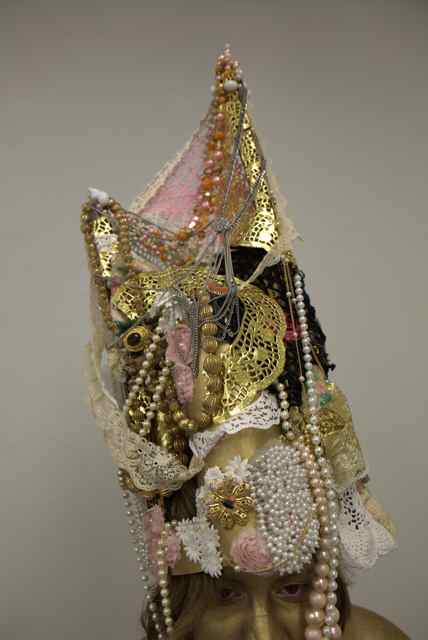
"Gilded" Performance with mixed media, 2014. Photo credit Liz Arenberg Metcalf

“Gilded” Performance with mixed media, 2014. Photo credit Liz Arenberg Metcalf

How has your work changed in the last five years? How is it the same?

Initially I was a 2D artist working in drawing and painting but when I found sculpture I became enamored with the idea of making tangible objects and creating experiential pieces. As the years progressed I began to introduce my body into my sculptural work until I eventually embraced performance as my primary way of working. Conceptually, I have always been interested in ideas of fantasy, gender, perceived beauty, and the body politic, but the method has definitely evolved.

Are there people such as family, friends, writers, philosophers or even pop icons that have had an impact on the work you do?

Writers like Carl Jung and Bruno Bettelheim who write about psychoanalysis in fairy tales have been a very big influence. The writings of Judith Butler questioning the gender binary and Peggy Phelan’s writing on performance art inspired my work. The people who had the biggest impact on the way I make my work are Angela Ellsworth from Arizona State University and Charles Garoian from Pennsylvania State University. Both Angela and Charles are performance artists who have very interdisciplinary studio practices and work in non-traditional ways. Angela taught me how to use the body as a material through endurance and action. She was also an inspiration because she has an ability to work seamlessly through various mediums such as performance, drawing, sculpture and video.  Charles also reinforced similar ideas, but would constantly ask me the question, “What is your work doing?” This question was always one that would make me stop and analyze what I was doing in the studio, and where I was going with the final piece. I would assess the process of making a piece and allow the action of making it influence the final outcome of my work. Charles’ question became one I constantly ask myself as I am producing my work and continues to influence the way I work today.

If you had an occupation outside of being an artist, what would that be and why?

I would be an anthropologist. I love to read about and research various cultures as well as their stories of folklore and fairy tales. I think having the ability to travel and study these things would be really fun to do, and it would add and enrich my life’s journey.

About

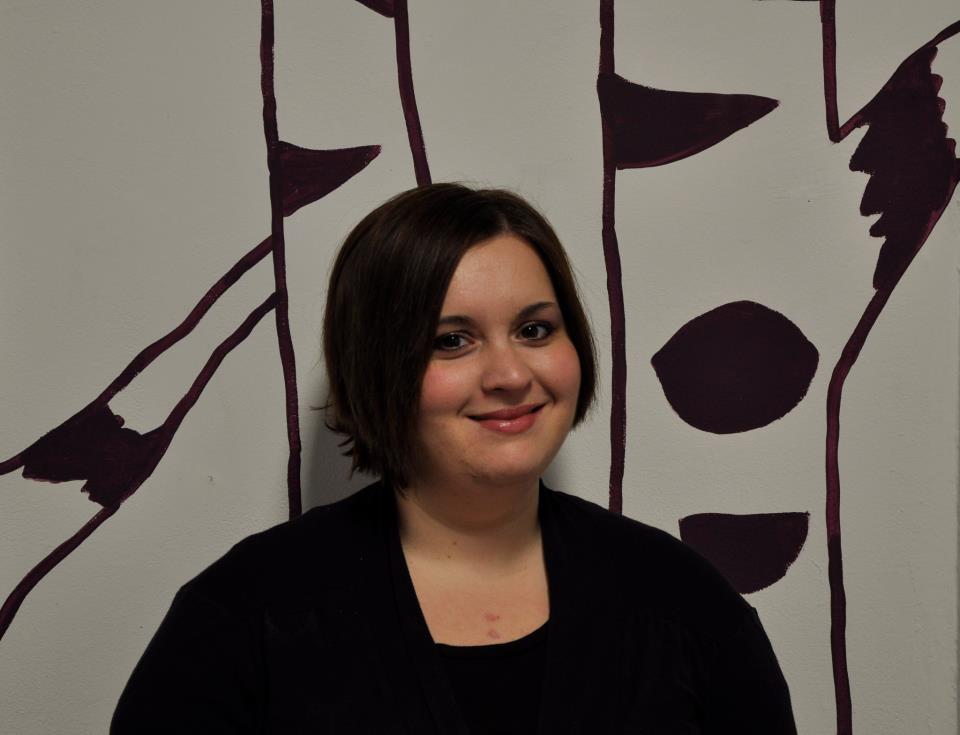
HeadshotKatie Hovencamp is an artist who fractures cultural constructs such as gender, beauty, and the body politic to expose, examine, and critique their social and historical assumptions. For some time fairy tales and fantasy have inspired her imagination and curiosity about their effects on women’s roles and the construction of their identities.

Hovencamp began her professional studies at the Baum School of Art in Allentown, PA and received her BFA from Arizona State University in 2009 and her MFA form the Pennsylvania State University in 2014. Hovencamp has exhibited her work in numerous exhibitions nationally and internationally. She was the recipient of Outstanding Student Achievement Award for Contemporary Sculpture for the International Sculpture Center in 2014 and the University Graduate Fellowship at the Pennsylvania State University in 2012. She has taught at various institutions such as the Edna Vihel Center for the Arts, Totts Gap Art Institute, Pennsylvania State University, and Harrisburg Area Community College.

"Gilded" Performance with mixed media, 2014. Photo credit Liz Arenberg Metcalf

“Gilded” Performance with mixed media, 2014. Photo credit Liz Arenberg Metcalf

katiehovencamp.com

All images copyright of the artist and used with their permission.  
Posted in Performance | Tagged , , , , | Leave a comment