Leslie Grossman – Davenport, Iowa

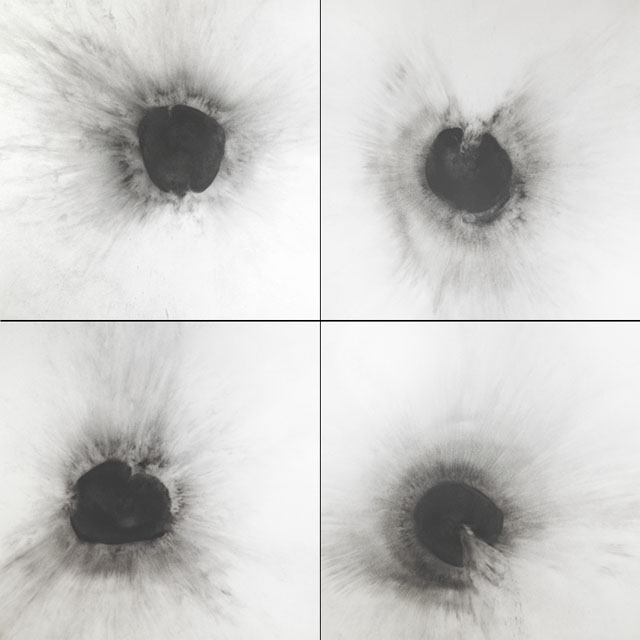
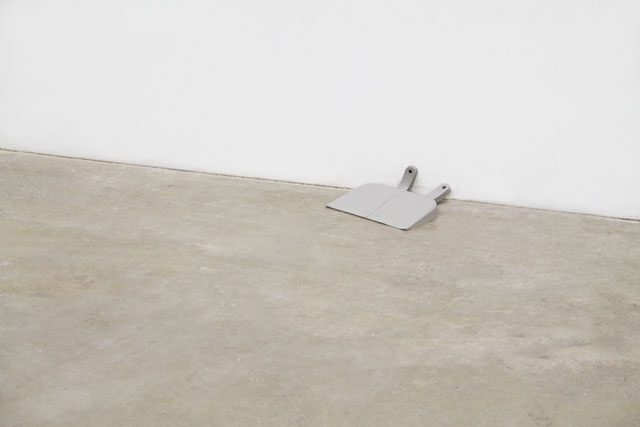
mpact(s),  2011-2012, air cannon, bike pump, graphite powder, and 16 graphite impact prints on BFK, prints 20"x20"

mpact(s), 2011-2012, air cannon, bike pump, graphite powder, and 16 graphite impact prints on BFK, prints 20″x20″

Briefly describe the work that you do.

I consider myself a printmaker, but more so in the unconventional and conceptual vein. I tend to focus on the process behind making multiples, history and documentation of the mark, and the ever-precious monotype.

At what point in your life did you decide to become an artist?

I think the answer to this question can be found here:leslieagrossman.com/1983

Tell us a little about your background and how that influences you as an artist.

In my 36 years in this body, I’ve lived in 6 states, 9 cities, and 27 different homes. Ever-shifting environments influences practically everything in my life – art-making, relationships with other humans, new routines, old routines, research, music, food, culture, etc. There are certain belongings of mine that have been packed and then unpacked practically every 16 months throughout my entire life. Those objects are the constants in my (unintentionally) fickle lifestyle. Finding (or creating) familiarity in unfamiliar settings influences me. 

What types of conceptual concerns are present in your work? How do those relate to the specific process(es) or media you use?

Time, history, environment, process, The Multiple, The Original, and The Variable are all pertinent concepts. I try not to limit myself to any particular medium… I suppose time is the most prevalent medium in my work, whether it be that the time it took to create something is recorded and documented to become part of the final piece(s), or labor intensive mark-making is apparent, or there is evidence of erasure or erasability.

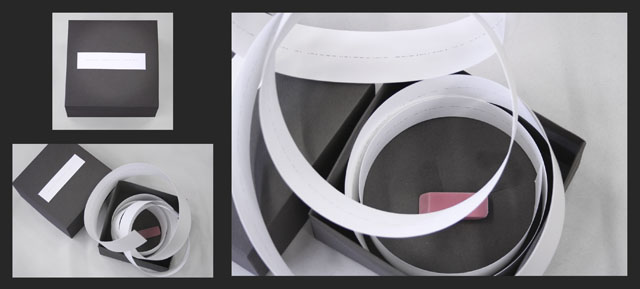
Line for Line (Gertrude Stein's "A Long Dress" remediated), 2011, graphite on 2" x 110" BFK, handmade box, and eraser

Line for Line (Gertrude Stein’s “A Long Dress” remediated), 2011, graphite on 2″ x 110″ BFK, handmade box, and eraser

We once heard Chuck Close say he did not believe in being inspired, rather in working hard everyday. What motivates you in your studio practice?

I thrive in communal studios. Working around other artists is inspirational to me… I don’t succumb to distractions as easily, ideas can bounce around the room, and collaborations can magically form. Yeah, I love an open studio and look forward to sharing workspace with other artists again soon! 

What artists living or non-living influence your work?

Robert Rauschenberg, Rube Goldberg, Agnes Denes, Fischli & Weiss, Paul Kammerer, Gaston Bachelard, David Byrne, The Oulipo Poets, Daniel Buren, Pee Wee Herman.

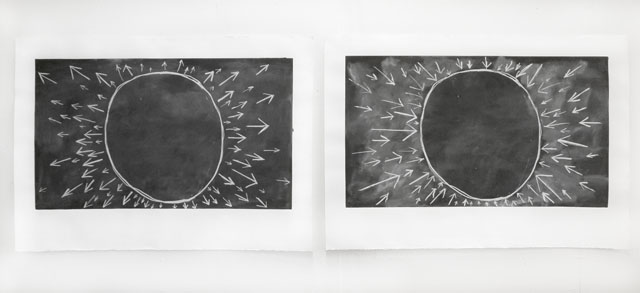
 A Lesson in Most Everything (Steps 1 and 2), 2012, serigraph on BFK, 42"x60" each

A Lesson in Most Everything (Steps 1 and 2), 2012, serigraph on BFK, 42″x60″ each

When you are not making art what types of activities and interests do you engage in? 

Well, I’m a gallery director/curator and an instructor of studio art. So when I’m not making art, I’m reading about it, writing about it, promoting it, hanging it, teaching it, etc. However, at home I absolutely LOVE to cook – creating my own bizarre (and sometimes bastardized) vegan versions of dishes I’ve had at restaurants. 

About 

GrossmanHeadshotLeslie A. Grossman was born and raised in Midwest America. She received her Printmaking BFA from Western Michigan University in 2008 and her MFA in Printmaking from The University of Tennessee-Knoxville in 2012. For over 3 years, she was a curator and member of Exquisite Corpse Artist Collective and Gallery in Kalamazoo, MI, which she co-founded in 2005. After moving to Knoxville, she remained active in curatorial practices as the Associate Director and Director of UTK’s Gallery 1010. Leslie has exhibited her work nationally and internationally at such venues as International Print Center New York in New York City; Artlink in Ft. Wayne, IN; and Grafiki Warsztatowej in Poznan, Poland. Currently she resides in Davenport, IA as Gallery Director and Campus Curator at St. Ambrose University.

(detail), mpact(s),  2011-2012, air cannon, bike pump, graphite powder, and 16 graphite impact prints on BFK, prints 20"x20"

(detail), mpact(s), 2011-2012, air cannon, bike pump, graphite powder, and 16 graphite impact prints on BFK, prints 20″x20″

www.leslieagrossman.com

All images copyright of the artist and used with their permission. 

Posted in Uncategorized | Tagged , , , , | Leave a comment

Aaron Meyers – Austin, Texas

XO (2013), urethane rubber, 2.5" x 9" x 8.5"

XO (2013), urethane rubber, 2.5″ x 9″ x 8.5″

Briefly describe the work you do.

My current work is anything but novel; it is largely about our bodily experiences with things like buildings, furniture. and highway overpasses. The materials and forms are used in a matter of fact way but there is often also some material irony. I try to defamiliarize common structures by having the materials do unexpected things.
 
What is your backgound?
My previous study of mathematics strongly influences the way I think about and make artwork. Mathematics taught me to think rigorously and examine basic assumptions and it has informed my understanding of conceptual beauty. G.H. Hardy wrote that beautiful ideas are ones that are inevitable, unexpected and gracefully stated. Mathematicians use the word ‘deep’ to describe ideas that are profoundly connected to disparate topics. I find beauty in ingenuity, surprise, and precision and look for things with deep connections.
Triplets (2011), plywood, enamel, dimensions variable

Triplets (2011), plywood, enamel, dimensions variable

 
How do you differ from the old definition of a studio artist?
In my studio I have no set methodology or process. Most projects involve a new material, new tool, or new set of ideas. I get bored of things rather quickly, so I don’t spend as much time refining any particular process.
 
Smile (2012), cast concrete, rebar, handmade hardware, 12' x 14' x 18"

Smile (2012), cast concrete, rebar, handmade hardware, 12′ x 14′ x 18″

Are there people that have strongly interested you?

I can think of many teachers and friends whose interests and way of life I highly admire and have impacted me. I wont name anyone in particular because all of them are people whose humility and skepticism would make them embarrassed to be listed. In general I have been highly influenced by people with an extreme breath of esoteric interests. They are mostly cynical, but also believe in individuals ability to be moral and learn about the world.    
 
If you had an occupation outside of being an artists what would it be?
Right now I can’t image being anything but an artist because it allows me to be a dilettante in so many other things–engineering, architecture, design, philosophy, art history, science history, bike riding. 


About 

head shotAaron Meyers is an artist working in Austin, Texas. Born in 1988, he grew up in Pittsburgh Pennsylvania. In 2010 Meyers earned a  Bachelors of Science in Mathematics from Bucknell University. He is current an MFA candidate at the University of Texas at Austin.

Studio

Studio

www.aaronmeyers.us 

All images copyright of the artist and used with their permission. 

Posted in Uncategorized | Tagged , , , , | Leave a comment

Sara Risley – Milwaukee, Wisconsin

COLOR TREE, photography based digital image printed on acrylic painting on watercolor paper, 28x36, 2013

COLOR TREE, photography based digital image printed on acrylic painting on watercolor paper, 28×36, 2013

Briefly describe the work that you do.

I work abstractly.  Most of my work is photography based and digitally altered but I also paint.  My photography based digital images start with their source.  I photograph anything with lots of color and depth and some shape or line.  I use camera movement and lens zoom to blend the colors and create shape.  On the computer, I employ Photoshop as whimsy dictates.  My choices are deliberate, but the results are serendipitous. My paintings are very vivid in color and there is movement and energy in the brush strokes.  Like my photographic work, shape, line, and color are important.  Also like my photographic work, I use layering to create mystery and depth so that the completed images keep the viewer finding more the longer they peruse.  Lately I have been using my paintings as my photographic source material. I am working on a project that truly combines them both.  I lightly paint on watercolor paper.  I photograph that piece and digitally create an image that I print onto the painting.  I then photograph that combined piece to create something else.  

At what point in your life did you decide to become an artist?

I was always creative.  My mother had me make name cards for special meals or her bridge tallies when she hosted her bridge club.  In 1967, my mother took me to The Art Institute of Chicago to see a major retrospective exhibit of the work of Andrew Wyeth.  I was in awe.  I had no idea how he could paint like that!  I could feel the warm breeze blowing through the window in one painting WIND FROM THE SEA.  I knew the crunch of frozen grass as the boy ran down the hill in WINTER.  We bought a catalog and I spent hours and hours looking over it.  I knew I wanted to be an artist.  I started oil painting lessons with a friend of my mother’s.  From then on, some type of art was always part of my life.

2SWEET ENIGMA, photography based digital image, 18X36, 2014

SWEET ENIGMA, photography based digital image, 18X36, 2014

Tell us a little about your background and how that influences you as an artist.

I was raised in Elgin, Illinois, close enough to Chicago for the occasional cultural excursion, but far enough out to lead an idyllic small (ish) town life. Our family was rowdy and athletic and full of the love of fun, but we worked to earn that time. My parents, raised during the Depression, had always worked hard and expected that from us.  Because of that strong work ethic I had small jobs as early as 10 years old (babysitting) and all through high school and college.  The only thing I wanted to major in was art, but I lacked a strong basic background for the studio arts program and entered the photography and filmmaking program where drawing was not needed.  I loved taking pictures and wanted to work on my photographic art upon graduation.  I did a few art shows but felt the pull of my heritage.  I had to get a job and pay the bills for myself.  I was lucky to have spent most of my career working as a portrait photographer for a company that mostly admired and supported creativity.  When I retired at 56 years old, I got to live my dream of being an independent full-time artist.  I do wonder, at times, what my art would be like if I had concentrated on it as my life’s work, but looking back in regret is not a positive or productive thing to do, so I revel in the opportunity I have in the latter part of my life to be a working artist.  I try to bring the color and energy and life I lived as a child, and try to live today, to my photographic images and my paintings.

What types of conceptual concerns are present in your work? How do those relate to the specific process(es) or media you use?

I want there to be an order in the chaos of my compositions.  I can’t explain what makes one of my images or paintings work and others not work, but I do know when it is right or finished.

I want to feel immersed in color and I want my viewer to feel that as well.  I am contemplating an installation, which would fully allow the viewer to be inside one of my images.  

1DISCOVERY, photography based digital image, 24x24 , 2013

DISCOVERY, photography based digital image, 24×24 , 2013

We once heard Chuck Close say he did not believe in being inspired, rather in working hard everyday. What motivates you in your studio practice?

I guess I agree with that statement.  I just paint, once or twice or more a day.  Some days suck and I leave the studio.  Others, I stay forever. I can only get better if I do it constantly so I try to. It is a rare evening when I am not sitting with my laptop working on a photographic image.  I may keep the results.  I may hit delete, but I do the work.  When I found out my mother had been diagnosed with cancer, my creative work stopped.  I had a hard time even thinking about creating when someone so dear was dying.  After her death seven months later, I still wasn’t working.  My reiki master asked why I wasn’t working and insisted I needed to be.  As a creative person, he told me, it is imperative for your well-being.  He suggested I just sit down and do it-even if what I created was bad.  Just do it.  I did and was after a few weeks, back on track.  That was some of the best advice I was ever given.

What artists living or non-living influence your work?

Andrew Wyeth, obviously has influenced my life.  Though I do not and could not paint as he does, he is why I am an artist.  In college, I fell forever in love with modern art and most especially the abstract impressionists. I was surprised at how some of my photographic work recalls some of Gerhard Richter’s watercolors-especially since I had not been introduced to him until recently. Locally, painter Pamela Anderson encouraged me to get involved with the Milwaukee art scene.  Occasionally, a Beki Borman Lloyd horizon line will appear on my canvas or my screen or I hear Melissa Dorn Richards speak in my subconscious. And I am constantly inspired by the work ethic and incredible art of Daniel Fleming.

When you are not making art what types of activities and interests do you engage in? 

I volunteer at Literacy Services of Wisconsin tutoring adults trying to get their GEDs.  I also have volunteered for and followed drum and bugle corps for the past decade.  The movement and color are a constant inspiration-and source-for my photographic art.  I absolutely LOVE the movies and I read, mostly fiction, constantly. And I have a kick ass party in December called Sararizmas!

About 

10-Sara RisleyOnce Sara Risley wrangled the camera away from her avid amateur photographer dad at the age of ten, she rarely relinquished her hold on it. Her fascination with light and color led her to study photography at Southern Methodist University in Dallas, Texas.  Her experiments in long shutter speed photography and subject movement became too expensive with film and, having grown up with Depression era parents, she felt the strong responsibility to pay her own way.  She left the fine art world for a creative job in portrait photography.  During her 27-year portrait career, she constantly looked for the odd angle, dramatic lighting, or unique setting to create a more dynamic portrait.    With the advent of digital photography, the exploration she had begun post-college was renewed.  She currently lives in Milwaukee, Wisconsin and shows her work locally and has been part of juried shows in Missouri, Illinois, Minnesota and Florida.

In the Studio

In the Studio

www.sararisley.com

All images copyright of the artist and used with their permission. 

Posted in Uncategorized | Tagged , , , , | Leave a comment

Maria Lux – Champaign, Illinois

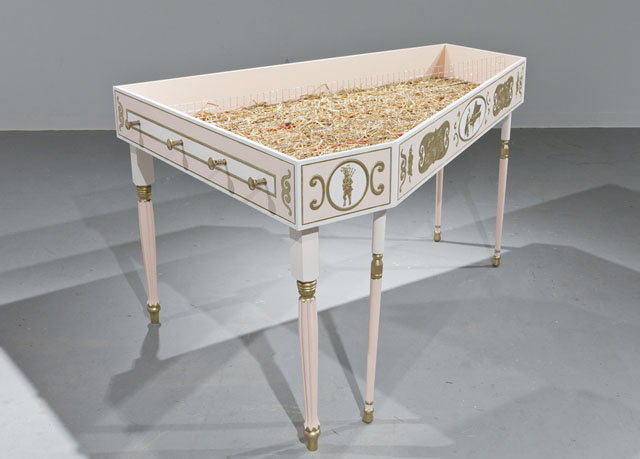
Pig Organ, 2011 Wood, metal, straw, music stand, hanging placard, wax heart (not pictured)

Pig Organ, 2011
Wood, metal, straw, music stand, hanging placard, wax heart (not pictured)

Briefly describe the work you do.

I make installation-based projects that use a variety of material approaches centering around animals. I consider myself part of larger work going on in many different disciplines that strives to take animals seriously as a subject and recognizes the many complicated ways animals figure into our understanding of the world. That means that at the heart of my work are questions about how we know what we know. I use installations because they allow me to put together a lot of intersecting objects, images, and texts in ways that I hope are generative. I choose materials and forms based on the content, though my training was originally in traditional oil painting and drawing. 

Tell us a little about your background and how that influences you as an artist.

The relevant background information, that is, the parts that most directly align with my work, are that I am a person who really likes learning new stuff, and likes to tell people about it. By the time I went to Iowa State University for my undergraduate degree, I had determined that my original plan of veterinary medicine wasn’t the right path because I just couldn’t get over enormous insects infesting animals, or certain kinds of lesions, and I didn’t want scrubbing for surgery to be my everyday life. I studied graphic design instead, probably because I admired the way designers communicated things in such complex yet paradoxically simple ways. Being a designer left a significant mark on what I do. And then partway through undergrad, I realized I just wanted to be really good at painting and drawing and I should at least get a second major in that. I was lucky to have a couple of colleagues who stood out as people that took art seriously, who believed it was indeed a job you could have. This was important because I think part of the reason I started down a path of graphic design was because nothing in my immediate life told me being an artist was a real option. I didn’t have many models for how to do that. But when I started to see artists who identified themselves as scholars—that made sense to me. I’ve always thought of myself as a learner, a student, and “scholar” and when I realized artists often see themselves and their work this way, it began to materialize as an option. I think the way all of that plays out in my practice is very evident.

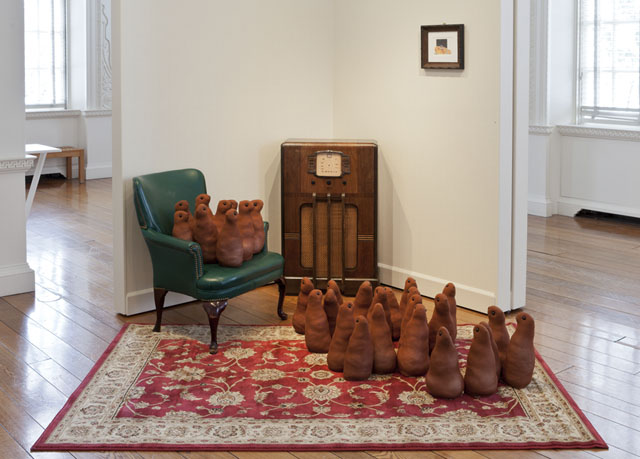
War of the Worlds , 2013 Stuffed fabric prairie dogs, buttons, rug, vintage 1930′s radio, collage

War of the Worlds , 2013
Stuffed fabric prairie dogs, buttons, rug, vintage 1930′s radio, collage

The concept of the “artist studio” has a broad range of meanings, especially in contemporary practice. The idea of the artist toiling away alone in a room may not necessarily reflect what many artists do from day to day anymore. Describe your studio practice and how it differs from (or is the same as) traditional notions of “being in the studio.”

Something I’ve noticed over the past two years is how much the social aspects of a shared studio environment are important to me. I strongly believe everyone’s work is better when they are surrounded with opportunities for regular, informal discussion about work. The energy and support that fellow artists provide is immeasurable. I currently have my studio in what should be the living room and bedroom of my apartment, and though the easy accessibility is great, I miss going to a separate place, saying hello to people in the hallway, and calling someone in whenever I feel like it to get a quick sense of feedback or even a hand with moving something. My current studio practice, then, is not ideal and it’s a good bit more lonely and self-involved than I’d like. Part of what I love about making art is that it provides me with avenues to connect with people – ways to talk with scholars, a mode of understanding other people’s work and life. And part of why I always wanted to make things and talk about them is that I find other people who make things and talk about them interesting. So an important part of my studio practice is the reading, asking questions, thinking, and writing, and then being willing to tell people what I think through my work and continue the conversation that way. 

Goat, 2012 Carved goat, glass taxidermy eyes, fabric gag, steel base (fabricated by Aaron Brunner), conceptual Drawing of Animal Conveyor System, 1987 by Temple Grandin (courtesy of the Krannert Art Museum, University of Illinois at Urbana-Champaign), fake security camera, wall text

Goat, 2012
Carved goat, glass taxidermy eyes, fabric gag, steel base (fabricated by Aaron Brunner), conceptual Drawing of Animal Conveyor System, 1987 by Temple Grandin (courtesy of the Krannert Art Museum, University of Illinois at Urbana-Champaign), fake security camera, wall text

What unique roles do you see yourself as the artist playing that you may not have envisioned yourself in when you first started making art?

I think because I am interested in professional conversations with people outside of art-making, I sometimes imagine myself as some kind of ambassador of art to other fields. I suppose I’ve always felt that way, and I think many artists do. Like if you’ve ever gone to an art museum with family and everyone wants you to explain why something is good because you’re an artist so you should know. I feel a certain responsibility to explain what we do, or at least what I do, in terms that respects our work without romanticizing it. When I go to academic conferences, its important to me to demonstrate that there are all ranges of art-making practices, and some are as rigorous and challenging as other academic disciplines, and others aren’t concerned with rigor. I guess I sometimes see myself as a translator between non-verbal, visual, expressive, or affective modes of knowing things and verbal, narrative, logic-based ways of knowing. And I’m not really even the best person to do that, but it’s something I’d like to be skilled at.

When do you find is the best time of day to make art? Do you have time set aside every day, every week or do you just work whenever you can? 

I should be honest and say that the time post-graduate school is challenging in terms of a studio routine. I’ve always just worked more or less every spare block of time I’ve had. Now those times are very fractured, because I have an average of 6 jobs at any given time (some of which are creative and productive, but nevertheless they present a challenge to my energy). To me, one of the best times to make things is when I feel totally overwhelmed by something else. Like when I was teaching – I loved it, but when you get done teaching you are anxious and overly critical about everything you just said and did, and for me, running to the studio was the best thing – distracting and involved and calming even when the work wasn’t “fun”. 

How has your work changed in the last five years? How is it the same?

The last 5 years included my time in graduate school at the University of Illinois at Urbana-Champaign, which means my work changed more than I can even fully appreciate. I think some of the same interests still underlie my work, but . . . when I started I was making modestly-sized paintings and chalk pastel drawings of stuffed animals. Like, bins of stuffed animals at IKEA. I actually still don’t hate that. I also used to do a lot of paintings of dogs at fairs and festivals, dogs swimming in pools. I had a feeling back then that here was something more critically interesting about dogs than was coming across in my dog paintings, but everyone read them as frivolous. I knew I wasn’t’ supposed to make art about dogs because that gets judged so quickly, but I never really shook the idea that dogs were actually important somehow. And then at the end of my second year of graduate school, I started reading a lot of animal cognition studies. It started with straight-up biology research, and then I realized there was an entire emerging discipline of people who use animals to understand the world, or who use theory to understand animals, or some messy combination of the two, and suddenly I had the critical structure from which to pursue work. This is in no small credit to the faculty at the U of I who saw the potential for criticality in my work and knew where to direct me. And it also grew from a lucky coincidence that an animal studies initiative was happening on campus that brought visiting scholars and offered an excellent special topics course. The content of the work deepened, broadened, and got richer for me at the same time as a major shift in materials and structure. 

Are there people such as family, friends, writers, philosophers or even pop icons that have had an impact on the work you do?

I was lucky to have an excellent cohort of fellow graduate students who were dedicated, critical, and invested in one another and their own progress, but not competitive or jealous. These people’s energy and direction, and their willingness to admit failures or doubts, helped to make art-making a dynamic, engaged practice for me that has everything to do with a shared community focused on success. It helped that my surroundings are people who are far less concerned the commercial or “art world” successes and more concerned with using art to satisfy their curiosity and engagement with the world.

It will probably sound cliché because David Foster Wallace influences so many people, but there is a lot about his voice and sense of humor and irony and observation that stands as an incredible example of what one might strive for. I’m talking in particular about his non-fiction. Creative non-fiction in general serves as a template for me in a lot of ways – its this method of learning about a subject, trying to teach someone else what you’ve learned, impressing that learning with your own voice and view, and still leaving room for other ideas to emerge from the mess of words and paragraphs. My art-making is an excuse for me to learn as much as I can about things, and then to translate or share that in the most interesting way I can.

If you had an occupation outside of being an artist, what would that be and why?

I feel lucky that being an artist basically lets me be all the other jobs I’d want. I could see myself being a scholar and teacher in an animal-studies related field, though I have a lot of academic-type training to catch up on since I didn’t do that sort of research as an undergrad or grad student. But I can be involved I those discussions as an artist, because thankfully the field seems generous and open and willing to listen to someone who’s forms of validation are very different than traditional forms of validating knowledge. I have a degree in graphic design and as much as I would not want to design for others full time, I get to be a designer constantly in my own studio practice. I am incredibly grateful for that training. I think I would also probably like to be a writer. My approach to writing (non-fiction) feels very similar to my approach to making visual work, so I think I would satisfy a lot of the things that art-making does for me. And I love teaching. I would most definitely teach. I’d teach something, and ideally, I’d teach art. 

About 

maria_lux_headshotMaria Lux holds an MFA in painting/sculpture from the University of Illinois at Urbana-Champaign and BFAs in graphic design and studio art from Iowa State University in Ames, Iowa. She currently lives and works in Champaign.

www.marialux.net

All images copyright of the artist and used with their permission. 

Posted in Uncategorized | Tagged , , , , | Leave a comment

Ashton Ludden – Knoxville, Tennessee

Briefly describe the work you do.

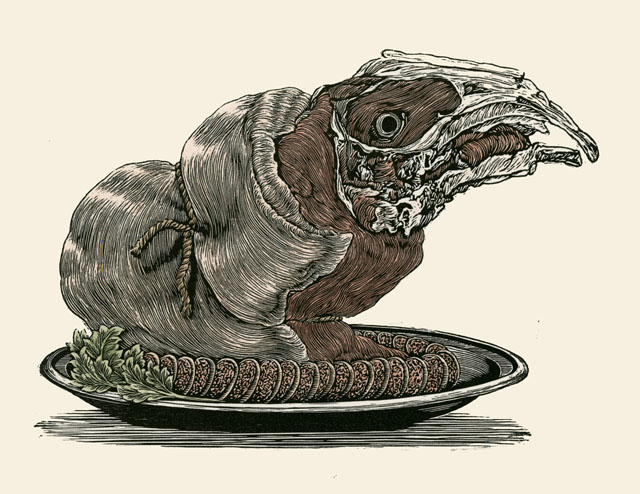
Braised Brisket Double-Chop Entrée (Olivia), wood engraving with hand coloring , 9” x 12” , 2013

Braised Brisket Double-Chop Entrée (Olivia),
wood engraving with hand coloring ,
9” x 12” ,
2013

My recent prints are primarily engravings augmented with labored aquatints and its imagery initiates a conversation about our relationship with animals. We assign roles and values to various species based on their function, visual appeal, convenience, or even on a trend. I am interested in how we morally justify – or have difficultly in justifying – these value placements. Most recently, my work has focused on the animals we eat versus the animals we love as companions. I created a hypothetical, utopian narrative based on a consumable pet animal product called, The Meatimal™ (Tender and Sweet, They’ll Lie At Your Feet, With Succulent Meat, It’s The Pet You Can Eat!); the premise of the Meatimal™ is imaginary and irrational in its justifications, and its absurdity points to our ethical contradictions regarding our relationships with animals.

As a printmaker specifically, I see parallels between the histories of printmaking and animal production in their mechanical and commercialized reproductive systems. These repetitive industries often desensitize the individuality of each product. Due to mass production, prints and animal commodities both struggle to be valued as a unique entity and to obtain an appreciative understanding from its viewers or consumers. I find it a fulfilling challenge to convey the individuality of mass produced animals in a medium that primarily functions in creating copies.

Tell us a little about your background and how that influences you as an artist.

Ever since I was a young child, I’ve wanted to be an artist and I remember thinking if I couldn’t do that, I wanted to a veterinarian. I have always been around animals. Growing up, we had dogs, cats, horses, and reptiles. Our neighbors raised buffalo while my other neighbor had chickens and a cow. When I was young I lived out in the rural landscape of Missouri and often played outside on our property, which exposed me to an array of wildlife. I constantly drew my pets or images from books and repeatedly watched movies like “The Last Unicorn,” “Milo and Otis,” or “The Lion King.” I grew up seeing our subordinate beings as an important aspect to this world and never quite understood why we (humans) occupy such an immensely higher status. Animals have always been prominent figures in my work.

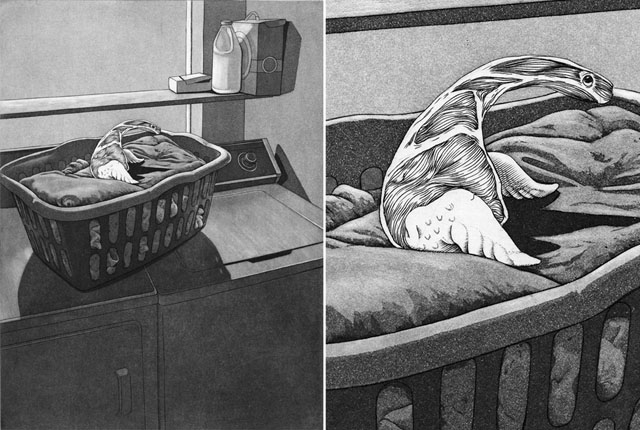
Fresh Laundry engraving, aquatint , 10.5” x 8” , 2013

Fresh Laundry engraving, aquatint ,
10.5” x 8” ,
2013

The concept of the “artist studio” has a broad range of meanings, especially in contemporary practice. The idea of the artist toiling away alone in a room may not necessarily reflect what many artists do from day to day anymore. Describe your studio practice and how it differs from (or is the same as) traditional notions of “being in the studio.”

I perform a lot of research for my work; reading books or talking with people primarily inspires me. Some examples of research I’ve done for my work are visiting butchers, acquiring access to slaughtering and rendering plants, studying pet stores or shelters, and taking subject-specific classes. During my graduate studies, I took a lot of classes in food science where I gained an in-depth knowledge of meat processing and manufacturing. I also was enrolled in an Ethics of Animal Agriculture class in the animal science department. These were highly influential to my work. Speaking directly to professionals in the fields I’m interested in often yield very visual narrative, which I then translate into my work. Otherwise, my studio practice in creating is similar to that of a traditional printmaker: I sketch out my ideas and compositions, recreate a finalized image on a plate, etch or engrave the plate, print, respond, adjust, then print a final edition. I enjoy being a printmaker because of its unique process of creating images; I never get bored.

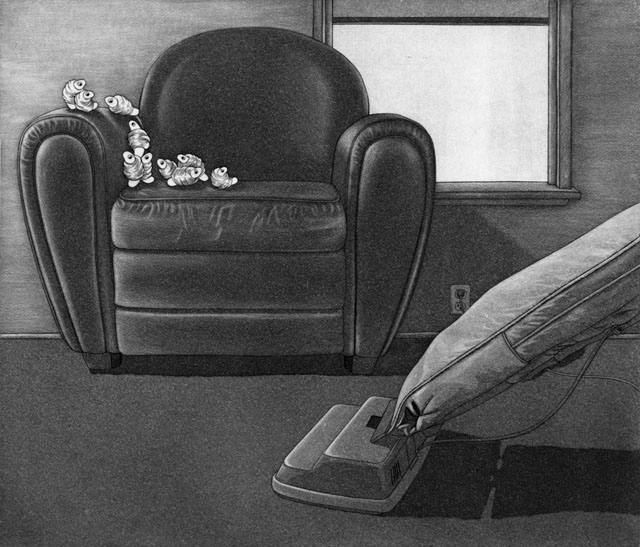
Clean Escape  Engraving, aquatint,  7.5” x 8.5” , 2013

Clean Escape
Engraving, aquatint,
7.5” x 8.5” ,
2013

What unique roles do you see yourself as the artist playing that you may not have envisioned yourself in when you first started making art?

Although I have always loved drawing and have been a draftsman at heart, I had
no idea I was going to be an engraver or a printmaker. In my undergraduate, I was introduced to engraving arts (focused on guns, jewelry, metals, and objects), which fortuitously introduced me to printmaking. I am very attracted to the unique linear quality of engraving that is unlike anything else and is so strongly related to drawing. The printmakers of the world are a small community, or at least smaller than that of painting or sculpture, and the engravers of the printmaking world are even smaller, so I feel unique in that regard.

When do you find is the best time of day to make art? Do you have time set aside every day, every week or do you just work whenever you can? 

I try to be in my studio as much as possible, especially if there are no lingering deadlines for other art-related agenda. If I have a completely free schedule, my day is spent in my studio and hiking with my dogs.

How has your work changed in the last five years? How is it the same?

Overall, my work has become quieter. I used to make statements in my work and have since decided, rather, to ask questions. The more I research, the more I find the issues in the human-animal relationship are much more complex than I initially thought. My work has stayed the same in regard to its focus on animals and has continued to have a strong linear quality.

Are there people such as family, friends, writers, philosophers or even pop icons that have had an impact on the work you do?

I admire artists such as Albrect Dürer, Francisco Goya, Edward Gorey, Jan Švankmajer, Noir Nouar, and Patricia Piccinini. Some influential essays/books are William Ivins’ “Prints and Visual Communication,” Dr. Hal Herzog’s “Some We Love, Some We Hate, 
Some We Eat: Why It’s So Hard to Think Straight About Animals,” Richard Sennett’s “The Craftsman,” and Jon Mooallem’s “Wild Ones: A Sometimes Dismaying, Weirdly Reassuring Story About Looking At People Looking At Animals In America.” Ultimately, my partner, my peers, fellow artists, and professors have always played a large role influencing my artistic practice.

If you had an occupation outside of being an artist, what would that be and why?

I would probably be a wildlife conservationist in order to aid those who cannot communicate or fight for their land and to educate to the public about the essentiality of maintaining our ecosystem.

About 

Ludden_Headshot_MONITORAshton Ludden is a meticulous printmaker and engraver. She received her MFA in Printmaking from the University of Tennessee in 2013 and her BFA in Engraving Arts and Printmaking from Emporia State University in 2009. Ludden’s works have been exhibited nationally and internationally as well as at conferences such as the 2012 Animals, Ethics & Law Symposium and the 2013 
International Veterinary Social Work Summit with keynote speakers Dr. Temple Grandin and Dr. Hal Herzog. She was an artist-in-residence at the Academy of Fine Arts in Wrocław, Poland in May 2012. Ludden was awarded the 2013 Frogman’s Graduate Scholarship Fellowship and the 2013 Emporia State University Liberal Arts & Sciences Outstanding Recent Graduate Award.

She is currently teaching print and book workshops at the Arrowmont School of Arts and Crafts and an intaglio workshop for Knoxville’s Community School of the Arts. She is an active artist member of the Vacuum Shop Studios Collective in Knoxville, TN.

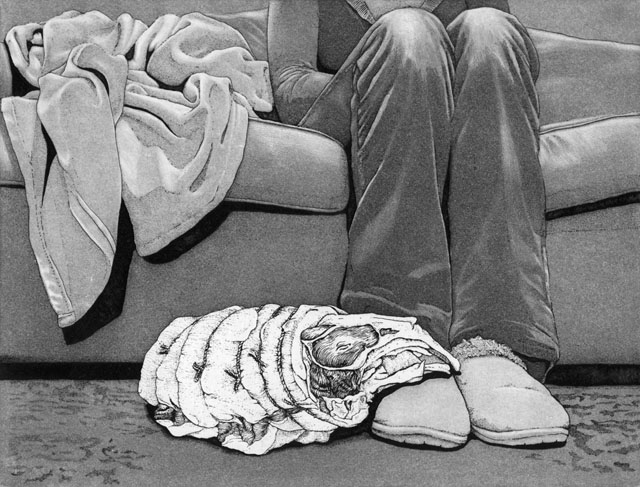
Slipper Snuggle  engraving, line etching, aquatint,  7” x 9” , 2013

Slipper Snuggle
engraving, line etching, aquatint,
7” x 9” ,
2013

www.ashtonludden.com

All images copyright of the artist and used with their permission. 

Posted in Uncategorized | Tagged , , , , | Leave a comment

Aaron North – Providence, Rhode Island

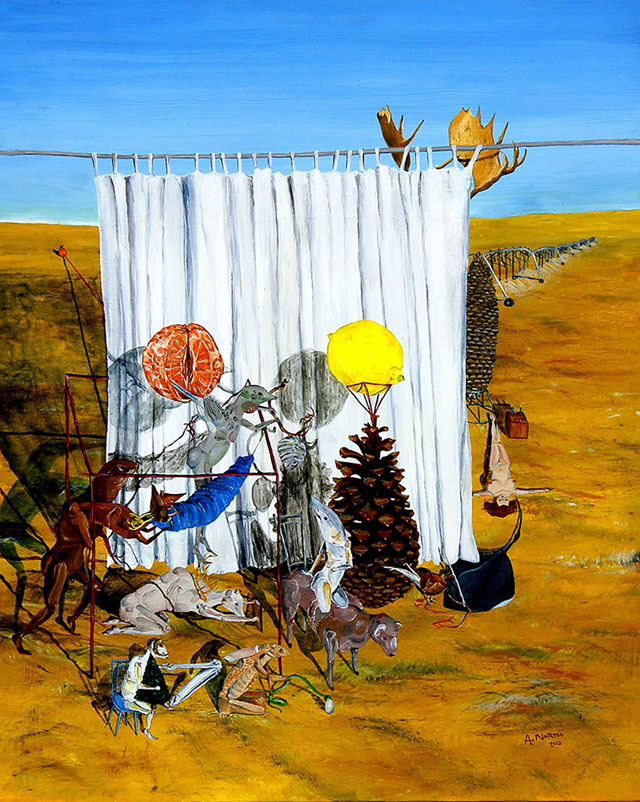
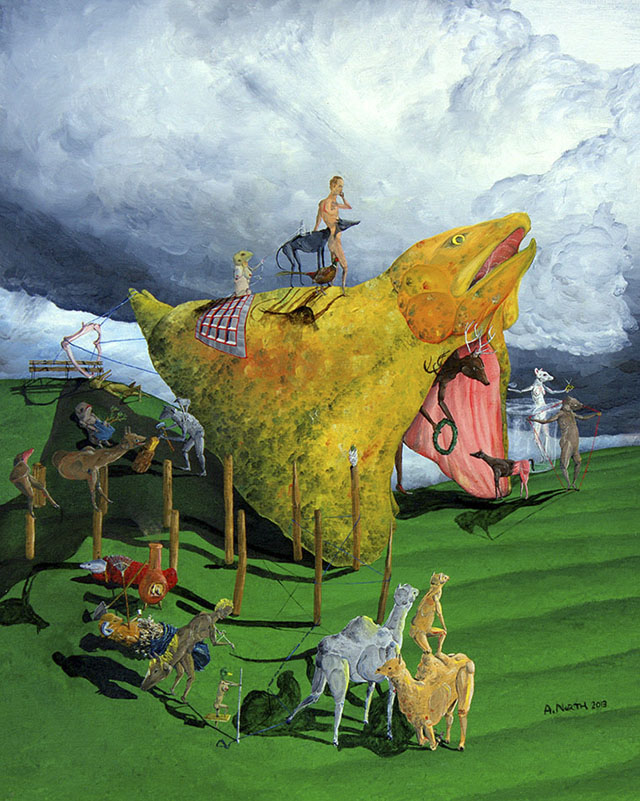
Curtain with Pine Cone, Oil on Canvas Panel, 20" x 16”, 2013

Curtain with Pine Cone, Oil on Canvas Panel, 20″ x 16”, 2013

Briefly describe the work that you do.

I predominately paint animals, humans, and objects, and I work in oils. My paintings are typically very busy and colorful.

At what point in your life did you decide to become an artist?

Art was always present for me at a young age with the mindset that I would get back to it at some point. I liked drawing as a kid and also painting as a teenager but never really found my own way until later. Art became more important to me after living on my own. I was working at a record store by day and screen printing and putting out street art in my own time. That was when I really began to take my own work seriously.

Tell us a little about your background and how that influences you as an artist.

I grew up in San Antonio, Texas and later Colorado in my formative years. My mother is a very accomplished seamstress and pushed my sisters and I creatively. She had these encyclopedia style volumes of craft projects, and I would sit in her sewing room, without having most of the required materials, and make what I could with what we had. At the time, I was kid and wouldn’t have noticed, but my mom definitely nurtured my creativity.

In Colorado, during and after the time I was in high school, there was a huge music/DIY scene that I grew up a part of. I think that the group I was in artistically really gave me the notion that ‘if you want it take it’ and made any goals I had much more reachable.

I traveled on my own for a while through the southern United States and also later on the Appalachian Trail and was constantly drawing throughout those times. My interests and ideas began to gel at a certain point into compositions more like my present work. After going back to Colorado and later moving to Rhode Island, I began making more finished works and spending time daily in any studio space I could come up with.

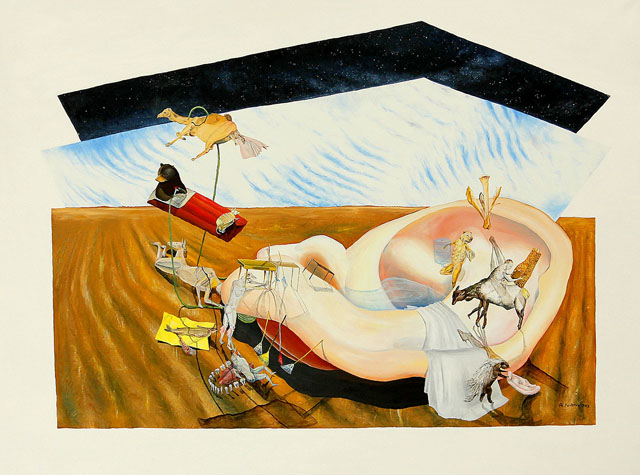
Two Skies with Ear, Oil on Canvas, 36" x 48”, 2013

Two Skies with Ear, Oil on Canvas, 36″ x 48”, 2013

What types of conceptual concerns are present in your work? How do those relate to the specific process(es) or media you use?

My paintings are a heavy mental collage of all of my thoughts with no narrative. I use an automatic process in my painting where I typically only know what I am adding the day of. I am happy for people to take away anything they enjoy or relate to on a personal level, but I do not want them to have a preconceived perception or be looking for a story line or explanation. 

We once heard Chuck Close say he did not believe in being inspired, rather in working hard everyday. What motivates you in your studio practice?

I agree with that statement. I am inspired by many things daily, but my studio practice is more work, and my personal experiences that have inspired me come through in my work. I was raised in a hard-working family, and I apply those same principals when I paint.

Trout, Oil on Canvas Panel, 20" x 16”, 2013

Trout, Oil on Canvas Panel, 20″ x 16”, 2013

What artists living or non-living influence your work?

As for artists, I like the work of Brueghel, Bosch, Gauguin, Kokoschka, Dali, and Tanguy.

I also enjoy the works of Philip Glass and Haruki Murakami a lot. When I was finding my place in art, I was definitely influenced by the massive street art scene locally and globally.

When you are not making art what types of activities and interests do you engage in? 

I work full-time as a screen printer, but I am mostly a home body with my fiancé, who is a writer. I like building things, animals, tv and movies, hiking, fishing, reading, gardening, and bicycles (to name a few).

About 

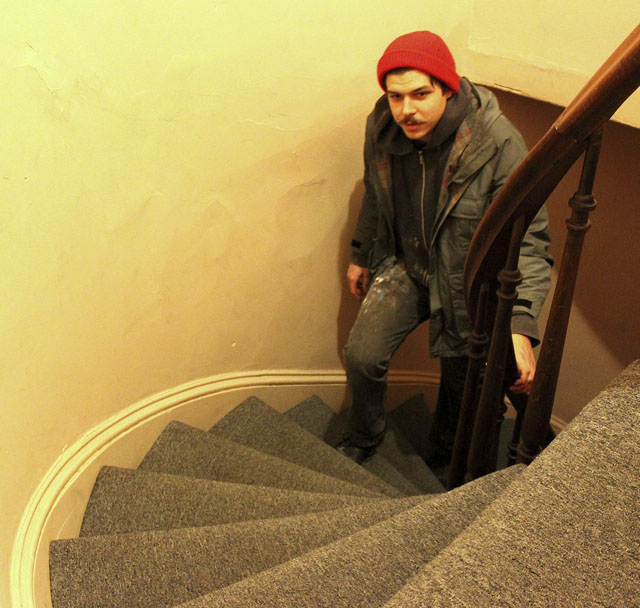
AaronNorth2014portraitMy work represents a heavy mix of memories, daily thoughts, and conscious dreams and focuses on abstract, yet relatable subject matter.

Surrealism has always made logical sense to me because of the unexpected circumstances. I don’t want to fully understand someone else’s work, rather I want to walk away with all my questions unanswered. The images in my work are typically uncommon, but recognizable, and they interact together to create a well of imagery for people to identify themselves in.

With a background in street art, I became accustomed to the urgency and immediate satisfaction of completing a piece of work. Transitioning to canvas and paper allows me to quickly join ideas together, but also enables me to continue to ponder and distort them without time constraints. When working, I rely on an automatic thinking process to execute new ideas with a similar sense of immediacy.

I express an action with a figure or object, and each additional element connected to it contributes to a central idea. My process involves depicting a famil- iar form and reconstructing that form into something new and foreign to me. Rather than predetermining the subject matter for a particular piece, I utilize a more organic process based on aesthetic value. The objects in my work are very positive or very harsh and sometimes appear for no particular reason. I empathize with the images that I create, and I see myself alongside them. 

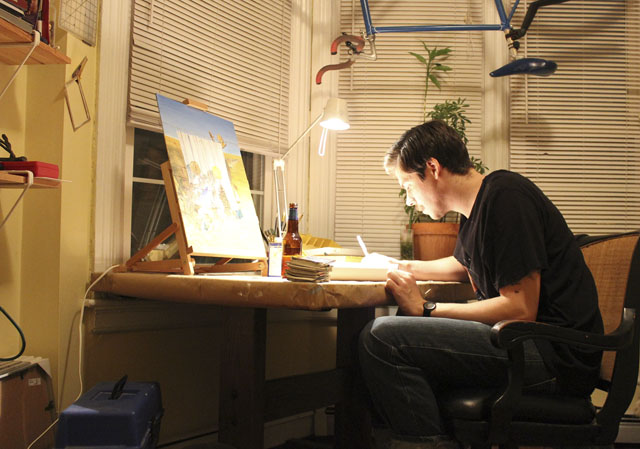
AaronNorth2014studio2

www.aaronorth.com  

All images copyright of the artist and used with their permission. 

Posted in Uncategorized | Tagged , , , , | Leave a comment

Betsy Byers – Minneapolis, Minnesota

Endless, 6' x 6', oil on canvas, 2013

Endless, 6′ x 6′, oil on canvas, 2013

Briefly describe the work that you do.

I paint to discover and imagine our intimate relationship with the environment in an abstract form. My paintings are an intersection of bodily senses, memory and process. Influenced by phenomenology, my studio practice seeks to manifest physical sensations through abstract painting. 

At what point in your life did you decide to become an artist?

I didn’t paint with oil until I was 20 years old. When I was growing up I did a lot of observing, drawing and writing, but I never imagined that I would become an artist. I switched my major from pre-med to art in undergrad because my first oil painting class challenged me more than any other previous course. I chose to become an artist due to the questions that art raises. I am constantly engaged by my work in the studio and by my attempts to translate and develop a visual experience for others. 

Tell us a little about your background and how that influences you as an artist.

I grew up in the suburbs of the Twin Cities in Minnesota. Like many other Minnesotans, my summers were spent up North at my family’s lake cabin. My mom would often wake us in the middle of the night to sneak down the stairs toward the big empty mouth of the lake to swim. We would slide our feet over the worn wood of the dock and sink silently into the liquid embrace of the water. Since 2008, my research has been focused on translating this corporeal experience of swimming at night.

Suppress, 4' x 4', oil on canvas, 2010

Suppress, 4′ x 4′, oil on canvas, 2010

The heightened awareness of my senses in those dark moments helped me to recognize the intimate relationship between the interior and exterior world. The millions of stars lit overhead accentuated my smallness. Water slipping and sliding over my limbs until I no longer understood where my body began and the lake ended negated previously understood boundaries. The hum of the world reverberated quietly through the lapping of the water in my ears. In my studio, the progression of each painting draws on sensual traces and visual structures of these remembrances for imagery and color. My work speaks to a kinesthetic understanding of our body in space; it captures an awareness and connectedness to materiality, light and pressure that we all possess, but at times fail to recognize amidst the background noise. 

What types of conceptual concerns are present in your work? How do those relate to the specific process(es) or media you use?

I am interested in phenomenology, as well as Lacan’s Mirror Theory. My conceptual concerns investigate the boundaries and relationships between self, other and place. Some literature that feeds my work includes Gaston Bachelardʼs The Poetics of Space, David Abram’s Spell of the Sensuous, Yi Fu Tuanʼs Space and Place, and John Deweyʼs Art as Experience. Boundaries are an essential part of the visual structure in my paintings. These boundaries include imagery that suggest horizon lines, the surface of

the water, and bodily movement through receding marks. My approach to painting is to work with layers, often wiping down and pulling away the oil and or acrylic paint to reveal the trace of the paint’s edges below. I play with color temperature and saturation to develop and negate spatial relationships. I also use tape to create hard foreground shapes that often act as “anchors” in the work for the viewer. 

Convergence, 6' x 6', oil on canvas, 2012

Convergence, 6′ x 6′, oil on canvas, 2012

We once heard Chuck Close say he did not believe in being inspired, rather in working hard everyday. What motivates you in your studio practice?

What motivates me as an artist is being actively engaged in the world. Being a “maker” requires one to investigate and intentionally respond to one’s surroundings. If I am in a “slump,” reading, writing and going to look at art often helps me figure out my next move in the studio. 

What artists living or non-living influence your work?

I appreciate many artists, including Claire Sherman, Tomory Dodge, Lisa Sanditz, Peter Doig, Amy Sillman, Ann Hamilton, David Schnell, Fra Angelico and Richard Diebenkorn. 

When you are not making art what types of activities and interests do you engage in? 

I enjoy teaching (art!), hiking, camping, drinking coffee, reading, running, yoga and eating food with friends and family. 

About 

Betsy Byers_headshotBetsy Byers holds a Master of Fine Arts in Visual Studies with an emphasis in painting from the Minneapolis College of Art and Design. She received her B.A. from St. Olaf College and her k-12 Art Education Licensure from St. Catherine University. Byers is currently an Assistant Professor at Gustavus Adolphus College in St. Peter, MN. Before arriving at Gustavus, she taught at MCAD, St. Catherine University and St. Cloud State University. Betsy’s work has been shown both nationally and internationally. She has exhibited at the Minnesota Museum of American Art, De Vos Art Museum, Hillstrom Museum of Art, University of Connecticut, Intermedia Arts, Guilford Art Center, The Soap Factory, Burnet Gallery in the Le Méridien Chambers Hotel, Augsburg College, and University of Minnesota Morris. Byers was awarded a 2009 Minnesota State Arts Board Artist Initiative Grant and a Jerome Foundation Grant for a month-long residency at the New York Mills Cultural Art Center. Byers was featured in the film Painting the Place Between, produced in 2013 by Carbon Mouse Studios. She is represented by the Kolman & Pryor Gallery and has an upcoming exhibition at the University of Wisconsin, River Falls. 

In the Studio

In the Studio

http://www.betsyruthbyers.com 

All images copyright of the artist and used with their permission. 

Posted in Uncategorized | Tagged , , , , | Leave a comment

Kylie Lockwood – Detroit, Michigan

"Cast that Aids the Function of a Hand," Silicone, protein powder, fiber supplement and dry clay, 3.5 x 5 x 8", 2013

“Cast that Aids the Function of a Hand,” Silicone, protein powder, fiber supplement and dry clay, 3.5 x 5 x 8″, 2013

Briefly describe the work you do.

My work begins out of an inquiry into objects that are close at hand. The process is mutable. Many works germinate at once, but rarely adhere to a straight path. They converge and separate bouncing off of one another and propelling each other into unforeseen directions. Sculpture allows me to address an immediate physicality thus evoking a somatic experience with the viewer. Something tenuous and dismissible is transformed into something challenging or even carnal.

 Tell us a little about your background and how that influences you as an artist.

Porcelain is ingrained in my generative process. My maternal grandmother taught me how to cast porcelain as a child. When I pour porcelain into a mold, I am not simply replicating a form but engaging my personal lineage. When I watch my hands at work, I am watching them mimic my grandmother’s hands as she worked; my hands are copies and extensions of her hands.

Foot Bath

“Foot Bath,” Pigmented porcelain, Styrofoam, almond milk, rice cereal, ground peanuts, protein powder and silicone, 18 x 11 x 15″, 2013

The concept of the “artist studio” has a broad range of meanings, especially in contemporary practice. The idea of the artist toiling away alone in a room may not necessarily reflect what many artists do from day to day anymore. Describe your studio practice and how it differs from (or is the same as) traditional notions of “being in the studio.”

I am a member of the artist run studio/exhibition space CAVE located in the Russell Industrial Center in Detroit, Michigan. The 6 members each have their own studios and separate studio practices within CAVE. The rent from our studios subsidizes our exhibition space. The gallery collective’s focus is hosting artist led projects and exhibitions. As a member of CAVE I have a dual focus on my individual studio practice and being part of a community that runs an alternative art space. http://www.cavedetroit.com

What unique roles do you see yourself as the artist playing that you may not have envisioned yourself in when you first started making art?

Issues of food and digestion have entered my work recently. There are aspects of my process that are evolving to look more like food preparation; kneading wheat-based clays, blending silicone smoothies and dehydrating/grinding nutritional elements into organic concrete forms.

"Digestive Rest," Pigmented porcelain, wax and floor pillow, 11 x 33 x 29", 2012

“Digestive Rest,” Pigmented porcelain, wax and floor pillow, 11 x 33 x 29″, 2012

When do you find is the best time of day to make art? Do you have time set aside every day, every week or do you just work whenever you can?

My schedule fluctuates regularly and I work in the studio at different times. However the night is my favorite time to work. Once the sun goes down I find there is so much more possibility for what can be achieved and it feels like I can step outside of time.

How has your work changed in the last five years? How is it the same?

My work itself has changed subtly in the last five years, however the biggest change in that time is my location. Five years ago I was living in New York and attending graduate school at Hunter College. Now I live and work in Detroit.

Are there people such as family, friends, writers, philosophers or even pop icons that have had an impact on the work you do?

My pool of influences fluctuates from project to project. Currently the people influencing my work are: Georges Bataille, Tom Robbins, Sarah Lucas, Helen Molesworth, Ice Hockey Goalies, and Prince

If you had an occupation outside of being an artist, what would that be and why?

Surgeon or professional swimmer; to work inside the body or to spend a significant time in water is greatly appealing to me.

LockwoodHSAbout

Kylie Lockwood was born in 1983 in Detroit, Michigan. She received her MFA from Hunter College in New York City in 2010 and BFA from the College for Creative Studies in Detroit in 2005. Lockwood’s recent exhibitions include South Bend Museum of Art, South Bend, Indiana; Printed Matter, New York, New York; Brooklyn Academy for Music, Brooklyn, New York; and Mediodia Chica, Madrid, Spain. She currently teaches in the Fine Art Department at the College for Creative Studies and is a member of the studio/exhibition space, Cave at the Russell Industrial Center in Detroit.

http://www.kylielockwood.com

Studio

Studio

All images copyright of the artist and used with their permission. 

Posted in Uncategorized | Tagged , , , , | Leave a comment

Nirmal Raja – Milwaukee, Wisconsin

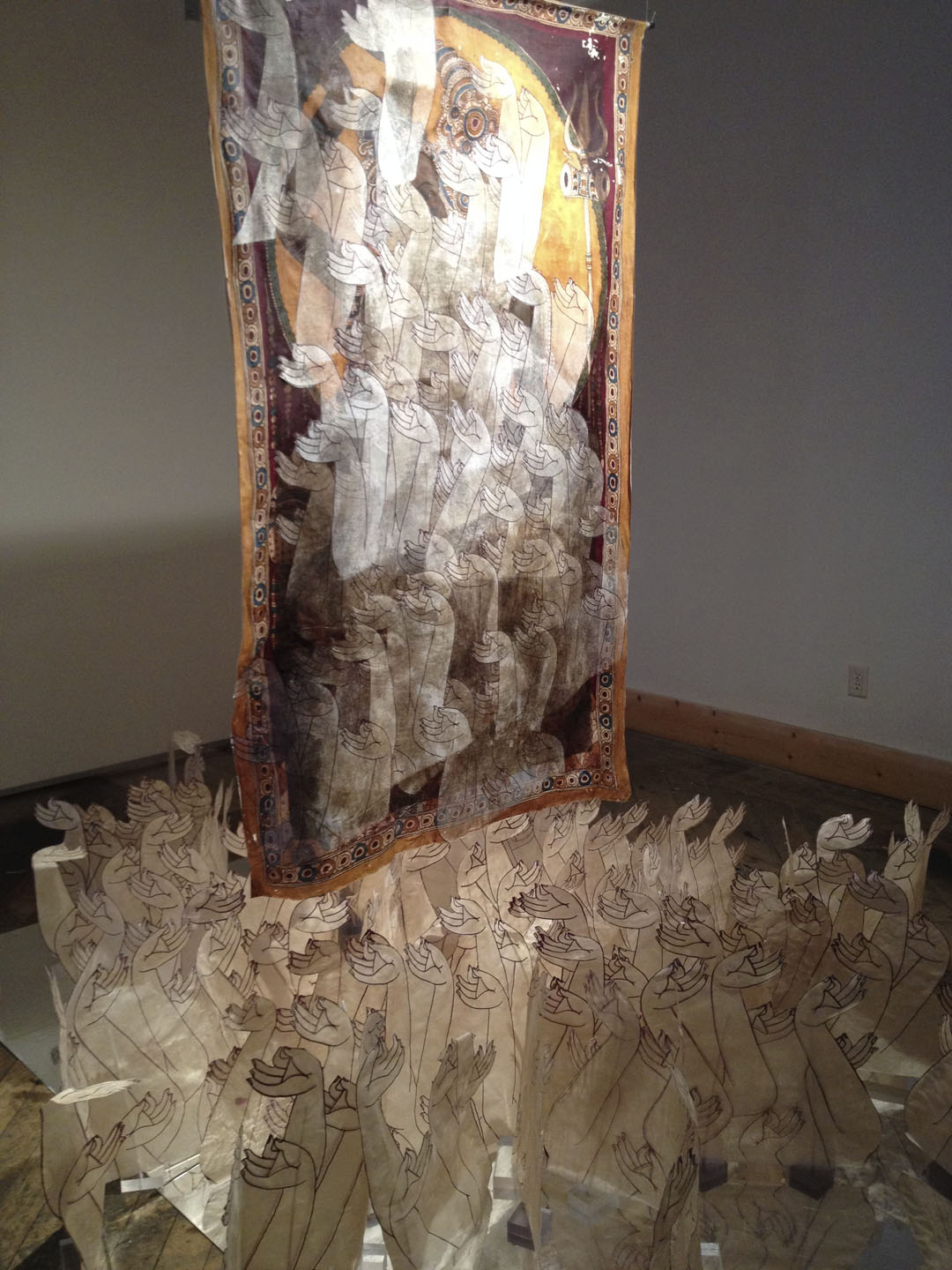
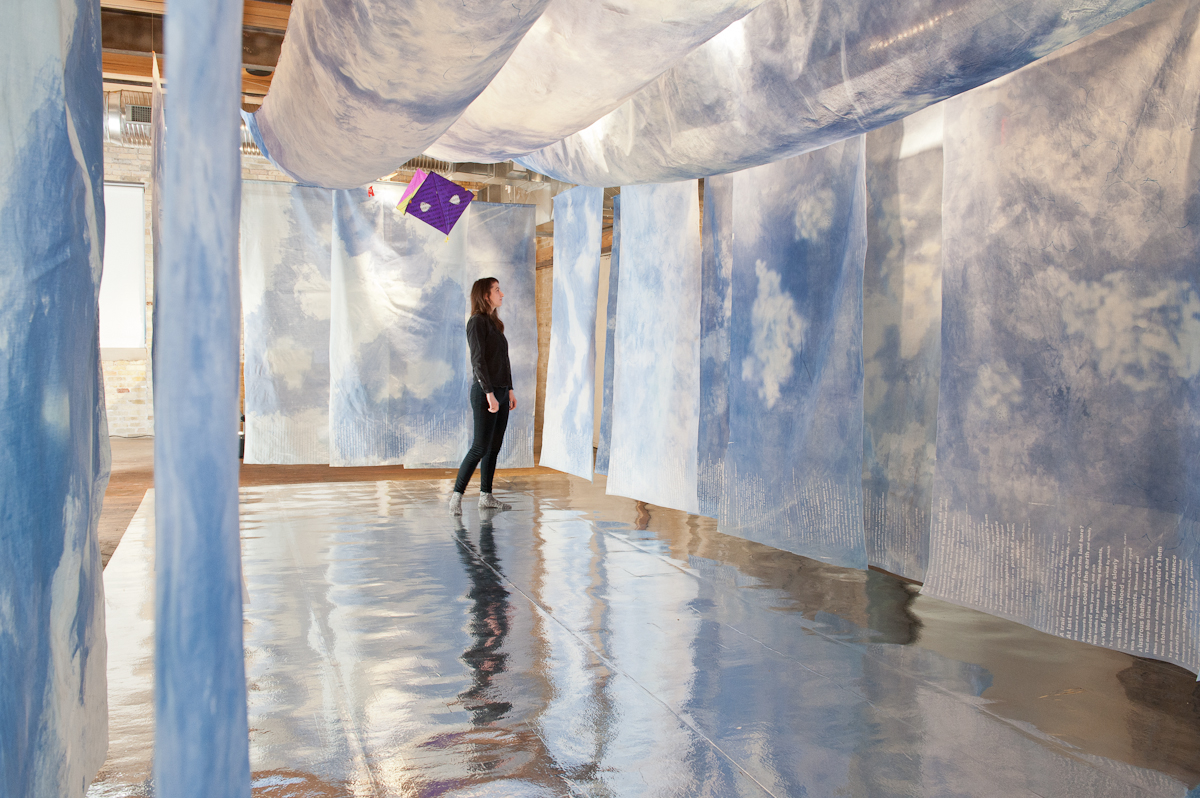
Emergence: screen prints on paper, mirrored floor, collage on fabric, 2014, size variable

Emergence: screen prints on paper, mirrored floor, collage on fabric, 2014, size variable

Briefly describe the work you do.

Concepts of memory, subjective experience and passage of time are overall interests in my work. As a result I approach art making as a communication of sensations rather than production of objects.  I incorporate many different media including video and video performance along with traditional forms of art like painting and printmaking. I use personal video recordings, releasing them from the specificities of time and place and give importance to the experience of moments. Fleeting and ephemeral, these moments are activated and brought to the present through installation strategies. Sometimes, I use video performance in order to pin these moments down, stitching them into a new narrative. Often times I implicate the audience in the installation to form unexpected juxtapositions through shadows and reflections questioning what is imagined and what is real.  My work asks the audience to engage with the potentials in and of memory: multiplicity, malleability and ephemerality and traverse boundaries if only in the confines of an installation.

The articulation of cultural negotiation is also a big part of my work. The fragmentation and partiality of my experience as a transplanted individual with multiple identities is expressed through the incorporation of layers, methods and materials. Iconic diagrams and visual culture from my country of origin- India, never fully disappear much like the embodied cultural memory of childhood that leaves indelible traces despite the passage of time. Text and language become part of this conversation quite often. Non-referential text is used as image in my work often, as a tool for communication beyond language.

My approach to making art is very inter-disciplinary. I believe the “idea” supersedes all. With this in mind, I pick and choose the material/ mode of communication that is best suited for the idea at hand. This approach has benefited me greatly in terms of encouraging a sense of play and risk taking in my practice.  I have chosen 3 works to describe- Emergence, Cloud Palace and Negotiate. 

I had the opportunity to live or travel not only in India but also in Hong Kong, S. Korea, Thailand and China. Every time I come back to the U.S, I am struck by the change in the rhythm of life- the way people interact and live. One aspect that always takes me some time to get used to is the idea of personal space.  Due to the density of population and difference in cultural nuances, personal space sometimes is non-existent in Asia. Nothing makes one more aware of this loss of personal space more than being inside an Indian temple during a crowded holiday celebration. The density of bodies gathered for the sole purpose of “Darshan”  (seeing and being seen) makes the multitude of people feel like a single organism humming in search of truth.

South Indian temples date back to the 2nd century. They can still be seen today as spiritual and community centers. Known for their exceptional architecture and sculpture, these temples also have extensive murals that are now barely visible and often go unnoticed. Although they are deteriorating and decaying, they have a beauty of their own that only age and climate can create. I am fascinated by the texture and mystery of these murals and old temple walls. This work is about my experience of visiting ancient and remote temples in Southern India.
Emergence: screen prints on paper, mirrored floor, collage on fabric, 2014, size variable

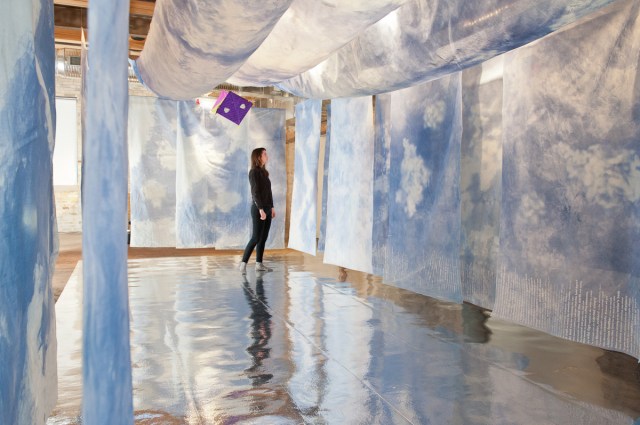
Cloud Palace: photosensitive dye on fabric, screen prints, mirrored mylar on board


Cloud Palace is an immersive installation that is inspired by “Badal Mahal” a room covered with murals of clouds, thunder and rain in the Junagarh fort, Bikaner, Rajasthan (India) and dates back to the late 1500s. This is a unique space where clouds are depicted as all enveloping in rich blue tones. The other inspiration for “Cloud Palace” is an epic poem titled “Meghdoot” or “cloud messenger” written by a 4th century poet- Kalidasa. Meghdoot is a love poem written for his wife from whom he was separated. This literary work is packed with reference to myth and allusion, longing and romance. Most of all the work draws attention to the human connection to nature and place as the cloud traverses the landscape on its journey to bring the poet’s message to his wife.

Clouds have a very special significance in India. They are much anticipated as the carriers of the monsoon season after a long, dry summer. They bring hope and new growth in dry arid regions of NW India. Gathering dark clouds become metaphors of impending doom and parting clouds become metaphors of hope in mythological stories.

Clouds have long invited and provoked our imagination worldwide. Much like the inkblot test, the associations and narratives we come up with as we gaze up to the sky can be reflective of our subconscious. Cloud analysis is used in studies to predict natural disasters in present day meteorology. And of course cloud computing is used extensively now. Through remote servers, the cloud as a virtual repository of information that we can access at will, releases us from the burden of storing information- much like a kite without a string.
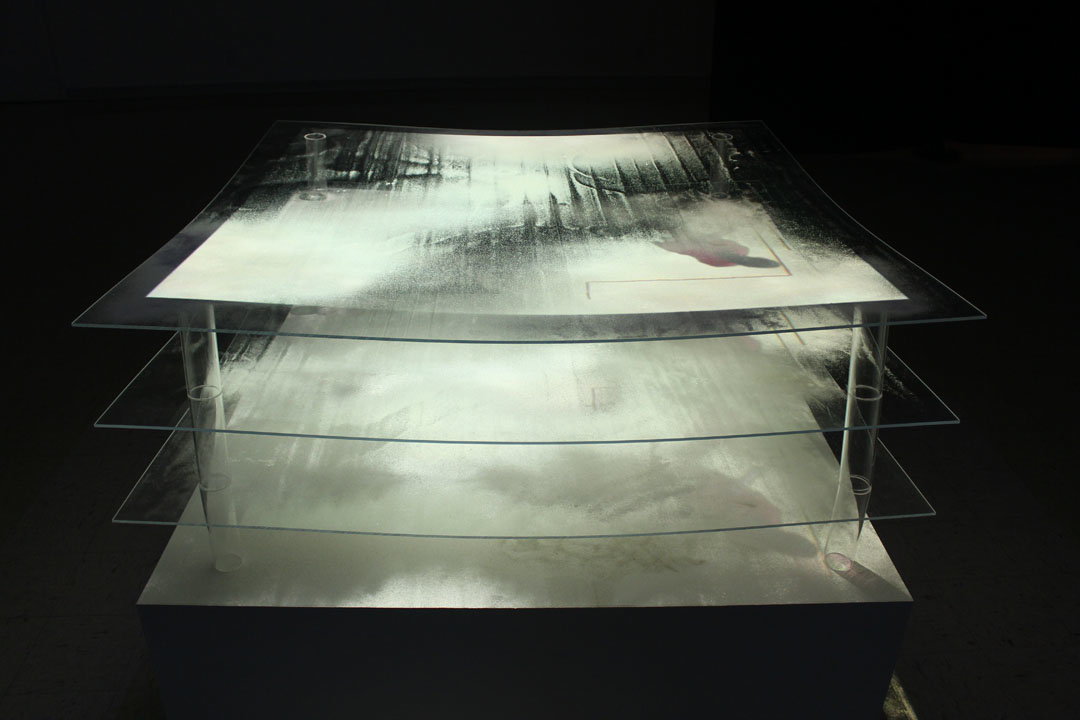
Negotiate: drawing animation and video performance projected on plexi glass and sand-2012, 42"X42"X42"

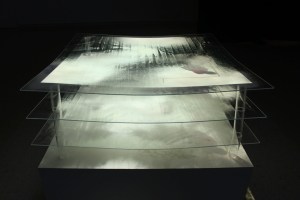
Negotiate: drawing animation and video performance projected on plexi glass and sand-2012, 42″X42″X42″

Negotiate engages an ancient diagram which functions as “form”, rooted in its history and culture, somewhat frozen in time. Many centuries ago, it was designed as a problem solving tool- the problem being, aiding the mind to focus on meditation. By activating this diagram through animation and performance, I release it from its specificity and “intensify” an inherent potential- one of “virtuality”. The evolution of the work is two fold. The animation dissects the form into infinite moments in time gradually building up and producing the gestalt of a diagram, at a certain point of completion, eventually becoming “still” and standing out as a “figure”. But my interventional performance of making changes to this figure activates it again, dissecting and morphing what is already there. Coupled with the looping installation, it becomes a never-ending repetition of transformation – of becoming figure and then disintegrating into the virtual and becoming figure again. The animation makes the cracks between each mark visible, bringing awareness to the perceptual “bridging “ that enables the marks to be perceived as line and the mind to “oversee” as diagram.

Tell us a little about your background and how that influences you as an artist.

 I grew up moving every 2-3 years all over India and then briefly to S. Korea and Hong Kong. I migrated to this country in 1991 after marrying my husband Sharath. For as long as I can remember, I have always wanted to be an artist. Due to several challenges, I was not able to fully devote myself to art making till recently. As a middle-aged mom and wife, the process of reinventing myself as a professional artist has been an incredible journey. I am fortunate to have had innumerable people in my life that helped me along the way.  My friends and family, the exceptional faculty at UWM’s Peck School of the Arts, and an amazing support system at Redline Milwaukee (where I am a mentor resident), have all had a hand in my growth as an artist. Due to migration and moving, my life has been a collage of experiences. As a result, my artwork is a collage too- of these experiences ruminated, digested and expressed in visual production. Nurturing a poetic sensibility towards life helps me reconcile diverse memories of a fragmented past with the here and now and come through in my work. 

The concept of the “artist studio” has a broad range of meanings, especially in contemporary practice. The idea of the artist toiling away alone in a room may not necessarily reflect what many artists do from day to day anymore. Describe your studio practice and how it differs from (or is the same as) traditional notions of “being in the studio.”

The course I teach at UWM- ART 150: Multicultural America and my work at Redline Milwaukee keeps me up to date on what is happening in the contemporary art field. Teaching Art 150 provides me with a space to foster cultural understanding among diverse racial groups through visual analysis and exposure to art production by artists of color.  At Redline, I mentor two wonderful artists- Stefani Quam and Nina Ghanbharzadeh.  Spending time with them, while problem solving, sharing technique and researching other relevant artists inevitably influences my work as well. I enjoy collaborating with other artists. Most recently, I co-curated the show Chasing Horizons with Christopher Willey (Villa Terrace Museum of Decorative Arts), collaborated with Jessica M. Ganger for Frame Story (Carroll University) and teamed up with Dara Larson for Transitions in Perspective: Myth and Mirror (Redline Milwaukee)

I believe that art cannot be made in isolation- “alone in a room”.  It is a response to lived experience and interaction with other thinkers and makers.

What unique roles do you see yourself as the artist playing that you may not have envisioned yourself in when you first started making art?

When I first started making art, I never thought that it would involve so much research! I am fascinated with what encompasses pursuing an idea. An exciting thought can result in weeks of reading, online research and failed experiments in the studio. I am constantly surprised at how when I think I have almost narrowed my focus, innumerable paths and questions present themselves which then take me into seemingly never-ending unexplored territories. This is what I find most interesting and exciting: going down the rabbit hole of art making. 

I also did not expect to write and speak so much! Articulating one’s intention in the work through writing statements and giving visiting artist talks is so much part of being an artist nowadays…

I never thought video performance would become part of work. The idea of including myself as part of the work came naturally and unexpectedly. 

When do you find is the best time of day to make art? Do you have time set aside every day, every week or do you just work whenever you can? 

Since I still have a child at home, I try to keep the hours between 8am and 3 pm at my disposal- time that is truly mine. I set aside the 3 days that I am not teaching as mentoring and studio days. I know it is a luxury and I feel incredibly fortunate that I have this time.

I take a lot of photographs as part of my practice. They are my journal, my sketchbook and diary. These pictures may seem random but they are records of what struck me as interesting, inspiring, weird or intriguing. They find their way into my work through collage or trigger memories of a certain experience even if I don’t remember the time and place they were taken. 

My favorite place to think is by the shores of Lake Michigan. I find the many moods of Lake Michigan fascinating, its waves calming and the sandy beach, a great place to mull over ideas. So much better than within the four walls of the studio!

How has your work changed in the last five years? How is it the same?

In the past five years, I have explored other media beyond painting and drawing. I am constantly learning new techniques and modes of expression- printmaking, video, sculpture, installation etc. I find this growth so liberating!

I have also found the joy of teaching and mentoring! I didn’t think I would enjoy it but I do. It is so gratifying to see the spark of understanding in a student and the excitement that comes with it. 

My love for materials remains the same. I enjoy the exploration of techniques like I always did. Also, my interest in subjects of nature, migration, culture and mythology has remained constant. 

Are there people such as family, friends, writers, philosophers or even pop icons that have had an impact on the work you do?

I keep track of work made by my favorite international artists like William Kentridge, Ann Hamilton, Kiki Smith, Wolfgang Laib, Aneesh Kapoor, Bill Viola, and James Turrell etc. along with spending time with other local Milwaukee artists. 

I especially enjoy reading and listening to William Kentridge’s many lectures.

Joseph Campbell’s work on mythology is a constant resource. 

I find Buddhist and Hindu ideas of balance, interconnectedness and the cyclical nature of life inspiring. 

My husband is the main influence in my life. He has an insatiable thirst for knowledge. His curiosity and attitude towards life – as a gift and an opportunity to learn is infectious, and my discussions with him have influenced my work tremendously. 

If you had an occupation outside of being an artist, what would that be and why?

I would have loved to be a cellist. For some reason, I am drawn to this instrument. Maybe, due to its soulful sound that has a way of touching something deep within.

About 
Nirmal RajaNirmal Raja is an interdisciplinary artist and associate lecturer at UWM. Born in India, Raja has lived and travelled in several countries. Raja received a Bachelor’s of Arts in English Literature in India, a diploma in Graphic Design from the Moore College of Art and Design in Philadelphia and a Bachelor’s of Fine Arts in Painting at the Milwaukee Institute of Art & Design. She received her Master of Fine Arts degree in painting and drawing at the University of Wisconsin Milwaukee.

She has participated in solo and group shows in the Midwest, nationally and
internationally including Richmond, VA (Art 6), Parkridge, IL (Brickton Art Center), Queens, NY (Crossing Art), North Selam, NY(Hammond Museum), throughout Wisconsin and also in Jonjou, S. Korea and Bangalore, India. She recently co-curated a show at the Villa Terrace Museum of Decorative Arts in Milwaukee, which opened May 3rd, 2013.  She has won several awards including second place at the Wisconsin Artists’ Biennale in 2012.

She is a resident mentor at Redline Milwaukee and has recently received grants
from the Wisconsin Arts Board and the Milwaukee Arts Board supporting the exhibition Transitions in Perspective: Myth and Mirror at Redline Milwaukee.
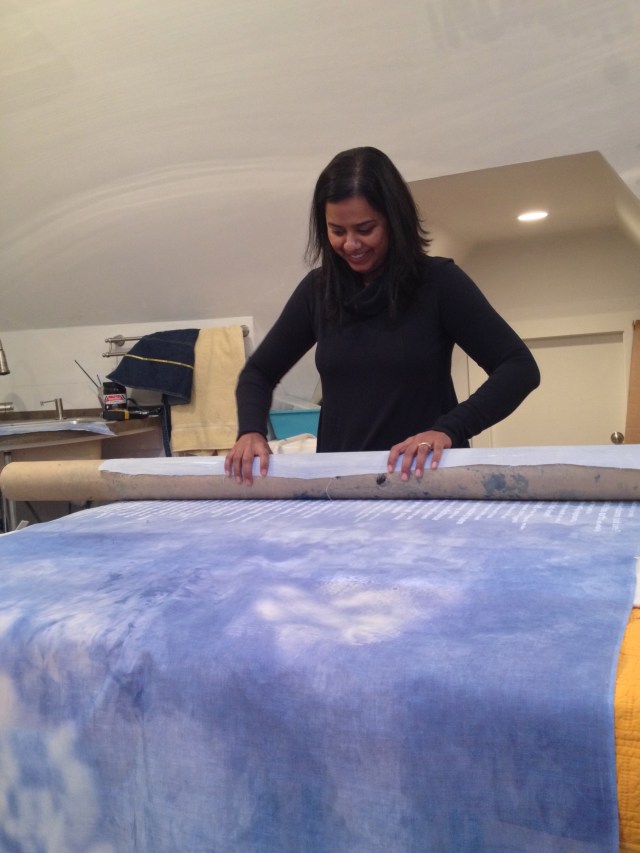
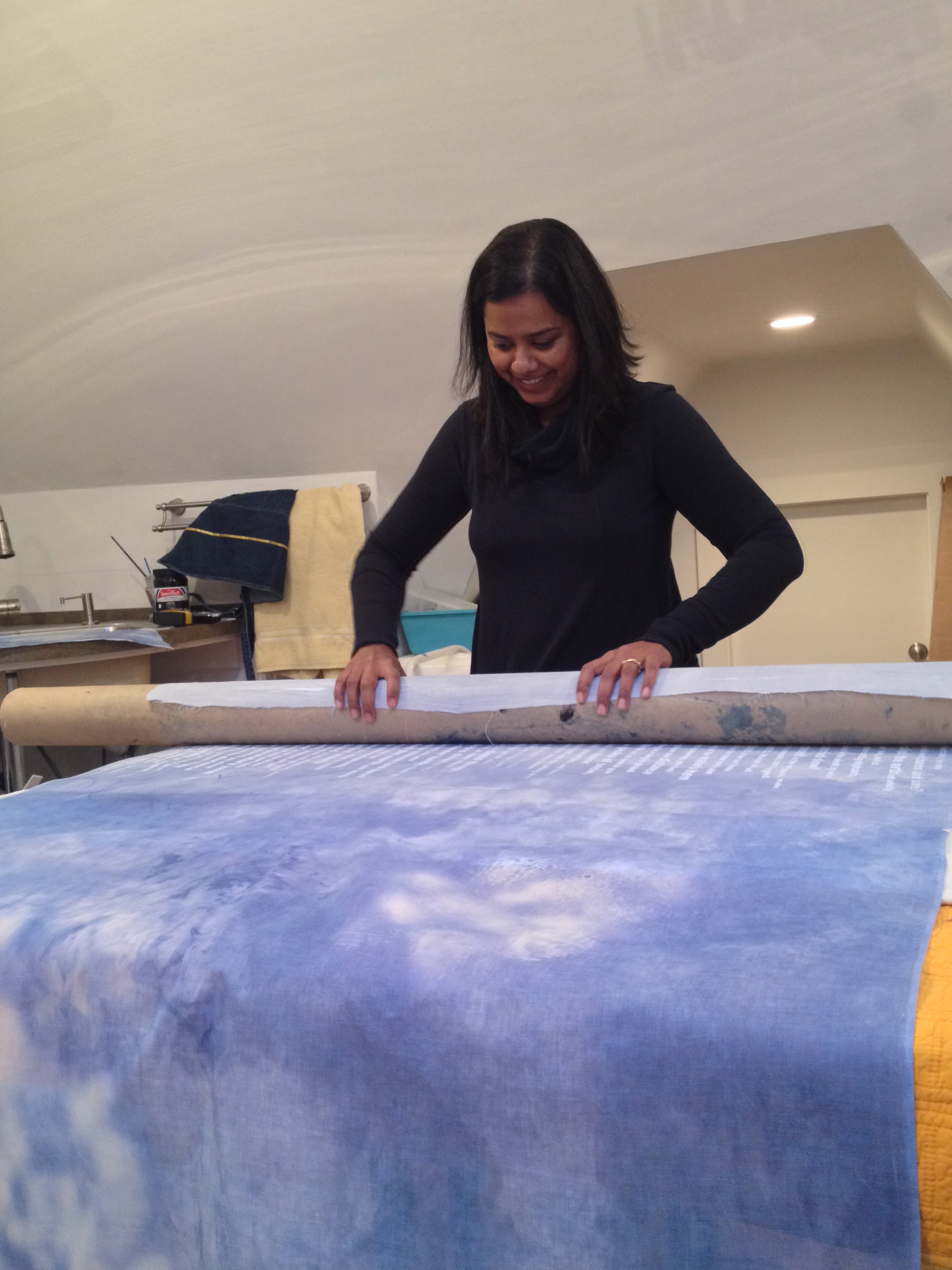
Raja at Work

Raja at Work

www.nirmalraja.com

All images copyright of the artist and used with their permission. 

Posted in Uncategorized | Tagged , , , , , | 2 Comments

Jamal Currie – Milwaukee, Wisconsin

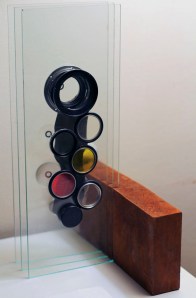
No Hiding Place for the Gods

“No Hiding Place For The Gods”, assemblage, 12″ x 9″ x 6″, 2014

Briefly describe the work you do.

At the moment I am working on physical assemblage compositions affixed to plexiglass that register and interact with video playing behind them. The works interpret and visualize relationships between people and some structures of cinema, the work begs questions of why and how the medium works so well with us, on us.
I’m using a lot of found-footage and found-object in these works, I’m really more of an editor in that way. Formally, I can’t say how fascinated I am with the play of light and physical material enabled through this type of collage, it’s like “real-world” compositing or a sort of reversed projection-mapping. I’m looking for successful blends of things and light, and am finding them where moving image is arranged to push through, say, canvas.., and at the edges of where a screen’s image and an association laden object meet.

Tell us a little about your background and how that influences you as an artist.

I studied art and 16mm film production in the University of South Florida’s fine arts department.  It was there that I was introduced to all kinds of frameworks for the critical analysis of art and cinema, beginning with tenets central to media literacy, and I started practicing non-narrative forms and installation approaches to art as soon as I began working with video in 1991.   I moved to Milwaukee in 1998 to take a job as an education coordinator at the city’s public access television station and engaged with the vibrant, diverse community of contemporary artists, educators and filmmakers here and eventually started teaching at the Milwaukee Institute of Art and Design.  I very much enjoy working with people who want to learn the tools, methods and processes of film and video to communicate their own vision through them.  I see myself as a type of media “literacist” using applied media aesthetics.  My pedagogy has had a big impact on my artistic practice, also on my choices around production outside of the fine art worlds.

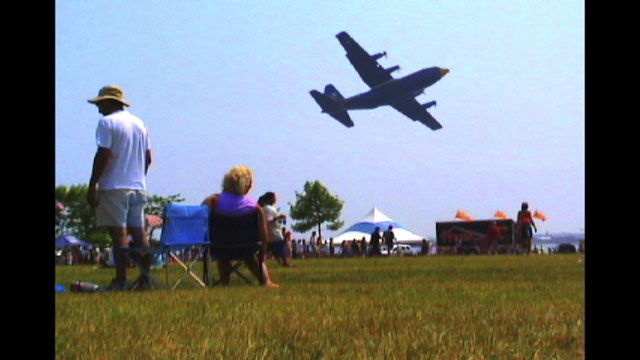
"A Lesser Piece",

“A Lesser Piece”, DV NTSC single-channel video, 3min, 2005

The concept of the “artist studio” has a broad range of meanings, especially in contemporary practice. The idea of the artist toiling away alone in a room may not necessarily reflect what many artists do from day to day anymore. Describe your studio practice and how it differs from (or is the same as) traditional notions of “being in the studio.”

My editing and materials studio is in my home, I am more comfortable and productive that way.  Art, production and teaching get me out and into the city’s communities.

What unique roles do you see yourself as the artist playing that you may not have envisioned yourself in when you first started making art?

For the past ten years a large part of my practice has been in collaboration with Express Yourself Milwaukee, Inc., a non-profit arts organization working with underserved and adjudicated youth in the area.

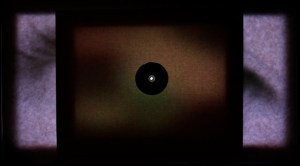
Eyetrace

Detail from “Eyetrace”, assemblage and video, 22″ x 13″ x 2″, 2013

When do you find is the best time of day to make art? Do you have time set aside every day, every week or do you just work whenever you can? 

I work whenever I want to and can.  Nights.

How has your work changed in the last five years? How is it the same?

I’m working less and less on single-channel video works , more on work for projection, interaction and installation.  My current work is much more akin to work I was making fifteen years ago, in some of the ways I am mixing mediums, trying to reconcile materials.

Are there people such as family, friends, writers, philosophers or even pop icons that have had an impact on the work you do?

Yes.

If you had an occupation outside of being an artist, what would that be and why?

I’d like to be a teacher, I do like being a teacher.

4_Jamal Currie headshotAbout 

Jamal Currie currently heads the Time Based Media program at the Milwaukee Institute of Art and Design. He is a video, sound and installation artist who has been teaching film and video courses to students of all ages for over ten years and has been the recipient of several awards and fellowships in Wisconsin. Jamal received his MFA from the University of South Florida-Tampa in 1998.

Studio

Studio

All images copyright of the artist and used with their permission. 
Posted in mixed media, Video | Tagged , , , , | Leave a comment