Daniel DeLuna – Rochester, New York

Briefly describe the work that you do.

DD091812 HD animated loop / one minute dimensions variable 2012

DD091812
HD animated loop / one minute
dimensions variable
2012

I create work consisting of paintings, drawings, digital video and stills that engage with the history of abstraction as filtered through and informed by the pervasive influence of technology on contemporary culture.

At what point in your life did you decide to become an artist?

I have drawn and painted since I was a child but I made the conscious decision to define myself as an artist early in my college education, perhaps at 18-19 years old. I once read that Jasper Johns felt that he became an artist when he simply decided to call himself one and that seemed good enough for me.

Tell us a little about your background and how that influences you as an artist.

I have been doing geometrical based work for a long time, the gestural stuff would creep in but not to the extent that it has in last few years though. In my first year at Pratt I was taking a seminar with the sculptor Gillian Jagger and we had to bring in slides and present work made prior to enrolling in the class and she wanted us to explain how it related to our childhood. I though, “Oh god, I make geometric abstraction, how will I BS myself out of this?” The more I thought about it the more I realized that it did indeed relate to the industrial urban environment of the steel mills and oil refineries of Northwest Indiana that I encountered in my youth. There was a harsh geometry that was humanized in a strange way through the dirt, grime, peeling paint, and rust. I remember that area striking me as some sort of post-apocalyptic Mad Max movie set. That vocabulary rooted itself in my mind but for years I didn’t make the connection. Franz Kline wasn’t painting bridges from his hometown in Pennsylvania nor am I painting steel mills yet I think in both of our cases these things become a familiar visual language that one can tap into and use. Even today when I come back to visit family it is such a terrifying yet fascinating landscape.

DD102713 Graphite on paper 36 x 28 inches 2013

DD102713
Graphite on paper
36 x 28 inches
2013

What types of conceptual concerns are present in your work? How do those relate to the specific process(es) or media you use?

The root of my work lies in my painting practice but I also make extensive use of digital tools. The work I make, tied to a medium that has a history several thousand years old, is modified and mediated by our contemporary technologically saturated culture and reflects my deeply ambivalent relationship with the digital.

We once heard Chuck Close say he did not believe in being inspired, rather in working hard everyday. What motivates you in your studio practice?

In a conversation between painters David Reed and Stephen Ellis published in a catalogue on Reed’s work, Ellis says something to the effect that as artists we simply need to cultivate the ability to make the types of images we want to see. When listening to music I will often put on a nice set of studio monitor, over-the-ear headphones to really be able to hear the nuances in the mix, actively courting a deep-listening experience. I am trying to create the same type of relationship with my work, creating the type of images that I want to see and the experience of which will grow and expand upon repeated viewings.

What artists living or non-living influence your work?

DD020913 Acrylic on canvas 18 x 24 inches 2013

DD020913
Acrylic on canvas
18 x 24 inches
2013

Frank Nitsche, Albert Oehlen, David Batchelor, Bill Jensen, James Brooks, David Row, Willem DeKooning, Carroll Dunham, Bernard Frize, Carl Fudge, Ashile Gorky, Adolph Gottlieb, Katharina Grosse, Heimo Zobernig, Hans Hoffman, Jacqueline Humphries, Franz Kline, Joan Mitchell, Jonathan Lasker, Robert Motherwell, Joan Miro, Ed Moses, Thomas Nozkowski, Stephen Parrino, Richard Serra, David Reed, Gerhard Richter, Sigmar Polke, Gary Stephan, Amy Silman, Pierre Soulages, Thomas Schiebitz, Cy Twombly, Christopher Wool, John Zinnser, Chris Martin, Alan Uglow, James Siena,  Stephen Westfall, Wade Guyton, Stephen Ellis, Adrian Schiess, Paul Henry Ramirez, Andrew Spence, Bruce Pearson, Joseph Marioni, Manfred Mohr, Eric Tucker, Jeff Elrod, Juan Ulse, Beatriz Milhazes, Mary Heilmann and Dennis Hollingsworth as well as Medieval Illuminated Manuscripts, Assyrian reliefs, ancient Chinese sculpture to Modernist Graphic design and on and on and on. I am deeply engaged with visual culture of all types.

When you are not making art what types of activities and interests do you engage in? 

Reading, music, cooking.

About 

headshotRochester, NY based artist Daniel DeLuna has exhibited his painting, drawing and digital work internationally. Starting as a painter, his work has been greatly extended and influenced by his engagement with digital media at the same time retaining the connection to the initial practice in that traditional medium. Working within an abstract visual language he creates richly evocative work influenced by art history, music and design. He holds an MFA from Pratt Institute in Brooklyn, NY and is currently Associate Professor in the School of Design at the Rochester Institute of Technology.

www.dd3studio.com

All images copyright of the artist and used with their permission. 

Posted in mixed media, Video | Tagged , , , , , | Leave a comment

Jonathan Johnson – Westerville, Ohio

Briefly describe the work you do.

After John Herschel, archival inkjet print from field scan process, 30"x40", 2011

After John Herschel, archival inkjet print from field scan process, 30″x40″, 2011

I make photographic things and videos that typically address ideas about nature and place in a contemplative tone.

Tell us a little about your background and how that influences you as an artist.

My mother is from Thailand and my dad worked for an airline during a time when employee benefits actually mattered, so we travelled internationally quite a bit.  I collected exquisitely designed flight schedules from Ozark Air, Cathay Pacific, JAL etc. and became eternally intrigued with the intersection of the global and local.

The concept of the “artist studio” has a broad range of meanings, especially in contemporary practice. The idea of the artist toiling away alone in a room may not necessarily reflect what many artists do from day to day anymore. Describe your studio practice and how it differs from (or is the same as) traditional notions of “being in the studio.”

My studio is the outdoors.  I spend money on backpacks and travel sized deodorant, not studio rent.  When I started studying fine art in graduate school, I was really blown away by the idea of the painting and drawing studio.  But there were guys that had their dogs with them and little beer fridges, so it did seem like  a fun place to hang out.  Everyone gets in the creative mood in different ways.  I was initially trained as a photojournalist, so I feel the most creative when I’m reacting to colors, sounds and things in real time.  Our bodies weren’t meant to sit at computers all day, and my neck starts to hurt after an hour or so of clicking the dust removal tool in Photoshop.  I like to walk.  I do have a re-modeled shed in my backyard that functions as a traditional studio–there’s no internet connection, so I usually use it for editing video and photo files and for collaging old issues of  Artforum and The Economist.  I also do writing and the other “business” aspects of my art practice in the studio.

Weeding Grid, install shot, cyanotype prints, 30"x40", 2013

Weeding Grid, install shot, cyanotype prints, 30″x40″, 2013

What unique roles do you see yourself as the artist playing that you may not have envisioned yourself in when you first started making art?

I teach art at a small liberal arts college.  I get stressed out about finding the balance between teaching and studio time, but I feel very fortunate to have a patron in the form of my college, they support me so that I can make art!  Sure, I’d like to have more time for it, but so few people can make an actual living from being an artist.  More and more I’m incorporating pedagogical projects into the fold of my studio practice.  I like poetry, so I got together with a creative writing faculty member, and now our students make photo-video-literary art work together–it’s one big collaboration.

When do you find is the best time of day to make art? Do you have time set aside every day, every week or do you just work whenever you can? 

In order for me to survive creatively, I’ve had to expand my idea of making. Reading about current events in the newspaper or a tutorial about some software program and going to artist talks are all part of the art making process for me.  I do set aside one whole day a week for making, but I’m usually applying to shows and doing research throughout the week in short increments.  I find that mid-morning is best–I’ve had my coffee and biked to my office (or walked to my studio) in freezing weather.  Nothing gets you in tune with the world like biking in the cold, gray mornings of central Ohio.

How has your work changed in the last five years? How is it the same?

Backyard Topographic IV, archival inkjet print from field scan process, 30"x40", 2012

Backyard Topographic IV, archival inkjet print from field scan process, 30″x40″, 2012

More and more I’m incorporating video into my practice.  I’m starting to find a way to communicate consistently through moving, still and collaged imagery.  My work is getting a little more sculptural as well–thinking about various sizes of images, frames and how to configure them in an exhibition space.

Are there people such as family, friends, writers, philosophers or even pop icons that have had an impact on the work you do?

The philosopher Edmund Burke who wrote about the idea of the Sublime; Liz Wells writes about the landscape in a way that makes it seem like it should be dinner table conversation for everyone and my wife has great attention to detail, so I usually show her things before they go out into the world.  And what about Ryan Seacrest?  What is his talent other than being the hardest working man in show business?  He’s made a career out of nothing except the American dream.  

If you had an occupation outside of being an artist, what would that be and why?

A photojournalist.  I had an inkling of skill and talent for it before I turned to fine art and teaching.  I also used to be very charismatic.  I think good journalism is more important than ever–it plays a large role in developing our world view and sense of responsibility.  

About 

Headshot_Jon3_ParisbJonathan Johnson is an artist-educator who uses various forms of photography and video to explore ideas about place and nature. Johnson received his BA from the University of Alaska and MFA in Photography and Intermedia from the University of Iowa and has exhibited his films and photographic work in over 30 countries at venues such as the Museo Nacional Centro de Arte Reina Sofia, Madrid; Wexner Center for the Arts, Columbus, Ohio; Gallery Sment, Braga, Portugal; Africa Centre, Cape Town, South Africa; Sofia Arsenal Museum of Contemporary Art; Keuruu Museum, Finland and the EXiS Film Festival, Seoul, South Korea. In addition to working in academia, he has held positions in public affairs and in the music industry. Currently, he is an Assistant Professor of Photography and Digital Media at Otterbein University in Columbus, Ohio.

Studio Shot

Studio Shot

www.jonathanjohnson.net

All images copyright of the artist and used with their permission. 

Posted in Photography | Tagged , , , , | Leave a comment

Daniel Fleming – Milwaukee, Wisconsin

Briefly describe the work you do.

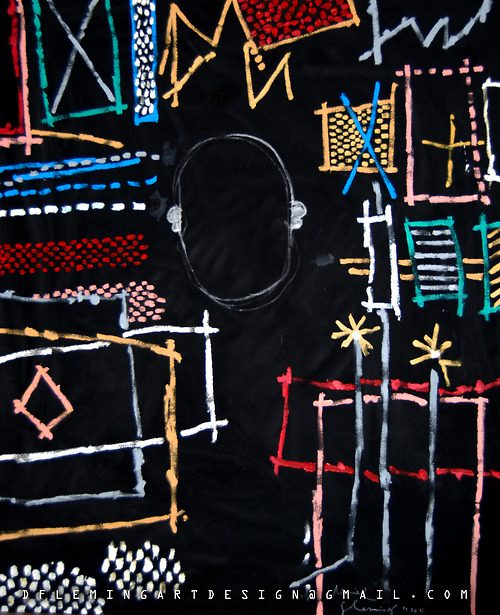
Maps To Other Things,   40x 46”,  Acrylic on canvas,  2013

Maps To Other Things,
40x 46”,
Acrylic on canvas,
2013

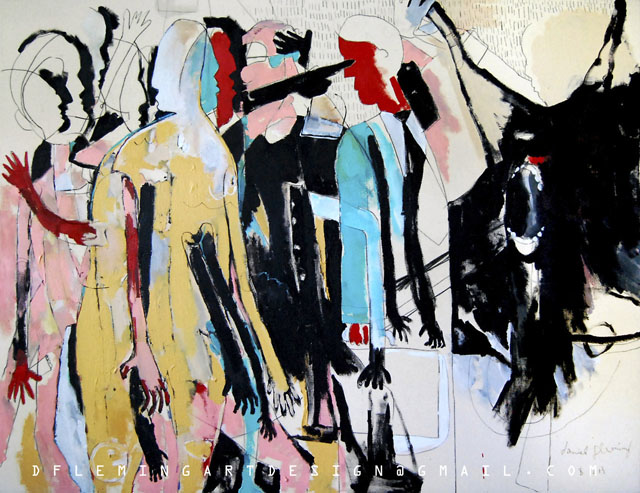
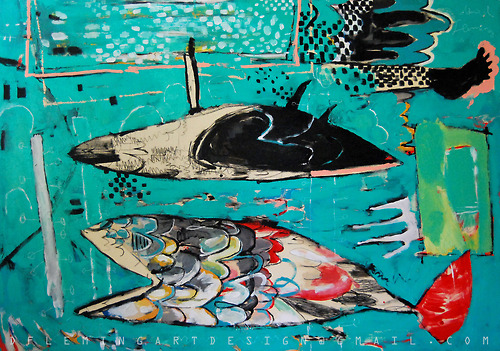
My work has notes of expressionism, graffiti and primitive artwork combined with images, symbols and narratives from contemporary social and political issues. I use bright and vibrant colors, primitive mark-making, and texture to create complex compositions that seek to display a variety of beliefs and perspectives that you might not otherwise encounter, helping the viewer gain a bit more understanding about the vast world around us and our place in it.

At what point in your life did you decide to become an artist?

The cliche answer would be “I’ve been an artist all my life,” but in reality, I didn’t think “artist” was actually a job direction I could choose until fairly recently. I had always been interested in creative jobs, from illustration to special effects, but only after a few months turning down college parties to stay in and paint alone did I realize that painting, specifically, was my passion. Even after that, I think it took a year or two for me to fully realize that I could legitimately make this a career…and if I’m being perfectly honest, there’s multiple times per month I have a little crisis of faith with art. 

I’d say I’ve always known I wanted to be creative and I’ve known I wanted to, specifically, be a fine artist for around 6-7 years…but even knowing the direction I’m moving, I wonder, from time to time, what it might be like to give it all up. I suppose that’s the essence of being creative…seeing where you are, wondering what’s ahead, and, no matter how good it is, looking to create something better.

Tell us a little about your background and how that influences you as an artist.

I grew up in a mid-sized city that specialized in building computers (IBM) and taking care of the sick (Mayo Clinic), and though it is, for the most part, upper-middle class, there really isn’t much of an art community. On top of that, I went to a tiny Catholic high school and never really had much to choose from in terms of art education. Art was supported and fostered by my parents, but art projects were scarce and I, largely, taught myself how to draw and paint through practice and developed my passions for art alone in a basement surrounded by art books, “how-to-draw” cartoon books from which I ignored the directions, and a constant supply of random paints, recycled surfaces and subjects to try out. While I don’t know if I’d suggest this path for most people, I think it definitely lead to a more open, unique and carefree approach to art. I have never really worried what reaction will be to my work…I’ve never really stopped to think if something was “correct”…and I’ve never had much care for “definitions” of what an artist is and what they can do. I run into artists that will see a piece I’ve done on a found object and say “I never thought you could do that” and my reaction has always been “I never thought there were rules.”

Standing in Line at the Butcher Shop - The Prize Fight,   48x 62”,  Acrylic, Ink and Charcoal on canvas,  2013

Standing in Line at the Butcher Shop – The Prize Fight,
48x 62”,
Acrylic, Ink and Charcoal on canvas,
2013

What types of conceptual concerns are present in your work? How do those relate to the specific process(es) or media you use?

My work is all about perception. I adopt certain symbols, beliefs and viewpoints from a variety of cultures, subjects and stories and present them in a way that is interpretable in a number of ways, depending on your past experience and knowledge. I hope to engage the viewer with the selected viewpoints, educate them about thoughts and beliefs that they might not otherwise encounter, and create a discussion that leads to a greater understanding of the world around them. The work may not mean the same thing to each person, but then neither does anything else in this world.

These concepts all reveal themselves throughout my process of art-making. While many artists approach a new piece with a set goal and a sketch, I approach a piece with nothing more than an inkling of what colors, surface or subject I may have in mind. The piece begins as a few small marks but, over time, becomes more complex, more specific and ultimately gains the meaning and purpose that usually follows the work. Our complete understanding of our world is developed throughout our lives with little control and no real foresight. We are influenced by the things we see regularly around us but, especially in the internet age, we regularly seek out that which shocks, excites, and sheds further light on the mysteries surrounding us. My work is this process and is created through this process of investigation and discovery. While the viewer may slowly scan the work and develop a unique understanding, I, the artist, slowly bring in symbol, narrative and subject as the piece slowly builds into a readable form. Like the scribbled down notes of someone in the beginning stages of a research paper, my work documents the accumulation of ideas as they come, presenting thoughts, questions, mistakes, and ultimately, the final product.

We once heard Chuck Close say he did not believe in being inspired, rather in working hard everyday. What motivates you in your studio practice?

Sleeping Trouble,   48x58”, Acrylic and Pastel on canvas,  2013

Sleeping Trouble,
48×58”,
Acrylic and Pastel on canvas,
2013

I love making art. It’s that simple. People ask how I make so much work and still have time for fun and I’ve always laughed at the question…ART IS FUN. If it wasn’t fun, I wouldn’t be spending all my hard-earned money from the day job on art supplies…i wouldn’t be sitting alone in my living room painting instead of drinking at a bar with friends…I wouldn’t write a daily blog that requires me to think long and hard about the work I’ve been creating. Art is what I enjoy doing more than anything else I have ever encountered…and this drive, this love, this compulsion to create brings me back to the studio daily. I can’t say I completely agree with Chuck Close, because hard work without inspiration happens daily at every workplace without much to show for it. Hard work alone gets our trash picked up daily…Inspiration alone gets us an uplifting quote…mix the two together, and you can get Guernica. Artists need to work hard, there’s no doubt about that…but they also need to be inspired by that work to continue making advancements…Loving the work you do is the best inspiration…and if you love the work, then the hard work comes easy.

What artists living or non-living influence your work?

The artist that inspired me to become one myself was Matisse. All of my early work could be considered an amateur attempt at capturing the simple beauty of Matisse’s colors, subjects and compositions. The artist that has most influenced my current work is Jean Michel-Basquiat…and he’s the one that really put some gas in the “You can be an artist for real” engine. His work makes me look traditional and his energy struck a note that I still yearn to match. It was just something I’d never before seen…there was an excitement that seemed to be missing in traditional work….a vibrance or boldness that seemed lost in many modern masterpieces..and a subject matter that, while abstracted, was very much a real, every-day experience. He was the first artist I saw that I didn’t feel like I was looking into the past…

When you are not making art what types of activities and interests do you engage in? 

This question gets harder and harder as life goes on as, well, I do less and less that doesn’t involve art…but there are a few things I fill my free-time not taken up by art-making…Like most guys in their mid-twenties I enjoy drinking beer and watching football. Unlike most guys in their mid-twenties, I’m not a big TV show watcher, gamer or gambler. I enjoy watching a good documentary over an action flick, and I couldn’t care less about fashion, trends or the recent celebrity gossip… I tend to keep to myself for the most part but I always enjoy catch-up meeting over drinks.

About 

DFleming_headshotI approach my work with an unparalleled enthusiasm and energy, exploring a variety of social and political issues and displaying perspectives and ideas that many would not otherwise encounter. I take pride in creating work that spans various religious, political and cultural boundaries, creating a discussion and narrative that informs the viewer of the vast world around them.

Though I call myself a painter, I use a wide variety of media and am always exploring new tools and techniques. While I almost always include painting in my work, drawing has become an equally important aspect of my recent work, leading to an even greater variation in mark, color and impact.

I seek to display the energy and excitement with which I approach my work, the impact and emotion I hope to convey to the viewer, and the strong underlying narrative with which I hope to create an ever-developing discussion. Through this combination of viewpoints, you not only are invited into the thoughts and questions of the artist, but your also led through a vast wilderness of differing opinions, investigations into new ideas, and explorations of beliefs and realities you would not normally confront.

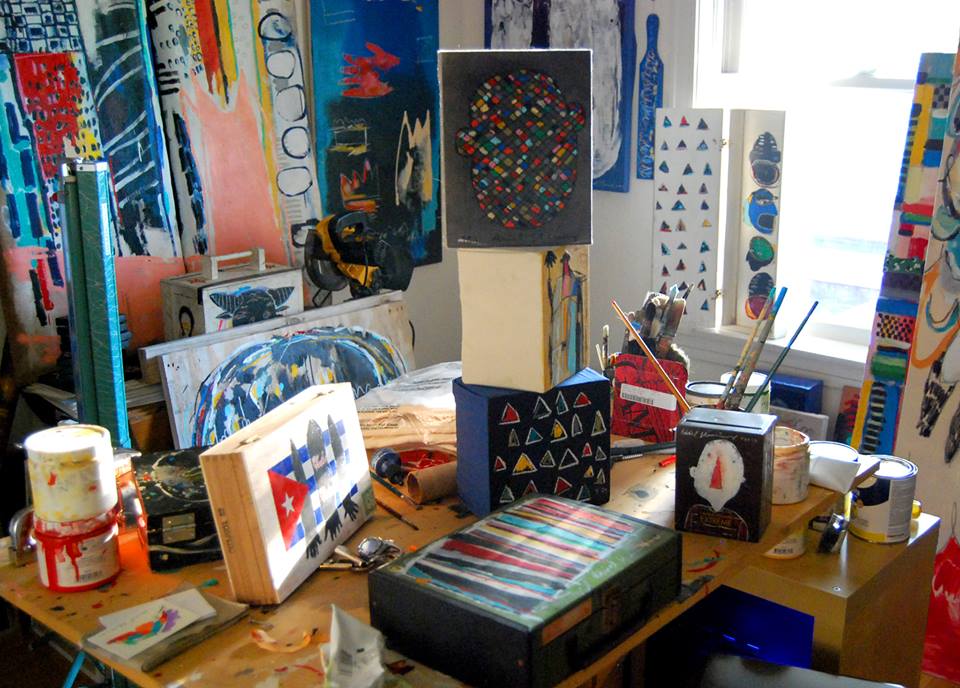
The Studio

The Studio

www.danielflemingart.com

All images copyright of the artist and used with their permission. 

Posted in Painting | Tagged , , , , | Leave a comment

Tim Abel – Asheville, North Carolina

Briefly describe the work do you do.

hand dyed paper circles varying from three to 14 inches, monoprinting, screenprinting, sewing, cut paper, map tacks & methyl cellulose Complete installation fills a 12 x 15 feet corner of the gallery space, window included 2013

hand dyed paper circles varying from three to 14 inches, monoprinting, screenprinting, sewing, cut paper, map tacks & methyl cellulose
Complete installation fills a 12 x 15 feet corner of the gallery space, window included
2013

In my latest work I have attempted to address and challenge my singular, limited view by developing a sense of place that is more complete through borrowed concepts of mapping and collaboration—with other artists, with the material itself and with the site of installation. By working in this manner, I am able to create printed matter that can then be reworked and integrated into larger constellations of printed and dyed sewn works. These materials and processes are based in a practice of the ephemeral, contrasting the source material of the expansive geologic and stellar. The resulting artworks are a temporary effort at understanding shifting ideas of landscape.

At what point in your life did you decide to become an artist?

For as long as I can remember.

Tell us a little about your background and how that influences you as an artist.

When I was ten, I went to the Andy Warhol Retrospective at the Art Institute of Chicago. The experience of running through his installation of Silver Clouds with my twin brother stuck with me.

I have always been interested in how art acts as a connective tool and can be used to foster understanding as related to abstract and concrete ideas, the self and the community.  

Art is democratic and about dialogue: in the making, in the experience, in the viewing. Over the years I have sought out environments that I could bring idea this into practice, either in my own work through the projects I have done, like installing in an empty storefront or using irregular areas of the gallery, or as an art educator teaching all ages or working with teens to create a mural for the side of a Milwaukee City Bus.

(Installed in the storefronts at 309 Pearl Street, La Crosse, WI.) hand dyed paper circles varying from three to 14 inches,  screenprinting, sewing, cut paper, map tacks Detail from central panel, complete installation spans approximately 32 feet 2012

(Installed in the storefronts at 309 Pearl Street, La Crosse, WI.)
hand dyed paper circles varying from three to 14 inches, screenprinting, sewing, cut paper, map tacks
Detail from central panel, complete installation spans approximately 32 feet
2012

What types of conceptual concerns are present in your work? How do those relate to the specific process(es) or media you use?

Artmaking for me is an inquiry: a question grounded in and derived from an intuitive process-based practice. My process is grounded in concepts of printmaking: exploring the usage of the multiple with a keen awareness of the printed surface. The practice of reworking, expanding, further fragmenting or re-puzzling my work back together reflects a desire to discover a sense of order through the process of making.

I am interested in the dialogue between order and disorder, inviting it in to my practice not only through the intuitive construction of my installations but also through seeking opportunities of collaboration with others.  This process is a process of fragments and negotiations, and in the most concrete sense is about finding a new perspective that isn’t singular, but a hybrid finding something beyond the individual collaborators.   In a sense I am echoing Italo Calvino’s epistemological question: “Who are we, who is each one of us, if not a combinatoria of experiences, information, books we have read, things imagined? Each life is an encyclopedia, a library, an inventory of objects, a series of styles, and everything can be constantly shuffled and reordered in everyway conceivable.”

We once heard Chuck Close say he did not believe in being inspired, rather in working hard everyday. What motivates you in your studio practice?

I am a collector, scavenger and pack rat. Making art is my way of maintaining control over these impulses. 

(Installation rising above the vault, along the staircase) hand dyed paper circles varying from three to 14 inches, monoprinting, screenprinting, sewing, cut paper, map tacks 2013

(Installation rising above the vault, along the staircase)
hand dyed paper circles varying from three to 14 inches, monoprinting, screenprinting, sewing, cut paper, map tacks
2013

What artists living or non-living influence your work?

  • Maximalist Minimalist: Eva Hesse
  • Material King: Kurt Schwitters
  • Always: Robert Rauschenberg
  • Father of Tangents: Italo Calvino (see answer for #4)
  • Finding narrative in every layer of the landscape: John McPhee’sAnnals of the Former World
  • Quilts of Gee’s Bend, for the way they constructed their quilts weaving story into the material.
  • Installations as networks and infestations: Nicola Lopez

When you are not making art what types of activities and interests do you engage in? 

I go on everyday adventures with my wife, make temporary planets and solar systems with my nearly three year old son, and maintain a photoblog: continuouscities.tumblr.com

About 

headshotAs an artist, Tim Abel is interested in exploring the dimensional potential of paper and tactile quality of sewing through creating process-based and site-responsive installations. He has exhibited his paper based-installations in soap factories, man-made lagoons and window-front galleries through out the Midwest. Tim Abel holds an MA in Art Therapy from New York University, and graduated from Minneapolis College of Art and Design’s MFA program in 2008 with a focus in Printmaking.

In the Making

In the Making

www.timabelart.com

All images copyright of the artist and used with their permission. 

Posted in mixed media | Tagged , , , , | Leave a comment

Leah Schreiber Johnson – Milwaukee, Wisconsin

Briefly describe the work you do.

Cultural Properties 67-918 2013 sumi ink, dust and pigment on calligraphy paper,  collaged onto Arches 22in x 28in

Cultural Properties 67-918 2013
sumi ink, dust and pigment on calligraphy paper,
collaged onto Arches
22in x 28in

My artwork is varied in media and approach. Much of my work is mixed media, incorporating found images, drawing, painting, and forms of printmaking all together. I also often work in sculptural installation and even collaborative performance. I use this diverse practice to investigate the unexplainable gap between our day-to-day physical experiences and scientific or cultural “truths”.

My current project is inspired by my visit this summer (2013) to Wuhan, China, where I spent 6 weeks teaching and traveling. Rich with texture, pattern, and ornament, the busy city sidewalks became an important physical and visual experience- heightening my awareness of both my need to avert the attentive gaze of those around me, and the varied and cobbled terrain of the growing urban landscape.

While I was there I made a large number of monotypes on traditional Chinese calligraphy paper with pigment, ink, and water, responding to the historical significance of these local materials and traditions. The process for making these works became public performance- carrying my materials with me as I walked, I brushed the sidewalk with water and ink often gaining attention and the assistance of curious passers-by. Sometimes alone surrounded by a skeptical crowd, but more often working together, we pressed the paper onto the wet surface, absorbing the water, ink, and dust left by the Wuhan air. The resulting prints become like archeological records, reflecting the contradictions embedded between China’s esteemed ancient customs and the fleeting nature of its quickly shifting populations and places.

Tell us a little about your background and how that influences you as an artist.

I moved around a lot both as a child and adult. I’ve lived in 9 different cities/towns including Detroit, Flint, Chicago and now Milwaukee for varying lengths of time. I often find myself thinking about navigation and how external influences like location change our understanding of our experiences. Recently influenced by my time in China, I have also started thinking about cultural landscapes- those places where humans’ physical alteration of the landscape becomes a reflection of those people’s attitudes about themselves. My process often starts with found sources like maps and historical records as points of reference to create works that explore experiences of observation, sensation, and fantasy.

Wuhan Lù Index 62-8ABL 2013 sumi ink, dust and pigment on calligraphy paper 16in x 57in

Wuhan Lù Index 62-8ABL
2013
sumi ink, dust and pigment on calligraphy paper
16in x 57in

The concept of the “artist studio” has a broad range of meanings, especially in contemporary practice. The idea of the artist toiling away alone in a room may not necessarily reflect what many artists do from day to day anymore. Describe your studio practice and how it differs from (or is the same as) traditional notions of “being in the studio.”

I tend to have different periods or categories of studio work that require different things from me.I definitely make work that benefits from that alone studio time- it is a reality of my practice. I also spend a lot of time using the internet as a resource and digital software for experimentation and research. When I am making sculptural work, it often starts with found objects, so the occasional trip to the salvage yard or surplus store becomes important studio time as well. But I also find great value in working with others. Collaboration a fantastic way to try new things and explore new territory. I am always open to a good collaborative project in my art making and in
my teaching.

What unique roles do you see yourself as the artist playing that you may not have envisioned yourself in when you first started making art?

Lately I have been thinking much more intentionally about entrepreneurialism and the role of the artist as business owner. I recently took a class about the Lean Start-up model and finding all of the ways it applies to being an independent creative is pretty eye-opening but also really exciting.

When do you find is the best time of day to make art? Do you have time set aside every day, every week or do you just work whenever you can? 

Diagram of studio process

Diagram of studio process

Working full time does impede my ideal studio routine, so during those busier parts of the school year, physical art making is more of a weekend thing. But there is so much else to do besides that physical making! There is thinking, planning, supply-attaining, application and proposal writing, opportunity finding, more writing, documenting, exhibition attending, and social networking to do during any “down time” I can muster. I really find that the only way I can get it all done is to have a very organized list and calendar system that reminds me what needs to be done each week.

How has your work changed in the last five years? How is it the same?

This time in 2008 I was in graduate school and was starting a project called Daily Navigation, a site-specific installation at the American Geographic Society Library. For this project, I recorded and mapped the common pathways of each of the AGSL librarians and hand-stitched those paths into the library carpet. It was a very public process, working on the ground among the library patrons. I definitely see a relationship with the process I worked with in China, making prints directly on the busy city street. In both cases, I was thinking about making a record, the interaction between the space and the people in it, and the process of public art making – though
only one of the projects resulted in what would be called Public Art.

Are there people such as family, friends, writers, philosophers or even pop icons that have had an impact on the work you do?

In graduate school I read a lot of art theory and philosophy, but the truth is I don’t think about it that much anymore. Rosalind Krauss and Maurice Merleau-Ponty have provided ways of framing or describing my interests, but not in a way that I think is important for anyone else at this point.

If you had an occupation outside of being an artist, what would that be and why?

Well, I don’t really think that being an artist is my occupation, since I really don’t come close to making a living from my work exclusively. I am paid primarily as an art educator, and I love it because teaching art and design provides the opportunity to engage with core concepts of contemporary art practice everyday. But chances are that if I had not studied art, I would have taught something else- before I discovered I wanted a career in the arts, I thought I would be a school teacher. But I also realize my parents were very hands-off when it came to my plans for my life. I sometimes wonder what would have happened if I had been under any pressure to study something more economically respected, like medicine or computer programming (neither
of which I showed any real promise for). But who knows- I’m not sure I showed any promise in art either. I just liked being around it and working with my hands in that way. I feel like success is mostly about how hard you work at whatever it is that you do.

About 

headshot2013Leah Schreiber Johnson is a Milwaukee area artist and educator with an interdisciplinary studio practice. She has received multiple awards and honors including a Marshall Frankel Foundation Fellowship and a grant from the Wisconsin Department of Commerce. She participated as Artist-in-Residence at Vermont Studio Center in Johnson, Vermont, The Contemporary Artist Center in North Adams, Massachusetts, the American Geographical Society Library in Milwaukee, Wisconsin and with Milwaukee Public Schools. She has exhibited her work nationally and internationally including Illinois, Indiana, Wisconsin, Arkansas, Alaska, Pennsylvania, Maryland, Virginia, Vermont, Maine and Budapest, Hungary. She has taught at Lillstreet Art Center and the Marwen Foundation in Chicago and at Carroll University in Waukesha. Schreiber received her Bachelor of Fine Art from Illinois State University, and her Master of Fine Art from the University of Wisconsin-Milwaukee where she currently teaches full-time as Associate Lecturer in the Department of Art and Design at the Peck School of the Arts.

SchreiberJohnsonsmallstudioshot

The Studio

www.leahschreiber.com

All images copyright of the artist and used with their permission. 

Posted in mixed media | Tagged , , , , , , | Leave a comment

Carrie Ann Schumacher – Grove, Illinois

Briefly describe the work do you do.

Emil and La Vie En Rose, Romance Novels, 2013, 5’5”x 2’6”x 2’ (Front view)

Emil and La Vie En Rose, Romance Novels, 2013, 5’5”x 2’6”x 2’ (Front view)

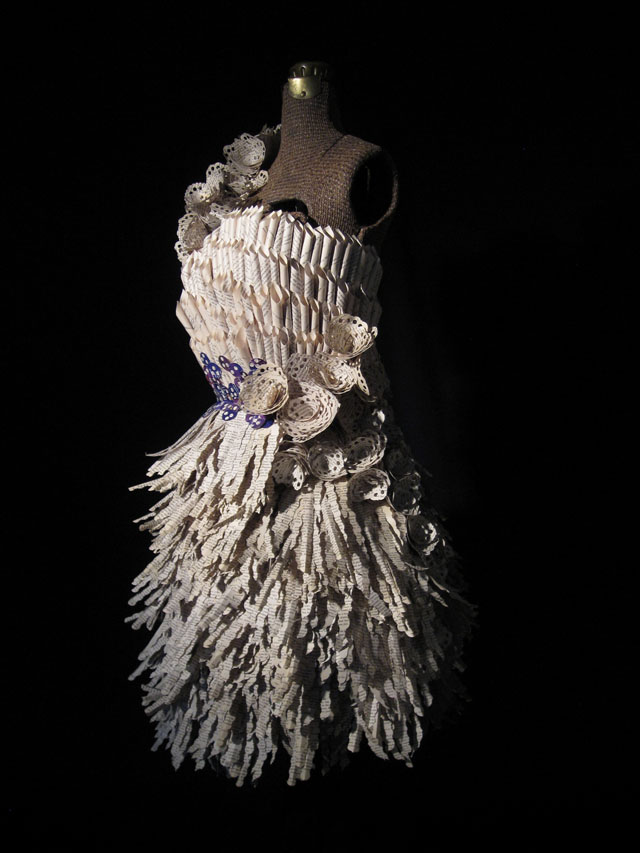
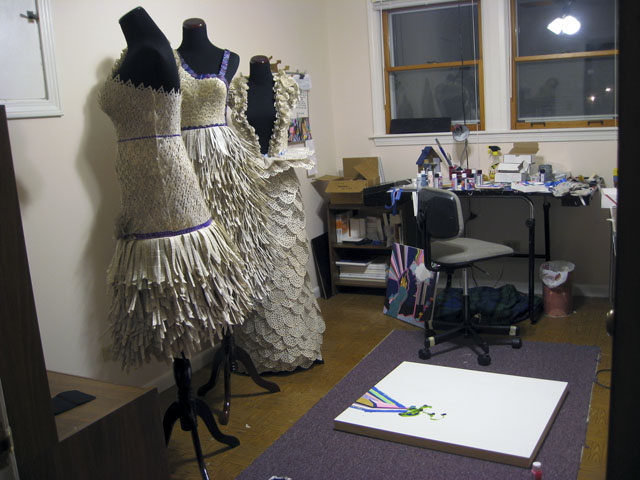
My studio practice is pretty inclusive, actually.  Sometimes it seems that people only want dresses from me, and that body of work tends to get pushed to the forefront.  So while I DO make dresses out of romance novels, I also draw and paint both traditionally and digitally, sculpt, and sew.  My work definitely encompasses a lot of different mediums and styles, and while it makes it difficult to efficiently and concisely summarize in an elevator pitch, I wouldn’t have it any other way.

At what point in your life did you decide to become an artist?

I think I was always an artist in some way, regardless of whether I called myself one or not. When I was little, I was very attracted to the art of storytelling and that consumed much of my childhood activities, whether that attraction was executed in drawing, writing or acting stories out with Barbies and My Little Ponies.  Deciding to officially pursue an art degree my senior year of high school was just a formality.

I also think at some point you have to stop becoming an artist and just BE an artist.  It’s a scary thing.  A lot of us in this field tend to give in to self-doubt, but at some point you just have to take the plunge.  It’s been a gradual process for me where I’ve had to slowly build my confidence until the label “artist” is one I’m comfortable with.

Tell us a little about your background and how that influences you as an artist.

I don’t think my background is that interesting; it’s pretty white bread.  I grew up in the Chicago suburbs, went to Catholic school, got good grades, went to college, met a boy, fell in love, went to grad school with said boy and later married him.  And then we got a dog. 

I do think I had a somewhat lonely childhood, because I was that weird geeky book-loving kid, and that shows up in my work.  My art is both an escape and a way to connect with others.  I get to build my own isolated world in a way, which has always been a really fascinating and attractive concept for me. But at the same time, my art forces me to enter the real world because if a girl doesn’t want to starve to death or live in a cardboard box, she has to talk to people and make opportunities for herself.

Harlequin, Romance Novels, 2011, 5’6”x 3’x 3’ (Front view)

Harlequin, Romance Novels, 2011, 5’6”x 3’x 3’ (Front view)

What types of conceptual concerns are present in your work? How do those relate to the specific process(es) or media you use?

One of my main concerns is always accessibility. I don’t think art has to be elitist to be “good”; it can have really strong conceptual content, but can be readable and enjoyed on a purely visual level as well.  The artist Amy Caterina once told me that you have to seduce the viewer; you want to get your message across, and no one is going to pay attention to you if you try to go over their head and immediately make them feel dumb.  You have to make it fun, and that idea has really stuck with me.  My dresses, for instance, run a gamut of ideas.  They speak about the helplessness of women in a culture that bases their power on their appearances; they criticize the beauty and fashion industries, as well as deconstruct myths about love, and what it means to be female.   They also are a way for me to construct my own folklore about women in my own life, and are a vehicle for me to explore my own personal history.  But at face value, they are just really beautiful dresses, and I don’t get offended if people just want to enjoy them for that.

We once heard Chuck Close say he did not believe in being inspired, rather in working hard everyday. What motivates you in your studio practice?

There are so many things that motivate me in my studio! 

Why You Don’t Kiss and Tell, Romance Novels, 2011, 5’6”x 3’x 3’ (Front view)

Why You Don’t Kiss and Tell, Romance Novels, 2011, 5’6”x 3’x 3’ (Front view)

One thing is not ever having enough time in there- that probably sounds discouraging, but it means there is always something on the back burner that I want to make.  Teaching Monday through Thursday means there are times that I stand in the doorway of my studio and just stare longingly at all the half finished pieces and beautiful empty canvases.

Empty canvases are a great motivator.   They’re just so temptingly blank and there’s that urge to fill. I enthusiastically start a piece and then I make a mistake and the enthusiasm dies. But mistakes also keep me coming back; being a perfectionist means that those errors weigh very heavily on my mind.

I also just really enjoy the alone time.  So many demands are made on my time during the week, it’s a luxury to have a day where you explore nothing but your own thoughts.  I definitely blast Pandora, sing aloud at the top of my lungs and dance; it’s this really great cathartic experience.

What artists living or non-living influence your work?

Nick Cave, Mariko Mori, Cindy Sherman, Yayoi Kusama, Yoko Ono. I just saw this great interview with Chris Uphues and I definitely fell a little bit in artist crush love.  My husband and I own one of his pieces, and I don’t know, it’s just magical.

My husband is my biggest influence; with 2 artists under one room, it just happens.  We steal from each other all the time, and there are definitely times where our respective color palettes show up in each other’s work.  He’s also a great motivator, because there’s always a competitive underlining.  You just spent 8 hours in the studio?  I’m going to spend 10 tomorrow.

When you are not making art what types of activities and interests do you engage in? 

I love going on roller coasters, laser tagging and roller skating; I don’t get to do enough of any of those activities.  My husband and I are somewhat catching up on the TV we missed during our 3 years of grad school, so we are usually bingeing on some show. Seriously, Breaking Bad was pretty much the best thing ever.

I love to read, and I enjoy the domesticity of being at home with my husband and our hyperactive dog.  It sounds lame, but I feel like I’m never at home, so being there is a luxury in a way.

About 

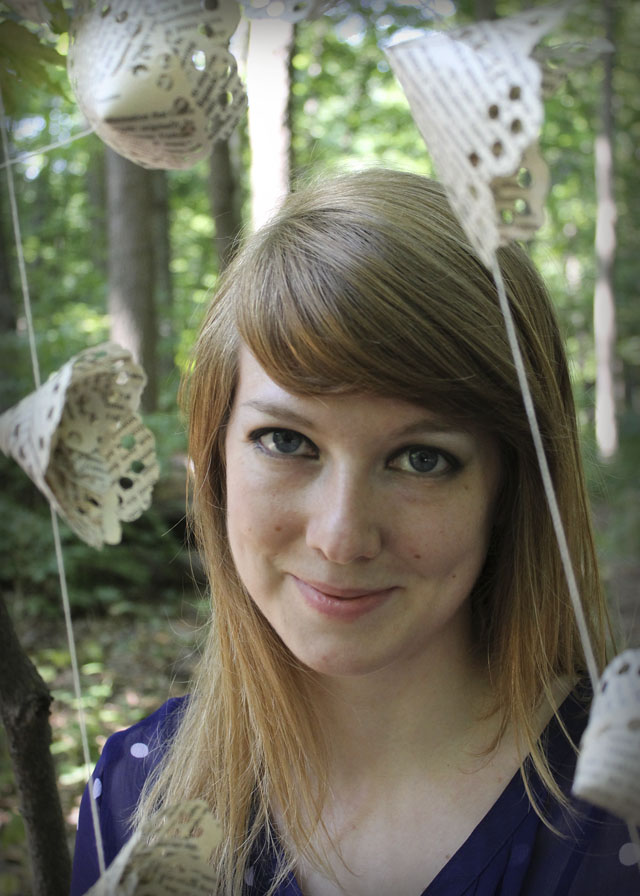
carrie_annCarrie Ann Schumacher is a multi-media artist living and working in Chicago.  She was born in 1986.  Her B.F.A. in Digital Media was received from Elmhurst College in 2008.  Subsequent to that she attended Northern Illinois University, where she received her M.F.A. in Painting in 2012.  She is currently on the faculty at Kishwaukee College, where she teaches Computer Art, Introduction to Visual Arts, and Digital Imaging.

Recent group exhibitions include The Personal is Political: The Transformative Power of Women’s Art at the Koehnline Museum of Art, Des Plaines, Illinois, and Consumer Culture at Woman-Made Gallery, Chicago, Illinois. She has four solo shows next year, starting in January at Moraine Valley College In Cicero, Illinois.

The Studio

The Studio

www.carrieannschumacher.com

All images copyright of the artist and used with their permission. 
Posted in 3D, mixed media, Sculpture | Tagged , , , , | Leave a comment

Andy Mattern – Albuquerque, New Mexico

Briefly describe the work you do.

Driven Snow #8489 Pigment ink print 22"h x 17"w 2011

Driven Snow #8489
Pigment ink print
22″h x 17″w
2011

Using place and everyday objects as inspiration, I investigate un-intentionality, residue, and the unconscious products of modern life. Photography is often a good tool for this work because of its capacity to render detail and its complicated relationship with truth. I am interested in the surface of the photograph and the image as a problematic representational artifact. 

Tell us a little about your background and how that influences you as an artist.

I first became interested in photography in high school, spending hours in my bedroom studio using a Rolleiflex from my grandfather and working intensely in the darkroom. The technical challenges of using slow film and a handheld light meter kept me busy for several years. In college, I became interested in painting and sculpture and ended up working in installation for my thesis, inspired by Robert Irwin, James Turrell, and Richard Serra. My other heroes at the time were Mark Rothko, Erik Satie, and J.D. Salinger. 

Absent Vessel #5256b Gelatin silver print 14"h x 11"w 2013

Absent Vessel #5256b
Gelatin silver print
14″h x 11″w
2013

The concept of the “artist studio” has a broad range of meanings, especially in contemporary practice. The idea of the artist toiling away alone in a room may not necessarily reflect what many artists do from day to day anymore. Describe your studio practice and how it differs from (or is the same as) traditional notions of “being in the studio.”

The importance of having a dedicated space, any space, to make and think about work is vital. I find it much easier to clear my head and get to work when I can be alone and separate myself from the ever-growing list of responsibilities and distractions. I schedule time in the studio and try to focus myself to go even when I don’t have a specific idea of what I will do. This is not always easy. 

What unique roles do you see yourself as the artist playing that you may not have envisioned yourself in when you first started making art?

Like many people who have studied art academically, my understanding of the field has changed dramatically over the years. The idea of being an artist seemed glamorous and romantic when I was younger, but now I find that it really means being the person who is caught staring at a lump of gum on the sidewalk while everyone else is purposefully walking by. There is an attention to the world that is awkward and always present. This attention can feel like a gift and also it can be exhausting. 

When do you find is the best time of day to make art? Do you have time set aside every day, every week or do you just work whenever you can?

I’ve always been a night owl. I enjoy the sense of seclusion and privacy at night, and the feeling that there is no time limit. 

How has your work changed in the last five years? How is it the same?

DVD Remote Control Pigment ink print 22"h x 17"w 2009

DVD Remote Control
Pigment ink print
22″h x 17″w
2009

Certain themes and ideas recur and sometimes it feels like nothing has changed in years, but when I look at the work I see a gradual drift toward more formal and abstract ideas. I try to be very aware of the conceptual underpinnings in the work, but my process never starts there. I always begin with the immediate, the physical, the thing itself and then end up reflecting on what happened. 

Are there people such as family, friends, writers, philosophers or even pop icons that have had an impact on the work you do?

The most significant influence in my artistic life has been from my teachers. Of course, there are too many to name and there are also the artistic and theoretical influences, both personal friends and artists from history. But I feel like it is appropriate to acknowledge the educators in my life like Paul Ford, Walt Pinto, Adrienne Salinger, Steve Barry, Elen Feinberg, Jan Estep, Chris Larson, and Jim Henkel, to name a few. I would not be who I am as an artist or as a person without these people. 

If you had an occupation outside of being an artist, what would that be and why?

In most cases, the life of an artist is a hybrid life professionally. I teach, I do commercial work, and I make art, so I already have occupations outside of strictly being an artist. 

About

Andy_MatternAndy Mattern is a visual artist based in Albuquerque, New Mexico. His often mundane subjects observe the unwitting collaboration between people and the built environment. His photographs and drawings cooly investigate the artifacts of unconscious actions in public spaces. Without focusing directly on people, but instead the traces we leave behind, Mattern puts an undue emphasis on the unintentional aspects of our experience. Visually, his work employs a minimal aesthetic and operates between abstraction and hyperrealism, problematizing the document and pointing to the limits of human control over our environment.

Mattern’s work has been exhibited at Photo Center NW, Box 13 Artspace, the Lawndale Art Center, DeVos Art Museum, Okay Mountain, Katherine E. Nash Gallery, Prøve Gallery, and the Peri Centre for Photography in Turku, Finland. His work has been published online at Fraction Magazine, Humble Arts Foundation, and numerous blogs such as iheartphotograph, Conscientious, and FlakPhoto. He has received grants from the Minnesota State Arts Board, Art Shanty Projects, and Springboard for the Arts. His work is included in the Tweed Museum of Art’s permanent collection.

Andy Mattern holds a BFA in studio art from the University of New Mexico and an MFA in photography from the University of Minnesota, Minneapolis. He currently teaches photography an an adjunct lecturer at the University of New Mexico and the Santa Fe University of Art and Design. 

In the Studio

In the Studio

All images copyright of the artist and used with their permission. 
Posted in Photography | Tagged , , , | Leave a comment

Michael Kautzer – Sussex, Wisconsin

Briefly describe the work you do.

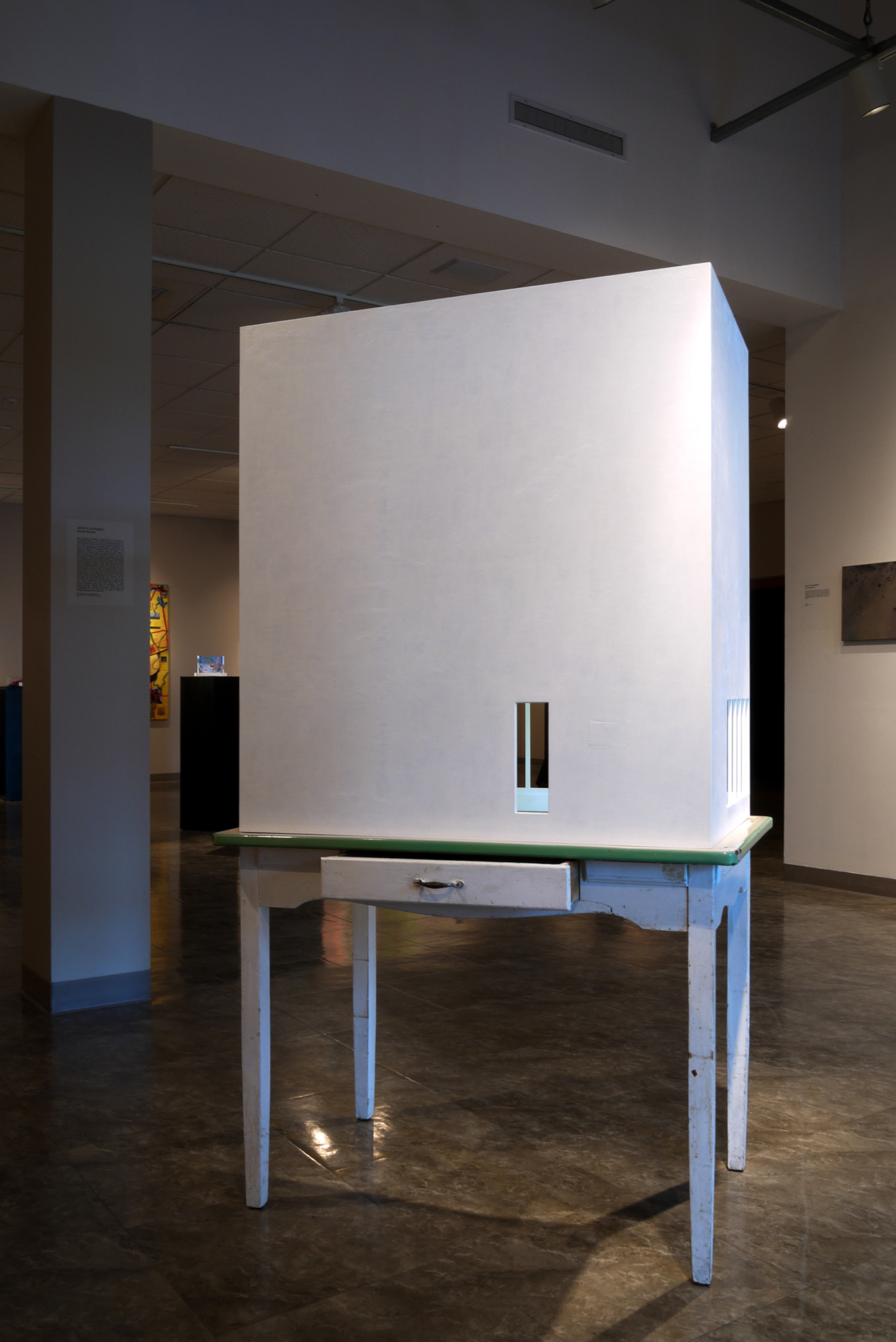
Neu Museum of Contemporary Art, Enamel-Top Table and Mixed Media, 2012, 40”W x 25”L x 72”H

Neu Museum of Contemporary Art, Enamel-Top Table and Mixed Media, 2012, 40”W x 25”L x 72”H

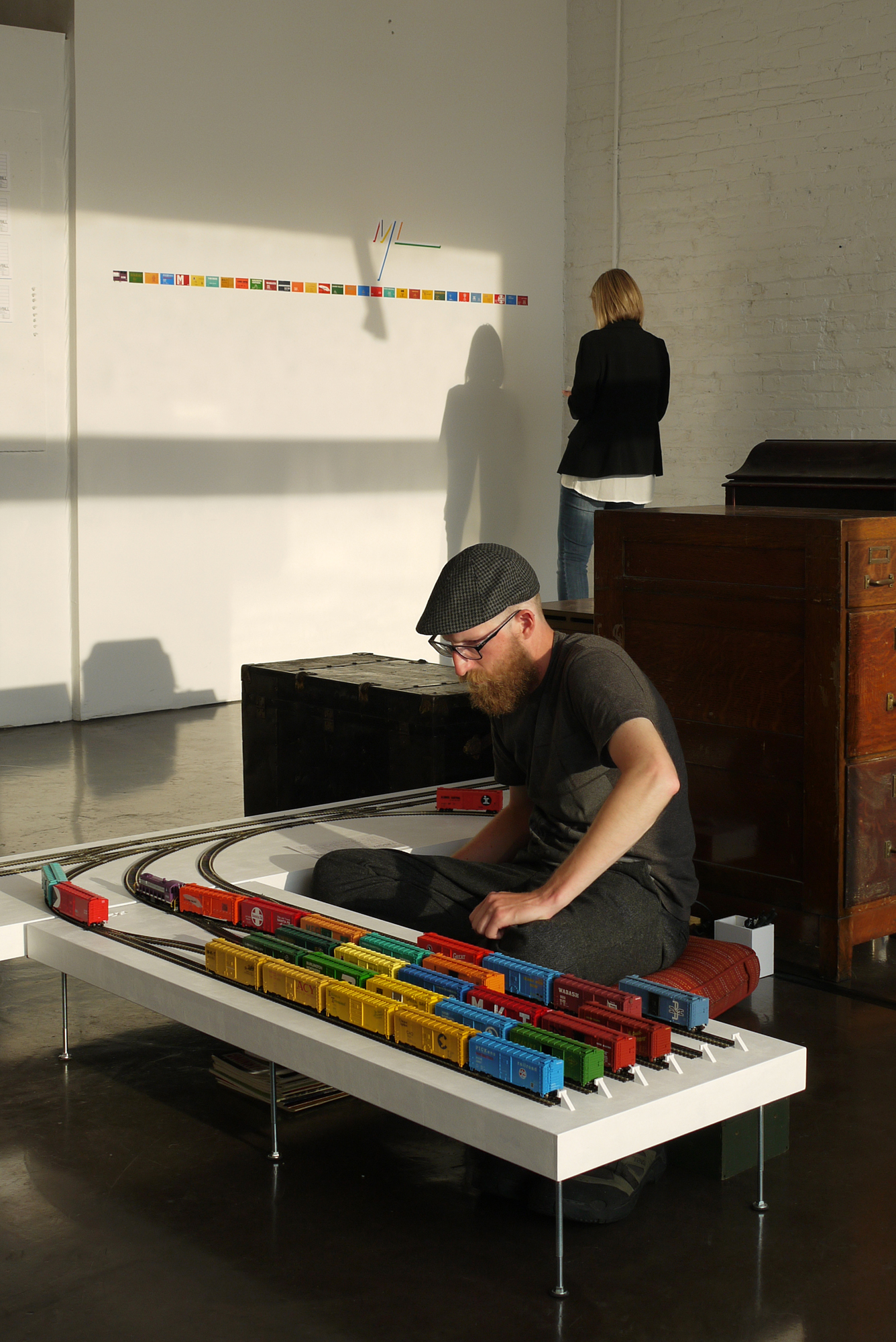
My work is based around three practices including: architectural models, interactive performance, and model railroads. My interest in models lies in their ability to represent architectural ideas and spaces in nice compact packages. This compactness has allowed me to transform them from static representations to being props in my performance pieces. Closely allied with my interest in architectural models is that of model railroads. Always considered a hobby, I recently began to realize its artistic potential and its inherent sculptural and interactive elements.

Tell us a little about your background and how that influences you as an artist.

Since childhood I have been driven to create an alternate world. Whether it is with Transformers, LEGOs, or compact architectural pieces showcasing contemporary artists, they are intended to create a personal storyline to share with others. As an artist I have refined this imagery and employed new materials and techniques.

The concept of the “artist studio” has a broad range of meanings, especially in contemporary practice. The idea of the artist toiling away alone in a room may not necessarily reflect what many artists do from day to day anymore. Describe your studio practice and how it differs from (or is the same as) traditional notions of “being in the studio.”

I wish I could toil away alone in my studio, but my work has led me to create complex if not convoluted pieces that rely on external forces. Each piece requires some degree of collaboration whether it’s during the production or exhibition. I enjoy creating objects, but I also enjoy presenting them.

Kautzer Mighline

Mighline Phase I, HO Scale Trains and Mixed Media, 2013, 72”W x 72”L x 10”H

What unique roles do you see yourself as the artist playing that you may not have envisioned yourself in when you first started making art?

When I first started producing work after college, my work was very solitary and merely a tool for exploring the physical world. The desire to share my travels and findings eventually led to the addition of public performance. Soon I found myself emphasizing the personal stories they provide.

When do you find is the best time of day to make art? Do you have time set aside every day, every week or do you just work whenever you can? 

The process consists of three stages: development, production, and operation. I am always thinking about new projects even while driving or brushing my teeth. Most of the big ideas come when I am not working on something. Usually, I have more ideas than I know what to do with. The better/achievable ideas eventually work their way to the top. Production follows the thought process being stopped and committing to an idea. It then becomes about refining the details and simplifying the concept. Operation of each piece is more defined, with time and location already determined. They are best activated at existing art and cultural events, although impromptu performances also produce interesting results. 

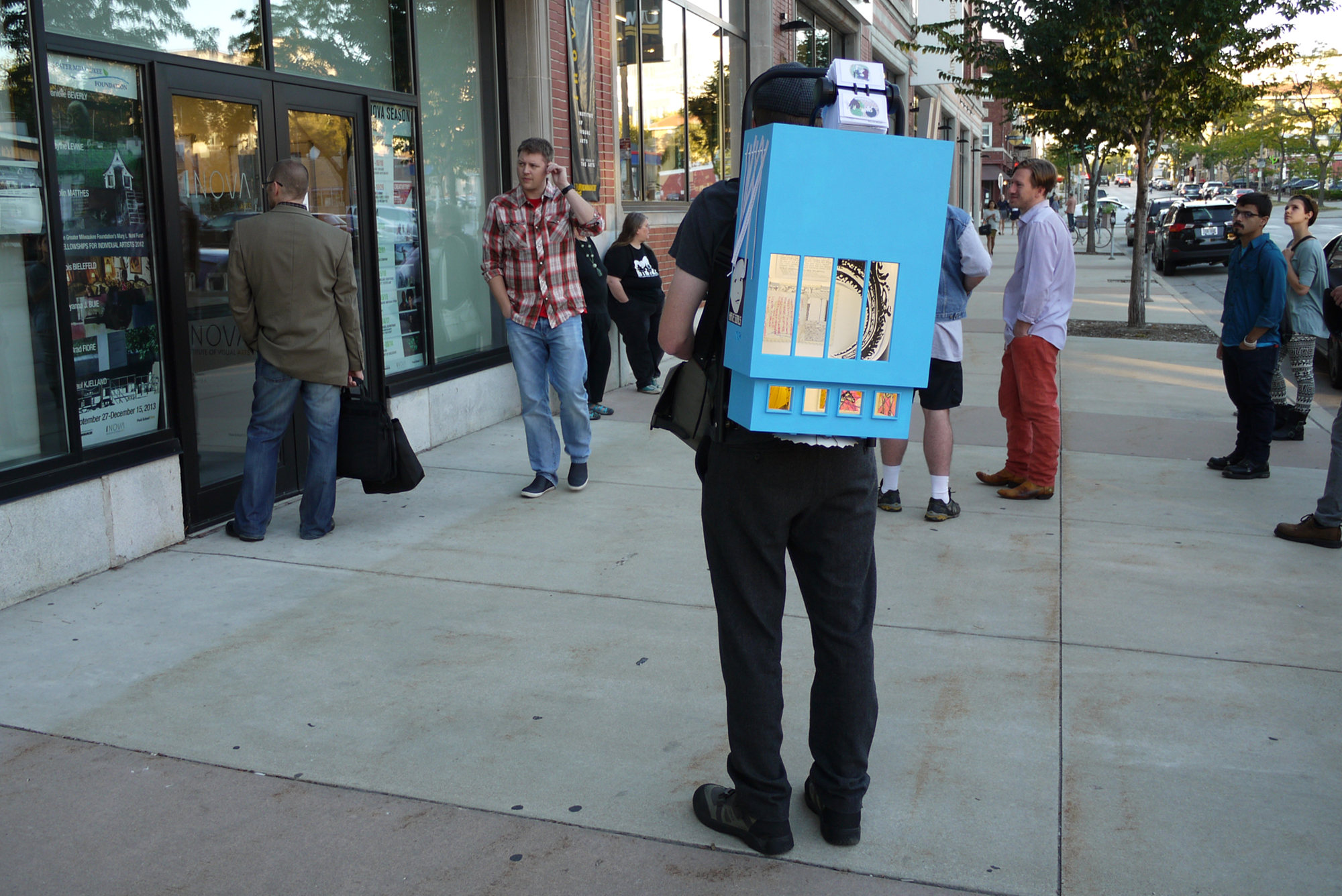
WISCONSIN TRIENNIAL at FRAME gallery (WTatF), Aluminum Backpack Frame and Mixed Media, 2013, 15”W x 11”L x 32”H

WISCONSIN TRIENNIAL at FRAME gallery (WTatF), Aluminum Backpack Frame and Mixed Media, 2013, 15”W x 11”L x 32”H

How has your work changed in the last five years? How is it the same?

My work has incorporated the same compositional themes over the past five years including architectural motifs, simple color schemes, and asymmetrical layouts. During school I despised the simple modern aesthetic, and now I find it to be an essential tool in expressing contrast in my work. What changed are the exhibition venues, use of performance, and overall complexity. The simple white box is now mounted on a backpack and carried around rather than fixed to a wall.

Are there people such as family, friends, writers, philosophers or even pop icons that have had an impact on the work you do?

Major influences on my work are books that deal with the subject of travel and expeditions. Chief among them are A Walk in the Woods by Bill Bryson and The Wild Trees: A Story of Passion and Daring by Richard Preston. Although they have nothing to do with art, they focus on the issues of micro and macro environments, mobility, and personal interaction.

If you had an occupation outside of being an artist, what would that be and why?

I have spent several years working at a landfill testing lawnmowers, which has afforded me a considerable amount of time to ponder the motion of the sun as well as develop new projects. It also presents me with an inspiring, albeit smelly environment.

About 

Kautzer HeadshotI received my Master of Architecture from UW-Milwaukee in 2007 with interest in bio-centric design. In 2009 I created The Epitecture Studio, which explores “epitecture” or “architecture that relies upon”. The emphasis is on the relationship between sculpture and its architectural context. Several key projects include: Neu Museum of Contemporary Art, Hedstrom Sculpture Park, and The Black Frame Gallery/FRAME gallery. Recently the FRAME, a mobile backpack gallery, held its first triennial that exhibited 200+ artists. Currently, I am working on a series of model railroad layouts called Mighline, which explores color and movement through train cars. 

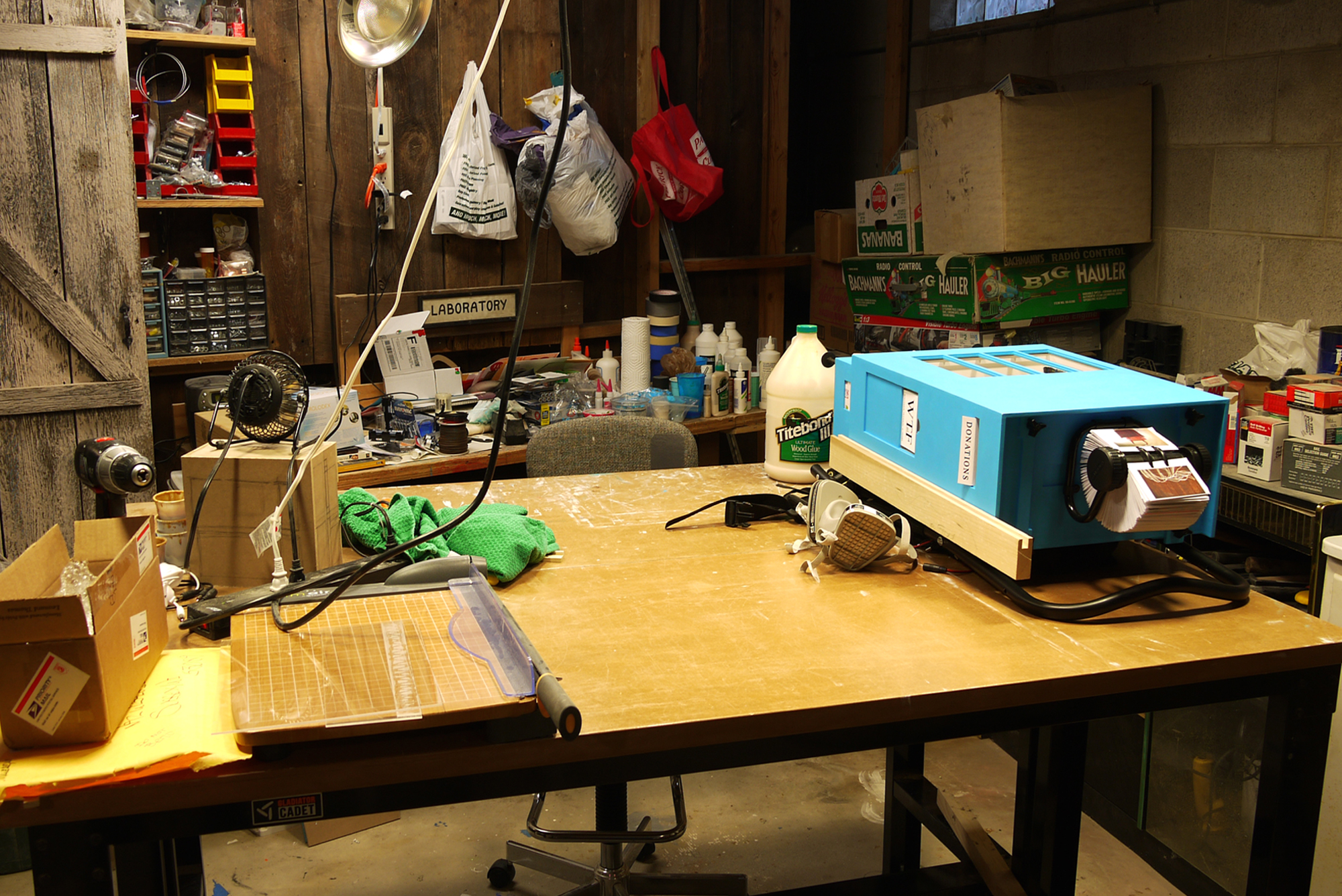
In the Studio

In the Studio

www.epitecture.com

All images copyright of the artist and used with their permission. 
Posted in 3D, mixed media | Tagged , , , , | Leave a comment

Lisa Albinger – Phoenix, Arizona

Briefly describe the work do you do.

I classify my work under Surrealism and it touches on a variety of topics; from what’s currently happening in my life to animal

 The Heatmeister, oil and collage on panel, 12x12 inches, 2013

The Heatmeister, oil and collage on panel, 12×12 inches, 2013

totems and spirituality. Imagery in my work is often made spur of the moment and I like that because I’m trusting my gut. One evening a bug flew into the wet painting, so I added wings to the figure in honor of it. Panic attacks led me to the emergency room a few times so the heart became a key figure in my work. Yesterday morning I found a bird’s nest on the ground and marveled at its intricacy. Later when painting I thought, ‘Ah, the bird’s nest!’ and added it to the painting.

At what point in your life did you decide to become an artist?

My first memory at age 5 is of my mom showing me how to draw the human body. I knew then that I would be an artist as an adult. When I colored in a coloring book I did it quickly because I felt the figure was coming to life as I colored, so I had to hurry and make them complete. They spoke to me and I could hear them, “Finish my arm, thank you!” True story. My first experience with oil paint as a child was a paint by number Arabian horse and I remember being so frustrated that the paint didn’t dry right away. Here I am as an adult choosing to work in oil. Growing up I knew art was my life emphasis and everything else – like math – was just fluff.

Tell us a little about your background and how that influences you as an artist.

I have scoliosis and wore a back brace 23 hours a day for nearly 4 years as a teenager. My organs are shifted around a bit and I ache but I’m grateful for this experience as I know it’s the gateway to my creativity. I’m able to access deeper realms and my intuition guides me. Rabbits with visible hearts and blood draining, morphing into wine seems as normal to me as ordering a cheeseburger with onions.

Shortbread Serenade, oil and collage on panel, 19x23 inches, 2013

Shortbread Serenade, oil and collage on panel, 19×23 inches, 2013

What types of conceptual concerns are present in your work? How do those relate to the specific process(es) or media you use?

I want people to be smarter and open minded, to morph into a better version of themselves. There is no ‘escapism’ in my work – you have to put your thinking cap on. My thinking cap never comes off, even though it itches at times. In my painting ‘The Heatmeister’ his tongue is connected to his heart and that’s because the heart meridian is at the tip of the tongue. The tip of my tongue is often red and that tells me there’s something going on with my heart.

When I’m working on a painting the concept typically morphs along the way so I need a medium that’s as malleable as my thought process, and that’s why I choose to work with oil. I incorporate found objects and collage them onto the board before painting. It saves items from the landfill and it gives them a second life. A bottle cap can represent the sun or a halo; puzzle pieces can represent piecing things together, things fitting together, etc. Collage items in my work have ranged from everything from playing cards to jewelry to boxer shorts. One client asked me to add her cat’s ashes, so I did.

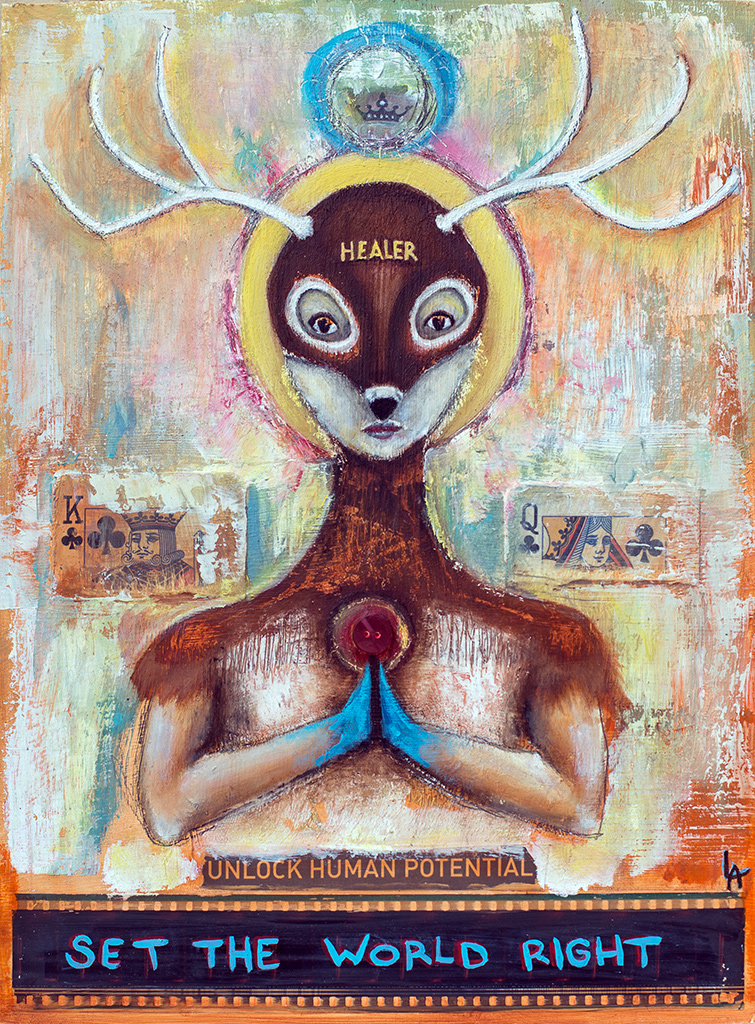
Set the World Right, oil and collage on panel, 9x12 inches, 2013

Set the World Right, oil and collage on panel, 9×12 inches, 2013

We once heard Chuck Close say he did not believe in being inspired, rather in working hard everyday. What motivates you in your studio practice?

What motivates me to paint is knowing that whatever I come up with is something I’m meant to learn and share with others at this moment. I’m compulsed to paint and paint nearly every day. It’s synonymous with breathing. I have to be creative – I have to get these half colored in figures finished and move on to the next one. They talk, they watch you when you eat cheese, it’s haunting. They’re as demanding as my long haired Chihuahua. But that’s how I give life. I’m just a conduit, and I love it.

What artists living or non-living influence your work?

Leonora Carrington, Remedios Varo, Leonor Fini, Faith Ringgold, Fred Stonehouse, Daniel Martin Diaz

When you are not making art what types of activities and interests do you engage in? 

I am passionate about the work of Frank Lloyd Wright and volunteer at Taliesin West in Scottsdale. Otherwise, I’m usually knitting a scarf, watching Doctor Who or Grey Gardens, or reading a book. You can bet there’s usually a cup of coffee within reach. There’s always more to learn and I’m never bored.

About 

Lisa-Albinger-HeadshotLisa Albinger was born in 1976 in Port Washington, Wisconsin. At 12 years of age she was diagnosed with scoliosis and spent nearly 4 years in a body brace that didn’t help, alas the experience shaped her mind to create the surreal and enigmatic worlds in her work. She received a BFA from UW-Milwaukee in 1999 and later moved to Arizona after a pilgrimage to Taliesin West introduced her to the sun and desert landscape.

In the Studio

In the Studio

www.lisaalbinger.com

All images copyright of the artist and used with their permission. 
Posted in Painting | Tagged , , , , | 1 Comment

Jessica Z Schafer – Milwaukee, Wisconsin

Briefly describe the work you do.

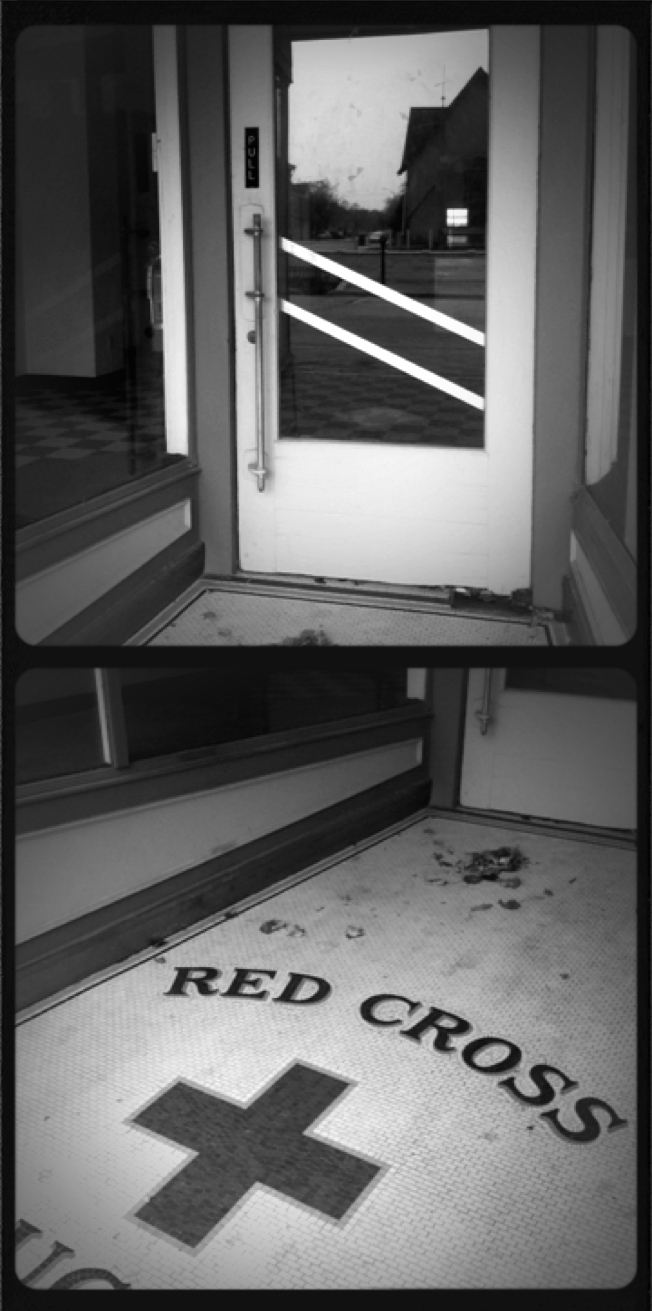
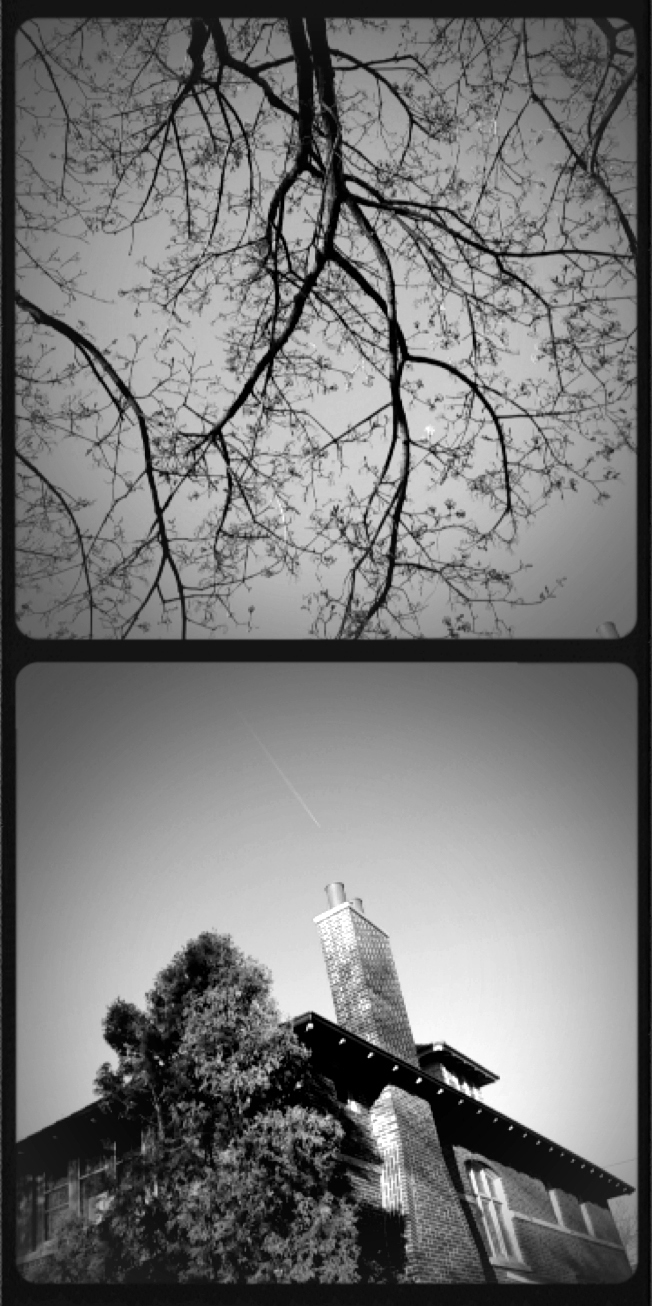
Observation: Sixth Street, 2012 Digital photography 11x14 inches framed

Observation: Sixth Street, 2012
Digital photography
11×14 inches framed

I make digital photographs, most often focusing on landscapes, both urban and rural. Most recently, I’ve been engaged in a continuing project entitled “cinephile.” This series of diptychs and triptychs is heavily influenced by my lifelong interest in classic film. I’ve been honored to hear that these images recall the 1930 and 40s genre, film noir. In each piece, I intend to engage a memory evoking the sentiment of particular place and time. A feeling of nostalgia set firmly within our present surroundings. I make these images with a Smartphone application; some are adjusted in post-production.

Tell us a little about your background and how that influences you as an artist.

I grew up entranced by visits to see classic films at a tiny movie theater called the Gallery Cinema in the Bay View neighborhood of Milwaukee. My mom and I always sat in the front row to absorb black and white comedies directed by Frank Capra and crime dramas like The Maltese Falcon. The cinema’s owner collected old film projectors and stories about the classic films. These pursuits fit perfectly with my burgeoning interest in history and what is now referred to as “the built environment.”

Milwaukee is my hometown. With the project “cinephile,” as well as my other photographs, I intend to highlight personal connections to physical places, depict how our surroundings describe our collective history, and explore the role that familiar landscapes play in defining personal stories.

In my work, my goal is to depict the essential emotions created by living within a post-industrial Midwestern city’s history and defining architecture. The images in “cinephile” use the impact of light and shadow, as well as carefully constructed composition, to establish recognizable connections to and memories about places.

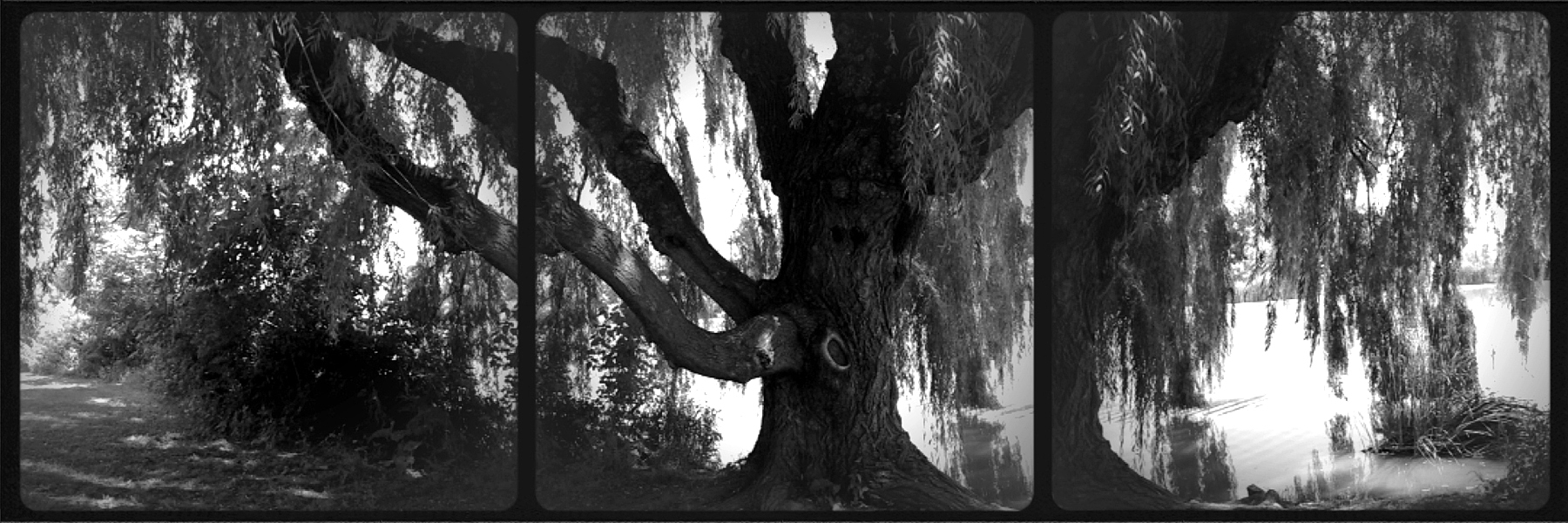
Interpretation: Willow Wept, 2013 Digital photography 14x11 inches framed

Interpretation: Willow Wept, 2013
Digital photography
14×11 inches framed

The concept of the “artist studio” has a broad range of meanings, especially in contemporary practice. The idea of the artist toiling away alone in a room may not necessarily reflect what many artists do from day to day anymore. Describe your studio practice and how it differs from (or is the same as) traditional notions of “being in the studio.”

While I currently have a rather traditional studio space, I use it mostly for framing, presenting, and displaying my photography. The essential work of making images is done on the road––whether walking in cities and towns or hiking elsewhere––with my camera or Smartphone. I select and edit the images on my laptop, which is also mobile. The substance of my artwork takes place as I form project ideas and consider photographs to print and display. This part of the process takes places everywhere, very similar to how the images are made in the first place. So, the contempoary version of my studio is any place that I have time to think, very frequently in my car during my 50-minute long commute, or again, while walking around the city. 

What unique roles do you see yourself as the artist playing that you may not have envisioned yourself in when you first started making art?

When I began making photographs in high school, I envisioned becoming a photojournalist. An internship after college at a local daily newspaper in Massachusetts began taking me in that direction as did a job a photographer’s assistant. It turned out, that I preferred to make images on my own terms. After a pause for other day jobs and a graduate degree in business, I began making documentary photographs to assist a friend on a film project. My love for creating images was rekindled by that endeavor as well as the day job that I’ve enjoyed for a decade, a position in marketing and graphic design for the Racine Art Museum. In 2008, I dove more deeply into the local sphere of fine art photography. My images progressed alongside my interest in supporting the regional art community. Now, I’m thrilled to have become an independent curator, an arts organizer, and writer for the Art City blog at JSOnline.com as well as the Milwaukee Journal Sentinel. Beyond my initial impetus to make photographs, my recent role is to build and reinforce our community’s creative efforts.

When do you find is the best time of day to make art? Do you have time set aside every day, every week or do you just work whenever you can? 

I make art whenever I can, shuffled in amongst my 40-hour workweek, long walks, and other creative commitments. The younger version of myself, as well as my college housemates, would be surprised to find that I’m now most productive in the morning.

Observation: North Point, 2013 Digital photography 11x14 inches framed

Observation: North Point, 2013
Digital photography
11×14 inches framed

How has your work changed in the last five years? How is it the same?

In the last few years, I’ve made mostly black & white photographs. Previously, I was mesmerized by color. My focus on dramatic use of light and shadow, and a preoccupation with balanced composition have remained the same. Throughout the last five years, there have been very few people in my photographs. This is a feature of my work that I plan to adjust in the near future.

Are there people such as family, friends, writers, philosophers or even pop icons that have had an impact on the work you do?

At the foundation of all my images are a few constant forces, Milwaukee and film. Beyond that, the people, landscapes, and culture of the Midwest have shaped my artwork. A tapestry of ideas from friends, family members, regional artists, and area art organizations has become layered into an inextricable quilt of thoughts that influence my aesthetic sense. My photographs also reference concepts of form and an appreciation for highly refined skill that are reinforced by my close daily connection to the contemporary crafts collection at the Racine Art Museum. While I do not name a specific artist, writer, philosopher, or even filmmaker, the sum total of my life experience directs my creation of art. 

If you had an occupation outside of being an artist, what would that be and why?

As noted above, I do have another occupation. I am delighted to conceive, write, and design materials that encourage people to seek out and enjoy art. Creating photographs is a part of the process, sharing art with the community is another significant portion of the joy for me.

About 

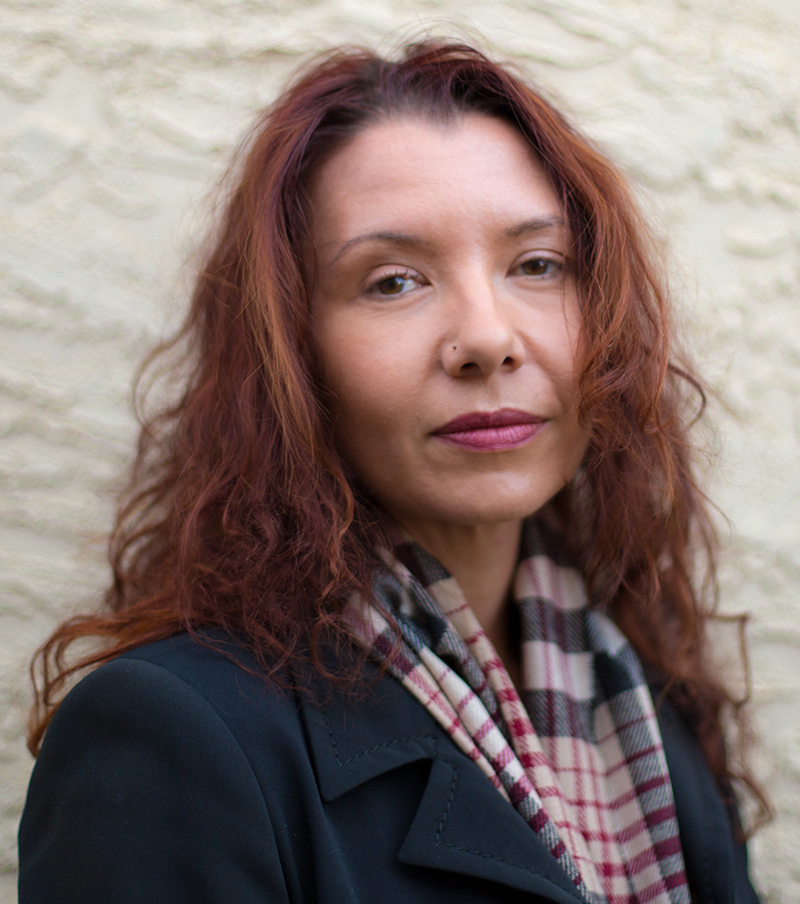
JZSchafer_headshotFor the last decade, Jessica Z Schafer has worked behind, in front of, next to, and beyond the camera. An award-winning photographer, her work has been juried into many regional exhibitions. Jessica’s recent series, “cinephile” was presented as one of four Featured Member Exhibitions in 2013 at the Walker’s Point Center for the Arts in Milwaukee, Wisconsin. Her photography has been highlighted with a solo exhibition at Leenhouts Gallery and included in many invitational group shows throughout the Midwest. “cinephile” was featured in fall 2013 at Cathedral Square, one of the Showcase Venue at the international art competition ArtPrize 2013 in Grand Rapids, Michigan. Wearing many hats, Jessica is also marketing and publications manager for the Racine Art Museum, an independent curator, an arts writer for JSOnline.com and The Milwaukee Journal Sentinel, a programming committee member for the Milwaukee Film Festival, and an artist affiliate of Plaid Tuba Productions in Milwaukee, Wisconsin. 

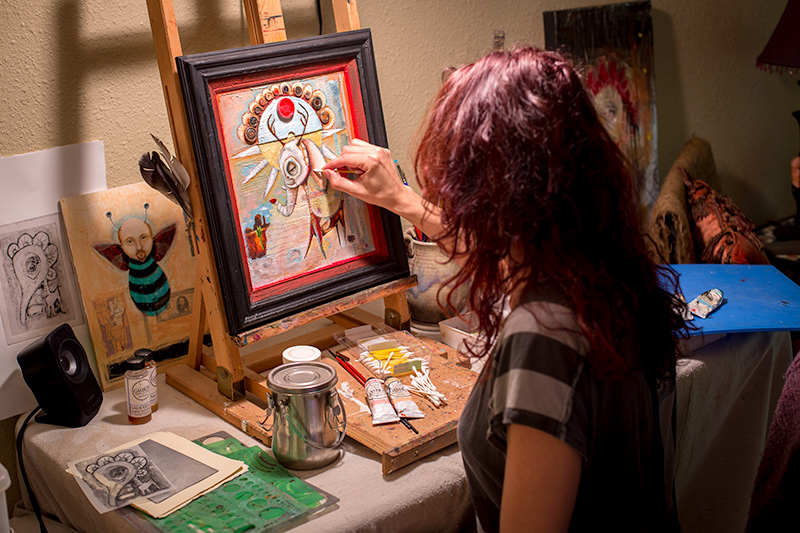
JZSstudio_9075

In the Studio

www.jessicaz.yolasite.com

All images copyright of the artist and used with their permission. 
Posted in Photography | Tagged , , , , | Leave a comment