Mark Rumsey – Grand Rapids, Michigan

"Hapi Ness, Facebook" found images, & transfer prints, 2013 (ongoing)

“Hapi Ness, Facebook” found images, & transfer prints, 2013 (ongoing)

Briefly describe the work you do.

I do many things, each a reflection of a set of circumstances. My primary interest has been a mash-up between building site-specific installation and creating social interactions.

Tell us a little about your background and how that influences you as an artist.

I am from a small Mid-Western farming town, the youngest of seven children, and grew up on public assistance. Growing up in a bucolic environment I spent a great deal of time outside, wandering through woods and fields. I was captivated by the underlying patterns in the natural world, which has influenced my site work. The Mid-West also instilled in me a certain work ethic and appreciation for labor, which also is evident in much of my work.

Being the youngest in a large family, having five older sisters doting on me, I developed a strong sense of self. I was told I can do anything, so nothing really seemed impossible. Educational attainment was not highly prized in our home or community, there was not many voices advocating for poor kids to go to college, but I did, and I chose to study art.

Growing up in poverty really taught me how to do things, to rely on my creative nature. I spent much time in the kitchen with my mother where she would spin meager supplies into loaves of bread and nightly dinners. The ethos was, how can you take what is around you and transform it into something more useful, something better. That is how I approach space, how can I make this space into something greater than it is now.

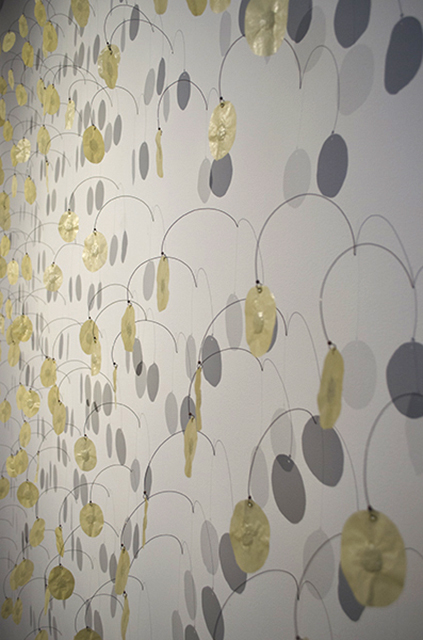
"Baldaquin" folded & sewn paper, 2010, installed at Meijer Gardens & Sculpture Park

“Baldaquin” folded & sewn paper, 2010, installed at Meijer Gardens & Sculpture Park

The concept of the “artist studio” has a broad range of meanings, especially in contemporary practice. The idea of the artist toiling away alone in a room may not necessarily reflect what many artists do from day to day anymore. Describe your studio practice and how it differs from (or is the same as) traditional notions of “being in the studio.”

My studio practice is in my head, on my laptop, at my dining room table, and sometimes most of my house, if I have a large project in process. When I left undergrad, a ceramics major, I realized that I was no longer surrounded by the equipment I was use to using, so I shifted, and continue to shift as my making practice changes. Much of my work now is about planning. I still fall back on occasion to a more traditional studio practice, usually associated with having a studio during an artist residency.

What unique roles do you see yourself as the artist playing that you may not have envisioned yourself in when you first started making art?

When I first started on the path to being an artist my work and thought were mostly about me, my identity, my emotional state. Then one day I realized, no one gives a shit about me as a subject, which caused me to start looking around me. Now, as an artist, my role is a mix of community organizer, social entrepreneur, event planner, mentor, teacher, and maker.

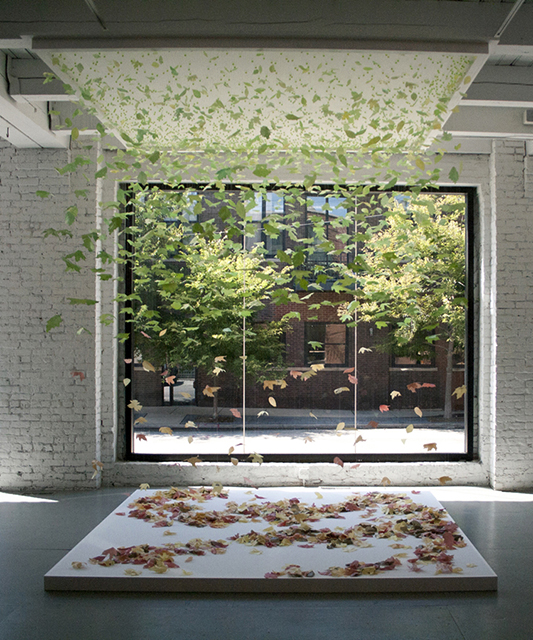
"Deshabille" paper & community engagement process, 2012, installed at High Five project space

“Deshabille” paper & community engagement process, 2012, installed at High Five project space

When do you find is the best time of day to make art? Do you have time set aside every day, every week or do you just work whenever you can? 

I am a full-time artist, my mind is always engaged with how I can manipulate what is around me. I wake up, make coffee, pack my wife’s lunch, and then start going through my mental list of things to do – e-mail show proposal, clean bathroom, update website, lunch with friend, research new materials…

How has your work changed in the last five years? How is it the same?

Five years ago I was just starting what would become a series of large scale, site-specific installations made of paper. That process began with me sitting at sewing machine for three months to make the components and ended with me showing up on site with a box of paper and a matrix for community engagement. My latest projects at engaged with the virtual world that we all invest so much time in. I am interested in modes of engagement that co-opt social media platforms and explore how this virtual world is changing our lived, physical world.

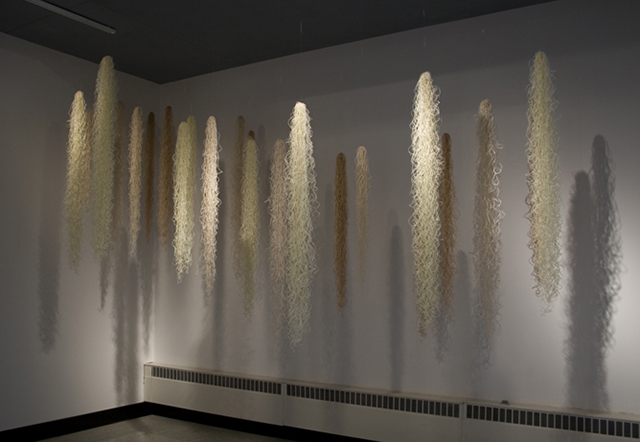
"Dr. TJ Eckleburg" (detail),  folded & sewn paper, 2008, installed at ActiveSite

“Dr. TJ Eckleburg” (detail), folded & sewn paper, 2008, installed at ActiveSite

Are there people such as family, friends, writers, philosophers or even pop icons that have had an impact on the work you do?

The world around my provides the fodder for my making, my ideas. I do not really look to other visual artists to inform my making practice, art about art holds no interest for me. I have a few artist friends that I have developed a long-term dialogue about art with which continues to inform me about the drive to make things. Travel has been important, to be immersed in another culture has helped me make correlations about the human experience across space, maybe even across time.

If you had an occupation outside of being an artist, what would that be and why?

I have, for a dozen years, at least part-time, as a non-profit administrator, you know, working on budgets and grants, that sort of thing. I could have done other things, I was as much into math and science as I was art when I was younger, maybe more so. I am not sure if I would do anything else, as an artist you can play with the entire spectrum of thought and information, all of our known world, or for some artist even the unknown world. If it were 1950, I would have made an excellent factory worker.

rumsey headshotAbout 

Mark Rumsey is an artist working in social situations and spacial manipulations. His work has been exhibited in China, Austria, Canada and much of the United States. Rumsey is a Michigan native and earned a BFA in Art and Philosophy at Grand Valley State University (MI). He pursued graduate studies at Montana State University (Sculpture) and The Ohio State University (Landscape Architecture) prior to completing an MFA in Printmaking at Kendall College of Art & Design (MI).

Rumsey has engaged in travel in the mode of cultural immersion including studying in China and Egypt as well as time in Nepal, India, Turkey, Germany, The Netherlands, Belgium, Canada, Austria, and much of the United States. He has been an Artist-in-Residence at The Swatch Art Peace Hotel (Shanghai, China), Rondo Atelier (Graz, Austria), The Studios of Key West (Key West, FL), Frans Masereel Centrum (Kasterlee, Belgium), Carvansarai (Istanbul, Turkey), and Global Arts Village (New Delhi, India).

Over the past decade Rumsey has been actively engaged with the non-profit sector in Grand Rapids and has worked to develop projects such as the Free Radical Gallery, Art Downtown, East Hills Tree project, Uptown collaboration, and Wealthy Heights initiative. Currently he serves as an Adjunct Professor At Kendall College of Art & Design and as a consultant to local mission driven organizations.

http://www.markrumsey.com

All images copyright of the artist and used with their permission. 

Posted in Uncategorized | Tagged , , | Leave a comment

Katrin Mäurich – London, United Kingdom

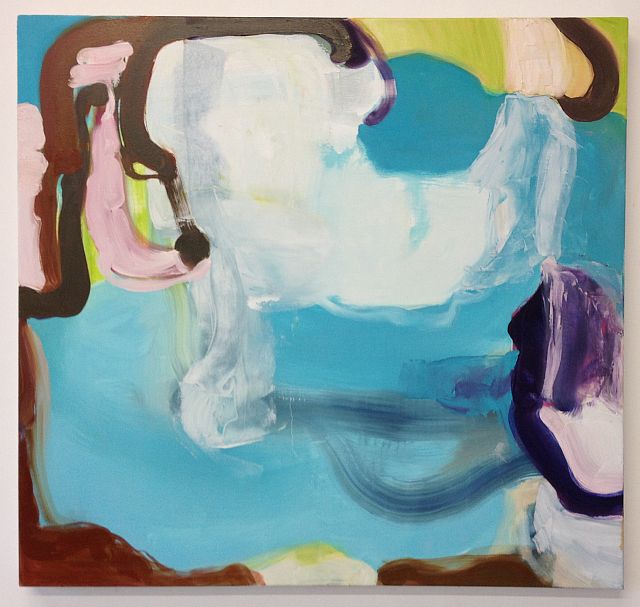
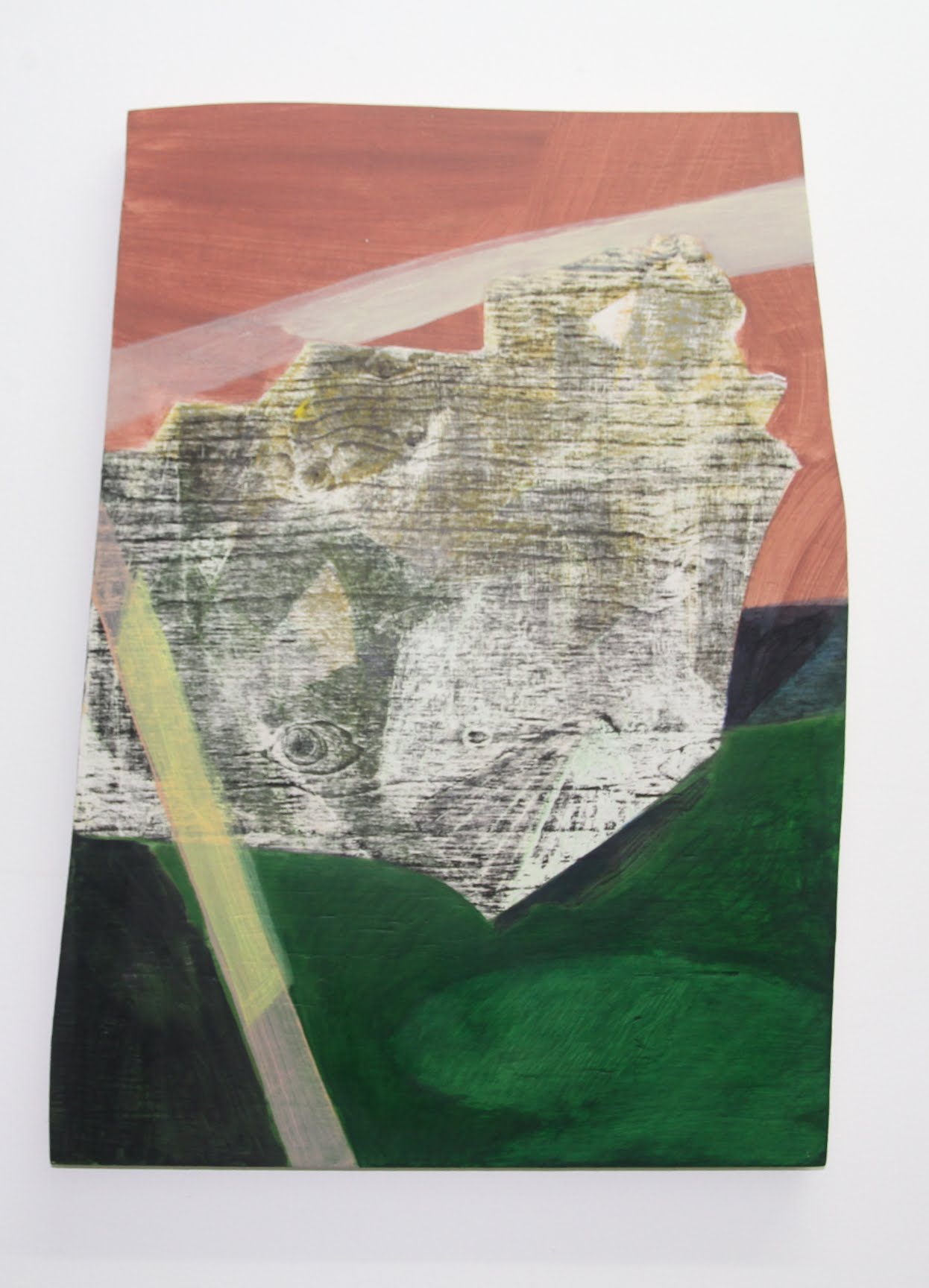
dove grey curve 2014, 33x36cm, acrylic and varnish on plywood

dove grey curve 2014, 33x36cm, acrylic and varnish on plywood

Briefly describe the work you do.

I have been painting with acrylics on plywood for several years. The painting’s outer shape and edge had begun to interest me and moving from paper to wood allowed me to explore this aspect more substantially. The boards are first cut to size with no other concern than the achievement of an interesting single shape which may be more or less irregular. The painting process begins, after careful consideration of this shape, with an opening move; each further decision is then made in response to the outcome of the previous one. I do not make preparatory drawings as such; the elements of my paintings are based on personal visual memory and are sometimes developed through sketching.

It is important that the painting is a step ahead of me. This creates the space needed to stay agile and responsive in the process – not to plan and lead but to put one foot after the other, be watchful and recognise opportunities as they emerge. The finished painting can never be anticipated at the outset; when successful, it achieves a certain level of incomprehensibility without being wholly inaccessible. The aim is something that appears simple but might not be that easily grasped.

At what point in your life did you want to become an artist?

My initial impulse was to say at 18, when I decided to move to England for a couple of years and thought I might as well do some studies while I was abroad, So I applied to take Fine Art, History of Art and Italian at University near London. At the time I thought of this as a temporary move, something transitional. I never meant to complete a degree; the plan was to return to Berlin and study Architecture or Design or perhaps become a cabinet maker. I’m not sure when exactly I finally felt I was an artist and would always be one. But it was much later, a few years after completing my BA, in my late twenties, when I had been living in London for a while. I decided to give up my studio and stopped painting for a bit to check whether I had just been carrying on for the sake of it…  That was an important test and significant turning point. I became serious about my work then.

ernst cliff 2014, 41x58cm, acrylic on plywood

ernst cliff 2014, 41x58cm, acrylic on plywood

Tell us a little about your background and how that influences you as an artist.

I can’t say I had a particularly cultured upbringing but I had always enjoyed drawing and making things as a child, as early as I can remember, and I think my mother encouraged that ( it was probably  the only time I was quiet). It isn’t immediately obvious from my background, why I became an artist. It might have been a matter of wanting something different, something I had caught a glimpse of in the copious amounts of books I devoured when I was younger. I think that my understanding and appreciation of the visual arts really developed rather late and slowly. Though I could engage with painting intellectually and appreciated them aesthetically, I didn’t truly “get it” until I was floored by the Philip Guston show at the Royal Academy in 2004. That was my eye opener and from there on I started to really see art and make connections everywhere: Richard Tuttle, Raoul De Keyser, Phyllida Barlow, Graham Sutherland, Helen Frankenthaler… well that list is long of course.

What types of conceptual concerns are present in your work? How do those relate to the specific process(es) or media you use?

I am not concerned with concepts in my work.

trotternish blue 2014, 29x36cm, acrylic and varnish on plywood

trotternish blue 2014, 29x36cm, acrylic and varnish on plywood

We once heard Chuck Close say he did not believe in being inspired, rather in working hard everyday. What motivates you in your studio practice?

The intensity and personal challenge of painting – I am 100% responsible for everything that goes on in my studio. It’s the most self-involved activity I indulge in – endlessly engaging, immediate, fresh and exciting. Just keeps on giving. And then there are these moments of pure giddy joy when I have put the final touch to a painting, step away and realise it’s good – that it really works and is entirely its own.

What artists living or non-living influence your work?

There are many artists I greatly admire and whose work means a lot to me. But while they certainly give me confidence, inspire and fire my ambition to continuously improve my practice , I can’t say that they influence my work. I can only follow my own trajectory. The only other artists who actually influence me are my peers who come to visit my studio and who I can talk to about my paintings. Their generous and honest engagement and criticism are immensely encouraging and help me to push my work further.

When you are not making art what types of activities and interests do you engage in?

I see exhibitions of course. Also read a lot (novels, non-fiction, poetry, art books, magazines), love the theatre, all kinds of music and I try to get out into the countryside as much as I can. I cycle, run or swim every day.

About

5_headshotKatrin Mäurich was born in Berlin and moved to the UK in 1999 where she gained a BA in Fine Art from Reading University in 2003. Katrin has been living in London for the last ten years. Apart from exhibiting her paintings regularly, she has also been the founder and organiser of series’ of artist talks and art salon events.

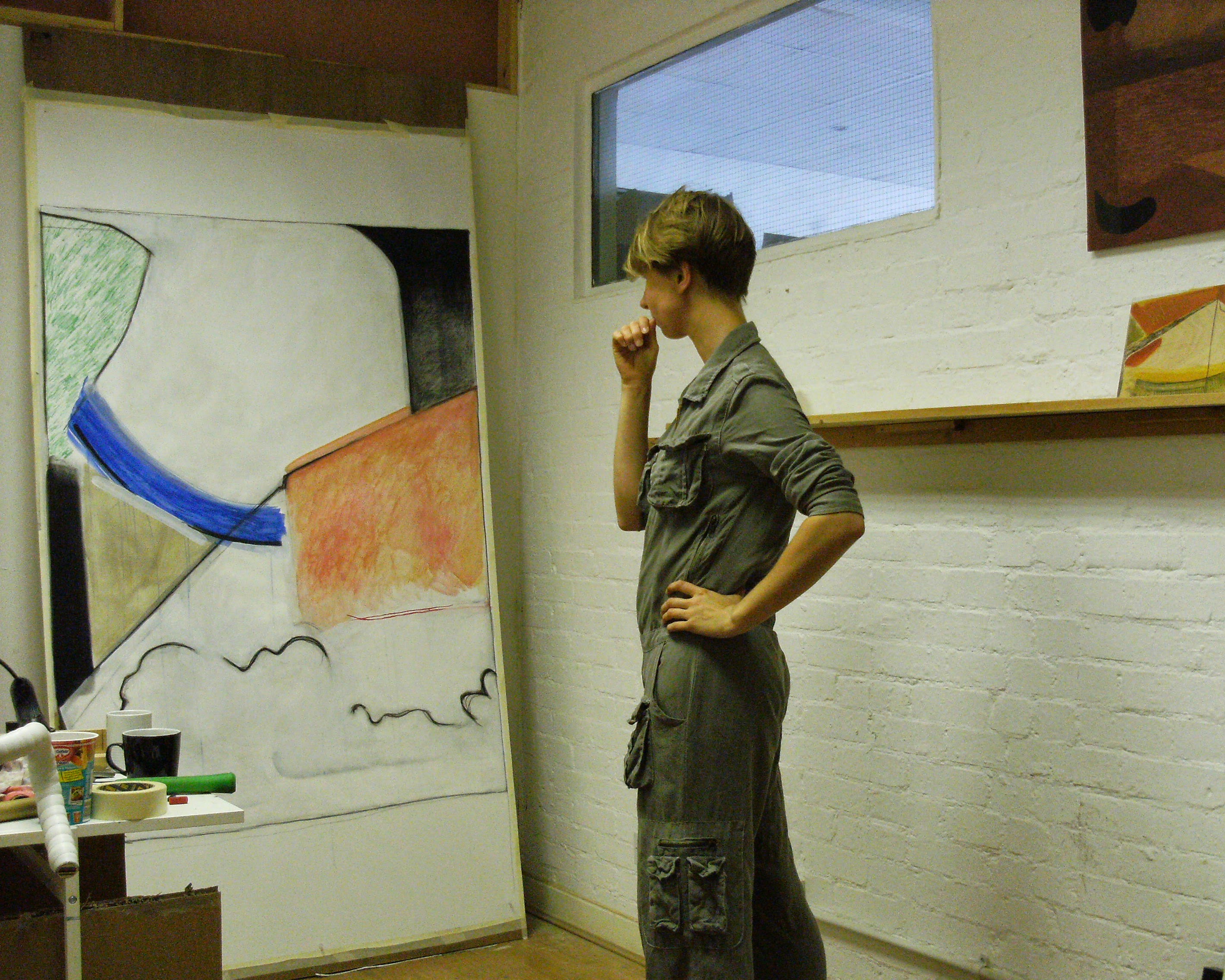
In the Studio

In the Studio

www.maeurich.co.uk

All images copyright of the artist and used with their permission.  
Posted in Uncategorized | Tagged , , , , | Leave a comment

Viviane Silvera – New York, New York

Film Interior No. 1 Acrylic on canvas 30" x 40" 2014

Film Interior No. 1
Acrylic on canvas
30″ x 40″
2014

Briefly describe the work you do.

My last two series of paintings—Therapy: Part I (2011) and Therapy: Part II (2013)—investigate the psychological and the solitary, and the interplay between reality and dream.

I used film stills from Ordinary People, The King’s Speech, and the HBO series In Treatment, as compositions for paintings. I overlaid washes and applied thick paint layers to transform specific figures into archetypal images exploring the human condition. The narrative is left up the viewers’ imagination in this series of haunting and moody paintings.

My current work explores themes of connection versus disconnection, dreams versus reality, and the conscious versus subconscious. Using new mediums—including gouaches on paper and a film I shot using two actors—I create a dreamlike narrative, unraveling the central character’s inner world.

I photograph my process and the paintings as they develop, and will splice together these images for a film. The paintings and film create a dreamlike mood, where time and season collapse.

At what point in your life did you want to become an artist?

My decision to become an artist was very gradual process of immersion and exposure to the life of an artist. When my family moved from Hong Kong to Brazil when I was ten years old, I started to copy figure drawings from a book I found. I filled my entire sketchbook with drawings of hands, feet and faces. After seeing my drawings, my parents took me to meet a Brazilian painter, Roberto D’ Oliveira. Although he mainly taught older students, 18 years and up, he agreed to take me on in his studio as a student on weekends, even though I was only 12 at the time. While I loved being immersed in a professional artist studio, and even showed a painting in an exhibition, but I didn’t imagine pursuing art professionally. Yet, the materials in the studio made an everlasting impression on me.

After college, where I studied Psychology, Political Science, and Film, I moved back to New York . I worked as a script-reader and interned at film production companies, while taking painting classes at the Art Students League on the weekends. It was at the League that I realized I wanted to, and could, carve out a life as an artist. Being exposed to other serious art students and professional artists showed me how I could find my own path.

Therapy No. 30 (Dream) Acrylic on canvas 30" x 40"  2013

Therapy No. 30 (Dream)
Acrylic on canvas
30″ x 40″
2013

Tell us a little about your background and how that influences you as an artist.

I was born in Hong Kong, moved to Brazil when I was ten, and came to New York City at fifteen years old. I have no country of origin. My parents are not American, and although I grew up in an English-speaking household, my parents speak Arabic to each other. Before moving to New York, I went to a British school, where my best friends came from many different ethnicities and nationalities. When we moved to Brazil, I went to an international school with a duel curriculum taught partially in Portuguese. I didn’t speak Portuguese at the time, and my school experience constrained how I expressed myself verbally. So, I turned to visual expression. I started carrying a sketchbook with me everywhere and sketching constantly.

Growing up in places where I didn’t speak the native languages created a sense of not fitting in. I think many people who become artists have formative experiences that place them in the position of observer, rather than participant. If I had grown up with a sense of belonging, a sense of place and easy communication, I think my art would be very different. I remember watching a documentary on Martin Scorsese where he describes being afflicted with polio as a child, and spending years isolated in his bedroom, watching the kids playing outside from his window—defining the way he watched the world—almost like scenes in a movie.

What types of conceptual concerns are present in your work? How do those relate to the specific process(es) or media you use?

Conceptually, I am interested in memory. In 2008, I did a series called Borrowed Memory. Attempting to reconnect with my blurry childhood memories I made drawings using white charcoal—(the white representing memory)—on toned paper of old snapshots from my childhood in Hong Kong. I also used images I found on the Internet of other children in Hong Kong in the 1970’s. Working from other people’s photographs allowed me to borrow their memories, to incorporate them into my psyche as if they were my own.

I continued to explore memory in my 2011 series called Therapy. I painted from film stills from both television and movies that resonated in some way with my own experiences. I also became intrigued by the idea that light, in an image, could tell the story of the subconscious. Those paintings are about the ways that light reveals a mental landscape.  In Therapy: Part II, I shifted my focus from memories to dreams. I used still images from The Kings Speech to explore the inner life of a solitary character  (as opposed to a relationship between two characters which was the focus of Part I). 

The mediums I used; white charcoal, dark toned paper, gouache, and in select paintings monochromes, distinguished my painted scenes from being mere illustrations of the film stills. I used these mediums to indicate light and mood. I chose to work from unmemorable stills—the split seconds you don’t notice.

Therapy No. 9 (Safe Passage) Acrylic on Canvas 48" x 60"  2011

Therapy No. 9 (Safe Passage)
Acrylic on Canvas
48″ x 60″
2011

We once heard Chuck Close say he did not believe in being inspired, rather in working hard everyday. What motivates you in your studio practice?

I definitely do not wait for inspiration. As a mother of two young children, and director of On Art (an art tour company), I have limited hours when I can work in the studio; I just get to work right away when I am there. I have moments—when a body of work or a project is completely finished—when I feel as if I am at a loss as to what to do next. At those points I turn to writing. I always write down exactly what I’m feeling. For instance, when I finished Therapy: Part II I wrote, “I don’t know where I want to go from here.” Once I write down my feelings of stagnation, a new realization comes. Using writing after Therapy Part: II, I realized I wanted to create my own moving images, rather than work from pre-existing movies.

What artists living or non-living influence your work?   

I’m interested in Irving Petlin, whose work is often about memory. My other influences are Donatello, especially his Mary Magdalene sculpture, and William Kentridge, who is a huge inspiration.  I once heard him say that “meaning accrues through process” and that resonated with me.  While I start with a concept, the idea often changes as I work, and process is integral to everything I do. What I love about Kentridge is how he evokes memory and tells a story without being didactic. He combines the still and moving image, taking something old (drawing in charcoal) and making it new and exciting.

When you are not making art what types of activities and interests do you engage in?

When I’m not making art, I’m researching and talking about art. I run a small company, On Art, that provides independent tours—that include private talks with artists, curators, and dealers—in galleries and studios throughout New York City. Learning about other people’s work can be very inspiring.  I alternate every three months between my own studio artwork and the art tours. I am also a mother to two great girls, Mia and Lila,  who are seven and five years old. They fill all of my time—often with their own art projects–outside of the professional art-related work I do.

 About

ImageViviane Silvera was born in Hong Kong and was raised in both Hong Kong and Brazil before moving to New York City at the age of fifteen. After earning her BA from Tufts University, Viviane returned to New York City where she received her MFA from the New York Academy of Art.

She has an upcoming show in Fall 2014 of new work at The Edward Hopper House. In 2013, she received the Award of Excellence at the Edward Hopper House, selected by Susan Cross, Mass MoCA. While in art school she received numerous awards and scholarships including the Chaim Gross Scholarship, the Valerie Delacorte Scholarship and the Harriet Whitney Frishmuth travel award.

She has been the recipient of grants from the Vermont Studio Center and the Newington-Cropsey Foundation.

Viviane has had six solo exhibitions in New York galleries. She has also exhibited in many group exhibitions including at the Museo de la Cuidad-Mexico, the Albright Knox Gallery and the Dahesh Museum.

Viviane’s work can be seen in the Clinton Presidential Center art collection in Little Rock, AR, The Tullman Collection at Flashpoint Media Academy in Chicago IL and in Vanderbilt University’s outdoor bronze sculpture collection in Nashville, TN.

Her work is included in many private collections and has been featured in the Wall Street Journal, Gotham magazine, Time Out New York, The NY Press, American  Artist and Sculpture Review magazines as well as in various catalogs and papers.

In the Studio

In the Studio

www.vivianesilvera.com

All images copyright of the artist and used with their permission.  

Posted in Uncategorized | Tagged , , , , | Leave a comment

Connie Wolfe – Chicago, Illinois

Isolation Intaglio on Mulberry, Glass Beads, Acrylic Medium and Copper Wire Variable Installation (300 pieces) 2013

Isolation
Intaglio on Mulberry, Glass Beads, Acrylic Medium and Copper Wire
Variable Installation (300 pieces)
2013

Briefly describe the work you do.

My work is an examination and exploration of various phenomena found in nature. I tend to get lost in and obsessed with the patterns and textures encountered in my travels. The work is translated into installations, prints and other mixed-media pieces based on these observations.

Tell us a little about your background and how that influences you as an artist.

I grew up in Kenosha, Wisconsin; which is a small town on the southeast border of Wisconsin on Lake Michigan. My proximity to Milwaukee and Chicago was great in terms of looking at art, but I stayed in Kenosha for my undergraduate degree. After, I was a graphic designer for five years in the same region, so I didn’t really get to travel until that time. I remember my first flight was to Detroit for work and that I was really excited about seeing new things both architecturally and in nature. This is where my passion for investigating nature began and I decided to pursue my graduate degree in Athens, Ohio. All of my work in those years stemmed from exploring new places including two month-long study abroad programs in Italy and in England. All of these experiences definitely shaped how my art evolved.

The concept of the “artist studio” has a broad range of meanings, especially in contemporary practice. The idea of the artist toiling away alone in a room may not necessarily reflect what many artists do from day to day anymore. Describe your studio practice and how it differs from (or is the same as) traditional notions of “being in the studio.”

I typically go to the studio with a plan. I am not one that sits there thinking about what to do next. My ideas come to me during random times such as sitting on the el on the way to work or home, when I am on a walk or when I am driving long distances. I keep a small book handy to write down ideas or to do quick drawings of those ideas. If I get to the studio and am the only one there, I typically get a lot done on the project of that day. Occasionally, a few projects are in the works; but most of the time I focus on one project at a time. If my studio mates are also there, we tend to talk about various things ranging from what’s going on in life, at work and also what we are working on in the studio. It is a good time to brainstorm.

Infinite Yarn, Acrylic Medium and Monofilament Variable Installation (25 pieces) 2010-2011

Infinite
Yarn, Acrylic Medium and Monofilament
Variable Installation (25 pieces)
2010-2011

What unique roles do you see yourself as the artist playing that you may not have envisioned yourself in when you first started making art?

When I first started making art, I didn’t think that it would become a lifelong endeavor. In high school, I knew that I wanted to teach but wasn’t sure what area to focus in. I had interests in Spanish, Math, and Art. Getting a small scholarship from the Art Department at the University of Wisconsin-Parkside made my decision for me. In that time, I was mostly interested in painting and didn’t really get into printmaking until after I graduated. Both are two-dimensional forms of art, so I never imagined through my time in graduate school that I would transition into making installations.

When do you find is the best time of day to make art? Do you have time set aside every day, every week or do you just work whenever you can? 

I am a morning person. The best time for me to make art is early morning through about 2:00. When working on installations utilizing sewing or attaching monofilament, I am able to also do this in the evenings. I usually use one weekend day at the studio and then other times when I can depending on my work schedule.

Detail of new work in progress: Glimmer Glass Tubes, Wire and Monofilament Variable Installation 2014 (Current WIP)

Detail of new work in progress:
Glimmer
Glass Tubes, Wire and Monofilament
Variable Installation
2014 (Current WIP)

How has your work changed in the last five years? How is it the same?

Within the last five years, my work has moved more to installation. Previous to that, it was more of a two-dimensional imitation of what I was looking at. The work was becoming more zoomed in on nature, so it became almost unrecognizable. The installations opened up an entirely new process and set of phenomenon to think about while making the work such as actual movement and lighting during different times of the day. By making the installations, my drawings and prints started to focus on some of these aspects of the installations. The work stayed the same in terms of inspiration coming from things encountered in nature.

Are there people such as family, friends, writers, philosophers or even pop icons that have had an impact on the work you do?

My studio mates, John and Annette have a large impact on the work that I do. We all went to graduate school together at Ohio University many years ago and are lucky enough to have come to Chicago together. We are able to have good conversations about each other’s works and are able to grow because of those conversations. John is also my husband, so we constantly bounce ideas off of each other about our own work and also give recommendations for each other’s ideas. Annette has similar interests and processes to what I am drawn to, so she is a great source of conversation and experimentation when we are working on new ideas in the studio.

The reflection after the death of my father also drastically changed my art. I spent quite a few hours under blooming cherry blossom trees and realized what a sense of peace that I was experiencing there just looking at and hearing the branches move in the wind. It was then that I realized I wanted people that encountered my art to have that same sort of feeling of getting lost into a peaceful sense.

If you had an occupation outside of being an artist, what would that be and why?

I think that I would really enjoy curating exhibitions. I had the opportunity to curate a few in my time as an artist and liked being able to find connections in various media that I typically wouldn’t look at together to form cohesive shows. I also enjoy arranging and hanging works so that there is a visual flow to the space.

About

connieConnie received an MFA in Printmaking from Ohio University in 2005 and a BA in Painting from the University of Wisconsin-Parkside in 1996. She also has attended two study abroad programs, in Italy and in England, and has since traveled to Mexico and Ireland.

Since receiving her MFA, she has taught courses in Drawing, Computer Art, and Printmaking at Bloomsburg University, the University of Wisconsin-Parkside, Ohio University, Anchor Graphics/Columbia College, North Park University and Carthage College. Her work has been included in both juried and invitational exhibitions nationally and internationally and has won prizes in national printmaking competitions. Her prints are featured in many permanent collections such as the Racine Art Museum, Derby Fine Arts, Ltd., the Sichuan Academy of Fine Arts, and the National Small Print Collection at the University of Wisconsin-Parkside. She participated in a month-long residency at the Vermont Studio Center and serves as an elected officer for the Mid-America Print Council. Recently, she was commissioned to create two small installations for Freeman Health Systems in Joplin, Missouri.

Disintegration Monotype, Monofilament, Acrylic Medium, Crochet, Glass Beads, Wood and Fabric 11' x 9' x 9' 2011

Disintegration
Monotype, Monofilament, Acrylic Medium, Crochet, Glass Beads, Wood and Fabric
11′ x 9′ x 9′
2011

www.conniewolfe.com

All images copyright of the artist and used with their permission.  
 

Posted in Uncategorized | Tagged , , , , | 1 Comment

Robin Koss – Summit, New Jersey

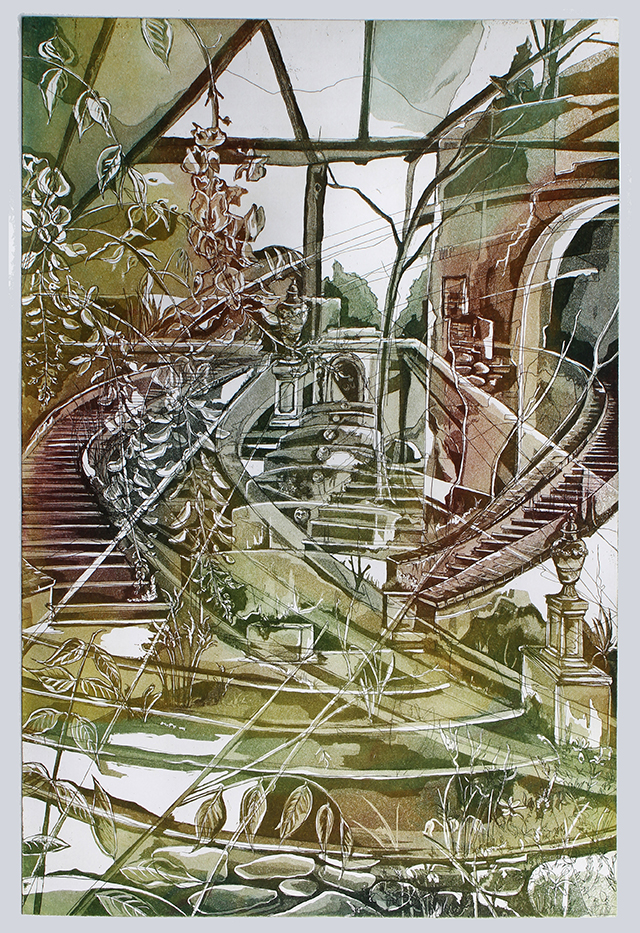
Walls Which Do Not Last, Intaglio, 18” x 12”, 2014

Walls Which Do Not Last, Intaglio, 18” x 12”, 2014

Briefly describe the work you do.

I work with etching, aquatint, and collage to create images that are layered in both concept and process. The imagery is based on my experiences and observances of the world around me and is abstracted and manipulated in order to create something entirely new. I then deconstruct these complex images, disassemble them and then piece them back together, further extending the layering process. It is through this process that new spaces and images begin to emerge, echoing the process of memory retrieval, and creating a kind of cognitive excavation. 

At what point I your life did you want to become an artist?

I think that I have always felt that I would become an artist. The physicality of making, and process of creating has always been present and important in my life. For me, there never seemed to be any other option. It was the way that I could express the way that I viewed and interpreted the world around me.

Tell us a little about your background and how that influences you as an artist.

I come from an east coast Italian-American background. Food and family have been central components in my upbringing. Listening to family stories countless times around the dinner table has always been a part of my family history. These stories, passed down through the generations have now become part of my memory, even though many of them are of people and places that I have never known. This idea of perception and memory has been a common thread throughout my career. Also, the focus around food preparation and gardening, has revealed my desire to work with, prepare, and tend to things, a concept that very much echoes my artistic practice.

 In the Shadow of Anthills (triptych), Intaglio, 2 panels 18” x 12”, 1 panel 18” x 24”, 2014

In the Shadow of Anthills (triptych), Intaglio, 2 panels 18” x 12”, 1 panel 18” x 24”, 2014

What types of conceptual concerns are present in your work? How do those relate to the specific process(es) or media you use?

The cinematic representation of thought and perceived experience is what drives my working process. I am interested in what happens visually and conceptually when continuous time is fragmented, stopped, and altered by memory and thought. I search for what the space of the mind might look like, considering the cognitive layers that are present within us as we perceive time and space. Process, layering, deconstruction, and rebuilding, are vital components to the work and serve as the motivating force behind my exploration.

There is an interesting dialogue between the physicality of the printing process and the use of digital layering, which forms an important foundation for my work. Each form serves as a record, a way of preserving something and presenting it again. There is a durational aspect to thought and cognition, in addition to one that wants to capture an image and hold on to it. The etchings, serve as a momentary impression, and a build up of time. The repetition of imagery and serial presentation suggest the various manifestations that a remembered image can take. The print collages appear as if they are both falling apart and coming together at once. They are completely deconstructed, reassembled, and frozen in a state of suspended animation. Cutting away at the collages themselves, references a cyclical system of building, growth, and excavation.   After a number of individual layers are constructed, I am able to overlay them on top of one another, creating an abstracted, layered space.

The Tides Pull Us Through- no. 1, Aquatint Etching Collage, 24” x 9”, 2013

The Tides Pull Us Through- no. 1, Aquatint Etching Collage, 24” x 9”, 2013

We once heard Chuck Close say he did not believe in being inspired, rather in working hard everyday. What motivates you in your studio practice?

Process and work are what drive my practice. I am motivated by my desire to make, and translate the things that I see and experience into a visual form. The act of physically working in the studio, experimenting with new techniques, and exploring new subject matter all serve to help me develop my conceptual ideas. In my work, process and concept go hand in hand. For me the act of working on one thing, tends to lead to another, resulting in a series of connected and fluid works. I see these works, less as individual pieces, and more as larger, related groups that tell a story together. This is the connection I find between the two dimensional work and the time based work, and the different forms feed off of one another.

What artists living or non-living influence your work? 

I have been influenced by all kinds of artists, ranging from medieval Italian fresco artists to the contemporary video installations of Hiraki Sawa. There have been times during my career that I have looked closely at Van Gogh’s brushstrokes and other times when I have studied the flattened two-dimensional space of Japanese woodblock prints. The layers of work in Rembrandt’s aquatints and the powerful depiction of light in Goya’s black and white etchings amaze me. I am continuously inspired by contemporary artists like William Kentridge, Sarah Sze, and Bill Viola in both their conceptual and technical impact, while films like, Fellini’s 8 ½, Stan Brakhage’s, Mothlight, and Eisenstein’s use of montage have been important as well. All of these interests feed my practice collectively, serving as an important form of education while creating a visual and procedural language that is necessary to drive my work forward.

When you are not making art what types of activities and interests do you engage in?

Food and gardening are my passions. I find a lot of connections between the work that I do in the kitchen and in the garden and my creative process. Cooking, experimenting with new recipes, and working with interesting ingredients are important to my daily life. During the warmer months my garden occupies much of my time. I love to grow perennials, vegetables, and herbs to use in my cooking. Some of my favorite places to visit are formal gardens, arboretums, natural history and geology museums. Also in my spare time, I love to play tennis. 

About

Koss_headshotRobin Koss was born in Philadelphia, Pennsylvania. She received her BFA in 2002 from the University of Delaware, an MS in Computer Animation from New York University in 2004, and an MFA in Studio Art from Maine College of Art in 2012. 

Robin has taught courses at the University level since 2005 in the areas of Digital Media and Animation.  She has also participated in numerous residencies both nationally and internationally, in places such as Florence Italy, Siena Italy, The Scuola Internazionale di Grafica in Venice Italy, Vermont Studio Center, and at the Printmaking Center of New Jersey.

Working primarily with printmaking, collage, digital and time-based media, Robin explores the nature of perceived experience and the space of the mind.  These media allow her to construct images that suggest process, layering, and a build up of time.

Her work has been exhibited in Boston, New York, Portland, Maine and in numerous cities in the state of New Jersey.  She currently works in New Jersey and New York City.

In the Studio

In the Studio

www.robinkoss.com

All images copyright of the artist and used with their permission.  
Posted in Uncategorized | Tagged , , , , | Leave a comment

Lydia Moyer – Charlottesville, Virginia

The Blocks, still from single channel video, in progress, 2014

The Blocks, still from single channel video, in progress, 2014

Briefly describe the work you do.

I work between video and visual art, mostly all photo-based processes.  I’m interested in the intersection of landscape and culture, particularly in America, and in the idea of poetic non-fiction.

Tell us a little about your background and how that influences you as an artist.

My formal training is as a studio artist but I’ve worked in community documentary and commercial production as well (a long time ago now).  I move readily between different formats and media. I grew up in the country and I think that has had a huge influence on my work – the focus on landscape is a reflection of my interest in nature, although I don’t think landscape is limited to the natural world. I’m also interested in people and the things they make and arrange and think and build.

The concept of the “artist studio” has a broad range of meanings, especially in contemporary practice. The idea of the artist toiling away alone in a room may not necessarily reflect what many artists do from day to day anymore. Describe your studio practice and how it differs from (or is the same as) traditional notions of “being in the studio.”

My studio is really my computer which is easily portable.  I work with found imagery – sometimes from the internet, sometimes not – as well as imagery I make myself but all of it is run through the computer at some point, through a browser or a scanner or a camera.  What is most important for me is a quiet place and an electrical outlet.

Black Damp, still from single channel video, 10 min, 2010

Black Damp, still from single channel video, 10 min, 2010

What unique roles do you see yourself as the artist playing that you may not have envisioned yourself in when you first started making art?

(note: not sure I answered this question as it was meant…) Like many artists, I don’t think I realized how much time would be spent on promotion and applications and all of the business of art.  I don’t think I imagined that life as an artist would also mean life as a self-promoter and a self-archivist.  When I was younger, my ideas about art were romantic.  It’s now pretty clear that it’s a job and like any job, there are some tasks that are less enjoyable than others.

When do you find is the best time of day to make art? Do you have time set aside every day, every week or do you just work whenever you can? 

I find the morning is my best working time – my mind is sharpest.  I try to set my mornings aside but I can’t always since I teach and work at a university. I know I feel best when I have put some working time in so I try to make sure to make some progress everyday, even if it’s just a small amount.

Tar creek, still from single channel video, 9 min, 2013

Tar creek, still from single channel video, 9 min, 2013

How has your work changed in the last five years? How is it the same?

It has become less cautious.  I’m not sure that means it’s better.  I think the tone has stayed consistent but the breadth is wider.  I’m more willing to dive into things that are daunting or complicated.

Are there people such as family, friends, writers, philosophers or even pop icons that have had an impact on the work you do?

The work of other artists, particularly filmmakers and writers, has a strong influence.  Which in particular is always in flux.  The people I am close to at any given moment are also important. I am grateful for the outside influence – maybe in that way all my work is responsive.  Maybe all art is, I’m not sure.

If you had an occupation outside of being an artist, what would that be and why?

A park ranger – nice uniforms, relatively low stress, excellent work environment.

About

headshotLydia Moyer completed an MFA in studio practice at UNC Chapel Hill in 2005.  Prior to beginning her graduate studies, she worked both in commercial video post-production in New York City and taught community documentary at Appalshop, Inc., a nationally known media center in Appalachian Kentucky.  She received her BFA from the New York State School of Art and Design at Alfred in 1999.  She is currently as associate professor of art at the University of Virginia.

Moyer works between print and video.  Her videos have been shown widely in festivals and galleries including The European Media Arts Festival in Osnabruck, Germany; The Impakt Festival in Utrecht, the Netherlands;  video_dumbo in Brooklyn, NY; the PDX Festival in Portland, OR; and the Black Maria Festival in Jersey City, NJ.  Her books have been included in exhibitions at Printed Matter in New York City and the Center for Book and Paper at Columbia College in Chicago.

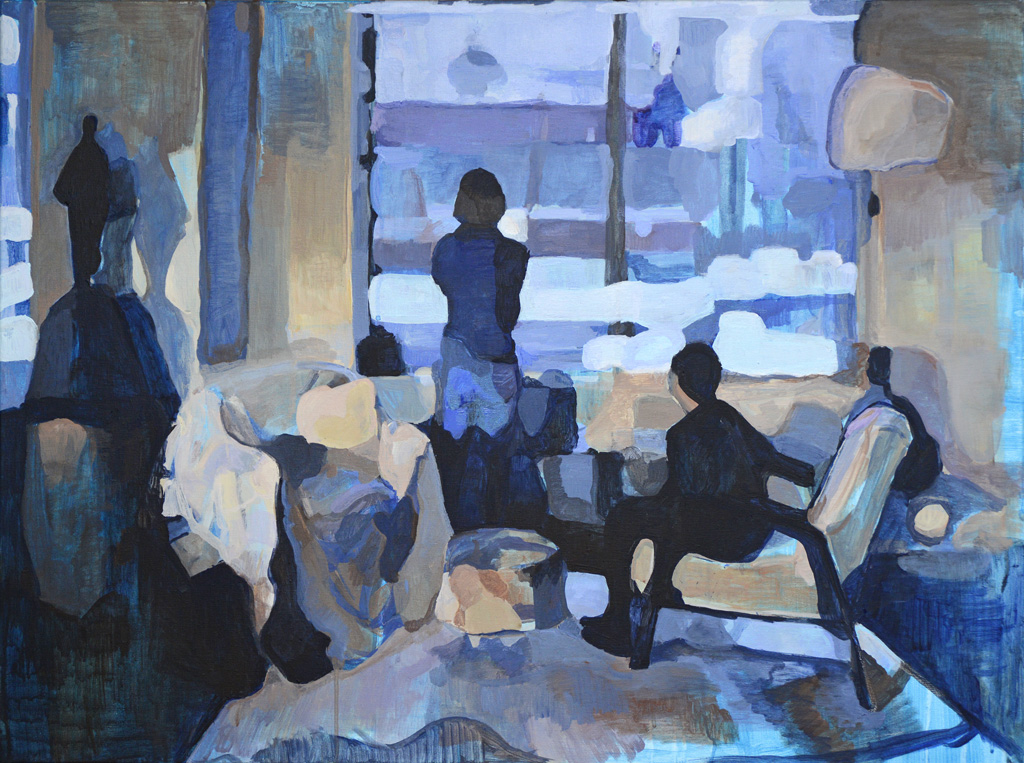
The Studio

The Studio

goodfornow.net

All images copyright of the artist and used with their permission.  
 

Posted in Uncategorized | Tagged , , , , | Leave a comment

Patricia Spergel – Larchmont, New York

Whispered 2, 2013,                 Oil on canvas, 36” x 40”

Whispered 2, 2013, Oil on canvas, 36” x 40”

Briefly describe the work you do.

Although I have flirted with painting landscapes and still lifes over the years, I always come back to abstraction. Painting non-objectively continues to challenge and excite me; it allows me to draw from my personal experiences, while keeping my focus on the formal qualities of paint.  My sources of inspiration and fascination vary fr

om a visit to an aquarium at night, the glaciers in Alaska, the shapes of the machinery on Dumbo’s Ride in Disney World, Renaissance frescos in Italian churches, or patterns made by sunlight on the wall. My oil paintings are composed of fluid, organic forms which crowd together, float and overlap, creating eccentric compositions filled with color and light.  These abstract shapes hover on the verge of becoming recognizable, tangible objects, momentarily throwing the viewer off guard. The images evoke stories about themselves that are just outside the complete grasp of full detection and understanding. Private, secret events are glimpsed just before they move or change. Forms surface, submerge, and press against one another as if for support, or come together as if magnetically, sexually attracted. 

At what point I your life did you want to become an artist?

Though I briefly toyed with the idea of being an archaeologist in elementary school, I never remember wanting to be anything but an artist

Tell us a little about your background and how that influences you as an artist.

I grew up in a middle-class area of Philadelphia and was lucky enough to have had an excellent art program at my public high school.  I also took courses at a local art center from kindergarten through my senior year where I learned about printmaking, which in turn became my major in college.  My mother enjoyed going to museum exhibitions and passed that passion on to me.  I have vivid early memories of the Philadelphia Museum of Art and especially the Brancusis and the Duchamps in the Arensberg collection.

Spergel Studio corner June 2014

What types of conceptual concerns are present in your work? How do those relate to the specific process(es) or media you use?

I am really interested in the associative qualities of oil paint on canvas or printing ink on paper.  There is a magical transformation that occurs in the midst of a good painting session—a portal into a calmer and more meditative space, not unlike  the sense of concentrated awareness of one’s body in space and time that one attains after years of yoga practice.  We are constantly bombarded with images on social media, on television and in print ads that demand rapid digestion.  I want my paintings to slow the viewer down—to help them find a moment of contemplation and beauty in our frenetic society.

We once heard Chuck Close say he did not believe in being inspired, rather in working hard every day. What motivates you in your studio practice?

I am in total agreement with Chuck Close.  I have only had the luxury of maintaining a full time studio practice for the past 2 years.  Before that, my time at the studio competed with a part time job and taking care of my family. This forced me to always take advantage of any time I had to work—and for me the fastest way to get into the mindset of being present with my work, but not overthinking it is by listening to music, specifically yoga chanting.  By listening to songs over and over again I am able to get into a focused state where the work flows.

 Santo Spirito 2, 2014,            Oil on canvas, 30” x 32”

Santo Spirito 2, 2014, Oil on canvas, 30” x 32”

What artists living or non-living influence your work?

That’s always such a hard question to answer definitively because my influences change frequently depending on what exhibitions I’ve just seen or which friend’s studio I’ve just visited. At the moment, the books I’m looking at in my studio are Martin Puryear, Walker Evans, Francesca Woodman, William Baziotes, and Mary Heilmann. I just saw the huge Sigmar Polke retrospective at MoMA and left feeling inspired to take more chances and to work more quickly.  I also saw the Mark Rothko show of watercolors dating from 1941-47 which was an epiphany.  Seeing the way he developed his ideas about transparency and depth in these early works allowed me a glimpse into Rothko’s head and gave me a deeper understanding of how his later canvases evolved.

When you are not making art what types of activities and interests do you engage in?

Traveling, yoga, swimming, reading, spending time with family and friends.

About

Spergel Headshot 2014Patricia Spergel received her BFA from Cornell University in Ithaca, NY and her MFA from School of Visual Arts in NYC. She has been included in numerous group exhibitions nationally and had a solo show at the Tjaden Gallery at Cornell in 2004. Her paintings are included in the collections of Citigroup, Sanford Bernstein and Bank of America and she has been published in New American Paintings and will be included in an upcoming book published by Watson-Guptil on abstract painting. In summer 2013 her work was featured on the cover and in an eight page spread of The Southern Review, a literary magazine published by Louisiana State University. While her focus is on painting, she has also done extensive work with monoprints for the past fifteen years at the Center for Contemporary Printmaking in Connecticut. Her work can be seen at Kenise Barnes Fine Art in Larchmont, NY. She currently lives and works in Westchester County, NY.

In the Studio

In the Studio

www.patriciaspergel.com

All images copyright of the artist and used with their permission.  
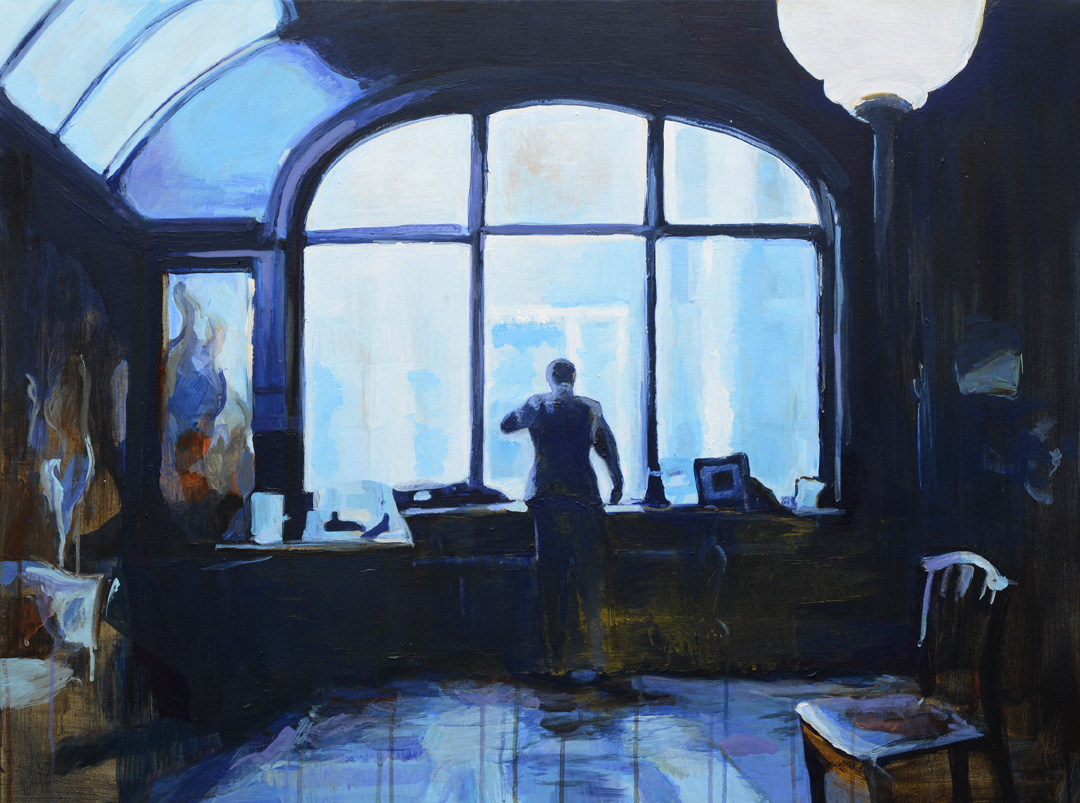
 

Posted in Uncategorized | Tagged , , , , | Leave a comment

Andrea Jensen – Salt Lake City, Utah

.0001, acrylic and spray paint on canvas, 36" x 36," 2014

.0001, acrylic and spray paint on canvas, 36″ x 36,” 2014

Briefly describe the work you do.

Speaking broadly, my work isabout the environment and mankind’s relationship to it. It is my belief that so many of our environmental issues stem from cultural and economic issues and the three are increasingly interconnected. This interconnectednessleads to all sorts of suffering. Internally it leads to desires, control, anxiety, and externally climate change and violence.

My most recent work draws on the notion of impermanence as a built-in factor of all life. The paintings reference buildings that have suffered through one of the “Super Storms” that have hit across the world in the past couple of years. I like the idea that these man-made structures signify a loss of control, of impermanence. But they also signify our attempt to control the environment which results in excessive carbon emissions, which then results in storms that destroy these structures; a circle. This is the larger picture, however at its core are my own personal and recent life events. My own loss has showed me how vulnerable we are in this life, despite the structures, physical and mental, we try to employ for some attempt at control.

Process is important to my work. It is one of collecting, of placing, arranging and tending to. I like to use pieces of found materials to reference our surroundings.

Compositionally, I want to bring a tension with structure and chaos, horizon lines that get lost, fragments strewn about. Often, I flip the painting upside down or to the side at some point and leave it that way. Visually, this throws off any grounding that once was, making the viewer question what is really stable.

Tell us a little about your background and how that influences you as an artist.

I grew up in the Midwest and raised within a large farming family. At their core is the farm my grandparents ran, which continues to thrive within my family. The countryside of the Midwest; the traditions it sustains, the vastness of the landscape and appreciate of land, has greatly influenced my work.

February, acrylic and spray paint on canvas, 36" x 42," 2014

February, acrylic and spray paint on canvas, 36″ x 42,” 2014

The concept of the “artist studio” has a broad range of meanings, especially in contemporary practice. The idea of the artist toiling away alone in a room may not necessarily reflect what many artists do from day to day anymore. Describe your studio practice and how it differs from (or is the same as) traditional notions of “being in the studio.”

There have been times in my life when I was able to dedicate adequate time “being in the studio.” These times did fit the traditional notion of what it meant to be in the studio. As this amount of time fluctuates from month to month, I have learned to adjust by finding different ways to incorporate studio practice. This has proved to strengthen my work in that it asks me to look outside myself and more to my surroundings. Alongside the tradition notion of being in the studio, my work relies on research and experience that happens outside it.

What unique roles do you see yourself as the artist playing that you may not have envisioned yourself in when you first started making art?

When I first started making art, I was that artist who whole heartedly enjoyed toiling away in a room by herself. Through the work I did at the time, I described the world around me and my experience of it. Although my work today still does that, I have opened myself up to the possibility of creating change and an awareness for others about the world. This was something I had never envisioned myself doing before.

When do you find is the best time of day to make art? Do you have time set aside every day, every week or do you just work whenever you can? 

Since the birth of my daughter, three years ago, I have been unable to schedule time set aside to work in the studio. For the most part, I get into the studio to work whenever I can and whenever my supplementary job allows for it. Applying for, and receiving opportunities to show, increases the amount of time I spend in the studio, so it is important that I continue to search out those opportunities. This past year has offered many opportunities and motivations for me to spend adequate time in the studio, thanks to exhibitions, galleries and a position as a Visiting Professor of Art.

Something Destroyed, Something New, acrylic and spray paint on canvas, 36" x 42," 2014

Something Destroyed, Something New, acrylic and spray paint on canvas, 36″ x 42,” 2014

How has your work changed in the last five years? How is it the same?

I can start by listing all the ways in which my life has changed in five years; completed my MFA, married, worked eight different jobs, had two kids, had a car stolen, had two surgeries and moved four times. Similarly, my work has changed significantly and undergone many revisions. I have become more focused in my work, but have also struggled with formal aspects. I have found that often you walk through your art like you do you life, and the past five years have been rotating forms of thin ice and solid ground. One thing I have not lost is my passion for my work and my desire to continue pushing myself both formally and conceptually. My experience has showed me the more time I have in the studio, the more I expand my work and push myself artistically. Overall, I think this is an important goal for every artist to have. To keep pushing limits, and ultimately finding uncomfortable places that challenge the conceptual and formal aspects of the work.

Are there people such as family, friends, writers, philosophers or even pop icons that have had an impact on the work you do?

Philosophers have always been of interest to me for the way they question different aspects of life. Their thinking is of the utmost rational of irrational thinking. Philosophers and thinkers of this sort that I am drawn to are Martin Heidegger, Gaston Bachelard and Alan Watts. I find a strong connection between philosophers and artists; both of whom look at the world from a different view. Additionally, life as I know it strongly impacts my work – so this would include all of my friends and family. They have made me who I am and will forever impact the work I do.

If you had an occupation outside of being an artist, what would that be and why?

I would be a teacher. Although I am not sure that is a fair answer, as I am one currently. For the past several years I have been lucky enough to complement my studio practice with teaching. This allows me to be continuously involved with the art community. Teacher and artist, or Art Teacher and artist, both offer consistent opportunities for learning, teaching, experiencing and growing. There are always new stones to turn over; always new experiences, lessons, discoveries.

About

headshotI was born in Geneva, Illinois to a large Midwest farming family and it was there that I found inspiration for my work. The sights, smells and sounds of the prairie have been tremendously influential. My work is intricately tied to the landscape; its use, misuse and particularly the individual’s sense of place within it. She uses different materials to process, visualize and interpret the landscape. Documentation, outreach, and public exhibition are important aspects in the development of the work as well as my contribution to the local community.

I received a Bachelor of Fine Arts from the University of Iowa in 2002.  I then worked as an elementary art teacher, and climbing instructor in Boulder, Colorado before pursuing my MFA in Tucson, Arizona at the University of Arizona. I worked as a Graduate Assistant for the University of Arizona teaching painting, drawing, color and design and mixed media. It was also in Tucson where I gave birth to my daughter Ila, who is now three years old. Since then, I have tried to find balance between my professional life and my life as a mother. I have worked as a Visiting Professor of Art for Idaho State University and now an adjunct at Westminster College and University of Utah. I reside in Salt Lake City.

Detail (February), acrylic and spray paint on canvas, 36" x 42," 2014

Detail (February), acrylic and spray paint on canvas, 36″ x 42,” 2014

www.andrearaejensen.com

All images copyright of the artist and used with their permission.  

Posted in Uncategorized | Leave a comment

Carlos Rene Pacheco – Tucson, Arizona

Collective: Dealey Plaza  Webcam, Photograph, 2013

Collective: Dealey Plaza
Webcam, Photograph, 2013

Briefly describe the work you do.

My work takes many forms; however, it is rooted primarily in digital photographic processes. I investigate how we use photography and technology in an increasingly virtual and connected world. I am currently exploring these ideas using live streaming webcams and social media. These spaces include Times Square and Dealey Plaza, where a webcam looks down from the vantage point of John F. Kennedy’s assassin.

Tell us a little about your background and how that influences you as an artist.

I was born and raised in Tucson, Arizona. I don’t come from a particular artistic family; in fact, I was originally an astronomy student in college. It wasn’t until I decided that applied mathematics and physics just weren’t for me that I turned to photography. Cameras have always fascinated me. I like technology and gadgets, but I had never done anything serious with photography. Switching from the School of Science to the School of Art at the University of Arizona was a transformational experience for the better. It was there that I exchanged my view through a telescope for a view through a camera . Thankfully, I was afforded the opportunity to really explore the crossover between art and science and develop my own voice as an artist. It is this overlap that greatly informs my work today.

The concept of the “artist studio” has a broad range of meanings, especially in contemporary practice. The idea of the artist toiling away alone in a room may not necessarily reflect what many artists do from day to day anymore. Describe your studio practice and how it differs from (or is the same as) traditional notions of “being in the studio.”

I’ve had a “traditional” studio space. It always served as a space where I could explore my more messy ideas, a place to tinker in a physical sense. It was common to find all sorts of electronic components from the projectors and computer monitors I was tearing down and rebuilding all over my workbench. Other times my studio would be filled with stray pieces of wood and sawdust from some of the cameras I was building. My most recent work, however, really breaks from the traditional studio setting. My webcam work requires only that I have a computer and an internet connection. Working on my laptop allows me to continue that particular body of work from just about anywhere, be that my house, at my desk, or while I’m waiting to catch a flight at the airport. Everything is connected to a network virtually all the time, I have even used my phone during breaks between classes to pickup where I left off. Depending on what I’m doing, my studio follows me around, whether in my pocket or in my backpack.

Collective Times Square, Webcam Photograph, 2013

Collective Times Square,
Webcam Photograph,
2013

What unique roles do you see yourself as the artist playing that you may not have envisioned yourself in when you first started making art?

What I envisioned when I first started is vastly different from what I do now. When I first decided photography was something I was really interested in professionally, I figured I would learn the technical side of the medium. I thought I’d go to school, learn as much as I could and apply it to my interest in astrophotography. I very quickly reconciled my interest in science with my interest in photography, but in ways I never expected. It’s clear now my knowledge and understanding of art was extremely limited. Since then it’s been total immersion. I have worked to explore new definitions of photography. I have had the unique opportunity of studying alongside many great artists. I learned a lot about the gallery-side of the art world, working at the Kennedy Museum of Art and managing two on-campus galleries in Athens, Ohio. I also had the joy of teaching a really great bunch of students who are beginning their careers as artists. That is something I’d like to do more of in the future.

When do you find is the best time of day to make art? Do you have time set aside every day, every week or do you just work whenever you can? 

I tend to work here and there throughout the day, but I prefer to schedule longer blocks of time in the morning and night. With a current ongoing webcam project I have to work sporadically since the project is very much time based. I’m working with webcam streams that are on wildly different schedules from my own. Working on this project that involves global time means sometimes I have to be working very early or very late.

Found (Collective: Abbey Road),  Installation View, Video, 2014

Found (Collective: Abbey Road), Installation View, Video, 2014

How has your work changed in the last five years? How is it the same?

Being that 5 years ago is about the time I started my art practice my work has changed quite a bit. Questioning of photography, technology, and identity are themes that have remained constant; however, some of my methods have changed. My early work involved being in direct contact with my camera, the new webcam stuff deals with cameras in places I’ve never been physically. They are like Mars rovers, beaming back images from distant places. On top of that, some of the projection based work I’ve been exploring the past couple years is very new territory for me.

Are there people such as family, friends, writers, philosophers or even pop icons that have had an impact on the work you do?

A wide array of scientific research certainly has an impact on my practice. That definitely informs my curious, questioning approach to my work. I do often find myself coming back to the Isaac Asimov quote- “The most exciting phrase to hear in science, the one that heralds new discoveries, is not “Eureka” but “That’s funny…”. Beyond that I make a point of surrounding myself with hard working people who are equally passionate about what they do, art related or otherwise. These are the people who have at some point heard me say, “Hey, come check this out.”

If you had an occupation outside of being an artist, what would that be and why?

Astronomer, still. Space is a vast, wondrous thing.

About

HeadshotCarlos Rene Pacheco is an artist and photographer from Tucson, Arizona. He received a Bachelor of Fine Arts degree with an emphasis in Photography from the University of Arizona and his MFA in Photography + Integrated Media at Ohio University, in Athens, Ohio. A former Astronomy student, Pacheco’s work has been described as equal parts magic and science. A reconciliation of his questioning of the photographic medium and his passion for scientific exploration, Pacheco’s work offers a subtle twist of the viewer’s expectations and feelings of familiarity.

The Studio

The Studio

www.carlosrenepacheco.com

All images copyright of the artist and used with their permission. 
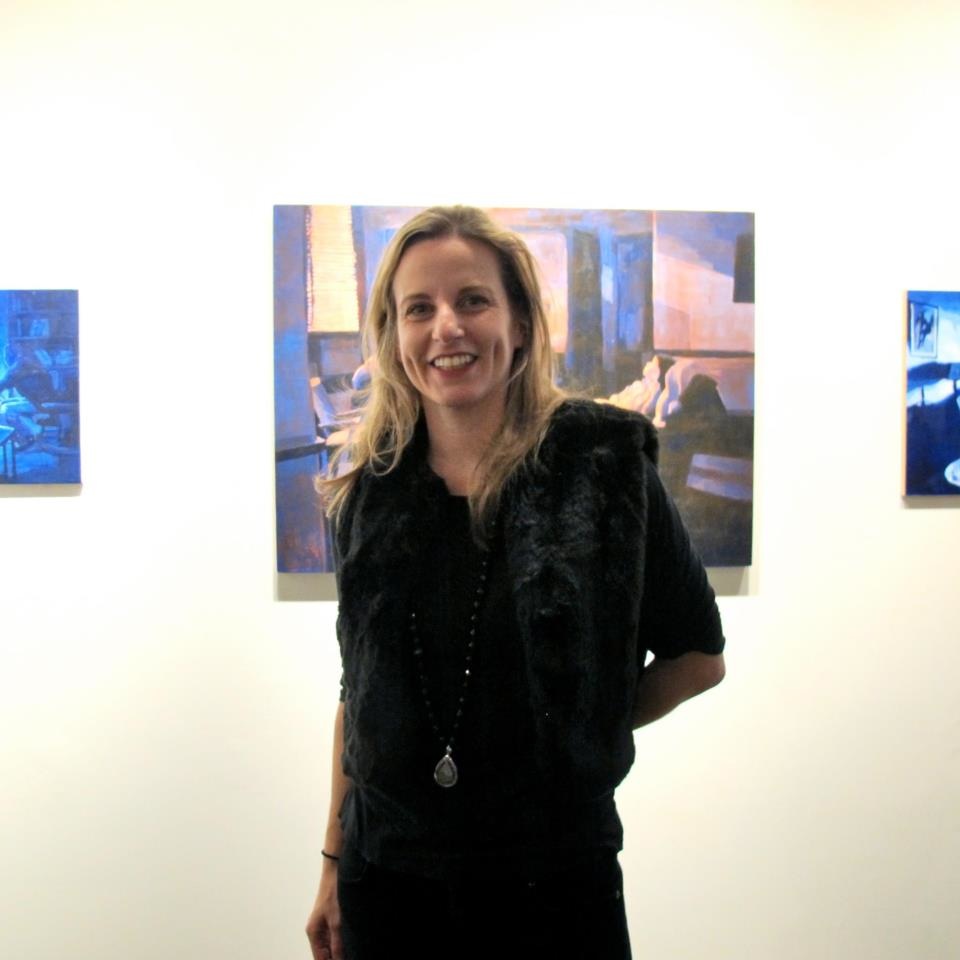
Posted in Uncategorized | Tagged , , , , | Leave a comment

Kayle Karbowski – Milwaukee, Wisconsin

Prolonged, Unfulfilled Desire or Need sugar, window, scratch marks, kitchen floor tiles, sound Dimensions variable, 2013

Prolonged, Unfulfilled Desire or Need
sugar, window, scratch marks, kitchen floor tiles, sound
Dimensions variable, 2013

Briefly describe the work you do.

I create cultural tableaus out of various materials and processes, from embroideries to videos to larger scale installations that isolate and attempt to reveal some of the power structures that affect our daily lives and decisions.

Tell us a little about your background and how that influences you as an artist.         

I grew up in a lower middle class home in an upper middle class suburb of Chicago, putting me at the heart of the whirlwind of hyper-suburban life. My mother and I were experts at thrift shopping, coupon-cutting and impromptu Boston Market picnics in our living room. When I moved to my “hometown” at six years old, I soon found that my sect of consumerism was far from that of my peers. As I grew up, the cause and effects of this difference in lifestyle only became more and more apparent, as well as complicated.

Upon moving to Milwaukee, I have been granted a distance from the suburban environment that has provided me an intensive interest in the mix of the foreign and the familiar, the authentic and the simulated.

The concept of the “artist studio” has a broad range of meanings, especially in contemporary practice. The idea of the artist toiling away alone in a room may not necessarily reflect what many artists do from day to day anymore. Describe your studio practice and how it differs from (or is the same as) traditional notions of “being in the studio.”

If we define the artist’s studio as the place where work is conceived and created, my studio practice takes place in multiple spaces; on the bus, at work, while I’m cooking, while I’m on Facebook, while I’m out with friends. I don’t have a permanent studio, but I am always “in the studio”. I’m not saying that all I do is think about making art, but I treat every experience and every moment as though it could be a contribution to what I could create. My interest is in the underpinnings of these commonplace events; is there something we are overlooking? What causes us to act the way we do in situations, and where do these behaviors come from?

Actually creating the final product can often happen in public venues as well. I tend to work in mediums that can travel with me; writing, hand sewing, crocheting, video… With the amount of time I spend on the go, being portable is essential to my ability to make work.

​film still from Home of the Brave digital video, costume: reconfigured lounge chair, set: fabric, paper, yarn, cardboard 3:36 minutes,2013

​film still from Home of the Brave
digital video, costume: reconfigured lounge chair, set: fabric, paper, yarn, cardboard
3:36 minutes,2013

What unique roles do you see yourself as the artist playing that you may not have envisioned yourself in when you first started making art?

Well, I first started making art as a way of coping with my alleged awkwardness, which originally made me want to be an art educator or art therapist. Today, I would call myself a fine artist, curator, and aspiring arts administrator. I wouldn’t say that my intentions as an artist have changed, but the hats that I wear as a person operating in the art world are slightly different than I had originally imagined.

When do you find is the best time of day to make art? Do you have time set aside every day, every week or do you just work whenever you can? 

I tend to spend a lot of time organizing thoughts and methods before actually executing the work. When it comes time to begin making, I’ll usually create a piece in one or very few, long sessions. This amount of time between “conception and creation” builds this excitement to actually get down to business and I end up just wanting to work until I absolutely have to sleep or be somewhere else. Even then, I will usually bring what I can with me so I can continue working.

How has your work changed in the last five years? How is it the same?

As I am still in the early stages of my career, my work has dramatically changed in the last 5 years. 5 years ago, I was primarily painting and doing a lot of etchings. 2 years ago, I was making installations and fiber-based sculpture. Most recently, writing, video and performance have been at the forefront of my practice. The mediums I work in are constantly changing and cycling based on interest in pursuing a material or process, as well as how the materials and processes I’m using are pertinent to the concept of what I’m making.

What I have found interesting about the evolution of my work is that regardless of medium, there is still a baseline idea that flows through everything I have ever made. I have yet to clearly articulate what exactly this is, but a power structure of sorts is inherent in my etchings of children being consumed by the natural world to the characters in my videos portraying an exaggerated stereotype.  

Process shot from filming "Home of the Brave"

Process shot from filming “Home of the Brave”

Are there people such as family, friends, writers, philosophers or even pop icons that have had an impact on the work you do?

As far as family and friends, there are so many amazing women that have contributed in raising me and have ultimately motivated me to make the work I make today. My mother, all of my grandmothers, my aunt, my first boss at my first job ever, my artistic mentor, my close friends growing up… they are all probably some of the strongest women I’ve ever met and they inspire me to push myself further everyday.

As writing is also a part of my practice, there are many writers who have had a very clear impact on what I do and why I do it. To name a few, Ralph Waldo Emerson for his colorful and self-reliant (pun intended) words, George Orwell for his simple yet powerful language, Chuck Palahniuk for his complete bad-assery, and last but most certainly not least, Kurt Vonnegut for his sass and bittersweet honesty.

As I work in video, there is also a copious amount of television and film that has been a huge impact on my work; Twin Peaks by David Lynch (my film god), The X-Files, The Shining, A Clockwork Orange, and 2001 A Space Odyssey, Melancholia, The Truman Show, and my most recent favorite, Upstream Color.

Science Fiction, in all of its forms, has been essential to what I make. It’s ability to teeter on the edge of reality, yet speak so clearly of current and future social issues in such a creative and abstract way is something I am always striving for in my work.

If you had an occupation outside of being an artist, what would that be and why?

It is hard to picture myself doing anything other than what I do, but I would like to see myself participating in more non-for-profit organizations. I think as a creator, critic and participant in culture, it is important to utilize the time I am not making work in a manner that is productive to my community.

About

headshot_web copyKayle Karbowski is an interdisciplinary artist working in video/performance, sculpture, fibers, and installation. She is currently pursuing her BFA (2015) and minor in Art History from Milwaukee Institute of Art and Design.

Karbowski is active in Milwaukee as both a practicing artist and a curator. She was recently invited to produce work for an exhibition by local curation group, Swim Team, and is currently co-curating and producing work for a collaborative photography show featuring young artists from Kansas City, Chicago, and Milwaukee. She has assisted with the NCECA conference in 2014 and fueled interest in the study of Fibers through her position as Sewing Room Technician and Teacher’s Assistant for fibers classes at MIAD.

Her work has been shown and awarded in multiple juried exhibitions in the area including MIAD’s It’s a Major Deal and the Chicago Area 4×5 Show.

​film still from Making Tomorrow More Equal digital video 4:32 minutes, 2014

​film still from Making Tomorrow More Equal
digital video
4:32 minutes, 2014

kaylekarbowski.com

All images copyright of the artist and used with their permission. 
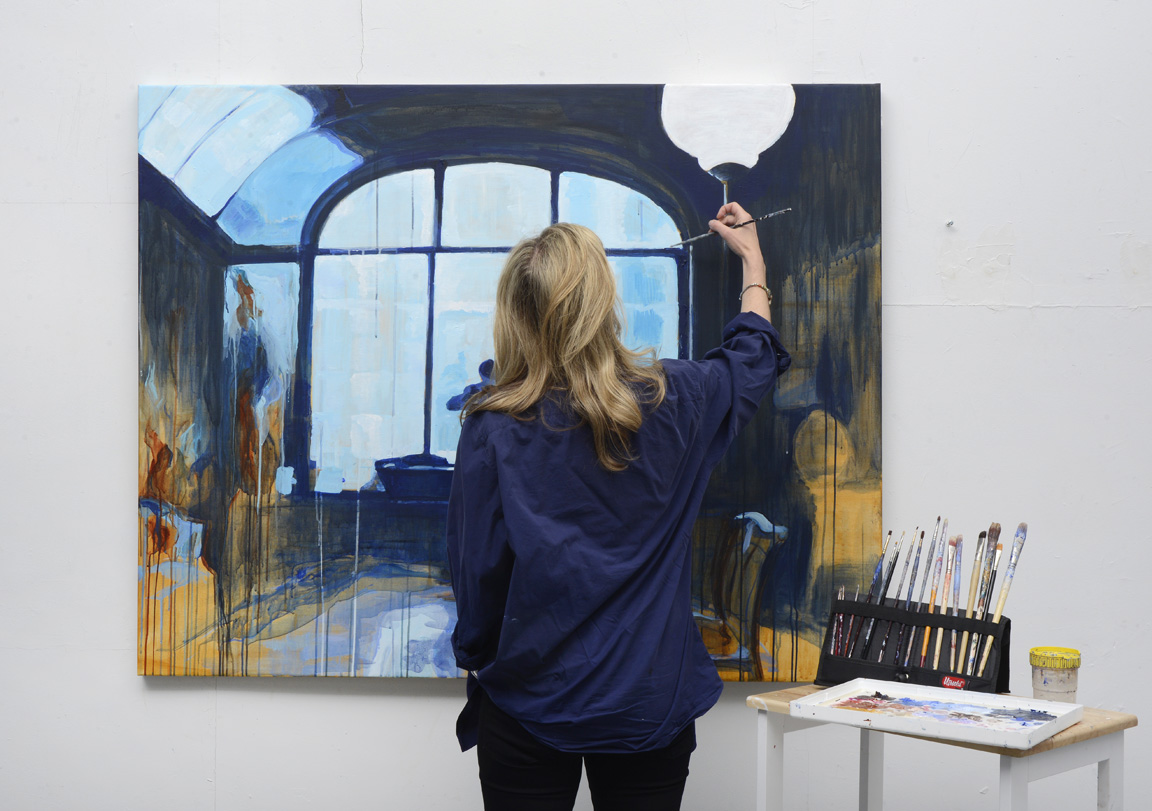
Posted in Uncategorized | Tagged , , , , | Leave a comment