Gil Gijón – Puertollano, Ciudad Real, Spain

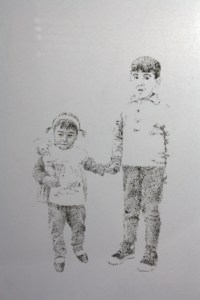
Encarnación y Antonio, dust stuck on glass, 33 x 24 cm, 2015

Encarnación y Antonio, dust stuck on glass, 33 x 24 cm, 2015

Briefly describe the work you do.

My most recent work reproduce old photographs, rescued from family albums, using household dust and lint from the people who appear in them.

The reason for choosing an element like dust is in its composition. Its particles come from both organic remains, such as skin or hair from the people who lived there, and inorganic remains from objects we have in our homes: carpet fibers, clothes and other textiles, street dirt swept under our shoes, environmental pollution, etc.

The dust is, in this manner, turned into an essential metaphor of destruction and the passing of time. A residue which stores within it the memory of all the events that have occurred since its creation and which is employed in the work to recreate the person in the same way that a phoenix bird is reborned, from their own material.

Tell us about your background and how that has had an influence on your work and on you as an artist.

Since forever, I have always like creation in a very broad sense: I really enjoy inventing things, drawing plans of houses or machines, sewing pieces of fabric, playing an instrument, composing music or even writing poetry. It was like a puzzle in which each piece had to fit in its place.

This way of understanding work is still present in my artwork. Each element of the composition must fit conceptually in the idea that is being developed, as nothing is the result of chance, in this way, it lets me make speeches with different readings.

In a personal level, as an artist, this way of working gives me great rigor and commitment to my work.
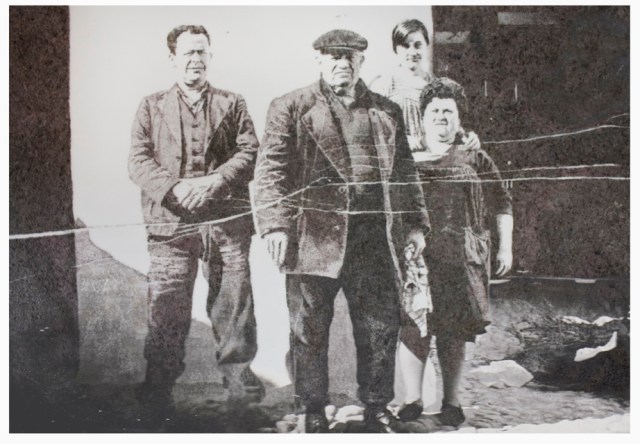
Jesús, Gabriel, Visitación y Ramona en Valdepeñas, dust stuck on plastic, 105 x 150 cm, 2015

Jesús, Gabriel, Visitación y Ramona en Valdepeñas, dust stuck on plastic, 105 x 150 cm, 2015

The concept of the artist studio has a broad range of meanings in contemporary practice. Artists may spend much of their time in the actual studio, or they may spend very little time in it. Tell us about your individual studio practice and how it differs from or is the same as traditional notions of “being in the studio.”

My way of working is very close to the traditional notion of “being in the studio.” My artworks need a long time of work. But what I do inside is as interesting as what I do out of it.

It all starts with me visiting my relatives to watch their photo album with them. I ask them to tell me the anecdotes, memories and stories behind each one until the memory is skin deep. It’s the part of the process I like the most, where I choose the picture that I will reproduce later.

In the following days, when the memory has faded and deposited on the ground like dust, I go back to their homes to collect it.

When I have both, I can start working on the portrait. My paintings have only two things, dust and transparent glue that holds it.

What roles do you find yourself playing that you may not have envisioned yourself in when you first started making art?

I think I could never have imagined myself going to the people’s houses to sweep their rooms. But it’s something I like to do when I do have the possibility. In the end, it has become a ritual.

When do you find is the best time to make art? Do you set aside a specific time everyday or do you have to work whenever time allows?

I especially like to work at night. There are more peace and calm. But being an artist is a 24 hours per day job. It is not just producing pieces of art, you must read, research, plan and prepare projects, exhibitions, spread your work and make it visible to the people …
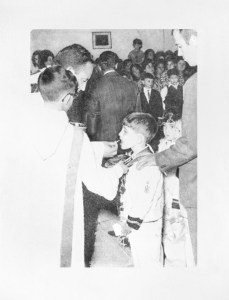
Primera Comunión, dust stuck on plastic, 150 x 105 cm, 2015

Primera Comunión, dust stuck on plastic, 150 x 105 cm, 2015

How has your work changed in the past five years? How is it the same?

Five years ago I was still forming in college and I think my work has changed completely. I´m specialized in sculpture, which is something I love, but you can get an idea of the change that supposes going from of stone carving or bronze casting to work with dust.

Still, I have never stopped doing other things (painting, drawing, photography, video …). I think I don´t choose the technique, the project itself tells me which tecnique is better.

How have people such as family, friends, writers, philosophers, other artists or even pop icons had an impact on the work you do?

Marcel Duchamp was the first artist to use the dust as a material for a work of art, and later another artist as Vic Muniz returned to incorporate it into his pieces, but my influences come more from the literature. I love reading essays and they help me to go in depth the study of the themes of my works. I prefer writers as influences because they don´t give you pictures, they give you concepts.

But we are all influenced by our surroundings. The cultural and social context is crucial although we are not aware of how it affects our work.

Have you ever been pulled in the direction of a pursuit other than being an artist? What are your other interests?

I like teaching and I have occasionally taught drawing, sculpture and printmaking. I have also worked as exhibition editor but I am currently devoted to art entirely.

About
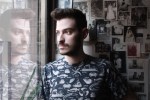
HeadshotGil Gijón, born in Madrid in 1989, is a graduate in Fine Arts from the University of Seville, and has a Master degree in Artistic Production from the Polytechnic University of Valencia. He has supplemented his education with courses taught by artists as important as Antonio López and also he has participated in various artistic events.

His works and projects have been exhibited in several solo and group exhibitions, both international, in Bologna (Italy) and San Francisco, and national level, in Madrid, Barcelona, Seville and Valencia, among others. He has won several awards and scholarships.

He is currently immersed in the creation of a multidisciplinary art collective, while he is developing his own works.
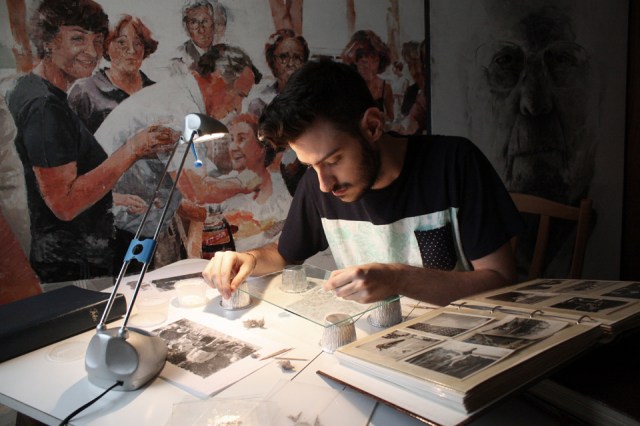
me and my studio

gilgijon.com

All images copyright of the artist and used with their permission.
Posted in mixed media | Tagged , , , , , | Leave a comment

Sofía Botero – Bogota, Colombia

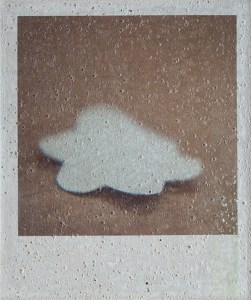
Floor with glueless sticker, Photography on handmade concrete block, 18x15 cm., 2015

Floor with glueless sticker, Photography on handmade concrete block, 18×15 cm., 2015

Briefly describe the work you do. 

My work builds on the quotidian, on personal and intimate stories and little details of daily life. It results from exploring routines, manias, memories, obsessions, and from an acute screening of the space I dwell: colors, shapes, materials, sounds, rhythms, stereotypes, doubts … In this pursuit, observation, intuition and imagination intersect, leading to a series of connections and disconnections between inside and outside. I aspire to build narratives that make sense of, or account for, life experiences and the many ways in which the milieu shapes memory and a sense of self. My goal is to make room for the trivial, the contradictory and paradoxical, by means of reflecting on the coexistence, tensions and possible relationships between public and private, proper and improper, fiction and reality, duty and love, absence and presence

Tell us about your background and how that has had an influence on your work and on you as an artist.

I was born and raised in Bogota (Colombia) in the 80s and 90s, at the height of the war on drugs; certainly the history of violence in the country has been a major influence in my work and in my life. But beyond the grand narrative of violence, I find my greatest inspiration in private and intimate stories of daily life, narratives about family, simple stories and tales of everydayness, which continues in spite of and pervaded by these awful stories.

The concept of the artist studio has a broad range of meanings in contemporary practice. Artists may spend much of their time in the actual studio, or they may spend very little time in it. Tell us about your individual studio practice and how it differs from or is the same as traditional notions of “being in the studio.”

For me the studio goes beyond a physical space, the study is a mental space that is operating all the time. I do have a studio space where I work mostly on painting; I try to spend two or three days a week over there. I also have a small space at home, which I consider another studio, where I work on photography and sound projects, and then there’s my computer, another studio space to spend time reading, doing research, surfing, socializing, taking notes, thinking and wasting a lot of time.

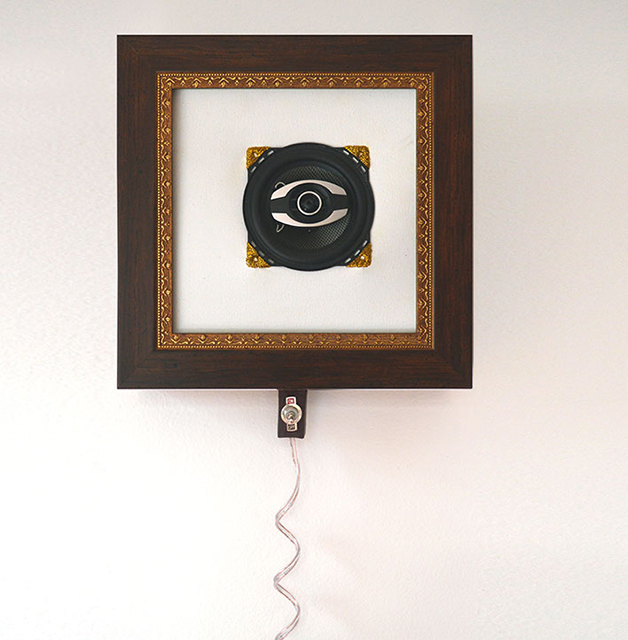
Still Life #2, Sound installation on canvas, 30x30 cm., 2013

Still Life #2, Sound installation on canvas, 30×30 cm., 2013

What roles do you find yourself playing that you may not have envisioned yourself in when you first started making art?

Public relations, networking, advertising and promotion, website development, business management, packaging, shipping and writing and re-writing and keep writing. I never thought I would have to write so much!

When do you find is the best time to make art? Do you set aside a specific time everyday or do you have to work whenever time allows?

I don’t think there’s a better time to make art, I think it’s a 24/7 job, I’m always creating, thinking and rethinking … my thought process is continuous and occurs at any time, anywhere, typically at the wrong time or when I have nowhere to take notes. Anyway, I think I’m more productive after 9AM and on sunny days.

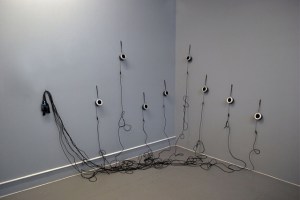
Tell me about it, Sound installation, dimensions variable, 2011

Tell me about it, Sound installation, dimensions variable, 2011

How has your work changed in the past five years? How is it the same?

My life has changed drastically in the past five years and so my work has also changed. I still work mostly in painting, sound, and photography, but my interests and concerns have transformed since I became a mother almost five years ago. Since then I’ve been balancing my life between being a mother and making art. I’ve always been interested in issues related to memory, history, personal narratives, and the way those little stories intertwine to build larger, public and official narratives. An undeniable influence in my work (and life) is the large-scale violence that has swept Colombia since 1948: guerrillas, paramilitaries, drug trafficking, kidnappings. Through my work I’ve tried to grasp and make sense of my experience… The birth of my daughter meant a drastic change in the way I approach the world … on the one hand it led me to “lock myself” indoors for a while, and it set me face to face with my insecurities and fears, with a completely unknown and hard task. On the other hand, it took me to reassess the value of routine and the little details of daily life, to see the little things that make up life, in contrast to the mega narratives of violence. Between 2011 and 2013 I worked on a project that emerged from many hours of sound recordings of every day life with my daughter, the project became a series of sound still-lifes. As of this project I began to consider noise and silence, intimacy, everyday life, routines, personal stories, and the intriguing bonds of family.

How have people such as family, friends, writers, philosophers, other artists or even pop icons had an impact on the work you do?

My family has unconditionally supported my career; in fact they have always driven me to continue even in times of uncertainty. Open and honest criticism and intimate conversations with family, friends and colleagues have an impact on my work and help me to keep things brewing longer. It also helps me to verbalize and shape my thoughts. As to other artists, writers, philosophers, the list can be very long, at this time I think of Sofia Coppola, Julie Gavras, Louise Bourgeoise, Liza Lou, Do-Ho Suh, Umberto Eco, Jorge Luis Borges, Simon Critchley Samuel Beckett, Nirvana … I could go on and on.

Have you ever been pulled in the direction of a pursuit other than being an artist? What are your other interests? 

Definitely. Besides being an artist, my other great interest is teaching. It is a job that I have done and I enjoy deeply, and actually enriches my work as an artist. Likewise, in teaching there are many opportunities to discuss my work, develop collaborative projects, and talk about art, philosophy, literature, music, theory, and more.

About

1-HeadshotSofía Botero is a Colombian artist whose work draws from everyday life, domestic routines, personal histories, and the gap between public and private life. She holds a BFA from Universidad de los Andes (Bogotá, 2002) and an MFA from Tufts University/School of the Museum of Fine Arts (Boston, 2011). Botero’s work has been shown since 1999 in solo and group shows in Colombia, Venezuela, United States, and recently in South Korea. She is the recipient of the Montague Travel Grant for Research and the President’s Research Award form the School of the Museum of Fine Arts, and the Graduate Research Award from Tufts University. Her artwork has been featured in magazines and newspapers including the Paint Pulse Magazine, Issue 3 (July, 2015) and it is part of private and public collections in Colombia, Venezuela and the U.S. She currently lives and works in Bogotá, Colombia.

5-Studio

sofiabotero.com

All images copyright of the artist and used with their permission.
Posted in Uncategorized | Tagged , , , , | Leave a comment

Virginia Derryberry – Asheville, North Carolina

 Sol and Luna Have a Conversation, detail of Kelly, oil on canvas, overall size, 96" x 72"; detail size 49" x 29", 2015

Sol and Luna Have a Conversation, detail of Kelly, oil on canvas, overall size, 96″ x 72″; detail size 49″ x 29″, 2015

Briefly describe the work you do

Recent work includes large scale oil on canvas figure paintings along with fabric/costume constructions that blend narrative elements from mythology and alchemy, the forerunner of modern science. The intent is to suggest multiple interpretations rather than a straightforward illustration of a specific narrative, a fitting choice in that alchemy by its very nature is about the process of transformation. The figures are portraits of specific individuals who are well known to me rather than idealized types. This has given the narratives an added “charge” and has served to ground the subject matter in the here and now. At first glance, it seems that a “real” space is being defined, but in fact, the painted images are constructed from multiple viewpoints and lighting systems. Passages of volumetric rendering set next to more abstract, painterly areas, result in the creation of a virtual, shifting world where nothing is quite what it seems.

Tell us about your background and how that has had an influence on your work and on you as an artist.

As an undergraduate at Vanderbilt University I majored in art history.   Later I chose the path of making art but have found that everything I have done is filtered through the lens of history—even in my questioning of that history.

The concept of the artist studio has a broad range of meanings in contemporary practice. Artists may spend much of their time in the actual studio, or they may spend very little time in it. Tell us about your individual studio practice and how it differs from or is the same as traditional notions of “being in the studio.”

I spend a lot of time in the studio and find it to be much like a meditative practice. Over the years, I have found the construction of “paint passages” in my paintings to be much like the adding or taking away of layers of experience, memory and dreams.

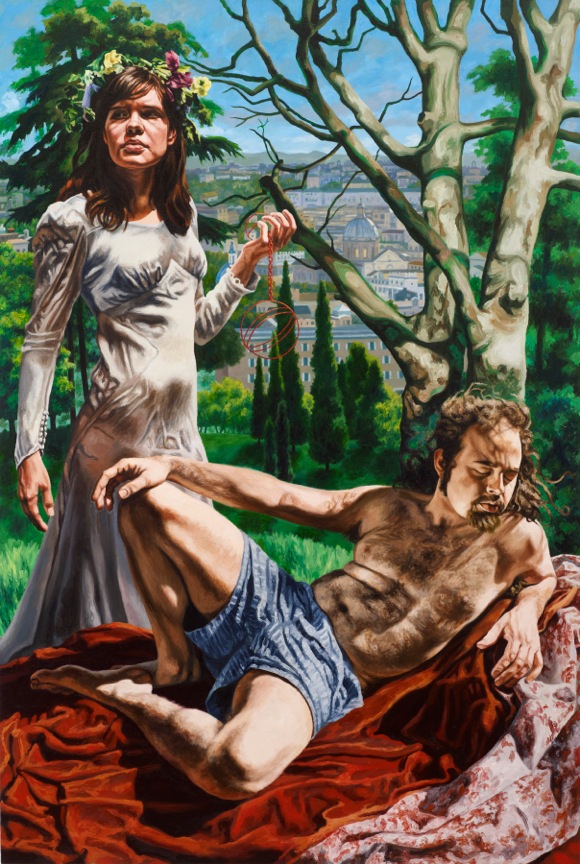
Alchemical Wedding, oil on canvas, 72" x 48", 2012

Alchemical Wedding, oil on canvas, 72″ x 48″, 2012

What roles do you find yourself playing that you may not have envisioned yourself in when you first started making art?

I have become more and more of an independent agent, and as such, have developed a number of personae to bring this about.   For example, although I’m an introvert, I have found that I am also very good at engaging an audience, in person, and behind the scenes in my role as an artist and teacher.

When do you find is the best time to make art? Do you set aside a specific time everyday or do you have to work whenever time allows?

The best time for me to work is mid afternoon until later in the day. In the morning, I spend time writing and drawing, but then I shift more into right brain thinking as the day progresses. As a full time university professor it is challenging to live “equally” in the studio and in the classroom. However, over the years I have found the kind of balance that allows me to work in my studio about 20-30 hours per week during the school year and many more hours during the weeks between semesters.   One world feeds the other.

Celo, oil on canvas with attached fabric, 70" x 47", 2015

Celo, oil on canvas with attached fabric, 70″ x 47″, 2015

How has your work changed in the past five years? How is it the same?

I am still interested in working with figures in a narrative but this has expanded to include other “non-traditional” aspects of painting, including sewing, costume fabrication and collage. Currently the two practices are combining in new ways.

How have people such as family, friends, writers, philosophers, other artists or even pop icons had an impact on the work you do?

Friends, family and people I encounter every day form the basis of my figure narratives—to the point where I paint some of the same people over and over again. Their body language, dress and immediate environments influence the direction of my paintings in a profound way.

Have you ever been pulled in the direction of a pursuit other than being an artist? What are your other interests? 

Yes, I’m a good writer and an even better editor. This has helped me in the profession of teaching in the arts.   I am also most interested in film making, from the point of view of a cinematographer.

About

Self Photo-2015Virginia Derryberry’s work is shown regularly in solo and group exhibitions throughout the United States, and her paintings have been written about in an extensive list of publications including New American Paintings, volume 82, 2009 and the 15th anniversary edition, 2010.  Her upcoming solo exhibition, Private Domain, which opens in February, 2016, at the S. Tucker Cooke Gallery, UNC Asheville, will subsequently travel to venues in South Carolina and Alabama.  She has received such awards as Outstanding Artistic Achievement from the Southeastern College Art Association (2013); Visiting Artist at the American Academy in Rome (2010 and 2016); the Distinguished Teacher of the Year Award (2005) and the Feldman Professor Award for scholarship (2010) from the University of North Carolina Asheville; the Annual Artist Fellowship from the Southeastern College Art Association (2005); a residency at Moulin a’ Nef, Auvillar, France, through the Virginia Center for the Creative Arts (2004) and two Individual Artist grants from the state of Georgia (1995 and 1993).  Her drawings and paintings are in numerous private collections throughout the Southeast and in the permanent collections of the Carnegie Museum of Art, the Morris Museum of Art, the Museum of Contemporary Art of Georgia, the Asheville Museum, the Bank of America Southeast Collection, and the Tennessee State Museum. Her work is also represented in two major public art commissions: a site-specific installation of 16 paintings at the Hartsfield-Atlanta International Airport and a 10 piece multi-panel painting at the Knoxville Convention Center. She has taught drawing and painting in a number of universities, most recently in the Department of Art and Art History, serving as department Chair from 2009-2014.

Virginia Studio-1

virginiaderryberry.com

All images copyright of the artist and used with their permission.
Posted in Painting | Tagged , , , , | 1 Comment

Nicole Ovalle Garcés – Santiago, Chile

abotonar collage 20x20 (2014)

abotonar collage 20×20 (2014)

Briefly describe the work you do.

My work is comprised of painting, drawing, collage, photography, shibori and weave. The presence of technical of textiles, the relation of the men with the textiles, as well as human consciousness. The pieces for these have been composed of items such as clothes: shirts, jeans, buttons, blankets, drawings, paintings, paper, stones, tea bags. These items exist as a part of my imaginary and my dreams, and I have put them in my works as forms of representation of my daily life I use textile art for explore concepts and to see how each idea is expressed. My process is to work with a idea present in my dreams or my awareness

Tell us about your background and how that has had an influence on your work and on you as an artist?

I grew up in Santiago city and I had access to art classes and paint,  during my adolescence. My father is sculptor and when I was a child my mother was seamstress, she worked in home, so textile materials they were always around in house and I became accustomed to them at an early age. I learned to sewing in a machine to the seven years, I toward clothes to my dolls.

In 2009 I was sixteen and take class of art in the school, my professor teach me painting with oil and draw with charcoal, my love of art is thanks the professor.

The concept of the artist studio has a broad range of meanings in contemporary practice. Artists may spend much of their time in the actual studio, or they may spend very little time in it. Tell us about your individual studio practice and how it differs from or is the same as traditional notions of “being in the studio.”?

I don’t work  in my studio, I work in the kitchen. I see the studio as a surface where I can assemble my work and contemplate this.  For me “studio” is more like a white wall; my kitchen it is a place where I feel like a alchemist and experiment.  So theoretically I stay every day in this place: I work, I eat, I read, I think and cook. The inspiration finds me wherever I am, especially when I wake up.

Metamorfosis, Photography 63x43 2014

Metamorfosis, Photography 63×43 2014

What roles do you find yourself playing that you may not have envisioned yourself in when you first started making art?

I had no idea that I would work with cloths although my mother worked with this materials, when I started thought “I will be painter for the rest of my life”, but I was just a child.  I had a really great inspiration during university, when I was in the workshop of painting I was bored and I needed explore in other workshop of art, there I met a artist of textiles , she showed us steps and tips necessary to make good jobs, the workshop was hard, but I learned much.  

When do you find is the best time to make art?

Do you set aside a specific time everyday or do you have to work whenever time allows? When I was in the university time ago I worked every days: day and night.

But now the best time to make work for me is in the night when everyone sleeps and the house is quiet. In the day I do various jobs that finances my art work.  I don’t work daily on my art, I left of the university two months ago and yet I don’t find the balance between art and job.

manual versus digital weave 34x25 2014

manual versus digital weave 34×25 2014

How has your work changed in the past five years? How is it the same?

I always wanted study art, but my work has changed in the conceptual and the technique.  As opposed to five years ago, I’m not painter, I making art with clothes and fibers, textil materials.  These materials mark to my history and the columbian culture that is a big influence to me, I travelled at 2010 to Iquique, in the north of Chile and saw the columbian textiles, and was love a first sight.

When you work with this materials you don’t see the process and you don’t back begin, doing so become less arbitrary, nothing is random.  However, in my process i don´t work until finish, I try to become more aware of the I see in the moment, and if I like the process I stop and start other piece with the same material. I experiment much with the materials and try to discover his potential in my art

How have people such as family, friends, writers, philosophers, other artists or even pop icons had an impact on the work you do?

Various influences on my work include my family, professors, other artists, writers, etc.  A few include my parents, Julio Cortázar, Haruki Murakami, Gonzalo Díaz, I try to read aesthetic texts in my free time, Mario Benedetti, among many.

Have you ever been pulled in the direction of a pursuit other than being an artist? What are your other interests? 

Baker. I love cooking cakes and have really enjoyed it.  I love making things with my hands and I’m vegan so is a challenge to me cook without milk and egg.  I cook to my family and when I see they enjoy my cakes is the best gift.

About

headshotBorn in Santiago at Chile, Nicole is a full time artist in Chile. She received her degree from the Universidad de Chile. Her work has been exhibited nationally and she have first place in a competition of art. Nicole’s work is in a number of corporate collections including that University Andres Bello.

book

nicoleovallegarces.weebly.com

All images copyright of the artist and used with their permission.
Posted in Textiles | Tagged , , , , | Leave a comment

Sarah Shamash – Vancouver, BC, Canada

Title: Telling Traces Medium: Audio Installation (with video) Size: 2mx3m (Variable) Year: 2013-2015 Collaborative project with Aisha Jamal

Title: Telling Traces
Medium: Audio Installation (with video)
Size: 2mx3m (Variable)
Year: 2013-2015
Collaborative project with Aisha Jamal

Briefly describe the work you do. 

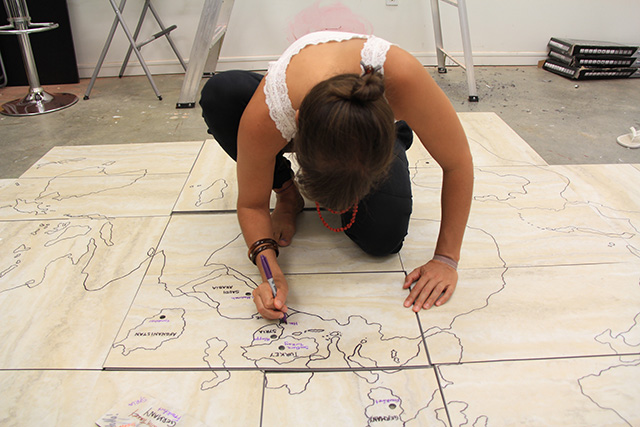
As a media artist, my works typically circumvent the art market, and generally don’t require gallery walls. My works tend to be transitory experiences, rather than material objects; in this sense, they are difficult to see, let alone purchase. Informed by cinema, I work through a variety of processes, technologies, and materials as needed to create artworks that engage socio-political realities and that take the form of videos, photographs, documentaries, installations, performances, sculptures, web and mobile applications. Working with a DIY (do-it-yourself) ethos, my way of working often involves spending time in a space, observing, interacting, and sharing. I then document that spatial experience with film, photography, video, and/ or sound and that material is usually the genesis of my projects that later involve much time on a computer doing post-production. Hand-drawn maps, and mapping workshops have also become central to my experimental approach to geography as a way to visualize some of the more hidden aspects of our complex relationships to space such as experiential knowledge, mnemonic, psycho, social and economic relationships to space.

Tell us about your background and how that has had an influence on your work and on you as an artist.

I come from a multi-ethnic background with ancestral trajectories from the Middle East to Brazil to Europe and now Canada. More and more, our society is composed of new generations of people that can say that they come from five different places. My son, for instance, already has three nationalities: Mexican, Canadian, and French. Understanding the complexities of place, belonging, and identity is how I have come to artistically explore our bodies as interfaces for our experiences of the world and how space-time is engraved on our bodies and in our psyches. That’s why my artistic project explores the subjectivities of our positions and conditions in time and space through the body with experimental mapping strategies that presuppose an understanding that space is not neutral based on our class, gender, ethnicity, etc.

The concept of the artist studio has a broad range of meanings in contemporary practice. Artists may spend much of their time in the actual studio, or they may spend very little time in it. Tell us about your individual studio practice and how it differs from or is the same as traditional notions of “being in the studio.”

Like the many media artists working in the world, I don’t have this beautiful space I can go to everyday to work, although I often fantasize about it. In the past, I have done artist residencies where I have had the opportunity to work intensely in a studio context to build, construct, physical parts of a sculpture or installation and/ or to work on the computer to complete the post-production for a project in a condensed period of time. In this sense, I have had a studio practice in Sao Paulo, Salvador, Toronto, Vancouver, Banff, Amman, and Paris, in no particular order. Considering the studio as a site of inspiration, archives, and work, I also think of the world and my computer as a studio. So really, that can be anywhere. Now with my one year old son, I work at home a lot.

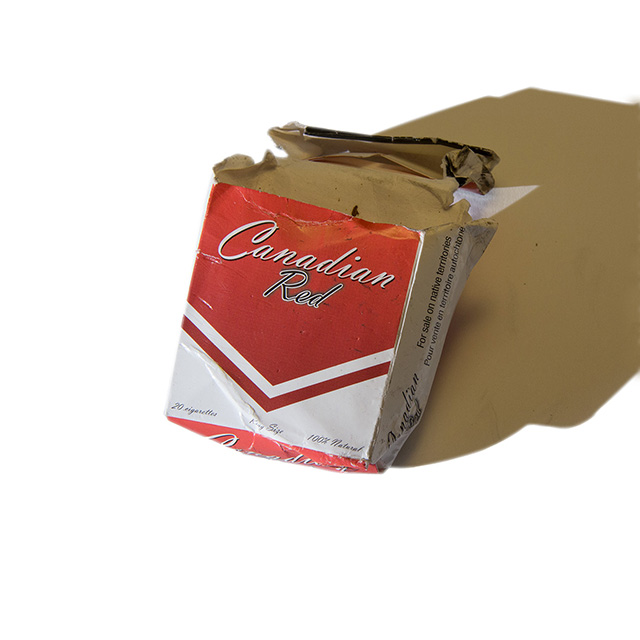
Title: Canadian Red from the series Hastings Glean (9 color photographic prints 32cm x 32cm and single channel video: 9.24mins color HD looped on monitor) Medium: Lightjet matte print Size: 32cmx32cm Year: 2014

Title: Canadian Red
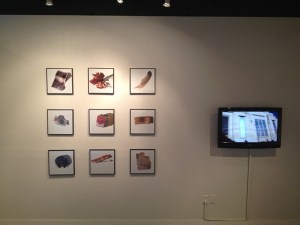
from the series Hastings Glean (9 color photographic prints 32cm x 32cm and single channel video: 9.24mins color HD looped on monitor)
Medium: Lightjet matte print
Size: 32cmx32cm
Year: 2014

What roles do you find yourself playing that you may not have envisioned yourself in when you first started making art?

Talking, project managing, writing, documenting, organizing, shipping, promoting… Each project is different and undergoes a unique process so I am always learning new things, new techniques, new people, new ideas, new materials. One of the most amazing and inspiring things about the work I do and my approach to research and creation is being in the world, “in the field”, and meeting people from all walks of life and learning about life and the world through their eyes. I love the role of always learning and engaging with the world and all of its chaos and complexities.

When do you find is the best time to make art? Do you set aside a specific time everyday or do you have to work whenever time allows?

Right now, I feel there is a before and after I had my son, in terms of art production and ways of working. Don’t get me wrong, having my son has been tremendously inspiring. In terms of time, before, I could work compulsively on a project day and night until I felt it was done or at least until I was ready to let go of it. Now I find, I definitely work when time allows.

Title: Hastings Glean Medium: 9 color photographic prints and single channel HD video looped Size: 32cm x 32cm and 24” monitor Year: 2014

Title: Hastings Glean
Medium: 9 color photographic prints and single channel HD video looped
Size: 32cm x 32cm and 24” monitor
Year: 2014

How has your work changed in the past five years? How is it the same?

A lot of my ideas are the same in terms of carrying out mostly slow, research based projects that evolve over a period of time on themes related to space, the human trajectory, borders, socio and psycho geographies, and a deep passion for cinema. Of course, we are in constant flux and transformation as is the world around us. There is a dynamic response to these two things that is reflected in the work over a period of time.

How have people such as family, friends, writers, philosophers, other artists or even pop icons had an impact on the work you do?

The values and the way I see the world come from my family and I am forever grateful for all the teachings that I have received from them. Because of my family, I have come to learn and understand my place in the world, as a daughter, granddaughter, sister, cousin, niece, mother, student, teacher, wife, friend, partner, artist, academic, activist, worker. I am also a cinephile, which has shaped the way I see the world. Third Cinema, Fourth Cinema, feminist DIY film and video, experimental / art house film and video, Direct Cinema, and autobiographical film have all been highly influential and inspirational sources. As a PhD student, of course, literature and philosophy are and have been important in my intellectual development, but reflecting on my most profound learning experiences, they were almost all experiential and many were teachings from my family, especially my grandmother.

Have you ever been pulled in the direction of a pursuit other than being an artist? What are your other interests? 

Doing a PhD has pulled me into an academic context, so it’s interesting to be an artist in and outside of academia. My interests as an artist and researcher are intertwined. It’s all about my passion for film as a medium with the power to reflect plural histories, cultures, geographies, worldviews, cosmologies, narratives, aesthetics, emotions, ethics and justice. Knowledge is interdisciplinary, relational, collaborative, and interdependent on the universal web that connects us all. So although I have other interests in geography, politics, the natural world, Indigenous film and video, Latin American film history, feminism, yoga, soccer, island culture, hammock culture, technology, cognitive philosophy, and Middle Eastern cuisine, to name a few of my other interests, it’s all related and connected. In fact, I am rather disinterested by the contemporary artworld and its exclusive, elitist, policing, gatekeeping policies that often disconnect people from their creativity and ways of knowing.

About

HeadShotSarah Shamash is a Vancouver based media artist and PhD candidate at the University of British Columbia. She teaches film, art, and digital design and has worked programming films and videos. She studied film and media arts at Paris 8, in France completing Master’s degrees in Film and in Media Arts. Since the 2000’s, she has been exhibiting her work in art venues and film festivals while pursuing her creative production at international artist residencies including Vancouver, Toronto, Banff, Salvador, Sao Paulo, and Amman. Informed by cinema, her interdisciplinary art practice engages the body, social and psycho geographies through experimental mapping strategies that convey experiential knowledge.

InMyStudioMakingArt02

sarahshamash.com

All images copyright of the artist and used with their permission.
Posted in Drawing | Tagged , , , , | Leave a comment

Stefanie Herr – Barcelona, Spain

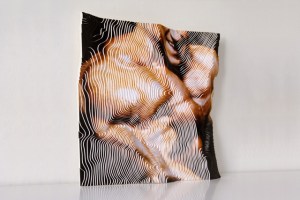
Mr. Olympia · Markus Rühl (2007) Archival pigment print on Hahnemühle Photo Rag Pearl, conservation matboard, adhesives · 50x50x15cm

Mr. Olympia · Markus Rühl (2007)
Archival pigment print on Hahnemühle Photo Rag Pearl, conservation matboard, adhesives · 50x50x15cm

Briefly describe the work you do.

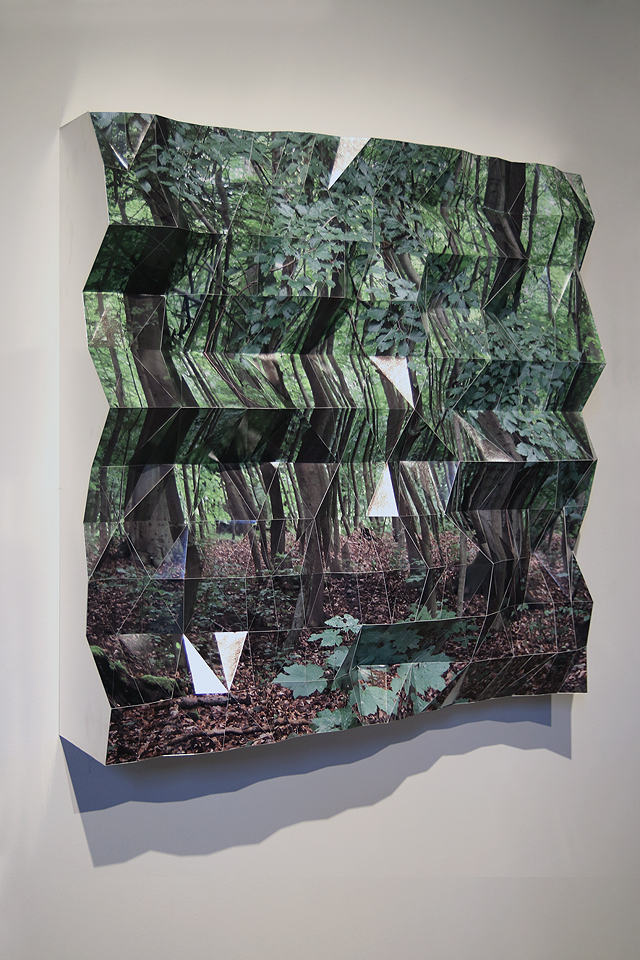
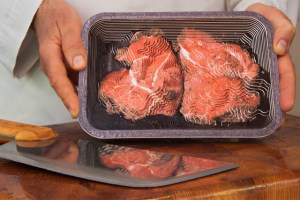
Blurring the lines between photography and sculpture, my work can be best described as photographic relief sculpture. With a special focus on geography, it addresses the way we relate and respond to the natural environment and is primarily aiming at exploring the contours of today’s dislocated consumer society. Topographic charts provide my main source of inspiration and constitute an indispensable tool within my creative practice.
Generally made from cardboard and paper, all pieces are painstakingly cut and assembled by hand. I strongly believe that I wouldn’t be able to grasp the very essence of my work, if I didn’t sculpt it manually – just like landscape can be fully experienced only by walking. In this way, my artistic practice is not limited to addressing sustainability issues only, but also an approach to sustainable design.

Tell us about your background and how that has had an influence on your work and on you as an artist.

When I started studying architecture, I would never have imagined that one day I would call myself a visual artist. On the other hand, if I had studied art I would have probably never come up with the idea of doing photographic relief sculpture. Actually, the origins of my artistic practice can be traced back to architecture school where I discovered my passion for model making: I was not only captivated by the intrinsic aesthetics of traditional contour-line modeling – a common tool in architecture – but also utterly convinced of its artistic potential. After graduation, whilst working within the profession for several years, my passion turned into an obsession, and I eventually jumped in at the deep end.

The concept of the artist studio has a broad range of meanings in contemporary practice. Artists may spend much of their time in the actual studio, or they may spend very little time in it. Tell us about your individual studio practice and how it differs from or is the same as traditional notions of “being in the studio.”

I generally spend a lot of time in front of the computer (for project-related research, technical drawings, and photo editing, as well as for day-to-day administration, PR, marketing and communication tasks), and, unless I don’t have to print, I can do that anywhere. As a matter of fact, you’ll most probably find me outside the studio whilst carrying out this kind of work. Since photography is fundamental to my work, I am also doing a lot of photographic fieldwork.
It is only after the preparation phase of a project that the studio becomes my main workspace and I won’t leave it until the final artwork is completed. At this stage, being in the studio means up to several weeks of solitary, persistent and meticulous manual labour, and corresponds mainly to cutting, stacking and gluing innumerable layers or fragments of cardboard and paper.

The Growth Imperative · Pure Growth (2015) Archival pigment print on Hahnemühle Photo Rag Pearl, museum matboard, adhesives, and other materials · 100x100x25cm

The Growth Imperative · Pure Growth (2015)
Archival pigment print on Hahnemühle Photo Rag Pearl, museum matboard, adhesives, and other materials · 100x100x25cm

What roles do you find yourself playing that you may not have envisioned yourself in when you first started making art?

When I started out as an artist, I actually didn’t realize what I was getting myself into, although I’m definitely glad I did! I’m still naïve enough to believe that the art business is not just another business.
Back then, I completely underestimated the importance of my educational background. Though historically considered as one of the main fine arts, architecture didn’t seem to qualify me to take the plunge into visual art – when it came to applying for certain scholarships or getting into a gallery, I was simply not admitted, as holding a degree in the visual arts was compulsory. I also undervalued the influence of age and gender on my career progression. I started doing photographic relief sculpture at the age of 33 and it roughly took me two years to make enough work to build a strong portfolio. At this time I was 35, but most open calls are restricted to artists under the age of 35. So whereas I had just begun promoting myself as an emerging young artists, the rest of the art world considered me an old lady already.

When do you find is the best time to make art? Do you set aside a specific time everyday or do you have to work whenever time allows?

Unfortunately, at this stage of my career, I cannot make a living with my art and have to juggle more than one job. As working time is distributed unevenly throughout the year, I have little choice but to make art whenever time allows. Luckily, inspiration often comes unexpectedly, and since art moves freely in the realms of freedom and discipline, imagination and reality, part of the conceptual work can be done at any time.


Alcampo · Butcher Bobs Garden (2012) Archival pigment print on Hahnemühle Photo Rag Pearl, conservation matboard, adhesives · 18x25x4.5cm

Alcampo · Butcher Bobs Garden (2012)
Archival pigment print on Hahnemühle Photo Rag Pearl, conservation matboard, adhesives · 18x25x4.5cm

How has your work changed in the past five years? How is it the same?

I’m afraid my work hasn’t changed a lot since I got started in 2007. As my pieces take considerable amounts of time to produce, and success doesn’t happen overnight either, it feels like it was only yesterday that I took my first steps as a visual artist.
Yet, the world is changing fast and technology is also redefining art and artists. When it comes to the issue that my photographic relief sculptures are entirely made by hand, I usually get a lot of well-intentioned advice on how to improve my performance: Consider a laser cutter! But, from my point of view, art is not about mass production. Besides, what to some people may seem like a huge chore, for me doesn’t even feel like work. 

How have people such as family, friends, writers, philosophers, other artists or even pop icons had an impact on the work you do?

I can’t think of nobody in particular having had a greater impact on my work so far, at least not consciously. Influence is everywhere.

Have you ever been pulled in the direction of a pursuit other than being an artist? What are your other interests?

As I explained earlier, I found my way into photographic relief sculpture rather by accident. Today, I wouldn’t change it for anything. Despite pretty much fulfilling the stereotype of the starving artist, I wouldn’t want my old job back. I enjoy the freedom of working autonomously, drawing a much greater benefit from the process of creation than from the money I could possibly earn. Besides, and that’s the great thing about art, it allows you to discuss any topic and, that way, target the intersection of multiple interests.

About

01_headshotStefanie Herr, born 1974 in Germany, holds a degree in Architecture from TU Berlin. After working in architectural design and model making for several years, she decided to pursue a genuinely artistic career and began mainly experimenting on photographic relief sculptures in 2007. Stefanie currently lives and works in Barcelona. Since 2009, her delicate handiwork has been shown in several group and solo exhibitions across Europe.

06_studio_me

stefanieherr.com

All images copyright of the artist and used with their permission.
Posted in Painting, Paper Art, Sculpture | Tagged , , , , | Leave a comment

Amanda Lenox – Astoria, New York

Beatrice, Graphite, 16x20, 2015

Beatrice, Graphite, 16×20, 2015

Briefly describe the work you do. 

I make work that ranges in content and feeling. I mostly like to make photo-realistic portraits using graphite but I also like to make very colorful and expressive portraits with oil paints. In addition, I love to create work that is fashion forward using primarily mixed media.

Overall, I find myself making images of happy and curious children, adults with various personalities, people merrily interacting, and certain fantasy scenes. I have recently begun to venture into an even wider territory of content by illustrating various cultural identities and pleasurable hobbies; including sports activity, vacationing, spiritual activism, and festive tidings.

Tell us about your background and how that has had an influence on your work and on you as an artist.

My background in other fields has been a major influence on my artwork. First, my educational track to become a certified psychoanalyst has been a huge mind blowing experience that has shaped my art. Within my art, I can visually see how my mind has grown and changed by psychoanalytic ideas, methods, and practice in the past 5 years.

In addition, my background in dance has hugely influenced my technical skills. It has helped me to develop my use of line, color, texture, shading, overall feeling, openness to improvisation, and all aspects of production.

The concept of the artist studio has a broad range of meanings in contemporary practice. Artists may spend much of their time in the actual studio, or they may spend very little time in it. Tell us about your individual studio practice and how it differs from or is the same as traditional notions of “being in the studio.”

I used to have a studio in Philadelphia in an old converted factory. I loved being there and connecting with the other artists. It gave me a place to host events and invite people to visit. I am now making art out of my home, which blurs the line between being an artist and being an “everyday” person. As soon as I wake up, I step into my artwork. I come in contact with my inspiration clippings, unfinished projects, frames, and shipping materials throughout my home; I am immersed.  

Amy, Oil, 19.5x25.5, 2015

Amy, Oil, 19.5×25.5, 2015

What roles do you find yourself playing that you may not have envisioned yourself in when you first started making art?

When I was young, I wanted to make art in order to entertain people. As I have aged, I find that art is a bridge for people to connect in a more phenomenal way. Whether or not people love a piece of art or hate it, art is great for starting conversations. As an artist, I think it is an important to recognize that this is a huge role we play in a world that desperately needs more talking and less acting out.

When do you find is the best time to make art? Do you set aside a specific time everyday or do you have to work whenever time allows?

I love making art at night. Starting at about 9:00 PM, my creative juices flow. My mind naturally loosens up at that hour and I am able to swivel around in my artistic matrixes more freely. On a perfect day, I will paint until 1:00 AM and fall into bed fully drunk on art. This does not happen daily but I do try to make it happen as much as possible. On days I do not have the time to sit for hours, I try to make time for some aspect of my artistic life. Whether it is a jotting a quick contour, putting something up on my inspiration board, or developing my website further, I try to do at least one thing daily for my art.

Beard #1, Oil, 19.5x25.5, 2015

Beard #1, Oil, 19.5×25.5, 2015

How has your work changed in the past five years? How is it the same?

My art has changed in its’ range of content and technical skills over the past five years. I used to only paint or draw portraits but now I am all over the map with what I like to use as subject matter. I think this change has come about because I love to experiment with new materials on a regular basis and I am a relatively spontaneous person by nature… I find it is easier to be spontaneous while making art than it is in your relationships with people; so, I am full force with it there. However, it remains the same that I still love to draw and paint people. Furthermore, I will never tire of blind contouring, cross hatching, and painting with wild colors.

How have people such as family, friends, writers, philosophers, other artists or even pop icons had an impact on the work you do?

Modern psychoanalytic thinkers inspire me. They are willing to explore every facet of every association in the mind and work hard to overcome resistances that crop up when attempting to do so. Their methods of doing this are developmental, nurturing, and non-threatening. This inspires me to make art in a similar fashion.

Other types of people influence my work too. My great friend, Johnny Columbo, is a vintage couture fashion guru. He influences me a lot when he talks about fabric, fashion designs, and the history of a particular garment. The way he arranges the window displays in his shop (Philadelphia Vintage and Consignment) are delightful and helps me to see composition from a whole other perspective. 

Moreover, I am very influenced by dancemakers. Choreographers today are making really cool work. Mats Ek, Jiri Kylian, Ohad Naharin, and Roni Koresh are extraordinary when it comes to writing dance. I used to dance for Roni Koresh, artistic director of Koresh Dance Company, and am very inspired by his work. If you have not seen any work by these choreographers, search for it.

Have you ever been pulled in the direction of a pursuit other than being an artist? What are your other interests? 

Besides my career in dance, I have a clinical practice in psychoanalytic based psychotherapy and am pursuing the highest credentials possible in this field. I think this still counts as artistic pursuit since so much of psychoanalytic clinical procedure is based on the same unconscious processes that are used to make art. There is so much improvisation and creativity that also occurs in sessions with my clients that I feel each hour is its’ own work of art…Given this, I would probably have to say no to this question… I am “all art,” all of the time.

About

headshotAmanda Lenox is a Dallas, Texas native who began her career aspiring to be a professional dancer and visual artist. In her teens, she trained throughout the United States for dance and performed alongside the Dallas Cowboy Cheerleaders as a guest performer for music artists: Leann Rimes, Toby Keith, and Creed. Inspired to further her education, she left Texas to pursue a BFA in Modern Dance Education from the University of the Arts, Philadelphia. Whilst there, she interned with BalletX Dance Company under the direction of PA Ballet’s, Christine Cox. After graduating, she began dancing as a company member for world renowned Koresh Dance Company and spent her time touring nationally and internationally. Amanda has collaborated with Koresh Dance Company as a visual artist as well. She has exhibited her work at Koresh’ bimonthly artist showcases and has donated her artwork to the company to aid in various fundraising campaigns. Amanda has exhibited her artwork in other Philadelphia venues, such as: The Painted Bride Theater; Square Peg Artery and Salvage Gallery; and Philadelphia Vintage and Consignment Boutique.

Alongside her career in the arts, Amanda developed a passion for teaching and went on to teach ballet, dance wellness, and dance history for several years at Georgian Court University. In her spare time, Amanda decided to go back to school for her masters at Capella University and graduated with her M.S. in Mental Health Counseling. She has since begun her clinical practice at the Philadelphia Consultation Center in downtown Philadelphia. She currently trains at the Philadelphia School of Psychoanalysis where she is Chair of the school’s Arts and Culture Committee. As Amanda has been working towards certification in modern psychoanalysis, she has gone on to build a second practice in New York City at the Psychoanalytic Psychotherapy Study Center. She suggests that her clinical practice inspires most of her recent artistic designs.

Amanda continues to pursue her clinical training and deepen her roots in New York City. She is currently teaching dance on faculty at the highly acclaimed Westchester Dance Academy in Mt. Kisco, NY. In addition, she has found a home exhibiting her artwork at Brooklyn Bagel in Astoria, New York and at Greenpoint Gallery in Brooklyn, NY where she recently won recognition in the gallery’s juried “People’s Choice Salon Show.” She has been offered a permanent spot in the gallery’s upcoming season and is currently making work for ongoing exhibition there. Amanda has become an exhibiting artist with Astoria’s Annual Art Festival but also has artwork that resides in various private collections in the United States. 

Krista Svalbonas 2015 LP

Centennialwomanart.squarespace.com

All images copyright of the artist and used with their permission.
 

Posted in Drawing, Painting | Tagged , | Leave a comment

Chanelle Walshe – Dublin, Ireland

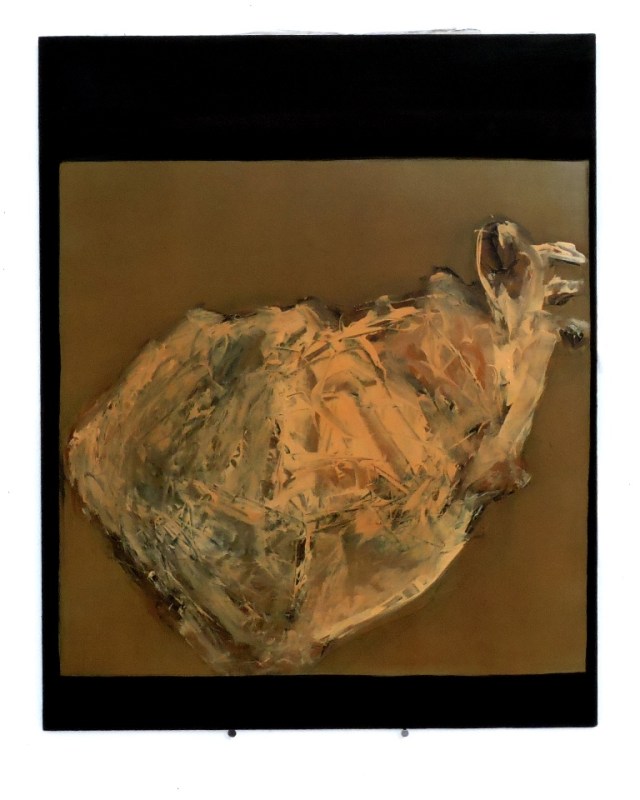
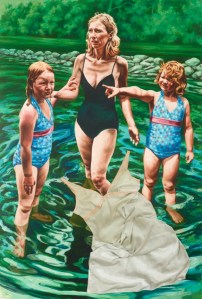
Facula_oil and pencil on board_30x25cm_2014

Facula_oil and pencil on board_30x25cm_2014

Briefly describe the work you do. 

I make paintings that are based on human organs and skeletal structures. I look at the ribcage, the pelvic bone , the heart and lungs. The work suggests the presence of an unknowable energy within these forms. I am interested in death, rebirth and regeneration. I work in series, using a framework of notebook documenting, drawing, and then painting. I am looking at land and the body in a way where each inhabits the other. I view bones and organs as relics; buried, rising, unearthed, and then revived or inhabited. My paintings impart land and body as a microcosm of an ever expanding universe and consciousness.

I am currently on a residency at the Royal Hibernian Academy in Dublin, Ireland.

Tell us about your background and how that has had an influence on your work and on you as an artist.

My Dad, Lorcan Walshe is a well known Irish artist, also a painter. And my mother Susan is a scientist. When I was around 4 years old I told them that I was a painter too. I never came up against any resistance from them for my chosen path and I am very grateful for their constant support and encouragement.

Because Mum works and teaches at one of Irelands biggest hospitals I have an interest in anatomy, the peculiarities of our bodies as systems and the latest developments in healthcare.

My parents buy a lot of art so I have grown up around paintings by well known Irish artists such as Patrick Graham, Cecily Brennan, Patrick Pye, Pat Harris, Michele Souter, Patrick Scott and Charles Brady to name a few. These paintings certainly influenced my early work, my drawings, my palette and my mark making.

I am also very lucky to have always worked in a studio space. I spent a lot of time hanging out in my Dads studio as a child. I think that had a very positive influence on me when I started art college. I was never daunted by a big blank white space and I didn’t find it particularly difficult to adjust to after leaving secondary school.

The concept of the artist studio has a broad range of meanings in contemporary practice. Artists may spend much of their time in the actual studio, or they may spend very little time in it. Tell us about your individual studio practice and how it differs from or is the same as traditional notions of “being in the studio.”

My studio space is very important to me. I always invest in good studio spaces – big, bright, white, quiet and in a group setting. I have to be able to close the door behind me and feel comfortable in the space if I want to get any work done! I also need other artists around me for lunch breaks and to avoid feeling isolated.

When I am researching I need to go and look at things in real life and draw from them. I have recently spent some time at The Huntarian Museum at The Royal College of Surgeons in London. The Natural History Museum is two minutes from my studio. I can draw from skeletons there and The Royal College of Surgeons is a five minute walk away. I have been drawing from hearts and lungs in their lab and they have been so kind and accommodating. In some ways the lab and the museums have been temporary studios.

I return to my studio with my notebooks and then make paintings. Painting days are very long. I am in early and usually take a 2 hour lunch break in the middle of the day and ill go for a walk. I get my best work done in the evenings when I am a little tired and my body is more relaxed.

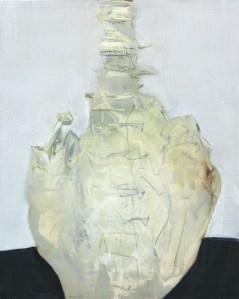
thelesthesia_oil on board_50x40cm_2015

thelesthesia_oil on board_50x40cm_2015

What roles do you find yourself playing that you may not have envisioned yourself in when you first started making art?

It turns out that I am a pretty good organiser. I did not envision that I would collaborate with other artists, curate and put on exhibitions. That has been exciting and a real learning experience. I also did not imagine myself to be in as many public speaking roles as I have been in. Giving talks and engaging in panel discussions has been very informative and really helps me to feel like I am connecting with an audience and a community that I belong in.

There is also an admin role which is everyday! And sometimes all day! It has to be done but it is the side of making art that perhaps people do not know about. I have to be careful to manage it well and not let it interfere with my studio practice so I try my best to do this work outside the studio, usually in a café that has good wifi !

When do you find is the best time to make art? Do you set aside a specific time everyday or do you have to work whenever time allows?

I make my best work from October to April, they are the coldest months in Ireland, they keep me indoors for longer and my sleep is better in the winter. As for daytime hours, the mornings and the evenings are good for me. Not the afternoon. Afternoons are for phonecalls, meetings, going to the library, the hardware shop or the art supply shop.

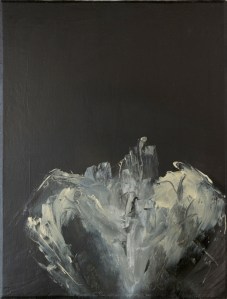
The conjuring_oil on board_40x30cm_2014

The conjuring_oil on board_40x30cm_2014

How has your work changed in the past five years? How is it the same?

My research methods, the long periods of time spent drawing and my mark making still seem to be the same as five years ago. Older works were more about body sensations and energy whereas newer work is influenced by ideas about consciousness and unconsciousness and in between states of being.

Looking at the heart as a subject is a new thing. Two years ago I suffered a severe concussion in a freak accident. When I woke up, my brain activity was so slow that I wasn’t sure whether I was dead or alive. In the days that followed I had an irregular heart rate and for a number of months afterwards I struggled with post concussive syndrome. I am fully recovered now and although it was a difficult time I feel that it influenced my work in a very positive way. My palette changed and the paintings have more depth to them now.

How have people such as family, friends, writers, philosophers, other artists or even pop icons had an impact on the work you do?

I was around very interesting tutors in art college (NCAD) such as Robert Armstrong, Diana Copperwhite, Clare Carpenter and Margaret O’Brien. Talking to them and following their work has helped me figure a lot of things out in regards to my own work, especially on a practical level.

Conversations about bodies and energy with other painters, singers and performers has helped me to think about how to tap into certain energies while I paint. I learn a lot from my friends and their methods and experiences. I always stand up when I paint and I don’t wear shoes. It is a very physical experience and I try to let anger, sexual energy, pain, joy, secrets and fantasy come to the surface as I paint.

I love the work of painters Cy Twombly, Mark Rothko, Frank Auerbach and Dana Schutz to name a few. I’m really into Rainer Maria Rilke’s poetry and Jeannette Wintersons writing.

Have you ever been pulled in the direction of a pursuit other than being an artist? What are your other interests? 

No not really, I always wanted to be an artist. Other interests include watching sports like soccer and tennis. I’m a big fan of Venus Williams and Paula Radcliffe. And my big passion in life is cycling. I am happiest when out for a cycle, my mind clears. I cycle everyday.

About

portrait_Chanelle_Walshe.jpg2Chanelle Walshe lives and works in Dublin Ireland. She is currently artist in residence at The Royal Hibernian Academy and recent recipient of The Thomas Dammann Award.

Walshe’s work suggests the presence of an unknowable energy within forms such as pelvic bones, lungs, hearts and landscape. She is interested in death, rebirth and regeneration with particular focus on the permeable, transitory boundary that exists between them.

She works in series, using a framework of documenting, drawing, and painting.  Her primary interests lie in both the self-destructive and regenerative qualities of both Man and Earth. She looks at land and the body in a way where each inhabits the other.  She is influenced by a traditional and romantic connection to Irish land, heritage and treasures. Walshe views bones and organs as relics; buried, rising, unearthed, and then revived or inhabited. Her paintings impart land and body as a microcosm of an ever expanding universe and consciousness.

Walshe graduated from NCAD in 2010. Recent exhibitions include not life / necessarily at NCAD Gallery Dublin, 2014 (2 person) and Copernicus and other systems at FLOORONEGALLERY, Temple Bar Gallery and Studios Dublin, 2013 (solo). Previous group shows include PANORAMA curated by Chanelle Walshe and Kathy Tynan at Pallas Projects Dublin 2015, Future Perfect The Hugh Lane Dublin City Gallery 2013 and On Departure The Golden Thread Gallery, Northern Ireland 2010. She has undertaken residencies at The good Hatchery, Co.Offaly (2011) and at Werk.Stadt.Laden, Dresden, Germany (2013). Walshe is artist in residence at the RHA Dublin from July 2015 to Feburary 2016.

studio_Chanelle_Walshe

chanellewalshe.com

All images copyright of the artist and used with their permission.
 

Posted in Painting | Tagged , , , , | Leave a comment

Bonnie Peterson – Houghton, Michigan

On the Nature of Fire, Embroidery on silk, velvet, 65”H x 85”W, 2015

On the Nature of Fire, Embroidery on silk, velvet, 65”H x 85”W, 2015

Briefly describe the work you do. 

I use embroidery to investigate cultural and environmental issues. Mixing a variety of source materials such as scientific data and early explorer’s journals, I stitch words and phrases on velvet and silk fabrics to make large narrative wall hangings. 

My recent projects examine geophysical climate issues. Instigated by a series of collaborations with scientists, I explore simple explanations for some of the important principles in climate and environmental science. 

Tell us about your background and how that has had an influence on your work and on you as an artist.

I grew up in a Chicago suburb.  During the summer before junior year of high school, my family moved to Zaire (Dem. Rep. of Congo). This experience had a huge impact on my life and gave me an unusual perspective on political issues.

I have a background in statistics and marketing research. One of my sisters inspired me to make a traditional pieced bed quilt.  My patience wasn’t great and I started cutting out the shapes of Chicago buildings for a small wall hanging of the skyline. When a close friend died of breast cancer in the early 1990’s, I used bras and dye-transferred text to compose my requiem.  Standing nearby at an exhibit, I enjoyed hearing people laugh at the bras, and then start talking about breast cancer experiences. When this work was rejected by a quilt show, I entered it in art shows. The Illinois Arts Council gave me a couple of artist fellowship grants which greatly encouraged me to keep working on personal and political themes. 

I’m very excited about working on artist/scientist projects. It’s rewarding to learn about new research in environmental science and interact with researchers and other artists who are engaged with science. The projects provide material for many years past their defined calendar. This year I worked on Fires of Change, an NEA funded project about wildfire.  Eleven artists joined fire scientists and land managers at the North Rim of the Grand Canyon for a week of education and training on the impacts of wildfire.  We had a year to complete our work and the exhibition opened in September.

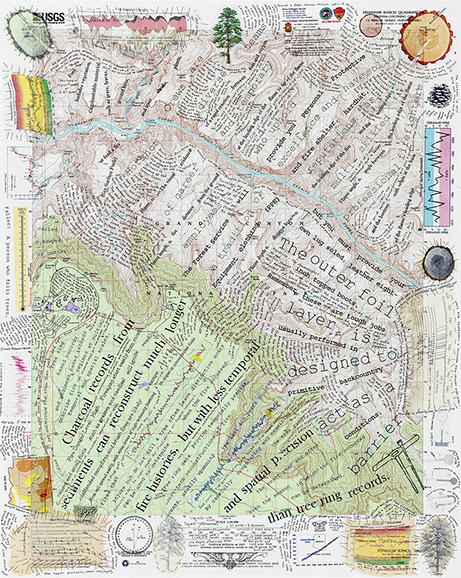
Phantom Ranch Quadrangle, Mixed media on topographic map, 27”H x 22”W, 2015

Phantom Ranch Quadrangle, Mixed media on topographic map, 27”H x 22”W, 2015

The concept of the artist studio has a broad range of meanings in contemporary practice. Artists may spend much of their time in the actual studio, or they may spend very little time in it. Tell us about your individual studio practice and how it differs from or is the same as traditional notions of “being in the studio.”

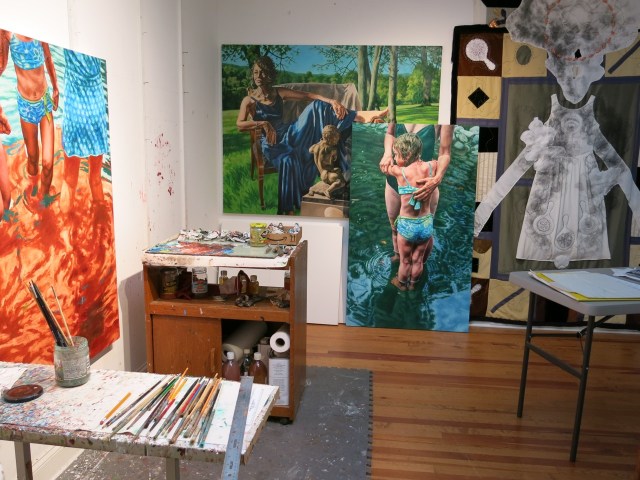
I spend a lot of time in my studio working on several projects simultaneously. Starting with a research phase, I collect and organize the project’s concepts and materials.  For assembly, I arrange fabrics on a 24’ wide Celotex pin-up wall.  At various stages the fabrics return to a table for basting or hand stitching, or go to a sewing machine for hand-guided embroidery.

I also make collages using text and transfers on paper topographic maps.  These works are long on planning, material gathering and editing, and quicker to complete than my large textile pieces.

What roles do you find yourself playing that you may not have envisioned yourself in when you first started making art?

advertising and promotion, website production, writing, digital photo management, speaking, printing, scheduling, exhibition preparation, packing, shipping, framing

When do you find is the best time to make art? Do you set aside a specific time everyday or do you have to work whenever time allows?

A typical day starts off with 1-2 hours of exercise (cross country skiing in winter or road biking in summer).  I work in the studio for the rest of the day, and return to it after dinner.

Transect, Embroidery on silk & velvet, 40”H x 52”W, 2015

Transect, Embroidery on silk & velvet, 40”H x 52”W, 2015

How has your work changed in the past five years? How is it the same?  

I use more embroidery and more numeric content in some of my work. Some of the same themes provoke my interest over a long period of time because my work emerges from life experiences and these evolve gradually:  the Hetch Hetchy Reservoir, environmental science topics, and a number of political issues.

How have people such as family, friends, writers, philosophers, other artists or even pop icons had an impact on the work you do? 

Living near Chicago was crucial to my integration into an art community and development as an artist. There were several nonprofit galleries which hosted my earlier work. A monthly critique group and gallery openings with other Chicago artists helped me develop a sense of where my work fit into the art world.

Have you ever been pulled in the direction of a pursuit other than being an artist? What are your other interests?   

Being outdoors and physically active every day as well as lengthy summer backpacking trips are a priority that takes time away from the studio but give me energy and space for creative thought.

About

BonHead640pxWBonnie Peterson has received multiple grants from the Illinois Arts Council, and other awards. Her work is in the collection of the Museum of Arts and Design in NYC, the National Park Service, private collections, and she has an extensive exhibition record. She was an Artist-In-Residence at Yosemite, Rocky Mountain, Isle Royale, and Crater Lake National Parks. She has a bachelor’s degree from the University of Illinois-Urbana and an MBA from DePaul University.

BasteWeb640pxW

bonniepeterson.com

All images copyright of the artist and used with their permission.
Posted in Fiber Art, Textiles, Uncategorized | Tagged , , , , | 2 Comments

Rihards Vitols – Cologne, Germany

Unborn_children_drawings_microscope_projection_laptop_sperm_2x4m_2013

Unborn_children_drawings_microscope_projection_laptop_sperm_2x4m_2013

Briefly describe the work you do. 

I always want to challenge myself when it comes to creation of an artwork. There is no specific equipment or media which I use for my works. Usually I try to use both digital and analogue equipment to create a work. Issues that attract me and I find important in my work are movement, unpredictable outcome and contrast. When I’m creating a work I don’t think about the result but the process. Process is very important for me in my work. Over the past two years my work has been about ecological issues caused by our lifestyle. In this field I like to create works that might be used in the near future as every day objects that may become part of our lives. My goal is not to solve the problems, but rather to remind about them.

Tell us about your background and how that has had an influence on your work and on you as an artist.

My mother is a math teacher and father an engineer. I think that this where my desire for a challenge comes from. When I was little, my parents sent me to the grandparents for the summer to the countryside. Living together with the grandparents I spent a lot of time in the woods, open fields or along the lakes and rivers. Often I was involved in the work in farm. There most probably lays my interest in nature and ecology. High school years I spent studying sculpture. This experience allows me freely to operate with a variety of materials and equipment. When I started media studies I quickly realized that fine art is not for me. Since then I’m trying to combine my skills form high school with my skills in media art to form hybrid works.

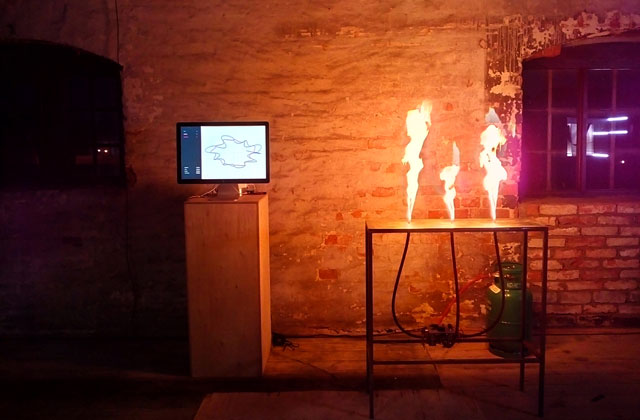
Liesma_fire_electronics_2x2m_2015

Liesma_fire_electronics_2x2m_2015

The concept of the artist studio has a broad range of meanings in contemporary practice. Artists may spend much of their time in the actual studio, or they may spend very little time in it. Tell us about your individual studio practice and how it differs from or is the same as traditional notions of “being in the studio.”

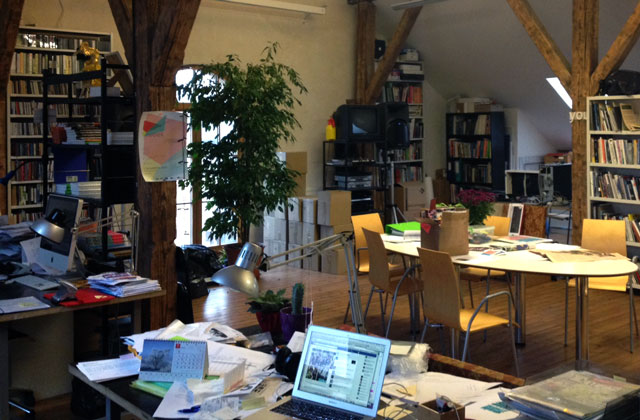
I spend up to 70% of the day in the studio. But it is only when I have an idea which I’m realizing. I don’t sit in studio trying to think what will be my next work. Mostly idea comes to me while I’m spending time relaxing, traveling or reading a book. The most recent studio space where I worked does not fit the first thought that comes to mind when you think about artist studio. It is more like a very cozy office, full of creative people. My artist’s practice shows that it is easier to work when surrounded by people from the same field. This allows talk about your ideas and develop your work both conceptually and aesthetically.

What roles do you find yourself playing that you may not have envisioned yourself in when you first started making art?

I began to focus on art when I was 15, originally I wanted to be an architect or designer. When I was 17 I realized that I’m more interested in architecture than design. I got an internship in architects office. Everything there went very well and it was very exiting. But when the time came to choose I chose design. I applied for industrial design studies in the Academy of Arts because as I thought it’s for me, but I was not admitted. Then I found out about the media art studies in Liepaja University, where I started my studies in 2010. And since then everything that happens with my artist career is more impressive then I ever had imagined when I was 15 years old. But most importantly occasionally I collaborate also with architects and at the moment for me it is enough.

When do you find is the best time to make art? Do you set aside a specific time everyday or do you have to work whenever time allows?

For me the best hours for practical work are in the night or early in the morning. Then there is silence, peace and the work goes very smoothly and fast. During the day it is easier is to do the production, planning and writing. Each day I spend approximately from 3 up to 16 hours working on my ideas.

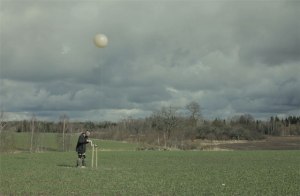
akA_weatherballoons_water_print_video_7x5m_2014_till_know

akA_weatherballoons_water_print_video_7x5m_2014_till_know

How has your work changed in the past five years? How is it the same?

I think that my method how I create work has changed more than the works themselves. Earlier I frequently created small works, now I create less but I devote much more time to the process. Some works take years some less than that. Regarding to creation of the work I have realized that everything can’t be done by yourself. Usually I’m trying to involve other artists to help to create some part of my work. Still I’m trying to experiment and be playful in the process of work creation.

How have people such as family, friends, writers, philosophers, other artists or even pop icons had an impact on the work you do?

The impact of the people has the bigger role in the way how I’m making my work, not in what I do. And here I can mention the artists from RIXC center. They have been my lectures for 5 years and I have spent a lot of time working for them which clearly have an impact on how I’m making my works. Also, the time spent in Art Research Lab (MPLab) of Liepaja University which often gathers together media artist from different fields and countries have left marks in my artistic work. As for the family, their influence is seen more in the themes which I choose for my works.

Have you ever been pulled in the direction of a pursuit other than being an artist? What are your other interests? 

Yes of course. Still occasionally when I’m overworked and don’t seeing the end of it, I want to leave everything. If I did it I would like to turn to extreme sports or become a farmer in a remote corner of the world. But when I complete the work and see it exhibited, everything changes. I wouldn’t change that feeling for anything. As for the hobbies I like to go out in the nature and sleep under the stars. If I don’t have so may free time, I love to spend time making realtime visualizations. Mostly I’m doing it for audiovisual organim Trihars (I’m part of it) and musician Toms Aunins.

About

portret_of_meTo create artwork for me means not only to make actual work but to think about the process which will make the work. For me the process is more important than the result. I like to create works which are partly digital and partly analogue. I like to use old and everyday things to create my works. For last two years my works are related to environmental issues. My goal is to make futuristic look on how I see the near future of the world. I have a master’s degree in media art from Liepaja University part of my studies I have spent in prestigious Bauhaus University Weimar (DE). This year, I started studies in Cologne Media Academy (KHM) to get a second master degree. I started my professional career in 2010 and since then I have participated in several exhibitions in different European countries: Belgium 2015 Mons European Capital of Culture official program exhibition Transformative Ecologies, Slovenia Maribor exhibition Virtuoso, Riga Exhibition Virtuoso, in 2014 I was a co-author for Latvian showroom in Italy Venice Architecture Biennial, 2011 France Arles Transience exhibition. Since January 2014 I am a chairman of the E-Lab, Center for Electronic Art and Media, since September I am a lecturer at the Liepaja University.

studio

rihards.mplab.lv

All images copyright of the artist and used with their permission.
Posted in Installation | Tagged , , , , | Leave a comment