Janina Anderson – Washington, DC

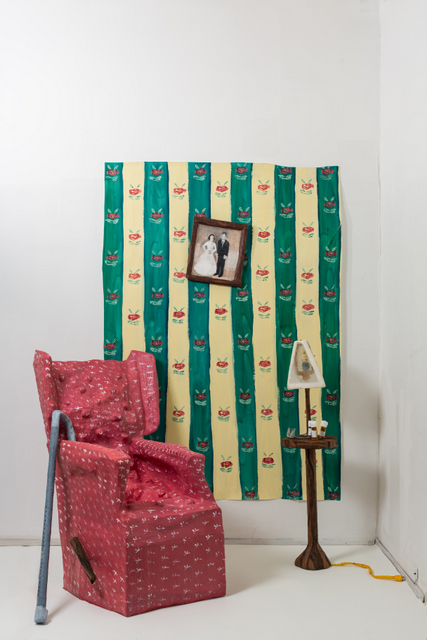
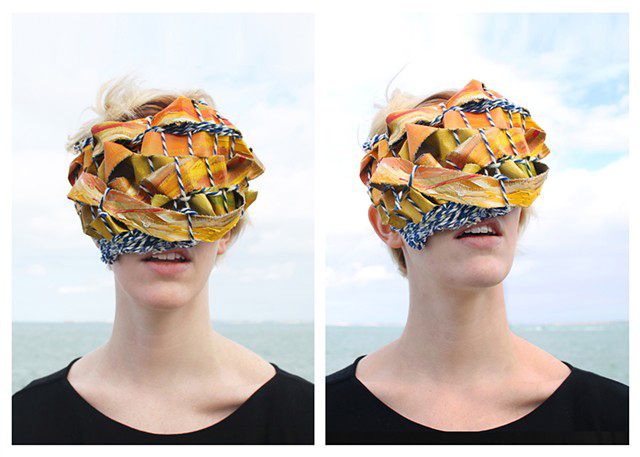
Meaning Structures (Yellow Structure), Cut and Woven oil on Canvas, Yarn, Wire, Dimensions Variable,  2014

Meaning Structures (Yellow Structure), Cut and Woven oil on Canvas, Yarn, Wire, Dimensions Variable, 2014

Briefly describe the work you do.

I work in a variety of mediums creating work that interacts with the human figure. I’m very interested in our relationship to the body, how it informs identity, and how these issues can be expressed through materials.

Tell us a little about your background and how that influences you as an artist.

I don’t like sameness. I grew up in a multicultural household and changed schools every two to three years. I’ve always felt that there is nothing more important to personal development than the challenge of new experience. Consequently I’ve spent a lot of time in my life and work concentrating on how we form identity, and how that identity changes or is affected by your physical and emotional environment.

The concept of the “artist studio” has a broad range of meanings, especially in contemporary practice. The idea of the artist toiling away alone in a room may not necessarily reflect what many artists do from day to day anymore. Describe your studio practice and how it differs from (or is the same as) traditional notions of “being in the studio.”

“Out of sight out of mind” is big for me. While this doesn’t usually contribute to the most organized or minimalist environment, I end up surrounded by everything I’m thinking about. The project’s biggest influences are always at hand. The walls are usually covered with notes, bits of fabric, images torn from magazines, or past work. I like to be able to take a step back and look at the big picture. I get into trouble if I start putting things in folders.

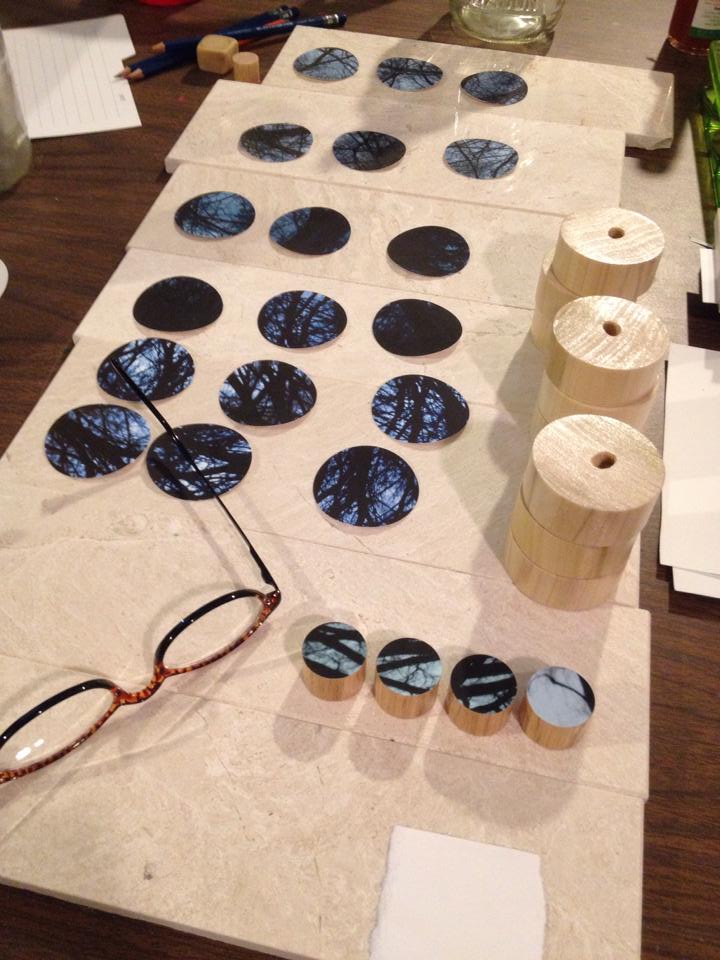
 Installation Shot: Meaning Structures, Digital Prints on Vinyl, Sand, print dimensions 5' x 3' , 2014

Installation Shot: Meaning Structures, Digital Prints on Vinyl, Sand, print dimensions 5′ x 3′ , 2014

What unique roles do you see yourself as the artist playing that you may not have envisioned yourself in when you first started making art?

A contemporary artist is essentially a small business owner. This is one of the biggest lessons you get smacked with once you leave school. Obviously the most important thing you can do is spend time developing your craft and enriching your mind conceptually. But in order to make your art sustainable you need to understand some of the basics of marketing, accounting, writing, and a whole lot of administrative organization. Everyone I know who is still making art a couple years out of college can write a charming professional email from their phone while managing an excel sheet.

When do you find is the best time of day to make art? Do you have time set aside every day, every week or do you just work whenever you can? 

For me its early in the morning or late at night. I think you can split up the day into hours you are acting on your own initiative versus hours you are reacting to other people’s needs. Even if your alone it’s something you can feel in the air.I can’t make art if I’m in a reactive mindset. I’m very productive while other people are sleeping and having their morning coffee. But once my inbox starts chiming all hell breaks loose.

Meaning Structures (Blue Structure), Yarn, Jersey, Found Plants, Wire, Dimensions Variable, 2014

Meaning Structures (Blue Structure), Yarn, Jersey, Found Plants, Wire, Dimensions Variable, 2014

How has your work changed in the last five years? How is it the same?

In my experience artists develop in the same way everybody does. They don’t really change; they just become more the way they are. I think that five years ago as a young artist starting out in school I didn’t have the confidence to present the art I wanted to, so I’d always present it from some other angle or gift wrapped in theory. These days I understand what I want to say and have given myself the space and confidence to become more direct and aesthetically eloquent.

Are there people such as family, friends, writers, philosophers or even pop icons that have had an impact on the work you do?

When I’m not paying attention everything has an impact on my work.

If you had an occupation outside of being an artist, what would that be and why?

Comedian. Comedians get to approach emotionally charged existential issues in a seemingly non-threatening way, but can end up really changing people’s outlooks through something beautiful (laughter/aesthetics). I always thought that stand up comedy and visual art where two sides to the same coin. But stand ups get to have a direct relationship with their audience. And they instantly know when something works.

About

headshotBorn In Asuncion Paraguay in 1989. Janina Anderson Attended the Maryland Institute college of art before Graduating with honors from the University of Oregon. Anderson’s work has been shown in galleries, museums, and artist run backyards in Washington DC, Eugene Oregon, Portland Oregon, Los Angeles, and Cádiz Spain.

All images copyright of the artist and used with their permission. 


Posted in Fiber Art | Tagged , , , , | Leave a comment

Brett Suemnicht – Milwaukee, Wisconsin

Example of Normie Gold, 30" x 30" Collagraph on Rives BFK, 2014

Example of Normie Gold, 30″ x 30″ Collagraph on Rives BFK, 2014

Briefly describe the work you do.

My work becomes as static as my self-exploration into a queer identification. My work looks at mainstream notions that define desire, behavior and personal constitution. I look at google mainframes, hate speech, and other modes of communication that exist as ready-made information. My work reclaims aspects of cultural behavior that have become an oddity in my own life. By retorting the information, I twist and reconnect ways of re-imaging  capitalist, normative and heterosexual lifestyles.  

Tell us a little about your background and how that influences you as an artist.

Growing up with divorced parents, I never lived in an idealized perception of domesticity. Currently I have lived in as many homes as my current age, 23. That fragmentation of my upbringing has reflected in my artwork as a young adult, challenging unrealistic notions of the valued idea of American heteronormativity. 

Recently my studio practice has been heavily reflective of queer theory. I have begun looking into authors such as Judith Butler, Jack Halberstam and Georges Bataille; these authors and theorists look closely at established notions of gender, sexuality and cultural normalities. As an artist, I am not interested in creating objects that already exist but finding ways to shift perspectives and draw attention to established notions of being.  

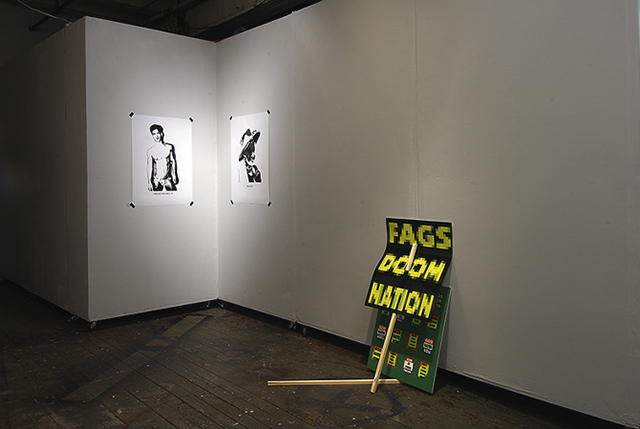
Left to Right: Twink:a, Digital Print, 2014 Twink:b, Digital Print, 2014 Queer Doom Nation, Laminated Digital Print, Poster Board, Wooden Stick, 2014

Left to Right: Twink:a, Digital Print, 2014 Twink:b, Digital Print, 2014 Queer Doom Nation, Laminated Digital Print, Poster Board, Wooden Stick, 2014

The concept of the “artist studio” has a broad range of meanings, especially in contemporary practice. The idea of the artist toiling away alone in a room may not necessarily reflect what many artists do from day to day anymore. Describe your studio practice and how it differs from (or is the same as) traditional notions of “being in the studio.”

A large portion of my studio time is spend at coffee shops reading, searching google and brainstorming project ideas that heavily involve being outside the typical studio environment. Part of my studio practice involves a strong photographic practice that  documents alternative environmental spaces here in Milwaukee as well as outside my community. For example, I recently finished a photographic series while accompanying two musicians playing shows across the East Coast. The culminating series, Domestics (http://bretterichsuemnicht.com/Domestics) documents underground musical spaces, all age’s venues, and punk houses showcasing interiors abundant in DIY musical cultural. Another series I have been working on over the past few years is DIY: MKE (http://bretterichsuemnicht.com/DIY-MKE-Series). This project documents the DIY music scene in the Riverwest Neighborhood of Milwaukee. DIY: MKE includes a series of photographs, artist books and zines, and catalogs the fluid nature of underground spaces.

What unique roles do you see yourself as the artist playing that you may not have envisioned yourself in when you first started making art?

After graduating from MIAD this past spring, my work has taken a huge shift. I have begun looking at issues surrounding LGBTQI lifestyles. As a queer identified person, I fall outside the traditional roles of homosexual/heterosexual identification. Through embracing my constitution as queer, I stand for embracing fluidity in the way I function by resisting aspects of culture that stand in the way of being an “outsider”. I look at my own lifestyle, as well as other queer identified individuals’ lifestyles, examining ways of expanding possibilities of resisting aspects of normative culture that go unquestioned.

When do you find is the best time of day to make art? Do you have time set aside every day, every week or do you just work whenever you can? 

My professor at MIAD, Rina Yoon, gave me the best advice. She told me if I put as little as 20 minutes aside a day to focus on my work, it would be enough to keep me motivated in my artistic practice. This is a habit that I follow every day. 

Studio Shot

Studio Shot

How has your work changed in the last five years? How is it the same?

Five years ago I wouldn’t have considered myself an artist; today I do.

Are there people such as family, friends, writers, philosophers or even pop icons that have had an impact on the work you do?

I am continually motivated by fellow artists and musicians I know and work with, especially here in the Midwest. I am surrounded by people who make work without the straightforward goal of just making a bunch of money, but rather working with this strong intuition or impulse to create their own culture. Last year, I sat in on a talk by LA Art Coordinator of MKE: LAX (http://www.mke-lax.org), Sara Daleiden, who referred to artists in the Midwest as artistic laborers. That term has really stuck with me. It made me reflect on some of the reasons why I love being an artist working in a post-industrial city such as Milwaukee. 

If you had an occupation outside of being an artist, what would that be and why?

Both my parents are social workers and growing up I was introduced to different aspects of public services. I think I would be somewhere in the non-profit sector of public services working with grassroots organizations. I couldn’t imagine not being involved in some facet of cultural production or activism.   

About

headshotBrett Suemnicht is a visual artist living and working in Milwaukee, Wi. They hold a BFA in Printmaking from the Milwaukee institute of Art and Design. Their photographic work has been showcased onfreatureshoot.com and lenscranch.com. They have shown in numerous galleries in the Milwaukee area including juried and group exhibitions. 

bretterichsuemnicht.com

All images copyright of the artist and used with their permission. 


Posted in Book Arts, Photography, Printmaking | Tagged , , , , | Leave a comment

Roger Colombik – Wimberley, Texas

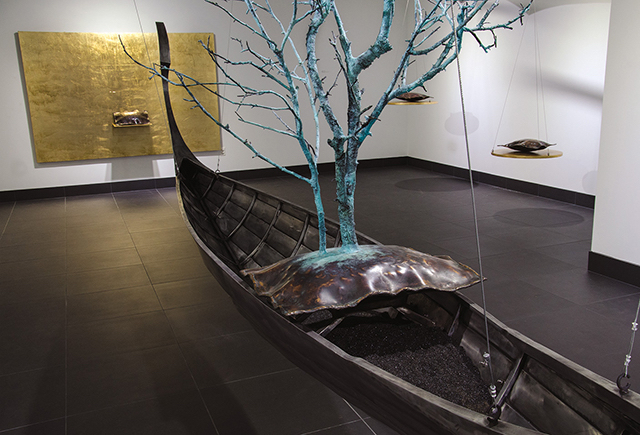
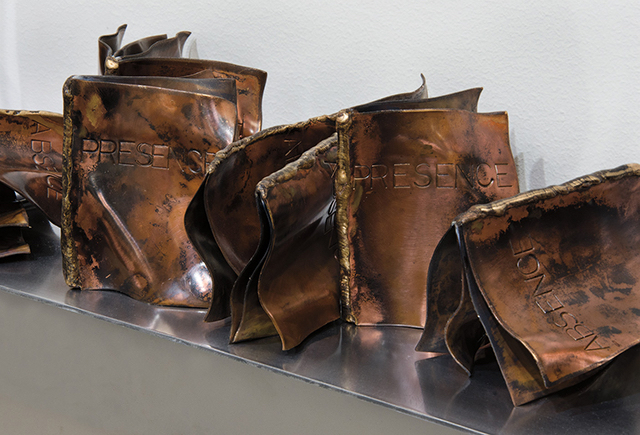
Absence/Presence (Enguri River detail)  Bronze, Aluminum, Sand, Hardware, 72” x 216” x 48”  ©2014

Absence/Presence (Enguri River detail) Bronze, Aluminum, Sand, Hardware, 72” x 216” x 48” ©2014

Briefly describe the work you do.

My studio practice is divided between sculpture and intervention/social practice based projects.  Working primarily in metal (cast and fabricated) the sculptures are often narrative, conveying fragments of a story that swims between fictions and truths.  My wife and creative partner, Jerolyn Bahm-Colombik collaborates with me on large public works and sculpture commissions. Social documentary studies greatly inform my cultural works as I immerse myself in a community for a period of time to observe, listen and record.  The output of these endeavors range from installations, large format photography to publications. These projects are collaborative based, working closely with artists in the community.

Tell us a little about your background and how that influences you as an artist.

Growing up in Chicago there was a common refrain in regards to where people could meet up in the city – “yeh, I’ll meet you at the Picasso”.  The Chicago Picasso as well as the many large-scale sculptures throughout the city had a profound influence on my interest in sculpture.  During the early years of my education the sculpture collective CONSTRUCT had their office/gallery in Chicago and the first exhibitions of monumental sculpture at Navy Pier (Mile of Sculpture) left an indelible imprint upon my imagination.

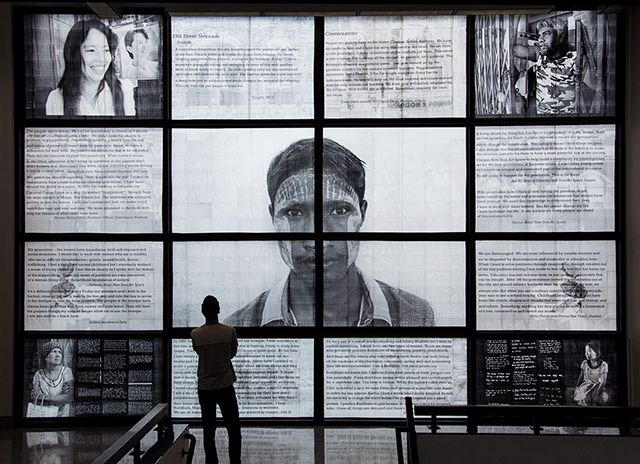
29th Street Serenade (The Burma Project)  Photographs on Transparencies, 192” x 288”  ©2014

29th Street Serenade (The Burma Project) Photographs on Transparencies, 192” x 288” ©2014

The concept of the “artist studio” has a broad range of meanings, especially in contemporary practice. The idea of the artist toiling away alone in a room may not necessarily reflect what many artists do from day to day anymore. Describe your studio practice and how it differs from (or is the same as) traditional notions of “being in the studio.”

My social practice work relies on the notion that the street is my studio. Projects in Republic of Georgia, Armenia, Romania, Ecuador and Burma are born from the kindness of strangers who take us into their lives to share their stories, dreams and hardships.  It always begins with intensive research prior to arrival, then letting go of everything and simply walking through neighborhoods and learning of life.  Patience and persistence are my most important tools.

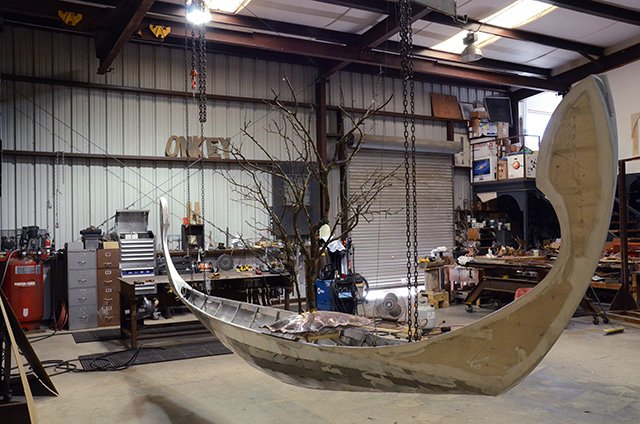
My studio in Wimberley, TX is a palace of creative refuge, a large metal building with everything I need to walk in the door and play, explore and struggle.  I have an assistant when necessary but I prefer to be alone or working only with Jerolyn on the larger pieces.

What unique roles do you see yourself as the artist playing that you may not have envisioned yourself in when you first started making art?

The thought of listening to a Muslim healer discuss his practice and life in Yangon would have been inconceivable to me as a young sculpture student, immersed in object making and working in a foundry.  I find that navigating between very divergent artistic practices is a fabulous way to stay relevant and aware of the possibilities for creative exploration.  The sculpture studio always looks fresher when returning from a journey and the journeys always provide new resources and influences for the sculpture work as well as the social practice projects.  I never imagined myself working collaboratively when I was younger.  Now I relish the experiences with artists around the world and the projects with Jerolyn.

When do you find is the best time of day to make art? Do you have time set aside every day, every week or do you just work whenever you can? 

The older I am, the early I begin.  Mornings are essential for clarity and high energy, whether that means physical production or reading/writing.  The days of staying up to 3am are long past me.  Most of my studio injuries occur later in the day when I should have hung up the gear and walked out.

Absence/Presence (The Journals, Detail), Bronze, Aluminum, 12” x 180” x 8”  ©2014

Absence/Presence (The Journals, Detail), Bronze, Aluminum, 12” x 180” x 8” ©2014

How has your work changed in the last five years? How is it the same?

The last five years have been a whirlwind of fabulous opportunities to develop my interests and skills in public works, both large-scale sculptures and temporary installations of photo based cultural projects.  What remains the same is a great passion for walking through the door to the studio, looking around with a big smile and jumping in.  Working in metal continues to challenge as skill development for new interests takes hold.  What remains the same is the pure joy of “making”.

Are there people such as family, friends, writers, philosophers or even pop icons that have had an impact on the work you do?

I am very fortunate to have received excellent instruction and mentorship from sculptors in my education.  First, my high school had a full art program with professional artists teaching classes.  Elliot Balter was tough and influential and sparked my interests.  Roger Blakely at University of Illinois treated his students as family and always made time to talk.  My love for the foundry comes from his influence as well as my grad mentor, Thomas Walsh.  Most importantly, Thomas Walsh instilled in me a great passion for reading and travel.  The writings of Borges, Rilke, Tolstoy and Dickens continue to inspire.

If you had an occupation outside of being an artist, what would that be and why?

Directing an NGO in a developing country that is transitioning towards a civil society.  My experiences in these types of environments continue to be profound and the young generations of artists I have worked with provide me with new ways of seeing and understanding the world.  Also, children with so few resources exude maturity well beyond their years and have much to teach the adults.  I am constantly humbled in their presence.

About

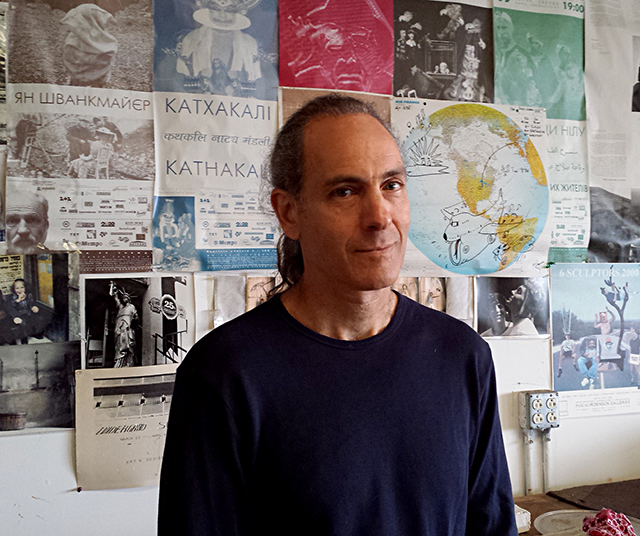
colombik_headshot_02Roger Colombik lives in the Texas Hill Country with his wife and artistic collaborator Jerolyn. Keeping them company are their two terriers and a never ending parade of wildlife.  His sculptural works create visual environments that soften the flight of time for the viewer.  Jerolyn and Roger have completed several public commissions in Texas including works for The Miller Library in Beaumont, Austin’s 2nd St. Redevelopment Project and the San Marcos Embassy Suites/Convention Center.  Roger has spent several years experiencing the post-Soviet/post Berlin Wall hangover that has destabilized many countries in their attempts to become civil societies.  Traditions and cultural heritage often collide head-on with westernization and government malfeasance.  Major public projects have been undertaken in Armenia, Republic of Georgia and Romania with the goal of promoting community dialogue on issues of emigration, education and communal memory.

The Studio

The Studio

colombik.tumblr.com

All images copyright of the artist and used with their permission. 
 

Posted in Sculpture | Tagged , , , , | Leave a comment

Candace Hunter – Chicago, Illinois

averydustwell

“At the Well”, installation, part of the Dust in Their Veins touring show. 7′ x 10′ x 5′. 2014

Briefly describe the work you do.

Much of my work is concerned with social inequality along both national and global fronts. My imagery explores the historical context for violence against humanity, in its many forms, with special attention to the plight of women and children.  Through research, I engage with the past and use my art to give a public and present voice to those whose voices have been silenced. Although I am well known for my collage-based work, I implement a wide variety of media to manifest my work.  My work is rarely conceived as a single piece, but is instead imagined as an entire body of work around a central theme, such as the 32 pieces in my latest produced show Hooded Truths (2014), which also includes installation and performance.  My practice is very socially engaged, personally, in my interaction and collaboration with other artists, and politically, in my activism through my work.

Tell us a little about your background and how that influences you as an artist.

Daughter of a mathematical genius and a fifth grade teacher, my parents created a safe haven in which I could grow and create. We traveled throughout Europe, most of the United States and parts of Northern Africa before I was ten. Knowing the Louvre at eight and the great cathedrals of Italy left an indelible impression of beauty and doing.

Delilah

“Delilah’s Room”, installation and performance, part of the Hooded Truths Exhibition. 8′ x 8′ x 4′ deep. 2014

The concept of the “artist studio” has a broad range of meanings, especially in contemporary practice. The idea of the artist toiling away alone in a room may not necessarily reflect what many artists do from day to day anymore. Describe your studio practice and how it differs from (or is the same as) traditional notions of “being in the studio.”

My studio for the past eighteen months has been solely that. It is also the epicenter of my social life – often I post open hours for friends/collectors/guests to spend time with me and whatever new project I might be working on. My day in the studio typically starts before eight a.m so that I can take full use of the natural daylight and usually work through two or three in the afternoon.

What unique roles do you see yourself as the artist playing that you may not have envisioned yourself in when you first started making art?

I resisted the title, ‘activist” for many years, but have finally started to claim that title as well as visual artist because it is what I do.

When do you find is the best time of day to make art? Do you have time set aside every day, every week or do you just work whenever you can? 

My day in the studio typically starts before eight a.m so that I can take full use of the natural daylight and usually work through two or three in the afternoon.I work four to six days a week.

lynchedsmall

“Lynched Hoodies”, installation, part of the Hooded Truths exhibit. 10′ x 8′ x 4′ deep. 2014

How has your work changed in the last five years? How is it the same?

I am a collagist, but it is in how I treat that medium to create the statements I make that changes.

Are there people such as family, friends, writers, philosophers or even pop icons that have had an impact on the work you do?

My grandfather who was a groundbreaking politician, my mother who was afraid of being an artist, the last Emperor of Ethiopia – Haile Selassie, and folk singer Vance Gilbert.

If you had an occupation outside of being an artist, what would that be and why?

Stand-up comedienne.

About

chheadshot2smallCandace Hunter, a native of Chicago, studied the plastic arts and performance arts at Barat and Mudelein Colleges in the Chicago area. Her early work was what she coined, “non-traditional batik”. Always affronted by the Euro-male created lines of the validity of “art” and understanding that batik was considered either a “folk” or “craft”, Hunter took it to another level that matched the parameters of the Western idea while leaning on the technique and creative force of the African perspective.

A child of formally educated parents – a mother with wanderlust, a COBOL speaking father, Candace traveled throughout Europe and northern Africa before the age of ten. Seeing the wee small girl in the corner of the enormous “Watchman” at the Louvre, the foot of the pyramids and the ceiling of the Basilica in Rome at such an early age, cemented the idea of beauty, grandeur and of service.

Hunter, in her work, has most often creates worlds in which she honors family, sacred text, justice and, water scarcity. She often works in series. “Ethi-Oh-My!”, spoke to her love of Ethiopia and Selassie, “Prayer Circles: Sacred Text and Abstract Thought” invited disparate communities to examine art together, “Dust in Their Veins” continues to enlighten audiences on water scarcity and its dire effects on women and children globally, “Hooded Truths” places the ubiquitous modern hoodie on many unspoken American truths and lately, “Loss/Scape” – which attempts to create a visual understanding of loss.

work in progress, "Loss/Scape" in my studio with previous series work in the background.

work in progress, “Loss/Scape” in my studio with previous series work in the background.

www.hoodedtruths.tumblr.com

All images copyright of the artist and used with their permission. 
 

Posted in Collage | Tagged , , , , | Leave a comment

Mariel Herring – Philadelphia, Pennsylvania

"Remember to remember to remember", 2014, oil on plaster, acrylic medium, paper, 84 by 67 by 58.25 in. (dimensions variable)

“Remember to remember to remember”, 2014, oil on plaster, acrylic medium, paper, 84 by 67 by 58.25 in. (dimensions variable)

Briefly describe the work you do.

I make paintings and sculptures of everyday objects and scenes.

Tell us a little about your background and how that influences you as an artist.

I grew up in a very supportive family with the belief that I could be anything I wanted to be. When I was in first grade I decided to become an artist and have never looked back.

The concept of the “artist studio” has a broad range of meanings, especially in contemporary practice. The idea of the artist toiling away alone in a room may not necessarily reflect what many artists do from day to day anymore. Describe your studio practice and how it differs from (or is the same as) traditional notions of “being in the studio.”

I work alone; I liked the distractions of working in more communal spaces during my education because it was so exciting to see what everyone else was doing, and I still had the time to devote to my own practice. Now, because my time is so much more limited I really want to just get to work. I usually have a few projects going at once so there is always something to do and it lets me be fairly productive in a short amount of time. I wouldn’t necessarily say that I “toil” though there are some days that are more of a struggle than others. I have never minded being by myself and so I just go about my business and most of the time it’s fun. I’ll listen to music and be in my own world.

"Hand tools", 2014, plaster on cardboard, 1.75 by 22 by 14 in. (dimensions variable)

“Hand tools”, 2014, plaster on cardboard, 1.75 by 22 by 14 in. (dimensions variable)

What unique roles do you see yourself as the artist playing that you may not have envisioned yourself in when you first started making art?

It took me a while to understand the way that I make art. When I first started painting, I was just trying to get a feel for it, and so I followed the more traditional methods of making a painting: preliminary sketches, mock ups, visual problem solving. But I’m much too impatient for that. I rarely plan or make sketches. I’ll write down ideas and sometimes just single words in a notebook I keep in my studio to remember, but mostly I just want to make the work. As a result I’m much more impulsive in my studio than I am in life. I’m also a lot dirtier and messier.

When do you find is the best time of day to make art? Do you have time set aside every day, every week or do you just work whenever you can? 

I’m most productive in the morning, which is also when the light coming into my studio is particularly nice. I like to get there earlier on the weekends, but working a full-time job I usually only go once or twice after work during the week.

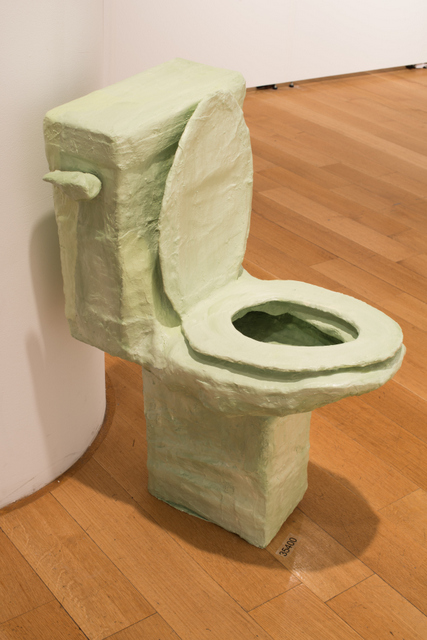
"Green toilet", 2013, oil on plaster, 32.5 by 35 by 22 in.

“Green toilet”, 2013, oil on plaster, 32.5 by 35 by 22 in.

How has your work changed in the last five years? How is it the same?

My work has changed a lot! Five years ago I was making large scale paintings with nude models. When I went to grad school I dabbled in abstraction. For my thesis I started making sculptures and recently I’ve started making paintings again. Through it all color, shape, texture, and compositional structure have connected these various works.

Are there people such as family, friends, writers, philosophers or even pop icons that have had an impact on the work you do?

My family has a huge impact on my work, in fact most of my work is deeply personal in nature, some of my most recent pieces having to do with the dementia and recent passing of my Granddad. I also keep close relationships with friends and professors from school, and still look to them for guidance and inspiration in studio. I love to read novels and poetry, some of my favorites being magical realists like Kazuo Ishiguro, Haruki Murakami, Salman Rushdie, Margaret Atwood, and Gabriel Garcia Marquez. My favorite poet right now is Katerina Stoykova. I like playful moments in the narrative which allow the reader to believe in the impossible.

If you had an occupation outside of being an artist, what would that be and why?

I really enjoy working as a carpenter because I love working with my hands, and using tools, and the smell of sawdust. Other occupations I would like are: a baker, a curator for a gallery or museum, a bicycle mechanic, or college art professor.

About

Mariel_Herring_01Mariel Herring was born in Philadelphia, PA and attended Earlham College in Richmond, IN where she earned a Bachelor’s Degree in Art. She returned to Philadelphia to study at the Pennsylvania Academy of Fine Arts where she earned a Post-Baccalaureate Certificate and a Master’s of Fine Art. She keeps a studio and works as a carpenter for a small construction company.

Mariel_Herring_05

www.marielherring.com

All images copyright of the artist and used with their permission. 
 

Posted in Installation, Painting, Sculpture | Tagged , , , , | Leave a comment

Dario Lazzaretto – Padova, Italy

"Hullyrug - s(sound installation)  mixed media installation (carved rug, wood, paper and garbage, sound) variable dimension (at least 150x170 cm)  2013

“Hullyrug – s(sound installation)
mixed media installation (carved rug, wood, paper and garbage, sound)
variable dimension (at least 150×170 cm)
2013

Briefly describe the work you do.

I produce mainly audio installations, sound sculptures, performance and relational art. The subjects of my research are political, religious and social issues, with particular emphasis on everything that is invisible or secret.

Tell us a little about your background and how that influences you as an artist.

I come from a family of craftsmen (father luthier – mother weaver and designer), I attended the school of music at an early age (from 6y.o. to 15y.o.) then I went to the High School and its (Latin and Greek) literary suggestions, and finally followed my university studies of classical art. I believe that my past training surely had an impact on my artistic path as much as the family traditions.

The concept of the “artist studio” has a broad range of meanings, especially in contemporary practice. The idea of the artist toiling away alone in a room may not necessarily reflect what many artists do from day to day anymore. Describe your studio practice and how it differs from (or is the same as) traditional notions of “being in the studio.”

In the last years I have worked in various parts of the world, almost never in similar spaces, perhaps never even with the same equipment. I like to experience what the work space offers me, use objects and tools typical of the place, even stealing small scrap pieces from the studios of other artists. I often develop – then – projects that require contact with the local community or part of it, which brings me to go out often from the claustrophobic dimension of “me behind my work table”, developing complex relational processes.

"Stretching analog drone orchestra" (workshop + performance) mixed media installation (wood, brass, horsehair, piezo pickup, sound) variable dimension (and performance lenght) 2014

“Stretching analog drone orchestra” (workshop + performance)
mixed media installation (wood, brass, horsehair, piezo pickup, sound)
variable dimension (and performance lenght)
2014

What unique roles do you see yourself as the artist playing that you may not have envisioned yourself in when you first started making art?

Perhaps, at the beginning of all – harbingers that honestly I remember well permeated with narcissism – I had not imagined how nice would be to forget a little about yourself and you give attention to others. For simultaneous though, I did not expect that the vulnerability could achieve a strengthened of my character and my intent.

When do you find is the best time of day to make art? Do you have time set aside every day, every week or do you just work whenever you can? 

It depends on the periods and projects. Sometimes, during art residence or intensive funded projects, I work from 8.00 to 18.00 and no lunch break. Much more often, in my studio in Padua, however, I work at night to process that require the use of computers, while during daytime, if necessary, to the construction of objects with noisy machinery or for anything else outside my room (research-contacts-workshps-etc).

"Akousmata" mixed media installation (pvc, metal, gold, sound) 45x50 cm 2014

“Akousmata”
mixed media installation (pvc, metal, gold, sound)
45×50 cm
2014

How has your work changed in the last five years? How is it the same?

I completely abandoned ogniforma design that is not functional to mieie projects, or do not propose to the public nor intact in my projects no pattern, graphic or illustration. I try to further develop the relational approach to the creative act, seeking the cooperation of others. However, I still devote much attention to the sound of my work, like 5 years ago and even more.

Are there people such as family, friends, writers, philosophers or even pop icons that have had an impact on the work you do?

External influences that I can list are among family: my father, my mother, my aunt and my grandmother;among friends and people known to me: Nicola Genovese (artist), Seijiro Murayama (performer), Georgina Criddle (philosopher and researcher of art), Peter Vink (artist); among the celebrities of art history and contemporary art: Luigi Russolo, John Cage, Christian Marclay, Maurizio Cattelan; among writers: Italo Calvino, Arthur Danto, D. Foster Wallace, David Toop.

headshot_bIf you had an occupation outside of being an artist, what would that be and why?

Currently in truth I carry out various jobs to keep my career: I often work as a graphic designer / copywriter, but if I could choose I would like to be a keeper of a lighthouse in Cornwall.

About

- your work or studio ritual: image of the performance "noise.machinary" with Staalplaat (Dordtyart, Dordrecht, NL) with the same set which I've used there for part of my research.

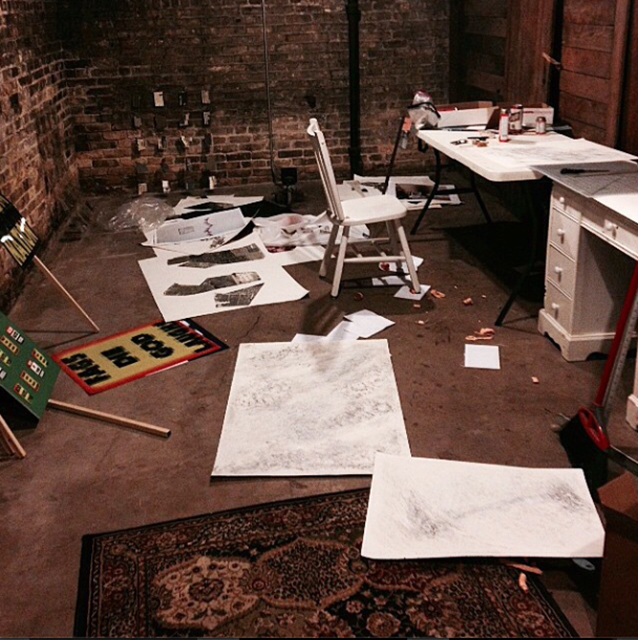
– your work or studio ritual: image of the performance “noise.machinary” with Staalplaat (Dordtyart, Dordrecht, NL) with the same set which I’ve used there for part of my research.

click here to read resume

www.dariolazzaretto.it/

All images copyright of the artist and used with their permission. 
Posted in Installation, Performance, Sculpture | Tagged , , , , | Leave a comment

Nancy Lamers – Milwaukee, Wisconsin

The Path, Oil on Canvas_48wx72h, 2014

The Path, Oil on Canvas, 48wx72h,, 2014

Briefly describe the work you do.

I work primarily in oil and watercolor. Once in a while, I will concentrate on encaustic. I use acrylic when I travel and work has to dry. I always draw. I recently gathered all of my sketchbooks and have about 40. I saw a demonstration given by Colette Odya Smith and am now also rather hooked on soft pastel. Yes, I like oil pastel and sumi ink too. I also write. I am a list maker. What do I care about? What interests me? What am I sick of? Then, I decide what to paint next. I dream about painting and have awakened and painted the painting I was working on in my dream. I choose my medium according to the idea. If the idea is about pure, perfect veils of color, I will use watercolor.

Tell us a little about your background and how that influences you as an artist.

A lifetime as a teacher continues to influence me. When I see something interesting, usually as a process, I will take on the role of student to learn how to do it (egg tempera, for example). I either teach myself or seek out the teacher. Anthony Suminski worked with me in egg tempera and Fujie Moses in sumi ink. At 12 years old, I would go into my bedroom to draw and would not come out for 8 hours. I am still rather like that

The concept of the “artist studio” has a broad range of meanings, especially in contemporary practice. The idea of the artist toiling away alone in a room may not necessarily reflect what many artists do from day to day anymore. Describe your studio practice and how it differs from (or is the same as) traditional notions of “being in the studio.” 

I do toil away alone in my studio. I take breaks to play with and pet my cat, to nap, waste time on Facebook (but meeting good people and a lot of artists) and I do spend time with my husband. It’s all about balance. When teaching, I thought I’d never find balance. I needed more hours. I still haven’t found out how to do that.

The Three Evils_ oil on canvas, 60w x 48h, 2014

The Three Evils, Oil on Canvas, 60w x 48h, 2014

What unique roles do you see yourself as the artist playing that you may not have envisioned yourself in when you first started making art?

I see the artist as a communicator and educator even if not trained as a teacher. People get what they will from what they see in the art. They become curious or engaged. Just the presence of art in people’s lives helps them to see differently. I never thought my making art could have a deep effect on someone else when they never met me. That comes through the way art communicates.

When do you find is the best time of day to make art? Do you have time set aside every day, every week or do you just work whenever you can? 

I never work in the morning. I like to sleep late and dream. I have been writing my dreams down in a whole other set of books, for 40 years. Then I read my e-mail and go on Facebook to see art until I feel I am awake. At about 1pm, I feel ready to work. I will paint continuously until about 6pm, then eat, read, and spend time with my husband. Sometimes, I go back to the studio after he has gone to bed or in the middle of the night if I am really motivated. When I feel blank, I draw. I scribble and see what comes out of the process. I go into a mental zone and the ideas flow.

Contemplation, Oil on Canvas_30wx36h, 2014

Contemplation, Oil on Canvas, 30wx36h, 2014

How has your work changed in the last five years? How is it the same?

During the last 5 years, I had all I could do to squeeze in my art practice. Someone told me my art was really a second job. She was right. Since I just retired in May 2014, I am making much more work. I am working so much that my employed money maker partner is concerned with how many supplies I need. Art supply stores are like heaven to me. That is the same. How I get ideas and conceptualize meaning is the same, rather random at first, but then I discover connections. Now I have more time to think. I think while I write and even while I read fiction. A sentence will stand out to me and I will think, “That would be a good title for a painting.” I plan to spend quadruple the time on art.

Are there people such as family, friends, writers, philosophers or even pop icons that have had an impact on the work you do?

Facebook friends who work and show what they do influence me very much. I see that they can put out that much work so I think I can too. They are not lazy. They are driven. I feel guilty taking a nap. Family prefers me to be around, not in my studio. One particular family member gets rather annoyed if I don’t come down from the studio and spend time with him. Going to exhibitions and seeing intriguing, and even boring, work, influences me. I vow to not make the boring work. I examine what intrigues me about Odd Nerdrum, El Greco, Velazquez, Marlene Dumas, Jenny Saville, Pam Hawkes, Vermeer, Byzantine art…I could go on and on. I buy a lot of books, sit in the rocker (my favorite place in my studio) I nursed my babies in, stare at a blank canvas and get lost in images. When a painting is not working out so well, I sit there and stare at it. When I don’t know what I’m going to do, I sit and stare and a blank white canvas or piece of paper. Sometimes, I start with no ideas at all. I just make marks and go with the flow. Paul Klee wrote a great book I can’t remember the name of and Paul Gaugin wrote Noa Noa. I concluded from Klee that art grows like a seed (so, just start) and from Gaugin to do what I want. You only get one life. I get a lot of ideas from reading authors like Haruki Murakami, James Joyce, Virginia Woolf, Kafka, Thich Nhat Hanh, Fyodor Dostoyevsky, Oscar Wilde, H.G. Wells, and John Muir. I get color juxtaposition ideas while I walk. That’s when Muir and Thoreau influence me.

If you had an occupation outside of being an artist, what would that be and why?

I would have a hard time choosing between archaeologist, art historian, and writer. I love searching and finding. New discoveries fascinate me, thus archaeology as a choice. As an art historian, I could choose one thing that fascinates me and spend my entire life on it. Are the San Francesco Upper Church frescoes by Giotto? If now, who painted them? Travel around and compare styles, materials, and chemistry. I used to contemplate writing. I’m a better reader than a writer.

About

NancyLamers_headshot_2014Nancy Lamers retired in 2014 after 24 years of teaching as a full professor of art at Alverno College in Milwaukee, Wisconsin. Prior to that, she taught K-8 Art in Lomira, Wisconsin and Grades 6-8 art in West Bend, Wisconsin. She taught drawing, painting, art history, and international study courses. Nancy Lamers received her MFA degree in Painting and Drawing at the University of Wisconsin-Milwaukee. Areas of specialization include watercolor, oil, acrylic, and encaustic paint media. She has exhibited widely, both nationally and internationally (Italy and Japan), and has received many awards for her painting. She has served as a consultant for university art curricular development in the United States and China, has participated in many panel discussions and presentations, and was the keynote speaker at several national and international art conferences. She also served as Southeast Chapter Chair of Wisconsin Visual Artists. Interests are in ongoing personal development as a painter, continued travel and study of art and history/culture worldwide, and making new connections with artists.

The Studio

The Studio

www.nancylamers.com

All images copyright of the artist and used with their permission. 
Posted in Painting | Tagged , , , , | 1 Comment

Jody Boyer – Omaha, Nebraska

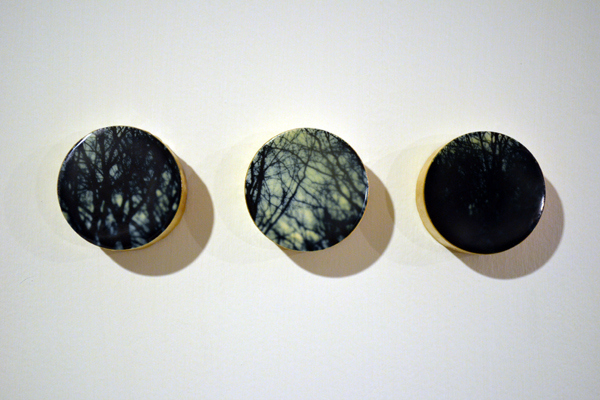
Forest for the Trees #16, Photo Encaustic on Poplar, 2013.

Forest for the Trees #16, Photo Encaustic on Poplar, 2013.

Briefly describe the work you do.

Throughout my work there is a theme of longing through conceptual gesture. I make images that hold a sense of poetry or reflect on the complexities of the human experience. Sometimes I create spaces or interactions, like in my installation work or community performance. Usually a lens is involved in some way, because of my history with photography, but not always. I use computer technology, but my work does not look “digital”- rather the technology is a means to an end, a tool. The work falls into a broad range of categories – photography, drawing, painting, mixed media, intermedia, depending on what framework you want to put around the artwork.

Tell us a little about your background and how that influences you as an artist.

I am heading into my 39th year. I grew up in Portland Oregon before Portland was hip and trendy, on the working class side of town. The public transit system opened worlds for me. I got on a bus pass at 14 and rode around town exploring places I had never been, literally expanding my own future. That sense of the landscape seen through a bus window, seeing everything I can in the world, is still part of my practice. This is one of many formative experiences from my hometown.
 
Since moving to the Midwest I have explored interests in personal memory, landscape, cinema and a sense of place. Science has always appealed to me, but I am far too subjective to withstand the rigors of its objectivity. At twenty, when my father was diagnosed with cancer, he gave me a camera. This had a large impact on me, and I became very fond of how the lens can frame, reconfigure and interpret the everyday world.

However, I have never been fully satisfied with the lens alone or the idea of the real story. The scientist in me continues investigating and experimenting with new tools for creating images and objects. Technology and the reconfigured image: Paints and pens, hammers to heat guns, antiquated and digital cameras, toys to electric trains, and computers, with all their 21st century possibilities. I use all of these in my studio.

If someone was to ask me what I like most about Art it is ideas.  The way an artwork and its formal constructs can symbolize a conceptual gesture, a philosophical theory or entire narrative without the written or spoken word. These are some of the things I think about when asked why I am an Artist.

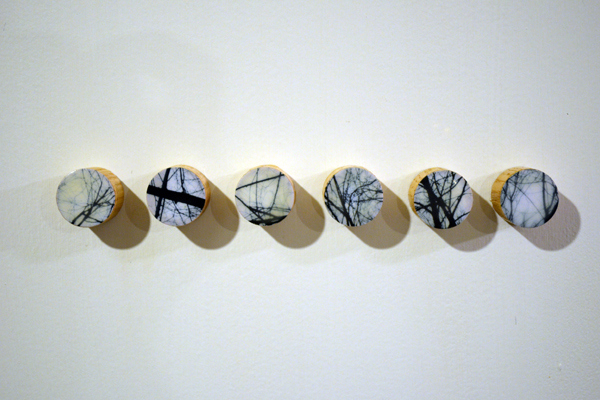
Forest for the Trees # 15, Photo Encaustic on Poplar, 2013.

Forest for the Trees # 15, Photo Encaustic on Poplar, 2013.


The concept of the “artist studio” has a broad range of meanings, especially in contemporary practice. The idea of the artist toiling away alone in a room may not necessarily reflect what many artists do from day to day anymore. Describe your studio practice and how it differs from (or is the same as) traditional notions of “being in the studio.”

I have a “traditional” studio, we converted one of the bays of our two bay garage into my studio space. During the school year I only get to spend a couple of hours a week in that space.  That studio is one of the spaces where I can complete my ideas, or leave a work in progress over time. One other studio space is my kitchen, where I have my computer most of the time.  Since I have several different roles (mother, middle school teacher, adjunct professor, artist) I am often balancing these different tasks in the kitchen. I like to cook from scratch, so while I am making bread dough or cooking a soup I am also researching ideas, writing proposals for a show or grants, grading lessons plans, or working on digital editing, all while cooking meals.  My last studio space would be my middle school. We have a very large school campus and I sponsor our garden club. We have 17 raised beds in our vegetable garden and a very large perennial garden of native plants. Except in the coldest months of winter I try to spend some time every day walking and being in these places, which helps me think.

What unique roles do you see yourself as the artist playing that you may not have envisioned yourself in when you first started making art?

My framework of success has radically changed since when I first started making art.  If you would have asked me at 24 if I would be an artist who was also a middle school teacher, I would have laughed and said you were insane.  At the time I was very much indoctrinated into the concept of artistic success proselytized at private art schools and in MFA programs. I made moderate regional success with my work fairly early in my career.  I continued on that path Between until 2009, struggling to balance my roles as a mother, adjunct professor and artist. My husband and I were collaborating on large scale installations, he was on the tenure track and I was an adjunct at three different Universities. In 2008 we were mentioned briefly in an article in Art in America. This should have been a pinnacle moment of success in my career. Instead I felt deeply dissatisfied with what I was doing. Simultaneously I was working during the day as a grant maker at a private foundation.  One of the things I had the experience of watching was an enormous amount of money being paid for public art projects being done by “Big Time” artists.  The foundation would pay a large sum for piece of art with an art star name thinking that this would transform a place.  To me, placing very expensive artworks in a community seemed to benefit the artist and their pocketbook more than anyone else.  I felt very uncomfortable with all the worlds I was living in. I wasn’t really sure about what I was doing, or why I was working toward goals I did not believe in.  In my heart I believed that the arts could have the most impact on people when they have the chance for authentic and personal experiences with creative production.  All this resulted in a life changing realization that I needed to change my framework of meaning and success.  I realized my real interests where in the intersections of studio practice and arts education.  So I went back to school, got my K-12 teaching license and now teach in a middle school. I am fostering future artists every day, helping them explore creativity and the creative process.  My life now is very much focused on balancing the needs of my children, my students and my own artistic pursuits within the frameworks of success that I define as important and rewarding.  I adore my middle school students and focusing my energies on making an impact in these arenas, instead of trying for success in a money driven art world.

When do you find is the best time of day to make art? Do you have time set aside every day, every week or do you just work whenever you can?

As an artist who is balancing the needs of two children and the daytime needs middle school a circus of multitasking.  During the week studio time is interspersed with other activities, driving to work, walking during my lunch time, playing at the park with my children.  I always have some type of camera with me, and I gather images that I will play with later. Then the weekends are when I get into the “traditional” studio.

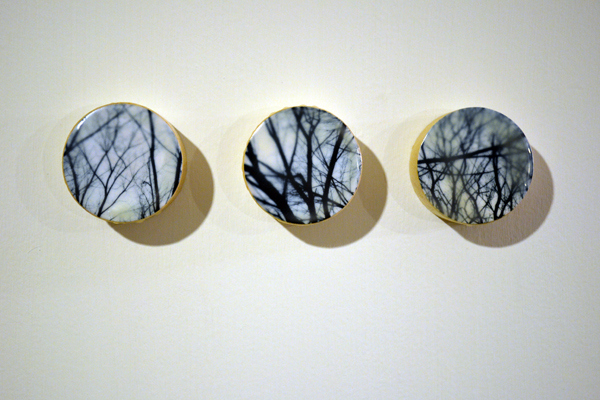
Forest for the Trees # 14, Photo Encaustic on Poplar, 2013.

Forest for the Trees # 14, Photo Encaustic on Poplar, 2013.

How has your work changed in the last five years? How is it the same?

5 years ago my husband and I were exhibiting elaborate installations throughout the Midwest. Since that time my work as moved towards being more intimate and personal, conceptually and literally.  I see the work of teaching during the day as informing my studio practice, in my modes of exploration.  I find that I am making less work but the work is more personally meaningful.

Are there people such as family, friends, writers, philosophers or even pop icons that have had an impact on the work you do?

My husband, Russ Nordman ( www.russnordman.com ), has the greatest impact on my work.  He is my biggest advocate and supporter. Early in my development the teacher and photographer Heidi Kirkpatrick ( www.heidikirkpatrick.com ) was extremely impactful on me, and I always think of her when I think of who has had a great impact on my life.  Lastly I am most inspired by artists who are making a life for themselves in unique ways, that list is too long to put here, but I admire and am inspired by those who are finding their own voices and creating their own frameworks of success.  

If you had an occupation outside of being an artist, what would that be and why?

I would like to be a farmer.  I absolutely love to dig in the dirt and grow things.  I adore being outside and physical work. I find real joy in growing something from seed.  One of my long term goals is to buy 3 to 10 acres and develop a hobby farm / artist retreat once I retire from teaching, but that is many, many years away.  Right now I think I am doing exactly what I was meant to do.

About

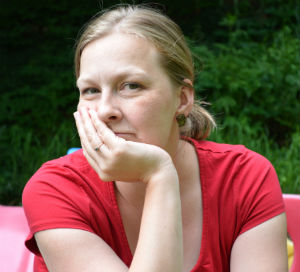
JodyBoyer1Jody Boyer is a visual artist and arts educator originally from Portland, Oregon. In her studio practice she explores the broad interdisciplinary possibilities of traditional and new media with a specific interest in personal memory, cinema, landscape and a sense of place. She received her B.A. in Studio Arts from Reed College, her M.A. inIntermedia and Video Art from the University of Iowa, and her K-12 teaching certificate at the University of Nebraska at Omaha.  Her artwork has been shown nationally, including at the Des Moines Art Center, Womanmade Gallery in Chicago, and the Bemis Center for Contemporary Arts and in such publications as Review and Art in America.  She has taught in a variety of P-16 environments including Universities, public schools and community nonprofits throughout the Midwest. She currently teaches art education and digital media courses at the University of Nebraska at Omaha and visual arts at Norris Middle School. In 2014 she was selected Nebraska Middle School Art Educator of the year by the Nebraska Art Teachers Association.

In the Studio

In the Studio

www.jodyboyer.com

All images copyright of the artist and used with their permission. 
Posted in Encaustic, Photography | Tagged , , , , | Leave a comment

Neerja Kothari – Kolkata, India

rote 1 to 8552, 50" x 46", ink, graphite, acrylic, 2012

rote 1 to 8552, 50″ x 46″, ink, graphite, acrylic, 2012

Briefly describe the work you do.

Through drawings, text and sound, my work is an investigation of the absurdity in trying to quantify an experience which cannot be. Derived from multiple instances and memories the work is an accumulation of time, labor, process, memories, marks and numbers. Each factor playing a part in its own investigation. 

Tell us a little about your background and how that influences you as an artist.

I was born and brought up in Kolkata( then Calcutta) , India where I lived most of my life and got my Bachelors of Commerce degree as an undergraduate. Whereupon due to an injury I spent a few years in physical rehabilitation at a clinic in Kolkata. A lot of my work is influenced by that time spent there and the people I met while in training. Also ever since I can remember I loved reading and some of my favorite characters were/are Sherlock Holmes, Feluda ( a fictional Bengali detective),  Don Quixote to name a few. And perhaps this also lends itself to my work in a strange manner.

The concept of the “artist studio” has a broad range of meanings, especially in contemporary practice. The idea of the artist toiling away alone in a room may not necessarily reflect what many artists do from day to day anymore. Describe your studio practice and how it differs from (or is the same as) traditional notions of “being in the studio.”

I think the idea of the studio changes for me according to my situation. In the past year and half I have lived out of a bag and travelled to various places. I have had to constantly switch from having uninterrupted time in the studio for months to not having a studio space at all. When I do have a dedicated studio space, I must confess I am very traditional to the idea of the “artist studio”. I will be in the studio almost all of the time. It becomes what I call myinspiration cell – I space where I can be very productive and create and dream and think and also fail miserably and have no inspiration at all and I would still be there waiting for something to happen. 

In times when I do not have a studio space , I think I’m in what I would call it the pre production stage. Thinking, reading, researching, taking long walks, writing, listening to music, various conversations and a lot of silence all play an important part of preparing for the next round of insane studio schedules and new work! 

gathering evidence on ones trace (5900) , 51.5” x 42”, ink, graphite,, 2013

gathering evidence on ones trace (5900) , 51.5” x 42”, ink, graphite,, 2013

What unique roles do you see yourself as the artist playing that you may not have envisioned yourself in when you first started making art?

I always thought art was about being in the studio and making work. The struggle and dialog were always insular. Perhaps its the curiosity and conversation that arise from the work is something I did not envision.

When do you find is the best time of day to make art? Do you have time set aside every day, every week or do you just work whenever you can? 

I work best in the evenings/ night. Having said that, I like to start in the morning and be in the studio, though the first few hours go in preparing coffee, setting the music for the day and reading, after which I like to work non stop till late at night. I go months not making work but just reading , writing and then there are months when I am just making work. I do not have a set schedule as yet or a set location where I am based out of. So I work when I can. 

bound, 19.5" x 25.5", ink, graphite, acrylic, 2012

bound, 19.5″ x 25.5″, ink, graphite, acrylic, 2012

How has your work changed in the last five years? How is it the same?

I had always been fond of drawing and painting and used to make work and dreamt of being an artist. Though that did not happen for the longest time. Five years back I went to art school for the first time and in that time I think I finally started understanding myself as an artist. I think instead of my work changing in the last five years, it has actually emerged for the first time in the last five years. I have more focus and patience. I am more confident in the work now. I am experimenting a lot more now. There is a lot more thought, research and a narrative behind what I do now. The one thing that has definitely changed has been the shift to a more minimal approach in art making.  

Are there people such as family, friends, writers, philosophers or even pop icons that have had an impact on the work you do?

Everything from books to people to various spaces have had an impact on my work directly or indirectly. Since my work is almost a representation of a lived experience, the memories and instances from various phases of my life has a huge impact on my work. The people I met and interacted with along the way have a big role to play in the making of the work.  I think the biggest impact on my development as an artist has been the fantastic professors I had the privilege to work with while in art school at SMFA, Boston. 

I am inspired by the works of Agnes Martin , On Kawara, John Baldessari, John Cage, Vija Celmins. Also the writings of Samuel Beckett , James Joyce, and recently Virginia Woolf. 

If you had an occupation outside of being an artist, what would that be and why?

Last week it was being a Disc Jockey! I love music and used to make playlists for friends, so last week I was thinking of taking that up! Building an art library in Calcutta was the other thought this week. Though I am very happy being an artist!

About

headshotNeerja Kothari is an artist currently living and working from Kolkata, India. She holds a B.Com from Calcutta University, India and a MFA from the School of the Museum of Fine Arts, Boston / Tufts University, USA. In this past year after graduation she has been awarded residencies at the Vermont Studio Center, Virginia Center for Creative Arts (VCCA) and the MacDowell Colony. Her work has also been published in the New American Paintings NE#110 journal and the Manifest International Drawing Annual INDA8. 

In the Studio

In the Studio

www.neerjakothari.com

 All images copyright of the artist and used with their permission. 
Posted in Drawing | Tagged , , , , , | Leave a comment

Mitra Saboury – Los Angeles, California + London

Briefly describe the work you do.

My work at the moment deals with the built environment’s affect on bodily space… how roads and sidewalks and cracks move us throughout the city, and how our minds and bodies respond in turn.

Tell us a little about your background and how that influences you as an artist.

I love brains. I used to cut them up and do experiments in a lab but then decided it would be more exciting to do that outside of a lab.

https://vimeo.com/91224903

“Pothole”

The concept of the “artist studio” has a broad range of meanings, especially in contemporary practice. The idea of the artist toiling away alone in a room may not necessarily reflect what many artists do from day to day anymore. Describe your studio practice and how it differs from (or is the same as) traditional notions of “being in the studio.”

I guess I’m a bit like a turtle with a studio shell. It goes with me throughout the day and sometimes I sit in it for a while.

What unique roles do you see yourself as the artist playing that you may not have envisioned yourself in when you first started making art?

When I first started making art, I never imagined I could live as an artist. So hey — it is a unique role in itself.

https://vimeo.com/105590263

“Nail Spa”

When do you find is the best time of day to make art? Do you have time set aside every day, every week or do you just work whenever you can?

I work when my head is clear — when my space is clean and there aren’t claws on my back, I’m working.

How has your work changed in the last five years? How is it the same?

It’s gotten filthier as I become a bigger and better woman every day.

Are there people such as family, friends, writers, philosophers or even pop icons that have had an impact on the work you do?

Whoever created the title sequence for True Detective / Matthew McConaughey

If you had an occupation outside of being an artist, what would that be and why?

Hockey player, carpenter, surgeon, car salesman, gardner, ophthalmologist, repo man, house painter, dog walker, roofer, anesthesiologist, furniture designer, forest ranger, firefighter, drug dealer, dolphin trainer, construction worker, bartender, navy seal, art handler, paparazzi, ambulance driver…. all occupations I admire.

About

headshotMitra Saboury holds her bachelors in neuroscience from the University of Pittsburgh (2010), and her Master of Fine Arts from Goldsmiths, University of London (2013). Selected exhibitions include Victoria House, “The Future Can Wait” (2014), Saatchi Gallery, “Jealous Graduate Award” (2014), Griffin Gallery and Charlie Smith London, “Young Gods” (2014) and Art Party Conference Scarborough (2013). Saboury was awarded the MAstars Axisweb award in 2013, the International Women’s Erotic Art Prize in 2014, and was featured in Edward Lucie-Smith and Zavier Ellis’ “100 London Artists.” She currently lives and works between Los Angeles and London.

https://vimeo.com/99083735

“Stumbling Block”

MitraSaboury.com

 All images copyright of the artist and used with their permission. 

Posted in Performance, Video | Tagged , , , , | Leave a comment