
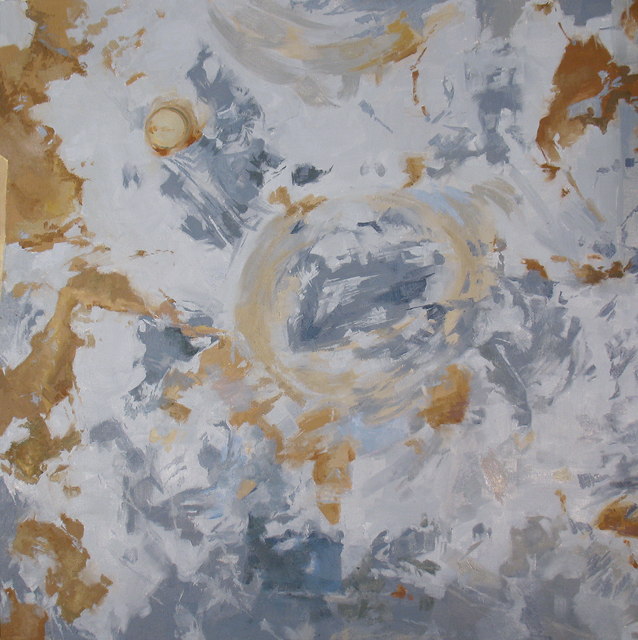
Erosion, 2015, oil on canvas, 32” x 32”
Briefly describe the work you do.
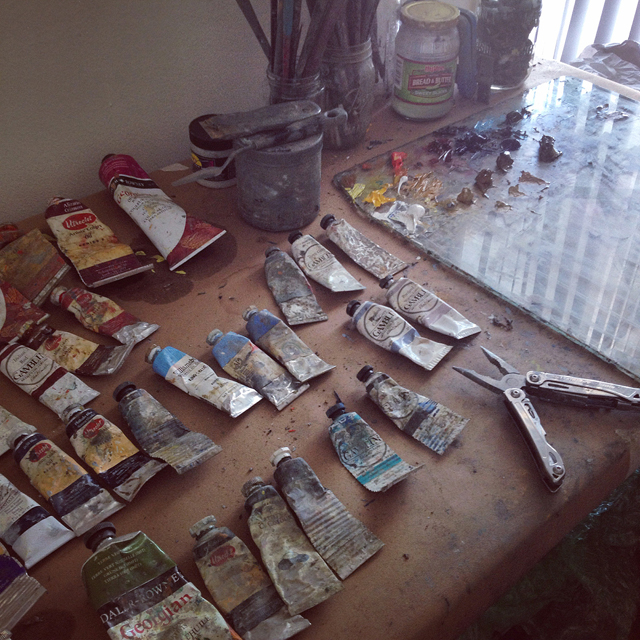
I make quiet paintings in a noisy world. My work is an intimate meditation on humble objects and the detritus of studio life. I use my studio as subject matter to create observational paintings that blur the line between representation and abstraction. The depicted paint residue on the walls and floor of my studio serves as a metaphor for the literal and emotional residue we all carry. I am interested in exploring the profound imprint people leave behind on each other and on the world.
Tell us about your background and how that has had an influence on your work and on you as an artist.
I come from a very creative family. My great-grandfather was a painter; my parents are graphic designers. One of my earliest memories is sitting at the kitchen table with my mom and a little pan watercolor set, mixing colors. My family had an enormous impact on the kind of person I am and on the work I make. I would not be where I am right now without their unwavering love and support.
I earned my BFA from the School of the Art Institute of Chicago and my MFA from Northern Illinois University. I was very fortunate to be able to study with some incredible painters – people like Marion Kryzcka, Betsy Rupprecht, and Frank Trankina – who taught me how to see, as well as what it truly means to be an artist.
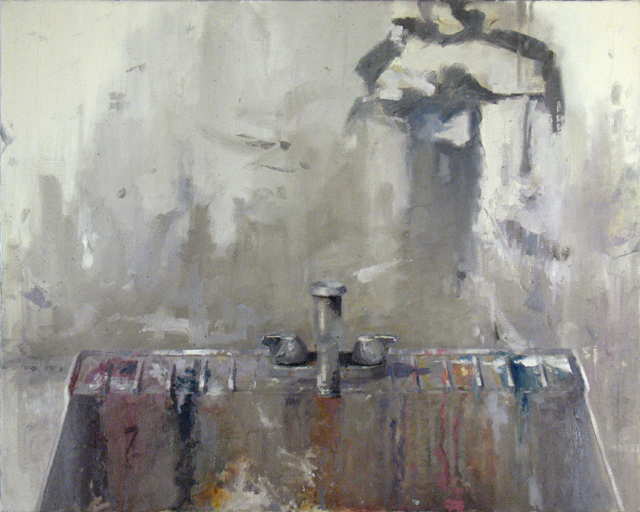
Sink, 2014, oil on canvas, 24” x 30”
The concept of the artist studio has a broad range of meanings in contemporary practice. Artists may spend much of their time in the actual studio, or they may spend very little time in it. Tell us about your individual studio practice and how it differs from or is the same as traditional notions of “being in the studio.”
My studio practice is fairly traditional. I spend most of my time standing at my easel. Look, paint, look again, repaint, repeat. For the past few years my studio has been my main subject matter. Since I work predominantly from life, being present in the studio is essential. There is an inherent energy in artist studios; even in a completely empty space, the paint left behind on the walls and floor has such presence. The duality of absence and presence, as described by the ‘empty’ studio space, is the focus of my current artistic research.
What roles do you find yourself playing that you may not have envisioned yourself in when you first started making art?
Being a self-employed artist means being one’s own self-promoter, salesperson, web designer, crate-builder, photographer, curator, critic… the list goes on. “Painter” is only one of the many hats I find myself wearing. There is a lot more to having a career as an artist than just making work in the studio. Technology has made tackling many of these roles much easier; it has also considerably broadened my community. Platforms like Instagram and Facebook allow me to network with people all over the world, and in turn I get to interact with other artists I would otherwise never have the chance to meet.
When do you find is the best time to make art? Do you set aside a specific time everyday or do you have to work whenever time allows?
Generally I work best at night. After finishing grad school, I converted my living room into my studio. I love working from home – it gives me tremendous freedom over my schedule, and I have found that living with my work means the “studio time” never really ends. I can contemplate the previous day’s decisions over breakfast, and when sleep is elusive, I can walk the ten feet to my easel and keep working. I don’t have set studio hours; my only rule is to work every day.
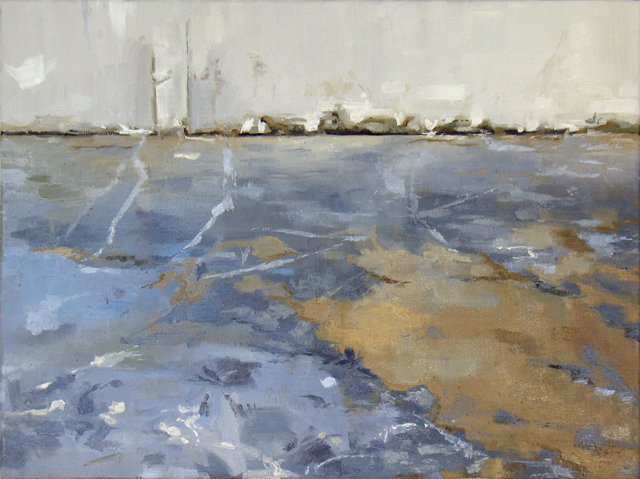
Distance, 2015, oil on canvas, 18” x 24”
How has your work changed in the past five years? How is it the same?
I felt like I found my voice as an artist in grad school. Before that I was still learning how to paint, and I spent a lot of time experimenting with different subject matter and concepts. I stopped working from photographs in grad school; I switched to painting directly from life, and that made a tremendous difference. I find that so much information gets lost in photographs; so many subtle shifts of color and value that are visible in real life disappear when translated into pixels. I still make quiet observational paintings – that hasn’t changed. The way I talk about my work has changed, and my concepts have become more focused. I have also become braver and more confident as a painter – five years ago I would never have been comfortable leaving certain marks or even discussing abstraction. Now I appreciate the value of letting the paint be paint. I also learned – and this may be the most important lesson – when a painting is finished for me.
How have people such as family, friends, writers, philosophers, other artists, or even pop icons had an impact on the work you do?
The old masters are always on my mind: Giotto, Piero, Velazquez, Vermeer… There is a Corot at the Art Institute of Chicago, a figure painting, that I especially love; it’s a very quiet painting, but the expression on the woman’s face speaks volumes. I also have an affinity with more contemporary painters like Giorgio Morandi, Euan Uglow, and Antonio Lopez Garcia. A few years ago, a friend and I drove to Texas to see the Lucian Freud portrait exhibition… I still dream about those paintings.
I’m a big fan of the modernist poets as well. William Carlos Williams’ “The Red Wheelbarrow” and Wallace Stevens’ “Thirteen Ways of Looking at a Blackbird” are two of my favorites.
Have you ever been pulled in the direction of a pursuit other than being an artist? What are your other interests?
No. I’ve always been an artist. Of the many things that define me, it’s the only label that matters.
I love to cook. My family is very Italian, so cooking has always been a big part of my life. The kitchen and the studio have always been connected in my brain. Both are creative spaces, full of experimentation and failure. For me, the act of painting is a lot like cooking; it is a slow process, full of trial and error, with recipes that more often than not get ignored in favor of trying something new.
About
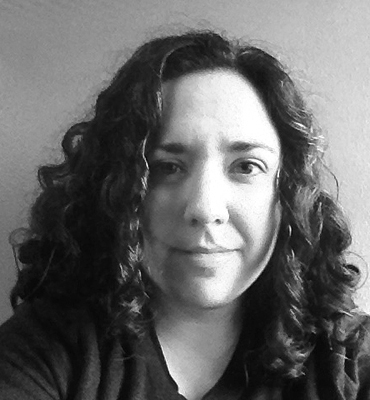 Samantha Haring is a painter, artist, and educator. She earned her MFA from Northern Illinois University and her BFA from the School of the Art Institute of Chicago. Haring received a scholarship from the Union League Club in Chicago in 2013. Her paintings have been exhibited across the country. Recent group exhibitions include the Evanston Biennial and the Bridgeport Art Competition. Presently she has two concurrent solo exhibitions, one in Chicago and one in St. Louis. Her work will be published in the upcoming Manifest International Painting Annuals 4 and 5. Most recently, Haring’s work was featured as part of The Labletter’s “Monthly Notes” series.
All images copyright of the artist and used with their permission.




 365 Artists | 365 Days
Reni Gower – Mechanicsville, Virginia
3. Papercuts:White/malachite-Detail
2014, 86½” x 56¼”, Acrylic on hand cut paper
Briefly describe the work you do.
Using the language of abstraction, I blend a fluid improvisational painting approach with a repetitively structured and analytical one to create complex images that counter visual skimming. I incorporate the circle as a repetitive decorative motif, as a metaphor for binary code, and as a cultural symbol. Through intricate patterning, I combine these references to contrast passive technological consumption with the redemptive nuance of slow work made by hand. By creating a private space within a public one, my art quiets the mind and encourages contemplation.
In my mixed media works, paint is applied to canvas, cheesecloth, nylon and aluminum screens, plastic, and rug-hold. These materials are torn or cut into strips, reassembled in layers, and suspended from wooden supports. In my works on paper, the physical layering is achieved through painterly illusions or paper cutting.
Tell us about your background and how that has had an influence on your work and on you as an artist.
While I grew up in the Midwest, I have lived in Virginia for over thirty years. With every move, my work has been influenced by the quality of the light and the color of my environs. I also love to travel. With my interest in sacred geometry, extended research trips to the Middle East and Western Europe have had significant impact on my work. As a professor of art, teaching has always informed what I do in my studio. Since I was fortunate to have many mentors in my early years, I believe in paying it forward through generosity, role modeling, and by giving artists tangible strategies for attaining a sustainable life in the arts.
2. Pivot.25 (left) and Pivot.24 (right)
2015, 38½” x 27″, Acrylic on paper mounted on canvas covered panel
The concept of the artist studio has a broad range of meanings in contemporary practice. Artist may spend much of their time in the actual studio, or they may spend very little time in it. Tell us about your individual studio practice and how it differs from or is the same as traditional notions of “being in the studio.”
I spend whatever time I have in my studio and I often work through ideas in my head while walking. I have a studio in the lower level of my home, which is large enough to include my office and several work stations. This is ideal because I always have more than one project under development. My studio layout accommodates “messy” process based activities at the same time I work on pristine cut paper pieces. It also allows me time to ponder works in progress while I tend to the administrative tasks tied to my artistic, curatorial, and teaching practices.
What roles do you find yourself playing that you may not have envisioned yourself in when your first started making art.
As a professional artist, I wear many hats. Over the years, I have learned or improved many essential non-art making skills as a curator, teacher, administrator, designer, fabricator, photographer, cultural producer, entrepreneur, collaborator, organizer, juror, advocate, mentor, communicator, and writer.
When do you find is the best time to make art? Do you set aside a specific time every day or do you have to work whenever time allows?
Balancing the demands of a career and family can be challenging. For me, it is a matter of being well organized, disciplined and working smart and efficiently. While I am in my studio every day, the amount of time varies. On a teaching day, I may only have a few hours in the evening. At other times, I can be easily absorbed by what I am doing for 8 – 12 hours at a stretch.
How has your work changed in the past five years? How is it the same?
The biggest shift in my work has been the addition of paper cutting to my studio practice.
Nevertheless, whether painting or cutting paper, my core motivations remain the same.
1. Fragments: Entwined
2013, 63″ x 62″, Mixed Media
How have people such as family, friends, writers, philosophers, other artists or even pop icons had an impact on the work you do?
I have always had the unconditional support of my family. Recently, I have worked more collaboratively on projects that have generated traveling exhibitions, publications, international workshops, and performances.
Have you ever been pulled in the direction of a pursuit other than being and artist? What are your other interests?
All of my interests are one in the same – just different aspects of the same pursuit. My aspirations combine my studio practice with my curatorial projects and teaching. I have never wanted to do anything else and I am grateful for all the opportunities I have had along the way.
About
Ms. Gower has received numerous grants and awards including the 2014 College Art Association Distinguished Teaching of Art Award and the 2014 Virginia Commonwealth University and VCUarts Awards of Excellence in Teaching; as well as NEA / SECCA Southeastern Artist Fellowship; Virginia Commission for the Arts Project Grants; SECAC Awards of Excellence in Teaching and Outstanding Catalog of Contemporary Materials; and VCUarts Faculty Grants for Curatorial Projects. Her work is represented in various collections including the Library of Congress Print Collection; Pleasant Company / Mattel, Inc; the American Embassies in Lima, Peru and Osaka, Japan; Media General, Inc; Capital One; and the Federal Reserve Bank.
Ms. Gower currently resides in Virginia where she is a Professor in the Painting and Printmaking Department at Virginia Commonwealth University. In addition to her teaching (painting, drawing, professional practice) and studio work, she curates award winning traveling exhibitions. She serves on the Board of the Southeastern College Art Conference and she is a past member of the Services to Artists Committee of the College Art Association. She holds a Master of Fine Arts degree from Syracuse University, a Master of Arts degree from University of Minnesota-Duluth, and a Bachelor of Science degree from the University of Wisconsin-Madison.
renigower.com
All images copyright of the artist and used with their permission.