Chris Ernst – New Brunswick, New Jersey

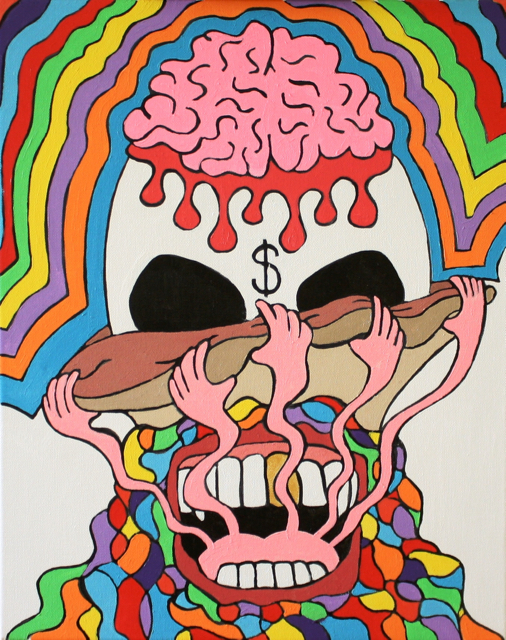
Oh the Places. . ., Acrylic, 16" x 20", 2015

Oh the Places. . ., Acrylic, 16″ x 20″, 2015

Briefly describe the work you do.

I work largely with acrylic paint and utilize a wide range of colors.  Pop culture is a common theme throughout my work.  Personal abstractions of design touchstones from punk, hip hop and skate culture shape a large portion of my catalog.  Original drawings have been a recent obsession.  My favorite pieces strike a balance somewhere between contemporary and nostalgic.

Tell us about your background and how that has had an influence on your work and on you as an artist.

I was born in Indiana, grew up in Virginia and have lived in Jersey for about fifteen years.  I feel my travels have impacted my artwork in the sense that my influences are far-reaching.  When I was younger I resented having moved so much but I think it has helped me be expansive in my practice.

The concept of the artist studio has a broad range of meanings in contemporary practice. Artists may spend much of their time in the actual studio, or they may spend very little time in it. Tell us about your individual studio practice and how it differs from or is the same as traditional notions of “being in the studio.”

I have a very open studio that I share with my wife Jamie.  When it comes time to do the work there are many times where I am “in the studio” mentally and focused on completing a new piece.  However, a big part of the action that happens in the studio are the conceptual discussions regarding the art I have with Jamie.  She is an excellent curator and I am fortunate for her council.  She hasn’t steered me wrong and some of my favorite pieces make me even happier than normal because I can see how we worked on it together. 

ODB - Snakes, Acrylic on Cassette Tapes, 10" x 12", 2015

ODB – Snakes, Acrylic on Cassette Tapes, 10″ x 12″, 2015

What roles do you find yourself playing that you may not have envisioned yourself in when you first started making art?

One of the roles I least envisioned when I started off was the role of the explainer.  I was just so excited to get my work into galleries at first that I totally didn’t think about the presentation of the work from the perspective of sharing the thinking process behind a piece.  However, over time I have gotten more comfortable as the explainer and I have had some great conversations with people that have furthered my art.

When do you find is the best time to make art? Do you set aside a specific time everyday or do you have to work whenever time allows?

My two favorite times to work are right around dusk when I am home from work or getting up super early on a weekend morning.  I work to deadlines, whether it is for a juried show with a formal deadline or an informal deadline I have created for myself.  As a result, my efforts in the studio may ramp up and I look to a weekend morning for a killer session or spend a little longer at night during the week.

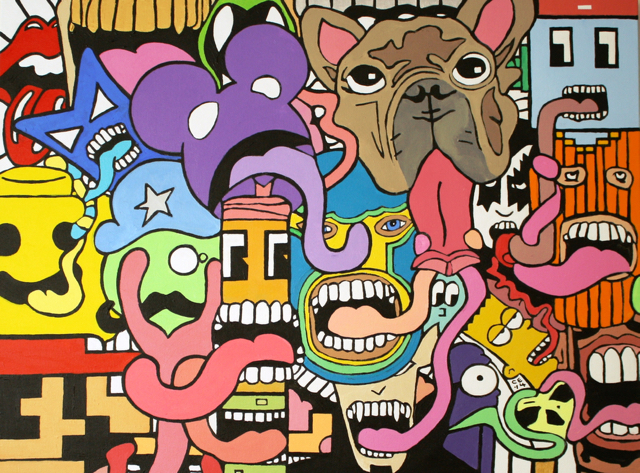
Tongue Tied, Acrylic, 40" x 30", 2014

Tongue Tied, Acrylic, 40″ x 30″, 2014

How has your work changed in the past five years? How is it the same?

I think my level of detail has advanced, my colors have gotten increasingly bright and neon and my lines have improved significantly.  Original drawings have influenced a larger number of my paintings over the past five years.  Within the past year I have begun using acrylic markers for the black lines in my paintings and I am not sure I will ever go back to brushes for my lines again.  Despite these changes I am still mining some of the same pop culture themes I have always explored.

How have people such as family, friends, writers, philosophers, other artists or even pop icons had an impact on the work you do?

Jamie is my best confidant.  My mom has been my biggest fan throughout the years but really my whole family has been supportive.  It takes a village to raise an artist, I am fortunate to have such a great village.  My grandfathers were both craftsmen and early influences.  Roy Lichtenstein is probably my biggest technical influence but Andy Warhol is a conceptual inspiration as well.    

Have you ever been pulled in the direction of a pursuit other than being an artist? What are your other interests? 

Yes, I am currently in advertising and have my MBA.  I enjoy the work and I think it blends naturally with my art background.  I am a huge music fan and always looking for new tunes.  Fall is my favorite time of year.  I am an avid runner and enjoy snowboarding and surfing. 

About

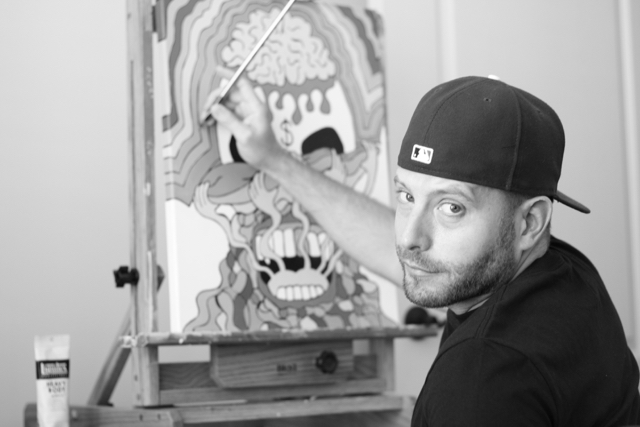
ChrisErnstStudioChris Ernst is a largely self-taught pop artist from New Brunswick, NJ.  He lives and develops his art with his wife Jamie.  He loves the Blue Ridge Mountains and the Jersey Shore.  Sometimes he feels more like a kid at Halloween than at Christmas.  He loves trip hop and he’ll never say no to good southern comfort food.

ChrisErnstStudio1

instagram.com/cernstart

All images copyright of the artist and used with their permission. 

Posted in Street Art | Tagged , , , , | Leave a comment

Carlos Colín – Vancouver, BC, Canada

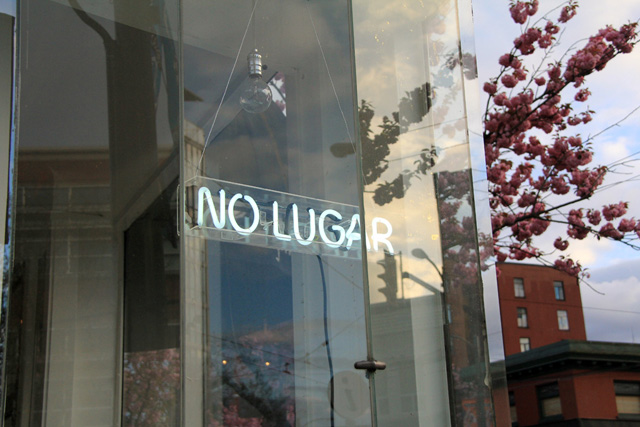
No Lugar (No Place). 8" x 20". Neon Light. 2014

No Lugar (No Place). 8″ x 20″. Neon Light. 2014

Briefly describe the work you do.

Art is an indivisible part of the people, and as an art worker, I must participate in my social communities. My works are conceptually based and socially engaged. I work with different materials as needed such as wasted wood, embroidery, photography, and text.

Tell us about your background and how that has had an influence on your work and on you as an artist.

As a Mexican artist, I consider that Latin America has a very particular vision of the world (history, politics, cultural activity, religion, etc.), and how there exists a conceptual variation to produce art, to live, to believe, and to survive as a community. I have an undergraduate diploma in graphic design and visual communication, two Masters degrees in visual arts, one in Mexico City and the second one in Vancouver. I am now studying a PhD in Interdisciplinary Studies, and I consider that the influence of all of these different approaches to creation has formed how I can connect with people through art.

The concept of the artist studio has a broad range of meanings in contemporary practice. Artists may spend much of their time in the actual studio, or they may spend very little time in it. Tell us about your individual studio practice and how it differs from or is the same as traditional notions of “being in the studio.”

I work at home most of the time. My family is there and I love that. It keeps me in perfect balance between life and work. I think the studio creates a distance between you and your surroundings. I am not against art studios and I even used to have one. My “studio” is being with my family, sharing a coffee with friends, walking in the street, and observing situations taking place around me and, of course, sitting down and working on projects, mostly at my kitchen table.

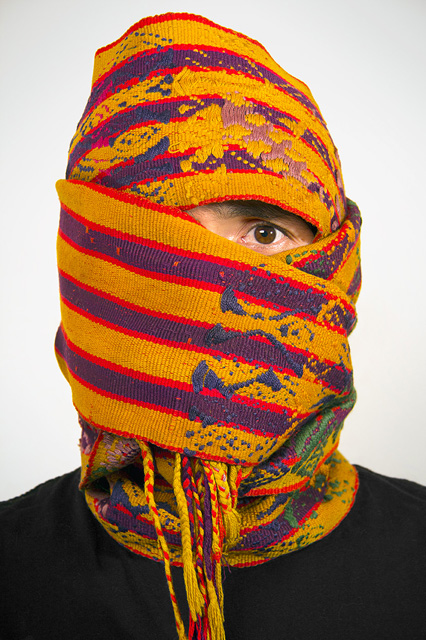
Máscara 010. Photography. 31 1/2" x 47". 2014

Máscara 010. Photography. 31 1/2″ x 47″. 2014

What roles do you find yourself playing that you may not have envisioned yourself in when you first started making art?

I consider art practice as a job, and artists as workers. Artists as workers and part of a society, have the same responsibilities than other workers, with the understanding that workers are people that contribute to society in a collective synergy with their work.

When do you find is the best time to make art? Do you set aside a specific time everyday or do you have to work whenever time allows?

It depends on the day and the project. Sometimes it’s better if I work in the mornings or evenings. The most part of the time I work at night. Most of my life I’ve been working at night because in Mexico City I used to live far from the Zocalo (downtown) and cultural activities, and when I got back home it was always late and I would spend my time working. Working at night has become a sort of habit.

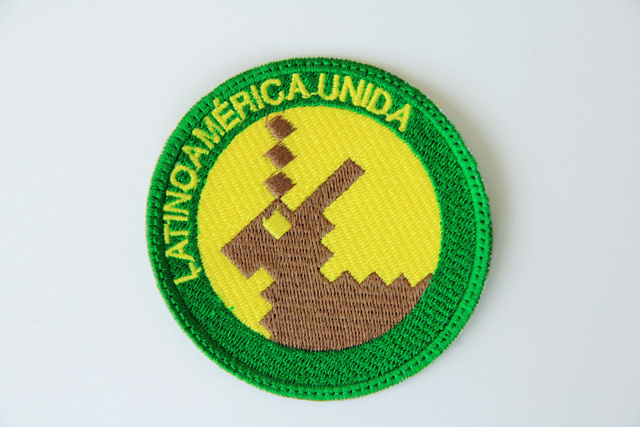
Latinoamérica Unida. Patch. 3". 2013

Latinoamérica Unida. Patch. 3″. 2013

How has your work changed in the past five years? How is it the same?

I have four years living in Vancouver, BC, Canada, and living in the diaspora changed my perspectives and notions about what kind of art I really want to do. Living outside of Mexico reinforced my ideologies, theories, and art production. As a Mexican, and Latin American person I became more conscious of all this knowledge and background I have within me and this has made me understand and explore the idea of living, working, and producing art and theory through the diaspora.

How have people such as family, friends, writers, philosophers, other artists or even pop icons had an impact on the work you do?

Lots of people had an impact on the work I do and my life, but mostly my family. I come from a very close and united family, with all of our problems and charms. The connection between my family and society as a whole has marked me as a person and artist. I try to be aware about what happens everyday in my country and how Mexican society (including my family) goes through all the events in my country. I think family, as the closest people in my life, are the most relevant in terms of how they impact my worldview and work. And now, having my own family, my wife, who is a filmmaker and artist, and our son, have become part of this network of closest persons that impact me everyday.

Have you ever been pulled in the direction of a pursuit other than being an artist? What are your other interests?

My undergraduate diploma is in graphic design and visual communication, and I thought that graphic design would be the direction that I was going to pursue. I began to interrogate the ethics, human behaviour, and the nature of products that you create for mass consumption and for commercial purposes, which led me to visual arts. Being an artist was my other interest, and graphic design was the first step that pulled me into the direction of artist.

About

Headshot - Carlos ColinCarlos Colín was born in Guadalajara, Jalisco, Mexico in 1980. He grew up in Mexico City. He studied Visual Communication and Design (2000-2004), and a Master’s of Fine Arts at the National School of Fine Art (UNAM) (2009-2011), in Mexico City. He recently completed a second Master’s of Fine Arts at the University of British Columbia (UBC) in Vancouver, BC (2011-2013), and is now pursuing a PhD in Interdisciplinary Studies. His research consists in investigating how contemporary art, artists, and art institutions are involved in current social movements and, by extension, how art contributes to social change and social activism in Latin America. As a Latin American artist, Carlos Colín brings perspectives on the discourse of how art evolves inside societies, how it finds expressions, and how art changes over time, as well as the implications this has for Latin America. Colín is represented by Fazakas Gallery in Vancouver. He participated at the LAB in the Art Gallery of Greater Victoria in 2015; Vancouver Art Gallery Auction, and ArtToronto Art Fair in 2014; Satellite Gallery and Back Gallery Project in Vancouver, BC in 2013; Biennial of Painting Rufino Tamayo in Mexico City in 2011; International Festival of Contemporary Art in Guanajuato, Mexico in 2008; and the Art Biennial of Glass, Museum of Glass, Monterrey, Nuevo León, Mexico in 2008 and 2004.

Favorite place - Colin

carloscolin.mx

All images copyright of the artist and used with their permission. 

Posted in mixed media, Photography | Tagged , , , , | Leave a comment

Jonathan Notario – Madrid, Spain

Vomit-art 2011 Wooden box painted in acrylic. 122 cm x 122 cm x7 cm (closed) 122x 122 x122 cm (open) Wooden toy die with Spewer mechanism confetti. 51 x 33 x 17 cm

Vomit-art, 2011
Wooden box painted in acrylic.
122 cm x 122 cm x7 cm (closed) 122x 122 x122 cm (open)
Wooden toy die with Spewer mechanism confetti.
51 x 33 x 17 cm

Briefly describe the work you do. 

My work investigates the relationship between art and game, breaking the line that separates reality and fiction, through participatory works that directly implicate the public.

My art can be touched, when the humor and irony are also an important component, because it allows me to talk about serious issues in an ambiguous way in which each person gets his own interpretation. I use manual techniques such as installation, painting, illustration or collage, but now I’m starting to use video and other digital resources.

I don’t like to be classify with a specific technique, because i try to use the most appropriate technique for each project . What interests me the most is to learn new things in every art project that I hold, developing research work and confronting new challenges.

Tell us about your background and how that has had an influence on your work and on you as an artist.

My name is Jonathan Notario, I was born in León (Spain) in 1981. I have a Bachelor’s Degree in Fine Arts from the University of Salamanca in 2004. I have received several awards and mentions, as the selection of my video “Moon Park” in the catalogue of the distributor of video art “Hamaca” Reina Sofía Museum, 2015. Scholarship “El Ranchito” Programme of residencies Matadero Madrid – AECID, 2015. Scholarship VEGAP “Proposals”, 2013. The INJUVE Award, 2010. The Award of “Young Art” at the Complutense University of Madrid, 2010.  First prize Carriegos Foundation of “Visual Arts”, 2010. Award of “Acquisition” in the contest of” Young Artists” of Castilla y León, 2007. Prize for comic of “Young art” organized by the board of Castilla y León, 2007.

I have worked with several Spanish galleries as “Blanca Soto”(Madrid) Mad is Mad (Madrid). My work has been exhibited in several samples of artists such as in “Temptations 09” curated by Javier Duero, within the contemporary art fair “Estampa”, the traveling exhibition “Displays of Visual Arts” of INJUVE by Spain and Latin America, curated by Jesus Carrillo with the sponsorship of the AECID.

I have also done editorial projects such as my book, “Portraits of the interior”, financed with the help of VEGAP, with foreword by Jesus Carrillo, presented in MUSAC and in the Central of the Reina Sofia Museum in 2014.

In the last year I have begun to develop an educational art workshops of plastic creation in several public and private institutions such as the National Center of Art Reina Sofía Museum (Madrid), MUSAC (Leon) or the Cerezales Foundation (León).

Cover Doght Holes paste 2012 Site participatory project specs. Made for the exhibition “The Empty Space”, curated by Maria Lopez Velasco, within Open studio. Madrid. Cardboard, acrylic, wire, spray. 450cm x 220cm 600 cmx Photography. Variation No. 16. Jonathan notario.

Cover Doght Holes paste, 2012
Site participatory project specs.
Made for the exhibition “The Empty Space”, curated by Maria Lopez Velasco, within Open studio. Madrid.
Cardboard, acrylic, wire, spray.
450cm x 220cm 600 cmx
Photography. Variation No. 16. Jonathan notario.

The concept of the artist studio has a broad range of meanings in contemporary practice. Artists may spend much of their time in the actual studio, or they may spend very little time in it. Tell us about your individual studio practice and how it differs from or is the same as traditional notions of “being in the studio.”

For me it is important to have the study closely since art is part of my life, that’s why my place of work is located in my home

The times that I dedicate my creation are not the normal. I work according to the needs of the moment, can be at night, it occurs to me an idea and i have to go running to the study to work on it without that nothing will stand.

There are months that I work a lot, other months do not work anything, and everything depends on the project that Im doing.

Lately my artwork is more theoretical, mainly because there has been a process of maturation, using currently less pictorial resources and explore more possibilities with the video and other digital tools.

What roles do you find yourself playing that you may not have envisioned yourself in when you first started making art?

I never imagined the educational aspect, since in recent years I have begun to make artistic workshops in institutions and museums of my country, including the Reina Sofía Museum, the MUSAC, or Cerezales Foundation.

This came by chance and has become an important creative aspect for my own work, create educating. I love to create projects that are generated from a collaboration with students. They learn and I learn from them, and together, we develop an artistic project. It is something that has enriched the individualistic way worked before, to enter in a new era more collective

When do you find is the best time to make art? Do you set aside a specific time everyday or do you have to work whenever time allows?

I work in function of the needs, but generally I have always worked better at night.

2015. Moon Park “ Chroma Dreams”. Acrylic on paper. 120 x 75 cm. 2015

2015. Moon Park “ Chroma Dreams”.
Acrylic on paper. 120 x 75 cm. 2015

How has your work changed in the past five years? How is it the same?

My work has become somewhat more sober, less colorful. I started doing painting with lots of color, and a great sense of humor, using very manual procedures. Now the humor remains and color only when it is necessary, also lately i am using a lot the video and other digital tools instead of using pictorial resources. Each time i focused more on the meaning and concept of the work and sought the most appropriate technique for doing so, without the need to demonstrate that I can paint or draw. If have to be a video made with computer because the idea of the work so requests, I do so, if it is better to use paint, i used, each idea has its particular form to be done. I don’t like to do always the same, for that when I learn to do something new, I leave the previous to learn something new that will allow me to evolve.

How have people such as family, friends, writers, philosophers, other artists or even pop icons had an impact on the work you do?

All mixed: Stan Lee, Stanley Kubrick, Martin Scorsese, Steven Spielberg, Bryan de Palma, Alex de la Iglesia, Tarantino, The Carpenters, ELO, Andy Warholl, Richard Hamilton, Neo Rauch, Fernando Fernandez, David Lynch, Stanislav Lem, Tarkovski, Narciso Ibañez Serrador, Carlos Saura, Victor Erice, advertising of the 50s American, The Spanish advertising on the 60s and 70s, The Kinki film, , Wacky Races, the Tulicrem, the Nutella, the Pecos, Supersonic man, Furniture catalogs, B-movies, theater and stage, Puppets, Carnivals, Costumes, Toy stores, amusement parks, Star wars, outsider art, travel in time, the churches of the 70s … and more … everything can serve as inspiration.

Have you ever been pulled in the direction of a pursuit other than being an artist? What are your other interests? 

I have always wanted to be an artist, film director, or illustrator. The most difficult part of being an artist is to be maintained and sometimes have to reject stable jobs and that’s hard. In my country being an artist is not easy because there is not a great love for the culture and you always have to combine it with other things.

In my case, I do illustration works and freelance design as well as post-production of video.

I have always seen the art as a feedback from other disciplines. What I learn doing arts projects I use it in other areas for a living, or what i learn earning a living, used it to make artistic projects.

Worker Man.The Puppet that replaces me in the work. 2009 Reply of the artist and sound button with engraved phrase. Wood, linen, acrylic, plastic, air. 600 x 450x 220 cm

Worker Man.The Puppet that replaces me in the work. 2009
Reply of the artist and sound button with engraved phrase.
Wood, linen, acrylic, plastic, air. 600 x 450x 220 cm

jonathannotario.es

All images copyright of the artist and used with their permission. 

Posted in Sculpture | Tagged , , , , | Leave a comment

Elena Pérez-Ardá López – A Coruña, Spain

Diary, 2015. Analog photography, digital print. Variable measurements, 2015

Diary, 2015. Analog photography, digital print. Variable measurements, 2015

Briefly describe the work you do.

My process of artistic work is influenced by the relationship between places and events. I prefer most of all analogue photography as media using its ambivalent meaning both as a souvenir or document. Concepts such as travel, seen from the simple displacement, movement, or the action of walking are latent in my work. Structures of lines drawn on the ground, footprints, directions, paths, in between-connections, the infinite and the ability to paralyze everything in an instant. On the other hand, to develop the idea of “once in a lifetime” as an original and initiatory experience I make a comparison between the analog image as a singular document, which represents the moment that can be no longer repeated, and use the film as something perishable but unique at the same time. The narrative that builds up in my images as you go along on the daily life travel, is a work that takes place in the movement, not from any exact place and goes to another.

Tell us about your background and how that has had an influence on your work and on you as an artist.

I was born in the south of Spain, but because of family matters, we moved north. From coast to coast, “there is no longer way than this to cross Spain” I used to hear. It may be that all those journeys, full of infinite lines, traveling by car always looking at the horizon remained very deep in my mind. Maybe that is why the term “travel” fascinates me (in my art work & life) and why I always refer to it to explain myself. The second big change in my life took place in my junior year of high school and refers to the them of travel as well; I studied for a year in the US and this allowed me to discover new cultures, ways of thinking, and living. I grew as a person and discovered the world I was most intrigued by; the art world. Back home, I was determined to obtain my high school diploma major in art and later pursue a degree in fine arts in college.

The concept of the artist studio has a broad range of meanings in contemporary practice. Artists may spend much of their time in the actual studio, or they may spend very little time in it. Tell us about your individual studio practice and how it differs from or is the same as traditional notions of “being in the studio.”

To have a studio for me its like a privilege! Well, we had spaces at college, but it was crowded. It was not really a proper studio, but it was the thing most similar to it i have ever experienced. Right now I have a big room I used to share, so I would try to make something out of this! I think more than being isolated at a great studio, it´s important for an artist to be surrounded by a creative environment, like small talks about art & engaging in discussions frequently. I once visited a friend´s studio in Dublin shared by four artists and I thought that was the right studio for me if I was living in Ireland.

Puntos de unión, Analog photography collage, digital print. 20x30cm, 2014

Puntos de unión, Analog photography collage, digital print. 20x30cm, 2014

What roles do you find yourself playing that you may not have envisioned yourself in when you first started making art?

I did not think much about the concept or process, i was still influenced about trying to mastering the technique and a bit obsessed I must say of doing it “right”, now Im first concerned about what I want to say, and then making a stress on that.

When do you find is the best time to make art? Do you set aside a specific time everyday or do you have to work whenever time allows?

I truly believe there is no way to make a schedule about doing art. I think sometimes that is the problem when you try to explain other people not relate at all to the art field what means to make art. The “urgency” to express yourself comes whenever. In my opinion its hard to wake up early in the morning and say “ok, im going to paint, draw, do this…in two hours because I dont have more time, and it has to be done”. For me, I can go weeks without any good shot, idea or feeling about what I want to do, but then sitting watching a movie, or just talking to someone I have this cliché “inspiration” thing and I keep it carefully for the next days to develop further. I find this question really interesting because I think everyone of us is dealing with this “time to be an artist in your free time”/ “time to work” and today´s society reality. This of course, doesn’t deny that there are well-organized artist!

Puntos de unión,Analog photography collage, digital print. 50x70cm, 2014

Puntos de unión,Analog photography collage, digital print. 50x70cm, 2014

How has your work changed in the past five years? How is it the same?

Five years ago I was beginning my education and could not imaging half of the things I do today. I think my work stays true somehow to who I am but what have changed is how I want to show that. But still I think I have to develop much further. To be honest, I still find it hard sometimes  to call it “work of art”.

How have people such as family, friends, writers, philosophers, other artists or even pop icons had an impact on the work you do?

Many! I think this has a lot to do with the previous question about the studio…and my opinion stays pretty much the same, it´s vital to have contact with other artists and let them influence you and influence them as well.

Have you ever been pulled in the direction of a pursuit other than being an artist? What are your other interests?

I have recently reached a conclusion that would be just pursuing to live a creative life, i think that is more important than being an artist who makes art pieces. Maybe this is just a logical reason to avoid any kind of frustration seeking for perfection or recognition. I feel somehow I have a long road to walk and I would like to continue my education.
Other than that, my interests are widely broad, this year I had contact with teaching and museum education and it was a very good experience. In spanish we have a famous saying which I totally agree: “nunca digas de este agua no beberé”, that means literally “never say you will never drink from this water”.

About

Elena Pérez-Ardá López (Almería,1991) is a spanish based artist. She holds a BA in Fine Arts from the University of Salamanca and she studied abroad at the Kunsthochschule of Kassel in Germany with Prof. Bernhard Prinz. Her work has been selected various times at national contests and at the Adora Calvo Gallery open call for emerging artists. Elena has exhibited at DA2 (Museum of Contemporary Art) in Salamanca and has participated as well in exhibitions in Kassel and the F/Stop Photography Festival in Leipzig (Germany).

6.Work on an exhibition

elenapal.es/

All images copyright of the artist and used with their permission. 

Posted in Photography | Tagged , , , , | Leave a comment

Fermín Díez de Ulzurrun – Pamplona, Navarra, Spain

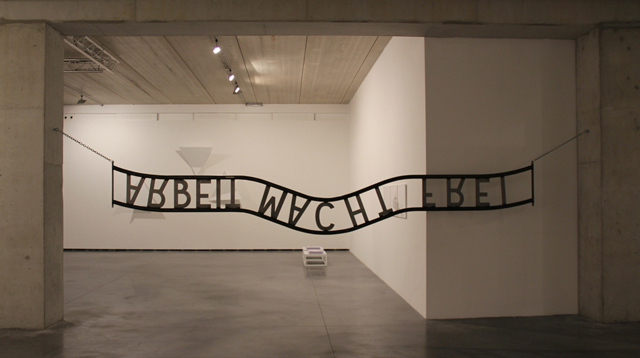
ARBEIT MACHT FREI, Steel, 5225 x 1250 x 50 Cm, 2012

ARBEIT MACHT FREI, Steel, 5225 x 1250 x 50 Cm, 2012

Briefly describe the work you do. 

My job is developed as a means to understand the continuous changes or adjustments in capitalism and how these changes affect the middle classes in areas ranging from social organization, lifestyle and hegemonic identity, conditioned by their cycles.I raise my work as a generator of collaborative models as opposed to the hegemonic production models that have occurred since the beginning of industrialization in order to redefine sustainable model.I also question how productive models hegemonic economic model affect people and how they are defining organizational models of consumption patterns, etc.

Tell us about your background and how that has had an influence on your work and on you as an artist.

As industrial designer I try to analyze situations from a rational point of view with the intention of articulating an ideological speech that produce small changes in my immediate environment.

THE INFINITE MONKEY THEOREME, Bronce and aluminum casting, variable dimensions, 2011

THE INFINITE MONKEY THEOREME, Bronce and aluminum casting, variable dimensions, 2011

The concept of the artist studio has a broad range of meanings in contemporary practice. Artists may spend much of their time in the actual studio, or they may spend very little time in it. Tell us about your individual studio practice and how it differs from or is the same as traditional notions of “being in the studio.”

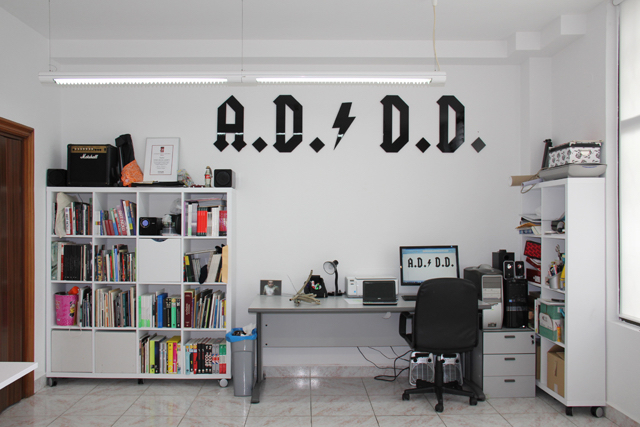
In my opinion the studio is only a place to think, read, and put on paper ideas. My projects happen elsewhere and with people involved on it.

What roles do you find yourself playing that you may not have envisioned yourself in when you first started making art?

At the beginning of my career I didn´t think that writing proposals, budgets and other “red tape” was so necessary to the artistic practice. Another aspect that I didn’t consider is the paper of the artist as curator for some projects.

When do you find is the best time to make art? Do you set aside a specific time everyday or do you have to work whenever time allows?

A contemporary artist, in my opinion, is always working.

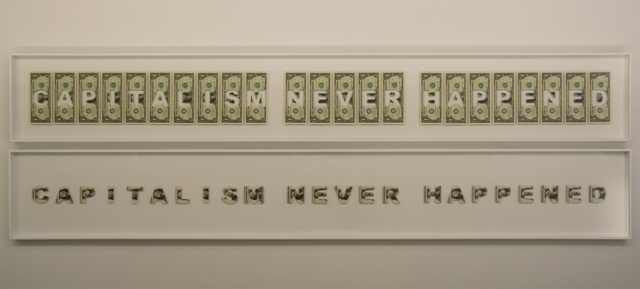
CAPITALISM NEVER HAPPENED, 23 dollar bills cutted, work in progress from 1$ to 100$, 2010

CAPITALISM NEVER HAPPENED, 23 dollar bills cutted, work in progress from 1$ to 100$, 2010

How has your work changed in the past five years? How is it the same?

It´s more and more relational and more and more ideological.

How have people such as family, friends, writers, philosophers, other artists or even pop icons had an impact on the work you do?

“How will this thought or action contribute to, or interfere with, the achievement, by me and the greatest possible number of other individuals, of man’s Final End?”

This Aldous Huxley quote was with me from the beginning of my career and defined the ideological background of my artistic production.

Have you ever been pulled in the direction of a pursuit other than being an artist? What are your other interests? 

Musician.

About

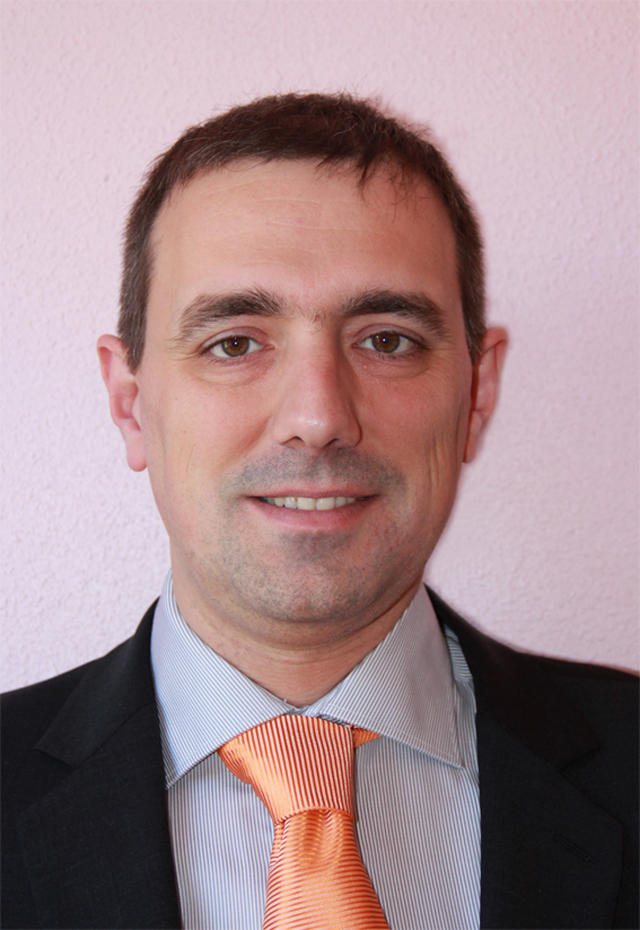
5 (1)Industrial designer, graduated in management of industrial plants by the Polytechnic University of Catalonia. He combines his professional work as an industrial manager in the automotive industry with his artistic career. He has received grants from the Government of Navarra and the CIEC conducting several solo exhibitions which include : -Reunión – Windsor Kulturgintza (Bilbao), -ARBEIT MACHT Frei in the C.A.C.H. or -KILL YR . -33430467 – J- IDOLS- at the Citadel of Pamplona. He has also participated in group shows as -Budget € 6 : artistic practice and precariousness- OFF LIMITS (Madrid) , curated by Cabello – Carceller and Generations of Caja Madrid project.

4

fermindiezdeulzurrun.es

All images copyright of the artist and used with their permission. 

Posted in Performance, Sculpture | Tagged , , , , | Leave a comment

Natalia Ludmila – New Delhi, India

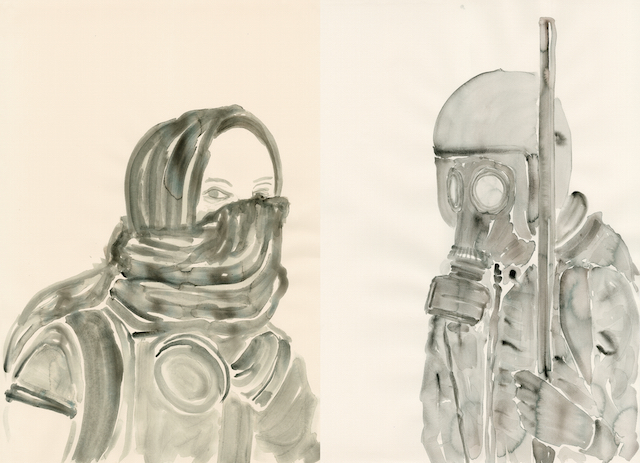
For the Love of Gas Mask_Watercolour on Paper_27.56x 39.37 inc_2014

For the Love of Gas Mask, Watercolour on Paper_27.56x 39.37 inc_2014

Briefly describe the work you do.

My practice is studio based research involving the reinterpretation of media generated images. I focus on images that depict circumstances of conflict of either a political or civil nature. Investigating how these images formulate a biased and skewed view of the world by developing a us/them narrative. The most recurrent representations in my work are active subjects from scenes of protest and civil unrest. In reinterpreting these images in a different medium they are bestowed with a different meaning, and thus create an opportunity for the viewer to form her/his own backdrop.

Tell us about your background and how that has had an influence on your work and on you as an artist.

Well, I was born in Mexico City and come from a family of academics that has always valued exploration, curiosity and looking at the world a bit differently so that had a definite influence on me. I have also been lucky enough to have lived outside my country for extended periods of time from an early age and this exposed me to other views and customs. Further down the line I did a Bachelor in Visual Arts and a Master in Digital Design and both disciplines inform my practice constantly. They complement each other, one is organic and sort of free flowing the other is quite deterministic and rule based.

An Urban Planner Called Ceyda Sungur_Watercolour and ink on rice paper_11.81 x 23.62 inc_2014

An Urban Planner Called Ceyda Sungur_Watercolour and ink on rice paper_11.81 x 23.62 inc_2014

The concept of the artist studio has a broad range of meanings in contemporary practice. Artists may spend much of their time in the actual studio, or they may spend very little time in it. Tell us about your individual studio practice and how it differs from or is the same as traditional notions of “being in the studio.”

A few years back I used to have a very traditional take on “being in the studio”. I put in quite a lot of painting hours and always compared it with having an actual office type job in the sense that there was a schedule to follow with lunch breaks and all. That type of structure helped me immensely to develop my technique and create much needed discipline. Now, I spend probably as much time in the studio as before but not actually painting. As my practice has changed so has my time in the studio. My activities involve a wide range of things yet they are all gravitating around art making. In a way artists are always working, studio time is just about putting ideas together and making them happen.

What roles do you find yourself playing that you may not have envisioned yourself in when you first started making art?

Before I had quite a romanticised view of what being an artist was, so the answer to that would have to be all the admin stuff involved with an art practice.

When do you find is the best time to make art? Do you set aside a specific time everyday or do you have to work whenever time allows?

There is probably an answer to that as there are artists, everyone is different and I have been very lucky to be able to work almost any time I wanted to. When having other jobs they have been low key and have not interfere too much with my practice. For me, mornings work best specially when painting is involved because I prefer natural light. For the rest such as research, editing and coding I can work all throughout the day.

The State of Affairs_Watercolour on Paper 27.56 x 19.69 inc_2013

The State of Affairs_Watercolour on Paper 27.56 x 19.69 inc_2013

How has your work changed in the past five years? How is it the same?

The content has changed radically, before I was exploring, I didn’t have a clear idea of what I wanted to say. What is different now is that I know the type of concepts I want to pursue and my practice has become more about finding the right channels to express those ideas. Yet, I have not stopped painting altogether, it has been a constant so that has stayed the same.

How have people such as family, friends, writers, philosophers, other artists or even pop icons had an impact on the work you do?

For me everything has the potentiality to impact your work. Whether is a quick chat with someone, something you read or saw, some sound you heard, even something you tasted. And that is the beauty of art, that it can be informed by a plethora of elements finding the sparks that trigger the interests is the tricky part.

Have you ever been pulled in the direction of a pursuit other than being an artist? What are your other interests?

Before art I studied architecture. I enrolled in a program but two semesters in I knew it was not for me as a practitioner, I still love it and keep informed . I hold many interests yet I don’t envision myself doing anything else other than art.

About

Natalia LudmilaBorn in Mexico City and raised in Canada. She holds a BVA in which she specialised in painting by the National Autonomous University (Mexico) and a Masters in Digital Design by the University of Canberra (Australia). Her work has been exhibited in several solo and group shows in Mexico, Brazil, Spain, Australia and Singapore among other countries. She was the Second Prize recipient in the XVIII Ibiza Biennale -Ibizagrafic’- with the project dfm e.p.(Spain). In 2012 she was awarded the International Residency grant by FONCA (National Fund for Culture & Arts. Mexico) and spent three months at INSTINC Artspace in Singapore. Ludmila has exhibited in and had work commissioned by the Diego Rivera Anahucalli Museum (Mexico City). In 2014 she took part in the -The Great Collaboration- project in Singapore along with ten other artists. In the same year Ludmila was also named in The 200 top expressions of Mexican Art initiative and catalogue and had work selected for the National Landscape Biennale (Mexico).

Ludmila currently lives and works in New Delhi, India.

OLYMPUS DIGITAL CAMERA

OLYMPUS DIGITAL CAMERA

natalialudmila.net

All images copyright of the artist and used with their permission. 


Posted in Watercolor | Tagged , , , , | Leave a comment

Wini Brewer – Los Angeles, California

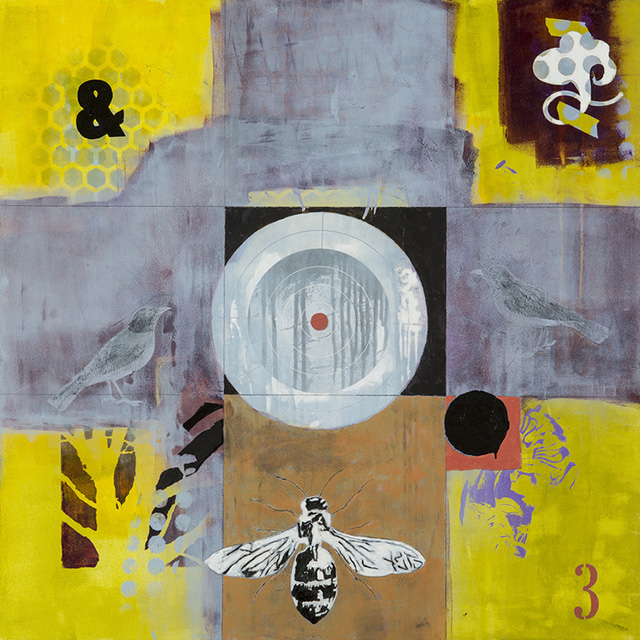
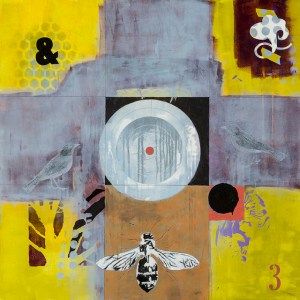
Birds and a Bee acrylic/collage/ink transfer on cradled wood panel 36” x 36” 2014

Birds and a Bee
acrylic/collage/ink transfer on cradled wood panel
36” x 36”
2014

Briefly describe the work you to.

I am a painter working with acrylic, mostly on square wood panels ranging in size from 10” to 36”. My work is many layered, combining occasional collage and ink transfer, while juxtaposing elements of representation and abstraction with bold black and white graphics. It doesn’t get interesting until it’s been ruined a time or two, the beat-up panels becoming the narrative of my struggle. My visual vocabulary is mostly derived from a New England childhood, with influences of Emily Dickinson. But I live in 2015 so I integrate the two — the 1940s child; the 2015 woman. 

I am looking for answers. I am looking to be surprised. That is the reward. If I know what a painting is going to look like, why bother to paint it? 

My goal has always been to paint without thinking. I begin a panel without any thought of what I will paint. My “rule” is to honor the first thought. Honesty is most important to me. If I am totally, painfully honest, this will be recognized. Others will relate because it is honest. I believe in the “collective unconscious”. You could say that is my “target audience”.

If that first thought is to paint an elephant, than an elephant I must paint. The brain is not allowed any debate or second thoughts. It’s the same with color — if the first thought is yellow than it is a yellow elephant. And so it goes. Same for placement on the panel. Doesn’t matter where. Of course this leads to many, many “mistakes”. I load the panel up with as much crap (sorry) as I can and then begin eliminating. I go through this process of adding and subtracting many times. Paintings come and go. Some quite good, others not so good. I’ll ruin and save, hopefully knowing when to stop — but not always.’
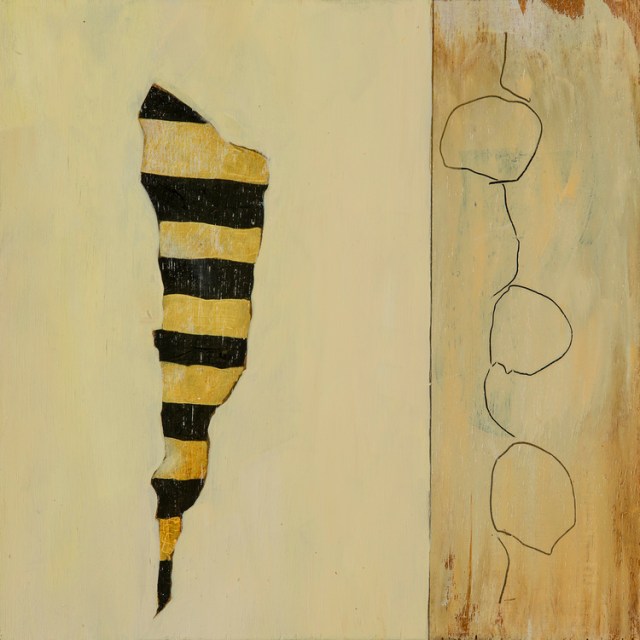
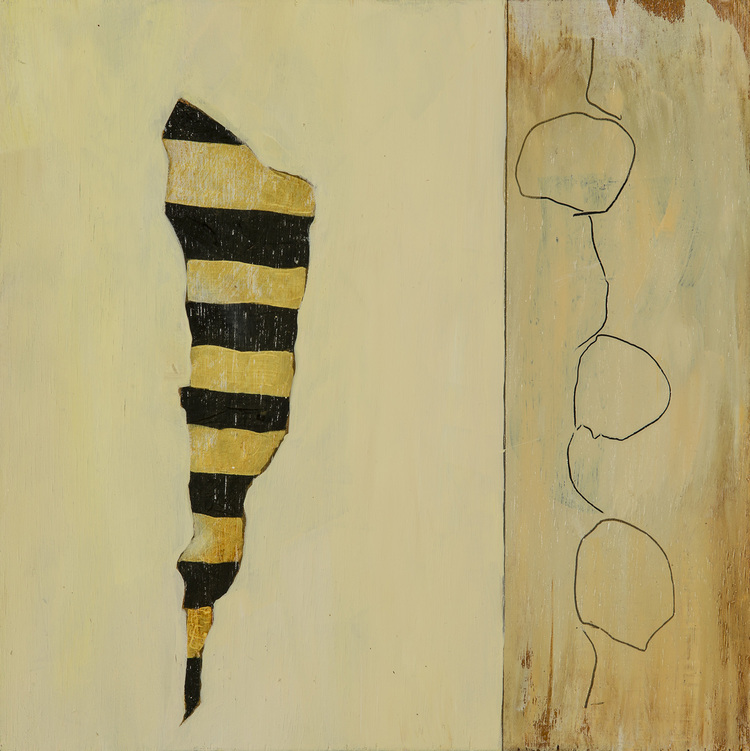
Easlen Series I acrylic in wood frame 12” x 12” 2014

Easlen Series I
acrylic in wood frame
12” x 12”
2014

Tell us about your background and how that has had an influence on your work and on you as an artist.

My earliest childhood memory is crawling on a paint spattered floor in Greenwich Village. Imprinted like a duckling, this experience was to define my life. I didn’t know this until, at the age of fifty, I stood in front of that old address and felt the closure. I’d come full circle. My life’s journey had been to find my own paint spattered floor. Albeit 3,000 miles away in Los Angeles.

My childhood picture book might have weighted more than me. At least four inches thick, and called “World Famous Paintings”, it was edited by Rockwell Kent and published in 1939.

This was a toddler’s study of art history. A three year old brain absorbing composition and palette and narratives on a nonverbal level. To this day I recognize every painting but may not be able to tell you the artist. I had my favorites — like Whistler’s Mother — and she very often appears in my work.

The concept of the artist studio has a board range of meanings in contemporary practice. Artists may spend much of their time in the actual studio, or they may spend very little time in it. Tell us about your individual studio practice and how it differs from or is the same as traditional notions of “being in the studio”.

I have two studios — a 1,000 square foot high desert studio and a, maybe 200 square foot, hole in the wall Los Angeles studio. I cannot paint in the desert. I need the energy of a city and the surrounding artist community that a city provides. Having a studio outside my home, a studio I pay rent for, has deepened my level of commitment and feeling of professionalism. It is my nest, my sanctuary. It is all me. All mine. A room of my own. It is my center.

What roles do you find yourself playing that you may not have envisioned yourself in when you first started making art?

I had not expected, nor been prepared for, the business side of art. I am an introvert and the networking, openings, and social side of a successful art career are draining. I go back and forth on this — making a real attempt at “getting out there” and then retreating when it all becomes too much. I disagree with the current “art speak” climate and having to explain my work. It is enough that I have made the work. I shouldn’t have to do the viewer’s job as well. When a painting leaves my studio it is no longer mine. What it means to me no longer matters. It is what you, the viewer see. I don’t want to tell you what to see.  And “sales” — salesmanship, like everything else, is a skill, a talent. I cannot sell! I cannot even decide on how much to charge. We shouldn’t be expected to be able to paint AND sell!

When do you find is the best time to make art? Do you set aside a specific time everyday or do you have to work whenever time allows?

This is ever changing. I have the luxury of almost unlimited time to paint. This can be good and bad. Unlimited time can mean you waste time. Except now I am 73 and I worry about the time when I won’t be able to paint anymore.

I call the painting process “my practice”. No different than a pianist, dancer, or athlete’s daily practicing. That’s what I do. My goal is to practice daily, weekends included. Right now the pattern seems to be to get the non-painting activities (like answering your questions!) done first thing in the morning so that the remainder of the day can be spent in the studio.

My practice consists of: “Show Up”. “Don’t Leave”. I show up every day. It’s never easy. I soon want to leave. I can think of a million good reasons to leave. But if I don’t, there’s this thing that happens. I’ll sit there for twenty minutes, maybe thirty, doing nothing. Then — aha — I realize I can do this. And then that. Soon I have painted something that never, ever, would have happened if I’d left.

No matter how many hours I spend in the studio there seems to be a pattern of three hours being the most productive.
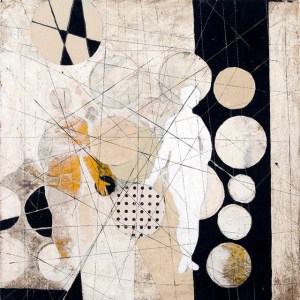
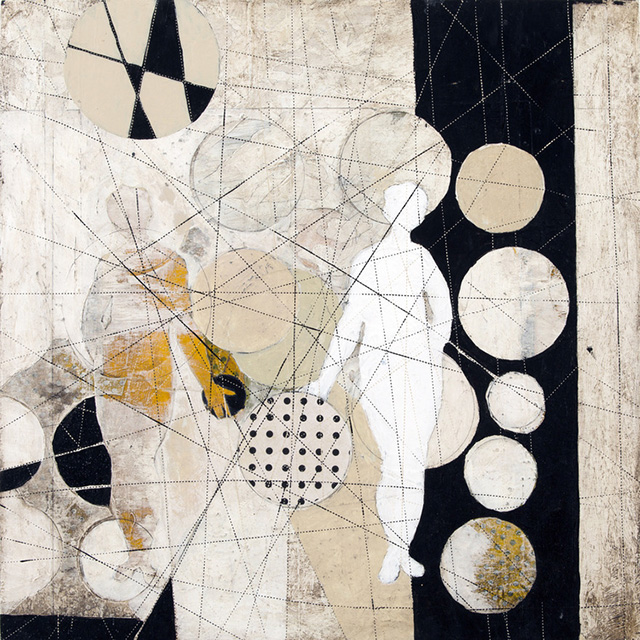
Multiple Personalities acrylic/collage on cradled wood panel 20” x 20” 2014

Multiple Personalities
acrylic/collage on cradled wood panel
20” x 20”
2014

How has your work changed in the past five years? How is it the same?

My skill set has improved, expanded. A big part of my process is asking the question “What if?”.  This experimenting has given me experience that allows me more control. I now know the answers to many “What if’s?”  I am working larger. I am working slower — I have developed more patience. This is a good thing and has led to better quality. Not surprisingly, my vocabulary remains the most consistent element. My palette is in constant flux — partly relating to my moods, partly responding to the palette shifts in our culture. I am receptive to cultural trends because it is important to make work not only in response to my past but to reflect the current world I live in.

I have an over-whelming sense of undiscovered paintings waiting deep inside — like when a word you are trying to remember is just there — on the tip of your tongue. I feel like I’ve snuck up closer , closer, closer. But not there yet….

How have people such as family, friends, writers, philosophers, other artists or even pop icons had an impact on the work you do?

All of the above!  My parents were painters and I grew up with the smell of linseed oil and turpentine and my Mom’s figure drawings tacked up around the washing machine.

Too many artists to list but there have been many favorites. My tastes changed from the romantic impressionists I liked as a child thru pop art to some of the interesting painters working in 2015.  All are influences. Music and poetry and fiction are influences too. Sometimes a line of fiction begs to be a painting. I cannot sit through live music without seeing paintings in my head.

I devour biographies and, even at age 73, continually search for role models. So many biographies of famous painters are filled with struggles, drama, problems. Reading about such lives is exciting and romantic but now that I find myself living such a life (albeit without the fame & success!) it’s not as romantic anymore. Being an artist is more than about painting. It is a way of being, a life style, a certain mentality.

The most important lesson I have learned is about working. Doing the work. Really successful people, whether Madonna, David Hockney, or Twyla Tharp, work hard — all the time.  Here at the Brewery, a loft community in downtown Los Angeles, my studio window used to be across from a French painter Ariane Bazin. No matter the day or time when I’d look out that window, Ariane would be working. She was the best role model I’ve ever had. 

Have you ever been pulled in the direction of a pursuit other than being an artist? What are your other interests?

I envied those who were so sure, who knew from an early age, exactly what they wanted to be. For most of my life I didn’t know what I wanted to be when I grew up. By age 49 this felt like a curse.

Writing came first (my mother and her mother were writers) As early as three or four I was making handmade books filled with scribbles. This year I made my first real book — Women — self published using Blurb — and I am working on my second book Birds.

I spent a decade doing photography (an interest shared with my dad). Photography was frustrating. Those damn laws of physics not allowing many desired darkroom manipulations. Today’s PhotoShop might make many such manipulations reality except that the hands-on experience would be missing as well as a certain human element in the final print.

By age 50 I’d decided that I’d chosen photography only because I believed I couldn’t draw or paint. That’s what I’d really wanted to do all along, draw and paint. I’d finally figured it out! I enrolled at Art Center in Pasadena, California and gave myself a ten year plan to learn to paint. That became a twenty year plan which is now a thirty year plan.

About
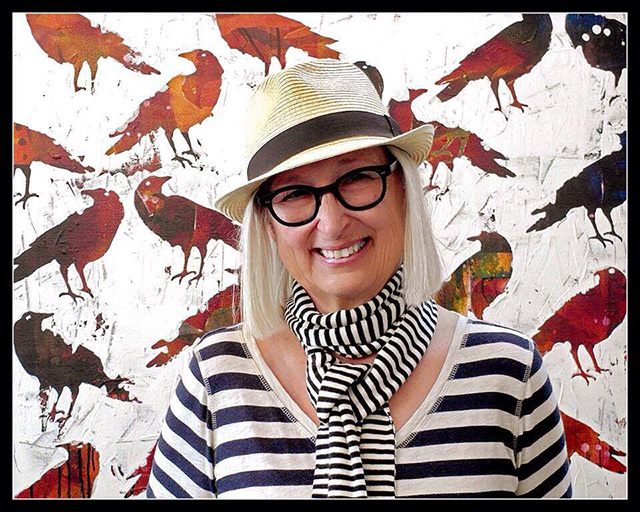
HEADSHOTBorn in Hartford, Connecticut, Wini maintains studios in Los Angeles and the California high desert.

She studied at Art Center College, California State University Long Beach, and University of California Los Angeles. She is the recipient of two Vermont Studio Center residencies.

Her current work combines abstraction with representational elements, using layered acrylics often juxtaposed with black and white graphics.   

Wini has exhibited throughout southern California including Kerckhoff Gallery UCLA, Pharmaka, Coagula Curatorial, La Luz de Jesus, Crussell Fine Arts, Red Dot Gallery, LA ArtCore, Barnsdall Art Center, bG Gallery/Bergamot, and the Palm Springs Art Museum.

She is represented in collections in the U.S., Canada, France, and the U.K.
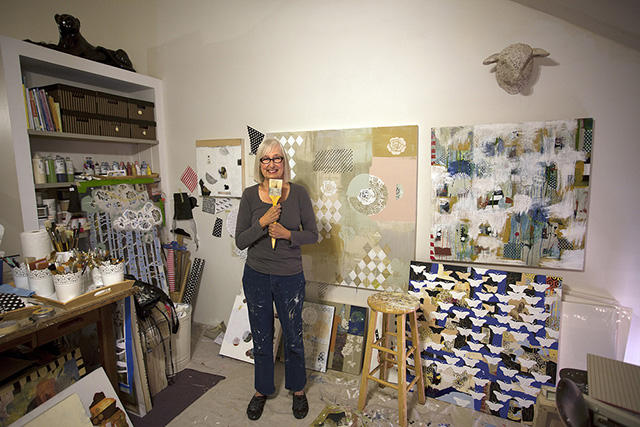
ARTISTinSTUDIO

winibrewer.com

All images copyright of the artist and used with their permission. 

Posted in Painting | Tagged , , , , , | Leave a comment

Jenny Day – Tucson, AZ

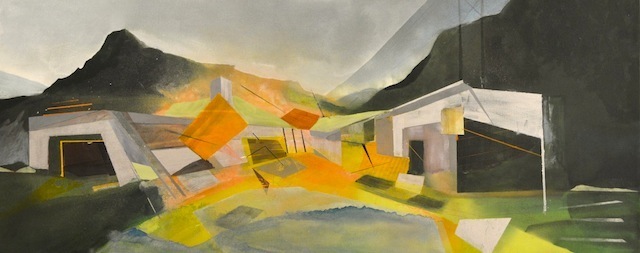
“Nearly somewhere 017″, Acrylic on canvas, 27″ x 60”, 2015

Briefly describe the work you do. 

Recently I have been working on Nearly Somewhere, a series of paintings using acrylic paint, spray paint, ink, crayon, pencil and collage. With this body of work I seek to reconcile our romantic notion of the environment with the way that the landscape is unavoidably fragmented and eroded through its conceptualization and use. Merging images of landscapes, horizon lines, cities, highways, water canals, and other forms of human infrastructure, the work explores concepts of place, space, utopia and dystopia.

Tell us about your background and how that has had an influence on your work and on you as an artist.

With a background in Environmental Studies, my paintings discuss how the fractured landscape, once altered, reconstructs itself. Influenced by resource extraction, architecture, and our need to document our effect on nature, the work investigates the construction of our relationship to land, water, and the built environment. The scientific framework of thinking, questioning and searching directly translates into my artistic practice as a way of creating, problem solving and conceptualizing in painting.

The concept of the artist studio has a broad range of meanings in contemporary practice. Artists may spend much of their time in the actual studio, or they may spend very little time in it. Tell us about your individual studio practice and how it differs from or is the same as traditional notions of “being in the studio.”

I begin with gathering found images, photos of places I have been, pieces of colorful trash and film stills. I fill my studio walls with these pieces of information that hold some type of meaning. From there I edit, gluing things together, cutting and pasting, dripping paint and drawing over, until a pattern or particular image stands out. I move to canvas, pouring ink, sanding, scrubbing, inserting paper and ripping it out to create a hierarchy of surface. At some point I begin to see something in the canvas that resonates with the image wall, and go back to a source photo. The final object is always a departure from my original idea.

My studio time is routine. Alone in one room for most of the day, I start at the same time, sweep, put on my apron and turn up the music. Art supplies are organized by color and type. Brushes are cleaned at the end of the day. When I am stuck on a painting I sit and map it out in thumbnails or knit, keeping my hands busy while I problem solve. This order helps to balance out the chaos of my artistic process.

“Nearly somewhere 001”, Acrylic on canvas,
12″ x 36″, 2015

What roles do you find yourself playing that you may not have envisioned yourself in when you first started making art?

My initial vision of an artist was someone who was in the studio all day making things. Now I understand that for me being an artist also involves business, promotional, writing and social skills.

When do you find is the best time to make art? Do you set aside a specific time everyday or do you have to work whenever time allows?

The best time for me is between 6-10 am and then again around 4-8 pm. My goal is to spend at least 40 hours a week in the studio.

How has your work changed in the past five years? How is it the same?

In the past five years I moved from Fairbanks, Alaska to Tucson, Arizona and then to Santa Fe, New Mexico. I finished a BFA in Alaska and an MFA in Arizona. These changes in education, landscape, and community drastically affected my work. Before graduate school I painted surreal situations and relationships between people using watered down paint on canvas. Now I paint abstracted landscapes using mixed media. I still work with acrylics and canvas, enjoy using a colorful palette, and am intrigued with concepts of reality and illusion. One of the biggest changes over the last decade in my artistic practice is that now I see that every hour spent in the studio is important, that some days you just show up and see what happens.

“Nearly somewhere 016″ Acrylic on canvas, 27″ x 60”, 2015

How have people such as family, friends, writers, philosophers, other artists or even pop icons had an impact on the work you do?

Before we moved to the Lower 48 from Alaska we took a year, lived in a van and drove around the United States exploring art scenes, museums and different landscapes. The ability to see actual art objects, as opposed to something online or printed and visually deconstruct how something is made was invaluable. In the fall we are planning on visiting Thailand, Cambodia and Laos. I am very curious to see how my work will change after visiting communities and landscapes so different from my experiences in the United States.

Connecting with artwork that departed from my original ideas of the picture plane and the environment such as Andrea Zittel, Annie Lapin, Lisa Sanditz and Jim Gaylord has helped me to push my own artistic process both formally and conceptually. Reading cultural geographer Yi Fu Tuan’s Topophilia and French philosopher Gaston Bachelard’s Poetics of Space, radically altered my ideas of landscape and our place in it.  My favorite authors include Rick Bass, Colum McCann, Annie Proulx, and Cormac McCarthy. Their ability to capture the multiplicity and specific memory of a place often inspires me to experiment with my own interpretations of landscape and memory.

Some of my biggest influences in realizing my work are my family, friends, mentors and husband. Having a network of people who question, challenge and support me to create art has allowed me to set aside the time to paint and to process some the difficulties of being a working artist.

Have you ever been pulled in the direction of a pursuit other than being an artist? What are your other interests?

Before I committed fulltime to painting I was a horticulturist and an environmental educator. Some of my interests include raising chickens, knitting, camping and baking pie.

About

JDay_HeadshotJenny Day was raised in the Sierra Nevada Foothills of California, where she developed an appreciation for transitional landscapes. She draws inspiration from many of the environments she has lived in including the interior of Alaska and the San Juan Islands in Washington. She paints a fragmented space, examining human demand and the effects of environmental degradation on an understanding of place. Her work presents landscapes that address the unstable balance of order and disorder, nature and culture.

Day has exhibited nationally in group and solo exhibitions in galleries and museums including: Center for Contemporary Art (Santa Fe, NM), Zhou B. Art Center (Chicago, IL), University of Alaska Fairbanks (Fairbanks, AK), Ciao Gallery (Jackson, WY), Davis Dominguez Gallery, Tucson Museum of Art, University of Arizona Museum, Process Museum, South West School of Visual Arts, Porter Hall Gallery, University of Arizona Lionel Rombach Gallery (Tucson, AZ) and the Shemmer Museum (Phoenix, AZ).

She earned an MFA in Painting and Drawing from the University of Arizona in Tucson, a BFA in Painting from the University of Alaska Fairbanks and a BA in Environmental Studies from the University of California Santa Cruz.  Most recently Day has spent time at a number of artist residencies including Playa (OR), Jentel (WY) and Ucross (WY). Day divides her time between Santa Fe, New Mexico and Tucson, Arizona.

Studio

Studio

www.jennyday.com

All images copyright of the artist and used with their permission.
Posted in Uncategorized | Tagged | Leave a comment

Matt Kish – Beavercreek, OH


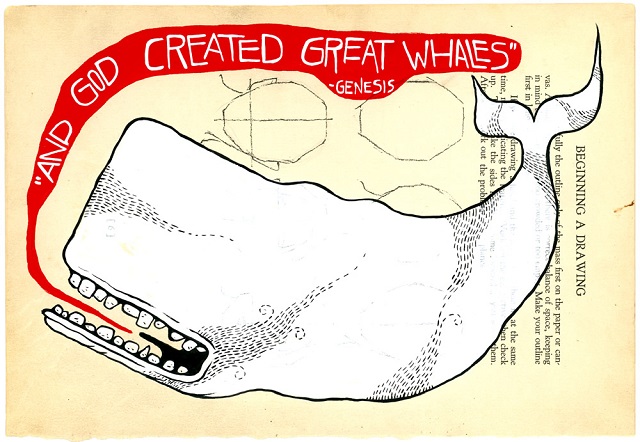
“Chasing the Whale” Extracts 01,” acrylic on found paper, 10 7/8×7 1/2″, 2015

Briefly describe the work you do.

I primarily use found materials such as old maps, repair diagrams, schematics, pages from old books, and anything with a kind of history inherent in its form to paint, draw and collage over creating multi-layered illustrations where seemingly random juxtapositions of visual information create distinct and unexpected relationships. My primary focus is in illustrating books and classic literature, taking what are at times abstract themes and ideas and giving them visual form. I actively avoid any kind of technological or digital method in creating art, and I feel that it is essential to see the hand of the maker in the work. Rather than obsess over polish and detail, the chaotic and disruptive aspects of the creative process, from stains on the paper to visible pencil outlines to unexpected elements of text and pattern showing through my paint and ink, add an essential and vital element to the work.

Tell us about your background and how that has had an influence on your work and on you as an artist.

I was the first child, born into a home full of books and readers. Even as a child in the 1970s, television and film were secondary to books, art and illustration. Books were everything from information to entertainment to art objects, and this great love for books and for the printed page became an essential part of my identity and my aesthetic. It wasn’t long before I discovered comic books which were to me the purest synthesis of image and text imaginable. I am old enough to remember a time when comic books occupied an unsavory and slightly dangerous corner of the world, and after internalizing, struggling against, and ultimately vanquishing the self-loathing brought on by that idea, I’ve come to relish the idea that the most powerful, visceral and provocative art can come from these unexpected, culturally trashy gutters of the art world.

The concept of the artist studio has a broad range of meanings in contemporary practice. Artists may spend much of their time in the actual studio, or they may spend very little time in it. Tell us about your individual studio practice and how it differs from or is the same as traditional notions of “being in the studio.”

I’ve had differing experiences with the studio environment, but that has distinctly shaped what I want from a work space. From October 2009 to January 2011, I created one illustration for every single page of the novel Moby-Dick at the rate of one piece per day. My “studio” during that time was a walk-in closet that measured approximately 4 feet by 7 feet. There was just enough room for a drawing table and chair, a small bookshelf full of art supplied, paint and old books, and a lamp. At that time, I was commuting nearly 3 hours a day and working every spare second on the Moby-Dick illustrations so the studio was simultaneously a prison and a protected space. When inside that tiny room with the closet door shut, there were no windows, no sounds, nothing at all to even make me aware of the passage of time or the world outside. In some ways, it was quite literally like the cabin of a whale ship, or being in the belly of the whale. That deprivation, solitude, and isolation was essential in driving me forward through the obsessive project of illustrating 552 pages of Moby-Dick. Since then, I’ve moved into a much larger space and the studio is now a second bedroom with a large window, several bookshelves, a computer and scanner, and a television. While it has been comforting and even luxurious to have those amenities, it took me far longer than I am happy admitting to get back to my old disciplined work habits. Strangely enough, I miss that tiny little prison of a closet, and I think I work best under conditions of isolation and deprivation.

What roles do you find yourself playing that you may not have envisioned yourself in when you first started making art?

I had been making art since childhood, and I had been taking the idea of making art very seriously since my late 20s. Despite some attempts to self-publish my work and to get my work into some Ohio galleries, I had been met with indifference at every turn. The lack of an MFA or BFA seemed to be an almost insurmountable obstacle in terms of galleries, and my work seemed a bit too obtuse for any publisher to consider. I had just turned 40 years old in June 2009 and decided that I was simply going to quit making art. I had a fulfilling career as a librarian and a rich and rewarding marriage to an amazing woman. However, I found myself completely unable to contemplate a life empty of the practice of making art. I agonized for 2 months and in early August 2009 decided that if I was going to quit, I would go out on top. I had been obsessed with the novel Moby-Dick for most of my life, so I decided almost in a flash to create one illustration for every page and to make, for myself alone, the perfect illustrated edition that I had always seen in my head. And that was going to be the end of the story. Strangely, after over a decade of total obscurity, the Moby-Dick work struck a chord with people and the blog I started in order to share the work gained more and more visibility in a remarkably short period of time. Before I was even halfway through the 552 illustrations, I had an agent, a publisher and a book deal. Coming through that experience and emerging on the other side, I was forced to come to terms with the fact that I had gone from obscure outsider working on his last project to professionally published artist and illustrator with new opportunities facing me. It’s still not always a comfortable fit.

“Moby-Dick page 109,” colored pencil, ink and marker on found board, 11×7 7/8″, 2009

When do you find is the best time to make art? Do you set aside a specific time everyday or do you have to work whenever time allows?

Discipline, routine and ritual have always been essential to my process, perhaps because of the obsessive-compulsive nature of my projects. Freedom can be toxic to me because it diffuses the will and makes focus more difficult. I work Monday through Friday from 9 to 5, so after dinner and taking care of whatever I need to do for the day in terms of mundane responsibilities, I work in the evening, often for many hours, and generally right until it is time to sleep. Making art has, for me, always been a product of momentum, and I find that even taking one evening off tends to slow that momentum dangerously. It can become almost frantic at times, and I feel as if I am constantly tending an engine on the verge of giving out, but slowly the momentum builds until it becomes almost impossible to not make art every night.

How has your work changed in the past five years? How is it the same?

Prior to beginning work on the Moby-Dick illustrations, I had only experimented with the practice of painting and drawing on old maps, diagrams and pages from books a few times and with decidedly mixed results. At one time, I was obsessed with having total control over every square inch of space on the paper, and I felt an impossible to resist compulsion to fill every bit of that space with details and color. The act of making art had become both physically and psychologically rigid and uncomfortable, so the decision to begin painting and drawing on paper that already contained visual information was a kind of creative destruction. I knew I had to quite literally and quite violently shatter my previous practices and learn new ways of making marks on paper, and relinquishing that obsessive control, allowing the texts or lines or information on the paper that I was painting on show through my work in random and unexpected ways was a revelation. Over the last 5 years, I have found myself reverting back to that mad need for control and obsession with detail more often than I am happy admitting, but the use of found paper is steadily becoming a more comfortable fit for me so I think that change is here to stay.

How have people such as family, friends, writers, philosophers, other artists or even pop icons had an impact on the work you do?

Growing up in a home full of fantastic illustrated stories was an essential part of my foundation. My parents really valued reading, and not just for informative or educational reasons. Their passion for books and art created in me a sense of wonder at art and fantasy, and that sense of wonder is the primary engine of my obsessions. Additionally, I can remember almost everything I have ever seen…from Jack Kirby comic books to Final Fantasy video games to Ray Harryhausen movies to Roger Dean album covers. All of those images, for over four decades, have been accruing in my mind in some kind of vast and constantly mutating database. All of this imagery is what I draw on, consciously or subconsciously, when creating my own art and I can see echoes of my entire life in every piece I create. So in that sense, my art is simply an external visual memory of my life.

“Moby-Dick page 424″ acrylic and pencil on found paper, 10 7/8×14 1/2”, 2010

Have you ever been pulled in the direction of a pursuit other than being an artist? What are your other interests? 

Although I have enjoyed some recent success as a professionally published artist and illustrator, making art has always seemed so natural, essential and intuitive to my identity and existence that I never even once considered pursuing it as a career or a means to pay the rent. That’s difficult to explain because so often we are told “Do what you love,” but it just never occurred to me to do it. Books and literature have been the through-line in all of my careers, from my days as a high school English teacher to my time working at several bookstores to my current vocation as a librarian. I’ve never felt the compulsion to try and become a writer of any kind, but as long as books are involved I could easily see myself in any number of book or literature related fields.

mattkish_headshotAbout

Matt Kish is a self-taught artist and a librarian. He lives in Ohio with his wife, their frog, and far too many books. His art, shaped by his reading habits and his personal obsessions, functions as an external memory for him and is how he records and orders his life. His primary media are found paper which is often scavenged from old books, cheap acrylic paint, and ink with occasional ballpoint pen and collage.

www.spudd64.com

All images copyright of the artist and used with their permission.

Posted in Uncategorized | Leave a comment

Angie Jones – Los Angeles, California

Angie Jones Painting Title Meneer van Gogh 1889, 30x30 inches 2015

Angie Jones Painting Title Meneer van Gogh 1889, 30×30 inches 2015

Briefly describe the work you do. 

My work is a deconstructed abstraction of the figure defined by creating something new from something old and making it new again.  I use technology in the process, like 3D imaging and 2D software, but the final image is a tangible painting in oil or a 3D print.  My vision is a splintered perspective of humanity. I am interested in the influence of imagery on brain circuitry. Maintaining one foot in the past and another in the future, I call into question how we perceive art by tracing a loop historically through image, technology and science.

Tell us about your background and how that has had an influence on your work and on you as an artist.

After two decades creating animation for award-winning Hollywood Blockbusters, I returned to traditional mediums and original content through painting. My career as an artist working in Visual Effects, Video Games and Animation inspires the “peak shift” palette, faceted surface and idiosyncratic portrayal through paint. If you have ever seen a “behind the scenes” of the work on a movie using computer generated animation, you will have seen the wire frame mesh surface I emulate in my paintings. Like the subliminal messages of advertising, movies and commercialism, the aesthetic components of my work note the influence of technology on our everyday life.

The concept of the artist studio has a broad range of meanings in contemporary practice. Artists may spend much of their time in the actual studio, or they may spend very little time in it. Tell us about your individual studio practice and how it differs from or is the same as traditional notions of “being in the studio.”

I am very much a hermit when it comes to the studio.  I can stay in the studio for days on end and not leave. Then, I get busy with other things and do not touch the palette for days.  I get a little crazy if I am not creating, so on those days I am not painting I am building something on the computer or envisioning a new project, commission or piece.  When the work is at its best, the studio floor is littered with tear sheets and dirty paper towels.  I live in my space, so I have to try and keep it fairly sorted.  Right now, I am working on a collaboration with Lolita Lorenzo, three new portrait commissions, and three new pieces.  So things are very busy and messy.

Angie Jones Painting Oil on Canvas Diptych Title You Are What You Eat 120x36 inches

Angie Jones Painting Oil on Canvas Diptych Title You Are What You Eat 120×36 inches

What roles do you find yourself playing that you may not have envisioned yourself in when you first started making art?

I spend every Monday just doing “desk work.” I find it to be a necessary evil.  Answering emails, promoting on social networks, research, blogging, following up on inquiries, press requests, collectors, newsletters, promoting shows, my e-shop, applying for grants, etc.  It’s all very businesslike.

When do you find is the best time to make art? Do you set aside a specific time everyday or do you have to work whenever time allows?

When the feeling strikes is the best time to do the work. I like late night when things are quiet, but I live with my boyfriend now in an open loft with no walls and it would be difficult to have music and the lights on at 4 AManymore.  I believe I am always painting in my head, but I think you are talking about the actual practice.  I feel a need to produce work, volumes of work, to close that gap between what I see in my mind and the process of getting it on the canvas.  So, I feel an urgency to work in some capacity either on the canvas or the computer every single day.  I cannot work more than 6 hours at a time, though.  That is my limit even though sometimes my brain wants to keep going.  If I force more than 6 hours a stretch, I look at what I did the next day with a big WTF?

Angie Jones Oil Painting Title DoomSayer 48x36 inches 2013

Angie Jones Oil Painting Title DoomSayer 48×36 inches 2013

How has your work changed in the past five years? How is it the same?

My work has change drastically over the years.  I began studying painting in 2007 with Cheryl Kline of the Kline Academy in a strict instruction of sight-size and classical painting.  I painted realistic imagery using a limited palette, and lots of layers and glazes.  One piece took a very long time to finish. In 2010, I entered the MFA program at LCAD.  My mentors Aaron Smith and Kent Williams inspired me to use more colors and push the paint around in a looser application. After making entirely new work for a year, I left the program in 2012 to regroup.  I spent a year on independent studio doing what I wanted without any interference of opinions.  I allowed myself to do anything in the studio and break all rules.  Some people call this deskilling.  For me it was like shedding the rules, so I could invent. I found my current figurative abstraction using geometric surfaces to describe the form during that year, working on my own.  Ironically, this abstraction relies heavily on the glazing techniques I learned from Cheryl, in the beginning of my journey, as I paint three glazes of pigment to get a luminous quality for each geometric facet.  People who sees the work in person usually say, “Wow they are so much better in person.”  I believe my work would not get this kind of response if I had not started at the beginning, learning everything I could about the craft of painting before I played with applications.

How have people such as family, friends, writers, philosophers, other artists or even pop icons had an impact on the work you do?

My mother was artistic. My father was an industrial engineer.  I think I got a little bit of both of this in my makeup. Close friends have always helped me hone in on what is working as I create a piece.  I think a good artist is always questioning.  My close confidants can confirm that nagging in my stomach that I know to be true, but for whatever reason am not listening to.  Writers and words are a big influence, especially those concerned with the role of technology and its influence on our behaviors and how we mirror the spaces we live in to the spaces we create in our minds. I have a folder in my bookmarks called JUNKIE where I keep all of my links to artists, philosophers, writers, etc.  Here is a list of some of the recent links in the JUNKIE box: Ray Kurzweil, Ernest Becker, Geoffrey West, Marshall Mcluhan, Steven Berlin Johnson, and Malcolm Gladwell.

Have you ever been pulled in the direction of a pursuit other than being an artist? What are your other interests? 

I am currently a full-time professor at USC’s School of Cinematic Arts in the John C. Hench Division of Animation & Digital Arts teaching animation.  It does split my time between teaching and painting, but I believe the pedagogy and exposure to the students fuels my work.  Otherwise, I would be operating in a vacuum.

Angie Jones Studio

Angie Jones Studio

stixandjones.com

All images copyright of the artist and used with their permission. 
Posted in Painting | Tagged , , , , | Leave a comment