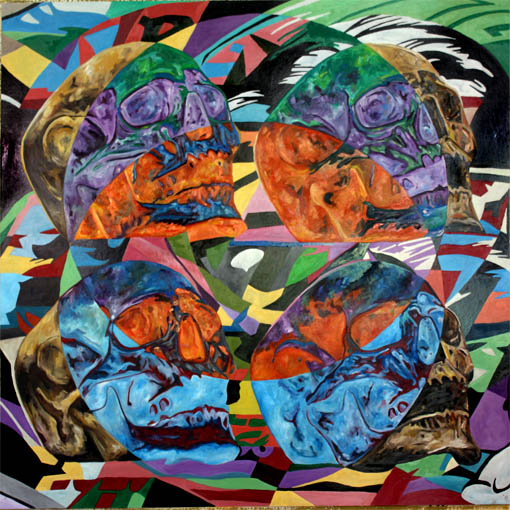
Dinashuy – Aguascalientes, Mexico

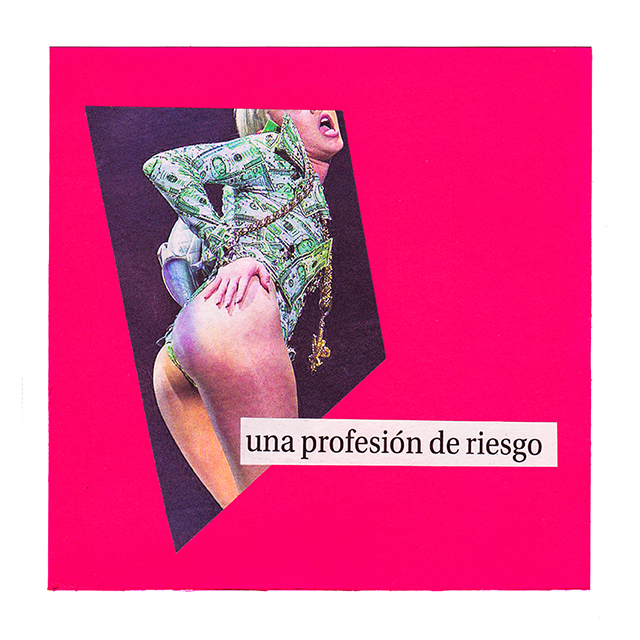
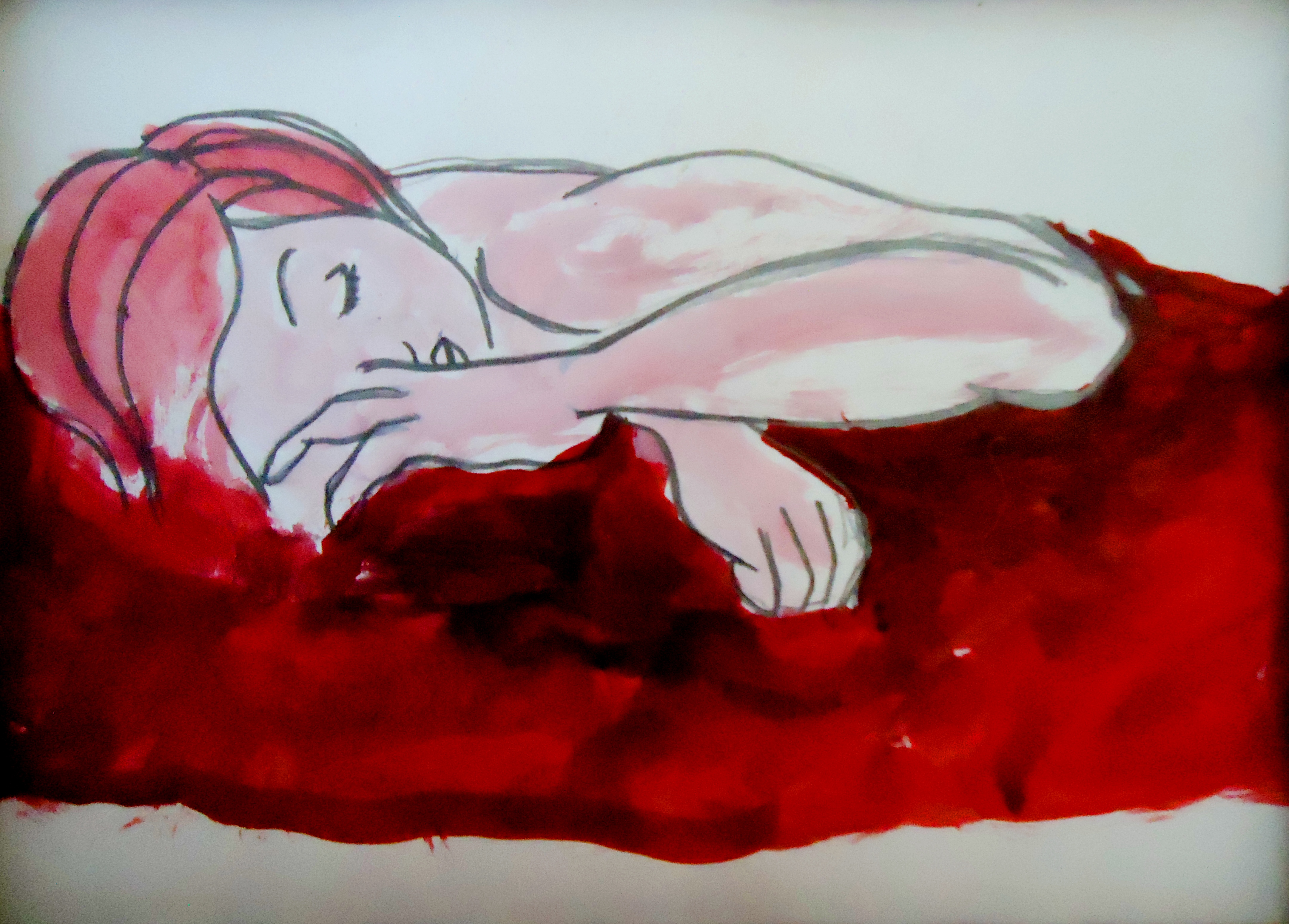
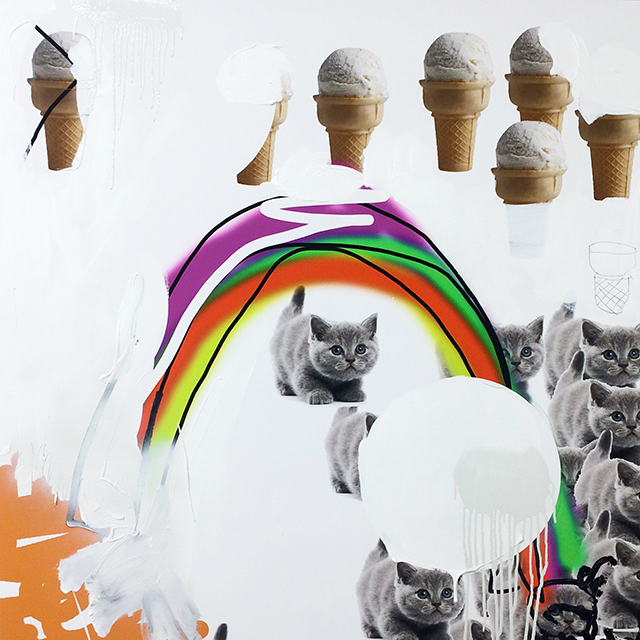
La hermosa vida oil on wood 1.20 x 1.20 m

La hermosa vida
oil on wood
1.20 x 1.20 m

Briefly describe the work you do. 

My work is based on images I find inspirational and deconstruct them digitally to give them a new look reflected on oil paintings. They’re based in the way I perceive the world, from the chaos of history of man to the end of life taking it as the beginning of other. I constantly search for the answer of the existencial question of where are we going after we die?

Tell us about your background and how that has had an influence on your work and on you as an artist.

I have always been interested in the graphic work, as a child I used to watch cartoons and try to copy their style. Later, since I belong to a very catholic family, I started going to the church very frequently and look at the painting which sometimes are very raw and violent and that made me be very curious about all the artistical process

The concept of the artist studio has a broad range of meanings in contemporary practice. Artists may spend much of their time in the actual studio, or they may spend very little time in it. Tell us about your individual studio practice and how it differs from or is the same as traditional notions of “being in the studio.”

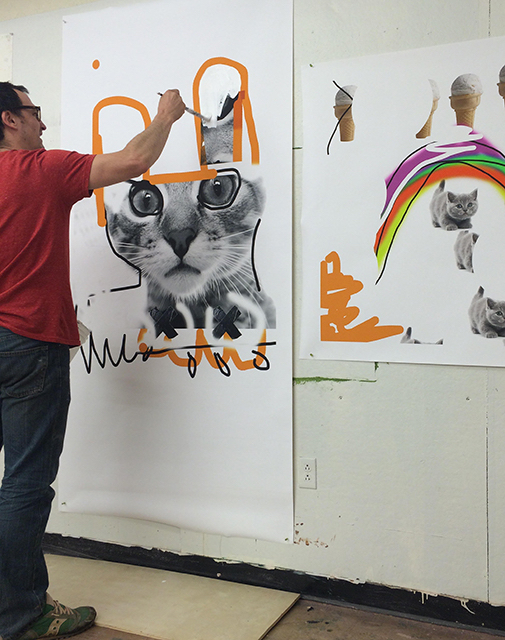
I am a very lonely person, and when I am in the studio i wake up very early to start working through mornign and afternoon. I tend to behave like a child with a new toy when I start a new painting and work hard in it until that painting is replaced for a new one.

When I’m not painting, I use t spend my time gathering and ordering images that will later be used for my newest paintings.
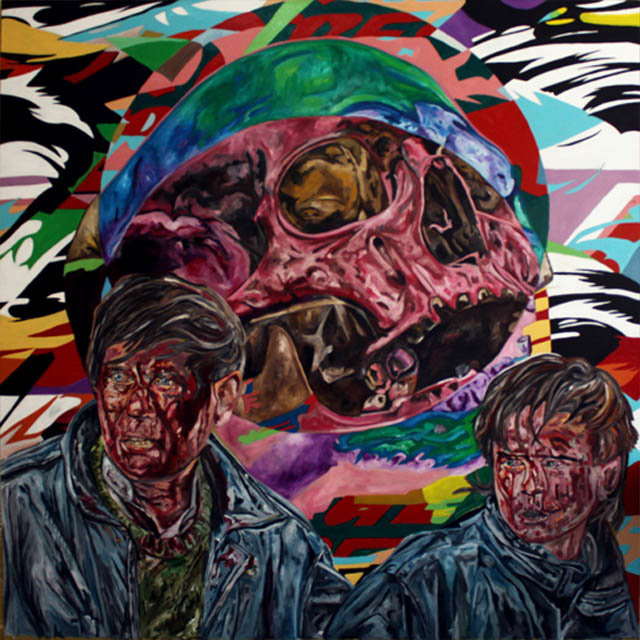
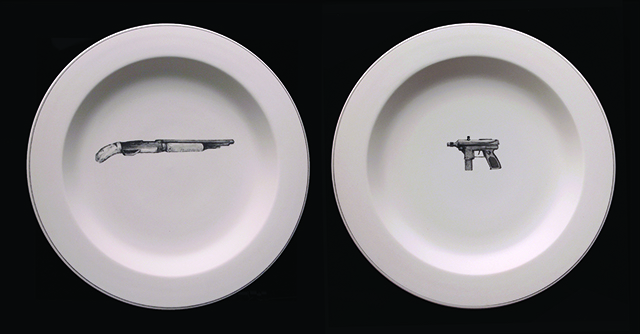
No todos fuimos ángeles oil on wood 1.20 x 1.20 m

No todos fuimos ángeles
oil on wood
1.20 x 1.20 m

What roles do you find yourself playing that you may not have envisioned yourself in when you first started making art?

When I first started working I used to paint Without taking things too seriously And after some years of working I find myself giving more importance to the concept behind my work and trying to reach my highest level of quality. This is very exciting to me since I have improved my technique and makes me wonder what kind of things could I be doing in the future.

When do you find is the best time to make art? Do you set aside a specific time everyday or do you have to work whenever time allows?

I don’t really have a spacific hour in the day to start working, but i tend to start whenever I fell the creative impulse to do or destroy. To avoid getting bored of a specific painting, i always starts with two canvases at a time, working in both. The only thing I always need is a good coffee and music.
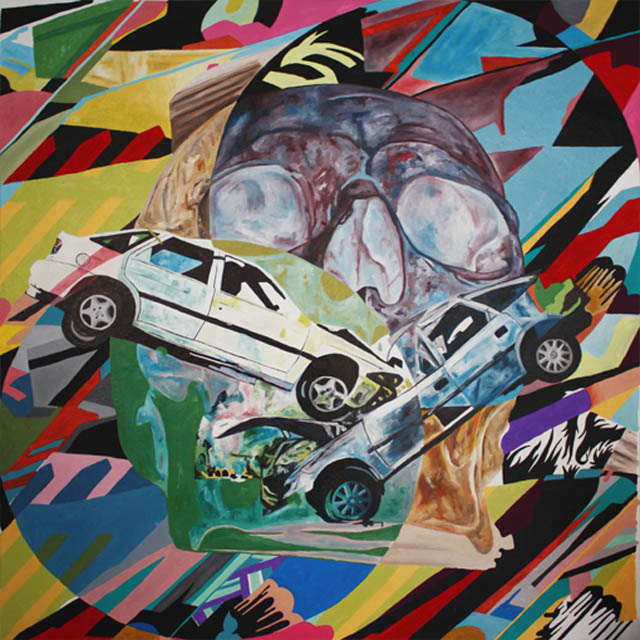
Que dios te perdone oil on wood 1.20 x 1.20m

Que dios te perdone
oil on wood
1.20 x 1.20m

How has your work changed in the past five years? How is it the same?

My work hasn’t changed drastically since I started drawing doodles. In the very beginning I used t copy other oil painting, but I failed and decided to make an abstraction of those paintings and not take it so seriously so I could have fun with what I do.  Later when I discovered other digital tools, a world of possibilities opened to me and could start working in distorted images, collages and layers.

How have people such as family, friends, writers, philosophers, other artists or even pop icons had an impact on the work you do?

Of course I have had a lot of influences: there are plenty of designers and creatives around me. My friends family and girlfriend always encourage me to get better being my best critiques.I always try to write down names of new artists that inspire me or ideas that i get form images, but overall one of my biggest inspirations is Andy Warhol.

Have you ever been pulled in the direction of a pursuit other than being an artist? What are your other interests? 

Nowadays  I believe that most of the time i spend it working on art, so I dont want to see me doing something else in the future. I would like to try my luck in design, but I will save that for later.

About
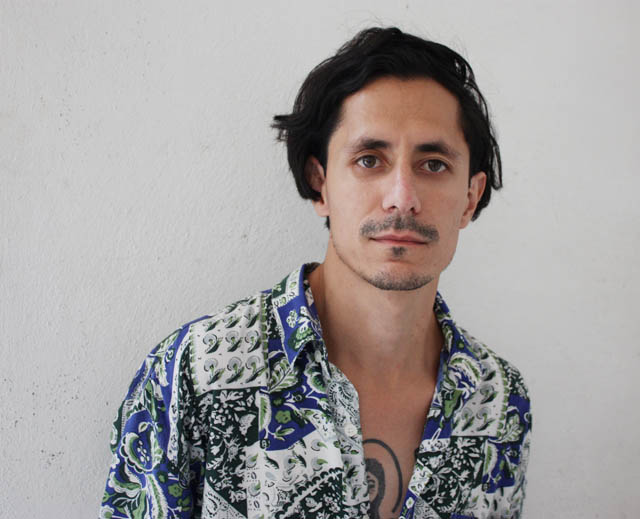
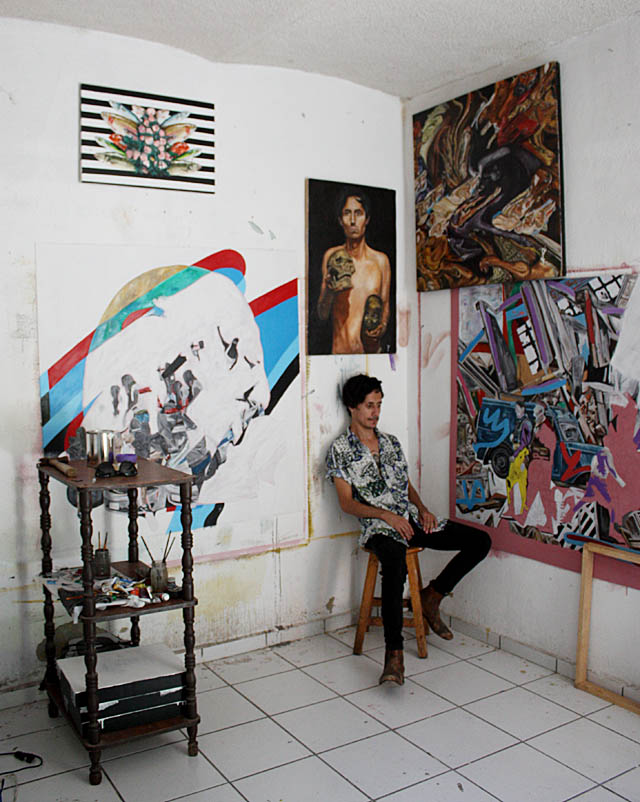
4Dinashuy  was born in Aguascalientes, México. Self taught artist form an early age is interested in depicting existencial human questions thought paintings. Nowadays interested in being multi-disciplined though design and sculpture.
3

instagram.com/dinashuy

All images copyright of the artist and used with their permission.
 

Posted in Painting | Tagged , , , , | Leave a comment

Lotus Bleu – Berlin, Germany

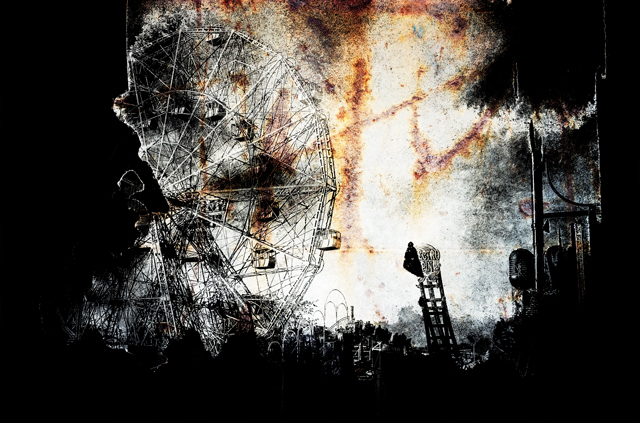
Polis #3 - Digital & Manipulated on Paper - 24 H x 36 W - 2015

Polis #3 – Digital & Manipulated on Paper – 24 H x 36 W – 2015

Briefly describe the work you do. 

Throughout my series, I build upon the concept of connections that exist between various memories and reality, interlinks between the elements surrounding us, the feelings of life. photographs become organic matter, clay.

Tell us about your background and how that has had an influence on your work and on you as an artist.

I was born in Nice, south of France at the end of the 80’s, I did study philosophy at The University of Provence Aix-Marseille, after graduated I finally stopped university because my studies were taking a lot of time and I needed a break. I traveled across the world, I visited several countries and I settled down six months in Korea while working on my own music. I finally landed in Berlin last year and this is where I started making my own digital composition. I continue to study and work social sciences and philosophy so the question of whether and how my studies affects my artistic work necessarily arises. I think, I use art as a way of fight against my rational side. I like the idea that creation frees me from the need to get an answer to the metaphysical questions I ask myself everyday. Perhaps, you can feel it in my work, like landscapes suspended to eternal questions. I allow myself to leave these questions open, without necessarily seeking answers.

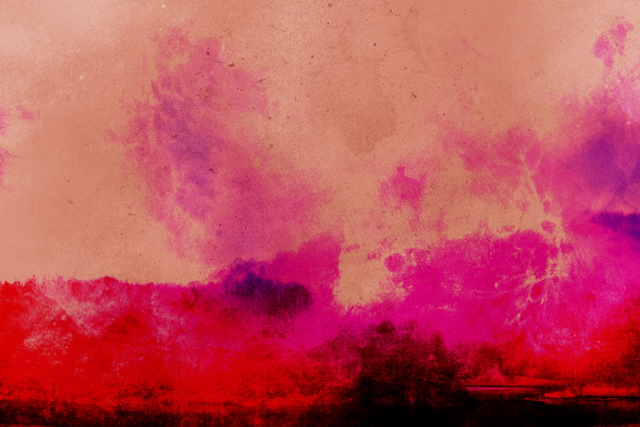
Fahrenheit #2 - Digital & Manipulated on Paper - 24 H x 36 W - 2015

Fahrenheit #2 – Digital & Manipulated on Paper – 24 H x 36 W – 2015

The concept of the artist studio has a broad range of meanings in contemporary practice. Artists may spend much of their time in the actual studio, or they may spend very little time in it. Tell us about your individual studio practice and how it differs from or is the same as traditional notions of “being in the studio. 

My actual studio is an industrial studio space in Berlin, It is very minimalistic space for printing and retouching where I usually plan and work on my exhibitions but sometimes I work at my home studio, a library, a coffee shop or a parc. I like to be free and try to create in different places surrounded by different atmospheres .

What roles do you find yourself playing that you may not have envisioned yourself in when you first started making art?

Administrator.

When do you find is the best time to make art? Do you set aside a specific time everyday or do you have to work whenever time allows?

Strangely even though I’m a nocturnal creature, I create mostly in the mourning. I can not explain it. I like this sensation to create something right after waking up, when your mind is still clear.

I don’t have any schedule or timeline for my artistic work, I prefer to let it free.

 Darker Tomorrow #10 - Digital & Manipulated on Paper - 24 H x 36 W - 2015


Darker Tomorrow #10 – Digital & Manipulated on Paper – 24 H x 36 W – 2015

How has your work changed in the past five years? How is it the same?

In the past five years I have grown in my art practice, even if my art is still very young, things changed radically when I moved to  Berlin one and a half year ago. I have tried and use new things inspired by this city in my art.

How have people such as family, friends, writers, philosophers, other artists or even pop icons had an impact on the work you do?

I always go back to reading and listening about artists whose work I admire, that affects me on a personal way.  Many of them influence me in subconscious ways, I guess everything around us becomes an influence in some way.

I am a sporadic reader; sometimes I have several books on the go at the same time. I particularly like french literature and analytic philosophy.

Have you ever been pulled in the direction of a pursuit other than being an artist? What are your other interests? 

I have not been pulled in other directions. My other interests include philosophy and the physical sciences.

About

Profil-PhotoI grew up in Nice, south of France and graduated from Aix-Marseille University, where I studied Art History and Philosophie (2008-2011). I am an Artist and Music Producer.

I consider myself a conceptual artist: Everything starts with an idea, and the idea determines the execution. I’m under the strict opinion that art is meant to be consumed. Photography is art, therefore it doesn’t do any good to keep it locked up on a hard drive. Consequently, my work varies in medium, from photography to installation, sculpture and painting. The themes of my work are primarily socio-political, although lately I’ve strayed into the deeply personal.

Fahrenheit-#7-(Print)

Fahrenheit-#7-(Print)

All images copyright of the artist and used with their permission.
 

Posted in Digital Art, Photography | Tagged , , , , | Leave a comment

Florencia Della Vedova – La Plata, Buenos Aires, Argentina

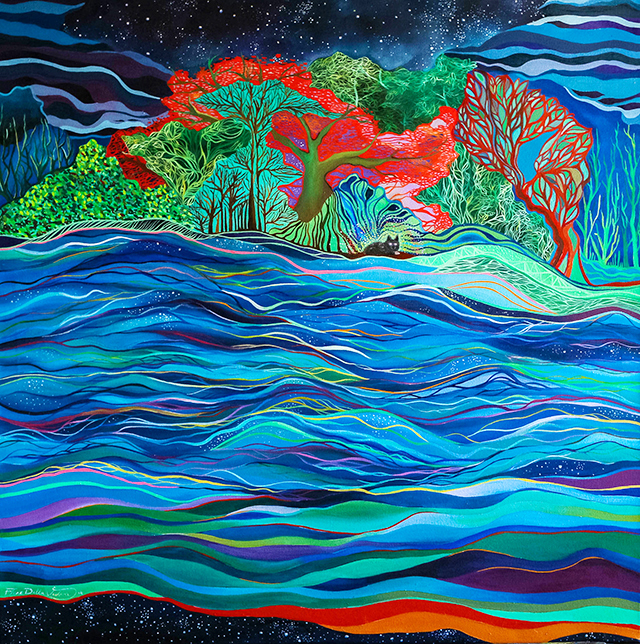
Bioluminescence. Oil on Canvas. 80 x 80 cm. 2014. Private ColectionTell us about your background and how that has had an influence on your work and on you as an artist. 

I believe that what we see changes what we feel and what we are. Our world is plenty of violence images and despair. We can see it everywhere, on TV, movies, we hear it in the radio, etc. The energy of these feelings replicates and generate more and more of the same chaos. I always believed as the Ayurveda philosophy professes, that the similar increases the similar. Therefore and so some day in the middle of a noisy street I decided that I wanted to paint the opposite meaning of this energy. Thus, I imagine lots of color in opposite way to the gray cities, lots of color as love, the color of the nature, the color of happiness, the color of live and all beauty that we have as human beings and what we are unfortunately forgetting. 

The concept of the artist studio has a broad range of meanings in contemporary practice. Artists may spend much of their time in the actual studio, or they may spend very little time in it. Tell us about your individual studio practice and how it differs from or is the same as traditional notions of “being in the studio.”

The concept of the artist studio as a real place where the artist imagines the subject of the creation does not represent me. I think that my studio is really my life. In this place I am able to transform in form and colors what I have been conceiving in the rest of my time.. Yesterday for example I went for a walk and I spent all time enjoying leaves, trees and flowers. Reading books, felling a sun set,  looking for references in the work of other artists, watching a film, shooting photographs, playing, writing,  all this is part of a process unfeasible follows this way, these feelings and this philosophy.  

The forest. Oil on canvas. 40 x 40 cm. 2014. Private Colection

The forest. Oil on canvas. 40 x 40 cm. 2014. Private Colection

What roles do you find yourself playing that you may not have envisioned yourself in when you first started making Art?

Creating Art is part of my life since I have memory. In my primary school I had two hours of Art daily. My high school was also orientated to Art. This school was located on the third floor over the university. So when I finished my high school I only needed to go two floors downstairs. 

When do you find is the best time to makeArt? Do you set aside a specific time everyday or do you have to work whenever time allows?

Well, I have been mum three months ago, so I make Art when time allows it. With a couple of friends of mine we use to paint twice a month together, it is very nice to share those moments of exchange with then. I like the light of the day but I love also nights to paint for some reason. 

The words of the silence. Oil on canvas. 60 x 60 cm. 2015

The words of the silence. Oil on canvas. 60 x 60 cm. 2015

How has your work changed in the past five years? How is it the same?

I think that, like water in movement, we are always changing, it is a natural aspect of the life, only people made of stone never change.  

How have people such as family, friends, writers, philosophers, other artists or even pop icons had an impact on the work you do?

I love to watch other artists´ work. I think that on that way you can get to know yourself better. Why do I like this image? What does he/ she do that pick my attention? There are forms to keep learning from other persons.  

Have you ever been pulled in the direction of a pursuit other than being an artist? What are your other interests? 

I worked doing Art direction in some movies in the Art team and F x in other projects. I also define myself as lover of the photography and I have done a lots of digital Art work too. At the moment I work also making photos and teaching in a Photo School several subjects. Painting is not my single passion. 

About

HeadshotFlorencia Della Védova was born in La Plata, Buenos Aires, Argentina. She received a degree in Fine Arts honored for the best average at the National University of La Plata (UNLP).  

Since childhood she was involved with Art, generating a great interest in many disciplines. 

In 2006 she was approaching to the world of cinema as a member of an Art team in several films of many styles. In 2008 she traveled for more than one year to Colombia where she worked for an FX company  as a makeup artist. In 2010 she came back to Argentina. In this year she performed the Art Direction of the movie “Topos”, which was winner of a number of national and international awards. She was selected with the Art price “Ubicuidad” in the Provincial Exhibition of Young Artists 2011, conducted by the Province  Museum of Fine Arts Emilio Pettoruti. Since them she presented several individual and collective   exhibitions of paint and also of photography and digital Art. She published her work in several magazines and her work is currently in national as well in foreign private collections. 

Me in my studio

florenciadellavedova.com

All images copyright of the artist and used with their permission.
 

Posted in Painting | Tagged , , , , | Leave a comment

María Hernández – Tudela, Navarra, Spain

Cuentos Modernos (04), Collage analógico+spray, 25x25 cm, 2015

Cuentos Modernos (04), Collage analógico+spray, 25×25 cm, 2015

Briefly describe the work you do. 

I use photography as a form of personal expression and communication, as well as my own relationship with the environment and way of self-knowledge. I am introvert and the camera destroyed those walls, helping to pass to other people what I think, I feel and I see around me.

The topics treated in my work are the time (past, present and future), memory, forgetfulness, nature and the time that I happen to live. I document this from a personal perspective, reflecting as it makes me feel and how I see the circumstances that happen to me as an individual. I also work with my feelings referring to different situations, using the photography to know them and interpret them. 

I try to find beauty, both in the good and in the bad, because any situation, no matter how bad that makes us feel, has a beautiful part; on the difficulties is the change and personal evolution. 

As for the technique I use, I always used digital cameras until this year 2015, because I’m making a first contact with analogue photography. 

I also work with archival photographs, especially my family album for the contrast between past and present and how we can imagine the future after examining this evolution. I also experiment with image transfer, intervention and collage. 

Tell us about your background and how that has had an influence on your work and on you as an artist.

I always took pictures in order to keep some moments (school excursions, parties, outings with friends …). Eventually I realized that memory is something very important to me; the fear of forget a moment drives me to save them. This fear combined with my passion for the collecting have greatly influenced my work, since my works are just that, ordered moments, objects / places collected with one intention: to tell something about me or my world view.

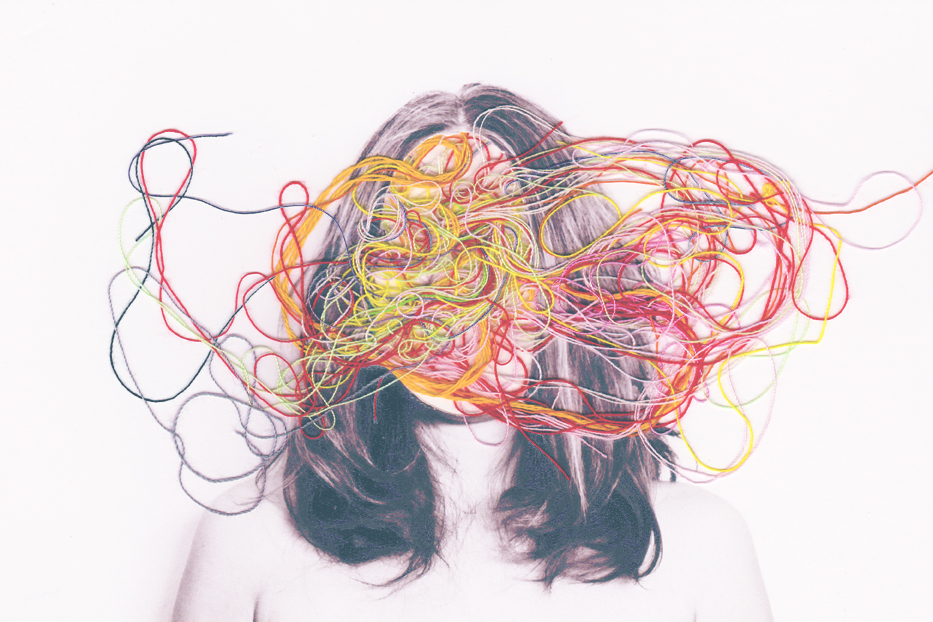
173-365, Fotografía digital intervendia con hilos, 20x30 cm, 2014

173-365, Fotografía digital intervendia con hilos, 20×30 cm, 2014

The concept of the artist studio has a broad range of meanings in contemporary practice. Artists may spend much of their time in the actual studio, or they may spend very little time in it. Tell us about your individual studio practice and how it differs from or is the same as traditional notions of “being in the studio.”

It depends on the project that i’m working. If the work is something manual, like collage or photographic intervention, my house could be the studio where I work, particularly my bedroom. Although I work elsewhere / houses depending on whether I’m traveling or working jointly with another person. 

If the work is photography, I do not have a studio, the reality would be my studio. Everywhere, city, building, transport … The world would be my studio here.

What roles do you find yourself playing that you may not have envisioned yourself in when you first started making art?

I never imagined that would be the way I want to earn my life, my perfect job, although this has still not been accomplished. 

When I started to create I never imagined the depth that I ended up reaching. I took photos for fun, going to nice things or moments that I wanted to remember, but I never imagined it would end up working on serious projects, creating works trying to convey an idea, a concept; I did not thought that photography (and the act of creation in general) would end up being a major and indispensable part of my life.

When do you find is the best time to make art? Do you set aside a specific time everyday or do you have to work whenever time allows?

I think it’s something that can not be calculated. There are many factors influencing the creation: inspiration, the mood, have time, space and material available to work. 

In 2014 I did a 365 project and I realized that (to some extent), you can not force yourself to create, if your mood or your condition does not allow it, because the result ends up being a complete disaster … I am not saying that you have to leave it for weeks because you feel depressed. You do not have to leave it, but you do not have to press it too.

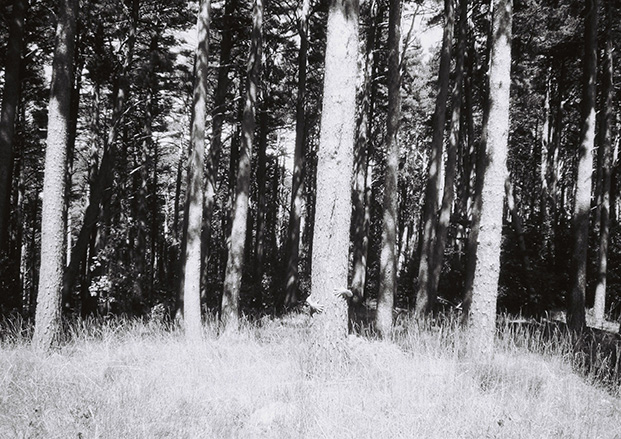
Esencia (08), Fotografía analógica, 20x30 cm, 2014How has your work changed in the past five years? How is it the same?

5 years ago my photographs were just that, pictures. I worried that the final result were beautiful, with the technique used correctly. At that time I began to realize that images not only reflect the beauty, they told stories, so I started to take photos with some intention behind the images. Today my understanding of photography has changed. Now I work with projects or series whose mission is to tell a story, convey a message.

How have people such as family, friends, writers, philosophers, other artists or even pop icons had an impact on the work you do?

I spend a lot of time each day to see the work of other contemporary artists on Internet, so i could say that in my work there are influences of mainly young artists. Another factor that also influences much my work is my circle of friends, with whom I exchange points of views about all sorts of topics. From this kind of conversations emerge ideas for future projects. Also, I like to take photos of them, they are often protagonists of what I do. 

Have you ever been pulled in the direction of a pursuit other than being an artist? What are your other interests? 

Spain is a difficult place to be an artist, if you also add the number of rejections and frustrations that an artist must endure throughout his career, I believe that everyone that is dedicated to the arts, they have thought more than one occasion if we are losing the time. 

As a parallel activity, I have been studying cultural management issues because in addition of creation i would like to show the work of other people. I would like to have in the future an art gallery where i could help others artists with their careers. Also, I currently work as a collaborator (for art’s sake) in a Mexican online magazine about art, making articles, interviews and reports.

About

María Hernández1990. Tudela (Navarre) Spain. Self-taught , I am dedicated to photography in a conscious way from 18 years ago, but I’ve had a camera in my hands since I was a child. I studied graphic design but I realized that I really did not appeal to me, but rather just the opposite, I’m not in favor of consumerism and much less I like to be part of that world. Since this time I have devoted to photography of author working with personal projects. Some of my works have been exhibited / published in Spain and other places as the United Kingdom, Mexico, Argentina and Portugal, among others.

cargocollective.com/mariahernandez

All images copyright of the artist and used with their permission.
Posted in Collage, Photography | Tagged , , , , | Leave a comment

Donald Morgan – Eugene, Oregon

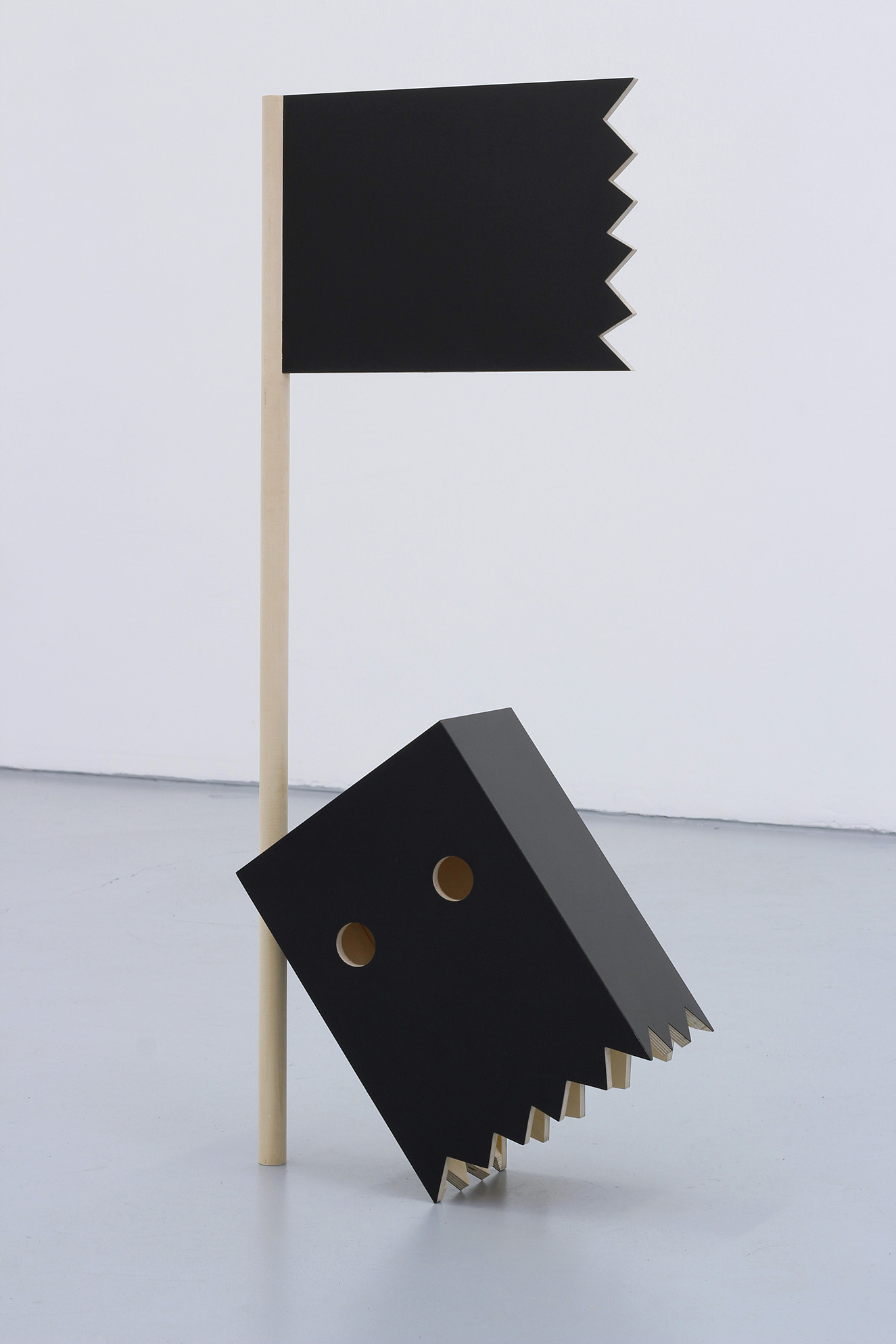
Black Flag 2013 Wood, Acrylic Laminate 47 x 20 x 7”

Black Flag 2013
Wood, Acrylic Laminate
47 x 20 x 7”

Briefly describe the work you do.  

I generate work from books, fiction and memoir.  I select themes and elements to rework into sculptures and paintings.  I suppose one could think of many of my pieces as sort of wayward, errant illustrations. Overall, the many small bodies of work I make function as loose, idiosyncratic, partial adaptations of the books I choose to use as source material.  In adapting writing into physical form, I am concerned with how the viewer physically encounters the work.  My pieces are constructed so that one’s experience of them leans toward the phenomenological, in the sense that our bodies are deeply enmeshed in the perceptual and cognitive process of viewing.  Much of my work is “passive-aggressively interactive”, resonating in a highly tactile manner, as if you could sit on it, touch it, or place something on it.  

Tell us about your background and how that has had an influence on your work and on you as an artist.

I saw tons of art growing up, we lived for years overseas (Middle East, Europe) and I was inundated with museums.  My father is an architect, both my parents are real aesthetes, we had tons of books, big paintings on the walls by their friends, everything seemed hand made by bohemians. I think at one point we had 3 pianos in the house. All that stuff that rubbed off on me and I knew pretty early I was going to be a writer or an artist.  I even went to an arts grade school where you could do calligraphy instead of math. I’m still bad at math. After undergrad I moved to Chicago and landed a job making furniture for a couple years which gave me access to a shop and the skills to make things. The limited fabrication repertoire I have is all from that time, about 20 years ago.

The concept of the artist studio has a broad range of meanings in contemporary practice. Artists may spend much of their time in the actual studio, or they may spend very little time in it. Tell us about your individual studio practice and how it differs from or is the same as traditional notions of “being in the studio.”

I tend to have very studio intensive 3 or 4 month stretches when I will complete a body of work, usually for a solo show, during which I am in the studio or a shop of some kind day in day out.  The rest of the year I will work on pieces intermittently but mostly focus on sketchbook stuff wherever I’m at, figuring out the next body of work.

My favorite studio time is when I’m in the early stages of a project and I’m sketching out ideas , ordering materials and making cardboard mock ups and listening to NPR all day long.  After that it’s a very shop heavy and exhausting.  I could never be one of those hermits who spend their entire lives holed up in their studios, brush perpetually to canvas. When I look at paintings that look as if they took longer than a few days to make, I feel queasy. 

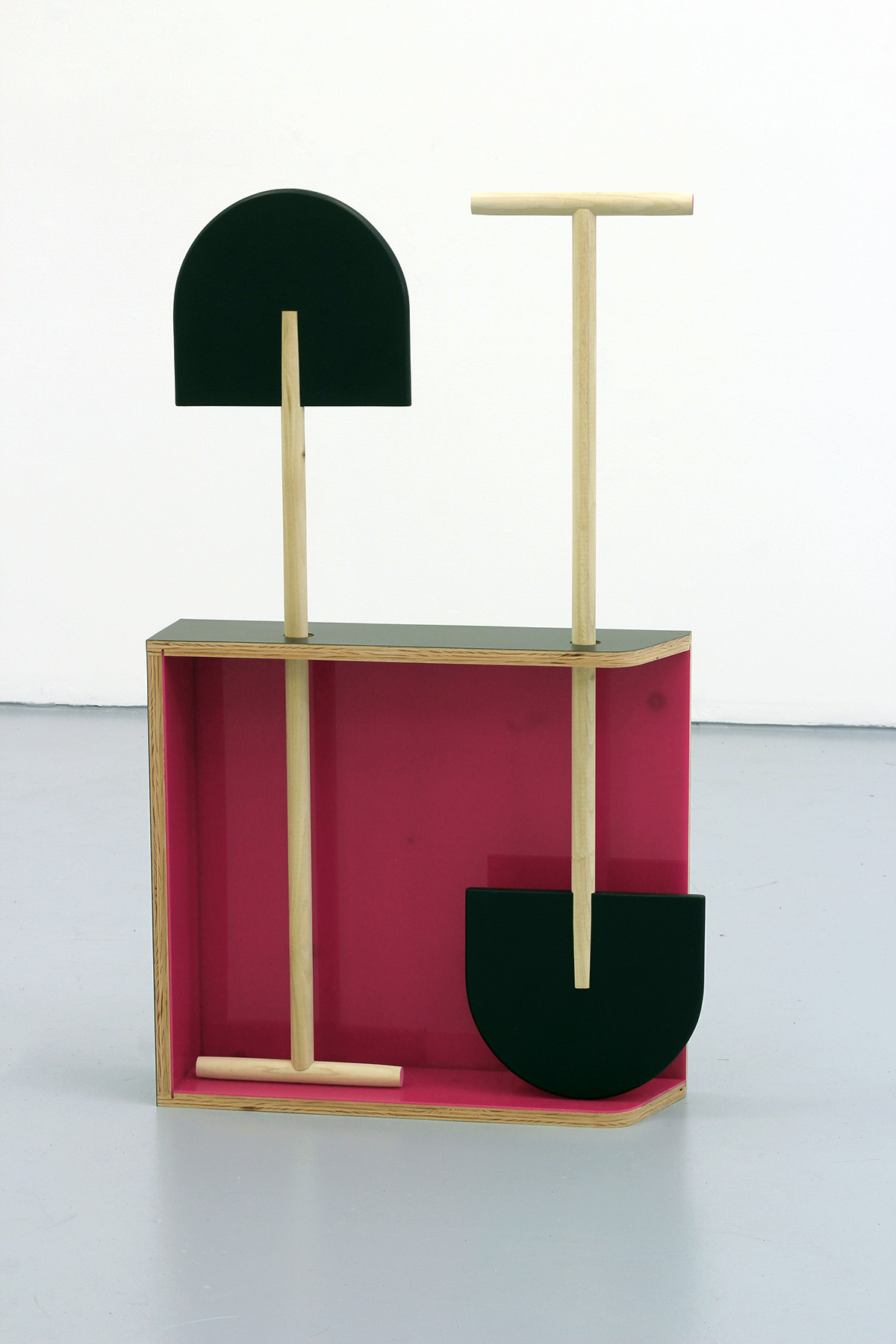
Display Unit 2013 Maple Plywood, Wood Dowels, Acrylic Laminate, Plexi, Rubber 35 x 26 x 6.5”

Display Unit 2013
Maple Plywood, Wood Dowels, Acrylic Laminate, Plexi, Rubber
35 x 26 x 6.5”

What roles do you find yourself playing that you may not have envisioned yourself in when you first started making art?

Being a professor.  It’s a very humbling job.  Being part of an artist run space that’s been around for almost 8 years now (ditchprojects.com).  I’m also a co-director of a residency (coasttime.org). 

When do you find is the best time to make art? Do you set aside a specific time everyday or do you have to work whenever time allows?

Whenever time allows.  Teaching and having a 2 year old make it tough to keep a regular studio schedule.  The summer months are generally the most productive for me.  I’ve gone on a couple of residencies, most recently Macdowell. Those are good for me, but mostly because I get some head space while I’m at them.  It’s good to get away from it all. 

Studio Installation shot The Green Towel 2010 Acrylic Panel, Maple Plywood, Enamel 35 x 37 x 22”

Studio Installation shot
The Green Towel 2010
Acrylic Panel, Maple Plywood, Enamel
35 x 37 x 22”

How has your work changed in the past five years? How is it the same?

Aesthetically it’s similar: hard edge, geometric.  But it’s getting funnier, which is good.  Before I moved back to Oregon a lot of my work addressed nature, trees etc… now that I’m in nature that subject matter is a lot lower on the totem pole for me.   Now I look to fiction as a source material. 

How have people such as family, friends, writers, philosophers, other artists or even pop icons had an impact on the work you do?

Though I got my MFA at Art Center and have read tons of theory, and teach it sometimes, it’s become less of a focus…different enthusiasms get me out of bed in the morning now.

Like every artist, influences are always bopping around in my head. Mostly Artschwager, Judd and Mccracken.  Often in a very nuts and bolts sculpture kind of way; volume, color, weight, arrangement etc…but I gravitate towards Artschwager the most, and for more than formal reasons.  He’s more interesting to me than Judd because of how idiosyncratic his overall practice was.  His drawings on celotex are just so weird and wonderful and deadpan.   He was funny.  Not many artists are.

Have you ever been pulled in the direction of a pursuit other than being an artist? What are your other interests? 

I read a ton of fiction.  I love sentences. Right now I’m half way through Evelyn Waugh’s Black Mischief and I feel a certain connection to his prose, how tightly coiled and surprising it is.  He sweats the small stuff, there is nothing casual in his writing. Similarly I obsess about the 1/32nd of  an inch, getting that shade of red exactly right in relation to that shade of green.   But writers can’t listen to music or public radio while they work.  And writing is a thousand times harder than sculpture.  You can just put an orange broom in the corner and it will look pretty great.  

I generate work from books, fiction and memoir.  I select themes and elements to rework into sculptures and paintings.  I suppose one could think of many of my pieces as sort of wayward, errant illustrations. Overall, the many small bodies of work I make function as loose, idiosyncratic, partial adaptations of the books I choose to use as source material.  In adapting writing into physical form, I am concerned with how the viewer physically encounters the work.  My pieces are constructed so that one’s experience of them leans toward the phenomenological, in the sense that our bodies are deeply enmeshed in the perceptual and cognitive process of viewing.  Much of my work is “passive-aggressively interactive”, resonating in a highly tactile manner, as if you could sit on it, touch it, or place something on it.  

About

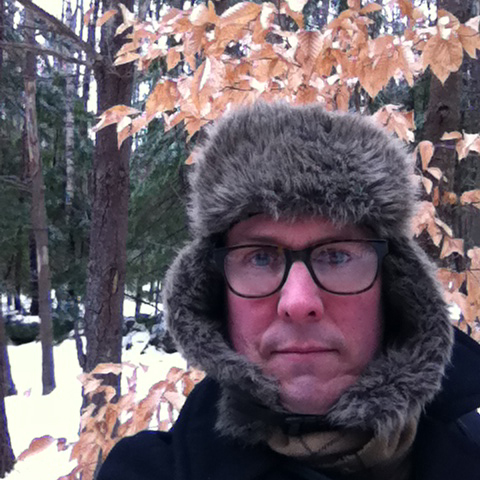
IMG_1728Donald Morgan received his MFA from Art Center College of Design. Prior to his current position as an Assistant Professor at the University of Oregon he was a sculpture lecturer at UCLA. He is a co-director of Coast Time Artist Residency in Lincoln City, Oregon and is a curator and member of Ditch Projects, an artist run space in Springfield, Oregon. In 2014 he was the recipient of grants from the Ford foundation, the Oregon arts Commission and was a resident at the Ucross Foundation and the Macdowell Colony. He has shown widely in the US and internationally and is represented by Fourteen30 Contemporary in Portland, Oregon. Reviews of his work have appeared in Art Forum, Art Issues, the NY Times, the LA Times and the Oregonian.

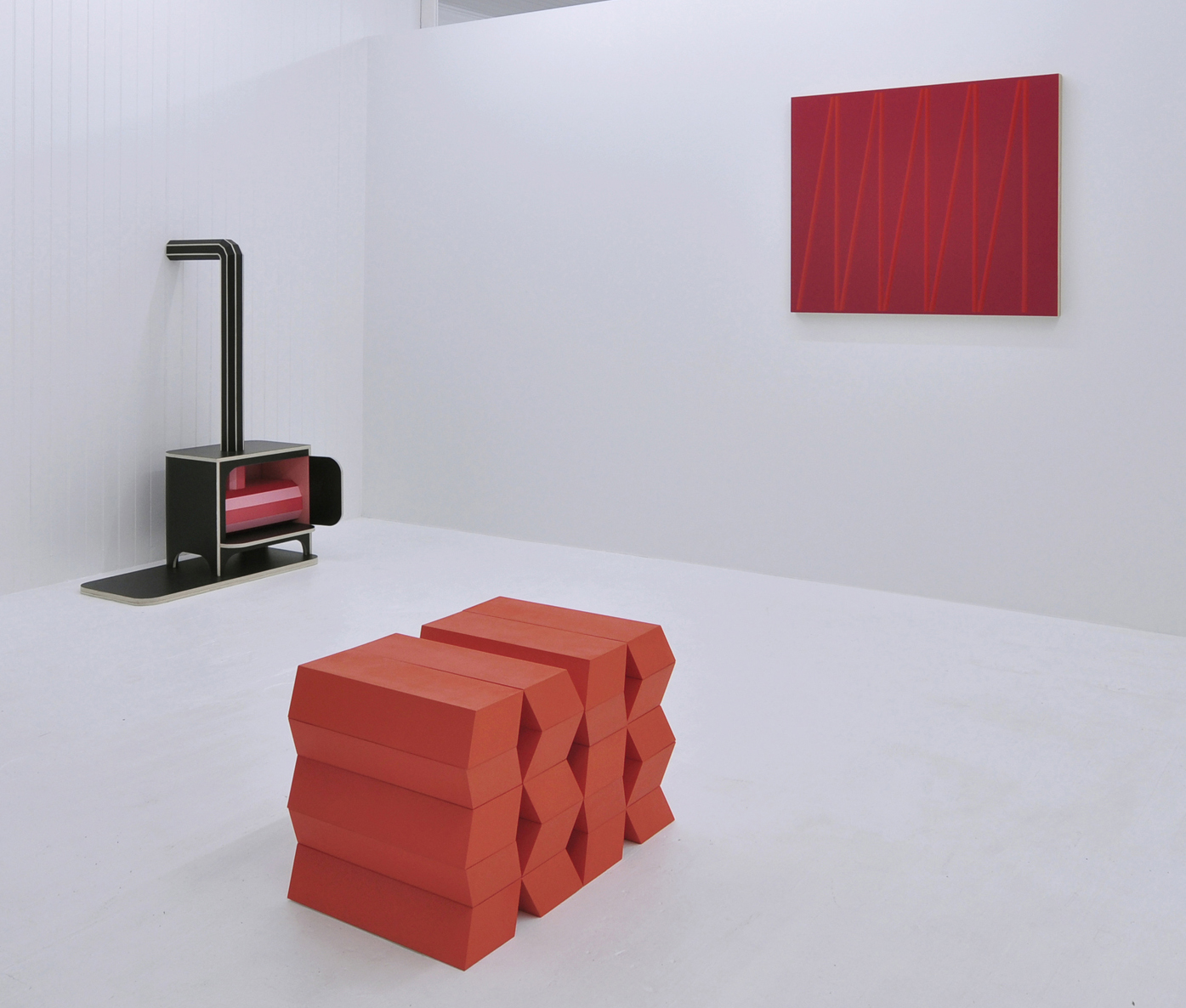
Gallery Installation shot from left to right Stove 2012 Acrylic Laminate, Enamel, Rubber, Maple Plywood 55 x 37 x 26” Firewood 2012 Acrylic on Board 17 x 30 x 17” Heater 2012 Enamel on Acrylic Laminate 34 x 40”

Gallery Installation shot from left to right
Stove 2012, Acrylic Laminate, Enamel, Rubber, Maple Plywood, 55 x 37 x 26”
Firewood 2012, Acrylic on Board, 17 x 30 x 17”
Heater 2012, Enamel on Acrylic Laminate, 34 x 40”

fourteen30.com/Artist-Detail.cfm?ArtistsID=257

All images copyright of the artist and used with their permission.
Posted in Installation, Painting, Sculpture | Tagged , , , , | Leave a comment

Paula Garcia – Santiago, RM, Chile

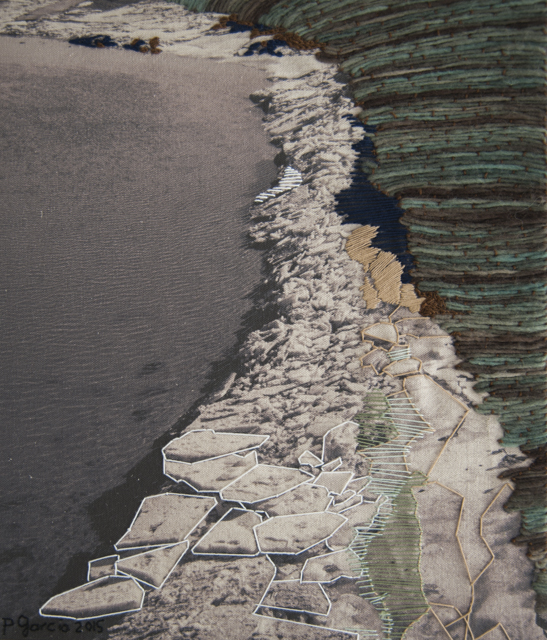
Landscape-Digital photography printed in cotton embroidered-40x33 cms-2015

Landscape-Digital photography printed in cotton embroidered-40×33 cms-2015

Briefly describe the work you do.

As an artist, I have dedicated my life to photographing ancient customs, religious festivities, and traditional artifacts typical of different cultures. This is done in order to record and preserve the cultural heritage and collective memory of a given place or ethnic group. I believe it is important to value the past in order to better understand the future, the diversity, and the history of the human race.

Afterwards I convert the shots into new images, through the use of various techniques that help me translate, reword, or add information that would not have appeared in the original picture otherwise.

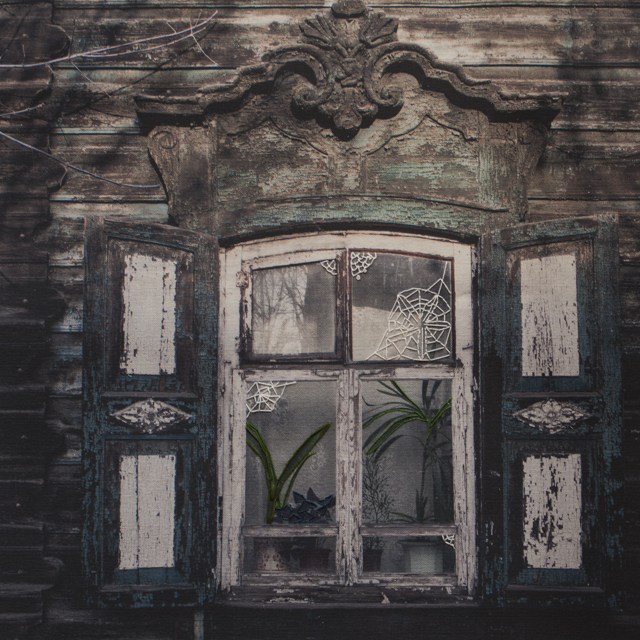
At present I am printing my photos on fabric over which I embroider images and textures. In turn, these added images and textures function as the brush-strokes, sketch lines or focus in a painting and they enhance the original photography by the addition of plastic and tactile elements that give back some of the content lost in the translation from the digital photo to the cloth.

Tell us about your background and how that has had an influence on your work and on you as an artist.

I realize that being an artist was an unconscious decision. When I was little, culture was a very important part in my life: books, history and science were usual topics. During holidays we spent time going to all kinds of museums and historical sights.

Later, when I was studying art, I was sure I would be an engraver, but I got a nasty eye infection. The doctor told my I could not work with chemical or acid for a while, so I started taking photos instead and sending them to the lab to be develop. After that I never stop shooting.

Window-Digital photography printed in cotton embroidered-50x50 cms-2015

Window-Digital photography printed in cotton embroidered-50×50 cms-2015

The concept of the artist studio has a broad range of meanings in contemporary practice. Artists may spend much of their time in the actual studio, or they may spend very little time in it. Tell us about your individual studio practice and how it differs from or is the same as traditional notions of “being in the studio.”

Half of my time I am talking pictures and researching, the other half is working in the studio. The good thing about embroidery is that I can work anywhere: while waiting for the doctor’s appointment, hanging with old friends, etc. So I take a bag with yarns and needles and settle a camp studio!

What roles do you find yourself playing that you may not have envisioned yourself in when you first started making art?

I did not think I would end teaching people about their own culture.

When do you find is the best time to make art? Do you set aside a specific time everyday or do you have to work whenever time allows?

I usually work in art whenever I have time left. I am a photographer, so I divide my time in four main activities:

  1. I take pictures for other companies, like magazines, web design agencies, etc.
  2. I teach photography.
  3. I take photos of intangible heritage.
  4. I do art whenever I am not doing any of the other three things on this list.
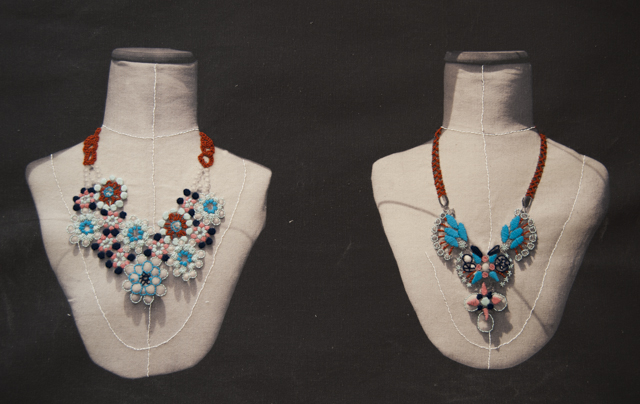
The Sisters-Digital photography printed in cotton embroidered-.50x70 cms-2014jpg

The Sisters-Digital photography printed in cotton embroidered-.50×70 cms-2014jpg

How has your work changed in the past five years? How is it the same?

My artwork has change a lot in the last three years. Before that I worked the image as traditional photo, but in 2012 I started embroidering the image, to change and enhance it message. Today I am working translating the photographic image into a code: one pixel, one stitch.

I think, in the other hand, it is the same, because I am still working with the topics I think are important: ecology, everyday life, heritage and culture.

How have people such as family, friends, writers, philosophers, other artists or even pop icons had an impact on the work you do?

I don’t think they know, but my family has had a lot of influence in my work. I have done different pieces inspired in the life, the personalities and decisions of my grandparents and siblings. The last I made was “Still Life” a coral and sea depth crochet series, using the yarn I inherited after my grandmother death.

Have you ever been pulled in the direction of a pursuit other than being an artist? What are your other interests?

Yes, when I was young I used to read and write a lot. For some time I studied to be a biochemist, but I think working with photos and images was stronger than anything else.

About

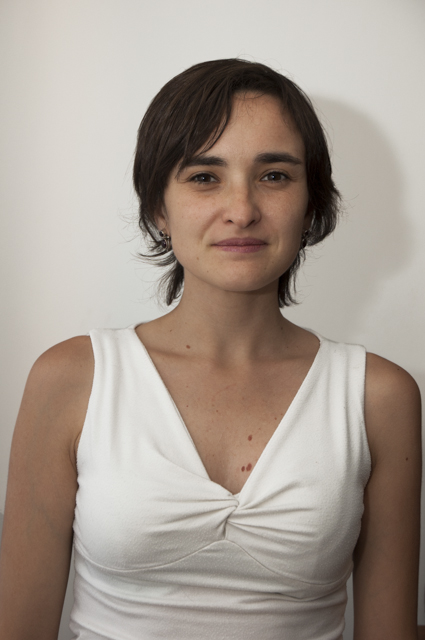
headshotPaula García was born in Valparaíso, Chile in 1977. She graduated in Fine Arts from Pontificia Universidad Católica de Chile in 2001.

Paula has exhibited in Chile and abroad including shows at Iberoamericanos, competition, itinerant exhibition in Bolivia, Paraguay and Perú, and Segunda Muestra Iberoamericana de Arte Miniatura y Pequeño Formato, Centro Cultural Plaza Fátima, Mexico.

She has published several books about cultural heritage.

In 2014, Paula received a award from “Transparentarte” competition, Consejo para la Transparencia (Government sponsored competition) Santiago, Chile. Paula lives and works in Santiago, Chile.

taking-pictures

enfocate.cl

All images copyright of the artist and used with their permission.
Posted in Photography | Tagged , , , , | Leave a comment

EYPRAKSIA – Greece, Athens

Performance 2015

Performance 2015

Briefly describe the work you do.

Basic role for me plays the instinct and the need.From there all begins.From there all are born and evolve .Have the power move and drives everything,from our own lives and by extension the art. Basic role Playing the meaning, symbolism, the deposit,the vision,also the values,values of human life and all that have life, of respect , solidarity and empathy.Art can not fit inside descriptions or  banners, art is based on freedom, the freedom of the artist to express his self and the freedom of the observer to perceive depending on his life experiences and needs  the current art. Βoth are fully respected.Art can save the world because world is art.

Tell us about your background and how that has had an influence on your work and on you as an artist.

In my blood flows a very important civilization  Greek,that was born the spirit,philosophy, the concept of democracy, the arts,health, strong values,.All this heritage exists in my DNA make me feel proud and grateful and shows me my inner road to evolution and  light.

The concept of the artist studio has a broad range of meanings in contemporary practice. Artists may spend much of their time in the actual studio, or they may spend very little time in it. Tell us about your individual studio practice and how it differs from or is the same as traditional notions of “being in the studio

Τhe real studio for me is my own humanity.The place that really arises meaning of creation, becomes the spoliation and the evolution of my art is inside me,my own self.Αll the vibrations, the actions ,gestation within continuity. From then on, I have a place that operates like my own parallel universe like my own black hole from the moment i’ll enter I will get lost in it.

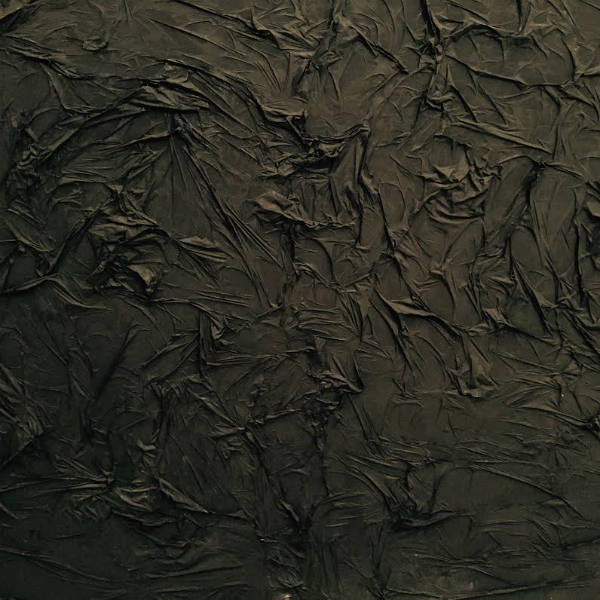
Canvas-Sheers-Acrylic Black-2015

Canvas-Sheers-Acrylic Black-2015

What roles do you find yourself playing that you may not have envisioned yourself in when you first started making art?

I born in the art, so that’s my natural environment . I learned to leave my self in the flow of art, to trust and be born again. Αnything new I trust it, and let  show me the way.

When do you find is the best time to make art? Do you set aside a specific time everyday or do you have to work whenever time allows?

As I mentioned previously, the real studio for me is in my own self, my soul, my spirituality, my vision, there is no specific time of creation,is alive constantly , we are living organisms, continually possessed by feelings, we are emotions Waterfalls you can not set the momentum him. Everything flows and evolves constantly within us.

How has your work changed in the past five years? How is it the same?

I can not isolate it only at he past five years, because Evolution is continuous,in every moment there is the evolution This is the goal  of human.

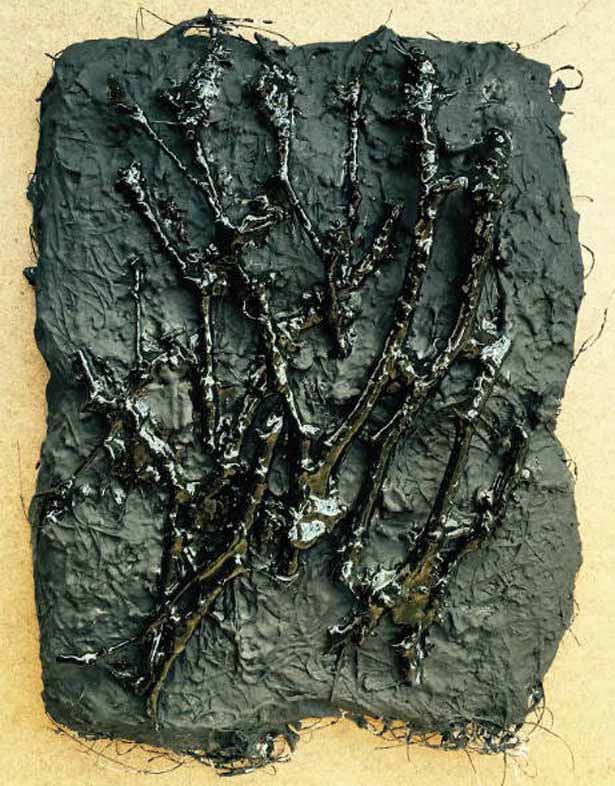
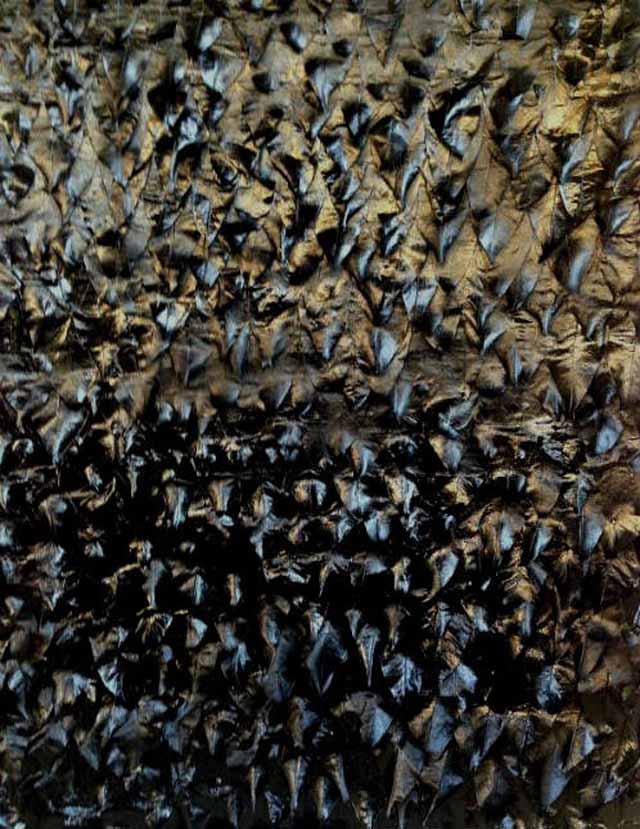
Canvas-Leafs-Acrylic Black-Glossy Spray 2014

Canvas-Leafs-Acrylic Black-Glossy Spray 2014

How have people such as family, friends, writers, philosophers, other artists or even pop icons had an impact on the work you do?

What characterizes me as an artist is the absolute innerness , I feed my self through the absolute silence.

Have you ever been pulled in the direction of a pursuit other than being an artist? What are your other interests? 

A flower does not ask why blooms, this is the nature of. This is my real nature.

About

01Eypraksia Kontsa was born in Greece. Study music, theater, dance and received education  visual arts.She graduated piano,music theory, Kontrabass, classic song, dance-ballet.Has attended seminars drama, acting, improvisation, mask, physical theater, directing, bioenergy,butho in Greece-Europe and New York. R​​eceived  Education at  Sorbonne in Paris -art history,philosophy, psychology and study the architecture of the burial places of the 19th century.As a visual artist received education structures-including painting-sculpture-video art-sound installations -installations-performance,next to great visual artists in Greece-Europe and New York Has worked as an actress in great performances in Greece and abroad.Directs Theatrical  Visual Performances.As visual artist active in Greece and abroad with exhibitions-festivals-independent art-Art in public space – performance in public space -e.t.

Ηad the Greek participation on Month Of Performance Art in Berlin 2015 also the Greek participation at Short Film Festival of Hamburg-Kinocabaret 2015.

unnamed (7)C

omghopelove.tumblr.com/

All images copyright of the artist and used with their permission.
Posted in mixed media, Painting | Tagged , , | Leave a comment

Maria Antonieta Cortez Cataldo – San Felipe, Quinta región, Chile

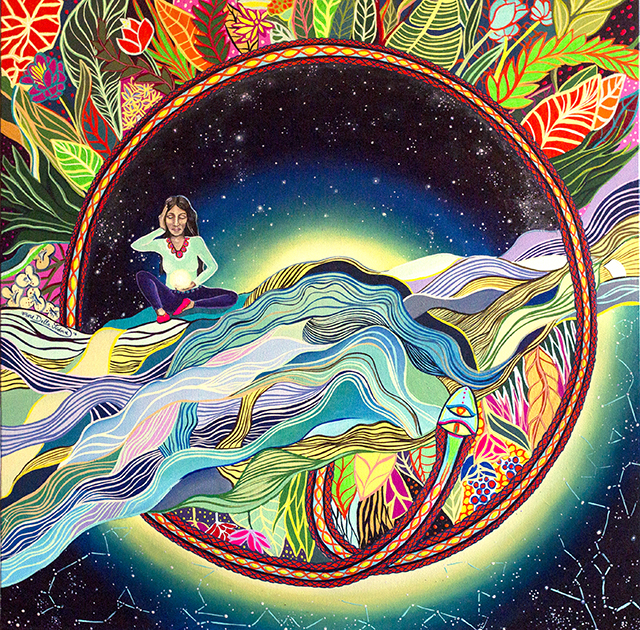
"Chile" acrylic paint, varnish, graphite,oil painting. 45 x 110 cm. 2013

“Chile” acrylic paint, varnish, graphite,oil painting. 45 x 110 cm. 2013

Briefly describe the work you do. 

My work consists in the perpetual creation parting from the perception of the real and the unreal, turning it to painting, collage, prints and experimentation mixing various techniques.

Tell us about your background and how that has had an influence on your work and on you as an artist.

Chile is, from a geographic point of view, long, narrow and multicultural. The Near North and the Central Regionof the country have been my life’s scene. I feel an eternal love for the flowering desert (unique in this world) and for the Andes’ mountain rage. These geographical zones, for whatever reason, shaped me since I was a child, and I keep admiring their immense beauty.

The concept of the artist studio has a broad range of meanings in contemporary practice. Artists may spend much of their time in the actual studio, or they may spend very little time in it. Tell us about your individual studio practice and how it differs from or is the same as traditional notions of “being in the studio.”

My working place is “the place where I happen to be”, be it a library, a bus, or my room. Personally, I don’t dispose of a studio where to realize my works. However, that does not put a limit to the hours I dedicate to creating art.

What roles do you find yourself playing that you may not have envisioned yourself in when you first started making art?

For some reason, I’ve always had the intuition of being creating, working on and observing art.

"El cuerpo sufre" collage, graphite, acrylic paint. 60 x 100 cm. 2011

“El cuerpo sufre” collage, graphite, acrylic paint. 60 x 100 cm. 2011

When do you find is the best time to make art? Do you set aside a specific time everyday or do you have to work whenever time allows?

It is always time to create. From day to day, almost like a routine, I assign time for creating, mostly at night. I can pass hours and hours working without feeling the exhaustion which the night brings. 

"Descanso en el placer" drawing on paper and chinese ink. 18 x 12 cm. 2014

“Descanso en el placer” drawing on paper and chinese ink. 18 x 12 cm. 2014

How has your work changed in the past five years? How is it the same?

Five years ago, my work was scattered and focused on investigating sources. Now I can see that my work is consolidated in both visual and conceptual terms. At present I can observe a particular and contemporary imaginary , grown eager through constant learning.

How have people such as family, friends, writers, philosophers, other artists or even pop icons had an impact on the work you do?

Naturally, the family and other close persons have an influence in giving the impulse to having perseverance in working, to continuing one’s way and not to turn away from it. I admire the simplicity of narrative and visual works and the professions that human beings can have when they do not aspire to wealth and recognition. Seeing that, I think it is a way worth following: I am concentrated only in my work, confident that the work itself will talk, travel and cross the world. 

Have you ever been pulled in the direction of a pursuit other than being an artist? What are your other interests? 

In some moment, I studied design. However, time passed by and I felt a necessity for art, I understood that – in spite of its way being vertiginous and sometimes agonizing -art is what makes me happy and which satisfies my soul. My interests also comprehend free education and the revaluation of ancient.

About

11051907_10206036987821621_1472410504212500781_nThe artist was born in 1986 in Chile which at that time respired the military dictatorship. The comet Halley was the year’s protagonist. The artist’s childhood was immersed, marked by her developing an imaginary full of questions and particular curiosities which the family still remembers. At home, there always existed a sewing machine, tools and materials which every day were used for creating and for resolving every-day matters. Nature and the mistakes of human progress were recurrent in the artist’s early observation of what was going on in her country.Generally, arts is considered a subject different from the other subjects which figure in the scholar curriculum. It is considered to be pleasant and less academic than the others. However, when the artist lived in this panorama of artistic education, her curiosity always led her to experiment and create with what was near her.

In her first artwork in college, when she had to made a replica of a contemporary artist’s work and chose Joan Miro and his work “The moon and the bird (La luna y el pájaro)”, she managed to create something distant from the original work but in which in a peculiar way remained its essence. This was the starting point for the artistic production. Later, thanks to academic studies and personal investigation the artist understand, develop and conceptualize in what she names “that the key lies in creating, creating and die creating”.In this way, talent can be developed, polished, smashed and revived.The techniques with and on which she works are painting, printing and mixed techniques; she es about to include screen printing into her visual repertoire.The artist has participated in the National Contest of Young Art in the University of Valparaiso and was selected from over 500 participants.

Her work was published in national newspapers such as “El Ciudadano”, in regional newspapers such as “El Trabajo” and on virtual platforms. A few months ago, “Le Monde Dilpomatique” began to use some of her paintings as illustration for the Chilean edition. The artist’s work has permanated in the underground, but is slowly beginning to be shown in various digital displays and hopefully will find it’s way to a gallery soon.

"Cerros después de la lluvia" xilografia on canvas. 30 x 20 cm. 2010

“Cerros después de la lluvia” xilografia on canvas. 30 x 20 cm. 2010

All images copyright of the artist and used with their permission.
Posted in mixed media | Tagged , , , , | Leave a comment

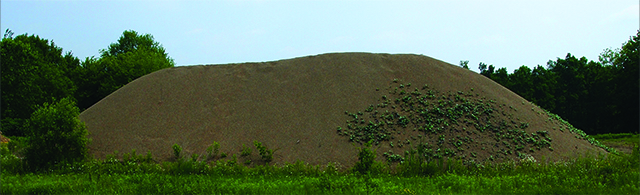
Ian Thomas – Slippery Rock, Pennsylvania

Reconciliation, approx. 325 cubic yards of gravel, 2013-2015

Reconciliation, approx. 325 cubic yards of gravel, 2013-2015

Briefly describe the work you do. 

Interdisciplinary.

Tell us about your background and how that has had an influence on your work and on you as an artist.

In 1975, the year before I was born, my grandfather, an industrial arts instructor, willed me a collection of unrelated curiosities. Among these seemingly unrelated objects were tools, measuring devices, and jars full of oddities.

As a child, through play, I would create/construct identities and stories for these bizarre unrelated objects. The older I got, play shifted to questioning, and I searched these groupings for meanings, while trying to understand the disconnected relevance to myself (or, even, my life, or, who I am).

This innocent comparative analysis of visual objects to create a dialogue has been a model for my creative research. A non-linear exploration conflates past and present, while objects of commonplace import are imbued with simultaneity, coupling personal narratives and sociological observations. Metaphoric and anthropocentric, the work sorts my declarations, my attempts at personal and social understanding, and my opinions of the self.

The concept of the artist studio has a broad range of meanings in contemporary practice. Artists may spend much of their time in the actual studio, or they may spend very little time in it. Tell us about your individual studio practice and how it differs from or is the same as traditional notions of “being in the studio.”

My studio practice is fairly traditional. I work in a multitude of locations, my personal studio, school, basement, dinning room, front porch, outdoors or in the gallery itself. Depending on the type of project that I have going on at the time often dictates which of these spaces will be utilized and viewed as “studio”. I view most of my life as “being in the studio” so regardless of the physical space, in someways I am am always in the studio mentally.

Art for the Internet as Viewer Series: Desensitized, archival print, acrylic and graphite on canvas, 38x38inches, 2015

Art for the Internet as Viewer Series: Desensitized, archival print, acrylic and graphite on canvas, 38x38inches, 2015

What roles do you find yourself playing that you may not have envisioned yourself in when you first started making art?

When I was a young maker I would have never realized the paperwork, typing, and administrative activities that surround being an active artist.

When do you find is the best time to make art? Do you set aside a specific time everyday or do you have to work whenever time allows?

After becoming a father I have found that every free moment has potential. I have no set schedule to make, making as much as possible when ever I can. It could be 15 minutes in the morning, 3 hours in the afternoon, or at 2 am. I have found, for my practice, there is no best time to make art, anytime is the best time.

1990's Tragedy Commemorative Series: Columbine, Eric and Dylan, porcelain, slip, 12x26x2inxhes, 2014

1990’s Tragedy Commemorative Series: Columbine, Eric and Dylan, porcelain, slip, 12x26x2inxhes, 2014

How has your work changed in the past five years? How is it the same?

My works have a fairly fast evolutionarily pace and has been this was since I can remember. Whether, good or bad, it is the methodology that holds my attention. My works tend to be diverse from one project to the next, so in this way, my difference in my similitude.

How have people such as family, friends, writers, philosophers, other artists or even pop icons had an impact on the work you do?

In addition to being a visual artists I have been a musician for a couple decades. Collaborating on a visual or conceptual project seem as natural as playing music with another. Ryder Richards, Byron Rich, Shreepad Joglekar are just a few artists that I have had the pleasure to work with. These artists have powerful presence in their own practice. When working with a collaborator it affords and opportunity for personal growth through a collective experience opening paths to ideologies that are not so independently idiosyncratic. These moments of shared making inform and echo within my own practice both on cognitive and subconscious level.

Have you ever been pulled in the direction of a pursuit other than being an artist? What are your other interests?

For a brief time I chased the music dream exclusively, playing and touring for a few years. It was a time that was powerful satisfying but didn’t take off quite as I had hoped. While I still play, it has certainly taken a backseat to the visual arts. My main interests, asides from making, now are my wife and my two children.

About

OLYMPUS DIGITAL CAMERAIan F. Thomas is an installation artist who lives in Slippery Rock, PA and works at Allegheny College in Meadville, PA. He holds a BFA from Slippery Rock University and an MFA from Texas Tech University. Thomas received additional training at the Academy of Fine Arts and Design in Bratislava, Slovakia, and The Pottery Workshop in Jingdezhen, China. His works have been shown nationally and internationally.

05_Thomas

ianfthomas.com

All images copyright of the artist and used with their permission. 
 

Posted in Ceramics, Installation, Painting, Sculpture | Tagged , , , , | Leave a comment

Jaime de la Jara – Madrid, Spain

Pool, Installation, 7,5 x 0,90 x 4 mts, 2015

Pool, Installation, 7,5 x 0,90 x 4 mts, 2015

Briefly describe the work you do. 

It is precisely in the hidden recesses of the picture where my work is displayed. Through a decontextualization of images and objects, fragmented at times, he reveals exactly how far appearances can deceive. Nothing is what it seems.  So what from a distance appears to be a boat, becomes when seen up close a structure made of felt, clearly incompatible with its function: on contact with the water the textile would no longer fulfill its given purpose of remaining afloat on that water.  Like Magritte, I think that all representation is an artifice and he bases himself on the agreed acceptance, and not on the nature of things.  On the contrary, very often the material of the object contradicts the apparent function of the image.

Tell us about your background and how that has had an influence on your work and on you as an artist.

After working about seven years in advertising productions and check the constant use of fiction in this and other means, as lies to find a target, I decided to undertake the task of giving expression to his opinions on the subject. To do this I situated myself within the suggestive and deceitful reality of objects, their narratives and their perception. I realised that the structure of truth and lies arises from beliefs and not from reality: that beliefs are what count, and that if the light from a window is brighter or darker, if it broadens or lengthens or is reduced or attenuated, the reason that explains it must be sought in the conditions and wishes of observation and not in the objects themselves, which are just as we find them or situate them. Mysteries, cadences, incongruities, are projections by the viewer who, if he were situated in other conditions, would produce other views. If we clear away all nostalgic feelings and phantoms regarding the beauty of deceit, with drawings, photos, two-way mirrors, videos, screens, models, sounds, spotlights or structures, the credentials of the current objective are achieved.

Solid, Installation 1, 7 x 3,6 x 3,40 mts, 2014

Solid, Installation 1, 7 x 3,6 x 3,40 mts, 2014

The concept of the artist studio has a broad range of meanings in contemporary practice. Artists may spend much of their time in the actual studio, or they may spend very little time in it. Tell us about your individual studio practice and how it differs from or is the same as traditional notions of “being in the studio.”My studio have two spaces for two different processes. One is for the mental or conceptual process and the other is for the physical process, It is not far from the traditional notions of the artist studio.

But I spend a limited time in the studio, because normally I’m traveling with projects, exhibitions, residences, etc… This forces me to make the most of my time outside and inside the studio, or the others places that I can use like my studio, like hotel rooms or the studio of the residences… Even when I can’t have any space then I have my laptop.

What roles do you find yourself playing that you may not have envisioned yourself in when you first started making art?

When I studied Fine Arts I wanted to be a painter… Now I’m something more complex, I work with different medias, talking with easy words: I’m something like a sculptor but no, I’m an artist, the limits now are broken.

When do you find is the best time to make art? Do you set aside a specific time everyday or do you have to work whenever time allows?

I’m working every time, every time is good for get a good idea. Into the crowds or alone,with family, friends…

Anger Project, Photograph and Installation, 100 x 210 x 90 cm, 2012

Anger Project, Photograph and Installation, 100 x 210 x 90 cm, 2012

How has your work changed in the past five years? How is it the same?

My work is the same, but in a conceptual progress. Experience causes changes in the work and acquire new elements, however my interests are the same like five years ago.

How have people such as family, friends, writers, philosophers, other artists or even pop icons had an impact on the work you do?

Every-thing, like every-person have impact over my work. Because my work talks about us, I’m doing something like a social art, from and for all.

Have you ever been pulled in the direction of a pursuit other than being an artist? What are your other interests? 

No, I’m a full time artist now. I need a lot of time for try to do good works.

About

headshotJaime de la Jara (Madrid, 1972), graduated in Fine Arts at Universidade Complutense de Madrid. Since then has won several prizes and grants, including the: grant of Fundación Marcelino Botín, the prize Creación Artística de la Comunidad de Madrid, the grant Pilar Juncosa Joan Miró / Sothebys, the prize Art Situacions / Honda Transart, the second prize of the Bienal de Fotografía Purificación García, the grant of the artistic residency for Iberoamericanos of FONCA / CONACULTA (Mexican Government) and the Celeste Intentational Art Prize in Rome. More recently, has won the grant of Pollock-Krasner Foundation, of Harriet and Esteban Vicente Foundation and was, over the last four months of 2014, in residency at the Yaddo Corporation, in NY.

Since graduating has received several invitations to participate in both collective and individual projects and has also produced works for different exhibitions, selections and awards, among them: in the chapel of Museo Patio Herreriano de Valladolid, at the Centro de Arte Tecla Sala de Barcelona. Was also present in the editions of the prize Generaciones de Caja Madrid 2005 y 2006 at the Casa Encendida, with honorary mentions.

Participated in the selection of young artists Destino Futuro – curated by Oliva María – in the rooms of the Botanical Garden of Madrid. Presented an individual project in Loop ’07. Participated in exhibitions with selections of the most representative artists of Spain with the curatorship of Lorena Corral/María Corral and Virginia in the projects Planes Futuros y Ocho cuestiones espacialmente extraordinarias respectivamente.

Was always present in the programming of Galería Fúcares in Madrid with which has collaborated from 2005 to 2011. Having presented there the projects 15 Inches and The Navel. Now is represented by Filomena Soares Gallery from Lisbon, where he did his last solo exhibition, The Skin (2015).

His work is represented in collections, such as: Museo Patio Herreriano, Fundación Repsol, Fundación Coca-Cola, Fundación Bankia, Fundación Marcelino Botín del Banco Santander, Museo Artium de Arte Contemporáneo del País Vasco, Fundación CAM, CA2M de la Comunidad de Madrid o Vocento.

I_and_studio

jaimedelajara.com

All images copyright of the artist and used with their permission. 
 

Posted in Photography, Sculpture | Tagged , , , , | Leave a comment