Daniel Shieh – Hsinchu County, Taiwan

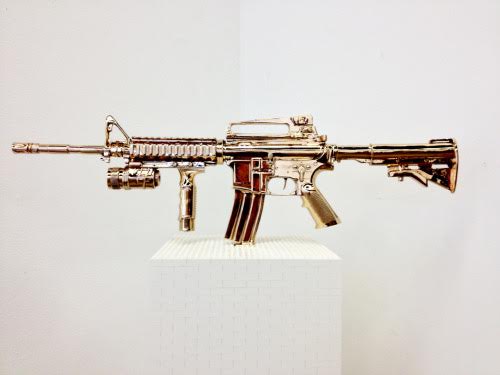
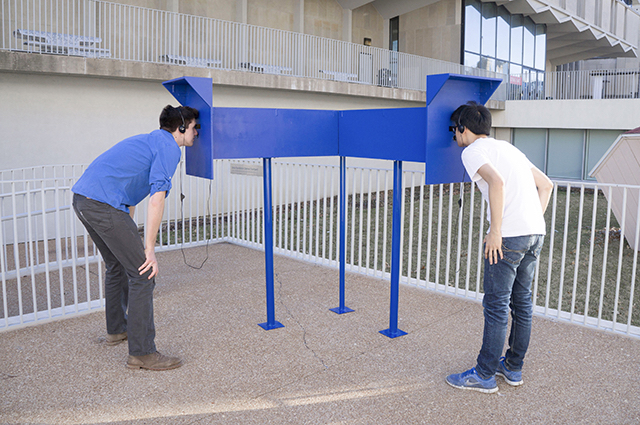
Coexist Wood, steel, paint, headphones, plastic, mirror, electric circuit components Dimension: 40 x 40 x 60” 2015

Coexist
Wood, steel, paint, headphones, plastic, mirror, electric circuit components
Dimension: 40 x 40 x 60”
2015

Briefly describe the work you do. 

Why does one care for certain people, yet regard others almost like living objects? Why does one form prejudice against others? We tend to ignore the intrinsic human qualities of others as we walk around in the public; we don’t perceive others as entities with lives just as complex and aspirations just as concrete as our own. We easily form assumptions of others through superficial cues, and forget the inherent similarities we share. My works are interactive structures that attempt to subvert these social tendencies and connect two strangers on a simple yet emotional level. They take on utilitarian appearances similar to that of public facilities such as playgrounds and phone booths, and are placed in public areas. I utilize these familiar forms to suggest possible ways of usage, and encourage passersby’s voluntary interaction. Once two participants activate the structure, they are prompted to playfully interact with each other through limited methods such as eye contact, and perceive each other’s presence from a different perspective. These structures pronounce certain biometric and emotional features of the participants, such as eyes, hands, and breathing, and allow them to examine each other closely. The simultaneous action of observing and being observed puts participants on an intimate level often deliberately avoided in public settings. By disrupting our social settings with discordant and distinctive structures, I challenge our habit of shielding ourselves from strangers, forming judgments from superficial cues and regarding others as persons of less substantial humanity then ourselves as we coexist in the public realm.

Tell us about your background and how that has had an influence on your work and on you as an artist.

My earlier years in college spent around many activist friends shaped my determination to challenge the status quo. I realized issues such as gender equality and racism are built in to the foundations of our society. We are brought up in environments with pervasive sexist and racist ideas, and we have trouble imagining how our world can be otherwise. These issues cannot be changed by laws and policies alone, as they require an update to our mindsets. With the rise of Humans of New York to popularity, I started to investigate our mental process of perceiving strangers in public. How can we alter our environment to facilitate an empathetic approach towards others? How can we modify the design of our streets and public transportation to encourage a fundamental understanding of our fellow humans?
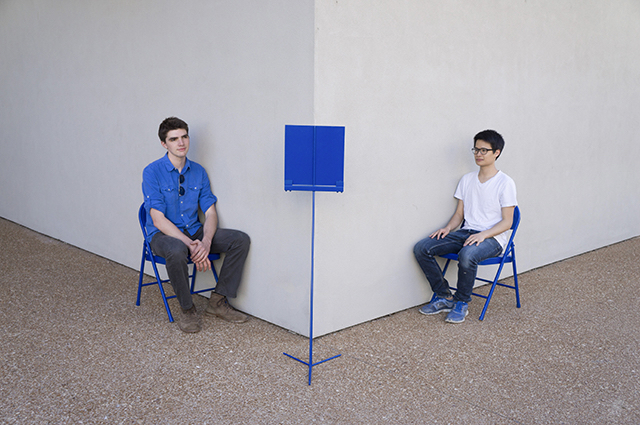
Sit With Me Steel, mirror Dimension: 40 x 40 x 45” 2015

Sit With Me
Steel, mirror
Dimension: 40 x 40 x 45”
2015

The concept of the artist studio has a broad range of meanings in contemporary practice. Artists may spend much of their time in the actual studio, or they may spend very little time in it. Tell us about your individual studio practice and how it differs from or is the same as traditional notions of “being in the studio.”

I have a studio space that I spend very little time in, because most of my research takes place in public areas. The studio space is just a temporary resting place for the interactive structures I created. In a way, the city is my studio; it is where I learn and develop ideas.

What roles do you find yourself playing that you may not have envisioned yourself in when you first started making art?

I adopted a pedagogical approach in the beginning of my practice. I created pieces that embody my beliefs, and presented them as objects from which the viewer draws information, and this resulted in a distance between the audience and myself. Recently, I turned to interactive works that are only activated when two participants interact with it simultaneously. I consistently found myself acting as a mediator between my sculptures and the audience. This happened specifically when I placed my works in public areas, where passersby are generally cautious toward unusual objects. I had to actively invite strangers to interact with my works, and explain my intent clearly and succinctly.

When do you find is the best time to make art? Do you set aside a specific time everyday or do you have to work whenever time allows?

The most coherent ideas come to my mind past midnight, when a sense of quiet stillness spreads over my room. Worries and obligations from the day temporarily fade away as I plan out my new works, and leave me with the capacity to critically assess my concepts.  
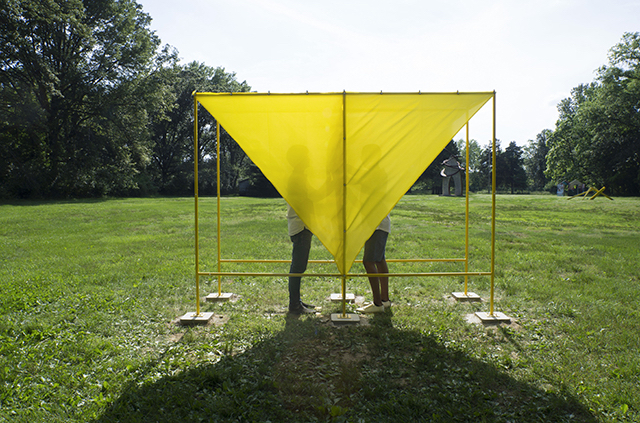
To See Beyond Our Appearances Steel, latex, nylon, paint Dimension: 112 x 38 x 84" 2015

To See Beyond Our Appearances
Steel, latex, nylon, paint
Dimension: 112 x 38 x 84″
2015

How has your work changed in the past five years? How is it the same?

Five years ago, I started creating sculptures out of materials gathered from a nearby dumpster. I couldn’t quite grasp the impact that art and artists create in our society, but I wanted to improve our lives somehow. These sculptures presented the effect human waste had on our environment, and aimed to persuade viewers into adopting more environmentally friendly lifestyles. I continuously questioned the extent to which my works contributed to the fight against pollution, and found my approach to be ineffective. I started to evaluate the strengths of art as a tool for driving change, and realized that art is extremely effective in instigating emotions. Simultaneously, I transitioned to interactive art. By having the audience adopt an active role in their perception and become co-creators of my sculptures, I attempted to shift the audience’s focus from what is presented to what they feel. 

How have people such as family, friends, writers, philosophers, other artists or even pop icons had an impact on the work you do?

Artists such as Rafael Lozano-Hemmer and George Ferrandi both create works that question the idea of a “stranger”, and have inspired many of my pieces.

Have you ever been pulled in the direction of a pursuit other than being an artist? What are your other interests? 

At various times of my college life, I had sudden urges to stop making art and become an urban designer, architect, astronomer, industrial designer, or even a physicist. However, these bursts of determination are generally short-lived.

About
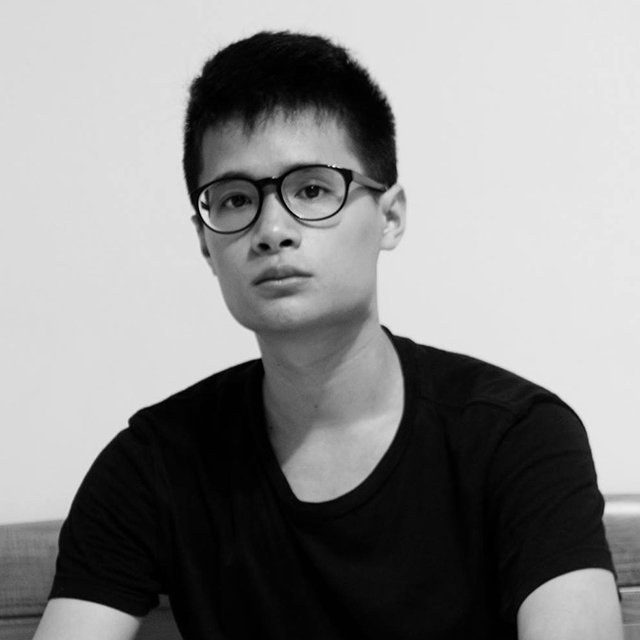
Daniel_Shieh_HeadshotDaniel Shieh is from Taiwan, and currently studies Fine Arts in Washington University in St. Louis. He aims to alter the way people perceive each other in public, and creates interactive sculptures that encourage strangers to see each other in a new perspective.
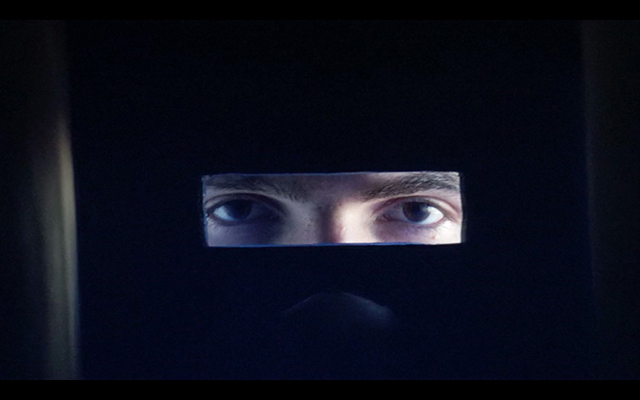
Daniel_Shieh_DetailShot

danielshieh.weebly.com/ 

All images copyright of the artist and used with their permission.  

Posted in Public Art, Sculpture | Tagged , , , , | Leave a comment

Gabri Solera – Madrid, Spain

La Condición HumanaBriefly describe the work you do.

As the great Joan Fontcuberta said: “there are two photographic trends, that which does not imply the documentary is not artistic nor the artistic documentary.” The Difference between the individual look (author) and the objective chronicler (journalist), is wrongly held by the Border Between art and documentary photography. “But Both are extensions of what photography: annotation, as there is in the world”. My photos are not very objective; Subjective North. It is not a competition Between the Straight Photography and staged drills, They can merge. Let’s just say That my realities are fictitious and my fictions, real.

Tell us About your background and how you That Had an influence on your work and on you as an artist.

I studied Bachelor of Journalism (at the Faculty of Information Sciences of Madrid) and then a master of creative photography in a prestigious school (EFTI). I think the two disciplines complement each other perfectly to create my images, where there is some improvised story, but also a lot of thought ingenuity. If I had to give two names that have shaped me so far, of course I speak of the surrealist painter Rene Magritte and writer Henry David Thoreau.

The concept of the artist studio has a broad range of meanings in contemporary practice. May Artists spend much of Their time in the actual studio, or May They spend very little time in it. Tell us About Your Individual studio practice and how it differs from or is the same as traditional notions of “being in the studio.

I have a photography studio as my work is more “street”. I could say that my studio is my own mind (though in my house I have a desk with two computer screens and a couch. This also applies to me as “workplace”). Sometimes I dreamed of having a place of co-working type work, but I’m so strange that would become as “the study of Francis Bacon”. Of course, if sometimes I have to do (much needed too) commercial, I rent a place and solved 🙂

What roles do you find yourself playing not Have That You May Envisioned in yourself When you first started making art?

I never imagined being an artist, I actually do not even like to think so. There was a time when I osbsesionaba make lots of pictures and series a year. Now, working as an editor at Getty Images (also related to photography, but without the pressure of “unemployed artist”), I enjoy taking the camera more times to “be a tourist with the camera hanging from the neck”. But I like that from time to time I add to social networks to tell me that they have seen some of my works at different sites to congratulate it. I always thought that my job was not to give answers but to ask questions.

Operación Recolonizar

When do you find is the best time to make art? Do you Set Aside a specific time everyday or do you have to work Whenever Allows time?

My creative process is pretty crazy (like me) because I never know when inspiration will emerge (Picasso said “I find inspiration to work” ). I read a lot, I see enough movies, travel to different cities, visiting exhibitions of different authors …. For me the most important is to have a good idea (I think the most important thing in a film is the script). I focus mainly on that and then developing trust with my people (girlfriend, family, friends). In some photographs as “Operation recolonize” series must be added a large production of field work, carrying heavy elements (I used a gasoline generator to directly illuminate the scene), meet “models” and aides … . so it is very stressful to be aware of all the details, but is also very rewarding when the result is very similar to the “original idea”.

How has your work changed in the past five years? How is it the same?

On the one hand, I think my work has varied greatly reviewing photos easy (I started in 2008 a photography course, tubeless, already showed signs as “artist”), but I also see that my fundamental interests remain the same: nature city ​​and mingling with humans. Sometimes speaking from a naturopathic perspective, more urban planner. Sometimes the presence of people and others like now where what interests me most is a powerful image minimalist geometries and abstractions where prevail over the rest.

Urbium (detail)How have people: such as family, friends, writers, philosophers, artists or even other pop icons Had an impact on the work you do?

I  think anyone who engages in an artistic discipline should be a little “Renaissance” and know a little of everything to influence him in his work (although a priori it seems that has nothing to do). I am passionate about film, literature, architecture, travel to different places and try that one way or another, all these interests appear in my series (or single pictures). In fact their titles often give clues of my references.

Have you ever Been pulled in the direction of a pursuit other than Being an artist? What are your other interests? 

Right now, other than thinking cool stuff to write (and I do not mean this post), my interests are focused on our pet (a dwarf rabbit named Brownie) the home chunks (literally) can not eat, spend as much possible time with my 4 nephews (learn more children than adults) and the wedding that came with my old girlfriend (now fiancee and future wife) a success year. We invite everyone, but if you know what happened to the daughter of Lola Flores, will understand that not.

About

_MG_4127Bachelor’s degree in journalism from the Complutense University. Master in Digital and creative photography at EFTI. He has participated on discoveries PHE 2012 and prestigious fairs such as stamping, Entrefotos, exit emergency (Madrid) and MirartePhoto (Guadalajara). He has also done several solo exhibitions in Madrid and other group exhibitions in places such as the IVAM (Valencia), Guggenheim Museum (Bilbao), Instituto Cervantes, circle fine arts and city (Madrid), Fundación Antonio Saura (Cuenca) and even Germany, France, Holland, Portugal, China and Brazil. He has won competitions such as the Alliance Française, Olympus, Fotoactitudes, Eurostars Hotels and selected him in contests like “Award Visual Arts” (both in Caceres and Seville), “Young creators”, “Impossible of tag” (Barcelona, Bilbao, Madrid and Santander shortly), “The floor” (screened at the Canary Islands). They have published you reviews in different places as New Landscape Photography (NY), Journal du Net (Paris) and Photographic Museum Shots Photography Competition (London). He participated in the book “Contemporary” (30 photographers of today), edited by the factory. She also works as a photographer and editor for Getty Images.

Terrain Vague

gabrisolera.com

All images copyright of the artist and used with their permission.  


Posted in Photography | Tagged , , , , | Leave a comment

Laureline Tilkin-Franssens – Leuven, Vlaams-Brabant, Belgium

TRACES - 2015 - VIDEO ART - https://vimeo.com/130251467

TRACES – 2015 – VIDEO ART – https://vimeo.com/130251467

Briefly describe the work you do

I am very much interested in the limits between the photographic image and the moving image. How can you make a photograph cinematographic and the other way around? So, my practice is somewhere in the intersection of photography, video art and also installation. I think images may be something more, other than just a way to show what the world is like… It can also be about creating an unexpected vibe and atmosphere. The subjects I work around have always been of much importance to me, either they directly relate to what I experience or it can be a feeling that I want to make clear to an audience. In general my art is very personal and usually about myself and the way I’m experiencing the world. If it is something that I cannot make too clear and transparent to the audience, I’d try to put the right emotion in it.  That means, I try to expand the notion of affection and individuality, so that other people might experience it in the same way.

Tell us about your background and how that has had an influence on your work and on you as an artist.

I grew up in Boutersem, a small town in Belgium. From early age my parents would take me and my siblings to museums, which is why I always have been interested in art and history. Somehow, this contact with visual culture inspired me to do a lot of things… I had a lot of hobbies while growing up, the most important one was music. I became more interested in photography when I was about 14, going to music concerts and taking pictures. But it was after seeing Erwin Olaf’s work that I became more aware of the artistic qualities in photography. I finished my Master degree in Photography in 2014 (Khlim: MAD-faculty, Genk). During that time I went on exchange to Tampere in Finland, and it turned out to be a very transformative experience both to me, as a being trying to find my place in the world, and also my work as a photographer. Travelling can make you more aware of cultural differences, possible identities we can create, values we get from birth… In that sense it affected all that I had learned about the world and life.

Currently I’m studying a master degree in Visual Culture and Contemporary Art at Aalto University in Finland. My classmates all come from very different backgrounds and cultures which has resulted in a constant learning process. This also has had an influence on my work and how I approach things nowadays.

PES - 2014 - PHOTOGRAPHY + VIDEO INSTALLATION

PES – 2014 – PHOTOGRAPHY + VIDEO INSTALLATION

The concept of the artist studio has a broad range of meanings in contemporary practice. Artists may spend much of their time in the actual studio, or they may spend very little time in it. Tell us about your individual studio practice and how it differs from or is the same as traditional notions of “being in the studio”.

I never really had a studio until I started my studies in Finland. But now that I have one I quite like it. As a photographer, I think everything is possible when I have my camera with me and my laptop to process the pictures. But still, I think it is very important for me to separate my work from where I live. So, I tend to spend most of the day in the studio. I’m currently sharing it with a close friend of mine and in the beginning of the year we built a tent there. For me this tent is really important, as I have spend much time there thinking about my projects. It feels like a safe place inside of a safe place. Everything is possible there. My studio is a site of research and inspiration, with the benefit of allowing me to meditate, feel safe and go through my work.

What roles do you find yourself playing that you may not have envisioned yourself in when you first started making art?

I actually never envisioned myself as an “artist” in the past. The goal I had set for myself when I first started photography was more commercial oriented. But I soon found out that I want to do something more than that. Creating something that can lure out reactions from different audiences is quite appealing for me. 

When do you find is the best time to make art? Do you set aside a specific time everyday or do you have to work whenever time allows?

In my opinion there is no best time to make art, of course it is better when you feel inspired. And once you are, it is very easy. For instance, when I’m traveling back home from a long day, the routes I trace whether by foot, bus, etc, become a moment of contemplation. As I don’t enjoy small talk with strangers I usually sit by myself and meditate about life. Usually this gives me some sort of epiphany about what I have to do about a certain artwork and how to proceed.

 IMPROVISATION KARAOKE - 2015 - PARTICIPATORY VIDEO-INSTALLATION

IMPROVISATION KARAOKE – 2015 – PARTICIPATORY VIDEO-INSTALLATION

How has your work changed in the past five years? How is it the same?

My recent work is very different from what I used to do. Nowadays I’m trying to address serious matters by using humor in my work. I think it reliefs a bit of the tension between artist, audience and the work itself. I am also attracted by the ways through which we can shake the limits between these different poles. Nevertheless, my work still is very personal. It has always been about my experiences, what I am going through at the moment. I would say that at this moment, this is my way to experiment with art, but this approach might still change very much.

How have people such as family, friends, writers, philosophers, other artists or even pop icons had an impact on the work you do?

Music has had the greatest impact on me. When I work on something I usually make a playlist of music that has the same atmosphere I want to show and I try to listen to that on a daily basis, so I get into that atmosphere. My family is a great inspiration for me. My first work of art was about going through the loss of my uncle, who passed away very suddenly.  Also, my friends contribute in my creating process. I find it very interesting to ask them for opinions about how I should proceed and I consider every meaningful conversation I have with them as a form of inspiration. Whether we agree on things or not, whether we know ourselves more or less, it can bring new insights and it is always very motivational for me to see that people are interested in what I am doing. As my work is very personal I usually don’t seek inspiration in other artists’ work, but for most of my projects Masao Yamamoto has been an outstanding reference.

Have you ever been pulled in the direction of a pursuit other than being an artist? What are your other interests?

I always knew somehow that I was going to be an artist. However while growing up I always thought I was going to be a musician, so not a visual artist. I started studying music theory when I was 6 years old. After that I started to play keyboards and piano when I was about 7 and afterwards I started to play many other instruments (violin, guitar, marimba, flute). I sang in a choir for years and I also played in a band and used to write my own music. Other than that I have been interested in language studies. My high school years were very much language oriented. I can speak Dutch (which is my native language), French, German, English. I can understand most Romanic and Germanic languages (especially written forms). Right now I’m in the process of learning Finnish, which has been quite a challenge so far. In a way everything I do always connects to languages, as for me music and art are also a language to express my core. I’ve also always been interested in science, I used to have a dream to become a doctor, but unfortunately my non-existing mathematical skills prevented me from a career in that.

About

HEADSHOT (2)Laureline Tilkin-Franssens was born in 1991 in Belgium. From birth she has been always very interested in visual arts, which resulted in studying photography. Her photography is mostly about things she experiences and is said to be very cinematographic. After finishing her master degree in Photography, she started a new degree in Visual Culture & Contemporary Art at Aalto University at Finland. 

Photograph from PES - 2014 - PHOTOGRAPHY + VIDEO INSTALLATION

Photograph from PES – 2014 – PHOTOGRAPHY + VIDEO INSTALLATION

laurelinetilkinfranssens.com

All images copyright of the artist and used with their permission.  


Posted in Photography | Tagged , , , , | Leave a comment

Sam Still – New York, New York

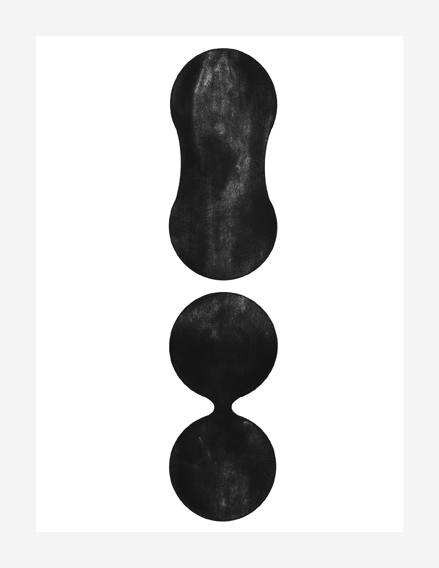
2013.201, burnished ink on Bark White paper ground, 25 " x 19 "

2013.201, burnished ink on Bark White paper ground, 25 ” x 19 “

Briefly describe the work you do.

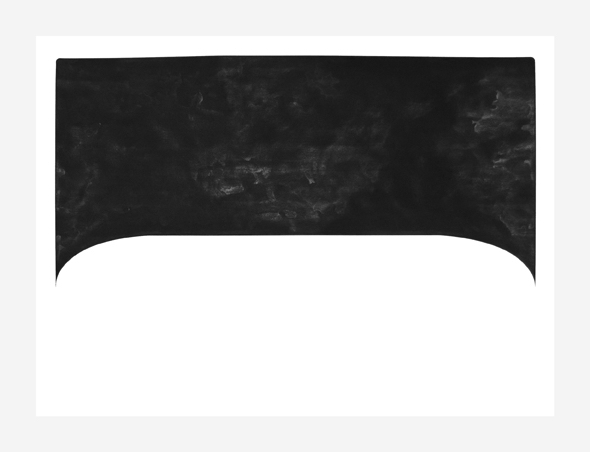
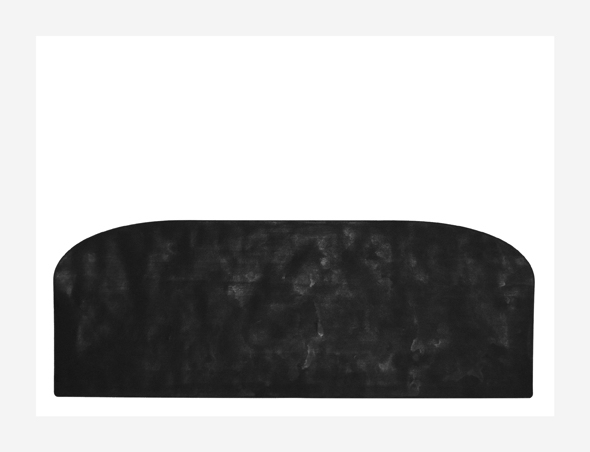
I make, burnished ink drawings on paper, minimal graphic images that in some cases seem to hover between foreground and background. These austere black and white shapes vibrate with tension; oscillating between dark/light, figure/ground, and negative/positive space. Others are emphatically flat rectangle and squares, divided and solid. This optical illusion invites viewers to linger, a place of rest for the body and contemplation for the mind.

Tell us about your background and how that has had an influence on your work and on you as an artist.

My Father was a tool and die maker and I worked for him summers as a teenager, working with metal returning, cutting, welding metal gave me an appreciation of a beautiful edge.

The concept of the artist studio has a broad range of meanings in contemporary practice. Artists may spend much of their time in the actual studio, or they may spend very little time in it. Tell us about your individual studio practice and how it differs from or is the same as traditional notions of “being in the studio.”

I live, with my wife, in an 800 square foot room, a bed and dining table at one end, my work table at the other end and a sofa in the middle facing a wall with work in different stages. It’s a studio/home/escape from the world situation all rolled into one. I like it like that.

2013.043, burnished ink on Bark White paper ground, 19 " x 25 "

2013.043, burnished ink on Bark White paper ground, 19 ” x 25 “

What roles do you find yourself playing that you may not have envisioned yourself in when you first started making art?

I never envisioned any particular role for myself in the art world, except as an artist. The action taken has always been to make art and then, in varying degrees, make money to exist.

When do you find is the best time to make art? Do you set aside a specific time everyday or do you have to work whenever time allows?

I’m pretty much always in art land in my head, there is no specific time. I rise at 5 and hit the sack at 9:30, in that time period is when I am pondering, making, pondering, making, pondering, making…

2013.042, burnished ink on Bark White paper ground, 19 " x 25 "

2013.042, burnished ink on Bark White paper ground, 19 ” x 25 “

How has your work changed in the past five years? How is it the same?

In my mind’s eye, it is always the same, it’s me, but it’s the current me, not the 2006 me. The truth is the 2006 me is not so different from the 2015 me, or the 1978 me. Though I know a tiny bit more about my practice, my love for a beautiful edge is the same and continues to be my obsession.

How have people such as family, friends, writers, philosophers, other artists or even pop icons had an impact on the work you do?

My mother’s father was an artist, not so much an influence, but gave me the knowledge first hand that artists existed and there was this place called the Art World. Also, it was not an endeavor that would support oneself and one might be a fool if one seriously considered the profession. My childhood was a turbulent ride and drawing offered a resting place of my own design that calmed.

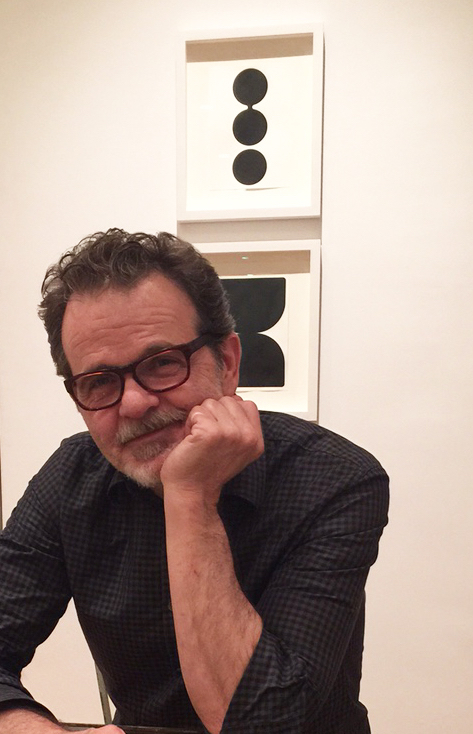
sam_still_headshotHave you ever been pulled in the direction of a pursuit other than being an artist? What are your other interests? 

Art making has always been the ring leader in all of my decisions, on every level.

Click here to read his CV.

samstill.com

All images copyright of the artist and used with their permission.  

Posted in Drawing | Tagged , , , , | Leave a comment

Niccola Devereaux – Los Angeles California

Teeth Palm Trees 8" x 10" Oil on Panel

Teeth Palm Trees
8″ x 10″
Oil on Panel

Briefly describe the work you do.

I make paintings and sculptures

Tell us about your background and how that has had an influence on your work and on you as an artist.

I’m from LA and that has in many ways made me who I am. Because I was born out that way in 83 I have seen all it has had to offer over the last 31 years. La has a color to it like a electric light blue and a toxic yellow, that’s how the place feels to me also, electric and toxic.

The concept of the artist studio has a broad range of meanings in contemporary practice. Artists may spend much of their time in the actual studio, or they may spend very little time in it. Tell us about your individual studio practice and how it differs from or is the same as traditional notions of “being in the studio.”

I have always thought this was stupid topic. “Studio” is just a word to help give an understanding of where an artist production takes place, like any word it can be played with and honestly the play is not all the interesting to me. In the loose sense of the word I am always in the studio.

Jungle boots escalator Bronze and Legos

Jungle boots escalator
Bronze and Legos

What roles do you find yourself playing that you may not have envisioned yourself in when you first started making art?

The only role I want and have ever envisioned is a person who makes art and I do that now.

When do you find is the best time to make art? Do you set aside a specific time everyday or do you have to work whenever time allows?
I’m always making something, I write and draw but mostly I like to paint and I do that when the moment takes me.

How has your work changed in the past five years? How is it the same?

My work is always changing. I think this is because I am always moving and doing new things, I hate the idea of stagnation.

16 x 20 Acrylic on Canvas

16 x 20
Acrylic on Canvas

How have people such as family, friends, writers, philosophers, other artists or even pop icons had an impact on the work you do?

I think that the person I think about most is Jeremy Bentham or specifically his idea about the Panopticon. Maybe that makes me sound paranoid but that is something always on my mind.

Have you ever been pulled in the direction of a pursuit other than being an artist? What are your other interests?

This has happened a lot to me. After high school I couldn’t afford school or art supplies or food or anything. I joined the army, that little journey took me all the way to Iraq and back. Since then my focus has been art and I never looked back.

About

Nick and grandpa! 2 copy 2BFA, Art Center College of Design: 2013Artist Assistant, Sculpture Studies Bronze Foundry, Kristan Marvell: Dec. 2011 – May 2012Internship, The Compound Gallery & Studios: 2008 – 2009Art Center Saturday Program: 1998 – 2002Nevada School of the Arts: 1995. 2015: group show @ Untitled Project Space and group show @ Exchange LA.2014: group show @ Think Tank Gallery and solo show @ Sosm Project Space.2013: solo show @ ACCD 

niccoladevereaux.com

All images copyright of the artist and used with their permission.  


Posted in Sculpture | Tagged , , , , | Leave a comment

José Galánt – Barcelona, Spain

Del Carrer d'Avinyó au Bateau Lavoir | Acrylic on linen smooth canvas | 90 x 150 cm | 2015

Del Carrer d’Avinyó au Bateau Lavoir | Acrylic on linen smooth canvas | 90 x 150 cm | 2015

Briefly describe the work you do. 

Right now, I’m working in my own project called “imaginary destinations”. With this artworks, I want to create my personal metaphor of the 3D virtual worlds. 

I intend to reflect on the relationship between the real and the virtual, through the pictorial and the digital, combining paintings, digital photography and 3D computer graphics.

In the other hand, I want to convert the exhibition spaces into hybrid imaginary destinations, and the public into avatars (inhabitants and visitors), focusing on everything from real to virtual including, virtual reality and augmented virtuality, investigating what motivates users in different use cases. In relation to can reflect about it, is my intention to provide the project with a theoretical context through a wider set of issues.

Tell us about your background and how that has had an influence on your work and on you as an artist.

I began painting canvases and graffiti in 1992, and I have been surrounded by artists, professors and paintings since that time. From 1993 to 1998, I attended the Fine Arts and Graphic Design School “Groc” in Barcelona, as a painting and ceramics major. In 2006, I obtained a DNAP, at the “École supérieure des Beaux Arts de Perpignan” (France) in Fine Arts. Between 2006 and 2007 I obtained a post-graduate degree in 3D Computer Graphics at Escola d’Informática i Oficis de Barcelona and a second post-graduate degree in 3D Computer Graphics at the Autodesk Training Center of Barcelona.

What has most influenced me in the artistic way, was my multidisciplinary training, but above all else, the years I was studying 3D Computer Graphics in Barcelona. This training has decisively influenced my digital and pictorial works since the year 2006. Currently my practice includes acrylic and watercolour paintings, 3D computer graphics and augmented reality.

Elephant ride Through Montmartre | Acrylic on linen smooth canvas | 80 x 100 cm | 2015

Elephant ride Through Montmartre | Acrylic on linen smooth canvas | 80 x 100 cm | 2015

The concept of the artist studio has a broad range of meanings in contemporary practice. Artists may spend much of their time in the actual studio, or they may spend very little time in it. Tell us about your individual studio practice and how it differs from or is the same as traditional notions of “being in the studio.

At present, I have my art studio at home. I spend most of my time there. So, my individual studio practice is the same as traditional notions of “being in the studio.” It would also be possible to splitting my practice into two parts: The development of digital art concepts with my computer and then, the painting of this concepts with acrylic or watercolour paints. 

What roles do you find yourself playing that you may not have envisioned yourself in when you first started making art?

As a full-time artist,  I take on many different roles. Beside I’m a very active person, always doing the most productive tasks I can to move things forward in my artistic project. When I’m not painting, I’m creating new art concepts, updating my website, managing my social media platforms, accounting tasks, etc. But sincerely I had not envisioned myself doing anything other than paint.

When do you find is the best time to make art? Do you set aside a specific time everyday or do you have to work whenever time allows?

I’m focusing on my project almost all the day, and I think that almost any time of day is perfect.

Zeppelin’s Mobile Airport | Digital painting | 2015

Zeppelin’s Mobile Airport | Digital painting | 2015

How has your work changed in the past five years? How is it the same?

So, actually, the process has been gradual. Until 2006, everything I paint, was in the traditional hand-drawing way. Then, I took nearly five years (from 2006 to 2011), that what almost everything I created were digital images. And finally, in the past five years, little by little I have combined the acrylic and watercolours with 3d Computer Graphics to such extent that 3D CGI, is the basis for my current project.

How have people such as family, friends, writers, philosophers, other artists or even pop icons had an impact on the work you do?

Because I live very close to Barcelona, I’m sure I’ve been influenced by Catalan art nouveau and Gothic architecture. But my main influences are the surreal works of Dali, the neosurrealist works of George Grie, and I should add that I like a lot the works of Remedios Varo and Leonora Carrington.

Have you ever been pulled in the direction of a pursuit other than being an artist? What are your other interests? 

Yes, a long time ago, I started to study Japanese, I wanted to be translator of Spanish-Japanese. I love the Japanese culture. These are the main reasons why a lot of Japanese characters and architectonic elements from the Japanese culture, appears on some of my artworks.

About

Headshot _ José Galant _ 365My name is José Galán, I was born in Barcelona (Spain) in 1977. I am a multidisciplinary artist and my practice includes acrylic and watercolour paintings, 3D computer graphics and augmented reality. I began painting canvases and graffiti in 1992, and I have been surrounded by artists, professors and paintings since that time. From 1993 to 1998, I attended the Fine Arts and Graphic Design School “Groc” in Barcelona as a painting and ceramics major. In 2006, I have a DNAP, at the “École supérieure des Beaux Arts de Perpignan” (France) in Fine Arts. Between 2006 and 2007 I obtained a post-graduate degree in in 3D Computer Graphics at Escola d’Informática i Oficis de Barcelona and a second post-graduate degree in 3D Computer Graphics at the Autodesk Training Center of Barcelona.

I’ve been participating in Art Fairs in the United States and Europe like ArtExpo New York (USA) in April 2015, and Art Shopping París (France) at Carrousel du Louvre, Spring edition in June 2015. I’ve been selected for the 1st International Modern Art Fair at Schloss Neuberg (Austria) in July 2015, as well as for the 1st International Modern Art Austria Biennale (14-30 august 2015) at Castle Hubertendorf in Blindenmarkt, Austria.

I’ve been participating in Collectives exhibitions like “International modern Artists today” (from 27 march to 9 april 2015), “Magic World of Art” (from 24 April to 17 May 2015) and “Expression of the colors” (from 23 May to 28 June 2015) in Schloss Hubertendorf, Blindenmarkt (Austria) with Paks Gallery. My latest solo exhibitions toke place in Casa Sagnier (Barcelona) from 9 to 27 February 2015, and Centre Cívic Sarrià, Barcelona (Spain) from July 1st to July 31st 2015, showing watercolours made between 2013 and 2014. 

This Fall-Winter, I will take part in Contemporary Art Salon of Blindenmarkt (from October 3rd to 18th 2015) on Castle Hubertendorf (Blindenmarkt, Austria), Art Shopping París 2015 (from October 23th to 25th), Contemporary Art Salon of Montreux (from November 4th to 8th, 2015) and some more… I am currently represented by Mahlstedt Gallery (USA), The Public House of Art (Netherlands), and Paks Gallery (Austria).

Me in my studio _ Jose Galant

All images copyright of the artist and used with their permission.  
Posted in Painting, Watercolor | Tagged , , , , | Leave a comment

Erica Elan Ciganek – Chicago, Illinois

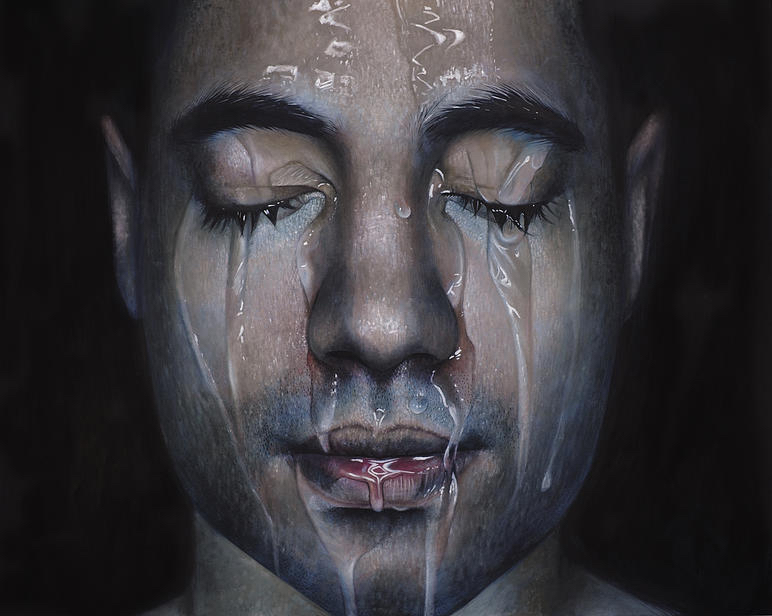
Miguel Oil on Canvas 48"X60" 2015

Miguel
Oil on Canvas
48″X60″
2015

Briefly describe the work you do. 

I paint predominantly figurative or portrait works with an emphasis on seeing the subject. 

Tell us about your background and how that has had an influence on your work and on you as an artist.

I had always been creative growing up, but I had not painted until my senior year of high school.  This class changed my life.  Though I began college as a politics major, I eventually succumbed to a different calling and finished with a double major in both art and conflict transformation. Pursuing art later in college had a deep impact on the work I do.  Initially I worked to hard to charge my paintings with political agendas.  It was senior year that I discovered a greater interest in the power of observing a human and translating it to paint rather than pressing upon an image or subject my own purpose.  

The concept of the artist studio has a broad range of meanings in contemporary practice. Artists may spend much of their time in the actual studio, or they may spend very little time in it. Tell us about your individual studio practice and how it differs from or is the same as traditional notions of “being in the studio.”

I have only had a studio space for the past month and a half as I have entered grad school at University of Washington.  It has been a big change from working in my dining room, and a welcomed one.  My studio practice is still developing.  At this point my practice relies heavily on the act of showing up, and seeking to be present in the space.  When I can do this, creating happens.  

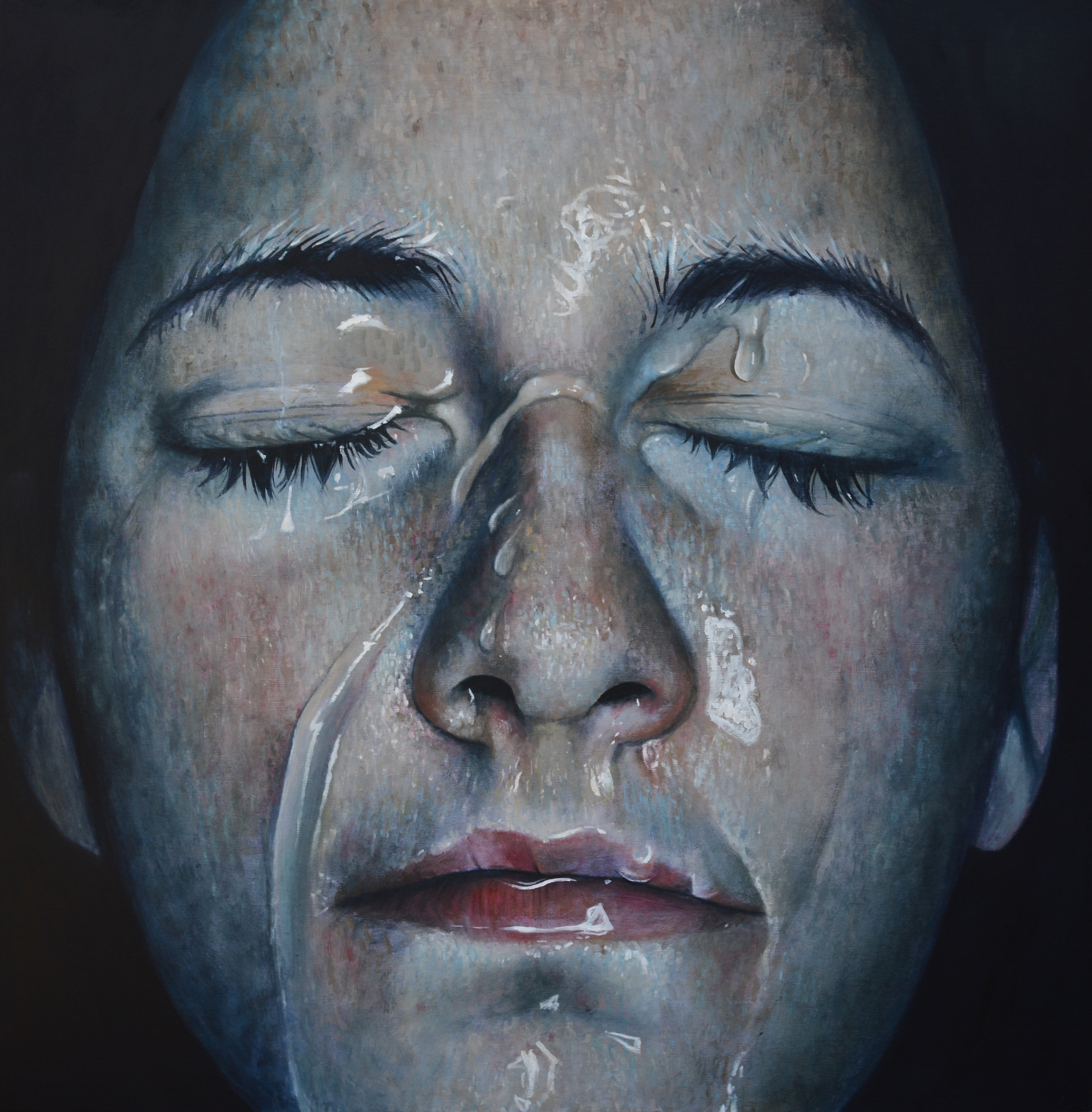
Drift Oil on MDF 36"X36" 2015

Drift
Oil on MDF
36″X36″
2015

What roles do you find yourself playing that you may not have envisioned yourself in when you first started making art?

I have found myself enjoying the business aspect of art making more than I ever would have expected.  It’s exciting to connect with new people and places by doing something that you love.  

When do you find is the best time to make art? Do you set aside a specific time everyday or do you have to work whenever time allows?

I work best when the sun is out.  At night, it’s very difficult for me to paint.  

Cece Oil on wood 15" round 2015

Cece
Oil on wood
15″ round
2015

How has your work changed in the past five years? How is it the same?

My work has drastically changed in the past five years.  I have only seriously been pursing art for a little less than five years.  So rather than changed, it has emerged from nothingness.  

How have people such as family, friends, writers, philosophers, other artists or even pop icons had an impact on the work you do?

Family, friends, musicians, theologians, philosophers, and other artists deeply impact my work and how I approach it.  Whether I recognize it or not each of these influencers has a role in the bounds, expectations, and message of my work.  

Have  you ever been pulled in the direction of a pursuit other than being an artist? What are your other interests? 

I initially thought I would study politics and event took the LSAT at one point.  I also have always written and played music, but thankfully I am still able to pursue this with my husband and our band.  

About

ericas headshots-4016Erica Elan Ciganek is a painter currently pursuing her MFA at the University of Washington in Seattle. She graduated in 2013 from North Park University with a BA in both Art and Conflict Transformation.  She continues to paint mainly portraits with an emphasis on the power of truly seeing people in a world that is quick to dehumanize.

image1 (1)

ericaelanciganek.com

All images copyright of the artist and used with their permission.  
Posted in Painting | Tagged , , , , | Leave a comment

Bill Guffey – Burkesville, Kentucky

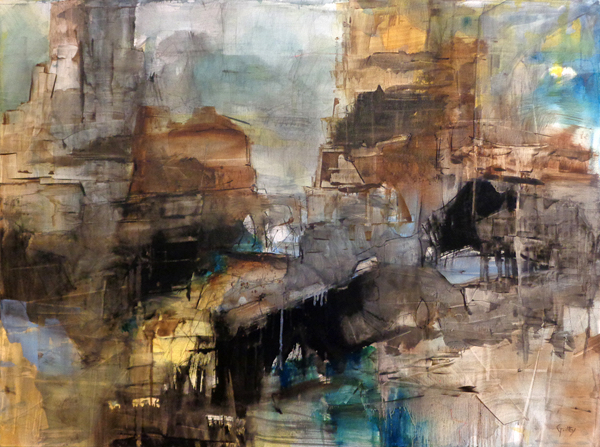
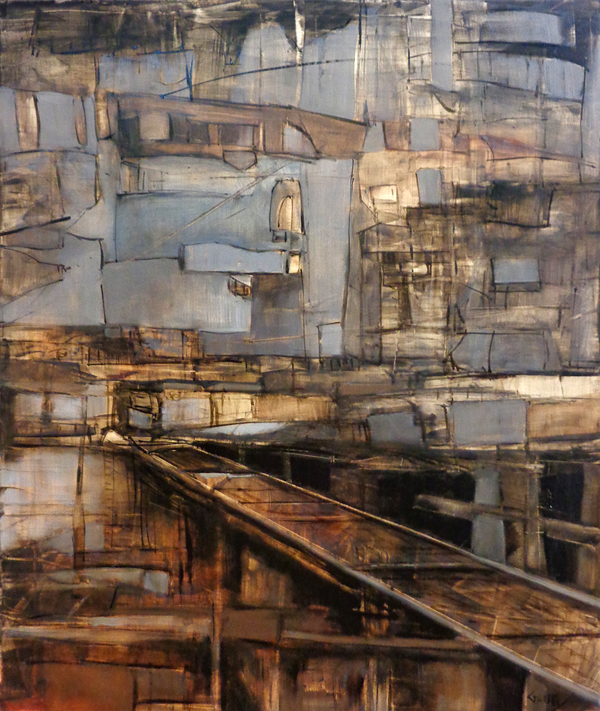
Buffalo Pass, 30" x 40", oil, 2015

Buffalo Pass, 30″ x 40″, oil, 2015

Briefly describe the work you do.

Abstracted views of the earth and our surroundings drive the ideas behind my paintings. Whether composed with a birds-eye view or from seemingly within, the shapes and colors explore what is essential for me to represent. My fascination with satellite views of fields, and the lay of the land, began my quest to show the earth in an abstract expressionist way. Using oil paint and a variety of tools to apply it, I spend hours at the easel every day, searching for the perfect composition, palette of colors, and abstraction. The pursuit of these things keep me coming back continually with more excitement than the day before.

I paint prolifically, almost obsessively, and look to complete over 300 paintings in the year of 2015.

Tell us about your background and how that has had an influence on your work and on you as an artist.

I’ve worked as a graphic artist for a newspaper for about 15 years. This job gave me insight regarding composition and color palettes. Living in various locales around the country has helped push me in directions that I otherwise wouldn’t have found if I had been stuck in the rural area in which I now live.

Span, 24" x 20", oil, 2015

Span, 24″ x 20″, oil, 2015

The concept of the artist studio has a broad range of meanings in contemporary practice. Artists may spend much of their time in the actual studio, or they may spend very little time in it. Tell us about your individual studio practice and how it differs from or is the same as traditional notions of “being in the studio.”

I use my studio for three different purposes. I have a gallery space in the front with windows to the street; a teaching area in the back with multiple easels for students; and my personal painting space that is also in the back area of the studio. I do work a 40 hour job outside my studio, so I make myself get up a 5 a.m. every day and get to the studio to paint before I have to leave for work. Since the town is small, and I live close by, I sometimes will fix lunch and head back to the studio to finish out my lunch break. I tell people that “I paint every day, whether I want to or not.” I’m of the mindset that if I work hard, keep my goals in sight, that I can attain what I want out of this journey. My studio plays a major role in that action plan.

What roles do you find yourself playing that you may not have envisioned yourself in when you first started making art?

Public speaker, marketer, and accountant.

When do you find is the best time to make art? Do you set aside a specific time everyday or do you have to work whenever time allows?

As stated above, I get up a 5 a.m. every day in order to have the time to do what I do. Plus, I find mornings more agreeable with the creative process.

Time Contingent, 36" x 30", oil, 2015

Time Contingent, 36″ x 30″, oil, 2015

How has your work changed in the past five years? How is it the same?

I have gone from being a prolific plein air painter, and painter of representational landscapes, to painting abstracts that take their cue from the earth and the world around us.

How have people such as family, friends, writers, philosophers, other artists or even pop icons had an impact on the work you do?

My family is the best, as they afford me time to create. The landscape painters from the turn of the 20th century played a major part in my self education when I first started painting. Now I am obsessed with the abstract expressionists of mid-century America. Including Diebenkorn, de Kooning, Kline, Joan Mitchell, Hofman, etc.

Have you ever been pulled in the direction of a pursuit other than being an artist? What are your other interests?

I dealt in rare and out of print books for years. Reading and family take up my time when not in front of the easel.

About

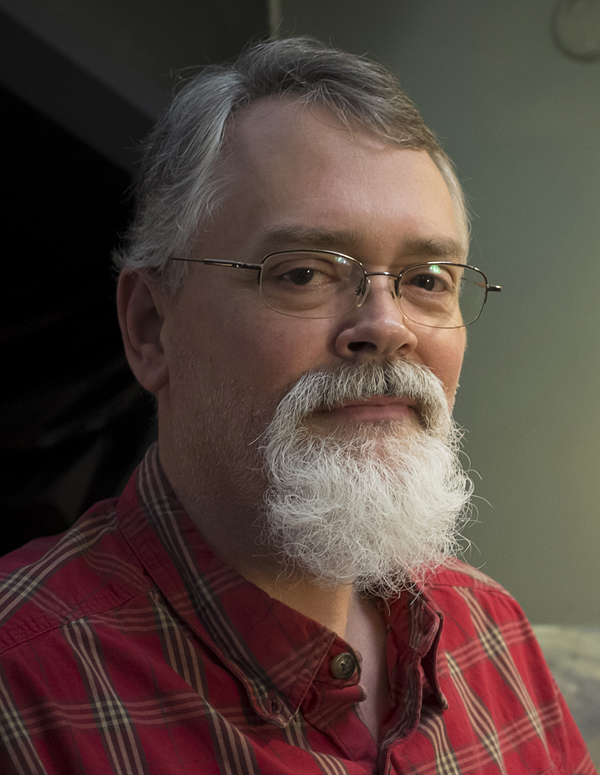
Bill Guffey, artist, Burnsville, KY.

Bill Guffey, artist, Burnsville, KY.

Bill Guffey was born and raised in the small, south central Kentucky town of Burkesville. Growing up in the rural area left much to be desired in the way of entertainment, and Guffey turned to drawing and painting at a young age. With no art teachers in the vicinity he took it upon himself to learn what he could through the use of television and books and magazines. He set up a booth at the annual Arts and Crafts Fair at the age of 12, with his simple, enthusiastic paintings. To his delight the high school started their first art class his senior year. The next few years to follow were filled with sketching, drawing, and painting sporadically, accompanied by much travel and adventure.

Leaving Kentucky, Bill headed west as a young man and ended up in the ski resort town of Breckenridge, Colorado. After the first winter of over 300 inches of snow he was ready for a warm destination. So it was off to the Caribbean. Bill lived for a short time on the small island of St. John, in the U.S. Virgin Islands. Beach life and night life was the laid back, and slowly paced norm on St. John, to which he was happy to endure both. Living in an apartment with only screens for windows and the daily lizards in the shower was a precursor of eclectic living situations for the young artist.

After leaving the island life he headed back to the Rocky Mountains of Colorado. He lived for a few months in Denver, in places that included the house of a paranoid, tow truck driving, Harley riding acquaintance that thought a spell had been cast upon him, with loaded guns, snakes and tarantulas plentiful around the house; to a one story, old motel called the Titan in a rough part of the city, whose renters were financially challenged people like himself, along with addicts, prostitutes, and roaches; a couple of multi-roommate situations full of people from all walks of life; and finally to a basement apartment that was the most normal, warm, clean, and safe place the 22 year old had lived in some time.

The mountains were calling again and we would see Bill moving to a 100+ year old mining cabin, just outside Breckenridge, Colorado. At an elevation of almost 11,000 feet, the cabin had no electricity or running water, although the outhouse was one of the deepest in the region as it was set over a vertical mine shaft that was long unused. Living through a couple of winters in this place was possible for the young man, but was harder than anything Bill had experienced before. With no sunlight hitting the cabin directly in the winter, everything was to freeze as the cold, hard, snowy season set in. A hike of a half mile on a trail was required to reach the cabin in the forest, and if one day was missed walking the packed trail it would be lost to the snow which seemed to fall almost daily. Steps were dug out of the deep snow at the front of the cabin to get up to the level of the trails to town, to the outhouse, and to the beaver pond. Some sketching and pastel work was done while living in the cabin, but most of this time was spent on surviving, and enjoying the mountain man lifestyle.

After the cabin, a few more years were spent in Breckenridge enjoying the ski town life and living with a cast of characters that would challenge any modern day sitcom. More than a decade after leaving Kentucky, Bill returned home to open (and close) a bookstore, get married, start a family, and finally have the stability and support to get serious about his art.

Bill now owns a building on a prominent corner of the courthouse square in Burkesville, Kentucky. He teaches classes there, and paints in the studio every day. Up at 5 a.m. daily for the opportunity to paint before going to his job as a graphic artist at the local newspaper is just a small part of the devotion Bill has for his artistic journey. Bill gets up and paints every day. He tolerates chaos, and works harder at his craft than anything he has done in his entire life.

There have also been dozens of interviews with Guffey regarding his paintings and techniques, and various projects he has taken on over the last few years. These interviews, including newspaper, magazine, television and radio, can been seen on this website under the Press heading.

Bill participates in many shows and competitions each year, including the All Kentucky Juried Fine Art Exhibition; the Annual Holiday Miniatures Exhibition at the Abend Gallery in Denver, Colorado; First Brush of Spring in New Harmony, Indiana; artist residency in Breckenridge, Colorado; and numerous other locations and plein air venues.

A solo exhibition of Guffey’s abstract work will be held during the months of December 2015 and January 2016 at SKyPAC (Southern Kentucky Performing Arts Center) in Bowling Green, Kentucky. The show opens on December 4th, 2015.

Bill has been selected as an Emerging Artist by Art Galleries and Artists of the South magazine which can be seen in their Fall 2015 Issue, and on their website under the Emerging Artists heading. Recently Bill has taken home a 1st Place Award at the 8th Annual Artworks, Inc. Members Exhibition 2015; a Best of Show and Merit Award, respectively, at the 7th Annual Artworks, Inc. Members Exhibition; 3rd place award at the Owensboro Museum of Fine Art Plein Air Paint Out; and an Honorable Mention at the 2013 All Kentucky Juried Exhibition.

Bill Guffey, artist, Burnsville, KY.

Bill Guffey, artist, Burnsville, KY.

billguffey.com

All images copyright of the artist and used with their permission.  
Posted in Painting | Tagged , , , , | Leave a comment

Amanda Pulcine – Altoona, Pennsylvania

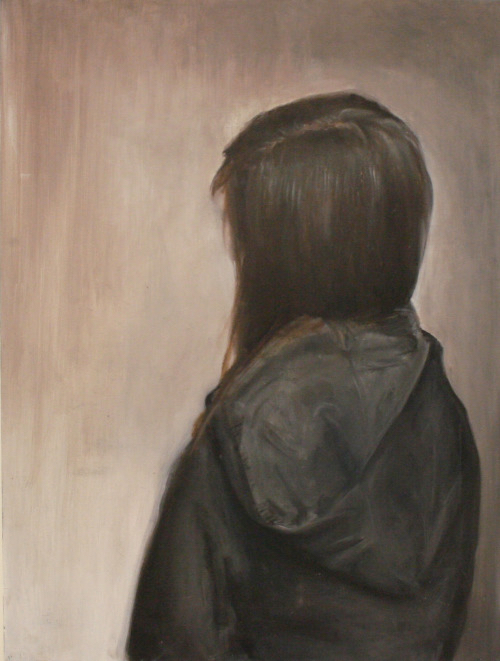
Self Portrait, Oil on panel, 36X24 in 2015

Self Portrait, Oil on panel, 36X24 in 2015

Briefly describe the work you do. 

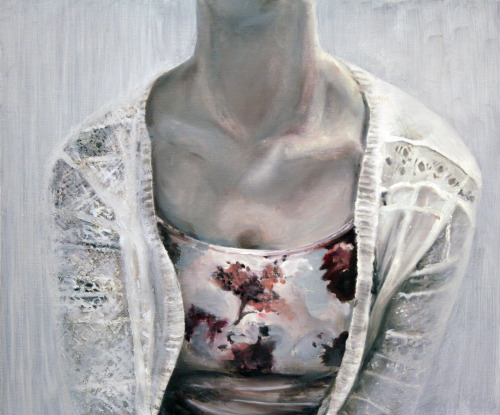
My most recent work consists of oil paintings that explore art therapy and the body. I consider all of my paintings to be a unique approach to self portraiture.

Tell us about your background and how that has had an influence on your work and on you as an artist.

I grew up in Altoona, Pennsylvania where I lived with my mom until I was eighteen. Looking back, I can’t think of a specific moment that I realized I wanted to be an artist. I did a lot of arts and crafts with my aunt and I remember always wanting to draw.

I was not social in school and still have little interest in socializing. This made me very observant and self critical. I began working as soon as I was old enough. I worked in fast food on top of school for four years. I think that is what made me an anxious person. All of this impacted my work as an artist, because I had a lot of time to contemplate what others were thinking about.

The concept of the artist studio has a broad range of meanings in contemporary practice. Artists may spend much of their time in the actual studio, or they may spend very little time in it. Tell us about your individual studio practice and how it differs from or is the same as traditional notions of “being in the studio.

My current living situation allows me the space I need to make art. I live alone with my greyhound and two cats. I assume that is a pretty typical studio set up for most artists. The front room in my house is unused so I keep all of my supplies there.

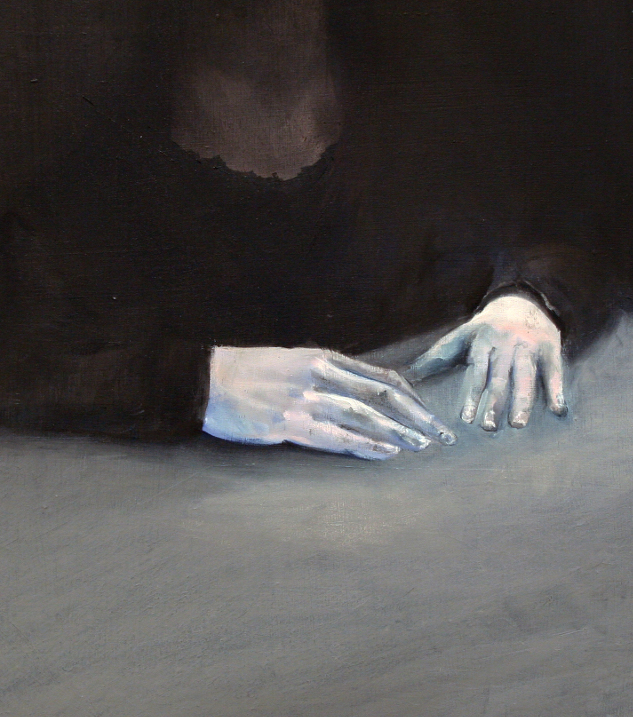
Posture, Oil on Panel, 16X19in 2015

Posture, Oil on Panel, 16X19in 2015

What roles do you find yourself playing that you may not have envisioned yourself in when you first started making art?

I didn’t know there would be so much writing about what I do. I still struggle with talking about myself and my work.

When do you find is the best time to make art? Do you set aside a specific time everyday or do you have to work whenever time allows?

I recently graduated from Penn State Altoona in May 2015. Currently, I am working two retail jobs averaging fifty-five hours a week. I started my second job to pay off student loans, so I worry that I am not producing enough work. I have been working on the same painting I started two months ago which is frustrating. I can maybe find a couple hours a week to get some painting done.

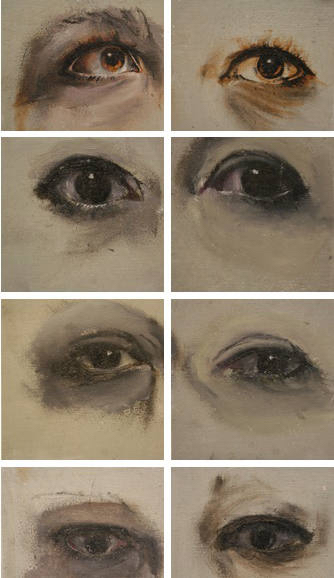
Eyes, Oil on panel, 3X3in each 2015

Eyes, Oil on panel, 3X3in each 2015

How has your work changed in the past five years? How is it the same?

Five years ago, I was a high school student also attending the Greater Altoona Career and Technology Center for Visual Arts. I was mostly drawing and learning Photoshop. I thought I was going to go to college for graphic design but got into art therapy right before graduating high school. I spent one year at Seton Hill University studying art therapy then transferred home to Penn State Altoona where I majored in Visual Arts and minored in Psychology. I did not start painting until my second year of college. I never liked painting and always thought I would be drawing. My first painting instructor encouraged me to stay positive and open minded about learning a whole new medium. I have not made a decent drawing since that class. During my senior year I worked on my first solo exhibition How Things Are. My last semester was when I decided I didn’t want to be an art therapist and wanted to focus on painting. Studying art as therapy influenced my work and helped me better convey ideas so that viewers could openly interpret my paintings. I would say one thing that has stayed the same is my attitude towards my work. I am very self critical and often talk myself out of ideas. Sometimes I am very ambitious about the projects I take on, and other times I am not confident in my own abilities as an artist. In a way this is a good thing because I want to make better work so I push myself to continue learning.

How have people such as family, friends, writers, philosophers, other artists or even pop icons had an impact on the work you do?

I am most inspired by contemporary figure painters. I often reference Michael Borremens. I spend a lot of time just looking at other artist’s work. I have been told I waste a lot of time looking at other artists’ paintings rather than diving into my own. My work would not be what it is if I had not discovered other artists with ideas similar to mine. I never would have gone through with a lot of ideas if I thought that no one would get what I was trying to say.

I had a professor my senior year who was really supportive of every choice I made, and he made sure I was aware that he understood the psychological aspect of my paintings. That was really refreshing because it was the most productive I had ever been, however it was incredibly stressful knowing a lot of people were about to see what I was investing all of my time into. I am lucky to have a family that supports what I want to do and believes that I can make something out of this.

Have you ever been pulled in the direction of a pursuit other than being an artist? What are your other interests? 

I thought I was set on being an art therapist. I knew that wasn’t really what I wanted, but it took me a while to admit it to myself, and others, that I just wanted to be a painter. When people ask me what I want to do, I feel happier saying artist rather than therapist just to avoid the, “What can you do with art?” question. I have found that a lot more people are interested in what I do.

I am not interested in much else. I don’t think I would be happy in any other field of work.

About

headshot (1)Amanda Pulcine, USA, born 1993 is a practicing artist based in Altoona Pennsylvania who creates drawings, paintings, and sculptures in both traditional and digital mediums. Amanda graduated from Penn State Altoona in May 2015 with a Bachelor’s degree in Visual Art Studies. Her work has been displayed in the Southern Allegheny Museum of Art in downtown Altoona and has appeared in the Penn State Altoona art magazine Hard Freight. Amanda was also a 2013 recipient of the Zoller Art Award at Penn State Altoona. She recently won a Howard Award of Excellence for her piece Self Portrait displayed during the Nebraska National Undergraduate Juried Art Exhibition September 2015. Her most recent work is a series of oil paintings that explore art therapy and the body. Amanda hopes to attend graduate school for Fine Arts.

the_best_part_of_a_bad_painting_detail

apulcine.tumblr.com

All images copyright of the artist and used with their permission.  


Posted in Painting | Tagged , , , , | Leave a comment

Robert Fraher – Menomonie, Wisconsin

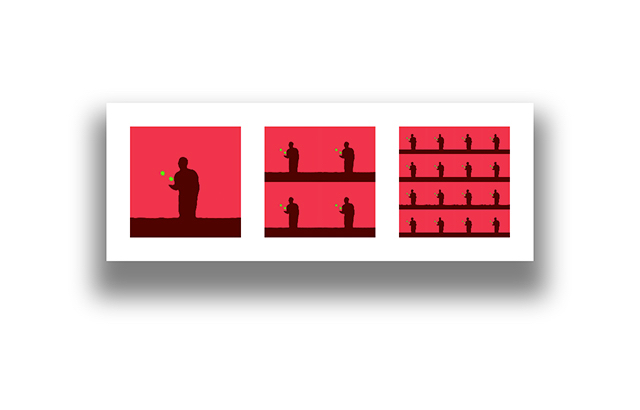
 Interwebs Killed the Video Star: Fraher_IKTVS.jpg (attached) Medium: HTML / CSS / JavaScript / GIF / MP3 Size: Any screen size Year: 2015 Link: http://iktvs.robertfraher.com

Interwebs Killed the Video Star: Fraher_IKTVS.jpg (attached)
Medium: HTML / CSS / JavaScript / GIF / MP3
Size: Any screen size
Year: 2015
Link: http://iktvs.robertfraher.com

Briefly describe the work you do. 

As an artist and designer, my work explores the medium of human-computer interaction as a context for cognitive and emotional engagement. For me, a key dimension of that engagement involves a sense of playfulness. I like to build things that allow users to investigate and create individualized experiences for themselves. A common way that I do this is by rewarding users’ for their curiosity with little discoveries! I believe that we all construct our own understanding of the world through exploration. Through my work, I try to promote people’s engagement by fostering exploration.

Tell us about your background and how that has had an influence on your work and on you as an artist.

My initial interest in the arts was through music. I began my undergrad career as a jazz major studying the electric fretless bass. My interest in music eventually led me to become a recording engineer, which is when I first started working with digital media. Over time, my work with digital audio evolved to involve digital video, and eventually, interactivity. As a result, I’m often led to create experiences that include the use of multiple media simultaneously.

Context is King: Fraher_Context_Is_King.jpg (attached) Medium: HTML / CSS / JavaScript / Processing / MP3 Size: Any screen size Year: 2015 Link: http://cik.robertfraher.com

Context is King: Fraher_Context_Is_King.jpg (attached)
Medium: HTML / CSS / JavaScript / Processing / MP3
Size: Any screen size
Year: 2015
Link: http://cik.robertfraher.com

The concept of the artist studio has a broad range of meanings in contemporary practice. Artists may spend much of their time in the actual studio, or they may spend very little time in it. Tell us about your individual studio practice and how it differs from or is the same as traditional notions of “being in the studio.”

I work almost exclusively digitally. Therefore, my studio is my laptop, and increasingly, my phone. More often than not, the place where I make work is my faculty office, as the space affords me the seclusion I need.

What roles do you find yourself playing that you may not have envisioned yourself in when you first started making art?

The roles I find myself playing that I did not envision when I first started making art are all of the trappings of being a university professor (e.g., committee member, advisor, instructor).

When do you find is the best time to make art? Do you set aside a specific time everyday or do you have to work whenever time allows?

I enjoy making work the most when I have dedicated blocks of time during which I can focus on the creative task and not be disturbed or distracted by other things. Often, this is during the evenings and nights alone in my office. But perhaps the most immersive way I’ve found for achieving this is through an artist residency. What an amazing opportunity to jumpstart a project!

 No Horse in Particular: Fraher_No_Horse.jpg (attached) Medium: Flash / JPG / XML Size: 960x640 pixels Year: 2009 Link: http://robertfraher.com/NHIP

No Horse in Particular: Fraher_No_Horse.jpg (attached)
Medium: Flash / JPG / XML
Size: 960×640 pixels
Year: 2009
Link: http://robertfraher.com/NHIP

How has your work changed in the past five years? How is it the same?

In the past five years, my work has grown to involve a lot more commercial web design. This change connects directly to my activities as a professor of interactive design at the University of Wisconsin-Stout. The university has a polytechnic designation. Therefore, the curricula for many of our degrees emphasize students developing industry-based competencies. In an attempt to help my students become Web designers, I kinda had to become one first!

How have people such as family, friends, writers, philosophers, other artists or even pop icons had an impact on the work you do?

My influences are many and diverse. Most recently, I’ve enjoyed studying the work of Christopher Alexander, an architect and theorist. His work on the Timeless Way of Building is fundamental to my current major project.

Have you ever been pulled in the direction of a pursuit other than being an artist? What are your other interests? 

The other directions in which I am pulled include my roles as father and husband. But, as much energy as having a family demands, it provides me with even more in return. My one remaining hobby for which I struggle to find adequate time is juggling. As a complement to the intense precision of the digital space, I find the imperfection and spontaneity of freestyle juggling (https://vimeo.com/user8398059/videos) creatively rejuvenating. So much so that I’ve recently started exploring ideas for integrating juggling into my creative research agenda. We’ll see how that goes…

About

Robert Fraher is an associate professor at the University of Wisconsin–Stout. He has a Master of Fine Art degree in graphic design with an emphasis on interactivity from the University of Minnesota. His research explores how interactive design and digital media can facilitate individual expression and community involvement. He has exhibited, published, and presented research in the fields of graphic design, art, instructional design, interaction design, and creativity.

RobertFraher.com

All images copyright of the artist and used with their permission.  
Posted in Digital Media | Tagged , , , , | Leave a comment