Nina Ghanbarzadeh – New Berlin, Wisconsin

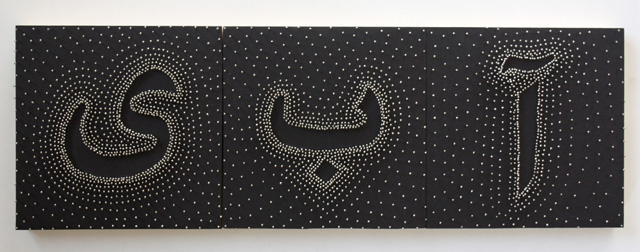
Blue Sequin pins on foam board mounted on panel, 6” x 18” (3 panels, each 6” x 6”), 2014

Blue
Sequin pins on foam board mounted on panel, 6” x 18” (3 panels, each 6” x 6”), 2014

Briefly describe the work that you do.

I consider myself mainly a painter but I switch to different media depending on the content of the works. My current body of work is an exploration of text as image. Here, I am trying to create a more simplified and abstracted version of Persian patterns using Farsi script (my mother tongue). I am not painting these, but rather creating them using different materials, such as pins on foam board, ball point pen on translucent paper, etc. 

At what point in your life did you decide to become an artist?

I have always wanted to be an artist as far as I can remember. But I knew it for sure after getting my first degree in chemistry (Pune University, India). I joined Gholamhossein Nami’s studio in Tehran, Iran upon my return. I would go there once a week to practice art. I owe my knowledge on painting and composition to him. He was also a graduate of UWM and it was just a coincidence that I ended up at the same school as him. Due to life circumstance at that time, going to his studio and taking his lessons was more of a hobby than a serious matter to me. It was only upon my immigration to the U.S. and the support of my husband, that I could continue my art education at University of Wisconsin Milwaukee. 

Tell us a little about your background and how that influences you as an artist.

Before migrating to this country, I was trying to make sense of my environment in my paintings. I would paint ordinary, everyday objects like chairs, shoes, fruits and anything that was interesting enough for me to paint. Later I found out that I was very much drawn to minimal and abstract works of art and hence I started to simplify the objects and forms in my paintings. Also I had started to investigate the relationship in between these simple objects and their surroundings like the table-top, the edge of the wall in the background or their own shadows. As I continued to paint, my colors became muted and shapes, simpler.

As soon as I migrated to this country about 13 years ago, it seemed like my whole world was turned upside down! I experienced culture shock as I transitioned from a very formal and close society to a very casual and open one. I was also lonely due to the isolation of the suburbs and depressed due to long and dark winters. Adjusting to the many practical aspects of living in this country and the many cultural nuances that I had to learn became a challenge.

When I started creating art again, I found an urge to explore my culture. I surrounded myself with everything Persian. knick knacks, books, pictures and music from Iran. I started to create a sanctuary not only in my head but in my artwork as well. It made me feel closer to my loved ones and the home that I grew up in. This process started when I became a student at UWM and it continues to be important part of my life and art making to this day.

I had an incredible experience at the Peck School of the Arts and I cannot say enough about my learning and the support that I received from my instructors. There are particularly two names that I need to mention here: Denis Sargent for his views on art and Allison Cook for her great knowledge on art making in general.

I am currently an artist in residence at RedLine Milwaukee. I feel very fortunate to be part of this great organization and also my wonderful mentor and friend Nirmal Raja who is helping me discover deeper meaning and purpose in my work. 
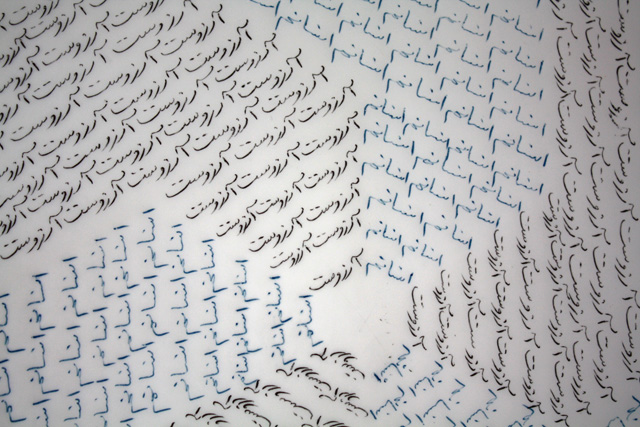
I desire for a human being 2 (detail shot) Black and blue ball point pen on drafting film, 17” x 11”, 2014

I desire for a human being 2 (detail shot)
Black and blue ball point pen on drafting film, 17” x 11”, 2014

What types of conceptual concerns are present in your work? How do those relate to the specific process(es) or media you use?

The underlying theme in my work is immigration and it’s challenges and the nostalgia that follows.

I believe that a majority of immigrants no matter where they come from, share similar experiences and challenges.

These are rich areas of inspiration for my work. At the same time, I am trying to simplify these concepts and reduce them to their essence. This sometimes calls for a switch in media or approach. For example, some of my work are small panels that show Farsi characters on them. I use sequin pins to create the shape of each individual character. The act of pushing in the pins and poking through a membrane lasts only a second and then disappears. Just like the fleeting pain that I experience every time I push in a pin, the memories that take me back in time are bitter sweet and fleeting. It would not have been possible to convey this idea of transient memories if I wanted to paint them. 

Red Sequin pins on foam board mounted on panel, 6” x 24” (4 panels, each 6” x 6”), 2014

Red
Sequin pins on foam board mounted on panel, 6” x 24” (4 panels, each 6” x 6”), 2014

We once heard Chuck Close say he did not believe in being inspired, rather in working hard everyday. What motivates you in your studio practice?

One cannot go wrong with hard work and perseverance. There has been many times in my career as an artist, that I was not creative and nothing made sense to me. But I would force myself to dedicate certain hours per day to be present behind my desk and in the studio space even if it meant just staring at the wall.

I also find it very crucial to look back at the works that I created in the past and critique them with a fresh eye. I regard each and every work regardless of medium and scale, as a stepping-stone towards more mature and better works in the future. This is something that I do often when I don’t feel like creating.

Working hard does not only mean sitting down and making something. Reading books and articles, researching and understanding the concepts and ideas are part of hard work as well.

We are all exposed to new ideas, discoveries, and findings every single day through the internet and social media. The amount of data and information available is extraordinary. In this environment, it is hard to be in total isolation. I might also get inspired while listening to music or driving my car and looking at the scenery. Is it even possible not to get inspired?

I also find it very helpful to interact and talk to other artists. I can find ideas or polish my ideas by interacting with them. I find it very interesting to listen to people’s stories and experiences. I also get inspired when I look at art in general. Nothing excites me more then walking through galleries or museums and looking at art. 

What artists living or non-living influence your work?

I look at different artists for different reasons. These artists may not have any similarity in their dis- cipline and practice but each of them have a great deal to offer. I am also interested in the path that an artist has taken and the evolution in their art making. Sometimes this journey is more interesting to me than the final destination. Some artists that I look at are Mark Rothko, Piete Mondrian, David Schnell, Jeremy Mann, Julia Fish, Agnes Martin,Robert Ryman and Mark Bradford. 

When you are not making art what types of activities and interests do you engage in? 

Because my extended family stays with us for several months at a time, I tend to spend a lot of time cooking and hosting. When I am not taking care of my family, I like to surf the net and look at work by other artists around the globe. I also like gardening and walking when the weather is warm. 

About 
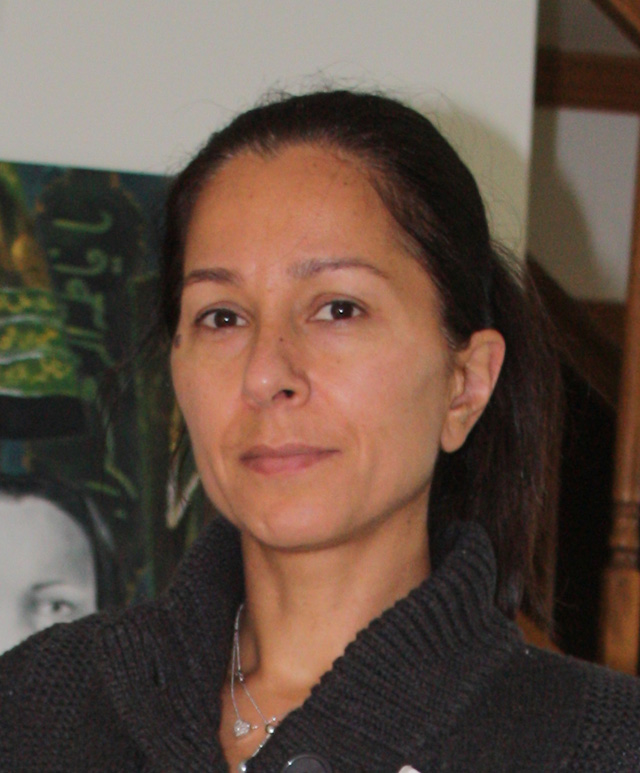
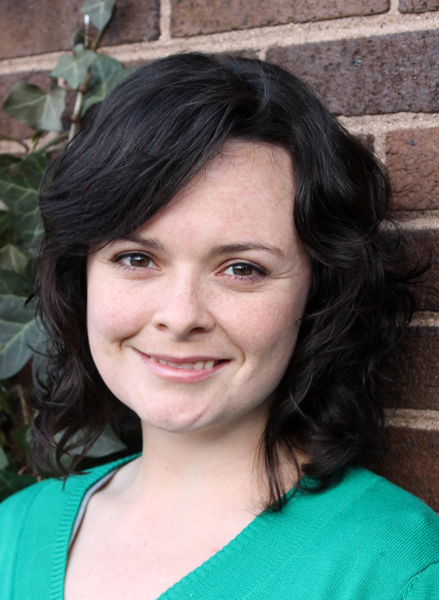
HeadShotNina Ghanbarzadeh was born and raised in Tehran,Iran. She spent four years in India from 1984 to 1988, where she got her bachelor’s degree in chemistry from Pune University. After returning to Iran in 1989, she realized that her passion was not in chemistry. She started taking art classes and painted for ten years. During this time she did several free lance translations and tutored children at elemen- tary schools. Upon immigrating to the United States, she returned to school in 2005 and received her BFA in Fine Arts and Graphic Design from the University of Wisconsin-Milwaukee in 2013.

Nina Ghanbarzadeh’s paintings are depictions of her culture and background. She is not only trying to portrait the unfamiliar subjects from Iran to Western viewers, but keeping her memories alive and fresh at the same time. Bits and pieces from historical sites to advertisements, Farsi script, tile and rug patterns are present in her work. Sometimes she juxtaposes subjects that do not belong to the same time period in the history of Iran. She would like for the viewer to think about how these elements could have any connection to each other. Her works are representational but she would like to bring more abstraction to the traditional Persian patterns and designs.

She currently lives and works in Milwaukee, Wisconsin with her husband and daughter. 

I desire for a human being 1 Ball point pen on drafting film, 11” x 8 1/2”, 2014

I desire for a human being 1
Ball point pen on drafting film, 11” x 8 1/2”, 2014

All images copyright of the artist and used with their permission. 

Posted in Uncategorized | Tagged , , , , | 1 Comment

Katherine Virag – Buffalo, New York

Time Flies. Found Objects, Mixed Media. 31_ x 28_ x 16_. 2013

Time Flies. Found Objects, Mixed Media. 31_ x 28_ x 16_. 2013

Briefly describe the work you do.

I make sculptures with found objects. I’m particularly interested in exploring how I can use material objects to represent abstract concepts of a physical self vs. a spiritual self or soul, one’s inner world vs. outer world and life vs. death. In addition to my found object sculptures, I’ve also recently started a series of wall hanging sculptures made out of twine representative of tangled inner thoughts and the struggle to make sense of those thoughts.

Tell us a little about your background and how that influences you as an artist.

I was born and raised in Detroit and I remember being fascinated early on by the graffiti and decay throughout the area. There’s a great recycling non-profit called Arts and Scraps in Detroit. They sell scrap industrial materials and donated arts and crafts materials and they have an education program where they put project kits together with these materials and bring them to schools. In the early 90s they came to my preschool, and in retrospect, I think that day was the start of my love affair with making art with odd materials. My mom was already a quilter and crafter, so the discovery of Arts and Scraps only added to the abundant presence of craft supplies in the house. Growing up, I went to lot of garage sales and thrift stores, and it was only a matter of time before I realized the potential of the items these places had to offer as art materials, too. 

The concept of the “artist studio” has a broad range of meanings, especially in contemporary practice. The idea of the artist toiling away alone in a room may not necessarily reflect what many artists do from day to day anymore. Describe your studio practice and how it differs from (or is the same as) traditional notions of “being in the studio.”

I’m currently a resident artist at Buffalo Arts Studio, where almost all of my art making takes place. Having a studio outside the home allows me to keep my art making mess contained and out of my tiny apartment, and also eliminates certain distractions while I work, like the TV and my cats. I do think it’s important to get honest thoughts and feedback from others, though. I try to leave my door open when I’m working so that visitors to can stop in and strike up a conversation about my work.

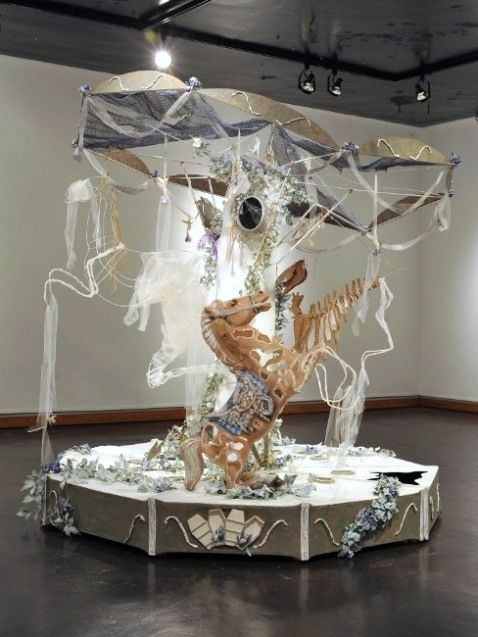
Carousoul. Paper Mache, Wood, Steel, Found Objects, Mixed-Media. 7' x 7' x 7'. 2013

Carousoul. Paper Mache, Wood, Steel, Found Objects, Mixed-Media. 7′ x 7′ x 7′. 2013

What unique roles do you see yourself as the artist playing that you may not have envisioned yourself in when you first started making art?

The artist as a researcher. When I was young, I had this belief that an artist thinks up a masterpiece, just sits down and makes it, thinks up another one, makes it, and so on and so forth. The reality is I spend a lot of time researching and experimenting, and frequently the results are not a masterpiece. Sometimes I make a couple maquettes of a piece before even starting on the real thing. Instead of producing one piece at a time, I’ve often got 4 or 5 things going at once. Research for me can involve looking at the work of other artists working with similar themes or materials, or going to the library and looking through psychology books, or wandering through the aisles of Home Depot or Michaels just looking at materials and thinking about their possible uses. Then I experiment. When I started working with found objects, a lot of initial experimentation went into just trying to affix objects of different materials together. I discovered many methods that didn’t work. At first, it was instinctual to think of these as failures, but eventually I came to realize that it’s okay not to get things perfect on the first try, and it’s actually a really unrealistic expectation to do so.

Lobotomy. Cast Aluminum, Mouse Bones, Found Objects, Mixed Media. 12_ x 20_ x 12_. 2012

Lobotomy. Cast Aluminum, Mouse Bones, Found Objects, Mixed Media. 12_ x 20_ x 12_. 2012

When do you find is the best time of day to make art? Do you have time set aside every day, every week or do you just work whenever you can? 

I work part-time during the week and my work shifts often start at 5 or 6am, so my studio time revolves around my work schedule. I generally spend all day Saturday and Sunday in the studio and try to get there after work a few times a week. If I’m working on something small or not very messy, I will occasionally bring things home to work on.

How has your work changed in the last five years? How is it the same?

Five years ago, I was an undergraduate at LSU studying photography. I was shooting 35mm film in New Orleans and occasionally flying home and shooting in Detroit. I was really interested in looking for found still life set-ups, like debris piles and thrown out toys. I moved on to making my own still life sets, which were gradually becoming more advanced and sculptural and I was becoming less interested in the actual photographic process. After I took a welding class, I switched my concentration to sculpture, and haven’t looked back. I’ve explored diverse 3D mediums such cast metals (aluminum, bronze and, iron), ceramics, paper mache, and wood, incorporating found objects with fabricated pieces.

Are there people such as family, friends, writers, philosophers or even pop icons that have had an impact on the work you do?

The writings and theories of existential psychotherapists have had a huge direct impact on my work, specifically Otto Rank, Irvin D. Yalom, and Emmy Van Deurzen

If you had an occupation outside of being an artist, what would that be and why?

I’ve always been envious of touring bands and musicians because living in a bus and getting to wake up in a different part of the country everyday sounds so exciting, so I’d probably sell band merchandise or be the roadie that vacuums the stage and tapes down the setlists for the band. But in actuality, I’m planning on going back to school for my MFA in a couple years, and hope to someday become a professor.

About 

headshot_viragKatherine Virag was born and raised in Detroit, MI. She received both her BFA in Studio Art (concentration in Sculpture) and her BS in Psychology from Louisiana State University in 2013. As an undergraduate, she also spent a year studying at Buffalo State College as a national exchange student. She has been the Arts and Crafts Program Director for two different summer camps in Colorado, planning and leading arts and crafts projects for a variety of populations including children and adults with disabilities. Her work has been included in the Uncommon Thread Wearable Art Show in Baton Rouge, LA and has been included in shows in Tangent Gallery in Detroit, MI and Hi-Temp Gallery in Buffalo, NY. She is currently a resident artist at Buffalo Arts Studio in Buffalo, NY.

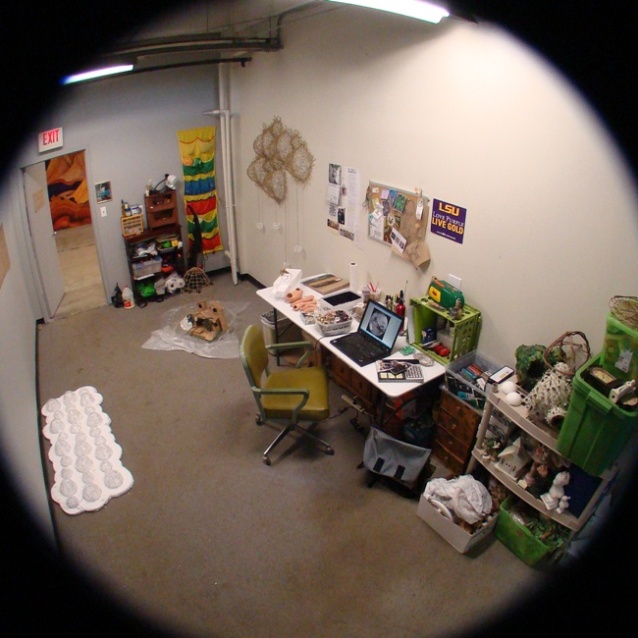
A Fisheye View of Katherine's Studio

A Fisheye View of Katherine’s Studio

www.katherinevirag.com

All images copyright of the artist and used with their permission. 
Posted in Uncategorized | Tagged , , , , | Leave a comment

Justin Crowe – Taos, New Mexico

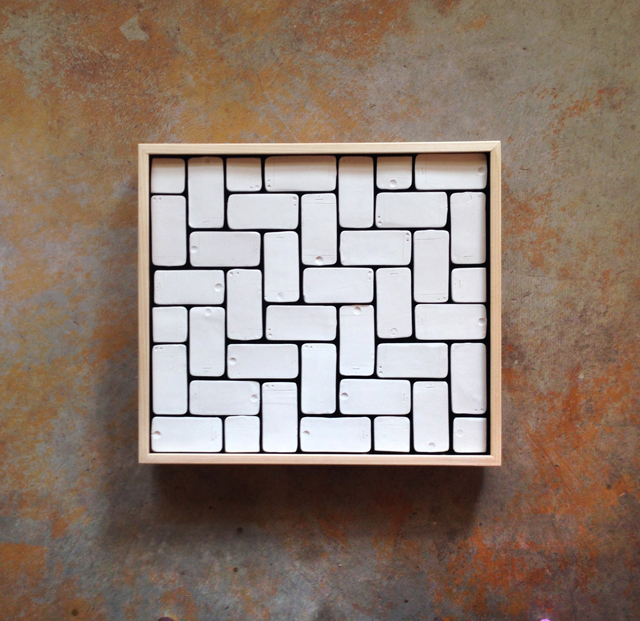
“Traditional 21st Century Tile Composition”, ceramic, 2014

“Traditional 21st Century Tile Composition”, ceramic, 2014

Briefly describe the work you do.

We are in the awkward midst of Digital Age puberty. I create art about technology’s affect on culture and culture’s affect on technology.

Tell us a little about your background and how that influences you as an artist.

When I was young I was really into making functional pottery. We are in the awkward midst of Digital Age puberty. I create art about technology’s affect on culture and culture’s affect on technology.

Not just for the creative ‘making,’ but also for the ability to market and sell a product. This is the first evidence of my combined interest in business and art, which has manifested itself many times. Evidence of this interest showed through recently in a Kickstarter project called Meme The World. In this piece I was able to produce and distribute over 100 mugs to travel around the world as physical renditions of the viral Internet meme. The results where incredible and I received images from the U.S, Australia, Scotland, England and France. You can see all the photos at www.MemeTheWorld.com. 

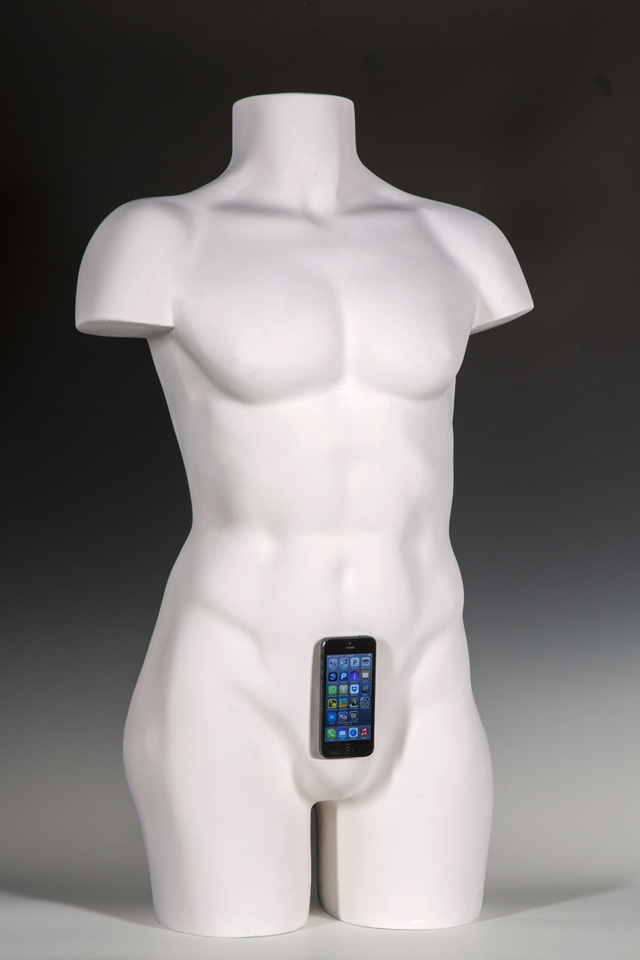
“Classical iPhone Charger” Medium: Foam and Plaster Year: 2014

“Classical iPhone Charger” , Foam and Plaster,  2014

The concept of the “artist studio” has a broad range of meanings, especially in contemporary practice. The idea of the artist toiling away alone in a room may not necessarily reflect what many artists do from day to day anymore. Describe your studio practice and how it differs from (or is the same as) traditional notions of “being in the studio.”

I pursue my art practice as an active entrepreneurial endeavor that extends beyond just creating art into other disciplines such writing and presentation. I consider my research an extremely important part of my studio practice. My best research is done through experience, like learning about crowdfunding by launching a Kickstarter project or learning about marketing by working as a freelance blogger. I try to immerse myself in the themes that I make art about in order to make sure I have an informed objective viewpoint and know my audience well.

The making of my art is definitely a secondary aspect of my overall practice right now. If I had the money to pay someone else to make all of my art objects, I would. I am most interested in designing the optimal experience to effectively get an idea across. 

What unique roles do you see yourself as the artist playing that you may not have envisioned yourself in when you first started making art?

When I began creating art I had a craft-centric practice, focusing on technique, medium, and process. Now, I have a very conceptual practice that involves thinking of a theme and then crafting an experience around that idea. This was an evolution that happened in school. I went to college to learn how to make a pot, but instead I spent four years learning what a pot is. I never expected that. 

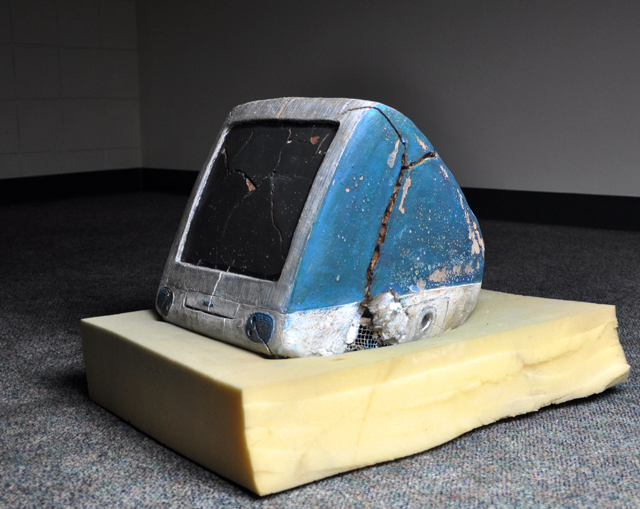
“The New Old” Medium: Unfired clay, acrylic paint. Year: 2013

“The New Old”, Unfired clay, acrylic paint, 2013

When do you find is the best time of day to make art? Do you have time set aside every day, every week or do you just work whenever you can? 

I work as a freelance blogger as well as an artist. My ideal schedule is to spend my mornings writing about art and the rest of the day making art. Although… the goal is always to spend more time making! 

How has your work changed in the last five years? How is it the same?

My conceptual development over the past five years has been massive. I transitioned from making technique-centric abstract objects that “felt like technology” to creating pieces about specific aspects of modern technology. The transition has been really exciting and has expanded and engaged my audience much more effectively. I began working as a potter and fell in love with the idea of interactive art. This is an interest that resonates to this day, but the function has gone from exclusively pottery to include iPhone Chargers, QR Codes, and performative work. 

Are there people such as family, friends, writers, philosophers or even pop icons that have had an impact on the work you do?

Miley Cyrus is pretty interesting. I am enjoying witnessing her Hannah-Montana- to-Modonna evolution over the past few years. Her stunt at the VMA’s in October was amazing. It tangibly manifested an incredible ideological divide between individuals in our culture who live primarily in the ‘lawless’ virtual realm and the individuals who live in the ‘censored’ physical realm. I think Cyrus is somewhat of a modern day feminist. 

If you had an occupation outside of being an artist, what would that be and why?

I love the tech startup culture right now. Entrepreneurs are delusional, passionate and creative. So they are pretty much artists working in a different medium. A lot of them are weirdoes. I would do that. 

CroweHeadshotAbout 

Justin Crowe creates art about technology’s affect on culture and culture’s affect on technology.

He received his Bachelor of Fine Art form the New York State College of Ceramics at Alfred University with a focus in ceramics. In 2012 Crowe successfully completed a Kickstrater.com project that sent over 100 ceramic mugs traveling around the world as a physical rendition of the Internet Meme. Following the success of the MEME The World Project Crowe received a Creative Opportunities Grant to complete a large-scale tile installation titled ‘It’s a Whale” and was invited for a one-month Visiting Artist position at Valley City State University. Crowe’s work has been featured in various publications including Ceramics Monthly Magazine, Clay Times Magazine, Huffington Post, and TrendHunter.com. Most recently his work has been exhibited at The Ohio Craft Museum and at Red Lodge Clay Center in Montana coinciding with a month-long sculpture residency. Crowe is based in Taos, New Mexico and in addition to being an artist, is Managing Editor of the visual culture blog DesignFaves.com and a writer for VisualNews.com. 

Favorite Place

Favorite Place

All images copyright of the artist and used with their permission. 
Posted in Uncategorized | Tagged , , , , | 1 Comment

Jeff Redmon – Milwaukee, Wisconsin

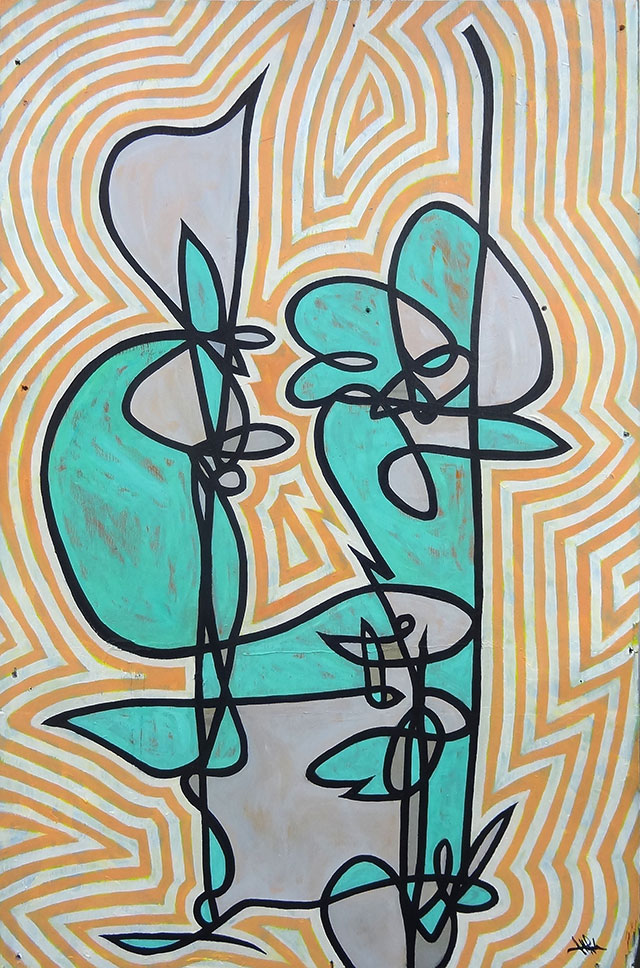
Soundwave, 30in. x 48in. oil on found wood, 2013

Soundwave, 30in. x 48in. oil on found wood, 2013

Briefly describe the work that you do.

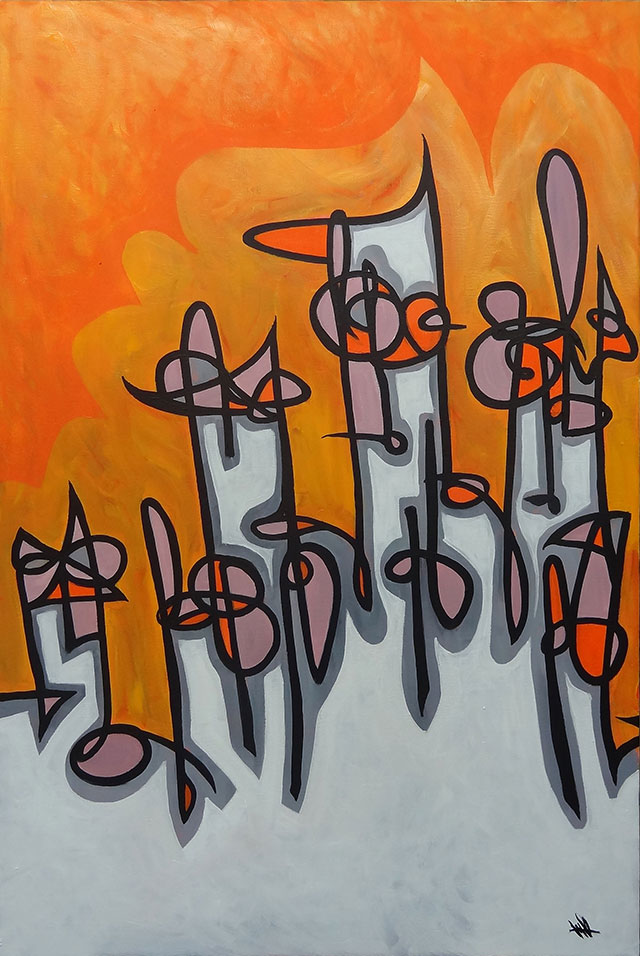
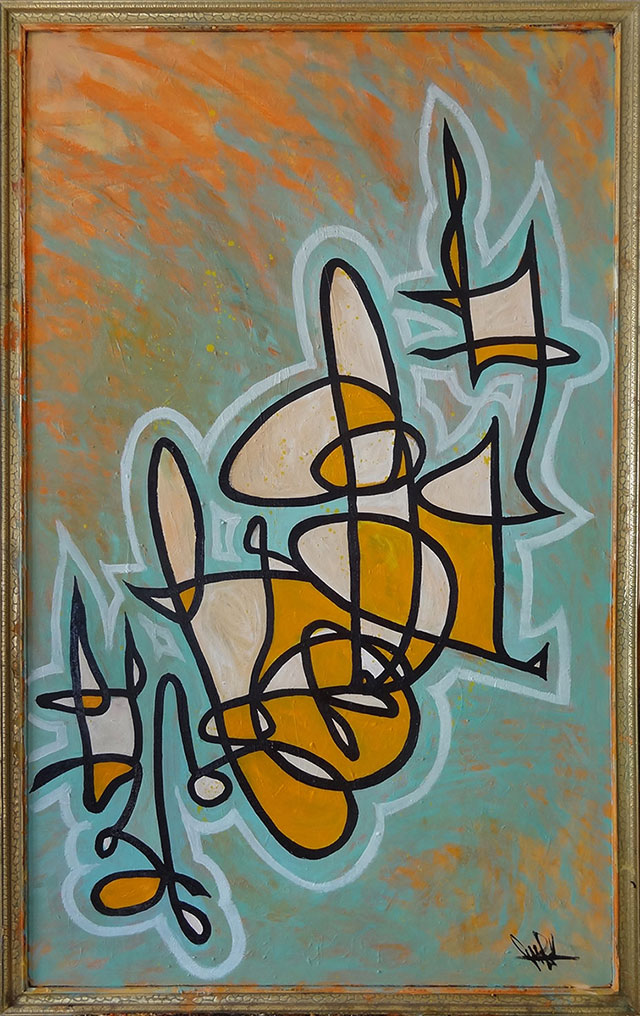
I create abstract art based on my distinctive style of line work. I am a studio artist, creating paintings and prints for the purpose of gallery exhibition, but I also work as a community artist, organizing, advocating, curating, collaborating, and creating public art. 

At what point in your life did you decide to become an artist?

When I was very little I used to tell my mom that I wanted to be a garbage man because I wanted to ride on the back of the truck. I have always loved to make art. In high school, one of my art teachers submitted the second painting I ever made to the scholastic art awards and I won one of the Golden Key prizes. At that time I was thinking about my future and I consciously realized that art was the only thing I wanted to do. 

Tell us a little about your background and how that influences you as an artist.

I grew up a happy middle class kid in Racine, WI. School never really kept my attention which led to a lot of day­dreaming and constant scribbling in notebooks. I think my love for bright colors, street art and my fascination with the abstract comes from growing up during the 80’s and early 90’s with the rise things like of video games, MTV, breakdancing, Nike, and Hip Hop just to name a few. 

Cityscape 2 , 24in. x 36in., oil on canvas, 2013

Cityscape 2 , 24in. x 36in., oil on canvas, 2013

What types of conceptual concerns are present in your work? How do those relate to the specific process(es) or media you use?

I would say that I have intentions with my works, but not conceptual concerns. 

Mind's eye,  28in. x 42in,  oil on found framed nature print., 2014

Mind’s eye, 28in. x 42in, oil on found framed nature print., 2014

We once heard Chuck Close say he did not believe in being inspired, rather in working hard everyday. What motivates you in your studio practice?

I get inspired, but I think it’s more important for an artist to work hard everyday. I had a conversation with an artist friend of mine several years ago about being an artist, and he asked me “Are you making art every day?” to which I replied “no.” He then said, “Well you aren’t an artist.” His statement irritated me at the time, but I took that to heart and began an everyday artist practice. I truly believe that the more you work, the better you are and the faster your ideas evolve. I enjoy being in my studio and creating art so it is not hard to stay motivated. 

What artists living or non-living influence your work?

Picasso, Kandinsky, Basquiat, Giacometti, Frank Stella, James Jean, Richard Jackson, and Street Art. 

When you are not making art what types of activities and interests do you engage in? 

Spending time with my friends and family. Attending local art and music events. Cookouts. Binge watching shows on Netflix. Nature walk/rides. Ping pong. Chess. 

About 

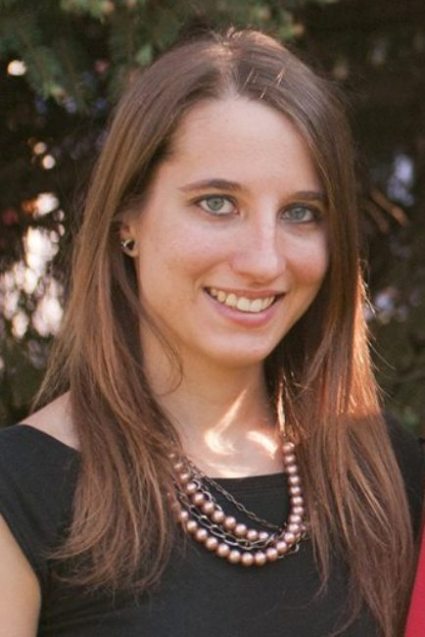
jeff_ headshot_colorJeff Redmon was born in the summer of 1977 in Racine, Wisconsin. Since receiving his BFA from the University of Wisconsin­Milwaukee in 2000, he has been heavily involved in the community through the arts. He is focused on painting, drawing and design.

Redmon is currently an artist in residence with Redline Milwaukee, a 501(c)(3) charitable organization, which is an urban laboratory that seeks to nourish the individual practice of contemporary art and to stimulate the creative potential of the local community to which we are linked. RedLine has provided Jeff with the opportunity to greatly expand his skills as an artist through mentorship, workshops, professional development, and interaction with the other artists in the facility.

Since 2010 Redmon has been a member of Made In Milwaukee, a cultural advocacy group dedicated to the exposure, growth, and advancement of the local art, music, and business community. Through MiM he has helped to organize Milwaukee’s first TEDx event, co­founded and organized BVGN (Bay View Gallery Night), created the “A­Lot” juried mural exhibition located in the Colectivo Coffee parking lot, and much more.

Jeff has shown his artwork in numerous locations, created murals, organized events and curated exhibitions in the Milwaukee area. He is a studio artist creating art for gallery exhibition but he is also a community artist working with others in his network to inspire, create, and shape the place where he lives. 

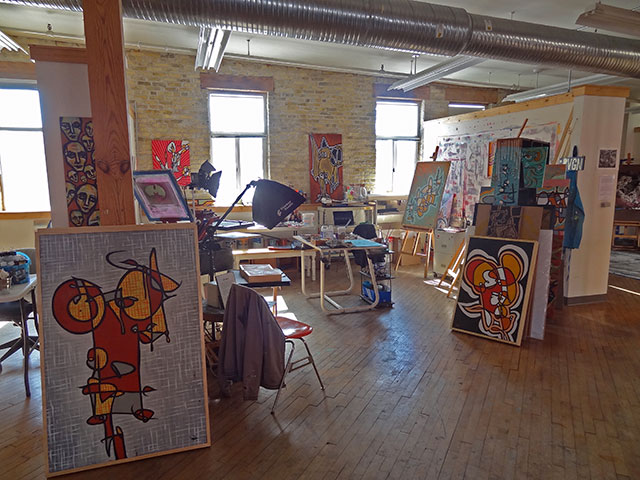
The Studio

The Studio

www.redmonart.com

All images copyright of the artist and used with their permission. 
Posted in Uncategorized | Tagged , , , , | 1 Comment

Eric Ashcraft – Olympia, Washington

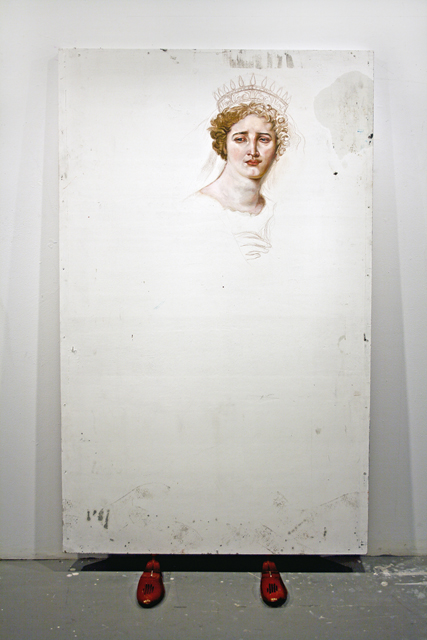
Clytemnestra, oil on panel with shoe horns, 72x 42", 2008

Clytemnestra, oil on panel with shoe horns, 72x 42″, 2008

Briefly describe the work you do.

I don’t have a specific agenda or medium.  I try to pay attention and articulate myself with whatever material I have a vision for at the time.  

Tell us a little about your background and how that influences you as an artist.

I grew up in Montana.  There is an interesting dichotomy there.  It carries a certain picturesque romanticism that often rings untrue.  Vast ideals of nature conjoin with the discarded refuse of urban living.  Regardless, it still is one of the “last best places”. People are incredibly mixed there, some are trying to escape from their past, others never leave.  Outlaws and inbreds aplenty.  

Much like the future, I see the past with uncertainty.  Though I visualize my history with clarity and can describe innumerable occurrences in my life that carry significance, I am skeptical toward the implementation of memory.  It is too easily manipulated and can be deceitful.  That said, I am sure growing up in Montana has had an impact on me.   I often find that influential experiences carry a mysterious quality.  I never know what sort of thing is going to have a transformative effect on my outlook.  It could be something incredibly mundane and seemingly insignificant.  I know that these experiences become part of my history.  That history is drawn as a diverging line from the present.

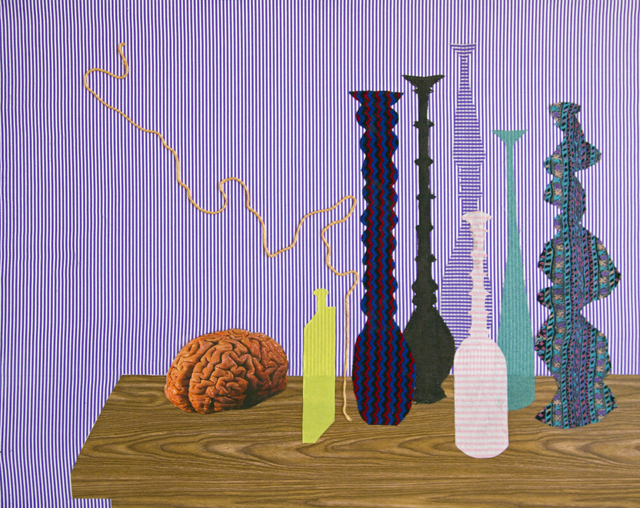
Still Life with Brain, oil, fabric, vinyl, transfer, and yarn on canvas, 27" x 34", 2014

Still Life with Brain, oil, fabric, vinyl, transfer, and yarn on canvas, 27″ x 34″, 2014

The concept of the “artist studio” has a broad range of meanings, especially in contemporary practice. The idea of the artist toiling away alone in a room may not necessarily reflect what many artists do from day to day anymore. Describe your studio practice and how it differs from (or is the same as) traditional notions of “being in the studio.”

I spend a good amount of time brooding in the studio.  When I’m not in the studio I’m usually brooding away somewhere else, observing the things around me.  I do like to work out ideas away from the confines of my small white room.  This amounts to many activities from countless hours drawing in public places to putting potential sculptures together in my “local” Walmart.  

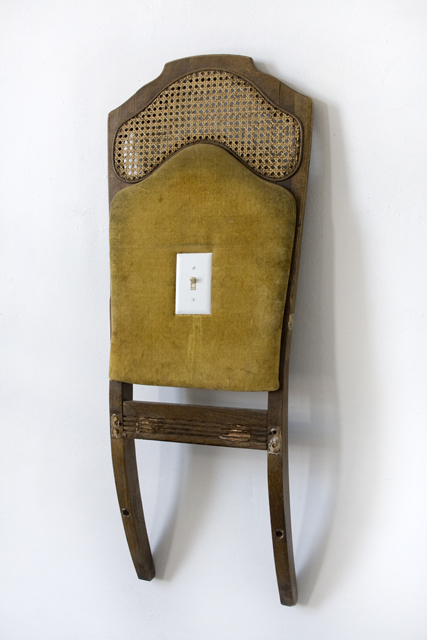
High Roller, modified chair and light switch, 2011

High Roller, modified chair and light switch, 2011

What unique roles do you see yourself as the artist playing that you may not have envisioned yourself in when you first started making art?

Being the interviewee. Socialite.  Businessman.

When do you find is the best time of day to make art? Do you have time set aside every day, every week or do you just work whenever you can? 

I work whenever I can.  I’ve found that I work most seamlessly during the early morning and late at night.  

How has your work changed in the last five years? How is it the same?

The work is always changing.  If it’s not changing, there is a problem.  The work is similar in that it comes from the same source, relatively.  I’m not a completely different person than I was five years ago.  Hopefully the changes in the work reflect the wisdom acquired in this time.

Are there people such as family, friends, writers, philosophers or even pop icons that have had an impact on the work you do?

Probably too many to list in any brevity here.  Here are a few: Shakespeare, Kafka, William Blake, Aldous Huxley, Nietzsche, David Bowie, Jimi Hendrix.

If you had an occupation outside of being an artist, what would that be and why?

I’ve had many occupations outside being an artist and I didn’t like any of them.  Maybe a conman…similar rules apply.

About 

Head Shot 365Eric Ashcraft (b. 1983, Billings, Montana) acquired a BFA from the University of Montana in 2006 and finished his MFA in painting at The School of the Art Institute of Chicago in 2009.  Ashcraft’s work has been known to navigate between multiple means of production including painting, sculpture, photography, performance, sound, and installation.

Ashcraft’s work can be characterized by a strong emotional and mental connection with impermanence, loss, and malleability of form.   His treatment of materials varies in great degree from the painterly to the sculptural, often fusing aspects of both into singular works.

Recent exhibitions in which Ashcraft has contributed include: NEXT invitational exhibition of emerging art at Art Chicago, Chicago; Patrajdas Contemporary, Chicago; Painting Centric at Cal Arts, Valencia, California; The Factory Underground, Greenwich, Connecticut; “Poseur” at Grizzly Grizzly, Philadelphia; “Taste” at Small Black Door, Queens, New York; and “The Bottom Line” at 3433, Chicago.

Ashcraft has taught at institutions including the Oxbow School of Art (2011), The Art Institute of Illinois (2010-2011), and the School of the Art Institute of Chicago (2009-2011).

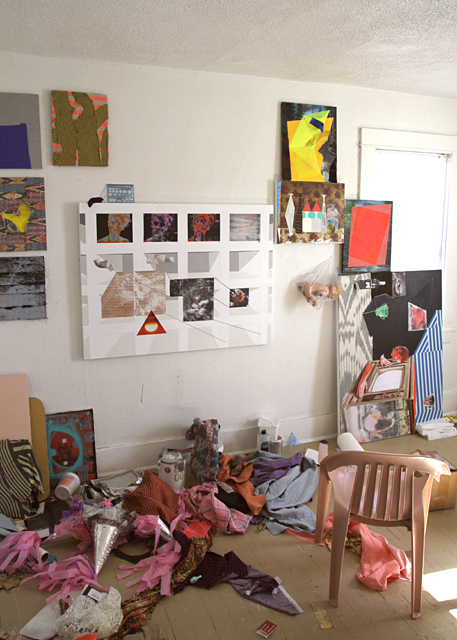
Studio

Studio

www.ericashcraft.com

All images copyright of the artist and used with their permission. 
Posted in Uncategorized | Tagged , , , , | Leave a comment

Guen Montgomery – Urbana, Illinois

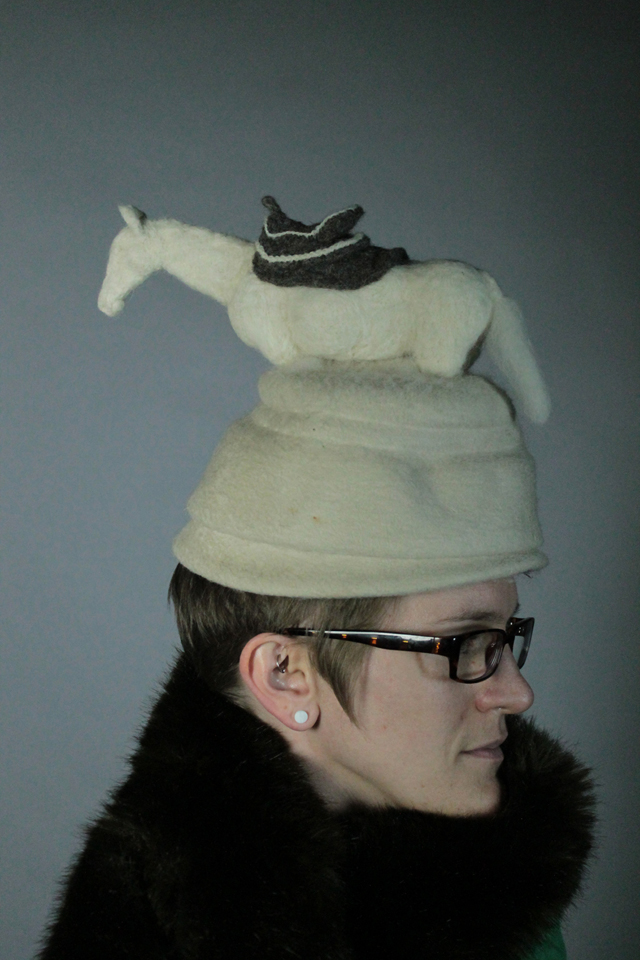
If Wishes Were Horses, wool, 2013

If Wishes Were Horses, wool, 2013

Briefly describe the work you do.

Chiefly I am interested in the complexity and inherent theatricality of real and imagined human characters. I focus specifically on the identities of my rural appalachian family members, and the varied identities which haunt the words queer, lesbian, and femme. I’ve found that working in only one medium doesn’t satisfy my desire to express different thoughts in different ways. To investigate my areas of interest I cross disciplines, negotiating between printmaking, fibers, sculpture and performance. I tend to work on more than one project at once, simultaneously producing prints and experimenting with sculptural forms. Ultimately, I use visually seductive images, textures and forms to create hybrid pieces that are motivated by family, history, and identity discourse.

Tell us a little about your background and how that influences you as an artist.

I am very close to my 68 year old mom, and my mother’s side of the family, who live in the Cumberland Plateau area of East Tennessee. My mom and her 8 sibling’s rural, relatively poor childhood, in contrast with my sibling-less, relatively well-off childhood, have both influenced me and my work greatly. The characters in my extended family, especially those of the women, have made a distinct impact on the way I think about strength and femininity. Southern family is strange, interesting, and a tie that truly seems to bind. As far as I remove myself geographically or otherwise, family continues to pull some part of me back. The people, and the general way of life there spawns a way of thinking that constantly butts heads with the esoteric values of the art world. This creates a sense that I am of two minds, both an insider and an outsider to both worlds. Ultimately, I have decided that this split consciousness is a good thing. 

The concept of the “artist studio” has a broad range of meanings, especially in contemporary practice. The idea of the artist toiling away alone in a room may not necessarily reflect what many artists do from day to day anymore. Describe your studio practice and how it differs from (or is the same as) traditional notions of “being in the studio.”

My studio currently is at home in a very nice, well lit little room. As nice as it is, I spend less time in this space than I would like. Partly this is because much of my more traditional printmaking work takes place in the University of Illinois’ Ink Lab, our recently established printshop. I enjoy the expansive table space and the sense of community that comes with a shared printshop. Printmaking provides a natural structure, and the shared space prevents one from feeling artistically isolated. I believe the work I do at home however, benefits from isolation. It tends to be more experimental, sculptural, and abstract. Although I enjoy the communal aspects of the shop and still plan to employ print, I would like to move my work towards the kinds of things I am producing in my home studio. My goal is to transition the majority of my work time out of the comforting confines of the printshop and back to my individual studio space, where I plan to push myself towards untested waters. 

Jennifer Montgomery, Scott County, Tennessee., photo lithography on sewn fabric, mixed media, 2012

Jennifer Montgomery, Scott County, Tennessee., photo lithography on sewn fabric, mixed media, 2012

What unique roles do you see yourself as the artist playing that you may not have envisioned yourself in when you first started making art?

When I began earnestly making art I didn’t expect to become interested or excited about being a teacher. Teaching was not in my initial plan, although future plans have always been somewhat flexible. My current path in teaching slowly took form, and I am grateful to have stumbled into it. I love being an instructor at the college level, and believe it is something I am good at. Importantly, teaching like making art, rarely feels like work. 

When do you find is the best time of day to make art? Do you have time set aside every day, every week or do you just work whenever you can? 

I do set aside time, usually 2-3 times a week, when I am not teaching, to focus on my studio work. Life and work make it hard to stick to this regimen though, so I sometimes sneak studio time into late evenings, or do mindless studio activities – like sewing – while we watch something on TV. In general it is easiest to work first thing in the morning, or late at night. 

Pris Stansberry, acrylic hair, 2014

Pris Stansberry, acrylic hair, 2014

How has your work changed in the last five years? How is it the same?

Past exhibitions like The Cecils of Scott County Tennessee, relied on sculpture and fibers to recreate a museum-like narrative space. My print practice in this show is in the installation’s details, the wallpaper and printed fabrics, and I plan to continue to employ print in similar ways as I move into new more sculptural territories. However, instead of jumping into a pre-defined, clearly representational body of work like The Cecils of Scott County, I want to experiment with my newly conceived sculptural pieces. In my home studio I have begun to explore forms that feel similarly plucked from a narrative but which are more obscure. These forms conceptually stem from a recent group of prints and drawings, made during the transitional period of our move, that respond to a “Southern Sapphic” sensibility. As someone who is equally deeply interested in her southern heredity, and personally invested in the contemporary discussion about queer “lifestyles,” I am excited about creating objects that, similar to these prints, combine a sense of antebellum kitsch in terms of fashion and femininity, with a distinct overtones of butch/femme sexuality, queer bodies, and gender jamming. 

Are there people such as family, friends, writers, philosophers or even pop icons that have had an impact on the work you do?

As I said above, mostly I am influenced by my family, deceased and alive, in Tennessee, especially my mother and her six sisters. I am very inspired by my partner, and fellow artist, Emmy Lingscheit. I also think I am still highly influenced by my grade-school friend Emma with whom I made some excellent paper mache puppets and music videos in middle school. Illustrations, Archie comics, and old cartoons, especially Dr Suess’ Hooberbloob Highway, had a significant impact on me and my artistic tastes as well. 

If you had an occupation outside of being an artist, what would that be and why?

I would like to think I would be an actress. Or hopefully I would be famous, possibly in some other, inadvertent way, like the Unsinkable Molly Brown or the double rainbow guy. 

About 

headshotGuen Montgomery is an artist and performer whose work investigates identity in terms of gender, femininity, femme sexuality, and family mythology. Currently living and working in Urbana, IL, Guen teaches in the art foundations program as a Clinical Assistant Professor at The University of Illinois, Urbana-Champaign. Guen received her BFA from the University of Hawaii at Manoa, and her MFA from the University of Tennessee, Knoxville. In 2012 Guen and her colleagues transformed an abandoned vacuum repair shop into the Vacuum Shop Studios, a new collaborative studio space for artists, performers, and designers in Knoxville, Tennessee. Guen’s work, which frequently centers around printmaking, performance, and installation, has been exhibited nationally and internationally, and was recently included in the 10th National Print Competition at the Turner Print Museum, judged by Anne Collins Goodyear. 

In the Studio

In the Studio

www.guen-montgomery.com

All images copyright of the artist and used with their permission. 
Posted in Uncategorized | Tagged , , , , | Leave a comment

Gina Adams – Lawrence, Kansas

HonoringLoss9Briefly describe the work that you do.

I respond to the world that I was born into and the one that is ever changing and constantly around me:
My ancestral memory, and the oral stories told to me by my family have imprinted my soul map and created who I am today. Learning to tan deer hides traditionally came from a place of wanting ancestral knowledge….learning to make coil pots came from the same yearning to recreate the past in order to grasp a sense of identity for the future. This work is about prolonging life….this moment…this breath…the eternal heartbeat….as even though I may not have those who have come before, I do have the continued remembrance of the words and the longing of what once was. You never lose the longing; it grows stronger and becomes like a heartbeat whose rhythm is a constant presence. For me this work is about survival of the spirit, of my spirit and that of my grandfather’s people and their heartbeat that beats within my own body, mind and soul.

At what point in your life did you decide to become an artist?

I have been and artist and a creative thinker my whole life. When I was very young I would drawing and paint on walls and unconventional surfaces. In my twenties I thought I was meant to work in my father’s sporting goods retail store, but the yearning to be a professional artist was stronger than the need to stay in a career that did not suit me. My decision to get a BFA confirmed that I would be an artist for the rest of my life.

Tell us a little about your background and how that influences you as an artist.

In the drawings of my youth my Ojibwa grandfather saw a connection to our heritage. It was in viewing the connection that he opened up the past and shared with me his life experience and assimilation story of being sent to Carlisle Indian Boarding School. When I was an adult I went to the Maine College of Art for my BFA. The years in between childhood and adulthood were all about exploration of life and materials. In the years after my BFA and before my MFA at the University of Kansas, my studio process and ideas merged strongly into one.

"Honoring Loss 9," Watercolor, graphite, encaustic on paper, 7" x 10", 2013

“Honoring Loss 9,” Watercolor, graphite, encaustic on paper, 7″ x 10″, 2013

What types of conceptual concerns are present in your work? How do those relate to the specific process(es) or media you use?

The forced integration of millions of natives is a truth that their descendants have come to know and deal with. My history of assimilation and my grandfathers forced boarding school experience at the Carlisle School is not unique. The feelings that have been passed down are now part of our genetic heritage. My current studio work deals with my ancestor’s many stories of assimilation. For this body of work, it was necessary to choose a new medium and material from which to begin to bridge these abstract ideas and bring them into concrete forms.

There are many Indigenous and assimilated people like myself making work and creating research right now. Post-Colonial discourses are everywhere. I take my research and my studio thesis project very serious as I am doing this not only for myself but for thousands of others who have a similar story to tell. In my studio process I am deliberately looking describe, enact, translate creatively what it looks like to be from a perspective of Indigeneity. We are as a people at the cutting edge of understanding what it means now to be of an Indigenous cultural heritage. I am attempting to think about these characteristics while developing my work: reclaiming history, renaming, educating, decolonizing, activating thought, recognizing perspectives from an indigenous center, and the recognition of indigenous pedagogy, and Indigenous intellect. I believe that we as Post-Colonial peoples have a responsibility to hear these ideas and move forward in creating an environment that leads toward a future that creates a foundation of respect and enduring understanding for all peoples. My research is Diverse and I intentionally lead by example for students and faculty where I teach and become part of the community. I also believe that all university settings should be the foundational place where we show the rest of the world that the discourse of diversity and hybridity is actively engaged in making change.

"Honoring Modern Unidentified 2," Encaustic and Oil on Ceramic, 11" round, 2013

“Honoring Modern Unidentified 2,” Encaustic and Oil on Ceramic, 11″ round, 2013

We once heard Chuck Close say he did not believe in being inspired, rather in working hard everyday. What motivates you in your studio practice?

I am motived by the individual and collective experience of my Native American and Immigrant American experience. Oral tradition and the emotions that are connected to assimilation stores told to me by my friends and family fuel my work. I want to create work that tells a story of a game changer and even a protagonist. I wish for the viewer to leave after viewing my work to consider the meaning and perhaps have a greater understanding of the true history of assimilation practices that occurred in the United States. I feel as an artist who has genetic and familiar roots in these practices, that it is my responsibility to tell these stories. Working hard every day is a given……the driving force that I have to do this work is my motivation.

What artists living or non-living influence your work?

My greatest living mentor is my good friend George C. Longfish. He has given me guidance, and strength and mentored my artistic practice. I am forever grateful for his teachings of wisdom for they have taught me to believe in myself and given validity to my ideas and studio practice. I worked with Michael Mazur at Provincetown Fine Arts Studio and had breakthroughs in how I saw the world which affected how I approached drawing in my prints and paintings. I am forever grateful to Norman Akers, who was my graduate thesis chair and advisor for three years, for he helped to shape me into the artist I am right now. Elizabeth Jabar and Meg Brown Payson are talented artists as well as good friends who give merit to the feminine in my work as well as to my roots in Maine and my BFA education at the Maine College of Art.

For inspiration I look to artists such as Shahzia Sikander, Brian Jungen, Kent Monkman, Melanie Yazzie, George Longfish, Maria Magdalena Campos-Pons, Brenda Garand, and writers such as Susan Power and Linda Tuhiwai Smith.

When you are not making art what types of activities and interests do you engage in? 

I teach painting, 2D color theory, drawing and printmaking as an adjunct, and teach encaustic painting workshops in several venues in the United States.

I love working on my house and also find inspiration while cooking amazing meals for my family and friends, as well as sewing and gardening.

I love being in the natural world, taking hikes, exploring woods and fields, finding elders who have traditional knowledge, saving seeds, finding sheds, working with wild medicinals. Doing this fuels my world and feeds my artist practice.

Bio-PhotoAbout 

Gina Adams spent her early youth in the San Francisco Bay, and then her adolescent and early adult years in Maine. Gina’s formal education includes a BFA from the Maine College of Art and MFA from the University of Kansas, where she focused on Visual Art, Curatorial Practice and Critical Theory.

Gina Adam’s cross,media, hybrid studio work includes sculpture, ceramics, painting, printmaking and drawing. Her work is exhibited extensively throughout the US and resides in many public and private collections. Most recent exhibitions include: “Stands With A Fist” from the MOCNA in Santa Fe, New Mexico; “Survival/Zhaabwiiwin” exhibited at the Bemis Center for Contemporary Arts in Omaha, Nebraska and the Institute of Contemporary Art in Portland, Maine; and an upcoming exhibit at the Heard Museum in December 2014.

Among her honors are a recent MFA from the University of Kansas where she earned the honorable Kelvin & Helen Hoover Award and the Daniel MacMorris Award in Painting. Gina’s studio practice is currently located in Lawrence, Kansas. Along with working in her studio, Ginatravels as a Visiting Artist to Universities and Artist’s Residencies, mentors and teaches college and youth Art Programs, and teaches encaustic at R&F Handmade Paint Workshops in the US.

www.ginaadamsartist.com

All images copyright of the artist and used with their permission. 
Posted in mixed media | Tagged , , , , | Leave a comment

Robert Howsare – Kansas City, Missouri

Rift

“Rift,” Single-Channel Video Projection, Animation, and Construction Flagging, Dimensions Variable, 2013

Briefly describe the work you do.

Through a rigorous material and process-based studio practice, my work investigates anomalies occurring in systems. My work explores optics, printmaking and the apparatus through an interdisciplinary approach that incorporates drawing, installation and projection.

Tell us a little about your background and how that influences you as an artist.

My background in psychology and commercial printing inform my interest in moiré patterns and other optical phenomena. I am currently working as a production printer at Hammerpress Letterpress and Design Studio in Kansas City, where I make hundreds of prints on a daily basis. Naturally, misregistered prints are going to occur and these “mistakes” are the basis for my investigation of patterns and perception. Historically the moiré pattern is the result of an error that occurs in the printing process while also creating the feeling of movement in a static image. My interest in the ways in which visual stimuli can affect us viscerally is a result of my years spent studying psychology in college.

The concept of the “artist studio” has a broad range of meanings, especially in contemporary practice. The idea of the artist toiling away alone in a room may not necessarily reflect what many artists do from day to day anymore. Describe your studio practice and how it differs from (or is the same as) traditional notions of “being in the studio.”

My studio functions like a laboratory with several material studies/experiments being conducted simultaneously. I find that my studio experience is a nice complement to my time in the print studio, which is a more communal and social environment. Additionally, I am actively involved in a few curatorial projects, which allow me to collaborate with artists in ways that differ from studio-centric collaborations. The Hown’s Den, http://www.thehownsden.com/, is a nomadic and domestic exhibition space that explores how work exists situated in a dwelling, as opposed to a more traditional gallery space. SPECTRA, http://spectrakc.org/, promotes the production of experimental film, video, and other time-based art works in Kansas City through monthly screenings and discourse in the community.

96fps

“96fps,” (with Detail) Letterpress Printed 16mm Film, Optical Sound, 16mm Projectors, and Two-Way Mirror, Dimensions Variable, 2012

What unique roles do you see yourself as the artist playing that you may not have envisioned yourself in when you first started making art?

When I first began making art, I wouldn’t have imagined the influence that science would have on my artistic interests and methodologies. While my work resides at the intersection of art and technology, my practice is similar to the scientific method in that I begin with a hypothesis, which leads to experimentation, and than a conclusion and the curatorial decision of whether or not the work is successful.

When do you find is the best time of day to make art? Do you have time set aside every day, every week or do you just work whenever you can? 

The mornings are definitely the most productive studio times for me. I try to reserve the evenings, after I get home from work for organizing and cleaning the studio. I set aside time every day to be in the studio, the amount of time varies depending upon the rhythm of our family.

Spectre

“Spectre,” Site-Specific Installation using Serigraphs, Each Print: 10.5″x10.5″, Overall Dimensions: 105″x105″ , 2013

How has your work changed in the last five years? How is it the same?

My work has become more interdisciplinary over the last few years; moving away from strictly two-dimensional prints to more installation-based modes of incorporating print media, whether actual prints or work that is informed by prints. Over the years, I have grown to embrace and seek out the unexpected results that occur throughout the art making process by setting up situations that invite happenstance. My studio practice has become more experimental, which allows more opportunities for wonderment and playfulness.

Are there people such as family, friends, writers, philosophers or even pop icons that have had an impact on the work you do?

I am fortunate to be surrounded by an engaging group of artists and friends whom consistently challenge and inspire me. My family, Crystal Ann Brown and my son, influence my work and are a constant source of inspiration. I am pretty excited about a series of process drawings that my two-and-a half-year-old son and I are working on together. I feel an artistic kinship with certain musicians and composers, such as Brian Eno, Philip Glass and Stravinsky.

If you had an occupation outside of being an artist, what would that be and why?

I would definitely be somewhere cooking. I have always enjoyed cooking and at one point had considered attending culinary school. I appreciate the similarities between the culinary and visual arts in fostering sensitivity to materials and processes.

HeadshotAbout 

Robert Howsare is an interdisciplinary artist who utilizes nontraditional printmaking matrices and processes to explore the anomalies that occur within systems.  He received his BFA in printmaking in 2009 from the Kansas City Art Institute and graduated with an MFA in printmaking from Ohio University in 2012.  His work has been exhibited nationally and internationally; selected venues include the Grand Rapids Art Museum, the Austrian Cultural Forum of New York, and the International Print Center of New York.  Additionally, Howsare’s work has been recognized by WIRED Magazine, Abitare International Design Magazine, HOW, and other publications. A recipient of a 2012-2013 Charlotte Street Foundation Urban Culture Project Studio Residency, Robert Howsare currently lives and works in Kansas City, KS.

http://roberthowsare.com/

All images copyright of the artist and used with their permission. 
Posted in Uncategorized | Tagged , , , , | Leave a comment

Jenie Gao – Milwaukee, Wisconsin

Beast of Prey

“Beast of Prey,” Ink and watercolor on paper, 30.5×18.5″, 2011

Briefly describe the work that you do.

Woodcuts and ink drawings, often of a grandiose scale. Animate and inanimate objects grafted onto one another, violent, yet intimate, suspended in moments of tension.

At what point in your life did you decide to become an artist?

Somewhere around the age of 3. My desires became foggier between the ages of 11 and 18, and have vacillated between clarity and uncertainty since then. At this point in my life, I’m pretty sure that three year olds have already got it figured out. The challenge is not letting the noise of growing up distract us along the journey.

Tell us a little about your background and how that influences you as an artist.

I grew up in a Podunk town in Kansas to parents who were as different as night and day and who both came from family backgrounds with richly brutal histories. My dad was Chinese and grew up during the Cultural Revolution and Mao’s reign. My mom’s family was from Nationalist Taiwan. For the purpose of this questionnaire, I will name three key influences that have shaped my life. One, I grew up raising all sorts of animals, strays and rescues and rejects. Two, a story of perspective my dad emphasized throughout my upbringing: “Don’t be a frog in a well, who looks up at the sky and says, ‘Who could love the sky, when its kingdom is so small, and mine is so vast and large?’” Three, my dad’s death, a hard lesson of keeping vs. loss, and a reminder for me to stay focused on the things that truly matter.

Attention

“Attention,” Woodcut on Canvas, 40×60″, 2011

What types of conceptual concerns are present in your work? How do those relate to the specific process(es) or media you use?

My work focuses on the interdependence of preservation and change. Stories and objects act as anchor points in our families, friendships, and relationships. The desire to anchor ourselves in familiarity contrasts with the need to grow amidst inevitably changing surroundings. At the same time, a grounded sense of identity enables further growth, by creating opportunities to connect with others and change along with our environment. There is a lineage that runs through my work. The drawings are reminiscent of old fable illustrations, and there’s something permanent and decisive about putting things in ink and carving pieces out, forever. Woodcut is especially important, because whereas most creative processes are additive, like paint, woodcut requires that pieces be cut out to make a record.

Redamancy

“Redamancy,” Woodcut on Muslin, 48×38″, 2012

We once heard Chuck Close say he did not believe in being inspired, rather in working hard everyday. What motivates you in your studio practice?

I’ve often thought of two artist stigmas. One, that creative pursuits are out of love, not financial stability, and two, that great work only comes from great suffering. I’ve always been unsettled by these stigmas, and in fact find them harmful and limiting. The first devalues the artist and overlooks the reality that a creative person still needs to eat. The second gives too much credit to the suffering and not enough to how the artist as a person chooses to respond to suffering. So a big motivator for me is the desire to prove that it is possible to balance personal wellbeing and career success with creative pursuits and accomplishments. I want every creative person to believe that it is possible to thrive instead of starve, and to not be afraid to make practical decisions that don’t “match” with the ideals of how artists are “supposed” to live.

What artists living or non-living influence your work?

Visual artists: Albrecht Durer, Art Spiegelman, Francis Barlow, Julie Chen, Swoon, Winsor McCay

Artists by philosophy: Bruce Lee, Norton Juster, Steve Jobs

When you are not making art what types of activities and interests do you engage in? 

I currently work in the printing industry, promoting Lean Manufacturing. I’m fascinated with the Lean mindset as a way to create a work culture that values continuous improvement, respect, and lifelong education.

I’m obsessed with business practices and the ever-evolving role of technology. I’m on a constant hunt for new tools to work and live smarter and free up human time to do better things.

Better things to do with human time include: being outside as much as possible, preparing delicious food such as fruit pies and various curries, hosting potlucks, teaching and leading workshops, jumping in the lake in January, and organizing a wide gamut of events such as pillow fort and box fort parties

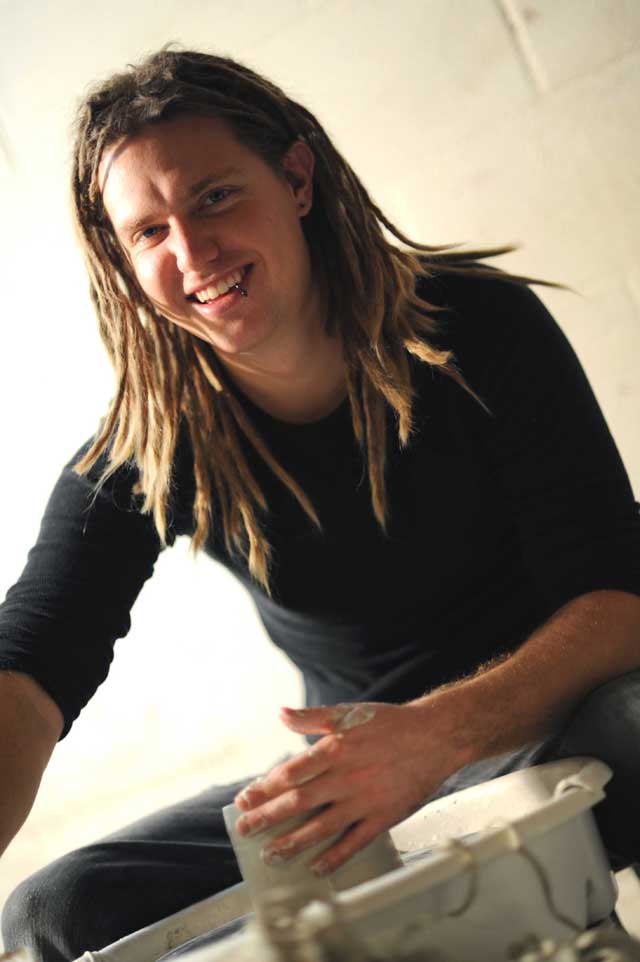
Jenie_Gao_portraitAbout 

At her core, Jenie Gao is an artist, a storyteller, and a teacher. As an artist, she approaches her artwork as a history in the making, aligning minute details with an overarching philosophy and purpose. Through her specialties of woodcut and ink drawing, she expresses that what is included is as important as what is cut out, and that craft must support concept.

As an artist and beyond, Jenie is a challenger of conventional norms and an asker of infinite questions. She believes that the work we do should be a reflection of who we are. She believes that the key to producing great work lies in the partnership between the constant core of who we are and the willingness to continually reinvent ourselves. And so she hunts for experiences outside of her familiar fields, from the arts and humanities to business and technology.

Jenie received her BFA in Printmaking/Drawing from Washington University in St. Louis. She has shown and led art workshops at various venues including RedLine Milwaukee, Carroll University, Schlueter Art Gallery, the Milwaukee Third Ward, and MIAD, and will have a solo show at the Sharon Wilson Art Center in early 2015. She currently has a studio in Milwaukee’s Bay View neighborhood and is a soon-to-be new addition to the Madison scene. Watch out, Madtown.

http://jenie.org 

http://sunnyapplesilk.com

Studio

Studio

All images copyright of the artist and used with their permission. 
Posted in Printmaking | Tagged , , , , | 1 Comment

Leon Patchett – Cromarty, Scotland

Pushing the Line

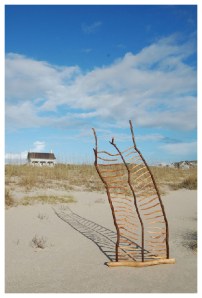
“Pushing the Line,” Found wood, 180x120x25cm, 2009

Briefly describe the work that you do.

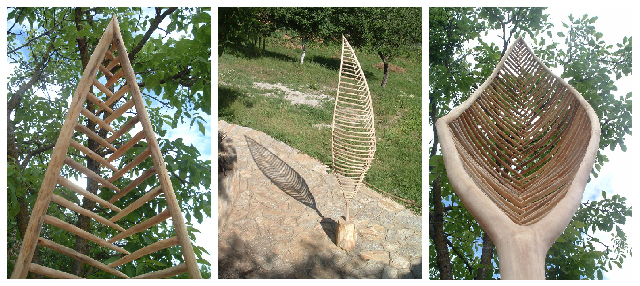
I produce sculpture made with wood collected from the forest floor, washed up on beaches, and generally from the local environment. This a pragmatic approach that creates an instinctive and intimate relationship between the locality, the material and myself.

The process of searching, gathering and making, leads to a continuous dialogue between ideas inspired by the material and its availability. Preconceived starting points are unhelpful, as the materials are determined by happenstance.
The ideas are essentially abstract, a visual language derived from an interest in sequences, patterns and rhythms that produce relationships between the disparate elements selected to produce a piece of work.

My work initially relied on a technique of threading and stacking taken from the breastplate adornments of Native Americans, and inspiring a series of geometrical wall hangings. Moving into three dimensions, I began making ‘frames’ by joining dried branches that provide the skeleton for the body of the work. Working the wood might involve cleaning, sanding, cutting, splicing, dowelling and gluing. The finished pieces have a quality of a drawing in three dimensions, and the shadows cast a new plane of observation.

At what point in your life did you decide to become an artist?

A significant moment came whilst working on a large ceramic installation consisting of three dimensional tiles in which symmetry was broken in the vertical. This occurred whilst studying at Central St Martins School of Art and Design in London, and that evening, as I cut through the vertical the sense of excitement and satisfaction is one I will always remember.

Leaf

“Leaf,” Found Wood, 230,40x40cm, 2008

Tell us a little about your background and how that influences you as an artist.

I grew up in a village on the edge of a fertile plain of the drained fens in the East of England. With the open pits of clay mining and tall chimneys of brickworks to the north, and industrial agriculture to the south and east, the extraction of needs from nature was an ever present part of the natural landscape.

What types of conceptual concerns are present in your work? How do those relate to the specific process(es) or media you use?

Ideas of transformation and order are central themes to my process as I work to impose new forms on seemingly random material. It is a process of refinement.
The need to search for my own material allows me to develop an intimate relationship with each piece of wood as I can continuously assess its usefulness. The collection is deliberate and considered. In the studio the bundles are catalogued into type (curve, length, width, individuality etc.) so I can begin to make connections in between individual pieces.

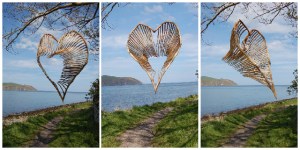
Heart II

“Heart II,” Cromarty Driftwood 120x90x60cm, 2013

In essence I am creating a palette that I can use when making.
Next I lay everything out to evaluate which branches could create desirable curves, rhythms and sequences when joined together.

Connecting one piece to the next the sculpture slowly appears giving the opportunity to refine the structure more precisely until the frame is complete and ready to attach the smaller detail.

The transformation from raw material to finished work is achieved with a systematic approach and a pragmatic view of what can be assembled. The more I work the broader the visual language develops and in turn I increase the potential for more diverse outcomes.

We once heard Chuck Close say he did not believe in being inspired, rather in working hard everyday. What motivates you in your studio practice?

It is about persevering and working hard but it takes little motivation for meto spend time working in the studio. I have a compulsion to live a creative lifestyle. It is at the centre of all I do. The challenge is to feel that my practice is always moving forward as I continue to refine the skills necessary to produce work that is truly personal.

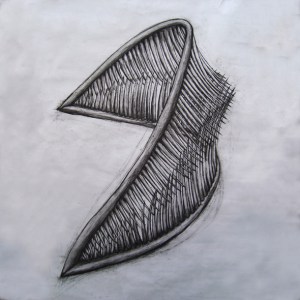
Sketch for work

Sketch for work

What artists living or non-living influence your work?

I find it difficult to pin down exact influences. I have to recognise the indigenous societies across the globe that have left wonderful examples of how to produce work from natural objects found in their local environment whilst using limited technology i.e. Aboriginal art, North American Indian art…… Pattern making has always been present in my thinking and I have been drawn to different styles including Islamic design & Celtic Art. There are natural connections with the work of Andy Goldsworthy who has been a contemporary pioneer environmental art.

It was significant moment to feel the power of ‘Unique Forms of Continuity in Space’ 1913 (Umberto Boccioni) when visiting The Tate London during my college years, a fine example how it is possible to infuse a piece of work with such power and dynamism.

I think the nature of these influences has a more subliminal influence, which adds to a soup of memory that can be instinctively drawn from when formulating ideas for my own work.

When you are not making art what types of activities and interests do you engage in? 

Maintaining a creative life occupies a large portion of my time and there is little left to spend on extra curricula activities. I have a keen interest in current events and make an effort to be aware of what is happening in the wider world, which often encourages me to go and see it for myself.

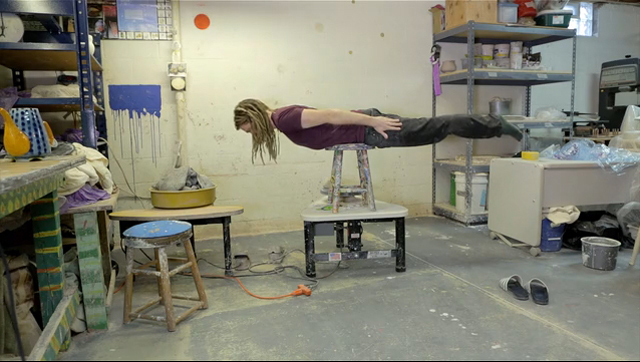
Leon PatchettAbout

Leon Patchett was born in Peterborough Cambridgeshire. England 1966. In 1990 he graduate from Central/St.Martins School of Art & Design with a B.a. Hons Degree in Fine Art Ceramics. Later on in 1994 he completed a P.G.C.E. in Art & Design from Manchester Metropolitan University.

Leon has exhibited at home and abroad having taken part in international art exhibitions & symposiums in the UK, Macedonia, North Carolina, Spain and Bosnia as well as an Environmental Eco-Art Butterfly Project in Finland receiving several funding awards in the process.

Since 2002 he has been a self-employed artist living and working in Cromarty, Scotland.

Working in the Studio

Working in the Studio

Studio

Studio

www.leonpatchett.com

All images copyright of the artist and used with their permission. 
Posted in Sculpture | Tagged , , , , | Leave a comment