Nicole Pancini – Boston Massachusetts

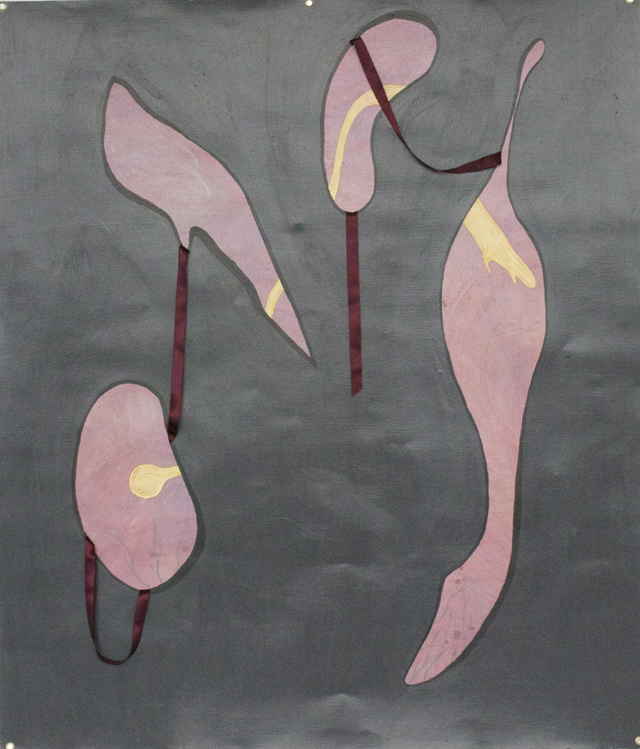
Exactly the Same, But Different, Acrylic and Ribbon on Paper, 4 feet 3 inches by, 3 feet 7.5 inches, 2014

Exactly the Same, But Different, Acrylic and Ribbon on Paper, 4 feet 3 inches by, 3 feet 7.5 inches, 2014

Briefly describe the work that you do.

In my studio I explore stories, real and imagined, philosophy and metaphysics, combining them to create intimate personal meditative images along with large scale pieces that deal with the more universal aspects of the ideas I uncover. I am interested in identity, humanity, change and environment and how all those things work together or against each other on both sides of the human boundaries with the world. 

At what point in your life did you decide to become an artist?

I grew up making things, like crafts for fairs with my grandmother or watercolor pictures with my brother. We made useful objects, like bags and baskets to collect things from the garden, but we also made things that were purely decorative. When I got further into school and “craft time” disappeared from the curriculum I challenged myself to keep making things. After many class trips to Chicago’s world-class Art Institute and the Museum of Contemporary Art I realized I could imbue those things with ideas and sentiments. That really solidified it for me. I think I was about 12 or 13.

Tell us a little about your background and how that influences you as an artist.

I have always been a reader, devouring books like candy. One of the things I love most in life is a good story, whether heard, read or witnessed. I think of many of my images as stories, or even as illustrations of ideas. Growing up in the midwest has had an impact on my color palette and my approach. Specifically growing up in the craft environment has given me a lot of deep motivation to work in small portable, holdable sizes with a sense of preciousness. Of course, in my studio there is also an element of challenging my past and I push myself to work larger. 
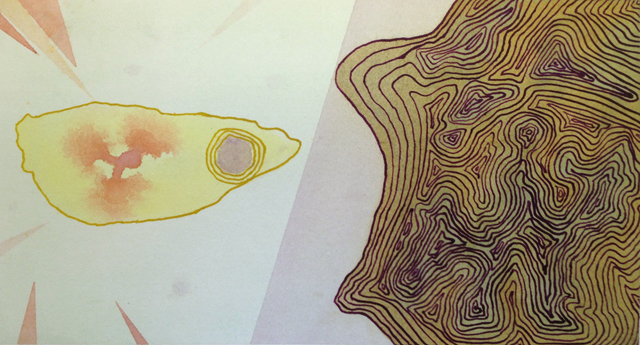
Armored Core, Watercolor and Ink on Paper, 5 inches by 8.5 inches, 2013

Armored Core, Watercolor and Ink on Paper, 5 inches by 8.5 inches, 2013

What types of conceptual concerns are present in your work? How do those relate to the specific process(es) or media you use?

My main conceptual concern is for identity and change and how we deal with that. I use a drawing language that has grown out of the language of maps and cartography to make work about tracking change or making a map of the self and place, internal and external. I use water-based media because of the simplicity with which it layers and the short drying times. In the larger work I am thinking more about what is inside and what is outside. Acrylic paint is easy to manipulate if you work with it from the ingredients, not from the tube. To create the feeling of a wall I can make the paint chalky and lightless, or I can make it slick and shiny so the viewer bounces off of it. 

We once heard Chuck Close say he did not believe in being inspired, rather in working hard everyday. What motivates you in your studio practice?

A professor and mentor of mine likes to say, “work makes work”. When I feel stuck in my studio I will make anything, because it is infinitely better than making nothing and it could lead me to a solution. Usually I turn to drawing from life. Even though I won’t show it and it might not be directly related to my paintings, it is still work. I find that when I draw from life my mind is quieter and I can think clearly. And even if I don’t find a solution, I am still exercising, still working. As far as what motivates my work and my studio practice as a whole, I would have to say its the ideas thems

elves, the stories and the act of making them into images. I love to make things.

Chase, Watercolor and Ink on Paper, 7.5 inches by 9 inches, 2013

Chase, Watercolor and Ink on Paper, 7.5 inches by 9 inches, 2013

What artists living or non-living influence your work?

My top three artist friends are Joseph Cornell, Louise Bourgeois, and Paul Klee. All three made work that speaks to me very deeply. They remind me what the point is and encourage me to keep making things that I believe in.

When you are not making art what types of activities and interests do you engage in? 

I love to read. I still can’t get enough. But in addition to books I take in stories through video games, comics and movies. I love to be outside. I climb, hike, swim and camp. I bake a perfect apple pie and dream about having a garden one day. And I travel to see my family as often as possible.

About 
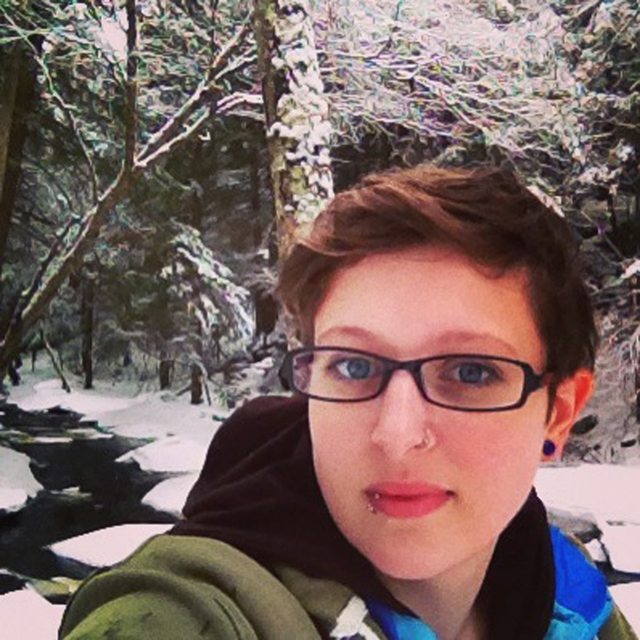
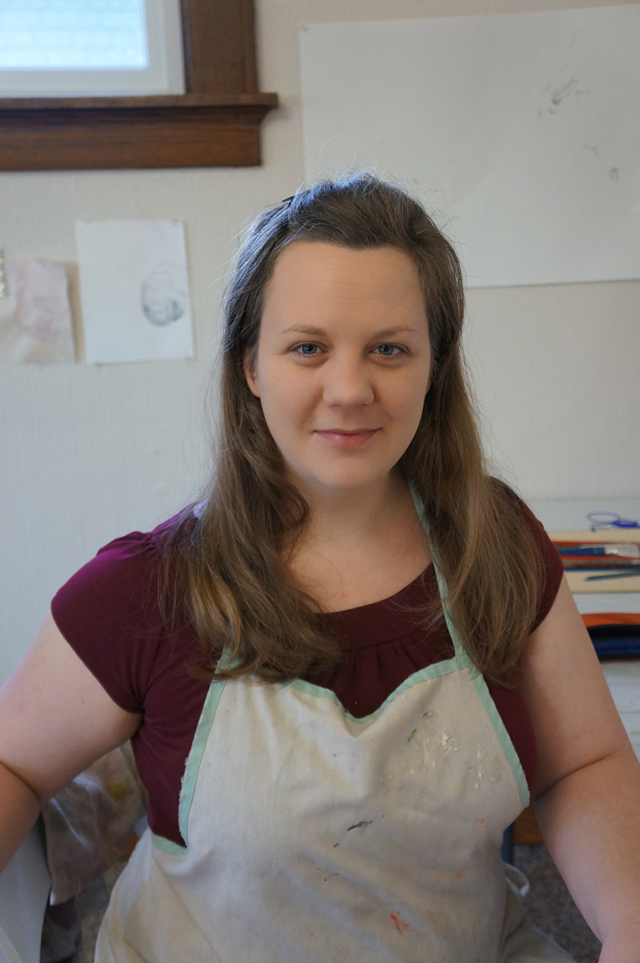
Pancini_headshotNicole Pancini was born in eastern Tennessee in 1987, but her family relocated to northwest Indiana when she was about 4. She grew up in what is lovingly referred to as “The Region”, the part of Indiana that is in proximity to Chicago and Lake Michigan. Nicole earned her first college degree, an Associate of Arts in Communication, in 2008 from Purdue University. She then continued on to Ball State University, where she earned a Bachelor of Fine Arts degree in Painting, graduating in 2012. She is currently a 2014 MFA candidate at Boston University. Nicole works through the university as a teaching assistant for an introductory drawing class and as a gallery assistant to the curator of two galleries on campus, 808 Gallery and the Sherman Gallery. In 2012 Nicole was awarded a Women’s Council Scholarship from the Boston University Women’s Council. Some recent shows Nicole’s work has been in includeAttraction and Doubt, an invitational group show curated by Scott Anderson in Muncie, Indiana in February of 2014, and a group show at Boston City Hall’s Scollay Square Gallery in March of 2014.
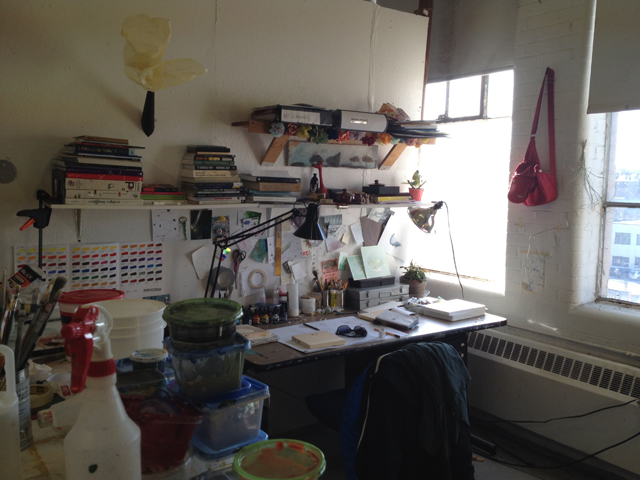
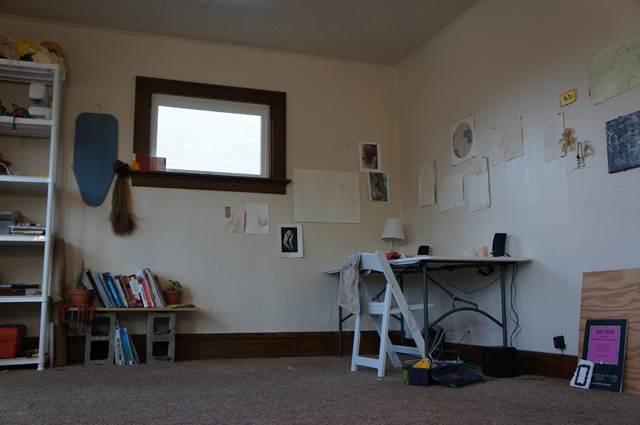
The Studio

The Studio

www.nicolepancini.com

All images copyright of the artist and used with their permission. 

Posted in Uncategorized | Tagged , , , , | Leave a comment

Stuart Gibson – Tucson, Arizona

 The Doormat Suit, 2012, Plastic grass doormats adhered onto complete and functional men’s suit, Dimensions variable


The Doormat Suit, 2012, Plastic grass doormats adhered onto complete and functional men’s suit, Dimensions variable

Briefly describe the work you do.

I’m very interested in the transient nature of the modern life.

My works are largely inspired by personal experiences, specifically on the aspects that might be easily overlooked within the whole. By emphasizing occurrences that might be otherwise qualified as fleeting, inconsequential or happenstance, my goal is to bring attention to the relevance of these less memorialized, yet far more numerable conditions of living that create our individual and collective character and experience. The physical manifestation of my creative process employs the use of a variety of media; including drawing, printmaking, photography, sculpture, installation, video and performance.

Tell us a little about your background and how that influences you as an artist.

The product of a very average middle class 1980’s upbringing, I grew up an only child and spent a lot of time inside my own head. I had never planned to be an artist, but instead a scientist, skateboarder, soldier or mechanic all of which were modeled after the characters in Hollywood movies like Top Gun, Police Academy, Real Genius and the like. Sometime during my freshman year of college I was sent to the campus art museum to do an English composition exercise and through the experience of looking at the collection I found myself completely convinced that pursuing visual art could give the opportunity to do something really extraordinary and meaningful, maybe still not unlike those characters in the movies.

The concept of the “artist studio” has a broad range of meanings, especially in contemporary practice. The idea of the artist toiling away alone in a room may not necessarily reflect what many artists do from day to day anymore. Describe your studio practice and how it differs from (or is the same as) traditional notions of “being in the studio.”

While I have kept a home studio since I was in graduate school, my creative practice often takes place outside of that space. I basically think of my laptop and cellphone as a portable studio and do the majority of my research and pre-production work using these tools wherever I might be when the time and creative energy presents itself.

All’s Fair in Love and War, 2011 , Mixed-Media Installation/performance, Dimensions Variable

All’s Fair in Love and War, 2011 , Mixed-Media Installation/performance, Dimensions Variable

What unique roles do you see yourself as the artist playing that you may not have envisioned yourself in when you first started making art?

When I first started making art I didn’t have any understanding of the importance of the public role of the artist. Over time I’ve found that it is important to be a positive presence in the both the art scene and the community at large. Representing oneself and our field with intelligence, logic and respect encourages the development of new business relationships, stronger ties for pre-existing ones and the opportunity to grow new enthusiasts and practitioners in the field of visual arts.

When do you find is the best time of day to make art? Do you have time set aside every day, every week or do you just work whenever you can? 

Anytime that I can steal for making art is a good time! While I work throughout the day on research, digital work, or preliminaries, the evening and night is typically when I do the physical production of my work. I don’t keep a regular daily or weekly schedule for my studio time allotment but allow it to fluctuate based on the projects that I’m engaged with, time of year and my professional commitments.

How has your work changed in the last five years? How is it the same?

Over the course of the last five years my work has become both less narrative and more abstract, but not necessarily across the board. I have been expanding my practice to include sonic work and I have recently started to seriously incorporate printmaking back into my work for the first time in nearly a decade. If anything I’ve gained a stronger sense of direction and discipline over the course of the last five years. I used to work in short bursts intermittently and now I have a steadily paced and recurring pattern for my research and production.

In the Studio

In the Studio

Are there people such as family, friends, writers, philosophers or even pop icons that have had an impact on the work you do?

Creative influences come from so many directions and people, some particularly strong influence on my creative practice have come from writers and artists such as Lorie Moore, Tom Clark and Don Delillo, Sophie Calle, Lawrence Weiner and Richard Prince. In my educational experience at UA I was greatly influenced by teaching artists that I studied with such as Ellen McMahon, Barbara Penn, Chuck Hitner and Ken Shore.

If you had an occupation outside of being an artist, what would that be and why?

I do have an occupation outside of being an artist. I am a fulltime college professor specializing in foundations education. Working with art students and other teaching artists is amazing and a constant source of inspiration both for my creative practice as well as general research interests.

About 

Born and raised in Tucson, Arizona, Stuart Gibson earned his BFA in studio arts with a multi-media emphasis from the University of Arizona in 2002, and spent the following two years traveling, exhibiting and studying further at the prestigious Cranbrook Academy of Art as well as Wayne State University prior to returning to the University of Arizona to complete his MFA with honors in 2007. As an emerging artist of growing international stature, Gibson has been showing his work across the United States in a variety of esteemed locations as well as gaining the attention of international contemporary collectors and critics. In the last few years Gibson has gained opportunities to advance his art-making career with increasing frequency which has lead to multiple solo exhibitions, being selected for two separate artist residencies, entering prestigious private and public collections and being awarded an artist project grant in Kalamazoo County among other achievements. After recently relocating from a two year stay in the Great Lakes region, Stuart Gibson is currently serving as a member of the full-time core faculty at the Southwest University of Visual Arts and plans to continue to grow his artistic career locally, nationally and internationally from his home and studio in Tucson.    

www.stuartjgibson.us

All images copyright of the artist and used with their permission. 

Posted in Uncategorized | Tagged , , , , | Leave a comment

Kathryn Wingard – Milwaukee, Wisconsin

Briefly describe the work that you do.

I am currently working on a series of ink drawings. I have a background in ceramic sculpture and my brain is wired to think in 3-D, so it is interesting to see what forms emerge while working within a 2-D format. 

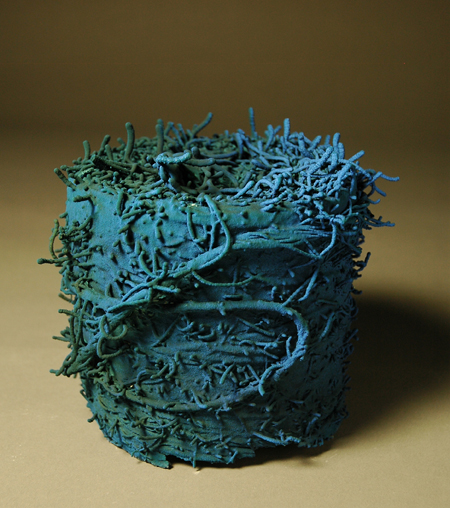
Metamorphosis/ Furry Blue Monster, 2008, Ceramic, 7" x 6" x 6"

Metamorphosis/ Furry Blue Monster, 2008, Ceramic, 7″ x 6″ x 6″

In all the work I do, whether it is sculptural, two dimensional, or video based, I aim to use many small marks, images, and movements to create complexity and depth within a fairly simple form. 

At what point in your life did you decide to become an artist?

I’ve had a desire to be an artist since high school. A friend of mine was very talented and I wanted to do what she was doing. It wasn’t until I took a ceramics class at a community college that I knew for sure I wanted to be an artist, and that I could be an artist. It was then I that learned that my mind thinks in 3-D and my prime sensory stimulation is through touch. With the support and encouragement from a couple of core faculty members I saw my potential and ability to create the artist identity I had previously just dreamed about.

Tell us a little about your background and how that influences you as an artist.

For all of my life my family has owned a dry cleaning business. I spent my childhood playing and building things out of laundry carts, hangers, boxes, machine parts, and press covers. My association with industrial equipment and close family ties comes through in my images. Also, growing up in a small family owned business has influenced the way I regulate my artistic practice. Continual care, maintenance, investment, and courageous exploration are necessary in developing an independent dry cleaning business and in developing an artist’s career. 

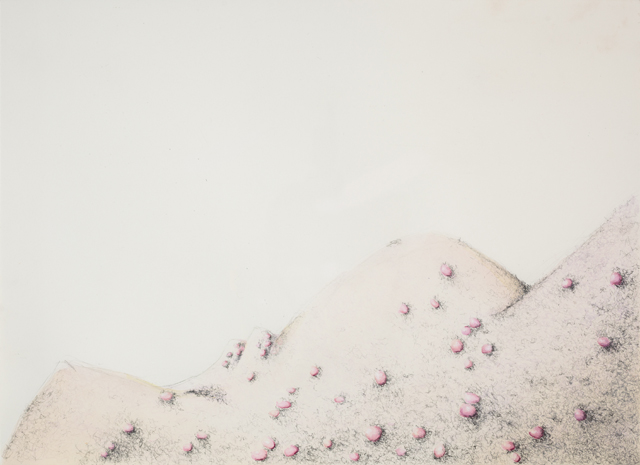
Mountain, Hair, Woman, 2014, Acrylic, Ink on Paper, 11” x 13”

Mountain, Hair, Woman, 2014, Acrylic, Ink on Paper, 11” x 13”

What types of conceptual concerns are present in your work? How do those relate to the specific process(es) or media you use?

The underlying constant in all of the different bodies of work I have done is how one object’s change or action affects those outside of itself. This conceptual concern seems to be most apparent in my ceramic pieces that involve manipulating cloth and clay together. The clay starts off soft, while the fabric is starts off sturdy. When the two materials are combined they become both pliable and firm. Once fired in the kiln, the cloth burns and leaves ashes as well as its mark on the clay. After the firing, the clay is sturdy, but brittle and fragile.  

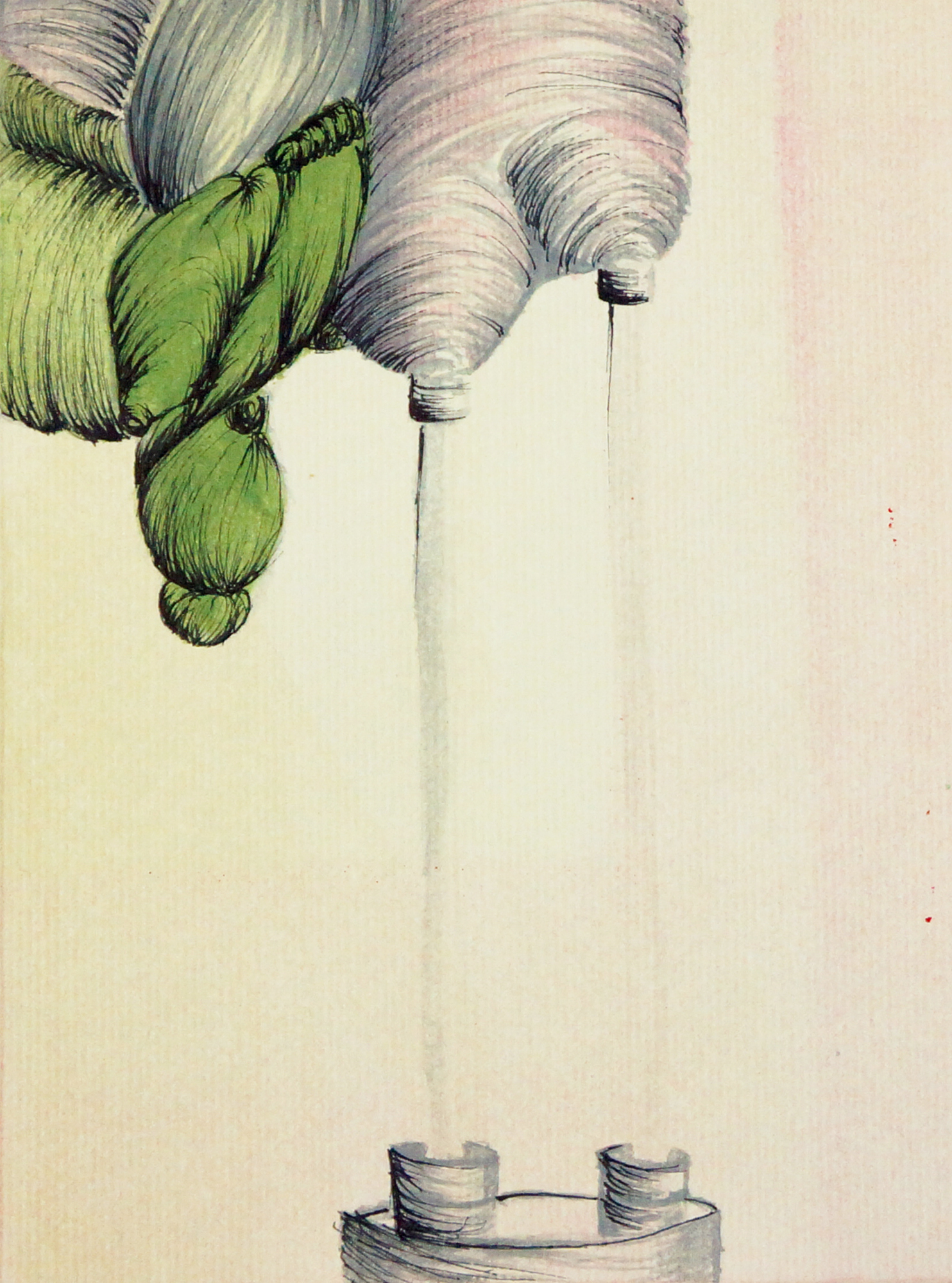
Surge Endow, 2013, Acrylic, Ink, Paper, 5 ½” x 4 ½”

Surge Endow, 2013, Acrylic, Ink, Paper, 5 ½” x 4 ½”

We once heard Chuck Close say he did not believe in being inspired, rather in working hard everyday. What motivates you in your studio practice?

I agree and disagree with Chuck Close. I agree that continually working hard is necessary for artistic development. When inspiration does come, you are ready to deal with it. Studio practice is like maintaining a long term loving relationship. It needs continuous care and attention, and may not always be hearts and roses. When inspiration does come, it is well worth the continual care, practice, and maintenance that have been invested.

What artists living or non-living influence your work?

My husband, Xi Zhang, is a painter. Though our styles, methods and materials are very different, my work is very much influenced by seeing his work every day. Other artists who influence my work are: Eva Hesse, Louise Bourgeois, Anish Kapoor, Michael Lucero, and Linda Lopez.

When you are not making art what types of activities and interests do you engage in? 

I’m currently pursuing a Master of Science in Art Therapy, so between graduate school and my studio practice, there is not much time for other activities. I have recently found that when I do have time, I really enjoy gaming. I am also trying to learn how to write code. I love playing with my cats, and my husband and I are constantly on the hunt for good thriller movies.

About 

wingardk_headshotKathryn Wingard is an artist residing in Milwaukee, Wisconsin who is currently a Master of Science candidate in the Art Therapy department at Mount Mary University. Though she now works in several different media, Kathryn has a fine arts background in sculptural ceramics. In 2008 she graduated from Massachusetts College of Art and Design with a BFA in fine arts 3-D, with a concentration in ceramics. After graduating, she left Boston and went on to continue studying fine arts with the graduate department of ceramics at the University of Colorado at Boulder. While in Colorado, Kathryn was a resident artist at the Paukune Wanner Art Hause in Severance, Colorado, and the Showpen Residency in Denver, Colorado. Kathryn has shown in Massachusetts, Colorado, and Illinois, as well as internationally.    

The Studio

The Studio

www. kathrynwingard.com

All images copyright of the artist and used with their permission. 

Posted in Uncategorized | Tagged , , , , | Leave a comment

Steve Juras – Chicago, Illinois

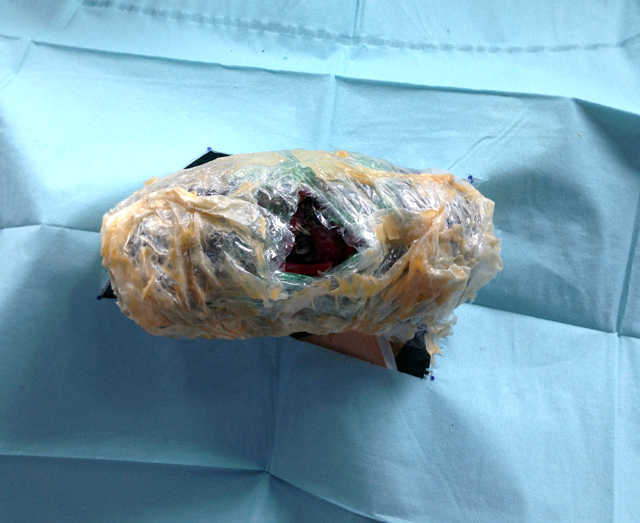
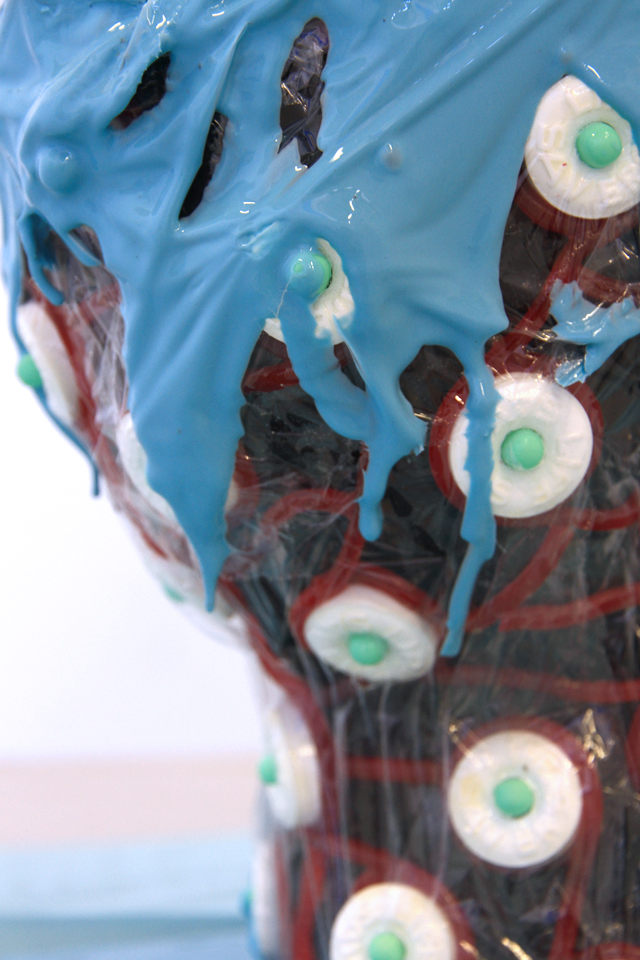
Mill of gigerium Twizzler™ twists, Lifesavers™, TicTacs™, chicken wire, bubble wrap, plastic wrap, duct tape, silicone rubber and polyurethane, 5 x 5 x 12 inches, 2014

Mill of gigerium
Twizzler™ twists, Lifesavers™, TicTacs™, chicken wire, bubble wrap,
plastic wrap, duct tape, silicone rubber and polyurethane, 5 x 5 x 12 inches, 2014

Briefly describe the work you do.

My recent work has taken a turn from geometric abstraction toward a humorous yet visceral mode of narrative performance. What does this mean? Well, that’s the big question my current work asks. Long story short, I’ve been developing a half human, half anatanine (duck) character who’s a fumbling, self-educated and somewhat confused pathologist. He dissects digestive organs engorged with chewed candy, specifically licorice and mint, in order to study their dead and diseased matter. It is his belief, however absurd, that these examinations can redeem scientific and aesthetic value from such lifeless objects. I create these organs from a variety of cheap and accessible materials, such as chicken wire, bubble wrap, duct tape, plastic wrap and wood glue. They are then placed within an ad-hoc autopsy room equipped with surgical tools, optical devices and a collection of esoteric medical and art historical reference materials. My most challenging work now is figuring out how I, as the author of this character, inhabit this role and moving gracefully back and forth between the space of the studio, the space of the maker, and the space of this strange medical theater, the space of the performer.

Tell us a little about your background and how that influences you as an artist.

It shouldn’t come as a shock that I’m familiar with medicine, hospitals and the messy work of healing and repair in the face of death and decay. 

My father was a doctor, practicing for over 30 years, and my mother and oldest sister were nurses. Quite a bit of time in my early years were spent sitting in a doctor’s lounge, paging through Gray’s Anatomy and yellowed copies of The Journal of the American Medical Association (the contents of which I understood about .005%). I’d be guzzling down papers cups of lemonade amidst the symphonic interference of CAT-scan machines, EKG monitors and other unknown radioactive frequencies. On other weekends I would accompany my sister on visits to Detroit area church shelters and help distribute fresh gauze to addicts who, having exhausted every traditional avenue of drug delivery, had rendered their shins pock-marked disaster sites.

Back at home, I would explore my Dad’s library, a wood paneled wonderland for a blossoming bibliophile. Single shelves spanned time and space, a compressed timeline of knowledge and wonder. The eight volume set of Netter Medical Illustrations was flanked by the TimeLife series on the American Indian, Peterson’s Birds of North America and St. Augustine’s Confessions. This early reading impacted my own intellectual pursuits and and wide ranging explorations. I went on to study philosophy and literature, namely phenomenology and Modernist poetry, before making my way to graduate school at the School of the Art Institute of Chicago. It was here that I ultimately found the path where all of my interests converged.

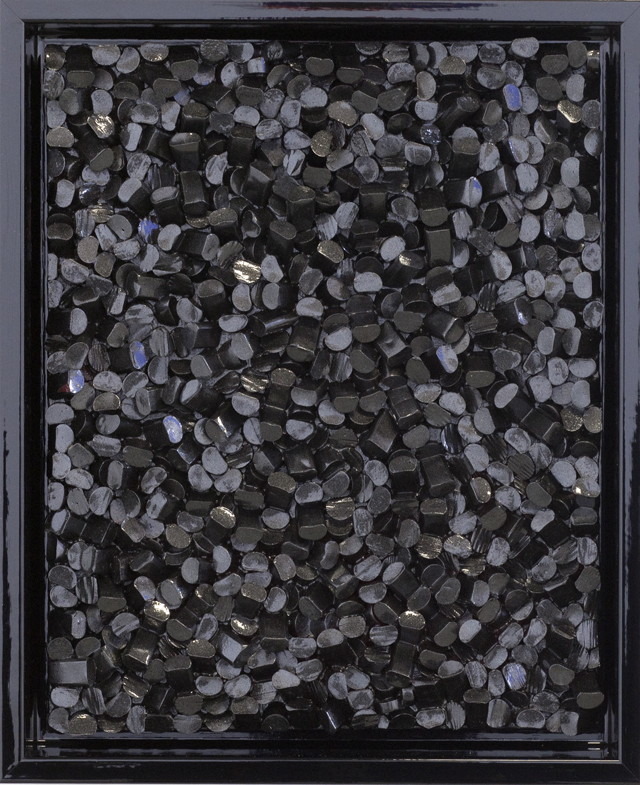
There’s always a black lining, 
Twizzler™ bites, spray paint and polyurethane on panel
, 9.5  x 11.5  inches
, 2013

There’s always a black lining, 
Twizzler™ bites, spray paint and polyurethane on panel
, 9.5 x 11.5 inches
, 2013

The concept of the “artist studio” has a broad range of meanings, especially in contemporary practice. The idea of the artist toiling away alone in a room may not necessarily reflect what many artists do from day to day anymore. Describe your studio practice and how it differs from (or is the same as) traditional notions of “being in the studio.”

In my mind, the “artist studio” is anywhere work related to one’s artistic practice gets done. 

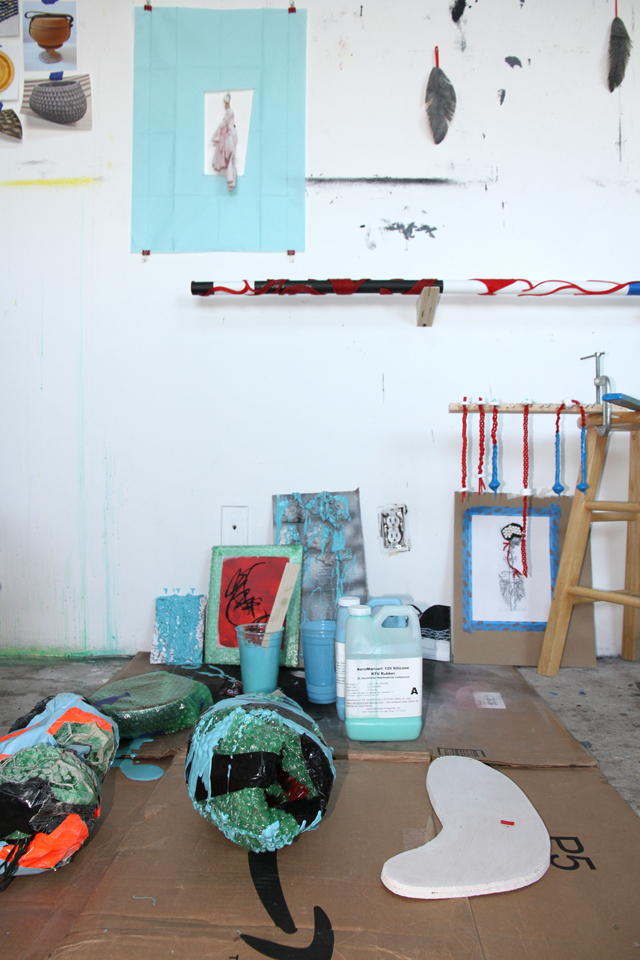
My formal studio space is a little room where objects get made. It isn’t located in my home so I treat it like a production office. It’s the place I go to work for extended periods of time, free from the day-to-day concerns that so often encroach upon our work. That said, this studio is part of the Fulton Street Collective, a motley bunch of painters, writers, designer and dancers. I spend a considerable amount of time talking with these other artists, learning about different creative processes and digesting new work. 

I also maintain what I like to call an extended studio, amorphous spaces where other kinds of practices happen. Over the past couple years I have been involved with more and more collaborative and curatorial projects so the studio has extended itself into the offices of gallery directors and exhibition planners as well as the studio spaces of emerging artists. As these projects call for applications, proposals and statements, I’ve found that the studio not only occupies a literal space but also a virtual one, the space of the page.

Another space, and perhaps the most important and rewarding one, is the Coleridge Studio of Esperanza Community Services. Here I help arts facilitators nurture the creative expression of developmentally disabled adults. They are fearless creators, engaging whatever medium they approach with enthusiasm and wonder. It is trite to say but nonetheless true that I learn more from these artists than they could ever learn from me.

First incision (oops), Twizzler™ twists, Good and Plenty™, Tic Tacs™, licorice gum, gel medium, polyurethane, bubble wrap, chicken wire, plastic wrap, wood glue, surgical drape and wood, 18 x 24 x 6", 2014

First incision (oops), Twizzler™ twists, Good and Plenty™, Tic Tacs™, licorice gum, gel medium, polyurethane, bubble wrap, chicken wire, plastic wrap, wood glue,
surgical drape and wood, 18 x 24 x 6″, 2014

What unique roles do you see yourself as the artist playing that you may not have envisioned yourself in when you first started making art?

I certainly did not envision myself ever taking part in any sort of performance. I hate being on camera or putting myself out in front of an audience. So this new turn my work is taking comes as a total surprise.

When do you find is the best time of day to make art? Do you have time set aside every day, every week or do you just work whenever you can? 

The best time of day to make art is early in the morning. The ideal studio session starts at around 6.30–7.00a and goes non-stop until 3p or so. I really like working while it’s still dark and then pushing through the early morning light. By 10.30a I feel like I’ve accomplished something (whether I really have or not). I make it to the studio 4-5 times a week while balancing design and volunteer work.

How has your work changed in the last five years? How is it the same?

My work has changed drastically over the last five years. It has evolved from formal, geometric abstraction to more visceral, sculptural work. It has stayed the same in that it is very process driven and always starts from a system of rules which I rigorously work through to exhaust.

Are there people such as family, friends, writers, philosophers or even pop icons that have had an impact on the work you do?

Wow. There are so many people that have and continue to have an impact on my work.

Family: I could not do any of my work without the help and support of my wife, Katie. 

Friends: Kyle FletcherJoshua LongbrakeAmy Honchell, Erin Smego, Michael Patrick Thornton, Marlon Fischer.

Writers: Lewis Hyde, George Saunders, David Foster Wallace.  

Artists and Philosophers: John Dewey, Thomas Hirschhorn, Søren Kierkegaard, Agnes Martin, Richard Tuttle

If you had an occupation outside of being an artist, what would that be and why?

I’ve had occupations outside of being an artist and can’t see myself doing anything else. 

About 

Juras_May_HeadshotSteve Juras is a Chicago-based artist and designer. He received a BA from the University of Notre Dame and an MFA from the School of the Art Institute of Chicago. His work uses a wide range of everyday materials, from candy and bubble wrap to sandpaper and silicone rubber, to create visceral encounters. Steve has shown and curated work throughout the Chicago area and is currently taking part in the Center Program at the Hyde Park Art Center where he will be exhibiting work at the end of 2014. 

The Studio

The Studio

www.stevejuras.com 

All images copyright of the artist and used with their permission. 
Posted in Uncategorized | Tagged , , , , | Leave a comment

Mary Johnson – Buffalo, New York

Johnson_Mary_03

“Transitory Benign Plagues of the Tongue” Spinach dye, red and yellow beet dye, concord grapes, pomegranate, acetone photograph transfer, colored pencil, graphite, digitally altered photographs and ink on paper, 36×78″

Briefly describe the work you do.

I make drawings and installation/performances that engage the absurd overlays between the luscious and the decayed; the image and experience. I use organic, decomposing materials in my work and directly on paper, as well as digitally altered photographs, to make images that span and confabulate time and space, reality and fiction. 

Tell us a little about your background and how that influences you as an artist.

Much of my childhood was spent moving- each place had a different flavor, a different pace. This constant shifting, with the vague spaces in between, I think gave me the ability and tendency to use multiple methods of making art in tandem, along with my work’s transient, loosely-defined visual qualities. I’m comfortable working like this and always have been. 

The concept of the “artist studio” has a broad range of meanings, especially in contemporary practice. The idea of the artist toiling away alone in a room may not necessarily reflect what many artists do from day to day anymore. Describe your studio practice and how it differs from (or is the same as) traditional notions of “being in the studio.”

Because my work uses so many processes at once, I spend my time doing what the method of the moment requires: building, photographing, cooking, cutting, painting and drawing. A lot of my time is spent looking, however, and determining the shape of things. Much of my working does take place in the studio, but some of it happens in the kitchen, or at the grocery store. New ideas tend to come to me while driving, looking at other artists’ work quietly, or in dreams. 

Johnson_Mary_01

“Hulusi’s Silken Road” Red and yellow beet dye, spinach particles and dye, cherries, pomegranate, artist’s saliva, digitally altered photographs, acetone photograph transfer, colored pencil, and ink on paper, 36×78″

What unique roles do you see yourself as the artist playing that you may not have envisioned yourself in when you first started making art?

My final year of my undergraduate education really crystalized my identity as an artist as not only being an object-maker, but an experience-maker as well. It was not until my second year of graduate school, however, that I realized that these experiences didn’t have to happen outside of me and without me, but could also depend on my presence for it’s existence and lifeblood.

I took an installation class with artist Millie Chen, and as I consulted with her on the production of my final work for the class, she suggested that what I was making called for a performativity to give the desired experience to viewers. This frightened me a bit, actually- I had always been able to make my work and step back from it- but I followed through, allowed myself to stay with it and become a character in the work I had built. Performance now plays a role of sustenance to my two-dimensional practice. 

When do you find is the best time of day to make art? Do you have time set aside every day, every week or do you just work whenever you can? 

I am usually very disciplined with my time, and do believe in clocking in the hours to fully realize a piece. Anytime is good time for me, although nighttime seems to be made for expressive modes of working, and morning for analytical and rote activities.

Recently, I have experienced  firsthand the value of John Cage and Sister Corita’s “Rules” #8: “Don’t try to create and analyze at the same time. They’re different processes”. Post-graduate school time has afforded me the opportunity to really analyze, re-contextualize, and reevaluate my work. As a result of this slow analyzing and thinking process, my mind is now bubbling with ideas and possibilities for the further development of my work. Anything is possible, and my brain feels like it’s on creative overdrive. 

Johnson_Mary_04

“Ti Kalisti” (detail), Pomegranate juice, turmeric dye, decomposing organic materials, digitally altered photographs, acetone photograph transfer, colored pencil and ink on paper, 15.5×36″

How has your work changed in the last five years? How is it the same?

The three years spent in graduate school greatly developed my work. It was in the summer of 2011 that I began making the work that I’m making now- previously I was making drawings, prints and paintings that had to do with unarticulated memory. Although it seems conceptually disparate from my current projects, there is a similarity between the two in that both describe intersections between object and experience, and shifting, transient spaces. I see the next 5 years as an evolution in my current work- I feel that I can stay with this for years and never get to the bottom of what I’m exploring. 

Are there people such as family, friends, writers, philosophers or even pop icons that have had an impact on the work you do?

Conceptually, my work has been influenced by many philosophers and writers- deceased and contemporary: Kant, Angela Ndalianis, Carolyn Korsmeyer and Jean Baudrillard. Francis Connelly’s book Modern Art and the Grotesque is an excellent source with essays by many thinkers.

Artists, however, have had some of the greatest influence on my work: from close friends, to those I have never met and merely admire from afar. 

If you had an occupation outside of being an artist, what would that be and why?

I think I would enjoy physics or cosmology: I’m fascinated by possibilities and mind-boggling ideas that condense time and space. More practically, I might also be an attorney: I get a thrill out of piecing information together from multiple, disparate sources into a new whole. 

About 

Johnson_Mary_HeadshotMary A. Johnson was born in Pittsburgh, Pennsylvania (1986) and is currently working in Buffalo, New York. She earned her BA from Gordon College in 2008, and her MFA in Visual Studies from the University at Buffalo: The State University of New York in 2013. Her most recent solo show was at the Castellani Museum of Art where among other works, she exhibited a 40 foot long drawing. 

In the Studio

In the Studio

www.maryajohnson.com

All images copyright of the artist and used with their permission. 
Posted in Uncategorized | Tagged , , , , | 1 Comment

Penelope Vlassopoulou – Athens, Greece

“Metamorphosis/Kurfürstendamm, Trace B, Improvisation VI”, powdered pigment on Arches 100% cotton paper, 22.5 cm x 32.5 cm, 2014

“Metamorphosis/Kurfürstendamm, Trace B, Improvisation VI”, powdered pigment on Arches 100% cotton paper, 22.5 cm x 32.5 cm, 2014

Briefly describe the work you do.

Constructing an image of the intangible.

Tell us a little about your background and how that influences you as an artist.

I enjoyed a happy childhood growing up in a family that inspired a feeling of security, cultivated the love of nature and favored dreaming. I believe that had a great deal to do with me choosing this path. When I was a kid I was interested in constructing things and learning how things are built, a curiosity that was encouraged by my father who has always been an artist in the broader sense, making beautiful things from scratch. I guess I am still doing the same thing only with different means.

The concept of the “artist studio” has a broad range of meanings, especially in contemporary practice. The idea of the artist toiling away alone in a room may not necessarily reflect what many artists do from day to day anymore. Describe your studio practice and how it differs from (or is the same as) traditional notions of “being in the studio.”

Isolating myself in the workshop to create is an essential part of my creative practice. Recently my studio practice expanded to include the social sphere in the form of its reflection on the urban environment. My current work in “Metamorphosis” involves documenting elements from the city and giving them a different, poetic, function as structural elements of my “Improvisations” and installation work. That means that a significant part of my studio practice takes place in the city streets. 

“Thirty six blue moons”, powdered pigment on handmade 100% cotton paper, 114 cm x 65 cm, 2013

“Thirty six blue moons”, powdered pigment on handmade 100% cotton paper, 114 cm x 65 cm, 2013

What unique roles do you see yourself as the artist playing that you may not have envisioned yourself in when you first started making art?

The vague vision I had early on of the artist as someone allowed to delve into his/her inner world and give it form through creating is now paired with the notion of the artist as someone who has the privilege of reintroducing reality to others with his/her added meaning.

When do you find is the best time of day to make art? Do you have time set aside every day, every week or do you just work whenever you can? 

The time I dedicate to my work is shared between studio practice and tasks that address the issue of taking the work out of the studio into the world. Documenting the work, preparing applications in response to artist calls, maintaining an online presence and finding the appropriate venues where I can sell my works are time-consuming but necessary tasks. The amount of time spent on either of these two distinct parts of my activity varies and moves in a circle. The circle opens with the studio practice and concludes with the introduction of the work into the world. Often circles that relate to different bodies of work run in parallel and overlap. As far as the studio practice goes my preference is to start the work early in the morning and go on until I feel I have accomplished something substantial that day.

“Metamorphosis/Athens,Trace A, Improvisation X”, powdered pigment on handmade 100% cotton paper, 37 cm x 30 cm, 2014

“Metamorphosis/Athens,Trace A, Improvisation X”, powdered pigment on handmade 100% cotton paper, 37 cm x 30 cm, 2014

How has your work changed in the last five years? How is it the same?

It is more my perception of my work that has changed rather than the work itself. Having acquired a better insight into what it is that interests me and keeps re-emerging allows me to tap deeper into that source, proceed with more confidence and have a stronger sense of direction.

Are there people such as family, friends, writers, philosophers or even pop icons that have had an impact on the work you do?

All my close circle has had an impact on me and my work, most importantly my parents and brother, my husband and my oldest and closest friends. Other than that, Plato, Baudelaire, Nietzsche, Breton and Kazantzakis are figures whose work has had an impact.

If you had an occupation outside of being an artist, what would that be and why?

Being an artist in my view is more than an occupation, it is rather a personality type. If material circumstances didn’t allow me to express this inclination through creating I think I would try and channel it through the role of the educator. Alternatively, I would choose being a tour guide, introducing sites and locations that carry cultural meaning to people and doing my part in keeping historical memory and knowledge of man’s accomplishments alive.

About 

HeadshotParts that constitute a whole or units that build a construction are recurring elements in Vlassopoulou’s work. Documentation re-emerges as a method focusing on the everyday environment and objects that carry personal histories. In her current work “Metamorphosis” urban space serves as the point of departure and a link to common human experience. Consisting principally of abstract forms, her vocabulary includes images that allude to the physical world as well as textual elements when the reference they make is relevant to the work. Painting, drawing, installation and the book are all welcome forms.

Penelope Vlassopoulou was born in 1977 in Athens, Greece. She studied Painting at the Athens School of Fine Arts, graduating with honors in 2006, and Technology of Graphic Arts at the Athens Technological Institute, graduating in 2000. She concluded her fourth year of studies in Painting at the Académie Royale des Beaux-Arts de Bruxelles, Belgium, on a scholarship from the State Scholarships Foundation of Greece (2004-2005). Past group exhibitions include Lost Space, João Cocteau Gallery, Berlin, Germany, 2014; The Art of the Book at the Athens School of Fine Arts, Cycladic Art Museum, 2011; Greek Artists’ books: Contemporary Artworks and Editions, ART-ATHINA International Contemporary Art Fair of Athens, 2010; and Book Arts Fair, Pyramid Atlantic Art Center, Washington, USA, 2006. Alongside her practice as an artist she works as a designer, with work featured in venues such as the National Museum of Contemporary Art of Greece and the Benaki Museum in Athens, Greece. She has published articles and essays on the subjects of art, design and the graphic arts. She lives and works in Athens, Greece.

Studio Practice

Collecting “Traces” for the project “Metamorphosis/Kurfürstendamm” Berlin, Germany 2014 Film still camera : Rebecca Culverhouse

www.vlassopoulou.com

All images copyright of the artist and used with their permission. 
Posted in Uncategorized | Tagged , , , , | Leave a comment

Charles Clary – Murfreesboro, Tennessee

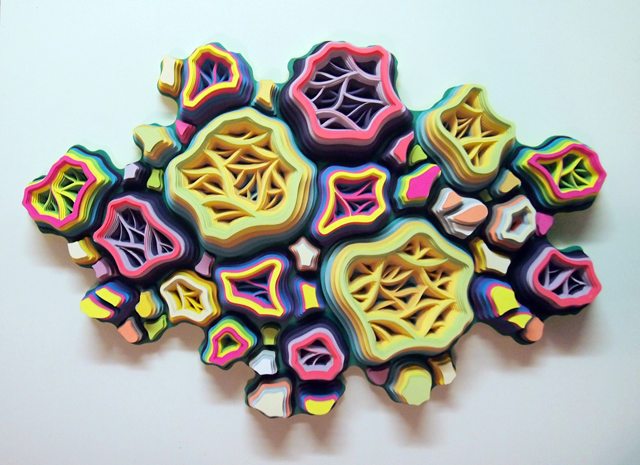
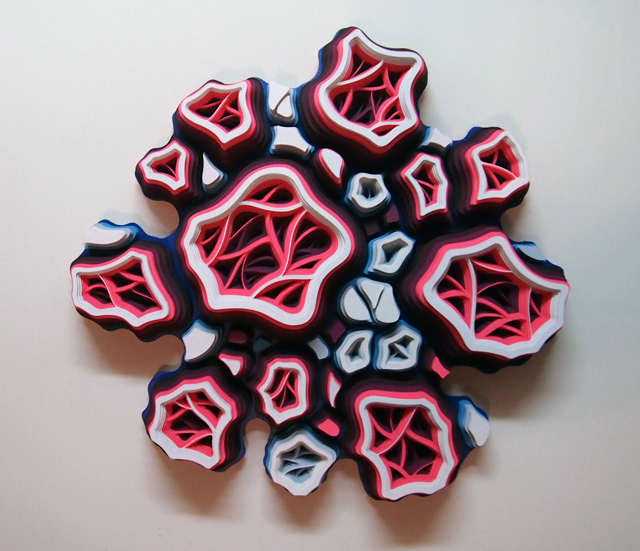
Patiflasmic Flamungle Gestation Movement #5, Hand cut paper and acrylic on panel, 24" x 24" x 7"    2014

Patiflasmic Plasmatic Gestation Movement #2 (detail shot)

Briefly describe the work you do.

I use paper to create a world of fiction that challenges the viewer to suspend disbelief and venture into my fabricated reality. By layering paper I am able to build intriguing land formations that mimic viral colonies and concentric sound waves. These strange landmasses contaminate and infect the surfaces they inhabit transforming the space into something suitable for their gestation. Towers of paper and color jut into the viewer’s space inviting playful interactions between the viewer and this conceived world. These constructions question the notion of microbial outbreaks and their similarity to the visual representation of sound waves, transforming them into something more playful and inviting. Recently my work has transitioned into a reflection/reaction to my mother’s diagnosis and death due to small cell carcinoma of the lungs, and my fathers passing due to throat and esophageal cancer.

Tell us a little about your background and how that influences you as an artist.

I grew up in a small town in East Tennessee and had a rough childhood with bullying and a tumultuous home life. I escaped into art to get release from those troubling times, and low and behold I got kinda good at it. I then found music as a secondary release and began to combine the two into expressive playful paintings. When I got into college I was a double major and still dealt with the ramifications of my upbringing but still relied on music and art to deal with the pain. After awhile, I realized that each took so much time to master that I had to choose one over the other and art won out.

Patiflasmic Flamungle Gestation Movement #5, Hand cut paper and acrylic on panel, 24" x 24" x 7", 2014

Patiflasmic Phlebotomy, Hand cut paper and acrylic on panel, 24″ x 38″ x 7″, 2014

The concept of the “artist studio” has a broad range of meanings, especially in contemporary practice. The idea of the artist toiling away alone in a room may not necessarily reflect what many artists do from day to day anymore. Describe your studio practice and how it differs from (or is the same as) traditional notions of “being in the studio.”

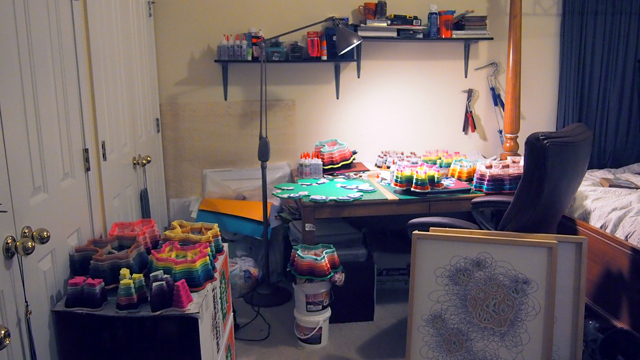
Your description sums up my practice to a T. I also teach at the college level, and what I have found is if I’m not doing everything I can to be as successful and productive as I can be what kind of advocate am I for my students. I try to fit in atleast 2-4hrs a day in the studio during the week even working in my office at school during student visits and then work about 12hrs a day during the weekends. It ends up being a lot of alone time but well worth it in the end.

What unique roles do you see yourself as the artist playing that you may not have envisioned yourself in when you first started making art?

I become a storyteller a weaver of fiction allowing my viewers the solace of an escape from the everyday. I also advocate against the preconceived stereotype of the American artist. Being an artist is hard work. Math, communication skills, business sensibilities, organization, problem solving all play a major role in my profession.

Patiflasmic Flamungle Gestation Movement #5, Hand cut paper and acrylic on panel, 24" x 24" x 7", 2014

Patiflasmic Flamungle Gestation Movement #5, Hand cut paper and acrylic on panel, 24″ x 24″ x 7″, 2014

When do you find is the best time of day to make art? Do you have time set aside every day, every week or do you just work whenever you can? 

Anytime of the day is a good time to make art, but I primarily work at night or whenever I can fit in some time.

How has your work changed in the last five years? How is it the same?

My work has been pretty consistent over the last 5 yrs but it has tightened up and gotten more intricate in the last 2. I have migrated over to smaller denser panels really emphasizing the microbial/petri dish imagery of viruses and bacteria. My cuts have become finer and thinner reinforcing the delicate yet rigid qualities of paper.

Are there people such as family, friends, writers, philosophers or even pop icons that have had an impact on the work you do?

There are many that have influenced me. My mother for one was always supportive of my drive to be an artist. I enjoy the writing of James Elkins, David Batchelor, Boris Groys and artists Matthew Ritchie, Sara Sze, Jane South, Bovey Lee, Brian Deitmer, Olek, Swoon, Keil Johnson and many others. My fiancé Katie Stringer is the love of my life and is just beyond supportive of all that I do and helps keep pushing me forward even when I struggle from time to time. Joe Amhrein from Pierogi Gallery in Brooklyn gave me a chance as an intern and apprentice and really keeping my drive going.

If you had an occupation outside of being an artist, what would that be and why?

I’m not sure I can imagine doing anything else it’s so ingrained in my psyche but I guess if I had to pick one it’d be a microbiologist b/c I’m fascinated with this microscopic realm and I could have the added bonus of helping society and individuals. 

About 

Alt head shotCharles Clary was born in 1980 in Morristown, Tennessee. He received his BFA in painting with honors from Middle Tennessee State University and his MFA in painting from the Savannah College of Art and Design. He has had solo exhibitions at Nancy Margolis Gallery in NYC, The Rymer Gallery in Nashville, TN, and Galerie EVOLUTION-Pierre Cardin in Paris, France. He completed a three week residency in Lacoste France, completed a painting assistantship with Joe Amrhein of Pierogi Gallery in Brooklyn NYC, and had work acquired by fashion designer Pierre Cardin and gallery owner James Cohan. As of 2013 Charles had been featured in numerous print and Internet interviews including, WIRED magazine (US and UK), Hifructose.com, Beautifuldecay.com and Bluecanavs Magazine. He has also been featured in publications including “Papercraft 2” published by Gestalten and “PUSH Paper” published by Lark Books, “Paper Art” published by ArtPower International Publishing, and “Paper Works” published by Sandu Publishing as well as 500 Paper Objects published by Lark Books. Charles has lectured nationally and exhibited regionally, nationally, and internationally in numerous solo and group shows, is represented by The Rymer Galery in Nashville, TN, the Diana Lowenstein Gallery in Miami, FL, the Kenise Barnes Gallery in Larchmont, NY and currently lives and works in Murfreesboro, TN.

In the Studio

In the Studio

www.charlesclary.wordpress.com

All images copyright of the artist and used with their permission. 
Posted in Uncategorized | Tagged , , | 1 Comment

Hao Ni – Providence, Rhode Island

lethal cards, 2013, PVC cards, wood, plexiglass, dremel and other mixed media

lethal cards, 2013, PVC cards, wood, plexiglass, dremel and other mixed media

Briefly describe the work you do.

Like a poltergeist that is only active in the absence of humans, my work is an on-going search of for the manifestation of aesthetic experience through acts of transgression. Ranging from sculpture to installation and painting to sound performance, I seek to uncover the subtle beauty of coincidence and anomaly, as well as to challenge pre-conceived notions of the everyday experience. My work is always in flux and subject to change, which allows me to create and experiment by constantly translating and imposing existing logic from one system to another. Drawing inspiration from a wide range of sources as diverse as pet psychology, modern interior design, nocturnal insects, bank robberies and Chinese ghost stories, I am constantly pairing moments in the broader culture to create new scenarios and situations that suggest alternate perspectives of the many social rituals that we participate in.

Tell us a little about your background and how that influences you as an artist.

When I was young, my mother always kept me engaged in different kinds of artistic activities. In high school I almost failed my chemistry class. 

The concept of the “artist studio” has a broad range of meanings, especially in contemporary practice. The idea of the artist toiling away alone in a room may not necessarily reflect what many artists do from day to day anymore. Describe your studio practice and how it differs from (or is the same as) traditional notions of “being in the studio.”

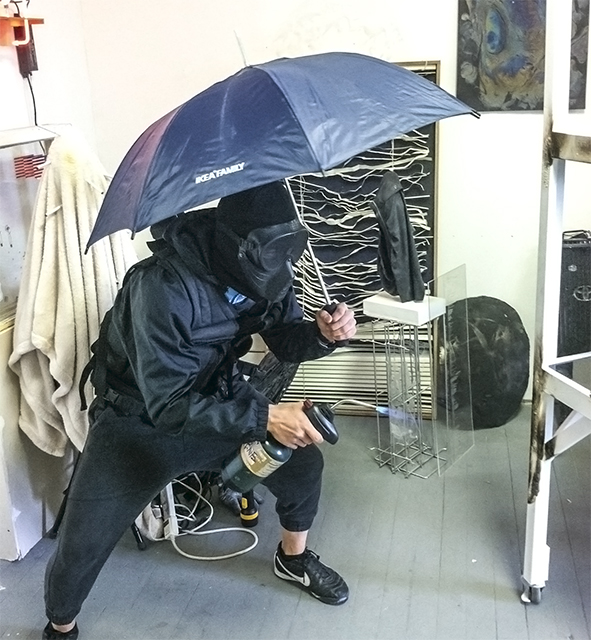
I am constantly observing and absorbing interesting things around me. Whether it’s from surfing the internet or visiting the local pet shop. Almost simultaneously, I started to think illogically, to make strange connections and scenarios that don’t necessarily make sense initially. I edit these strange thoughts, saving the essences from the thinking session, and let them marinate for a few days. I then try to make sense of new ideas by researching and learning from them, before translating them into actual work.  Having a studio is very important to me because I am an impulsive buyer, and it really helps to have a space to store all the crap i buy from amazon. In addition, studio is almost the only place where we can hide our bad art from the precious eyes of our viewers.

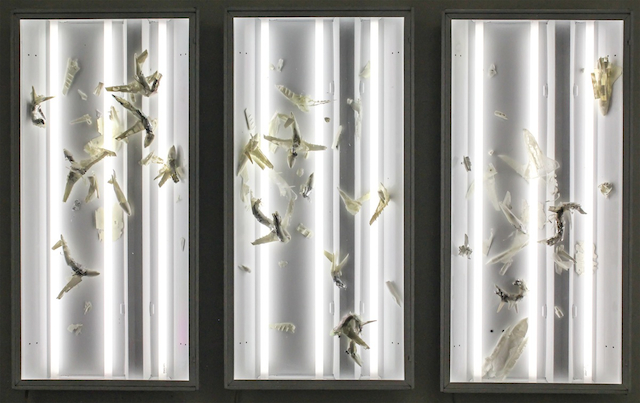
Residue, 2013, enamel paint and aluminum on cast plastic, fluorescent light and light box, 2ft x 4ft each

Residue, 2013, enamel paint and aluminum on cast plastic, fluorescent light and light box, 2ft x 4ft each

What unique roles do you see yourself as the artist playing that you may not have envisioned yourself in when you first started making art?

Before, I always thought I was an artist, I didn’t know that I was actually a muddy catfish, a flying cockroach, a grounded bat, or a noisy ghost. 

When do you find is the best time of day to make art? Do you have time set aside every day, every week or do you just work whenever you can? 

I find myself most active at 12:00am sharp.  

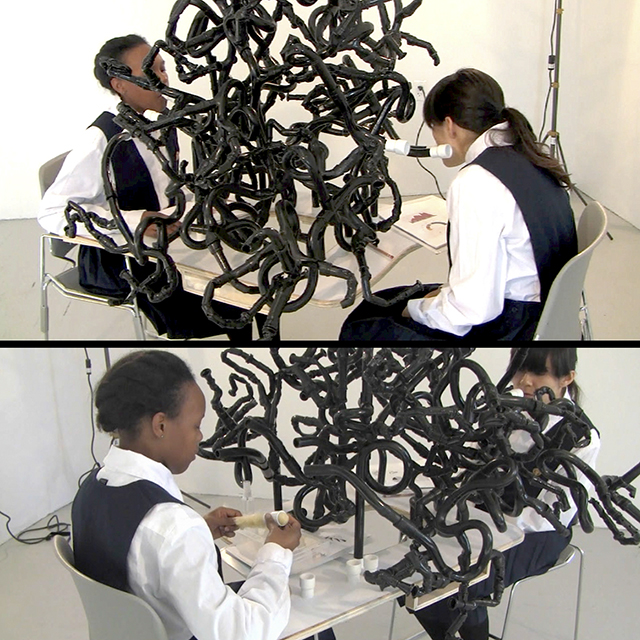
Structure Study I, 2012, Enamel paint on PVC and ABS plastic, plywood, vinyl, cotton, alcohol in spray bottle, found chairs. variable, Performers:Sophia Sobers, Katie Taylor

Structure Study I, 2012, Enamel paint on PVC and ABS plastic, plywood, vinyl, cotton, alcohol in spray bottle, found chairs.
variable, Performers:Sophia Sobers, Katie Taylor

How has your work changed in the last five years? How is it the same?

I think that the more art I do, the harder it gets. When I started taking art seriously in high school, art was very easy as I was able to create drawings of beautiful creatures from my own imaginary world, and everyone loved it. Now when I make something, people usually say “WTF” or “I don’t know about that”.  I really miss the good old days when art used to be so simple. 

Are there people such as family, friends, writers, philosophers or even pop icons that have had an impact on the work you do?

Ukraine’s Darth Vader (http://www.theguardian.com/world/2014/mar/31/ukraine-darth-vader-president-internet-party) is someone I have been thinking about. Vader’s dedication to humor in the time of serious crisis is something that is very admirable to me personally. 

If you had an occupation outside of being an artist, what would that be and why?

1: I’d like to be a handsome detectorist that does not find anything ever, so I can always hang out at the beach with a Piña colada, reciting world history to half naked passersby.  

2: I’d like to be the captain of Kanye West’s space ark. According to word on the street, Kanye is currently constructing a space ark exclusively for his art collections. 

About 

haoniOriginally born in Hsin Chu, Taiwan, Hao Ni is an artist currently living and working in the United States. Hao Ni received his BFA in 2011 from the School of the Art Institute of Chicago, and is expected to receive his MFA from the Rhode Island School of Design in May 2014. Ni’s work has been exhibited at the Granoff Center of Art, Yellow Peril Gallery in Providence, RI, Stephan Stoyanov Gallery in NYC, Scope Art Fair in Miami and NEXT Art Fair in Chicago. In 2011 Ni was awarded the Edward Ryerson Fellowship at the SAIC, and in 2012 the Presidential Scholarship from RISD.

In the Studio

In the Studio

www.haoishao.com

All images copyright of the artist and used with their permission. 
 

Posted in Uncategorized | Tagged , , , , | Leave a comment

Crystal Brown – Kansas City, Kansas

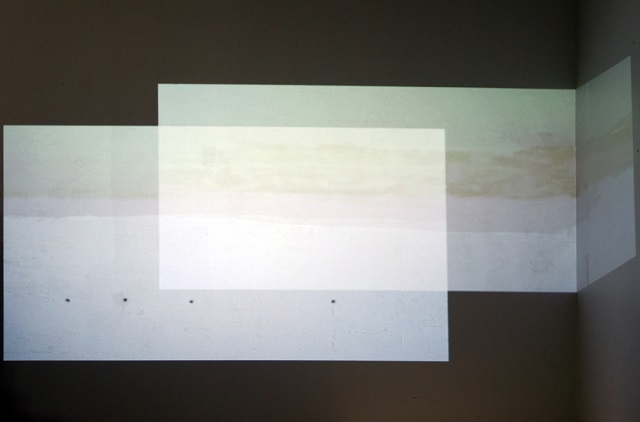
“Interior Horizon”, 7’x3’, video and audio installation, 2013

“Interior Horizon”, 7’x3’, video and audio installation, 2013

Briefly describe the work you do.

I consider myself to be an interdisciplinary artist and a parent/artist activist, I don’t believe being an artist and a mother are mutually exclusive endeavors but that the two inform and influence each other. During my day I am constantly archiving information to use in the studio.  The information I am collecting most often takes the form of video and audio recordings, to-do lists, drawings, and photographs all taken from my domestic life as mother and most often in collaborations with family members.

Tell us a little about your background and how that influences you as an artist.

I come from a Sculpture and Design background with a love for performance.  My undergraduate training was at Kendall College of Art and Design in Grand Rapids, Michigan, where I studied sculpture and art history with a great deal of emphasis on design and performance. In 2012 I earned my MFA from Ohio University in Athens, Ohio where my primary focus was in the sculpture and expanded practice department. I spent much of this time working with time based media, performance and installation.  Because of my background I find that working across a broad range of media to be very satisfying.  I feel that I am very sensitive to space and how we interact with it. I’m continually inspired by our performance of the everyday and draw a great deal of inspiration from domestic ritual and routine.

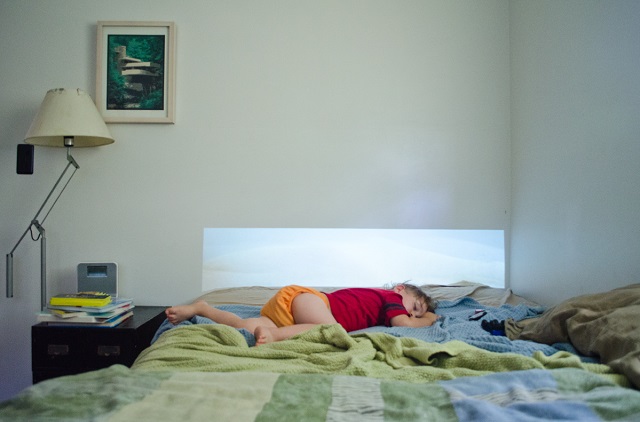
“Breathing”, 5’x1.5’, video projection installation, 2013

“Breathing”, 5’x1.5’, video projection installation, 2013

The concept of the “artist studio” has a broad range of meanings, especially in contemporary practice. The idea of the artist toiling away alone in a room may not necessarily reflect what many artists do from day to day anymore. Describe your studio practice and how it differs from (or is the same as) traditional notions of “being in the studio.”

My studio is in our house, in our living room actually, and I work at my desk whenever I can. I am constantly colleting information to bring back to the “studio”, sometimes it’s in a sketchbook and other times it is in a recording on my phone or another digital device. For me the studio extends a defined space because I need to remain flexible. As a mother/artist I’m always squeezing in time to get various studio tasks done. Sometimes I work outside in our backyard, sometimes at our kitchen table or in our garage, but more routinely I am at my desk in our living room.

What unique roles do you see yourself as the artist playing that you may not have envisioned yourself in when you first started making art?

Activist and feminist, I had no idea that I would be considering myself a parent/artist activist let alone a feminist. I had a really great mentor during graduate school, she asked us to consider what’s at stake in our work and this activated something in me that resurfaces every time I consider exposing my work to the world.

I founded and direct the Hown’s Den: A Nomadic + Domestic Exhibition Space, I think of this project as an extension of my studio practice. The mission of the project is to redefine the way that we view and discuss art. The project strives to end the preconceived notion that art can only be viewed in a nonobjective space by fully incorporating art installations in our domestic dwelling.  After all most or our interactions with art happen on a domestic level. I find that this promotes experimentation and extends a discourse that most frequently is stunted by the traditional gallery walls.

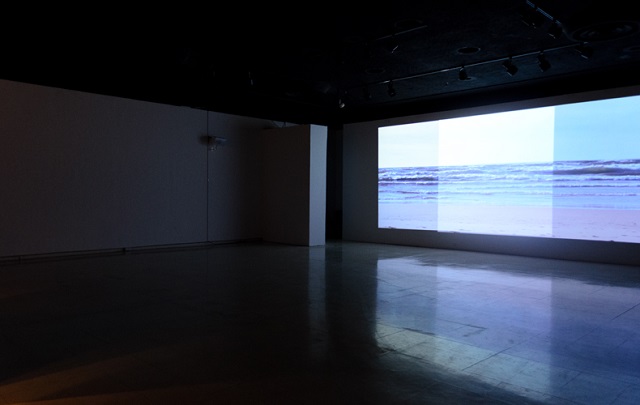
“The Sea: Between Speech and Language”, 2500 square feet, video and audio installation, 2012

“The Sea: Between Speech and Language”, 2500 square feet, video and audio installation, 2012

When do you find is the best time of day to make art? Do you have time set aside every day, every week or do you just work whenever you can? 

A little of all the above, recently my goal is to be in the studio from 4am-7am everyday, but sometimes life gets in the way of that and I have to squeeze in time during the day or at night if I miss time in the morning. Three days a week I work in the studio during my toddler’s naptimes, and that is a useful and productive block of time. It depends on the day and the task, but I find that I am much more focused in the wee hours of the morning when my house is quiet.

How has your work changed in the last five years? How is it the same?

My work changed when I became a mother. This life event forced me to reconsider what I make and how I make it. My studio time is influenced by my role as mother and vice verse.  The work that I produce is directly related to my own life experience and that has not changed.

Are there people such as family, friends, writers, philosophers or even pop icons that have had an impact on the work you do?

My Family and environment are always influencing my practice; my family and the poetics of our interactions with each other inspire me on a daily basis.  Other outside sources of inspiration are always shifting depending on current projects and focus but right now I am finding myself fascinated by the works of Martha Rosler, Chantal Akerman, Laura Larson and Moyra Davey.

If you had an occupation outside of being an artist, what would that be and why?

I actually think about this question a lot, I think I would be a midwife/yogi/lactation consultant/female health and wellness coach.  I know this seems so different than the actions of an artist, but I think of these roles as acts of feminist activism and in that way it’s not that far of a stretch from what I am interested in conceptually as an artist. 

About

headshotCrystal Ann Brown is an interdisciplinary artist, and parent/artist activist working in Kansas City. In 2012 she earned her MFA in sculpture and expanded practice from Ohio University School of Art.  In 2013 her work was included in Chasing Horizons, an exhibition at the Charles Allis Museum of Decorative Arts in Milwaukee.  Since then she founded The Hown’s Den: A Nomadic + Domestic Exhibition Space and has curated four events from the fall of 2013 to March 2014.  Crystal has been asked to participate as a guest critic in the sculpture department at the Kansas City Art Institute in recent semesters, and is one of five members of SPECTRA, a nomadic platform for experimental film and video.

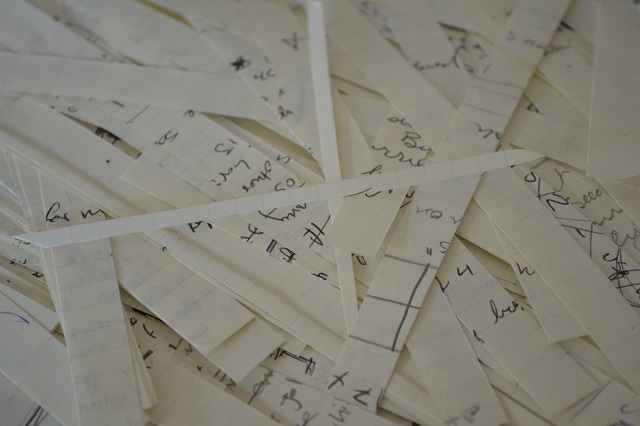
“Sketchbook”, work in in progress, ¼” Slices of paper, 2014

“Sketchbook”, work in in progress, ¼” Slices of paper, 2014

www.crystalannbrown.com

All images copyright of the artist and used with their permission. 
Posted in Uncategorized | Tagged , , , , | Leave a comment

Joe Page, Walla Walla, Washington

Working in the “studio” (installing in a gallery space)

Working in the “studio” (installing in a gallery space)

Briefly describe the work you do.

The escapist allure of immersive environments drives my work, orienting the viewer in a place of comfort and curiosity.  The vibrant colors, reductive imagery, and illustrated movements within the “Flow Chart” series of installations are deceptively simple, derivative of early video games, pinball machines, mass transit maps, and schematic diagrams.  Within this framework, one soon begins to uncover the world’s underpinnings: a modular, rules-based system of sculptural parameters, compositional logic, and spatial relationships.  Innumerable variations in scale and narrative can be constructed from this limited “kit” of elements.  The reductive simplicity of these environments is at once comforting and cloying, sincere and cynical.

Tell us a little about your background and how that influences you as an artist.

Since my brother and sister are quite a bit older than I am, I grew up essentially as an only child.  Avoiding boredom through solitary play pushed me to be inventive, resourceful, and more than a little bit strange. I cannot overstate the influence of Legos, blanket forts, backyard mud pits, and video games on my work as an artist!

I’m also a bit of a chronic collector, a trait my brother and I determined that we both inherited via our father.  As a kid it was action figures, rocks and minerals, and baseball cards, while adulthood has brought an amassing of bicycles, graphic tees, and plants. The process of making my artwork builds upon and satisfies this compulsion to accumulate and categorize things.

Flow Chart: Diffusion, porcelain, vinyl, polystyrene, mdf, wire, 2014.

Flow Chart: Diffusion, porcelain, vinyl, polystyrene, mdf, wire, 2014.

The concept of the “artist studio” has a broad range of meanings, especially in contemporary practice. The idea of the artist toiling away alone in a room may not necessarily reflect what many artists do from day to day anymore. Describe your studio practice and how it differs from (or is the same as) traditional notions of “being in the studio.”

I find that my personal studio and the installation site are of equal importance in my studio practice. The personal studio represents a workshop for creating elements to be used in the larger installations, while the gallery is the creative laboratory where all of these variables come together to form a whole that is unique to the eccentricities of the space.  Naturally, these two halves of the creative process possess a rhythm and pacing that are completely different from one another.  I might spend weeks or months in my studio for a few hours each day constructing the physical objects for a show, while I usually only have a few days to install the work in a space.  This second half is a very condensed creative process and a grueling test of mental and physical endurance, often involving an all-nighter on the final day of the install.  My work wouldn’t be possible without the wonderful friends and assistants I’ve been fortunate to work with over the years.

What unique roles do you see yourself as the artist playing that you may not have envisioned yourself in when you first started making art?

I know for sure that I never really considered the amount of advance planning, self-promotion, and task delegation that come with being a professional artist.  None of these come naturally to me, but I’ve been fortunate to become more adept at them over time.  Simply possessing talent and enjoying the act of making artwork is rarely enough to get any of that work out into the world.  You need to learn to wear many hats.

Flow Chart: Vortex, porcelain, vinyl, polystyrene, mdf, wire, 2014.

Flow Chart: Vortex, porcelain, vinyl, polystyrene, mdf, wire, 2014.

When do you find is the best time of day to make art? Do you have time set aside every day, every week or do you just work whenever you can? 

With a teaching schedule to work around, I’m most productive in the evenings. I’ve always been a bit of a night owl by nature and frequently stay in the art building long after all of my students have gone home.  Managing creative energy and protecting free time have been the most important aspects of continuing to make work since starting to teach.

How has your work changed in the last five years? How is it the same?

Undeniably, the aesthetic sensibility remains very much the same as the work I made five years ago. The bubble continues to be an endless source of new variations and themes emanating from the same form. I would say there’s an obsessiveness in wanting to explore every possibility within a fairly limited formal framework. Lately I’ve added interactive elements to the environments, engaging viewers in a physical dialogue with the work rather than just a visual one.

Are there people such as family, friends, writers, philosophers or even pop icons that have had an impact on the work you do?

I’m indebted to the amazing people I’ve had come into my life. An appreciation for making things runs in my family: a carpenter grandfather, a seamstress grandmother, a jeweler aunt, and a quilter mother. They passed down a connection to the thoughtfulness and labor it takes to create meaningful objects. A ceramics professor in undergraduate school took that inherited desire of mine and gave it a critical focus.  One incredible friend has given up countless hours of sleep and sanity to assist me in several shows around the country.  Most importantly, my partner has been invaluable at offering her unwavering love and support, keeping my priorities aligned, and encouraging the need to spend time away from my artwork to travel and experience the unfamiliar.

If you had an occupation outside of being an artist, what would that be and why?

A career as an artist and teaching others to make art is curiously like building and operating a small business.  It would be rewarding to start a profitable business that could foster beneficial activity within a local community.  My dream in an alternate life would bring together two of my favorite things: a bicycle/coffee co-operative that hosted group rides, community outreach, and cultural events!

About 

5Joe Page is from Northbrook, IL and earned an MFA from the New York State College of Ceramics at Alfred University in 2008 and a BA from Knox College in 2003.  His work has been exhibited throughout the U.S. including The Philadelphia Clay Studio, The Archie Bray Foundation, and numerous colleges and universities.  After teaching art at Whitman College in Walla Walla, WA for the past five years, he is thrilled to be moving back to the Midwest to teach at Southern Illinois University Edwardsville as the area head of ceramics this fall.

Flow Chart: Torrent, porcelain, vinyl, polystyrene, mdf, wire, 2014

Flow Chart: Torrent, porcelain, vinyl, polystyrene, mdf, wire, 2014

www.joe-page.com

All images copyright of the artist and used with their permission. 
Posted in Uncategorized | Tagged , , , , | Leave a comment