Linda Bond – Weston, Massachusetts

Briefly describe the work you do.
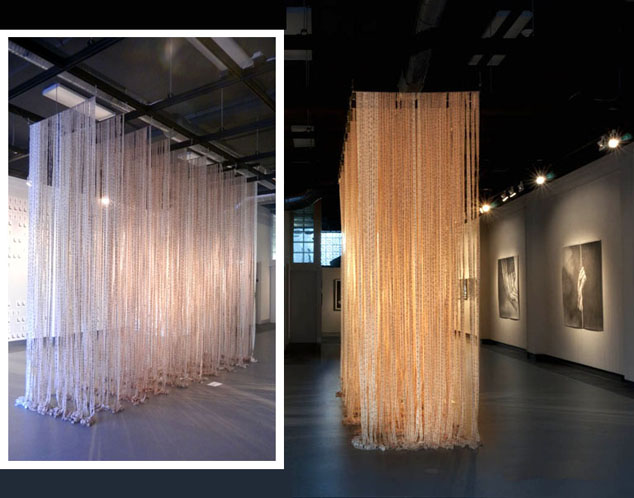
“a count”, 2010-ongoing, vintage gauze, gunpowder, safety, pins, steel rods, dimension variable

“a count”, 2010-ongoing, vintage gauze, gunpowder, safety, pins, steel rods, dimension variable

My work explores the mediated experience of wartime. As an American artist, much of my understanding of our country’s involvement in the Middle East and South Asia develops from the articles I read, or from information presented on the televised news. The essence of human suffering is often buried in this over-abundance of information. The work I have produced during this past decade of American conflict is unified in its desire to distill, encapsulate,and visually present complex issues of war with equanimity.Pausing to examine the details of violent events, my work is a personal attempt to both humanize these tragedies and to combat the numbingeffects of a media-saturated culture. Gunpowder has been a central medium in my work. Incorporated into my drawings and installations, this material speaks to the volatile conditions from which my subject matter derives. Sometimes dampened, and thus rendered inert, the gunpowder also acts as a metaphor for the human potential to be compassionate and to promote peace — to create, rather than destroy.

Tell us a little about your background and how that influences you as an artist.

I was born in San Francisco and grew up outside of New York City, in Montclair, New Jersey. I come from a family of modest means. My father was a news photographer in the military and left both professions for factory work when I was about two years old. Later my mother joined him and worked on the second shift assembly line at Westinghouse.  Coloring books and paint by number sets were my only exposure to art until I was mesmerized by Michelangelo’s Pieta at the 1964 World’s Fair in Queens, New York.  In 1968, I began studying mathematics at Bradley University in Illinois. After one semester, encouraged by friends, I changed my major and entered the College of Art. At 18 years old I walked into my first art class and found my passion.  Since then this passion has defined my life.     
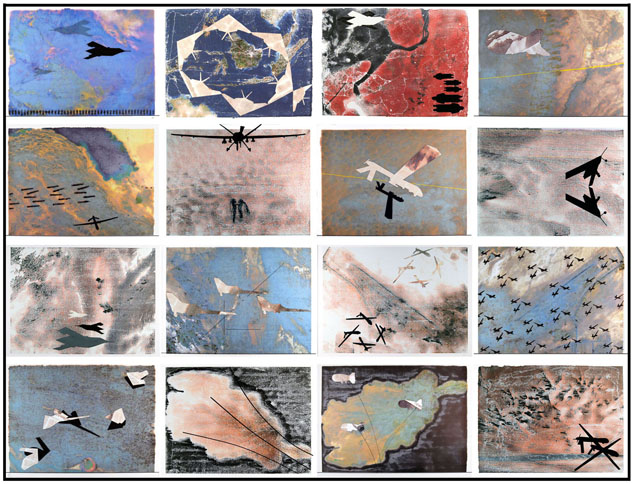
“Shadow War”, 2012- 2014, selection from 370 unique works, Ink , gouache, cut paper collage on archival pigment monoprint on mylar on paper, 12” x 16” each

“Shadow War”, 2012- 2014, selection from 370 unique works, Ink , gouache, cut paper collage on archival pigment monoprint on mylar on paper, 12” x 16” each

The concept of the “artist studio” has a broad range of meanings, especially in contemporary practice. The idea of the artist toiling away alone in a room may not necessarily reflect what many artists do from day to day anymore. Describe your studio practice and how it differs from (or is the same as) traditional notions of “being in the studio.”

While much of my work has concentrated on two-dimensional drawing and has taken place in the studio, recent projects mark a move towards site specific, interactive installation. Engagement with a broad public audience is important. Using an expansive visual language, I seek to inspire both personal reflection and generate discussion about topics that are often difficult and polarizing. I look for exhibition venues that encourage investigation of current cultural and social issues while educating and building audiences for Contemporary art.

What unique roles do you see yourself as the artist playing that you may not have envisioned yourself in when you first started making art?

Two years ago I began a collaborative project with a socially active component. It was inspired by Nicholas Kristof and Sheryl WuDunn’s book “Half the Sky”. How would things be different if the injustices suffered by women around the globe ceased? Bringing women into the economic, political and academic spheres of poor nations would not only contribute to their evolving economies, helping to alleviate poverty, but could actually transform some of the causes that lead to war and conflict.  In partnership with Barakat, a Cambridge MA non-profit that provides education for women and girls in Afghanistan and Pakistan, I am developing an installation that speaks to the benefits that this potential could unleash.
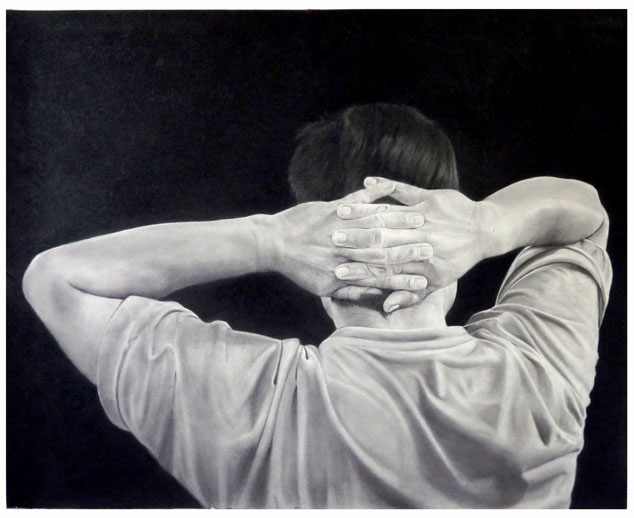
“Untitled (Custody)”, 2010, gunpowder & graphite on paper, 40” x 50”

“Untitled (Custody)”, 2010, gunpowder & graphite on paper, 40” x 50”

When do you find is the best time of day to make art? Do you have time set aside every day, every week or do you just work whenever you can? 

In the past, when I was teaching more, I had a structured schedule for the studio. Now, I am more flexible. I used to be most productive in the early morning, now I find myself working more productively in the afternoon and early evening hours. I have more meetings and out of studio tasks that make scheduling fixed studio times less practical.

How has your work changed in the last five years? How is it the same?

My work has always been labor intensive and detailed. The form of the work continues to morph – from very realistic drawings in gunpowder & graphite to more abstract, graphic depictions that quantify events. Drawing is always a component weather I am working with traditional tools or unconventional materials such as gunpowder and vintage gauze.

Are there people such as family, friends, writers, philosophers or even pop icons that have had an impact on the work you do?

I am inspired by many creative souls – in and out of the art world. Howard Zinn, Thich Nhat Hanh, Nancy Spero, Doris Salcedo, Mona Hatoum, William Kentridge, Felix Gonzalez-Torres, JR, Krzysztof Wodiczko to name a few.

If you had an occupation outside of being an artist, what would that be and why?

I love teaching and would teach mindfulness practice to young people if I could.

About 
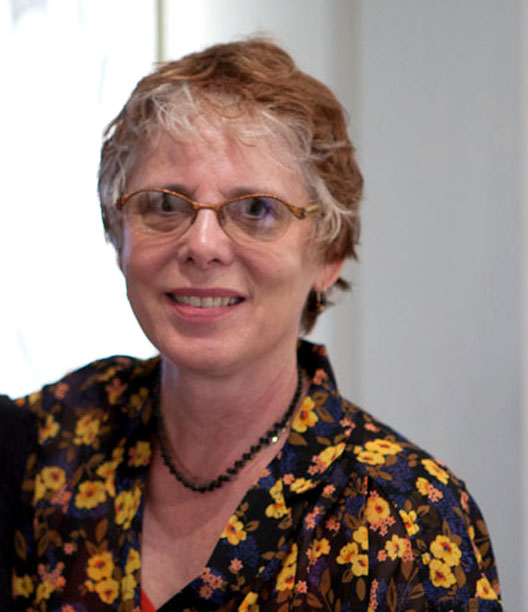
Linda BondLinda Bond is a former Fellow of the Fine Arts Work Center in Provincetown and a 2013 Massachusetts Cultural Council fellowship recipient. In March 2014 she exhibited her drawings and installation work in a solo show at Southern New Hampshire University. Other recent exhibitions include those at the MFA in Boston, Simmons College, Brandeis University and Available Potential Enterprises. In addition her work has been exhibited at venues throughout the Northeast, including the Brattleboro Museum, the Art Complex Museum, the Fitchburg Art Museum, and the Corcoran Gallery and is in numerous collections including those of Boston University, Simmons College, IBM, Nokia and Fidelity Investments. She is the recipient of grants from the Artists Resource Trust, the Massachusetts Foundation for Humanities & Public Policy, and from the Massachusetts Council on the Arts and Humanities.  In Provincetown she is represented by the Schoolhouse Gallery. Linda taught at the Massachusetts College of Art in Boston for fifteen years and has been a mentor for the low residency MFAWC MFA program.  Currently she is working on a new drawing series and a large scale installation project as a Visiting Scholar at The Women’s research Study Center at Brandeis University.    
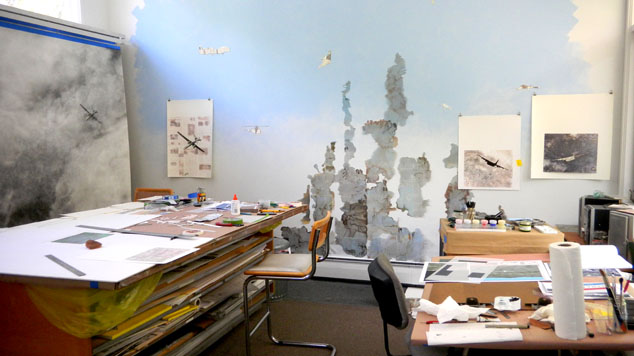
The Studio

The Studio

www.lindabondart.com

All images copyright of the artist and used with their permission. 
Posted in Uncategorized | Tagged , , , , | Leave a comment

C Matthew Luther – Milwaukee, Wisconsin

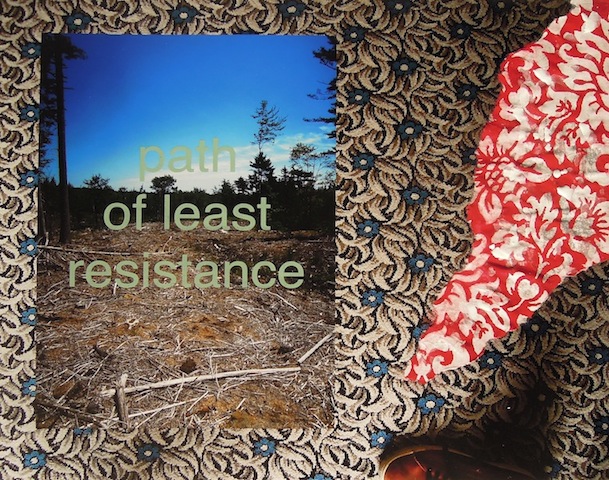
Path of Least Resistance. digital print, acrylic, silkscreen, and collage. 24x30. 2013

Path of Least Resistance. digital print, acrylic, silkscreen, and collage. 24×30. 2013

Briefly describe the work you do.

Currently I am developing an archive for photographic and written documentation of EPA Superfund Sites both past and present in Wisconsin. From this archive images are used in photographic and print based artworks along with encaustic paintings both processes employ digital and analogue means of art making. The work examines the affect of images through the feeling of occurrence and memory within the production and manipulation of surface, pattern, and layers

Many of these sites are located within inner city neighborhoods labeled as Environmental Justice areas and defined as communities with high populations of low-income, minority or tribal residents who may endure a lop-sided share of the nation’s environmental waste and pollution problems. Milwaukee’s Riverwest and Harambee neighborhoods where I live and keep a studio is defined as an Environmental Justice area and home to two Superfund Sites along with numerous Brownfields (lesser contaminated and/or post industrial land sites). The Environmental Protection Agency defines a Superfund site as an uncontrolled or abandoned place where hazardous waste is located and possibly affecting the local ecosystem or people.

There is an underlying relationship between my practice as an artist, continual environmental themes in my work and my daily struggle living with Crohn’s Disease.  A condition in which the body attacks itself creating a splitter effect of disorder, illness, and pain throughout the body, Crohn’s along with the many fragments of the disease affect my daily decisions as a person and as an artist.  There is no know reason why someone develops and is affected by Crohn’s Disease, but one of several speculations is an environmental factor. A vague suggestion that something in the soil, water, air, or food may be suspect in the development of the disease.  This idea permeates through near all of my projects including my most resent research for Superfund Wisconsin.

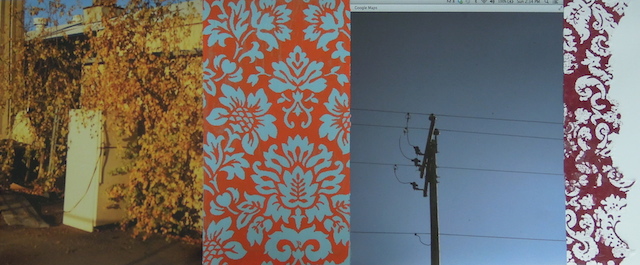
Chilton MDC. digital print, acrylic, silkscreen, and collage. 20x42. 2014

Chilton MDC. digital print, acrylic, silkscreen, and collage. 20×42. 2014


Tell us a little about your background and how that influences you as an artist.

I finished high school in Fairfax Virginia outside of Washington D.C. The political climate of Northern Virginia in the late Reagan years made a huge impact on my social and economic understanding of the world.  I worked for Greenpeace and Sane/Freeze (Peace Action) in D.C. as an activist. Those years forged my passion for civic engagement and demonstration. I was also drawn to wilderness and travel and continued involvement with Earth First! in the Mid-West and West Coast. I was always making art so eventually all of these influences merged into my work as an artist in different ways over the years.

The concept of the “artist studio” has a broad range of meanings, especially in contemporary practice. The idea of the artist toiling away alone in a room may not necessarily reflect what many artists do from day to day anymore. Describe your studio practice and how it differs from (or is the same as) traditional notions of “being in the studio.”

At this point I am a “seeker” of images.  I continue to do a good bit of travelling to photograph Superfund Sites for the archive.  So each of these sites become my studio.  I spend time there, often visiting several times, and with some sites a strange relationship occurs.  I know the boundaries of each location and what to expect as far as people, attitudes, or hazards.  The studio I rent is a space to make objects as a result of my research and fieldwork.  It is like a lab or kitchen where I am bring back the forage of foodstuffs for the day to prepare to eat.

What unique roles do you see yourself as the artist playing that you may not have envisioned yourself in when you first started making art?

My work has often taken a larger view of politics and pollution, but now I have begun to narrow my scope to a much more localized area. The possibilities of this project (Superfund Wisconsin) are evolving as I envision trying to build community through art. It forces me out of the comfort of the studio, and into new experiences along with the possibility of failures.  As much as I have been an activist, building an educational based project around my own artistic practice has been a new experience and not something I was prepared for.  But the challenge of the project and its purpose push aside any fears, or failings to make it successful. 

When do you find is the best time of day to make art? Do you have time set aside every day, every week or do you just work whenever you can? 

It really depends on my schedule or if I have any deadlines, but in general I prefer early evenings.  I enjoy the late afternoon sunlight and having the sun go down in the studio.

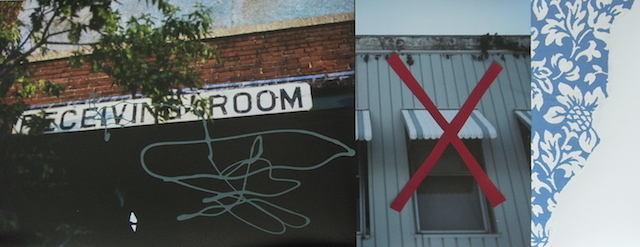
Receiving Room. digital print, acrylic, silkscreen, and collage. 18x42. 2014

Receiving Room. digital print, acrylic, silkscreen, and collage. 18×42. 2014

How has your work changed in the last five years? How is it the same?

The integration of different mediums has remained consistent and the use painting, photography, and printmaking continue.  I have added video work to my practice as an artist over the past five years.  Themes of ecology have always been present in my work, but now I begin to work with the notion that my disease is a direct link to the ecological themes of the work along with the ideas temporality and tactility.

Are there people such as family, friends, writers, philosophers or even pop icons that have had an impact on the work you do?

The writing by Edward Abbey and Slavoj Žižek who never crossed paths, but oddly look similar. My mother who is an artist and painter, and the love and support of my wife Robin.

If you had an occupation outside of being an artist, what would that be and why?

Chef.  I worked for a time as a chef, but at the time the stress and atmosphere of a kitchen combined with Crohn’s Disease was difficult to manage.  I have a strong passion for cooking, food education, and sustainable food practices. 

About 

04_Head Shot-LutherC. Matthew Luther is a Milwaukee-based painter, printmaker and video artist whose work explores the human relationship to nature along with the connection of visual imagery to memory, the unconscious and its affect. He is currently working

on a project known as Superfund Wisconsin, an archive of environmental calamity. Luther received a Bachelor of Fine Arts with an emphasis in printmaking and photography at Southern Oregon University and a Master of Fine Art in painting at the University of Wisconsin-Milwaukee. He has exhibited internationally, and a recent visiting artist-in-residence in Iceland, Sweden, and Norway. 

In the Studio

In the Studio

www.matthewluther.com

All images copyright of the artist and used with their permission. 
Posted in Uncategorized | Tagged , , , , | Leave a comment

Kasia Stachowiak – Mount Prospect, Illinois

Na Drodze 2 (On The Road 2) Lithography, vellum, 34inch x 24inch, 2013

Na Drodze 2 (On The Road 2) Lithography, vellum, 34inch x 24inch, 2013

Briefly describe the work that you do.

I work with found materials combining them with new graphics through printmaking, collage and sculpture. My work blends an interest of material manipulation and organized by significant dates, numbers, such as my height, age, distance, and my living space locations. They are influenced by architectural elements and repetitive imagery coupled with context as an autobiographical content. The juxtaposition of graphics and found materials gives them a new life. In a way, they are abstracted reflections of my own existence, which is an assemblage of ongoing experiences. 

My ultimate intention is to explore ready-made objects and materials while combining them with new graphics, found materials and layers through printmaking.

At what point in your life did you decide to become an artist?

Becoming an artist was a slow process for me.  At first, I chose a practical field pursuing a business degree, but along the way I’ve met artists and art faculty at Harper College that have awaken my artistic curiosity.  I decided to purse art in my late 20’s.  

Tell us a little about your background and how that influences you as an artist.

I’m a native of Ruda Slaska, Poland.  My parents decided to immigrate to America to purse better life opportunities.   My upbringing and the experience living with different cultures have a profound impact on my life and art practice.  I’m very nostalgic about my hometown and the meaning of home.  I arrived to Chicago with one suitcase leaving behind my family, friends, favorite belongings, and two parrots.  Though I have lived here for 21 years I often feel as a visitor.    

Spectrum, Lithography, wood, ink, plexiglass, 24inch x 34inch x .5inch, 2013

Spectrum, Lithography, wood, ink, plexiglass, 24inch x 34inch x .5inch, 2013

Visual historic artifacts depicting from my past, and present influence my works. They correspond to layers of experiences, memories layered with personal metaphors. The idea of using everyday discarded materials is what inspires the work or compositions. Each piece is unique and irreplaceable. 

All found materials are carefully selected and recombined to create a new form and point of view.  Discarded materials especially capture my attention when they are aged, and looking worthless. The textures, shapes, and faded colors often bring out the connection I have from the present or past surrounding environments. These visual connections with materials are combined to various final forms from found materials that influence the final form tosolely recognize the value of their visual aspects, and context of each piece through their new configurations. 

The artwork’s context, texture, and imagery transform the materials into a new existence.

What types of conceptual concerns are present in your work? How do those relate to the specific process(es) or media you use?

I am still trying to figure out and be conscious of the development of simplicity while combining the ideas with traditional processes and not over using them.  My intuition manipulates the found materials to sustain the original idea.  I often struggle and fall into the work that primarily satisfy the look of final form but the idea becomes distant.  In my practice and usage of various processes such as, collage, printmaking techniques, photography, and sculpture bring out the beauty in physicality of found object/paper that once used to have a purpose or function.  While using found materials there is no second attempt in making second piece. The materials are very unique and have limited quantity.  A lot of thought, movement and placement is involved as if you are putting together a puzzle with parts that do not fit.  At the end the discarded materials transform into new existence.  The physical materials, visual connection, and history of the materials are important concepts of my work.  

I-90, Serigraphy, monoprint, mixed media, 28inch x 28inch, 2013

I-90, Serigraphy, monoprint, mixed media, 28inch x 28inch, 2013

We once heard Chuck Close say he did not believe in being inspired, rather in working hard everyday. What motivates you in your studio practice?

I believe in working hard, working while being inspired and being open minded.  Working hard everyday is a very good motto.  It also takes a lot of discipline to stay on top of your work load while dealing with daily life responsibilities.  I tend to work better under pressure but I don’t prefer it that way.  I am still learning how to utilize my studio time/space efficiently. What motivates me? Due dates, inner need of making/discovering new forms.

What artists living or non-living influence your work?

Krzysia Frankowska, Jacek Joostberens, Andrzej Pietsch, Dorothea Rockburne, John Cage, Martin Puryear, Jasper Johns, Robert Rauschenberg, Mark Bradford, Frank Stella, Laszlo-Moholy Nagy, Robert Motherwell, Richard Serra to name a few.  

When you are not making art what types of activities and interests do you engage in? 

I like to travel, read, drooling over articles on prefabricated home design or anything doubts with architecture, taking pictures of street, sidewalks, parking lots, visiting other artists, going to gallery openings, seeing art exhibits at MCA, Art Institute in Chicago the Modern Wing, Cultural Art Center in Chicago, bike riding, horseback riding, listening to Pandora radio and watching documentaries.  

About 

HeadSho.KasiaStachowiak1.1Kasia Stachowiak is an artist working and living in Chicago suburbs. She holds a Bachelor degree of Fine Art with emphasis in print media.  Her work incorporates variety printmaking techniques combined with found materials, collage and sculpture. Her ultimate intention is to explore ready-made objects and materials while combining them with new graphics and layers through printmaking. She appreciates each material and object source, as does the Japanese aesthetic concept of Wabi-sabi.

Kasia has shown both locally and nationally, at galleries and art centers in, Illinois, Wisconsin, and Colorado. Her work is held in a number of private collections and at  Harper College Art Collection in Palatine, Illinois.  

In the Studio

In the Studio

www.kasiastachowiak.com

All images copyright of the artist and used with their permission. 
Posted in Uncategorized | Tagged , , , , | Leave a comment

Diana Behl – Brookings, South Dakota

looping, 2014, Printed, painted, drawn, photocopied and found collage; gouache and cut paper on rag board, 16" x 16"

Looping, 2014, Printed, painted, drawn, photocopied and found collage; gouache and cut paper on rag board, 16″ x 16″

Briefly describe the work that you do.

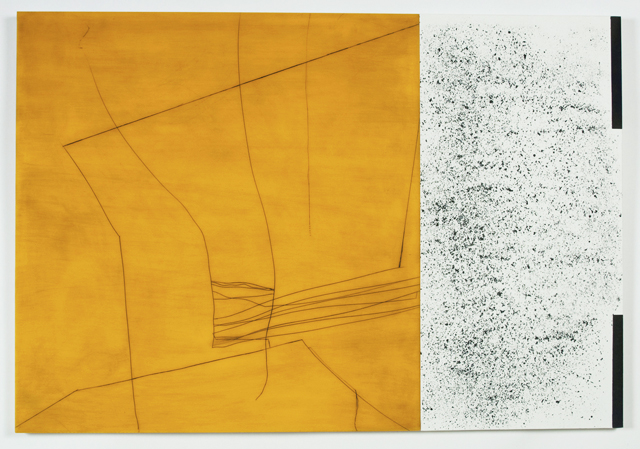
My work explores an assortment of paper-based media in the forms of prints, drawings, collages and cut-paper installations.

At what point in your life did you decide to become an artist?

For as long as I can remember I’ve been interested in making and creating. Imagination and play in childhood naturally unfolded into the choice to seriously pursue art.

Tell us a little about your background and how that influences you as an artist.

As an undergraduate at Bowling Green State University I discovered intaglio with copper plates while studying with Janet Ballweg, and this process was, and continues to be, a deep interest. Over time, I began exploring image-making in other media. Common and overlapping threads include layering, repetition and texture.

Years, 2014, Printed, painted, drawn, photocopied and found collage on cotton rag board, 16" x 16"

Years, 2014, Printed, painted, drawn, photocopied and found collage on cotton rag board, 16″ x 16″

What types of conceptual concerns are present in your work? How do those relate to the specific process(es) or media you use?

I work on many different bodies of work at once—various works on paper including drawings and collages, mixed media works on panel and intaglio prints. Typically, I have many projects on the burners at any given time. Working in this way informs each process (and process informs the images, and their construction), which helps to combat monotony in the studio. Each mark informs the next. And each piece informs the next image. Each medium has its own language and I think that is evident in each body of work.

I’ve been working on a series of collages constructed on rag board. These works encompass a fusion of multiple sources, acknowledging Matisse’s paper cutouts and William S. Burrough’s literary Cut-Ups. Salvaged printed proofs, forgotten then found scribbled notes, painted and cut paper are culled together to connect disparate fragments. Though, contrary to the beat writer’s chance-based (Cut-Up) practice, I am most often reconfiguring and re-contextualizing years of collected material in a gestated manner.

Strips, 2014, Printed, painted, drawn and found collage; cut paper on rag board, 22" x 22"

Strips, 2014, Printed, painted, drawn and found collage; cut paper on rag board, 22″ x 22″

We once heard Chuck Close say he did not believe in being inspired, rather in working hard everyday. What motivates you in your studio practice?

Steadfast commitment in the studio often creates ideas with which to build an entire body of work.

I am very interested in the artist Corita Kent. She wrote a list of “General Rules for a Student” that is profoundly wise.

My favorite rule is:

“The only rule is work. IF YOU WORK IT WILL LEAD TO SOMETHING. IT’S THE PEOPLE WHO DO ALL OF THE WORK ALL THE TIME WHO EVENTUALLY CATCH ON TO THINGS.”

What artists living or non-living influence your work?

Corita Kent, Crown Point Press, Ben Shahn

When you are not making art what types of activities and interests do you engage in? 

Gardening, documenting, collecting, reading

About 

BEHL_headshotDiana Behl’s recent work embodies an assortment of material exploration, including print media, collage and drawing. Her images are prompted by specific instances—memories of places visited, passages read, bits of everyday references, or interactions of material and form—both in and outside of the studio. Using these prompts, her practice then evolves around the improvisation and discovery uncovered while making, further enabling form to embody the evolution of that specific cue.

She has exhibited works in the Upper Midwest at the Soo Visual Arts Center, Highpoint Center for Printmaking and Minnesota for Book Arts (Minneapolis, MN); the South Dakota Art Museum (Brookings, SD) and Ipso Gallery (Sioux Falls, SD); as well as at venues such as the International Print Center New York (NY, NY) and SPACE (Pittsburgh, PA). Her works on paper have been featured in the Western Edition of New American Paintings (Volume 66) and the 2004 New American Paintings MFA Annual.

A recipient of a South Dakota Arts Council grant, Diana Behl holds an MFA from The University of Iowa, and a BFA from Bowling Green State University.

In the Studio

In the Studio

www.dianabehl.com

All images copyright of the artist and used with their permission. 
Posted in Uncategorized | Tagged , , , , | Leave a comment

Beti Bricelj – Postojna, Slovenia

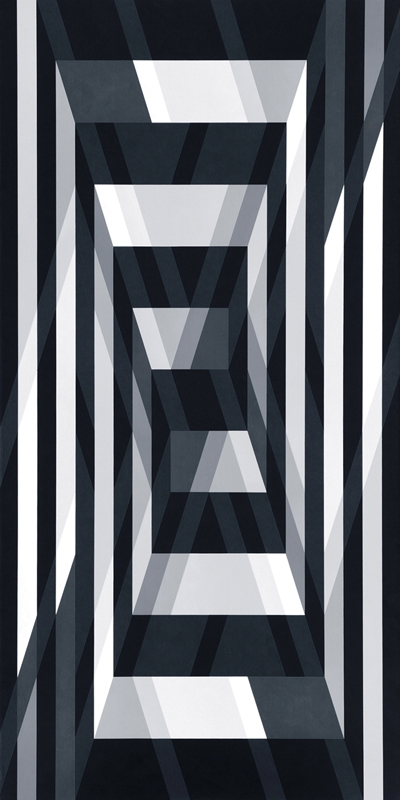
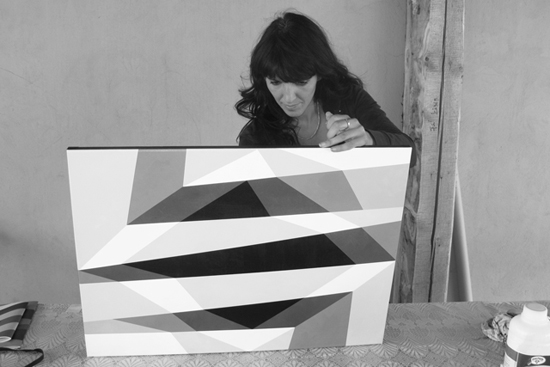
From the cycle SPACE in FORM, acrylic on canvas, 120x60cm, 2011

From the cycle SPACE in FORM, acrylic on canvas, 120x60cm, 2011

Briefly describe the work that you do.

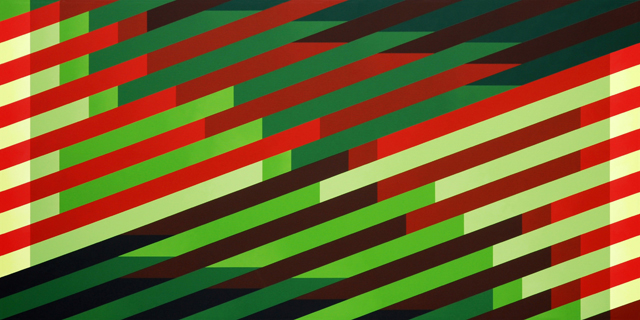
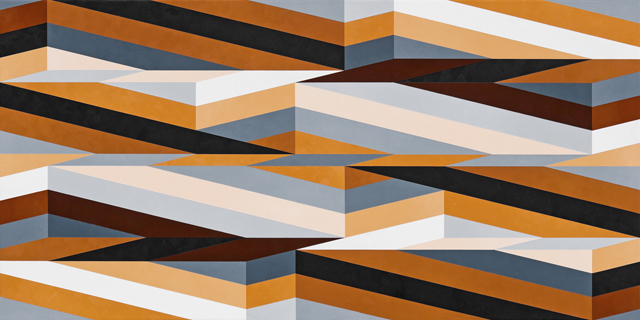
I am dealing with geometrical abstraction. I find myself constantly in the process of exploration, searching for new solutions of composition and color, which uncovers new options and new opportunities for the next series of work.

I place high importance on studies of colors, and I strive to harness the physicality of color, its vibrations and influences they have on each other. I make use of all available artistic elements in order to produce paintings with an added value.

This means that each individual work of art does not only represent a carefully thought out geometric abstraction, but also serves as a tool to engage with the observer allowing different associations and emotional states. Put simply, to be drawn into the work and react to it. Through this interaction, the observer becomes trapped in two different systems of perception – mine and their own.

At what point in your life did you decide to become an artist?

Already as a child I dreamed that I would become an artist and my dreams came true .

My childhood was accompanied by colors, drawings and paintings probably be due to the grandfather, who was an artist. I’ve always admired all of his pencils, brushes, paints and other art tools which some are still keeping in my studio.

Tell us a little about your background and how that influences you as an artist.

I grew up in Postojna, a town in southwestern Slovenia. Studied at College of Visual Arts in Ljubljana capital of Slovenia. During this time I discovered the theory and practice, history and modernity, and of course myself in art. To complete my thesis for my diploma I visited Australia to spend an extended period researching the ancient aboriginal art of painting which was to become a crucial influence in my artistic development. Aboriginal art gave me the opportunity to encounter typical simple geometric elements and patterns, which the Australian Aborigines used to enforce their deepest beliefs about nature, rhythm and cycle of life.

Incidentally, a significant leap in my artistic growth was caused by a review of my first exhibition in Melbourne (2001), which drew parallels to optical art. From that point on-wards, I consciously started to devote my time to geometric abstraction in its fullest manner of expression.

However, I think that the time spent in Australia played an important role in completing my studies and at the same time initiated my career as a geometrical artist. 

From the cycle geoLOM, acrylic on canvas, 60x120cm, 2012

From the cycle geoLOM, acrylic on canvas, 60x120cm, 2012

What types of conceptual concerns are present in your work? How do those relate to the specific process(es) or media you use?

A characteristic of my artwork is constructivism, where everything is determined. All of my paintings, when seen as final results, do not allow mistakes and demand extremely exact and disciplined work

There is only one possibility for the unpredictable to happen – and that is a spontaneous, unplanned line or a stroke within the initial sketch, which I use for the creation of a new idea.

The manner in which I paint is above all a careful and thoughtful process, originating from a net base, which allows me to develop my ideas. The compositions are created from basic shapes subjected to change as I go along. The sketches in their initial phase are merely compositions made up of lines.  They represent the first step – a black and white version. This contrast is extremely important, as it allows me to get a glimpse into the visual effect my idea might have. The next step is to experiment with colored surface variations.

The exact geometric compositions inevitably contains my own personal perceptions, experiences, as well as views of the world and nature. This intimate approach to creating eventually softens up the mathematical exactness of the developed form. Even though the final version of my paintings is often already visible in my sketches, the leap from the rough idea to the final result – the painting that suddenly becomes alive and always manages to excite me.

From the cycle SPACEinFORM, acrylic on canvas, 60x120cm, 2011

From the cycle SPACEinFORM, acrylic on canvas, 60x120cm, 2011

We once heard Chuck Close say he did not believe in being inspired, rather in working hard everyday. What motivates you in your studio practice?

It is a decision. I believe inspiration can come from inner or outside world and a hard working attitude will maintain a high motivation. 

When I decide to work I start developing an idea on sketches and then a whole creative process starts to motivate me with an intense game of exploration during when only one sketch can produce several solutions or possibilities of expression. And so the never-ending process of development continues.

What artists living or non-living influence your work?

There were people present during my artistic development who influenced me in an abstract way and whose artistic expressions and thoughts have left a mark in my studies of color. The artists I love are Victor Vasarely, Bridget Riley, Josef Albers….

When you are not making art what types of activities and interests do you engage in? 

In my free time I enjoy being with my friends, I like traveling, it makes me rich. Most of all, I’m happy if I manage to successfully perpetuate some funny and interesting moments on photos.

About 

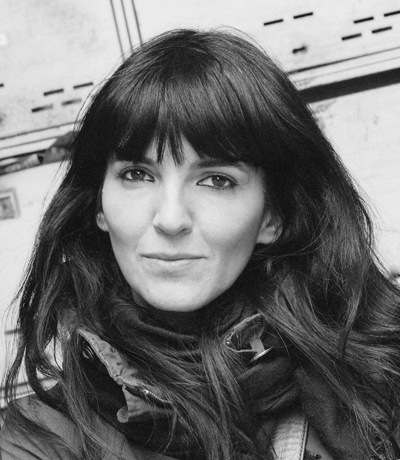
Beti BriceljBeti Bricelj was born in 1974 in Postojna (Slovenia). In 2000 she graduated from Fine Arts on Arthouse – College of Visual Arts in Ljubljana. In her diploma thesis she focused on the elements of Aboriginal Art in the abstraction of three holy colors. After completing her studies she continued her education in Australia where she lived for a year. She accepted the invitation of an Australian government organization to participate in a research of the Aboriginal culture organized by the Department for Aboriginal Affairs, South Australia, Adelaide from 1998 to 1999.

Beti Bricelj participated in numerous independent and joint exhibitions in Slovenia and abroad. Recently she received a Recognition for High Quality Artwork by International Fine Arts Festival Kranj – ZDSLU.

As an artist she took up an architectural challenge and designed the front of the Epicenter B2 Trade and Business Center in Postojna using her expertise in art.http://betibricelj.weebly.com/epicenter-b2.html 

Since 2002 Bricelj has been a member of the Union of Slovene Fine Arts Associations. She lives and works in Postojna. 

In the Studio

In the Studio

www. betibricelj.weebly.com

All images copyright of the artist and used with their permission. 
Posted in Uncategorized | Tagged , , , , | 1 Comment

Gerit Grimm – Madison, Wisconsin

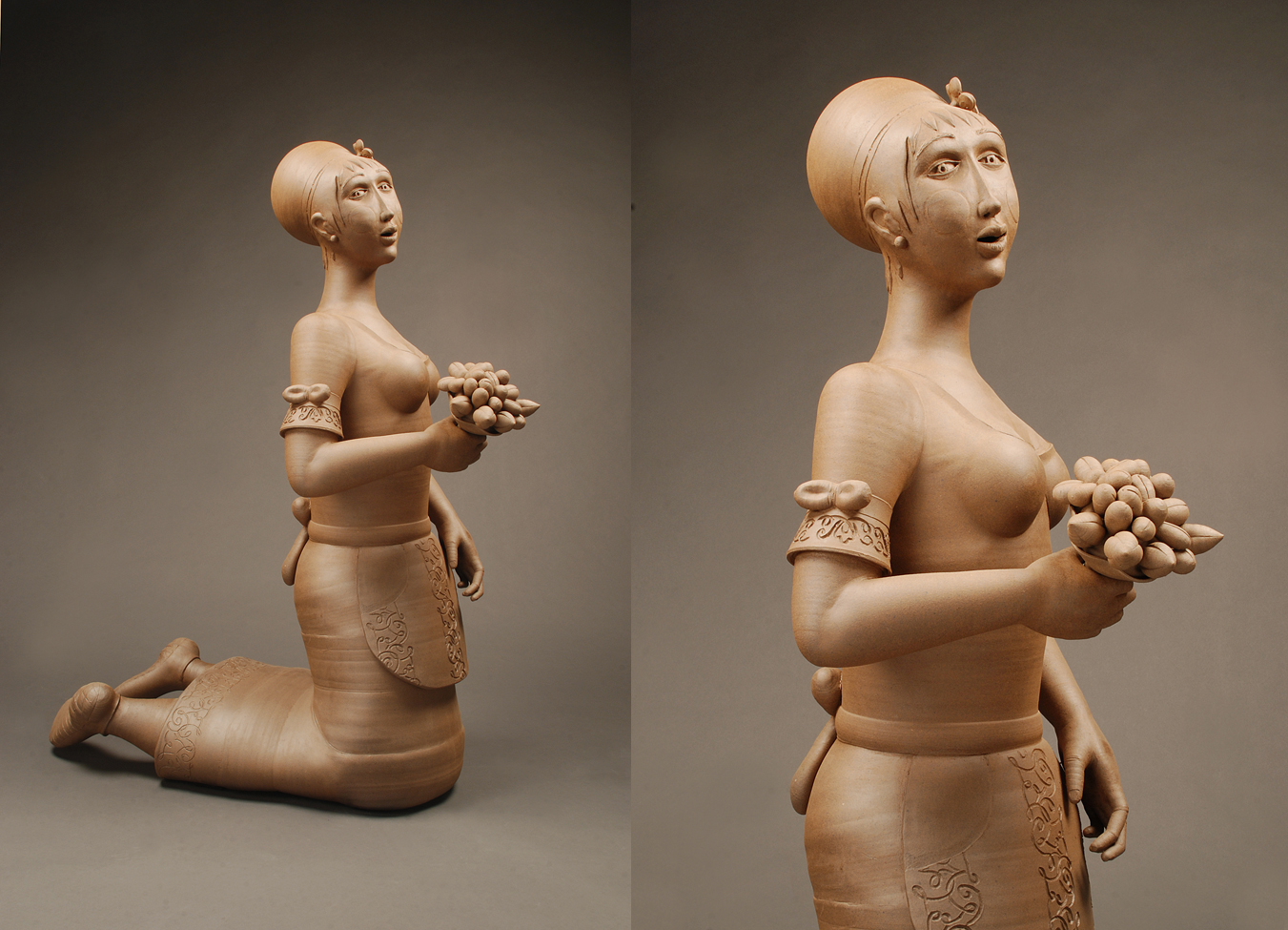
Isabella 2012, Stoneware, 46x34x18

Isabella 2012, Stoneware, 46x34x18

Briefly describe the work that you do.

I had the privilege of being classically trained as a production potter and working as a journeyman for notable German craftsmen before arriving in the United States. Utilizing traditional ceramic craft processes, I have developed an innovative and distinct approach to making sculpture with wheel-thrown parts and my work seeks to render the formless material of clay into figures that resonate with wonder and makes the familiar increasingly strange. 

At what point in your life did you decide to become an artist?

I was introduced to craft early in my childhood through my parents’ modest collection of affordable folk art, dolls and pottery—all being difficult to find. I especially admired my mom’s pottery collection and used to steal cookies from a jar that was as big as I was.

When I was four years old, it happened that I broke my mom’s favorite vase. Dad rescued me from her wrath, but from that day, I was fated to become a potter.

When I look back at my childhood, it seems to be a fairytale. We visited castles, theaters and listened to Baroque music.

Being supplied by state-owned businesses in the GDR we all owned the very same things. People did not use phones and color TVs were rare. The inhabitants in my hometown spent their leisure time pursuing hobbies, socializing, telling stories and creating things and so did I.

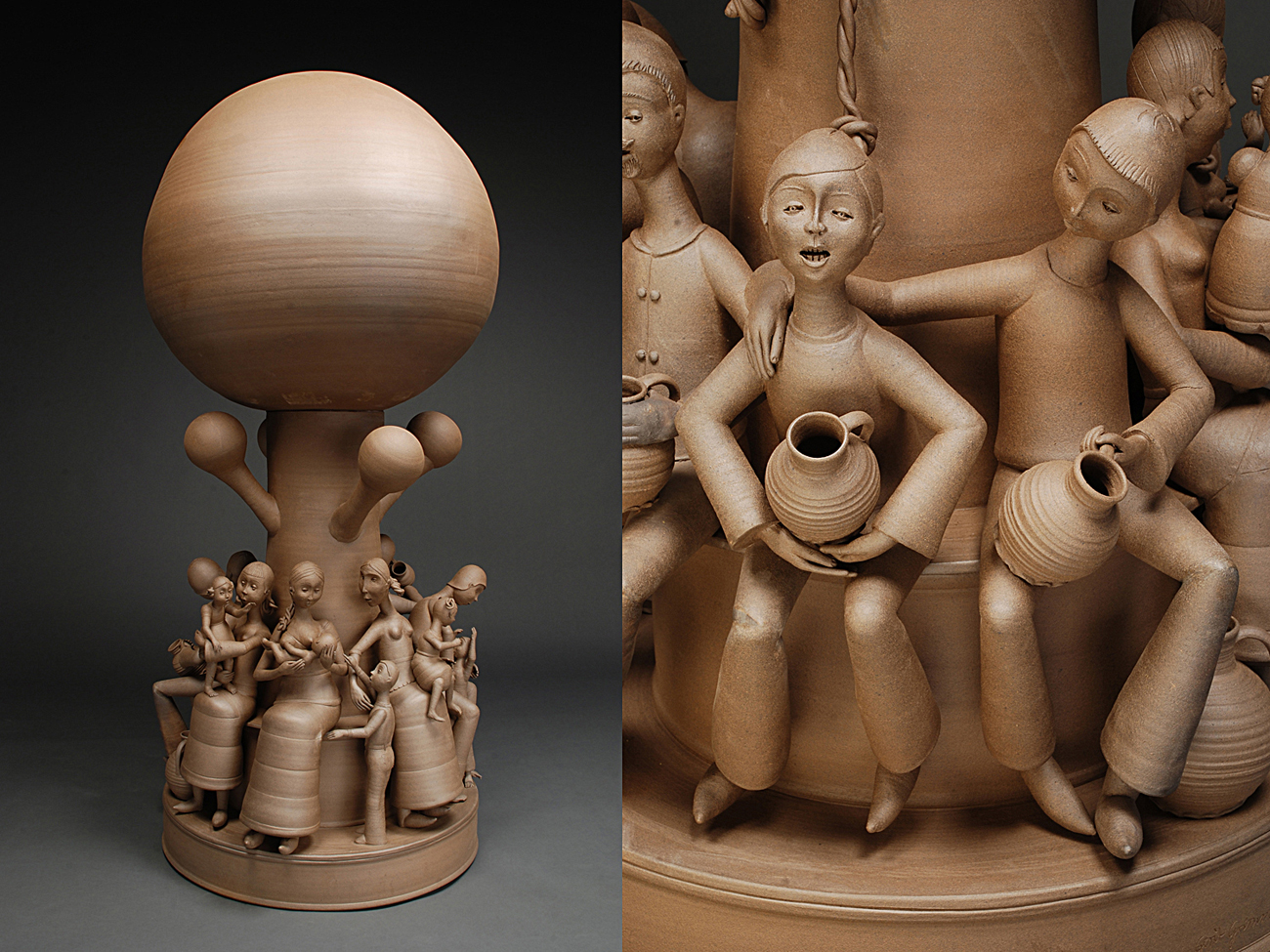
Village Tree 2011, Stoneware, H. 55" x W. 23" x D. 23"

Village Tree 2011, Stoneware, H. 55″ x W. 23″ x D. 23″

Tell us a little about your background and how that influences you as an artist.

I kept drawing and creating, and around the age of ten, I started to fool around with clay at the “pioneer house” in Halle—my hometown. We had only one wheel for the entire class, but my teacher prohibited all of us from using it except for one boy. Deprived of the object of my heart’s desire, I vowed to become a potter one day. I took art classes every day. I skipped high school art classes to bike nine kilometers to take pottery classes in a little village outside of town instead. By the time I was eighteen, I became an apprentice at a production pottery for three years and a journeyman for one year—being paid per piece. During this time, every evening after work, I took countless ceramic, figure drawing and painting classes.

What types of conceptual concerns are present in your work? How do those relate to the specific process(es) or media you use?

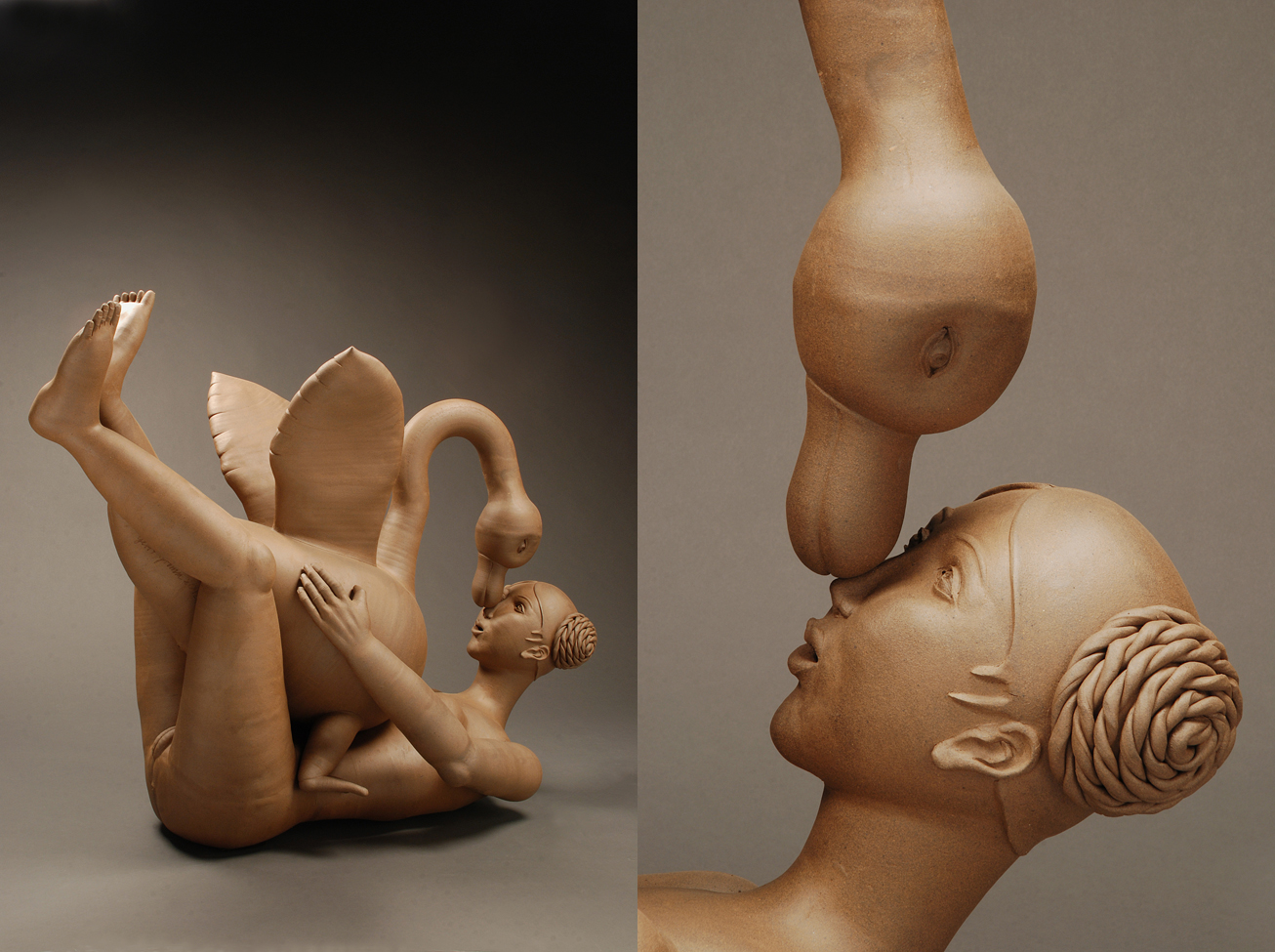
As a sculptor, my work appropriates historical figuration derived from the content of fables and myths that are then reinterpreted and pushed to physical limits through the materiality of ceramics. My artworks offer a glimpse into the ominous side of fables that presents a history that is at once revealed and concealed through figurines, fairytales and myths.  The history of the figure within art history in general, and ceramics in particular is a complex and rich base for me to work from. An often-overlooked art, these historical works offer an uncanny union at once wonderful, elegant and fanciful but also uncomfortable and awkward as stories about statues come to life and illustrate the undercurrents of contemporary culture.

Devoid of color and increased in scale, the objects I produce move away from the seemingly whimsical nature of their original source both in terms of physical size and technical virtuosity. I find great power in working from this historical base, and the opportunity it presents for questioning the boundaries between kitsch and high art.

Leda & Swan 2012, Stoneware, 37x43x22

Leda & Swan 2012, Stoneware, 37x43x22

We once heard Chuck Close say he did not believe in being inspired, rather in working hard everyday. What motivates you in your studio practice?

In terms of method, when I work I keep myself focused and restricted by guidelines. Some of these might seem very strange. For instance, for years I did not allow myself to use black until I woke up one morning and asked myself, why not use black? and it was introduced back into my artwork. I would set myself certain aesthetic rules at certain times until I could not justify using them any more. During one period in my work, everything had to be extremely colorful and gloss glazed. Every bit of surface had to be covered until, years later, I forced myself to remove the glaze and then even the color. What I discovered then was an attractive stone-like apparent clay body in which the throwing lines simulated the feeling of skin. Earlier in my career, I was smitten by Pop and Funk art and now I’m drawn to Baroque and Renaissance art. It was only after many years in my own aesthetic development that I finally learned how to digest this complex historical work. It is now my inspiration, and I get shivers and goose bumps from looking at such mastery.

What artists living or non-living influence your work?

The ceramic work of artist Margit Kovacs (1902-1977).  While Kovacs is known in certain decorative arts circles, her work is far less known within the context of American studio ceramics and scholarship.  There are relatively few of her works in public collections outside of Hungary, and the work of Wiener Werkstatt artists Vally Wieselthier.  As woman working in the early to mid twentieth century they were pioneers in developing new ways of working in ceramic materials, and extending the traditional process of wheel throwing from its utilitarian base into a tool for the production of narrative sculpture works. These Wiener Werkstatt artists are the only historical precedent I am aware of that connects to the manner that I have developed in my own working process; specifically that of creating large scale figurative works through parts generated on the potters wheel.  

When you are not making art what types of activities and interests do you engage in? 

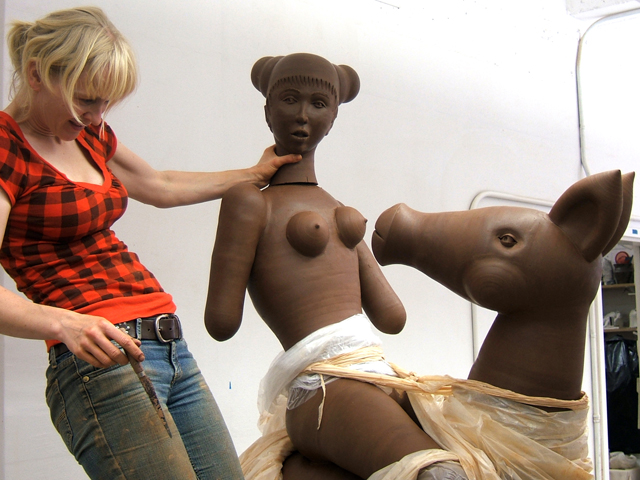
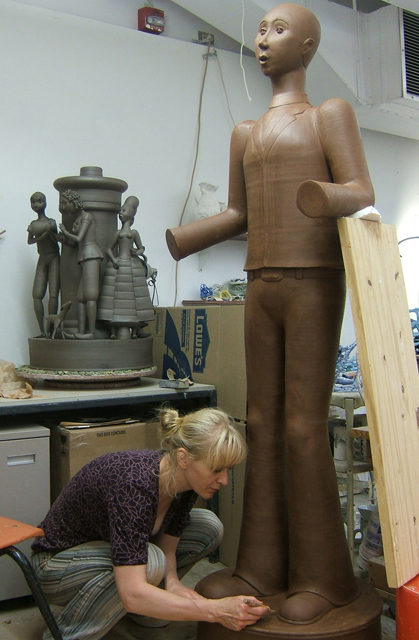
Recently I moved to Wisconsin to teach ceramic art at the University of Wisconsin-Madison. The minute I moved to town I joined the Hoofer sailing club, known as the second largest inland fleet with more than 120 different boats and sailboards. When the boats were put away for the winter, I started Tango dancing. Those two fantastic hobbies keep me sane, happy and focused, because no one can stay healthy without some relief from studio practice when work breaks, collapse or moves and twists in unexpected ways. One of my newer rules: if the piece does not survive because of technical issues, then I attempt to resolve these issues by building the same sculpture again but bigger.

About 

HeadshotGerit Grimm was born, and grew up in Halle, German Democratic Republic. In 1995, she finished her apprenticeship, learning the traditional German trade as a potter at the “Altbürgeler blau-weiss GmbH” in Bürgel, Germany and worked as a Journeyman for Joachim Jung in Glashagen, Germany. She earned an Art and Design Diploma in 2001 studying ceramics at Burg Giebichenstein, Halle, Germany. In 2002, she was awarded with the German DAAD Government Grant for the University of Michigan School of Art and Design, where she graduated with an MA in 2002. She received her MFA from the New York State College of Ceramics at Alfred University in 2004. She has taught at CSULB, Pitzer College, Doane College and MSU Bozeman and has worked at major residencies like Mc Coll Center, Bemis Center, Kohler Arts & Industry Program and Archie Bray Foundation. In 2009 NET Television created “Fantasia in Clay” a Nebraska Story about artist Gerit Grimm. Grimm is now an Assistant Professor at University of Wisconsin, Madison. The National Council for Education on the Ceramic Arts conference published on Mar 12, 2014 a 2 hour DVD: NCECA National Council on Education for the Ceramics Art Gerit Grimm 2013 Demonstrating Artist (ISBN 978-1-935046-60-8).

In the Studio

In the Studio

www.geritgrimm.com

All images copyright of the artist and used with their permission. 

Posted in Uncategorized | Tagged , , , | Leave a comment

Sarah Rebekah Byrd Mizer – Richmond, Virginia

(detail) Glass Wallpaper Pattern no.1 : Virginia’s Executive Mansion. Glass and gold leaf, 2013

(detail) Glass Wallpaper Pattern no.1 : Virginia’s Executive Mansion. Glass and gold leaf, 2013

Briefly describe the work you do.

I am a 2-d maker: installations, relief sculptures, books, billboards…I have two degrees in Craft, both with a focus in glass. Glass plays a prominent role in what I do. 

Tell us a little about your background and how that influences you as an artist.

As an athlete from childhood through college, I have invested great amounts of time, energy and focus into playing around. Play can sometimes be misinterpreted as superficial or frivolous but it has been my foundation for in-depth research and work. There is a bridge in thinking about sports and thinking about making. Both are independent, acute and self-propelling. Both require honed skill level and both require a greater understanding of nuance and context. Today this means that I have acquired a certain amount of discipline and self-awareness. I am critical and driven but at the core of what I do, I still consider it to be playing.

The concept of the “artist studio” has a broad range of meanings, especially in contemporary practice. The idea of the artist toiling away alone in a room may not necessarily reflect what many artists do from day to day anymore. Describe your studio practice and how it differs from (or is the same as) traditional notions of “being in the studio.”

Generally I toll away at any flat space with terrible posture, plugged into my computer while serial watching trash TV.  Isn’t this everyone’s studio?

A Roadside Attraction: Providence RI, Billboard. 2012

A Roadside Attraction: Providence RI, Billboard. 2012

What unique roles do you see yourself as the artist playing that you may not have envisioned yourself in when you first started making art?

I don’t know what I had envisioned and I am not certain how I got here so to say that it is different from what I had envisioned would be misleading. With any profession the awareness that comes from working in the field is always humbling and eye opening. Both vast and insulated, this world we work in is full of surprises. 

When do you find is the best time of day to make art? Do you have time set aside every day, every week or do you just work whenever you can? 

Often I am fueled by deadlines, which is to say that I work around the clock for bursts of time. If I had my choice in the matter, I would say that I am inclined to do the most productive work in the mornings but that is rarely an option. I like to wake up and immediately make progress (this is a family trait, I am afraid). I wish I did this more often.

Verdant Grassplot. Glass, flocking, red oak. 2012

Verdant Grassplot. Glass, flocking, red oak. 2012

How has your work changed in the last five years? How is it the same?

The work evolves slowly, I tend to think about things in threes so for about three years I will focus on a topic and move on without much pomp and circumstance. Formally, I am not sure if it has changed much in the last five years though a shift has occurred mentally. Initially I found myself stumped by the completion of a deadline and for moths at a time would be scavenging for ideas. Finally, completely disgusted with this process, I stepped back and revisited the reasons I have for making work, what I hope to achieve with the work and why I am making at all. Revisiting these big picture questions helped to re-focus my approach: instead of lusting after the next fête, I steadily make hoping to know beauty. 

Are there people such as family, friends, writers, philosophers or even pop icons that have had an impact on the work you do?

One of my most favorite items is a grocery list written by my grandmother. It isn’t special in any way other than it is in her handwriting. I had it framed because it is such a lovely thing to remind me that the small day-to-day nothings are what it is all about. That is everything and nothing and that is what we strive for and are lucky enough to be part of. 

If you had an occupation outside of being an artist, what would that be and why?

Can’t even imagine such a thing…can’t. 

About 

headshot_SRBMOriginally from Providence, RI, Sarah Mizer is a Richmond based artist whose work ranges from billboards to small glass objects. Sarah’s has exhibited extensively, from Los Angeles to New York, Milwaukee to Houston, including her hometowns: Richmond and Providence. This summer, Sarah will be showing one of her Glass Wallpapers in part of an exhibition titled Art We Use at Dairy Barn Arts Center in Athens, OH. Her glasswork was part of a contemporary craft exhibition at the Taubman Museum titled Ambiguity and Interface, curated by Ray Cass and Howard Risatti. Sarah’s work is in public collections at Alfred University and Pam and Bill Royall’s Try-Me as well as many private collections.

Upcoming, Sarah will be an Artist in Residence at Houston Center for Contemporary Craft from June through September 2014.  She too has been an Artist in Residence at Haystack Mountain School of Craft. She is the Administrative Director and Assistant Professor in the Art Foundation Program at Virginia Commonwealth University. Sarah also sits on the Board of Directors for 1708 Gallery. With a background in glass she holds her MFA from VCUarts in the Craft/Material Studies department and her BFA from the New York State College of Ceramics at Alfred University. 

In the Studio

In the Studio

www.sarahrbmizer.com

All images copyright of the artist and used with their permission. 
Posted in Uncategorized | Tagged , , , , | 1 Comment

Niya Lee – Silver City, New Mexico

dissolution-wet-clay-installation-clay-sand-water-drip-line-size-variable-2012

dissolution-wet-clay-installation, clay, sand, water drip line size variable, 2012

Briefly describe the work you do.

Seeking rich abundance and relation with the natural world that is seemingly at conflict with our culture, I have been working on a series of sculptures depicting humans that are colonized by other life forms and natural elements. Alluding to symbiosis and the web of life, hair is made up of birds, honeycomb, flowers, pine cones, and various other flora and fauna. Birds roost on shoulders, and a scattered continuation of growth occurs on the sculptures’ bodies. These sculptures act as memories of the past, storied accounts of when the sky ran black with passenger pigeons, streams ran thick with salmon, and forests loud with birdsong. They are sorrowful; an expression of what is missing, yet, also hopeful, asking what might we recover?

I have also been working on a series of animals skulls.  In death, energy does not vanish, but is transformed.  As a meditation on this concept, I have been transforming the antlers or horns of these sculpted skulls into a colorful display of life, of botanical growth. This cyclical and interconnected process where decay leads to new life returns to the overarching aim of all my work to reveal some of the intricate relationships that occupy our world.

Although ceramic sculpture is where I have been placing most of my creative energy at this time, I also make useful pottery, and form experimental narrative clay installations that tell stories through their changing form.

Tell us a little about your background and how that influences you as an artist.

It is only in the last few years that I have really recognized how much my childhood shaped me as a person, and, in turn, influenced my art.  I grew up roaming the meadows and forests nearby our various homes in the wet, Willamette Valley of Oregon.  My mother always encouraged exploration and engagement with the natural world.  We ate wild strawberries, fed raccoons, hiked amongst bears, canoed lakes, and felt at home in nature.  This sentiment led me to feel a deep appreciation and awe at the natural world, internalizing the interconnection that occupies all of life, and a desire to preserve and protect what I can, while influencing the substance and narrative of my art.  

 transformation-botanical-skull-1-earthenware-acrylic-paint-varnish-gold-leaf-8-75-in-x-8-in-x-7-in-2014


transformation-botanical-skull, earthenware, acrylic paint, varnish, gold-leaf, 8.75in x 8in x 7in, 2014

The concept of the “artist studio” has a broad range of meanings, especially in contemporary practice. The idea of the artist toiling away alone in a room may not necessarily reflect what many artists do from day to day anymore. Describe your studio practice and how it differs from (or is the same as) traditional notions of “being in the studio.”

Although my artist studio has fluctuated a great deal in the past year or so, from a shed to a more communal space to where I am currently working, a trailer, I do certainly fall into the more traditional notion, spending the bulk of my time laboring away in wonderful seclusion as I create.  I am, no doubt, most absorbed in my work when I am alone, although I break the silence often with audiobooks or podcasts.  I also spend time researching for my projects, often on the internet, but sometimes out in the real world.  One of my installation projects, Transient Animals in Clay, a public ephemeral art project installed in Albuquerque, NM, took me to Armendaris Ranch with a conservation biologist and a fellow artist, to see firsthand the conservation projects in process there and to see species of concern such as the Northern Aplomado Falcon, in person, that I was sculpting for this work.  

What unique roles do you see yourself as the artist playing that you may not have envisioned yourself in when you first started making art?

Gift-giver, activist, salesperson, etc. 

I carried out one particular project that involved gifting my art to strangers, but I also have the compulsion, often, to gift my work, to find homes for my art, without regard to tangible compensation; and, really, the act of gifting becomes its own kind of intangible reward. 

My activism is mostly a quiet one that embodies my lifestyle, bike-commuting and walking, supporting sustainable and local agriculture, etc, but I do try to infuse these concerns and energy into my artwork where I can.  Currently I am making bee-inspired pottery and small sculptural works where 10% of the proceeds are donated to support research and protection of these important beings.  I also have been involved in installation work that acts as an homage and representation of vanishing and/or diminishing species. 

I am not a natural salesperson.  This role makes me rather uncomfortable, and, when placed in this position, in person, I often do myself a disservice, giving away too much for too little, however I am working on this.  Aside from spending energy applying to juried shows, seeking galleries, etc., I also have an etsy shop where I sell my pottery and smaller sculptural works on-line.        

Flock (She Who Hears the Song), Earthenware, Terra Sigillata, Oxide wash, Acrylic paint, Gold Luster, Varnish, 19 in. x 16.25 in. x 11.75 in., 2013

Flock (She Who Hears the Song), Earthenware, Terra Sigillata, Oxide wash, Acrylic paint, Gold Luster, Varnish, 19 in. x 16.25 in. x 11.75 in., 2013

When do you find is the best time of day to make art? Do you have time set aside every day, every week or do you just work whenever you can? 

My art-making schedule fluctuates a good deal.  At times, I will get really immersed in a project and work obsessively on it, and then I will need some recuperating time where I will put my energy into less intensive efforts… putting finishing touches on sculptural work, taking photographs of finished pieces, uploading items to my etsy shop, catching up in my garden, and so on.  My studio is not insulated and I have no climate control so I am very conscious of the weather and what time of day I work is often dependent on this.  On cooler days, I wait until mid-afternoon or so for it to warm up and I hotter days, I choose to work in the morning and evening.  

How has your work changed in the last five years? How is it the same?

My underlining interests have remained the same, but my work has changed a great deal.  This is mostly because I went to graduate school at University of New Mexico starting in 2009 allowing for me to really focus and explore creatively.  This concentration on my personal body of artwork, not only, improved my technical ceramic skills, allowing for me to better actualize my creative visions, but also stimulated more complex and involved works of art.    

Are there people such as family, friends, writers, philosophers or even pop icons that have had an impact on the work you do?

I could compile an endless list of inspiration and influences, in part, because so much motivates and inspires me, but also, recognizing the intrinsic interconnection of life, I see a spiraling network of muses and random ahahs.  Of course family holds a strong influence on where I am and what I do.  My mother exposing me to many wilderness experiences helped shape the content and concepts behind much of my work, and her endless support gave me a foundation to stand on.  My spouse has, also, had a huge impact.  Although his vocation is in medicine now, when we first met he spent much of his energy and time on his music and I learned discipline from watching him.  He has also acted as a strong, encouraging support beam. 

Poets such as Linda Hogan, Mary Oliver, Carolyn Forche, Wendell Berry, and e.e. cummings have all been quite influential in their own ways as have nature writers such as David Abram and Annie Dillard, and philosophers such as Henry David Thoreau. 

If you had an occupation outside of being an artist, what would that be and why?

I have taught ceramics as an adjunct in the university environment and in small workshops and both were a pleasure, and I anticipate returning to that, again, at some point.  I am, also, planning to attend a yoga teacher’s training retreat soon and I hope to balance my art-making practice with yoga teaching.  I am an avid gardener and have worked on farms and at farmer’s markets in the past, and if I was not a ceramicist, I would likely seek out a livelihood that involved sustainable agriculture in some form.    

About 

HeadshotNiya Lee is a ceramic artist whose work includes ceramic sculptures, functional pottery, as well as ephemeral and public art installations. She recurrently references both interior and exterior biological morphology, with a present emphasis on narrative figurative sculpture and vanishing fauna. Raised in the wet, green hills of Oregon, she now lives in the strikingly different, sun-laden desert of New Mexico.  Niya Lee received her BFA in Painting & drawing with honors from Oregon State University and her MFA with distinction in Ceramics from University of New Mexico. She received a provost fellowship during her MFA studies at University of New Mexico. In addition, she has been granted numerous scholarships and awards, such as the Phyllis Muth Scholarship for Fine Arts, Clyde & Elizabeth Hill Fine Art Scholarship, and the Takami Memorial Art Scholarship. She is forever striving to catch up with all the ideas running around in her head and currently lives and works in Silver City, NM. 

In the Studio

In the Studio

www.niyalee.com

All images copyright of the artist and used with their permission. 
Posted in Uncategorized | Tagged , , , , | Leave a comment

Cayla Skillin-Brauchle – Chicago, Illinois

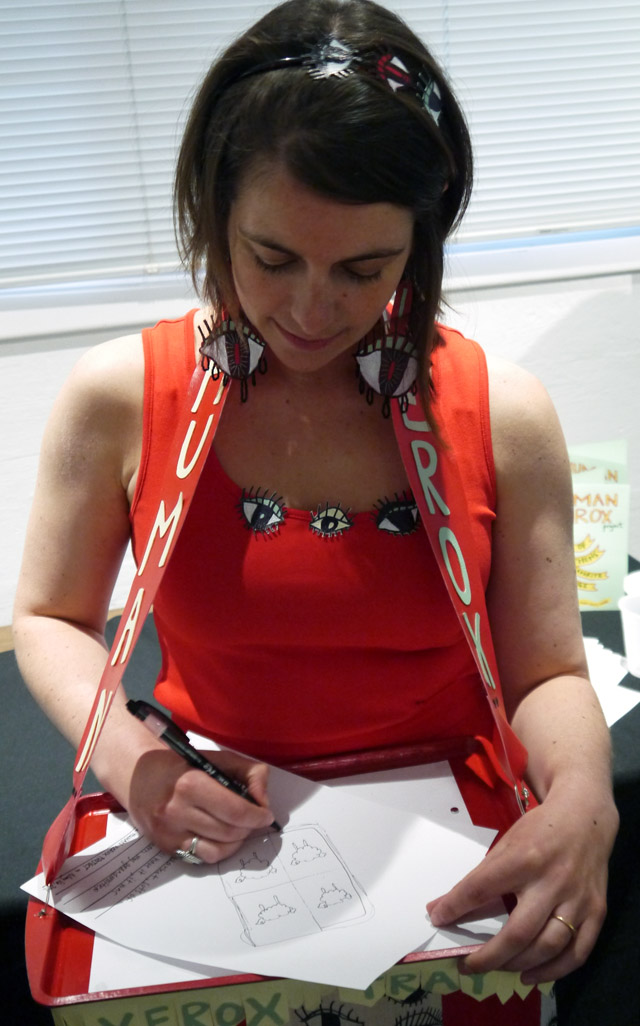
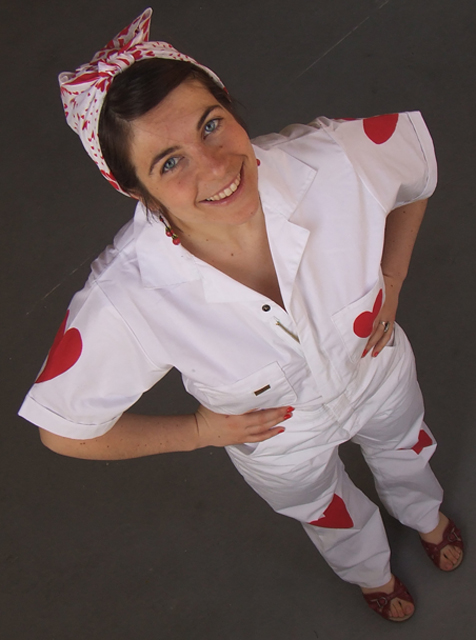
THE HUMAN XEROX PROJECT, Ongoing performance, 2014

THE HUMAN XEROX PROJECT, Ongoing performance, 2014

Briefly describe the work you do.

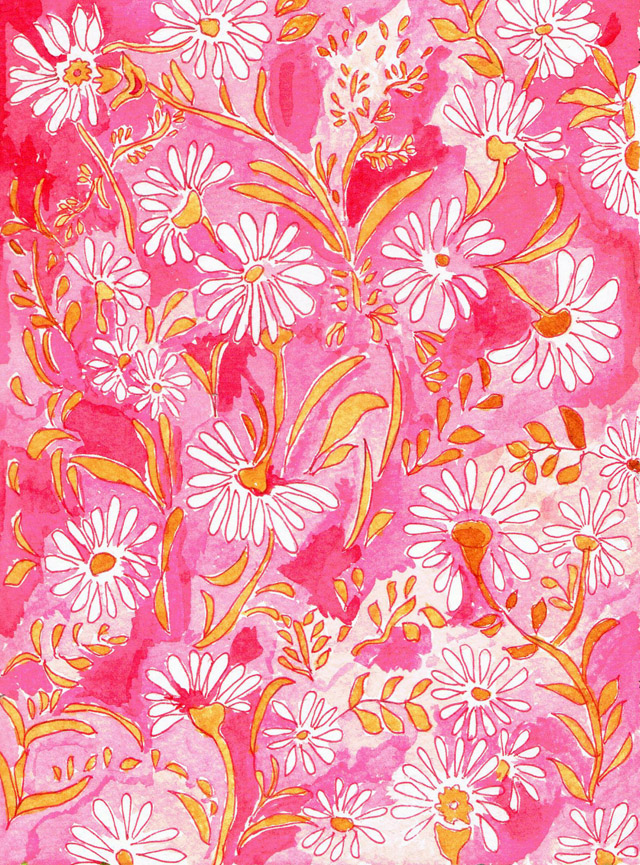
Ownership over possessions as well as ownership over individual or collective thought both fascinate me. My work spans a variety of media and takes the form of interactive art events and meditative studio based projects (such as Indian Pattern Archive, a drawing made for every week I lived in Mumbai, India). Much of my work involves the design and execution of projects that combine elements of interactive installation and performance with printed and handcrafted ephemera. Through these projects I rely upon community participation and view everyday people as experts on their own lives; lives that ultimately form our shared experience.

With The Declaration and Preservation of Love, I literally sugarcoated and displayed gallery goers’ possessions; during Certifying the Truth, a multilingual performance in Mumbai, India, I offered to verify any version of the truth presented to me which in turn created a public platform for discussion and debate; and with THE HUMAN XEROX PROJECT, I drew participants’ favorite things as described to me and began the compilation of an ongoing record of American ownership.

Tell us a little about your background and how that influences you as an artist.

I grew up in rural Vermont with unconventional, thrifty, and exceptionally creative parents.  Consequently, American consumer culture feels mysterious to me.  This combined with living abroad in both India and Thailand drives my curiosity to discover patterns in human behavior and thought across geographic, social, and economic borders.

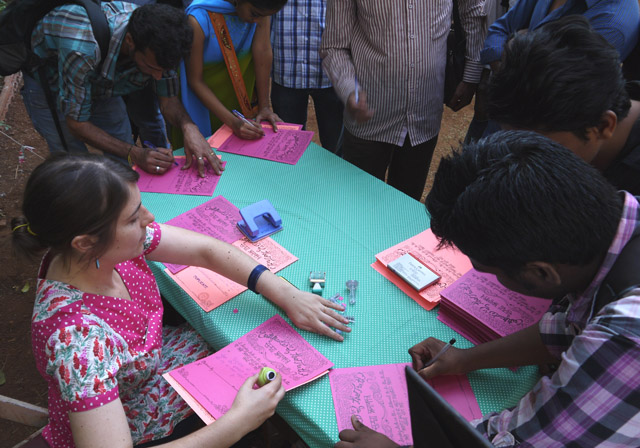
Certifying the Truth, Bilingual and Interactive Performance at the Sir JJ School of Art, Mumbai, 2013

Certifying the Truth, Bilingual and Interactive Performance at the Sir JJ School of Art, Mumbai, 2013

The concept of the “artist studio” has a broad range of meanings, especially in contemporary practice. The idea of the artist toiling away alone in a room may not necessarily reflect what many artists do from day to day anymore. Describe your studio practice and how it differs from (or is the same as) traditional notions of “being in the studio.”

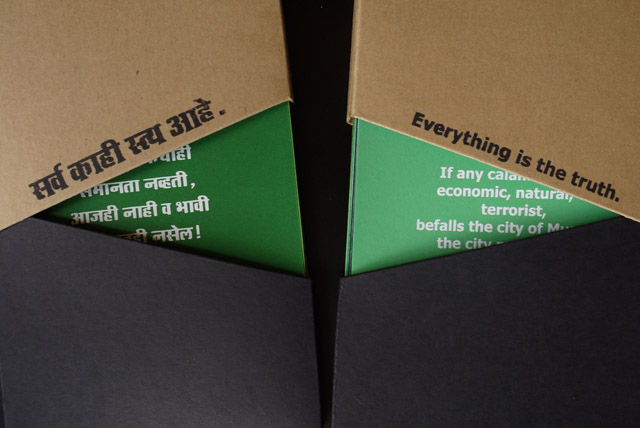
I have a hard time divorcing the idea of “being in the studio” in a traditional sense from the performances I give in public.  For me a public event functions as a form of research and represents just one intervening step that often informs the conclusion of a larger project.  For example, my Certifying the Truth performance resulted in over 100 written versions of the truth.  Later, I compiled a selection of these truths in a bilingual (English/Marathi) artists book, Everything is the truth.

What unique roles do you see yourself as the artist playing that you may not have envisioned yourself in when you first started making art?

Over the years I have come to see artists as a crucial contributors to social and political dialogue.  I now see myself as an “Artist as Engaged Citizen” and believe that all artists have the unique opportunity to imagine and present alternative approaches to everyday life and cultural conundrums. 

Everything is the truth. (DETAIL), English/Marathi Artist Book, 2013

Everything is the truth. (DETAIL), English/Marathi Artist Book, 2013

When do you find is the best time of day to make art? Do you have time set aside every day, every week or do you just work whenever you can? 

Whenever possible, I work first thing in the morning when I tend to have the most clarity.  When that’s not possible, I work throughout the day in small concentrated chunks of time, which is surprisingly effective.

How has your work changed in the last five years? How is it the same?

Five years ago I worked primarily with print media.  Since then my work has expanded across several disciplines.  I once compartmentalized and cherished my art practice, but have learned that letting it seep into the rest of my life makes that practice more joyful and relevant.  The result has been more collaboration—especially with my husband who is a creative force— as well as the discovery of an intuitive approach that allows my projects to develop organically. 

Are there people such as family, friends, writers, philosophers or even pop icons that have had an impact on the work you do?

I am in awe of great storytellers and especially love listening to This American Life and A Prairie Home Companion on NPR.  Visually, innovative graphic design and inventive product packaging provide constant inspiration.  I feel hugely fortunate to have great mentors, an outstanding peer group of artists and scholars game to throw around ideas, and a problem-solving partner willing to help me figure out how to do anything.

If you had an occupation outside of being an artist, what would that be and why?

Perhaps a textile designer because I love patterns!

About 

HeadshotCayla Skillin-Brauchle’s trans-disciplinary studio practice spans printmaking, drawing, installation, performance, and social practice. Her work has been shown at venues including JDK Gallery in Burlington, VT; the Rotunda Gallery in Bangkok, Thailand; ROY G BIV Gallery in Columbus, OH, the Sir JJ School of Art, Mumbai, India; and 621 Gallery in Tallahassee, FL.  Skillin-Brauchle earned a BA from Beloit College (2006) and her MFA in Printmaking from Ohio University in Athens, Ohio (2012).  In 2012-13 she was a Fulbright Fellow in Mumbai, India and this fall she will join the faculty at Whitman College in Walla Walla, Washington as a Visiting Assistant Professor of Art. 

IPA: Indian Pattern Archive: Contact Paper, Navi Mumbai, Mixed Media Drawing, 2013

IPA: Indian Pattern Archive: Contact Paper, Navi Mumbai, Mixed Media Drawing, 2013

www.caylaskillin-brauchle.com

All images copyright of the artist and used with their permission. 

Posted in Uncategorized | Tagged , , , , | Leave a comment

Adrian Chin – Chester, New Jersey

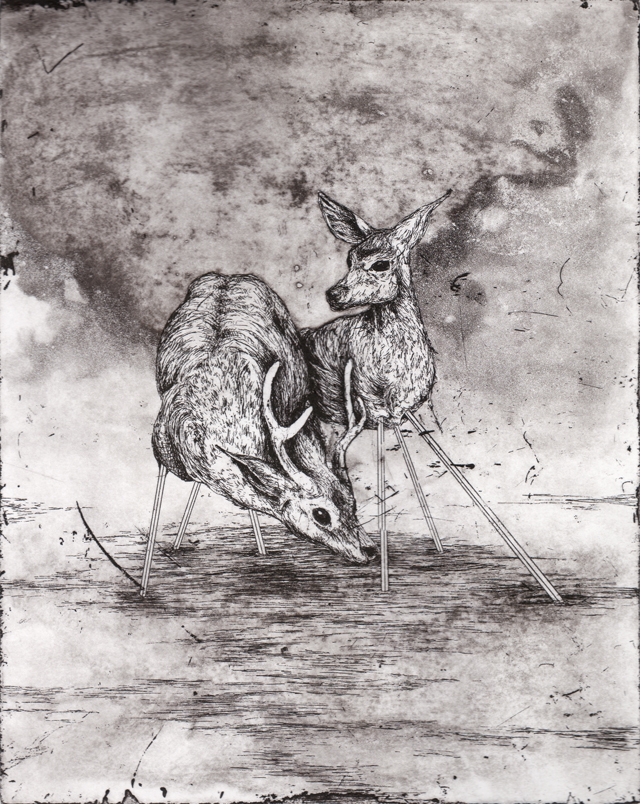
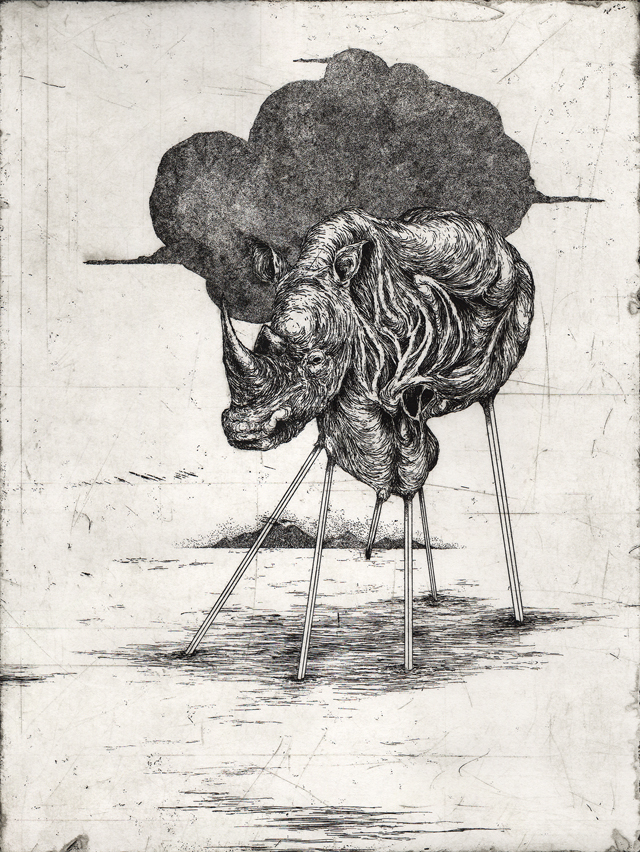
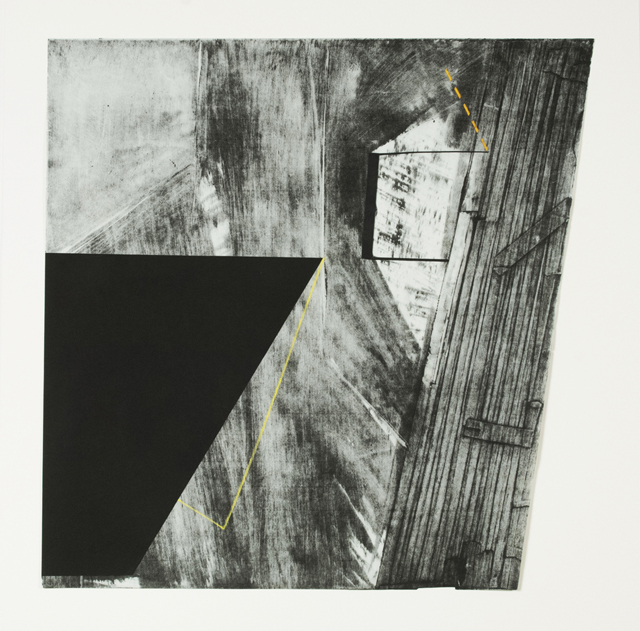
Cervine, Etching, 8in x 10in, 2014

Cervine, Etching, 8in x 10in, 2014

Briefly describe the work you do.

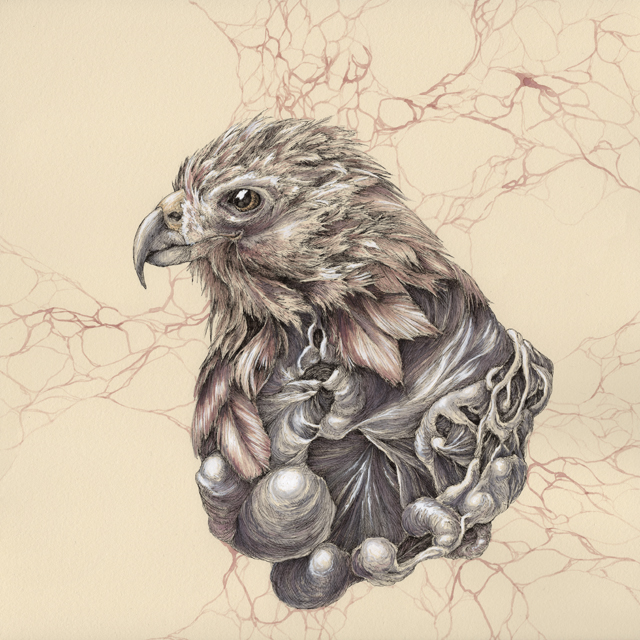
I work primarily in printmaking and drawing, focusing on intaglio and lithography.  I have an interest in forms found in biology and draw inspiration from these images. My work explores the psychological aspect of stress, anxiety, and isolation.  It is also an examination in aesthetics; I want to create a tension between what is attractive and what is grotesque.

Tell us a little about your background and how that influences you as an artist.

I have always been interested in science and art, I’ve been drawing for as long as I can remember, and I studied neuroscience and studio arts at the University of Pittsburgh.  I have always felt a tension between these two interests: each one vying for my attention. Eventually, I pursued a Master in Fine Arts specializing in printmaking from Northern Illinois University.  I see printmaking as the perfect marriage of art and science.  So many techniques, such as etching and lithography, involve the use of chemical reactions to transfer an image onto the matrix. 

The concept of the “artist studio” has a broad range of meanings, especially in contemporary practice. The idea of the artist toiling away alone in a room may not necessarily reflect what many artists do from day to day anymore. Describe your studio practice and how it differs from (or is the same as) traditional notions of “being in the studio.”

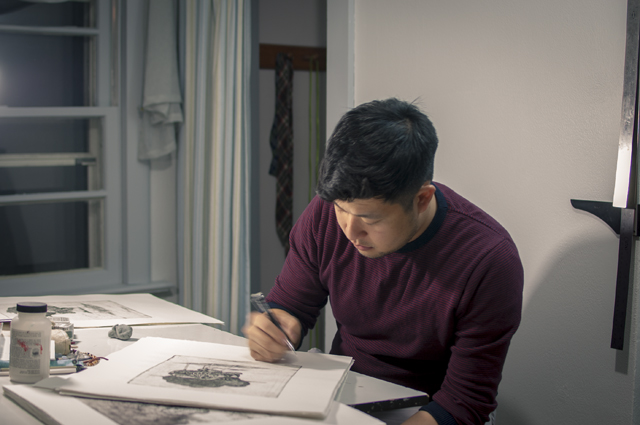
The medium of printmaking has historically been a communal one with many printmakers and artists working collaboratively in a studio.  I find that I split my time between working alone in a traditional sense, and working in the print studio, with fellow artists.  I get a lot of drawing done alone in the studio with a nature documentary or show in the background, but I finish up my work in the print shop with other people around (I like the convenience of having a second opinion when I want it.)  Most of my idea generation occurs away from my drawing desk, through walks in nature, long drives, airplane rides, etc.  I am fascinated by texture and I’m constantly searching for new and unique ones. 

Horned, Etching, 9in x 12in, 2014

What unique roles do you see yourself as the artist playing that you may not have envisioned yourself in when you first started making art?

The businessman and marketer.  I’ve never been one to promote myself and talk myself up.

When do you find is the best time of day to make art? Do you have time set aside every day, every week or do you just work whenever you can? 

I try to do something every day, a little doodle to a large-scale drawing, but it’s a little hard when inspiration is thin.  I like to work mainly at night, when distractions on the Internet and TV are very minimal.  I prefer to find long stretches of time where I can work on a project – I gain momentum after about two or three hours of work.  If I’m not making work, I’m thinking about making it.

Hawk, Pen and Ink with Ink Wash, 11in x 11in, 2014

How has your work changed in the last five years? How is it the same?

My early work was full of color and light-hearted.  Over my years of graduate school, the color has muted to subtle tones and become a serious study.  The only constant is that a majority of my time is spent on drawing.

Are there people such as family, friends, writers, philosophers or even pop icons that have had an impact on the work you do?

My family has always been hugely supportive of everything I do.  I have several family members in the medical field, which first sparked my interest in medical imagery.  Max Brödel, the medical illustrator, and the paintings Zdzisław Beksiński have long been an underlying influence in my work. I follow a couple hundred art blogs online, influences that seep into my imagery.

If you had an occupation outside of being an artist, what would that be and why?

I would probably be a marine biologist.  I love the ocean, especially the diverse and otherworldly life that inhabit it.

About 

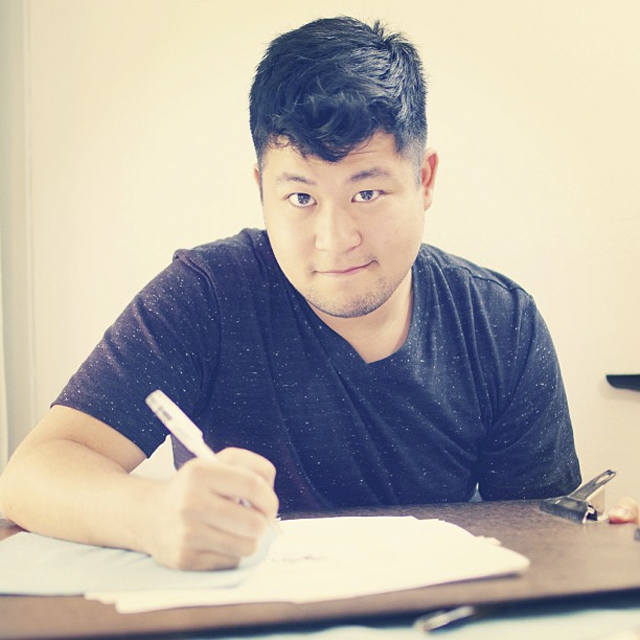
headshotAdrian Chin is an artist and printmaker from New Jersey.  His work mixes biological images and animals, examining the tension between the beautiful and grotesque.  He received his MFA in 2012 from Northern Illinois University, previously graduating from the University of Pittsburgh in 2008 with a BS in Neuroscience.  He has shown nationally in Chicago, New York, Pittsburgh, and Washington D.C.

Adrian is a printmaking assistant at the Printmaking Center of New Jersey.  He also teaches printmaking in various community outreach and education programs through the Center. 

In the Studio
In the Studio

www.adrian-chin.com

All images copyright of the artist and used with their permission. 

Posted in Uncategorized | Tagged , , , , | Leave a comment