Ericka Walker – Halifax, NS, Canada

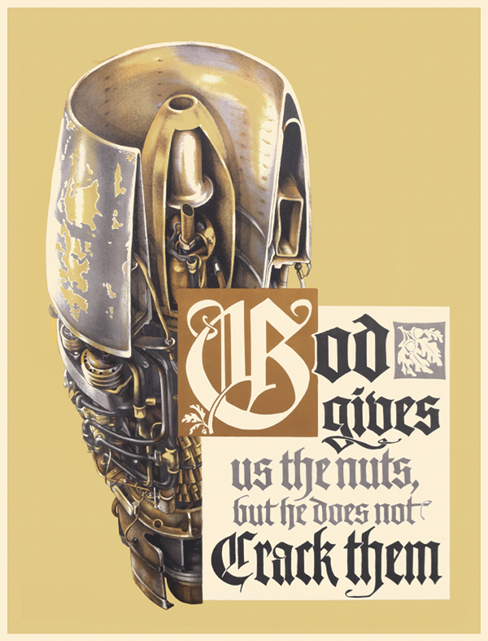
Nuts Lithography 30" x 40" 2014

Nuts
Lithography
30″ x 40″
2014

Briefly describe the work you do.

!The majority of my visual artwork revolves around drawing and printmaking. I am especially interested in the vernacular history of printmaking and printed ephemera, and the sociopolitical uses of visual propaganda throughout modernity. I am also an arts educator. I teach studio courses and mentor graduate students in the visual arts at an independent arts University, and work to enlarge the arts community with workshops, public exhibitions and collaborative projects that bring together studio art practice and the study of visual culture and art history.

Tell us a little about your background and how that influences you as an artist.

I grew up with a lot of visual stimulation, mostly in the form of imagination- intensive, self-directed play time. My childhood home was surrounded by farm fields. The land spanned orchards, vegetable gardens, forests, and streams, and with strict parental rules governing my television time and an older sister who didn’t always want to play, the abandoned farm equipment in the fields provided plenty of solo adventures and daydreaming.

My upbringing was as American, whitebread, and middle class as it gets. I am the daughter of two public school educators, both born and raised in Illinois. My mother was the daughter of a Serbian-American steel mill worker and WWII veteran, and my father grew up on a farm in Norman Rockwell’s America, in North Central Illinois. Family members on both sides are veterans, home-makers, law enforcement officers, and educators. I spent a lot of time traveling across my country in the family car, and later in my own vehicle in an attempt to recreate some of the magic of those American road-trips that I experienced as a child.

Back then and today the highlights of those journeys are a cross section of National Parks and National Historic Sites, Civil War battlefields, monuments to massacres, and monuments to great men. These sites and these experiences originally instilled in me a proud and sometimes confused reverence for my origins and the history of the continent I inhabit. Today, when I watch a historic reenactment or enjoy a National Park, I enjoy a slurry of nostalgia, grief for the stories not presented, and awe at the violent confluences of forces that have shaped our nation and our national identity.

There Lithography 25" x 36" 2014

There
Lithography
25″ x 36″
2014

The concept of the “artist studio” has a broad range of meanings, especially in contemporary practice. The idea of the artist toiling away alone in a room may not necessarily reflect what many artists do from day to day anymore.Describe your studio practice and how it differs from (or is the same as) traditional notions of “being in the studio.”

I see the work I do in my studio as sharing equal footing with the investigative work I do before a visual artwork emerges. This can be anything from talking to a fellow American about about regional barbecue hierarchies, to visiting museum archives, reading scholarly books and articles, or watching documentaries while I sketch ideas in a notebook. Sometimes I hit a block and I need to exercise, spend time alone on a hike, build a stone wall or get out the chainsaw. Of course, the time I spend in the studio actually drawing is certainly a primary ingredient in the recipe, but even more crucial is learning to pay attention to all of my experiences, especially those where I have an opportunity to be challenged by anything from an unknown history to a difficult idea to simply being quiet in the world. Wherever I am open and humble I can allow both the visual and the emotional to enter, and then find out what resonates with me. With diligence and luck, I can capture some of that in my artistic output.

What unique roles do you see yourself as the artist playing that you may not have envisioned yourself in when you first started making art?

My role as a mentor has been the most notable shift in what once were my preconceived notions about how my creative life was going to play out. My own experience has proven to me that success takes many forms, and is attributable to far more than my own work ethic. It will always include those who took the time to help me define what I wanted success to look like, and those who helped me to see what was superficial and what had value. I had patient teachers and guides who helped me unpack my reasons for choosing to pursue art, and to articulate what it was I wanted to do with that privilege.

One of the most important roles I play, however, is fulfilling an obligation to strengthen and rebuild sisterhood with the women I encounter through my work. Whether or not their age or walk of life resembles mine, I can recognize when I am in a situation to give, and when I am faced with an opportunity to ask for guidance. I still need mentors, too, and I can thank my own teachers for the willingness to reach out and find them, and for my enthusiasm to be there for others.


When do you find is the best time of day to make art? Do you have time set aside every day? Every week? Or, do you just work whenever you can?

I work best at night, though I’ve tried many times to change that cycle. I think it is biological. At this point I’ve accepted and embraced it, and it feels like a good slice of freedom to give up a fight that proved to be a lot less critical than I thought it was. I grew up presuming normal, successful people get up early, work during the day, come home in the evening, eat three square meals, shower constantly, act polite, floss and brush, etc. In addition to finding fabric softener and hair conditioner somewhat pointless, I love discovering that other social mores might be useless for me, too, and that it often pays off when I privilege my studio practice above what would appear to be other more responsible behaviors. I know there is a ceiling to this attitude, but I have yet to hit it very hard or too often.

We’ll see what the future holds, though.


Begins Lithography 25" x 36" 2014

Begins
Lithography
25″ x 36″
2014

How has your work changed in the last five years? How is it the same?

The content of my work has changed the most. Five years ago (2009) I finished my first large lithographs, in response to some turn of the century propaganda posters I had come into contact with. This really opened up a lot of avenues of inquiry for me, in terms of looking at marginalized histories and the broader relationships between our politics and economies of industry, culture, and social power.

My work is the same, though, in terms of its artifice. I have a deep bond with drawing, and the work of my hands. I utilize digital tools often, especially when it comes to iterative design processes and quick layout possibilities, but I return almost exclusively to mylar sheets, stones, crayons, hand-cut stencils and inks to realize final works.

Are there people such as family, friends, writers, philosophers or even pop icons that have had an impact on the work you do?

Running into the writings of French philosopher/Christian anarchist Jacques Ellul has certainly provided some verbal articulation around why propaganda interests me, though I would not necessarily consider his work an inspiration. More of an explanation, perhaps? At any rate, he had a lot to say on a lot of subjects, some of which include the role of different types of propaganda in society and politics.

Colleagues in critical studies and art history also fuel a lot of my investigations into socially engaged art practices, and have served as connections and inspiration to investigate decentralized and collaborative practices making art somewhat outside of the mainstream; for example, the Justseeds Artists’ Cooperative.

The musical soundtrack of my youth, which included System of a Down, Pink Floyd, Rage Against the Machine, and even Andrew Lloyd Weber’s Evita — among others — exhibited a convergence of artistic expression and the relatively dry/rigid systems of what appeared to constitute the grown-up world: national politics, banking, WASPs, casual Christianity, things like that.

I really enjoy author Rebecca Solnit’s ability to weave together very specific stories that reveal larger pictures of the human condition, especially when it comes to self-mythologizing narratives of American history and gender relations in Western society.

Also, I adore Lady Gaga.

If you had an occupation outside of being an artist, what would that be and why?

Before making the decision to continue my studies as a graduate student, I was going to move out West to train as a smoke jumper and fight forest fires. That was a pretty good idea.

Probably, though, I’d join the operators union and work for a contractor somewhere in the midwest of the United States. Then, I’d take up a serious semi- professional career as a noodler.

About
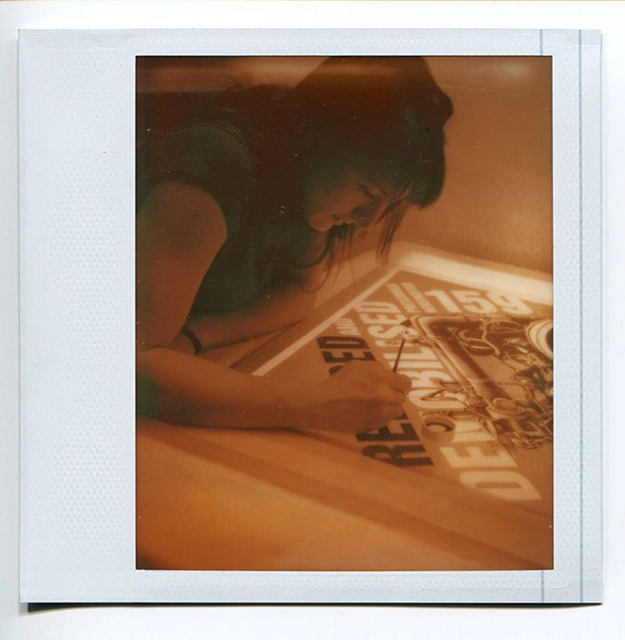
headshot_polaroidEricka Walker was born in Hartford, Wisconsin, USA. She received a BA from the University of Wisconsin-Madison, and an MFA from the University of Tennessee-Knoxville. She currently teaches studio coursework in printmaking as an assistant professor in the Fine Arts Division at the Nova Scotia College of Art and Design. Walker’s creative practice draws on the graphic media of late 19th and early 20th century, including propaganda, advertising, and printed ephemera. Her work has been included in numerous domestic and international exhibitions and biennials, as well as teaching and private collections in Canada, the United States, Europe, and Asia.

walker_graining_stone

www.erickawalker.com

All images copyright of the artist and used with their permission. 

Posted in Uncategorized | Tagged , , , , | Leave a comment

Monica Lacey – Charlottetown, Prince Edward Island, Canada

"Tangled, Mallorca"  digital photograph, 2014

“Tangled, Mallorca” digital photograph, 2014

Briefly describe the work that you do.

In my work I focus mainly on drawing out the beauty of that which is broken, overlooked, or discarded – it is important to me to look closely at life, to notice the tiny details. My practice consists of conceptual and material exploration in the areas of photography, painting, and installation-based art. Currently I am working on encaustic mixed media paintings, underwater photography, a textile-based installation and an interactive outdoor installation. I’m really interested in creating immersive installed environments using photo, video, and built structures.

At what point in your life did you decide to become an artist?

I think I was always an artist, growing up I was always creating, making things, taking photos, drawing, and also looking at things in a creative way…I was always encouraged in that, my mother took me to be mentored by local artists and things like that, but I only gave myself permission/figured out that I wanted to do it full-time professionally when I was 27.  That’s when I went to art school and got serious about it.  I graduated in 2011 and have been working professionally ever since.

Tell us a little about your background and how that influences you as an artist.

I grew up in the country and my sister and I were homeschooled by my mother until around grade 7.  We spent most of our time outside playing in the woods, and that connection with the natural world is a strong presence in my work today.  My father worked as a filmmaker for many years, and gave me my first camera when I was 8 years old, he is a big influence and taught me about composition and how to train your eye.  My family on his side is in Italy, so we travelled often to Europe to see them and we always went to all the museums and galleries, so I had wonderful exposure to the arts from a young age.  As part of homeschooling we watched the opera, we memorized poetry, we learned piano, we painted, we danced, it was really a good childhood and it made the arts a regular part of life rather than a luxury or something separate.  Though we were wealthy in so many ways, we didn’t actually have much money and so I also learned about the world of secondhand objects/materials and doing interesting things with what was available.  I was always encouraged to create and experiment.

For many years I focused on writing and dancing and I still work out ideas verbally rather than through sketches and movement when I get stuck. I trained for over 2 years as a Kundalini Yoga Teacher, and have had a daily yoga practice since 2004. The depth of awareness I cultivated through that process influences my entire life, including my studio practice. I’m interested in finding a deeper emotional response and trying to invoke a kind of meditative quiet through my work, both in myself and the viewer.

I did Interdisciplinary Studies in Textiles and Photography at college and as a mature student with prior experience, I got permission to do things outside the boundaries of the programs offered, such as Independent Study and exploring media that wasn’t actually formally offered at my school, such as encaustic and photo-etching. I went to a Craft and Design college but many of my instructors have or were pursuing MFA degrees so it was a perfect mix of technical skill and conceptual rigor. It prepared me well for turning my work into a full-time job and taught me about treating my studio practice as a business.

The Body Cage (Your Body Holds You Back) - Installation at UNB Art Centre 2012: Digital photograph, mixed media, and video with original choreography by Julie Scriver and original score by Devon Ross Cages: cotton, plywood, steel, 2011-2012

The Body Cage (Your Body Holds You Back) – Installation at UNB Art Centre 2012: Digital photograph, mixed media, and video with original choreography by Julie Scriver and original score by Devon Ross
Cages: cotton, plywood, steel, 2011-2012

What types of conceptual concerns are present in your work? How do those relate to the specific process(es) or media you use?

Altered memory, nostalgia, quiet, darkness, nature, ideas of house and home, abandonment, various agents of comfort and survival(such as daily household rituals), social environments – all of these are ongoing themes in my practice.

I’ve been working with abandoned houses as a subject matter for almost a decade and they are endlessly rich and mysterious to me. The idea and structure of a house and all that it encompasses, the energy that it can hold, how it is a metaphor for the human body, these containers we’re in all the time, is so interesting to me. I believe that things and places have their own lives and intimate
feelings and I want to tell those stories. I started by approaching it with photography, from the outside, then I started to go inside, and now I’m working with video, installation, putting people in the houses, using them as a set. I think for years I’ve been trying to tell these houses that they are still loved…in fact I made an outdoor installation that was a ‘love letter to abandoned houses’ where I constructed an abandoned house in the woods using furniture, windows and doors.

I’m continually examining the balance of tenderness and power contained in my relationship with the natural world, and plants in particular. I work with watercolour and ink when dealing with plants and flowers – mostly I use found windfall leaves, flowers, seed pods, branches etc. – I love to study them so closely and then render them as faithfully and slowly as I can, sort of a way of paying homage and deeply appreciating their beauty.

I recently got an underwater camera and I’m completely addicted right now to working underwater, it’s a whole other world, and a great opportunity to explore light and silence. It’s a combination of so many things I love.

We once heard Chuck Close say he did not believe in being inspired, rather in working hard everyday. What motivates you in your studio practice?

Materials, process, curiosity…I often start working with a material and then the concepts emerge later, so that can be a fascinating process as it’s sometimes a surprise.  I get inspired by other artists, musicians, writers, dancers…also I’m very motivated by deadlines – I actually thrive on that pressure!   If/when I get stuck I’ll do a photo-a-day project, using set themes each day, and that always helps me break through any blocks.

"Last Gladiolus"  watercolour and graphite on paper, 22"x30", 2013

“Last Gladiolus” watercolour and graphite on paper, 22″x30″, 2013

What artists living or non-living influence your work?

It changes often depending on new work that I see, but right now I’m looking at Ken Rosenthal, Brooks Shane Salzwedel, Dominique T Skoltz, Jane Hambleton, Mike Nelson, David Hoffos.  I watch a lot of films, and they influence how I see things – I am a big fan of Jan Svankmajer, Wim Wenders, Wes Anderson, Miranda July, Spike Jonze, Charlie Kaufman….I’m also very inspired by Judy Pfaff, Louise Bourgeois, Marie Chouinard’s dance creations and Reines d’un Jour by Pascal Magnin.  Two people who made me want to make art in the first place are my aunt Cristina Lisi, who is a sculptor and architect in Florence, and my late grandfather Giordano Lisi who was a wonderful painter.

When you are not making art what types of activities and interests do you engage in? 

In the summer, I spend a lot of my free time in the ocean…I also write, play the piano, run, lay in my hammock, play with my cat…I love to garden, travel, I teach workshops, and I sit on juries and boards of different arts organizations, and of course there is always a substantial amount of admin work to do for my business as well.

Monica LaceyAbout

Monica Lacey is a multi-disciplinary artist whose work focuses on the beauty of the broken, overlooked, or discarded. Monica spent many years traveling, working in the film industry, and developing her skills as a writer, dancer, and yoga teacher before returning to interdisciplinary studies in Textiles and Photography at the New Brunswick College of Craft and Design. She has received several awards and grants for excellence in her work and service to her community, including the Nel Oudemans Award for Excellence in Visual Arts  in 2012 and the City of Charlottetown Emerging Artist Award in 2014. She is represented by Gallery 78 in Fredericton, New Brunswick, and her art can be found in private collections across North America. She lives and works in Charlottetown, Prince Edward Island, Canada.
 

www.monicalacey.com

Studio

Studio

All images copyright of the artist and used with their permission. 

Posted in Uncategorized | Tagged , , , , | Leave a comment

Lena Klyukina – Vilnius, Lithuania

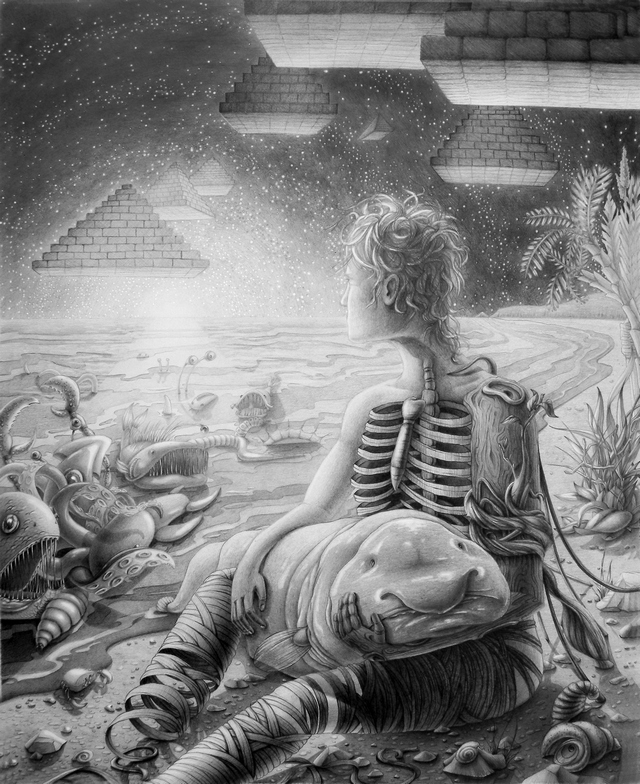
unocular transition_graphite_30x40cm_2014

unocular transition_graphite_30x40cm_2014

Briefly describe the work you do.

I draw surreal pictures, mostly inspired by music and nature and everything in between.

At what point in your life did you want to become an artist?

I started taking drawing seriously about 6 years ago, when I moved to another city and started college, and a lot of positive change happened. Though I can’t say I wanted to become an artist, nor I expected that to happen, or that it actually happened. I still get nervous each time a see a blank piece of paper as if it is a first time.

Tell us a little about your background and how that influences you as an artist.

I am a nature lover and study natural sciences on daily basis, which is why it is easy to see natural motives in my drawings. The further my body is from the city, the closer I am to finding missing pieces of the puzzle. I also love astrophysics, black holes and time travel theories, and it adds up to the science-fictional feel.

What types of conceptual concerns are present in your work? How do those relate to the specific process(es) or media you use?

I think the basic conceptual concern in my works is probably to try to reveal the microcosm of things and patterns and put them together in an unexpected kind of way. I use pencil for this because it lets me to get as detailed as possible to the very base of creative process.

meteor shower_graphite_55x70cm_2013

meteor shower_graphite_55x70cm_2013

We once heard Chuck Close say he did not believe in being inspired, rather in working hard everyday. What motivates you in your studio practice?

I agree with this. And I don’t believe in motivation either, because you need motivation to keep doing things you don’t really like. I love what I do, it always feels like a coming of spring when I have something to work on, and I feel miserable when I don’t. Sometimes mind images and experiences just need some time to evolve into idea, so it is important to learn to lay back and let them to. And make sketches.

shore_graphite_45x55cm_2013

shore_graphite_45x55cm_2013

What artists living or non-living influence your work?

I don’t have any visual artists that had or have influence on my work, but there are a lot of musicians and writers and poets and storytellers and freedom seekers who keep inspiring me at all times, like Robert Smith, Martin L. Gore, Jim Morrison, Andrew VanWyngarden, Kurt Vonnegut, Richard Matheson, Henry David Thoreau, Charles Bukowski…..

When you are not making art what types of activities and interests do you engage in?

Basically, riding a bicycle in a forest while listening to favorite music, with a book and a grilled cheese sandwich in my backpack – this is my perfect day in a nutshell. I also love to play guitar and keyboards from time to time, and I’m quite a singer as well.

About

headshotLena Klyukina is a traditional drawing artist, currently residing in Vilnius, Lithuania. Each character’s inner world is expressed through detailed surreal surroundings, naturally chaotic and bizarre, leading to take a trip to the subconscious.

www.facebook.com/lenaklyukinadrawings

All images copyright of the artist and used with their permission. 

Posted in Uncategorized | Tagged , , , , | Leave a comment

Jane Gordon – Albuquerque, New Mexico

Parched Earth Tiles and Garden Bowls with Seedballs, clays, lithium wash, terra sigellata, tile mastic, MDF, steel plates and wall anchors. Seedballs contain clay, compost, seeds. Paper bags with labels noting contents and instructions for use., Parhced Earth Tiles: 20 units 10" x 10", 10 units 14"x 28", 13 units 11"x 34". Garden Bowls with Seedballs: 2 of 5 bowls pictured, 28" D x 16"H and 20" D x 24" H,2014

Parched Earth Tiles and Garden Bowls with Seedballs, clays, lithium wash, terra sigellata, tile mastic, MDF, steel plates and wall anchors. Seedballs contain clay, compost, seeds. Paper bags with labels noting contents and instructions for use., Parhced Earth Tiles: 20 units 10″ x 10″, 10 units 14″x 28″, 13 units 11″x 34″.
Garden Bowls with Seedballs: 2 of 5 bowls pictured, 28″ D x 16″H
and 20″ D x 24″ H,2014

Briefly describe the work you do.

For the past seven or eight years, I have been focused on installation work in ceramics, most often designed for temporary outdoor installations. I consider the pieces “site-particular,” because they each need some specific components to be present but one of the joys of the work is seeing how it changes installed in different locations.

Tell us a little about your background and how that influences you as an artist.

Some elements of my upbringing that have a lot of resonance in my work are my attendance and participation in theater from a young age, giving me an interest in immersive environments as well as developing a personal artistic voice. I have always loved the science fiction and fantasy genre (books, television, film), and my consumption of this has directly influenced my artwork as well as my practice and ways of viewing the world and my place in it. Additionally, I have been working in the natural foods industry for over fourteen years, and the people, products, and ideas that I have been exposed to through that employment have a strong influence on my lifestyle and perspectives.

The concept of the “artist studio” has a broad range of meanings, especially in contemporary practice. The idea of the artist toiling away alone in a room may not necessarily reflect what many artists do from day to day anymore. Describe your studio practice and how it differs from (or is the same as) traditional notions of “being in the studio.”

Due to the nature of ceramics, when working in clay I am very much the “artist toiling away alone in a room,” although generally with some nice loud music. My current studio, however, is borrowed—so along with not making changes/organizing/decorating like I would in a studio of my own, I am constantly aware of the possibility of losing the space and having to find another method/place to work.

What unique roles do you see yourself as the artist playing that you may not have envisioned yourself in when you first started making art?

Installing work outdoors, even temporarily, often entails permissions and negotiations with public officials or private owners. As I’ve grown, I’ve become more introverted (thus my transition from theater arts to visual arts), and finding that the work I desire to create requires this type of engagement is somewhat humorous. There are roles I hope to fill as an artist, which I think many have in mind: those of questioner, instigator, entertainer, educator, aesthetician…

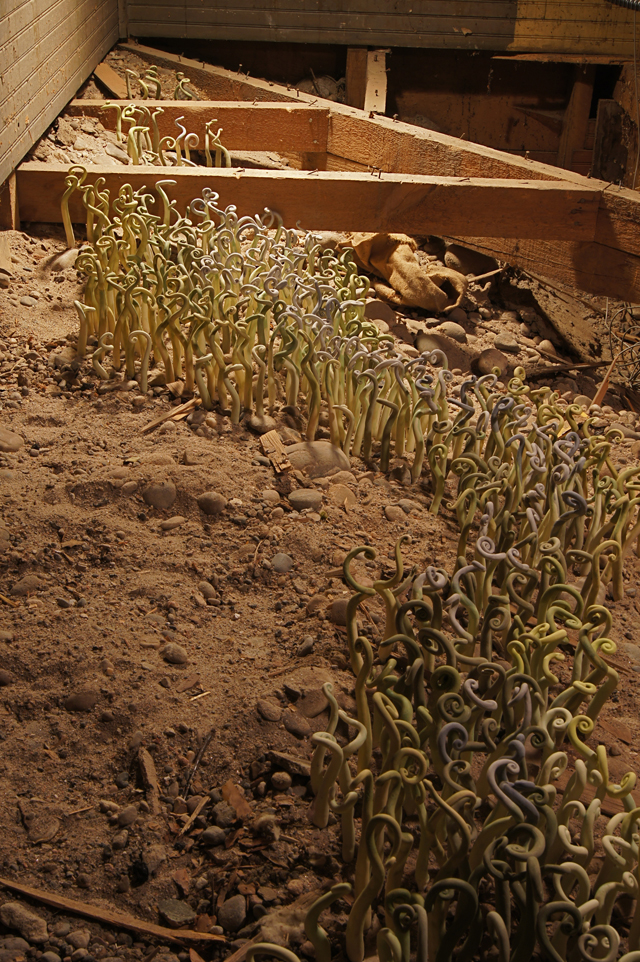
Replacement System 2, earthenware, slip, Approximately 625 units, 2"x 1.5" – 4"x2.5". Total dimensions variable, 2010, pictured as installed June 2013

Replacement System 2, earthenware, slip, Approximately 625 units, 2″x 1.5″ – 4″x2.5″. Total dimensions variable, 2010, pictured as installed June 2013

When do you find is the best time of day to make art? Do you have time set aside every day, every week or do you just work whenever you can? 

Morning and afternoon: during the regular workday, are best for me. However, multiple jobs and having to get to and from my studio mean I haven’t been getting quite as much pure studio time as I would like… the amount varies throughout the year as other demands on my time fluctuate.

How has your work changed in the last five years? How is it the same?

The last five years, which covers just before and just after my time in graduate school, has seen my work distill to clearer ideas, incorporate more materials, question itself and respond, and allowed me to understand more about my process, concepts, and goals. I hope all of these aspects continue to develop as I continue to grow and change. Certain things have remained constant: my use of multiples, my desire to create work for outdoor installation in the public sphere, the amount of labor and experimentation, and my use of clay as a primary medium.

Are there people such as family, friends, writers, philosophers or even pop icons that have had an impact on the work you do?

Some of the strongest influences on my work are literary: particularly writers of science fiction and dystopian/post-apocalyptic fiction. The MaddAddam Trilogy by Margaret Atwood has had a profound effect on my work of the past 5 years, and the writings of Ursula K. LeGuin, Ray Bradbury, and others have also deeply affected me, and therefore my work.

Other parts of my life, such as my employment in the natural foods industry and interests in sustainability, as well as individuals who have introduced me to ideas and processes that I was not aware of, have also filtered through my consciousness and found their way into my art practice.

If you had an occupation outside of being an artist, what would that be and why?

This is an interesting question, as I do not make my living as an artist currently—I am employed as an adjunct professor, and work in the produce department of a local co-op. If I had taken another educational path when I was younger, I think I may have gone into architecture: a field that also combines elements of aesthetics, creativity, function, energy flow, and sustainability.

About

gordon_headshotJane completed her Bachelor of Fine Arts at the University of Minnesota, Twin Cities, in 2006. She moved to Albuquerque in January 2010 to attend the Master of Fine Arts program at the University of New Mexico, focusing on the Art & Ecology Area and participating in the 2011 Land Arts of the American West program. She completed her MFA in early 2013, and currently is teaching at UNM as an adjunct professor in the Ceramics Area.

Coming from the “land of 10,000 lakes” to the high desert was a huge shift, and provided as many challenges as it did inspirations. Jane has spent over fourteen years working in the natural foods industry, and this, along with her love of science fiction and fantasy, has had strong resonances in her art practice. Jane loves her sweet husband, enjoys cooking, eating, and sharing delicious food, losing herself in a good novel, and singing in the studio. Jane considers her strong work ethic one of the most important facets of her personality, but is learning to honor relaxing as a necessity for a fulfilling and productive life.

SONY DSC

janegordonart.com

All images copyright of the artist and used with their permission. 

Posted in Uncategorized | Tagged , , , , | Leave a comment

Mark Creegan – Jacksonville, Florida

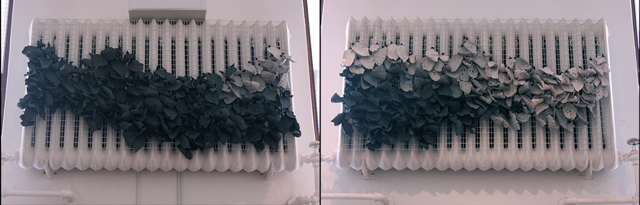
Stacked & Strapped, used paint rollers and bungee cord on wall, dims vary, 2010

Stacked & Strapped, used paint rollers and bungee cord on wall, dims vary, 2010

Briefly describe the work you do.

I make various formal arrangements and structures, usually site-specific, with materials I have accumulated over the years. Some of the materials include used watercolor sets, hairnets, shark teeth, and toothpaste. I work in a variety of presentation contexts including the wall, floor, ceiling, or outdoors. I also make paintings, video and do performance work. I am rather all over the place actually. I try to give my work a witty flavor.

At what point I your life did you want to become an artist?

My much older brother was an artist so I am sure my interests began with him. Later it became the typical foray into comicdom and MAD magazine as the culprit.

Tell us a little about your background and how that influences you as an artist.
I grew up rather poorish, so that may have something to do with my low-scale hoarding habits. I do hate to throw away stuff! Humor and performance have always interested me. I was a theatre major in school before switching to art. I know I regard my current work as a sort of performance.

Symmetrix Yellow, hairnets, nails on wood panel, 36" diameter, 2013

Symmetrix Yellow, hairnets, nails on wood panel, 36″ diameter, 2013

What types of conceptual concerns are present in your work? How do those relate to the specific process(es) or media you use?

This does not apply to every work, but it is the interaction between the materials I use, the minimalist forms, and the contexts that I present the work in that contribute to the overall concept of the work. An oft-used material are the used watercolor pans and sets. I collect these from my wife who is an elementary school art teacher. The
context behind these is something that I love to play with- the fact that these items were once used in a different, more pedestrian context, and then I come along and appropriate them in some high-art context using Minimalist aesthetics. I often imagine that the same materials I am using were once used to paint a picture that is hanging on a proud parent’s refrigerator. I am always drawn to the underdog, and my own humble background gives me a sense that I want to elevate the common… whatever.


Symmetrix Yellow, hairnets, nails on wood panel, 36" diameter, 2013

Symmetrix Yellow, hairnets, nails on wood panel, 36″ diameter, 2013

We once heard Chuck Close say he did not believe in being inspired, rather in working hard everyday. What motivates you in your studio practice?

I think when you know exactly what you are going to do everyday it makes sense to get in there to make the donuts. I need soak-in time where I am just living. I wouldn’t call it waiting for inspiration though because, like I hinted, I hardly ever know what I am going to do, so I just go when I go and what gets made gets made.


What artists living or non-living influence your work?
Felix Gonzalez-Torres, Willie Cole, Tom Friedman, Tony Feher and Andy Kaufman.

When you are not making art what types of activities and interests do you engage in?
I read, do yoga, play with my dogs and hang out with my wife and good friends.

About

selfieMark Creegan is an artist and curator located in Jacksonville, Florida and teaches art at Florida State College. He works in various media and formats but is mostly involved in making arrangements and installations using materials such as hairnets, shark’s teeth, toothpaste, soap bubbles, and watercolor sets. Mark spent his adolescent years planning to become a writer for Mad Magazine and Saturday Night Live. In school, he spent more time drawing satirical cartoons of his teachers than studying. His main artistic influences include Monty Python and Andy Kaufman. He is known to make blanket statements about his work, but only because he is often cold. 

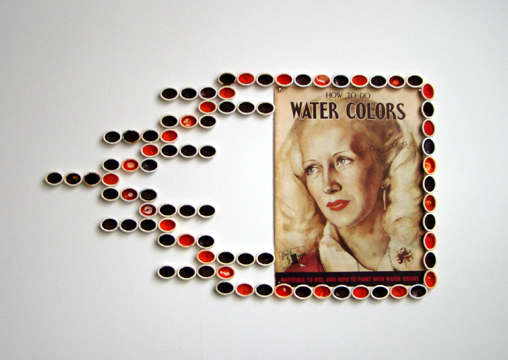
detail image os of Walter Foster Mountain Range, Walter Foster book pages, tape on wall, dims vary, 2009

detail image os of Walter Foster Mountain Range, Walter Foster book pages, tape on wall, dims vary, 2009

www.markcreegan.com

All images copyright of the artist and used with their permission. 
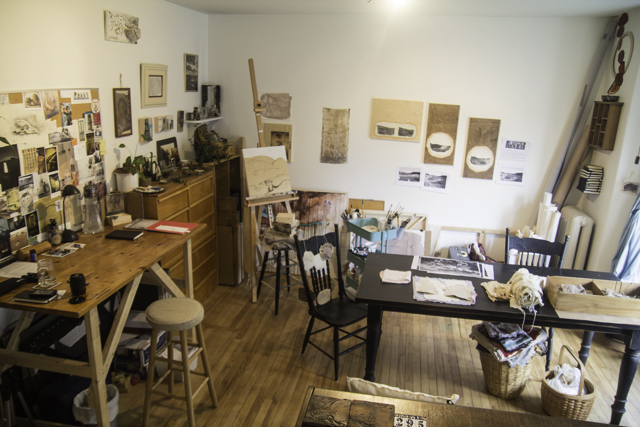


Posted in Uncategorized | Tagged , , , , | Leave a comment

Yeol Jung – Boston, Massachusetts

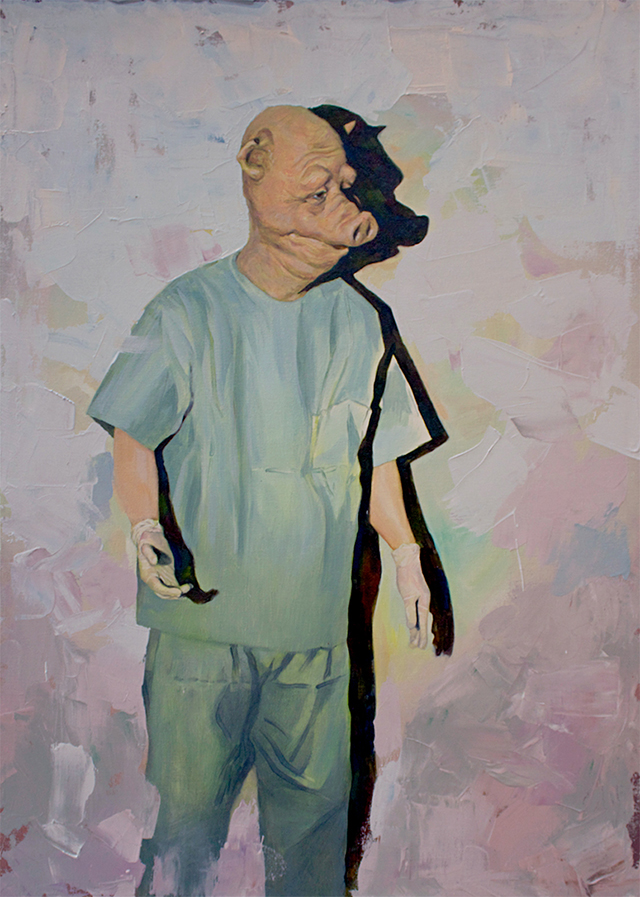
Title: The Doctor Year: 2014 Medium: Oil on canvas Size: 26(w)x36(h)

Title: The Doctor
Year: 2014
Medium: Oil on canvas
Size: 26(w)x36(h)

Briefly describe the work you do.

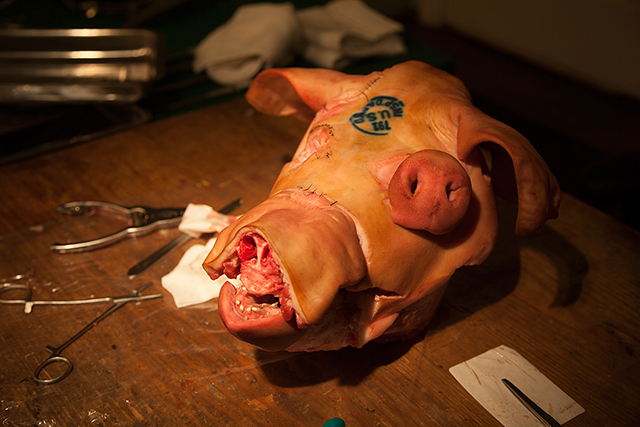
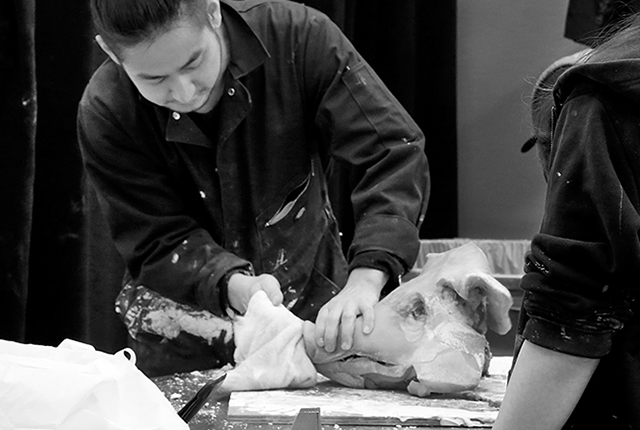
I tear, I cut, and I sew. My work is to operate plastic surgery on a pig’s head. By using metaphors I can intensify reality. The context of my work describes not only the shape of a phenomenon, but also one’s perspective about the cause of a cultural happening.

Studying the cause and effect of plastic surgery in South Korea is the subject matter of my research. South Korea has the highest cosmetic plastic surgery rate in the world. I believe the phenomenon of radical plastic surgery in South Korea is a reaction to the loss of self-identity during the Japanese colonial period. It is a way to overcome the notion of a split nation and ideology, and the acceptance that Koreans must strictly follow social rules, which was how Korea was able to succeed in economic growth. These three factors have led Koreans to fail to acknowledge diversity. One aspect of the outcome was the idolization of a certain westernized look. The pig symbolizes the destruction of Korean tradition and beauty, and idolization of a certain look and way of thinking.

My project focuses on finding the relationship between factors in history. Although the research is limited to South Korea, it will explore the vulnerability of humankind and I hope my work serves as a vocal point in exposing the violence of idolization.

Tell us a little about your background and how that influences you as an artist.

The beauty of the opposite sex is my biggest pleasure. However, it is also an addicting and unfortunate idol that intoxicates me. My experience with plastic surgery culture in South Korea especially excites my curiosity, and its extremeness is a useful example for my observation into the nature of fallacy (misconception). “Idol” as a concept is created by humans and fueled by the weakness of human beings.

In order to understand plastic surgery as South Korea’s major weakness and idol, we must examine this phenomenon not just from the present. We must also examine this from all angles, past and present. The past 100 years have been a turbulent era of change in South Korea. In 1910, South Korea was colonized by Japan, and the insidious policy to obliterate the Korean nation eliminated and distorted Korean identity. In 1945, Korea got its independence restored. Five years later, the Korean War broke out based on antagonism between Liberalism and Communism, and it drove ideological confusion and caused economic collapse. For the last 50 years, South Korea has been extremely focused on its economy and education to overcome hunger, despite political chaos. Western technology has been the driving force of growth, and western culture has begun to replace Korea’s lack of identity through media. The country’s discontinuity from its own history and its modification by outside pressures have increasingly impacted the culture at the beginning of the 20th century. Korea’s culture, which was stifled for so many years, has now developed dramatically. As a result, the media has created dynamic cultural icons such as plastic surgery. This is a reaction to a lack of inner identity, and a self-comforting method to overcome the country’s remembrance of its historical and material poverty. The experience of a huge gap between Western civilization and Korea in its relatively poor era also became a trauma. Significantly, the whole process of this history and the relationship of cause and effect have not been recognized since people are already familiar with living in a new civilization without connection to past tradition.

Plastic surgery cultures in South Korea reveal that culture does not have absolute justification in itself, but is instead closer to the nature of statistical tendencies and developments that can be deconstructed. I am raising questions about freedom and truth in order to resist the human history that has evolved and developed through mimesis and idols. Even if I am living a fully manipulated life, I at least want to realize it. Endless inquiry concludes in aporia, yet for a moment it approximates freedom.

In terms of influential work experience, I worked for Nike as a retail-marketing specialist and have my career in an advertising field. To graft my work background to fine art is one of my main goals.

Advertising is a very racy activity. Advertising agencies are using the core of philosophy and technology that developed throughout human history to move people’s minds; They obviously include visual art to double the power of temptation. I have a great appreciation for advertising and its relationship with the human’s ability to communicate, but it is sad that advertising is restrictive at the same time.

The whole process of advertising is geared towards one goal, to induce a person to buy a product. My plan is to apply my knowledge in advertising to human life, and not only for sales. I want to advertise humane topics. There are many ideals we shouldn’t forget or issues that we should recognize, however not every company is willing to spend their money to promote ideals unrelated to their profit. The context of my work will be deeper than the base advertising “buy” message. I plan to create a visual narrative to deliver complicated messages or emotional conversations.

Title: The Mask Year: 2014 Medium: HD single channel video, stereo Length: 7 min Link: https://vimeo.com/92121536

Title: The Mask
Year: 2014
Medium: HD single channel video, stereo
Length: 7 min
Link: https://vimeo.com/92121536

The concept of the “artist studio” has a broad range of meanings, especially in contemporary practice. The idea of the artist toiling away alone in a room may not necessarily reflect what many artists do from day to day anymore. Describe your studio practice and how it differs from (or is the same as) traditional notions of “being in the studio.”

My studio work starts from the small room in my brain. I gather all my materials from this room in the form of people, events, objects, and stories. When I find a topic I really want to talk about, I leave it in the room for a long time to mold with my consciousness. The topics start to combine with random ideas in the room, and will strangely transform into the body of an artistic concept. This process provides me with a chance to conceptualize the core of the topic with an ironic viewpoint. After this conception, I can move to find an actual space to visualize it. The materials required to bring the concept to fruition depend on the concept itself and are therefore subject to change with each project. Choosing and preparing a studio is often difficult; I tend to create a studio with whatever means are available to me. Eventually, a white box in a gallery or museum becomes my studio. After trial and error experimentation, the conversations with viewers in real space and time become valuable materials in the room in my brain again. Since the meaning of an artist’s studio is diverse in contemporary art, I think artists cannot escape from the studio anywhere or anytime. The studio is everywhere and everything.

What unique roles do you see yourself as the artist playing that you may not have envisioned yourself in when you first started making art?

I doubt that there is any value in creating something with meaning and purpose that I have decided beforehand. The art itself should be at the edge of what has been done before; it should open up new areas and bring light to new concepts. I add new perspectives and knowledge to make me unsure about the direction of my work. I’m doing research and looking for new experiences. When I am faced with a new direction that I’ve never thought about, I am unable to judge the work until I go further with it. This is what makes me realize that I can go further with this new work. This might distinguish my roles from other artists who instead find answers from within themselves. With that being said, this is the broad role that I play as an artist, but the specific details of my role are constantly changing with each new project.

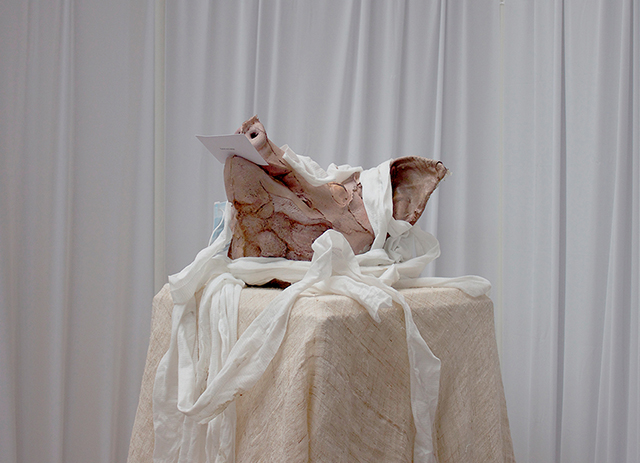
Title: The Pig Year: 2014 Medium: Dragon skin, RTV liquid rubber, plastic, acrylics Size: 10(h)x14(w)x12(d)

Title: The Pig
Year: 2014
Medium: Dragon skin, RTV liquid rubber, plastic, acrylics
Size: 10(h)x14(w)x12(d)

When do you find is the best time of day to make art? Do you have time set aside every day, every week or do you just work whenever you can?  

Honestly, I was not the kind of person who was too diligent. My decision in my late 20’s totally changed my situation. I made the choice to do art abroad instead of having a stable job, so making art is my life now. You may think it sounds little bit sad, but now that I am abroad I cannot find any reason to hesitate to create art. I don’t have any family and friends here to spend my time and energy with. I’m working all the time. I’m developing my ideas through research and planning when I cannot get access to make art, and I am waiting until I maximize my concentration. Personally, I prefer to work after organizing my ideas. Cleaning my studio and having adequate sleep contributes to the organization of my ideas. I really enjoy these moments that allow me to entirely focus on making art. I also think that this is the time I really needed in my life; this time is all the time.

How has your work changed in the last five years? How is it the same?

There was a great change in my work, and my work is still progressing in unexpected ways. Switching a pig’s head to a pretty celebrity’s face was my simple original goal. Now, I have a different visual narrative and I have added more historic contents. Above all, my viewpoint about plastic surgery has been changed drastically.

If you had an occupation outside of being an artist, what would that be and why?

This is a tough question to answer because I haven’t found any other position that can satisfy my interest except making art.

In the Studio

In the Studio

www.yeol.com

All images copyright of the artist and used with their permission. 
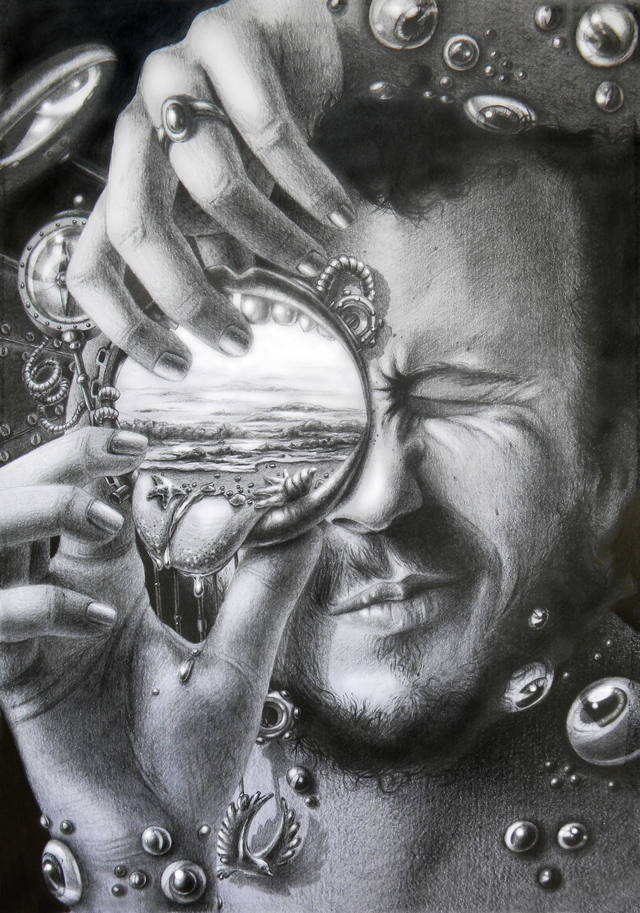


Posted in Uncategorized | Leave a comment

Zach Mory – Glen Ellyn, Illinois

Untitled, graphite on paper, 2012 – ongoing (This drawing is comprised of multiple cutout drawings which are hung at varying distances off the wall. This is an ongoing project.)

Untitled, graphite on paper, 2012 – ongoing (This drawing is comprised of multiple cutout drawings which are hung at varying distances off the wall. This is an ongoing project.)

Briefly describe the work that you do.

My practice revolves around drawing. Because I draw in a particular way (borderline obsessive mark-making) this seems to align me with minimalism, though I’m not huge on labels. Basically, I am interested in systems, labor, mark making, process and drawing. Though to be fair, I have another body of work that is more illustrative in nature with nods to underground comics, psychedelic art, outsider art, medieval manuscripts, and post-modern myth making. They are drawings to be sure, but the come from a completely different place.

At what point in your life did you decide to become an artist?

Honestly, I think I always wanted to be an artist. I don’t think there was ever a time that I didn’t consider myself one, though not always a good one. Making things was very natural for me. I suppose it was sometime around 16 or 17 that I realized I wanted to pursue art more seriously though. That’s when I applied the actual label “artist” to myself, deserved or not.

Tell us a little about your background and how that influences you as an artist.

While growing up, I always loved building things with my Construx and copying my favorite comic book characters and baseball card profiles. My uncle owned a comic book distribution company in Madison, WI and he would inundate my siblings and me with all sorts of strange and fantastic comics…mainstream stuff as well as graphic novels that kids of 10 or 11 probably shouldn’t have been reading. I devoured them and tried my hardest to recreate them. My older brother is a cinema fanatic and I spent a lot of times watching great films that he would dig out of the crevices. Movies and comics played a huge role in my love of all things visual. When I went to college, I went in as an art major and spent a lot of time taking life-drawing classes. I think I took eight semesters worth in total as an undergrad. I learned a lot from a technical perspective, especially from Bob Schultz, who is absolutely amazing when it comes to life drawing. Slowly my interest veered away from life drawing into non-objectivity as I began taking classes at UW- Madison, but the technical chops and work ethic stayed and defined the trajectory of my future work. 

9 of 25 Circles and Diamonds, graphite on paper, 2012 – ongoing

9 of 25 Circles and Diamonds, graphite on paper, 2012 – ongoing

What types of conceptual concerns are present in your work? How do those relate to the specific process(es) or media you use?

When you boil it down, my work is about process. To me, process is the melding of media, time, and labor. I love graphite and am comfortable with it, so naturally it has become my medium of choice. The nature of creating works with graphite, specifically creating works with a pencil (as opposed to powdered graphite or charcoal where you can cover large areas more quickly) requires a substantial amount of labor. For some reason, probably due to stubbornness, I never “grew out” of using pencils or markers into a more “mature” medium like paint (which I have zero interest in as far as a personal medium goes). Ironically, this strong familiarity with graphite has opened the door to new conceptual possibilities for me. It might seem that the opposite would be true, that in order to be expansive the artist should explore numerous options. Personally, I’ve found that the more I understand graphite, the more I’m willing to play around with it and the more I can strip away visual excess and get straight to the point.

There is also a Sisyphean quality to my drawings, which is due in large part to my choice of medium as well. I have to additively build up the surface with tiny little marks for hours upon hours. These “technical limitations” and the slowness of working this way builds the framework for larger conceptual questions, such as finding meaning and beauty in one’s tasks, as redundant as they might be and, most importantly, the idea of labor. 

Labor has all sorts of connotations in today’s society. It is easily romanticized, like the proletarian hero of socialist and communist struggles. Labor is seen as folksy and anti-intellectual. It’s become part of the myth of the self-reliant capitalist American pulling themselves up by their proverbial bootstraps. Yet it is also seen as something the “lower class” is relegated to when you aren’t smart enough, rich enough, or lucky enough to part of the relaxed, upper echelon of society. Labor is also a metaphor for the current digital age. It is the antithesis of speed and ease, something you have to earn with your hands and time.

For me, labor is the main theme running through all of my work. It is also one of the main reasons why I try to avoid literal image making in my work. I want the work to be specifically about time spent in a particular creative state. By stripping away all of the bells and whistles, I can put the focus on the beauty of the medium, the handmade, the system, and the subtle nuances which are created when the system plays itself out on the paper.

Arrow, graphite on paper, 2013

Arrow, graphite on paper, 2013

We once heard Chuck Close say he did not believe in being inspired, rather in working hard everyday. What motivates you in your studio practice?

I love the act of looking. I also love to see what my ideas will look like when they are fully executed. This frenzied desire to see the end result is a huge motivating force for me. It’s strange to have a practice that revolves around process, yet I rush to speed up the process up so I can be done with it, enjoy the finished work, and move on. 

As far as being inspired goes, working and completing works is more of an “inspiration” to me than simply feeling inspired. Inspiration is kind of a terrible and over-simplistic Hallmark sentiment. Sure, sometimes I don’t feel like working for a variety of reasons, but the idea of only working when inspired would be fickle and mercurial. If we only worked when we were inspired, nothing would ever get done. Inspiration part of the false mystique of the clichéd artist who is nothing more than a slave to his or her emotional whims. I believe that setting aside time every day is what keeps me focused and productive as an artist.

When you are not making art what types of activities and interests do you engage in? 

My wife and I just had our first daughter Josephine, so we spend a lot of time hanging out with her. She has quickly become the focus of our lives and its just amazing to watch her grow. Aside from that I’m a huge soccer, tennis, and basketball player and love to play all three sports as much as I can. Growing up I probably spent more time practicing sports than making art and the jock in me has never left. I was an assistant high school soccer coach for twelve years (I started coaching when I was still in high school) and that was a really great experience.

Sports aside, I have a huge music collection of indie rock and experimental music, so more often than not you can find me with my headphones on getting lost in something or other. As far as work goes, I went back to school a few years back for graphic design degree and currently do website and other design work. I’ve also been an adjunct instructor since finishing graduate school in ’08 at pretty much any institution that has let me in their doors in Wisconsin and Illinois.

About 

ProfileZach Mory hails from the small town of Cottage Grove, WI, a few miles southeast of Madison, WI. Initially trained as a life drawer, his work slowly turned towards the abstract and non-objective possibilities of art-making as his undergraduate schooling continued at the University of Wisconsin-Madison. 

In the spring of 2008, he received his MFA from UW-Madison with a concentration in drawing. Since his graduation he has taught various courses throughout Wisconsin and Illinois including UW-Madison, Carthage College, Lawrence University, Ripon College and most recently at Waubonsee Community College and the College of DuPage in their graphic design program.

In the Studio

In the Studio

www.zachmory.com

All images copyright of the artist and used with their permission. 
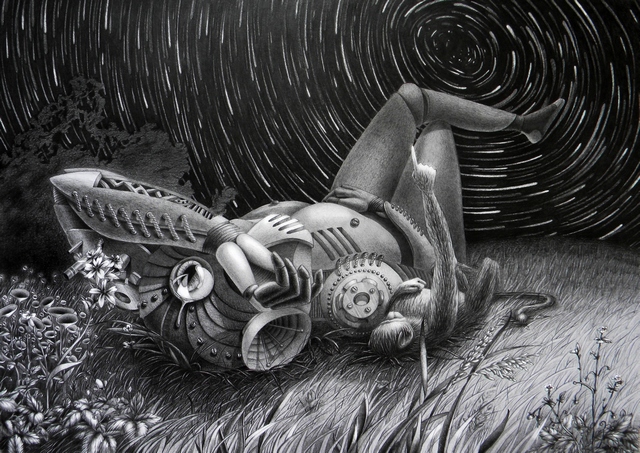
Posted in Uncategorized | Tagged , , | 1 Comment

Cory Imig – Kansas City, Missouri

"Failing Structure"; 2012; artist tape and balloon; 120" x 360" x 20"

“Failing Structure”; 2012; artist tape and balloon; 120″ x 360″ x 20″

Briefly describe the work you do.

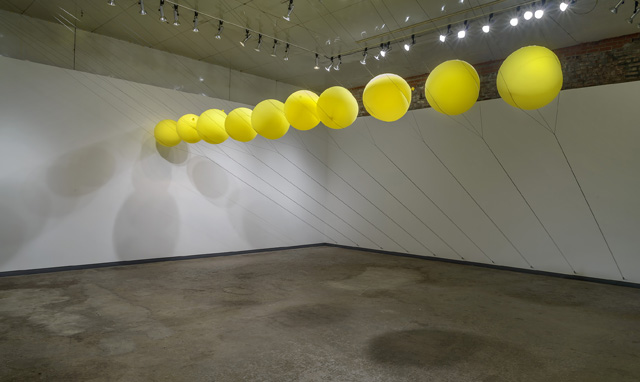
Much of my current work is primarily sculpture and installation based. The work is usually an attempt to document time and objects that change over time. The way I have been exploring these ideas is by experimenting with balloons as a documentation of time. Since balloons are not airtight, they immediately start the deflation process once they are inflated. In the installations the balloons are used as structural elements that the entire work relies on. Over time as the balloons deflate, the structural integrity of the sculptures and installations begin to fall apart, in some cases that could literally mean falling off the wall or tumbling to the ground.

Tell us a little about your background and how that influences you as an artist.

I was raised in a family of math and science practitioners; my mother is a dietitian, my father a neurophysiologist, and my brother is a statistician.  I was raised to think about things in a very logical and rational way.  I have also always been a collector.  I enjoy the process of cataloging, sorting and documenting objects.  At times this “obsession” comes through mapping my own life: keeping detailed notes of things like where I go everyday, how I spend my time, and everything I google. I work better from a plan than from intuition. I would say my work is greatly influenced by the way scientists ask questions and search for answers but what Im seeking isn’t necessarily a scientific based answer.

The concept of the “artist studio” has a broad range of meanings, especially in contemporary practice. The idea of the artist toiling away alone in a room may not necessarily reflect what many artists do from day to day anymore. Describe your studio practice and how it differs from (or is the same as) traditional notions of “being in the studio.”

I share a studio in downtown Kansas City with an amazing artist and one of my best friends, Garry Noland.   I use the space in my studio to experiment with materials and try out different possible installations.  Often times my work begins outside the studio.  It is inspired by a situation or encounter as I am going about my day.   I bring a lot of things into the studio to play with and expand upon.  Some of my most productive time is spent outside rather than inside.

"Slow Release"; 2014; balloons, parachute cord, hardware; dimensions variable

“Slow Release”; 2014; balloons, parachute cord, hardware; dimensions variable

What unique roles do you see yourself as the artist playing that you may not have envisioned yourself in when you first started making art?

As well as making art, I also co-direct and co-curate a space in Kansas City called PLUG Projects.  Myself and four other Kansas City artists founded PLUG Projects in 2011.  We all share the mission of bringing fresh perspectives and conversation to the local Kansas City art community. Our goal is to energize artists and the larger Kansas City community by exhibiting challenging new work, initiating critical dialogue, and expanding connections of artists in Kansas City as part of a wider, national network of artists.  We host several event series, publish a biannual publication, and exhibition artists from all over the country.   I have always had an interest in other artists work but I never thought I would be as invested in curating as I am today.

"Progressive Collapse"; 2013; mason line, balloons, drywall, nails; 144" x 120" x 40"

“Progressive Collapse”; 2013; mason line, balloons, drywall, nails; 144″ x 120″ x 40″

When do you find is the best time of day to make art? Do you have time set aside every day, every week or do you just work whenever you can? 

I am the most productive in the morning. One of my good friends has started what I refer to as the “Michelle Grabner routine.” She goes to studio at 4:30am before she starts her regular workday. It’s a great way to ensure that you get the studio time that you need. I hate to admit it but 4:30am is a goal I’m still working on.

How has your work changed in the last five years? How is it the same?

Visually, my work has changed greatly in the past five years. It has grown in scale and the materials have changed, but I find that the ideas driving the work are still the same.

Are there people such as family, friends, writers, philosophers or even pop icons that have had an impact on the work you do?

It is hard to pinpoint what exactly has had the most impact on my work. One thing that is has helped immensely is being part of a supportive community made up of friends, artists, critics and curators that are more than happy to donate their time and provide feedback. These are the people I constantly look to for conversations about work. I have found that Kansas City is a very healthy and productive place to be an artist.

If you had an occupation outside of being an artist, what would that be and why?

I would be an urban farmer. The past few years I have been helping my partner start his business, which is based around local and organic food, and I realized there is a big part of me that loves growing food. I like to nurture the plants, check on them daily, pull the weeds and foster the development of the plants. And of course, the best part, harvesting the produce.

Imig_headshotAbout 

Cory Imig is an interdisciplinary artist, curator, and educator currently working in Kansas City, Missouri. She received her BFA from Savannah College of Art and Design in 2008, where she studied fibers and sculpture.  Imig has attended residencies at Virginia Commonwealth University, The Vermont Studio Center, ACRE and the Charlotte Street Foundation Urban Culture Project Studio Residency. In 2012, she was a fellow in the Oklahoma Art Writing and Curatorial Fellowship Program. She has participated in numerous shows in the Kansas City area in spaces such as Charlotte Street Foundation Project Space, La Esquina, City Arts Project, and the Kansas City Library.  Imig along with four others was awarded a Rocket Grant from the Andy Warhol Foundation for Visual Arts in 2011, to start a curatorial collaborative in the West Bottoms called Plug Projects.

www.coryimig.com

Studio

Studio

All images copyright of the artist and used with their permission. 
Posted in Uncategorized | Tagged , , , , | Leave a comment

Laura Fischman – Boston, Massachusetts

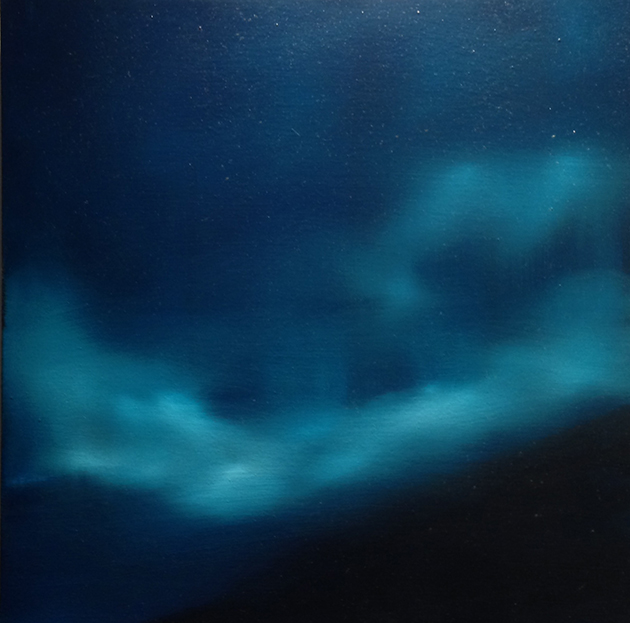
"Weather(Glow)" 2014 Oil on canvas 16x16"

“Weather(Glow)”
2014
Oil on canvas
16×16″

Briefly describe the work you do.

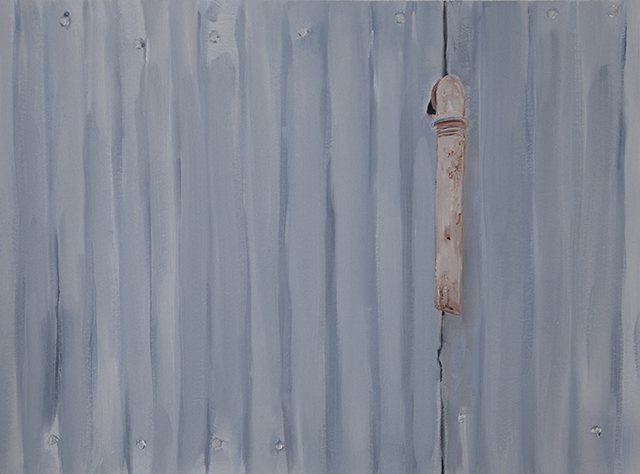
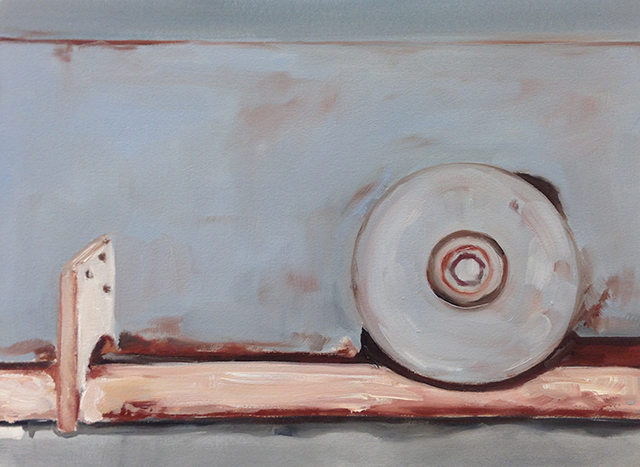
I draw and I paint with a number of different mediums, but at heart I am an oil painter. I love the smell, the viscosity, the colors, and the whole process of oil painting – it challenges my patience and allows for impulsiveness at the same time. In terms of subject matter I tend to have a varied practice, trying to utilize the appropriate visual metaphor and painting style for that which I seek to convey. My style evolves with the subject that I am painting, though I do tend to work in series, trying to fully consider ideas through repetition and investigating different vantage points. Topics that I continually explore include, meditative, atmospheric landscapes, the human body as landscape, and the banal and imperfect topographies of everyday life. In my practice I honor overlooked spaces and moments by exploring the humanity embedded within their flaws, and the ruin resulting from the passage of time, attempting to create a moment of pause, of contemplation and even of confusion.  Most recently, I have been painting quite a few gutters, pipes and downspouts; though commonplace, they seem so human, bodily and abject.

Tell us a little about your background and how that influences you as an artist.

I came to art after a career in marketing/public relations in the Internet start up world. I started taking night classes at the School of the Museum of Fine Arts, Boston (SMFA) and couldn’t believe how much I loved drawing and painting. I ended up getting totally hooked on the constant challenge of art making and the opportunity it affords for searching for and expressing the authentic. Ultimately, I left my previous career and pursued an MFA from Tufts University/SMFA. I was a history major in college and have always been interested in looking back and discovering patterns. Art is an amazing lens for this type of inquiry.

The concept of the “artist studio” has a broad range of meanings, especially in contemporary practice. The idea of the artist toiling away alone in a room may not necessarily reflect what many artists do from day to day anymore. Describe your studio practice and how it differs from (or is the same as) traditional notions of “being in the studio.”

It is interesting to think about the contemporary “studio.” My own practice seems to land somewhere between a traditional studio practice and a more expansive, less traditional idea of the studio. Although I paint in my studio just about every day, what I paint is very much inspired by what I see and photograph (almost never in my studio), what I read and think about, and conversations that I have with colleagues, friends, and even strangers. Though the painting happens in the studio much of the thinking, inspiration and struggle that happens outside of it drives my studio practice. I like having a quiet place to think and to paint, but I also value the questioning, conversation and company of trusted colleagues and friends.

"In the End, It's Just You" 2014 Oil on paper 11x15"

“In the End, It’s Just You”
2014
Oil on paper
11×15″

What unique roles do you see yourself as the artist playing that you may not have envisioned yourself in when you first started making art?

I guess the first one that comes to mind is “witness;” someone who really pays attention and looks closely and questions; as well as someone who is willing to fail publicly. I never thought about this aspect of art making prior to really diving into art, but to make art that has meaning and resonates, I have found that I have to put a lot of myself into it and this can be very scary at times.

When do you find is the best time of day to make art? Do you have time set aside every day, every week or do you just work whenever you can? 

In graduate school I liked to work early in the morning, before others arrived and before life got loud and busy. Now, I find that I paint at all different times, still early in the morning, but often late at night when I return from teaching. Teaching painting always makes me want to paint. One of the great joys of being an artist is that you are never bored – but it also means little free time, because all of that time that used to be “free” is now spent in the studio.

"Untitled (Waste Removal)" 2014 Oil on paper 11x15"

“Untitled (Waste Removal)”
2014
Oil on paper
11×15″

How has your work changed in the last five years? How is it the same?

When I look at earlier work I am always surprised by the continuity of my ideas. I often think that I am doing something totally new and different, but then I look through the entirety of work and there are real consistencies in subject matter; ideas like human connection, the temporal, memory, and the banal. What have changed over time are my technical ability and my willingness to take risks – two areas that I think I will always struggle to improve. I think that this is a matter of time served. There is so much more to learn!

Are there people such as family, friends, writers, philosophers or even pop icons that have had an impact on the work you do?

Absolutely. Colleagues, friends and family are essential to my practice – they are my reality check, my honest critics and my supporters. Philosophy and literature have had, and continue to have, a huge impact on me – from Plato, to Hegel and Kant, to critical theory and fiction – like Ralph Ellison’s Invisible Man. Artists I can’t stop looking at include Antonio Lopez Garcia, Turner, Richter, Giacometti, Adrian Ghenie, Chris Marker, and so many more! When I am not listening to NPR or audiobooks, I tend to listen to the The Smiths and Neil Young over and over again in the studio.

If you had an occupation outside of being an artist, what would that be and why?

I love teaching, so certainly I could imagine that. Otherwise, perhaps I would open a gallery – there is so much artwork that would be great to show; or maybe have a flower shop. I would like to say that I would be a writer, but I wouldn’t be a very good one.

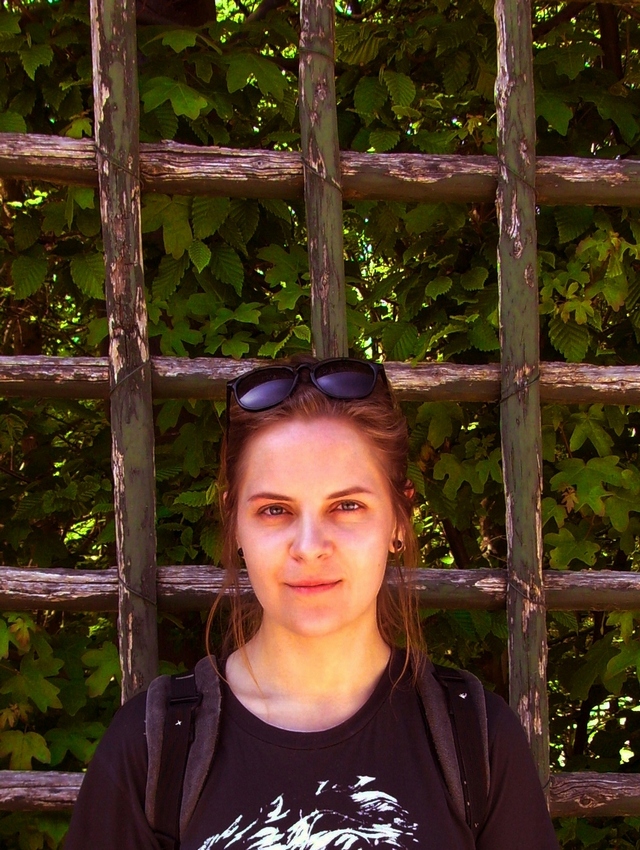
FISCHMAN HEAD SHOTAbout

A Boston-based painter, Laura Fischman’s work was recently featured in New American Paintings, MFA Annual, issue #111. She has shown her work in the Courtyard Gallery at the Museum of Fine Arts, Boston through the Students-Curate-Students exhibit, at the Attleboro Museum of Art, at the 808 Gallery at Boston University, at Gallery 263, at the Nave Gallery, Fourth Wall Project, and at Gallery Benoit in Boston, among others. Fischman has had solo exhibitions at the McGladrey Art Gallery at Bentley University and the Elizabeth A. Beland Gallery at the Essex Art Center.  A 2013 graduate of the SMFA/Tufts University MFA program, Fischman received a Boit Award from the SMFA in 2012. She just completed a month-long residency at the Vermont Studio Center and teaches painting classes at the School of the Museum of Fine Arts, Boston where she is visiting part-time faculty. Fischman’s work can be viewed at http://www.laurafischman.com.

www.laurafischman.com

Studio

Studio

All images copyright of the artist and used with their permission. 
Posted in Uncategorized | Tagged , , , , | Leave a comment

Chelsea Voss – Pensacola, Florida

"Memory." (Phase 1 of 8) Multiple layers of laser-cut paper. Phase 1 is 4" x 5." Entire framed series is 48" x 9." 2013.

“Memory.” (Phase 1 of 8) Multiple layers of laser-cut paper. Phase 1 is 4″ x 5.” Entire framed series is 48″ x 9.” 2013.

Briefly describe the work you do.

What stands out in my work is the juxtaposition of geometric and organic structures—namely, spider webs. I use the webs as a visual and conceptual metaphor for the evanescent, fractaled structure of neurons within the brain. I am interested both in neurology and psychology, as well as the theoretical, psychoanalytical works of Carl Jung. My work explores the physical makeup of the brain and the intangible, speculative nature of consciousness. My practice exists in the intersection of these two approaches to understanding the human mind.

Tell us a little about your background and how that influences you as an artist.

For as long as I can remember, I have had vivid dreams that I remember every night. As a kid, I’d write them down; when I grew older, I began to analyze my dreams and study psychology. About seven years ago my father developed dementia; his mental state has been devolving ever since. Understanding the brain became a deeply personal endeavor. Through my art I explore the complexities and mysteries of both the brain and the subconscious.

"Orbs." Glass orbs, monofilament, European Garden Spiders, webs. Size variable. Located in Kesselfall, outside of Graz, Austria. 2013.

“Orbs.” Glass orbs, monofilament, European Garden Spiders, webs. Size variable. Located in Kesselfall, outside of Graz, Austria. 2013.

The concept of the “artist studio” has a broad range of meanings, especially in contemporary practice. The idea of the artist toiling away alone in a room may not necessarily reflect what many artists do from day to day anymore. Describe your studio practice and how it differs from (or is the same as) traditional notions of “being in the studio.”

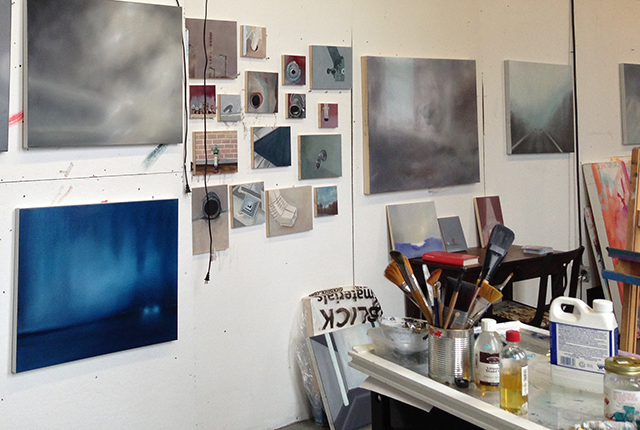
Much of my process is reading, dreaming, reflection, research, and hiking, which I do as often as possible. Only after an idea has been incubated to maturity will I create. Even then, I often find myself outside of the studio either in search of spiders or enacting the performative nature of my art.

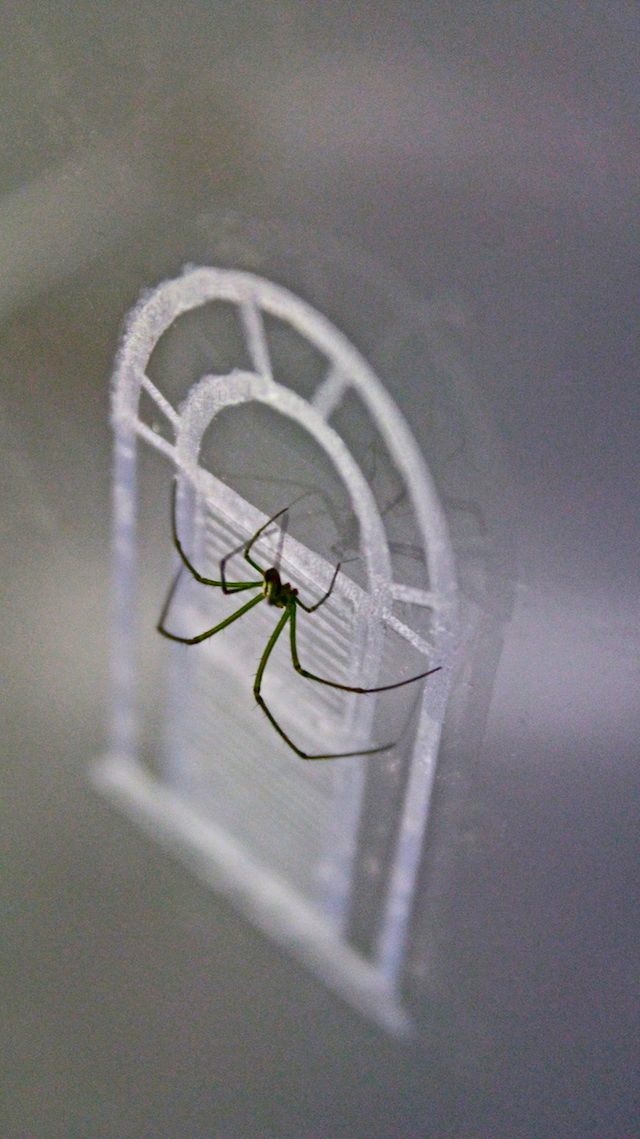
For Mason House, the act of trying to enter the actual building of which the sculpture was based upon was as much a part of the art as the sculpture itself. Mason House came about from a dream I had of a building. Keeping in mind Carl Jung’s emphasis on symbols within dreams, a house is a representation of the self. Weeks later when I saw the building in downtown Gainesville, I knew I had to enter. It ended up being owned by Free Masons, who would not let me inside. So, I created a glass model of the house and let spiders live in it, making it my own and symbolically entering it myself. For added catharsis, I brought spiders to the downtown house and slipped them through cracks in windows and in keyholes. At that point, I felt the project was complete. The studio practice was only a part of Mason House.

"Mason House." Laser-cut plexiglass, Venusta Orchard Spider, webs. 17" x 13" x 17." 2013.

“Mason House.” Laser-cut plexiglass, Venusta Orchard Spider, webs. 17″ x 13″ x 17.” 2013.

What unique roles do you see yourself as the artist playing that you may not have envisioned yourself in when you first started making art?

My art forces viewers to acknowledge the role their subconscious plays in the makeup of who they are. For this reason, I see myself as a psychoanalyst.

My work that deals with the breakdown of memory and sense of self that accompanies dementia is deeply emotional. It offers not only insight to my own heartbreak, but commiseration to those who experience it was well. In this sense, I am a therapist.

When do you find is the best time of day to make art? Do you have time set aside every day, every week or do you just work whenever you can?

I make art at any time of day I can, which lately has been in the evenings because of work at the museum. Though, the best time to catch spiders is in the morning before the Florida heat drives them out of their webs and into shade.

How has your work changed in the last five years? How is it the same?

Five years ago, I saw myself as a painter. The notion of being a sculptor had never crossed my mind. Throughout the past five years, I have been surrounded by phenomenal artists who have pushed my boundaries and made me grow, both as an artist and a person. I am forever grateful to my professors, especially Celeste Roberge, who never let me settle and always inspired me to explore and research entirely new ways of thinking, making, and being. In comparison, my older work is unrecognizable. It is important for me to be in a constant state of flux.

"Mason House." (detail) Laser-cut plexiglass, Venusta Orchard Spider, webs. 17" x 13" x 17." 2013.

“Mason House.” (detail) Laser-cut plexiglass, Venusta Orchard Spider, webs. 17″ x 13″ x 17.” 2013.

Are there people such as family, friends, writers, philosophers or even pop icons that have had an impact on the work you do?

I cannot read enough of Carl Jung’s literature. He is best known for being the father of Analytical Psychology, which places emphasis on dreams and the subconscious. What some do not know about him, however, is his prowess as both a poet and an artist. His symbolic paintings in The Red Book and his prose on Bollingen Tower continue to inspire me. His work has a direct impact on my art.

If you had an occupation outside of being an artist, what would that be and why?

If not a psychologist or neuroscientist (for obvious reasons), then I would like to be an astronomer. The universe is full of such amazing beauty and mystery; to spend a lifetime learning about something so much greater than oneself would be endlessly fulfilling.

ChelseaVoss_headshot_365About 

I grew up in Pensacola, Florida and graduated High Honors from the University of Florida, where I received a BFA in Sculpture. During the summer of 2012 I studied Film and Photography studios in contemporary art capitol Berlin, Germany, which offered life-changing inspiration. My art has been shown throughout Florida, most notably in Gainesville and Hollywood. I have been nominated for the Windgate Fellowship Award and won numerous artistic merit-based scholarships during my time at UF.

After graduation, I pursued artistic endeavors in forests outside of Graz, Austria, and later worked in Barcelona, Spain. Currently I am employed by the Pensacola Museum of Art and continue working as an artist.

http://chelsealanevoss.carbonmade.com/

All images copyright of the artist and used with their permission. 

Posted in Uncategorized | Tagged , , , , | Leave a comment