Tony Conrad – Appleton, Wisconsin

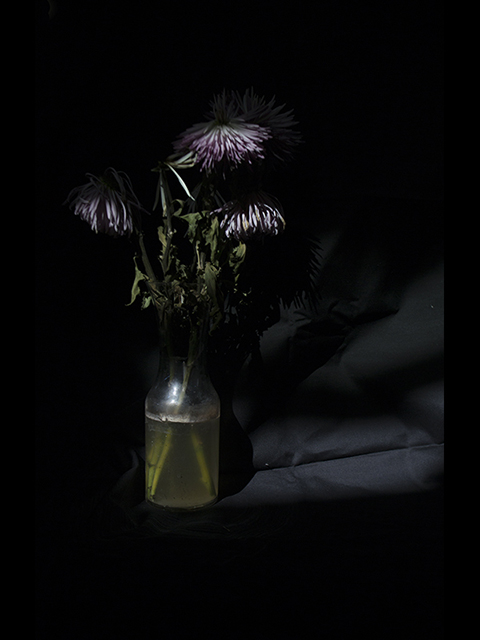
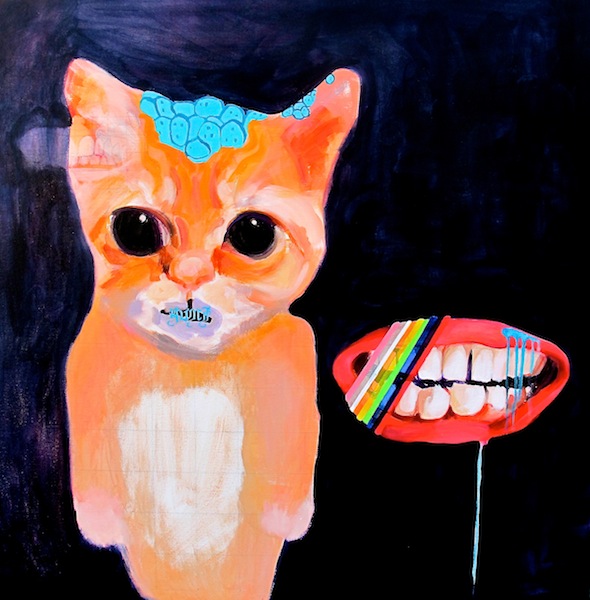
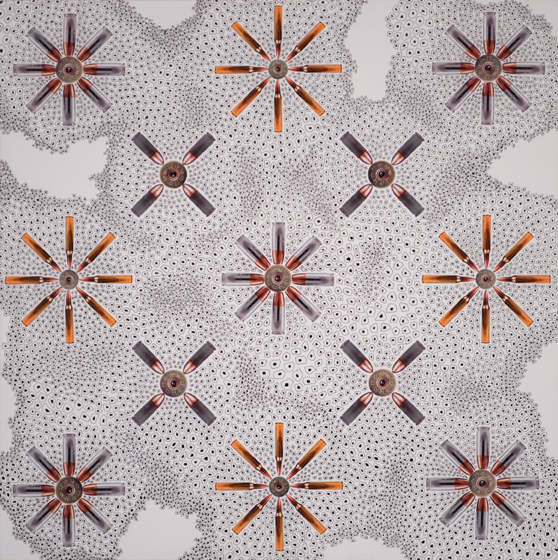
Kancer, ink and collage on panel, 20 x 20 inches, 2014

Kancer, ink and collage on panel, 20 x 20 inches, 2014

Briefly describe the work you do.

I am mainly a painter who dabbles in collage and drawing. The focus of my work in years past has explored stereotypes and oddities surrounding the ‘outdoorsman’ culture. A lot of my work deals with these stereotypes through a complex set of systems including silhouettes, collaged photos of ammunition casings, vibrant, pulsating, and disorienting color combinations, along with decorative patterns inspired by various traditional textiles produced around the world. Recently, I have been moving away from the silhouette as a central figure in the paintings and have begun playing around with pattern and mark making to express the ideas of expansive space and meditational states of mind.

Tell us a little about your background and how that influences you as an artist.

I grew up in a small rural town in Northern Wisconsin. I never felt like I related with the people and activities there. I guess I was always drawn to counter culture stuff like skateboarding, punk rock, and art. I gravitated toward doing things that gave me a rush of adrenaline. I remember as a young boy exploring the dark and mysterious places on my Aunt and Uncles dairy farm – it was such a great feeling to get lost in such a foreign space. I think the getting lost and rebellious nature of my past interests are a reflection of the dysfunction I was experiencing at home with divorced parents and the alienation I felt from my peers.

The concept of the “artist studio” has a broad range of meanings, especially in contemporary practice. The idea of the artist toiling away alone in a room may not necessarily reflect what many artists do from day to day anymore. Describe your studio practice and how it differs from (or is the same as) traditional notions of “being in the studio.”

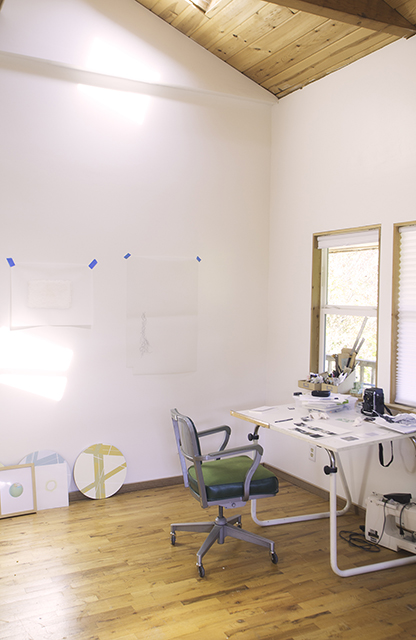
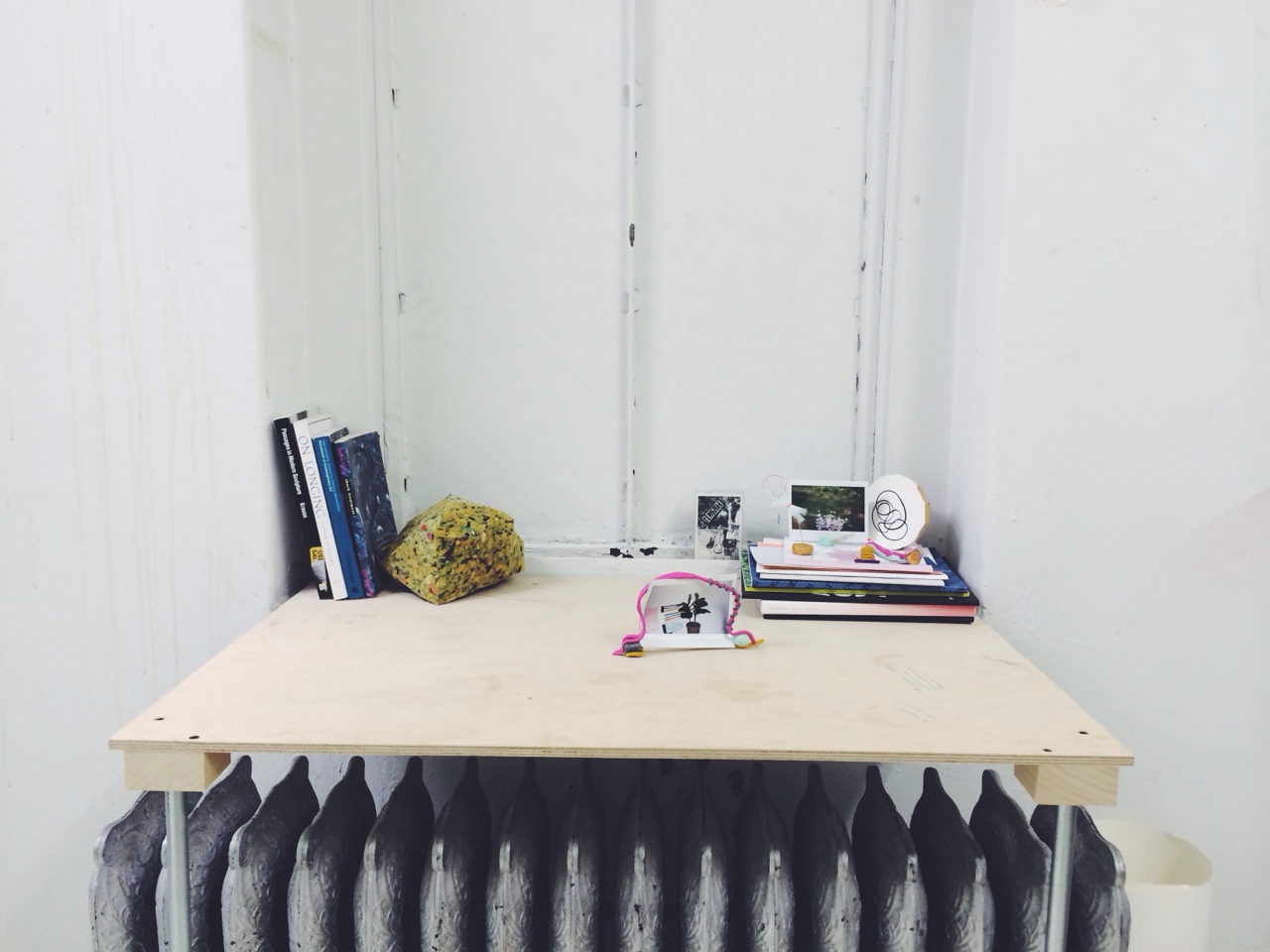
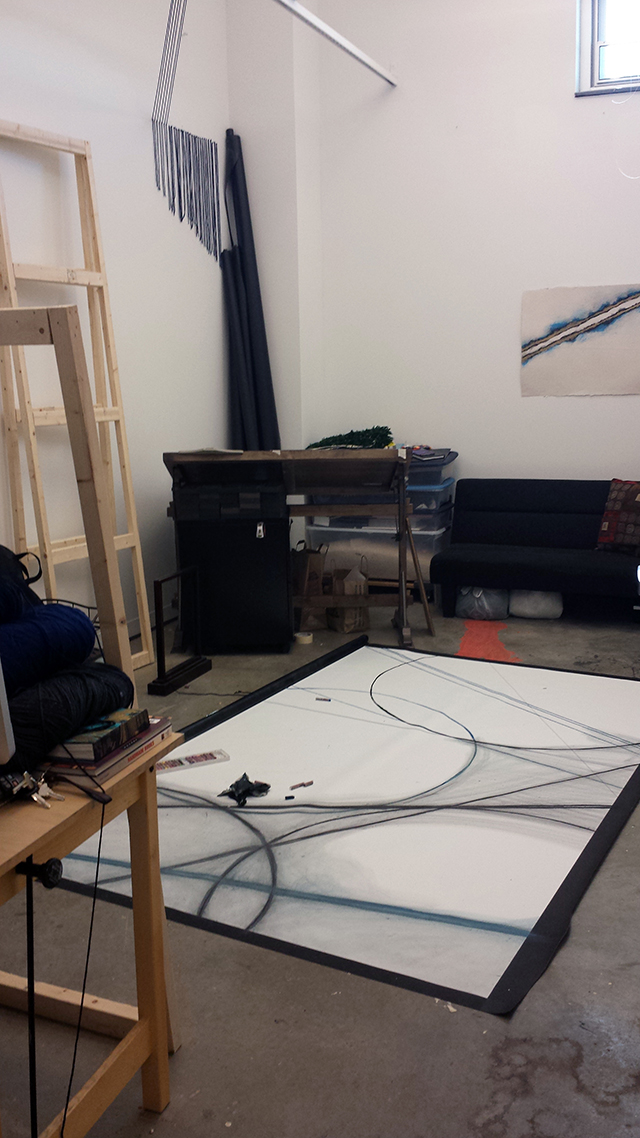
My studio practice is more a traditional one I guess. I have white plywood walls that I hang paintings and drawings on as I work. Additionally, I have tables that I move around the space to accommodate my needs depending on what I’m doing. I generally like to paint on vertical walls but prefer the tables for laying out collages or doing certain types of drawing. On the days that I’m not teaching at the University, I will get started right away in the morning once the kids are at school. I typically mess around with e-mails and computer stuff while I get the coffee going. Then I will get to work – first taking in what was most recently done. Some days are easier than others to get going. Usually when I’m really excited about a painting I was working on the day before, it seems like I can’t get in there quickly enough. It’s important for me to be comfortable. I have a couch that I sit on and read books or look at stuff for inspiration.
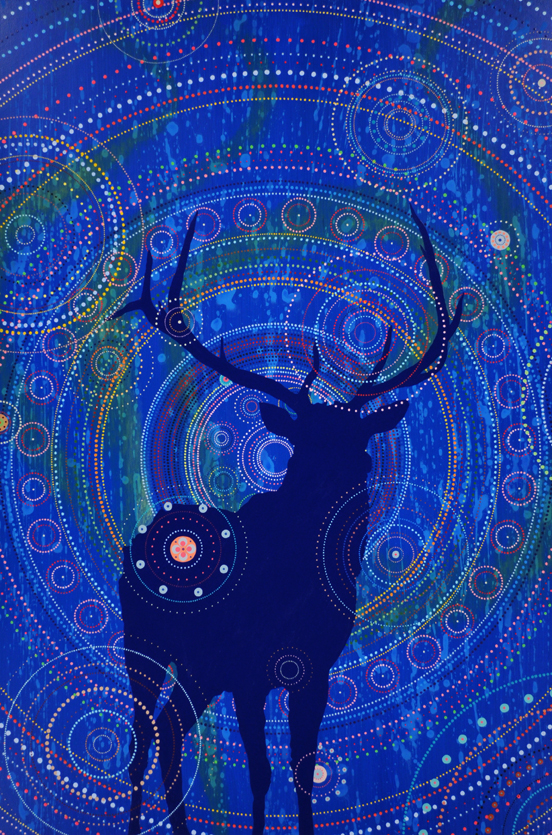
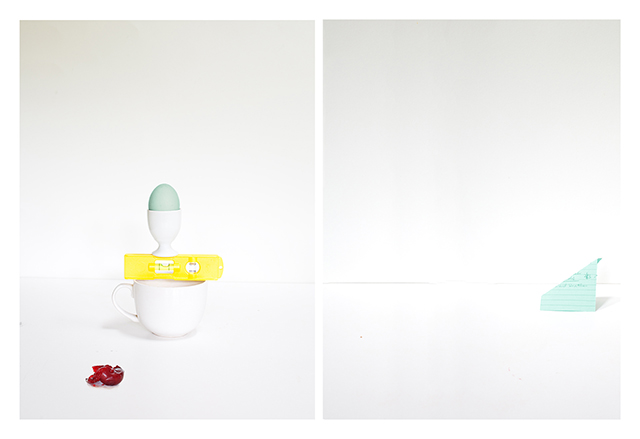
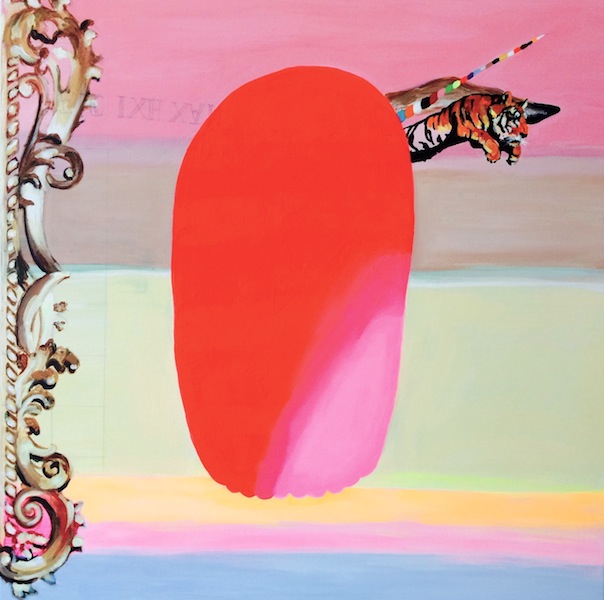
I Have Found Peace, acrylic on panel, 48 x 32 inches, 2013

I Have Found Peace, acrylic on panel, 48 x 32 inches, 2013

What unique roles do you see yourself as the artist playing that you may not have envisioned yourself in when you first started making art?

I never really wanted to be didactic with my work and never really thought I would be attempting to create a social awareness for the people around me. My early years as a painter were really more personal and involved a world that was not necessarily so relevant for others. I guess it’s really humbling to hear someone tell me that my work is inspirational in some way or another. Being in that position where other artists are really engaged with what you’re doing and are willing to support it – that I guess is something I never really expected.

When do you find is the best time of day to make art? Do you have time set aside every day, every week or do you just work whenever you can? 

I think like most people, I work when I can. Now that both of our kids are in school, I have the opportunity to work during the day, which is what I prefer. I used to have to work late at night all the time and that can take a toll on you after awhile. On the days that I don’t have to be at the University, I just get studio time all day. Very often, I will get back in the studio after dinner and sometimes work into the late hours of the night. I find that I am most productive during the workweek and tend to do more family things during the daytime on the weekends.
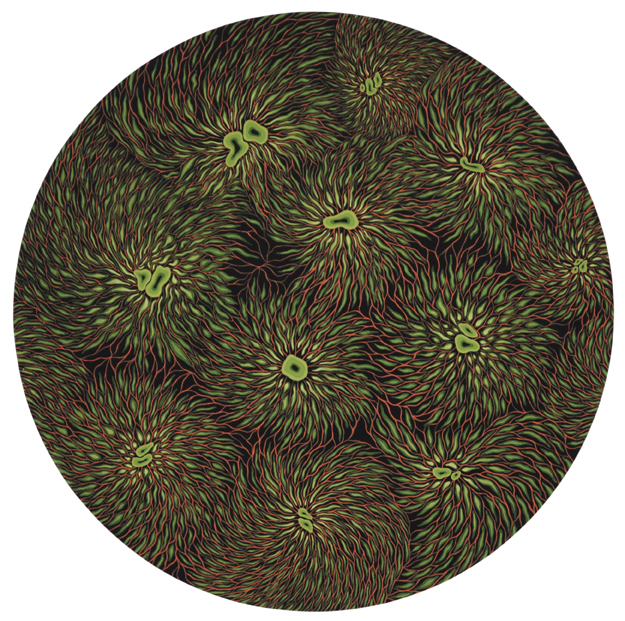
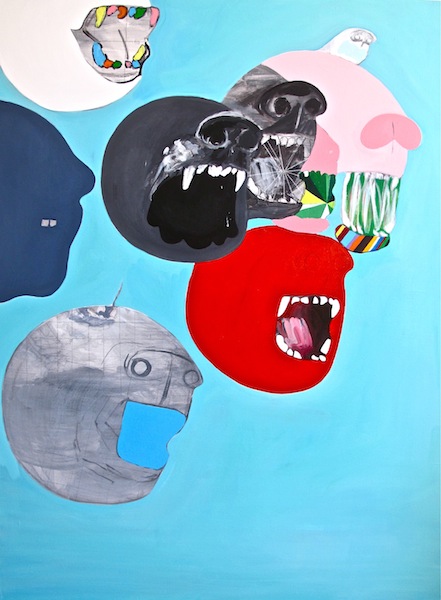
Nervous, acrylic on panel, 17 inches round, 2014

Nervous, acrylic on panel, 17 inches round, 2014

How has your work changed in the last five years? How is it the same?

My paintings five years ago were so different from what I’m doing today. My process used to be much more organic, ‘painterly,’ and free flowing. I used to work on the floor a lot, pooling washes of paint onto the canvases. The work was very abstract and was about the abandoned, post-industrial landscape of Milwaukee’s downtown areas that I was exploring (sometimes illegally).

The work I am doing more recently seems to be the polar opposite. I find myself measuring out the collage elements, arranging them and the other painted elements in a specific organized fashion. The work now gravitates toward balance and symmetry much more than before. I could never say that I didn’t make conscious decisions with placement or color choices in the older work but it definitely was more left up for chance than what I’m doing today. Because of my tendency to create such order with the patterns I am using now, I have to sometimes force myself to ‘let go.’ I am enjoying the unexpected outcomes of this approach and I feel it opens up the work quite a bit. The two different bodies of work may look very different visually but they do still embody my interests in altered states of the mind and exhibit meditative qualities – this all comes back to my escapist tendencies from childhood.

Are there people such as family, friends, writers, philosophers or even pop icons that have had an impact on the work you do?

Of course my family and friends influence the way I create and position the work that I make. Seeing my two children growing up and their unlimited curiosity for how things work inspires me to keep asking questions and digging deeper into my own understanding about the world. My wife Lillie continues to teach me about patience and the virtues that come with it. My younger brother David has taught me so much about deer hunting culture and has given me a more complex perspective on its moral and poetic implications. My friends and colleagues will often times come by the studio to see what’s going on – offering criticism and comments that I take to heart as I work on into the future.

If you had an occupation outside of being an artist, what would that be and why?

I really can’t imagine doing something entirely different. I guess I would be a fly-fishing guide in Colorado or Montana. Being out in the Rock Mountain backcountry is an endless source of inspiration for me. I can’t think of anything more meditative than being deep in the wild backcountry and seeing beautiful native trout. There is something so peaceful and invigorating about hiking through that environment that never gets old to me.

About 
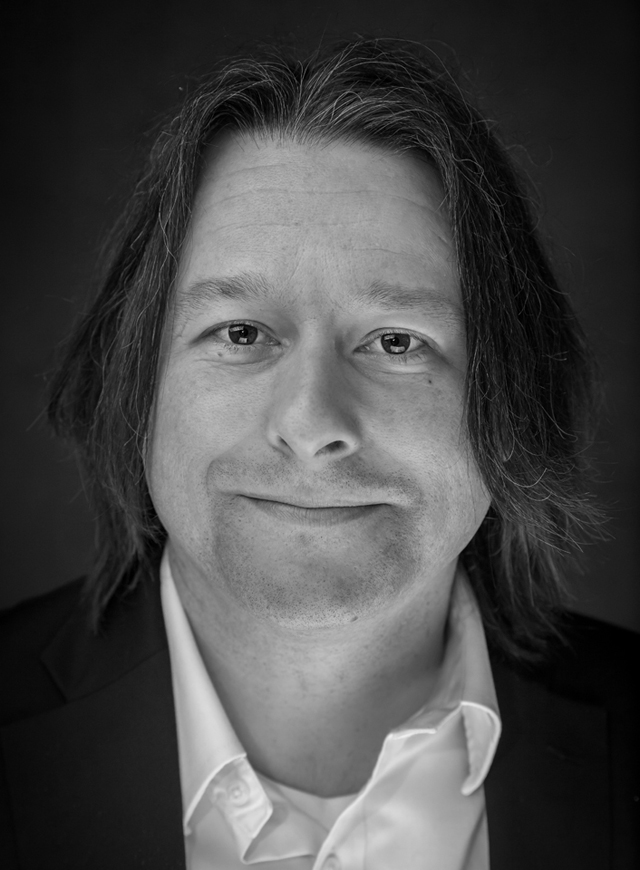
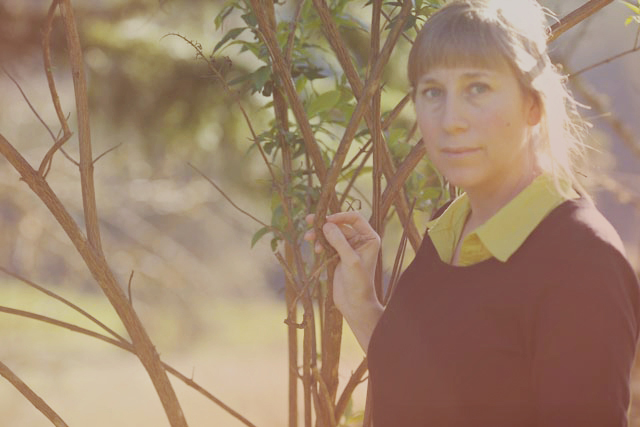
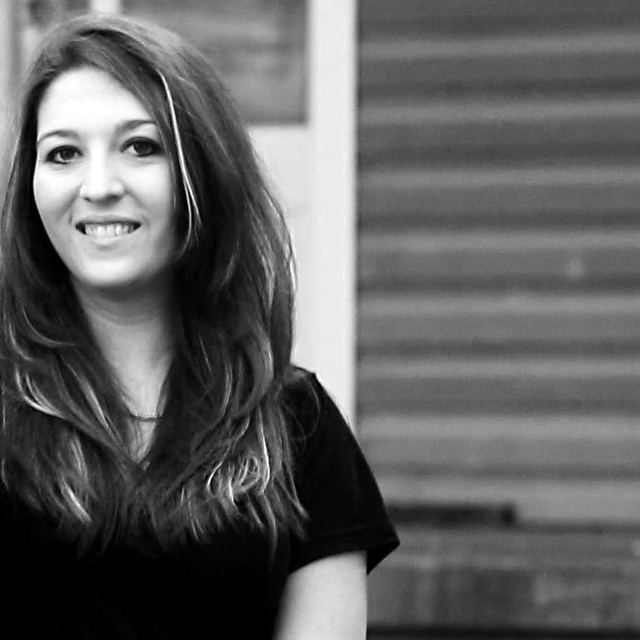
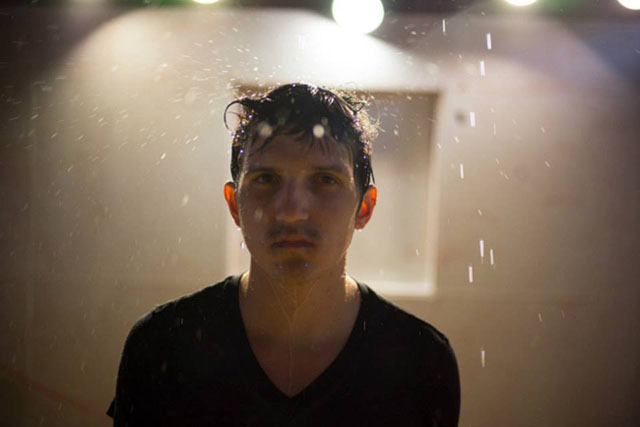
Conrad_PortraitTony Conrad received his MFA degree in painting and drawing from the University of Wisconsin-Milwaukee in 2009.  Currently, Conrad is a Lecturer of Art at Lawrence University in Appleton, Wisconsin.  Conrad’s work has been exhibited nationally in various solo and group exhibitions and has won a number of awards including the Lawrence Rathsack Scholarship and the Frederick R. Layton Fellowship.  Recently, his paintings have been exhibited at the Museum of Wisconsin Art in West Bend, the Frank Juarez Gallery in Sheboygan, WI, as well as the Madison Museum of Contemporary Art in Madison, WI.
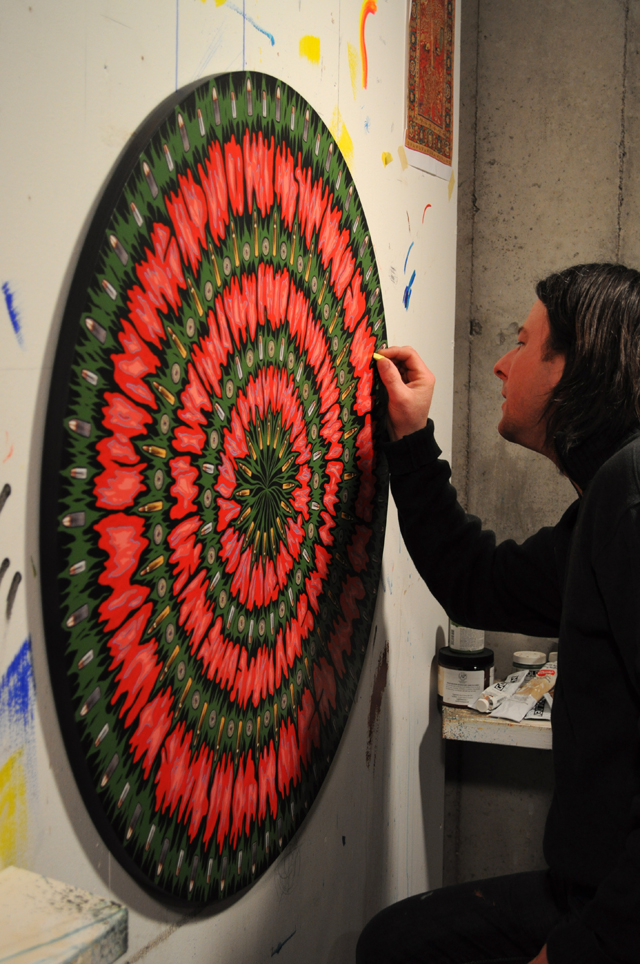
In the Studio

In the Studio

tonyconradart.com

All images copyright of the artist and used with their permission. 
Posted in Uncategorized | Tagged , , , , | 1 Comment

Corey Dunlap – Los Angeles, California

In collaboration with Bradley Tsalyuk, Monolith, C-Print, 2014

In collaboration with Bradley Tsalyuk, Monolith, C-Print, 2014

Briefly describe the work you do.

Working primarily in sculpture, installation and photography, my practice is concerned with the perception of the corporeal and the mechanics behind such material negotiation.  Drawing from the aesthetics and devices of body oriented objects such as furniture, exercise equipment and ergonomics, my work extends the psychological-body through various imagined scenarios. I also work collaboratively with my partner, Bradley Tsalyuk. Our collaborative practice has allowed for larger scale works and a collision of interests.

Tell us a little about your background and how that influences you as an artist.

I grew up in Birmingham Alabama, which is not exactly an artistic Mecca. However, I was able to attend a pretty rigorous art magnet high school for six years, which looking back probably saved me in a lot of ways.

My mother died when I was nine years old. While attending the open casket funeral, I was able to internalized her bodily presence and absence in tandem. This incident of multi-stable awareness fundamentally structured my relationship to the material world and spurred an ongoing obsession with psychological and corporeal perception. My artistic practice has been greatly informed by this cognitive shift and naturally has gravitated towards sculpture and material studies.

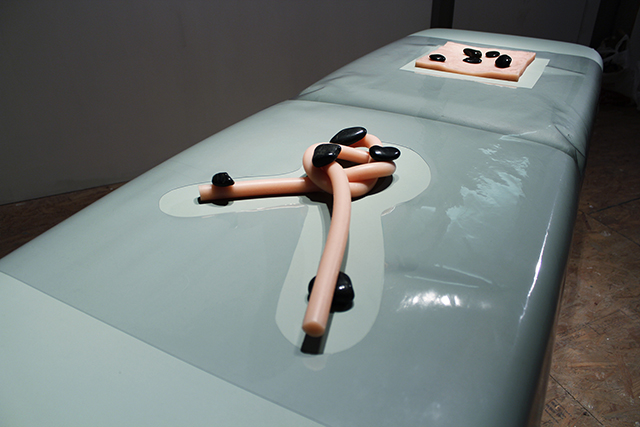
The Hot Stones Are Never Rough, massage table, silicon, stones, plastic, 4' x 6' x 2', 2013

The Hot Stones Are Never Rough, massage table, silicon, stones, plastic, 4′ x 6′ x 2′, 2013

The concept of the “artist studio” has a broad range of meanings, especially in contemporary practice. The idea of the artist toiling away alone in a room may not necessarily reflect what many artists do from day to day anymore. Describe your studio practice and how it differs from (or is the same as) traditional notions of “being in the studio.”

For the past year and a half I have shared my studio space with my partner and collaborator in our home. This method is both convenient and cost efficient. When we are feeling claustrophobic and insular we will plan a larger project outdoors or put together an open studio event.

 I thrive in the studio. It is where the action happens. I certainly conduct research outside of the studio and will sometimes put together a traveling photo series, but in the traditional sense, I rely on the studio as my universe. Many artists (photographers in particular) have been returning to the studio in recent years and there seems to be a lot of conversation around the validating of this return. This interests me.

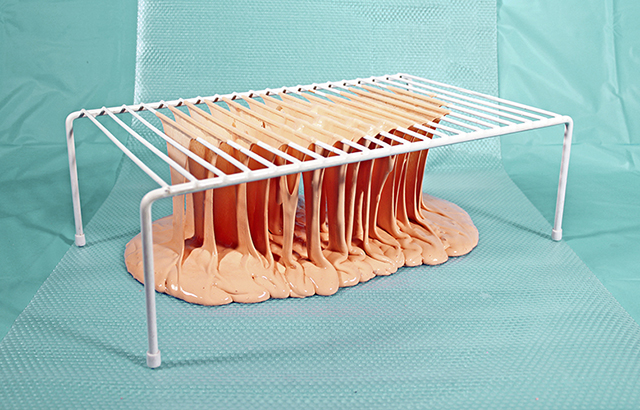
Gak, C-Print, 2014

Gak, C-Print, 2014

What unique roles do you see yourself as the artist playing that you may not have envisioned yourself in when you first started making art?

In addition to my independent work, I work collaboratively with my partner on large-scale sculptures and installations. Being an only child, I never imagined working intimately and making decisions with someone, let alone my significant other. It happened organically and has been successful thus far.

When do you find is the best time of day to make art? Do you have time set aside every day, every week or do you just work whenever you can? 

I work when I can, mostly weekends. I’m a big believer in Flow Theory and have to be working on multiple projects at once. If paint or glue needs to dry, I will just set it aside and move on to the next one. If it’s a good weekend and I don’t have too many errands to run, I will work through the afternoon, break for dinner, and work into the evening. Music is a must as is some kind of drink; coffee, wine, tea, Gatorade, etc.

How has your work changed in the last five years? How is it the same?

Five years ago I was eighteen, eager, naïve and enthusiastic. As expected, I have since become more broadly aware and gained many skills (both mental and technical). However, the only significant change in my work over the past five years is the level of critical rigor I apply to myself. Like with most art colleges, my undergraduate institution taught me to be critical and have an answer for every action. While criticality is good to some degree, my practice is still very much the same as it was five years ago. I continue to rely upon my interests and impulses as my guiding force and have an insatiable appetite for knowledge and experimentation.

Are there people such as family, friends, writers, philosophers or even pop icons that have had an impact on the work you do?

As far as a single person, my partner and collaborator has probably had the most impact on my work. Understanding the way he makes decisions has helped me to understand my own mental preferences.

I tend to focus on little peculiar topics that interest me and will then read various articles on that subject. They are sometimes art related, artist interviews or critical essays, but are other times completely tangential, like the product safety reports of baby cribs and playpens.

These tend to be more influential than a single person.

If you had an occupation outside of being an artist, what would that be and why?

In my wildest fantasy, I would love to be a surgeon of some kind. You are able to explore and repair the body in real time, as it is pulsing and breathing.

About 

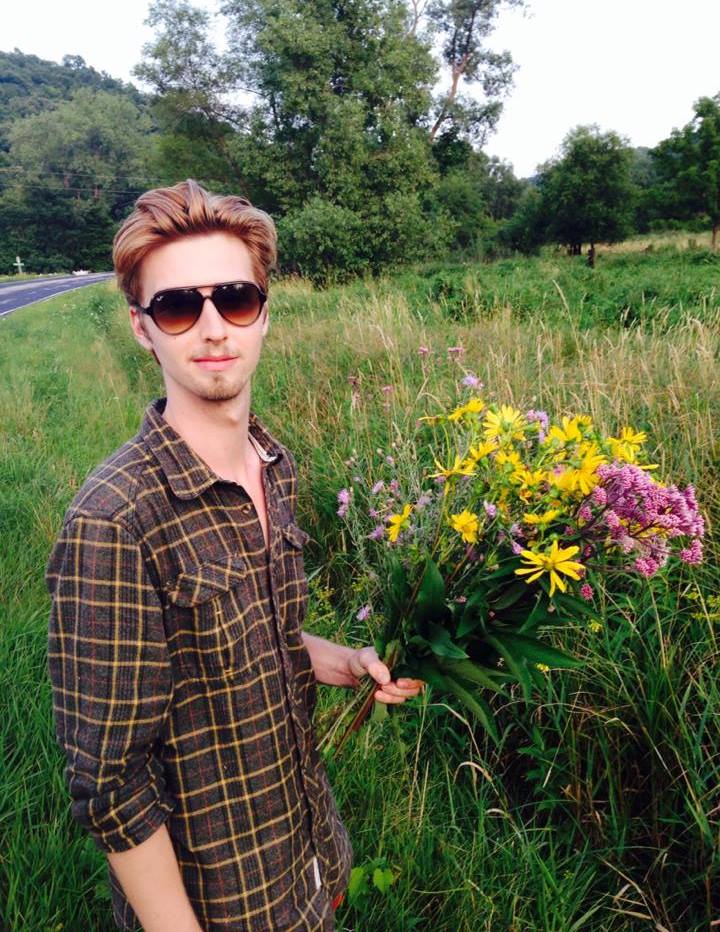
10580246_10203339384977632_5060782982087987793_nCorey Dunlap (b. 1990) earned his BFA from The School of the Museum of Fine Arts-Boston in 2013. He has shown nationally and internationally including Suffolk University in Boston Massachusetts, Grace Performance Space in New York City, and The Old Ambulance Depot in Edinburgh Scotland. He is a recipient of the 2013 Stephen D. Paine Fellowship and recently completed the ACRE residency in Steuben Wisconsin. Corey Dunlap currently lives and works in Los Angeles, CA.

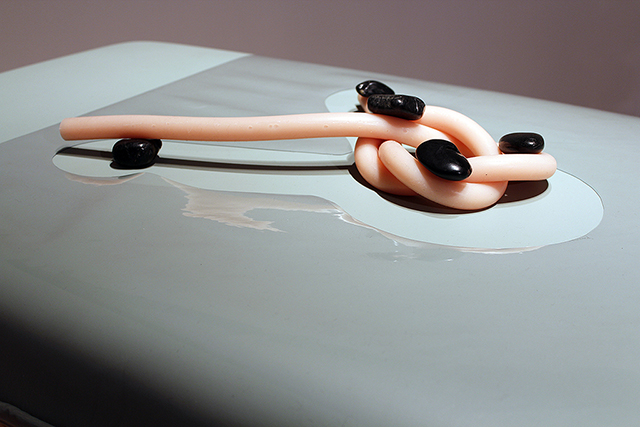
"Detail" The Hot Stones Are Never Rough, massage table, silicon, stones, plastic, 4' x 6' x 2', 2013

“Detail” The Hot Stones Are Never Rough, massage table, silicon, stones, plastic, 4′ x 6′ x 2′, 2013

coreypatrickdunlap.com

All images copyright of the artist and used with their permission. 
Posted in Uncategorized | Tagged | Leave a comment

Ewa Wesolowka – Poland

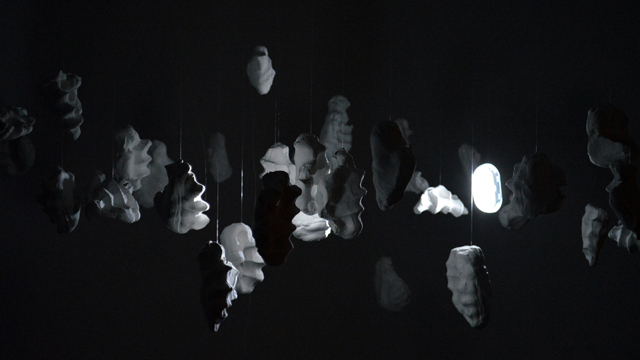
Music Box mobile-light-sound installation, 1.5 x 1.5 x 2m, 2013

Music Box
mobile-light-sound installation, 1.5 x 1.5 x 2m, 2013

Briefly describe the work you do.

I’m working with light-sound installations. I have very traditional sculptural background but since a few years I’m in installations link to the idea of light and darkness. It touches the question how we remember things when we do not see them anymore. How those things changes in our memory and perception. In my recent works I use flickering light as a reminiscent of something ending, and I juxtapose it with the sound that makes one think of the beginning. This creates a relationship of opposition, and this is what interest me the most.

I think of my art practice as a trace of presence, a reference to memory, and perception. It is a desire to preserve the moment. My work is about trying to keep a trace of a human touch and also displays the inability to do so; instead the desire to maintain the trace and history of an object reveals the opposite. It evokes an absent human, and shows that we cannot keep anything. The more we try to hold onto one’s trace, the more we pinpoint the lack of one. Therefore my work is more about trying. It is an act of meditation of our fragile and temporal nature with the essential value being the permanent trace left by the human hand through creative action.

In some works I choose ordinary objects that makes one think about vanity and elevate this mundane object to the dignity of a work of art. By choosing objects with marks of history, or creating them with visible traces of gestures, I mediate the realm of memory and the realm of experience through the work I do.

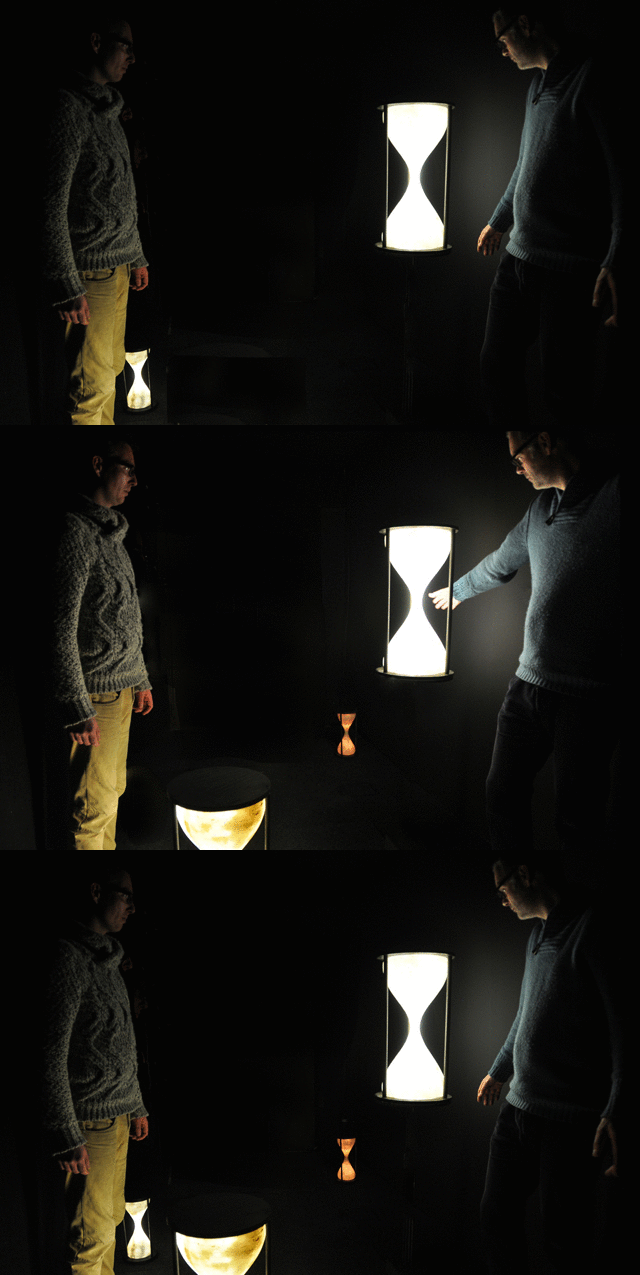
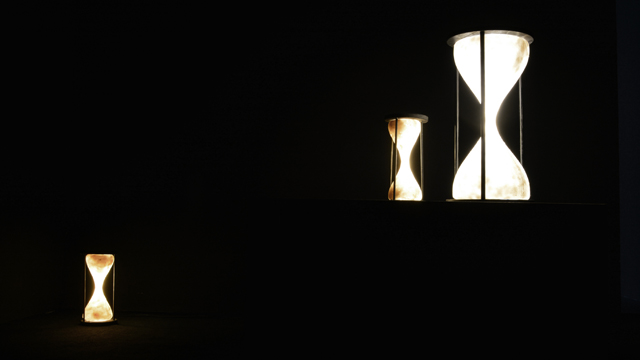
O=O interactive light-sound installation, objects: 30cm & 60cm, 2013

O=O
interactive light-sound installation, objects: 30cm & 60cm, 2013

Tell us a little about your background and how that influences you as an artist.

I graduated from a university considered one of the most conservative and craftsmanship-oriented in Poland, that I deeply respect craftsmanship. I have studied and acquired it with great humbleness because I believe it is an essential language both for conveying something more and for learning new media.

This is why after finishing Academy my goal was to find a synthesis of traditional (classic) and modern concepts of sculpture, and to combine the consideration for the traditional sculptural technique with the spatial arrangement. In my understanding – or maybe I should say feeling – the traditional sculptural technique was at some point synonyme to trace of a human hand left on a surface of a work. At the time I did the works “Open Sculpture”  (http://www.ewawesolowska.co.uk/portfolio-item/04-2012-opening-up-sculpture/) and “Safesurround” (http://www.ewawesolowska.co.uk/portfolio-item/03-2012-safesurround/). Both of them were informed by the traditional formation of sculpture – a visible ‘artist’s gesture’ on the surface of work with the arrangement of the space in which the work is exhibited.

The first of them was very strongly referring to Robert Morris exhibit from Green Gallery. It was my doubt if the minimal haven’t runs out nowadays. Is there sense to repeat it over and over again. Isn’t it getting us too dangerously close to design…

In my opinion, the new thinking about spatial art doesn’t exclude traditional methods in the sense of work that leaves the trace of the sculptor’s hand, and the spatial arrangement doesn’t have to imply purely geometrical, abstract solutions. The traces left by a gesture -natural and imperfect, hand and tool – are incompletely defined or expressed. Interruptions of the form leave room for speculation and interpretation by the viewer. I believe that new things can be communicated with a traditional language which doesn’t have to equal a stylistically stiff form of representation.

In the course of time, I moved into light-sound installations, but still in my works I involve elements that are created with the respect to traditional sculpture craftmanship. In one of my recent works shadows are cast onto the walls from suspended objects which are sculptural forms created by an impression of the squeezing hand (“Music Boxhttps://www.youtube.com/watchv=SHhCntvzO6k&list=UUWakmkpCIc54ypUKkHP6Jew) so I think my background – even though sometimes I try to reject it – will be always part of my thinking about my art practice.

O=O interactive light-sound installation, objects: 30cm & 60cm, 2013

O=O
interactive light-sound installation, objects: 30cm & 60cm, 2013

The concept of the “artist studio” has a broad range of meanings, especially in contemporary practice. The idea of the artist toiling away alone in a room may not necessarily reflect what many artists do from day to day anymore. Describe your studio practice and how it differs from (or is the same as) traditional notions of “being in the studio.”

After a few residency programs I learned how adapt to different studios as quick as it is possible. Few years ago I was in a studio every morning from day to day.

In the course of time, I have appreciated the importance of art theory, my own statement and philosophy of art. At this point, concept and my artistic framework play a very important role for me. As, to convey them, I use the language I acquired during my education years – the craftsmanship – so my practice is a mixture of working on concepts which I can do not necessarily in a studio, and the studio practice.

I think one day I will miss a day to day studio practice but now my work has a little nomadic character. I learned to build my studio whenever I am. Moreover every single time my work evolve influenced by different places. Also the materials I can find on spot determine my projects and how I develop it.

What unique roles do you see yourself as the artist playing that you may not have envisioned yourself in when you first started making art?

Maybe I will say what was the only one role I envisioned myself in when I started making art, and when I finished Academy of Fine Arts. I was seeing myself as traditional sculptor with a daily studio practice. So I can say all my approach to art, along together with seeing myself as an artist is something I haven’t envisioned myself in few years ago.

When do you find is the best time of day to make art? Do you have time set aside every day, every week or do you just work whenever you can? 

Some say it about waiting for the moment when ideas comes to you. There is a lot of truth in it. I can’t find a rule. I don’t have any. I work all the time.

How has your work changed in the last five years? How is it the same?

This time moved me from traditional filled sculptural form the one could only walk around into installations the one can walk in. At some point the filled sculpture has become insufficient for me. A desire to enter inside, and feeling it has appeared around five years ago. Then I moved towards light-sound installations where visitors are activating different parts of work by passing by (O=O https://www.youtube.com/watch?v=CXP_vzpkxwI&list=UUWakmkpCIc54ypUKkHP6Jew).

It this five years I moved my interest from the literal trace of human touch into mental trace. Although in a first glance, when you look at my works, it has changed a lot, it is about the same questions. Generally I think those questions will remain the same in art no matter how the way of development will change.

Are there people such as family, friends, writers, philosophers or even pop icons that have had an impact on the work you do?

All. Every single person I meet can have influence on what I do.

If you had an occupation outside of being an artist, what would that be and why?

Can’t imagine

About

ewa_wesolowskaEwa Wesolowska, born in 1982 is a visual artist working with environmental sculpture and light-sound installations. She works in ‘dialogue’ with the place of exhibition, through this site-specific way of working the object and space develop and transform as a whole. The work becomes part of the space. Through creating works of installation, Wesolowska wants the viewer becomes a part of the work through their interaction and participation.

Wesolowska graduated from Cracow Academy of Fine Arts obtaining a very traditional training in sculpture. She has participated in artist-in-residence programs (La Napoule Art Foundation, La Rectoria Art Foundation, DordtYart Foundation, Camac Art Foundation) where she has absorbed more conceptual approaches for her work. Subsequently she is refining her own visual and conceptual vocabulary that has emerged through her focus on the intersections of sculpture and spatial analysis.

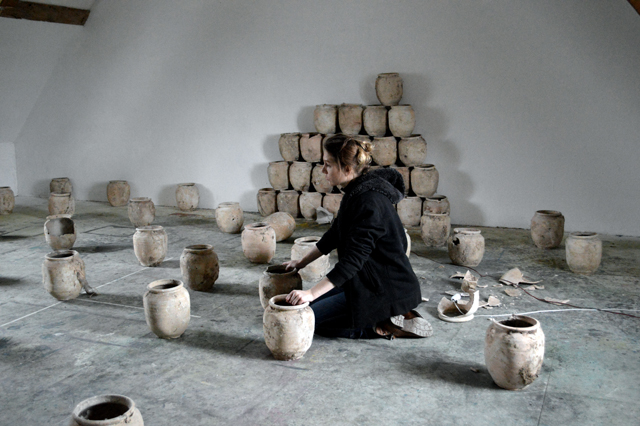
Colombier light-sound installation, 2013

Colombier
light-sound installation, 2013

ewawesolowska.co.uk

All images copyright of the artist and used with their permission.
Posted in Uncategorized | Leave a comment

Sandee McGee – Winston, Oregon

On the vast, deep, mossy bed, a velvet cry Archival Pigment Print 30" x 40" 2014

On the vast, deep, mossy bed, a velvet cry
Archival Pigment Print
30″ x 40″
2014

Briefly describe the work you do.

I primarily work in Photography. I’ve always been interested in the idea of it; how it developed as a technology and the history of it. I think its fascinating how technological developments happen alongside cultural, societal, spiritual, political, philosophical developments and shifts. In my work, I’m asking questions such as; how did we begin to behold the image of the thing, rather than the thing itself? What does it mean in our culture to be a subject? What are the various ways we imagine and rethink subjectivity? Drawing upon memory, place, and domestic life I am exploring these questions through photography, video and sculpture.

Tell us a little about your background and how that influences you as an artist.

I’m a rural artist who came to live in Oregon after having grown up in the suburbs of California. The threshold between these two places is a space in my work that I tend to visit often. There’s often something wild which has happened or is happening within a very controlled space in my work and that combination has much to do with my experience of place and with memory related to domestic life.

I also grew up in the 70’s and I remember watching a lot of TV during my younger years. There was a fantasy show, Land of the Lost, which was a high concept, low budget production. It was pure eye candy for me. The producers created special effects using cheap analog technology and the result was totally bizarre, but I loved this show. I would stare at the characters and was mesmerized by the fact that I was seeing something that seemed so real yet was obviously a total fabrication. I think it was probably that moment in my life where my fascination with images formed. It’s funny when I think about it because it wasn’t like I saw a famous work by one of the many incredible artists working at that time. I saw Land of the Lost in the 70’s. I think what’s wonderful is that they weren’t trying to make everything look perfect, they just wanted to tell a story in the best way possible. I can relate to this approach in my use of media. I sometimes use media I”m not as familiar with for the sake of realizing an idea. This pushes me to expand my vocabulary to break down those boundaries. I give myself a lot of permission to try new things. I have to work extra hard to push the media to the point where the technique kind of disappears and the idea emerges.

The concept of the “artist studio” has a broad range of meanings, especially in contemporary practice. The idea of the artist toiling away alone in a room may not necessarily reflect what many artists do from day to day anymore. Describe your studio practice and how it differs from (or is the same as) traditional notions of “being in the studio.”

My studio is the place where the ideas form or come together in a final iteration. I sketch there and I write. I also do lots of post-production work in that space. I went for a very long time without a studio, making work in my living room and kitchen table. I walk into my studio now feeling very grateful to have a space of my own. A place to just think or to stare at nothing in particular. All of these moments help me to formulate ideas and to act on them. It’s the place where I can really experiment and get inspired.

This question though makes me think about an artist I admire, Bruce Nauman, and the notion that if an artist is in the studio than whatever she/he is doing in the studio must be art. This implies that art is an act and not a product. Bruce can get away with that, but I’m not sure that I could manage to convince people, without the product/art object that I’m a real artist! If the above is true though, I’m making art all the time! That said, I have a studio and although you can usually find me working in there, I would say that I’m never not thinking about art. So in a way I kind of bring my studio practice with me everywhere I go. This mentality allows me to really broaden my senses and to continue to ask the question, “what is art?” Every space I find myself in can be an opportunity for discovery. That’s what my studio practice has taught me..to ask questions, to experiment, to look for meaning. This is something I think I bring with me in every life situation.

The Hours We Spent Archival Pigment Print 22" x 34" 2013

The Hours We Spent
Archival Pigment Print
22″ x 34″
2013

What unique roles do you see yourself as the artist playing that you may not have envisioned yourself in when you first started making art?

It took me a while to understand my role as an artist because in some ways the effect that art can have on ones life isn’t made as public as issues regarding surface, formalism and technique. The question has always been, “What medium do you use?, not “What ideas are you thinking about in your work and how does the medium expand the notions within your work?” There’s always something there and I had to learn to look for that and be deeply effected by it to fully understand what my role would be as an artist.

Art has the capacity to facilitate healing because it uses the problem to answer the question. Very much like the idea behind good design or just like homeopathy where the cure exists within the cause. Another aspect of healing is to tell the truth about something and in that way art (thanks to Marcel Duchamp) seeks to level the playing ground in a world built on ideals and hierarchy’s developed during the enlightenment period. Breaking down the barriers between high and low art, between public and private, between male and female, and between nature and culture is part of what I see as my role.

As artists, I think we have to block out the rest of the world at times and find our own language to say what we need to say.

When do you find is the best time of day to make art? Do you have time set aside every day, every week or do you just work whenever you can? 

I work whenever I can. I have to keep a strict schedule otherwise other things bleed into my studio time and then it just takes longer to work through ideas. Exhibition schedules keep me on track though. Having deadlines really helps and mapping out my time during the week. I know, going into the week, how much time I can spend, so then it’s a matter of managing that time well so that the work gets done. It feels bad to have an idea and not be able to get to it. That’s something that took me a while to figure out. I have always taken the approach of “strike while the iron’s hot!”, but that’s not always realistic, nor is waiting to be inspired. Somedays I don’t know what I’m doing, but I always have to trust that something is percolating and so I go to my studio anyway, to sit there. It’s my calm place.

As far as time of the day goes, the late afternoon has always been a bit of a magical time for me. Something about the light is just right. I go to the kitchen and heat up water in order to press a coffee. I go to my studio, cup in hand, and what happens are some of my own personal perfect moments. Those are the moments when things start to gel in my mind. Let’s face it, half the time I don’t know what I’m doing in there or whether or not it will work out. Lots of things don’t work out, but I suppose those perfect moments happen when I catch that deeper meaning in my work, the love I have for art and for how it works in my little world.

On the vast, deep, mossy bed, a velvet cry Archival Pigment Print 30" x 40" 2014

On the vast, deep, mossy bed, a velvet cry
Archival Pigment Print
30″ x 40″
2014

How has your work changed in the last five years? How is it the same?

Five years ago I was entering into my Grad Program at the University of Oregon  where I began to discover these underlying themes and questions in my work. I started thinking about hand painted photographic backdrops during that time, which eventually led me to explore the idea of wallpaper in my work. I was fascinated with the female as subject/object using wallpaper as a metaphor. I was photographing still life’s which were highly constructed sets featuring floral or fruit filled wallpaper. I would take that opportunity to identify the flowers and/or fruit in the paper and go to the grocery store to find the varieties I was searching for. I’d create a still life in front of the papered wall because I really wanted to take what would normally be the background and bring it forward, to become the subject. I’ve always been interested in how we construct identities and create norms through the use of media and in particular through photography. This is something that has morphed into different bodies of work over the last five years, but really hasn’t changed. I think I’m just more aware and attuned to the direction of my work.

Are there people such as family, friends, writers, philosophers or even pop icons that have had an impact on the work you do?

There are a whole list of artists who have had an impact on my work. I’ll mention the ones I continue to look at from an early point in my career up to today: Laurie Simmons, Cindy Sherman, Larry Sultan. These are artists who’ve had prolific careers making conceptual art, centering on issues of domestic life and/or female subjectivity, all of which has had a significant impact on not only my work, but on culture. The French thinkers: Jaques Derrida and Julia Kristeva’s work have also had a major impact on the way I think about my own work and has played a large  part in helping to formulate the way I think about the image as text. Some former professors: Gail Wight , Robin McDowell, Deirdre Visser, Catherine Wagner and the ever brilliant and golden hearted, Dan Powell, have all had major impacts on my life and work.

My family, especially my mom and my grandmother have given me a lot of things to think about in terms of the themes related to identity and subjectivity in my work.

I honestly don’t know what I’d do without my artist friends who give me honest feedback, helpful thoughts and loving nudges to keep going when things get a little dicey in the studio. I couldn’t really do anything without them.

If you had an occupation outside of being an artist, what would that be and why?

A Curator of art exhibitions. I’m so interested in the language of art and how to design exhibitions so that a third or fourth thing gets to happen. I love thinking about the relationships between disparate works and discovering how to put pieces together that help to create complex relationships.

About

McGee_Headshot_365Sandee McGee was born in San Francisco, California in 1971. She received her BA in Studio Art from Mills College where she was the recipient of the Ralph DuCasse Award for Excellence in Art. She received her MFA from the University of Oregon in 2010. McGee has exhibited across the US including shows at In Site Gallery in Vermont, Blue Sky Gallery in Portland, Oregon, 1650 Gallery in Los Angeles and The California Center for the Arts. Her work has been published in an exhibition catalog which has been collected by the Brooklyn Museum Library, the Metropolitan Museum of Art’s Thomas J. Watson Library and the Aukland Museum Library in New Zealand. In 2013, McGee received an Individual Artist grant from the Douglas County Cultural Coalition to complete a recent body of work. Sandee McGee lives and works in rural Southern Oregon.

The Studio

The Studio 

sandeemcgee.com

All images copyright of the artist and used with their permission.
Posted in Uncategorized | Tagged , , , , | 1 Comment

Traci Fowler – Chicago, Illinois

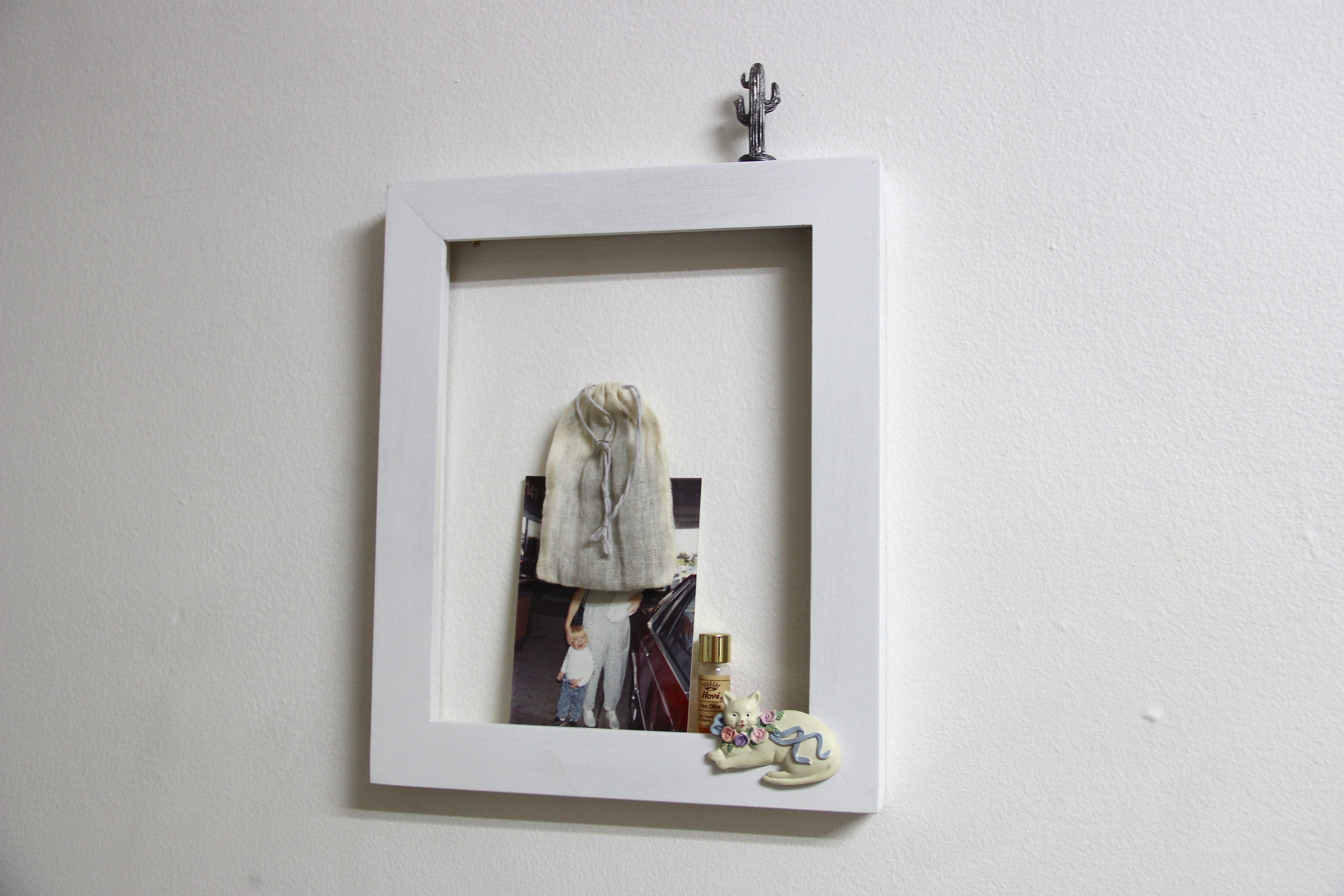
She'd complain if Jesus Christ came down and handed her a five dollar bill Frame, lavender, collected items, photograph 10" x 12" 2014

She’d complain if Jesus Christ came down and handed her a five dollar bill
Frame, lavender, collected items, photograph
10″ x 12″
2014

Briefly describe the work you do.

I weave personal narrative with social treatises to connect impulse and awareness. My work focuses on issues of class structure, gender regulations, and the ways in which these discourses both challenge and strengthen one another. I am interested in how tropes of social consciousness can be potentially exclusive and work to eradicate these exclusions. My work is inclusionary, yet educated. I create small-scale installations, and set up visual Venn diagrams in which multiple disparate parts (be they family heirlooms, unpaid bills, or domestic artifice) maintain individuality, yet simultaneously meet in the middle.

Tell us a little about your background and how that influences you as an artist.

I was born and raised in Houston, Tx. Same street, same house, same bedroom for 18 years. Now living in Chicago, I find myself drawing inspiration from my home. I often use plants, specifically cacti in my work I suppose because of a primal longing for wide open spaces. I often use family heirlooms and aesthetics of the culture/class I was born and raised within. Such as in my series the only thing the same is that it ain’t for everyone or All hat no cattle.

The concept of the “artist studio” has a broad range of meanings, especially in contemporary practice. The idea of the artist toiling away alone in a room may not necessarily reflect what many artists do from day to day anymore. Describe your studio practice and how it differs from (or is the same as) traditional notions of “being in the studio.”

Though I wouldn’t consider much of what I do and the way I work to be “traditional”, I believe my studio practice is fairly such. I like to be alone when I’m working, I like to write a lot of things down, take notes, and really focus on what I’m doing for as long as I possibly can.

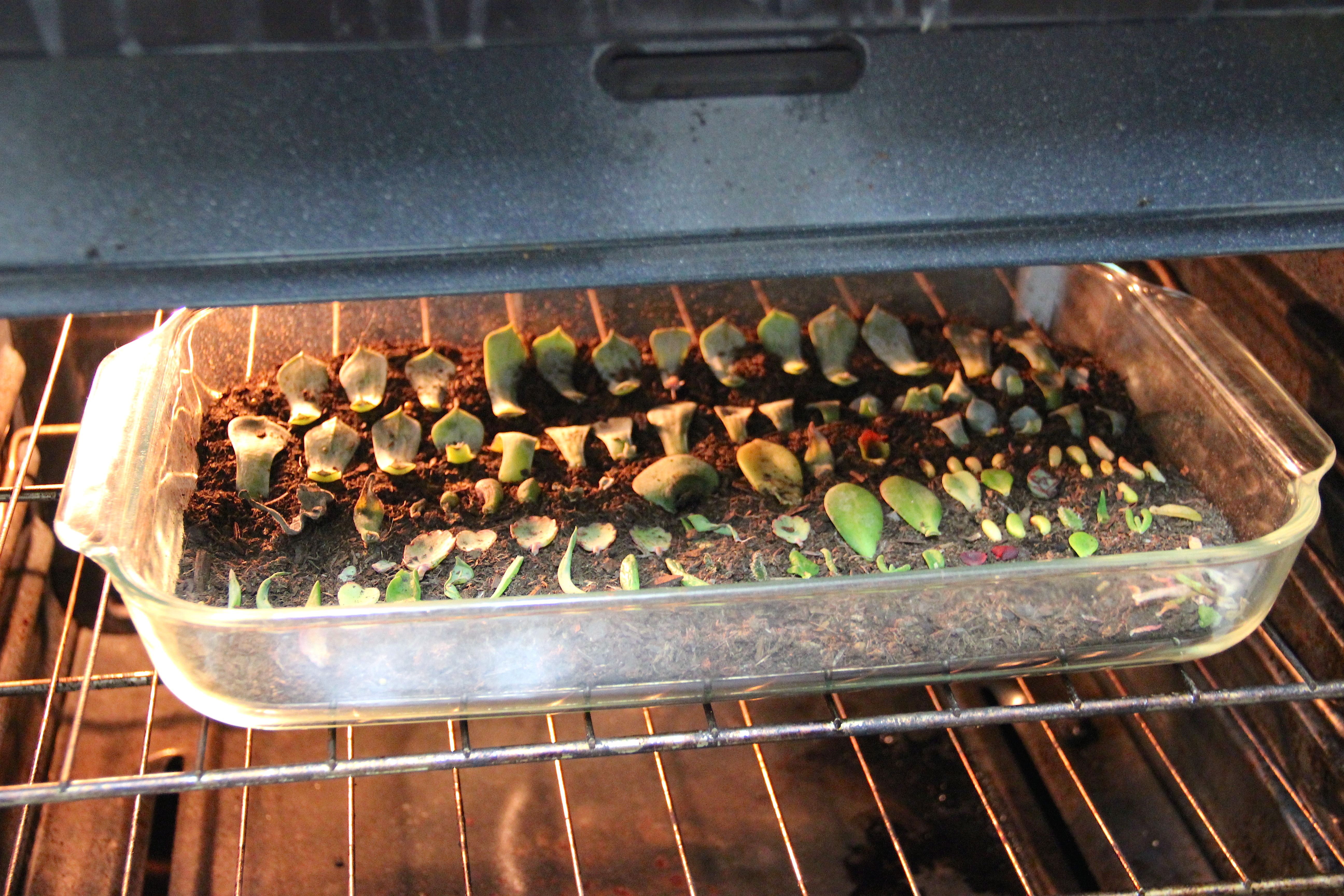
Though shalt not put sugar on thy grits either Baking dish, potting soil, plant cuttings 10" x 12" x 3" 2014

Though shalt not put sugar on thy grits either
Baking dish, potting soil, plant cuttings
10″ x 12″ x 3″
2014

What unique roles do you see yourself as the artist playing that you may not have envisioned yourself in when you first started making art?

Facilitator. When I first started this, I didn’t really ever think I would be interested in any position that wasn’t artist, curator, gallerist, teacher, critic, but the deeper involved I become within the art world, the more interested in these positions I become. In fact, my partner and I have even opened an exhibition space within the kitchen of our home. (kitchen-space.tumblr.com)

When do you find is the best time of day to make art? Do you have time set aside every day, every week or do you just work whenever you can? 

Honestly, whenever I can. Currently I’m still in school, so I have classes Tuesday-Friday. I make work on the weekends, Mondays, and in the in-between class time I find for myself sometimes.

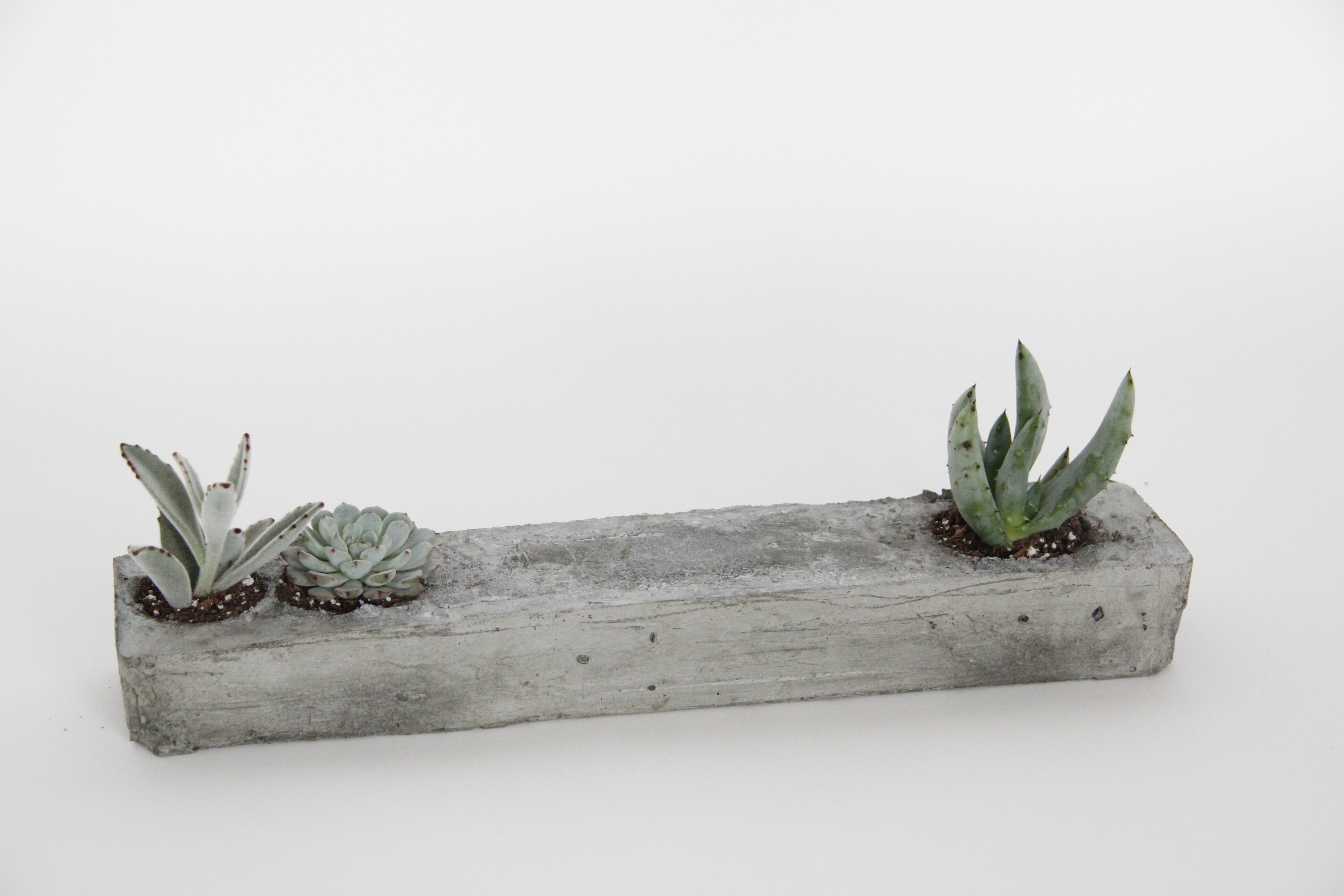
Grounded together regardless Concrete, potting soil, plants 18"x4"x3" 2014

Grounded together regardless
Concrete, potting soil, plants
18″x4″x3″
2014

How has your work changed in the last five years? How is it the same?

Oh it’s changed so much in even just a year! Five years ago I didn’t even consider myself an artist. I was just leaving high school ready to study photography. It’s amazing how much your work can change in such a short amount of time. I think I’m constantly changing directions, but my impulses have remained the same over the years.

Are there people such as family, friends, writers, philosophers or even pop icons that have had an impact on the work you do?

My family I think impacted me very indirectly. My grandmother was a painter and actress, my grandfather a guitar teacher, my father a musician/graphic designer and my mother a multidisciplinary creative. This, I supposed has all been an important part of my upbringing though I never quite realized it.

If you had an occupation outside of being an artist, what would that be and why?

I’ve always wanted to open up a small flower shop. For no particular reason other than my love for plants and beautiful wildflowers.

About

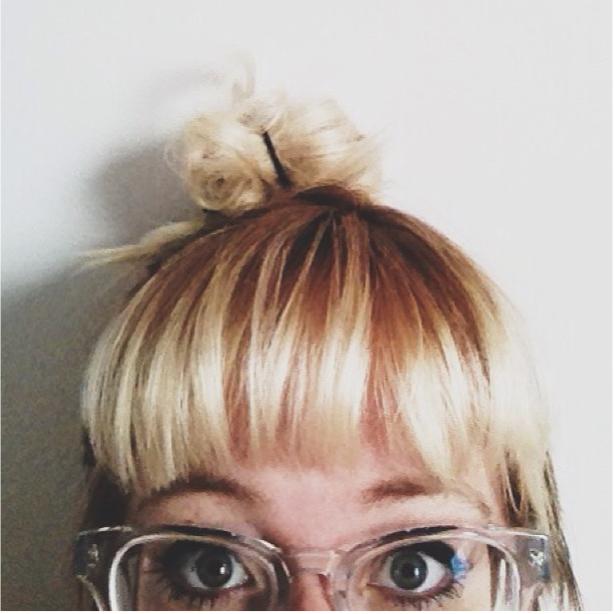
BioPicTraci Fowler (b. 1991) Lives and works in Chicago, IL. She currently attends Columbia College Chicago and will receive her BFA in December 2014. Her work has previously been exhibited at A+D Gallery, Chicago Community Bank, US Africa Network: One Struggle Many Fronts Tour and DfbrL8tr. Her most recent project involved a collaboration with her mother which was featured in a group show happening simultaneously in Chicago, Il and Austin, Tx at )( gallery. She was a 2013 and 2014 resident at 8550 Ohio. In November Traci will have her first solo exhibition, the love that let us share our name, at C33 Gallery.

Along with her partner, Trevor Schmutz, Traci operates a gallery in the kitchen of their apartment. Kitchen Space opened in April of 2014 and operates as a project space for artists to either adapt their work for the setting or create work in reaction to the site.

Favorite Studio Spot

Favorite Studio Spot

Tracifowler.com

All images copyright of the artist and used with their permission.
 

Posted in Uncategorized | Tagged , , , , | Leave a comment

Melissa Hill – Fairfax, Virginia

Irregular Pearl Gold Leaf, Mass-produced Chair, Yarn, Velvet, Branches, Steel, Brass Tacks, Tulle, Paint 50 x 24 x 28 2014

Irregular Pearl
Gold Leaf, Mass-produced Chair, Yarn, Velvet, Branches, Steel, Brass Tacks, Tulle, Paint
50 x 24 x 28
2014

Briefly describe the work you do.I am currently working in fiber based sculpture and installation. Everything that I am creating is extremely process oriented and labor intensive making it a meditative practice for me. The substantial amount of time required for a piece to go from conception to creation allows an opportunity for evolution. My pieces rarely resemble my initial sketches in form, though they typically are much better manifestations of my conceptual intent.

Tell us a little about your background and how that influences you as an artist.

I grew up with a family that insisted that I should be free to make my own decisions. I’ll always remember my dad telling me at a very young age that I should pursue what I want to in life and not what I think I should because I didn’t want to be thirty years into a career and dislike what I was doing. This advice follows me even today and really helped me when I decided to quit my IT job and continue my education in fine arts. When I started as an undergraduate I was studying drawing because I was always interested in the line. I became enamored with the idea of pulling the line off of a page and placing it in three dimensional space and so I began my forays into sculpture and other 3D media.

The concept of the “artist studio” has a broad range of meanings, especially in contemporary practice. The idea of the artist toiling away alone in a room may not necessarily reflect what many artists do from day to day anymore. Describe your studio practice and how it differs from (or is the same as) traditional notions of “being in the studio.” 

I tend to work when I can and where I can and I find that multiple space is much better suited to my process. As such, while I have a formal studio set up I also always make a niche for myself wherever I am living. I like going to my formal studio to work on larger scale pieces, for information and feedback from my colleagues, and as a general social setting but my thinking usually happens at my home studio. The quiet lets me focus my thoughts and reflect on reactions to my work from viewers, while the formal studio setting lets me put those thoughts to action in a larger space that’s more conducive to the scale of my works.

Tilting at Windmills Yarn, Steel, Paint, Branches 52 x 144 x 26 2013

Tilting at Windmills
Yarn, Steel, Paint, Branches
52 x 144 x 26
2013

What unique roles do you see yourself as the artist playing that you may not have envisioned yourself in when you first started making art?

I think the roles of social commentator and mediator are the two roles that I never expected to inhabit as an artist. I’ve always wanted to be a professor, so I knew that I would have to be able to communicate complex ideas both through works and words, but when I began as an artist the work was simply a raw outpouring of emotion that felt very me-centric. As I’ve come to understand myself a bit better I realize that all of the things that are important to me are made manifest in my work and as I’ve matured as an artist they are more compellingly spoken.

When do you find is the best time of day to make art? Do you have time set aside every day, every week or do you just work whenever you can?

I typically work whenever I can, but I always feel at my zenith in the quietest moments of the night. While other people are asleep I ponder any number of things, and in almost all cases those things need to be brought into being in some shape or form immediately upon their inception. I am always afraid that my ideas will fade away with the morning light like ephemeral dreams if I’m not quick to capture them on the pages of a sketchbook or journal.

We Contained the Sea Yarn, Wood, Felt, Steel, Polyfill 27 x 62 x 72 2014

We Contained the Sea
Yarn, Wood, Felt, Steel, Polyfill
27 x 62 x 72
2014

How has your work changed in the last five years? How is it the same?

My work is always evolving and what I was making five years ago is quite different from what I am doing today as a direct result. I believe that I’m more skilled, that my process is more well-developed. I feel I am constantly continuing to experiment and that allows me to learn, grow, and to create new ways of bringing to life my subject matter. My work has recently allowed me to tear down some long-lived emotional barriers and it has grown and changed immensely in a very short period of time. I am extremely excited to see where it takes me from here.

Are there people such as family, friends, writers, philosophers or even pop icons that have had an impact on the work you do?

I am a constant reader and I incorporate a lot of what I find to be compelling into my world view which translates into my artistic output.  I recently read The Structure of the Scientific Revolution by Thomas Khun and it really gets at the way I think and approach the world. As I evolve my perception of everything shifts in fundamental ways. Sometimes it may have minute outcomes on my work, but that minutia is how I can gauge my evolution as an artist. For a long time I was hung up on a very particular subject and after the catharsis was through I felt like I had a breakthrough in my work. I didn’t understand why the new work was seemingly so disparate from my old work until I realized that it was working through the same types of things except on a macrocosmic scale instead of a microcosmic scale. Because of that I have found myself able to interrogate a much wider array of issues that are important to me and I have realized what I was really trying to get at in the first place.

If you had an occupation outside of being an artist, what would that be and why?A geologist. As odd as it sounds I have always had a fascination of and obsession with rocks. How they are composed, their lines and colors, and the variation of textures a rock can have are absolutely intriguing to me. My love of rocks has always left me with the sentiment that if I was not an artist, I would absolutely be a geologist.AboutHeadshotMelissa Hill (b. 1986 in Norfolk, Virginia) is an award winning artist who received both her Bachelor of Fine Arts in 3D media and her Bachelor of Arts in Art History at Old Dominion University in Norfolk, Virginia. She is currently pursuing a Master of Fine Arts in Sculpture at George Mason University in the Washington D.C. suburbs of Fairfax, Virginia. A fascination of tactile materials and a love of line has lead her to her experimentation with yarn and other fibers. She currently works as an adjunct professor at George Mason University. 

The Studio

The Studio

melissahillart.com 

All images copyright of the artist and used with their permission.
 
Posted in Uncategorized | Tagged , , , , | Leave a comment

Linda Hemmersbach – London, England

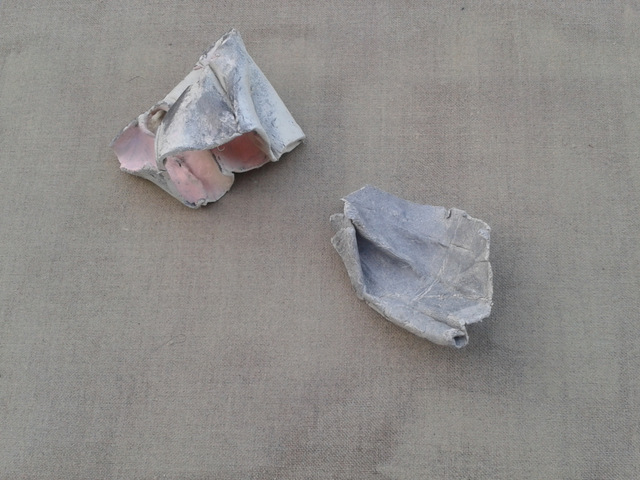
Untitled, clay, graphite, ond oil on linen, dimensionsvariable_2014

Untitled, clay, graphite, and oil on linen, dimensions variable, 2014

Briefly describe the work you do.

I make abstract paintings, drawings, and small objects in clay, paper and from found materials. For me, the act of painting is akin to trying to pin down an internal dialogue; thoughts rise to the surface but remain outside the reach of language. It’s a process of continuous making, where one medium can inform another but is never directly translated into another. Through making, I am interested in discovering transitions from conscious to unconscious, exterior to interior.

Tell us a little about your background and how that influences you as an artist.

Growing up in Cologne in Germany, I spent most of my time at dance and singing classes with my sister. We would perform concerts for our parents and my sister would write stories and plays that I would illustrate. I liked staying at home and drawing in my room and always thought it was strange that other children preferred to watch TV or hang around outside. My dad collected Native American art and often took us to museums and galleries. At 14, I remember seeing Joseph Beuys’ fat sculptures for the first time at the Hamburger Bahnhof in Berlin, alongside Anselm Kiefer’s lead books and Cy Twombly’s paintings. I didn’t understand what I was seeing but I was intensely struck by the physicality of the materials and their application, the sense that something deep and powerful was happening underneath the surface of the works. These artists are still some of my favourite artists to date.

I remember having a strong need for beauty in my day to day life….I would spend hours meticulously rearranging my toys and collections of crystals and other things. I loved anything small and jewel like and took great care of the things I loved. I think this sense of preciousness has stayed with me in my art practice and is what still draws me to painting; the preparation of the surface, the grinding of pigments, the discovery of the new and unique through creation. And I have been told some of my paintings have jewel-like qualities. For my BA I studied Jewellery Design because I wanted to learn the craft of silversmithing and to make something that would last forever. But I quickly realised I wasn’t a designer; I didn’t want to make the same thing twice and my pieces were more sculptural and conceptual than wearable. When I changed to fine art my appreciation for the hand-made and for materials stayed with me but I also tried to resist being too precious about my work. I need the process to be more raw and intense. It’s good to destroy or push things that are too beautiful or recognisable. I need to be surprised by what I am making.

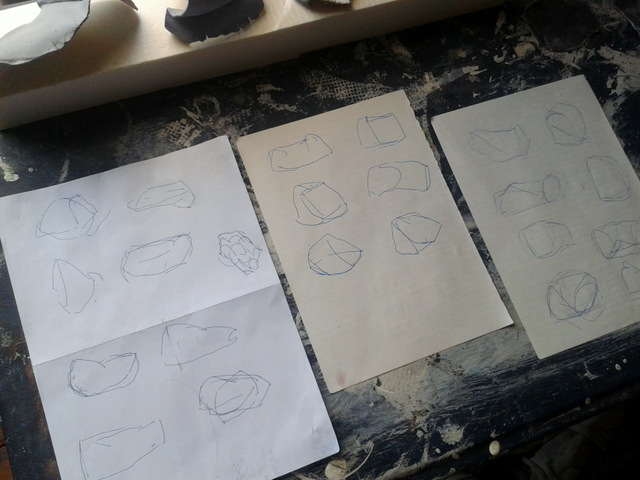
Sketches

Sketches

The concept of the “artist studio” has a broad range of meanings, especially in contemporary practice. The idea of the artist toiling away alone in a room may not necessarily reflect what many artists do from day to day anymore. Describe your studio practice and how it differs from (or is the same as) traditional notions of “being in the studio.” 

I am very much a maker who needs a quiet place by herself to work. I am always working on ten to twenty pieces at the same time so I need somewhere I can get messy and move things around. I have been working from home for nearly two years now as I can’t afford a studio space in London. I am lucky to have a spare room that I can use but it’s not ideal, too small and too dark, but it works for me at the moment. I like being able to go and look at my paintings before I go to bed or using the studio for a few hours before work. This year I have felt it necessary to leave my familiar studio environment behind though. I took myself on two residencies, one in Switzerland, where I shared a big studio with two other painters, and one in a tiny isolated bothy on the Isle of Eigg in Scotland. Working in different environments and set-ups gave me the confidence that I can make work anywhere and from anything. In Switzerland I made a lot of work on cardboard and found materials such as wood because of the high cost of materials and shipping, which in turn inspired new ways of working. In Scotland I had to be able to fit everything into a rucksack, so I made stacks of paintings on paper and took many photographs, both new developments in my practice. The work I made away from home was my best work so far. In the future I would like to try and make work ‘on the road’ or take part in a travelling residency. Going back to the concept of the ‘studio artist’ though, in London I try and visit other artist’s studios as much as possible. I have found that it is a great way to meet other artists, share concerns and feel less isolated. I am also trying to embrace social media more, and have discovered that there exists a great community of abstract painters worldwide connected through the web. Trough tumblr I have been in touch with painters from Russia and America, as well as others in London, whom I would have not met otherwise.

What unique roles do you see yourself as the artist playing that you may not have envisioned yourself in when you first started making art?

I never thought I’d spend so much time writing and talking about my work. It’s something I find very difficult and it’s taking me a long time to let others into the process. Even if you don’t feel confident about the work, someone else might believe in you and see something in it that you can’t see. For a long time I rejected the idea of self-promotion, but I think there are subtle ways to go about it.

I also never thought I would enjoy teaching so much and get so much out of it for my own practice. Working with primary school children can be intense but also incredibly rewarding; watching them create without inhibitions and self-consciousness is inspiring.

I also didn’t think I would spend so much time worrying and doubting. Painting is difficult and emotional but that’s what keeps me interested in it. As much as I love what I do, I continuously find myself making decisions that take me further away from any stability or security.

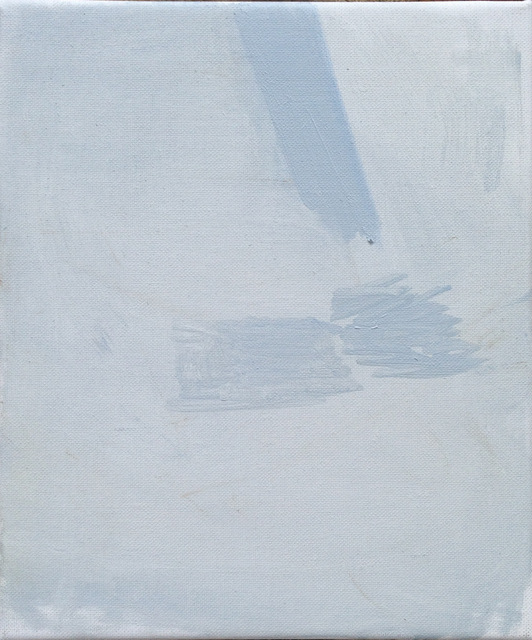
Untitled_oilonlinen_25x30cm_2014

Untitled, oil on linen, 25x30cm, 2014

When do you find is the best time of day to make art? Do you have time set aside every day, every week or do you just work whenever you can? 

At the moment I am teaching afterschool clubs part-time in primary schools, so I try to have a few hours in the studio every morning. Between 9am and 10am is my favourite time to paint, the ideas are fresh and everything is possible. I also like the afternoon around 4pm as you have got into a rhythm by then, but sadly I hardly get time to work then. I have never produced anything I liked late at night. I do try to work whenever I can really, and in a good week that can be four mornings plus one whole day at the weekend.

How has your work changed in the last five years? How is it the same?

Five years ago I started an intense twelve-month MA at Wimbledon College of Art. I hadn’t done a BA in Fine Art, so I felt very anxious that I had a lot of catching up to do and tried to experiment as much as possible. Despite wanting to paint I remember feeling very dissatisfied and insecure about my work, and spent a lot of time drawing and making strange 3d objects instead. At the time I was working figuratively, working from photographs but also from memory and found images. Thematically I was thinking about the same subjects I think about now when making work…the nature of memory, experiences of landscape, the ultimate fleetingness of our existence, the transient and cyclical nature of all things, making visible the invisible. I don’t think that ever really changes. After I graduated it was a long and hard process of stripping back, shedding old habits and simplifying. I had always been drawn to abstract art and felt that I didn’t need figures or a to communicate what I was trying to express , but I had no idea how to go about making an abstract painting. I needed to get away from the pressures of the London art world so I took myself away to Berlin for eight months and started again, going right back to mark making and really examining what it was that made me want to create. I did a lot of writing, read poetry, looked at a lot of work by artists that I had loved since childhood, took evening classes in photography and etching, and made dark A4 pencil drawings working from my imagination. I found this process of stripping back and trusting my instincts liberating yet scary and isolating, but it laid the ground for the work I am making now. When I moved back to London I decided to start painting again. I now paint as much as I draw. I also take a lot of photographs, which help me identify painterly sensibilities as well as understanding instinctively what I am drawn to visually in my day to day life.

Are there people such as family, friends, writers, philosophers or even pop icons that have had an impact on the work you do?

Anyone who pursues their life and interests with passion, sincerity and honesty can have an impact on me. I am lucky to be living with a group of friends who are all either artists or performers. None of us have a regular 9 to 5 job, and we’re all working on our individual projects most of the time. It’s an inspiring and encouraging environment to be living in.

One writer that I love and who has had an impact on my work is the poet Paul Celan. I discovered him during my time in Berlin; Anselm Kiefer also references him in many of his paintings. Sometimes I think I am trying to do with paint what Celan tried to do with words…..express the ‘unspeakable’ or ‘unknowable’. His poems were mysterious, incredibly atmospheric and visually ambiguous. He made me love the German language anew, by creating new words that have no clear meaning.

As for pop icons, I love Patti Smith, Bill Callahan, Tom Waits, Cat Power. Their work is embedded in truth and honesty and an artistic vision that is all encompassing.

If you had an occupation outside of being an artist, what would that be and why?

I would be a contemporary dancer or be involved in music in some way. I believe that dancing is the purest and most abstract art form there is…all you need is your body. We understand dance in a subconscious, deeply felt way, as we all share the same body. I have always danced but never in a professional way, I’m not competitive. I’d still like to be involved in music, maybe get back into singing, but right now I don’t seem to be able to dedicate my time to anything other than making art.

About

Lhemmersbach_headshotLinda Hemmersbach was born in Cologne, Germany in 1984. In 2004 she moved to London where she studied BA (Hons) Jewellery Design at Central Saint Martins (2008) and MA Fine Art at Wimbledon College of Art (2010). She was artist in residency at the Trelex Residency, Switzerland, in March-May (and will be returning in November 2014) and at the Bothy Project on the Isle of Eigg, Scotland in July 2014. In November 2014 she will be showing new work at Footfall Art, Bermondsey, London. Recent exhibitions include: Stick ‘Em Up, Husk Gallery, London (2014), It’s very quiet here, Gowen Contemporary, Geneva (2014); New Paintings (Solo), The Trelex Residency, Trelex, Switzerland (2014); Form/Entformt (Solo), 86b Greenfield Rd, London (2014); First Come First Served, Lion&Lamb, Hoxton, London (2013/14); Loopart13, Creekside Studios, London (2013); Drawing Open, One Church Street Gallery, Great Missenden, UK (2012); The International Drawing Project, Pr1 Gallery, Preston, UK (2012); Double the Vision My Eyes Do See, Three Stags, Lambeth, London (2011); Tarradiddle, Art Space East, London (2010); I Swore/ I Sore, The Nunnery, London (2010).

The Studio

The Studio

linda-hemmersbach.com

 All images copyright of the artist and used with their permission.
Posted in Uncategorized | Tagged , , , , | Leave a comment

Jana Ireijo – Westport, Connecticut

“In My Head, I See You All Over Me” 40x30” acrylic 2013

“In My Head, I See You All Over Me”
40×30”
acrylic
2013

Briefly describe the work you do.

I am a contemporary pop artist who works in oils and acrylics.  My process is intuitive, and I am always surprised by how a painting turns out! I start with a figure (often a dog), and slowly paint in other images.  Each marks points the canvas in a new direction. The end result is dense and layered, and a single painting can take months to complete.

Tell us a little about your background and how that influences you as an artist.

I grew up in 1970’s Hawaii, and Japanese anime is a nostalgic and constant influence – Hello Kitty, Asian super heroes, all the trading stickers and cheesy, subtitled TV shows.  I was also a Graphic Design undergraduate major, and love great logos, commercials, and discovering new fonts.  Another design influence is my use of the grid to enlarge and transfer images to the canvas.  I find the process both meditative and incredibly stimulating.  Regarding imagery, I often use dogs as a starting figure.  When my parents divorced, my dad adopted over thirteen dogs, so they bring with them strong associations.  Lately, I had several teeth and jaw issues, so those have found their way into my work as well!

The concept of the “artist studio” has a broad range of meanings,
> especially in contemporary practice. The idea of the artist toiling away
> alone in a room may not necessarily reflect what many artists do from day
> to day anymore. Describe your studio practice and how it differs from (or
> is the same as) traditional notions of “being in the studio.”

I am a traditional studio artist.  I look forward to the time alone to create a painting from start to finish. The idea of collaboration, or hiring others to help me finish a project is abhorrent.  However, much of my inspiration comes from observing the outside world – music videos, fashion, or the work of street artists.  I always have several magazines lying about the studio when I am working.  If I am stuck, I flip through them until a figure, pattern, or color, catches my eye and calls out to be included in my composition. I also try and see as many exhibits as possible. Although I thrive in solitude, I do not believe great art can be made in a vacuum.  Contemporary art is a conversation, and artists need to keep up with what is being made by others.


“My Sweetest Friend” 40x40” acrylic 2014

“My Sweetest Friend”
40×40”
acrylic
2014

What unique roles do you see yourself as the artist playing that you may
> not have envisioned yourself in when you first started making art?

Like many artists, there are the roles of business person or self-promoter that I did not really consider in art school.  But I’ve found it’s about making friends and connections with curators, gallery owners, etc. who share a common vision.  The internet has made the process so much easier. This project is a great example!

“A Narwhal and a Tiger Walk Into a Bar” 18x18” acrylic 2014

“A Narwhal and a Tiger Walk Into a Bar”
18×18”
acrylic
2014

When do you find is the best time of day to make art? Do you have time
> set aside every day, every week or do you just work whenever you can?

There is no best time!  I love the rare days when I have an entire day to devote to art, but usually I just work when I can – at 6am in the morning, a couple hours at lunch, or after my kids go to sleep at night.  I don’t wait for inspiration to strike.  If I have a block, there is always something to do – clean my studio, organize applications, or just start moving the paint around on a canvas. The majority of the time, art making is pretty frustrating; I just keep chipping away, to hopefully get over the mental hump, and at some point the light turns on.

How has your work changed in the last five years? How is it the same?

I think I allow for more of myself in my work – both the fun and flawed sides.  I used to think art was such a serious occupation, and it still is… the process is always soul-searching (which is never comfortable), but these days I care less about what people think, and it is reflective in my paintings.  I also don’t take years to finish a piece like before… I’m not as obsessed with perfection.  

Are there people such as family, friends, writers, philosophers or even
 pop icons that have had an impact on the work you do?

Living away from Hawaii for so long, I realize how unique it was to grow up in the islands.  People are always taking stances out here – whether it’s about race, the economy, religion, or even an art movement. I am baffled by the energy expended on arguing or making a point.  I am most inspired by the Hawaii-born artists who just created from the heart – completely embracing the multi-cultural background they came from.  Someone like Bruno Mars is well known and exemplifies this joy, but I can think of many other island artists, singers, dancers, and writers who have inspired me just as much.  Living in such a melting pot brings about such empathy and artistic freedom.

If you had an occupation outside of being an artist, what would that be
 and why?

I cannot think of any other occupation where I am as fearless. 


About

photo-2Jana Ireijo currently lives and works in Westport, CT. Her roots are based in Honolulu, HI where she received a BFA in Graphic Design from the University of Hawaii at Manoa. She went on to graduate with an MFA in Painting from the Pratt Institute in Brooklyn, NY. Jana has participated in group exhibitions throughout New York, New England, Chicago, and California and Germany.

www.janaireijo.com

 All images copyright of the artist and used with their permission.


Posted in Uncategorized | Tagged | Leave a comment

Anya Roberts-Toney – Portland, Oregon

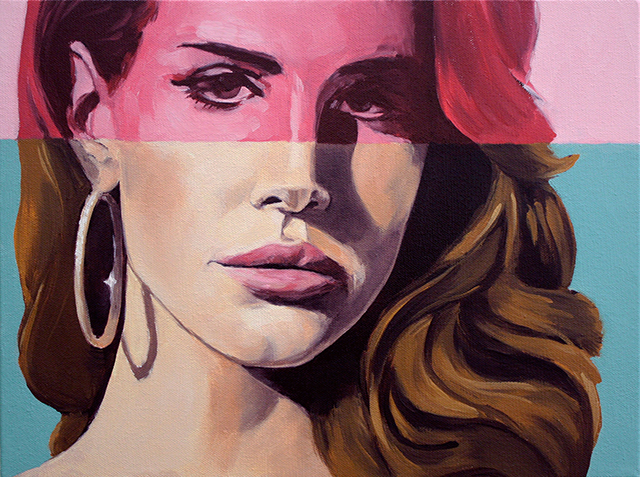
Lana with Hoop Earring and Pink Stripe, oil on canvas, 12” x 16”, 2014.

Lana with Hoop Earring and Pink Stripe, oil on canvas, 12” x 16”, 2014.

Briefly describe the work you do.

My work examines the consumption of pop culture images through the lens of painting. Referencing promotional photographs and stills from television and music videos, I utilize formal disruptions to examine both the desire and discomfort these images instill in me.

Tell us a little about your background and how that influences you as an artist.

As a teenager, I made a lot of drawings based on pages torn from fashion magazines, and I’ve recently been coming to terms with how much that process—and the kinds of images you seen in magazines like Seventeen and Cosmopolitan—continues to influence my practice. As artists, I think we’re all told at some point not to work from photographs, but as an image maker, I’m interested in the idea of looking at media images, and how their meaning can shift when reiterated and then manipulated through painting.

The concept of the “artist studio” has a broad range of meanings, especially in contemporary practice. The idea of the artist toiling away alone in a room may not necessarily reflect what many artists do from day to day anymore. Describe your studio practice and how it differs from (or is the same as) traditional notions of “being in the studio.”

In many ways I have a traditional studio practice, in that I have to be physically in my studio to apply the paint to the canvas. However, I also consider the time I spend thinking about my work to be an integral element in my act of making. Rather than make preliminary sketches, I write pages and pages of notes, outlining what I plan to make, how I plan to execute it, and what effect I want the work to have on the viewer. Often my best ideas come to me when I make the time to sit and wait for them, but it’s through writing about them and interrogating them that I come to understand how to bring them into the studio.

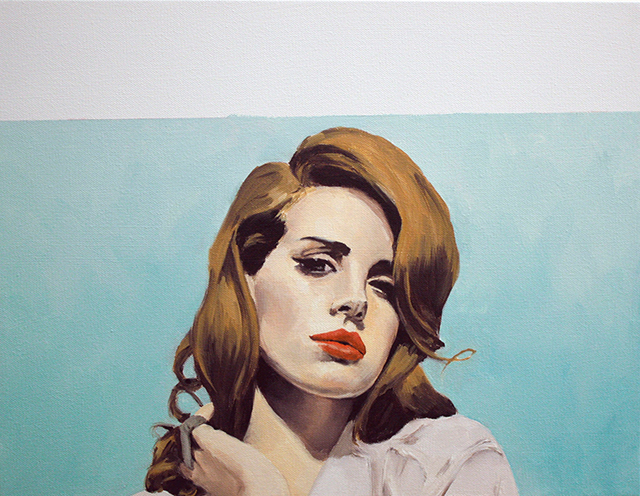
Lana Slipping II, oil on canvas, 14” x 18”, 2014.

Lana Slipping II, oil on canvas, 14” x 18”, 2014.

What unique roles do you see yourself as the artist playing that you may not have envisioned yourself in when you first started making art?

My older work was very personal, with an implied narrative but no straight forward message, so my shift towards engaging pop culture has come as somewhat of a surprise for me. In my day to day life I try to shy away from pop culture—television, magazines, celebrity gossip blogs—but when something in pop culture does grab me, I’m kind of fascinated by my own interest, and the link it creates between me and so many other people. The familiarity that viewers have with the kind of imagery I use allows for an entry point that I’m really interested in.

When do you find is the best time of day to make art? Do you have time set aside every day, every week or do you just work whenever you can?

After a long hot summer in Portland, I’d say that it’s more an issue of weather than time of day. I go to the studio as often as I can, and stay until the heat becomes unbearable. I’m looking forward to the rainy season and long days in the studio.

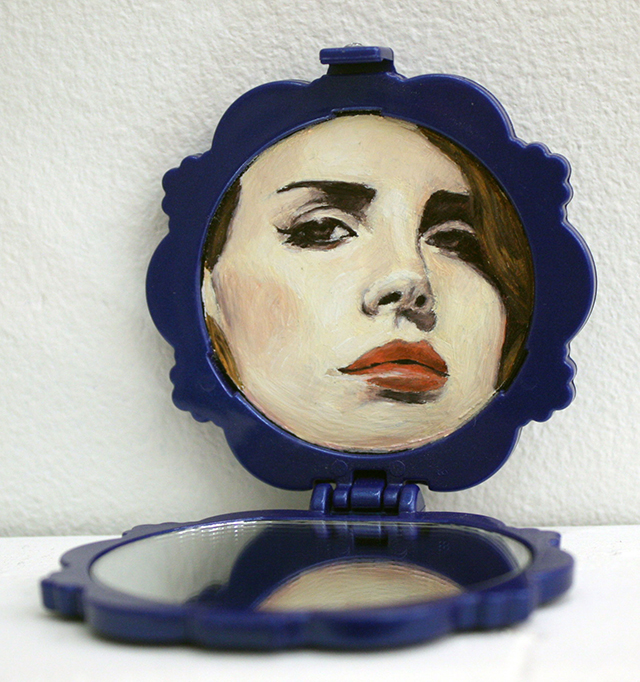
Lana Compact, 2.75” x 2.75” x 2.5”, oil on compact mirror, 2014.

Lana Compact, 2.75” x 2.75” x 2.5”, oil on compact mirror, 2014.

How has your work changed in the last five years? How is it the same?

Over the last five years, I’ve shifted my focus away from what I personally want to get from the work, and have begun to focus more on the viewer’s experience. This shift has required that I ask myself a lot more questions about how the work functions formally and conceptually. I’ve also made big changes to my palette, allowing myself to explore a lot of premixed colors that my painting teachers always warned against. I’ve fallen in love with cobalt violet, radiant magenta, and quinacridone red, to name a few. At the same time, my interest in faces has remained a constant in my work, and will likely continue.

Are there people such as family, friends, writers, philosophers or even pop icons that have had an impact on the work you do?

My mother is painter as well as a portrait artist, and has been an incredible inspiration, teacher, and mentor. I’ve learned a lot from just being around her work, and seeing how her practice has evolved. My recent work has also been highly influenced by the work of Karen Kilimnik and Elizabeth Peyton, both of whom engage pop culture imagery in their work in really exciting ways.

If you had an occupation outside of being an artist, what would that be and why?

The ten-year-old girl in me says Rockstar, and I think there was a short period of time when I wanted to grow up and be Mariah Carey. I don’t think it would work out—I can’t read sheet music and can barely sing—but there’s something so romantic about being on stage, on the road, writing songs that people listen to alone at night. I love a good love song, the kind that on a deep level says exactly what you’ve been wanting to say. I don’t see the rockstar lifestyle meshing with my relatively early bedtime, but I hope that my paintings can be like songs, the ones that stick with you long after the music stops playing.

About

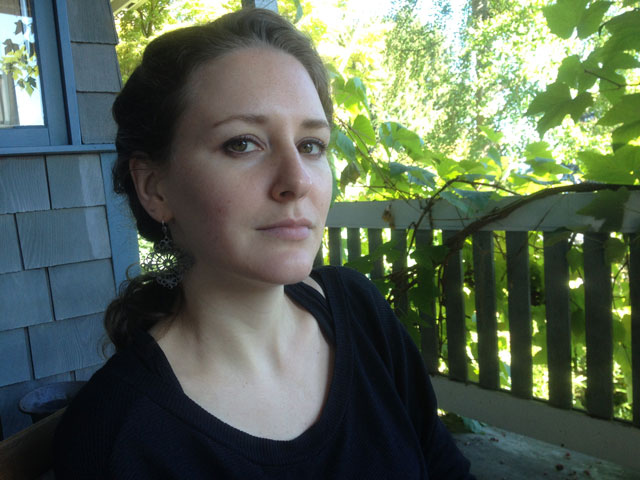
Headshot_RobertsAnya Roberts-Toney is a multidisciplinary artist working primarily in painting. She received her B.A. in Visual Art from Brown University in 2006, and her M.F.A. in Visual Studies from Pacific Northwest College of Art in 2014. Her work has been exhibited in California, Minnesota, New York, Oregon, and Rhode Island. She currently lives in Portland, OR.

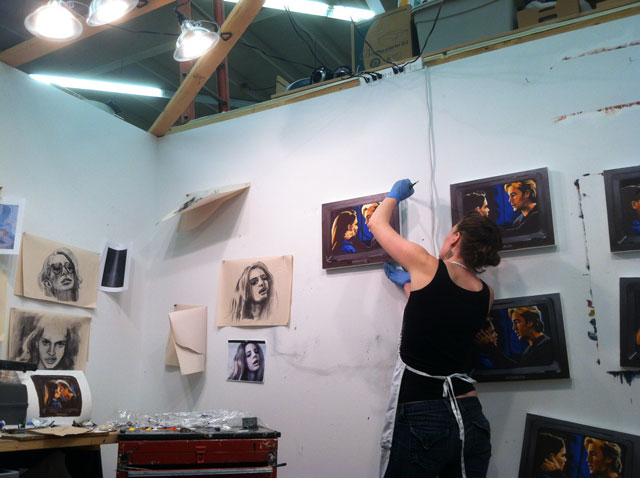
In the Studio

In the Studio

anyarobertstoney.com

 All images copyright of the artist and used with their permission.

Posted in Uncategorized | Tagged , , , , | Leave a comment

Ryan Hawk – Austin, Texas

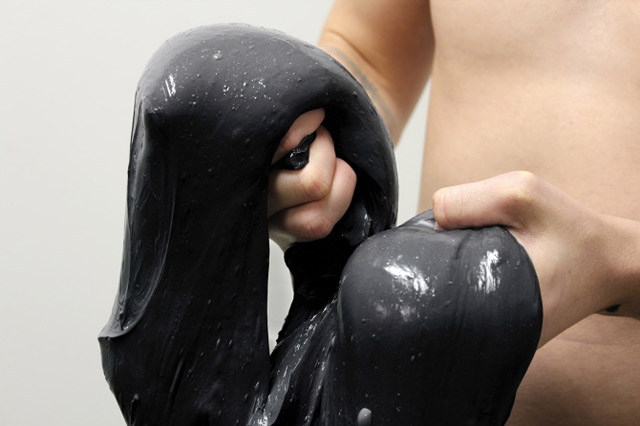
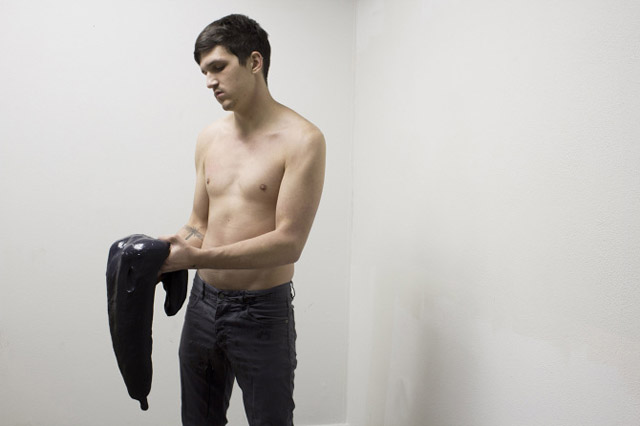
 "Untitled, Drip" Photo documentation of live visual performance. 2014.

“Untitled, Drip” Photo documentation of live visual performance. 2014.

Briefly describe the work you do.

Spanning mediums, my work is concerned with systems of art making as they relate to history, technology and the politics of desire. I often employ formal and aesthetic strategies as a means of questioning our associations with previously prescribed narratives and spaces.

Tell us a little about your background and how that influences you as an artist.

This is new for me to think about. I’m not sure if my personal history/background has informed my work at all, but rather, that my current experiences in the world do. A lot of my work has been concerned with the role of the artist as it relates to the process of viewing or experiencing art. As I first started interacting with the world ‘as an artist’, I immediately became infatuated with the mythology of my role as prescribed and enforced by the public.

More recently, I’ve been trying to understand my position as an artist in the world as a queer. I feel an increasing responsibility for my work to engage with that aspect of my identity, by attempting to create space for other queers to better understand how they interact with the world, or how the world interacts with them. I’ve been ‘out of the closet’ for a while in my personal life, but only recently ‘came out’ in my work.

The concept of the “artist studio” has a broad range of meanings, especially in contemporary practice. The idea of the artist toiling away alone in a room may not necessarily reflect what many artists do from day to day anymore. Describe your studio practice and how it differs from (or is the same as) traditional notions of “being in the studio.”

I definitely need a studio where I currently am with my practice. It serves as a reflection of the mind in the sense that it’s a place where my abstract ideas/concerns are materialized. It would be hard for me to work at a space such as my home or job as there is so much going on. Ideas, even before they are materialized, can take up a lot of space.

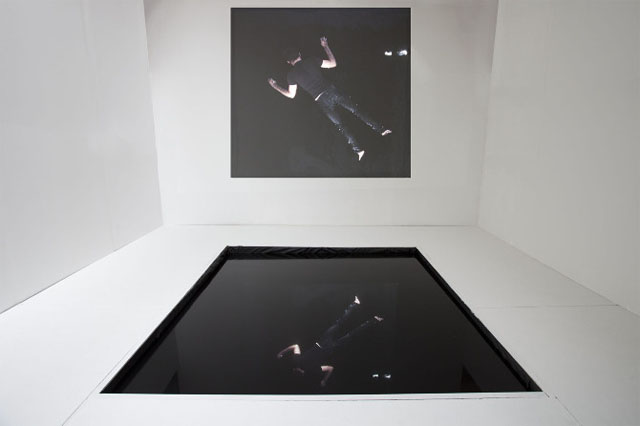
"Repeating Histories" Multimedia installation consisting of black reflecting pool, performance for the camera, and video projection. 2013

“Repeating Histories” Multimedia installation consisting of black reflecting pool, performance for the camera, and video projection. 2013

What unique roles do you see yourself as the artist playing that you may not have envisioned yourself in when you first started making art?

I think artists have a lot of responsibility given the history of art. I find myself constantly debating the ethics of my decisions and what or how the work is communicating. Artists are put on a platform and constantly critiqued, therefore I’ve become incredibly self-aware and the more I think about it, most of the artists that I really respect are incredibly responsive to their own actions. This is separate from ego though, as I also think in order for work to be effective, it needs to transcend the artist’s ego.

When do you find is the best time of day to make art? Do you have time set aside every day, every week or do you just work whenever you can? 

I don’t think that there is a consistent or fixed time that I am most productive or creative and if there is, I haven’t figured it out yet. I do have set times that I force myself to be in the studio, though, as there is always something to do even when work isn’t in production. Also, if I’m fully engaged with a project it’s hard for me to be social as I’m constantly thinking about it… I’ll be that person who just nods at you even though I probably have no idea what you’re saying.

"Untitled, Drip" Photo documentation of live visual performance. 2014.

“Untitled, Drip” Photo documentation of live visual performance. 2014.

How has your work changed in the last five years? How is it the same?

Five years ago I was only making drawings and paintings. Since then, the work has expanded into large-scale installation, video, and performance. However, I think the presence of drawing and painting, specifically the tension between the language of painting and the utilization of media, is an easily traceable to my work.

Are there people such as family, friends, writers, philosophers or even pop icons that have had an impact on the work you do?

I think reading various theories and philosophy is crucial to understanding/engaging the context of contemporary art, so I’m constantly reading things. I’m particularly interested in Queer Studies and Epistemology. There’s this essay by Amelia Jones called “decorprealization” that I’ve been returning to lately. Also, a good friend just turned me onto “Queer Phenomenology” by Sara Ahmed that I think everyone should read. It’s important.

Also, I can’t forget my teachers. I’ve had some amazing teachers and mentors who have crucially impacted my work in positive ways.

If you had an occupation outside of being an artist, what would that be and why?

I spent an unnerving amount of time thinking about this question. Unfortunately the only sincere answer I can think of is that when I was younger, I really wanted to be a pop singer. I’m a terrible singer though.

About

headshotRyan Hawk (b.1992 Houston, TX) is a visual artist, curator, and arts organizer focusing in performance, video, sculpture, and drawing. Hawk’s work has been shown in several venues throughout New York, Boston, exhibited at Chicago’s Rapid Pulse International Performance Art Festival, Select Industries at Miami Basel 2012, as well as several international performance art festivals. Most recently, he had a solo exhibition at the Art League Houston in Texas and was included in a group show at the Museum of Fine Arts in Nagoya, Japan. Ryan Hawk received his BFA from the School of the Museum of Fine Arts, Boston and is currently an MFA candidate in studio art with a focus in Transmedia at the University of Texas, Austin.

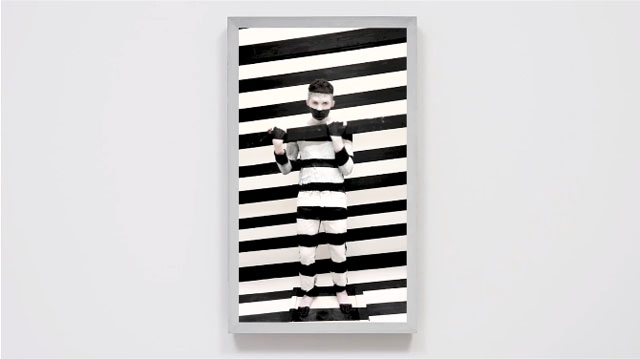
"Balance" HD video in framed LCD monitor. 7min loop. 2013

“Balance” HD video in framed LCD monitor. 7min loop. 2013

cargocollective.com/RyanHawk

 All images copyright of the artist and used with their permission.
Posted in Uncategorized | Tagged , , , , | Leave a comment