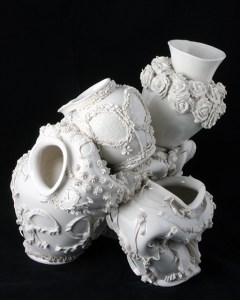
Robert Chamberlain – Boston, Massachusetts

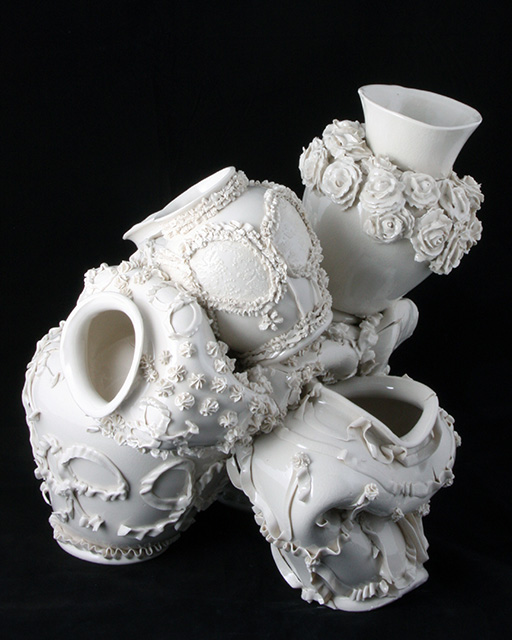
Fountain 10 2014 Porcelain with porcelain decoration  16" x 14.5" x 16"
Fountain 10
2014
Porcelain with porcelain decoration
16″ x 14.5″ x 16″
Briefly describe the work you do.

I am a conceptual artist living and working in Boston, Massachusetts where I recently received my MFA from Tufts University and The School of the Museum of Fine Art. Working across media (photography, performance, ceramics etc.) to express ideas and promote conversation. I tackle projects that channel a contemporary socio-political issues like surveillance, sexuality, and domesticity through a personal lens.

Tell us a little about your background and how that influences you as an artist.

I was raised on the move in a military family moving from Germany, South Carolina, California, Massachusetts, Georgia and again to MA. Studying photography in undergrad was vital in my arts education.  Georgia State University was an amazing place to be educated both with its location inside of Atlanta and its opportunity to study both art and indulge in sociology, rhetoric, history and sciences. My final project was a sixth month performance of identity at my job of the time waiting tables.  The project culminated in a book of documents and images.

It was in undergrad that I dabbled in the ceramics department filling all of my electives with ceramics classes becoming an honorary ceramics major.  It was in graduate school at SMFA/Tufts that I went back to clay and as my thesis “Fill Me Up” a 106 piece ceramic installation.  this set me on my continued exploration of desire through porcelain.
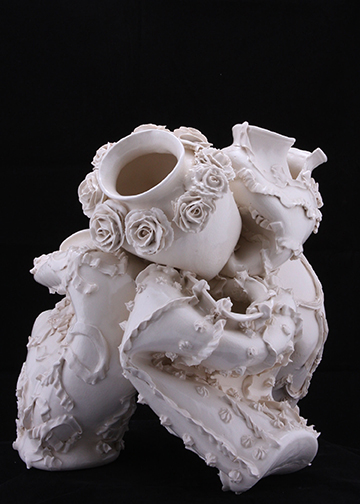
Fountain 04 2014 Porcelain with porcelain decoration  11" x 14" x 15"

Fountain 04
2014
Porcelain with porcelain decoration
11″ x 14″ x 15″

The concept of the “artist studio” has a broad range of meanings, especially in contemporary practice. The idea of the artist toiling away alone in a room may not necessarily reflect what many artists do from day to day anymore. Describe your studio practice and how it differs from (or is the same as) traditional notions of “being in the studio.”

 I think the notion that being an artist means you are struggling over a blank canvas all day waiting for inspiration etc…  is a way out dated and antiquated notion.  While I am sure some artists who identify as a painter do spend some time contemplating the empty space on a canvas, I’m sure they are spending other time reading, researching, and critiquing or doing something outside the limits of the traditional studio.  

My practice is studio and equipment specific most of the time, but that is only considering the physical production of objects.  In order to create a body of work a concept will be thoroughly explored and filtered through that artists lens or voice, in my case lately porcelain. I hold my library time, museum visits, lectures to be just as important if not more than time in my ceramic or digital lab. 

I am currently have a studio in the Harvard Ceramics Program where I am an Independent Artist.  Luckily I live in Boston and am able to take advantage of the many many free talks that are always happening. 
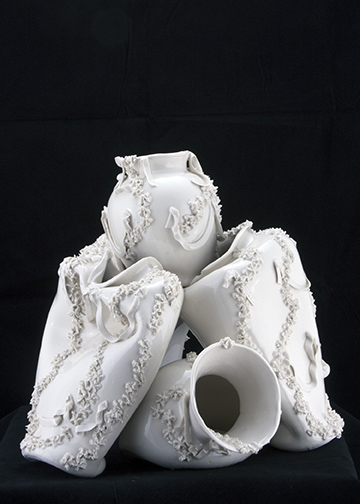
Fountain 03 2014 Porcelain with porcelain decoration  15" x 14" x 14"

Fountain 03
2014
Porcelain with porcelain decoration
15″ x 14″ x 14″

When do you find is the best time of day to make art? Do you have time set aside every day, every week or do you just work whenever you can?

At this point in my career my schedule seems to be constantly shifting and studio time has to adjust around that, sometimes meaning studio from 7am -11:30  going to work and then returning after to finish.  Currently I am able to have two half days devoted to the studio and try to get there during the week if I can.  (talking of my studio as the place of physical work being made)

How has your work changed in the last five years? How is it the same?

My work has changed a lot in the last five years going from a photography focused practice to one that thinks much more broadly about media.  Context will also continue to shift my work, having recently graduated from grad school I have an extreme cut off to equipment.  Living in Boston is also drastically different in terms of living space than Atlanta, GA.  If my computer of camera brake tomorrow or i brake my leg my practice will shift again.

Are there people such as family, friends, writers, philosophers or even pop icons that have had an impact on the work you do?

My family has had a great deal to do with my work and who I am as a person.  My friends and peers are always inspiring me and making me want to push harder and do more!
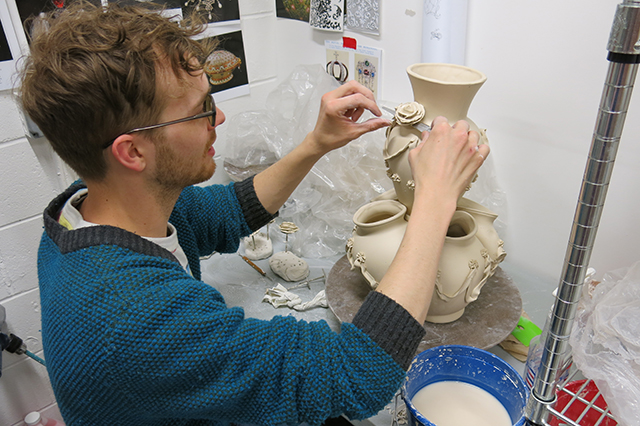
Chamberlin_365_workinstudio2If you had an occupation outside of being an artist, what would that be and why?

I think to have the sole occupation of artist is something that few people experience.  I am a teacher, barista, server, etc  Once in a while I do like to fantasize about being a doctor, but  I think that has more to do with a Grey’s Anatomy fantasy than an interest in medicine.
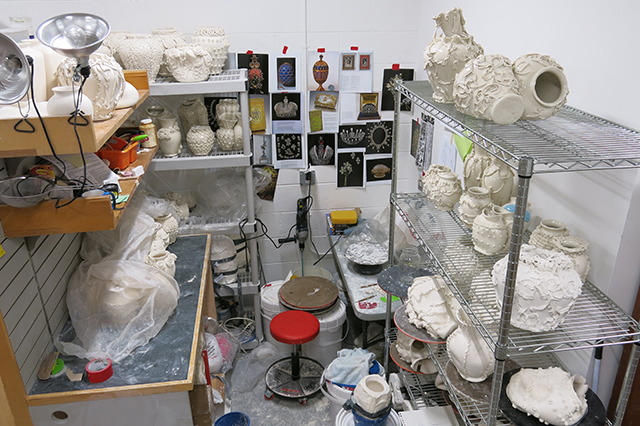
Chamberlin_365_Studio

www.robertchamberlin.com

All images copyright of the artist and used with their permission.
Posted in Uncategorized | Tagged , , , | 2 Comments

Melissa Eder – New York, New York

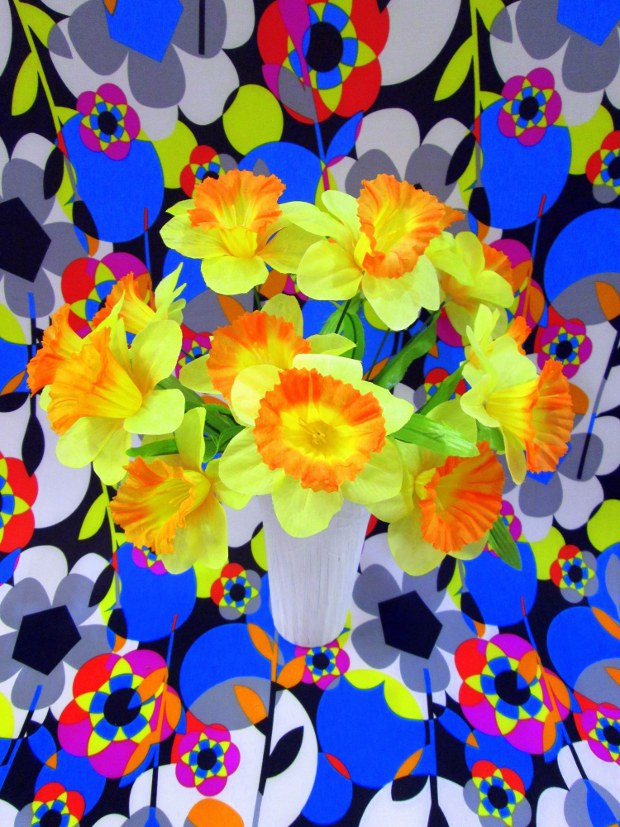
Can You Dig It? A Chromatic Series of Floral Arrangements (Yellow), digital print on metallic paper, 30"x40", 2014

Can You Dig It? A Chromatic Series of Floral Arrangements (Yellow), digital print on metallic paper, 30″x40″, 2014

Briefly describe the work you do.

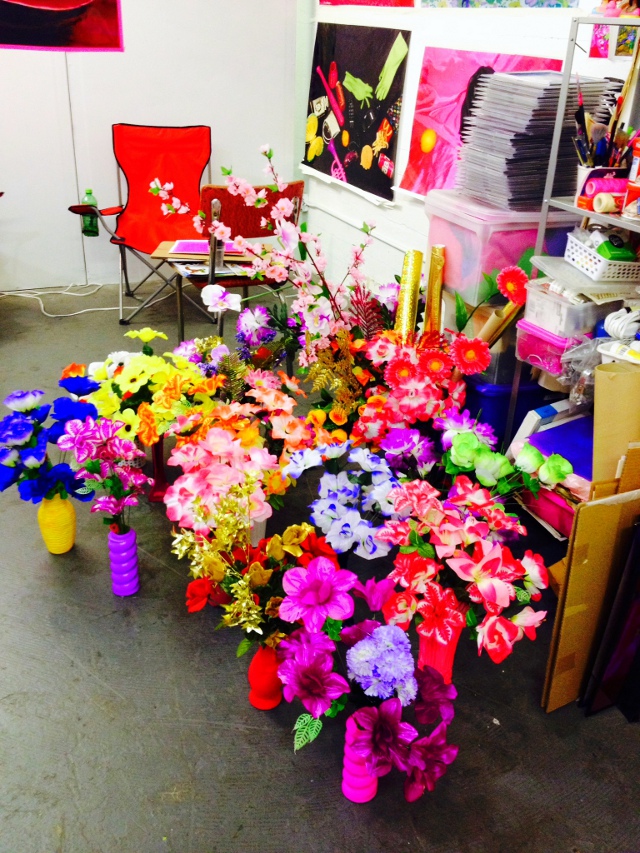
I am interested in exploring ideas related to beauty, popular culture, and kitsch. Can You Dig It? A Chromatic Series of Floral Arrangements is a series of photographs taken of floral arrangements that I have created. This series consists of ten 30” x 40” digital photographs printed on metallic paper. Part of my artistic practice is collecting objects to photograph from 99 cents stores. These ‘fake’ flowers used were gathered from various 99 cents stores found throughout New York City and New Jersey. The backdrops are made out of polyester spandex. Creating each picture has been fun. Quite often, I am surprised by how an arrangement translates into a photograph. These photographs challenge notions related to what is natural and artificial, what is considered to be beautiful and what is considered to be tasteful. By using a low tech camera and lighting, I address this concept of high/low art and the idea of the well-crafted photograph.

Tell us a little about your background and how that influences you as an artist.

I have a degree in painting from the Parsons School of Design where I studied with Sean Scully and I have a Master’s degree in combined media from Hunter College where I studied with Robert Morris and Rosalind Krauss. I realize that my work is greatly influenced by Pop Art. Let me explain. When I was about three or four, I went with my family to see a Pop Art survey show at MOMA in 1967. I can recall my parents pointing out a sculpture of French fries and a painting of a piece of cake. When I got back home to New Jersey, I painted a picture of a piece of cake with a cherry on top. I thought it was great that you could look at everything as art. I still believe this notion to a certain degree. Of course, now, I acknowledge the layers of complexities of meaning(s) that create Western culture on both a personal and larger field.

Can You Dig It? A Chromatic Series of Floral Arrangements (Purple), digital print on metallic paper, 30"x40", 2014

Can You Dig It? A Chromatic Series of Floral Arrangements (Purple), digital print on metallic paper, 30″x40″, 2014

The concept of the “artist studio” has a broad range of meanings, especially in contemporary practice. The idea of the artist toiling away alone in a room may not necessarily reflect what many artists do from day to day anymore. Describe your studio practice and how it differs from (or is the same as) traditional notions of “being in the studio.”

I have worked collaboratively in the past and can appreciate that type of work. Currently, I am an artist in residence with chashama at the Brooklyn Army Terminal. It’s great to be around such creative energy. Still, I have to say that I have moments when I want to be alone in my studio. I am the proud owner of 3 camping chairs (the ones with the cup holders in them)! I find that when I’m in my studio, I sit on my chair, think, daydream and drink a lot of Diet Coke while imagining what I’ll do next when I get up from my chair!

What unique roles do you see yourself as the artist playing that you may not have envisioned yourself in when you first started making art?

That’s an interesting question. When I was younger, I didn’t think about myself as an artist beyond my own art making process. (Boy, I’m a true narcissist!) I wasn’t super into self-promotion etc. I just wanted to make my art. There is still a part of myself that is encapsulated in that creative bubble. I truly feel connected as a person when I’m involved in my art making process. Now, though, I want to share my work with an audience and see how it fits into a larger global context. I’m a believer in the concept that art is about ideas and that discourse and sharing your work, promoting dialogue etc. about art/culture continues to promote growth in a society. I would now like to thank social media and its part in promoting this exchange of ideas! Thanks to the ‘Interweb’!

Can You Dig It? A Chromatic Series of Floral Arrangements (Orange), digital print on metallic paper, 30"x40", 2014

Can You Dig It? A Chromatic Series of Floral Arrangements (Orange), digital print on metallic paper, 30″x40″, 2014

When do you find is the best time of day to make art? Do you have time set aside every day, every week or do you just work whenever you can? 

I am definitely a night owl. I can procrastinate pretty well. If I work late at night, there’s nothing but myself and the wee hours of the morning so I feel like I have to focus. But I will say, if I have a deadline or a show coming up, I’m up early, too.

How has your work changed in the last five years? How is it the same?

My work hasn’t changed that much in the last five years. I still scour the 99 cents stores for inspiration. I will say, however, that I’m trying to push myself and take more ‘personal risks’ in my work than I ever before.

Are there people such as family, friends, writers, philosophers or even pop icons that have had an impact on the work you do?

Hands down, my sister Nancy is a huge influence. She’s an art historian and the smartest person I know. I feel like I can discuss my art ideas and all ideas with her. We spend a lot of time together looking at art. I also listen to tons of music. I can name what music has influenced certain work. Right now, I’m totally into Jerry Garcia and can’t stop listening to the Dead. Also, I’m completely obsessed with BRAVO TV and all of the Real Housewives shows!

If you had an occupation outside of being an artist, what would that be and why?

I’m an educator. I teach Critical Thinking for the City University of New York at a local community college. I love teaching and the exchange of ideas. Being an artist and an educator is exactly why I value living in a free-thinking society.

About

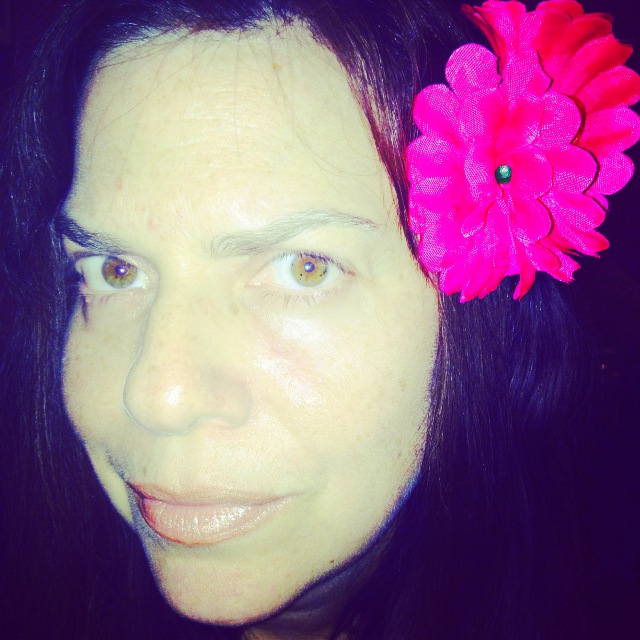
Head shot EderMelissa Eder is an artist who creates photo-based projects that explore notions related to female identity, popular culture and kitsch. Ms. Eder received her B.F.A. in painting from Parsons School of Design in New York City where she studied with Sean Scully and a M.F.A. in combined media from Hunter College in New York City where she studied with Robert Morris and received a Meritorious Award from the Alumni Association. As a visual artist, her work has been shown nationally and internationally in such venues as the Bronx Museum of the Arts, New York University’s Broadway Windows Gallery, Art in General, the Aperture Foundation, the Parlor Gallery, the Charlotte Street Foundation’s Paragraph Gallery in Kansas City, Missouri and in Stadtlengsfeld, Germany where she created a permanent art installation in a former kindergarten. She was an artist-in-residence at the Henry Street Settlement in New York City, the Saltonstall Foundation in Ithaca, New York and the Atlantic Center for the Arts in New Smyrna Beach, Florida as selected by photographer Graciela Iturbide. In 2011, her work was selected by Eric C. Shiner, the director of the Andy Warhol Museum for his curated exhibit on CurateNYC. Her work was also chosen by Sarah Hasted for Photography Now, 2004, for the Photography Quarterly, Woodstock, New York. Her photo book “Can You Dig It? A Chromatic Series of Floral Arrangements” was included in a group show at the Davis Orton Gallery in Hudson, New York. During the summer of 2014, her work was included in the Aperture Foundation’s Summer Open and was chosen from over 860 applicants. She was selected to design a piano for the public art project for Sing for Hope during the summer of 2013 that was displayed at Lincoln Center. She has received numerous grants including funding from the Puffin Foundation and two Manhattan Community Arts Fund grants from the Lower Manhattan Cultural Council. Her work has been reviewed by the New York Times, highlighted in Feature Shoot, Co Design, the Collector Daily and various other publications. She lives in New York City and works in Brooklyn as an artist in residence through the chashama studio residency. She was born in Long Branch, New Jersey on October 8, 1963.

Studio Flowers

Studio Flowers


melissaeder.com

All images copyright of the artist and used with their permission.

Posted in Uncategorized | Tagged | Leave a comment

Kara Gunter – West Columbia, South Carolina

Family Portrait paper, faux fur, wood, metal chain, found objects 22 x 27 x 5 inches

Family Portrait
paper, faux fur, wood, metal chain, found objects
22 x 27 x 5 inches

Briefly describe the work you do.

My concepts, and sometimes my methods and aesthetic, can vary from one body of work to the next. Generally, however, my concepts deal with the Self—my self, and the archetypal self. My current body of work is about the human animal– a meditation on the modern human—and the things we’ve given up, and the things we’ve gained from being members of a civilized society. Our trappings are absurd, in some cases, but I refrain from judgment, and instead rely on surreal humor to have this discussion with the viewer. I’m a fabricator/maker, and my materials and methods vary from casting to sculpting clay, from wood working to assembling found objects, from sewing to collage.

Tell us a little about your background and how that influences you as an artist.

I was raised in a family who worked with their hands. I’m especially influenced by my grandparents, who valued the industry and practicality of craft. My grandmother taught me how to sew, quilt, and crochet. My grandfather worked with wood, leather, and also quilted. Because of this, I pay special attention to craftsmanship. Something well-made is important to me. When helping my grandmother quilt, sometimes she’d fall very silent, and we’d both work, absorbed in flow of the repetition of stitches. This is state I seek when I work. It’s a form of meditation, and I find is most often in repetitive, and sometimes tedious, processes.

The concept of the “artist studio” has a broad range of meanings, especially in contemporary practice. The idea of the artist toiling away alone in a room may not necessarily reflect what many artists do from day to day anymore. Describe your studio practice and how it differs from (or is the same as) traditional notions of “being in the studio.”

I work almost every day. I also teach. I love teaching, but alas, this doesn’t always leave me with long swaths of time to devote to “being in the studio.” I tend to work whenever the opportunity arises, throughout the day. That means, I keep some work close, and leave the messy stuff (like clay) for the studio space, which is located away from my home. Projects which involve sewing or tediousness are often done in the comfort of my living room. Unfortunately, the byproduct of this is sometimes clutter, but it ensures I’m able to get as much work done as possible.

Becoming Death painted earthenware, wood, fabric, found objects 48 x 12 x 12 inches 2014

Becoming Death
painted earthenware, wood, fabric, found objects
48 x 12 x 12 inches
2014

What unique roles do you see yourself as the artist playing that you may not have envisioned yourself in when you first started making art?

I am very introverted, and used to be very shy. Never in a million years, did I think I would be an artist who also teaches. I fell into teaching when a friend asked me to head up an alternative metal-casting jewelry class within the community, right out of undergrad. I thought I was terrible at it, and my voice shook every day we met. My students were older, could see my discomfort and were patient with me. They also loved the course, and wanted more. Teaching was in the back of my head when I started grad school, but it wasn’t something I set out to do.   To my amazement, I found that crafting a lesson plan to teach students about the fundamentals of art, was something I was good at and enjoyed. It never ceases to amaze me that I stand in front of classrooms full of students and teach them how to be artists.

When do you find is the best time of day to make art? Do you have time set aside every day, every week or do you just work whenever you can?

As I stated above, I keep projects nearby so I can constantly have something to work on. I do work almost every day, though life sometimes does get in the way. When I can devote the entire day to working, I will start in the morning as soon as I can, as I’m usually pretty excited to get going.

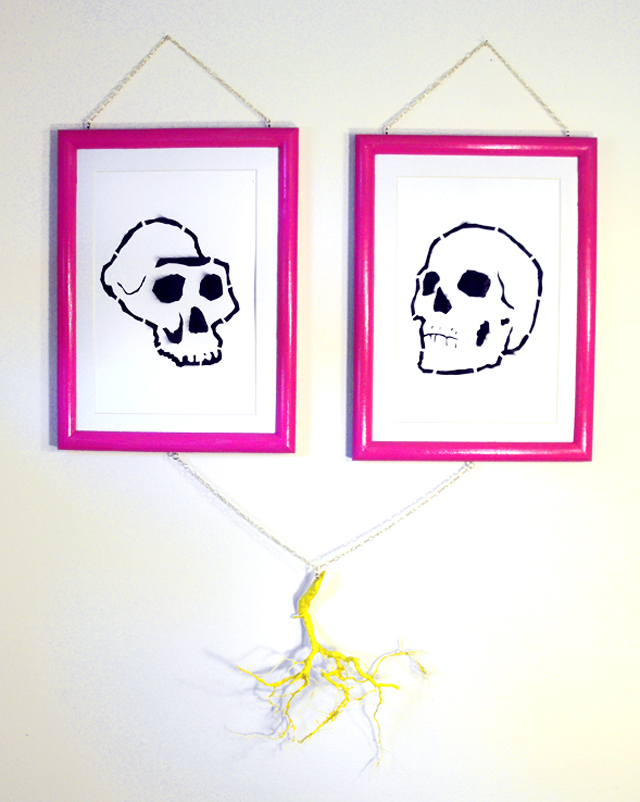
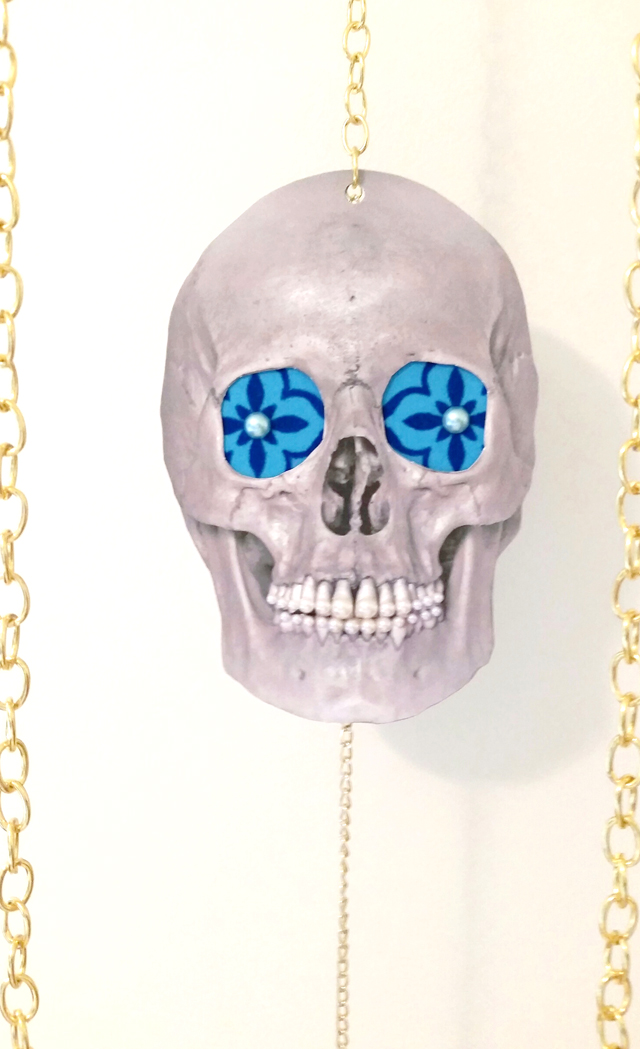
detail of Time (is not on our side) (image of skull)

detail of Time (is not on our side)
(image of skull)

How has your work changed in the last five years? How is it the same?

Five years ago, I finished my masters program. As a student, you have so much feedback which makes the work, oftentimes, stronger. It’s a bit shocking to find yourself in such complete silence when you’ve left school. I’ve struggled with determining on my own, when something works or doesn’t. It’s difficult to always remain objective, and self-doubt can be paralyzing. My work has seen a lot of ups and downs during this time, and I think I’ve occasionally struggled within bodies of work. While, as whole, my art varies in aesthetic from body to body of work (and I’m comfortable with this), I’ve had some issues with remaining cohesive within a particular body. This is symptom of being on my own, I believe, but also in coming into my own and finding my voice. I haven’t always embraced the surreal nature of my work, and I’ve had a reserved and timid approach to getting too “weird”. My grad school and immediate post-grad school work was very controlled and measured. I’ve found myself, lately, on a lot of unfamiliar ground; and sometimes my work can make me very uncomfortable, but I push through it. Overall, I believe I’m growing as an artist and I like where I’m headed. The constant in my work has been the exploration of self.

Are there people such as family, friends, writers, philosophers or even pop icons that have had an impact on the work you do?

My grandparents, as I mentioned, are very influential to me. There are teachers, as well, from my past that have had a big impact on me and my work. I think I’m lucky to have had really great teachers who have provided me with a somewhat formal/traditional education, so I feel I have a very strong foundation to build on. I’m also inspired by my husband, composer Tom Dempster. I felt as though I always had a good work ethic, until I saw the amount of time he devotes to writing his music. We’ve been married for a little over a year, and following his example, I’ve stepped up my game and my approach, and subsequently my work has grown in a way I never foresaw.

As a young person and artist, I was often labeled as weird. And being a shy, introverted kid, well, sometimes that label, though worn as a badge now, wasn’t always so easy to shoulder. Especially, when you’re struggling with such profound loneliness and a desire to belong. It’s taken me a long time to fully accept my oddness, and perhaps I’m still in the process of this. Kiki Smith is an artist I continually revisit, when I feel my nerve begin to wane, when I wonder if something is just too strange. In Smith’s work, I find inspiration, a buoy, and fellowship in weirdness.

If you had an occupation outside of being an artist, what would that be and why?

I do have an occupation outside of being an artist. I’m a teacher! And I enjoy it. My pipedream is to open a school of fine craft in my area, which is not an area that has previously put a lot of importance on the arts. I’d like to change that.

About

365_headshotKara M Gunter was born in 1976 in Lexington, SC.  She earned a BFA in sculpture with an emphasis in small metal works and jewelry in 2000 from Winthrop University in Rock Hill, SC, and continued her education at the University of South Carolina in Columbia earning a MFA in 3-dimensional studies and ceramics in 2009.

Kara has taught at Lander University, South Carolina State University and currently teaches at the University of South Carolina.  She has taught extensively in the community at the Columbia Museum of Art and through residencies at area schools.  Kara writes and acts as assistant visual arts editor for Jasper—The Word on Columbia Arts, a Columbia, SC arts magazine. 
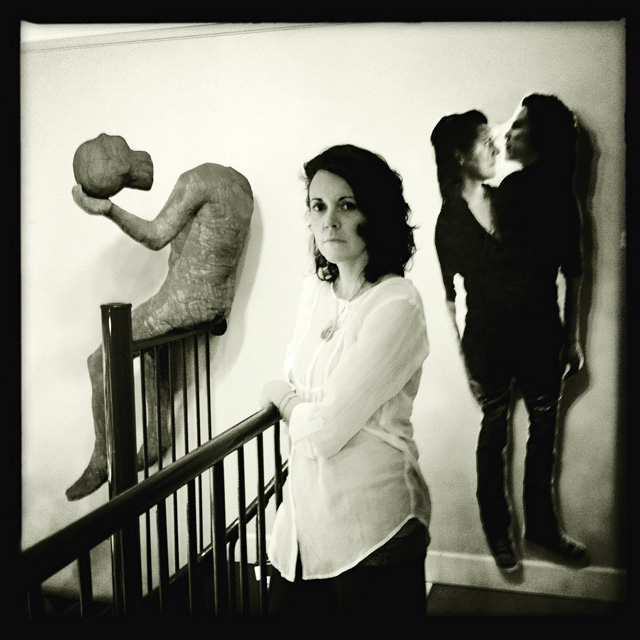
365_me with my work

karagunter.com

All images copyright of the artist and used with their permission.

Posted in Uncategorized | Tagged , , , , | Leave a comment

Kim Matthews – Minneapolis, Minnesota

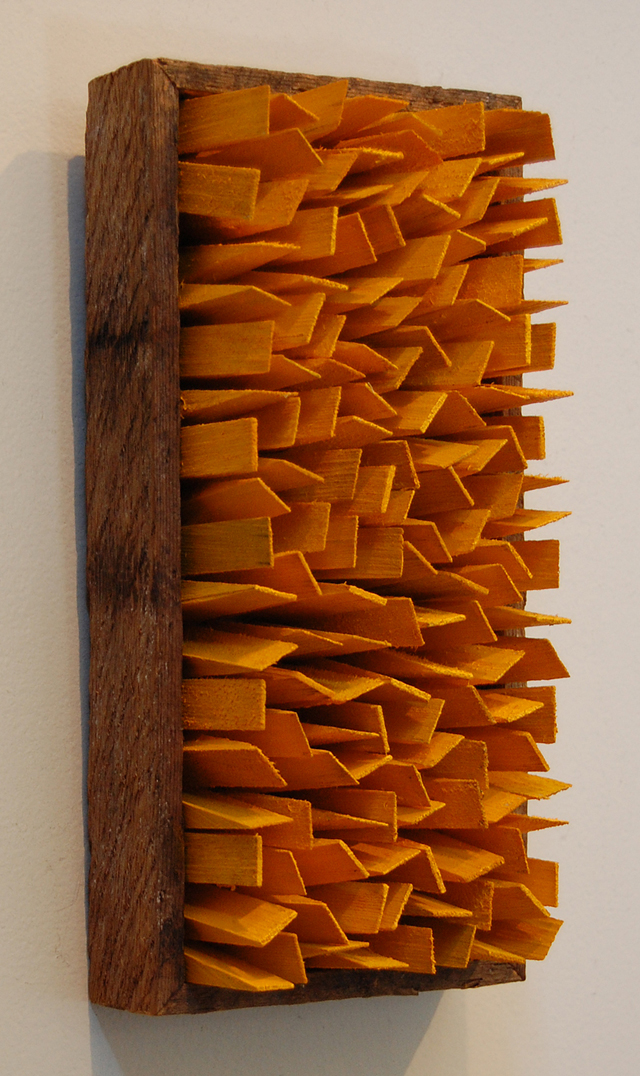
Groomer, 2014. Wood and acrylic on hardboard, 4.75 x 9.75 x 3.5" approx.

Groomer, 2014. Wood and acrylic on hardboard, 4.75 x 9.75 x 3.5″ approx.

Briefly describe the work you do.

I’m a consciousness-based sculptor, meaning that in addition to formal concerns, my work deals with the evolution of consciousness. I started this work as a way to understand what was happening as I got deeper into my meditation practice. My goal is to imbue the works with an energetic quality that leads the viewer inward and enables an immersive experience of quietude. “Slow art” is almost as tired and hollow a phrase as “green (fill in the blank)” but I think that intense engagement is critical to understanding ourselves and our world.
Tell us a little about your background and how that influences you as an artist.

I was born on the Pacific and spent my formative years on the Atlantic. Despite the fact that I’ve been living on the prairie for the past thirty years, the ocean is embedded in my work. I am the youngest of three children and because my siblings were so much older than I, it was like being an only child. I spent a lot of time alone in the woods of Maine and got interested in wildflowers, birds, the natural world in general. The older I get, the more I find that I need that kind of silence and space to think most of the time. I can’t stand the hyperactivity and constant need to be plugged in to electronics that pervades our culture.

I learned how to meditate sixteen years ago, and it brought me back to making art after a very long hiatus and has formed the basis of everything I’ve done since.

The concept of the “artist studio” has a broad range of meanings, especially in contemporary practice. The idea of the artist toiling away alone in a room may not necessarily reflect what many artists do from day to day anymore. Describe your studio practice and how it differs from (or is the same as) traditional notions of “being in the studio.”

I have a conventional studio practice. My studio is in my house, so I can work in the middle of the night if I want to. I read; I look at stuff; I make work. I consider the whole world my studio though—I’m always looking and thinking in terms of my work. There’s no separation between life and work.

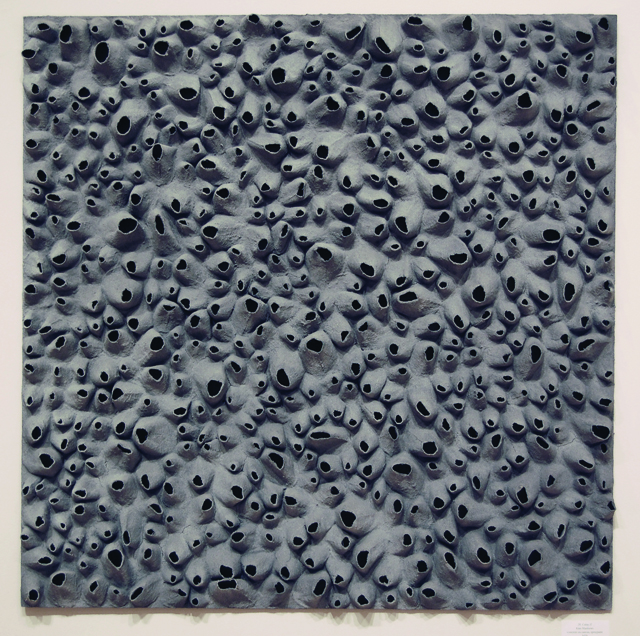
Colony II, 2011. canvas, concrete, acrylic media on hardboard, 44 x 44 x 3" approx.

Colony II, 2011. canvas, concrete, acrylic media on hardboard, 44 x 44 x 3″ approx.

What unique roles do you see yourself as the artist playing that you may not have envisioned yourself in when you first started making art?

This is a cliche but I knew I wanted to be an artist when I was in kindergarten or first grade and other kids used to stand around and watch me draw, so I drew not only because it was fun but because I got praise and attention. I had no idea at that time that I would ever take something fun so very seriously, as though it may actually have some chance of changing the world by encouraging others to look within themselves and live more mindfully.

When do you find is the best time of day to make art? Do you have time set aside every day, every week or do you just work whenever you can?

I have to have a day job to support myself (though I’m currently between assignments). When I’m free, my favorite time to work is definitely beginning in the morning and going all day long, like a 9-to-5. I wish I could do that every day but when I have a job, I’m in the studio after dinner until bedtime. I had to develop a way of working to accommodate the lack of big chunks of free time.

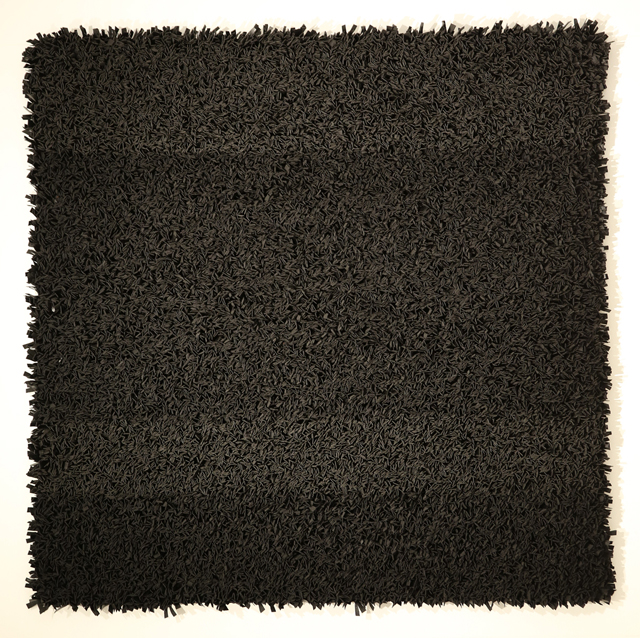
Mahamritunjaya, 2013. Vinyl (pleather) on plastic grid, 44 x 44 x 2" approx.

Mahamritunjaya, 2013. Vinyl (pleather) on plastic grid, 44 x 44 x 2″ approx.

How has your work changed in the last five years? How is it the same?

I adopted a modular, square, monochromatic format about five years ago and started making more reliefs and fewer freestanding works that have gradually become more geometric and less organic. The choice to work with accretion was largely a practical decision based on the amount of time with which I had to work but it’s turned out to be a far richer experience than I could have imagined. I’m not sure how long I’ll stick with my current preoccupation with repetition; it’s not showing any signs of subsiding though. I’m going to be studying metal casting this fall and it will be interesting to see what comes out of that.

Are there people such as family, friends, writers, philosophers or even pop icons that have had an impact on the work you do?

My dear friend, the painter John Rummelhoff has been a mentor for a long time. We’re diametrically opposed in terms of our politics, but we have a mutual reverence for technical and conceptual quality and we exchange books and ideas all the time. He makes my frames and boxes. He’s taught me a lot about technique and materials and encouraged me to loosen up and be more experimental (a futile but noble effort!). He also has drafting skills that would move you to tears.

It’s weird; most of my friends are painters. My friend Tina Blondell is a sensitive, very skilled figurative painter in the tradition of great European masters like Caravaggio, but she finds the heroic, extraordinary, and beautiful in everyday people. I met her through my ex-husband when we were dating, and she gave me my first solo show. She’s been the biggest champion of my work and really gets it even though we do very different things. 

More directly influential in terms of my work would be artists like Eva Hesse, Agnes Martin, and others: Martin Puryear, Eleanore Mikus, the Zero Group. I’ve also been very interested in Tantric and Neo-Tantric art for the past few years and want to go to India to study. I see my work as devotional art or tools, so the Tantric paintings of Rajasthan (such as those shown several years ago at Feature Gallery in the Tantra Song show) are of particular interest to me.

If you had an occupation outside of being an artist, what would that be and why?

I support myself as a graphic artist, proofreader, and occasional technical writer, but if I hadn’t been involved in art, I might have gone into science if I were math savvy enough. I’m fascinated by quantum physics and how current developments are demonstrating scientifically what rishis have been saying for hundreds of years.

About

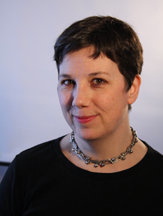
headshotMinneapolis-based Kim Matthews works in a variety of sculptural media ranging from paper to wood, exploiting each medium’s unique properties while utilizing a format of numerous repeated forms often in a square or cubic presentation. The use of accretion to create her works evolved from both practical concerns—the need to be productive with little available studio time—and spiritual ones, as repetition is evocative of the mantra meditation that shapes her daily life.

The recipient of a 2010-2011 Jerome Fiber Artist Project Grant, Ms. Matthews exhibits locally and nationally and has had the honor of exhibiting alongside such notable sculptors as Ferne Jacobs and George Morrison. Her work is currently featured in Focus: Fiber at the Erie Museum of Art, Erie, PA and will be on exhibit in New Fibers at Eastern Michigan University Ypsilanti, opening on 10/27, as well as in a solo exhibit: Abhyasa: Recent Works by Kim Matthews, at the University of Wisconsin, La Crosse opening on Friday, October 17.

detail, Relief for Sohan Qadri, 2013. Acrylic and canvas on hardboard. 12” x 12” x 2.5"  approx.

detail, Relief for Sohan Qadri, 2013. Acrylic and canvas on hardboard. 12” x 12” x 2.5″ approx.

kimmatthewsart.com

All images copyright of the artist and used with their permission.

Posted in Uncategorized | Tagged , , , | Leave a comment

Aldobranti Fosco Fornio – Petersfield, Hampshire, UK

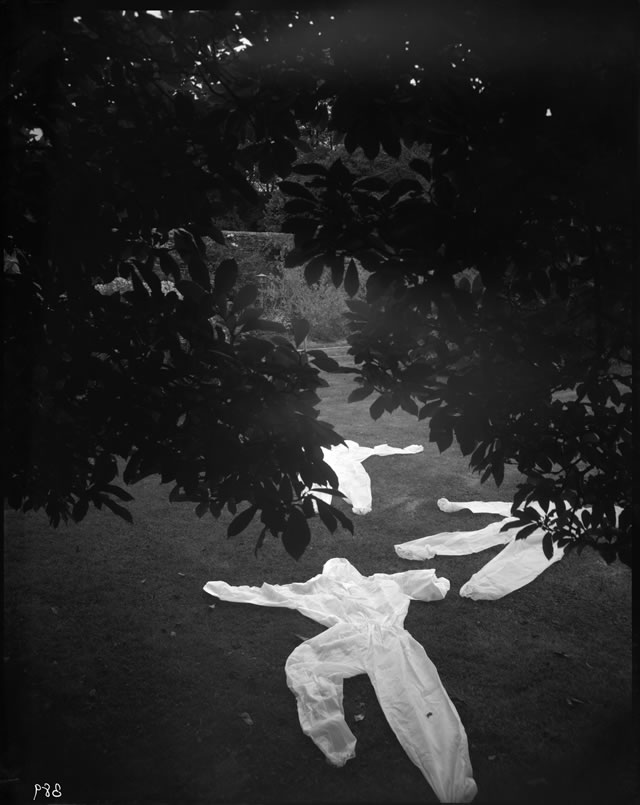
where shadows play  #389 medium monochrome large format photograph (8x10), with protective work suits size 16 inches w x 20 inches h year 2014

where shadows play #389
medium monochrome large format photograph (8×10), with protective work suits
size 16 inches w x 20 inches h
year 2014

Briefly describe the work you do.

I am increasingly understanding my process as that of a researcher understanding my world through a drive to make images that I cannot describe in advance – my curiosity about the image , what it will look like , what its affect is &c &c

Much of my work over the last four years has been the study of my shadow, a metaphysical conceit of a separated and independent entity.

Tell us a little about your background and how that influences you as an artist.

My early graduate and postgraduate degrees were as a Mathematician, this means that Pattern is an immediate stimulus. I was fortunate enough to ride the crest of the computer wave: I had an internship with the guys who put the ArpaNet together and then worked across a fascinating range of emerging ideas with Artificial Intelligence and Parallel Logic Programming for just two – I was always very interested in Language and Symbol.

The concept of the “artist studio” has a broad range of meanings, especially in contemporary practice. The idea of the artist toiling away alone in a room may not necessarily reflect what many artists do from day to day anymore. Describe your studio practice and how it differs from (or is the same as) traditional notions of “being in the studio.”

I tend to move around during the day—the internet has made us all very sedentary in habit. I will spend time with my desktop computer sitting upright in an approved orthopaedic fashion. Then I’ll slump on a sofa with my laptop; back to the darkroom where I must stand and when I begin to flag, then off to the kitchen to cook for us all.

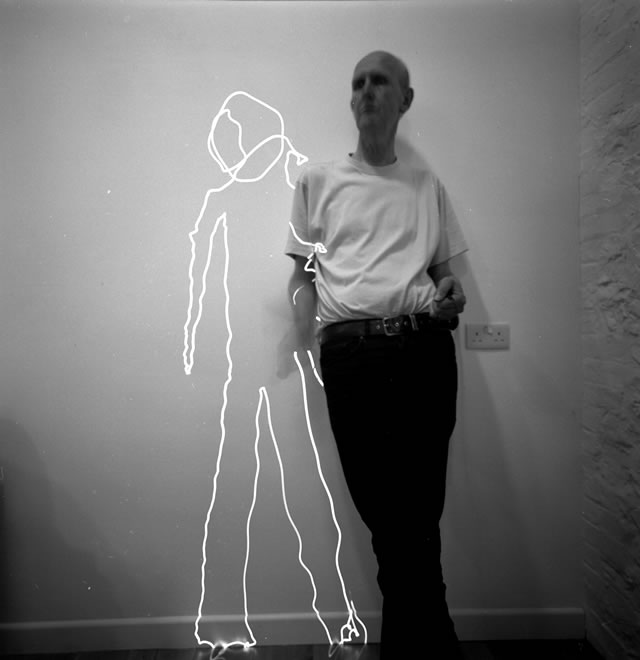
two is company #360 medium: monochrome analog MF photograph, artist draws with laser pointer into mirror size 20inch x 20inch date 2014

two is company #360
medium: monochrome analog MF photograph, artist draws with laser pointer into mirror
size 20inch x 20inch
date 2014

What unique roles do you see yourself as the artist playing that you may not have envisioned yourself in when you first started making art?

As l do more, I believe that networking and supporting other artists is the way to really develop as an artist. You only get so far by looking at the luminaries of the art world – seeing myself as others see me helps me develop far more strongly.

When do you find is the best time of day to make art? Do you have time set aside every day, every week or do you just work whenever you can?

I think about making art at every turn, I write a great deal in my notebooks and this will emerge in constructed work sooner or later.

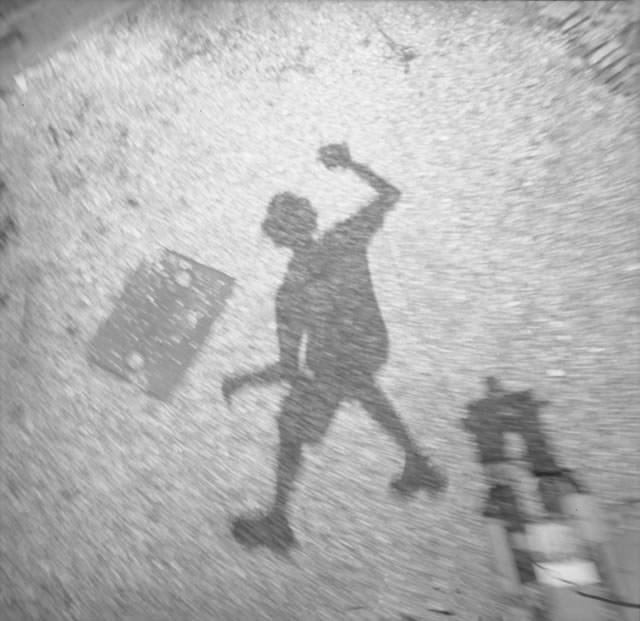
jumping shadow #157 medium: MF analog image, with electronic sensor controlled shutter release size: 20inch x 20inch date: 2013

jumping shadow #157
medium: MF analog image, with electronic sensor controlled shutter release
size: 20inch x 20inch
date: 2013

How has your work changed in the last five years? How is it the same?

I am slowly understanding how my work is about things and not of things. It is less photographic and much more narrative so, I am still making marks by photographic process—the large format work goes on as a meditative process and I recently made a volume of work in the Naked Portrait tradition. It was fun to rise to the challenge of my MA class and make work that stepped outside of the photographic.

Are there people such as family, friends, writers, philosophers or even pop icons that have had an impact on the work you do?

I wouldn’t do any of this without the love and support of my family, of my network and classmates. In particular I support my partner’s projects and then sometimes make work that is quite distinctly orthogonal to clarify my understanding of her work. Having placed all these influences in the present, one of the delights of spending time in academe again was to discover Poussin for myself.

If you had an occupation outside of being an artist, what would that be and why?

I am not short of other occupations, it is part of being a living artwork process that these other jobs impinge and creatively delay my progress.

About

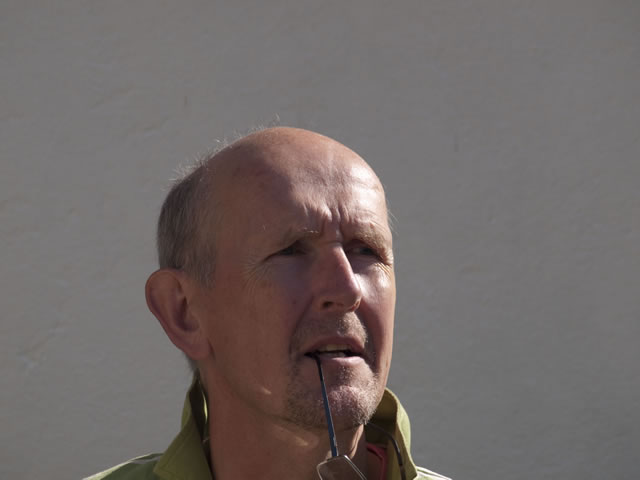
mugshot+heroicBorn in Boston, Mass. USA. Aldobranti gained a MA Fine Art with Distinction from Winchester School of Art, University of Southampton in September 2014. The practice of Aldobranti, a performative name is that of a writer and artist based in the south of England.

wip+120wrappers

aldobranti.eu

All images copyright of the artist and used with their permission.

Posted in Uncategorized | Tagged , , , , | Leave a comment

YK Hong – Brooklyn, New York

As Long As We Have Our Great Leader, We Will Win Wood, acrylic paint, ink 42”x39”x1.5” 2014

As Long As We Have Our Great Leader, We Will Win
Wood, acrylic paint, ink
42”x39”x1.5”
2014

Briefly describe the work you do.

I combine traditional Korean techniques and mediums with contemporary Western themes to tackle issues of race, migration, anti-oppression, consumption and mindfulness. 

Tell us a little about your background and how that influences you

as an artist.

I was born in the States, but spent my formative years in Korea, which shaped my idea of multiple cultural and sociopolitical identities, and concepts of home. In Korea, there is an appreciation of the organic material that is intimately tied to everything, which inevitably surfaces in my work. At the same time, I’ve been grounded in the States for the past two decades and that adjustment manifests in my themes throughout.

The concept of the “artist studio” has a broad range of meanings, especially in contemporary practice. The idea of the artist toiling away alone in a room may not necessarily reflect what many artists do from day to day anymore. Describe your studio practice and how it differs from (or is the same as) traditional notions of “being in the studio.”

Because I incorporate my artwork with every aspect of my life, my activist work, my political work, my social and familial influences, so too has my workspace become integrated into everything I do.

I have a studio off of my apartment but end up using my entire apartment for different moments of the production of my art. In a way my time in my studio is a practice in versatility of location; I have different “stations” in areas of my home where I do specific tasks.

DoJang Series Carved wood, acrylic ink 43”x43”x1” as shown 2010-2012

DoJang Series Carved wood, acrylic ink 43”x43”x1” as shown 2010-2012

What unique roles do you see yourself as the artist playing that you may not have envisioned yourself in when you first started making art?

Even though I often use language and text in my work, I find that the underlying intention of the piece translates universally across languages and cultures. With art I can push boundaries and issues are often received with more inhibition in other contexts. I can address issues of racism, commercialism and oppression in a less formal way than I do with my workshops. It adds more dimensionality to modes of communication and relatability.  

When do you find is the best time of day to make art? Do you have time set aside every day, every week or do you just work whenever you can?

I work on my art every day throughout the day in small increments. 
Smissiles: Stand Here Wood, acrylic paint, ink 52”x34”x1”, varies 2014

Smissiles: Stand Here
Wood, acrylic paint, ink
52”x34”x1”, varies
2014

How has your work changed in the last five years? How is it the same?

My work changes pretty radically every few years, mostly because of new techniques, experimentation with different mediums and inspirations. The message, however, remains the same; it is about social justice, and transforming our current structures through creative thought.

Are there people such as family, friends, writers, philosophers or even pop icons that have had an impact on the work you do?

I’m inspired by movements, historic and cultural. I’m inspired by traditions of my Korean culture, as well as how tradition clashes or meshes with contemporary culture. I don’t usually specify individuals when I’m asked this question, one, because there are so many, and two, because as with my style of work, the people and pieces that influence me ebb and flow, from person to person.

If you had an occupation outside of being an artist, what would that be and why?

Along with being an artist, I already have an occupation of traveling around the world giving trainings on anti-oppression, meaning I talk to people about racism, sexism, classism, ageism, ableism, heterosexism and more. I’ve been doing this for almost 20 years now and it is profoundly tied to my creative work. 

About

headshot_1Born in the States, raised in Korea and based out of Brooklyn, NY, YK uses traditional Korean artistic techniques paired with experimental contemporary methods. She often works in wood, combining its inherent grit with often jarring human elements. She uses text and imagery that are reminiscent of propaganda, to make commentary on its proximity to Western advertising, specifically tackling issues of identity, race, the division of land, migration, mindfulness and conspicuous consumption. 

In addition to being a visual artist, she gives trainings and talks around the country on anti-oppression and mindfulness, and recently gave a TED Talk entitled, “How Having Nothing is Having Everything” talking about her project called 365 Release, where she gave away one thing a day every day for a year to practice letting go and change. 

In the Studio

In the Studio

www.ykhong.com/ykart

All images copyright of the artist and used with their permission.

Posted in Uncategorized | Tagged , , , , | Leave a comment

Virginia Broersma – Long Beach, California

At Home oil on canvas 60 x 48 inches 2014

At Home
oil on canvas
60 x 48 inches
2014

Briefly describe the work you do.

The way I think about my paintings is that I use the vocabulary of the human form – the colors of its flesh, its contortions and protrusions, its extensions,curves and crevices – as the components from which I develop my subjects. I’m interested in how we present the body and the human image when we try to pin it down in a still, two-dimensional image – particularly in painting – and how it becomes more complicated the less straightforward it is.

Tell us a little about your background and how that influences you as an artist.

Every summer of my childhood, my family would take a long road trip around the US, visiting National Parks, historic landmarks, geologic wonders, distant relatives, and going down countless unknown roads. My parents encouraged exploring, seeing new places and being interested in how people do things differently from me, and this has given me a curiosity and openness to the unfamiliar. I was also always encouraged to pursue the things that interested me – music, reading, writing, art – so I have grown up feeling empowered to go after my inclinations.

The concept of the “artist studio” has a broad range of meanings, especially in contemporary practice. The idea of the artist toiling away alone in a room may not necessarily reflect what many artists do from day to day anymore. Describe your studio practice and how it differs from (or is the same as) traditional notions of “being in the studio.”

My studio is definitely the place where I, as an artist,  toil away alone in a room. It’s the space I go to work-  away from everyone else – that is completely governed by me and only me. This is both incredibly electrifying and gives me comfort, which allows it to be a place I look forward to going to. The toiling comes in with the challenges I give myself with the work – I often work on several paintings at once, each with a different problem or approach I am tackling, and usually with a variety of scales. If I ever get stuck or need some time away from a piece, I will always have something else to work on so I can stay productive, while also taking my time.

The Bath oil on canvas 60 x 48 inches 2014

The Bath
oil on canvas
60 x 48 inches
2014

What unique roles do you see yourself as the artist playing that you may not have envisioned yourself in when you first started making art?

I’ve always had more roles that interest me than I can actually fill, so I am still working on attaining all I envisioned I would do as an artist.

When do you find is the best time of day to make art? Do you have time set aside every day, every week or do you just work whenever you can?

Right now I have a routine which I’ve found works really well for me. I split my time between my “day job” (which at this point I still need for income) and working in my studio. Luckily I’ve been able to work it out so that I can be in the studio 5+ days a week, for a decent amount of time. I strategically took a day job where it is geographically easier to go to my studio than home so going to the studio after work (and avoiding traffic) is always the better option. I find that I am much more productive if the decision to be at the studio has already been made, and once I’m there I can’t help but want to work. I think a key component of having an art career is making the time in the studio the priority, regardless of being in the mood or how many other things are competing for your attention.

Nocturne oil on canvas 54 x 38 inches 2014

Nocturne
oil on canvas
54 x 38 inches
2014

How has your work changed in the last five years? How is it the same?

It has changed significantly. When I first became interested in working with the portrait, I headed (no pun intended) in a very representational direction where I relied heavily on photographic references. I think this was an important phase to go through because I gained many skills for capturing an accurate likeness, but I realized the work was lacking in the singularity I could bring to it if I allowed myself to follow my instincts rather than a source. So, my paintings have moved away from specific references to being developed through the undertaking of painting. The forms I am working with now are highly invented.

Are there people such as family, friends, writers, philosophers or even pop icons that have had an impact on the work you do?

Undoubtedly.

If you had an occupation outside of being an artist, what would that be and why?

I am often occupied by a good book and cup of coffee, so I would take that as an occupation.

About

Broersma headshotVirginia Broersma (b. San Diego, CA) received her BFA in Painting from the Savannah College of Art and Design in Savannah, GA in 2004. Recent exhibitions include a solo show at Autonomie in Los Angeles, CA and Fermilab Art Gallery in Batavia, IL and group exhibitions at the Museum of Art and History in Lancaster, CA and at JAUS, Autonomie, and with 5790projects in Los Angeles, CA. Upcoming exhibitions will include the Yokohama Triennial and  a group show that will be traveling to the Palazzo della Provincia de Frosinone in Italy, the Oceanside Museum of Art and the Riverside Art Museum in Southern California. Broersma has been the recipient of a several grants including funding from the California Institute of Contemporary Arts, the Puffin Foundation and was awarded a Community Arts Assistance Program grant from the City of Chicago, IL, which she received in both 2010 and 2011. Broersma currently lives in Long Beach, CA.
Broersma in studio by EMS

Broersma in studio by EMS

virginiabroersma.com

All images copyright of the artist and used with their permission.

Posted in Uncategorized | 2 Comments

Aaron Bos-Wahl – Queens, New York

Linda, 2011, Pencil and watercolor on paper, 9” x 7”

Linda, 2011, Pencil and watercolor on paper, 9” x 7”

Briefly describe the work you do.

My creative activity rests on the idea of interconnection as an ecological and spiritual reality. I engage in artmaking, in part, as a form of spiritual practice – attempting to touch the fundamental. Often taking the form of delicate drawings and watercolors, as well as multi-media installations, my work presents windows through which to glimpse the substance of emptiness, the significance of the commonplace, the warmth of the familiar. The everyday is the sacred.

Tell us a little about your background and how that influences you as an artist.

I grew up in Wisconsin and Iowa with one foot in the city and one in the country. My imagery reflects the Midwest. The near-absence of the prairie and indigenous peoples in Iowa has always been poignant for me. When I was still a child probably I became
vividly affected by notions of loss and a desire to memorialize. I think this sadness, and it’s companion – celebration, inform my work today. Also, my parents are both artists and activists, so I was always surrounded by poetry, music and other art, and I was given a broad education that included aspects of botany, ecology and social justice issues. These things relate to old values and a “wakefulness” that goes back to Whitman, Thoreau and the Buddha.

The concept of the “artist studio” has a broad range of meanings, especially in contemporary practice. The idea of the artist toiling away alone in a room may not necessarily reflect what many artists do from day to day anymore. Describe your studio practice and how it differs from (or is the same as) traditional notions of “being in the studio.”

I like traditional notions of being in the studio, because I feel like nowadays there is a mild stigma attached to being alone, or people try to avoid it. Sitting alone and making art and enjoying the isolation is a beautiful experience, and I think everyone should do it more.Also, I don’t have a lot of time in the studio, working to make ends meet in New York. So, sometimes it’s finding things on the street on my way home that I want to incorporate into a work, or writing in my notebook or just walking in the park. And these things are critical to my practice. So, the studio really bleeds out into everyday life, just like Buddhist practice – it’s all one practice, all the time.
Untitled, 2014, pencil and watercolor on paper, 16” x 21”

Untitled, 2014, pencil and watercolor on paper, 16” x 21”

What unique roles do you see yourself as the artist playing that you may not have envisioned yourself in when you first started making art?

As the artist has become less specialized than she may have been historically, she learns more of a diversity of skills. For me, this has included learning how to work with my hands in a broad variety of ways, as well as with technology. Also, I did not necessarily anticipate being such a collector of ephemera. Collecting has really become important to my practice. These physical objects as well as ideas or texts are then reinterpreted or re- presented in my work.

When do you find is the best time of day to make art? Do you have time set aside every day, every week or do you just work whenever you can?

I wish I had the luxury to make those decisions, but I’ve always been someone who has to work a day job (or two). I love working in the morning though. And working at night and listening to music all by myslef and taking a break to dance.
Untitled, 2013, pencil and watercolor on paper, 12” x 9”

Untitled, 2013, pencil and watercolor on paper, 12” x 9”

How has your work changed in the last five years? How is it the same?

It has broadened. My perspective has broadened. I’ve been able to define what I’m interested in better. I think it has matured (now I’m a teenager in art years – ha). I have experimented a lot in the last five years, and I feel some of these explorations have come full circle now and are maturing. I’m still really interested in people, craft and awkwardness – which I feel really conveys the human condition.

Are there people such as family, friends, writers, philosophers or even pop icons that have had an impact on the work you do?

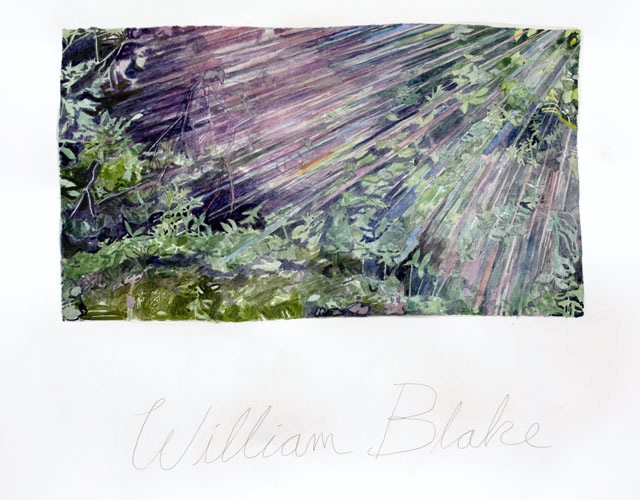
Everyone has impacted my work. My parents and family have been crucial, as well as all my teachers and peers. People are important, but cultures are probably more important. Visionary and folk artists make some of the best, most lively work that exists. Music has had a strong influence on me, most notably Irish and American traditional music, early American blues and hardcore/punk. I have a romantic interest in a lot of pop icons of art, literature and music – mostly from the past. I’m really drawn to those who seem to yearn for experience, yearn to touch God, or the sacred, yearn to touch the fundamental or the unseen (the magic and mystery of the world). Like Kerouac wrote, “the mad ones, the ones who are mad to live, mad to talk, mad to be saved, desirous of everything at the same time [who] burn, burn, burn like fabulous yellow roman candles.” Writers and artists that have influenced me include Whitman, Thoreau, Kerouac, Gary Snyder, Wendell Berry, Shunryu Suzuki – William Blake, Alice Neel, Mary Cassatt, Frida Kahlo, Ann Hamilton, Tim Gardner.

If you had an occupation outside of being an artist, what would that be and why?

I would be a kindergarten teacher or work professionally on issues of poverty or environmental advocacy. There are so many good uses of one’s time.

About

Bos-Wahl_Aaron_headshotAaron Blake Bos-Wahl was born in Milwaukee, Wisconsin and grew up in both Wisconsin and Iowa. He received a BFA in painting and a BA in English from the University of Iowa, and he earned his MFA from Washington University in St. Louis in 2010. He has taught art at Washington University in St. Louis and Mt. Mercy University in Cedar Rapids, IA. Currently, he lives and works in Queens, NY. His work has been shown at the Mildred Lane Kemper Art Museum, the Cité Internationale des Arts in Paris, France and will comprise a solo exhibition in 2015 at The Virginia M. & Edward Juergensen Gallery at Mohawk Valley Community College in Utica, New York.
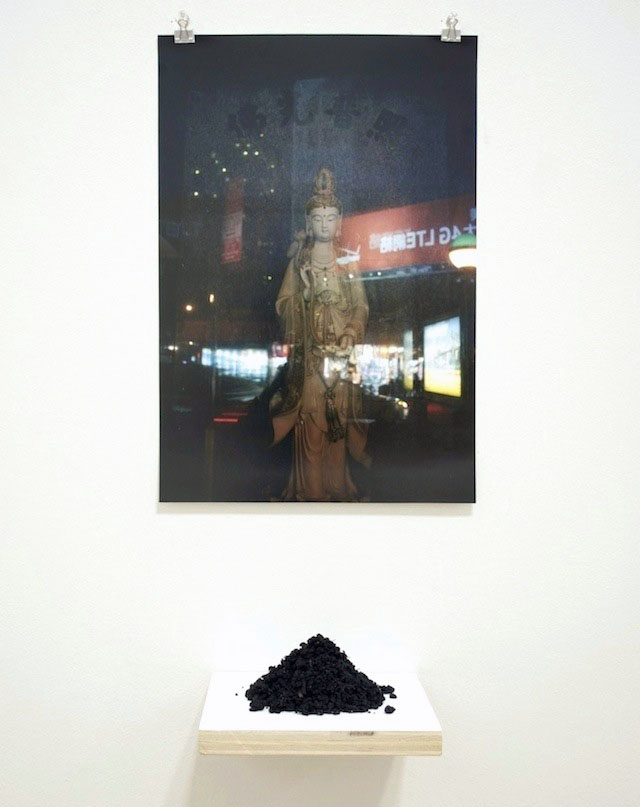
Detail: Untitled (Kwan Yin), 2014, photographic print, earth and shelf, 5 1⁄2’ x 12” x 6”

Detail: Untitled (Kwan Yin), 2014, photographic print, earth and shelf, 5 1⁄2’ x 12” x 6”

All images copyright of the artist and used with their permission.

Posted in Uncategorized | Tagged , , , , | Leave a comment

Molly Segal – Los Angeles, California

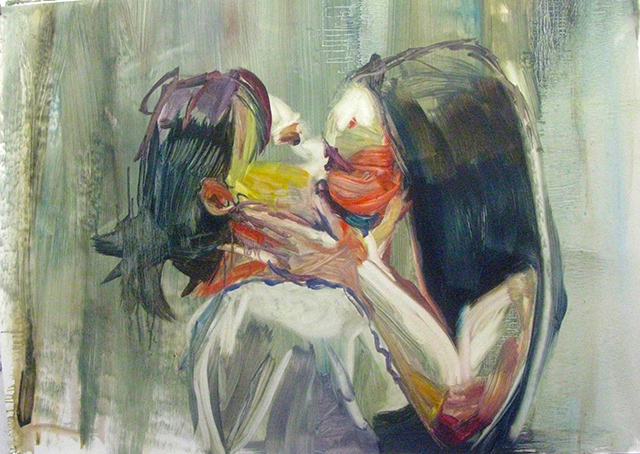
White Girls Kissing, oil on paper mounted onto panel, 31" x 43", 2012

White Girls Kissing, oil on paper mounted onto panel, 31″ x 43″, 2012

Briefly describe the work you do.

My painting practice explores psychological ambiguities within intimate spaces. I use personal experiences and relationships as a starting point to investigate ideas about fear, desire, recklessness, and honesty. Currently, I’m working on a portrait project about my assumption that most men I know want to have sex with me. I work primarily in oil and watercolor on paper.

Tell us a little about your background and how that influences you as an artist.

I think growing up in Oakland, CA had a huge influence on me. My hippie/commie parents raised me with this idealistic optimism, but navigating adolescence in the city streets kind of chipped at some of my naiveté and gave me a wary, matter-of-fact skepticism about the world. It left me something of a critical humanist and I think that seeps nto my work.

I was also really influenced by the intense friendships I had with other young women growing up. The ways that boundaries get murky, and the way a relationship can be many things at once is rich soil for me. I’m fascinated by interpersonal relationships, especially the way something can be nurturing and toxic at once. 

I was also totally that little urban kid obsessed with power line silhouettes in the sunset.

Man Project, Installation Shot, n/a, n/a, 2014

Man Project, Installation Shot, n/a, n/a, 2014

The concept of the “artist studio” has a broad range of meanings, especially in contemporary practice. The idea of the artist toiling away alone in a room may not necessarily reflect what many artists do from day to day anymore. Describe your studio practice and how it differs from (or is the same as) traditional notions of “being in the studio.”

I am obnoxiously stereotypical in my studio practice. For me, all of the answers are in the studio and are usually found through making work. Being willing to make bad or failed paintings is sort of a pillar of my practice. Bad work begets bad work begets interesting work. Mistakes, unexpected turns, and a willingness to not be precious are very important to me.

What unique roles do you see yourself as the artist playing that you may not have envisioned yourself in when you first started making art?

Art making has allowed me (or forced me) to speak more truthfully and pointedly on a regular basis. A lot of my work centers around things that make me uncomfortable- that’s why I think they are interesting. By making this work and then having to talk about it, I find that telling the truth about my experience becomes less and less awkward. I’m really interested in exploring honesty and the limits of its usefulness. What happens when you explicitly talk about things that we’ve all decided are better left unspoken?

When do you find is the best time of day to make art? Do you have time set aside every day, every week or do you just work whenever you can?

My most productive time of day is 2-10pm or so. But it helps for me to be in the studio futzing around for two to three hours before that to sort of warm up. I hate going into the studio knowing that I have an end time. Unfortunately that’s a decadent way to work that I often can’t sustain. But ideally, I love having long studio days.

I also try to treat my studio practice like exercise. It’s important to go in whether you feel it or not and stretch and run drills. Not all days are going to feel good. I had a teacher who really emphasized that some days we just see better than others. But putting in the work helps make those magical transcendent Did I just fucking paint that??? moments possible.

Michael, watercolor on paper, 47"x36", 2014

Michael, watercolor on paper, 47″x36″, 2014

How has your work changed in the last five years? How is it the same?

My work has dramatically changed in the last 5 years. I think that leaving the place I was born and raised to go to grad school helped me make work that was a little more honest and left me feeling a little more exposed. The work I’m making now much more closely reflects the kinds of things I’ve always thought about. 

Materially, I think I’ve accepted that my best work comes when I don’t over plan things. I come from an illustration background and can get obsessive about sketches, transfers, value studies, etc. Loosening up on my expectations of what a painting will look like has been rally good for me.  

All of the planning and control of my earlier work still seeps into my paintings though. I’m very attached representation and figuration. I think there’s a push and pull in my work between this goody two shoes who really wants you to know how well they can render a hand and an artist who is interested in what the materiality of paint can do on it’s own when you stop trying to micro-manage it.

Are there people such as family, friends, writers, philosophers or even pop icons that have had an impact on the work you do?

Sometimes fiction will contain passages that articulate something I have never explicitly thought about but immediately recognize and leaves me thinking I can’t believe they just said that. Jonathan Franzen, Toni Morrison, and Miranda July have all done that to me. I appreciate unflinching and unflattering confessionals like Junot Diaz and Louis CK. I love how specificity makes things become universal.  I listen to a lot of podcasts while I work and Marc Maron’s aggressive, often combative insistence on making a human connection resonates with me.

I don’t know if this has anything to do with my work, but Judge Marilyn Milian from the People’s Court is a personal hero. I went to a taping and everything!

If you had an occupation outside of being an artist, what would that be and why?

I think I’d be a good cultural critic. I enjoy making meta connections between seemingly unrelated things. I also like being given a platform to articulate exactly why I don’t like something.

I edit a lot of friend’s work and enjoy that process so some job editing would be exciting. I love shooting around ideas and paring things down in a meaningful way.

About

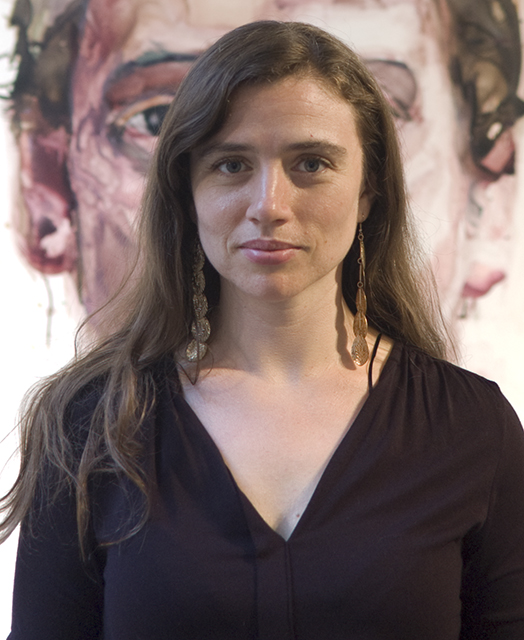
photo credit Ashley Wood

photo credit Ashley Wood

Molly Segal is a painter from Oakland, CA. She received her BFA from the California College of the Arts in 2008. After getting her MFA from The School of The Museum Of Fine Arts in 2013, she was awarded post-graduate teaching fellowships at both the Museum School and Tufts University. She is currently co-curating I Want To Smell Your Hair at the New Art Center in Newton, MA. She lives and works in Los Angeles, CA. 

photo credit Jason Wallace

photo credit Jason Wallace

mollysegal.com

All images copyright of the artist and used with their permission.

Posted in Uncategorized | Tagged , , , , | 2 Comments

Norwood Viviano – Plainwell, Michigan

Mining Industries: Downtown Seattle, 3D printed pattern, kilncast glass, fabricated steel, and vinyl cut drawings, 38” x 14.5” x 17.25”, 2014. Photo: Tim Thayer/Robert Hensleigh

Mining Industries: Downtown Seattle, 3D printed pattern, kilncast glass, fabricated steel, and vinyl cut drawings, 38” x 14.5” x 17.25”, 2014.
Photo: Tim Thayer/Robert Hensleigh

Briefly describe the work you do.

For the past four years I have focused on three related bodies of work that deal with landscape after industry moves on. These projects are complementary as each tells a story of population shift and its relationship to industry. The first project, Cities: Departure and Deviation, culminated in an installation of blown glass forms and vinyl cut drawings that serve as three-dimensional population graphs of major urban centers. The second body of work is the result of a collaborative Arts/Industry Residency at Kohler Co. that explored the dynamic historical relationship between the Kohler factory and neighboring village. My current project, Mining Industries, is comprised of kilncast glass works created from LiDar scan data of the earth and 3D printed patterns showing aerial views of sites related to Detroit, Houston, and Seattle and their iconic industries.

Mining Industries uses LiDar data captured with a laser beam during airplane flyovers that define the landscape through a coordinate system. I am interested in how the technology of Sanborn Maps, aerial photographs, and LiDar data merge to reference times of peak industrial power. I then layer these maps and photographs between stacks of clear kilncast glass blocks so that the imagery filters through the polished glass landscape from above and is seen through the layers in the mirrored reflection below.

Tell us a little about your background and how that influences you as an artist.

The three research projects represent my interest in the dynamic relationship between American industry and the towns that grew up around it. This focus – the domestic landscape – is a direct result of my experience growing up in the city of Detroit, which was devastated by changes in the auto industry, and moving to a small Michigan town that lost its primary employer in 2000 and was registered as a superfund site that same decade. My approach considers the tension between historical modes of manufacturing and contemporary notions of efficiency and industry’s influence on the individual and collective narratives in the surrounding communities.

Mining Industries: Installation View, 3D printed patterns, kilncast glass, fabricated steel, and vinyl cut drawings, dimensions variable, 2014.  Photo: Cathy Carver

Mining Industries: Installation View, 3D printed patterns, kilncast glass, fabricated steel, and vinyl cut drawings, dimensions variable, 2014. Photo: Cathy Carver

The concept of the “artist studio” has a broad range of meanings, especially in contemporary practice. The idea of the artist toiling away alone in a room may not necessarily reflect what many artists do from day to day anymore. Describe your studio practice and how it differs from (or is the same as) traditional notions of “being in the studio.”

To create my work, I routinely consult with specialists in several areas including architecture, urban planning, industrial design, GIS data collection, engineering, and 3D printing. In many ways these conversations help to shape my creative work and the classes I teach at Grand Valley State University.

In my studio practice, newer 3D computer technology is an essential tool in my creative process. At Grand Valley State University, I have access to a 3D printing lab, mold making space, and kilns for casting glass. To gather the GIS data, I work directly with municipalities and libraries that routinely hold databases of LiDar scan data, Sanborn Maps, and historical aerial photographs.

What unique roles do you see yourself as the artist playing that you may not have envisioned yourself in when you first started making art?

For me this is strongly related to question # 3.

Early on in my career, I couldn’t imagine incorporating newer technology as a regular part of my studio practice. Additionally, I enjoy the engagement with specialists outside of the field. The conversations with outside specialists are increasingly productive often resulting in future projects and collaborations.

Mining Industries: Houston Installation View (detail), 3D printed patterns, kilncast glass, fabricated steel, and vinyl cut drawings, dimensions variable, 2014.  Photo: Cathy Carver

Mining Industries: Houston Installation View (detail), 3D printed patterns, kilncast glass, fabricated steel, and vinyl cut drawings, dimensions variable, 2014. Photo: Cathy Carver

When do you find is the best time of day to make art? Do you have time set aside every day, every week or do you just work whenever you can?

Because of regular deadlines, I try to work in the studio as much as possible. Since the new project Mining Industries has a strong technology component – some of the process is portable. I can work on the cropping and conversion of LiDar scan data anywhere, but when it comes to mold making and casting glass – I need to be in my studio where I can make a mess and have access to kilns.

How has your work changed in the last five years? How is it the same?

For more than ten years, I explored the relationship between generating 3D printed patterns, mold making, and casting a variety of materials. Mining Industries represents the synthesis of many early experiments.

Within my work, it’s the representation and form of the subject matter that changed. One of the early influences connected to finding a way to make sense of the dramatic population decline in the city of Detroit as well as developing new ways to visualize the change over time. It’s this early question that continues to be the foundation for my approach to other cities.

Are there people such as family, friends, writers, philosophers or even pop icons that have had an impact on the work you do?

While growing up, I had several family members connected to the automobile industry in Detroit. Attempting to make sense of the family conversations and connecting the question of how my local industry (automobile production) related to a much larger national discussion aided in the growth and development of studio practice.

If you had an occupation outside of being an artist, what would that be and why?

During graduate school at the Cranbrook Academy of Art, I had the opportunity to take electives in Architecture and Industrial Design giving me several ways to look at my sculpture work in new ways. It was at Cranbrook that I had my first introduction to the potential of 3D printing and CAD software. If I were to move away from sculpture or compliment my career in visual art, I would likely find myself working in a field related to Architecture or Industrial Design.

About

Norwood VivianoNorwood Viviano is an Associate Professor at Grand Valley State University, where he is the Sculpture Program Coordinator. He received a BFA in Sculpture and Glass from Alfred University and MFA in Sculpture from the Cranbrook Academy of Art. Viviano utilizes digital 3D modeling and printing technology in combination with glass blowing and casting processes to create his sculptural works. In 2001, he was the recipient of the Emerging Artist Award from the Glass Arts Society.  Recently he was an Artist-in-Residence at the Royal College of Art, London, UK, Ox-Bow School of the Art, Saugatuck, MI, the Museum of Glass, Tacoma, WA, the Corning Museum of Glass, Corning, NY, and was awarded an Arts/Industry Residency at the Kohler Company in Kohler, WI.  Viviano’s recent exhibitions include, Grand Rapids Art Museum, Grand Rapids, MI, Art Miami/Context Art Miami, Miami, FL, Heller Gallery, New York, NY, and the Venice Biennale, Venice, Italy. 

Mining Industries: Downtown Seattle (detail), 3D printed pattern, kilncast glass, fabricated steel, and vinyl cut drawings, 38” x 14.5” x 17.25”, 2014. Photo: Tim Thayer/Robert Hensleigh

Mining Industries: Downtown Seattle (detail), 3D printed pattern, kilncast glass, fabricated steel, and vinyl cut drawings, 38” x 14.5” x 17.25”, 2014. Photo: Tim Thayer/Robert Hensleigh

norwoodviviano.com

All images copyright of the artist and used with their permission.

Posted in Uncategorized | Tagged , , , , | Leave a comment