Laura Watters – Los Angeles, California

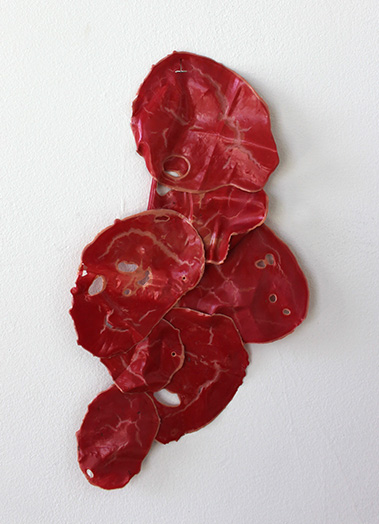
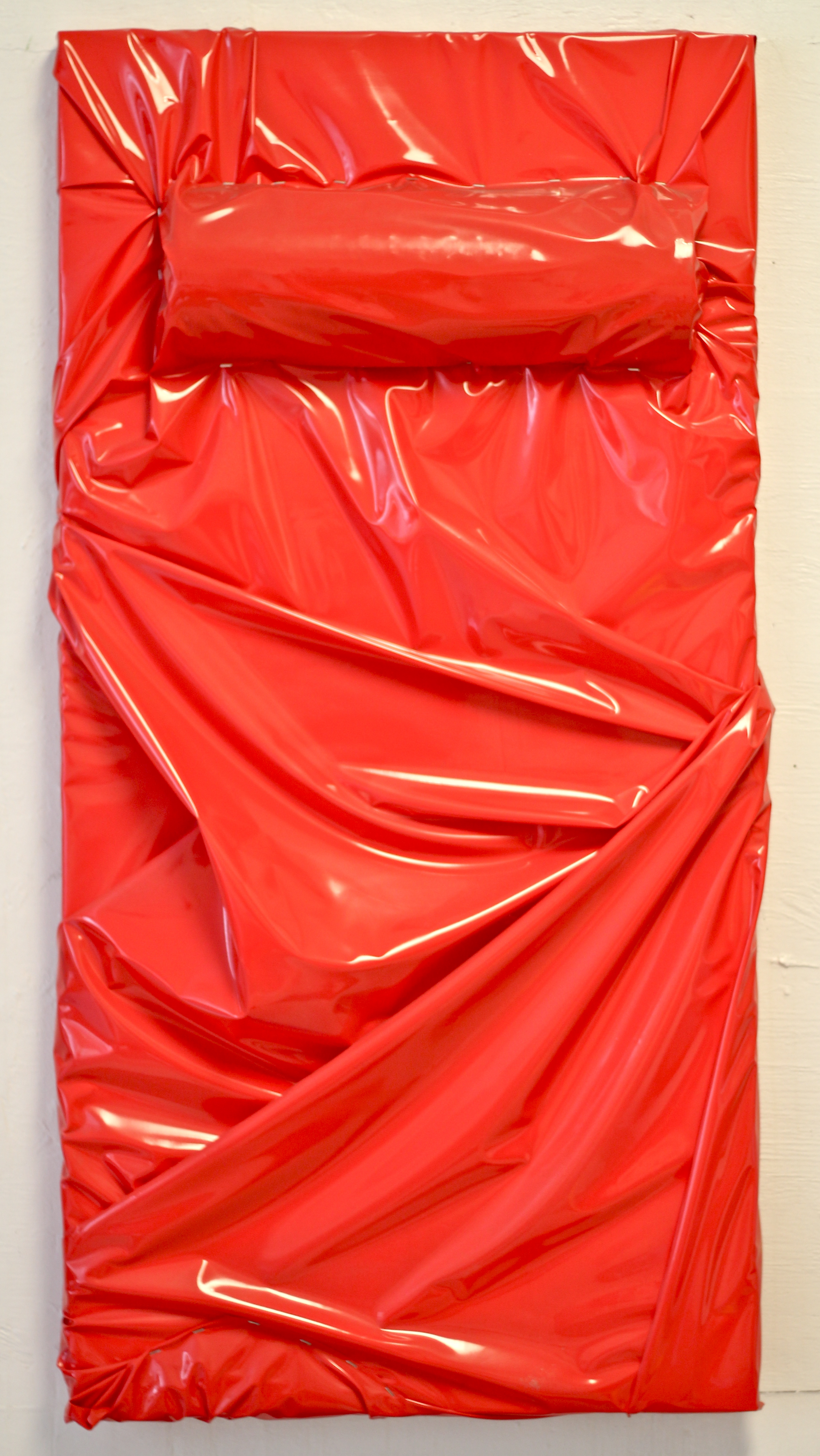
American Graffiti 2014 Vinyl and staples on panel 48” x 24”

American Graffiti
2014
Vinyl and staples on panel
48” x 24”

Briefly describe the work you do. 

My work is a continued and varied exploration of the duality and potential visual intrigue of materials. The materials that I chose to manipulate rely on the optical seduction of their superficial, synthetic, and slick surfaces. These “tease” paintings as I call them pull you in with heir sensuous surfaces and yet repel you with their reflective nature. Their simple formal compositions highlight these materials and best illustrate their tactility in their pared down arrangements, I see the vinyl as a transforming medium that emphasizes the literal physical presence of objects and forces the viewer to perceive physical reality of the object and its existence in his or her space. The attitude and style of the materials create flashy objects that call attention to themselves. I want the pieces to appear to be tough and assertive, yet gentle, familiar, and inviting thereby initiating a dialogue with the viewer. Ultimately I strive to create works that are embedded with a sense of joy, and are simultaneously fun and smart, while also being critical yet playful.

Tell us about your background and how that has had an influence on your work and on you as an artist.

Growing up, my father worked in the travel industry, which allowed me to see much of the world from a young age. I was fortunate enough to visit some truly remarkable and remote locations. While on these trips, it was critical to pay attention to my surroundings and always be looking at my environment. This fundamental idea of hyper-awareness has stuck with me and shaped the way I see the world.
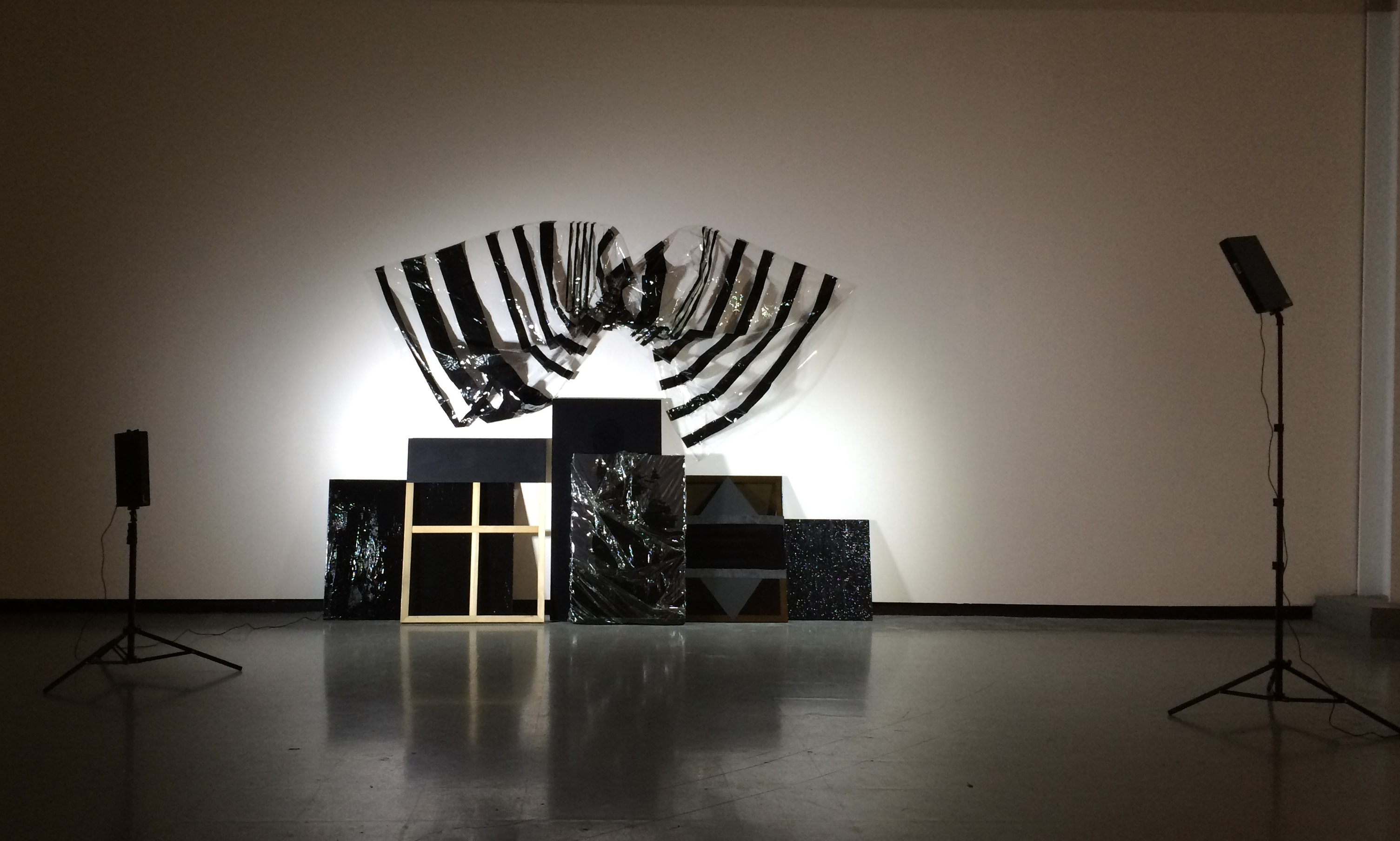
Installation View 2014 Vinyl, resin, house paint, glitter, and canvas Dimensions Variable

Installation View
2014
Vinyl, resin, house paint, glitter, and canvas
Dimensions Variable

The concept of the artist studio has a broad range of meanings in contemporary practice. Artists may spend much of their time in the actual studio, or they may spend very little time in it. Tell us about your individual studio practice and how it differs from or is the same as traditional notions of “being in the studio.”

I try to get to my studio as much as often, discipline is important, as being an artist is just as much of a job as anything else. I find that even if I don’t have an exact idea or plan in mind, just being in my studio around my materials, something productive will happen. Even if it’s a failed experiment, that can be more important in an ongoing exploration, that successes. I usually drive to my studio, meander on the way, grab lunch, hit an art store or Home Depot, and go from there. I don’t usually try to restrict myself to one strict routine or plan. 

What roles do you find yourself playing that you may not have envisioned yourself in when you first started making art?

Public Relations. Carpenter.

When do you find is the best time to make art? Do you set aside a specific time everyday or do you have to work whenever time allows?

I find it best to try to get into the studio before noon and leave around six or whenever I feel as though I’ve accomplished enough to feel good about. I don’t limit myself to particular times or days just whenever I’m feeling the vibe. 

How has your work changed in the past five years? How is it the same?

The art that I was making while at college was stylistically much more representational and conceptually based off of memories and old childhood snapshots. However, now my work is clearly much more abstract and lacking in any representational content. Despite the physical differences, my goal is still to evoke an instant attraction and emotional response. I’ve also broadened my use of materials and stopped limiting what qualifies as a painting as a canvas on a wall. Adding this idea of three-dimensionality and illusionism has really broadened the spectrum of what I’m interested in making. 

While living in New York, my space dictated the type of work I could make, and since I didn’t have a studio at the time, was generally creating works on paper. Since moving back to Los Angeles, going back to school, and getting my own studio, I’ve really been able to focus on building my body of work and pursue art full time. I’m also still very young and very new to this, so I imagine my work will constantly change as I also have a relentless curiosity and perhaps a bit of ADD.
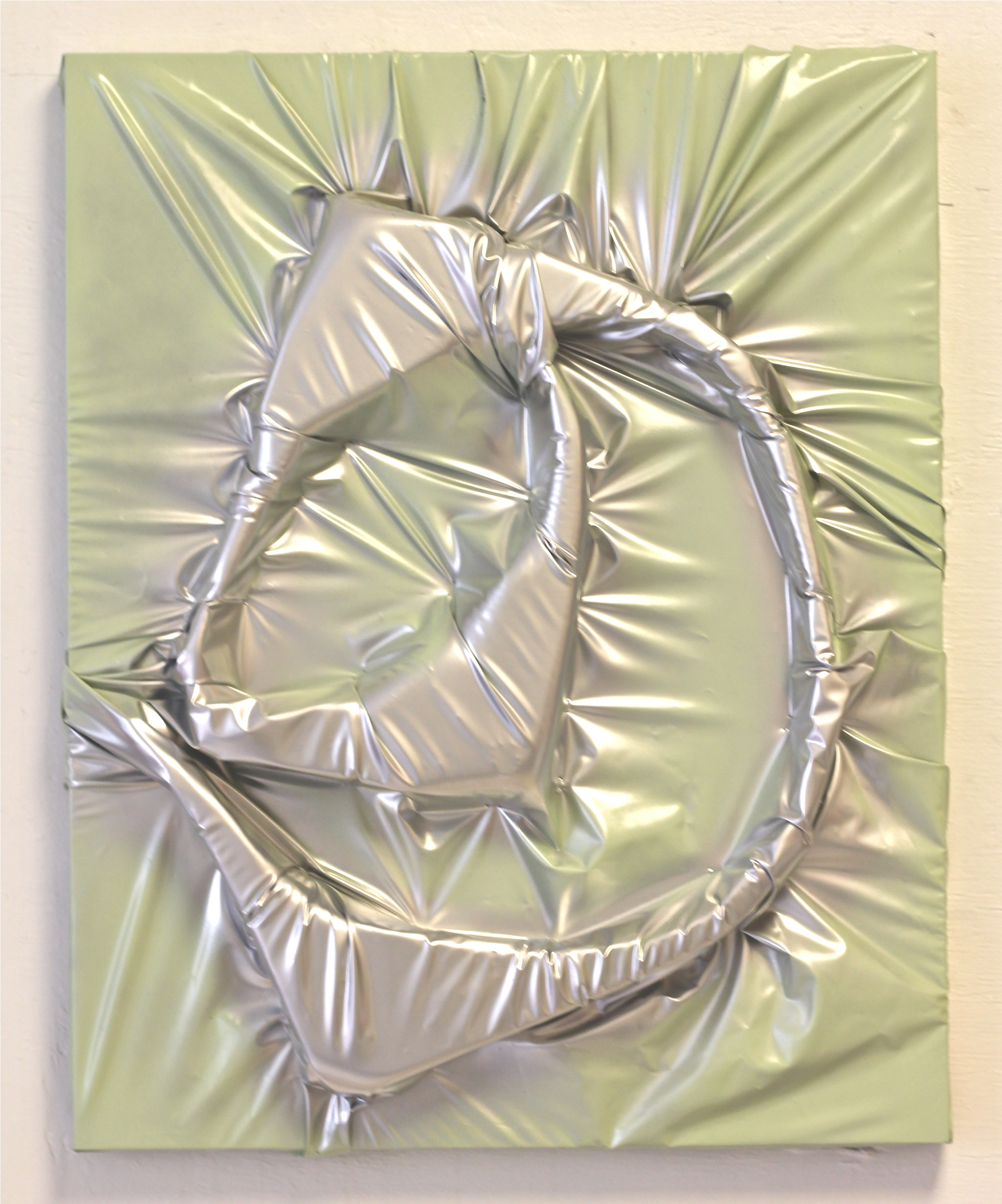
Premium Matcha Green Tea 2015 Spray paint, foam, and staples on panel 24” x 30”

Premium Matcha Green Tea
2015
Spray paint, foam, and staples on panel
24” x 30”

How have people such as family, friends, writers, philosophers, other artists or even pop icons had an impact on the work you do?

I think as an artist it is imperative to look outside of your own field for inspiration, while also being aware of the origins of art history and what your contemporaries are doing. I’m lucky to have many people in my life pursuing different passions, including art, music, film, fashion, and literature that I can gain knowledge from. I have a nagging desire to learn about everything and become obsessed with learning all there is to know about a variety of different topics. I don’t think that these different creative fields are exclusive from one another, but rather inform each other in a multitude of ways. There is a long history of cross pollination that I find fascinating and freeing. I enjoy the works of Iza Genzken, John Armleder, Steven Parrino, David Foster Wallace, Joan Didion, David Lynch, Talking Heads, and most importantly all nature shows. 

Have you ever been pulled in the direction of a pursuit other than being an artist? What are your other interests? 

I initially was working towards a career in fashion, working during the summers during college, and for magazines and stylists when I lived in New York. However, I pretty quickly realized in New York that I did not enjoy the superficiality of the industry and felt removed from the act of creation, which is what I really missed. That’s when I realized I wanted to move back in the direction of pursuing a career in art and decided to move back to Los Angeles, and go back to school at Otis College of Art and Design.

About

LauraWattersheadshotLaura Watters (b. 1989) is an American artist living and working in Los Angeles. Watters was born in San Francisco, California, raised in Los Angeles, and has lived in Washington D.C., Paris, and New York City. She received her Bachelor’s Degree in Art History and Fine Arts from George Washington University in 2011 and completed the Special One Year Program from Otis College of Art and Design in 2014.
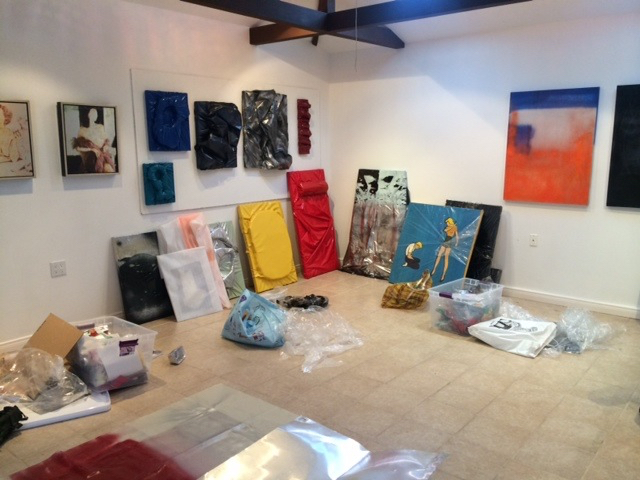
studioview

auraannewatters.com

All images copyright of the artist and used with their permission. 
Posted in Installation, Sculpture, Uncategorized | Tagged , , , , | Leave a comment

Hannah Skoonberg – Bowling Green, Kentucky

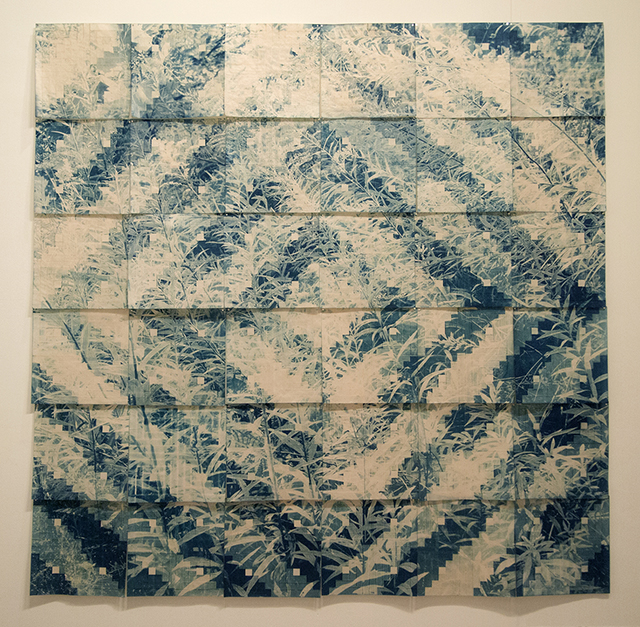
Resting Place Quilt 90"x 90" 2014

Resting Place Quilt 90″x 90″ 2014

Briefly describe the work you do. 

My work often combines delicate cut paper with relief and photographic processes. I work on translucent Japanese paper that accentuates the fragility of the work. Recurring themes revolve around my interest in landscape, grief, and surface.

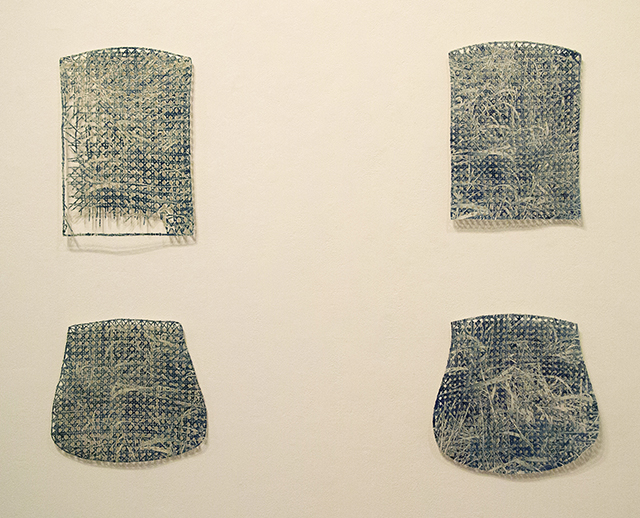
My most recent body of work deals with two different spaces. One is the indoor domestic setting which is defined through a series of objects. The other is this completely overgrown outdoor space which is defined through surface. I have been making a series of non-functioning household objects out of delicate cut paper and then printing wild overgrown plants onto their surfaces. The household objects serve to describe a real space in a fragile, ephemeral way while the surfaces describe a chaotic emotional state.

Tell us about your background and how that has had an influence on your work and on you as an artist.

As a child, I spent a lot of time camping with my family lending me an appreciation of the outdoors.

My background in Zen Buddhism and my deep love of asian art has influenced my work most.

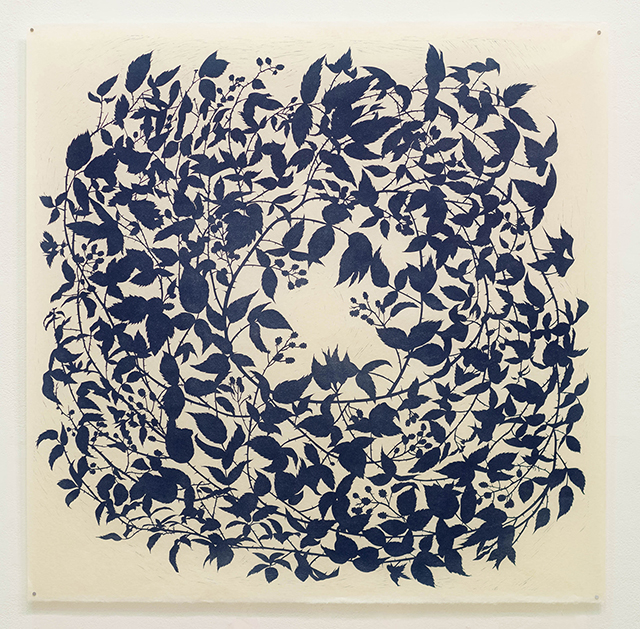
Blackberry, linocut 38"x 38" 2014

Blackberry, linocut 38″x 38″ 2014

The concept of the artist studio has a broad range of meanings in contemporary practice. Artists may spend much of their time in the actual studio, or they may spend very little time in it. Tell us about your individual studio practice and how it differs from or is the same as traditional notions of “being in the studio.”

My studio practice is split between a shared printmaking studio and a quiet individual studio space. The quiet space is where I spend the majority of my time: drawing, carving, and thinking. It tends to be a clean space while the shared space is energetic and inky. For me, the shared studio energy is essential to expressing my creativity and being part of the artist community.

What roles do you find yourself playing that you may not have envisioned yourself in when you first started making art?

I had no idea how much time I would spend framing, shipping, and photographing my work. The reality of what it means to exist as a professional artist involves a huge amount of behind the scenes work.

When do you find is the best time to make art? Do you set aside a specific time everyday or do you have to work whenever time allows?

Ideally, I would be able to work in the studio every day, but I often have to fit studio time around other responsibilities. I like to block out at least 4 hour intervals so that I can really get into the process. I have admiration for artists who can make use of every small interval of time during an otherwise hectic day.

How has your work changed in the past five years? How is it the same?

My interest in landscape has been consistent for many years, but I feel that the emotional tenor of my work has changed considerably. It has become far moodier and layered in meaning.

Me and You, cyanotype on cut paper 2014

Me and You, cyanotype on cut paper 2014

How have people such as family, friends, writers, philosophers, other artists or even pop icons had an impact on the work you do?

The artists I have worked with personally have had the most impact on me. Even if they make work that is very different than my own, seeing how they plan their work and exist in the studio inspire me. My mother is an artist as well and has been a profound supporter of my artwork from the moment I started making art.  

Have you ever been pulled in the direction of a pursuit other than being an artist? What are your other interests? 

I love novels! If I hadn’t discovered the printing press, I think I would have gone into creative writing and would have written a magic realist novel.

About

headshotHannah Skoonberg recently received her MFA from the University of Tennessee and is represented by Blue Spiral 1 Gallery in Asheville, NC. Hannah has been enthusiastically making prints for the last decade. She is an itinerant professor at Western Kentucky University and has been moving northward one state at a time.

in_the_studio

skoonberg.com

All images copyright of the artist and used with their permission. 


Posted in Printmaking | Tagged , , , , | Leave a comment

Laura Moreton-Griffiths – London, United Kingdom

Selfie 2015 After Taeuber-Arp: Acrylic on stitched canvas Dimensions variable

Selfie 2015
After Taeuber-Arp: Acrylic on stitched canvas
Dimensions variable

Briefly describe the work you do. 

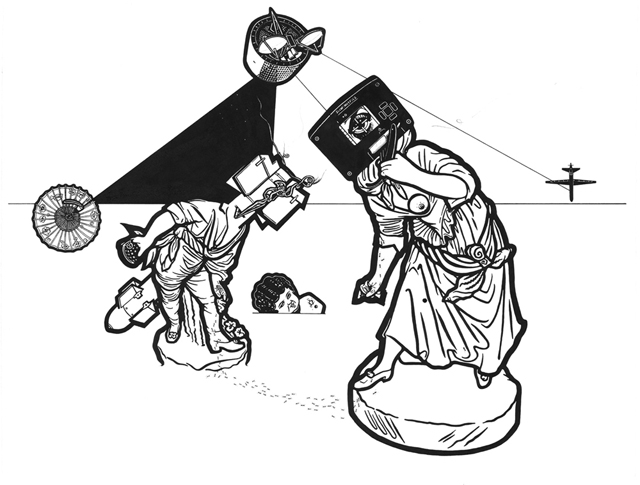
I construct my paintings, drawings and sculptural objects using cultural and art-historical references, taken from the art of the past and ceramics, found imagery and photography. Interested in the riot, revolution and reform that made modern Britain and science-fictions, I use the idiom of the past to describe the 21st century, conflating past and present in one pictorial event. Each element is selected because it socially and historically encapsulates the time in which it was made, the story it tells and its resonance today. Backwards and into the future and existing out of time in a dysfunctional melancholy world, I have developed a visual and narrative language of social and magical realism. The works appear whimsical, yet set within the familiar my themes are subversive and are about the underbelly of Englishness and contemporary anxiety.

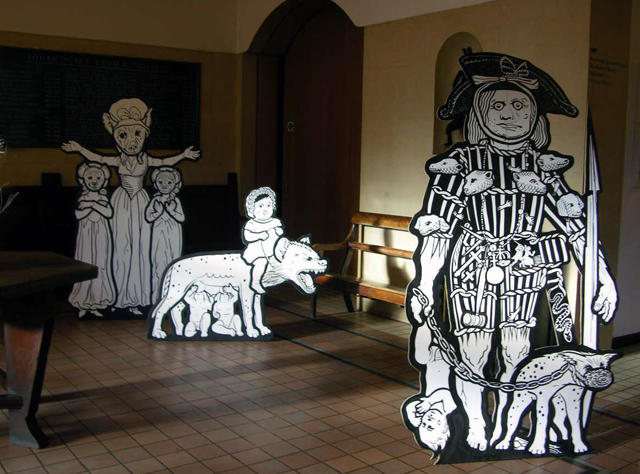
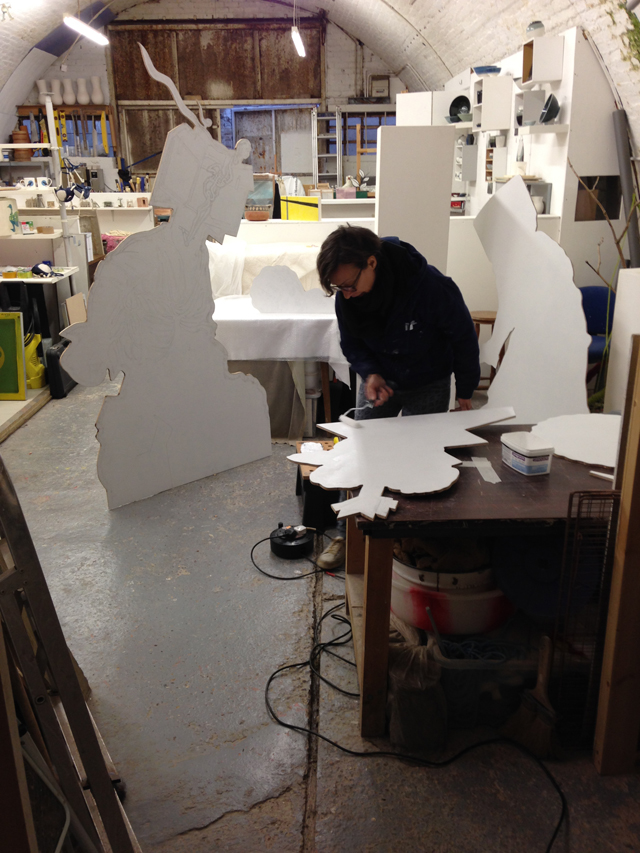
My ink drawings are deceptively simple, and recall folk art, woodcuts and graphic novels. Developed from collages, the scenes are drawn using overlapping forms in outline, each line thickened and every angle rounded off, and balanced with negative space. Recently, the drawings have taken the form of sculptural objects, staged off the wall and into the room, to animate the space to tell complex tales that involve the viewer in the narrative. I am interested in the shift of context and how situation changes the experience of the viewer. The characters are scaled up and drawn life size onto hand cut ply that has been prepared with layers of gesso.

Tell us about your background and how that has had an influence on your work and on you as an artist.

I have more than 20 years experience as a creative practitioner. I worked for 11 years in the multimedia industry as an adult education tutor, illustrator, and freelance designer and creative director. For the last 10 years I have concentrated on my fine art practice as an artist and curator. My practice combines my interest in technology and history, and art as the visual record of our culture. I am always surprised by what I don’t know, what has been forgotten and what has be written over. My research is a process of discovery, shock, horror, wonder and awe. I read around a theme, make connections in time and space and respond emotionally in some way. I work from collages, hybridizing past, present and future projections with politics. Recent drawing objects have developed from collages about about globalisation, commodification and the effects of living in an increasingly digitised world with references from the Surrealist film ‘Chien Andelou’ and ‘The Third Man’. In the drawing ‘Smoking Gun’ I pull together personal concerns about international arms trade and Britain’s role as a leading arms manufacturer and exporter: eyes in the sky, unmanned drones, violence mediated by TV screens and surveillance technology. ‘Brimstone Bureaucracy’ is about British overseas policy and wars fought from behind desks; the ink splashes are oil. I am currently making these drawings into life-size freestanding objects to create a submersive narrative environment.

A Hyena in Petticoats 2014 Ink on gesso on board Dimensions variable

A Hyena in Petticoats 2014
Ink on gesso on board
Dimensions variable

The concept of the artist studio has a broad range of meanings in contemporary practice. Artists may spend much of their time in the actual studio, or they may spend very little time in it. Tell us about your individual studio practice and how it differs from or is the same as traditional notions of “being in the studio.”

My practice is my own self-initiated research project – a line of enquiry that asks questions of my world in an attempt to understand it. Drawing for me is a way of collecting source materials, working in my notebooks and making collages on the computer to draw from. I use the computer because there is so much information and visual material available that I can resize and manipulate. I think of the resultant drawings, paintings and sculptural objects as visual poems. I work six days a week, two or three of which are spent in the studio in the traditional sense, using traditional techniques. I have several projects on the go at any one time and work in a range of media. I also curate.

What roles do you find yourself playing that you may not have envisioned yourself in when you first started making art?

When I set out to paint 25 years ago I had never touched a computer so I never imagined that I would spend so much time using one. As well as researching and compositing images, much of my creative practice is spent developing my networks and doing my arts admin: emailing, working with timelines and budgets, applying for funding, publicizing my work via social media and submitting to shows.

When do you find is the best time to make art? Do you set aside a specific time everyday or do you have to work whenever time allows?

I am disciplined in my art making. Studio days are 9am to 6pm, perhaps longer and later if I have deadline. My arts admin is done first thing in the morning or at night, again dependent on deadlines. A lot of my creative thinking happens when I am walking down the street.

How has your work changed in the past five years? How is it the same?

My responses have become more multifaceted; any one image cannot depict the complexities that I am trying to convey. I am currently playing with scale to take the audience inside my peculiar vision, to position them as protagonist within my storytelling.

1.Smoking Gun 2014 Ink on Saunders Waterford paper 56 x 76 cm

1. Smoking Gun 2014
Ink on Saunders Waterford paper
56 x 76 cm

How have people such as family, friends, writers, philosophers, other artists or even pop icons had an impact on the work you do?

I read a lot of history and science fiction. The life and works of Mary Wollstonecraft, eighteenth century English writer, philosopher and proto-feminist, influenced recent drawings ‘A Hyena in Petticoats’. I have just finished reading The Windup Girl by Paolo Bacigalupi and On Ugliness by Umberto Eco. I am currently reading Guns, Germs and Steel by Jared Diamond, and Madd Adam by Margaret Atwood – all of which will inform my new work about science fictions that are happening now. I have a very good network of peers and often collaborate other artists working locally. I follow lots of artists on Twitter to see what they are making and where they are exhibiting. My family is very supportive.

Have you ever been pulled in the direction of a pursuit other than being an artist? What are your other interests? 

From time to time I get pulled away from the studio to make enough money to support my family and my practice.

About

image001Artist and curator, I studied at St Martins School of Art, the Artec and Camberwell College of Arts, graduating in 2008 with a degree in painting. I live and work in London. Shortlisted for The 2010 Jerwood Drawing Prize, I exhibit regularly and have work in private collections within the UK and abroad.

image009

lauramoretongriffiths.com

All images copyright of the artist and used with their permission. 
 

Posted in Painting | Tagged , , , , | Leave a comment

Rory Tangney – Dublin, Ireland

Sigma Series IMG_V03 2012 Pencil on paper 234 x 416mm

Sigma Series IMG_V03, 2012, Pencil on paper, 234 x 416mm

Briefly describe the work you do.

My work is concerned with a range of ideas from religion to science, and my feeling that, though the demise of religion is a healthy and necessary thing, the purely rational/materialist society we seem to be moving towards is not necessarily a solution. I am excited by the possibilities inherent in science but feel it often comes with a dogmatism that is dangerous. I believe that art can act as a counter balance to such overarching rationalism. I mostly work in sculpture, sound, drawing and installation and my work is process-based. The sculpture has been on scales from the very large to small, and with a variety of materials. These include conventional materials such as plywood, mdf and metal, as well as cellophane or audiotape. The forms I create seem to be increasingly minimal, and often colour is a significant element. I worked as a sound engineer for a couple of years a long time ago, and this has led me to explore sound as a medium. I have been creating soundworks for both installation and headphones using a combination of found sounds and processing. I have even used my own vocals at times. Sounds can be taken from field recordings, such as an MRI booth In a hospital, from YouTube clips or from the salvaged audio tapes that ended up as sculpture. I started drawing only about 5 years ago, and it has become hugely important to within practice. The drawings are primarily in pencil, though I have recently been working with pen, and I also do occasional live drawings in charcoal.

Tell us about your background and how that has had an influence on your work and on you as an artist.

I grew up in Cork City in the south of Ireland in a suburb which was, in the early days, on the edge of the countryside. This allowed for a lot of roaming and exploring in the days when children were allowed such freedoms. This freedom was even greater during summers in the west of Ireland, a special place in the Irish psyche that seems increasingly precious today given the cleansing of other landscapes over the past 20 years. I spent 8 years living in Conemara, an incredibly beautiful and remote region of the west when I was in my 20s. This access to space and to nature was important as the loss of the natural world is something that concerns me greatly. My early work was very much engaged with this environmental mindset, but somewhere along the way it occurred to me that the environmental problem was but a symptom of other issues. As we have moved from the traditional and religious world to one in which scientific rationalism holds sway there has been a loss of something (spirit, perhaps?) a connectedness with each other, with ourselves and with the natural world. I see art as a means to reconnect, not just for the artist, but for the viewer also.

Monument, 2014, MDF, 1300 x 340 x 1560mm

Monument, 2014, MDF,
1300 x 340 x 1560mm

The concept of the artist studio has a broad range of meanings in contemporary practice. Artists may spend much of their time in the actual studio, or they may spend very little time in it. Tell us about your individual studio practice and how it differs from or is the same as traditional notions of “being in the studio.”

My studio practice has been evolving greatly over the past 5 years, and in truth I’m not sure it has found a pattern just yet. Maybe it never will and will keep evolving. It used to be very regimented, 8 hours a day, 6 days a week in the workshop making sculpture. Eventually, I worked myself into a very unproductive corner, and quite literally I had to go back to the drawing board to figure it all out. I remember the day I resolved to do this – a sculpture I had been working on for several months ended up on the bonfire. I closed the workshop that day and shortly afterwards moved from one end of the country to the other. I then set about re-inventing my process, as well as my life. 5 years later I find myself with a young family, which means that even if I wanted to spend so many hours working, I couldn’t. And somehow, having a bit of space from the work has proven a lot more productive for me. An ongoing problem I have is that I have a need for both a clean space and a dirty space, a workshop for making sculpture and a studio for drawing and computer work. Unfortunately, this is not a possibility, so I have to combine the two. For the past few years I’ve had a studio which from time to time has had to make do as a workshop. This is very problematic with noise and dust and access etc. It also has meant that I haven’t been as prolific as I would like. I have just recently moved into a full time workshop, but now of course I’m stuck for a studio. We will see how it works out. I’m hoping it won’t be too damp for the paper work, and I have managed to box off one corner to make a tiny office for my computer. One day……….

What roles do you find yourself playing that you may not have envisioned yourself in when you first started making art?

The roles I have not envisioned generally involve other types of work that I do to pay the bills. This has recently included everything from picture framing and carpentry to filming accountancy lectures for online learning.

When do you find is the best time to make art? Do you set aside a specific time everyday or do you have to work whenever time allows?

I work whenever my time allows, but when I do get consistent runs at it, I find the mornings to be the most creative.

How has your work changed in the past five years? How is it the same?

My work has changed enormously over the past 5 years. My primary training is as a cabinet maker, so I am a self-taught artist. I started out making sculptures, nearly always out of wood, and they were very craft-based, intricate assemblages. Over the past five years I have really worked hard on developing my conceptual process. My work is still largely dependent on manual skills, even the sound work, but it has become a lot more sophisticated. I have learned how to really refine ideas to their most crucial form.

Jump 2013 Steel, fluorescent paint 6 x 6 x 1850mm

Jump 2013
Steel, fluorescent paint
6 x 6 x 1850mm

How have people such as family, friends, writers, philosophers, other artists or even pop icons had an impact on the work you do?

I often find that when I hear/read about an artist that excites me that the idea of the work is generally much better than the reality. I did have a life-changing moment at an Anish Kapoor show a few years ago in the Royal Academy in London. That was work that had an incredible sublime energy. A lot of it was quite dark, violent even, which I like. That level of energy that he achieves is something I aspire to in my own work. Apart from that, I have never really had any significant mentor, but my life partner has become one. She is an incredible person from whom I learn every day about myself and about navigating the world. She has had an affect not just on the work itself, but in particular how I disseminate it.

Have you ever been pulled in the direction of a pursuit other than being an artist? What are your other interests?

I have toyed at times with other careers. I have previously worked as a sound engineer, a cabinet maker, and a chef, and aspired to be a musician. About once every year or two I have a minor crisis in what I’m doing and start thinking seriously about other possible careers which would satisfy me creatively. The latest one was last year I was contemplating architecture. These never amount to anything, as art is the one thing that can encompass all my interests, and that can challenge me enough.

About

head shotBased in Dublin, I work in both visual media and sound. I previously trained as a furniture designer and maker at The Furniture College, GMIT Letterfrack (2000-2002), and prior to that, I trained as a sound engineer at Pulse College, Dublin (1997-98).

In October 2014 I had my second solo exhibition, This Way To Enchantment, at Sirius Art Centre in Cobh, Co. Cork. This consisted of a large body of work in sculpture, sound and drawing. The sound works in this show have since been featured on the radio show Nova on national radio station RTE Lyric FM and will also feature at the “Soundscapes & Sound Identities” international symposium on soundscape organized by the FKL in Italy in May 2015.

In 2011, my first solo exhibition, Build Your Church On The Strength of Your Fear, was held at the Camden Palace Hotel Arts Centre in Cork. This consisted of a large-scale sculptural and sound installation which was the first large visual art project to be crowd-funded in Ireland.I first exhibited as an artist in 2005, in a 2-person show at Gallery 44, Cork, during the city’s year as European Capital of Culture. Since then I have exhibited widely in group shows including at the Royal Hibernian Academy Annual Exhibitions – where, in 2006, I won an award for a ‘Sculpture of Distinction’ – Farmleigh House, Dublin, Ormston House, Limerick, and the Solomon Gallery, Dublin. In 2012, I made my first foray into international waters, exhibiting a series of 7 drawings in a group show at Temporary Gallery, Berlin.I have also developed a new strand to my work over the past 2 years with a number of live drawing performances in conjunction with cellist Kate Ellis and the RESOUND Collective. These took place in various venues and festivals across Ireland, including the National Gallery, the Model in Sligo, Kilkenny Arts Festival and Cork Midsummers Festival, to name a few.

studio view

rorytangney.com

.All images copyright of the artist and used with their permission. 
 

Posted in Drawing, Installation | Tagged , , , , | Leave a comment

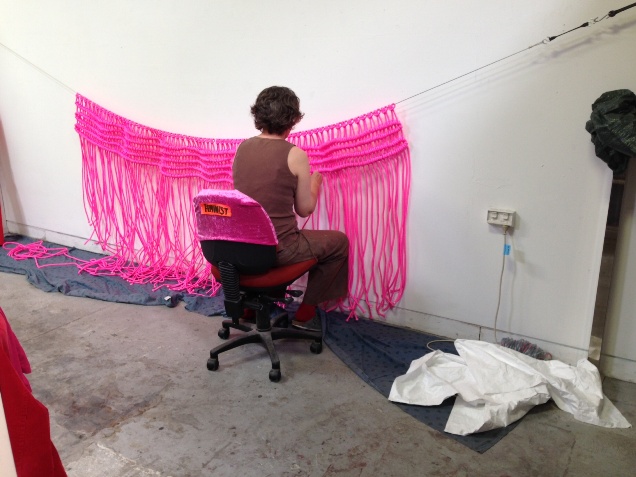
Caroline Phillips – Melbourne, Victoria, Australia

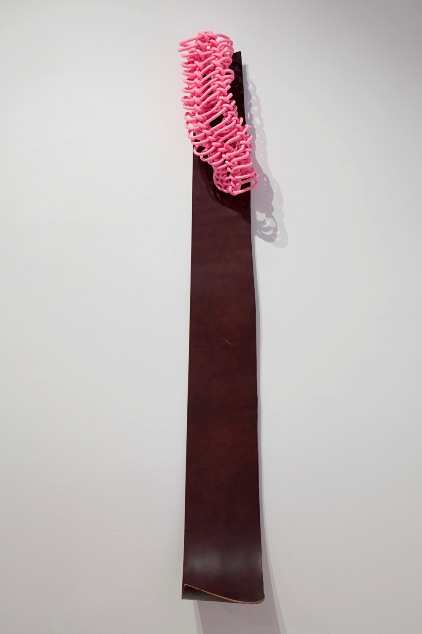
Caroline Phillips, Tongue and Groove, 2015, acrylic rope, leather, 130x30x20cm

Caroline Phillips, Tongue and Groove, 2015, acrylic rope, leather, 130x30x20cm

Briefly describe the work you do. 

Overall, my practice explores typologies of feminism, in particular the exploration of new ontologies beyond binary subjectivities. The conjuncture of craft practices and minimalist form activates relationships of movement, embodiment and affect. Using recycled materials gleaned from industrial processes, the material properties of rubber and plastic such as resistance, elasticity and insulation  are exploited in conjunction with industrial hardware such as rope, and stainless steel. These explorations investigate, through the conceptual and material metaphors of knotting, winding and tension, the articulation of forces of bodies in space, forces between bodies and the interval in between. Infrastructures of the built environment such as balustrades and seat belts are transformed into aesthetic constructions whilst colour plays with gender roles and associations. These convergences seek to propose a potential aesthetics of relatedness.

Tell us about your background and how that has had an influence on your work and on you as an artist.

As a child I was always scrounging around fossicking for stuff and making things by hand. Nothing much has changed, really! I am still drawn to particular recycled and industrial materials, especially those that flex, bend, are shiny or glossy or have sharp, pointy bits. I pile them up in my studio and assemble them with other materials when they seem to make a good match.

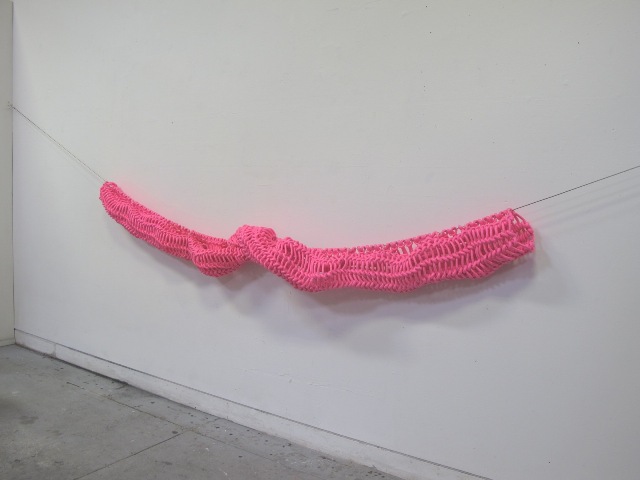
C.Phillips, Warped, 2015, acrylic rope stainless steel, 30x400x20cm

C.Phillips, Warped, 2015, acrylic rope stainless steel, 30x400x20cm

The concept of the artist studio has a broad range of meanings in contemporary practice. Artists may spend much of their time in the actual studio, or they may spend very little time in it. Tell us about your individual studio practice and how it differs from or is the same as traditional notions of “being in the studio.”

My ‘studio time’ is very traditional in that I spend time on  my own making my art. However at the moment I am doing a PhD, so a lot of my time is spent in the academic context, for example going to seminars, reading, writing and talking to others, most of which takes place outside the studio. But what occurs in the studio is the impetus for it all.

What roles do you find yourself playing that you may not have envisioned yourself in when you first started making art?

I work a lot with other artists on collaborative projects and curating shows. In particular I work on projects that engage with social and political issues, using art as a means to give a voice to others. From my interest in feminism I have found myself being asked to speak and write about the work of others, which I would never have anticipated.

When do you find is the best time to make art? Do you set aside a specific time everyday or do you have to work whenever time allows?

I try and keep to a weekday routine in the studio, built around the demands of my family. I get the most done in the mornings, although at the moment I am mostly writing for my thesis. Later in the day I will have meetings, or be dealing with administration or other demands of my studies. I also need the evenings and some of the weekend to do marketing and promotional activities, prepare for projects or other work that comes up such as writing a catalogue essay.

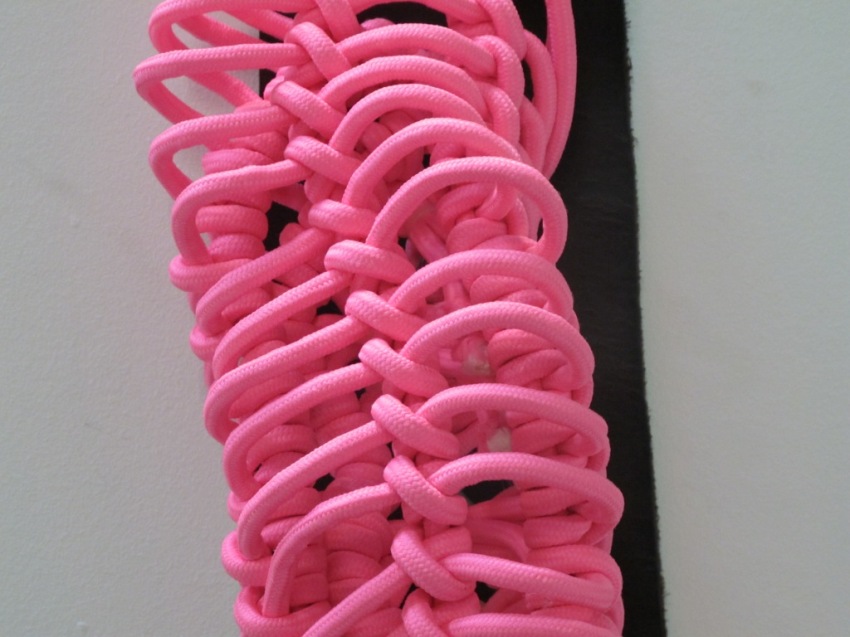
Caroline Phillips, Tongue and Groove (detail), 2015, acrylic rope, leather, 130x30x20cm

Caroline Phillips, Tongue and Groove (detail), 2015, acrylic rope, leather, 130x30x20cm

How has your work changed in the past five years? How is it the same?

Five years ago I was working with a very minimal palette of black, white and grey and I was also using a lot more textiles such as recycled cotton and felt. Recently I have begun to include more colour in my sculptures, in particular I am loving fluorescent pink at the moment! I have also gradually introduced more machine made materials such as stainless steel. I am enjoying the contrasts between the handmade and machine processes, as well as the change of surface texture and colour.

How have people such as family, friends, writers, philosophers, other artists or even pop icons had an impact on the work you do?

A big influence on my thinking comes from feminist philosophy, in particular the work of Luce Irigaray. I am very interested and inspired by her formulation of sexual difference, which I see as being a very generative framework for social and political change. I am very happy to see the resurgence of feminist art around the world over the last decade and what appears to be a regeneration of feminist theory, moving forward from a lot of negativity and feminist backlash that took place in the 90’s. I am also continually inspired by the creativity and hard work of my peers, which encourages me to take risks in my own practice.

Have you ever been pulled in the direction of a pursuit other than being an artist? What are your other interests? 

I have always been interested in architecture and interior design, which I studied for a short time when I first left school. I felt the demands of technical drawings would be too limiting, so I left to pursue fine art. Interestingly, lately, I have come to see the connections between my work and my early interest in space and design, and I continue to take an interest in contemporary architecture. I like to be recharged and inspired by travel to other places when I can. Being from Australia, we tend to grow up here feeling that ‘the rest of the world’ is far away, and so we are great travellers. I have spent a lot of time in Central America, which I enjoy, and Paris, which I love. It always regenerates your work to travel and experience life differently.

About

Head shot Caroline PhillipsCaroline Phillips is a visual artist based in Melbourne, Australia. Working primarily in sculpture and installation, her materially based works have been exhibited nationally and internationally including the George Paton Gallery, Melbourne, First Draft Gallery, Sydney, the Cité International des Arts, Paris and the Slade School of Art, London. Phillips has been awarded a number of grants and residencies including NAVA Australian Artists’ Grant, City of Melbourne Arts Project Grant, Arts Victoria VicArts Grant, Australian Tapestry Workshop Artist in Residence and the Art Gallery of New South Wales Moya Dyring Paris Residency. Caroline also works as an independent curator and her most recent project The f Word; Contemporary Feminist Art in Australia was presented at two major regional Victorian galleries in 2014. Caroline is currently studying a PhD at the Victorian College of the Arts (University of Melbourne), School of Art and her research project explores contemporary feminist art practices. Later this year Caroline will undertake the FAC Feminist Art Residency at Artscape, Toronto.

Caroline Phillips, working in studio - Copy

carolinephillipsart.wordpress.com

All images copyright of the artist and used with their permission. 
 

Posted in Sculpture | Tagged , , , , | Leave a comment

Mollie Douthit – Callan, Ireland

 And a scotch and water!, Oil on panel, 40x40cm, 2014

And a scotch and water!, Oil on panel, 40x40cm, 2014

Briefly describe the work you do.

I am a still life painter, I choose objects that visually attract me and remind me of an experience, or person that’s significant in my life. I paint directly from life, situating the object(s) in a view that feels right, and paint what I see.

Painting is an experience that demands all of my attention and alertness; I have to hold the same emotional connection to the objects as I do with the process, and substance itself. I love how an objects physical presence can become a catalyst for underlying memories and emotions, exploring this I place the figures in the paintings on a ground of color that has a resonance with grey. I am putting them in a new space for consideration. The works titles often evolve from the flow of thought that memory can induce.

Tell us about your background and how that has had an influence on your work and on you as an artist.

I am from eastern North Dakota, the landscape is extremely flat- simple, but intense. Although I am not a landscape painter the landscape has influenced my work. Similar to the landscape, my paintings might initially be viewed as minimal, but become complex as subtleties in color, form, and space are revealed. The flatness of North Dakota has had a great impact on how I position objects, often I find myself trying to view objects with some form of foreshortening, finding planes to view.

 Dippin dot loops, Oil on panel, 40x40cm, 2014

Dippin dot loops, Oil on panel, 40x40cm, 2014

The concept of the artist studio has a broad range of meanings in contemporary practice. Artists may spend much of their time in the actual studio, or they may spend very little time in it. Tell us about your individual studio practice and how it differs from or is the same as traditional notions of “being in the studio.”

I am more of a ‘traditional’ studio artist than I had ever imagined! I stand in front of an easel, mixing each color, painting from life. I find that when I leave the ‘studio’ where I make the body of my work, the studio does not stop. I have sketchbooks in the kitchen, bedroom, and in my bag, so if something strikes me I don’t have to bring it back into my physical studio space. Because the subject matter in my work is found intuitively in my daily life, I find that I am constantly making mental notes when I see something that has the potential to become a painting. If that mental note sticks with me then I know I want to paint it. The lower level of my still life table acts as a visual sketchbook where I place the potential items.

What roles do you find yourself playing that you may not have envisioned yourself in when you first started making art?

I don’t think I consciously knew what virtues can come with making work, and how it gives me a much stronger sense of self. The foundation of why I paint is the experience of physically dealing with a substance- fear, doubt, tension and enjoyment teetering. I find myself having to reach deep internally, painting requires a sense of unknowing, and vulnerably to access a deeper level of understanding.  

When do you find is the best time to make art? Do you set aside a specific time everyday or do you have to work whenever time allows?

I find it very important mentally to hold regular studio hours, arriving in the studio approximately the same time daily- from there I let the painting dictate. I paint best during the day and find evenings better for drawing, reading, or admin.  

Tucked in, Oil on panel, 40x40cm, 2014

Tucked in, Oil on panel, 40x40cm, 2014

How has your work changed in the past five years? How is it the same?

For a long time my work was actually based on family photos. During a final critique during my post baccalaureate, I was encouraged to work from life. That really stuck with me. I started to make still life paintings one day a week outside of my normal practice. It didn’t take long for me to see that this is really what I wanted to do, and the results were evident of that. I suppose the work is the same in that I am still making work that is connecting back to people and experiences that mean something to me. The subjects are the same, but the content is different.

How have people such as family, friends, writers, philosophers, other artists or even pop icons had an impact on the work you do?

I gain strength in my practice when I am able to read about other painters and their perspectives on painting; finding connections with their thoughts, as we each find our own way in the images we make. Painters who’s paintings influence me would be Giorgio Morandi and Gwen John, because I am able to actually see them seeing, that really excites me. I love reading poetry and have been influenced by Seamus Heaney’s use of repetitive words, in his ability to use them in a non-repetitive manner. Lydia Davis’s Short stories as well, which to me are small snippets of information, which can linger for long periods of time. In both these painters and writers there is a sense of consideration of each word, or mark in its use and placement; immediacy and patience seem to exist in both forms.

Have you ever been pulled in the direction of a pursuit other than being an artist? What are your other interests?

For career day in third grade I went as an artist, it has just always been my desire. If I were to do something else I would have to work with my hands, so I assume baking or a line of craftwork.

About

Douthit-March-headshotMollie Douthit (b. 1986, Grand Forks, ND) is a painter who currently resides in Ireland. Her work has been published in 2013 New American Paintings, The Irish Arts Review, and the Irish Independent.  Reviews of Douthit’s work have been published in the Irish Times, and Sunday Times Culture. Her work is included in both public and private collections.

In 2013 she was the recipient of the Hennessy Craig Award from the Royal Hibernian Academy. In 2014 Douthit’s work was advanced to Stage II of the John Moores Painting Prize, and was highlighted through Saatchi Art’s ‘Invest in Art Series’. Completing her MFA from The Burren College of Art, Douthit was shortlisted for Saatchi Art’s New Sensation Prize.

2014 Exhibitions include the Continental Shift- Saatchi Gallery, London, The Royal Hibernian Academy Annual Exhibition, and If I show you the roses-Rubicon Projects, Dublin.  January 2015 Douthit held a solo exhibition at the RHA Ashford Gallery in Dublin. Douthit currently resides in Callan Ireland as the Tony O’Malley artist in residence.

Douthit-March-Studio

molliedouthit.com

All images copyright of the artist and used with their permission. 
 

Posted in Painting | Tagged , , , , | Leave a comment

Ellie Dent – Athens, Georgia

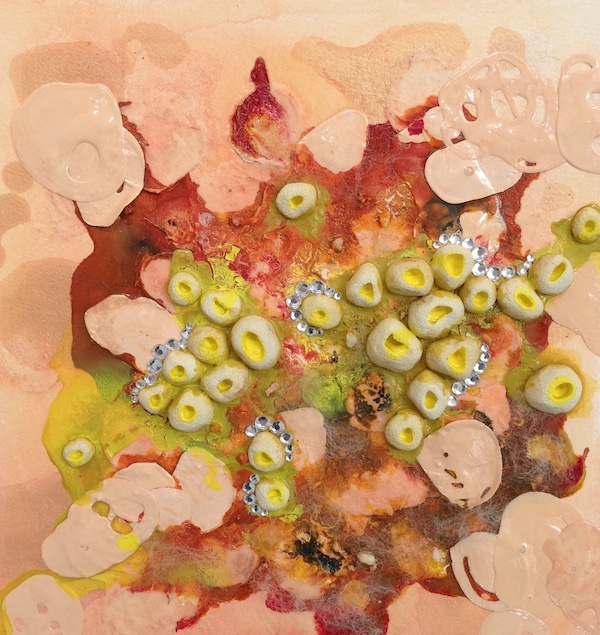
Slabs 14”x9” acrylic and ink 2015

Slabs
14”x9”
acrylic and ink
2015

Briefly describe the work you do.

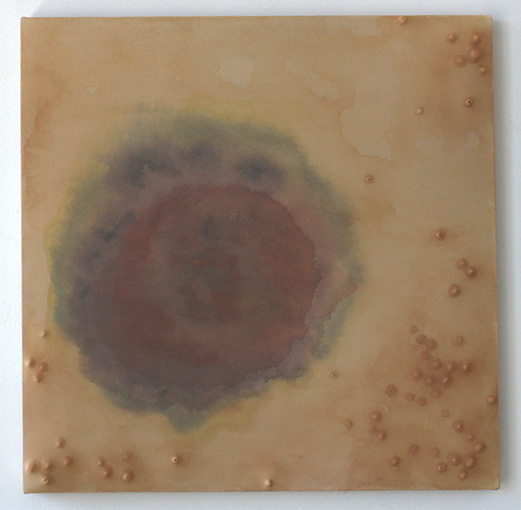
I make paintings and objects that visualize disease as a means of self- portraiture.

Tell us about your background and how that has had an influence on your work and on you as an artist.

I grew up on a large, Civil War era farm outside of Baltimore, Maryland. I spent the majority of my childhood outside playing in the dirt and rummaging through the fields, adding to my various collections. My Mom is a ceramicist and always had my brothers and I creating something. My Dad is a computer software engineer and a vat of knowledge. I am a true amalgamation of my parents.

The concept of the artist studio has a broad range of meanings in contemporary practice. Artists may spend much of their time in the actual studio, or they may spend very little time in it. Tell us about your individual studio practice and how it differs from or is the same as traditional notions of “being in the studio.”

I have trouble keeping my hands still. I feel the need to constantly use my hands in a productive manner. When I am in my studio, I try to stay as busy as possible making. There are too many things to play with in my studio that I get very distracted from researching and reading.

Endure This 14”x14” acrylic, ink, and mixed media on panel 2015

Endure This
14”x14”
acrylic, ink, and mixed media on panel
2015

What roles do you find yourself playing that you may not have envisioned yourself in when you first started making art?

I take on the role of a scientist in my studio. I conduct every project like an experiment. I am constantly testing new materials and I have them act like experimental variables—some are constants, others controlled, and I always like to throw in a catalyst just to add some excitement. However, unlike a scientist, there isn’t always a concrete solution I’m searching for and I am also a compulsive rule breaker. Most of the time my experiments are purely for fun, but the results may appear in work that I make months later.

When do you find is the best time to make art? Do you set aside a specific time everyday or do you have to work whenever time allows?

I try to spend as much time in my studio as possible during the week, but the moment the sun goes down is the moment I go into hibernation. The studio can be an overwhelming place and lying on my couch watching bad TV is my panacea. However, no matter where I am, I feel like my studio is always there with me—I am researching, reading, sketching, or obsessing in my spare time away from my studio.

How has your work changed in the past five years? How is it the same?

I have always been fascinated with disease—a hypochondriacal obsession. Trying to visualize disease has always been the foundation of my work, but the imagery that I use has changed over the years. Scientific imagery, especially images that are nearly impossible to see unassisted, has always captivated me. Despite imagery changes, my work still has a sense of delicacy and intimacy.

Contusion Confessions 24”x24” acrylic, porcelain, and nylon on panel 2015
Contusion Confessions
24”x24”
acrylic, porcelain, and nylon on panel
2015

How have people such as family, friends, writers, philosophers, other artists or even pop icons had an impact on the work you do?

My parents and my brothers are my go-to for advice. When I’m researching and don’t understand scientific terms, I call my younger brother so he can put it into simple terms for me. I feed off the knowledge of other people and they are always there to teach me something new. Lately, the 1970’s feminist art movement and the Abject have had a huge impact on my work.

Have you ever been pulled in the direction of a pursuit other than being an artist? What are your other interests?

I daydream about being a plant pathologist, a veterinarian, a mycologist, or an owner of a cat sanctuary. But I am neck deep in this career, so I take my daydreams and make them the guiding force in my studio. The physicality of material, the lack of rules and endless possibilities, and the therapeutic nature of art keep me motivated to continue creating.

About

Dent_headshotEllie Dent (b. 1991) is an American artist working in painting and sculpture.  Dent was born in Baltimore, Maryland and received a Bachelor of Fine Arts in painting from Towson University in 2013.  She is currently an MFA candidate in painting at the University of Georgia in Athens, Georgia.

Dent_Studio

elliedent.com

All images copyright of the artist and used with their permission. 
Posted in Painting | Tagged , , , , | Leave a comment

Elodie Abergel – Jerusalem, Israel

United Nation without "s", 2012 Prints on matte paper and chairs, 13 x 5.9 x 13 feet

United Nation without “s”, 2012
Prints on matte paper and chairs, 13 x 5.9 x 13 feet

Briefly describe the work you do.

My artistic work is contextual art, a type of art committed to serving mankind. I feel like what I call an “artivist” because I chose to create art and to live in Jerusalem and I think that my artwork offers a sensitive and off-beat perspective on the complexity of what is taking place in this specific part of the world. To realize my artworks, I use various materials (paint(painting), photography, video, collage and mixed techniques) to set up projects such as installations. What concerns me most is to express what I wish for, and techniques are not a constraint for me but ” as many ways to tame reality” in the service of an idea.

Tell us a little about your background and how that influences you as an artist.

Being the last in a family of four girls, I’ve always been a dreamer child, immersing myself constantly in the imagination to reinvent reality. The product of a double culture – Jewish-Moroccan on my father’s side and French-communist, having adopted Judaism from my mother, I was bathed in a family atmosphere that was both warm and surreal. From there, I did what I could to keep up with traditional schooling but I was always caught up in my dreams. Even though I persisted on a path that was not mine, I was lucky to have been somehow “jolted” by one of my sisters, Deborah (with whom I still work today) and this allowed me to do what I really wanted to do: CREATE!

Then, I went to the School of Fine Arts in Nantes where I acquired a robust formation to the various techniques. I especially learned how to get to the end of a creative process and to follow my own progress under the expert supervision and mentoring of very open minded teachers.

As soon as i finished the Fine Arts School, I decided to settle in Jerusalem to pursue my work on the subject of ” Territoires de Partages * “, which started during my studies. Thanks to these teachings, I developed my artistic practice by using various plastic art mediums (painting, collage, photography, vidéo…) but it’s essentially immersion in a new environment that was the source of creativity as shown by the works grouped under the title Shambles (Capharnaüm).

More recently, I had an experience as an artist in residence at NARS in New York, which was also very stimulating by the presence of other artists  from various countries and meetings with actors of the world of the contemporary art. To show my work encouraged me to pursue my personal progress.

Little Finger, 2013 Collages, composite materials, 2.3 x 2.7 feet

Little Finger, 2013
Collages, composite materials, 2.3 x 2.7 feet

The concept of the “artist studio” has a broad range of meanings, especially in contemporary practice. The idea of the artist toiling away alone in a room may not necessarily reflect what many artists do from day to day anymore. Describe your studio practice and how it differs from (or is the same as) traditional notions of “being in the studio.”

My studio is where I draw my materials, where my ideas occur, the streets where I walk with my camera, the traces of exchanges I film between moving walls; whether I find myself in Jerusalem, New York or in Paris, I assemble what I can find in my path.

What unique roles do you see yourself as the artist playing that you may not have envisioned yourself in when you first started making art?

The most difficult when i allow to call myself « an artist » is to think that what one has to express and what takes shape in one’s work may not only interest others but also bring them closer together. As such, I never thought that I could act as a mediator, or even an “agitator” through my artwork in the face of political events.

When do you find is the best time of day to make art? Do you have time set aside every day, every week or do you just work whenever you can? 

The best time is when an idea comes to me! Most often it is true that this happens rather at night, but this is not always the case. Sometimes an idea comes to my mind and a whole series of ideas keep coming. Once I have an idea, there really is no preferential moment to realize it and usually I cannot stop until the work is fully accomplished, sometimes to the point where I lose all sense of time.

Unveiled, 2014, Installation (print on canvas and ironing board), 6.2 x 5.5 feet

Unveiled, 2014,
Installation (print on canvas and ironing board), 6.2 x 5.5 feet

How has your work changed in the last five years? How is it the same?

I feel that my work always addresses the same issues, but my techniques have been refined through my artistic research. I am probably bolder with the materials I use and I have also developed some techniques of my own which I continue to explore. As to the substance of my work, it still questions the world around me, the present times, and the notion of “living together”.

Are there people such as family, friends, writers, philosophers or even pop icons that have had an impact on the work you do?

As I explained earlier, I take inspiration from everything around me, the list of people who have had an impact on my work is therefore immense.

If you had an occupation outside of being an artist, what would that be and why?

If I had an occupation except that of artist, it would probably be a manual one close enough to the realm of art (fashion, decoration, design …) or a social occupation. Besides, social work is quite similar to my artistic mediation activities between the Israeli and Palestinian people for the Zellige Paris-Jerusalem association and also with disadvantaged young people (Israel, Palestine, France, Brazil …)

About

Headshot_elodie abergelThe young Franco-Israeli artist Elodie Abergel has been part of the “contextual art” movement for several years, coupling her artistic work with her associative commitment to “Zellige Paris-Jerusalem”, where she is both the founder and coordinator. After her studies in Fine Arts in Nantes, she moved to Jerusalem to pursue her work on what she calls the “Territories of Sharing” (“Territoires de Partages”)*.

Through her artistic vision and works, she has developed the concept of “art of the present moment”, offering up a humanistic yet poetic and critical view of politics in the Middle East. She identifies herself as a committed activist and sees this land as an open workshop. By immersing herself in the heart of the Israeli and Palestinian culture, she has developed an art which is participatory and engaging.

The focal point of her art is the territory she works within, the borders of which house her energy, whether they are visible or not. To convey this focus to her audience, she uses materials found in her surroundings, transforming them through different mediums (photography, installations, video, performance…) as a function of her expression.

In her work, she also focuses on “repetition” to highlight the absurdity of the Israeli-Palestinian conflict.

5)Elodie At work

elodieabergel.com

All images copyright of the artist and used with their permission. 


Posted in Performance | 1 Comment

Emmanuelle Ly – Lyon, France

Neovanitas, animation, loop, dimensions variable, 2014

Neovanitas, animation, loop, dimensions variable, 2014

Briefly describe the work you do. 

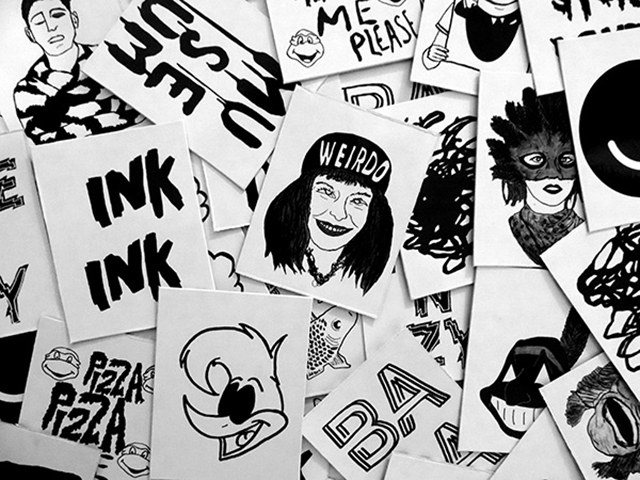
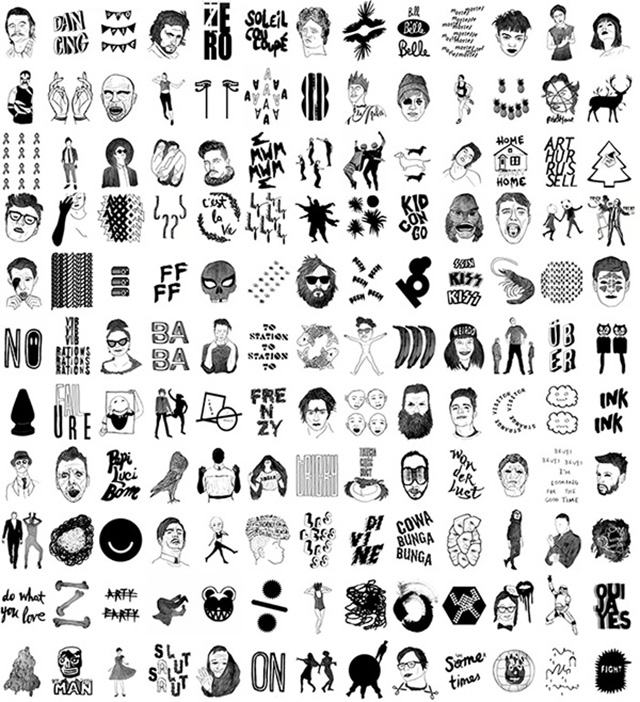
I’m a young French illustrator. I opened a blog in 2012 where I post a sketch a day mixing portraits, iconography, typography and animated Gifs in black and white. I mostly use digital tools and analog traditional techniques such as ink, pencil, watercolor, gouache or charcoal.

At the begining my project was a 365 day challenge but I’m still continuing it ! It’s a daily graphic experiment lab, a kind of extimate diary where I build my own visual archive. The result of this ongoing series is an illustrated cultural map named Daily Sketch Crossing (D*S*C)

Whenever it’s possible, I make collaborations and I show all my sketches in collective exhibitions.

Tell us about your background and how that has had an influence on your work and on you as an artist.

I have various influences. My mother is french and my father is Cambodian.

Regarding my education, after reading a novel written by Jorge Luis Borges, I decided to learn more about Spanish literature and civilization. So I went to the university to get a Spanish degree. But at the same time, I wanted to learn more about art history, improving my artistic apprenticeship in order to get new skills. That’s why I went to a fine art school and I was graduated with honors.

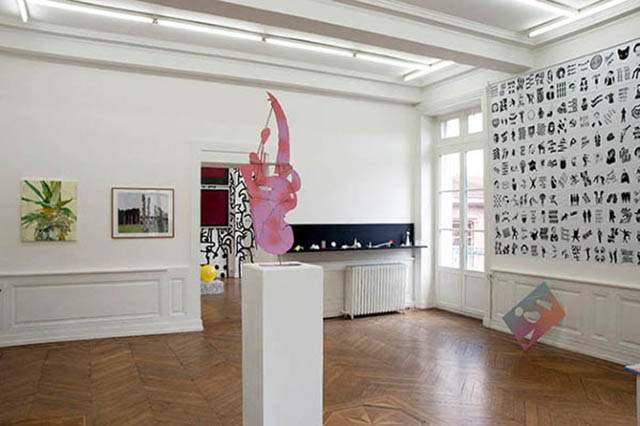
Panaché, collective exhibition curated by Broadcast Posters at the gallery l'Attrape-couleurs, Lyon, France, 2014 / with Fredrik Åkum, Emmanuelle Coqueray, Grégory Cuquel, Dina Kelberman, Magali Lefebvre, Emmanuelle Ly, Guillaume Perez, Amandine Rué, THTF and Bruno Zhu - photo©Gilles Bernasconi

Panaché, collective exhibition curated by Broadcast Posters at the gallery l’Attrape-couleurs, Lyon, France, 2014 / with Fredrik Åkum, Emmanuelle Coqueray, Grégory Cuquel, Dina Kelberman, Magali Lefebvre, Emmanuelle Ly, Guillaume Perez, Amandine Rué, THTF and Bruno Zhu – photo©Gilles Bernasconi

The concept of the artist studio has a broad range of meanings in contemporary practice. Artists may spend much of their time in the actual studio, or they may spend very little time in it. Tell us about your individual studio practice and how it differs from or is the same as traditional notions of “being in the studio.”

I can’t stand being stuck in the same location. I don’t really need a studio for the moment. I can work anywhere I want ! Finally a sketchbook is a nice pocket nomadic lab! And anywhere I open up my laptop is my studio.

What roles do you find yourself playing that you may not have envisioned yourself in when you first started making art?

You have to learn to love social media! Nowadays, being an artist also means basic knowledge of management to promote your work.

When do you find is the best time to make art? Do you set aside a specific time everyday or do you have to work whenever time allows?

When I have a big project I work constantly night and day! Nevertheless I’m a nocturnal bird and I definitely prefer working at night. It’s so silent and peaceful!

Greetings, limited edition, printed postcards, 2015

Greetings, limited edition, printed postcards, 2015

How has your work changed in the past five years? How is it the same?

Making art is like cooking or practicing yoga. You need daily training to achieve simplicity and efficiency. I try to evolve with the same determination and serenity as a turtle, keeping in mind what I like to do. As Pierre Soulage said « It’s what I do that teaches me what I’m looking for ».

How have people such as family, friends, writers, philosophers, other artists or even pop icons had an impact on the work you do?

When I was a kid, one of my aunts bought me a book of Henri Matisse. Then I began to reproduce what I saw all around me. I got interested in painting, I wanted to became a figurative painter! Nevertheless I terribly suck at coloring and I finally realized I prefer to draw in black and white.

About the impact of other artists, I usually pin what it inspires me on my pinterest board. There is an abundance of very talented artists on internet! More specifically I love autobiographical art. I think I need that art tells me stories about people.

I have also a huge admiration for Aby Warburg, a german art historian who attempted to build a visual Mnemosyne Atlas.

And right now I’m pretty impressed by the vitality of the independent publishers and zinesters scene !

Have you ever been pulled in the direction of a pursuit other than being an artist? What are your other interests? 

I am also interested in philosophy and linguistics. But art is a matter of focus and point of view, isn’t it? For me art is interdisciplinary, it can embrace all areas of reflection & creation. There is no boundaries.

Moreover, since my double jaw surgery, I’m particularly fascinated by the maxillofacial changes.

I enjoy exploring old human anatomy books !

About

headshotEmmanuelle Ly is a young visual artist and freelance illustrator, based in Lyon, France. She studied spanish at the University of Burgundy. In 2011, she received a master degree of fine Arts from the Nationale Art School of Dijon. Since 2012, she posts a sketch a day on her blog focusing on the pop culture icons. She is paddling down an endless river of artistic inspiration illustrating a raw portrait of our society. She has showcased her artwork in various spaces, platforms and magazines.  

DSC_detail

emmanuellely.com

All images copyright of the artist and used with their permission. 
Posted in Illustration | Tagged , , , , | Leave a comment

Katarina Rankovic – London

Others Will Love Me, video, 00:01:40, 2014

Others Will Love Me, video, 00:01:40, 2014

Briefly describe the work you do. 

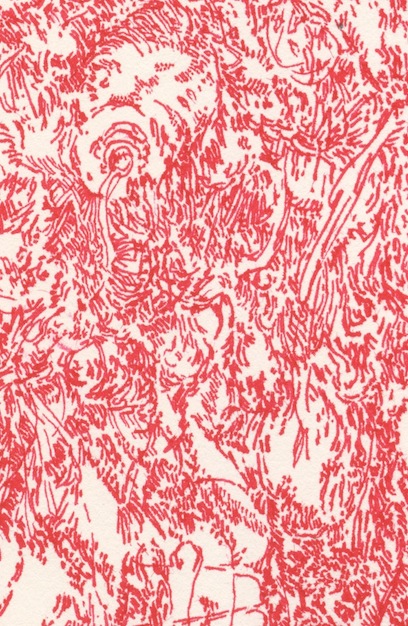
I imitate the spirit of the things that interest me, by drawing or performing. Drawn to luscious organic structures, from cellular membranes to galactic clusters, I create manneristic ink drawings where each line is the trace of an attempt to wriggle into the bustling character of these things, like a skin.

I also stage fictional interviews which I record by video or by sound, and in which I play the role of interviewee. Like the drawings, these are improvised. I tell stories from the perspective of an invented persona, becoming a Frankenstein’s collage of accents, mannerisms and gestures that I pick up from personalities around me.

A jealousy for the power of the other is what drives me, and improvised empathetic imitation is my way of coping with this desire.

Tell us about your background and how that has had an influence on your work and on you as an artist.

I first saw Mulan when I was eight years old. Struck by her irresistible power and otherness, I got hold of my father’s camera and took a photo of myself shortly afterwards. With a plastic sword in hand positioned offensively across my face, and a ferocious, direct glare, something about the pose seems slightly out of place for a young child. Whenever I look at this photo now I am reminded of what a reality produced itself for me when I allowed myself to imitate the object of my admiration with utmost earnestness. Ever since, I have been talking to the mirror and lying to strangers, in a living attempt to rid myself of the shame of copying – so that I now allow and even encourage influences to permeate my practice.

Railway Rocket Dog Song 1, ink on paper, 15 x 21 cm, 2014

Railway Rocket Dog Song 1, ink on paper, 15 x 21 cm, 2014

The concept of the artist studio has a broad range of meanings in contemporary practice. Artists may spend much of their time in the actual studio, or they may spend very little time in it. Tell us about your individual studio practice and how it differs from or is the same as traditional notions of “being in the studio.”

My ideal studio is a bubble in which I am cut off from the world. Filled with plenty of light, it is a place in which all things I love can culminate and confront me. I might keep a list of “one thousand things Katarina likes” on one wall, and might let a nostalgic Serbian pop song from 1967 resound in the space. One day I might come along and dance in it, and wonder how the world can not know of my joy at that moment. Another day I might lie across a table, and pass the time wrapping myself around its legs. I might stare into a mirror until I start crying, or tell a story to nobody. I need such a place, but I find I construct them nomadically, wherever I go. Art can happen in a studio. But it can also happen at a party, or in bed when you are sick with the flu.

What roles do you find yourself playing that you may not have envisioned yourself in when you first started making art?

The more I pursue art the more I am surprised at my newfound sense of entitlement to do it. Growing up, art was something I always had to ‘steal away’ and do in solitude, or while nobody was looking. Now that I identify myself as an artist, it is almost like having a permit to take silly things seriously. I let fall time in the belief that there is integrity in nurturing the private curiosities that I tremble to speak of openly. I now see myself as someone who fumbles about chasing glaring ambiguities that have no name, yet seem to me so global and persistent.

When do you find is the best time to make art? Do you set aside a specific time everyday or do you have to work whenever time allows?

Sometimes I set about things with a strategic vigor and sense of direction. Other times, I feel hopelessly vulnerable and making art becomes a spontaneous consolation lottery, where engaging in it either offers me solace or throws me into further uncertainty. Example: once I was standing by a partitioning wall between my parents’ bathroom and landing. I was about to go downstairs but my father began Skyping with my grandfather, a difficult man of great talent, with whom I have developed a very sour relationship. Standing in the landing, I was reluctant to move, yet ashamed that I was avoiding my own family like this. Looking into a mirror in the bathroom, I began to embrace, and then kiss the partitioning wall, which seemed to have human proportions. It was one of those unexplained private activities. I took out a mobile and started to film myself kissing the wall. Now that clip has detached itself from me and become something I consider to be a work in its own right (Others Will Love Me, 2014).

Widow, video, 00:02:34, 2014

Widow, video, 00:02:34, 2014

How has your work changed in the past five years? How is it the same?

It has mostly changed in the media I use, from drawing to collage, writing to photography, performance to improvising stories, until the present, as I consider making interactive web pages and podcasts. What remains consistent however, is a drive to imitate powerful expressions by latching onto their respective superficial traits – in effect copying things I am jealous of.

How have people such as family, friends, writers, philosophers, other artists or even pop icons had an impact on the work you do?

Pieces of behavior and personal expression relentlessly enter my vocabulary of mimicry. I love surrounding myself with impressive personalities, be they fictitious or real. Cyrano de Bergerac and his undying panache, or Barbarella’s babeness. The humanity in a single gesture by Pina Bausch. My mother’s articulate English in a slight and sharp Slavic note. The passionate glare of my friend as she holds a trembling teacup. It is the impossibility of these things, heavy enough with care to move the earth, yet shedding so effortlessly from these individuals, that awakens my jealousy and desire to do my work.

Have you ever been pulled in the direction of a pursuit other than being an artist? What are your other interests? 

Like many artists I know, I want to be everything. An actress, a programmer, an ecologist, a fencer. My practice is probably a result of this indecisiveness.

About

headshotKatarina Rankovic was born in 1994 in Leeds, UK to Serbian parents. At twelve she moved with her family to Bergen, Norway, where she spent her adolscence working in a studio provided to her by the council. Meanwhile she completed an International Baccalaureate at Bergen Katedralskole, while also working as a Language and Engagement Coordinator for NGO TakingItGlobal’s environmental initiative Tread Lightly, whom she also delegated at the 2011 United Nations DPI Conference on Sustainability.

With a long-standing concern for the environment, and issues relating to gender and identity, her art and writing became a primary means of reflecting on these interests. Katarina has participated in and co-curated numerous UK exhibitions, and she is now studying for her BA in Fine Art at Wimbledon College of Art, University of the Arts London.

studio

katarina-rankovic.com

All images copyright of the artist and used with their permission. 
Posted in Video | Tagged , , , , | Leave a comment