Dana Stirling – New York City

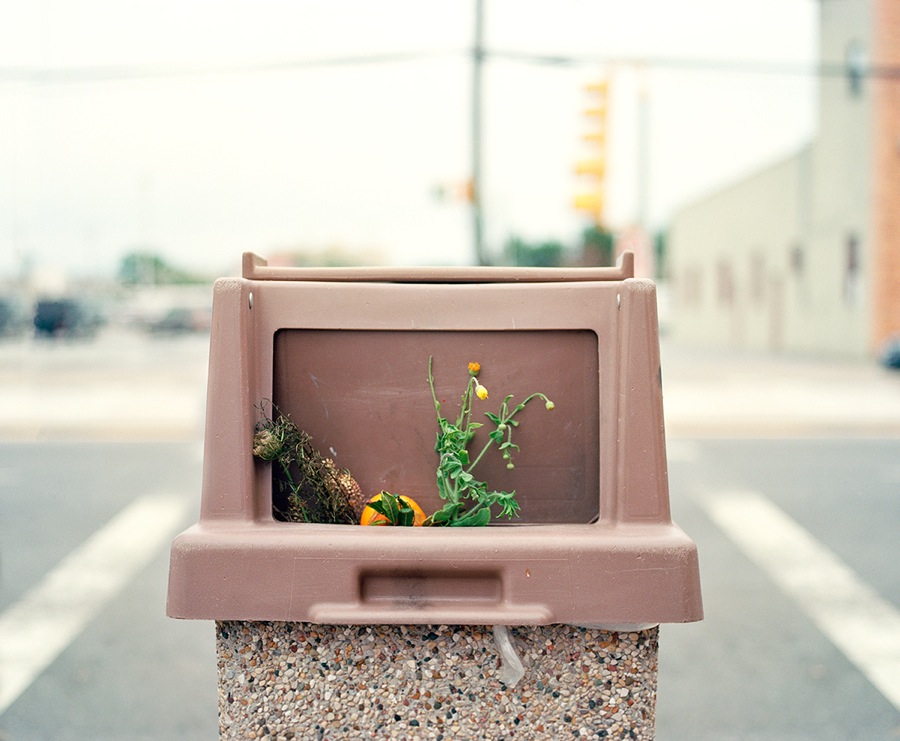
Wendy's, 2013

Wendy’s, 2013

Briefly describe the work you do.

My photographic practice chains together straight and still life photography,found footage from my family history and imagery from strangers family albums. Using photography I’ve conducted an examination of my history. Due to the migration of my family from England to Israel that history discontinued, and therefore I find it hard to consider it as mine. The images become objects that I use in order to create a new history and memory of my own; people and places as I would like to remember and understand them.

The concept of the artist studio has a broad range of meanings in contemporary practice. Artists may spend much of their time in the actual studio, or they may spend very little time in it. Tell us about your individual studio practice and how it differs from or is the same as traditional notions of “being in the studio.” 

I actually don’t have a studio. My work revolves around straight photography and found footage.I feel as if I have no real need of an indoor space to work in. I travel as much as I can to different places in order to find my photographic subjects and look for flea markets and thrift stores. I work most of the time at home and my scanning and printing I do at school. Once I graduate I will start thinking of a studio, but I think that even then this “studio” would just be a small section at home for technical equipment. 
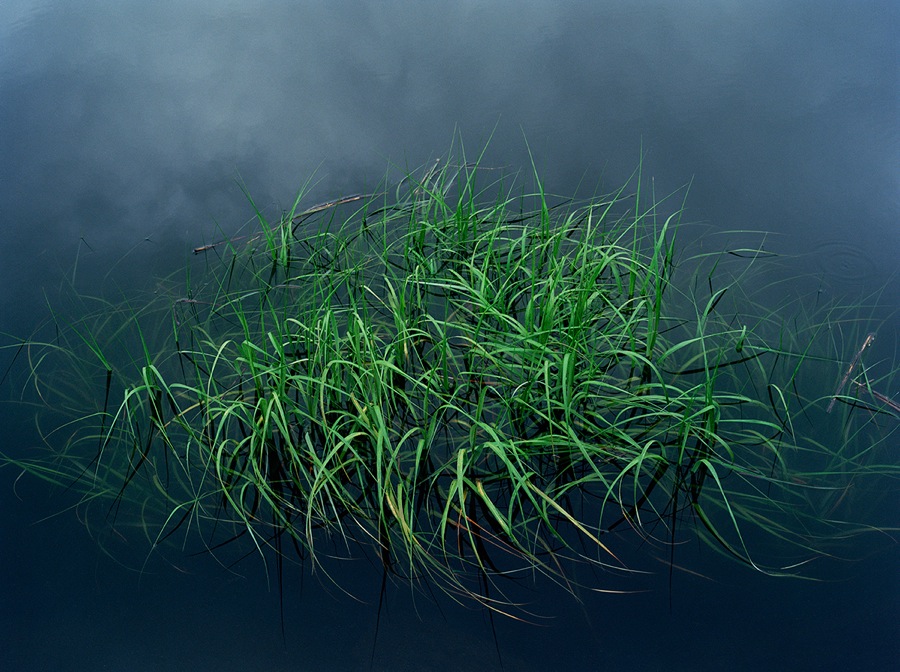
Float, 2013

Float, 2013

What roles do you find yourself playing that you may not have envisioned yourself in when you first started making art?

I started my BA with no real understanding and ambitions about photography. I wasn’t even sure if I had a talent for photography. My BA helped shape my vision and perspective about photography, and specially helped me develop a photographic style and aesthetics. I think I am still working on getting into the role of an artist. I saw myself up to now as a photographer, but have been thinking of this notion of an artists and what it means to be one. I am currently working in feeling comfortable in that role.

When do you find is the best time to make art? Do you set aside a specific time everyday or do you have to work whenever time allows?

I am currently a Graduate student at the School of visual Arts here in NYC. Therefor, I am dedicated to art in general and my own practice in a intense environment and situation. When you are an art student, you have deadlines and Critique classes which push you to make work (even if sometimes bad work) all the time. Each assignment, each class, makes you think about your work and the direction you are going in towered your thesis project. I guess the biggest challenge will be one I graduate. Then you have to be self motivated and productive. I hope to allow myself time to work on my art all the time. I mainly work on it during the weekends and when I go and do photography trips with my husband.
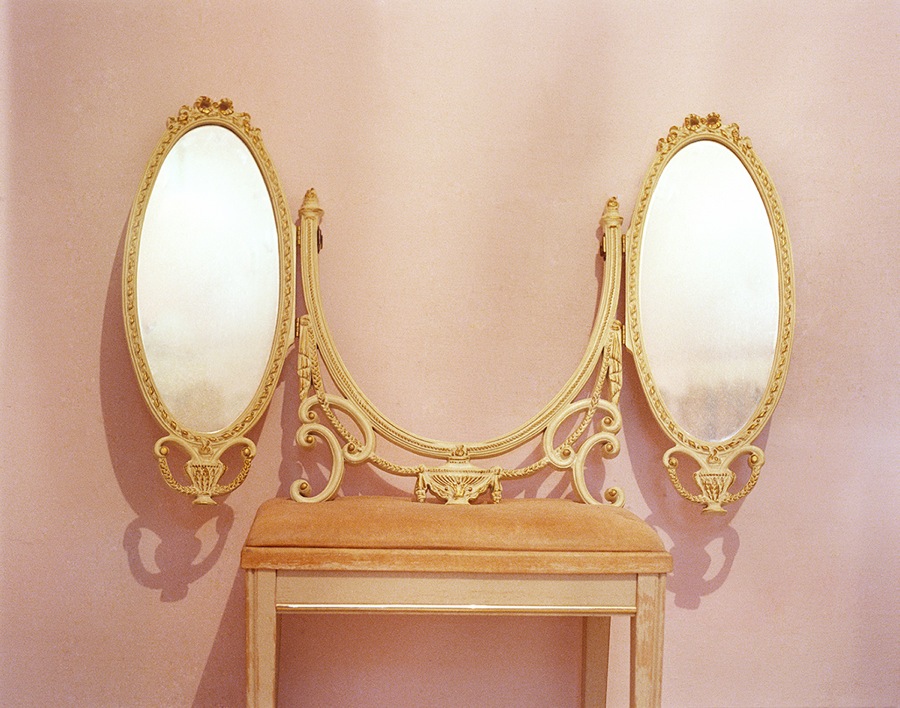
Mirror, 2012

Mirror, 2012

How has your work changed in the past five years? How is it the same?

I think my work has evolved, not so much changed. I have been working on the notion of family albums, identity and memories through photography for a while now. I started working with only BW old images from my own family album, moved to BW and color old images from my album and combining them with my own photography, and now I am working with strangers and anonymous found footage. My subject matter hasn’t really changed, it is more the visual of these ideas that has changed.

How have people such as family, friends, writers, philosophers, other artists or even pop icons had an impact on the work you do?

Takashi Yasumura. A Japanese photographer with his project “Domestic Scandals” . He photographed his parent’s home, mainly still life’s. He managed to capture this silent fusion of cultures and he has an elegant way of creating a juxtaposition between American objects and the way they affected his parents traditional Japanese home.

I first came across his project while I was working on a project about my Grandparent’s home that was in the process of been emptied completely. My teacher recommended him to me, and the second I saw his work, my entire view and perspective changed 180 degrees. He became almost like a mentor to me and he heavily influences that project.

Till today, he is by far one of my favorite artists to go to when I need inspiration.

Have you ever been pulled in the direction of a pursuit other than being an artist? What are your other interests?

When I was younger I was into journalism and writing in general. My dream back then was to be a professional writer for a big newspaper. As time passed I realized that I wasn’t as good as I wanted to be. My aspiration was greater than my talent. I knew I wanted to do something creative, but couldn’t find my place in any of the disciplines (painting, sculpture, graphic etc.)

I did find photography eventually in my late high school years and in my Mandatory Israeli army service, and have been working with it since.

About

3d1cfe_a9d512b6bb1e55fe99fa438789f6b12b.jpg_srz_p_272_292_75_22_0.50_1.20_0Born 1989, Jerusalem Israel.

In 2007 served my mandatory Israeli army service at the Youth and Education corp, as a tour guide in the biblical nature park “Neot Kedumim”. In 2009, a few month after the army service, started a BA in photographic communications at Hadassah College Jerusalem, graduated in 2013. In 2013 moved to NYC interned at Hasted Kreautler Gallery, did a TA position at ICP (Black and White darkroom printing assistant) and was a studio intern at Gilles Peres Studio.

Currently an MFA student at the School of visual arts NYC (photo, video and related media department).

danastirling.com

All images copyright of the artist and used with their permission. 
Posted in Photography | Tagged , , , , | Leave a comment

Stephanie Barenz – Milwaukee, Wisconsin

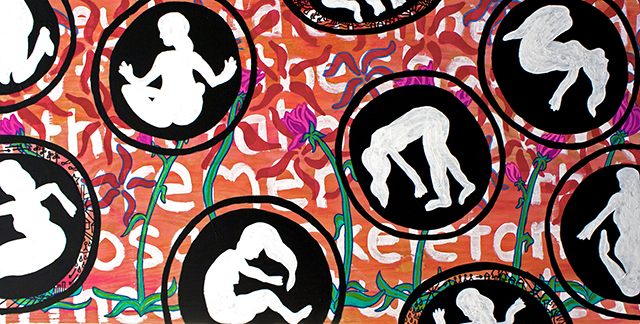
“Gathering Sense and Sweetness: A Homage to Rilke”  Mixed media on canvas 6’ x 8’ 2013

“Gathering Sense and Sweetness: A Homage to Rilke”
Mixed media on canvas
6’ x 8’
2013

Briefly describe the work you do. 

My work honors the stories of others through mixed media painting. The act of sharing a story or listening to one connects us to our shared humanity. My mission as an artist is to create paintings that tell people that their experiences, whether of pain or joy, matter. Storytelling serves as a way for us to form and preserve our neighborhoods and to develop empathy. It helps to stimulate a conversation about the sanctity of knowing one’s neighbor, whether it is someone across the street or ocean.

Within this framework I also explore themes of place, travel, sojourning, and displacement. Our connection to place is so much a part of our stories, whether that place is physical or relational. So often we find “place” through the  transformative act of journeying.  That journey may last an hour or a lifetime, but within that frame perspectives are changed and a story is formed.

Tell us about your background and how that has had an influence on your work and on you as an artist.

I am very blessed to have loving parents and siblings who encouraged me to pursue art. My father is a minister and my mother is a kindergarten teacher. I see a lot of my childhood coming through in the paintings. We moved and traveled a lot, the importance of serving others was taught in our home, and storytelling, reading, and collaboration were all part of my upbringing. Therefore, it is no surprise to me that travel, storytelling, and knowing one’s neighbor are all major themes in my work today. 

I spent my twenties moving around for school and residencies. This included getting my MFA at Washington University in St. Louis, studying at Santa Reparata International School of Art in Florence, Italy, and completing artist residencies in Chicago and Milwaukee. After school, I taught at colleges in Milwaukee and in Hangzhou, China. The people that I met throughout these travels not only changed my world view but how I viewed myself. 

Listening to the stories of others and honoring them through painting and storybooks became my focus when I was chosen as the 2013-2014 Pfister Artist-in-Residence, at Milwaukee’s historic Pfister Hotel. It was here that I met my collaborator, Pfister Narrator, Molly Snyder, who is a local storyteller and Senior Writer at onmilwaukee.com. Molly and I spent a year collaborating on the book project, “The Carriers,” which was inspired by the stories of hotel guests.

Molly and I are now collaborating on some projects at S. Barenz Studio. Together we interview my clients about their story. I create a bespoke painting and Molly writes a creative copy that is inspired by their story. Images of the painting and creative copy are woven together into a storybook that is presented to the clients along with their painting.

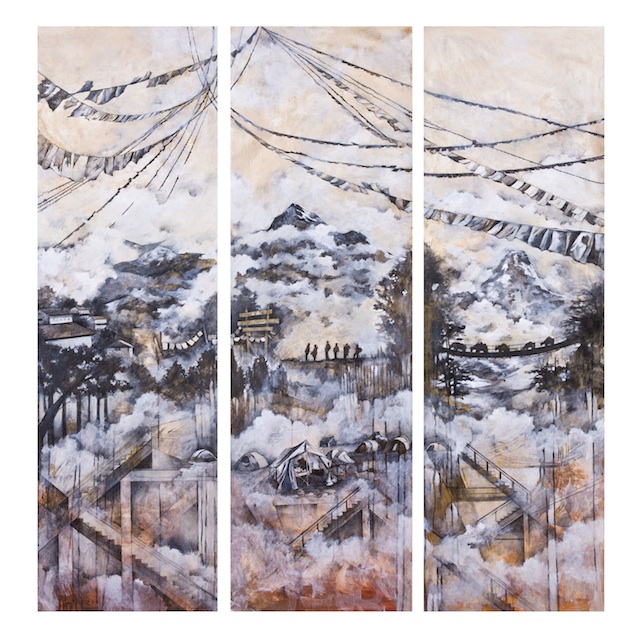
“Going to the Sun” Mixed media on panel 60” x 54” 2014

“Going to the Sun”
Mixed media on panel
60” x 54”
2014

The concept of the artist studio has a broad range of meanings in contemporary practice. Artists may spend much of their time in the actual studio, or they may spend very little time in it. Tell us about your individual studio practice and how it differs from or is the same as traditional notions of “being in the studio.”

My studio practice has changed over the years. Most people would think that you would spend more time in your studio as a full-time artist. For me it is opposite. As a full-time artist I spend more time completing administrative tasks, networking, and traveling then making art. I see my practice as more of a business now then ever before. I really enjoy the business aspects of my studio life. Painting is my first love but it is enjoyable for me to be involved in every step of that painting’s life, from conception to bringing it to its new home. 

What roles do you find yourself playing that you may not have envisioned yourself in when you first started making art?

I never really saw myself as an entrepreneur when I started making art. I went through six years of formal art training and we never talked about the business side of being an artist. When I got out of school I spent a lot of time feeling defeated because I couldn’t make enough to be an artist full-time. When I assumed the role as entrepreneur, formed an LLC, took a few business classes, and began to write up a business plan I realized it was a major missing piece in the “equation.” Getting my business in order has allowed me to be more creative and has given me more freedom as an artist. 

When do you find is the best time to make art? Do you set aside a specific time everyday or do you have to work whenever time allows?

I normally work in a series or am working on commissions. This means I will usually work for 3 months at a time on a project and then take a month off to catch up on other projects and get inspired to go onto the next thing. I always show up at the studio, but that doesn’t mean I am always making art. I go to work from 8am-5pm, Monday through Friday, and try to stick to that schedule as much as possible.  

“A True, Abiding Place” Mixed media on canvas 24” x 48” 2014

“A True, Abiding Place”
Mixed media on canvas
24” x 48”
2014

How has your work changed in the past five years? How is it the same?

My work has changed formally over the years but the themes have always been constant. I think that over the last six years I have been able to articulate those themes more so then when I started. For example, when I got out of grad school I was making work about our relationship to place. What I realize now, is that I was really interested in the sanity of knowing one’s neighbor and people’s individual stories. I became more interested in how story gives us a place and that each story matters. 

How have people such as family, friends, writers, philosophers, other artists or even pop icons had an impact on the work you do?

I read a lot of Edward Casey’s work in grad school, he is one of the leading philosopher’s on the topic of place. He wrote, “Getting Back Into Place” and teaches at Stony Brook University. Wendell Berry’s work has also influenced me greatly. 

However, I  believe that the everyday influences me more now than ever, it is really the people that I know and my relationships to them that inspire the work. 

Fred Rodgers has always been a role model that I look up to. I love everything that man stood for, especially his mission to validate others and to learn their stories. 

As far as other artists, I have fallen in and out of love with different genres over the years. My loves that has always stayed constant are Chinese ink painting, Japanese wood cuts, and architectural renderings.  

Have you ever been pulled in the direction of a pursuit other than being an artist? What are your other interests? 

There have been many times when I play the game of, “What if I went to school for _____ instead of art.” However, I haven’t really come up with anything else I would rather do full-time. I like teaching on occasion, but only a class here and there. I prefer mentoring over teaching. I mentor central city youth several times a week and enjoy working with them the most. I would love to help facilitate more mentoring programs and to encourage others to become a mentor. 

Besides that I really enjoy cooking healthy food, traveling, spending time with friends and family, going to events and new places in Milwaukee, camping, and the occasional netflix binge. 

About

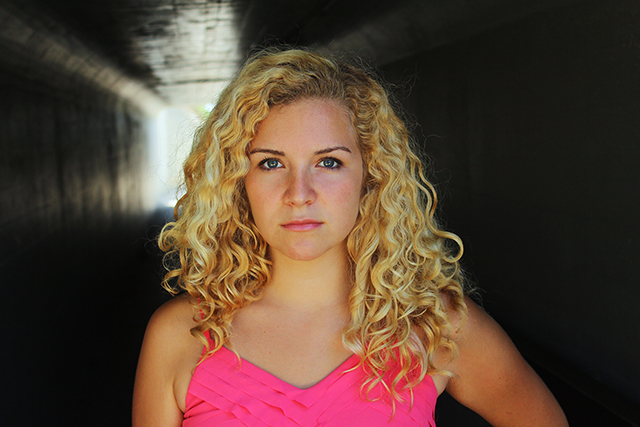
Barenz_Headshot copyStephanie Barenz is an artist currently living in Milwaukee, Wisconsin. She received her Bachelors of Art from Bethany Lutheran College in Minnesota, her MFA in Visual Art from Washington University in St. Louis, and studied abroad at Santa Reparata International School of Art in Florence, Italy.   

Barenz was chosen as the 2013-2014 Pfister Artist-in-Residence and Professional Dimension’s 2015 Sacagewea Artist. She has taught at the Milwaukee Institute of Art and Design, Wisconsin Lutheran College, and Hangzhou Dianzi University in China. Her studio storefront is located in the Third Ward as part of the Mandel Creative Studio Program.  She also runs a small  mentoring program for central city youth called “Our Story Arts.” She has works in public and private collections and has exhibited across the U.S. and abroad. Her work has been featured on MPTV, the Huffington Post, the Milwaukee Journal Sentinel, Milwaukee Magazine, Artist’s Magazine, and many more.

Working_in_Studio

stephaniebarenz.com

All images copyright of the artist and used with their permission. 
Posted in Painting | Tagged , , , , , | Leave a comment

David Borawski – Hartford, Connecticut

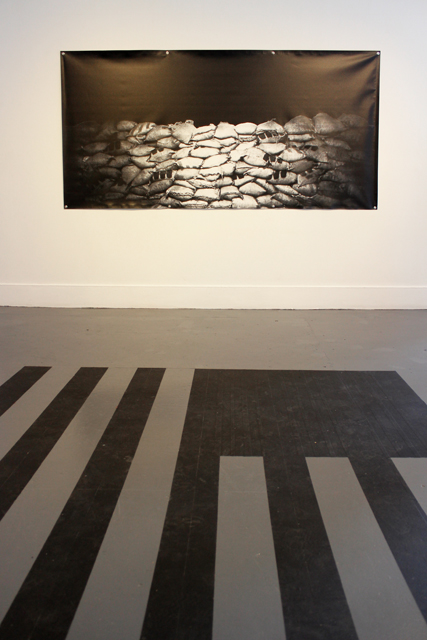
(on wall) Anti-Fascist Protection Rampart, 2014, digital print on vinyl, 48” x 96”; and  (on floor) Greatest Threat (of all time), 20014, gaffers tape, 72” x 72”.Installation view from the exhibition CT (un) Bound, Artspace, New Haven, Ct.

(on wall) Anti-Fascist Protection Rampart, 2014, digital print on vinyl, 48” x 96”; and
(on floor) Greatest Threat (of all time), 20014, gaffers tape, 72” x 72”.Installation view from the exhibition CT (un) Bound, Artspace, New Haven, Ct.

Briefly describe the work you do.

I create conceptually driven installations that reflect upon iconic cultural and societal events that have influenced major shifts in our collective consciousness, but now are at the point of forgetting.

For each exhibition, I combine and arrange multiple elements and mediums, (i.e. sculpture, video, digital images, etc.), to present visual and cognitive signs, or “clues”, that evoke a sub/conscious nostalgia, building multiple layers of information to be considered.

Veiled references to politics, pop culture and art history suggest connections and idiosyncrasies while exposing them as uncanny precursors to present-day realities.

Tell us about your background and how that has had an influence on your work and on you as an artist.

I grew up in a Connecticut suburb and was good at drawing cartoons. My mother was a frustrated artist as a youth, so she encouraged me to pursue my interests and was supportive of me attending art school. In my first semester I was exposed to so many great artists and movements, work that was basically ignored in my high school curriculum, that my direction and perspective was changed from that point on.

Fool Me Twice, 2012, gaffers tape, 360” x 80”, installation view from the exhibition Somewhere Between Support and Collapse, Elon University, Elon, NC,

Fool Me Twice, 2012, gaffers tape, 360” x 80”, installation view from the exhibition Somewhere Between Support and Collapse, Elon University, Elon, NC,

The concept of the artist studio has a broad range of meanings in contemporary practice. Artists may spend much of their time in the actual studio, or they may spend very little time in it. Tell us about your individual studio practice and how it differs from or is the same as traditional notions of “being in the studio.”

I had a studio in an old factory for many years, getting time only once a week or so as my kids were growing up. I lost that space when a developer bought the building and intended on turning it into luxury apartments. For many years after that I would prepare an exhibition based on floor plans and photos of the space all on my computer. Three years ago I received a grant from the city to rent a studio space, and now I don’t want to give it up. It has been incredibly beneficial to my work, allowing me to experiment with concepts and materials. I arrange elements for my sculptural installations, so I can set up scenarios in the space and leave them up to think about. The way I work is to bring an idea to a point of possible completion, then take pieces away until falls apart, that’s when I know its done.

What roles do you find yourself playing that you may not have envisioned yourself in when you first started making art?

I not only make art, but I look at a lot of art. I have been fortunate to get opportunities over the years to curate exhibitions of the work that I have fallen in love with. I also have gotten into art handling and installation at galleries and museums which not only pays the bills, but allows me intimate access to great art. Never saw that coming.

When do you find is the best time to make art? Do you set aside a specific time everyday or do you have to work whenever time allows?

My studio is a only a block from where I live so I can pretty much go whenever the desire arises. I tend to work more when I have an exhibition on the horizon and in clusters of time when I am obsessed with a piece.

Man in the 5th Dimension, 2013, digital print on vinyl, 72” x 84”, installation view from the exhibition In The Next World’s Fair, Orison Project, Essex, Ct.

Man in the 5th Dimension, 2013, digital print on vinyl, 72” x 84”, installation view from the exhibition In The Next World’s Fair, Orison Project, Essex, Ct.

How has your work changed in the past five years? How is it the same?

My work has come together in the past several years, in a way that connects the work not just as a “body of work” but as a total way of working. The different outlets for ideas all fit together so that I can mix older pieces with new ones, bringing the original concept into a new scenario to influence and be influenced by the context.

How have people such as family, friends, writers, philosophers, other artists or even pop icons had an impact on the work you do?

I look at a lot of art, and much of it impacts me in a variety of ways. I also am inspired by music and good lyrics. My work is driven by sex, drugs and rock and roll. And politics, but that’s redundant.

Have you ever been pulled in the direction of a pursuit other than being an artist? What are your other interests? 

I am very interested in computer graphics, web site development and design. I worked for Apple for ten years and it was a good run. I still do my own site, and a few for friends. The computer now plays a big role in the digital work I do, videos and images. Instead of it pulling me away from art I was able to pull it into my art.

borawski-headshotAbout

Click here for CV

rot8tor.com

All images copyright of the artist and used with their permission. 


Posted in Installation, Sculpture | Tagged , , , , | Leave a comment

Kristy Deetz – De Pere, Wisconsin

Frame NarrativesBriefly describe the work you do. 

Each painting in my recent THROUGH THE VEIL series begins with a rendering from a closely observed fabric with wrinkles and folds. They recapitulate the compositional structure of a painting/drawing by artists from the past and present. The fabric in these paintings acts as a limen or threshold that places the viewer into multiple, often conflicting, layers of space and meaning. In the series the Rabbit or environment may be stretched or manipulated through Photoshop to create a sense of instability, heightened emotion, or a digital sifting. The paintings good-humoredly deconstruct imagery from pop, outsider, and high culture to create new “spaces” of meaning. The shape-shifting Rabbit is positioned in front of or behind; it looks into, out, around or between images and spaces. The paintings use dark humor, visual puns, symbols and metaphors, moments of silence, art historical allusions, cultural collisions, and spiritual conundrums to play with style and pictorial/formal construction.

EARTH TEXTS comprises a series of thirty-five wooden relief sculptures (carved, burned and painted with encaustic) that create visual metaphors of the book form as well as autobiographical explorations. Playing off concepts like frame narratives, in medias res, and earth digest, these pieces operate in one sense as visual puns and connect ideas of language to both earth and body. Through interplay of forms each piece seeks to explore what we know or how we behave. Books embody text, and the “text” connects internal and external landscapes in a search for answers to human dilemmas. The plywood represents nature destroyed; construction of the art piece from the recycled plywood represents nature re-empowered or its pattern newly disclosed. The tactile paint surface, created through layers of encaustic (wax and pigment), serves as “skin,” unveiling greater complexity beneath.

deetz_kristy_1

Tell us about your background and how that has had an influence on your work and on you as an artist.

I grew up in a large family in the Midwest. We often spent time on family farms and hiking in the woods. The feeling of being connected to nature and examining it closely was an extremely pleasurable activity that encouraged me to find interconnecting patterns that echo through nature and our spiritual, emotional, and intellectual lives. My parents also encouraged all kinds of creative activities. We got music lessons and studied or took classes in whatever art form or athletic activity interested us. One holiday I received an acrylic paint set in my Easter basket. My parent instilled in us a love of learning. My mother is particularly creative, curious about all kinds of things, and interested in the arts. My father is interested in how things work, engaging the world with preparation and logic, and he values tenacity. Both my parents have an incredible work ethic.

The concept of the artist’s studio has a broad range of meanings in contemporary practice. Artists may spend much of their time in the actual studio, or they may spend very little time in it. Tell us about your individual studio practice and how it differs from or is the same as traditional notions of “being in the studio.”

I continually think about the current painting/artwork that I am working on and what I will do next. I value long stretches of uninterrupted time in the studio. I also value long stretches of uninterrupted time to read and learn about art history, art criticism and theory, philosophy, religion, literature, poetry, and science. Studio time requires focus and intense preparation time.

What roles do you find yourself playing that you may not have envisioned yourself in when you first started making art?

Curating and promoting traveling art shows, traveling as a visiting artist and giving workshops to other artists, giving conference papers and serving on art panels, writing about art and art ideas, developing a detailed and evolving philosophy for making and teaching art: all those roles come from the experiences of being a professional artist and teacher for many years.

When do you find is the best time to make art? Do you set aside a specific time everyday or do you have to work whenever time allows?

I generally work best in afternoons and evenings, after I get home from the university, often until 11:00 pm or later.

deetz_kristy_2How has your work changed in the past five years? How is it the same?

Over the part thirty years of being an artist and teacher, I have deliberately made huge leaps in my work by investigating very different ideas, styles, media, and subject matter. I still like to keep more than one body of work going at a time. Aside from recent explorations of things digital, I continue adding to a series of wooden relief sculptures, Earth Texts and Liminal Trilogies, and work that includes illusionistically painted elements and textural surfaces that incorporate fabric and drapery as image and concept. The manifestation of these ideas continues to evolve—the recent evolution is the series Through the Veil, which mixes elements from many past series and introduces new ones.

How have people such as family, friends, writers, philosophers, other artists or even pop icons had an impact on the work you do?

I have been influenced by the writings of Derrida, Deleuze, Dante, the Victorian and Romantic poets, Buddhism, Theology, Geology, Biology, many different painters (Goya, Celaya, Tuymans, Piero della Francesca, Magritte to name a few), but most of all my conversations with my husband, Edward Risden, who is a professor of Medieval and Renaissance literature and language. He is incredibly well read, accomplished, and has a variety of interests and pursuits—a true Renaissance Man. He is a skilled, insightful, and productive scholar and has the heart and soul of an artist. His input and support on my creative endeavors is unwavering, inspirational, deeply thought, and well informed. He is an intellectual, scholar, and artist with words. We have just begun giving InterArts workshops together and are finding the preparation rewarding because we move immediately and naturally to interdisciplinary conversations.

Have you ever been pulled in the direction of a pursuit other than being an artist? What are your other interests? 

I am happy being an artist and university art teacher, though through undergraduate school I also pursued interests in music. In another life I was a French Pastry Chef, harpsichordist, starving philosopher, or sailor.

About

website portraitKristy Deetz, professor in the Art Discipline at the University of Wisconsin—Green Bay, received her MFA in painting and drawing from The Ohio State University. Kristy has taught painting and drawing at a number of universities and art schools over the past twenty-five years and frequently gives encaustic painting workshops at art centers such as Anderson Ranch, OxBow, Haystack, and Penland. Her extensive exhibition record includes competitive, invitational, and solo exhibitions throughout the United States. Her recent Veil paintings revise traditional images of drapery and reweave Deleuze’s ideas of internal versus external and virtual verses actual–playing with ideas of “the fold” in painting. Carved wooden reliefs painted with encaustic, her “book” series are visual metaphors of the book form and autobiographical explorations.   Playing off of concepts such as palimpsest, aporia, and table of contents—these pieces operate as visual puns and connect ideas of language to body and earth.

deetz vertical studio shot

kristydeetz.com

All images copyright of the artist and used with their permission. 
Posted in Painting | Tagged , | Leave a comment

Clara Aden – Lagos, Nigeria

Food for thoughts oil on canvas 38" by 24" 2012

Food for thoughts oil on canvas 38″ by 24″ 2012

Briefly describe the work you do.

My passion for drawing grew out of insatiable thirst to document, to analyze, to recreate to comment on the world l live in, using figures to convey different messages. My drawings are unique, able to communicate and evolve strong emotions. I work in acrylic, oil and pastel but my principal medium of work is pencil and charcoal.

D.H. Lawrence says “the business of art is to revealed the relation between man and his environment”. I believe that the skills and techniques in the world are of little use unless you have something interesting to say about the world around you. I look for gestures images or thoughts that move or evolve my sense of observation. I see it with my artistic mind, and start to lay it out.

Tell us about your background and how that has had an influence on your work and on you as an artist.

I grew up in the waterside area of Agboyi land in Alapere, where l had her primary and secondary school education. With inborn artistic talent, encouraged by her mother a fashionista, l worked with Soul publication limited as Assistant production Manager and Art illustrator. I started creating art in my kindergarten. I grew up in a country where female child exploring the world of art is regarded as peculiar or unusual. I started drawing by tracing from cartoon characters, draw and colouring books, just like today’s artists redrawing the work of masters.

Fulani maiden charcoal on paper 38" by 20" 2014

Fulani maiden charcoal on paper 38″ by 20″ 2014

The concept of the artist studio has a broad range of meanings in contemporary practice. Artists may spend much of their time in the actual studio, or they may spend very little time in it. Tell us about your individual studio practice and how it differs from or is the same as traditional notions of “being in the studio.”

Two years ago, l had a studio, situated in Lagos. When the building was sold, l had to create a moderate space in one of the flats. “Being in the studio” is a time of reflection, research, production and exploration of images, ideas, thoughts that inspired me. From inspiration to my sketchbook, to finished drawing all within my studio but at times l find inspiration outside my studio spaces.

What roles do you find yourself playing that you may not have envisioned yourself in when you first started making art?

Over the years l thought wearing apron or overall is for bakers and technicians. I put on my apron while working in my studio, though l haven’t been forced to wear it. I find myself acquiring skills and knowledge in acting, runway modeling, writing historical stories, social activist.

When do you find is the best time to make art? Do you set aside a specific time everyday or do you have to work whenever time allows?

I have no specific time when l want to create my art. Drawing everyday is my daily multivitamins supplements. I see images, scences, thoughts that evolve my sense of observation. I see it with my artistic mind, have a brainstorming session with my research and references and l start to lay it out.

Sammie pencil on paper 16"by 11" 2015

Sammie pencil on paper 16″by 11″ 2015

How has your work changed in the past five years? How is it the same?

I have been drawing on canvas for over a decade now, using pencil and charcoal with extreme care and great effort. In the past five years, I’ve studying the style and shading techniques on canvas surface and there is an immense improvement. Currently l am embracing textured surface canvas for drawing. I tear apart packaging or things in the trash, newspaper cuttings or out of use traditional Ankara fabric print. I cut, tear and glue them into a drawing.

How have people such as family, friends, writers, philosophers, other artists or even pop icons had an impact on the work you do?

I’ve always excelled in drawing and painting when l was in my kindergarten. My Art teacher saw my pen and ink drawing of a frog jumping over water lilies, she said l must not shy away from what l was born to do. My parents’ encouragement motivates me to draw and colour but my teacher’s encouragement helped my decision to be an artist.

Have you ever been pulled in the direction of a pursuit other than being an artist? What are your other interests?

I feel so sad when l see some of my talented colleagues, set aside their art practice to pursuit another profession. I believe one has to be passionate about your profession. It is the passion for what you love to create that substain you in the time of financial concerns, seeking other creative means to earn a living. I have other interests but nothing could tempt me to set aside my pencils and brushes.

About

IMG_20140808_110921Clara Aden grew up in the waterside area of Agboyi land in Alapere, where she had her primary and secondary school education. With her inborn artistic talent, encouraged by her mother a fashionista she worked with Soul publication limited as Assistant production Manager and Art illustrator. She attended Federal Technical College Yaba. Recently, she exhibited at the Global images of U. S. Women 2015 exhibition at Slippery Rock University, Pennsylvania, hosted by the Martha Gault Art Society, the Gender studies program and the Know art Project, she participated at the Goethe institut “12 squares” project workshop on Performance Art conducted by the Berlin-based performance group Monster Truck Sahar Rahimi, Sebastian Roniq and Ina Vera. She is a pencilist winning awards in several competitions; Third place 1999 UNFPA International poster contest, the top five visual artists Olokun Festival foundation art competition 2007, Art for Fela Anikulapo-kuti 2007, and the best five visual artists National Patriot Portraiture and Immortalisation awards 2010. She owns Clara Aden Art Studios situated in Lagos, and specialises in Drawing and Painting.

Hausa man work in progress

artwanted/claraaden

All images copyright of the artist and used with their permission. 
Posted in Uncategorized | Leave a comment

Aileen Bassis – Jersey City, New Jersey

Muslim in America (Maliha), unique artists books, 15” H x Width varies, 2012

Muslim in America (Maliha), unique artists books, 15” H x Width varies, 2012

Briefly describe the work you do.

I begin with a topic, mostly political and social issues, and think about ways to approach the material that will also be visually engaging. Form varies, sometimes I make a group of work on paper that sits on the wall and other times I make books, both altered books and one of a kind artists books. There’s an element of ambiguity to most of my work, that I think serves to invite the viewer to engage with the material. Recently, I’ve been making work about income inequality that I’m titling “Homilies for the 99%” and I’m also working on an ongoing book arts project about Muslims in the USA.

I usually begin with photographs that I’ve taken that are fairly neutral images. I use photos to make prints that are incorporated into collages with mixed media or become artists books. I combine them with additional imagery and texts to give them a context that speaks to the issues that interest me.  

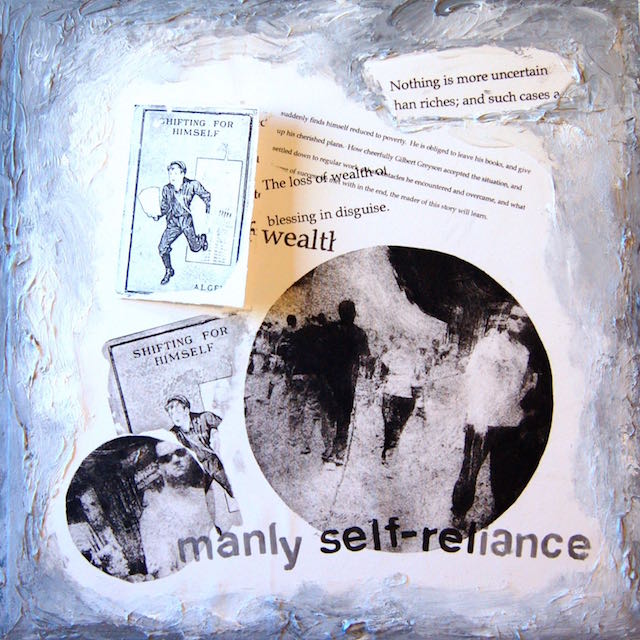
“Homilies for the 99% - Shifting,”  Collage, 16 x 16” 2015

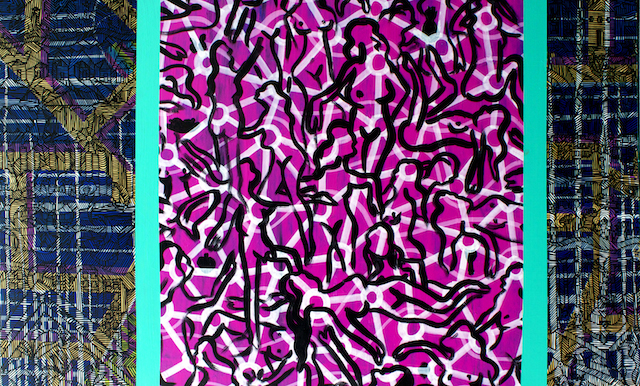
“Homilies for the 99% – Shifting,” Collage, 16 x 16” 2015

Tell us about your background and how that has had an influence on your work and on you as an artist.

I grew up in a housing project in the South Bronx in New York City. I always loved art and remember fixing up other children’s pictures in kindergarten. I was always the “class artist,” selected to make the posters and murals in elementary school. The world of my childhood: loving art, reading constantly to escape into books and living in my imagination has stayed inside me. Likewise, I’ve continued to identify with people that haven’t been given a lot in life despite living most of my adult life in suburbs in New Jersey where I raised my children. I also spent 18 years as an art teacher, working in poor, urban school districts. I’m interested in making art that reaches out beyond the often hermetic art world into a broader dialogue.

The concept of the artist studio has a broad range of meanings in contemporary practice. Artists may spend much of their time in the actual studio, or they may spend very little time in it. Tell us about your individual studio practice and how it differs from or is the same as traditional notions of “being in the studio.”

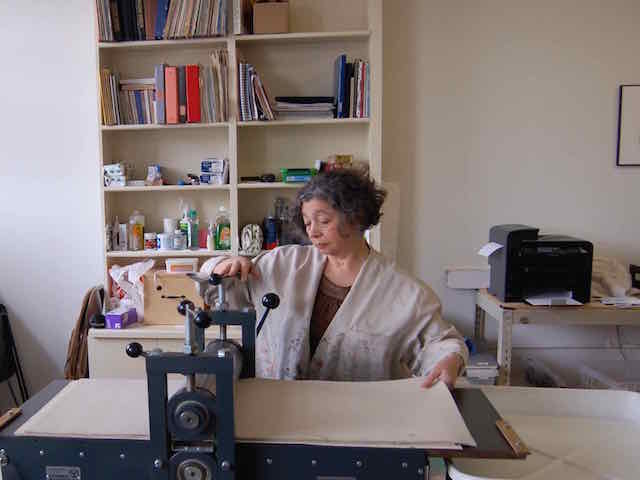
Being in the studio, making physical objects is central to my art practice so I’m quite traditional in that way. I need to see, position, cut, and tear physical images on paper to grow my work organically. I have some workspace ( 2 large tables and a blank wall for hanging work) where I live and do my computer work, and some collage and book work there. But around five years ago, I became tired of traveling to different print studios in Manhattan or New Jersey to make prints and finally bought my own etching press (which I love). I joined a feminist artist collective in my neighborhood with a communal workspace to give my press a home. After a few years, I wanted more space that was just mine and recently moved into my present studio that I share with a musician.

What roles do you find yourself playing that you may not have envisioned yourself in when you first started making art? 

I didn’t think about the constant effort to get work out into the world. Making art is just one piece of the process and a lot of time and energy goes into presentations, proposals and searching out opportunities that seem like a good fit.

When do you find is the best time to make art? Do you set aside a specific time everyday or do you have to work whenever time allows?

If I’m working on a print project, I try to go to the studio pretty early in the day so I have a big block of time for working. I also work on random projects at home, sometimes I get a second wind late at night, and at 11 pm will start working on my computer, photoshopping images, or glueing paper down, etc.  

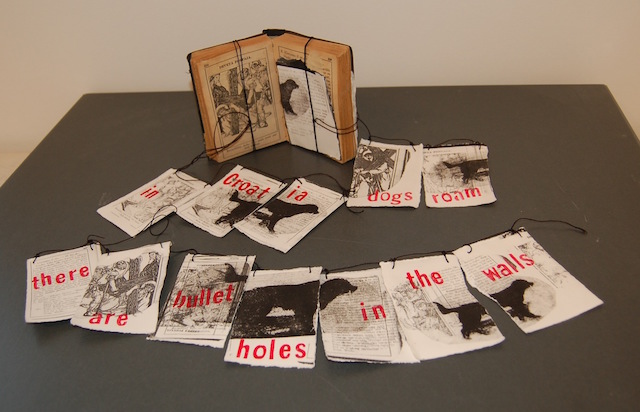
“Croatian Prayer”, Altered Book with Transfer Prints, Ink, Thread, 5”H x about 27”W, 16”D,2013

“Croatian Prayer”, Altered Book with Transfer Prints, Ink, Thread, 5”H x about 27”W, 16”D,2013

How has your work changed in the past five years? How is it the same?

The subjects that engage me have continued to evolve. A long time ago, I was working in a special needs school with a lot of children that had traumatic lives. I made art about them and wondered, if I changed jobs, would I have anything to make art about? I don’t worry about that anymore. My engagement in the world is a continuous thread through my work. I’ve moved into working in a more painterly manner in some of my most recent collages. I think that’s a result of an artist residency last spring in France, where I just did work on paper and it forced me to rely on my hand and eye rather than photographs for material.

How have people such as family, friends, writers, philosophers, other artists or even pop icons had an impact on the work you do?

I’ve been lucky having parents that visited museums like the Metropolitan Museum of Art and the Frick (they were free at that time) and many paintings are old friends to me. My mother recognized that art was something that was deeply important to me and managed to buy me art supplies and pay for art lessons for me. One of the reasons that I married my husband was his consistent support of my art and recognition that making art was central to my life. He’s always there for me. I’m inspired by the lives of women artists who’ve been creative into old age, continually evolving like Louise Bourgeois.

Have you ever been pulled in the direction of a pursuit other than being an artist? What are your other interests?

About two years ago, in Feb. 2013, I took a poetry workshop. I was thinking about making an artists book in collaboration with a poet. It then occured to me that maybe I could write poetry for the book. I had played around with writing a bit, and loved reading but I had never studied creative writing. Art has always been my creative focus. I discovered that I really love writing poetry, and it’s entirely different type of process from making art. Poetry is very much about revision. I’ve taken several workshops since the first one and attended some writing conferences. I had my first publication in May 2013 and since then I’ve had poems published in over 30 journals.

About

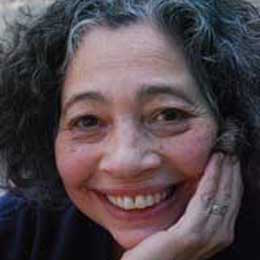
AileenBassisHeadshotA native of New York City who now lives in New Jersey, Aileen Bassis holds a BA in studio art from SUNY Binghamton and an MA in creative art from Hunter College. She has been awarded multiple artist residencies including the Fine Arts Work Center in Provincetown, Frans Masereel Center in Belgium and a Dodge fellowship to the Vermont Studio Center. She has received a fellowship from the NJ State Council on the Arts and a grant from the Puffin Foundation. Widely exhibited in galleries and universities, Bassis has had solo shows at Rutgers University, Moravian College, University of Pennsylvania and Ohio University. Her work is in the collections of Wellesley College, the Newark Public Library, the NY Public Library, Royal Museum of Fine Arts, Antwerp, St. Stephen Museum, Hungary, and the Nelimarkka Museum, Finland. She creates work in book arts, printmaking, installation and digital photography and is also a published poet.

bassis - at work

aileenbassis.com

All images copyright of the artist and used with their permission. 
Posted in Book Arts, Photography, Printmaking | Tagged , , , , | 1 Comment

Ambar Januel – Los Angeles, California

Savage Utopia: Acrylic on Wood, 2'x4', 2015

Savage Utopia: Acrylic on Wood, 2’x4′, 2015

Briefly describe the work you do. 

I create through a multitude of approaches, but my most active and intuitive medium is painting.  My work is a deep intent into the root of self representation within a culture.  The perception of oneself within the place they were created, and have been placed.  I often speak of family and destruction, how many allow one to lead to the other.  I am especially interested in the intentions under which children are raised, and the psychological aspects of their growth.  My paintings allow the proximity of parenthood, diverse cultures and languages, self interpretation, and chaos to be pronounced within one textured level (several placed upon each other, as layers), the level within which we are all able to understand, through our own recognition of history.  

Tell us about your background and how that has had an influence on your work and on you as an artist.

My past is a multitude of often incoherent layers; foreign houses and homes, homes many might not label so.  I was taught to view the world differently; in a way to experience it as all others do.  Through my practice and my own recognition of chaos, I hope to bring meaning to history in a form that speaks to multiple cultures that might possess barriers in other terms.  From an education that has been primarily self taught including psychology, language studies, fashion, writing, and philosophy I have grown a structure of acknowledgement that mirrors my work.  

 Delicate Entities of Edible Decisions: Acrylic on Wood, 6'x3.5', 2015

Delicate Entities of Edible Decisions: Acrylic on Wood, 6’x3.5′, 2015

The concept of the artist studio has a broad range of meanings in contemporary practice. Artists may spend much of their time in the actual studio, or they may spend very little time in it. Tell us about your individual studio practice and how it differs from or is the same as traditional notions of “being in the studio.”

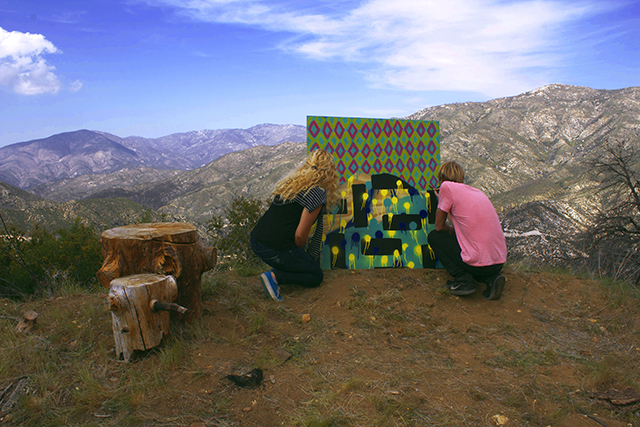
My studio is a constant rotation of places.  I often take it with me, whether it be only with the constant moving, or literally taking it with me.  Most recently my partner and I have begun to set up our studio in the middle of nowhere; in the mountains, in a field, by the ocean.  Taking our work and materials, and placing them in nature.  While our work does not obviously reflect this mindset, our minds often are in need of a refreshment and these locations are the perfect breath of fresh air.

What roles do you find yourself playing that you may not have envisioned yourself in when you first started making art?

When I began to create work I was very naive and a bit ignorant.  I did not quite yet understand my position in the world and how I was able to take advantage of my work to speak from it in a manner I could not speak from before.  Feeling afraid and vulnerable within a piece forced me to step back, until finally now I have adjusted to realizing that my movements and beliefs are shadowed and integrated into the entire diversification of human kind, whether it be in parallel or in direct opposition.  

When do you find is the best time to make art? Do you set aside a specific time everyday or do you have to work whenever time allows?

My work is in constant rotation.  Sometimes it comes intuitively and naturally, and at times I feel that I have to force it.  Regardless of whether I am actually physically painting or creating I am always thinking.  Every day I wake from a fresh dream that puts an incredible amount of pressure on my creative state.  When I am not working I am researching, I like reading about psychology and foreign cultures as well as social issues to keep myself in constant vigilance of our times and this world.  

How has your work changed in the past five years? How is it the same?

My work is dynamically different.  There have been realizations on an extremity of issues that have developed my work to where it is today.

An Integrated Domesticity: Acrylic on Wood, 2'x4', 2015

An Integrated Domesticity: Acrylic on Wood, 2’x4′, 2015

How have people such as family, friends, writers, philosophers, other artists or even pop icons had an impact on the work you do?

While I tend to remain close to the news and to current affairs I also like to keep a safe amount of distance.  Visual artists have influenced my work incredibly, however what I find that I am most drawn to is the creation of the piece itself, the way the artist crafted it, created it, and put themselves into it.  In the same way I have always been very attracted to writing and poetry, as a child I would read and write poems and view perceptions from philosophers based on the abstraction of their writings, instead of the actual content.  My work as a whole is influenced by my family, my pieces speak from a figurative society; while they are always conceptually based off of personal experience, I use my research and reading to connect it to everyone else.

Have you ever been pulled in the direction of a pursuit other than being an artist? What are your other interests? 

I find that my versatility in work subjects is what continues to push me to be an artist.  Mentally I need other pursuits, I thrive under the pressure of business, and I am constantly pushing for my own endeavors.  I find it a bit thrilling, and I fear that if I solely created paintings I would become lost in it.  While this in part may be the closest I am capable of coming to true happiness, I am also aware that I would be giving up everything else I’ve ever had.  Currently I work closest to the fashion industry, as well as freelancing in graphic design and writing.  These topics allow my creativity and imagination to stay in focus, while feeding my need for a self created regime.

About

Headshot_AmbarJanuelI have been constructed through the teaching of deconstruction and misconception.  Taught through a diversity of cultures and locations.  Living in homes with indigenous peoples, and then moving to a city of 20 million; moving to create personality.  I have been taught to believe in human kind while remaining strangely cast aside and protected, protected from the very own who raised me.  Most recently I have taken to Los Angeles and I believe that it is because it mirrors this kind of perception, the people that reside here are artistic and strangely happy, yet they (and we) tend to live five feet back, always participating yet always removed.  

InStudio_AmbarJanuel

www.ambarjanuel.com

All images copyright of the artist and used with their permission. 


Posted in Conceptual Art, Pop Surrealism | Tagged , , , , | Leave a comment

Isaac Scott – Madison, Wisconsin

Briefly describe the work you do. 

I am a ceramics artist living in Madison, WI. Most of my work is made of cone 6 stoneware. Some of my work is meant to be purely functional while other pieces are meant for exhibition. However, all the pieces I make are functional in some way. My influences come from Hiphop, Music, Philosophy, Ancient Cultures, Friends and Family.

Tell us about your background and how that has had an influence on your work and on you as an artist.

I started doing ceramics my junior year of High school. I ended up spending a lot of time throwing on the potter’s wheel. At the time it was just a fun past time though. It wasn’t until my junior year of college that I decided to make a career out of ceramics. I kept up with my ceramic work through college although I never took any art courses at the University I graduated from. The owner of a local ceramics studio allowed me to use her studio and continue my passion for throwing pots in exchange for helping out around the shop.

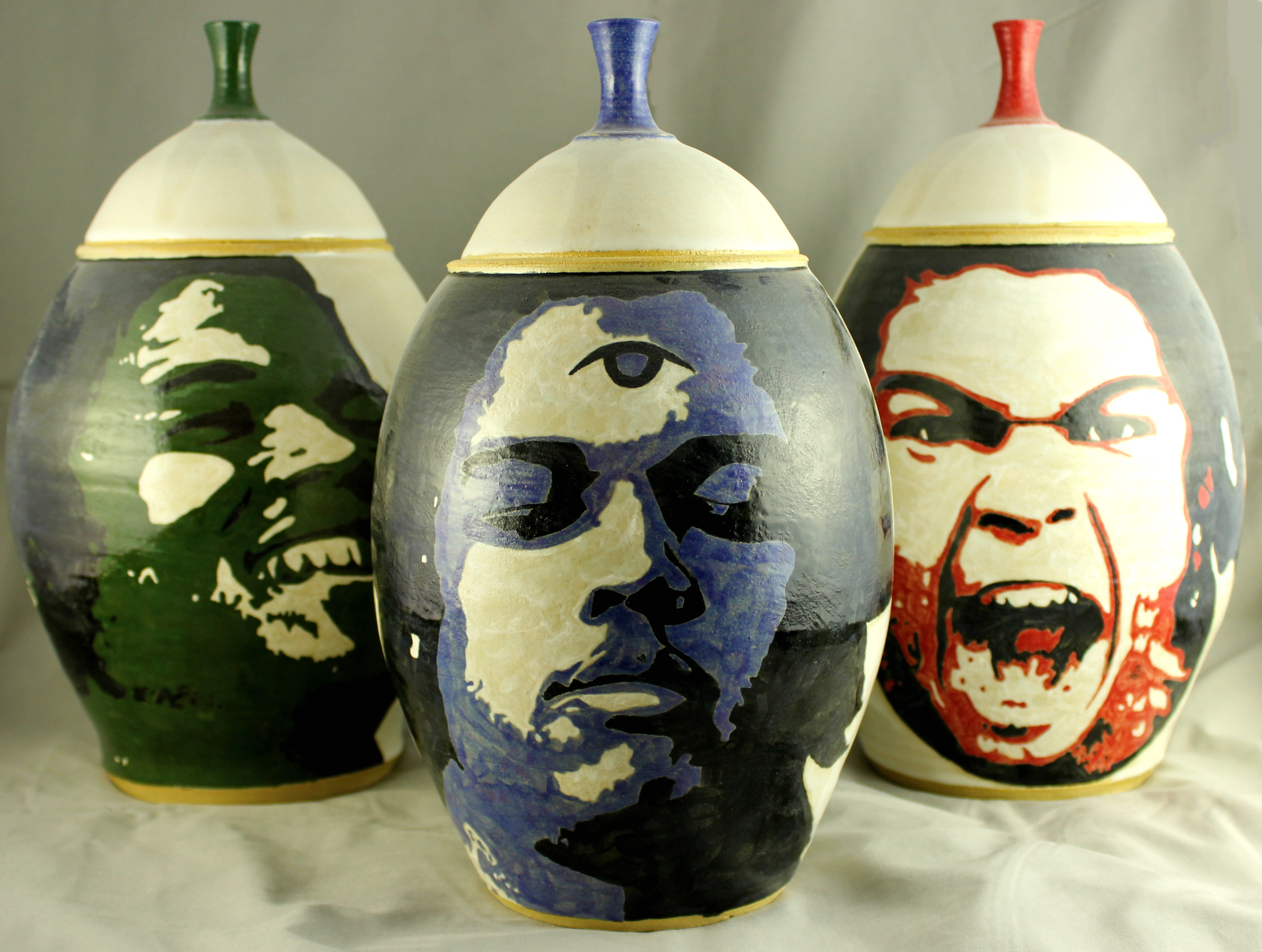
While in school I majored in Philosophy. I also took courses on Ancient Greece and Rome, Religious Studies, sociology, and anthropology. These classes as well as my interest in music, specifically hip-hop, r&b, funk, electronic, shaped the majority of the concepts behind my work. I see my work as trying to capture specific emotional/ mental states, that I experience in the attempt to reflect them back to the audience. For example, The three jars that make up my self portrait are meant to capture as much of my inner self as possible. Each Jar has a name: Rage, Peace, and Ecstasy. They are meant to each capture a particular part of me, each playing an important role in my life. I believe that life itself would not be as fulfilling without all three. This does not only hold true for myself but I think this also holds true for each individual that sees the piece and for society on the whole. Part of the meaning in my pieces is on an individual level and part on a macro/universal level. My hope is that as I continue my work I can broaden the ways I can capture both types of meanings.

self- portrait

self- portrait

The concept of the artist studio has a broad range of meanings in contemporary practice. Artists may spend much of their time in the actual studio, or they may spend very little time in it. Tell us about your individual studio practice and how it differs from or is the same as traditional notions of “being in the studio.”

I spend most days in the studio. I don’t always work on my own pieces while their however. It is actually hard for me to not go to the studio for more than a couple days because I feel like I wasted the day if I don’t at least work on something. There is a good amount of work I do at home as well.

What roles do you find yourself playing that you may not have envisioned yourself in when you first started making art?

The role of an entrepreneur. It’s amazing how little this is discussed within the art scene. Knowing how to manage your finances, do promotions, and having a basic understanding of business is crucial to artistic success. Without a good understanding of business, it is hard to know how to live off of making your work. Which for me is the ultimate goal.

When do you find is the best time to make art? Do you set aside a specific time everyday or do you have to work whenever time allows?

I don’t have any specific times to create. Sometimes I work at 10am sometimes at 3am. It all depends on when I can get in the studio and when I’m inspired.

How has your work changed in the past five years? How is it the same?

Considering I have only been doing ceramics for 7.5 years It has changed considerably. I think the quality of the pieces have come a long way as well as building more techniques in to my repertoire. I also see many themes that I keep coming back to that can be traced back to when I started.

How have people such as family, friends, writers, philosophers, other artists or even pop icons had an impact on the work you do?

My inspirations come from so many places. My siblings are very important in my creative process. I always want them to like whatever I make. All of my family supports me which means a lot. Musically, I draw from Michael Jackson, Kanye West, Kid Cudi, KRS ONE, Lupe Fiasco, P Funk, Snoop Dogg, Justin Timberlake, FKJ, Erykah Badu, Bob Marley, The Wailers, Daft Punk, Frank Ocean, etc.

Have you ever been pulled in the direction of a pursuit other than being an artist? What are your other interests? 

My second biggest passion as you might have guessed is music. I have also played trumpet since I was in 4th grade. Ever since music has played an important part in my life. I often listen to music when I create and it helps to get my creative juices going.

I also am a cook as my job that pays the bills, so I enjoy thinking about the food that goes into the dishes I make as well.

About

Souper Bowl 006 Isaac’s experience with ceramics began in middle school where he threw his first bowl. He didn’t get another chance to work with clay until he reached high school, but somehow the desire to throw again had never left him. During his junior and senior year at Madison West High, he had the privilege to learn under a great teacher and artist named Philip Lyons. Since high school Isaac has worked out of the Craftshop Studio at the University of Wisconsin – Madison and now works out of the Midwest Clay Project which is also located in Madison. Despite not attending Art School, Isaac continues to grow as an artist and develop his skills on the wheel outside the classroom. With 6 years of experience, Isaac has decided to make a career in ceramics and continues to be inspired by family, friends, music, and his dreams. 

Souper Bowl 020 (1)

isaacspottery.com

All images copyright of the artist and used with their permission. 


Posted in Ceramics, Uncategorized | Tagged , , , , | Leave a comment

Corwin Levi – Alexandria, Virginia

Dimatis Calemes / Acrylic, ink, and medium on panel / 9 x 12" / 2014

Dimatis Calemes / Acrylic, ink, and medium on panel / 9 x 12″ / 2014

Briefly describe the work you do. 

Imagine, at this very moment, you find yourself looking for something of the utmost importance. Suddenly, you realize you have forgotten what you are pursuing and cannot even recall whether it is a thing, person, or idea. Maybe you start to doubt you ever knew what it was in the first place. 

In an effort to make sense of the situation, you start documenting your experiences in a notebook. Images appear and instantly, naturally, transform into something else. Things you see in the corner of one eye flash across your vision to linger in the corner of the other. You fill the last page in your book and continue on top of what you have already demarcated, new layers obscuring old. 

At some point, you realize a note on the bottom layer of page six is critical to make sense of what is happening, but have marked over it so many times it is now impossible to read. You take your pen, write down what you think it may have said, and continue on. As you search flailingly, these pages do not become maps, nor pieces of a puzzle to be later assembled. They become a record of a search for something unknowable, bound by neither space, time, nor place. Your eye never rests and there is no way out: only in, through, and back in again.

Through the Horizon / Installation view of video projection from hand-drawn stop-motion animation edited in After Effects / 25 x 100' / 2013

Through the Horizon / Installation view of video projection from hand-drawn stop-motion animation edited in After Effects / 25 x 100′ / 2013

Tell us about your background and how that has had an influence on your work and on you as an artist.

I grew up in the suburbs, which instilled me with both an insatiable wanderlust and a knack for finding wonder and beauty everywhere. I learned to read because my mother wrote down words and would let me draw pictures of them if I knew what they meant. I survived grade school by filling up every single inch of my margins with doodles. I made it through art school by putting that notebook marginalia on the walls. 

I’ve tried my hand at being a baker, attorney, web designer, illustrator, and teacher, among other things, across ten different states—but in the end always come back, eyes a little more open, to artmaking.  

The concept of the artist studio has a broad range of meanings in contemporary practice. Artists may spend much of their time in the actual studio, or they may spend very little time in it. Tell us about your individual studio practice and how it differs from or is the same as traditional notions of “being in the studio.”

I don’t have a studio practice separate from my daily life. I travel often, so I try to be able to switch in and out of making mode on a moment’s notice. I always carry a manual-controls camera and a small book in my pocket where ideas for both new and ongoing pieces get tucked away. I guess “being in the studio” most accurately describes how I feel when I’m trekking up and down Wyoming mountains or across Oregon beaches.

What roles do you find yourself playing that you may not have envisioned yourself in when you first started making art?

At some point (and maybe still) as a maker, I loved the idea of spending my days in the studio toiling away at paintings. I quickly realized, though, that I also needed to be a publicist, became a curator, publisher, photographer, writer, and, essentially, anything anyone needed. Even if I had NO idea what I was doing, I had to be able to say yes without hesitation, learn how to do whatever I had just said yes to, and do a very good job at it on the deadline that happened to be in place.

When do you find is the best time to make art? Do you set aside a specific time everyday or do you have to work whenever time allows?

Before we were all connected to everything all the time, I found the best, most focused time to make art was during primetime television with the set on as background noise. The TV provided just enough distraction to keep my attention focused on making, without my mind wandering to something else that required me putting down my pencil and heading off in pursuit. Since then, with the advent of television on demand, I can recreate those happy primetime hours of yesteryear on a moment’s notice. I especially enjoy running through a season of television while making in the middle of the night, free from phone calls, emails, and other worldly interventions.

Shepherd Boy Study / Pencil on paper / 8 x 8" / 2014

Shepherd Boy Study / Pencil on paper / 8 x 8″ / 2014

How has your work changed in the past five years? How is it the same?

In grad school, after my first year in the painting department, I had a review in which the professors informed me that perhaps I did not need to make any more paintings. I took that to heart and have, since then, been a mixed-media artist who employs whatever medium best suits the idea I am pursuing. Now, fifteen years out of grad school, I have happily returned to painting—for as long as it makes sense to do so.

How have people such as family, friends, writers, philosophers, other artists or even pop icons had an impact on the work you do?

Because my art is rooted in experiencing life, my interactions often find their way into what I create. Whether it’s collaborating with other artists, working a dinner conversation into a painting, drawing a Fukurokuju mask onto a character, or borrowing a thought from Camus, it all works its way into the making.   

Have you ever been pulled in the direction of a pursuit other than being an artist? What are your other interests? 

No. All my interests are tied to artmaking. Sometimes I wonder if that makes me boring or limited? In the end, I guess it just makes me me. I like walking and driving, thinking about art. I enjoy a good beer and dreaming about future projects or talking about what might be. A dinner with creative people, of whatever field, is especially delightful. (I guess I do, unrelatedly, very much enjoy racquetball.)

About

CorwinLevi_HeadshotCorwin Levi is a mixed media, project-based artist. His undertakings include looking at ruptured walls and finding faint fields, investigating gin piles, capturing the insides of eyelids, pulling moments from the void, and seeing how long people can hold their breath for shine. Corwin has shown across the country from Portland, OR, to Kansas City, MO, to Washington, DC. He has wandered about various residencies including the Roswell Artist in Residence Program, Elsewhere, the Millay Colony, Willapa Bay, and Ucross. Corwin has a BA from Rice University, an MFA from the Tyler School of Art, and a JD from the University of Virginia.

Darii Celarent (detail) / Acrylic, ink, and medium on panel / 8 x 10" / 2014

Darii Celarent (detail) / Acrylic, ink, and medium on panel / 8 x 10″ / 2014

corwinlevi.com

All images copyright of the artist and used with their permission. 
Posted in Drawing, mixed media, Painting, Video | Tagged , , , , | Leave a comment

Janet Goldner – New York, New York

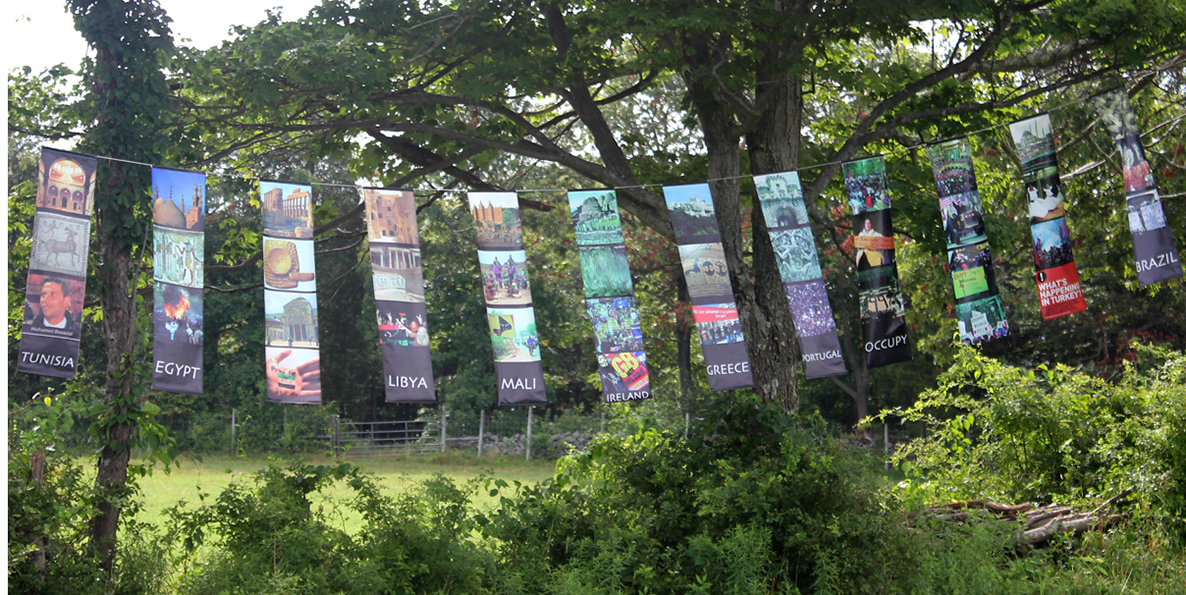
Interesting Times  vinyl banners, 25' x 4', 2013

Interesting Times vinyl banners, 25′ x 4′, 2013

Briefly describe the work you do.

My work explores culture, identity and social justice in various media: sculpture, photography, video, installation and writing. It consistently bridges diverse cultures, celebrating the unique beauty and genius of each as well as what we have in common. Cultural preservation is important to my work. My research takes the form of immersive field work and annual visits to Mali provide inspiration. My social consciousness and my deep and continuing interest in African art and culture also fuel my work.

Long-term collaborations, particularly with Malian artists, are clearly in the realm of social art practice. They are all, at the same time, researcher and object of research producing dialogues and concrete works of art. My many community projects internationally and in the US include participation with diverse groups of artists and non-artists.

My life experiences play an integral part in the development of my work. A master welder, I work in three dimensions as well as on paper, on the floor, on walls, and suspended from the ceiling, indoors and outdoors. her installations include steel sculptures, video, photography and sound. My work combines poetry, patterns, forms and African themes that engage in social discourse.

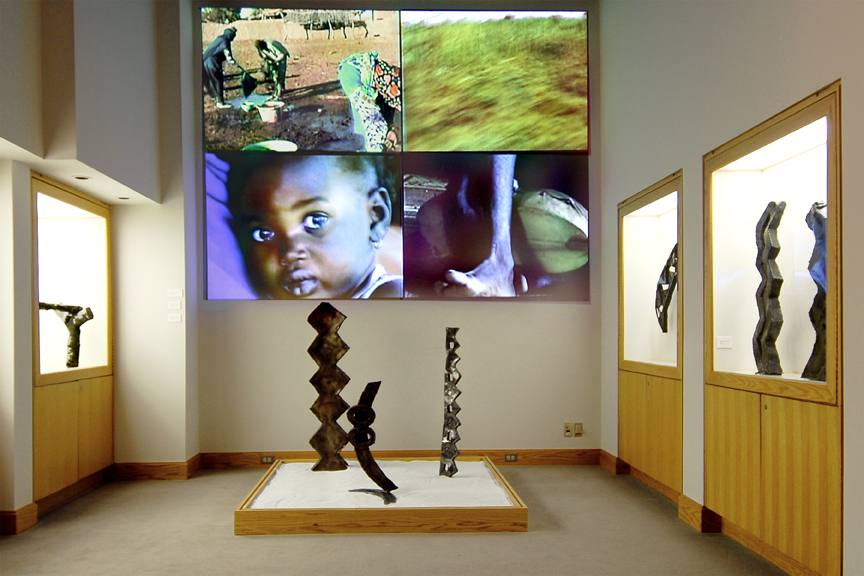
Zig-Zags Installation, steel sculpture, video, sound, Colgate University, 2006

Zig-Zags Installation, steel sculpture, video, sound, Colgate University, 2006

Tell us about your background and how that has had an influence on your work and on you as an artist.

Born to a family of political activists, I grew up in the Washington, D.C. area, fully immersed in the social and political issues of the tumultuous 1960’s. The evolution of my artistic practice traces my enduring exploration of sculptural form, my ongoing relationship with African culture, and my lifelong involvement in political activism. My life experiences have played an integral part in the development of my work, and have allowed my oeuvre to carry on a unique cohesion where themes recur and overlap, appear and disappear, then reappear in altered form.

It participated in The Experiment in International Living Program in 1973 and spent nearly a year in West Africa, igniting my life-long connection with the continent and particularly West Africa. The heart of my journey was Mali. I returned to West Africa as a Fulbright fellow in 1994-95, working in Mali with potters, metalsmiths, and contemporary artists. During my concentrated eight months of research, my many African experiences began to coalesce and emerge in my work. As a result of these experiences, I combine Western and non-Western images and ideas, issues of cultural identity, and responses to my own layered American cultural identity.

The concept of the artist studio has a broad range of meanings in contemporary practice. Artists may spend much of their time in the actual studio, or they may spend very little time in it. Tell us about your individual studio practice and how it differs from or is the same as traditional notions of “being in the studio.”

I think of the space where I weld as my artist studio because it is a specialized, dedicated space.  I only weld there.  I also have a studio in my home where I work on digital photography, video, writing and where I store and display finished work.  This is more interwoven with the rest of my life.

What roles do you find yourself playing that you may not have envisioned yourself in when you first started making art?

My annual trips to Mali and my projects there are an intrgral part of my artistic practice.  I do research there which inspires my work and my life.  This includes mentoring and being mentored, teaching and learning,

When do you find is the best time to make art? Do you set aside a specific time everyday or do you have to work whenever time allows?

I work everyday, all the time.  I may not be fabricating sculpture or installations but making art is a way of life, a creative way of living.  The tought process is ongoing and always growing and deepening.

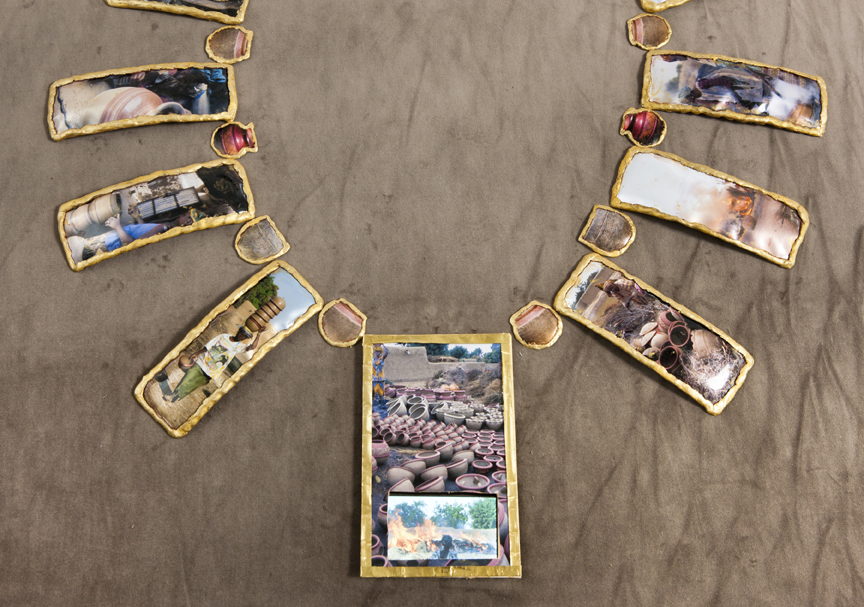
Wealth in Africa, Photographs, video, sound, mixed media, 40" x 32" x 2", 2013

Wealth in Africa, Photographs, video, sound, mixed media, 40″ x 32″ x 2″, 2013

How has your work changed in the past five years? How is it the same?

I have been making welded steel sculptures since the late 1980’s.  Recently I have worked on installations that combine the sculptures with photography and video.  The photography and video tends to be documentary and the sculptures are more abstracted.  Since they are inspired by the same sources, they expand each other.  The themes are the similiar across my work but change and deepen with time.

How have people such as family, friends, writers, philosophers, other artists or even pop icons had an impact on the work you do?

My closest relationship in Mali has been with members of the Groupe Bogolan Kasobane, a group of six artists who have been working together for about 35 years. Members of the Groupe and I met in 1994 during the first month of my Fulbright research. Kasobane is my Malian family and most of my projects in Mali have involved members of the Groupe.

Some factors that make our collaboration work include Kasobane’s skill at collaboration thru 35 years of work as a group and the Malian value of collectivity, one of the aspects of Malian culture that Kasobane has fought to explore and  preserve. The members of Kasobane and I are all about the same age.

My experience of collaboration stems from the American Feminist Art Movement of the ’70’s and ’80’s  where collaboration, growing out of consciousness raising, was a way to break down isolation in American culture.  We began to work collectively in new ways to engage communities and address social issues.  The Feminist Art Movement challenged ideas about authorship, particularly the myth of the solo male artist.  The movement pioneered new approaches to group identity through various means such as collaborative performances, women’s co-op galleries, “leaderless” institutions and inclusive artworks.

Have you ever been pulled in the direction of a pursuit other than being an artist? What are your other interests?

 No

About

IMG_2366Born to a family of political activists, Janet Goldner grew up in the Washington, D.C. area, fully immersed in the social and political issues of the tumultuous 1960’s. The evolution of Janet Goldner’s artistic practice traces her enduring exploration of sculptural form, her ongoing relationship with African culture, and her lifelong involvement in political activism.Goldner’s life experiences have played an integral part in the development of her work, and have allowed her oeuvre to carry on a unique cohesion where themes recur and overlap, appear and disappear, then reappear in altered form.

Over thirty years as an active artist, Janet Goldner has shown her work in over twenty solo exhibitions, and over one hundred group exhibitions throughout the United States, as well as in Lithuania, Germany, Italy, Bosnia, Australia, New Zealand, and Mali. Exhibition highlights include Multiple Exposures (2014) and The Global Africa Project (2010-11) at the Museum of Arts and Design, and Women Facing AIDS (1989) at the New Museum as well as Have We Met?, a major installation at Colgate University (2007). Her work is in the permanent collection of the American Embassy in Mali, the city of Segou, Mali and the Islip Museum on Long Island, NY.

She is the recipient of numerous awards, grants, and artist residencies, including a Fulbright Senior Research Fellowship and two Fulbright Senior Specialist grants as well as grants from the Ford Foundation, the Mid-Atlantic Arts Foundation and the United Nations Special Committee Against Apartheid.

Her work has been published in many books, journals, magazines, catalogs and news sources. An artist-scholar, Janet Goldner has curated exhibitions, published articles and catalogs, and lectured at conferences, universities, and community venues. Published articles include a chapter in Contemporary African Fashion, Indiana University Press, an essay in Poetics of Cloth, Grey Art Gallery, NYU. She has also conducted sculpture workshops and community art projects in both the United States Mali and Zimbabwe.

Janet participated in The Experiment in International Living Program in 1973 and spent nearly a year in West Africa, igniting her life-long connection with the continent and particularly West Africa. Janet Goldner returned to West Africa as a Fulbright fellow in 1994-95, working in Mali with potters, metalsmiths, and contemporary artists. During her concentrated eight months of research, Janet’s many African experiences began to coalesce and emerge in her work. As a result of these experiences, she combines Western and non-Western images and ideas, issues of cultural identity, and responses to her own layered American cultural identity.

Janet’s work in the US and internationally includes commissions, exhibitions, collaborations, residencies, teaching, community art projects, public art projects, cultural festivals and women’s empowerment projects.

She lives and works in New York City and spends several months every year in Mali.

me2a

janetgoldner.com

All images copyright of the artist and used with their permission. 

Posted in Photography, Sculpture | Tagged , , , , | Leave a comment