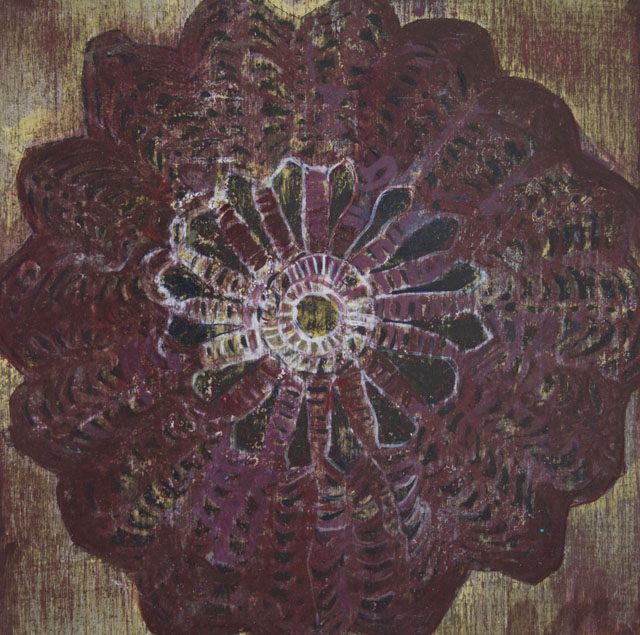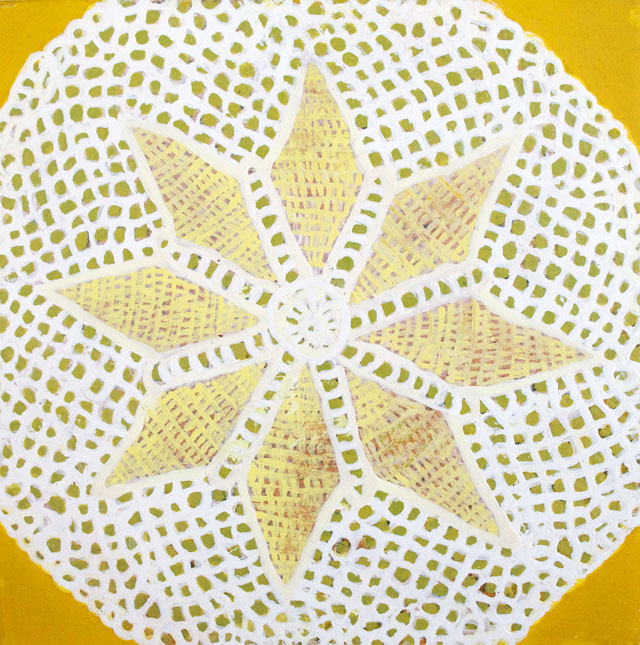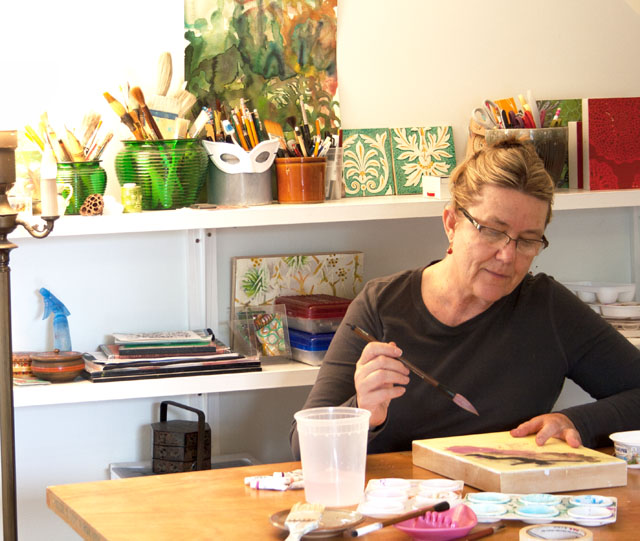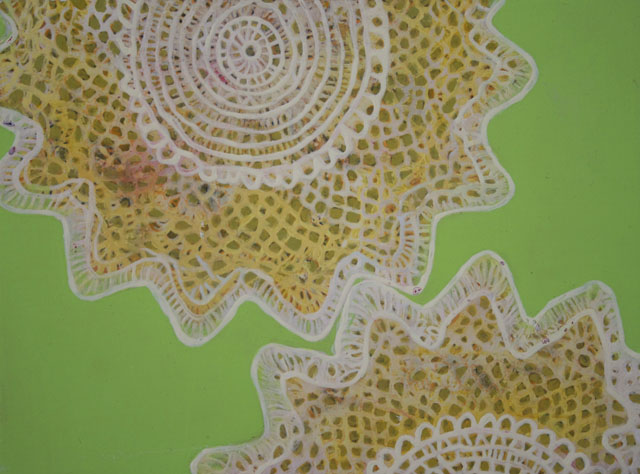
Melis Agabigum – Milwaukee, Wisconsin

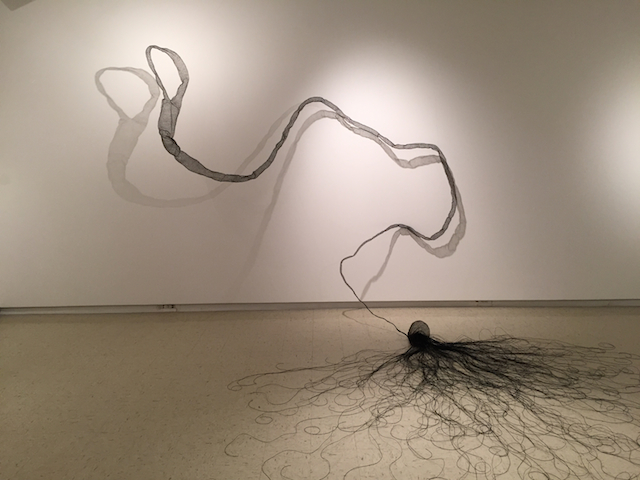
WhenyouToldMeTo_GoLong,_IshouldHaveAsked_HowFar__Copper,PowderCoat,WaxedCottonThread_2015

When you Told Me To Go Long I should Have Asked How Far, Copper, Powder Coat, Waxed Cotton Thread, 2015

Briefly describe the work you do. 

I make small and large scale sculptural objects that can function on and off the body. Many of the pieces I make, fall into the category of wearables/jewelry, but because of their sculptural aspects, I consider them to function as intimate installation art that can interact with the human body on some level.

Tell us about your background and how that has had an influence on your work and on you as an artist.

I graduated from the University of Michigan-Ann Arbor with my B.F.A. in Art&Design. While there, I took many metals and sculpture courses. Now, I am attending the University of Wisconsin-Milwaukee as an M.F.A. candidate in Intermedia, focusing on combining Jewelry/Metals, Fibers and Installation Art. Having an interdisciplinary education in both my undergraduate and graduate studies has allowed me to view my work on a multitude of platforms. I draw upon different principles and technical skills and ways of looking at my work because I do not feel restricted to one material or medium. With jewelry for example, I have no fear in making it as large and sculptural as possible, where the piece becomes a performance rather than just an object for adornment. I like having the opportunity to transition between materials and practices, and luckily, having this background in interdisciplinary art has made every day in my studio exciting.

The concept of the artist studio has a broad range of meanings in contemporary practice. Artists may spend much of their time in the actual studio, or they may spend very little time in it. Tell us about your individual studio practice and how it differs from or is the same as traditional notions of “being in the studio.”

I’m pretty traditional when it comes to the way I utilize my studio. As an artist who works in fibers, metal and installation, I need the tools and studio spaces to create. I love walking into my studio in the early afternoon with a large coffee and just looking at the things I’ve made and left out from the day before on my workbench. I always have something started and I always have a few hundred things that need finishing. And that possibility of what I’m going to produce for the day makes me feel stoked and inspired. My studio space becomes this place that I look forward to visiting everyday of the week, and I get restless when my schedule doesn’t allow enough time for me to sit and just make.

I also look forward to going to my studio because the one that I have right now through the university is amazing. I have every tool I could possibly need at my disposal, a coffee shop just down the street, and two amazing people I get to share my space with and bounce ideas off of when I feel stuck or stressed.
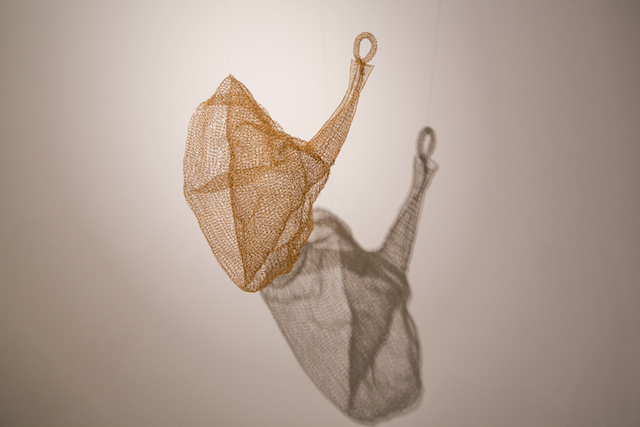
Our oboros Dripping In Gold, 18K Gold Plated, Copper,14KGold, 2015

Our oboros Dripping In Gold, 18K Gold Plated, Copper,14K Gold, 2015

What roles do you find yourself playing that you may not have envisioned yourself in when you first started making art?

When I first started making art seriously, I was convinced I was going to be a graphic designer. And then something weird clicked in me and all I wanted to do was go back to the days of my childhood when I was physically making crafts and building things. I guess I never expected to completely reject technology the way that I had. Now, I’m trying to find ways to bring technology back into my practice. It’s been this constant push and pull between wanting to make digitally and then want to just physically make everything. Basically, I see myself as this jack-of-all-trades that I didn’t think I would be if I had just stuck to the digital.

At the same time, I didn’t see myself as an educator when I first started art school. Before I strictly settled on art, I was doing a double major in art and English Literature. I wanted to teach Literature at the college level, but I had no desire what so ever to teach art. And now, I’m pursuing my Master of Fine Art with the intention of teaching in Academia. I’ve been lucky enough teach my own Foundations Courses (2D and 3D Design), and to assist in intro and upper level jewelry classes. I love the idea of passing on and sharing knowledge.

When do you find is the best time to make art? Do you set aside a specific time everyday or do you have to work whenever time allows?

I used to leave school, work on homework, and then head to the studio late at night from 7 in the evening till about 3 or 4 in the morning. Now, I can’t even imagine working with the tools that I’m using (like torches and kilns) at those ridiculous hours. I’ve wised up and learned to separate my studio life from my non-studio life, so I try and make it into my studio immediately after I teach or have class during the week with the plan to leave before 8:00 in the evening. On weekends depending on what I have going on, I usually head in a little before noon and try to stay for at least a solid work day of six hours. When I can’t make it into my studio, I read, sketch or work from home because I need to keep my hand busy.
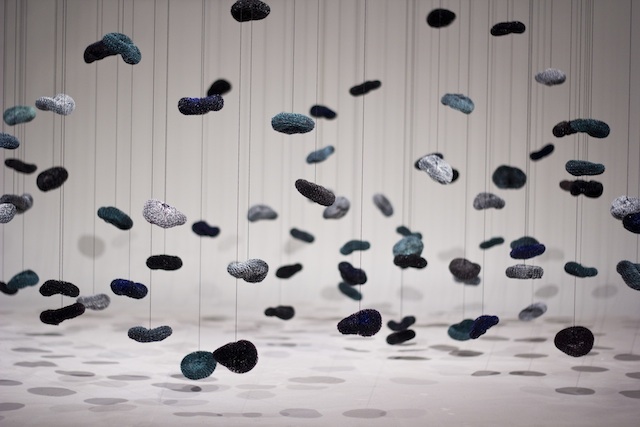
Sea Is the Saddest Lullaby I Can't Hear, Copper Mesh, Enamel, Wood, Thread, Sand, 12'x8'x6', 2013

Sea Is the Saddest Lullaby I Can’t Hear, Copper Mesh, Enamel, Wood, Thread, Sand, 12’x8’x6′, 2013

How has your work changed in the past five years? How is it the same?

My work has changed for the better in the past five years. I’d like to think that I’ve grown as an artist technically and conceptually. I’ve also become more comfortable with letting my work take me in unexpected directions. In the past, I was, what I would call, “narrow minded” about what certain forms of art could be. Jewelry/Metals meant it could only be made of metal, and sculpture had to be small and non-functional for example. Now, I don’t feel restricted by medium, dimension or technical skills. On the flip side, I am still a perfectionist when it comes to making. My friends and I joke pretty often that because I’m so driven to be technically precise, that I can be a machine with how exact some things are. It makes me feel good knowing that I can be technically sound when I want to be, and completely unrestricted when I choose. I’ve slowly made space for that freedom.

How have people such as family, friends, writers, philosophers, other artists or even pop icons had an impact on the work you do?

My family and friends have always been supportive of my work, so their impact has been pretty significant. Almost all the work that I make, has some personal connection to the concept, so every interaction and experience I have impacts my work on some level.

In the last year of my undergrad, I had two professors for my year long senior thesis that greatly impacted me as an artist. They supported me and challenged me in ways that I had never experienced before in my education. Both of them were very supportive of me pursuing graduate school immediately and now, I stay in contact with them as my mentors.

My current professors in grad school along with my graduate thesis committee have impacted me as well. They’ve challenged me and helped me develop philosophically (through introducing me to the writings of theorists such as Brian Massumi and Erin Manning), conceptually and professionally. I’ve had the fortune of working as a studio assistant to Arline Fisch at Penland School of Craft. Through my various opportunities like studio visits and critiques with visiting artists, along with participating in summer workshops and various organizations, I’ve found myself growing as a maker.

Have you ever been pulled in the direction of a pursuit other than being an artist? What are your other interests? 

I love reading. I wanted to be a Shakespearean scholar and professor of modernist literature earlier on. While I don’t actively work as either of those, I still spend a good amount of time reading. Recently, I’ve found myself coming back to that world in terms of writing. I love writing about my work, and analyzing other’s work, so hopefully, I’ll find a nice way to combine the making process with writing in some way in the future. My other interests include old movies, coffee and really good desserts.

About

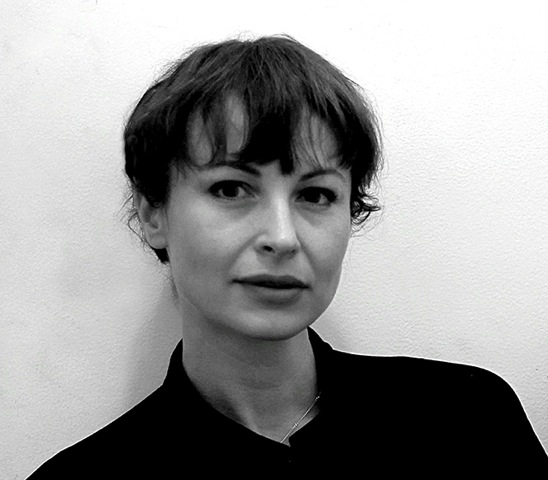
MelisAgabigum_HeadshotMelis Agabigum is a M.F.A. candidate studying Intermedia with a focus in Jewelry/Metals and Fibers at the University of Wisconsin- Milwaukee. She received her B.F.A. from the University of Michigan, Ann Arbor in 2013. Melis served as a studio assistant to metalsmith Arline Fisch at the Penland School of Craft in 2014, and is currently working as a Foundations Instructor at UWM teaching 2D Design and 3D Design.

Provoked by an interest in material fiction, Melis’ work examines the physical and emotional connections that can occur between the body and object. Her work has been shown at the national and international level in shows such as: #StickitSNAG Platforma Gallery, SNAG Boston, MA; TACTILITY Gallery 224, Port Washington, WI; and Resolutely Ambiguous at the Walker Art Museum in Minneapolis, MN. She was also the 2013 MJSA Education Foundation Scholarship recipient.
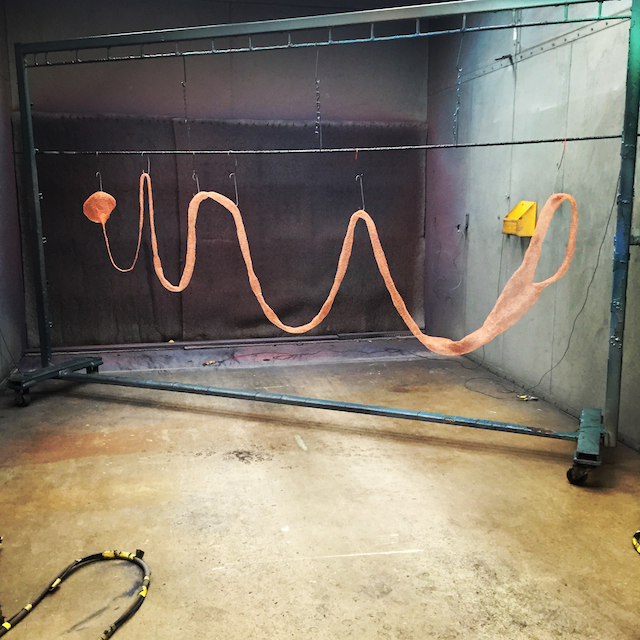
Powder coating In Process Studio Shot

Powder coating In Process Studio Shot

melisbanu.virb.com

All images copyright of the artist and used with their permission.
Posted in Conceptual Art, Fiber Art, Installation, Metal, Uncategorized | Tagged , , , , | Leave a comment

Erin Fitzpatrick – Baltimore, Maryland

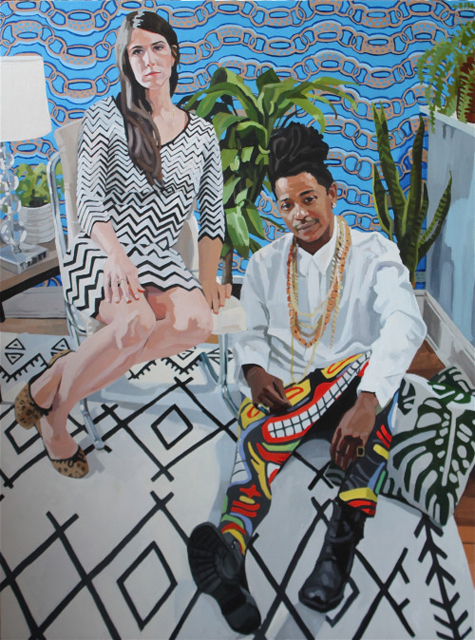
"Maggie and Jay" 36x48in, Oil on wood panel, 2015

“Maggie and Jay” 36x48in, Oil on wood panel, 2015

Briefly describe the work you do. 

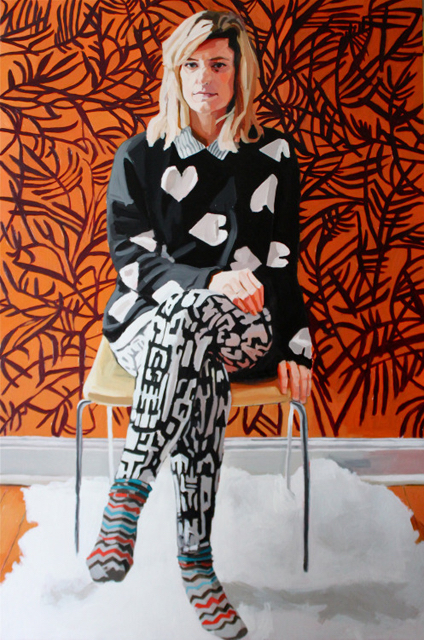
I make paintings to entice the viewer with decorative, visual overload. My paintings are full of layered patterns and textiles, items I have collected and sought out for each piece. While the figure creates a point of interest, I am not concerned with the portrait as the depiction of a specific individual. The figure, like the setting that I have built, is merely a catalyst for the exploration of formal aspects of painting, line, shape, color, pattern, composition, and brushstroke. 

Tell us about your background and how that has had an influence on your work and on you as an artist.

Pretty much, in 5th grade I traded line drawings of faces for people to color in, for like Doritos and use of better art supplies than what I had. Ha, let’s say the portraits started there….and all the layered patterns…. I am an image collector. My sketchbook is full of clippings, and my phone and laptop are full of screenshots. Visual stimulation, plants, interiors, patterns, textiles, food, fashion, tropical landscapes, gives me a jolt of adrenaline. I try to capture this with my work. 

The concept of the artist studio has a broad range of meanings in contemporary practice. Artists may spend much of their time in the actual studio, or they may spend very little time in it. Tell us about your individual studio practice and how it differs from or is the same as traditional notions of “being in the studio.”

Since I make the majority of my living painting commissions I spend 40ish hours in the studio during an average week, and 60 plus once it gets closer to the holidays. Right now I’m prepping for a solo show and starting a corporate commission, so I’ll be in there holiday hours for a bit. Unless you’re discovered as an art star in school, if you want to make your financial living making art, it needs to be treated as a full-time job. For a long time I was full time at a regular job and in the studio.

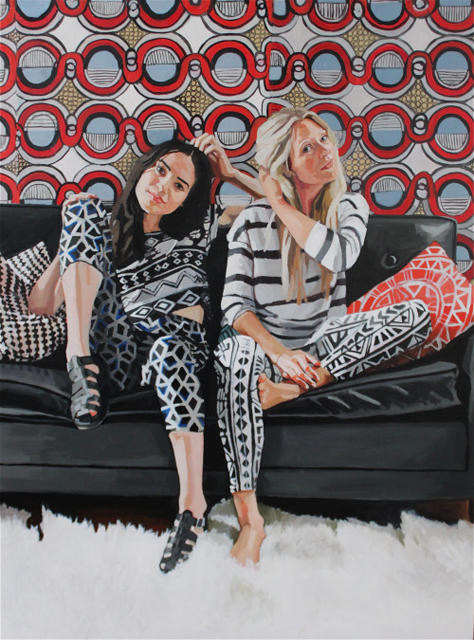
"Brynn and Kristin" 36x48in, Oil on wood panel, 2014

“Brynn and Kristin” 36x48in, Oil on wood panel, 2014

What roles do you find yourself playing that you may not have envisioned yourself in when you first started making art?

I’m basically a one woman business, so I run PR, marketing, research, photography and photo editing, grant writing and application procedures, customer service, and I’m sure a handful of jobs I can’t think of right now. Luckily, I have an accountant to help with taxes…and I’m getting an intern this summer. I like the game of business. Marketing is problem solving. Now that I’ve been doing this for a living, I think that if I hadn’t gone to school for art I would have liked to go to business school. Ha, I probably should have gone to business school.

When do you find is the best time to make art? Do you set aside a specific time everyday or do you have to work whenever time allows?

I like to do any writing and take care of email when I first get up, any office-type work. Once that’s done I spend the rest of the day in the studio. I’m usually in there from about 10 or11am until midnight. If I’m working a hard deadline I’ll work until the work is done, like the time I had to photograph 12 subjects, and draw/photograph/frame/hang all 12, 18×24″ pieces in 14 days. I worked from 9am to 4am for a solid week.

"Beth" 24x36in, Oil on wood panel, 2014

“Beth” 24x36in, Oil on wood panel, 2014

How has your work changed in the past five years? How is it the same?

I used to paint simple head shots. The work was about really capturing my subject. The backgrounds were a neutral grey or white. Now the figure has become a prop in my multi-layered setting.  

How have people such as family, friends, writers, philosophers, other artists or even pop icons had an impact on the work you do?

I look at fashion and design more than I look at fine artists, how ads are composed, how spaces are lit, what patterns/textiles/colors I’m drawn to at a particular time. This comes mostly magazines, photography books and Instagram. When I look at actual painting, I’m looking at formal aspects more than subject matter most of the time, how an artist lays down paint, uses pattern, composition…stuff like that.

Have you ever been pulled in the direction of a pursuit other than being an artist? What are your other interests? 

Not seriously. I like to say yes to a lot of things for the experience (and money of course), but painting is my main man. I’ve done a ton of odd freelance jobs. I’ve done wardrobe, art direction, art department, and acted in film/advertising. When I did wardrobe for an ESPN commercial I had to make sure all the actors looked like Washington Redskin players. I’ve taught high school, run a letterpress, taught a sewing class, been an illustrator, and poured a lot of beers. I’m getting ready to do art department on another commercial next month and I’ll be in front of the camera painting for my next commercial commission.

My other non-work/art interests have a lot to do with baseball, pools, summer, and tropical vacations in the winter.

About

10644992_10204787485191986_798812081927353644_nErin Fitzpatrick, Baltimore native and graduate of the Maryland Institute College of Art, began her current series of portraits in mid 2008. This body of work now contains hundreds paintings and drawings of notable artists, musicians, business people, Fitzpatrick’s peers, and commissioned subjects. Exhibiting extensively in solo and group shows, she has gained collectors throughout the United States, Europe and Asia. 

When Erin is not in her studio she is probably somewhere being really good at summer, scouring over interior design and fashion images, pretending not to be on Instagram too much, getting a fake tan, listening to rap music, lying by a pool, traveling, watching/listening to/talking about baseball, and/or all of the above.

365headshot

erinfitzpatrickportraits.com

All images copyright of the artist and used with their permission.
Posted in Painting, Textiles | Tagged , , , , | 1 Comment

Marcy Thomas – DeKalb, Illinois

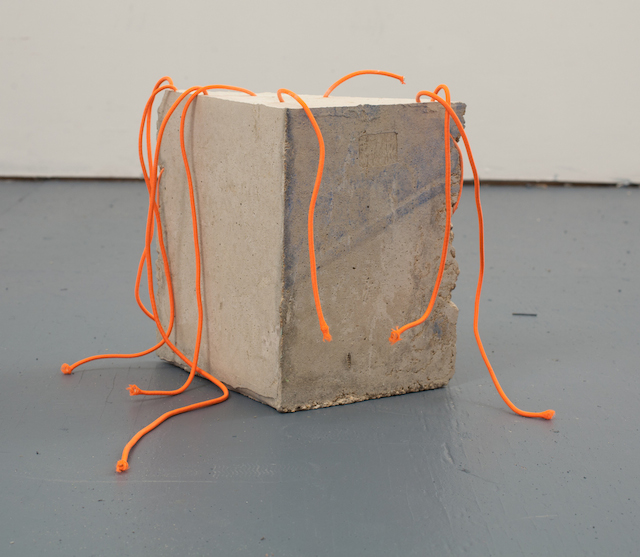
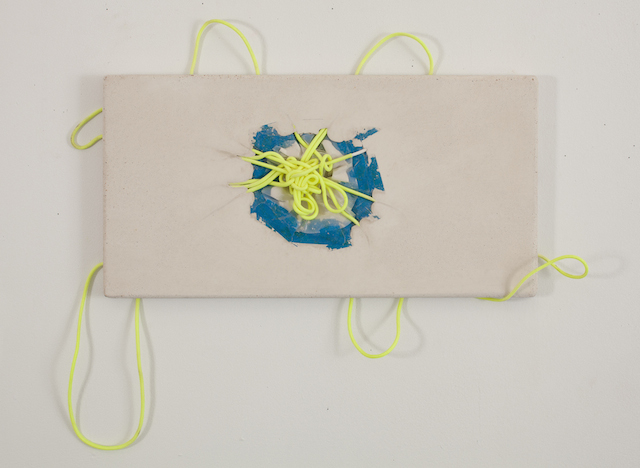
burial ground for parrots, concrete and neon bungee cord, approx. 10”x 12”x 7-1/2,” 2015

burial ground for parrots, concrete and neon bungee cord, approx. 10”x 12”x 7-1/2,” 2015

Briefly describe the work you do.

I am interested in transitions. I am interested in the transition concrete makes from liquid to solid, and the transition that objects make between the surface and subsurface of the form. I am forced to work quickly and react to the emerging content of found, discarded elements. There is always the chance of content emerging or misbehaving, but these materials are ultimately halted from their means of organic mobility.

Tell us about your background and how that has had an influence on your work and on you as an artist.

My college path was not the most traditional. Leading up to that, I hadn’t taken an art class since 8th grade, so I began working VERY leisurely for a while at a community college. I cannot express enough how fundamental community college is for exploration, and I really established my creative and critical foundations there. In undergrad I double majored in art history, as well as studio art. It was then that I began a researching craft and contemporary art, which led me to pursue graduate school. My work and research has changed, but this desire to learn, make, and converse with my influences began this way.

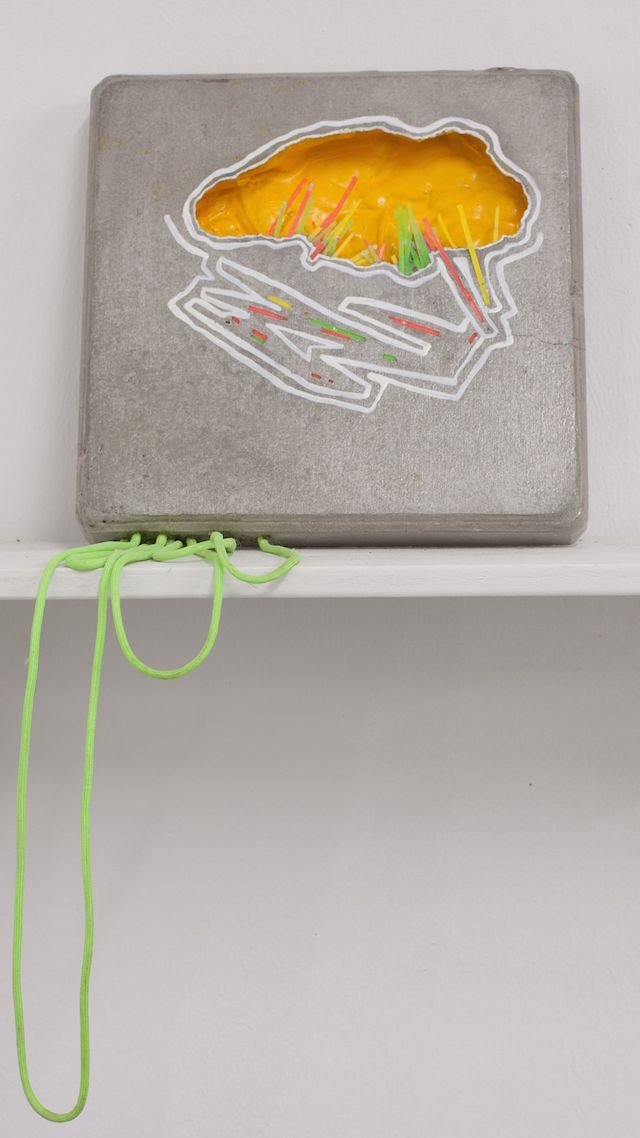
Keeps rainin’ all the time, concrete, enamel, plastic, parachute cord, approx. 14”x 10”x 1 3/8,” 2015

Keeps rainin’ all the time, concrete, enamel, plastic, parachute cord, approx. 14”x 10”x 1 3/8,” 2015

The concept of the artist studio has a broad range of meanings in contemporary practice. Artists may spend much of their time in the actual studio, or they may spend very little time in it. Tell us about your individual studio practice and how it differs from or is the same as traditional notions of “being in the studio.

The majority of making occurs within my studio, but I do not abide by a particular schedule. I think that I actually enjoy the stress of irregularity. Graduate school taught me to balance under the pressures of other responsibilities. With an ever changing schedule I have learned to function by the seat of my pants. I often work on multiple things at a time so that I get a good energy flowing, but so that I can also take a step back and assess myself.

I at least try to visit the studio daily, even if it is for a minute to observe my surroundings. If I cannot be in my studio space, I have to find a way to make my environment work to my advantage. During graduate school I would work on technical experiments in the classroom if I knew had to be there working on preps. I know that I can bring drawing and small work home with me. If I have to be sitting, I’m on my computer researching and finding opportunities. When life starts to permit less that is when I know that it is time to trim the fat to make way for my practice.

What roles do you find yourself playing that you may not have envisioned yourself in when you first started making art?

Scavenger, Risk-taker, Collaborator, Mentor, Theorist, Organizer, Researcher, Historian, Mason, Vampire.

When do you find is the best time to make art? Do you set aside a specific time everyday or do you have to work whenever time allows?

I prefer to work at night, or at least get a late start to my day and crank through the evening. My graduate school schedule was busy and I have kept busy since, so I am working whenever I can, however I can. Carry around a small notebook, or hash out your ideas on junk mail and cocktail napkins. Bring your work home at night if you can’t finish it during the day. Go to sleep thinking about it.

banana gas through a fog mask, concrete, plaster, tape, plastic, neon parachute cord, approx. 19”x 25-1/4” x 1,” 2015

banana gas through a fog mask, concrete, plaster, tape, plastic, neon parachute cord, approx. 19”x 25-1/4” x 1,” 2015

How has your work changed in the past five years? How is it the same?

I am just emerging from grad school, so change has been rapid. The range of materials that I have come to embrace is the first big difference. I made mostly figurative work in undergrad, so the way I have moved toward the abstract is also a noteworthy change. My sculptural work has not stopped referencing the figure or having character, however. When I look at old drawings, I find that is where my work has stayed the most consistent. I have always had an affinity with line, but an odd way of showing it.

How have people such as family, friends, writers, philosophers, other artists or even pop icons had an impact on the work you do?

My family has always been supportive, even when we have different understandings. I have gained the most on a personal level from my faculty and peers in graduate school. My mentors have pushed me to lengths technically and conceptually, and I always enjoyed bouncing ideas off of fellow students within the studio. That is one of the things I hear you miss the most about graduate school. One of my mentors jokes that when she works on something new, she longs so much for that type of feedback that she would ask the next person that comes to the door, even if it is the Fed-Ex man.

I have a handful of cultural influences… I am interested in Contemporary Art theory and criticism, especially the Minimalist and Post-Minimalist writings of Robert Morris. I am attracted to satirical fiction, biography, and modern poetry, for example, the novels of Tom Robbins, the poetry of Sylvia Plath, and the writings and lyrical poetry of Patti Smith. These influences originally reflected what mood I was in when I was working, but then I began drawing relationships between language and the visual information I was putting forward. They are crucial to my working and titling processes. They help me to establish opposite relationships, by toning down something that is bright or awkward, or by lightening up a work that is heavy and somber.

Have you ever been pulled in the direction of a pursuit other than being an artist? What are your other interests?

I used to sing in various choirs and ensembles throughout community college, and actually accomplished several credits toward a music performance degree. I dappled with the idea of teaching K-12 art for a while. Eventually I had to focus and choose my battles. I am not ruling out college teaching, in fact I find it very rewarding. I think that I have just been in school for so long and that I need a break. Right now I am trying to focus on my studio practice, mainly applying for shows and residencies.

I also have a great deal of experience in the restaurant industry. It has helped me pay my bills through school, and is getting me through the transitory period I am in right now. It is very easy to become overworked in this industry, but I am really thankful that it is there. It offers a certain extent of flexibility that a typical 9-5 does not. I actually don’t function very well before 11 a.m., so it’s just right for me.

About

mthomas_5Marcy Thomas was born in 1986 in New Brunswick, NJ and grew up in the Chicago suburbs. She received her B.A. in Studio Art and Art History from North Central College, Naperville, IL, and her M.F.A. in Studio Art (Fibers) from Northern Illinois University, DeKalb, IL. She has exhibited at Ithaca College, New York at the National Conference for Undergraduate Research, as well as various juried exhibitions at both of her alma maters. Thomas is looking forward to participating in a group exhibition at Roots and Culture in Chicago July 10-August 9, 2015. She currently lives and works in DeKalb.

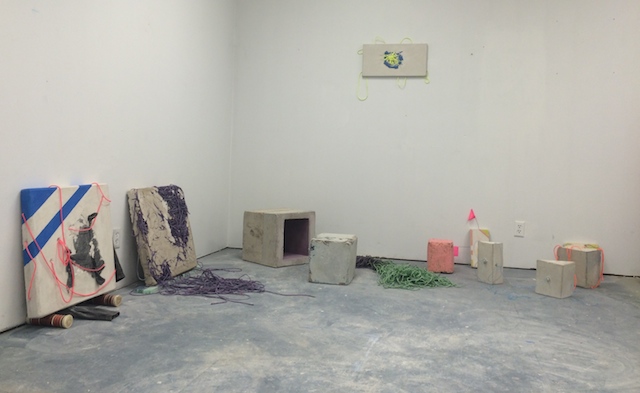
Studio View, April 2015

Studio View, April 2015

marcyjthomas.weebly.com

All images copyright of the artist and used with their permission.


Posted in Fiber Art, Sculpture | Tagged , , , , | Leave a comment

Erika Lizée – Los Angeles, California

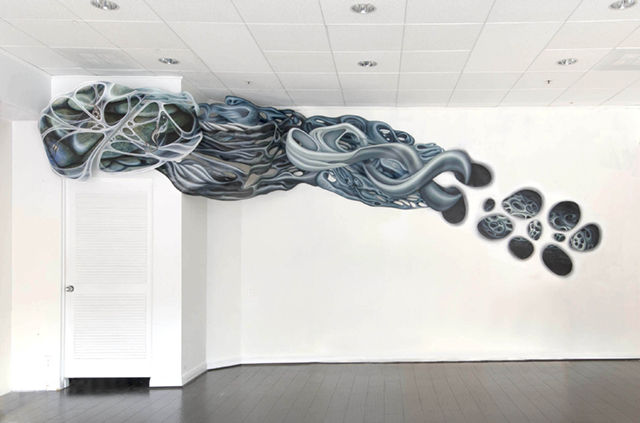
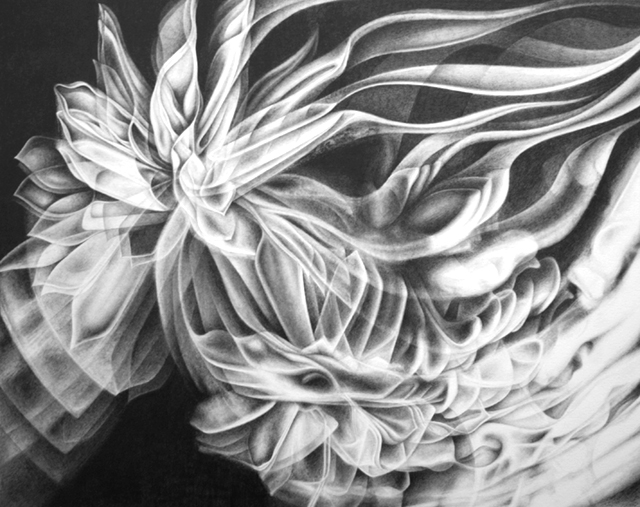
 "...and yet, things continue to unfold", 4' x 25', Acrylic on Duralar, site-specific installation for GALA Exhibits, Glendale, CA.  2015

“…and yet, things continue to unfold”, 4′ x 25′, Acrylic on Duralar, site-specific installation for GALA Exhibits, Glendale, CA. 2015

Briefly describe the work you do. 

I make artwork that contemplates the impermanence of existence.  I am intrigued by how we craft an understanding of reality based on our perceptions of what is known and unknown.  The fluidity and flux of reality is seamless and constant, and in my work I seek to express the feeling of this elusive experience.

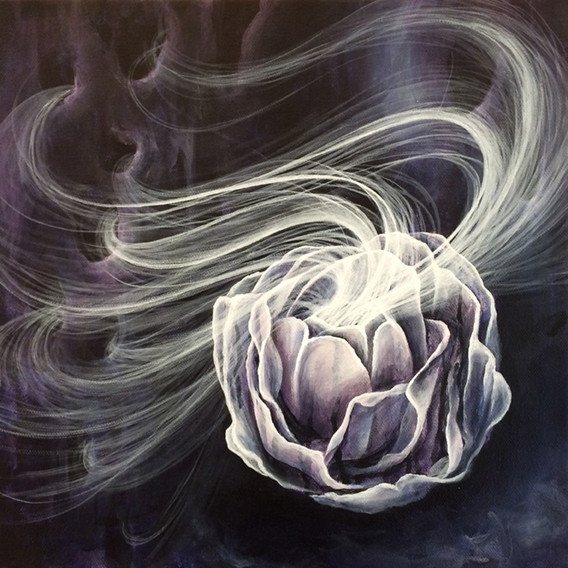
In my drawings and paintings, I depict complex yet often subtle energies that animate living things. Using depictions of flora as symbols, flowers breathe, pushing and pulling energies along the edge between life and death.  I use ideas of thresholds and portals, to examine the transitions between these realms.  My installation work draws from the same ideas, while bringing the artwork into the physical space of the viewer.  Gallery walls serve as the metaphorical threshold between life and death, the visible and invisible, tangible and intangible.

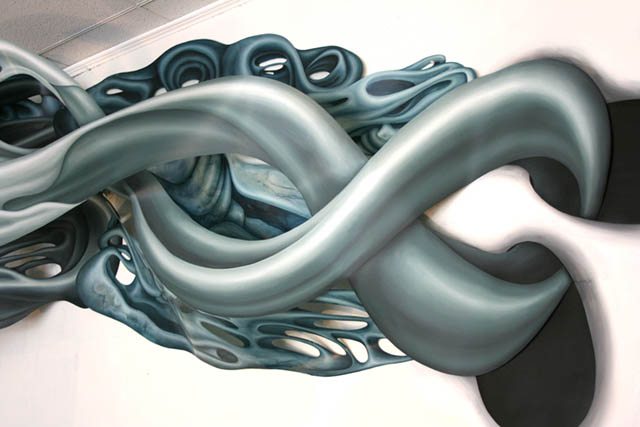
 Detail, "...and yet, things continue to unfold", Acrylic on Duralar, site-specific installation for GALA Exhibits, Glendale, CA.  2015

Detail, “…and yet, things continue to unfold”, Acrylic on Duralar, site-specific installation for GALA Exhibits, Glendale, CA. 2015

Tell us about your background and how that has had an influence on your work and on you as an artist.

I grew up in a tiny town amidst the trees and lakes of Northern Wisconsin. The majority of my time was spent discovering and communing with nature. Summers were savored with long walks in the woods, building forts, riding bikes down our three-mile driveway, and swimming and fishing in our lake.  Winters were spent building snow forts, sledding, ice skating, hockey, ice fishing and drinking hot apple cider.  These formative years of my life created a deep-rooted connection with the natural world and the cycles of life and death.

I was also raised within a strict Catholic family. I followed the dogma of the church until I came of age and discovered my own thoughts and beliefs about the world.  What I came away from Catholicism with, was a profound and genuine desire to contemplate and understand the mysterious world around me; but rather than feeling like I have the answers, I have grown comfortable within the realm of not knowing.  These two aspects of my childhood shaped my relationship with the natural world. They created a desire to understand the world and contemplate the purpose of being alive.

The concept of the artist studio has a broad range of meanings in contemporary practice. Artists may spend much of their time in the actual studio, or they may spend very little time in it. Tell us about your individual studio practice and how it differs from or is the same as traditional notions of “being in the studio.”

I would say my studio practice is more traditional, as far as spending time working in my space.  Currently I’m working on a large-scale installation piece as well as some small canvas works.  I like the variation in that the installation work can be very physical, working with 4 x 8 foot sheets of Duralar, pouring paint, cutting and hanging elements from the ceiling.  With the small canvas pieces I can sit at my desk, hold the canvases in my hands, and paint delicate detail work. 

What roles do you find yourself playing that you may not have envisioned yourself in when you first started making art?

Going into my undergraduate schooling, I just saw myself as a maker—as someone that wanted to be an artist and I didn’t think beyond that.  After several years of working office jobs while making my artwork on the side, I decided I would like to teach so that art would be the focus of my life.  I went back to school for my MFA, and am now an Associate Professor of Art at Moorpark College and Director of the Campus Art Gallery.   I have found myself in the roles of providing both students and professional artists with opportunities to exhibit and discuss their artwork. I really enjoy this aspect of my career as it continues to broaden my appreciation of and advocacy for artists and their work.

When do you find is the best time to make art? Do you set aside a specific time everyday or do you have to work whenever time allows?

For me, anytime is the best time to make art! As a working mother of a three and five year old, I structure my practice around available time.  For now that means working late into the evenings.  I try to be efficient, and make the most of long and short studio sessions.  Having multiple projects going on helps and I find the variation interesting and motivational.  I like the relationships and connections between my installation and canvas works.

"Connecting Breath", 12" x 12", Acrylic on canvas, 2015

“Connecting Breath”, 12″ x 12″, Acrylic on canvas, 2015

How has your work changed in the past five years? How is it the same?

In the past 5 years, I have begun to figure out how to transform my paintings into site-specific sculptural installations.  This has proven to be quite a challenge, in that I am in the uncomfortable place of not absolutely knowing what the finished piece will look like until the installation is up in the new location.  There is always “the plan” as configured in my sketchbook and studio, but I am learning to release some control and trust in my abilities and instincts that things will work.  The way that I think about space and depth in my work has changed drastically, as well as my process and materials.

It is the same in that I am still working in a similar style in my paintings.  Subject matter shifts slightly, but my combination of forms created with chiaroscuro and smooth, blended surfaces, along with light and ethereal tendrils remains.

How have people such as family, friends, writers, philosophers, other artists or even pop icons had an impact on the work you do?

“Let the artist have just enough to eat, and the tools of his trade: ask nothing of him.  Materially make the life of the artist sufficiently miserable to be unattractive, and no one will take to art save those in whom the diving daemon is absolute.” – Clive Bell

I love this quote from art critic Clive Bell, as there is so much truth in the difficulties of sustaining a life as an artist.  I talk to my students about this and the importance of having a network of creative and supportive people in your life.  Feedback from my husband, Ted, and from other artist friends has a positive impact on my creative process.  I also feel supported by my mentors and those that appreciate my work and are willing to help me promote it.  I am continuously inspired by the work of so many artists, but particularly Darren Waterston, Sharon Ellis, and Inka Essenhigh.

Have you ever been pulled in the direction of a pursuit other than being an artist? What are your other interests? 

Much of my high school experience revolved around sports and music.  I entered into college as a double major of Art and Music.  After a year or so, music fell to the wayside academically, but still remains an important aspect of my life.    

About

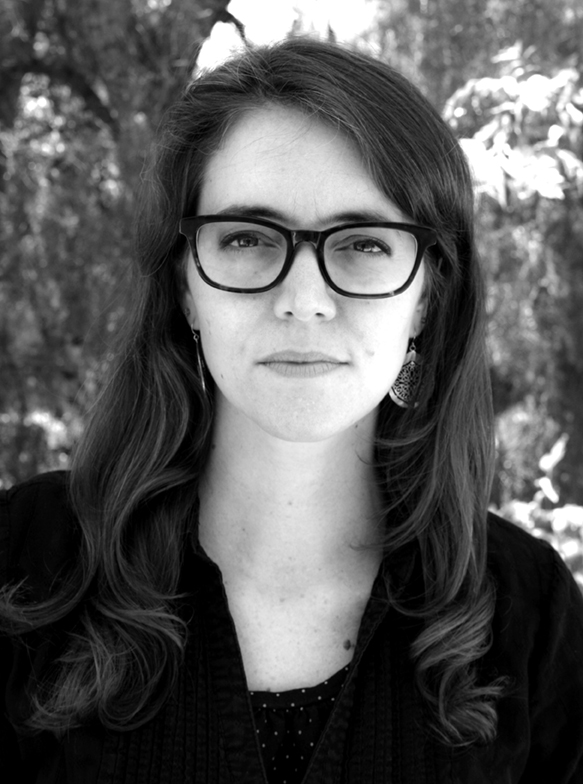
Erika Lizeģe headshotErika Lizée was born in Chicago, Illinois. She earned her BFA in Painting from the University of North Carolina at Asheville in 1999, and her MFA in Painting from California State University, Northridge, in 2007. In 2008, she was hired as full-time faculty at Moorpark College where she is currently an Associate Professor of Art. She teaches Drawing, Painting, Two-Dimensional Design, and Gallery Practices, and is the Director of the Moorpark College Art Gallery. Ms. Lizée is an artist that works in the mediums of drawing, painting, and installation. Her artwork has been exhibited throughout the United States and abroad. She is currently working on an installation for Angel’s Ink Gallery in San Pedro, CA, and will be exhibiting within the Los Angeles International Airport (LAX) next year. Ms. Lizée resides in West Hills, California, with her husband and two young children.

"Together our intentions grow stronger", 11" x 14", graphite on paper, 2008

“Together our intentions grow stronger”, 11″ x 14″, graphite on paper, 2008

erikalizee.com

All images copyright of the artist and used with their permission.

Posted in Illustration, Painting | Tagged , , , , | 1 Comment

Michaela Davies – Sydney, NSW, Australia

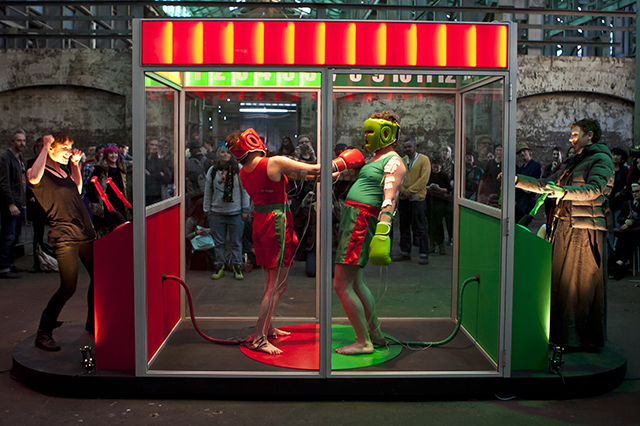
 Title: Game On medium: performance/ installation/ video size: 240cm high, 460cm long and 151cm wide year: 2013

Title: Game On
medium: performance/ installation/ video
size: 240cm high, 460cm long and 151cm wide
year: 2013

Briefly describe the work you do. 

My creative practice spans sound, performance, installation and video. My recent work has used electric muscle stimulation and other methods to bypass conditioned responses in order to both obstruct and extend human capabilities and musical possibilities in composition and improvisation.

Tell us about your background and how that has had an influence on your work and on you as an artist.

My work as an artist is informed by an interest in the role of psychological and physical agency both in and beyond the context of musical performance. I have a doctorate in psychology and my interest in human behaviour has a strong influence on my work, particularly ideas about free will, moral responsibility, and how people negotiate various obstructions. I also play bass guitar in various projects, and I am interested in questions regarding creative agency in the creation of music. I use electric muscle stimulation in a musical context to both extend and obstruct human capabilities in performance, and to create works which literalize certain aspects of musical performance where musicians become conduits or transcribers of a creation that is not their own. 

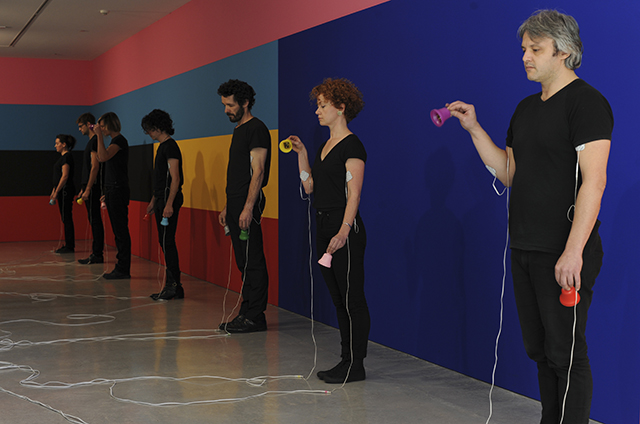
Title: Duty medium: performance size: minimum size requirements: space to accommodate the 7 performers  year: 2014

Title: Duty
medium: performance
size: minimum size requirements: space to accommodate the 7 performers
year: 2014

The concept of the artist studio has a broad range of meanings in contemporary practice. Artists may spend much of their time in the actual studio, or they may spend very little time in it. Tell us about your individual studio practice and how it differs from or is the same as traditional notions of “being in the studio.”

My studio is in my home, or rather, I sleep in my studio, which is great because I’m a workaholic, but bad because I never really have any down time.

What roles do you find yourself playing that you may not have envisioned yourself in when you first started making art?

When I first started making art I never envisioned myself playing the role of “artist”. I still don’t. I just like making things. (I also never envisioned doing so much admin, or filling out so many application forms).

When do you find is the best time to make art? Do you set aside a specific time everyday or do you have to work whenever time allows?

There is no best time of day, but there are better or worse days. I struggle through the days when I’m unmotivated, and work manically at times when I’m feeling inspired and focussed.

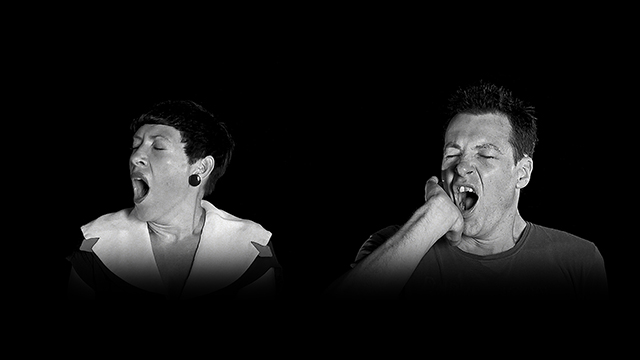
Title: Yawning Room medium: 6 channel audio, 3 channel HD video surround installation. Duration: 14’ 17” loop size:  minimum size requirements: 400cm x 400cm year: 2015

Title: Yawning Room
medium: 6 channel audio, 3 channel HD video surround installation. Duration: 14’ 17” loop
size: minimum size requirements: 400cm x 400cm
year: 2015

How has your work changed in the past five years? How is it the same?

In the past five years it has become more important to me that my work clearly reflects my philosophy,  but I also aim to make work that doesn’t take itself to seriously.  My work has always had an absurd element to it and if I can make people laugh, while inspiring reflection on some ideas that are meaningful to me, then that is a good thing.

How have people such as family, friends, writers, philosophers, other artists or even pop icons had an impact on the work you do?

My work is heavily influenced by philosophers (particularly in the field of psychology), other artists from various fields, and discussions with friends. I don’t really believe there is such a thing as an original idea- just interesting combinations of ideas that already exist in the world- so the more ideas I can expose myself to, the greater the chance of any interesting combination occurring.

Have you ever been pulled in the direction of a pursuit other than being an artist? What are your other interests? 

I also work as a practicing psychologist and musician, but I don’t see these as entirely separate pursuits- just different ways of expressing the same ideas.  

About

Michaela Davies_photocredit_Kyle Sanna (2013)Michaela Davies’ cross-disciplinary practice is informed by an interest in the role of agency both in and beyond the context of musical performance. Her recent work has used electric muscle stimulation and other methods to obstruct and extend human capabilities in performance. She has presented work internationally and throughout Australia including Museum of Contemporary Art (Australia), Institute for Cultural Enquiry (Berlin), Experimental Intermedia (New York), ISEA (Sydney), Mona Foma Festival (Hobart), and at Sonica festival (UK) where she was 2013 Artist in Residence. Michaela holds a Doctorate in Psychology from the University of Sydney. In 2014 Michaela was awarded a Creative Australia Fellowship from the Australia Council for the Arts, and received an Honorary Mention at Prix Ars Electronica 2015 for Digital Musics & Sound Art. In addition to exploring sound in installation & performance, Michaela plays electric bass in numerous projects.

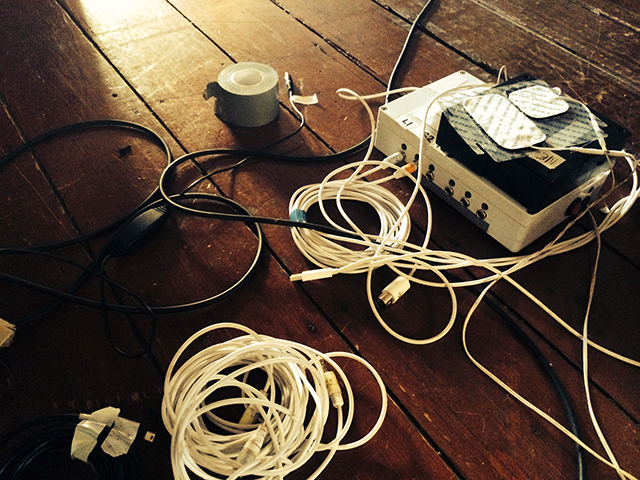
Studio floor

michaeladavies.net

All images copyright of the artist and used with their permission.
Posted in Performance | Tagged , , , , | Leave a comment

Ashleigh Alexandria – New York, New York

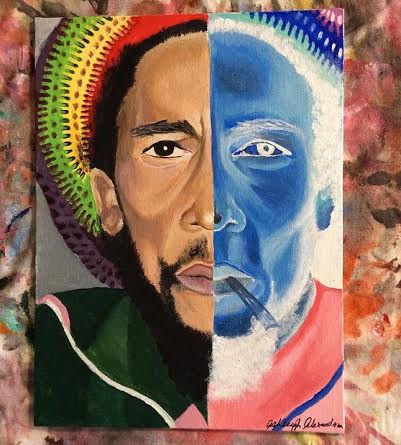
 Bob, acrylic  paint, 9x12

Bob, acrylic paint, 9×12

Briefly describe the work you do. 

Currently I am a freelance portrait artist from New York City. Somedays I sell my pieces on Prince and Broadway in Soho, NY. When I am in my “street studio” I am always encountering different kinds of people. The networking I do when I’m out there sometimes is equally as rewarding as when I sell a painting.

Tell us about your background and how that has had an influence on your work and on you as an artist.

Growing up as an only child to a single mother, I would always love being around other kids and just people in general. Once I realized my love for art I would always practice capturing or recreating human features. It wasn’t until I was in high school that I found my passion for art was targeting towards portraiture. In my works I want to evoke a sense of relevancy through the emotions of my subject matter.

The concept of the artist studio has a broad range of meanings in contemporary practice. Artists may spend much of their time in the actual studio, or they may spend very little time in it. Tell us about your individual studio practice and how it differs from or is the same as traditional notions of “being in the studio.”

My studio varies. I can literally set up anywhere that makes me feel most comfortable. My living room space doubles as a studio as well. I usually paint my larger pieces there. However I mostly paint when I am outside selling my 9×12 celebrity portrait pieces. Sometimes traffic can be slow so I rather make sure I am working, while I am working.

 Frida, acrylic paint, 9x12

Frida, acrylic paint, 9×12

What roles do you find yourself playing that you may not have envisioned yourself in when you first started making art?

Lately I see myself playing the role of the teacher and the student. Younger artists I know come to me for advice or tips on how to paint or draw faces usually. Its always gratifying  knowing that I inspire others with my artwork. I draw my own inspiration from my peers and elders who have cultivated successful lives by doing what I am striving to do. I have been making art since I can remember so my progress has depended upon my own personal dedication towards my creative process. Over the past few years I have played the role of the student and I have learned  that discipline is the only way to flourish in my craft. Everyday has become a lesson in elevating my discipline. I’ve also learned that as long as you live you’ll never stop assuming the role of the student.

When do you find is the best time to make art? Do you set aside a specific time everyday or do you have to work whenever time allows?

When creating my pieces I tend to use my spare time while I am selling art on Prince and Broadway in Soho, NY.

Mike Brown , acrylic paint, 16x20

Mike Brown , acrylic paint, 16×20

How has your work changed in the past five years? How is it the same?

The direction of my portraits weren’t derived from any particular place previously. I have made it a necessity to start narrowing in on my own style or theme when creating. Having talent is one thing but depicting a message through painting using symbolizing is another. I had a professor at Hampton University that would often harshly criticize my works and would push me to draw from my own originality. I didn’t understand at the time why everything had to have a meaning or message, but now I do. I am currently focusing on practicing my skills in painting emotion and feature through painting famous faces. In turn I am selling these pieces as well because of the popularity of the subjects I use. Recently I have developed a series of dead celebrities to execute my positive/negative theme which includes a divided image with inverted colors typically on the right side. Through this almost surrealistic view I want to create a afterlife feeling as if the audience were wearing goggles to see into “the other side”.

How have people such as family, friends, writers, philosophers, other artists or even pop icons had an impact on the work you do?

Everyone that is around me has made an impact on my work in some way or another however my first supporter has always been my mother. She has provided a way for me to pursue art since an early age. Without her believing in my talent I would not be as far along in art as I am now in skill or in passion. Before entering college at Hampton University my mother helped me get my first art show at the Langston Hughes library in Corona, Queens. It was there that I made the decision to choose fine art as a major when I arrived on Hampton University’s campus in 2008.

Have you ever been pulled in the direction of a pursuit other than being an artist? What are your other interests? 

Other interest I have is in film (polaroid) photography inspired by my mentor and partner Jean Andre Antoine, street photographer. I have developed a love for visual story telling through my photos and would like to use them as models for my next series of paintings where I will be creating a story including photography and paintings.

About

HeadShotAshleigh Alexandria was born in Washington Heights, NY and currently resides in Jersey City, NJ since 2014. She received her BA in Fine Arts from Hampton University in Hampton Virginia. She recently exhibited at the critically acclaimed group art show entitled “RESPOND”, an exhibition that featured art in response to the recent police brutality on young black men. She was one of the 200 artists selected out 600 entries.From a very young age Ashleigh has been surrounded by the arts. She fell in love with portraiture at a very young age. Her passion for capturing human features has motivated her to manipulate different mediums to portray messages through
the emotions of her subjects.

Favspotstudio2

la-virginarte.tumblr.com

All images copyright of the artist and used with their permission.
Posted in Painting | Tagged , , , , | Leave a comment

Rickard Eklund – Gothenburg, Sweden

Apeiron Helix (Prototype) Plexi-glass, One-way mirror film, Wire, LED-lights & Disco ball motor.  50 x 300 cm, 2015.

Apeiron Helix (Prototype)
Plexi-glass, One-way mirror film, Wire, LED-lights & Disco ball motor.
50 x 300 cm, 2015.

Briefly describe the work you do. 

What I do is that I take a concept which might be a symbol, sentence, system, object or any idea that seems promising for whatever reason and then start a construction process in my mind, imagining what the results could look like by different material combinations and working methods. When I arrive at something that I find visually interesting I start working to acquire the means to perform the idea. The actual execution tends to bring with it a lot of changes, so for me it is important to plan for an open-ended process.

Some projects are complicated and takes a lot of planning, communication and funds, while at other times slight altercations to available found objects might be entirely sufficient. Generally I try to manage my work into keeping what seems to me to be interesting strings of possible associations attached to them or, into being things that might generate new thoughts. Basically things worth looking at for an extended period of time – looking and thinking.

Tell us about your background and how that has had an influence on your work and on you as an artist.

My choice to be an artist came from a pursuit of autonomy and trying to avoid any limitations to my options of choosing areas of interest. From a wish to be able to work for myself and to be allowed to change my mind at a whim. Working as an artist seemed to me to be the most free-minded career choice available. I think this is reflected in the material variability of my output and continually trying to gain new skills and insights from many different fields of study and modes of thought.

Palanquin Iron, Wood, Mesh fabric & Jute tassels.  100x200x300 cm, 2013.

Palanquin
Iron, Wood, Mesh fabric & Jute tassels.
100x200x300 cm, 2013.

The concept of the artist studio has a broad range of meanings in contemporary practice. Artists may spend much of their time in the actual studio, or they may spend very little time in it. Tell us about your individual studio practice and how it differs from or is the same as traditional notions of “being in the studio.”

I used to live in my studio for the last couple of years, which meant for me that I was always potentially working on something, even when relaxing. Only since this last year do I keep a division between ”at home” and ”in the studio”. My studio is located within walking distance from where I live, so I still go there in the middle of the night sometimes, but the difference is that I let go of getting any more work done at the point of stepping out of the studio.

I’m definitely a studio-based practitioner that keeps on-going projects set up in workstations around my space – building on my notes for ideas and stacking my storage of materials.

For larger projects that are in need of manufacturing in other workshops, much of the work still comes from out of the studio practice by making sketches and preparations.

What roles do you find yourself playing that you may not have envisioned yourself in when you first started making art?

Most of the chores that goes with being a free-lance artist that’s not directly related to actually making art I find quite awkward. All the paper work of being a small business, writing applications, negotiating fees etc. take up a great deal of my time and energy, and I wish I could pass that on to someone else that might willingly do a better job of it. Chasing opportunities goes with getting turned down a lot, which is a bummer, but so far it is a reality that has to be dealt with. So managing my own expectations is a role I’m reluctantly getting better at.

However, I enjoy the social aspect of the role of project coordinator and getting in touch with people for advice of how to proceed with an idea – discussions, making plans, setting dates and seeking collaborations.

When do you find is the best time to make art? Do you set aside a specific time everyday or do you have to work whenever time allows?

I typically work nights when there are no other distractions. But I am in the process of trying to turn this around just to see what might happen if I adopt a regular working schedule. I find it difficult, but for me it’s an exotic challenge. I suspect there is a reward in an overall increase in quality of life in not staying up all night that I am actually quite distrustful of, because I think that for me it might also be creatively stunting.

Why Would a Water Vein Need To Find A Place To Die? Mixed media. Exhibition Installation View. 2014

Why Would a Water Vein Need To Find A Place To Die?
Mixed media. Exhibition Installation View. 2014

How has your work changed in the past five years? How is it the same?

My work has generally gotten larger in scale and more expensive to produce. I find myself thinking more about things like logistics these days, which I suppose means I am getting more professional.

I also collaborate much more than I used to and am developing on-going collaborations and exchanges with a number of other artists. Sharing skill-sets and creatively exchanging viewpoints seems increasingly important to me.

How have people such as family, friends, writers, philosophers, other artists or even pop icons had an impact on the work you do?

I have been greatly influenced by extensively reading and listening to the psychedelically informed philosophies of Carlos Castaneda, Terence McKenna and Alan Watts over the last couple of years. From them and other thinkers I have gathered many spawns of ideas from coming across theories of the nature of time, plant shamanism, the role of aesthetics in human cultures and so forth.

I listen quite a lot to podcasts and lectures while working and often on varying subjects of history; cultural history; art history; the history of science; philosophy and any history of ideas, and so making my work has for me become imbued with the acquisition of knowledge.

Have you ever been pulled in the direction of a pursuit other than being an artist? What are your other interests? 

Not really. For myself, I never saw the point. I would maybe like to teach art eventually, just to directly dig into what people are thinking and why.

About

Headshot Rickard Ljungdahl EklundBorn in Stockholm, Sweden 1987. Received his MFA after five years of studies at Valand Academy in Gothenburg 2014. Currently lives and works in Gothenburg where he recently had his first solo exhibition since graduation at the artist-run gallery BOX.

Ljungdahl Eklund’s work concerns the themes of altered perception, mythology and the process of sight.

By operating with different cultural symbols and knowledge systems through a wide range of techniques and materials, his artistic practice is both a conceptual and material investigation, aimed at by observation instilling a sense of immediate presence.

Time Traveller Bindle (detail) Wood, Mesh bag, A 1968 copy of the I-Ching & Six 18th century chinese copper coins. 15 x 142 cm, 2014

Time Traveller Bindle (detail)
Wood, Mesh bag, A 1968 copy of the I-Ching & Six 18th century chinese copper coins.
15 x 142 cm, 2014

rickardljungdahleklund.com

All images copyright of the artist and used with their permission.
Posted in Conceptual Art, Installation, Sculpture | Tagged , , , , | Leave a comment

Billie Giese – DeKalb, Illinois

After Party, mixed media, 6”X6”, 2014-15

After Party, mixed media, 6”X6”, 2014-15

Briefly describe the work you do.

Ideas drive my media choices. I have a very deep desire to interact physically with the processes of different materials. Thematically, I have explored personal narratives and memories for the past two decades. The shifting nature of how we perceive our life experiences and memories parallel my working methods and material choices. Images, surfaces, patterns, textures are created, destroyed, veiled, excavated, lost, and found…in flux then fixed.

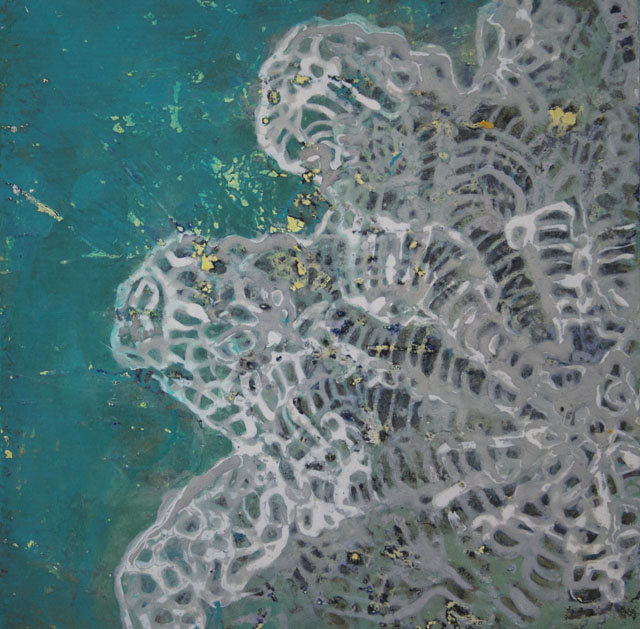
This most recent body of work is an homage to my mother. I began collecting doilies after she died because they reminded me of her. Painting each one in the collection is my way of honoring the handiwork of the makers. My goal is to create 86 individual pieces, my mother’s age when she died from Alzheimer’s disease.

Tell us about your background and how that has had an influence on your work and on you as an artist.

Both my parents were Pisces, each swimming in opposite directions in the same circular pool. My father, born and raised in the South, was a career military man until he retired into farming. My mother, an artist, was a first generation Polish-American born in Pittsburgh, PA. She was a person who was very intellectually curious, constantly learning something new, and loved beauty. Our family moved quite a bit when I was growing up. Travel, cultural diversity, and an appreciation for nature were the key life experiences I gained as a kid. Both my Mom and Dad were makers, so working with my hands felt instinctive. I remember choosing to be an artist in kindergarten, why would you choose to be anything else? My mother certainly supported the idea.

Broody Moody, mixed media, 6”X6”, 2014-15

Broody Moody, mixed media, 6”X6”, 2014-15

The concept of the artist studio has a broad range of meanings in contemporary practice. Artists may spend much of their time in the actual studio, or they may spend very little time in it. Tell us about your individual studio practice and how it differs from or is the same as traditional notions of “being in the studio.”

My studio practice is pretty traditional, I suppose. Having a space to make work in is a wonderful luxury. Taking time to be alone, listen to music, work. It grounds me and makes me a better person to be around when I venture out.

What roles do you find yourself playing that you may not have envisioned yourself in when you first started making art?

I am an art professor at Northern Illinois University. Teaching compliments my studio practice and I really love doing it. Sometimes it is challenging to be fully committed to both. I’ve learned to balance what I can and take advantage of school breaks for studio time.

When do you find is the best time to make art? Do you set aside a specific time everyday or do you have to work whenever time allows?

I prefer to work in jags. Once I start, I keep going until the juices run down. The cycle usually is a 4-5 day run then I’ll take a break for a day or two, repeat. This is nearly impossible to do during the academic year. I have had to adjust to having several hours here and there maybe a weekend from time to time. I start many things at a time during the Fall and Spring terms, then when winter and summer break comes, I go back to my preferred pattern. Also, I keep a journal, mostly notes and impressions, I have several sketchbooks I carry around with me. I doodle a lot especially in meetings! My doodles are mostly patterns, only occasionally will I draw figuratively even though I consider myself a figuratively based artist. Drawing is addictive, so once I start I hate to stop.

Doiley for a Sunny Day, mixed media, 6”X6”,2014-2015

Doiley for a Sunny Day, mixed media, 6”X6”,2014-2015

How has your work changed in the past five years? How is it the same?

Five years flies now that I have reached sixty. Material process and figuration has always been at the core of my practice. Overall there have been subtle changes in my work in how and what I have pursued. Still, there are times when I will throw myself a curve in style or idea, which can result in complete failure or an occasional keeper. It’s in my methods to have several different things going on simultaneously, the majority of which is either destroyed or waits for another time. A few things make it out, maybe one fifth of what I initially create.

How have people such as family, friends, writers, philosophers, other artists or even pop icons had an impact on the work you do?

Everything and everyone. So many of friends, family, students and artists impact my thinking about art, work and life. I don’t think I can select a singular thing or person right now. Certainly, my brothers are my touchstones, we have the best conversations, which can follow an expansive range; art, politics, music, environmentalism, social issues, wine making, food…

Have you ever been pulled in the direction of a pursuit other than being an artist? What are your other interests?

In second grade, I took to creating dance performances in the living room, using my sister for a partner. We had these really great crinoline petticoats that were perfect for twirling and whirling. One day I flung my sister too hard and she got hurt. It was a terrible feeling and I lost interest in that ambition. Also, for a very, very brief moment in college I considered Fashion and Interior Design, it took me two semesters to figure out I was really miserable in both of those pursuits.

Other interests? Travel, for all the obvious reasons, it resets my mind and opens up my thinking on things. Then there is music. I have taken up the ukulele so that I can hang out with people who like to play and sing.

About

Bgiese-StudioBillie Giese is an artist/educator whose work explores material processes and personal narratives. She earned her MFA in Painting from the University of Kansas where she studied with the artist, Roger Shimomura. She currently lives in DeKalb, Illinois where she teaches Studio Art at Northern Illinois University.

Two of a Kind, mixed media,8”X6”, 2014-2015

Two of a Kind, mixed media,8”X6”, 2014-2015

All images copyright of the artist and used with their permission.


Posted in mixed media | Tagged , , , | Leave a comment

David Rowe – Las Vegas, Nevada

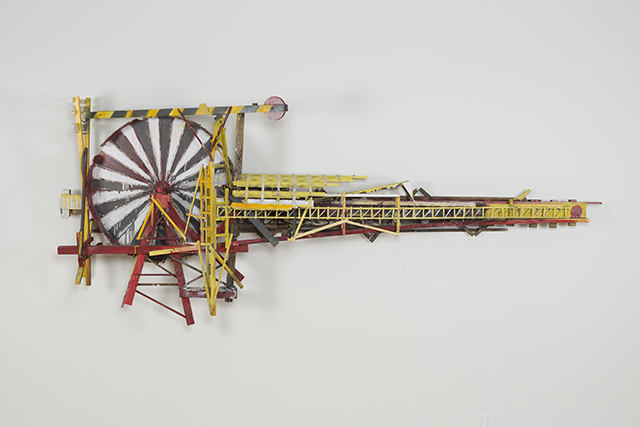
"untitled landscape with wheel" Wood, paint, stain, glue, nails

“untitled landscape with wheel” Wood, paint, stain, glue, nails

Briefly describe the work you do. 

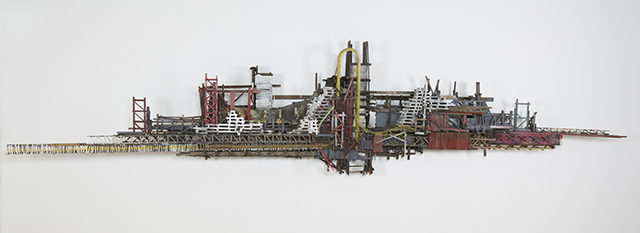
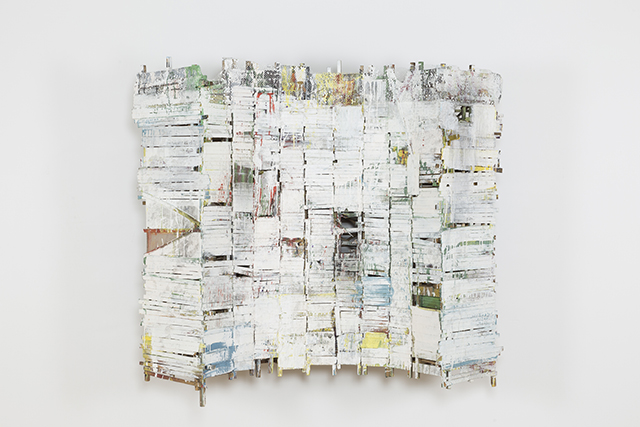
I make large wall based sculptures addressing concerns of landscape and environment. They exist somewhere between abstraction and realism. The work is created from widely available materials such as plywood, 2x4s and cardboard. The works reference archetypal moments within the landscape and architectural spaces, asking the viewer to examine personal and collective histories as well as their own place in time.

Tell us about your background and how that has had an influence on your work and on you as an artist.

I grew up in Illinois, so the midwestern environment has had a huge influence on my aesthetics. I want to capture the vastness of the American landscape and the effect that human development has had on this environment. I can remember seeing the south side of Chicago in the early 90’s from the window of the car as we traveled through the city and being fascinated with the decay of the region. At the time it possessed a great visual appeal to me, but I really had no idea about the cultural forces at work. I tend to be very observant of my surroundings, and as I matured I became very interested in landscape as a vehicle for documenting social and political change. My initial fascination with the textures and forms of decayed barns and derelict factories became an awareness and interest in the circumstances that resulted in these ruined landscapes and by extension the economic and social upheaval. In a way I see my work as political, but not in an overt way.

"Desert Constructions" Wood, glue, nails, fiberglass, paint, stain

“Desert Constructions” Wood, glue, nails, fiberglass, paint, stain

The concept of the artist studio has a broad range of meanings in contemporary practice. Artists may spend much of their time in the actual studio, or they may spend very little time in it. Tell us about your individual studio practice and how it differs from or is the same as traditional notions of “being in the studio.”

In a lot of ways I still maintain a pretty traditional notion of what constitutes a “studio practice.” I go into my studio and make things. It sounds simplistic, but I think that’s what keeps me returning to what I do. It’s an escape, a way of just immersing myself in material and process. For me, the act of making is also a way of thinking and a way of communicating, so that really becomes one of the driving motivators in my studio.

What roles do you find yourself playing that you may not have envisioned yourself in when you first started making art?

My quick answer is self-promoter. But the more complex answer would be that as an artist you have to be an entrepreneur. You end up playing a lot of different roles, everything from artist, to promoter, to janitor. I think we all go in naïve about what it takes to be an artist, and we have that moment where reality and expectation collide. Recently I have added the role of collaborator to the mix. I have a few side projects I work on with friends and colleagues. It’s a new approach for me, but it allows for larger and more complex projects or work with new materials that I would never approach on my own.

When do you find is the best time to make art? Do you set aside a specific time everyday or do you have to work whenever time allows?

I generally try to set aside large blocks of studio time, usually Saturday I spend the entire day in the studio, and then fit in more time between my teaching responsibilities the rest of the week. I’ve tried to fit in smaller working sessions, but I find that it takes me time to really get into work mode. I try to get all the other stuff done throughout the day, sending out images, writing, and things like that. I just started the summer season, so I have much more time to focus on my work, and minimal responsibilities at the University, so summer tends to be a really productive time for me. I’m spending a few weeks in June at Brush Creek Center for the Arts in Wyoming, which is going to be really great. Nice to get out of Vegas and spend time focusing on my work with fewer distractions.

"Curved Surface" Wood, paint, stain, glue, nails

“Curved Surface” Wood, paint, stain, glue, nails

How has your work changed in the past five years? How is it the same?

Digital tools have had a huge impact on my work over the past 5 years. I came of age at a really unique time. Being born in the early 80s meant that I saw the emergence of the Internet and the transformation of culture to an almost entirely digital framework. My cohort, more than any other, came of age as the Internet matured. Initially I saw my work as a hedge against these developments. I learned ceramics, woodworking, welding, these really traditional and “analog” technologies, and for a long time I resisted the application of any digital methodologies into my process. But after seeing how other artists integrated digital technologies into their work in either a seamless way or used it to advance their own conceptual or visual agenda it really made sense. My work remains focused on the landscape, and I still use it as a vehicle for exploring ideas regardless of the material or technique involved.

How have people such as family, friends, writers, philosophers, other artists or even pop icons had an impact on the work you do?

Despite being a Sculptor I count a lot of photographers among my influences. The WPA photographers, Walker Evans, Dorthea Lange, etc. all had a big impact on my work. I have been very fortunate to have the support of my family and several very beneficial mentors over the course of my career.

Have you ever been pulled in the direction of a pursuit other than being an artist? What are your other interests? 

Not in many years. I really wanted to be an architect as a child, until I spent a day working with one, and realized that it was so boring! I still count architects among my major influences, Frank Lloyd Wright of course, but also a lot of the mid- century architects who built on his work. Architects like John Lautner and Paul Williams. Architecture has been a huge influence on my work and personal fascination for me though. But I really can’t see myself doing much else other than making art and teaching. At the end of the day there is still a lot of freedom to be had as an artist.

About

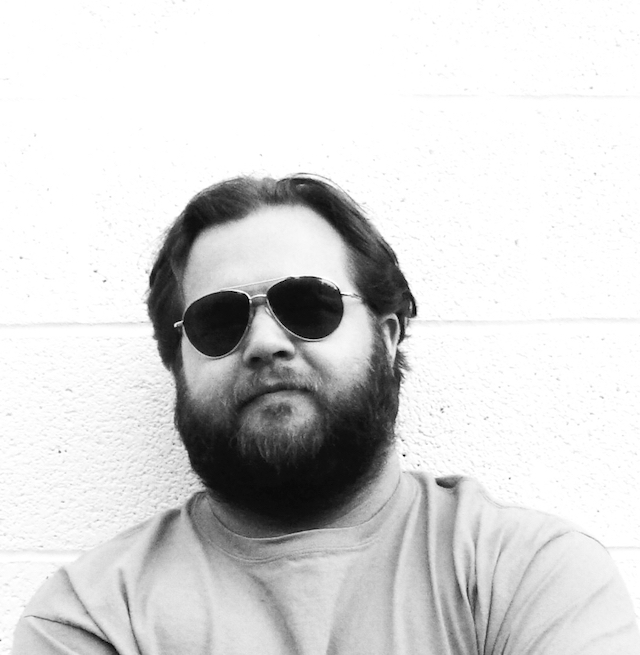
daverowe1Dave Rowe received his BFA from the University of Illinois at Urbana Champaign and his MFA from Indiana University Bloomington. He has shown nationally, and his work was included in the national survey show “Crafting a Continuum” at Arizona State University. He is a 2011 recipient of an Efroymson Contemporary Arts Fellowship. In summer 2015 he willl be in residence at Brush Creek Center for the Arts.

From 2010-2013 he ran the 3D Foundations Program at Indiana University Bloomington. He is currently an Assistant Professor and Area Head of Sculptural Practices and 3D Foundations at the University of Nevada- Las Vegas.

daverowe2

daverowesculpture.com

All images copyright of the artist and used with their permission.
 

Posted in Sculpture | Tagged , , , , | Leave a comment

M. Kardinal – Berlin, Germany

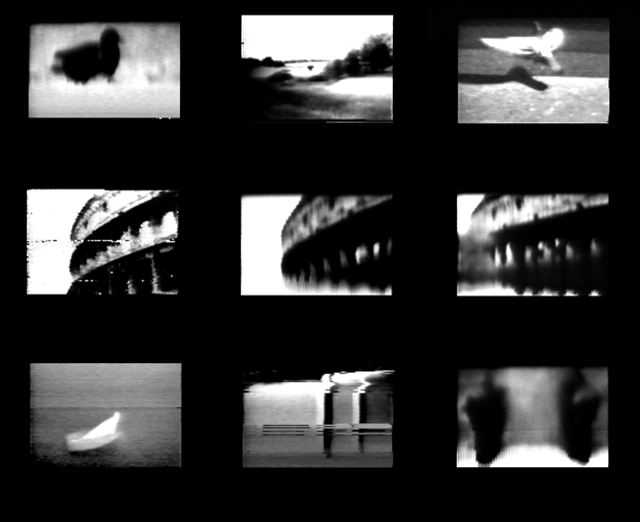
Collection of stills, Non-Lieux (2014) and audiomemories (2012),  Experimental video art  work,

Non-Lieux (2014) and audiomemories (2012), Experimental video art work. http://segmentederwirklichkeit.de/videoart_4

Briefly describe the work you do.

My artistic position is primarily manifested in black-and-white and almost monochrome photographies and moving images. As in my photographic work, I also renounce in my work with moving images the reproduction of external reality. Attributes such as clear, sharp, and realistic have a lower priority in my images. The deconstruction of forms, the distorted and blurry images, the absence of color, and the play with light and dark refer to a kind of primordial state of the vision. This representation of a dream state or the kind of visual experience that is liberated from the rational consciousness is an essential part of my recent work.

Tell us about your background and how that has had an influence on your work and on you as an artist.

In the light of my early childhood in the GDR, and the consequence that some places, pieces of art or scents and sensations, I could only experience through language or pictures, I developed a vivid imagination. As I discovered the camera of my father and secretly held it in my hands, I was fascinated by its mystery and enthralled by its beauty. I fell immediately in love with the spirit of image creation. This passion accompanied me throughout my adolescence, and led to the study of Art History and Fine Arts. While studying, I experimented excessively in the darkroom, and it’s alchemy always haunted me during my creative process and led to more experiments with different mediums.

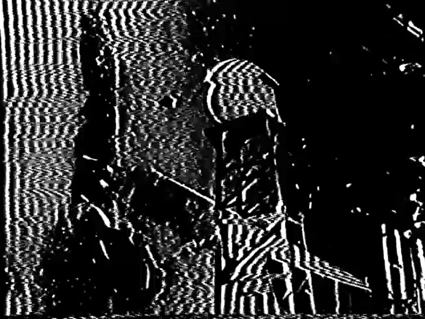
Collection of stills, TSCHAIKA (2014) and Geometrie non euclidee (2012),  Experimental video art work

TSCHAIKA (2014), Still, Experimental video art work http://segmentederwirklichkeit.de/videoart

The concept of the artist studio has a broad range of meanings in contemporary practice. Artists may spend much of their time in the actual studio, or they may spend very little time in it. Tell us about your individual studio practice and how it differs from or is the same as traditional notions of “being in the studio”.

My studios always have been in the place I live in, and that is the way I still prefer to work even if it gets sometimes claustrophobic since boundaries between the daily routine and the creative process are crossed. Nevertheless, unlimited access to my studio became of the years essential to me. Even though I wish sometimes there would be a magical garden between these spaces because being in my studio, feels like being in the rabbit hole.

What roles do you find yourself playing that you may not have envisioned yourself in when you first started making art?

Mastering the art of solitude.

When do you find is the best time to make art? Do you set aside a specific time everyday or do you have to work whenever time allows?

My work schedule is very ordinary. I work every day, and try to keep a balance between the creative period and the times when I have to take care of exhibitions and festivals or maintaining my archive. In fact there are certain times of the day or night, and the seasons in which I prefer certain types of work or work stages.

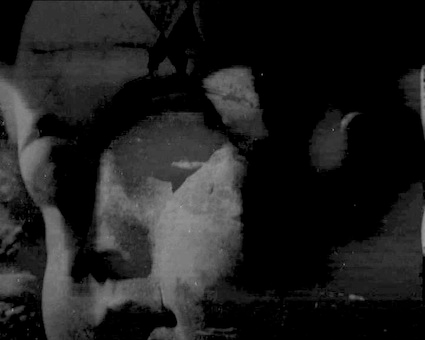
Stills, Triptych Diario di una bambola - Canto I (2012),  Experimental video art work

Detail, Diario di una bambola – Canto I (2012), Still, Experimental video art work. http://segmentederwirklichkeit.de/videoart_6

How has your work changed in the past five years? How is it the same?

In the last five years I experienced the transition from the the photograph to the moving image. After almost a decade of doing primarily black-and-white photography, I experimented with instant photography. The technical imperfection and the transience of the Polaroid picture, has something highly subjective and authentic that reminds me of the way our perceptual apparatus works, and the ephemerality of human existence. Confronted with the transience of the image, dealing with time, in the process of production and in the result itself, suddenly became object of my artistic contemplation. I started to integrate time as well as the duration of time in the photographic image, and moved the photography in the vicinity of the film.

My desire to create moving images, and my preference for analog working methods, obsolete technology, distorted dreamlike images, and my interest in perceptual processes eventually led to the confrontation with video synthesis, and the use of circuit bent machines and toy cameras. Exploring the medium itself, its tactile qualities, became important to my work.

The last years I try to develop a poetry of failure. I have the profound desire to understand how the medium I work with behaves under certain circumstances, especially under malfunction. It is very inspiring to find out how the image change when the material is treated in unexpected ways. There is a kind of logic and stunning beauty behind it. It is almost as if you dive beneath the surface of the image, and discover the “unconscious” in the image. The visible and the invisible in the image. They coexist but the “unconscious” in the image is only visible by defective treatment.

The not satisfying curiosity, the urge to explore in more depth, and the need for solitude seem to me like an invariable maxim in my work. Undoubtedly, I stick with a certain visual vocabulary and remain with related themes. To conclude, therefore, it seems that the desire to create a sort of mental landscape of desire, where the viewer engages actively in the process of conveying meaning, a kind of visual experience that is liberated from the rational consciousness will accompany me for a long time.

How have people such as family, friends, writers, philosophers, other artists or even pop icons had an impact on the work you do?

To be continuously surrounded by art and its history, and my curiosity and thirst in literature, philosophy, and psychology allow me to dive deep into the ocean of inspiration. I believe there are influences, of those I am not even aware of. By contrast, to name the influences of those I am aware of certainly could fill pages. I must concede, however, that I prefer to discuss about the particular pieces of art, art films, video art or writings, rather than the artist or writer in general but to list them would leap beyond the boundaries. Therefore, I try to name some writers and artists whose works accompanying me since a long time: the writings of Joseph Brodsky, Italo Calvino, Elias Canetti, Carl Gustav Jung, Anaïs Nin and Susan Sontag. I also appreciate the works of the filmmaker Bill Morrison, and Peter Tscherkassky, who both work with found footage as well as the works of Tacita Dean and Chris Marker. Equally, I appreciate the work of the composer Delia Derbyshire. From the field of photography the works of my master Arno Fischer, the enchanting photography of Sibylle Bergemann, Mario Giacomelli, Sally Mann, Sarah Moon and Francesca Woodmann have moved me deeply.

Have you ever been pulled in the direction of a pursuit other than being an artist? What are your other interests? 

I faced many streets and some crossroads but I always walked towards the arts and art history. Art can be a universal language, and overlaps with many other disciplines. My curiosity is never satisfied and during my creative process, I explore constantly comprehensive topics.

About

Self PortraitKardinal was born in East Germany, she studied Fine Arts and Art History in Germany and Italy. In 2008, she took up her Master’s studies in Fine Arts with a focus on photography, film, and new media. An intensive confrontation with photography and new media led her to study in Rome from 2008 to 2009. Back in Germany, she was a master student of Arno Fischer from 2010 to 2011. Influenced by her intense work in photography, she began to work with obsolete video-technology in 2009. M. Kardinal successfully completed her studies with a Master of Arts degree in Fine Arts in 2012.

Her work has been exhibit and screened in national and international exhibitions and film screenings including Festival Alto Vicentino VIII (Italy, 2014), Nomadenkino Berlin (Germany, 2014), SI FEST#OFF di Savignano Immagini Festival (Italy, 2013), Another Experiment by Woman Film Festival at Anthology Film Archives New York City (USA 2013), the International Short Film Festival Detmold (Germany, 2013) and the European Month of Photography In Berlin (Germany, 2012).

Kardinal lives and works as a freelance artist and in Germany and Italy.

9.-Detail-Polaroid-Segments-of-substantiality

Detail, from the series, Segments of substantiality (2011 – 2012), Polaroid, 10,7 x 8,9 cm, Courtesy of the SØR Rusche Collection Oelde/Berlin http://segmentederwirklichkeit.de/polaroid

All images copyright of the artist and used with their permission.
Posted in Photography, Video | Tagged , , , , | Leave a comment