Christa Bowden – Lexington, Virginia

Skeletal Leaf, 2009 archival pigment prints and encaustic on wood panels 40"h x 10"w x 1.5"d

Skeletal Leaf, 2009
archival pigment prints and encaustic on wood panels
40″h x 10″w x 1.5″d

Briefly describe the work you do. 

The overarching theme running through all of my projects is observation of the natural world and consideration of the human experience within that world. This is often, but not always, realized through constructed still-life photographs of natural subjects, serving as metaphors for these experiences. In terms of technique, much of my work is created using a flatbed scanner as my camera, and has been since 1999. About 7 years ago, I began incorporating encaustic painting into much of my work. I also sometimes utilize alternative photographic processes like platinum and palladium printing, cyanotype, and metal leaf on vellum.

Tell us about your background and how that has had an influence on your work and on you as an artist.

Although I was raised in the suburbs of Atlanta, I spent a lot of time outdoors in nature as a kid. My mother and grandmother took me camping quite often, and we spent a lot of our family vacations on Cumberland Island, off the coast of Georgia, which is a truly magical place. I have always been the most at peace in nature, and I think that consistently influences my subject choices across my projects. At the same time, I try to infuse many of these subjects with a deeper meaning which reflects my personal experiences. This is most readily apparent in the Roots & Nests project featured here, in which I use subjects like roots and nests as metaphors for family and my experiences as a mother.

The concept of the artist studio has a broad range of meanings in contemporary practice. Artists may spend much of their time in the actual studio, or they may spend very little time in it. Tell us about your individual studio practice and how it differs from or is the same as traditional notions of “being in the studio.”

My studio practice does not necessarily occur in one location, but is rather a multi-location, multi-step process. My scanner work begins as a hunter-gatherer process, looking for subjects that might make interesting photographs as scans. Sometimes friends will bring me things that they find, if they know that it relates to a current project. They’ve brought me everything from dragonflies to all kinds of nests, from hummingbird nests to wasp nests. But I most often find my subjects while on walks, or even in my own backyard. My current project in progress is about the moon and the night sky, so I’ve been doing everything from charting and photographing moon phases for the past year, to experimenting with astrophotography through a telescope, to playing around with NASA’s royalty-free deep space images, to creating constellations with salt on my flatbed scanner. In terms of my physical studio space, this exists in a few different places. I have a “clean” area for my digital work and a “dirty” area for my encaustic, both in my house. I also utilize the darkrooms at my school for most of my alternative process printing. While it’s a little difficult having my studio spread out between three physical spaces, it’s also nice that when I get tired of being in one space, I can move on to working on something different in another space.

Nest II, 2009 archival pigment prints and encaustic 32"h x 32"w x 1.5"d

Nest II, 2009
archival pigment prints and encaustic
32″h x 32″w x 1.5″d

What roles do you find yourself playing that you may not have envisioned yourself in when you first started making art?

I teach photography at Washington and Lee University, and essentially have my dream job sharing my love of photography and art with others full-time. I often feel like pinching myself when I remember that I get paid for this gig. What I underestimated coming into my career is how much that my students would actually teach me, and not the other way around. I have been consistently surprised over the years at how much the content of my courses has influenced my own work. For example, I began utilizing alternative processes in my work after teaching an alt pro class in my first year at W&L. I also learn new material constantly through teaching, and through my student’s questions in particular. They definitely teach me as much or more than I teach them. 

When do you find is the best time to make art? Do you set aside a specific time everyday or do you have to work whenever time allows?

Because I am teaching and running the photography program at W&L full-time during the academic year, I make the majority of my new work during the summer. Throughout June, July, and August, I am pretty much able to dedicate myself entirely to my studio practice during the week. I also get fantastic research support from my university for this. During the school year, I generally have Fridays set aside for studio time. In smaller time windows, I handle the administrative side of my studio practice, like shipping work to shows, updating my web site, etc. Between teaching and having young children at home, finding time to create new work is definitely a balancing act. I treasure the uninterrupted studio time in the summers, as I find shifting gears between creative work and teaching during the academic year quite difficult. 

Morning Glory Triptych, 2013 22”h x 30”w x 1.5”d archival pigment prints, encaustic, and rubbed oil pigment on wood panels

Morning Glory Triptych, 2013
22”h x 30”w x 1.5”d
archival pigment prints, encaustic, and rubbed oil pigment on wood panels

How has your work changed in the past five years? How is it the same?

The utilization of natural subjects to serve as metaphors for human experiences, and particularly a woman’s experiences, are the ideas that have remained constant in my work over the years. I don’t want to say that this will always be the case, but it seems to have worked out that way for as long as I can remember. Five years ago, I was just starting to explore motherhood and family through the Roots & Nests project. During that time, I experienced the pregnancy and birth of my second son, which had an immense impact on the work. Many of the pieces were made while I was on sabbatical and at home with my son during his first year of life. My studio practice had to be balanced with nursing, rocking, and other aspects of caring for a newborn. Everything about the Roots & Nests project, from the subjects themselves to the encaustic wax, were impacted by my overwhelming desire to nurture and protect this tiny human in my care. As he has grown into a more independent child, I have moved into a less introspective project about the moon and stars. So essentially, five years ago I was looking inward with my work. And now, I am literally looking outward into the night sky. In terms of technique, I have found over the years that I feel more and more of a need to incorporate the artist’s hand into my work. I am no longer satisfied with an image that is purely digital, from scanner to finished print. Whether it is painting encaustic over a digital print, or a print made through an alternative process, a piece is not finished for me anymore until I get my hands dirty. I am by no means the only photographer who has found herself in this position, and I believe that there is something to be said for this being a response, conscious or unconscious, to the rise, prevalence, and ease of digital photography in society. 

How have people such as family, friends, writers, philosophers, other artists or even pop icons had an impact on the work you do?

As I explained previously, my family has a huge impact on my work. I also believe that my move to rural Virginia nine years ago impacted my work a great deal. I live in the amazingly beautiful Shenandoah Valley. It is a calming and grounding force in my work. Even though the relationship between a circular nest balanced within a square to a landscape of green rolling hills flanked by mountains may not be immediately apparent, it is most certainly present. As far as other artists, I try to look at as much work as I can. I keep up with several photography blogs, read periodicals, attend conference presentations, and see as many exhibitions as I can. I am sure that these things seep into my work like a big visual stew. If I had to name specific artists who I feel have influenced my work consistently over a number of years, I would probably say that Michael Kenna and the Starn twins have had the biggest influence on me. The calm minimalism and compositional balance of Kenna’s work is wonderful. His understanding of how to use line in photography is phenomenal. With my latest project, I’ve also been thinking about his approach to photographing at night, and how this can transform a subject. I find the Starn’s innovations in media and process, as well as their approaches to layering and degrees of transparency, so engaging. These are artists whose work I never get tired of looking at and thinking about.

Have you ever been pulled in the direction of a pursuit other than being an artist? What are your other interests? 

I have known that I wanted photography to be a big part of my life since I took my first photo course my freshman year of college. The only question  was what kind of photography I would pursue. Throughout college, I thought that I wanted to be a photojournalist. I was a photographer for my college newspaper, and I took a lot of relevant courses. But I was always an art school girl at heart. That’s where I felt at home, especially in the darkroom. I am glad that I stayed true to that calling. It has become clear to me over the years that my preferred method of working is definitely constructed rather than found photography. I make rather thantake images, and this is a fundamentally different approach than that of a documentary or journalistic photographer. In terms of other interests, I am definitely a foodie. I love going to restaurants and trying new things, and I love cooking. I might have enjoyed being a food critic. Maybe that will be my retirement career.

Ab0ut

Portrait of artist in her studio by Kat Kiernan

Portrait of artist in her studio by Kat Kiernan

Christa Bowden was born and raised in Atlanta, Georgia. She earned her MFA in photography from the University of Georgia and a BA in photography and film from Tulane University. She is an Associate Professor of Art at Washington & Lee University, where she started the program in photography in 2006. Her work explores the use of a flatbed scanner as a camera, as well as alternative photographic processes and the integration of encaustics and photography. She was the recipient of a 2009-2010 Virginia Museum of Fine Arts Fellowship, and a 2005 nominee for the Santa Fe Prize for Photography. She has exhibited extensively throughout the United States in both group and solo shows. Her work has been included in numerous highly-regarded photography web blogs and artist indices, including Plates to Pixels, Light Leaked, and Art Photo Index, and was highlighted in 2014 as an Editor’s Pick by LensCulture Contemporary Photography. Her work also appears in the recently publishedAnthology of Appalachian Photographers from Sapling Grove Press, as well as Exploring Color Photography, 6th edition by Robert Hirsch. She is currently the Southeast region chair for the Society for Photographic Education, and lives in Lexington, Virginia.

detail from My Grandmother's Roots (turnips), 2012 Carved line work and rubbed oil pigment in encaustic

detail from My Grandmother’s Roots (turnips), 2012
Carved line work and rubbed oil pigment in encaustic

christabowden.com

All images copyright of the artist and used with their permission. 
Posted in Encaustic | Tagged , , , , | Leave a comment

Kathleen Hawkes – Winona, Minnesota

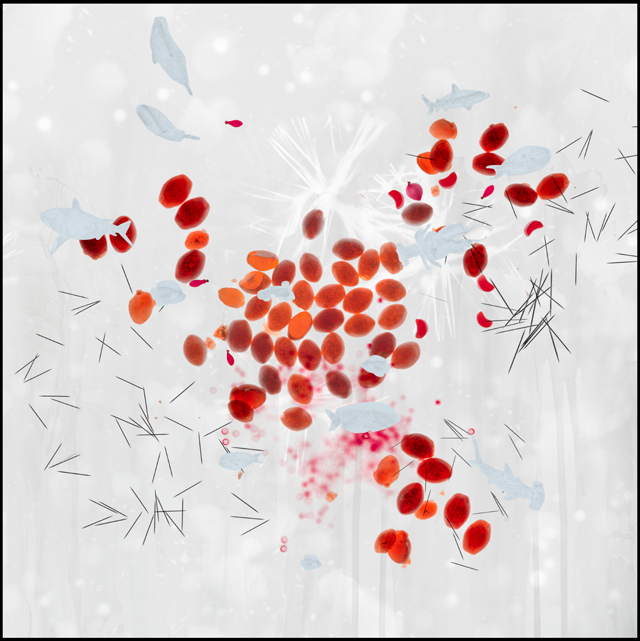
The Theory of Everything, inkjet print, 40x60 inches, 2015

The Theory of Everything, inkjet print, 40×60 inches, 2015

Briefly describe the work you do.

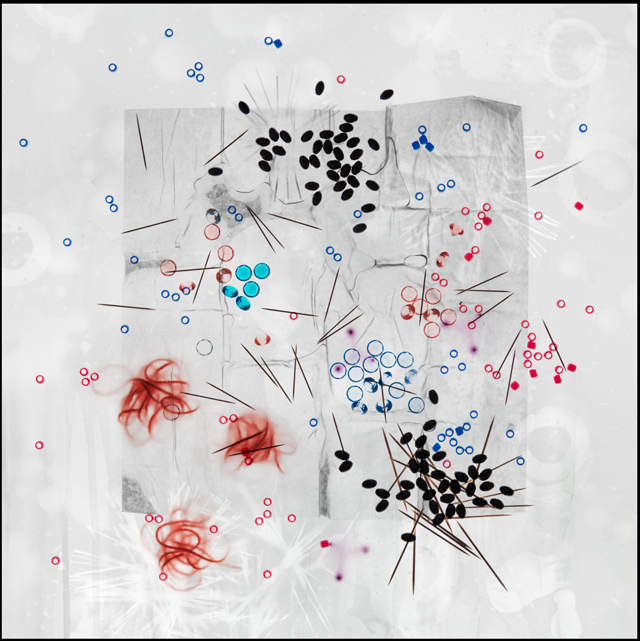
Currently I am working on a series of large scale still life photographic artworks that are constructed from many layered photographs of cheap consumer goods (candy, dime store trinkets, cellophane, etc).   

Tell us about your background and how that has had an influence on your work and on you as an artist.

I have a large extended family, and they have played a huge role in who I am as a human and the artwork that I am interested in making.   

The concept of the artist studio has a broad range of meanings in contemporary practice. Artists may spend much of their time in the actual studio, or they may spend very little time in it. Tell us about your individual studio practice and how it differs from or is the same as traditional notions of “being in the studio.”

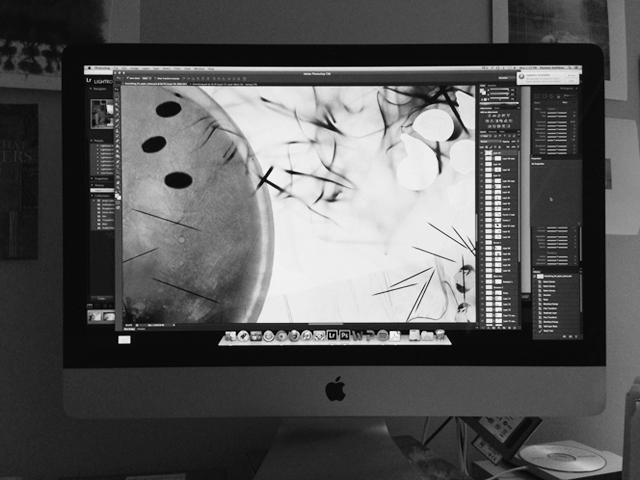
My process and relationship the the studio changes depending on the project I am working on.  For the project I am currently working on I find myself rotating between three studio spaces and modes of working.  One part of the process takes place in a very open and sterile lighting studio.  This part is very intuitive – I arrange objects on a white background, photograph them, and discard them.  Another part of the process takes place on my cluttered desktop computer where I stitch/composite images together.  This portion is much more messy, and is about trial and error, evaluation, reworking and finding balance.  And lastly, there is the step of printing the work, which takes place in an organized communal lab.  This work is much more structured, formulaic and direct.  These three modes and studio spaces comprise a mentally balanced whole.  

Super Nova, inkjet print, 36x36 inches, 2015

Super Nova, inkjet print, 36×36 inches, 2015

What roles do you find yourself playing that you may not have envisioned yourself in when you first started making art?

This is a good question because I think that an active studio practice takes you in so many unexpected directions.   Buts let’s see…  a few things that I never envisioned becoming well versed in… scavenging materials, burying dishes in sand and other fine particulates, freezing liquids, pyrotechnics, X-acto knife skills, fixing tools and cameras, rigging cameras and lights to boom arms, general MacGyvery, listening to books on tape for days, promoting and publicity, collaborating with other artists, and many, many other things that I never really considered prior to the moment that they were necessary.     

When do you find is the best time to make art? Do you set aside a specific time everyday or do you have to work whenever time allows?

I have a day job as an art educator, so there is little time during the school year make artwork.   That said I do think it is important for me to do a little bit each day or week while I am teaching.   During the school year I try to fit in small increments of my studio practice such as drawing in a sketchbook, researching an idea, scheduling a photoshoot, preparing materials, etc.   Otherwise I strongly rely on large blocks of free studio time during the summer or other school breaks to get fully immersed in a project.  

Battle Ship, inkjet print, 36x36 inches, 2015

Battle Ship, inkjet print, 36×36 inches, 2015

How has your work changed in the past five years? How is it the same?

I would say that in the last five years my works has slowly shifted from being very focused on the self and examining the past to becoming more outward looking and concerned with the future.

How have people such as family, friends, writers, philosophers, other artists or even pop icons had an impact on the work you do?

Wow…  this is such a tough questions because I feel like so many personal relationships, authors, artists, media, conversations, etc influence my work in so many conscious and subconscious ways.   Recently I am on a kick of reading and watching environmental and outer space themed science fiction and enjoying trying to envision possible futures of our existence on this planet.  This has certainly influenced my recent work.  

Have you ever been pulled in the direction of a pursuit other than being an artist? What are your other interests?

I used to work on a flower farm – picking flowers, arranging flowers, creating things.  I loved it and I miss it.  I think that I learned a lot about aesthetics and form from working with flowers, and it always reminded me of making artwork.  But, there is something nice about how temporary their existence is.  You would spend all this time making a beautiful arrangement knowing that it was going to completely fall apart in a few days time.  The work was so much about the process and enjoying the moment.   

About

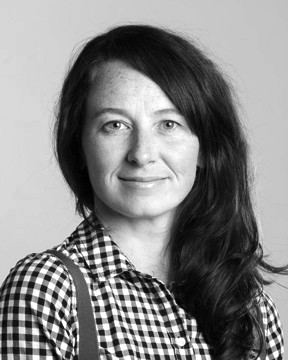
Hawkes_HeadshotKathleen Hawkes is a visual artist who creates photographs, drawings and digital works.  Hawkes was born in Ithaca, New York.  She received her BFA from Cornell University and her MFA from the University of New Mexico.  In 2012 Hawkes received a Fulbright to pursue a photographic project in Fiji.  Hawkes is an Assistant Professor of Photography at the University of Wisconsin La Crosse and resides in Winona, Minnesota.  

Hawkes_Studio_03

kathleenhawkes.com

All images copyright of the artist and used with their permission. 
Posted in Photography | Tagged , , , , | 1 Comment

Sarah Kaufman – Philadelphia, Pennsylvania

Devil’s Pool Bathers, archival pigment print from medium format film, 20 x 20 inches, 2015.

Devil’s Pool Bathers, archival pigment print from medium format film, 20 x 20 inches, 2015.

Briefly describe the work you do. 

I use color photography to picture moments of coherence among our bodies and the world around us and explore our potential to exist unselfconsciously and fully present within our physical selves. The images investigate relationships among people, their bodies, and the environments that they inhabit. I am interested in the reflexivity of looking at imagery of people wrapped up in and fully absorbed by their physical and psychological surroundings.

Tell us about your background and how that has had an influence on your work and on you as an artist.

While in College, majoring in Art with a Photography Concentration, I spent countless hours in the studios drawing and sculpting from nude models. My photography at the time was all happening out in the world, collecting images, but everything else I made concerned the human body. Eventually I began making photos of people too, starting out with the formal nudes that I knew so well from my academic art training. My work has changed immensely since then but looking back, I understand the roots of my persistent interest in representing bodies – or maybe now I finally understand why I was so engaged by the academic figure study in the first place.

Devil’s Pool Diptych #4, archival pigment print from medium format film, 23 x 43 inches, 2014.

Devil’s Pool Diptych #4, archival pigment print from medium format film, 23 x 43 inches, 2014.

The concept of the artist studio has a broad range of meanings in contemporary practice. Artists may spend much of their time in the actual studio, or they may spend very little time in it. Tell us about your individual studio practice and how it differs from or is the same as traditional notions of “being in the studio.”

I don’t make any photographs in the studio and people often ask me why I have a studio at all. I photograph in people’s homes or most recently, out in the Wissahickon woods around a local swimming hole. I do share a studio with three other artists who also use photography and teach art in Philadelphia area colleges. Our space is in an old bandage factory in Germantown, a beautiful historic neighborhood in Philadelphia known for its Quaker history and later, its economic struggles. We use the studio to come together to discuss our work and our teaching. I think of the studio as a place to spread out my ideas on the table, to receive feedback from my work and figure out what happens next. I look forward to the informal critiques that unfold naturally when my studio mates are around. We all benefit from the support and critical conversation. We also discuss our curricula and the questions that we are working through as teachers. Bringing students over to the studio is always rewarding – my teaching and practice feel intertwined and supportive of each other and when students come to see the work and hear artist talks from my studio mates, it all comes together so well.

What roles do you find yourself playing that you may not have envisioned yourself in when you first started making art?

Drawing from a model in the studio had a certain coldness but when I started photographing people and their bodies, I immediately felt like a collaborator with my “subject.” I now depend so much on others and their openness towards me and the camera. Making work at Devil’s Pool in the Wissahickon, for instance, is a very social give and take and I love it when people ask me what I am doing and when kids want to look through the ground glass of my Rolleiflex to see what’s going on in there.

When do you find is the best time to make art? Do you set aside a specific time everyday or do you have to work whenever time allows?

As a teacher my summers are incredibly productive out in the world with my camera. During the school year my work heads more into the studio for a period of assessment and reflection. During times of slower productivity in the studio, working with students keeps me engaged with ideas and the process of inquiry. I have been teaching full-time for four years now and have developed a seasonal flow that is sustainable. I make a huge number of photographs during the warm months. Winter is a great time for reading, writing, editing, printing, and analyzing and processing the work into coherent thoughts.

3.Untitled (Sliding Door), from Moments of Absorption, digital c-print from medium format film, 40 x 40 inches, 2010/2014.

Untitled (Sliding Door), from Moments of Absorption, digital c-print from medium format film, 40 x 40 inches, 2010/2014.

How has your work changed in the past five years? How is it the same?

Over the past five years I have moved through three projects, but all deal with the body in relation to environment and onlooker. I have photographed people in their own homes, and then myself in mine, perhaps as a response to that. I am currently devoted to looking at the people swimming and reveling in nature at Devil’s Pool, a place where I am able to expand my admiring picture of everyday bodies, their owners absorbed in unselfconscious presence. Physical vulnerability and the freedom that can be born from it is a theme that runs through all the work.

How have people such as family, friends, writers, philosophers, other artists or even pop icons had an impact on the work you do?

My interests have led me to admire painters who have represented real human forms, naked and free in their vulnerability and strength. David Hockney, Jenny Saville, and Philip Pearlstein are a few whose work has had an impact on me. My work has led me to think about the politics of looking at the body and the writings of theorist Michael Fried, who complicates photography in relation to painting, theatricality, and voyeurism. Justine Kurland’s photographs and Will Oldham’s music inspire me for their romantic take on reveling in the everyday freedoms and joys of having a body. Similarly, Thomas Eakins’ 19th century photographic studies of his male students jumping and bathing in a lake near Philadelphia have always communicated something exciting to me, from the first time I saw them as a teenager.

With his work, my teacher, Willie Williams, has taught me the magic of photographs that unfold slowly and reward a patient viewer. Right out of graduate school, for three years I worked for Dwight Primiano, a photographer in New York City. His mentorship helped me navigate the struggle to make work while also earning a living and to find a balance that I am grateful to have (mostly) sustained since then.

Have you ever been pulled in the direction of a pursuit other than being an artist? What are your other interests? 

Making work and teaching support one another and I hope to keep doing both! I also volunteer for a non-profit in Bolivia, grow a veggie garden with my brother, take care of 165 year old house in Philadelphia with my husband, and go fishing whenever possible.

About

Kaufman headshotSarah Kaufman received a BA from Haverford College and an MFA from Virginia Commonwealth University. She has had solo exhibitions of her photography at Saint Joseph’s University, Haverford College, Soho Photo and Porter Contemporary galleries in New York, and has participated in group exhibitions nationwide. Kaufman’s photographic and curatorial projects have been reviewed in ARTnews Magazine and The Philadelphia Inquirer. She is a Visiting Assistant Professor in Art at Ursinus College in Pennsylvania where she teaches all levels of Photography and cross‐media Studio Practices. Kaufman lives and works in Philadelphia and is represented by Porter Contemporary Gallery, NY.

Kaufman Studio

sarahkaufmanphoto.com

All images copyright of the artist and used with their permission. 
 

Posted in Photography | Tagged , , , , | Leave a comment

Jesper Blåder – Sweden

“I, Me, Mine”, Oil on MDF, 180x180cm, 2014

“I, Me, Mine”, Oil on MDF, 180x180cm, 2014

Briefly describe the work you do

My paintings depicts everyday events and places, often with a dark undertone. I like the questions:

-What has happened before and what will happen after?

There is often a feeling of threat present in my paintings and there are always traces of human activity, even if the people themselves are not always visible. My paintings have in recent years increasingly come to consist of several panels combined into one unit, the outer forms have become almost sculptural. The irregular shape reinforces the impression that it is only a part of the story we see. What happens beyond the painting’s edge.

Tell us about your background and how that has had an influence on your work and on you as an artist.

I grew up in a family where artistic creation was encouraged. My choice of profession did never encountered any obstacles from my family, which I otherwise think is quite common.

I get a lot of inspiration for my paintings from my background. My pictures are always about things that interest me, so my art is influenced much of who I am and who I have been.

“Morning meeting”, Oil on MDF, 90x100cm, 2014

“Morning meeting”, Oil on MDF, 90x100cm, 2014

The concept of the artist studio has a broad range of meanings in contemporary practice. Artists may spend much of their time in the actual studio, or they may spend very little time in it. Tell us about your individual studio practice and how it differs from or is the same as traditional notions of “being in the studio.”

I always spent as much time as possible in my studio. It is a place where I can concentrate on nothing but my work and just do what I as an artist likes most, try to find the best solution for the painting I´m working on at the moment. I am a slow painter and my paintings usually takes several months to complete and changes many times before they are done, both in terms of color, composition and content. I always have several paintings standing by the walls of my studio, in different stages. I always listen to music when I paint and I think that the choice of music to some degree influence how the end results looks like.

What roles do you find yourself playing that you may not have envisioned yourself in when you first started making art?

I say as I think many others do.

-It is not enough to make your art, one must also tell the world that you do it.

It is a task that you might not think of much in the beginning (and perhaps not so much later, either.)

When do you find is the best time to make art? Do you set aside a specific time everyday or do you have to work whenever time allows?

I probably work best in the mornings. Then I think most clearly. But in reality, I work in my studio at all times. I always try to take advantage of the time that is available.

“Overlook Hotel”, Oil on MDF, 124x84cm, 2014

“Overlook Hotel”, Oil on MDF, 124x84cm, 2014

How has your work changed in the past five years? How is it the same?

It is often difficult to see a change in what you do when you work, but for each new painting there will be a small change in one direction or the other. And if you look in the long term, it has obviously happened a lot. If I compare what I do now with how it looked five years ago, the paintings has often become larger in size and my colors have become more varied. The content of the picture has become more complex and I let more things happen in the paintings in terms of both color and content. Even the way to add the color has changed a bit, my painting is much “looser” now.

How have people such as family, friends, writers, philosophers, other artists or even pop icons had an impact on the work you do?

Books, movies and music often influence my paintings. I hear something, see something, and comment on it in a painting. The value of a soundtrack should also not be underestimated. When I worked for a major exhibition that I had last year, I listened only to the Beatles in my studio. In 18 months I did not listen to anything else, I bought a new album every month and I definitely think the choice of music colored the paintings that were made.

Have you ever been pulled in the direction of a pursuit other than being an artist? What are your other interests?

Wild birds is one of my big interests. But I am totally uninterested in bird paintings, there are in my opinion much more interesting things to paint. Birds do best in reality.

About

jesperbladerJesper Blader was born in Solna outside Stockholm but raised and living in Örebro. He is a painter and works with oil paint on MDF board. He has had many exhibitions around Sweden and also exhibited in Denmark and Lithuania.

SONY DSC

www.jesperblader.com

All images copyright of the artist and used with their permission. 
Posted in Painting | Tagged , , , , | Leave a comment

Chris Hewitt – Fredonia, Wisconsin

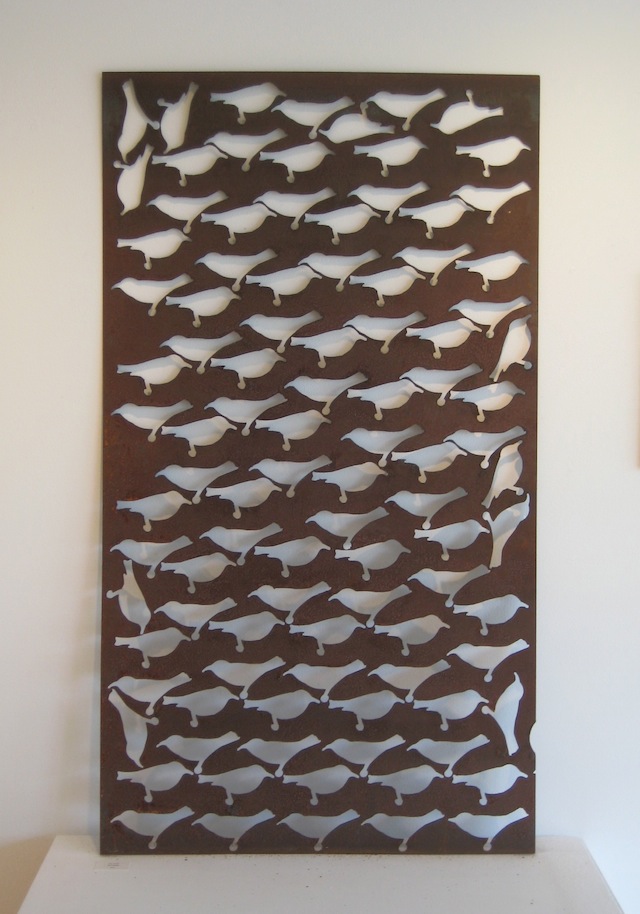
bachman's warbler_ steel, 60x30_ 2015

bachman’s warbler, steel,, 60x30inches, 2015

Briefly describe the work you do.

It’s all about relationships.  The mechanics of how the tar paper feather fits to the wood wing.  Or how the frame works with the cypress knee pedestal beneath it.  In my art, I’m trying to create new connections between dissimilar objects.  Exploring natural materials and working at combining and recombining them into new relationships. From this process, sometimes a narrative forms commenting on “work” or “waste” or “greed”.  Sometimes the object may suggest a purpose or function, like a tool or a toy.  And sometimes it is what it is.  With the completion of these objects, the process, my process is definitely not over.  The ultimate test for doneness is to bring the work into my home. Because artwork is for the home.  I know immediately if the work is complete, or good, by the connections it makes with other objects in the house.  The new work needs to “find a place”.  It needs to work with existing art, objects and furniture.  Again, it’s all about relationships.  If it can’t fit in, it needs to find another home.

Tell us about your background and how that has had an influence on your work and on you as an artist.

I started out following a familiar path artists take, I have a BFA in Ceramics and an MFA in Studio Arts.   But the quest for new information has never stopped.  There were the woodcarvers, the clock maker, basket weavers, painting conservators, and most recently the bread baker!  I enjoy learning.  Collecting new skills.  Discovering new techniques.  It doesn’t matter where you gather your information, be it at grad school or your neighbor who is passionate about adult coloring.  It’s all good.  And it all comes into play every time I face a new problem.

untitled,  mixed media, 15_x30inches,  2015

untitled, mixed media, 15_x30inches, 2015

The concept of the artist studio has a broad range of meanings in contemporary practice. Artists may spend much of their time in the actual studio, or they may spend very little time in it. Tell us about your individual studio practice and how it differs from or is the same as traditional notions of “being in the studio.”

Working on art is hard.  It’s a challenge.  It requires a lot of good, positive energy and a clear mind.  This is a state hard to find in the summer where there is a million things to do at our farm.  I’m most productive after a good killing frost!  Then you can find me either in my indoor “clean” studio or my workshop out in the barn.  

What roles do you find yourself playing that you may not have envisioned yourself in when you first started making art?

Being an artist can be very isolating, especially a rural one.  Jane Suddendorf, Director of Gallery 224 (Port Washington, WI), has helped me change that.  I am currently in Gallery 224’s Artist in Residence program. Now, it seems, Art is all about community and making connections with people and working together with other artists and I’m loving it, even the meetings!  And I’m learning all sorts of new things.

When do you find is the best time to make art? Do you set aside a specific time everyday or do you have to work whenever time allows?

Mornings are golden.

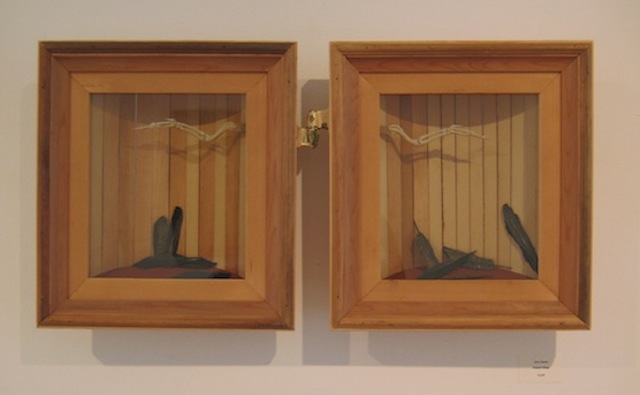
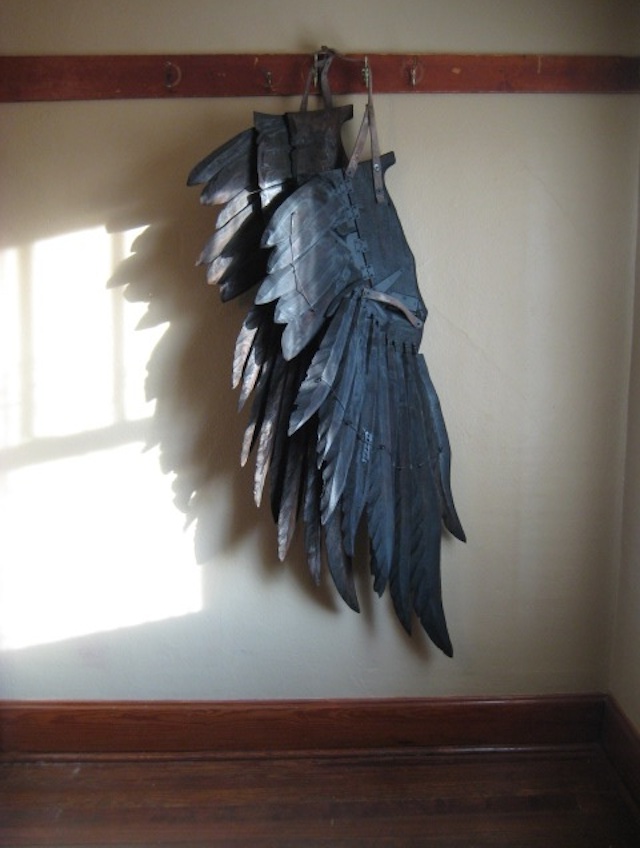
wings, mixed media, 60_h, 2014

wings, mixed media, 60_h, 2014

How has your work changed in the past five years? How is it the same? 

My work is still all over the map.  I don’t see a common thread.  If you do, please send me a note!  But, at 50, I seem to have more confidence in the studio.  I seem to have more patience in exploring a technique, not necessarily an idea.  I have gotten quite ruthless at stopping midstream and dismissing an idea that is leading in the wrong direction.

How have people such as family, friends, writers, philosophers, other artists or even pop icons had an impact on the work you do?

Being around people who are completely engaged in what they are doing is inspiring. Seeing other artists’ work habits and feeling the energy of someone else’s workspace is great. But what really gets me going are found objects, objects taken out of context, raw materials, antiques and of course, music. All kinds. Almost.

Have you ever been pulled in the direction of a pursuit other than being an artist? What are your other interests? 

When I’m not working on art my creativity transfers into other things—making food, baking, antiquing, finding the right rock… I could stop “making art” and still feel somewhat fulfilled doing any number of things. That being said, the process of making art, when all things are going well, gives an amazing high unlike anything else.   

About

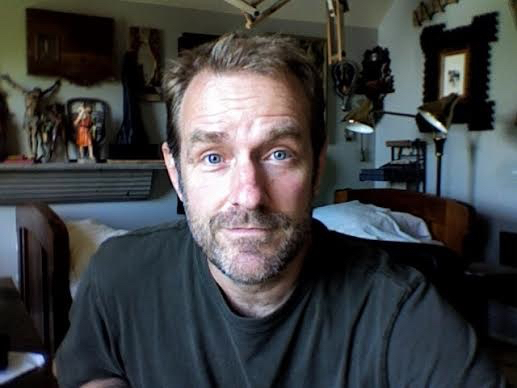
c. hewitt studio_selfieChris Hewitt is a sculptor who walks a fine line between art and function.   He  puts the viewer in a position of questioning the use or function or purpose of the object or installation.  And he’s not giving out any answers.Hewitt received his Masters degree from the University of MN, Minneapolis in 2002.  From there he developed an arts curriculum for the State of MN Correctional Facility in Faribault, MN where he taught for several years.  After returning to WI where he was raised, he worked as a lead artist at Conrad Schmitt Studios conserving, restoring and making new statuary, paintings and mosaics.  He is currently an artisan bakery at the Daily Baking Company in Port Washington, WI.Chris and his partner of 31 years live on a farm in rural WI.

www.hedgerowfarm-fredonia.com

All images copyright of the artist and used with their permission. 
Posted in mixed media, Sculpture | Tagged , , , , | Leave a comment

Kuh Del Rosario – Vancouver, BC, Canada

Tatlo 2015, mixed media, 8 x 6.5 x 13.5”

Tatlo, 2015, mixed media, 8 x 6.5 x 13.5”

Briefly describe the work you do.

My work is about where I came from, where I am now and where I want to be. I think about the malleability of memory and its role in fantasy and reality. I think about what it means to be here at this time; all the unseen things that connect me to nature, and all the things I can see that does not. What I have chosen as truth over memories, are materials and objects that stay constant as memories change and fade.Even materials that have been transformed and weathered by time, reveals more than the secrets they are capable of keeping. The materials I use are selected for texture, colour and pliability; some carry significant meaning while others have lost its value. Through the process, they are all leveled out to form new objects that sit in the middle of understanding.

Tell us about your background and how that has had an influence on your work and on you as an artist.

Philippines have always haunted my memories. It is a country full of contradic- tions and every thing seems to be fighting to live and destroy. It is hot, sticky and teaming with all sorts of life both beautiful and grotesque. The cycle of life in both inanimate and living things is fast and enduring.I was born in Manila and spent my first years there. The collection of memories from that time has been my barometer for colour and texturally exciting.

The concept of the artist studio has a broad range of meanings in contempo- rary practice. Artists may spend much of their time in the actual studio, or they may spend very little time in it. Tell us about your individual studio practice and how it differs from or is the same as traditional notions of “being in the studio.”

I’ve had many different types of studios and have moved due to outside factors that usually have nothing to do with what’s happening in the studio. This con- sistent instability of space, have changed the meaning of studio from a physical space to a state of mind. To be in the studio is to be in the mind frame of making, the process of making or in the mode to act on inspiration.

Underground People 2015, mixed media, 10 x 8 x 20”

Underground People, 2015, mixed media, 10 x 8 x 20”

What roles do you find yourself playing that you may not have envisioned yourself in when you first started making art?

Because an art career is so elusive and not easily definable, I was never really
sure of what I was getting into. I did not have a mentor or someone that gave me insight to the long road ahead. I just knew that I wanted to make things with my hands and express ideas through tangible forms. However I can say that I would never have predicted that being an artist which is by nature a solitary occupation, would take me out of my shell and get me comfortable with being uncomfortable.

When do you find is the best time to make art? Do you set aside a specific time everyday or do you have to work whenever time allows?

I have set days dedicated to art and if I get up early enough, I start the day with a thirty minute run to clear my head. This sets the tone of the day to one of produc- tivity and positive intentions. In the evenings or weekends, I set aside time to do adminstrative work that is the hidden side of art.

North Node 2014, mixed media, 13 x 16 x 15”

North Node,  mixed media, 13 x 16 x 15”, 2014

How has your work changed in the past five years? How is it the same?

The last five years have been so fruitful and it leaves me wanting more. The pro- verbial fire has been lit and I am excited about where my work is heading. I am more confident than ever before and the unknown scares me far less than it did before.

How have people such as family, friends, writers, philosophers, other artists or even pop icons had an impact on the work you do?

My work is a regurgitation of everything I take in with intention as well as the stuff that makes its’ way subconsciously. Perhaps it shows in a big way and others ap- pear as a speck on the surface of my work. I embrace all these things and I trust the filter I’ve developed during my lifetime.

Have you ever been pulled in the direction of a pursuit other than being an artist? What are your other interests?

I have recently began to run, I am an emotional home cook which means I make great meals when I am happy, I have always been interested in sartorial styling, feminist issues and other just causes, but I can do all these things and more as an artist. All the possibles end with art.

About

03.ArtistInStudio.KuhDelRosarioKuh Del Rosario is a visual artist currently based in Vancouver, BC Canada. She graduated with a BFA in Painting at the Alberta College of Arts in Calgary, AB Canada. Born in Manila, Philippines, she immigrated at an early age to Canada, signifying a personal event that has inspired her practice profoundly.

Del Rosario was involved in the administration and management of Dynamo Arts Association, an artist run studio and project space. In conjunction, she was part of a curatorial team, SHIP based out of the Dynamo project space.

Del Rosario has exhibited across Canada in solo and group shows. Her past work includes installation, painting, video and performance, distilled from her mainly sculptural art practice.

Most recently, she joined the arts collective WAEV, consisting of a small group of artists and designers based in Vancouver. Currently, Del Rosario’s work can be viewed at the Kit & Ace shop as the featured artist (May-July 2015). In October 2015, Del Rosario will be participating in the Tokyo Design Fair with the WAEV collective.

06.Sketchbook.KuhDelRosario

kuhdelrosario.com

All images copyright of the artist and used with their permission.  

Posted in Sculpture, Uncategorized | Tagged , , , , | Leave a comment

Chenhung Chen – Los Angeles, California


 Entelechy #1, Copper wire & found object, 20"x12"x7", 2010


Entelechy #1, Copper wire & found object, 20″x12″x7″, 2010

Briefly describe the work you do. 

In my work I focus on line, always recognizing its presence within drawing, Chinese calligraphy and painting, and American Abstract Expressionism. I make sculpture/installations, which are composed of recycled materials including copper wire, electrical wire and components, and some found objects. My work is about harmony and dissonance, peace and chaos, the subtle and the powerful as well as the driving force for inner fulfillment, balance, and the experience of inner power.

Tell us about your background and how that has had an influence on your work and on you as an artist.

I was born in Beigang, Taiwan graduating from the Chinese Cultural University. I continued my post-graduate education at the School of Visual Arts in New York City where I graduated with a Master of Fine Arts degree. I have traveled the world spending time in India, Malaysia, Australia, Thailand, North Eastern China as well as Beijing, and Rome, as a volunteer for a non-profit organization working for global peace. I am rooted in the understanding of the universal nature of the human being. Inside we are all the same and we are magnificent. This understanding colors all my work and has led me to try to express what that means to me and how it feels to be one of those Human Beings.

The concept of the artist studio has a broad range of meanings in contemporary practice. Artists may spend much of their time in the actual studio, or they may spend very little time in it. Tell us about your individual studio practice and how it differs from or is the same as traditional notions of “being in the studio.”

I spend a lot of time in my studio. I just moved to the Brewery Artist loft because I need more space for what I am working on. My understanding of myself as an artist in the studio is this: I am a studio rat. I want to spend all my time in my studio! This is why I downsized my life to make this journey, selling it all to move into the space I am in now.

Entelechy #9, Electrical wire, components & Erhu bow, 9'x5'x5', 2013

Entelechy #9, Electrical wire, components & Erhu bow, 9’x5’x5′, 2013

What roles do you find yourself playing that you may not have envisioned yourself in when you first started making art?

I first started making art for self-fulfillment and self-expression and did not expect to have a career as an artist. But when nothing felt right if I wasn’t working on my stuff, when even my husband pointed out that I wasn’t happy, that I was just dragging myself through this life, I realized that this wasn’t really a matter of deciding to enjoy whatever and it would be OK. I am an artist. I have no choice.

When do you find is the best time to make art? Do you set aside a specific time everyday or do you have to work whenever time allows?

This is going to sound mystical. But, I let it come to me and in the process I discover the art. That’s why it takes so long sometimes. I work when the inspiration gets a hold of me. I started the Entelechy series in 2010 and it is still going on. I find inspiration from meditation, Nature and life experience.

Entelechy #10, Electrical wire & components, 9'x4'x5', 2013

Entelechy #10, Electrical wire & components, 9’x4’x5′, 2013

How has your work changed in the past five years? How is it the same?

I have been working on the Entelechy series on and off for five years. Sometimes I side track into mixed media drawings, which go hand in hand with the sculpture/installations. They are all the small pieces of a big pie because I choose the linear elements in various materials and merge them in my work to express the flow of power and strength reaching towards a cohesive whole. To me, when I group materials together, such as “electrical wire, plastic casing and components”, “paper, paper clips and staples”, they have to either make sense in terms of objects’ function or contrast in a mind boggling way.

How have people such as family, friends, writers, philosophers, other artists or even pop icons had an impact on the work you do?

They all have an impact on my work, because my friends, family and certain philosophers and sages influence and impact my life. My work is rooted in my life experience. However, I am especially influenced by the writings of the Chinese philosopher Lao Tzu.

Have you ever been pulled in the direction of a pursuit other than being an artist? What are your other interests?

I enjoy spending quiet time with myself exploring the inner world. I also enjoy travelling, cooking, gardening and spending time with my outrageous family.

About

Chenhung_ChenChenhung Chen is an artist living and working in Los Angeles. She was born in Beigang, Taiwan graduating from the Chinese Cultural University. She continued her post-graduate education at the School of Visual Arts in New York City where she graduated with a Master of Fine Arts degree. She has traveled the world spending time in India, Malaysia, Australia, Thailand, North Eastern China as well as Beijing, and Rome, as a volunteer for a non-profit organization working for global peace. Her work has been shown internationally.

Entelechy #9 detail

Entelechy #9 detail

chenhungchen.com

All images copyright of the artist and used with their permission. 


Posted in Installation, Sculpture, Uncategorized | Tagged , , , , | Leave a comment

Michael Weigman – Columbus, Ohio

Title: Prepare The Ground II (Tamer ov Hedges) Medium: Lithography Size: 25"x18" Year: 2012

Title: Prepare The Ground II (Tamer ov Hedges)
Medium: Lithography
Size: 25″x18″
Year: 2012

Briefly describe the work you do. 

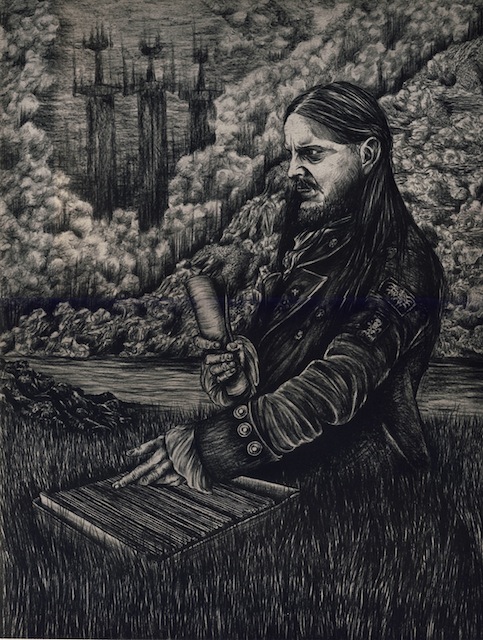
My work explores fascinations with the underground subcultures of heavy metal music and my personal history of growing up in the northwest suburbs of Ohio. These two disparate sources clash within my work, creating an abstract personal mythology. I use printmaking as my main medium, but I see myself more as a draftsman, using drawing as the common thread throughout my work.

Tell us about your background and how that has had an influence on your work and on you as an artist.

Most of my work utilizes imagery from my youth, my teenage years to be more direct. This was the period in my life (like many others) where I began to build an abstract role for myself, trying to separate from my average suburban community. I gravitated to dark subcultures found in the metal genre, which is a bizarre yet common escapism to most people interested in the music.

Despite this urge to separate as a youth, I still have a respect and fondness of my upbringing, which shows in my work. This is most visible in my “Prepare the Ground” series of lithographs, where I use the physique and attires of father figures, and mesh them together with black metal power stances from early promo photos of bands like Darkthrone, Emperor, Hellhammer, and Immortal.

Title: Fenriz/Adams Medium: Intaglio Size: Image Size 16"x12" Paper Size 22"x16" Year: 2014

Title: Fenriz/Adams
Medium: Intaglio
Size: Image Size 16″x12″ Paper Size 22″x16″
Year: 2014

The concept of the artist studio has a broad range of meanings in contemporary practice. Artists may spend much of their time in the actual studio, or they may spend very little time in it. Tell us about your individual studio practice and how it differs from or is the same as traditional notions of “being in the studio.”

My studio practice shifts from week to week. Generally everything I make starts up in my attic, where I’ve created a studio for general scheming and drawing. I sketch up there just about every day and post everything on the wall, checking weekly to see if anything stands out. If I come across and image that fascinates me, I usually begin the process of elevating it into a print. I’m fortunate to have access to a printmaking studio, so after an idea is worked up I spend most of my studio time there, until the print is completed.

I spend a lot of time outside of the studio environment studying metal culture as well. I frequently check out heavy metal blogs like Cvlt Nation and Metal Injection to gather inspiration. It’s sad to say, but I think I spend more of my time looking for obscure metal acts than I do artists. The culture of metal is very image focused, and has different representations in different subcultures in its community. It also has connections to paganism and other mythologies that come up in my work as well. This gives me a great deal of information that I can plug into the suburban elements, which creates the strange results I’m looking for.

What roles do you find yourself playing that you may not have envisioned yourself in when you first started making art?

The show and group organizing I have done outside of my studio time. It’s a major part of my practice now, and something I feel that allows me to make my own opportunities, which I feel is vital for artists today. While I still teach art at universities in the Columbus area, I spend a great deal of time outside of academia with my print group titled Flood Wall Press, working as a principal contributor for a publication titled Keith Ledger, and helping to organize art events in the Columbus area. I have a lot of hats now, but I wouldn’t have it any other way. I take great pride in not just getting myself exposure, but helping others out who I think are doing some cool stuff.

When do you find is the best time to make art? Do you set aside a specific time everyday or do you have to work whenever time allows?

It’s more difficult than it used to be, but over the past few years I’ve become much more flexible when it comes to time management. Making work is a pleasure for me, so any point and time during the week that I can put in a shift in the studio, I’m on it.

One thing that’s a bit more difficult is figuring out what’s next in my “fine art” practice. I try to sketch and research as much as possible, as I mentioned, but it sometimes can take weeks before I settle on an idea. My freelance work for bands on the other hand is a much quicker process, since it’s directly influenced by their work. I feel the commercial work helps my fine art practice evolve, plus they connect to each other with heavy music as the common thread

Title: Putrefaction Medium: Lithography Size: 11"x24" Year: 2015

Title: Putrefaction
Medium: Lithography
Size: 11″x24″
Year: 2015

How has your work changed in the past five years? How is it the same?

I feel it’s gotten stranger. For years I held back a lot of ideas, trying to fit an academic aesthetic I guess. This all changed once I had to create my first solo show. I began shooting from the hip, caring less about how my vision may be perceived, which I feel is the best way to create your voice. It also gave me a kind of relentless approach to what I was making, which fits right into that heavy metal aesthetic, or the true kvlt aesthetic as I like to call it.

How have people such as family, friends, writers, philosophers, other artists or even pop icons had an impact on the work you do?

As far as visual artists goes, my direct influences would have to be Sue Coe, Otto Dix, Francisco Goya, William Kentridge, and Steven Shearer. These artists I feel represent my visual foundation. I’m really into work that has a visceral approach; I want the hand to be very apparent.

Obviously heavy metal is a huge influence for me both sonically and visually, but one figure from the scene that I feel is most visible in my work is Fenriz from the Norwegian black metal band Darkthrone. I find some similarities to myself within his personality, yet he’s a bit more chaotic; still, that connection I feel is what draws me. He’s also considered a tastemaker when it comes to the heavy metal genre as a whole, so I guess you could say I’m one of his disciples. I’m sure he would hate that.

Have you ever been pulled in the direction of a pursuit other than being an artist? What are your other interests? 

My music interests have me constantly considering starting a band. I haven’t played in a group since college, so I’m pretty removed from it, though I still play guitar and write music as a part of my studio breaks. The hardest thing for me is finding time to play with a group, or get one together much less, but honestly I don’t really push for it that much. I would on the other hand like to fit some more sonic elements into my work the future.

About

Artist PhotoMichael is currently living in Columbus Ohio. He received his Bachelors of Fine Arts from Bowling Green State University in 2009, and his Master of Fine Arts from Northern Illinois University in 2013, with a focus in printmaking. His artwork studies Heavy Metal Culture and its relevance to his upbringing in the suburban Midwest. He has shown his work both nationally and internationally, and he currently organizes shows in the Columbus area and teaches fine art at the college level. He is one of the founders of the print group entitled Flood Wall Press and is a principal contributor for the artist publication, Keith Ledger.

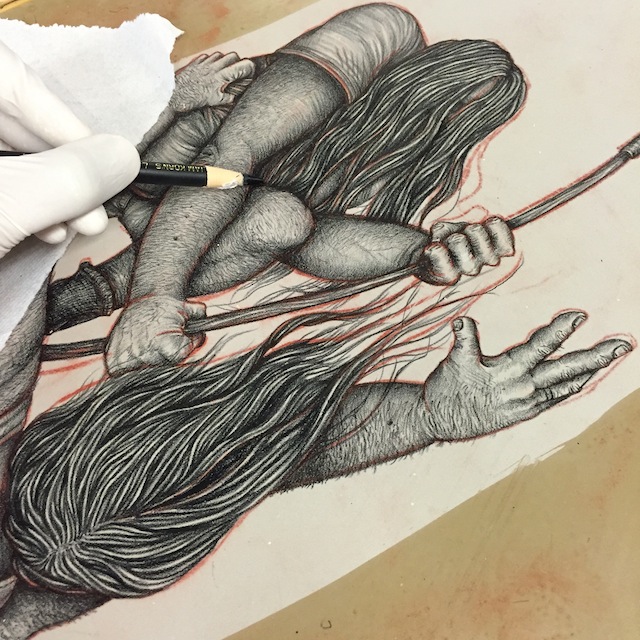
In Progress Photo

michaelweigman.com

All images copyright of the artist and used with their permission. 

Posted in Drawing, Printmaking | Tagged , , , , | 1 Comment

Katie Westmoreland – Astoria, New York

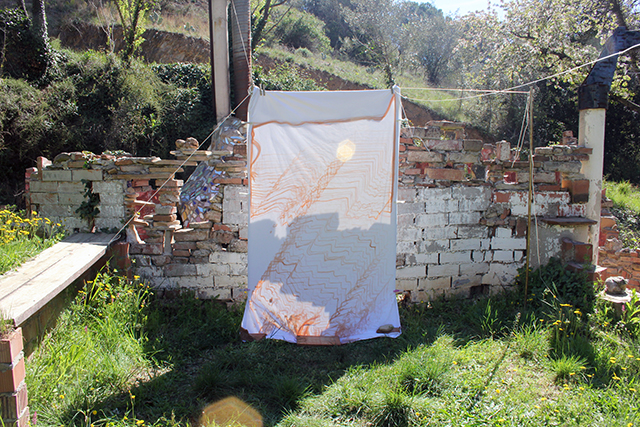
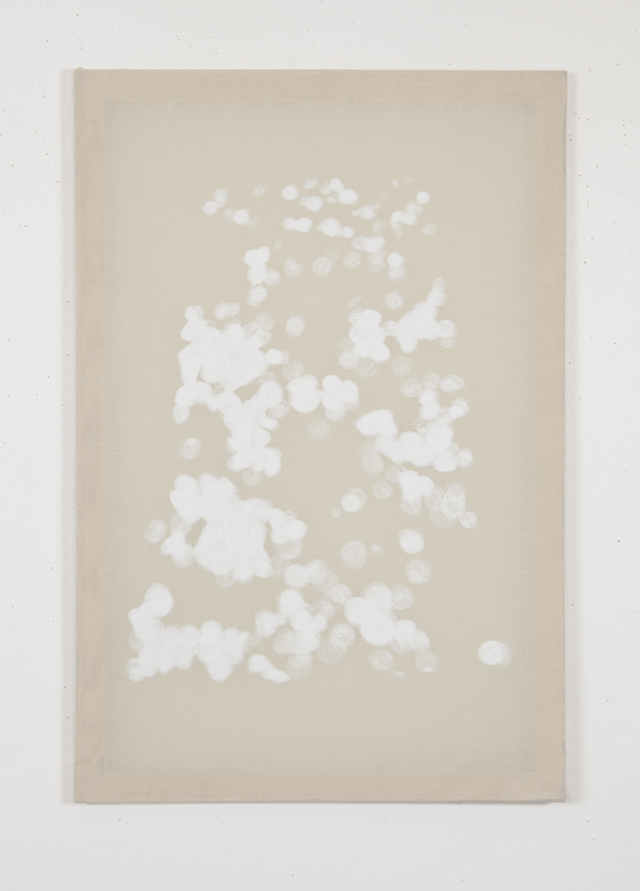
Can Serrat Light Collection clay dye on a bedsheet 81 x 48 inches 2015

Can Serrat Light Collection
clay dye on a bedsheet
81 x 48 inches
2015

Briefly describe the work you do.

I transcribe the passage of light as it sifts through windows, curtains, found objects, architecture, and landscape.   From the initial experience of viewing filtered light, I consider elements of the visual and sensorial experience such as ambient visual temperature, materials involved in the filtration system, and the geographical, contextual, and cultural aspects of place.  These considerations inform the way in which I make each artwork.  The methods of creation vary greatly between each piece; however, foundations of painting and analogue photography influence the way in which each filtered light situation is handled.  

Tell us about your background and how that has had an influence on your work and on you as an artist.

I grew up in a family that nurtures creativity.  Both my grandmothers and my mother are talented quilters  and seamstresses.   A major component of my father’s profession is mapmaking.  As a child, I was encouraged and free to make up “recipes” in the kitchen, spend endless hours sewing and crafting, and given every opportunity to explore and learn.  I inherited a ridiculously strong will and independent streak that I credit for contributing to my interest in art-as-career.  

The concept of the artist studio has a broad range of meanings in contemporary practice. Artists may spend much of their time in the actual studio, or they may spend very little time in it. Tell us about your individual studio practice and how it differs from or is the same as traditional notions of “being in the studio.”

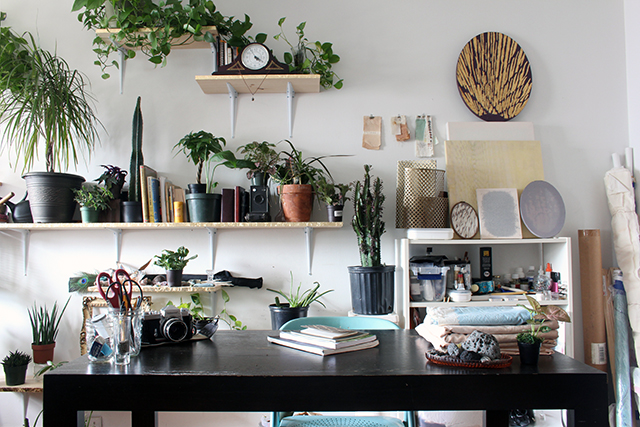
I have a few studio spaces.  My primary studio space is in my home and occupies one third of my bedroom and a balcony and regularly expands into the kitchen, bathroom and living room.  I consider this space to be my “think box” where I prepare natural dyes on the stove, wash out paintings in the shower, contemplate my work and build components on the balcony, contemplate “sketches” that exist for me in the form of photographs and lists of thoughts and dye samples, and study work in progress.   My secondary studio space is on the streets of New York, wandering along the hiking trails in Cold Spring, on the mountain of Montserrat.  It is comprised of the ever-evolving list places in which my inspiration, challenges, and questions are sourced and these locations in which my work is made.  The final, and often most crucial, studio space is the intellectual and spiritual place I enter into when running.  On long distance runs, I find a special and strange kind of enlivened calm in which I can ask new questions of my work and come to resolutions for issues within the work.  

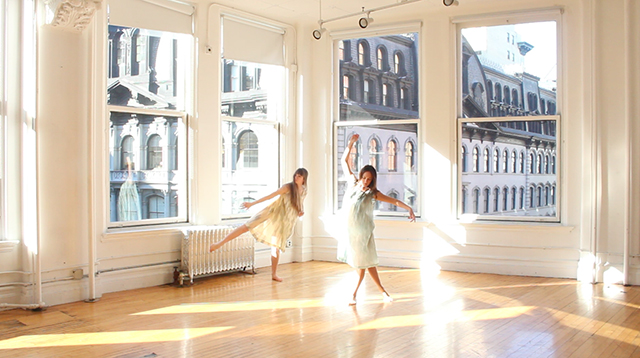
Film Still from Painting Dresses  //  Dress Paintings: Movement Sequence  choreography and dance improvised by Paulette Lewis and Elise Ritzel dresses made and movement prompts given by Katie Westmoreland  filmed at Gibney Dance Studios in Union Square 2015

Film Still from Painting Dresses // Dress Paintings: Movement Sequence
choreography and dance improvised by Paulette Lewis and Elise Ritzel
dresses made and movement prompts given by Katie Westmoreland
filmed at Gibney Dance Studios in Union Square
2015

What roles do you find yourself playing that you may not have envisioned yourself in when you first started making art.

An insatiable desire to do everything and know everything and constantly learn drew me to art.  If I envisioned any role, it was a blurry amalgamation of all roles, or at least the freedom and compulsion to explore and know as many roles as possible.  

When do you find is the best time to make art? Do you set aside a specific time everyday or do you have to work whenever time allows?

Each piece or project has situational light requirements that determine when I work.   My daily habits, living patterns, and environment form the conditions in which I find the intriguing light situations for my work.  The time that I have available and spend to make art is constantly changing and is often determined by a tricky dance between daily life and light requirements for the project.  I find early mornings and late nights to be the most magical times, but sometimes nothing is more powerful than the sun at noon.  Weather is a major factor in when I work and the nature of work made, as it immensely affects the light filtration patterns.  When I work on a piece outside, I spend a great amount of time studying the clouds – the size and shape, pattern and density of distribution, as well as the speed and direction of movement.  

If It Could Play The Piano, It Would Really Play (Central Park Dapple) chalk, cotton fabric on stretcher bars 24 x 36 inches 2012

If It Could Play The Piano, It Would Really Play (Central Park Dapple)
chalk, cotton fabric on stretcher bars
24 x 36 inches
2012

How has your work changed in the past five years? How is it the same?

Over the past five years, my work has evolved greatly.  In 2010, I was in my second of three and a half years at The University of Texas, Austin.  I have spent the past three years exploring life as an artist in New York City, and my work has struggled and grown through that exploration.  When I moved to New York, I was making light-based work on semi-transparent, tinted, cotton/linen fabric stretched on wooden supports.  While I continue to make somewhat traditionally structured paintings, I also make temporary, site specific pieces and collaborate with dancers to explore light filtration narratives through body and space.  

How have people such as family, friends, writers, philosophers, other artists or even pop icons had an impact on the work you do?

I am thankful to be surrounded by wonderfully creative and intellectually challenging friends and artists.  I derive a great amount of inspiration not only from fellow visual artists, but also from the chefs, mixologists, horticulturists and dancers who I’m honored to have as dear friends.  Art takes many forms — I’m presented with guidance and new questions, sometimes from the least expected places and people.  I glean structural and compositional influence from literature I read.  I gravitate towards cerebral, experimental, poetic fiction, but my bookshelf is also filled with art theory writings as well as reference books about sewing, running, and plants.  

Have you ever been pulled in the direction of a pursuit other than being an artist? What are your other interests?

Any tangential hobbies and professional interests have somehow always been or become integral components of my art making.  My obsession with tea and my day job as the manager of a tea parlor in the West Village, when I first moved to New York, provided the material inspiration for the “City Lights” pieces and prompted an exploration of natural dyes.  I frequently happen upon dynamic light circumstances when I am going on long runs through my neighborhood and hiking through the mountains.  I have dreams of becoming a chemist, a meteorologist, and a cartographer, and I intend for all of those things to happen via my art practice.  

About

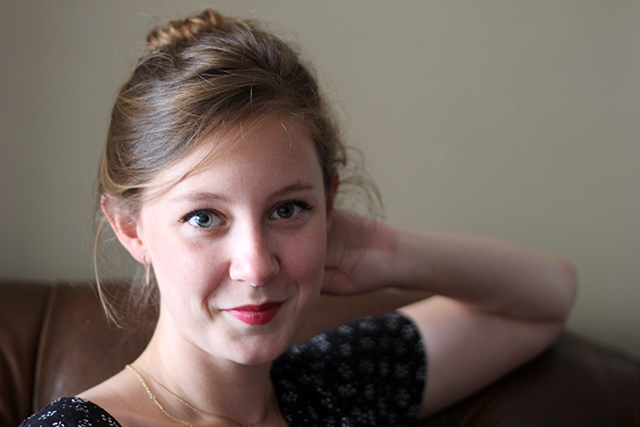
KatieWestmoreland_HeadshotKatie Westmoreland’s light-based work began in Austin, Texas, where the skies are expansive and the sun shines for long hours.  She earned a Bachelor of Fine Arts in Studio Art from The University of Texas, Austin and attended Columbia University’s Advance Summer Painting Intensive in 2012.  When she moved to New York City in 2013, her studio practice evolved in response to a completely different quality of light.  As she began to explore all the expansive hiking trails New York State offers, her paintings expanded from stretched cotton hung on walls to rock facades and boulders.  An interest in temporality, a desire to integrate art works deeper into daily life, and a fascination with the interplay of and distinctions between beauty in nature and urban forms became primary concerns of her practice.  Katie currently lives and works in Astoria, Queens and spent Spring 2015 studying the light and hiking in El Bruc, Catalunya, in Spain for a residency at Can Serrat.

KatieWestmoreland_Studio

katiemwestmoreland.com

All images copyright of the artist and used with their permission. 

Posted in Painting, Performance | Tagged , , , , | 2 Comments

Osvaldo Cibils -Trento, Italia

PaesaggioZoomIn3: videostill paesaggio zoom in 3. osvaldo cibils and subtle parallelepiped. Montevideo, Uruguay. May 2015.

videostill paesaggio zoom in 3. osvaldo cibils and subtle parallelepiped. Montevideo, Uruguay. May 2015.

Briefly describe the work you do.

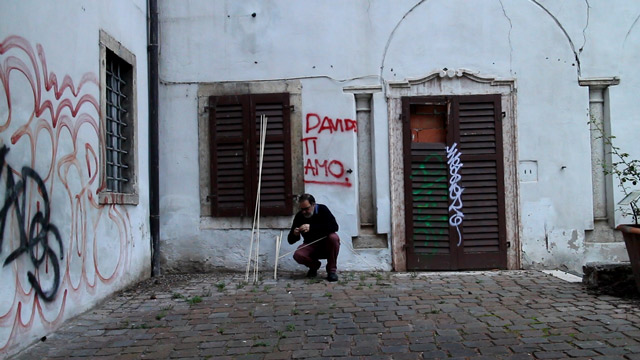
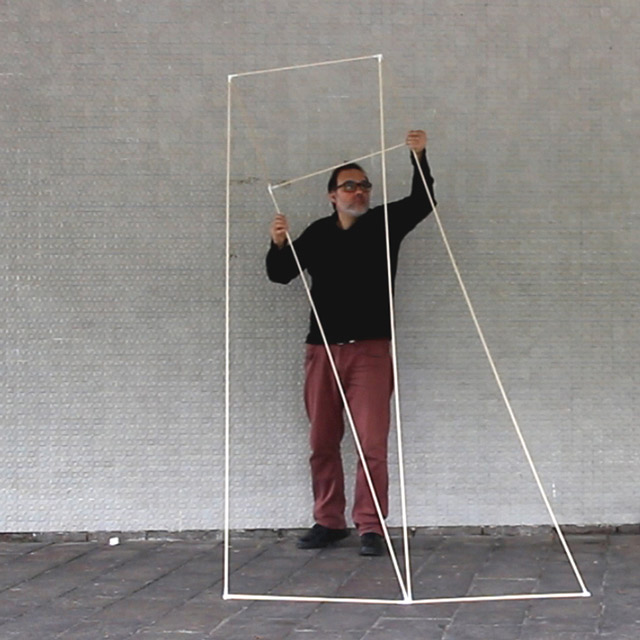
My last artwork paesaggio zoom in 3 is a videoart with the systematized edition of twenty performances, with a subtle parallelepiped, realized in different places in the cities of Trento, Italia, and Montevideo, Uruguay, during the month of May 2015. Reciprocal exhibitions Sala Thun and EAC.

Web project http://paesaggiozoomin3.osvaldocibils.com/

Tell us about your background and how that has had an influence on your work and on you as an artist.

In the first version of paesaggio zoom in 1 I emphasized my artwork with a lot of aesthetic content for six hours, making and unmaking, in a performance on the street.

Thus, in this event, the parallelepiped, built with wooden slats thicker, served to support a three-dimensional collage with drawings, paintings, digital prints, objects, soundart, videoart and several tools of assistance.

In the second version of paesaggio zoom in 2 I make my solo performance in a secluded place and check that the parallelepiped is able to confront the landscape with river and a bridge heavy color.

In this event, I leave the scene and the parallelepiped becomes the absolute protagonist.

Web project http://osvaldocibils.com/paesaggiozoomin/paesaggiozoomin.html

videostill paesaggio zoom in 3. osvaldo cibils and subtle parallelepiped. Trento, Italia. May 2015.

videostill paesaggio zoom in 3. osvaldo cibils and subtle parallelepiped. Trento, Italia. May 2015.

The concept of the artist studio has a broad range of meanings in contemporary practice. Artists may spend much of their time in the actual studio, or they may spend very little time in it. Tell us about your individual studio practice and how it differs from or is the same as traditional notions of “being in the studio.”

paesaggio zoom in 3 is an artwork that has been realized on the streets of the cities of Trento and Montevideo and on a laptop with a video edition software.

The artist studio is not a primary need, but an empty table with roof is always very useful for developing an artwork.

What roles do you find yourself playing that you may not have envisioned yourself in when you first started making art?

Through the videoart paesaggio zoom in 3 I managed to be in two places at once, almost the same time and doing the same thing over and over again, concentrated only in the materials and in my action.

When do you find is the best time to make art? Do you set aside a specific time everyday or do you have to work whenever time allows?

To reach the fair idea of paesaggio zoom in 3 I spent six months with the project that was spinning in my head continuously. Finally, find the right places and to make the twenty performances, record and edit the videoart paesaggio zoom in 3 it took me the whole month of May 2015, between seven and ten hours per day.

videostill paesaggio zoom in 3. osvaldo cibils and subtle parallelepiped. Trento, Italia. May 2015.

videostill paesaggio zoom in 3. osvaldo cibils and subtle parallelepiped. Trento, Italia. May 2015.

How has your work changed in the past five years? How is it the same?

Today I’m interested in the idea of concentration on a certain action, I try to make a clear demonstration that, in a performance or making another type of artwork, the artist is doing that and only that, nothing else.

In this sense, the only themes for the realization of my artwork are the materials I use, the date and myself (this “myself” may be my son, my daughter, my wife or an admired friend artists).

My statement is:

During the realization of my artworks I limit myself to a few movements, repeated, with little variations: the hands neutralizing the materials, the eye straight in the action, the breathing contained and brief, the head rigid and the thoughts compressed based on my artistic logic.”

How have people such as family, friends, writers, philosophers, other artists or even pop icons had an impact on the work you do?

Great inspiration for me are: my son (break dancer) and my wife and my daughter (architects). Also, since 2009 I like some artists that upload or created your artworks in internet or in social networks.

Have you ever been pulled in the direction of a pursuit other than being an artist? What are your other interests?

No, I never wanted to make another activity. Since 1961 the word ARTE includes me absolutely.

The only thing I’ve always wanted to do is: to obtain a result through my artwork and exhibit such result. The result of an artwork has to be notable, certainly intelligent and imperceptibly useful. An artwork exhibited in these conditions allows to comprehend all the rest.

About

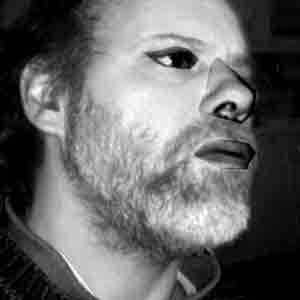
headshot_osvaldocibilsOsvaldo Cibils. 1961. Artist born in Montevideo, Uruguay. He lives in Trento, Italia. His artworks are oriented to drawing, sound art, video art and the development of experimental ideas mainly.

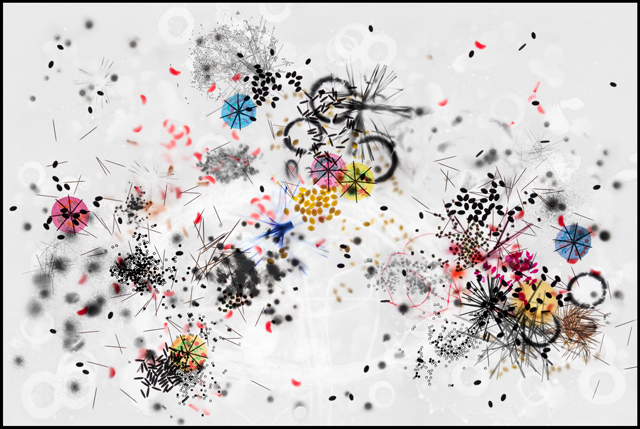
videostill (detail) paesaggio zoom in 3. osvaldo cibils and subtle parallelepiped. Trento, Italia. May 2015.

videostill (detail) paesaggio zoom in 3. osvaldo cibils and subtle parallelepiped. Trento, Italia. May 2015.

osvaldocibils.com

All images copyright of the artist and used with their permission. 


Posted in Video | Tagged , , , , | Leave a comment