Liisa Ahlfors – Tampere, Finland

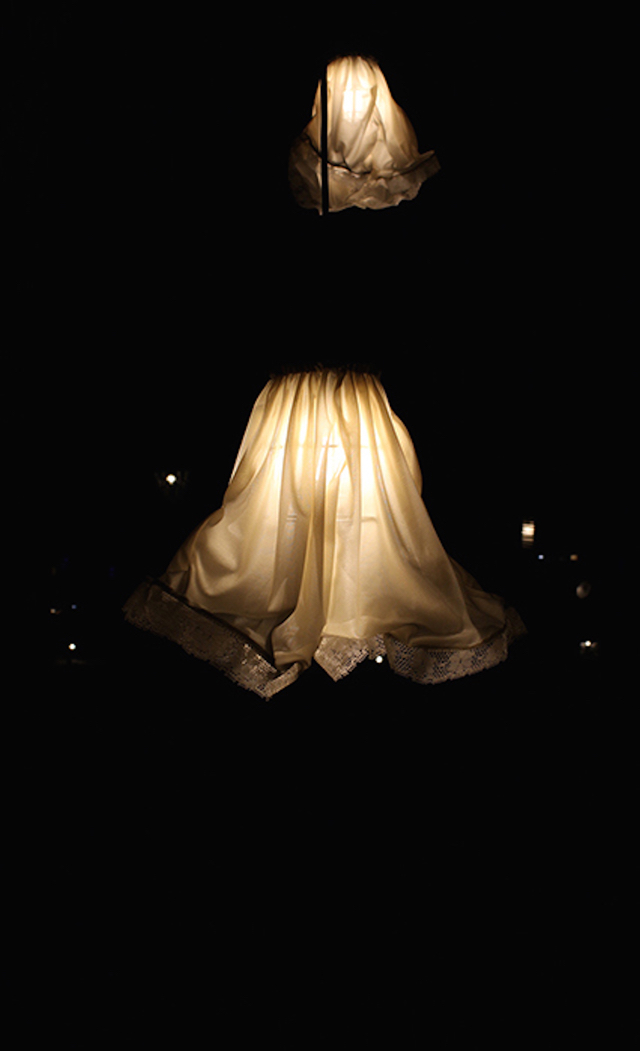
Unmentionables, found objects; second hand female under garment, lights, 25 x 30 cm each, 2015

Unmentionables, found objects; second hand female under garment, lights, 25 x 30 cm each, 2015

Briefly describe the work you do. 

My work responds to specific objects, particular sites or situations, and specific contexts. Due to this my artistic practice has naturally developed as multidisciplinary and the work may take form of an action, installation, assemblage etc, the space of representation controlling the final visual outcome. I often use mundane materials from everyday live, as I am eager to see beyond the surface of structured reality – thus deconstruction in one way or another usually takes place in my work. 

Tell us about your background and how that has had an influence on your work and on you as an artist.

I have graduated from the Master of Arts programme of Environmental Art from Aalto University, Helsinki, Finland. Prior to this, I did my BA in Fine Arts in an interdisciplinary programme. Though I have studied traditional techniques of art making such as drawing, painting and sculpture, I have never mastered any of these. Instead I have always been encouraged by teachers and professors not to be limited to one technique but let the concept control the material and technique of each work. I hardly use any materials or techniques associated as traditional art materials or techniques nor is the gallery space the only space of representation of my work but the space also varies depending on the concept of each work.
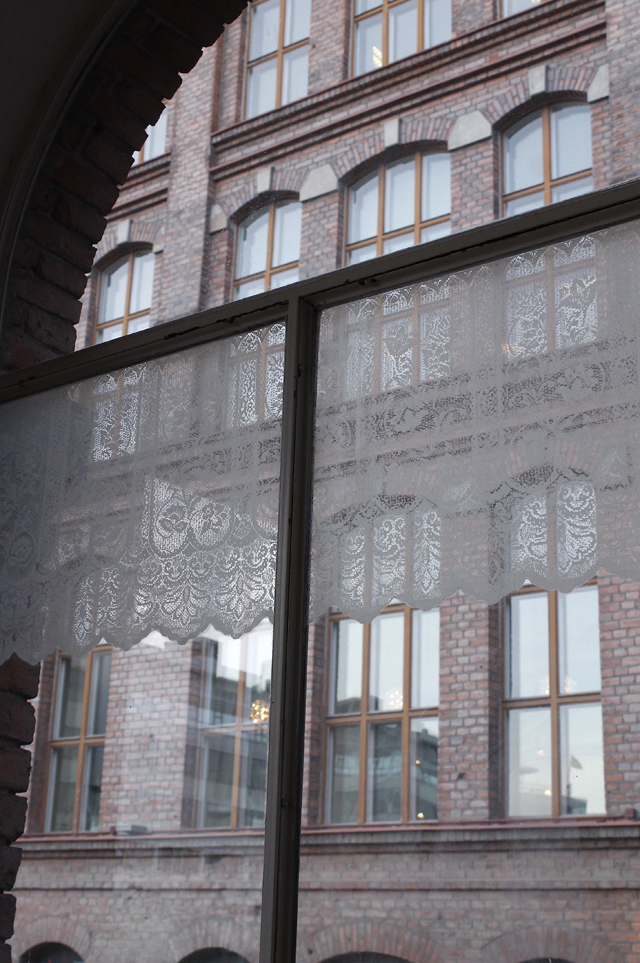
 Curtain, sour milk on window, 143 x 50, 2015

Curtain, sour milk on window, 143 x 50, 2015

The concept of the artist studio has a broad range of meanings in contemporary practice. Artists may spend much of their time in the actual studio, or they may spend very little time in it. Tell us about your individual studio practice and how it differs from or is the same as traditional notions of “being in the studio.”

In fact, I do not have a studio. My works are always conceived on site, so the environment, public space etc. is my studio. Creating ideas is more of a conceptual process for me, so I just  do my research at home. Once I have the conceptual framework for my work for an upcoming exhibition, I go on site and much of the material experiments happens only there. This can be quite stressful, since usually something unexpected comes along and my original idea does not work with the features of the space. Yet this is a situation I perpetually put myself into, as it seems to be what I enjoy most: it allows the space to surprise me and lose control of the final visual outcome. If everything goes as I have planned, I am quite unsatisfied in the end. On the other hand, to be able to make quick and drastic decisions in situ, the conceptual basis must be well constituted in order to make a solid piece of work. 

What roles do you find yourself playing that you may not have envisioned yourself in when you first started making art?

I now find the artist role not solely as an author of her own works, but as the author of the  system of practises of the art world as a whole.

When do you find is the best time to make art? Do you set aside a specific time everyday or do you have to work whenever time allows?

Due to the nature of my site-specific artistic practice I have very intense periods of working followed by periods best described as hibernation. Though my work has the conceptual side to it, the visual outcomes demand long and physically labour-tense working hours. After every project comes exhaustion that requires some time to recover. All in all, I do not have a distinctive line between work and leisure, nor do I follow any regular working hours. Most of my works have come to my mind as an image when I have been in an in-between state of asleep and awake when going to bed at night. So perhaps the best time for me to make art is the short moment before totally falling to sleep. 
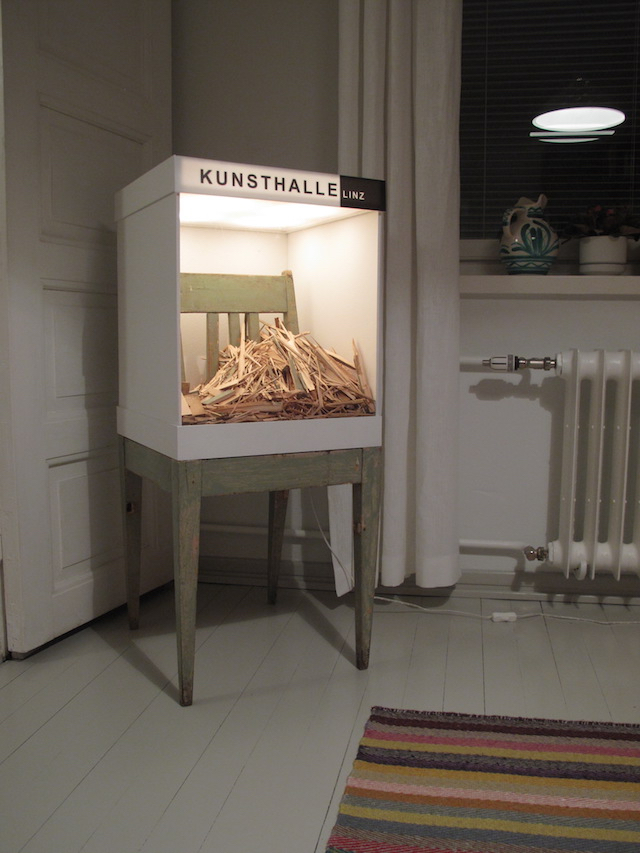
Siege, found object; a chair, 90/40 x 40 x 40 cm, 2015

Siege, found object; a chair, 90/40 x 40 x 40 cm, 2015

How has your work changed in the past five years? How is it the same?

I think there are similar kind of themes reoccurring throughout my work. However, theoretical studies in recent years have clarified my thoughts about art and my own practice and to my surprise, this has clarified also the form of my artworks and occurs as improved technical skills. I never thought that the stimulation of the mind with theory would conduct so straightforward to the hand and practise. 

How have people such as family, friends, writers, philosophers, other artists or even pop icons had an impact on the work you do?

Family and friends have a positive impact on my work with their enduring support. Discussions with people, on various subject matters and not merely on art, inspire me and give me a lot of ideas. Many of my close friends are artists, so it is interesting to see their development and talk about their views on art, as well as follow wider discourses that circuit in  contemporary art. Surely there is an attempt to response to these discourses and other artists work with my own, though not necessarily directly to one particular artist’s or philosopher’s work. 

Have you ever been pulled in the direction of a pursuit other than being an artist? What are your other interests? 

I recently picked up dancing again, which I used to do a lot when I was younger. I enjoy reading and literature is sort of a hobby for me, so being a dancer was a childhood dream and I hope to write a book some day. But for the time being, I cannot really vision myself doing anything else than art. I think that the field of visual arts so broad that basically anything can be explored within its framework. 

About
headshot_ahlforsLiisa Ahlfors (b. 1985) is a visual artist based in Tampere, Finland. She has graduated from MA programme of Environmental Art from Aalto University, Helsinki, Finland in 2015. Her work is site-specific and thus responds to each space, site or situation, and specific contexts individually without following a method of systematic production. Her work has been exhibited in her native country Finland, as well as in Europe and Northern America, most recently in group shows in Augusta Savage Gallery in Amherst, Massachusetts, United States of America, 6th Triennale of Pirkanmaa in Tampere, Finland, and Kilometre of Sculpture 2015 in Võru, Estonia. She has an upcoming solo show in January 2016 at Third Space, Helsinki, Finland.
studio_ahlfors

liisahlfors.com

All images copyright of the artist and used with their permission.  
Posted in Conceptual Art, Sculpture | Leave a comment

Kate Shannon – Columbus, Ohio

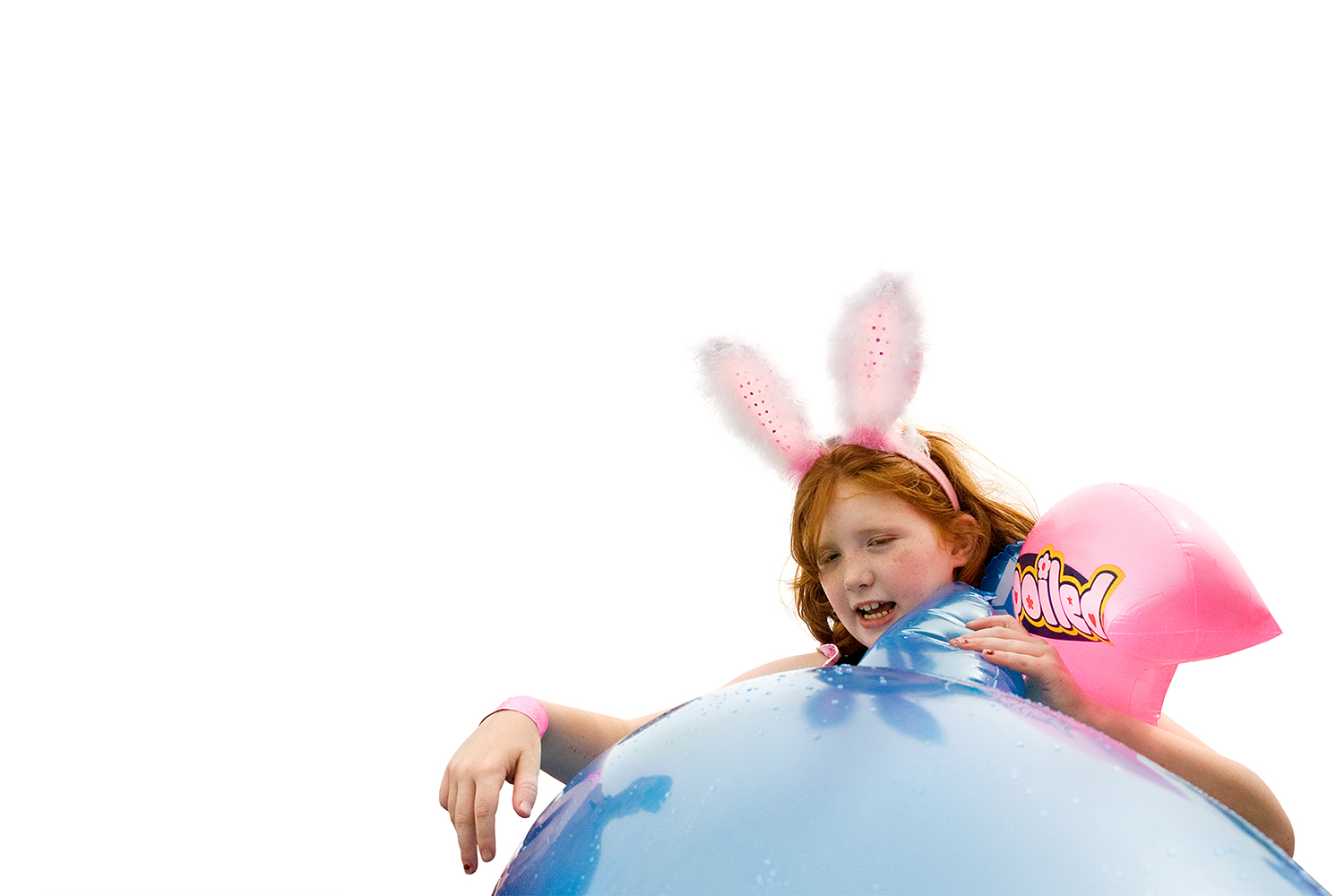
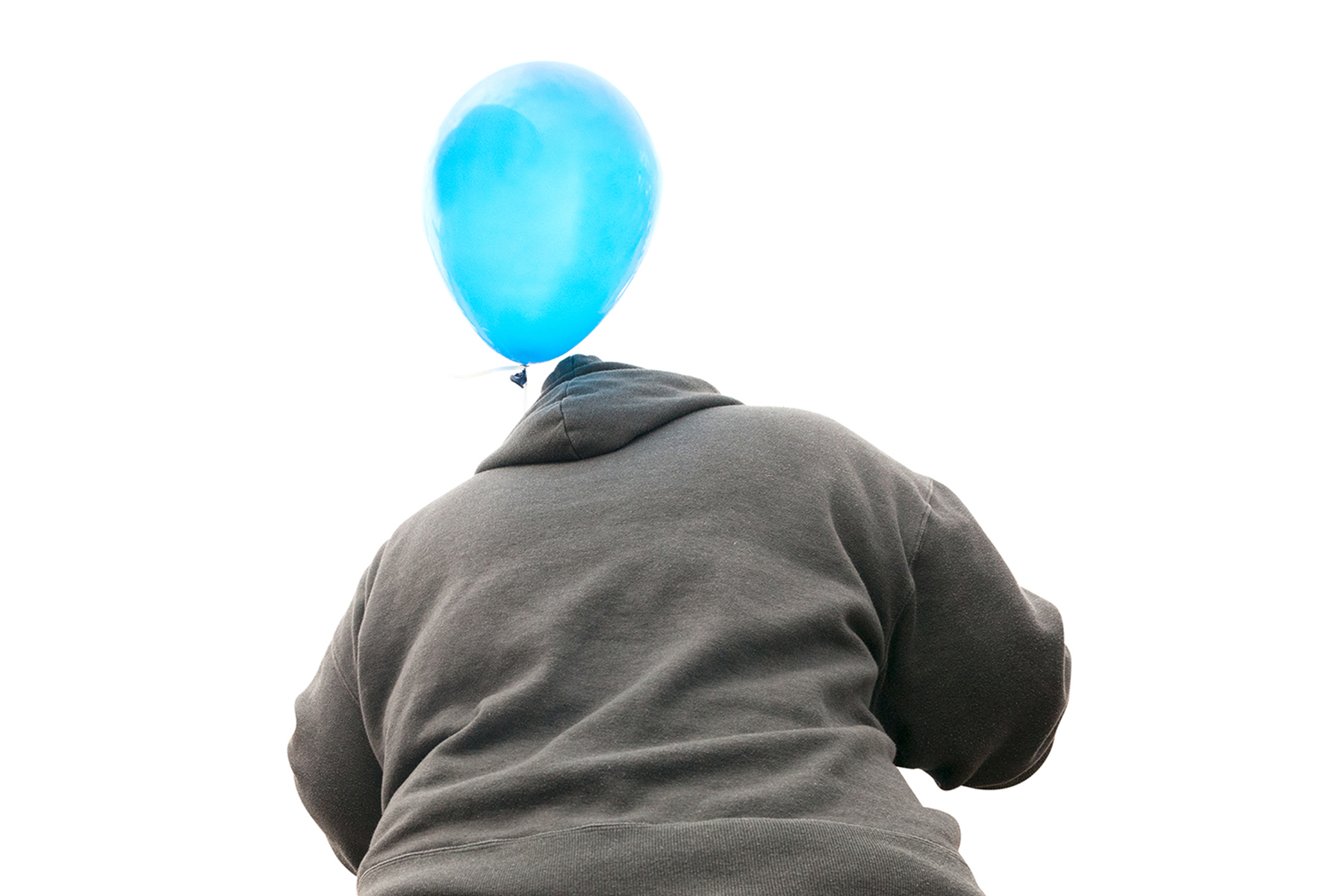
Untitled Images from Within the Happy Crowd, digital inkjet prints, 15” x 22”, 2010-ongoing (series)

Untitled Images from Within the Happy Crowd, digital inkjet prints, 15” x 22”, 2010-ongoing (series)

Briefly describe the work you do. 

At the center of my studio practice is an interest in the photographic image. I begin my visual projects by creating or appropriating digital photographs. Then I spend time in front of a computer screen meticulously eliminating, rearranging, or animating the tiny pixels that form these images. In this way, the photograph itself is not an end result but a foundation for further research, discovery, and invention.

For the past several years, I have been engaged in a project through which I examine one facet of American consumer cultureThe project involves images I create in environments where crowds gather to experience a series of happy moments, such as amusement parks or carnivals. By digitally removing the background elements from the original photographs, I visually isolate adults, teenagers, and children in transition between these moments. Although they gaze toward a prize to win, a thrill to experience, or a concession stand to visit, these individuals are stripped of their spectacular surroundings and become solitary subjects to contemplate.

Tell us about your background and how that has had an influence on your work and on you as an artist.

I grew up just south of Nashville in the city of Franklin, Tennessee.  My mother was a puppeteer, and she instilled in me an appreciation for the arts.  

Untitled Images from Within the Happy Crowd, digital inkjet prints, 15” x 22”, 2010-ongoing (series)

Untitled Images from Within the Happy Crowd, digital inkjet prints, 15” x 22”, 2010-ongoing (series)

The concept of the artist studio has a broad range of meanings in contemporary practice. Artists may spend much of their time in the actual studio, or they may spend very little time in it. Tell us about your individual studio practice and how it differs from or is the same as traditional notions of “being in the studio.”

My studio is my computer and it travels with me wherever I go.

What roles do you find yourself playing that you may not have envisioned yourself in when you first started making art?

As a college professor, I take on many roles.  In addition to making art, I teach, serve on committees, engage in community service projects, and help oversee an art gallery on our campus.  I did not envision taking on such roles when I first became involved in the arts, but these experiences have informed my visual work and enriched my life.

When do you find is the best time to make art? Do you set aside a specific time everyday or do you have to work whenever time allows?

I have a busy teaching schedule and service obligations at my school, so I use evenings, weekends, and school holidays to focus on my art.  I do not necessarily enjoy being busy, but I work best under pressure.  Otherwise, I tend to overthink things and talk myself out of ideas.

Untitled Images from Within the Happy Crowd, digital inkjet prints, 15” x 22”, 2010-ongoing (series)

Untitled Images from Within the Happy Crowd, digital inkjet prints, 15” x 22”, 2010-ongoing (series)

How has your work changed in the past five years? How is it the same?

The photograph is central to my work and I suspect that will never change. In the past five years, I have become more interested in finding new ways to create, manipulate, and share images in the digital age.

How have people such as family, friends, writers, philosophers, other artists or even pop icons had an impact on the work you do?

Some of my historical influences include photographers such as Robert Frank, Diane Arbus, Lee Friedlander, and Garry Winogrand.  My works often fall into the tradition of social landscape photography but are rendered in a new way through digital manipulation.

Have you ever been pulled in the direction of a pursuit other than being an artist? What are your other interests? 

I knew from a young age that I wanted to be involved in the arts and I have been very lucky to pursue a career in a field that I enjoy.

About

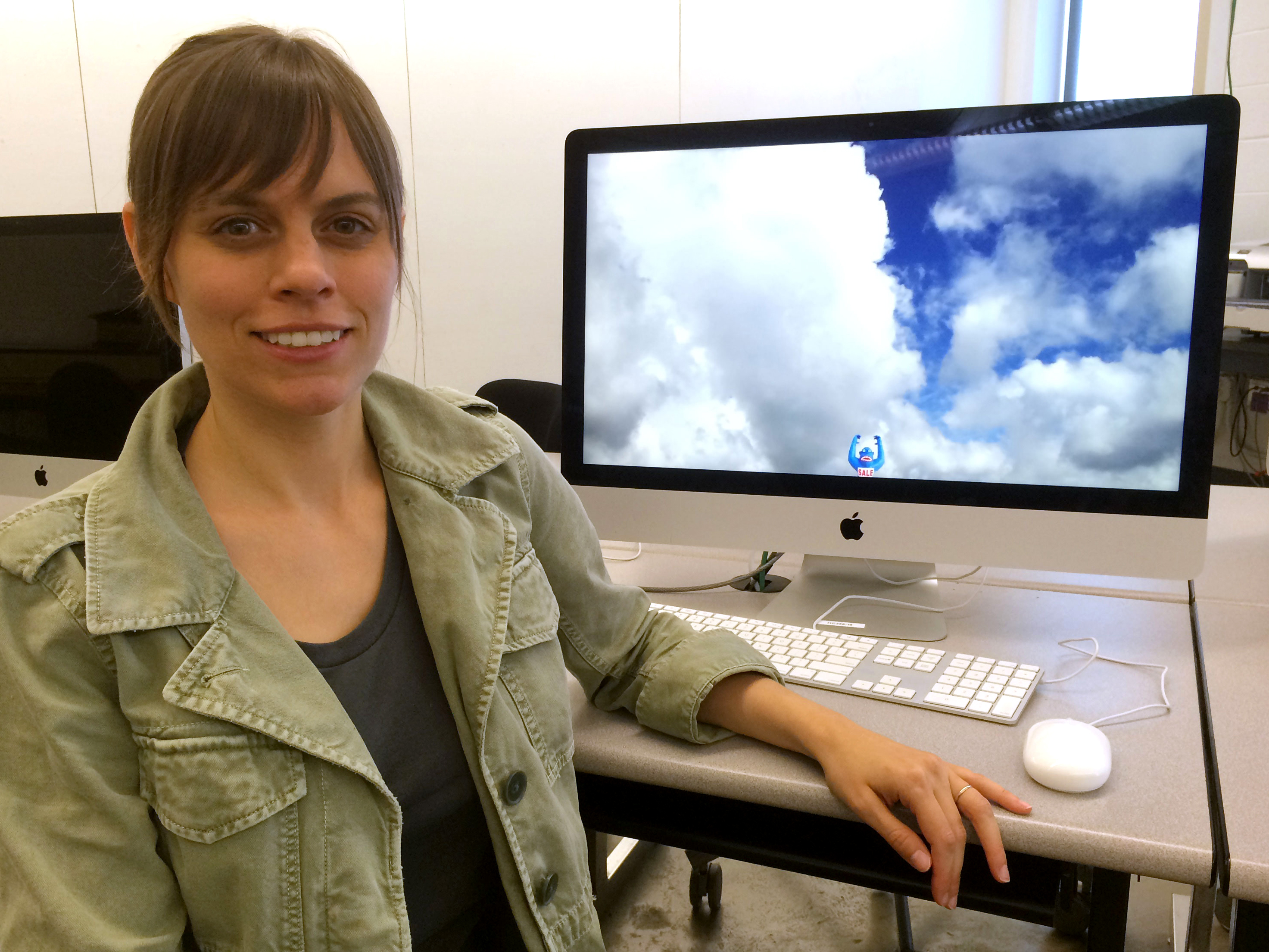
001 Shannon HeadshotKate Shannon is an associate professor at The Ohio State University Mansfield. The recipient of the 2013 Ohio State University Mansfield Campus Award for Excellence in Scholarship, she explores notions of desire, consumption, happiness, and loss through digitally manipulated photographs. Shannon received her master of fine arts degree in studio art from The Ohio State University and her bachelor of fine arts degree in studio art from the University of Kentucky. She currently resides in Columbus, Ohio with her husband and cats, Shoulders and Herman Schmo.

004 Shannon Studio

All images copyright of the artist and used with their permission.  

 

Posted in Digital Art, Photography | Tagged , , , , | Leave a comment

Danielle Genzel – San Francisco, California

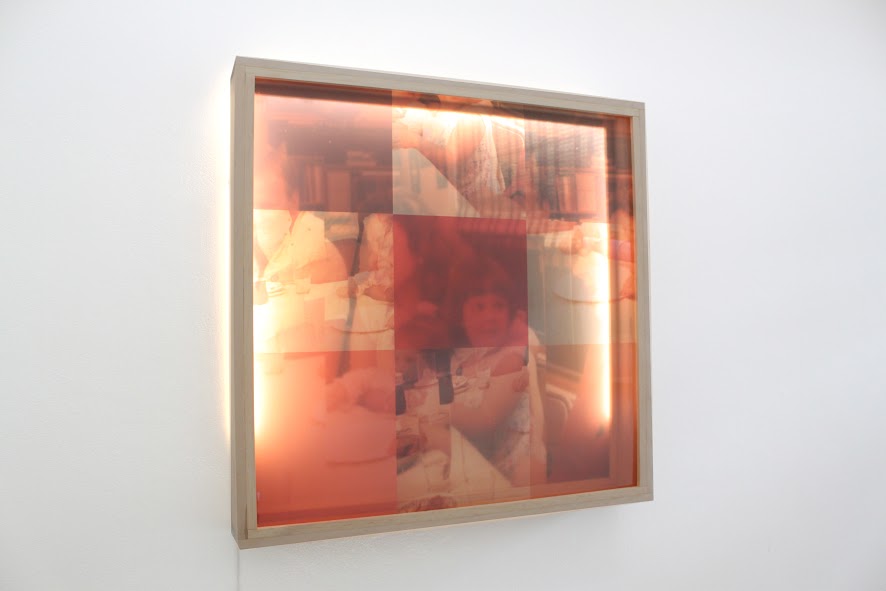
Family Dinner in Sequence of Red 36''x6''x36'', 2015 Birch wood box holding two plexiglass panes with inkjet printed transparencies mounted to each.

Family Dinner in Sequence of Red 36”x6”x36”, 2015
Birch wood box holding two plexiglass panes with inkjet printed transparencies mounted to each.

Briefly describe the work you do. 

I am interested in the relationship between ourselves, and the devices we use for recalling and storing memory. I question the divide between documentation and an original event or moment, and where the devices we use for recall intersect. In my process I dissect my own familial archive, looking for clues of a time and place I have forgotten, and for the traces of the apparatus used to capture and recall a particular image or moment. In making, I manipulate scanners to perform in ways not intended, giving the process up to chance, in order to obscure the original information, and create traces of digital input.  Through the use of these digital tools I aim to both clarify and distort the read of a single image, breaking down the digital and analogue information the image holds.  The images are then compiled into digitally manipulated compilations, printed and layered on transparencies that, once compiled, create new imagery and form.  I am examining ground and plane of each image in order to recontextualize the perspective (both physically and metaphorically) and composition of the image.  The final composition is created only through the layering of each transparency, creating a build up of an image. Each image is reliant on the layer that comes before it, and uses the white, or negative space, of each composition in order to draw contrast to image and form. The layered photographs then seem to contain dimension, yet are limited and static in nature, in order to illustrate this ultimate sense of loss created in the divide between experience and recall.

Tell us about your background and how that has had an influence on your work and on you as an artist.

I started to realize from a very young age that what I experienced was very different from what the person next to me experienced, and what was remembered and recalled always resulted in slightly different stories.  From there I was fascinated by the instability of memory, and baffled by how we often rely on it to be a solid backboard for our past.  So my interest in memory grew from there, which really got me interested in perspective and perception. Now while we are entering the digital age, this opens new conversations on the concept and as well as a whole new set of issues for the future, particularly, in how we document and archive the past.  Since these processes are changing, what does it mean to have essentially unlimited access to the past. 

How will our vast documentation of the present be reflected on in the future, and what does that leave for the construction of the past?

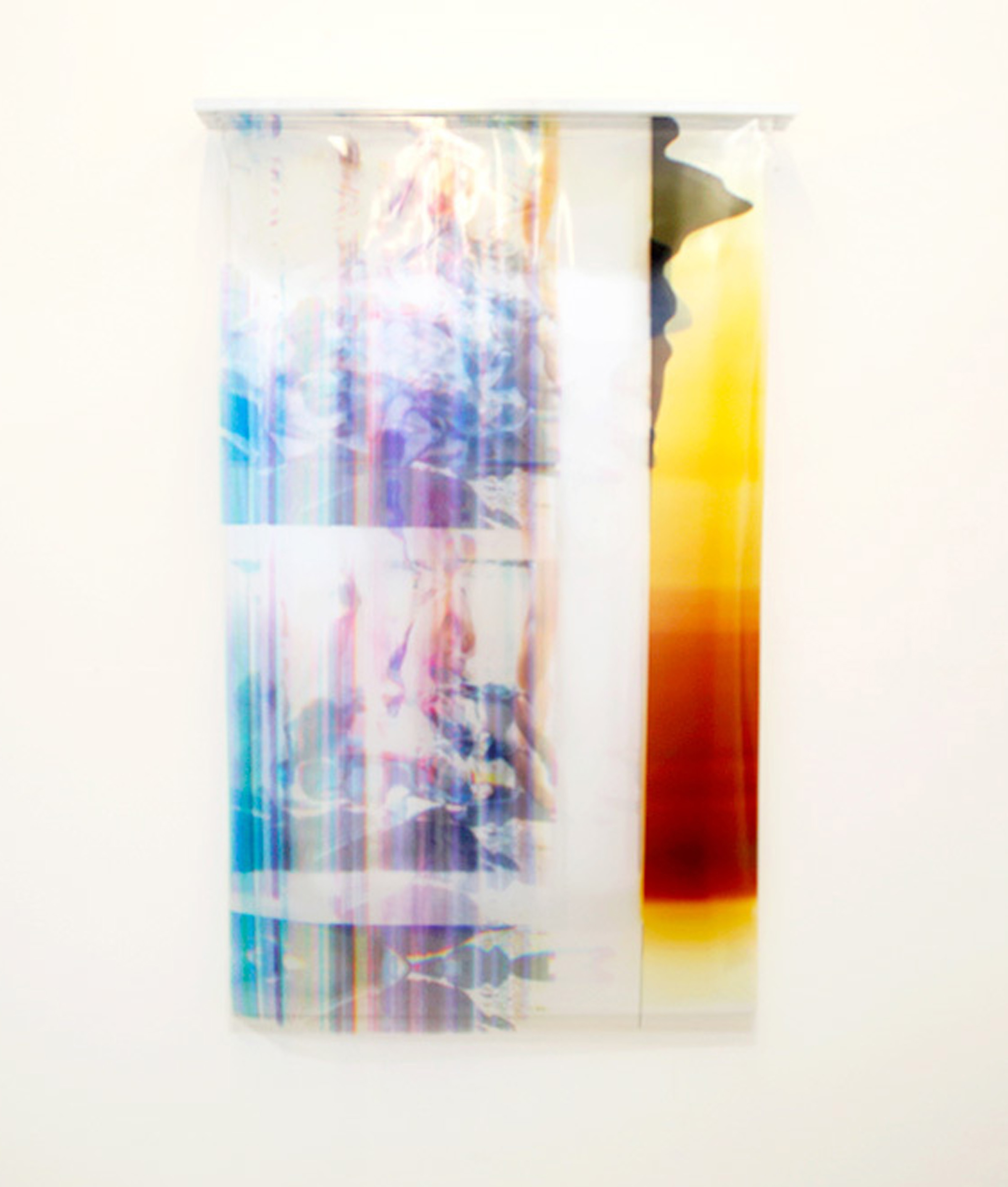
"Reduction" 36''x 60'', 2014 Inkjet printed transparencies, Aluminum framing

“Reduction” 36”x 60”, 2014
Inkjet printed transparencies, Aluminum framing

The concept of the artist studio has a broad range of meanings in contemporary practice. Artists may spend much of their time in the actual studio, or they may spend very little time in it. Tell us about your individual studio practice and how it differs from or is the same as traditional notions of “being in the studio.”

I would say a lot of my practice occurs outside the studio.  While the actual end product requires focused time in the studio, that product could only come from hours outside the studio. Time, experience, and research often dictate the length of this process.  I suppose it is an equal balance of both, and a successful piece requires focused research outside the studio, as well as focused making time.

What roles do you find yourself playing that you may not have envisioned yourself in when you first started making art?

I am currently a member of CNTRL + SHFT, a collective of women artists and arts organizers aimed at providing a supportive, inclusive space whose mission it is to contend with traditionally underrepresented content in the contemporary art market, based out of Oakland.  We all started this project from the ground up, and have been renovating a large warehouse space, doing all the construction ourselves.  We built the walls to our studios, made alterations to several other walls, moved conduit, and are currently perfecting our gallery space, which will launch at the end of this month.  I never thought I would be doing this sort of construction, let alone working with other members in collaborative thought to get our ideas, hopes, and dreams for this collective up and running.

When do you find is the best time to make art? Do you set aside a specific time everyday or do you have to work whenever time allows?

Having recently completed grad school, my time in the studio has changed a lot. During grad school my focus was on my studio practice 24/7.  This included a lot of 2 am studio nights, and week long “studio binges”, and ideally one day I will be able to work this way again. Having that focus and concentration in the work is the most pragmatic way of working.  Since I live in San Francisco, it is necessary to have a full time job on top of my Collective work and Studio Practice.  Now my weekends and week nights are  dedicated to studio time.  It is nice to go from my “day job”way of working and then be able to tap into an entirely different mode of working and thinking. I think that’s an important balance to maintain, although a hard one none the less. In this way, it is more important for me to both schedule and dedicate specific time to my studio practice, as I don’t have the luxury of letting it flow freely.

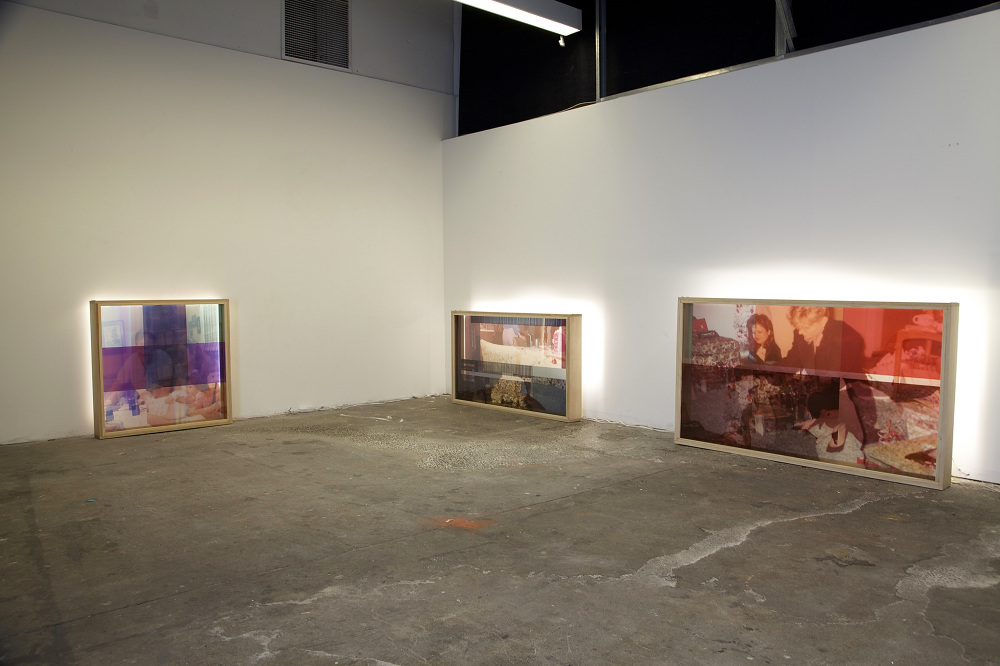
Family Dinner in Sequence of Blue 36''x6''x36'' Grandmas kitchen table in progression 54''x6''x31'' and Rewired Holiday 1987, in Corresponding Color Flow 63''x6''x36'' 2015 Birch wood box holding two plexiglass panes with inkjet printed transparencies mounted to each.

Family Dinner in Sequence of Blue 36”x6”x36”
Grandmas kitchen table in progression 54”x6”x31”
and Rewired Holiday 1987, in Corresponding Color Flow 63”x6”x36”
2015
Birch wood box holding two plexiglass panes with inkjet printed transparencies mounted to each.

How has your work changed in the past five years? How is it the same?

In the past five years, my work and my investigations have changed a lot and grown with the advancement and changes in technology.  Having studied Printmaking, I have always been interested In the construction of an image and the boundaries of that visual information.  How much or how little an image can convey based on its context both with another image or on its own, or simply how it is rendered and segmented. With the development of technological integration into our daily lives, a reflection on this has helped develop and change the form of my work, and my interest has moved more from memory to documentation and the archive. The form of my work has changed entirely.  I used to work solely in flat works on paper, be it Etchings, Lithographs, or Silkscreens.  Now I’ve moved more into dimensional and installation based work, that the content calls for, and to produce the images I am printing inkjet produced images on transparencies, incorporating light and movement.

How have people such as family, friends, writers, philosophers, other artists or even pop icons had an impact on the work you do?

My family has influenced me tremendously, not only because they are the subject of my investigation, but because of their interest and consistency in documentation, and this goes back generations.  Growing up there were always camera around, and the video cameras changed as the development of the camera grew. My father was always behind the camera recording various trips, and we had a consistent roll of filmed developed. Out of that, I have a lot of source material to access my past, including videos to watch and pictures to hold. I can’t imagine how it will be for future generations to look back at a vast number of images and videos of their past. Will they dive back into old hard drives or simply lose everything once they get damaged? Herein lies some of the threads of my research.  What does it mean now to have documentation, recording, even surveillance constantly at our fingertips? what does it mean to have every second of our individual lives, our history, documented?

Have you ever been pulled in the direction of a pursuit other than being an artist? What are your other interests? 

My day job pulls me in a direction I never expected to be in for so long, which is simply administrative.  I am also diving more into a graphic design field, which I always resisted while in my undergrad, being very dedicated to an analogue way of making through printmaking.

About

IMG_4731Danielle Genzel is an emerging artist based in San Francisco. She recently completed her MFA from California College of the Arts.  She is a member of the Oakland based Art Collective CTRL+SHFT and has participated in various exhibitions such as MFA Now at Root Division, Ntropic Exhibit: Light, and This is not A Painting at Embark Gallery in San Francisco.

studio

All images copyright of the artist and used with their permission.  
 

Posted in Printmaking | Tagged , , , , | Leave a comment

Maria Camila Bernal Toro – Ciudad de Panamá, Panamá

Allí estaré Acrylic con Canvas 76 cm X 122 cm 2014

Allí estaré
Acrylic con Canvas
76 cm X 122 cm
2014

Briefly describe the work you do. 

My work doesn’t have the intention of making a change in the world nor in peoples’ way of thinking, my work only seeks to transmit a sensation of plenitude and tranquility, for whomever finds themselves in front of my work to be able to forget reality for a few minutes and for them to give themselves a moment to not think.

My concept remains the same independent from the material, however, each tool and surface will always produce different results and I really enjoy exploring new materials because it gives me the sensation of discovering something new and this makes it so that art never becomes monotonous.

Tell us about your background and how that has had an influence on your work and on you as an artist.

For many years, I lived in a town in Colombia called Villeta de San Miguel. Growing up in such a tranquil environment, surrounded by nature developed a fascination for it in me, I could spend hours drawing. I can say that I loved introducing myself in a fantastical world through drawings. 

I moved to the city, studied graphic design. In the University I learned many concepts about image in relation to harmony, proportion, functionality, and color, however it was all in favor of someone else’s project, all of the design was done for a client.

I worked many years as a graphic designer at advertising agencies. I was art director for one of them. I got to Panama in 2011 to work for Converse All Stars, but I knew I didn’t want to design commercially anymore and that I wanted to focus all my acquired knowledge on making personal work as an artist.

So once again I moved from the city, I lived at the beach for a couple moths and for another couple of months in a magical place called “El Valle de Antón” or “The Anton Valley” where I went back to that sensation of tranquility, which allowed me to grow even more in my work.

Habitar en El Valle por siempre - 05 Acrylic con Canvas 55 cm X 76 cm 2015

Habitar en El Valle por siempre – 05
Acrylic con Canvas
55 cm X 76 cm
2015

The concept of the artist studio has a broad range of meanings in contemporary practice. Artists may spend much of their time in the actual studio, or they may spend very little time in it. Tell us about your individual studio practice and how it differs from or is the same as traditional notions of “being in the studio.”

At the present time I have my studio in Panama city, which I share with my husband because he’s also an artist and we grow a lot through producing work together even if our work is very different. “Being in the studio” I think is a concept that goes beyond the barriers of space. Being in the studio is a moment with oneself, a moment to isolate the world and focus on the work, either in the city, at the beach, or in the mountains. 

I definitely like being in a comfortable place where I have my materials and books at hand, however my sketchbook is like a “portable studio” to me.

What roles do you find yourself playing that you may not have envisioned yourself in when you first started making art?

Teaching.

When do you find is the best time to make art? Do you set aside a specific time everyday or do you have to work whenever time allows?

It is always the right moment to make art, everyday I work on my projects without a schedule, however I do prefer working at night because I feel that the city is more tranquil and I can submerge myself happily and without interruptions in my work.

Sketchbok

Sketchbok

How has your work changed in the past five years? How is it the same?

It was  only until three years ago that I decided to surrender myself to art, and making that decision took me from the informality of occasional drawing to the production of art seriously and in series.

My work has definitely acquired a higher level of maturity during this period and I know that it will keep growing, I feel that I keep taking the first step.

How have people such as family, friends, writers, philosophers, other artists or even pop icons had an impact on the work you do?

My parents have definitely been my greatest incentive and my husband who I not only adore, but admire as an artist. I think that people and moments that generate impact in my work are constantly coming, to list some of them: TierraBoca, Yann Tiersen, Wes Anderson, Salman Rushdie, my art history teacher at the University, art nouveau, Owen Jones, William Morris, Rebecca Dautremer.

Have you ever been pulled in the direction of a pursuit other than being an artist? What are your other interests? 

I can’t say that studying design was a bad decision, because it taught me really useful things for my work as an artist, and I think that with different purposes, both careers depend on the same connection with image.

There are hobbies that I would like to dedicate more time to, learn to surf well for example, but I can’t conceive my life doing something other than art.

About

headshotVisual artist and graphic designer from Bogota Colombia, resident in Panama City. Since 2005 works in advertising agencies and in the Imprenta Distrital de Bogotá. In 2010 he comes to Panama to design for Converse All Stars prints of the female wear.  Founded in 2012 “La Tienda de Remedios” virtual platform that functions as a design studio while developing personal projects as a visual artist. Her  work is based on admiration of nature, the small details and the fantastic stories derived from everyday life.

FULL COLOR 000

cargocollective.com/remediosart

All images copyright of the artist and used with their permission.  
Posted in Painting | Tagged , , , , | Leave a comment

Brittany Ellis – Lake Forest, California

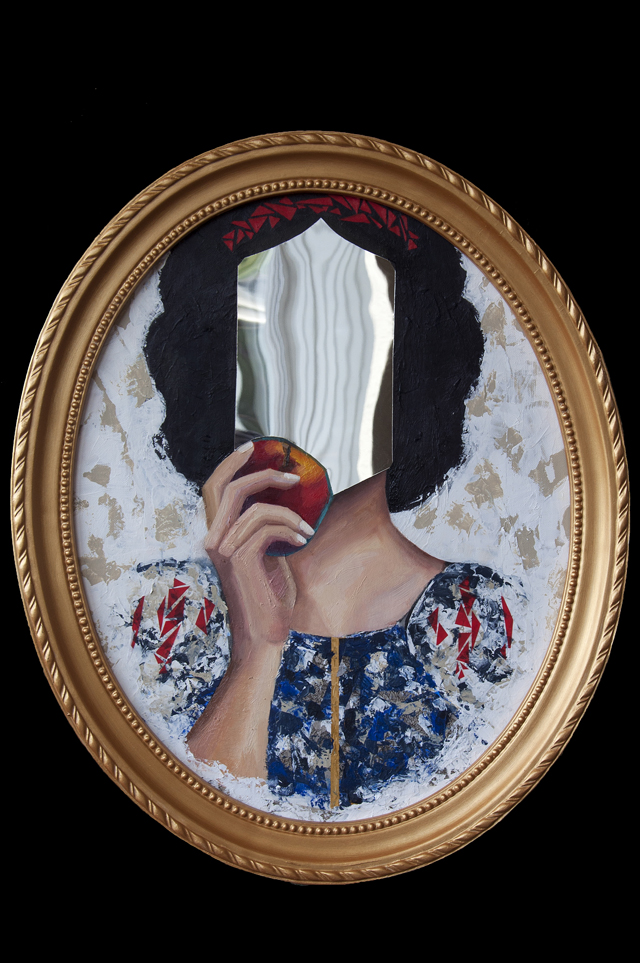
 Don't Eat The Apples Medium: Collage, Oil, Found Objects Size:19x23 Year: 2015

Don’t Eat The Apples
Medium: Collage, Oil, Found Objects
Size:19×23
Year: 2015

Briefly describe the work you do. 

My new art series is based upon pop cultural icons that influence society.  Pop cultural icons are glamorous, flawless, and even considered perfect.  But what happens when perfect suddenly becomes imperfect? What happens when you strip away materialistic items, and peer into the soul of whom a person truly is?  Curiosity of the unknown is a natural human tendency.  My art explores the surreal narration of pop cultural icons’ lives which lead to their demise due to the antagonist in the narration.

Tell us about your background and how that has had an influence on your work and on you as an artist.

As a child I could create good artworks sporadically rather than constantly. I never could create works of art well until I began taking art classes in fourth grade, where I met my future mentor. Mary Lynne Grimes was my first art teacher who believed in my potential I possessed as a creator and innovator. Mrs. Grimes scheduled a meeting with my mother, who was also a teacher at the same school and spoke with her about me considering becoming an artist in the future. Sixteen years later I still have Mrs. Grimes in my life and I’m still creating unique works of art. Meeting Mrs. Grimes really impacted the future I was meant to have.

The concept of the artist studio has a broad range of meanings in contemporary practice. Artists may spend much of their time in the actual studio, or they may spend very little time in it. Tell us about your individual studio practice and how it differs from or is the same as traditional notions of “being in the studio.”

My studio at the moment is my home.  I value the moments I posses from being able to create at home morning, noon, or night. When I create I tend to move locations on occasion to continually posses a focus while working. Other than being a nomad while I work, my studio practices are pretty traditional.

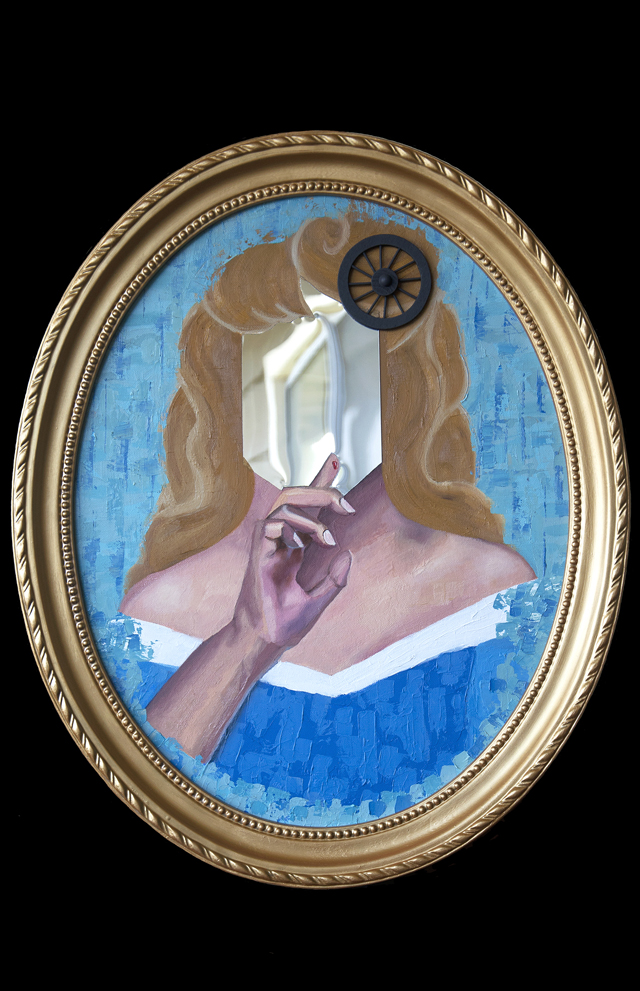
 To Prick a Beauties Finger Medium: Oil, Found Objects Size:19x23 Year: 2015

To Prick a Beauties Finger
Medium: Oil, Found Objects
Size:19×23
Year: 2015

What roles do you find yourself playing that you may not have envisioned yourself in when you first started making art?

 I never envisioned that the work I would be making now would be the work my art began with. Before college I made works of art using assemblage pieces as I am today with my art. While attending the Academy of Art University student talent was on the same caliber. Creativity was a deciding factor in differentiating yourself from others. Returning back to square one became my creative solution to truly being an individual. When using alternative materials within my work I never know what trials and tribulations I could encounter.  The tribulations I face makes my work exhilarating and truly exciting 

When do you find is the best time to make art? Do you set aside a specific time everyday or do you have to work whenever time allows?

Typically, when I begin to create I’m burning with excitement to create. When I become intrigued with a concept I instantly document it . Most of my artworks evolve from dreams I’ve had, sarcasm I’ve heard, or personal opinions I posses.  I usually create artworks whenever time allows which is10am-1pm continuing  9pm-12am. Outside of being a part time artist, I have a full time job and another part-time job

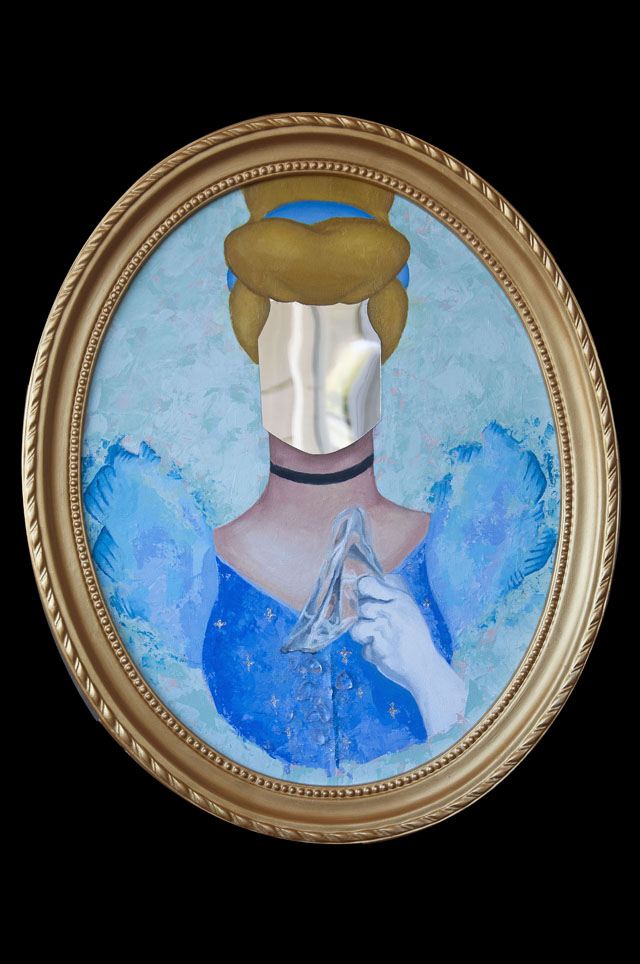
Shattered Dreams Medium: Glass, Oil, Found Objects Size:19x23 Year: 2015

Shattered Dreams
Medium: Glass, Oil, Found Objects
Size:19×23
Year: 2015

How has your work changed in the past five years? How is it the same?

After attending college my technical skills improved along with my problem solving skills. Although I attended college to accelerate my artistic skills my creative ideals the same. Before college I created works of art using found objects. One addition that I added to the work I’ve created is figures. Figurative works of art were my least favorite subjects to work on. In college I had a teacher that once said “there are artists who give everything to do their art even if they’re not the best at it, and that makes them an artist. Avoiding certain subjects or ways of creating based upon fear is not what art is about.” I really took what he said to heart and began practicing works of art based upon figures.  I refused to be an artist based upon my fears, and once I did my artworks improved.

How have people such as family, friends, writers, philosophers, other artists or even pop icons had an impact on the work you do?

Pop Culture really impacts the work of art I create. The series I work on first began with celebrities and have evolved to other icons that influence the everyday life of their consumers.  My art first began with the exploration of celebrity lives through the imagination of the fan . My ideal in my work is beauty, fame, and popularity that comes with a price when you live in the public eye or in a position of stature. The Disney bodies of works I created continues to feed off of my ideas I originally possessed.  Each Disney protagonist faces obstacles that originate for vanity, greed, jealousy, and the naive.  Essentially, the ideal of the antagonist wanting a portion of the protagonist because of their ideal of what they see, and imagine within the protagonist. What is seen on the outside could not be who a person truly is.

Have you ever been pulled in the direction of a pursuit other than being an artist? What are your other interests?  

Before I became interested in art I was interested in rocks and minerals. As I child I envisioned I would become a Geologist. After I discovered my artistic abilities I pursued a journey in the art world. My plan was to get a fine arts degree then pursue a gemologist degree after my first degree. After college I receive an opportunity to work in the jewelry industry, and still do today. Currently, I’m working towards completing my gemologist degree.

About

Screen Shot 2015-09-15 at 2.25.15 PMBrittany lives and works in Lake Forest, California. She was born and raised in Houston, Texas. Growing up with a car artist father, and an educator mother she was taught to follow her dreams and accomplish her passions and goals . Brittany’s experience in the art world has taught her to incorporate what she loves, and what she knows, to her conceptual ideas. While attending the Academy of Art University Brittany was compelled to live a creative and innovative driven life.  Her background as a painter, photographer, and innovator compelled her to create unique; one of a kind art pieces. By using objects in addition to painting allows her to enforce the message her paintings possess. Brittany’s numerous awards and achievements include four publications in Photographer’s Forum  Magazine, two publications in Teen Ink Magazine, and Artist to Watch in Houston Chronicle news paper (09). Exhibitions including Contemporary Art museum Houston Contents under pressure exhibit (09), The De Young Museum New Generations Matter Exhibit (2012), Arts Benicia Fragments The art of collage and assemblage Exhibition  (2015),  Las Laguna Gallery Unconventional Means (2015).

hollowdolls.weebly.com

All images copyright of the artist and used with their permission.  
 

Posted in Assemblage, mixed media, Painting | Tagged , , , , | Leave a comment

Pamela Casillas – Hermosillo, Sonora, Mexico

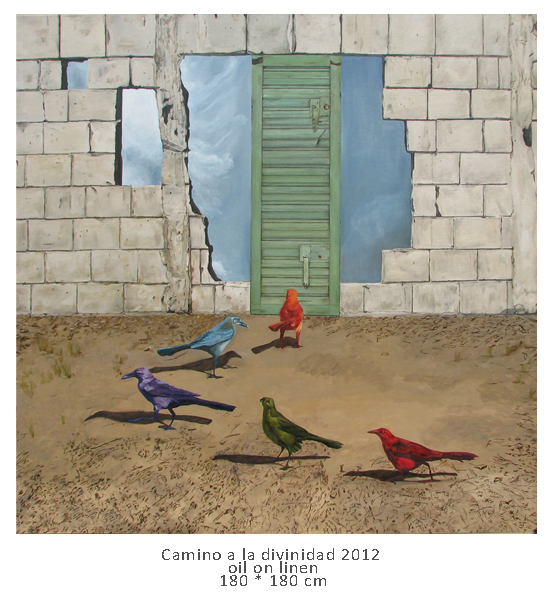
DIVINIDADBriefly describe the work you do. 

Figurative art is my passion, along with the Italian classical artwork and the human figure with its perfect design and functionality that dazzles us with its beauty. My work consists on several phases in which generates creation through imagination, organizing my ideas using photographs taken along the process, this photographs captured the essence of objects through the lens and my soul. Translating the flow of ideas into a composition that creates meanings to the observer

My artwork uses oil paintings and handcrafted linen canvass. My goal is to always be looking to get near my roots and leaving a piece of my essence in each artwork, but never interfering with the creative process, where anything is possible.

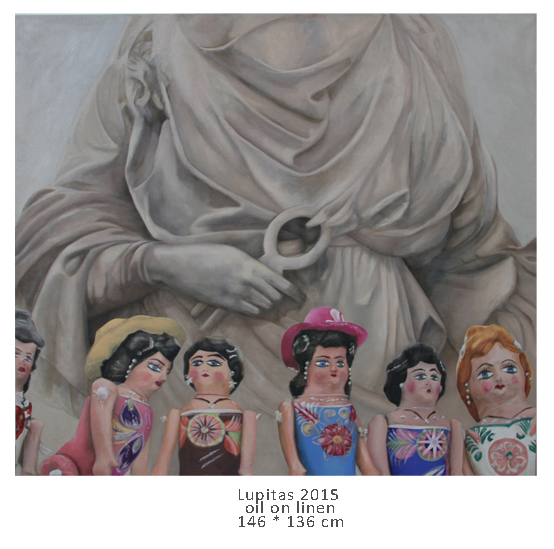
Currently I am playing between two cultures, Mexican handcrafts and Italian Madonnas, creating a juxtaposition, which has been very educational for me.

Tell us about your background and how that has had an influence on your work and on you as an artist.

My studies in Florence, grew a fascination with the human figure, after coming back to Mexico, went to live in Monterrey and worked as a trainee apprentice for a Mexican Sculptor Jorge Elizondo.

My everyday experiences in this complex world made me believe that today everything is considered art. Before this, in the past, artists broke ties with the academy due to rebellion and social restraint.

Today, fast globalization brought art to the masses, which is good, but art has become fast food with no quality, as Andy Warhol predicted. I feel we need to slow down, take a breath and return to create things with innovation and value.

Art has value when is backed by a human feeling.

lupitas

The concept of the artist studio has a broad range of meanings in contemporary practice. Artists may spend much of their time in the actual studio, or they may spend very little time in it. Tell us about your individual studio practice and how it differs from or is the same as traditional notions of “being in the studio.”

My studio is at home, a space full of pictures, photographs, drawings and handcrafts in which reality escapes the routine of every day, this place embodies me with a language that translates in a direct communication with art, roots and my work, combined with playfulness.

For me art is like meditation, in which while creating you become aware of everything, and nothing, a process of introspective into oneself and exploiting our most deepest and beautiful being in the form of art.

This way is my way of achieving that the observer feels the art piece with all the physical senses and its soul.

And while working in my Studio I remember Pablo Picasso’s phrase: “Inspiration exists, but it has to find us working.”

What roles do you find yourself playing that you may not have envisioned yourself in when you first started making art?

When I started I was clueless, no idea of the meaning or the process of creating art, though my mind was like an empty canvass. I enjoy the process of discovering and rediscovering the evolution that my art is going on through time, and how it comes to life representing each of my phases and personal experiences.

When do you find is the best time to make art? Do you set aside a specific time everyday or do you have to work whenever time allows?

My life is also in constant transformation, before I had a daughter I usually kept a tight schedule as in other occupancy. With the light that has brought my daughter, now I make time to make art. Always focusing with constant lectures that keeps my mind discovering unknown territories and keeps putting gas on the creation engine.

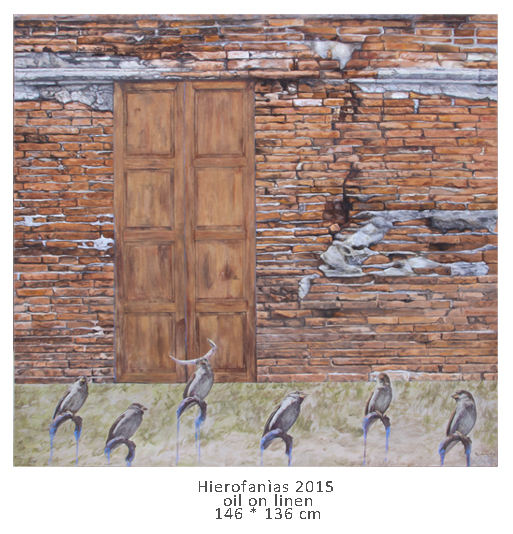
HIEROFANIASHow has your work changed in the past five years? How is it the same?

Still doing figurative, still am fascinated by the human body, I have introduced objects to interpret the things that run through my imagination. As time has gone by I have achieved to get more vivid colours, which I feel liberated after taking that step. My passion takes me to put all my heart in every art piece.

How have people such as family, friends, writers, philosophers, other artists or even pop icons had an impact on the work you do?

History of art has had a great impact on my growth as an artist, it made me love, understand the relationship between and art piece, its creator and their context. Books have been a great inspiration for me, specially philosophers and artists biographies. In that same way I feel like every person in my life, specially family has made me what I am.

Have you ever been pulled in the direction of a pursuit other than being an artist? What are your other interests? 

For a short period of my life I worked as a trainee for Jorge Elizondo learning sculpture, it was a life changing experience, it made me learn and love to create art. My daughter has pulled me momentanously in the role of being a mom, which I love, she is a great inspiration and an everyday testimony of spontaneity and joyfulness.

About

Went to Florence, Italy, and study Fine Arts for three years, there I fell in love for antique techniques, the great classics and the human figure.

What amazes me and moves my current art pieces, is the need of human beings to believe in something, trying to find the origin, this need is coded on our primary roots of our soul, on what moves the human being.

My art shuffles between the different religions or systems of beliefs, their icons, totems, traditions and different ways of worship or pray.

While thoroughly respecting every faith and religion in a unique way, my art seeks the colloquial objects that through history turn themselves into subjects of worship, seeking to convey the rhythm in which cycles of life evolve changing the colors of those credos, although the foundation of those roots remain unchanged and their beliefs change constantly its color, gaining life through humans. My interest is in exploring how humans faith, while blind can easily turn into superstition through dogmas and intolerance, due to fear and uncertainty.

Actually I am representing the energy of Mexican handcrafts and traditions, great example of how objects created originally with beauty and greatness for a purpose and then lose their sense through time and human usage.

pamelacasillas

pamelacasillas.com

All images copyright of the artist and used with their permission.  
 

Posted in Painting | Tagged , , | Leave a comment

Ekaterina Popova – Wilmington, Delaware

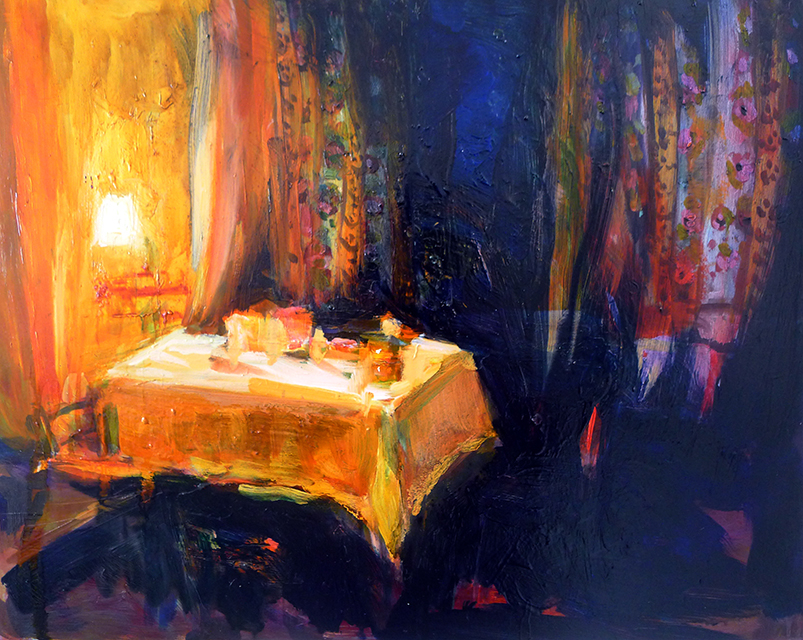
Interior I, oil on panel, 2015

Interior I, oil on panel, 2015, Photo courtesy of Emily Grace Photography.

Briefly describe the work you do. 

For the past few years, I have been exploring the idea of home and memory in my oil paintings. I collect found images, old photographs and sketches to create interiors and landscapes that remind me of different parts of my life or recreate certain moods. I play around with scale and color to see what works best. I am still exploring this subject matter and just when I think I am finished with it, I find something else that reignites my interest.

Tell us about your background and how that has had an influence on your work and on you as an artist.

I grew up in Vladimir, Russia. I was surrounded by a lot of history and culture, which left a strong impression on me. In 2001 we moved to the US, and I continued to paint, eventually getting my BFA. I think having two cultural experiences as a child made me cling to certain imagery, so I began focusing on partially separating myself from it. My work is slowly evolving from nostalgia to the idea of home and memory mixed with a little fantasy.

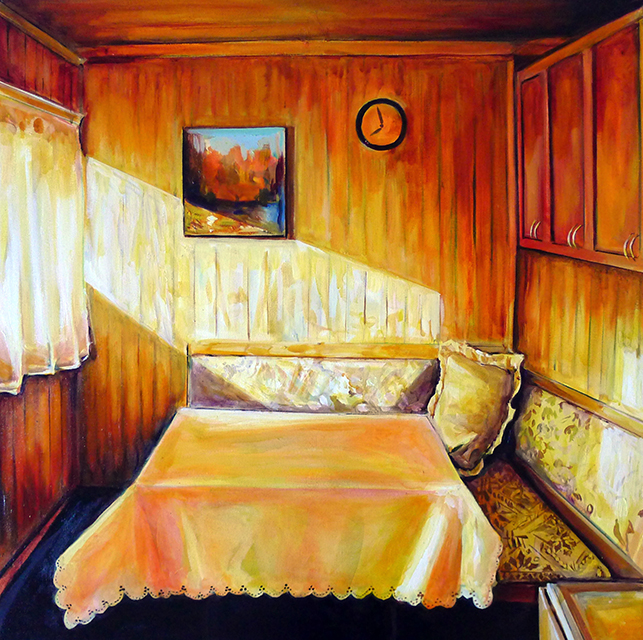
Sunday Morning, oil on canvas, 36x36, 2014

Sunday Morning, oil on canvas, 36×36, 2014. Photo courtesy of Emily Grace Photography.

The concept of the artist studio has a broad range of meanings in contemporary practice. Artists may spend much of their time in the actual studio, or they may spend very little time in it. Tell us about your individual studio practice and how it differs from or is the same as traditional notions of “being in the studio.”

At this point in my life, being in my studio is as much a priority as it is a luxury. Unfortunately, I am unable to be physically present and make work every day, but instead I focus on collecting sketches and images that inspire me for future use. I always carry a notebook and jot down ideas when I can. I think for a lot of artists there are two parts of studio practice: collecting experiences, ideas and references, and making actual work. One cannot exist without the other.

What roles do you find yourself playing that you may not have envisioned yourself in when you first started making art?

I find myself collecting images of other people’s homes and interiors, which can be considered a little creepy. I am really fascinated by different reminders of my own experiences, as well as creating fictional stories about the people who reside in these spaces.

When do you find is the best time to make art? Do you set aside a specific time everyday or do you have to work whenever time allows?

I dedicate a few days a week to being in the studio, and the rest of my time I research ideas and opportunities. I am learning to be flexible and work whenever I can.

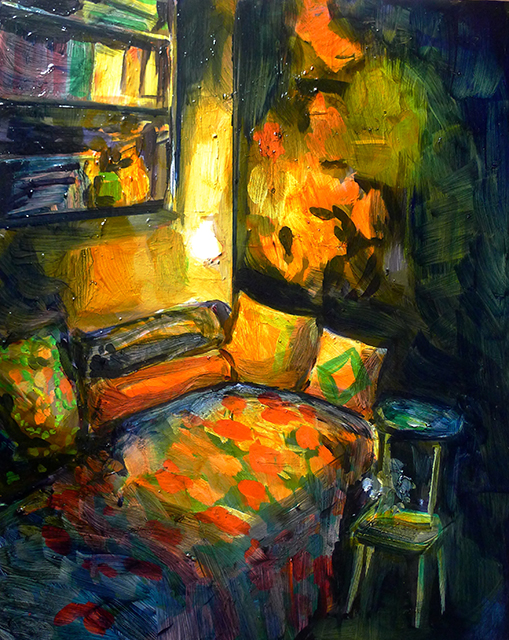
tory Time, oil on canvas, 16x20, 2014

tory Time, oil on canvas, 16×20, 2014. Photo courtesy of Emily Grace Photography.

How has your work changed in the past five years? How is it the same?

Over the past few years my work became a little bit less personal in terms of actual images. I still include depictions of my own space, but focus more on conveying a more universal sense of place or mood. That can always change.

How have people such as family, friends, writers, philosophers, other artists or even pop icons had an impact on the work you do?

I look to literature to develop my understanding of place and listen to music to focus on a particular mood or emotion.

Have you ever been pulled in the direction of a pursuit other than being an artist? What are your other interests?

I am currently the U.S. editor of Fresh Paint Magazine. It is both thrilling and intimidating to work with so many talented and accomplished artists. I am really inspired by the work we publish and am thankful for a sense of community. Right now, I split my time between working on the magazine and creating my work, but inevitably sometimes one takes precedent over the other.

About

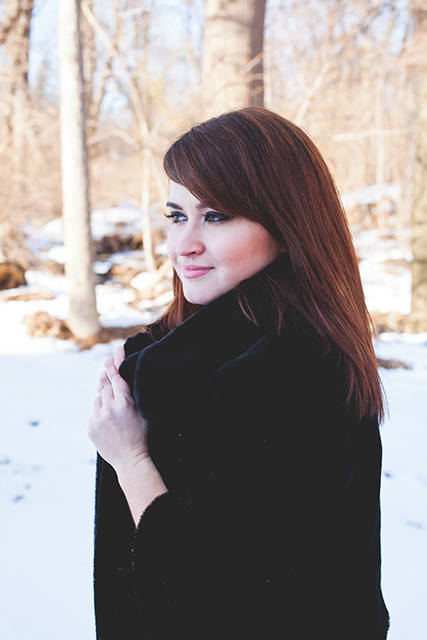
headshot_popovaEkaterina Popova was born in Vladimir, Russia. After moving to the United States, she pursued her passion for painting and received a BFA from Kutztown University of Pennsylvania. Her work has been exhibited in national galleries, a few of which include Uforge Gallery, The Painted Bride Center, The Boxheart Gallery, Chris White Gallery, Buckham Gallery and more. She has also been featured in publications, including The Artist Catalogue, Studio Visit Magazine and the cover of Ivory Tower Journal, Delhi, India. Ekaterina is a member of 3rd Street Gallery in Philadelphia, PA.

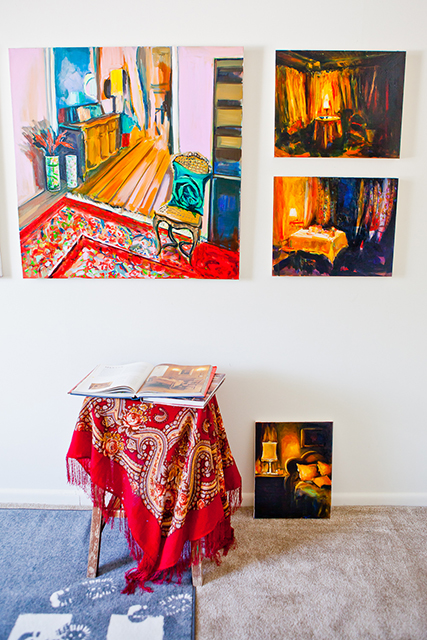
popova_studio

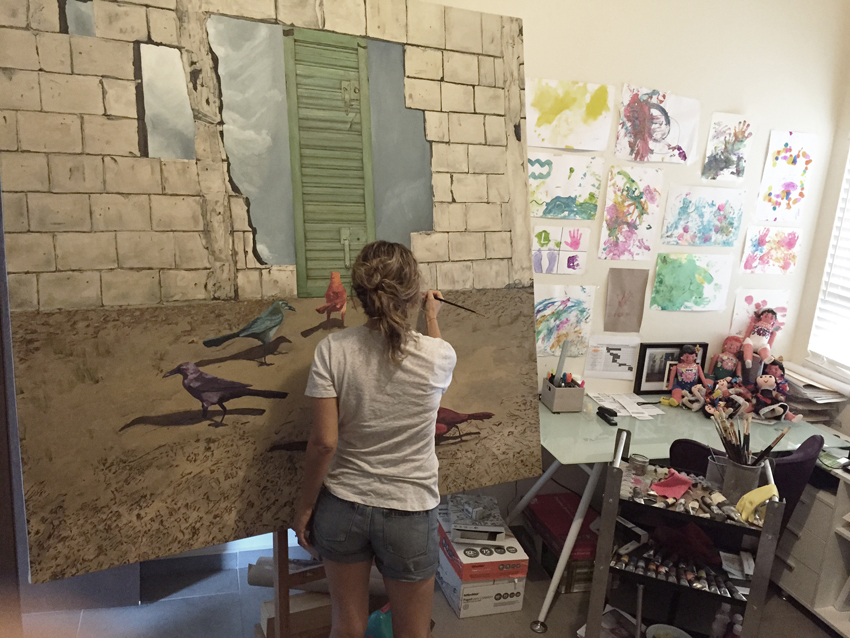
Photo courtesy of Emily Grace Photography.

katerinapopova.com

All images copyright of the artist and used with their permission.  
Posted in Painting | Tagged , , , , | Leave a comment

Santiago Castro Borda – Bogotá, Colombia

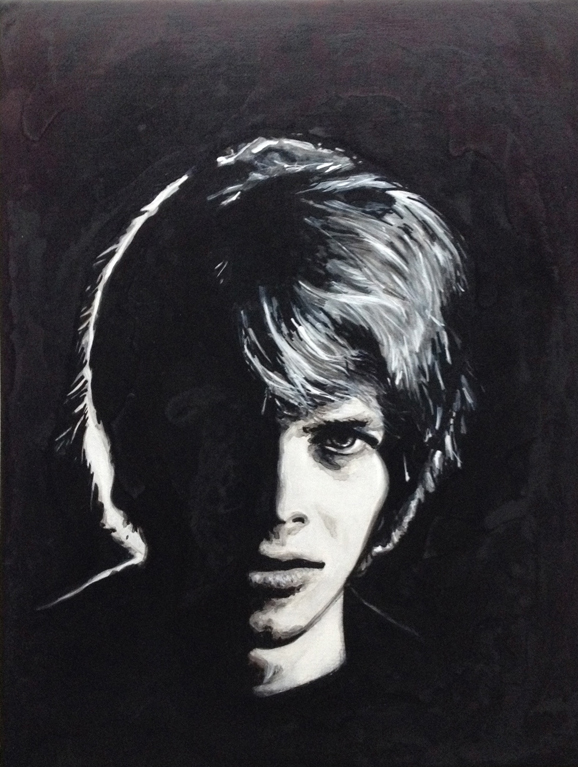
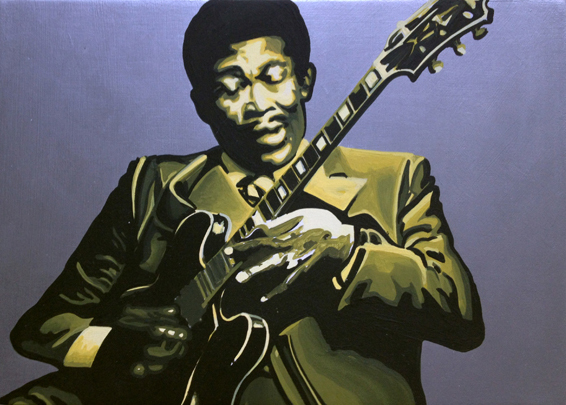
Bowie 67. Acrylic and ink on wood. 2014. 23.5 x 30.5.JPG

Bowie 67. Acrylic and ink on wood. 2014. 23.5 x 30.5.JPG

Briefly describe the work you do. 

I had focus my work in painting and in drawing, but especially in painting. I like to manipulate, to trace, to create images, and to use the visual language. I am interested in the technical exploration and in the communicative power of the image as a carrier of  contents and creator of interrogatives. Painting is the main core of my work where there are two recurrent subjects: space and rock and roll, but I am always open to other possibilities, techniques and themes.

Tell us about your background and how that has had an influence on your work and on you as an artist.

My father taught me how to draw when I was 3yrs, and my brother and I used to trace comics. When I was 18 living in Ibague, Colombia, I met Fox Barrios, a master from Tolima, who taught me the painting technique and a way of living as an artist. While studying fine arts in the University of Jorge Tadeo Lozano, the contemporary artist, Fernando Uhia, showed me the current possibilities of art and painting, and the media appropriation. The classical technique of Barrios and the contemporary input of Uhia have both influenced my work. The TV, the radio, rock and roll and the web have as well. 

The concept of the artist studio has a broad range of meanings in contemporary practice. Artists may spend much of their time in the actual studio, or they may spend very little time in it. Tell us about your individual studio practice and how it differs from or is the same as traditional notions of “being in the studio.”

Art nowadays, in my opinion, has many ways of being executed , and not all of them need to be done or process in an art studio. I believe every artist has its own point of view and way of work, but in my case I do need the space to experience the process.

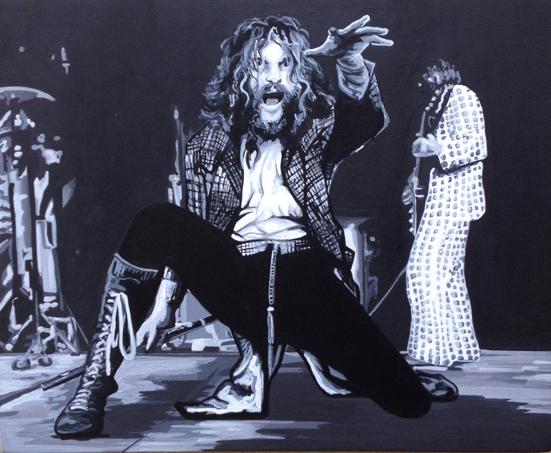
Jetro Tull. Acrylic on wood. 2015. 23 x 19 cms

Jetro Tull. Acrylic on wood. 2015. 23 x 19 cms

What roles do you find yourself playing that you may not have envisioned yourself in when you first started making art?

A publicist or a plastic surgeon, maybe. Something that would give me money to be able to paint. I´d have like to be an actor, or a rock star and spend my life traveling, but I think I made the right decision of being an artist.

When do you find is the best time to make art? Do you set aside a specific time everyday or do you have to work whenever time allows?

The day light and the silence of night are good for painting. Any time for me is good to make art. Riding a bus or walking for example. I have a little notebook that I carry with me where I write my ideas. To dedicate as much time as I can to think and do art would be ideally. 

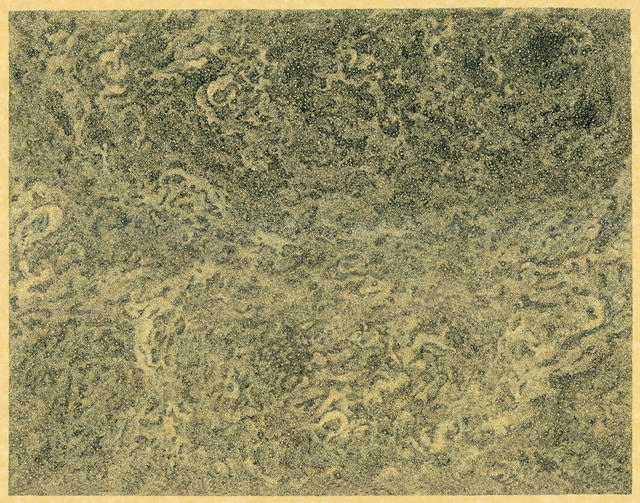
work in progress 3How has your work changed in the past five years? How is it the same?

I have polished my technical processes, and I have found my own language. Every series I paint gives me something new and requires different things which takes me to what I want to do next.

How have people such as family, friends, writers, philosophers, other artists or even pop icons had an impact on the work you do?

The origin of my work is based on the images I see on TV, on its icons. I particularly like the 60´s aesthetics and what was happening with art and music during that era.

Have you ever been pulled in the direction of a pursuit other than being an artist? What are your other interests? 

I would like to study art restoration to eventually work doing that. I would also like to do jokes videos and web parodies.

About

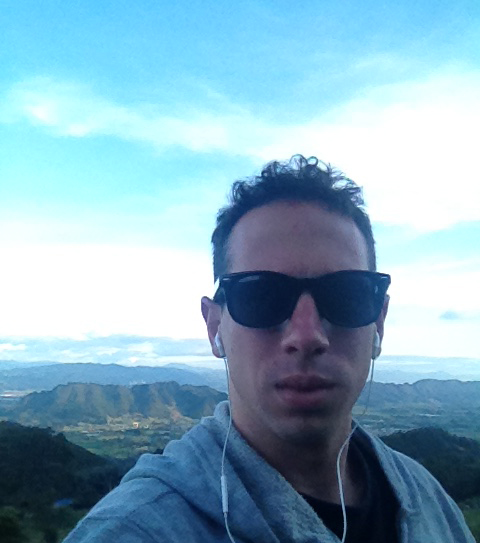
HeadshotBorn in Bogotá in 1982, studied painting for two years in Ibague where I lived half of my life, then returned to Bogota to start the career first as a designer and change quickly to Arts and finished in 2007. A brief time as teacher in different schools and now live and work in Tabio as a full time painter.

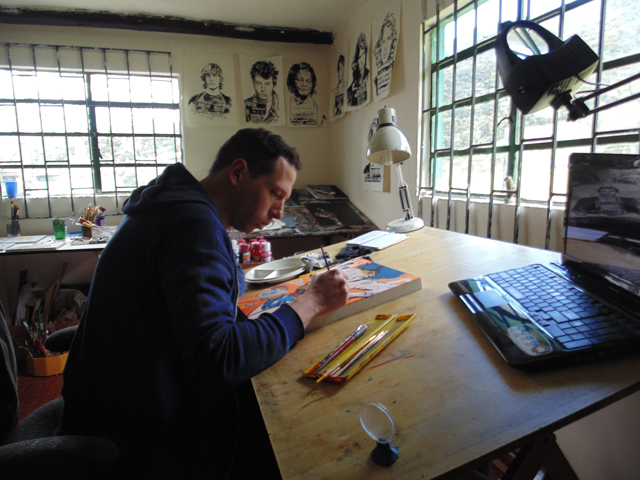
working

santiagocastroborda.wix.com/santiagocastroborda

All images copyright of the artist and used with their permission. 
 

Posted in Painting | Tagged , , , , | Leave a comment

Shannon Tomanovich – Athens, Georgia

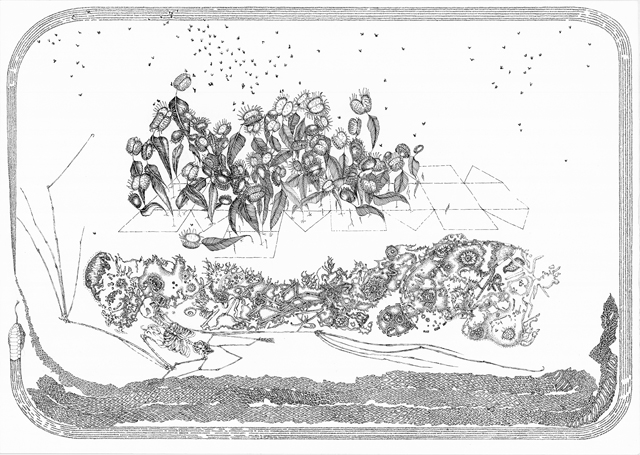
As Is, Ink on parchment paper, 12in x 9in, 2015

As Is, Ink on parchment paper, 12in x 9in, 2015

Briefly describe the work you do.

Mostly, I make highly detailed and time-altering drawings.

Tell us about your background and how that has had an influence on your work and on you as an artist.

I’ve always had compulsions; nail biting, split-end pulling (hair chewing when I was younger), a great appreciation for a well-popped blackhead, my dog is a collie mix and I cannot help myself but pull the hair clumps off her when she sheds her undercoat. I can sit, but cannot be still. The energy requirement for the creation of these drawings is very similar to endless nail biting or hair clump picking in a growth cycle where the nails never get to short and shedding never ends.

The concept of the artist studio has a broad range of meanings in contemporary practice. Artists may spend much of their time in the actual studio, or they may spend very little time in it. Tell us about your individual studio practice and how it differs from or is the same as traditional notions of “being in the studio.”

The amount of time I spend in my studio varies depending on if I am in the active making phase, planning phase or general wandering phase in the creation process.  It is a part of my home so I spend some time considering it everyday.  I could never be a “studio artist” where my job is to be in the studio and produce.  I will always have some sort of job that I am required to fulfill with a time obligation.  The ideas for my drawings pop up in everyday encounters at my job, while reading, during my commute, all the in-between times when I am not intentionally considering art-making.

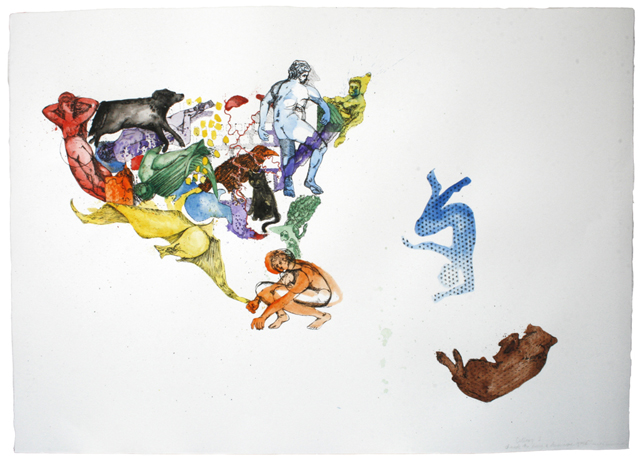
Longevity and Decay, Ink on rag paper, 27in x 19.5in, 2014

Longevity and Decay, Ink on rag paper, 27in x 19.5in, 2014

What roles do you find yourself playing that you may not have envisioned yourself in when you first started making art?

Collector, I have never wanted to accumulate much stuff.  I would love it if all my possessions fit in an old-fashioned leather suitcase.  In the pursuit of art-making, however, I have found many objects’ potential where I otherwise would have overlooked it or easily passed it by.  Most recently I saved a large metal machine lever with a heavy plastic ball handle from going in the trash because it seems perfect for some sort of tool or to serve as the scroll holder for a book.

When do you find is the best time to make art? Do you set aside a specific time everyday or do you have to work whenever time allows?

After work or before work or all weekend or on the fly on vacation.  I can only set specific time when I know exactly what I am doing.  Usually it’s in between everything else.

New World General Map and Weather, Ink and watercolor on rag paper, 27.5in x 19.5in, 2012

New World General Map and Weather, Ink and watercolor on rag paper, 27.5in x 19.5in, 2012

How has your work changed in the past five years? How is it the same?

Since I graduated from the University of Delaware in 2011 my work has become more manageable in scale and scope.  As a student I worked in sculpture, ceramics and printmaking.  These media require space and tools or lots of time to spend at a shared studio facility.  I am still interested in the same narratives, landscapes and visual languages.  My native visual language is flat, I can envision my idea and bring it to fruition with ink on paper.  The thing I miss most about clay is its skin and I may need to address that soon.

How have people such as family, friends, writers, philosophers, other artists or even pop icons had an impact on the work you do?

Reading is a huge part of my daily life and every writer is a philosopher; some writers, philosophers and artists who have specifically influenced me and some of my works include; Annie Dillard, Mark Twain, George Saunders, Arthur Schopenhauer, Alan Watts, Luigi Serafini, various cartographers, Oliver Sachs, Richard Feynman, Marina Abramovic (because of her commitment to rituals, attention to the sublime and our human interconnection), Sophie Calle (because of her attention to and weaving of the everyday through awareness), Voltaire, fashion designers and makers: Alabama Chanin, Illustrator Yuko Shimizu and too many more to count.

Have you ever been pulled in the direction of a pursuit other than being an artist? What are your other interests?

I’ve only ever been internally pulled into one thing and that is drawing, it’s what I cannot give up.  Actually that’s not true, I really wanted to be a train engineer and watch the tracks on end but I get sleepy when I drive.  I would love to sit in the train cab and draw or just do all of my art making on trains. I know if I tried to quit drawing, I would come up with all the best ideas I ever had and go right back to it (so maybe I should try to quit 😉 ). I love reading, writing and history and my love for blackhead extraction has made me toy with the idea of being a dermatologist but my interests in all of these things lead me to want to make drawings.  Like Sophie Calle in that Venetian Hotel, if I changed my job it would always be for the art and if I were a train engineer I would get too distracted and frustrated because I would want to draw what I saw and experienced all the time.

About

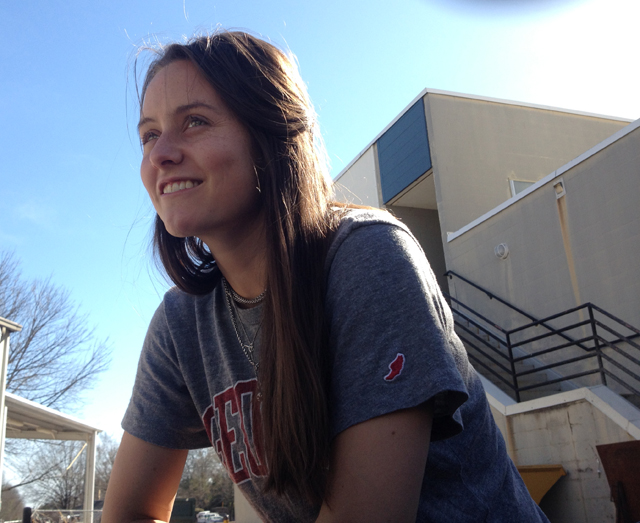
STomanovich_headshotBorn in New Jersey, Shannon has lived in Massachusetts, Delaware and Athens, Georgia but now calls Philadelphia home.  She is captivated by imaginary places like the bottom of a small spring-fed lake in upstate New York; ancient ruins of all kinds and the infinite intricate coincidence of everything.  She has worked as a textile designer, graphic designer, bartender, barista, customer service representative, book repairer, theater prop constructor, house guardian, dog watcher, babysitter, plant water bearer, Senior Citizen visitor, kids clay camp instructor and sandwich maker.  She has exhibited in Pennsylvania, Baltimore, Delaware, Savannah and Athens, Georgia and St. Louis, Missouri.  She has a BFA in studio art from the University of Delaware and a weakness for a good pair of shoes.

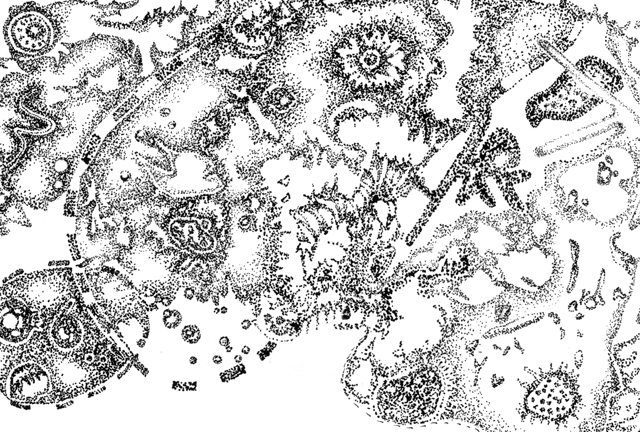
Detail

Detail

shannontomanovich.com

All images copyright of the artist and used with their permission. 
Posted in Drawing, Illustration | Tagged , , , , | Leave a comment

Chris Ivory – Four Marks Hampshire, United Kingdom

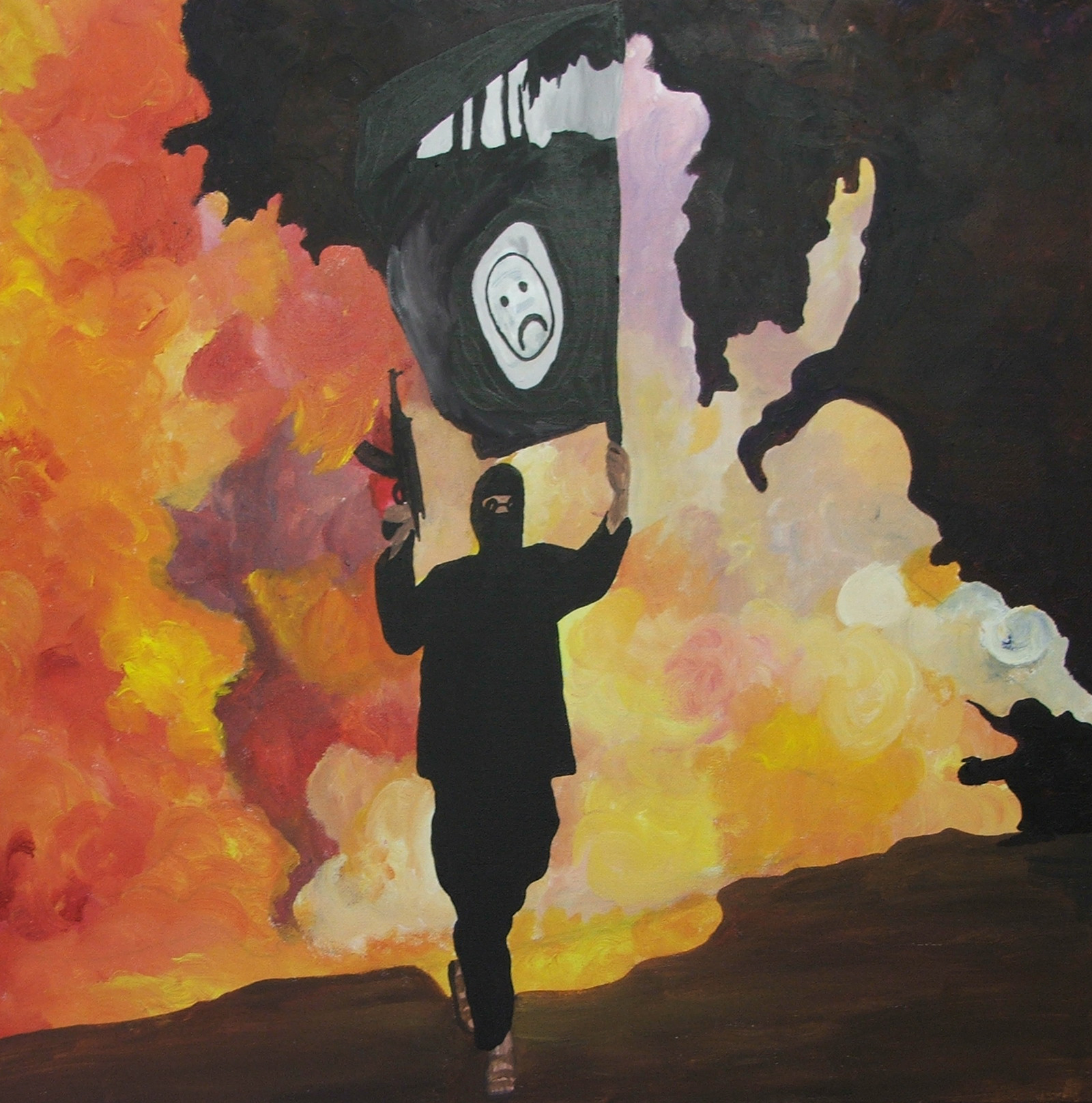
“Faith”. Acrylic on Canvas. Dec 2014 60cm x 60cm

“Faith”. Acrylic on Canvas. Dec 2014 60cm x 60cm

Briefly describe the work you do. 

I make work to try to understand the relationships between people and the invisible constraints that confine them. This may take the form of painting, drawing or sculpture

Tell us about your background and how that has had an influence on your work and on you as an artist.

My background was in nursing – which introduced me to psychology and philosophy – both of which have become intellectual driving forces.

The concept of the artist studio has a broad range of meanings in contemporary practice. Artists may spend much of their time in the actual studio, or they may spend very little time in it. Tell us about your individual studio practice and how it differs from or is the same as traditional notions of “being in the studio.”

In my practice I am always working. When I am not physically in my studio working, I am observing and thinking. The nature of my work as a line of enquiry into human relationships and the constraints that inform them means that every day interactions in turn inform my practice. I often find my best thinking time is when I am engaged in other activities. It is often in these instances that I gain an insight into my work that sends me straight to my studio to make work. In that sense my studio has no boundaries!

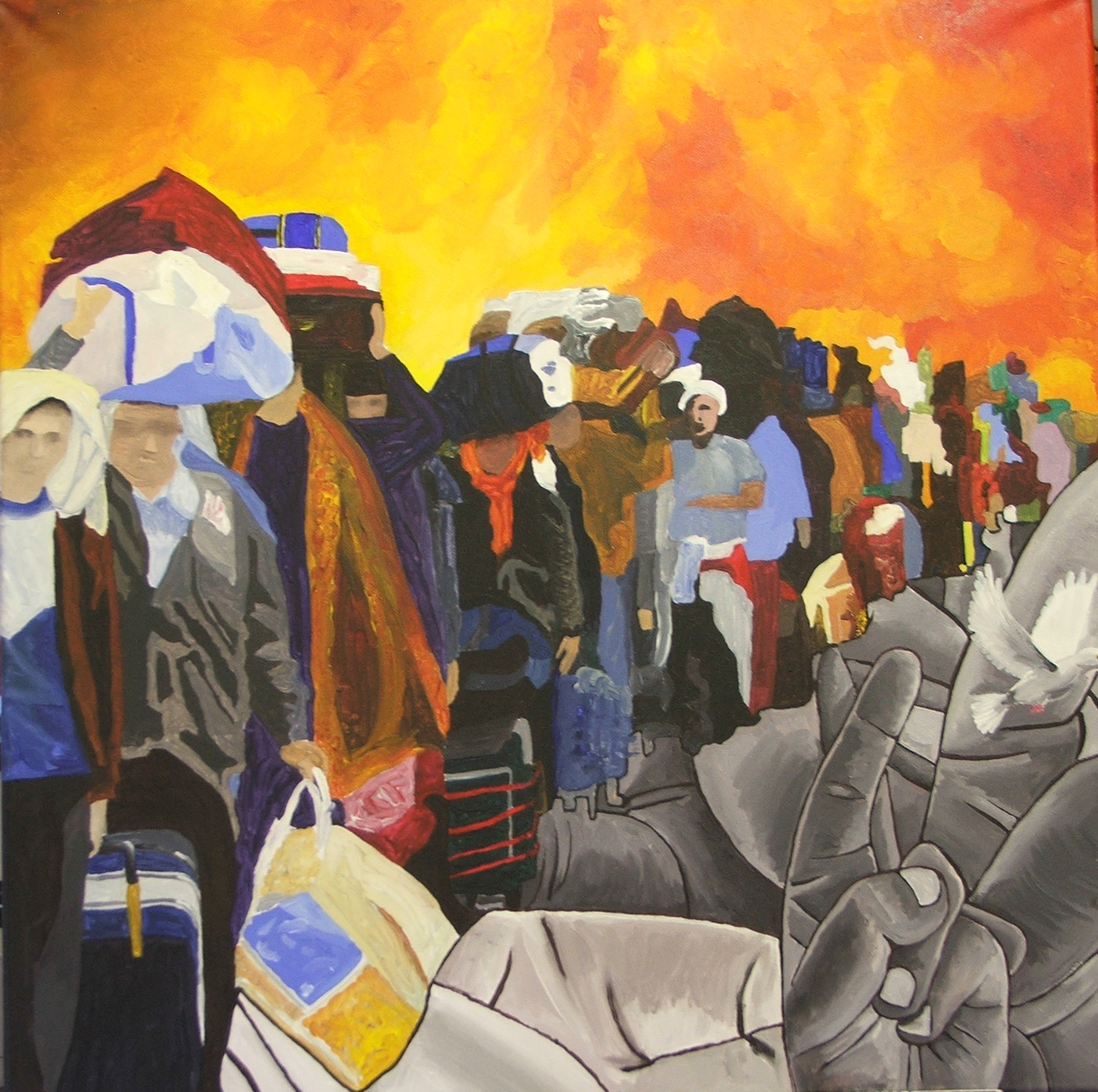
“Hope”. Acrylic on Canvas. Dec 2014 60cm x 60cm

“Hope”. Acrylic on Canvas. Dec 2014 60cm x 60cm

What roles do you find yourself playing that you may not have envisioned yourself in when you first started making art?

Probably the biggest surprise was to find myself teaching. I teach in my local community.

When do you find is the best time to make art? Do you set aside a specific time everyday or do you have to work whenever time allows?

The best time for me to make art is when it consumes me and occupies my every thought – it is at these times that I have to get it out of the ether and realized as a piece of work. I am unable to function in my other roles if I have a piece of work in my mind! I find that this process cannot be forced. Setting a 9 – 5 regime kills my creativity. If I need to work into the small hours of the night then that is what I do. This is much easier now that my family has grown up.

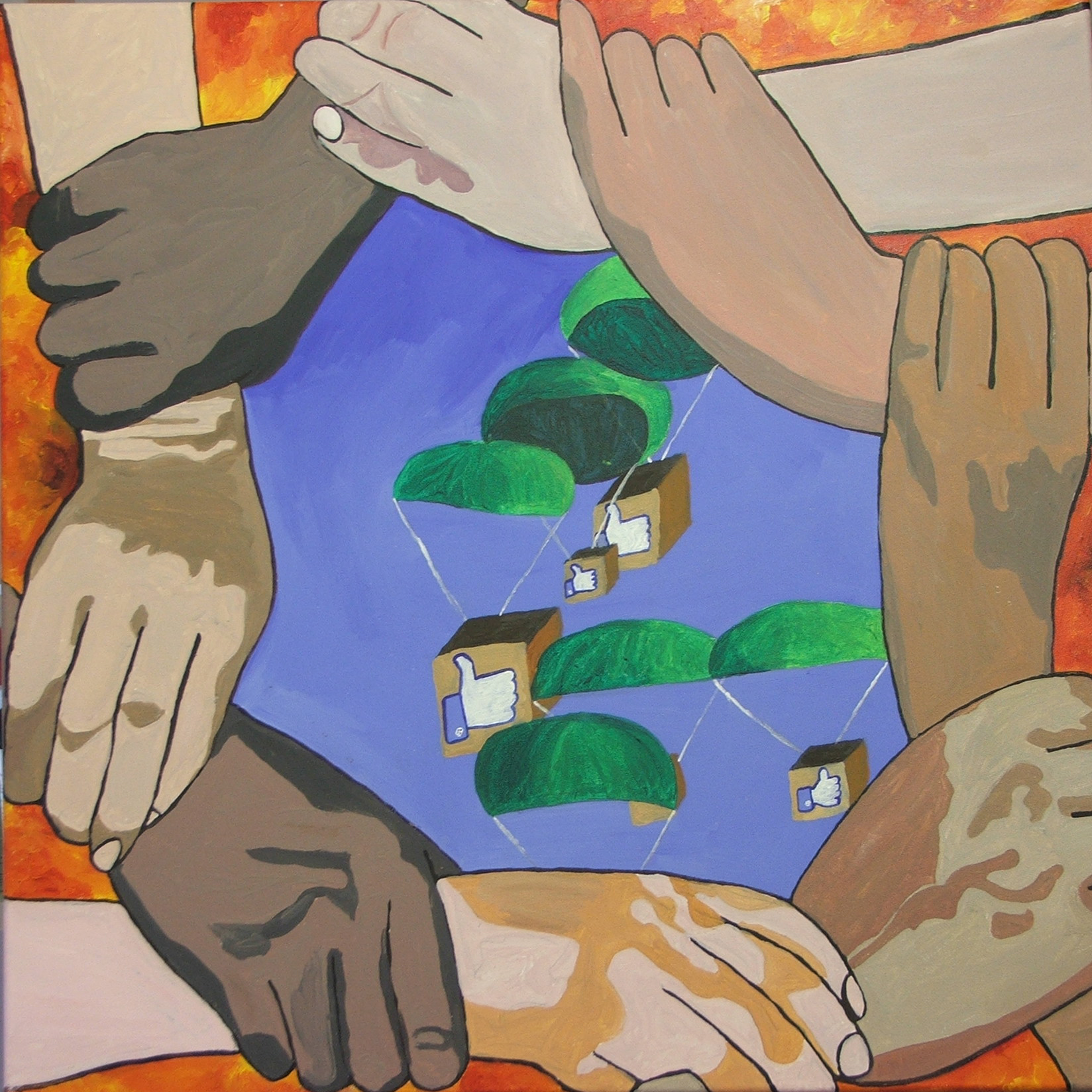
“Charity”. Acrylic on Canvas. Dec 2014 60cm x 60cm

“Charity”. Acrylic on Canvas. Dec 2014 60cm x 60cm

How has your work changed in the past five years? How is it the same?

The last five years for me have been to recover from my art school education. I am rediscovering and reclaiming practices, which I was put off during my BA. I guess I have really taken ownership of what I do and don’t tend to feel pressured into trying to make a masterpiece every time. Some things work and some things do not. I have put a big sign in my studio saying “permission to play!” I still have the same theme runs through every piece I make and I am learning to embrace that.

How have people such as family, friends, writers, philosophers, other artists or even pop icons had an impact on the work you do?

Every thing has an impact on what I do. I am kind of interested in the concept that ideas are viral – when a seed of an idea is planted in your mind it can take root and inform your choices from that moment on. Some are good some are not so good. You cannot un – know things or un – experience them so every thing has an impact especially World events. I think sometimes it is easy to become blasé about the horrific events in the world as reports saturate every aspect of our lives. Social media contributes to this.

Have you ever been pulled in the direction of a pursuit other than being an artist? What are your other interests? 

I am currently training as a counselor – I am hoping to integrate my art practice to work within art therapy. I am aiming to continue making art at the same time. I also love to sing, walk the dogs and learn new things.

About

image001I was born in Taunton in 1968. Before having my family I trained and worked as a nurse, which ignited my interest in psychology. In 2004 I made the decision to pursue my life long passion for art, which has now changed from an interest to a way of life. I am in the process of adjusting to life after art school, and making new work.

chrisivory.me.uk

All images copyright of the artist and used with their permission. 
 

Posted in Painting | Tagged , , , , | Leave a comment