David Delgado – Alicante, Spain

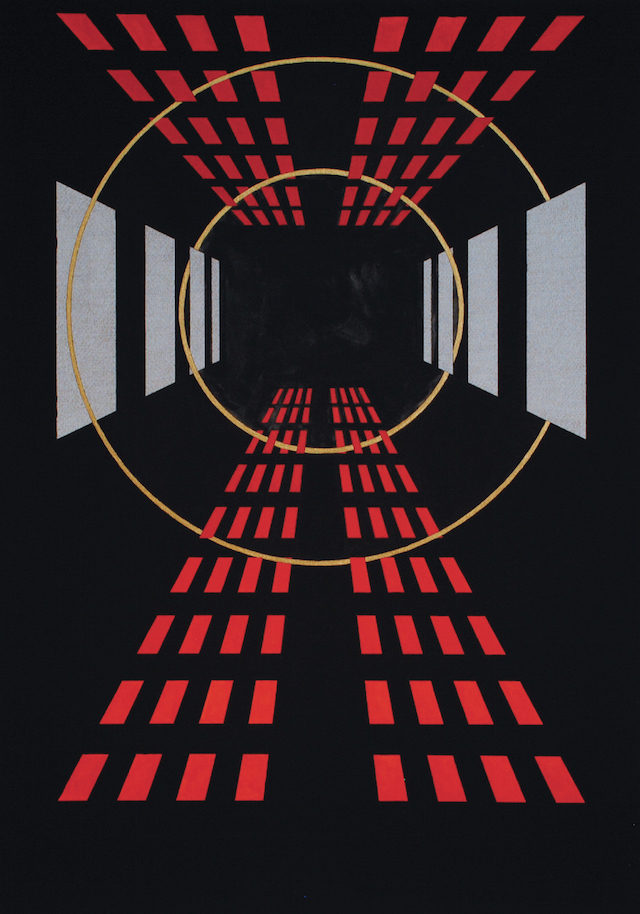
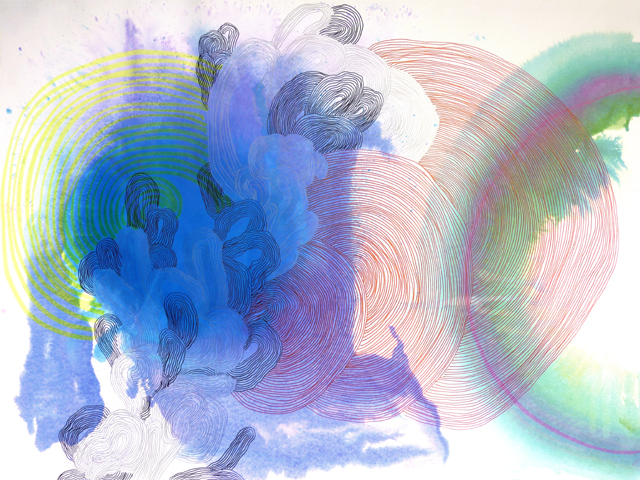
st. (tentacles series) 50x69 cm. mixed media on paper. june 2015

st. (tentacles series) 50×69 cm. mixed media on paper. june 2015

Briefly describe the work you do.  

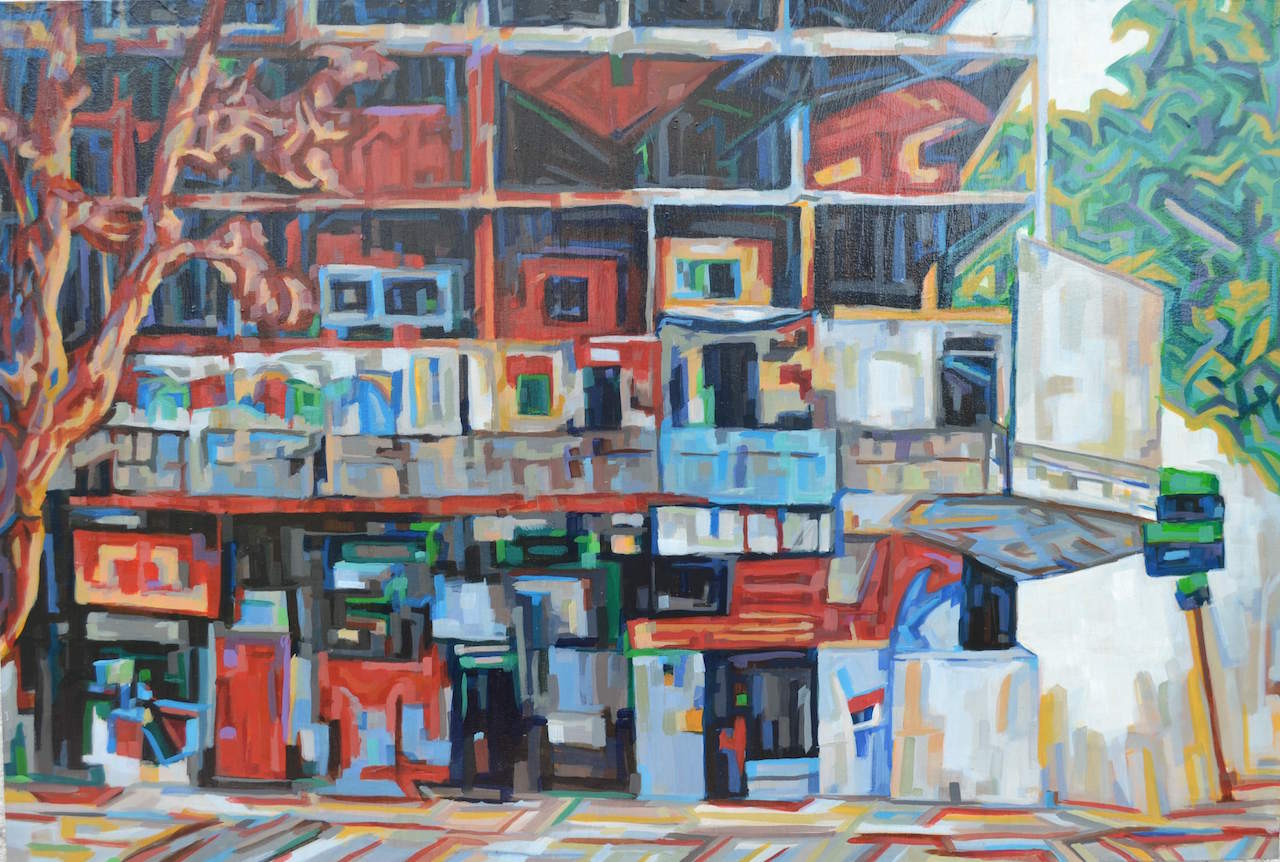
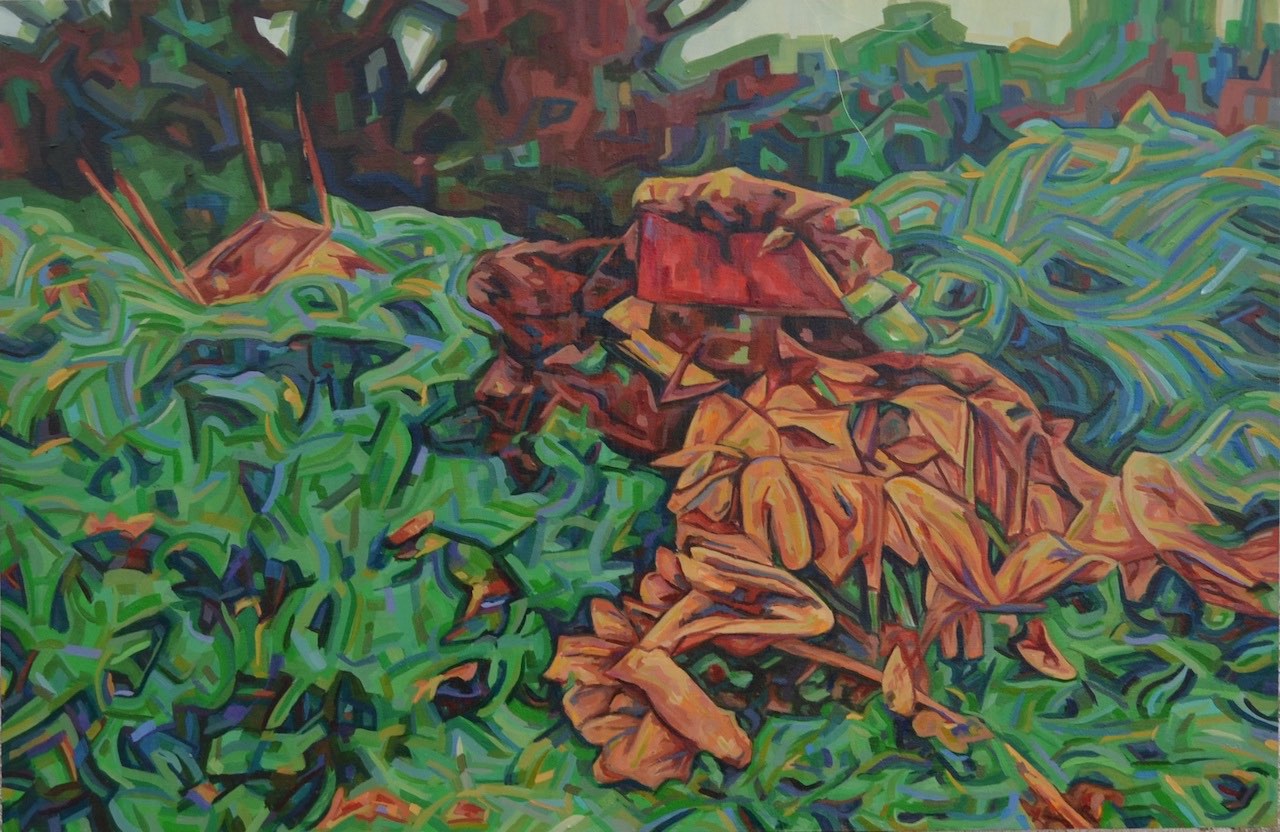
I do mostly paintings. but also digital art, video art and drawing. My work addresses the visual perception. my only aim is to provoke emotions throughout the colors, composition and rhythm. with no narrative at all. I have realised I tend to adopt a mocking tone in my work. Playing with opposing ideas and being deliberately superficial. In some way I feel attracted by the ridiculousness. And I want to put it into a pedestal. I love the idea of playing down the importance of things, including my own existence. But somehow, I fall in the paradox of “to give importance to play down importance”

Tell us about your background and how that has had an influence on your work and on you as an artist. 

I grew up in a middle class family, in a middle-sized town in Spain in the seventies. not surrounded by art or culture at all. but my elder brother liked to paint copying some famous paintings from an encyclopedia of modern art we had at home. i still remember the strong smell of turpentine in our room. and how I enjoyed watching those photos of modern and contemporary art. There was also a little museum in the town. set by a private collection of kinetic and geometric art. I visited a few times. I didn’t imagine how much these images impressed me and conformed my sensitivity.
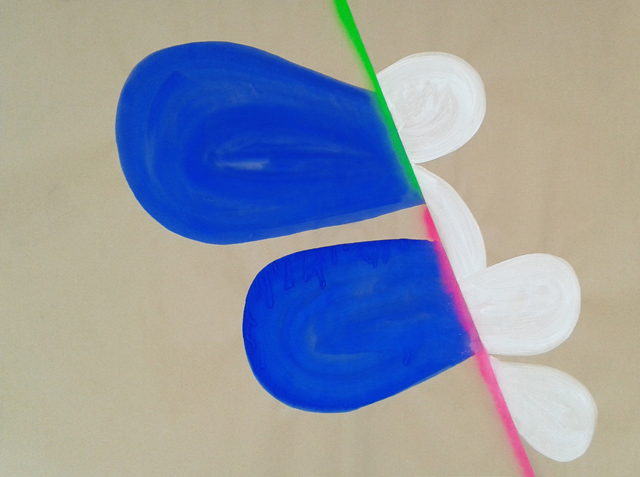
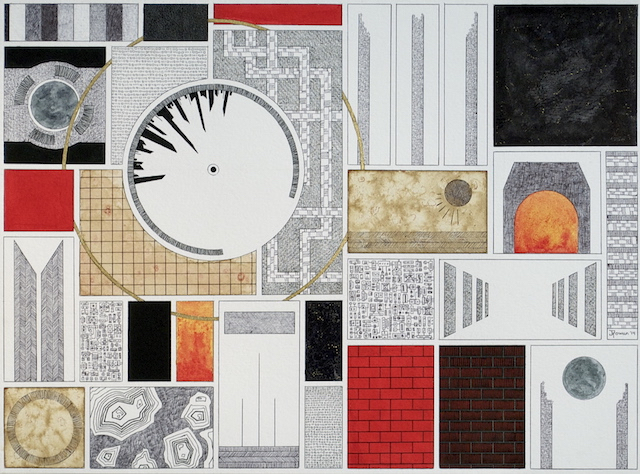
st. (tentacles series) 90x120 cm. acrilic and spray paint on paper. april 2015

st. (tentacles series) 90×120 cm. acrilic and spray paint on paper. april 2015

The concept of the artist studio has a broad range of meanings in contemporary practice. Artists may spend much of their time in the actual studio, or they may spend very little time in it. Tell us about your individual studio practice and how it differs from or is the same as traditional notions of “being in the studio.” 

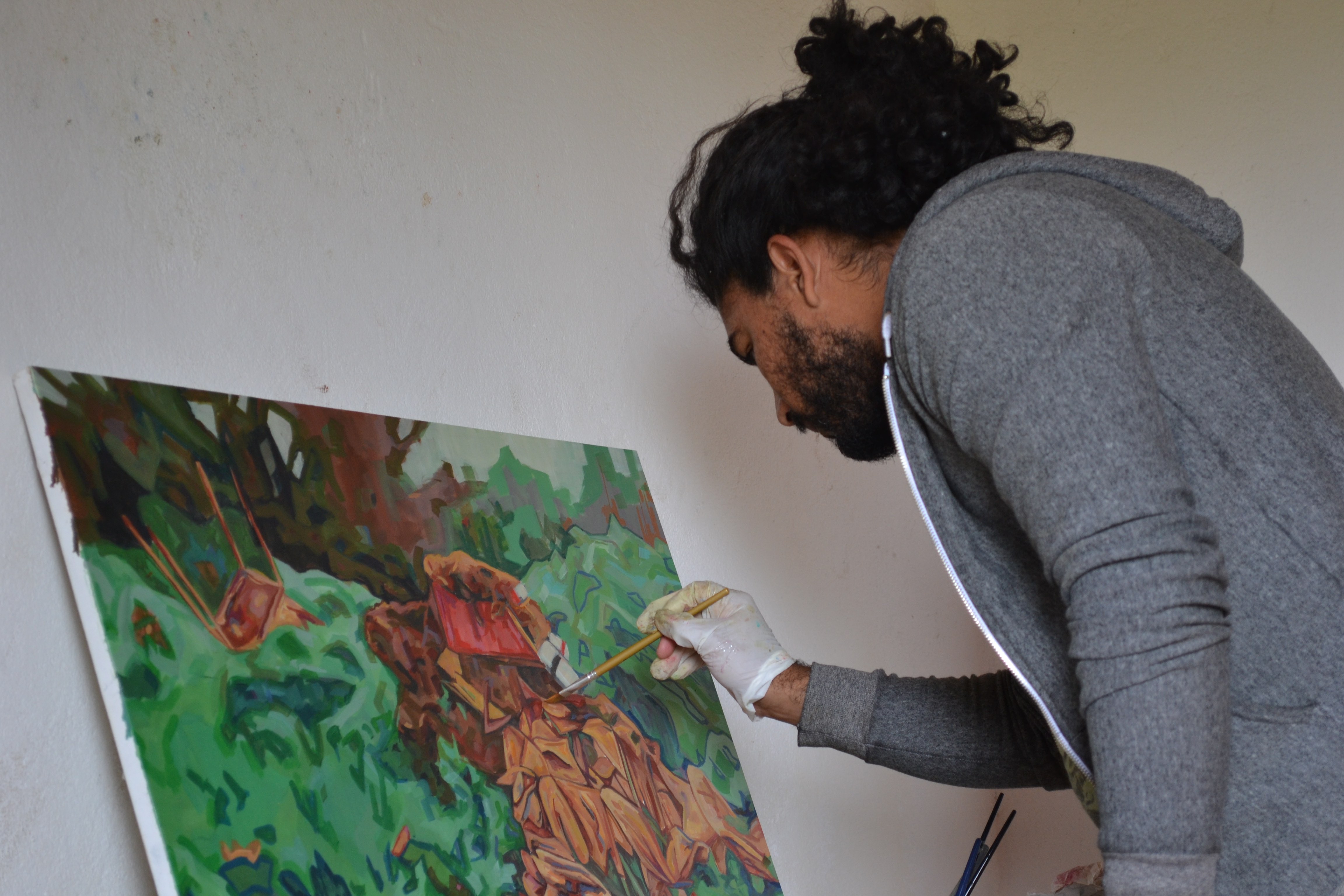
For me the studio is not a sanctuary. it is a necessity. as long as you work with materials and produce objects. I envy writers or artists who only need a laptop or a little pad to develop just ideas or concepts. so they can move around freely and create whenever and wherever they want. in fact, this is the reason I have been thinking seriously sometimes of going exclusively to digital. Finally, I can’t pass over the enormous pleasure that provides me the physical act of painting. Not always I had a proper studio. most of the times I had just a room of the flat. and it hasn’t been a big problem. most of my time I have worked in small format. you don’t need necessarily bigger sizes for making big artwork. At this moment, after moving to Thailand, I found an “artist-in-residence studio” that was temporary. but after the period of stay i was able to rent it. This is, actually a garage. is not a proper studio, nor a proper living space. but I am happy. I have quite good space. I like the place and the location, in the Japanese quarter of Bangkok.

What roles do you find yourself playing that you may not have envisioned yourself in when you first started making art? 

Being a self promoter. a thing which I don’t like and don’t think I do well. but until I find an agent, this is something I can’t avoid.

When do you find is the best time to make art? Do you set aside a specific time everyday or do you have to work whenever time allows? 

I don’t feel there is a better or worse time of the day for creating. the only thing I need is to have free time onwards. so i can get concentrated.
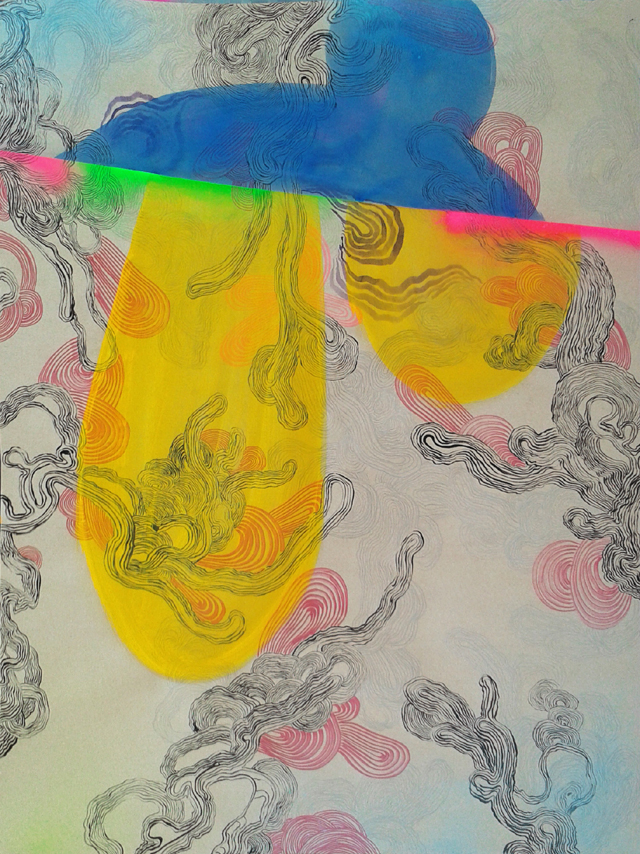
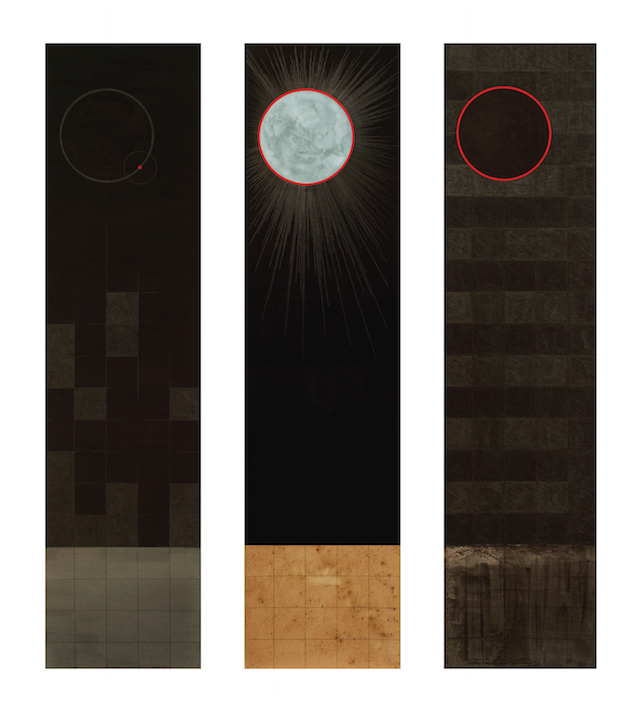
st. (tentacles series) 120x90 cm. mixed media on paper. april 2015

st. (tentacles series) 120×90 cm. mixed media on paper. april 2015

How has your work changed in the past five years? How is it the same?  

I used to go more into drawing. with a tendency of eroticism. I invented a character in between human and doll teenagers, sexy and a bit nasty. and created a little universe of them. I called them “girlinas” (you can google them, if you are interested in) this is very different from the work I am doing now. but I believe I made them with the same spirit in how I approach the ideas and feelings: grace, some kind of stupidity, and spark.

How have people such as family, friends, writers, philosophers, other artists or even pop icons had an impact on the work you do?

This is difficult to say with precision. my work is conformed by how I am. and how I am is the result of an every single experience and circumstance in my life. I recognise the influence of some artists, like jeff koons. or books like “ubu roi”.  but I am not sure if this have more weigh in how I paint and how I am that the memories and the feelings of my childhood.

Have you ever been pulled in the direction of a pursuit other than being an artist? What are your other interests?   

I have studied graphic design and product design. I realised I didn’t like graphic design. but product design is something what I always loved to do. in fact, I must say I feel split between art and product design.

I know that seems to be completely antagonized. but I can say in my mind there are an artist and a product designer. and they coexist very well.

About
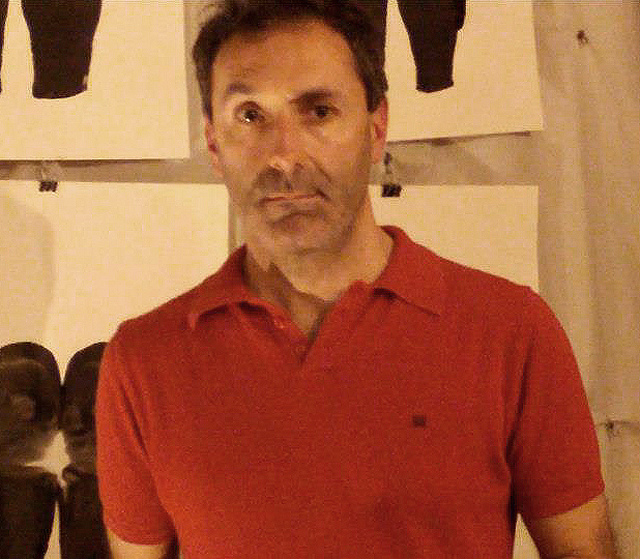
headshotI am David Delgado, a Spanish artist based currently in Bangkok. I have studied graphic and product design. and also illustration and advanced etching techniques. But never worked professionally in those subjects. Since I finished my studies I am dedicated almost exclusively into art. with exhibitions in Barcelona, Switzerland or California, at the beginning of this year, I decided to move to Thailand. I always wanted to come to Asia. I feel very close to asian sensitivity.I do mostly paintings; abstract art. and also sometimes I go for moving images, working on video-creation pieces. Interested in creating emotions through color and rhythm. my personal quest is to reach the absolute grace; grace is for me something above political or philosophical speech; much higher. at least in the practice of arts. my interests go from decorative arts to trash culture. a constant in my work is ridiculous, freshness and honesty.
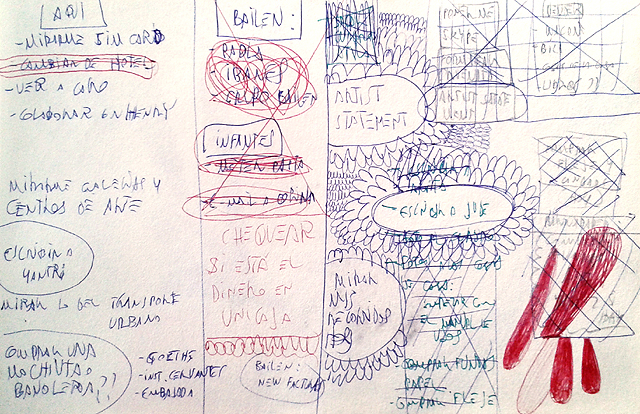
work plan

delgadodavid.com

All images copyright of the artist and used with their permission.  
Posted in Painting | Tagged , , , , | Leave a comment

Marsha McDonald – Milwaukee, Wisconsin

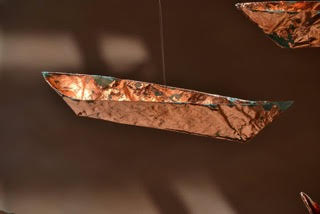
Paper, paint, thread and copper leaf, 1000 origami canoes 12’ x 40’ ( 3.65 x 12.1 metres ) installation 2015

Paper, paint, thread and copper leaf,
1000 origami canoes 12’ x 40’ ( 3.65 x 12.1 metres ) installation
2015

Briefly describe the work you do.

For over two decades, I have undertaken a site-specific “intuitive exploration” of landscapes (including houses) I have lived in or traveled to. My work is intentionally meditative, recording relationships (human, archeological, poetic) that exist or have existed between people, objects and place. I use printing, paint, ink, paper, metal, collected stones and glass, photography and video. Water is physically or metaphorically present throughout my practice. I translate my experiences of rivers, seas, farm fields, streams, and even the homes and household items of the dead, into interrelated image/ object series, using spiritually significant numbers (1000,108, 99, 36, 39, 24,12,7,8, 4, 3, 2). In addition, I write, including librettos for song cycles celebrating the lives of two Americans intensely involved in the natural world, Lorine Niedecker and John Muir.

Tell us about your background and how that has had an influence on your work and on you as an artist.

Water and numeration as spiritual qualities spring directly from my childhood. My grandmother had an enormous influence on my worldview. She lived next to a remnant of northwest Ohio’s Great Black Swamp, and knew a lot of local natural history, herbal remedies and folklore. We visited her nearly every week, often staying over. She could add large sums in her head and used to play counting and guessing games with us.Through her, I learned to value my direct experiences of the worlds of earth and numbers. I also grew up surrounded by difference – many of my friend’s parents spoke a variety of different languages at home. We learned from them about others places and landscapes, mostly near water like our Lake Erie/ Ottawa/ Maumee River area. My father had eccentric friends, loved opera and poetry and art, had a lovely bass voice. My mother was painfully shy, so our family household had both periods of long silence and of music, librettos and poems read aloud, stories told. English language (spoken and read), the watery natural world we played in, and love of the arts were unifying, familial forces. Silence has remained a comfortable state for me. Quiet is equally “home”, whether visually or environmentally.

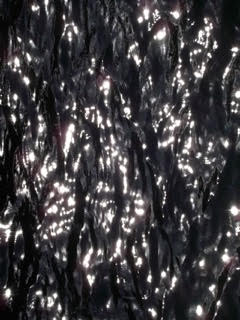
photograph digital archival inkjet print, 13” x 19” (4 x 5.7cms ) 2015

photograph
digital archival
inkjet print,
13” x 19”
(4 x 5.7cms )
2015

The concept of the artist studio has a broad range of meanings in contemporary practice. Artists may spend much of their time in the actual studio, or they may spend very little time in it. Tell us about your individual studio practice and how it differs from or is the same as traditional notions of “being in the studio.”

Hmmm. That’s a great question. I have traveled a lot recently. This year, I’ve only been in Wisconsin 3 months. I still use the studio. But the studio by necessity has also become my camera, my computer, my suitcase, my mind. Travel, being in places that are not mine or outside my culture, is changing my work and changing me. I’m literally outside much more, in all kinds of weather, which is very good for someone intrigued by water, land, and light. Numbers too have become significant presences – temperatures, water levels, earthquake intensities, the stars, the lamps at night and distances between them, transport routes. They are somehow even more numinous as they grow in practicality. How strange the mind is!

What roles do you find yourself playing that you may not have envisioned yourself in when you first started making art?

I am very, very happy to be teaching English to non-English speakers. To me, it is a homecoming, a world where I feel comfortable in my outsiderness, my difference. It’s also allowed me to meet many adults (I teach university or adult sessions) outside the arts, and that is valuable. Too often artists are speaking to themselves among themselves. We need that dialogue, absolutely, but we need to speak to others about what we do and, importantly, listen to their worldview. I hadn’t thought I would find myself doing this sort of work, and I am surprised at how well it suits me.

When do you find is the best time to make art? Do you set aside a specific time everyday or do you have to work whenever time allows?

I meditate every day, I walk every day, I eat every day, I work at my practice every day. I played classical piano for 8 years as a child. Practice is just that – practice. It’s perhaps a little difficult at times, but the flexibility of body and mind, the emotional engagement, is worth it.

e q u i n o x - photograph digital archival inkjet print, 13” x 19” (4 x 5.7cms ) 2015

e q u i n o x – photograph
digital archival
inkjet print,
13” x 19”
(4 x 5.7cms )
2015

How has your work changed in the past five years? How is it the same?

I’m learning more about materials – video, photography, bronze. Painting continues to be a learning experience. My images have slid more and more into the light and darkness of earlier ink and intaglio work, more gestural, yet also I hope more present in actual sighting of place. I am still immersed in watery things and thoughts, in kinds of spiritual numerations. I am still very much tied to the physical nature of my materials – that is, I like to make things that remain, that are left as remnants after the experience of making.

How have people such as family, friends, writers, philosophers, other artists or even pop icons had an impact on the work you do?

As a young artist, I saw a roomful of Mark Rothko’s work and cried. I’m stunned by Agnes Martin and Agnes Varda, indelibly marked by Goya’s prints and late paintings, Picasso’s Guernica. The work of Akira Kurosawa, Kon Ishikawa and Alexander Sokurov has deeply affected me. Robert Grenier’s poetic legacy is huge and so important and clear for me, Stephen Ratcliffe’s temporality blog is quietly monumental and engrossing. Writers Kyoko Yoshida, Marton Koppany, Anca Cristofovici, Royston Tester, and Hans Henning Harmer have all inspired me as they struggle with form and meaning. My closest friend of 36 years, Cynthia Back, is also an artist. My sisters and their families are imaginative, creative, and fiercely pro-union, pro-arts, tolerant working Americans struggling with the current closed-minded political situation. That they are my rock is an understatement. Constant companions have been poets – Rilke, Lorca, Williams, Niedecker, Ko Un and Ikkyu among them. I admire Dogen, Kuo Hsi, Emerson and Muir. I am intrigued by so much writing from fiction to neuroscience. We live in an age when great discoveries and creations as well as acts of selfishness and suffering are equally, and easily, accessible. If we are open and remain fluid, we filter such copious amounts of information throughout our life. It is there in the work. How completely conscious of this influence are we? Even if we are mindful, I believe very little.

Have you ever been pulled in the direction of a pursuit other than being an artist? What are your other interests?

I am art-centred. I believe because of that, I am able to incorporate expansive thinking and doing into my life path.

About

unnamed-2Marsha McDonald was born in Toledo, Ohio, USA. She has lived in the United States and South Korea, working as an artist and teacher in Europe, the Middle East and Asia. She is currently teaching a semester at university in Tokyo, Japan. She has collaborated visually with writers, poets, and composers, including video and still images for writer Anca Cristofovici (Ninebark Press). Recent exhibitions include online platforms for art and poetry in Paris and Budapest, and an exhibition at the Watrous Gallery, Wisconsin Academy of Arts and Sciences. She is currently exhibiting in Venice, Italy and is represented by galleries in San Francisco, New York, and Milwaukee. She lives in Milwaukee, WI.

unnamed

marshamcdonaldart.com

All images copyright of the artist and used with their permission.  


Posted in Uncategorized | Tagged , , , , | 2 Comments

Karen Hochman Brown – Altadena, California

Allium Amaranthine Digital Art/Reimagined Photograph 24 x 24 inches 2014

Allium Amaranthine
Digital Art/Reimagined Photograph
24 x 24 inches
2014

Briefly describe the work you do. 

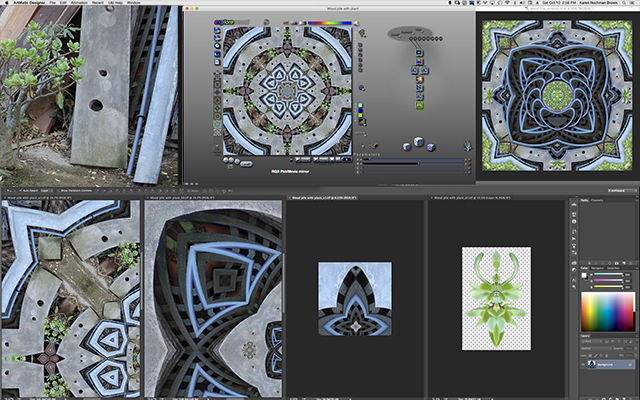
Each piece starts with a single photograph that I manipulate on the computer in many ways before I am satisfied with the finished artwork. I import the base image into a modular graphics-synthesizer program where I can distort and reflect specific elements into kaleidoscopic forms. By operating different functions and formulas—polar space, fractal space, assorted modulations, reflections, waves, distortions, symmetry—I identify, save, and collect a series of images; I call them “foundlings.” In the next step, I use image-editing software, I mask out areas to reveal only the juiciest parts of the foundlings. I continue by stacking them into multiple layers, then manipulate shadows and lighting to create an illusion of depth. As the work develops, I return to the modular graphic-synthesizer, creating additional foundlings as needed.

Tell us about your background and how that has had an influence on your work and on you as an artist

I found my passion for art in my early primary school years. In high school I discovered geometry and did not hesitate to fuse mathematics with my artwork, exploring intersecting circles, and patterns. There was a distinct and immediate marriage of mathematical precision and aesthetic beauty. In college, I continued with art mainly, but still took the occasional math class “for fun.” Through college and into graduate school, I studied art and art education. I created a curriculum for Junior High students teaching geometric concepts and construction using art methods. My biggest breakthrough in art came with the advent of the graphic based computer. I fell in love with the process of creating images on screen and over the years, I found software that was able to merge my love of geometry with my art.

Twig Digital Art/Reimagined Photograph 24 x 24 inches 2015

Twig
Digital Art/Reimagined Photograph
24 x 24 inches
2015

The concept of the artist studio has a broad range of meanings in contemporary practice. Artists may spend much of their time in the actual studio, or they may spend very little time in it. Tell us about your individual studio practice and how it differs from or is the same as traditional notions of “being in the studio.”

I work at home, from my computer. I have a room set up with a wide format printer that I use mainly to make proofs of my work in progress. The actual printing of my pieces goes out to be processed.

What roles do you find yourself playing that you may not have envisioned yourself in when you first started making art? 

I was not prepared for the amount of promotion and I have to do in this age of Social Media.

When do you find is the best time to make art? Do you set aside a specific time everyday or do you have to work whenever time allows?

Whenever I can carve out the time, I like to make art. I find I get lost in my pieces so it is important to have several hours to dedicate at a time. However, the digital nature of my work makes it relatively easy to pick up a piece in the middle of its completion and continue, sometimes years later. I think I work best in the afternoon.

Love In The Fringes-Medallions Digital Art/Reimagined Photograph 36 x 36 inches 2014

Love In The Fringes-Medallions
Digital Art/Reimagined Photograph
36 x 36 inches
2014

How has your work changed in the past five years? How is it the same?

I began The Kaleidoscope Mandala Project about five years ago, so the form of my work totally changed in that time frame. My skill using the software tools has grown considerably, but I am using the same software to create my art that I have used for over a decade. I think my decision making process, which is key for an artist, has gotten sharper so my work is more refined.

How have people such as family, friends, writers, philosophers, other artists or even pop icons had an impact on the work you do?

My father was an amateur photographer and some of his favorite subjects were flowers grown in my mother’s garden. My mother was a bit of a plant collector, so the flower forms were often unusual and rare. I took after both of them, planting my own garden and photographing the blooms. These are the photographs that were used in the beginning of this project.

Have you ever been pulled in the direction of a pursuit other than being an artist? What are your other interests?  

Yes and no. I have many pursuits that do take me away from my artwork. I act with a community theater ensemble and sing with a choir. I like to travel and much of my photography is taken while traveling. But these do not take me away from my true passion, creating my artwork and getting out  into the world.

About

Karen Hochman Brown hedshotHochman Brown had found her passion for art in her early primary school years. In high school she discovered geometry and did not hesitate to fuse mathematics with her artwork, exploring intersecting circles, and patterns. To the artist, there was a distinct and immediate marriage of mathematical precision and aesthetic beauty.  After she received a B.A. in Art from Pitzer College in Claremont, she continued to study math and did post-graduate work at California College of Arts and Crafts, creating a course titled Construction Geometry Via Art. She taught this curriculum at the Arts Magnet High School in Oakland, CA and in Altadena at the Waldorf School. In 1984, after buying her first Macintosh computer, she further tightened the role and interconnection of art and math via the medium of technology. She went back to school again, taking classes at UCLA and Art Center College of Design, to study computer-based graphic design. Using her years of education and experience, the artist creates digital art that explores “hidden worlds” within manipulated reflections of flower imagery, using fractal geometry-based software.

Process shots

hochmanbrown.com

All images copyright of the artist and used with their permission.  
 

Posted in Digital Art, Photography | Tagged , , , , | Leave a comment

Eric Stefanski – Boston, Massachusetts

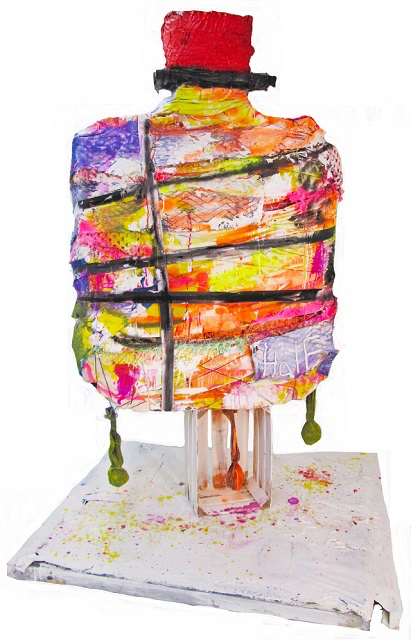
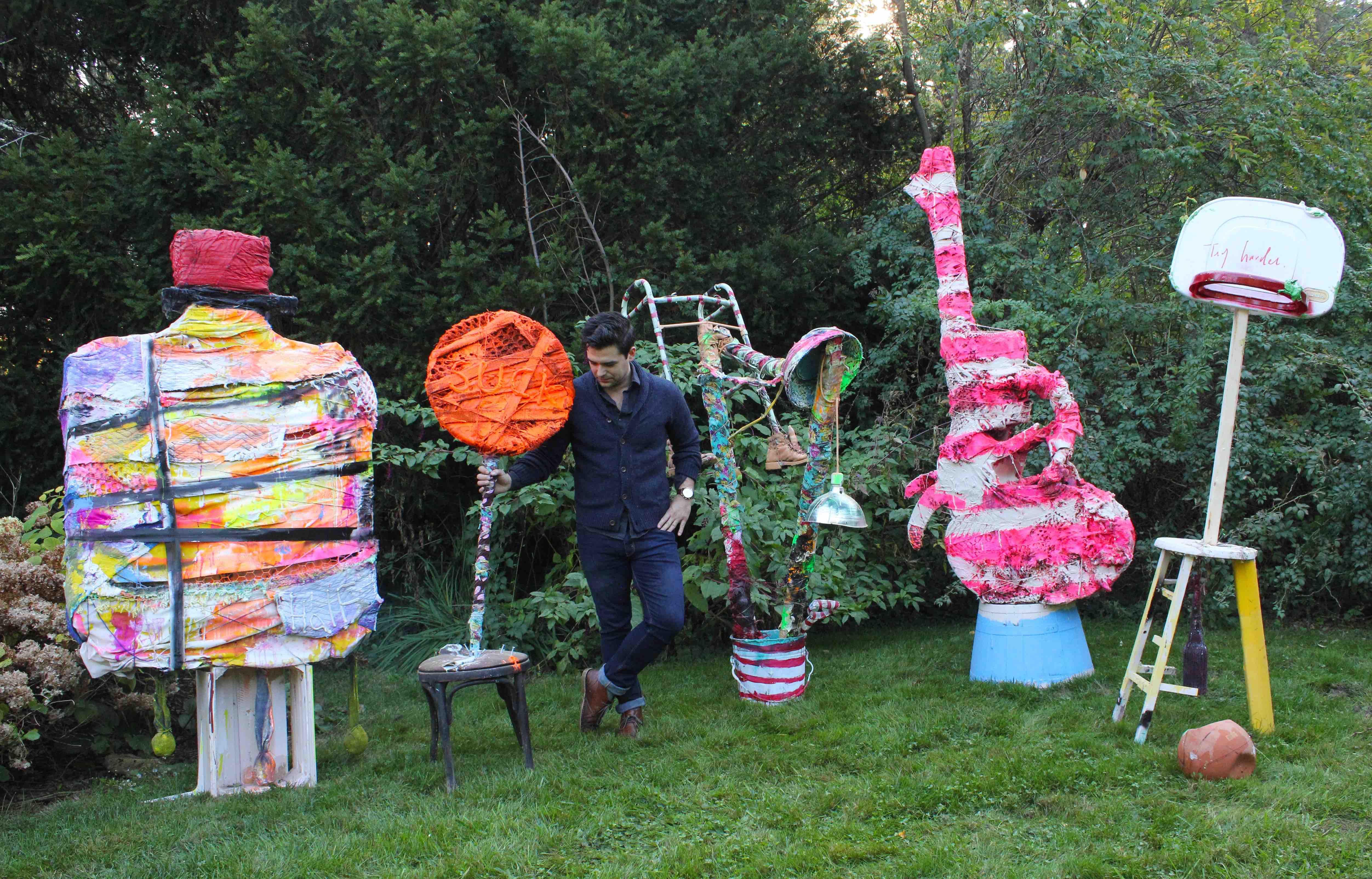
 "Half Pint" wood, crochet fabric, yarn, silicone, spray paint, enamel, nails, tape and acrylic. 95" x 48" x 48" 2015

“Half Pint” wood, crochet fabric, yarn, silicone, spray paint, enamel, nails, tape and acrylic.
95″ x 48″ x 48″ 2015

Briefly describe the work you do.

I make large provisional sculptures and paintings that operate in the area where art history and my personal background overlap.

Tell us about your background and how that has had an influence on your work and on you as an artist.

Ultimately my work is a reflection on identity and art history viewed through the lens of the South-Side of Chicago. Raised in a middle-class family, these experiences continue to shape my work. The materials, tools, techniques, and palette choices are a direct reflection of this history. I am aiming to capture a duality between the abject and the ironic. In the work, references to alcoholism, gun violence, and mourning run parallel with absurdity and humor.

The concept of the artist studio has a broad range of meanings in contemporary practice. Artists may spend much of their time in the actual studio, or they may spend very little time in it. Tell us about your individual studio practice and how it differs from or is the same as traditional notions of “being in the studio.”

In that sense, I have a pretty traditional studio practice. I arrive in the morning, have coffee and read before I start working. Photographing work, studio visits, writing and responding to emails usually come later in the day. I am currently working in a barn with a large garden so at times it can be isolating and yet placid.

What roles do you find yourself playing that you may not have envisioned yourself in when you first started making art?

Right now I am on faculty at The School of the Museum of Fine Arts, so teaching is becoming a rewarding component of my practice, much more so than I ever expected. Also at the suggestion of some great people, I started writing about my own work and that exercise has been invaluable.

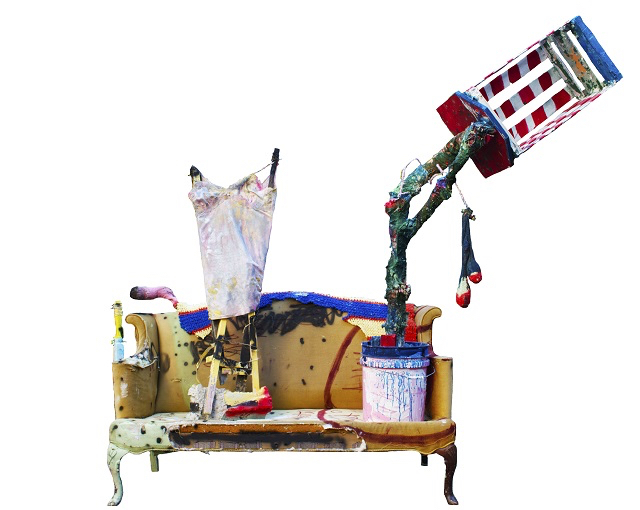
"Couples Therapy" concrete, wood, silicone, yarn, crochet fabric, tar, enamel, spray paint and acrylic.

“Couples Therapy” concrete, wood, silicone, yarn, crochet fabric, tar, enamel, spray paint and acrylic, 102″x72″x44″, 2015

When do you find is the best time to make art? Do you set aside a specific time everyday or do you have to work whenever time allows?

I really enjoy working in the morning. I find having a set schedule in the studio works best for me, the discipline keeps me focused and productive.

How has your work changed in the past five years? How is it the same?

I initially began just making abstract paintings and small collages. That evolved into making sculptures informed by the paintings. Now the sculptures usually come first and then the paintings. Although deriving content from the heavy emphasis on materials has remained a constant.

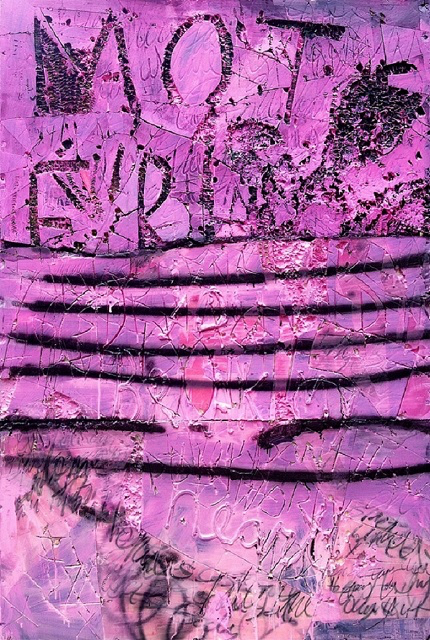
"Purple America" acrylic, oil, charcoal, spray paint and silicone on insulation board mounted and sealed on wood frame 84" x 48" 2015

“Purple America” acrylic, oil, charcoal, spray paint and silicone on insulation board mounted and sealed on wood frame
84″ x 48″ 2015

How have people such as family, friends, writers, philosophers, other artists or even pop icons had an impact on the work you do?

My personal history has probably had the greatest impact on my work; where I grew up, my parents etc. but I like to sample from a broad range of vocabularies. Whether it is literature, poetry, popular culture, specific artists, human sexuality and domesticity, they all seem to play a recurring role.

Have you ever been pulled in the direction of a pursuit other than being an artist? What are your other interests?

Not really. I listen and play a lot of music but I find this challenging and too much fun to want to pursue anything.

About

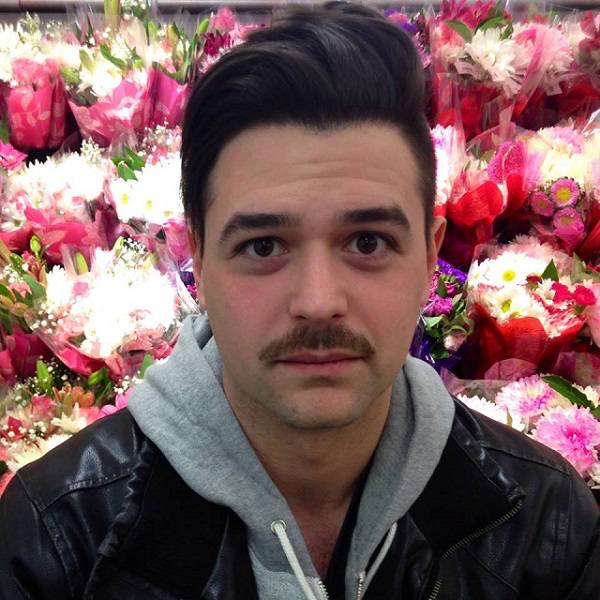
Eric Stefanski Head ShotBorn 1987. Eric Stefanski is an artist that lives and works in Chicago IL. and Boston MA. He holds a BS from DePaul University, attended the School of the Art Institute of Chicago and holds a MFA from Tufts University/School of the Museum of Fine Arts. He has exhibited widely throughout the United States and his work is held in numerous public and private collections. He is currently on faculty at The School of the Museum of Fine Arts and on staff at the Boston Society of Architects.

Studio Shot (1)

ericstefanski.com

All images copyright of the artist and used with their permission.  
Posted in Painting, Sculpture | Tagged , , , , | Leave a comment

Frances Kuehn – New York, NY


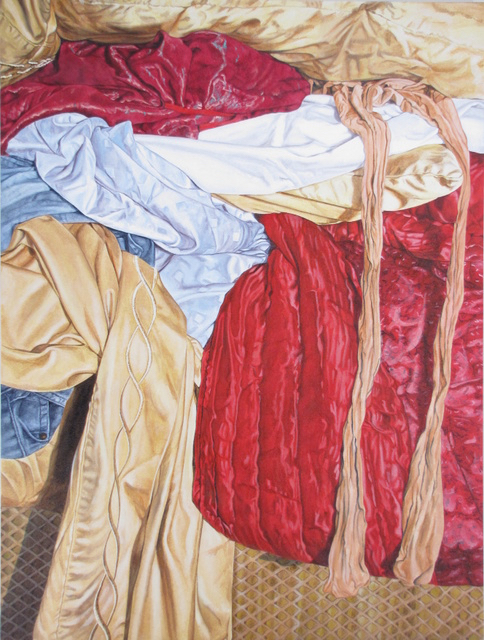
NUDE WITH PRIMARIES, 40 x 30 inches, 2015

NUDE WITH PRIMARIES, 40 x 30 inches, 2015

Briefly describe the work you do.

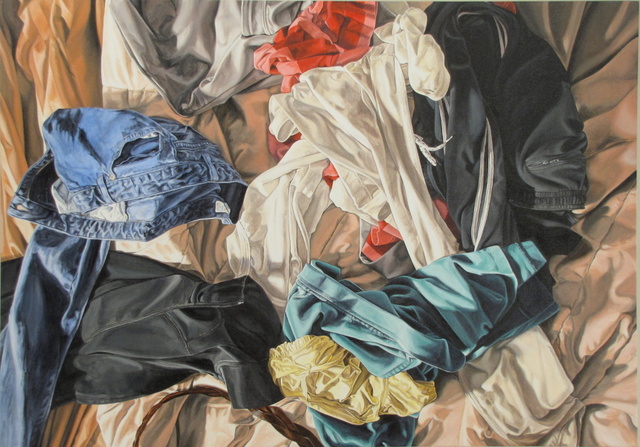
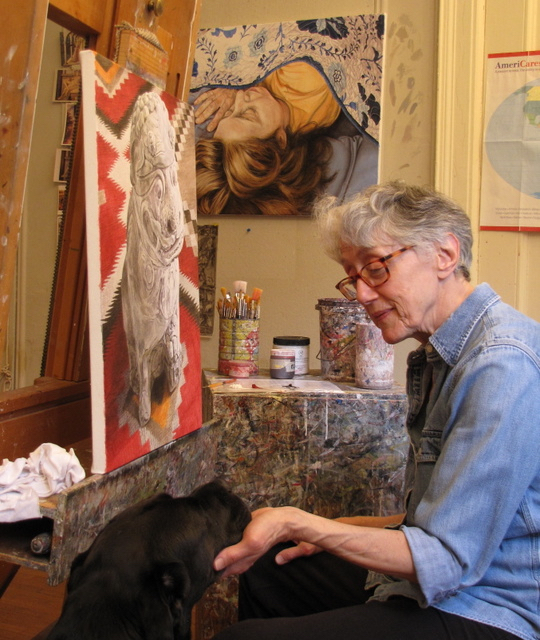
With some exceptions, as the paintings seen in the studio shot reveal, my current and recent work is mostly still life painting, the most abstract of representational painting genres. The subject matter is clothing and bed-clothes, which can be draped, compressed, spread, folded, juxtaposed and mingled, and viewed from a variety of perspectives .

Tell us about your background and how that has had an influence on your work and on you as an artist.

I am a university-educated artist, was a student at Rutgers at a time when there was an unusually interesting group of teachers and students. It was a remarkably stimulating environment, which made everything seem possible.

The concept of the artist studio has a broad range of meanings in contemporary practice. Artists may spend much of their time in the actual studio, or they may spend very little time in it. Tell us about your individual studio practice and how it differs from or is the same as traditional notions of “being in the studio.”

My paintings have always been labor-intensive, because it’s work I enjoy. This means I spend a lot of time in the studio, and my studio has always been in my home.

HOMAGE TO JOHN CHAMBERLAIN 8, 20 x 15 inches, 2012

HOMAGE TO JOHN CHAMBERLAIN 8, 20 x 15 inches, 2012

What roles do you find yourself playing that you may not have envisioned yourself in when you first started making art?

The self-promotion responsibility of an artist is something I didn’t think about much as a beginner.

When do you find is the best time to make art? Do you set aside a specific time everyday or do you have to work whenever time allows?

Ideally, I like to work between late morning and late afternoon every day, but there are days when other things need to get done instead. And there is also value in diversions — hearing music, family and social occasions, travel , etc.

MULTICOLOR OVERALL, 38 x 54 inches, 2009

MULTICOLOR OVERALL, 38 x 54 inches, 2009

How has your work changed in the past five years? How is it the same?

My work has not changed dramatically in the last five years. Big change for me came in 2003, before which I was a figure painter. The implied context of the current paintings suggests an intimate environment and human presence.

How have people such as family, friends, writers, philosophers, other artists or even pop icons had an impact on the work you do?

I think that we are all affected by history and the culture of our time and place, and probably not specifically conscious of the impact of every element.

Have you ever been pulled in the direction of a pursuit other than being an artist? What are your other interests?

I never wanted to pursue another career. At various times I have had other responsibilities, like parenthood and earning a living. I have a significant interest in music, as a listener.

About

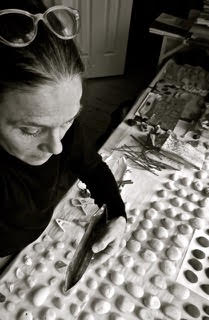
head shotAfter painting the human figure for a long time, in the latter part of 2003 I began making realistic paintings of abstract subjects. Most of these fall into groups or series – the flexible grids, the ribbon drawings, and the curved squares. In general, the subjects were aggregate forms of identical or very similar elements.

Further development of the ribbon images with enclosures led directly to the drawer paintings. The bed paintings continue the overhead view of the dispersed elements, while the chair paintings offer other approaches to the implied body and the fluidity of form.

John Chamberlain’s sculptures were made by assembling crushed materials originally fabricated into other objects.  That process and the diminutive size of some of Chamberlain’s works were part of the inspiration for my “Homage to John Chamberlain” series of paintings.

Development means that one thing continues to lead to another.

Click here to view her CV.

studio shot

franceskuehn.neoimages.net

All images copyright of the artist and used with their permission.  
Posted in Painting | Tagged , , , , , | Leave a comment

Miguel Angel Salgado Rosales – Cuautitlán Izcalli, México

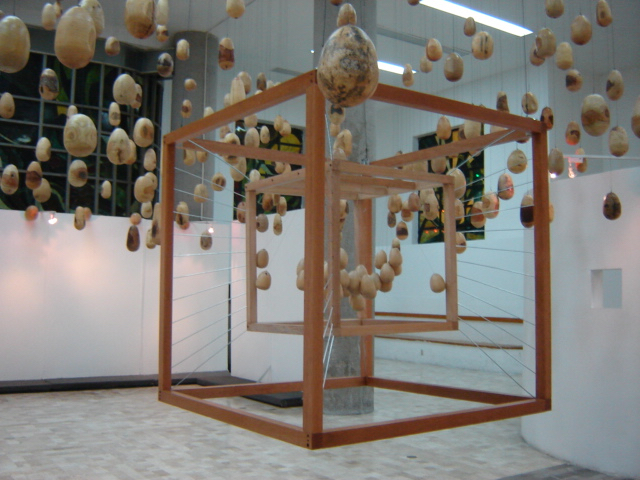
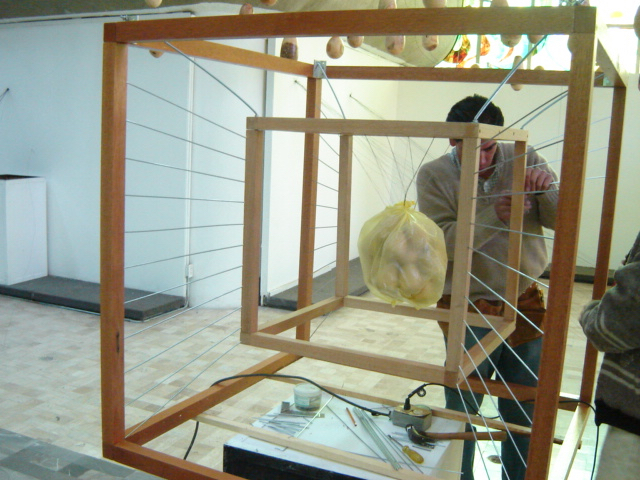
Títle: "Movimiento Suspendido" Medium: Wood (pirul, pine, ash, poplar, jacaranda) Size: 8 meters x 8 meters x 6 meters (26.24 ft x 26.24 ft x 19.68 ft) Year: 2006

Títle: “Movimiento Suspendido”
Medium: Wood (pirul, pine, ash, poplar, jacaranda)
Size: 8 meters x 8 meters x 6 meters (26.24 ft x 26.24 ft x 19.68 ft)
Year: 2006

Briefly describe the work you do.

I am currently working on a project that relates the painting, sculpture and installation at the same time, what I called “Wizards” it is an anthropological study of the first Wizards, half-man half-animal, the first Superman connected to magic andIt takes us back more than 25,000 years in the past and have been an issue that has really impressed me and has been a great challenge for the strength, vitality and character that remain and allowed me to imagine solutions to problems sculptural shape, movement, processing of materials, manufacturing tools had to solve these extraordinary artists, giving me the opportunity to create my own interpretation.

Tell us about your background and how that has had an influence on your work and on you as an artist.

Since 2001 I have taken drawing classes with Maestro Gilberto Aceves Navarro, his influence on my work has been fundamental, has always fueled my concerns, I believe that this attitude of sharing and have a real critical and committed approach has generated in my form of seeing and making art.

I always carry a notebook and pen or graphite, try to capture things that catch my attention, seize the moment, they can be very simple things that give me the ability to generate ideas, expand new fields that can develop in painting, sculpture , installation, stay for exercises memory, imagination or interpretation. They help me see better, to better understand what surrounds me, understand best to be as free as possible and put it into my work.

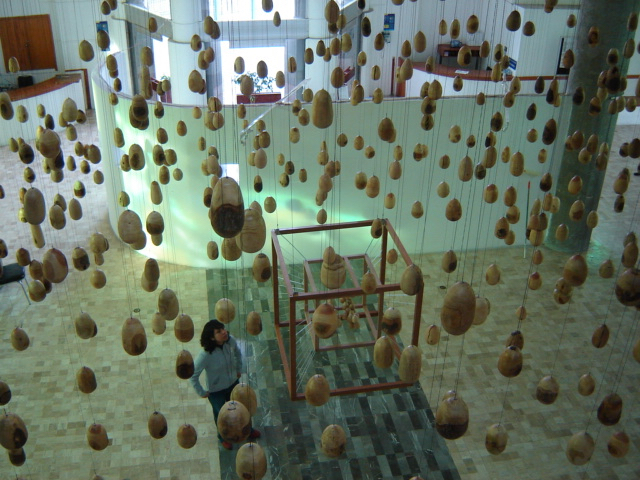
Títle: "Movimiento Suspendido" Medium: Wood (pirul, pine, ash, poplar, jacaranda) Size: 8 meters x 8 meters x 6 meters (26.24 ft x 26.24 ft x 19.68 ft) Year: 2006

Títle: “Movimiento Suspendido”
Medium: Wood (pirul, pine, ash, poplar, jacaranda)
Size: 8 meters x 8 meters x 6 meters (26.24 ft x 26.24 ft x 19.68 ft)
Year: 2006

The concept of the artist studio has a broad range of meanings in contemporary practice. Artists may spend much of their time in the actual studio, or they may spend very little time in it. Tell us about your individual studio practice and how it differs from or is the same as traditional notions of “being in the studio.”

Currently I have my studio at home and attend to the drawing workshop in the morning. For my work is mainly in my workshop has become a base to work and plan new projects, place for reflection and organization, in this aspect I can say that traditional notions of “being in the study” are which I develop my work.

What roles do you find yourself playing that you may not have envisioned yourself in when you first started making art?

The role of the artist is very complex, there are many jobs that I never thought develop to start making art, many of them brand new, but for me all of them have become indispensable, from management on the web, to woodworking, welding , etc.

When do you find is the best time to make art? Do you set aside a specific time everyday or do you have to work whenever time allows?

I do not have a specific time, there are very intense periods of physical work but there are many mementos of research and reflection. I spend many hours drawing and work all day in my work, as Picasso think the moment of inspiration comes when it is working.

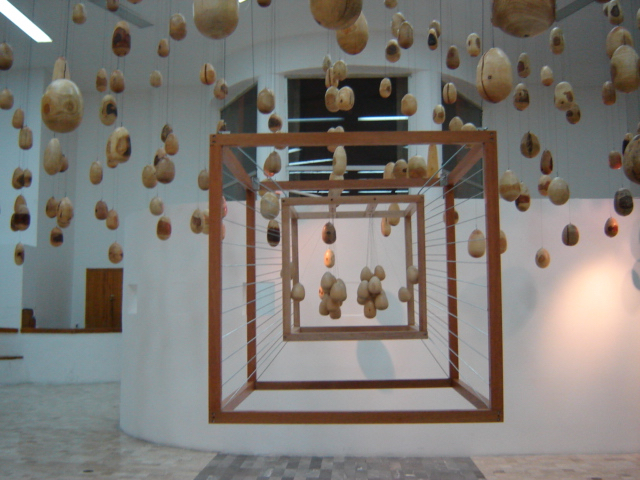
Títle: "Movimiento Suspendido" Medium: Wood (pirul, pine, ash, poplar, jacaranda) Size: 8 meters x 8 meters x 6 meters (26.24 ft x 26.24 ft x 19.68 ft) Year: 2006

Títle: “Movimiento Suspendido”
Medium: Wood (pirul, pine, ash, poplar, jacaranda)
Size: 8 meters x 8 meters x 6 meters (26.24 ft x 26.24 ft x 19.68 ft)
Year: 2006

How has your work changed in the past five years? How is it the same?

It has changed in many ways, I think this is favorable, it has given me the opportunity to gain experience in many fields other unknown and has strengthened security for giving me solve problems. I think as an artist you always experience new challenges, (technical development, new materials, conceptual development, team organization, places to exposure, etc.) have a sensitive insight into the possible and always be aware of what It is happening around me. These five years have generated many more questions than I have answered and I’m on the way to continue learning.

How have people such as family, friends, writers, philosophers, other artists or even pop icons had an impact on the work you do?

The support of family and friends is of great impact on the work, it is the first review I received and often the hardest but also the most honest.

I think as an artist I admire and influence of the work of artists who preceded us, because in it we find things that I identify with, things I would like to experience, learn, interpret and then try to use in my work, with my own view. Great teachers are always a very strong influence and I see it as enriching and necessary in my search.

Have you ever been pulled in the direction of a pursuit other than being an artist? What are your other interests? 

I taught drawing and has been a pleasant experience has enriched me as it is a constant flow of ways of seeing. I am interested to know more about photography, video art, engraving techniques, experiment with new materials and tools to make sculpture. Generate viewers to identify with my work. Basically everything related to my art.

About

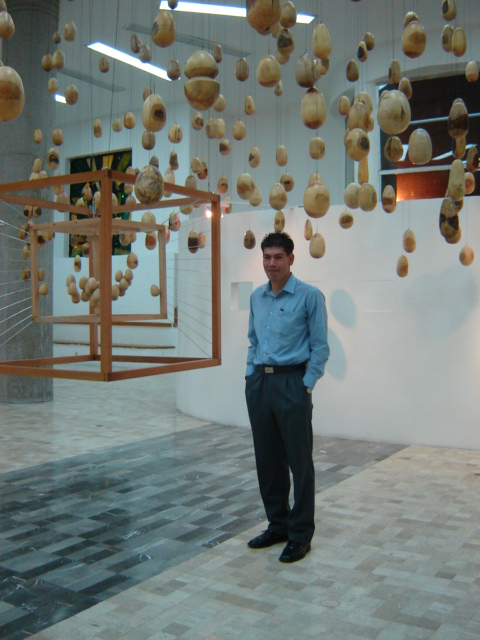
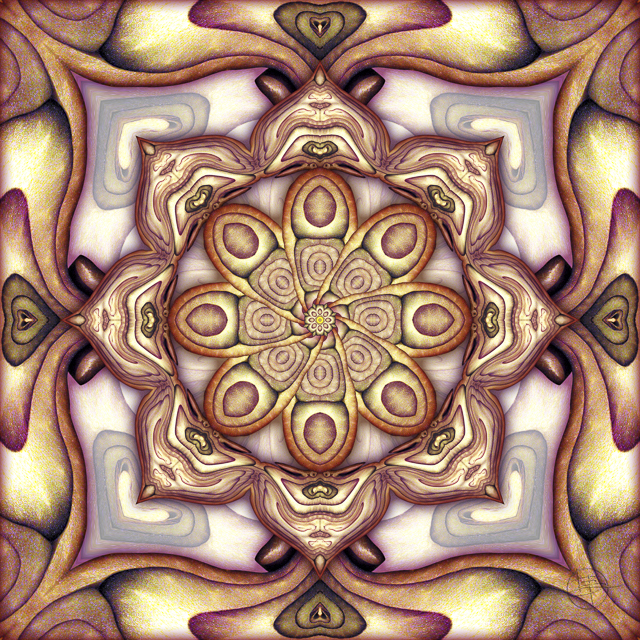
DSC09725Miguel Angel Salgado Rosales, Visual Artist graduated in 2004 from the Facultad de Artes y Diseño   of the Universidad Nacional Autónoma of Mexico, from 2001 to date working in the workshop of Maestro Gilberto Aceves Navarro. He has made the following works: 2006 “Suspended Movement” 650 pieces of wood, Casa de Cultura del Bosque de Tlalpan, 2007 with the artist Maria Orozco “Emptiness fills everything” 1300 pieces of wood, Casa Jaime Sabines, Mexico City, and “Dedicated to my grandfather,” 130, 000 paper boats, Park Abraham Lincoln, Polanco, Mexico City, 2008 “ran from one side to another … and in the morning the show was gruesome … And the square dawned full of shoes … “7 tons of shoes, Center Tlalpan Mexico city. Currently he is working on the play “Wizards”. Currently he is working on the play “Wizards”.

DSC09342

miguelangelsalgado.see.me

All images copyright of the artist and used with their permission.  


Posted in Installation, Painting, Sculpture | Tagged , , , , | Leave a comment

Jacob Rowan – Jackson, Mississippi

Chorus, ink on watercolor board, 23.5”x16.5” 2015

Chorus, ink on watercolor board, 23.5”x16.5” 2015

Briefly describe the work you do

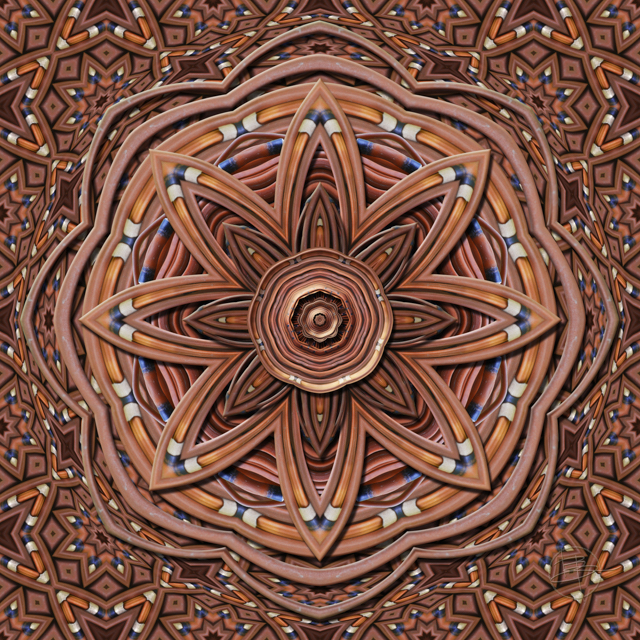
I make drawings in response to what I read. They are not illustrations of events or characters, but rather an externalization of the mental imagery invoked by the experience of literature. I want to pick up where words leave off by creating images to accompany the literature I love. By combing both art and words, I hope that I can enrich the experience of both.  

It’s easiest to say that my main medium is ink, but really that has come to mean all kinds of liquid materials including coffee, tea, traditional sumi, and watercolor. Conceptually, I appreciate the connection of ink and graphite to the writing process and literature. Because my work is based on ideas and structure, I also appreciate the straightforward ease of applying ink and graphite to untreated surfaces. 

Tell us about your background and how that has had an influence on your work and on you as an artist.

Growing up there were two things my mom could never get me to do—draw and write. In spite of that I somehow ended up majoring in art and minoring in creative writing. On the surface, following a last minute whim to study art (sparked by an encounter with drawings of Alan Lee) was not the wisest way to make a major life decision. Fortunately, despite my lateness to the scene, I discovered a deep love for art. I was always a voracious reader and through that developed a way of thinking that prepared me to be an artist. However, as a result I approach art very much like a writer. My drawings are structured like a poem, and I seek to imbue my work with images that evoke narrative and metaphor. 

Nimrod’s Blueprint, ink and graphite on watercolor paper, 11”x15” 2015

Nimrod’s Blueprint, ink and graphite on watercolor paper, 11”x15” 2015

The concept of the artist studio has a broad range of meanings in contemporary practice. Artists may spend much of their time in the actual studio, or they may spend very little time in it. Tell us about your individual studio practice and how it differs from or is the same as traditional notions of “being in the studio.

One great paradox of art is that through the solitude of hiding away in a studio, artists are able to reach out and connect to innumerable others. It can be lonely, but the rewards are great, and I am a big fan of the traditional studio model. In the past my studio has been a corner of the bedroom or half of the living room. Fortunately, I am now blessed to have a small room—which was actually meant to be a storage closet—where I’ve set up my studio. Having a space solely dedicated to making art is hugely important, especially when life is a juggling act in which art-making can’t always come first. I need a space without distractions where the creative “muscle memory” can take over and renew my energy to create. 

What roles do you find yourself playing that you may not have envisioned yourself in when you first started making art?

My vision of the future seems to constantly shift into things better than I could have planned. When I first decided to study art, I envisioned myself as some kind of illustrator or conceptual artist for film. However, in my junior year I had a “conversion” experience and realized that I loved the “fine arts” (for lack of a better term) and wanted to be part of that world. I’ve ended up leading a local organization called the Jackson Art Movement which seeks to connect and build community among artists of all disciplines and mediums. I knew as I neared graduation that I wanted to eventually teach at the college level (and I still do), but a door opened for me to teach middle and high school art at a private school. The challenge of exposing seventh through ninth graders to the world of art and drawing is more rewarding than I imagined, and I am so fortunate to be paid to study and talk about art all day. 

When do you find is the best time to make art? Do you set aside a specific time everyday or do you have to work whenever time allows?

I have found that my best works seems to happen when I’m able to set aside daily time in my studio. Because I teach in secondary education, I start my day early and finish early which means  that, if I’m disciplined, I can manage to fit almost two hours of studio time in before dinner. My goal is to draw at least ten hours a week—an hour or two on every weekday that I can manage it and two to four hours on the weekend. I always carry a sketchbook and use that to fit the thinking/thumbnail part of my process into every spare moment. 

The Plains of Shinar, ink and graphite on watercolor board, Three 40”x10” drawings, 2015

The Plains of Shinar, ink and graphite on watercolor board, Three 40”x10” drawings, 2015

How has your work changed in the past five years? How is it the same?

I’ve only been making art for about seven years, but I’ve still seen a lot of change in the last five. Five years ago I wasn’t very confident in the expressive quality of my work and so I relied on obsessive detail, hoping that my commitment in hours would cover my fear and dazzle the viewer. I’ve grown a lot more confident over time and feel less pressure to overwhelm the viewer and a greater desire to achieve my ends with more subtlety. Obsessive detail and repetitive mark making still intrigue me, and many of my pieces are full of the same detail that was present five years ago. However, I’m allowing that detail to become more subtle and uniform so that pattern becomes texture and the number of hours isn’t as immediately obvious. 

How have people such as family, friends, writers, philosophers, other artists or even pop icons had an impact on the work you do?

My wife is a musician, and I have learned an enormous amount about discipline and the importance of daily practice from her. We also have similar views about art, but she comes at it from the perspective of the performing arts which has helped expand the way I approach and think about my own creative process. She has been a constant muse for me and seems to have an uncanny knack for critiquing with the perfect balance of encouragement and insightful comments. 

The poetry of T.S Eliot has proved to be an almost inexhaustible source of inspiration and insight. 

The contemporary painter Makoto Fujimura has profoundly influenced how I think about art. Aesthetically his paintings are vastly different from my religiously structural drawings, but the way he talks about the role of art in culture and the relationship between beauty and truth speaks deeply to me. 

Have you ever been pulled in the direction of a pursuit other than being an artist? What are your other interests

Because I’ve loved reading for so long, I have often felt that I understand literature more easily than visual art, and about every week or two I wonder if I should have gone into writing. However, I’ve realized that such thoughts usually come when I’m working on something difficult or when none of my experiments have come together. Writing seems easier because it’s an ideal in my head that I assume wouldn’t be difficult for me, but I know that if I were to abandon art and move to writing I would find just as many challenges. I’m learning to embrace the value of the struggle that is being a visual artist. Making art is hard, but it’s a satisfying endeavor to fashion all of my interests and beliefs into visual expression. 

About

Headshot (4)Jacob Rowan is an art teacher at Jackson Academy with a B.A. in Art from Belhaven University. His work explores the idea of illumination—art that creates a visual aesthetic experience parallel to the mental imagery invoked by words. In 2013, he spent six months in Japan as an artist-in-residence for Community Arts Tokyo before starting at Jackson Academy. His work has been included in multiple group shows both in the U.S. and Japan. Most recently, he had a solo show at Pearl River Glass Studio Gallery and had work featured in the Belhaven Alumni Invitational.

Studio (1)

jacobrowanstudios.com/

All images copyright of the artist and used with their permission.  


Posted in Uncategorized | Tagged , , , , | 1 Comment

Dick Evans – Santa Fe, New Mexico

Favorite place to hang out (1)Briefly describe the work you do. 

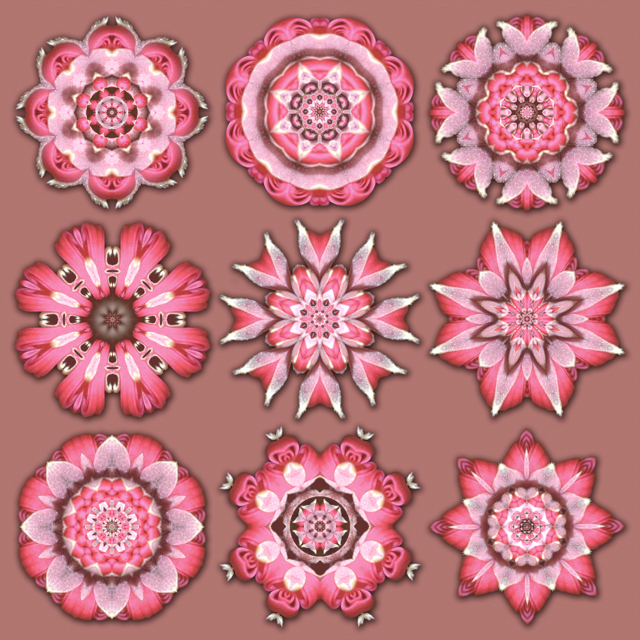
I do abstract paintings, with lots of gesture and brushstroke and color, sometimes loosely based on landscape and sometimes totally abstract. They are explorations, interpretations and expressions of the world around me and within me; which are ultimately the same.

Tell us about your background and how that has had an influence on your work and on you as an artist.

Dick Evans was born in the “Land of Enchantment,” New Mexico, USA. Having grown up in a rural farming community in the panhandle of Texas, he had no exposure at all to art until he started college. Fortunately he was required to take drawing and design courses as he started his supposed major of architecture. He soon realized architecture was not right for him, but also that he loved ART! As he progressed through an advertising art program at Texas Tech, he realized he was more interested in the Fine Arts, and transferred to a rich art program at the University of Utah, where he obtained a BFA in Drawing and Painting, and went on to obtain an MFA in Ceramics and Sculpture.

After completing college, Evans began a university teaching career. His first position was back at the university where he began as a student, Texas Tech. He taught courses in ceramics, drawing, and design. At the age of twenty-nine he was granted tenure. Uneasy about settling into one area so early in life he resigned within the month and set out on his own with wife and two children, establishing studios in Northern New Mexico in which he produced sculpture and ceramics. After a year he realized how much he missed teaching and returned to the university scene. He spent a year teaching at the University of Tennessee-Knoxville. Then he spent three years teaching art at the University of New Mexico. In 1975 he married for the second time. This time to sculptor Susan Stamm Evans, with whom he is still married.   Also in 1975 he took a position teaching art at the University of Wisconsin-Milwaukee. Evans progressed through the professorial ranks to tenure, full professorship, and also a two-year stint as Associate Dean of the School of Fine Arts.

In 1987 the Evans’ made the decision to leave academia and devote full time to their art. In 1990 they decided to return to New Mexico. They moved to Santa Fe and built a house with two studios. Throughout Evans’ teaching career he was teaching primarily in ceramics, and thus also working in that medium as his primary form of expression (although he also produced sculpture in welded steel and cast bronze). In 1991, after several years of creating ceramic murals, he decided to return to his early love of painting. Evans’ art is found in 17 Art Museums and over a dozen Corporate collections. He has had over 30 solo shows as well as numerous group shows and invitational shows. Examples of his work are found in 7 books and many periodicals and publications.

ARRIVAL-OF-A-NEW-DAY---2015---30'x48'---ACRYLIC-ON-CANVAS-- copy

The concept of the artist studio has a broad range of meanings in contemporary practice. Artists may spend much of their time in the actual studio, or they may spend very little time in it. Tell us about your individual studio practice and how it differs from or is the same as traditional notions of “being in the studio.”

The time I am actually painting is not unlike most traditional notions of studio time.  Where my time might be different is the time I am “gathering” material for what goes into the paintings.  Many artists devote time to sketching, either in or out of the actual studio.  I find that nearly all my waking time involves mentally designing and composing everything I see around me.  All that imagery (mental sketching) is stored someplace inside me for use when I am at the easel.  

What roles do you find yourself playing that you may not have envisioned yourself in when you first started making art?

The role of curator and marketer of my own art.  Documenting and marketing takes a far larger percentage of my professional time than I would ever have guessed.

When do you find is the best time to make art? Do you set aside a specific time everyday or do you have to work whenever time allows?

Life is complex!  Oftentimes the needs of others supersede my own needs.  I work when I can and when time allows.  If the painting is simply not flowing, I stop and do menial studio work until I can try again.  I actively search within the time available for my most creative times and then go full blast.  I am fortunate in that I work extremely fast when I do work.  I am able to focus and totally immerse myself.  This is in marked contrast to the way I live a lot of the rest of my life, which is often not all that efficient.

working in studio2How has your work changed in the past five years? How is it the same?

I continually try to keep my work fresh by changing sizes and palette.  Landscape is the basis in my paintings, but during certain series it may lean toward more recognizable imagery (trees, mountains, lakes clouds, etc.) and other times toward totally non-objective.  It’s always abstracted to varying amounts. Purely representational imagery is not of particular interest to me unless it contains compelling mystery.  I find myself re-visiting icons and images that go all the way back to when I was a small child.  Hopefully greater maturity enriches the statement each time these ideas re-emerge. 

How have people such as family, friends, writers, philosophers, other artists or even pop icons had an impact on the work you do?

Most important in impact on my work is simply everything around me, whether landscape, cityscape, or mundane objects around my living space like the food on my late.  I’m constantly composing.

Second are artists whose work has helped me see those things in different ways than I might have without seeing their work.

P. Ryder for mystery, Peter Voulkos for the power of destructive creativity, Milton Avery for composition, Mark Rothko for spirituality and color, Anselm Keifer for psychological impact, My grand daughters, Zoe, Sasha and Sarah for freedom of expression and for focus of what is important.

Third is music.  I am not able to demonstrate a clear relationship between music and the visual arts, but I do know that music in my studio is very important to the release of creative juices, and to the build up of energy necessary to pursue the painting as long as it takes.

About

Headshot (3)Dick Evans was born in the “Land of Enchantment,” New Mexico, USA. Having grown up in a rural farming community in the panhandle of Texas, he had no exposure at all to art until he started college. Fortunately he was required to take drawing and design courses as he started his supposed major of architecture. He soon realized architecture was not right for him, but also that he loved ART! As he progressed through an advertising art program at Texas Tech, he realized he was more interested in the Fine Arts, and transferred to a rich art program at the University of Utah, where he obtained a BFA in Drawing and Painting, and went on to obtain an MFA in Ceramics and Sculpture.

After completing college, Evans began a university teaching career. His first position was back at the university where he began as a student, Texas Tech. He taught courses in ceramics, drawing, and design. At the age of twenty-nine he was granted tenure. Uneasy about settling into one area so early in life he resigned within the month and set out on his own with wife and two children, establishing studios in Northern New Mexico in which he produced sculpture and ceramics. After a year he realized how much he missed teaching and returned to the university scene. He spent a year teaching at the University of Tennessee-Knoxville. Then he spent three years teaching art at the University of New Mexico. In 1975 he married for the second time. This time to sculptor Susan Stamm Evans, with whom he is still married.   Also in 1975 he took a position teaching art at the University of Wisconsin-Milwaukee. Evans progressed through the professorial ranks to tenure, full professorship, and also a two-year stint as Associate Dean of the School of Fine Arts.

In 1987 the Evans’ made the decision to leave academia and devote full time to their art. In 1990 they decided to return to New Mexico. They moved to Santa Fe and built a house with two studios. Throughout Evans’ teaching career he was teaching primarily in ceramics, and thus also working in that medium as his primary form of expression (although he also produced sculpture in welded steel and cast bronze). In 1991, after several years of creating ceramic murals, he decided to return to his early love of painting. Evans’ art is found in 17 Art Museums and over a dozen Corporate collections. He has had over 30 solo shows as well as numerous group shows and invitational shows. Examples of his work are found in 7 books and many periodicals and publications.

Regardless of medium, critics and reviewers are always struck by the richness of form and color used by Evans. Reference to the mysterious, emotional and psychological is always a primary concern. Never interested in a “realist” manner of expression, he continues always to attempt to get to a deeper, more personal place. His feeling is that the more personal the statement is, the more universal it may be. By avoiding the visually expected, his art often aids the viewer to see surroundings in a different and richly rewarding manner.

dickevansart.com

All images copyright of the artist and used with their permission.  
Posted in Painting | Tagged , , , , | Leave a comment

James Maria – Reading, Pennsylvania

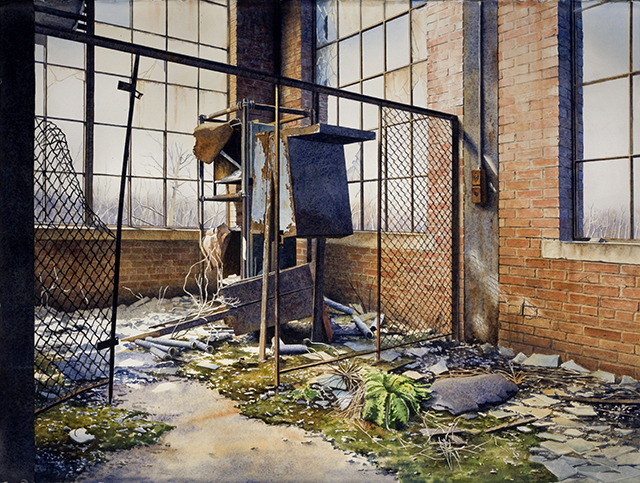
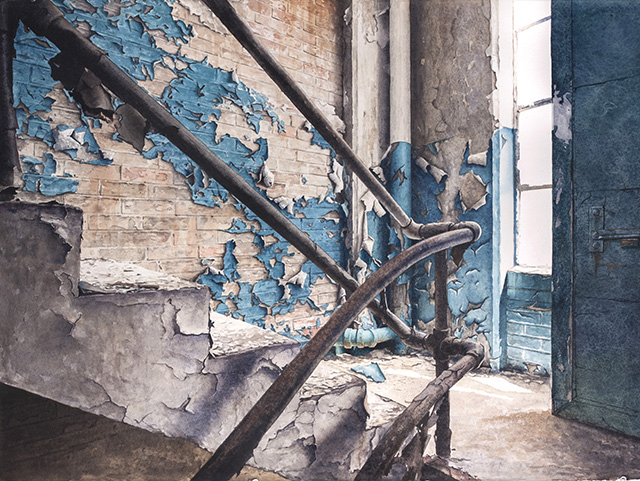
“Thy will be done.” Watercolor, 22x30”. 2014.

“Thy will be done.” Watercolor, 22×30”. 2014.

Briefly describe the work you do. 

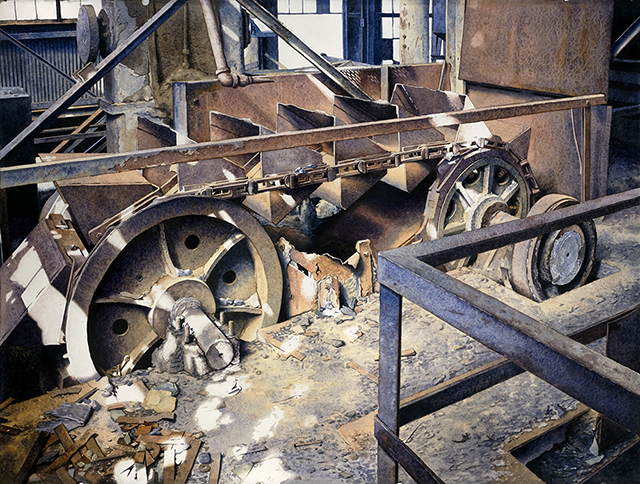
The apparent struggle between the natural and synthetic worlds has long been the subject of painters and photographers alike. I intend that the rusted, crumbling objects and spaces that I chose to paint stand as monuments, not to human ingenuity, but as documentation of the process by which the remnants of industry and invention often fade. I offer gentle reminders that nothing of this world truly lasts-no human innovations, inventions, nor material aspirations. In the processes of oxidation and decomposition, human imposed “order” tends toward the apparent disarray of natural order, and it is here that I’ve encountered captivating beauty. I propose that these images bear witness to the simultaneously destructive and restorative essence of that struggle.

Tell us about your background and how that has had an influence on your work and on you as an artist.

I try to look to my immediate physical surroundings for inspiration because it ensures that I have a connection to the subject. Having grown up surrounded by the vestiges of the coal and steel industries in Pennsylvania, my geographical background has informed the literal subject matter featured in my paintings, while the primary source of my content is derived from my spiritual identity as a Roman Catholic. 

“Deus Ex Machina” Watercolor, 22x30”. 2014

“Deus Ex Machina” Watercolor, 22×30”. 2014

The concept of the artist studio has a broad range of meanings in contemporary practice. Artists may spend much of their time in the actual studio, or they may spend very little time in it. Tell us about your individual studio practice and how it differs from or is the same as traditional notions of “being in the studio.”

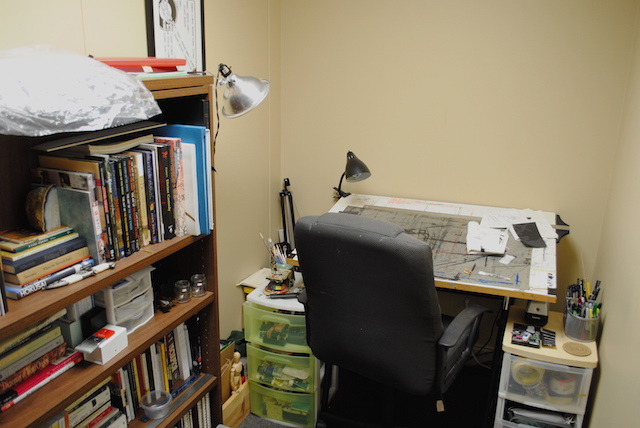
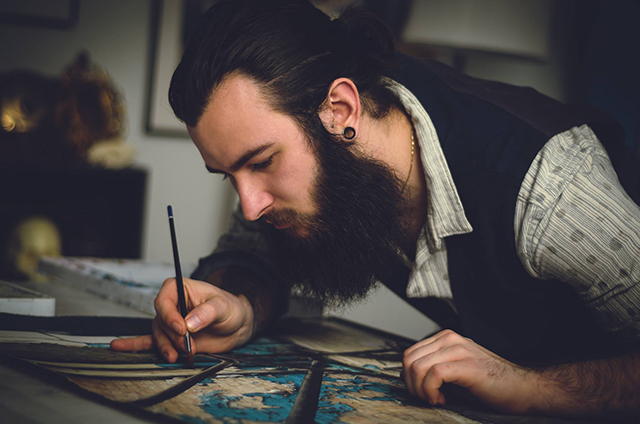
For me, first and foremost, my physical studio space represents a place to “go to work”-a space where I can work without the distractions of my workspace at home. I should also cite the abandonments that I explore and photograph as places where I create my art. While the majority of my painting discipline transpires in my studio, I strive to articulate the emotions that the abandoned spaces elicit when I’m exploring them in search of the perfect reference photos. 

What roles do you find yourself playing that you may not have envisioned yourself in when you first started making art?

I suppose that I, like many artists, envision an idealized version of a career in the arts. At the outset of my fine arts education, I never would’ve anticipated that I would’ve worked to make ends meet as a wedding decorator, event photographer, graphic designer, tattoo artist or arts educator, but I’ve been blessed enough to reap both the extrinsic and intrinsic benefits from all of these opportunities. 

When do you find is the best time to make art? Do you set aside a specific time everyday or do you have to work whenever time allows?

As much as I’d like to pretend that I’m disciplined enough to maintain a specific time for my studio practice, I’m often happy to get a couple hours in the studio immediately before or after work. 

“Crescente Luce” Watercolor, 22x30”. 2014

“Crescente Luce” Watercolor, 22×30”. 2014

How has your work changed in the past five years? How is it the same?

In the past five years, my work has maintained a lot of core characteristics. I’ve persisted with my style and subject matter; however, I’ve spent a lot of time working through the thematic content of my work. I like to ask questions about the spiritual world, now more than ever, and to reinforce these associations, I’ve explored different materials, disciplines and formats for presenting my work.

How have people such as family, friends, writers, philosophers, other artists or even pop icons had an impact on the work you do?

I draw a lot of inspiration from philosophers and theologians when I contemplate the content of my work-the cycles of desolation and consolation that I try to articulate visually. I think that the greatest impact on my art has been made by my professional mentor, Matthew Daub, whose technical insight and instruction was as influential to my formation as his career advice is now. 

Have you ever been pulled in the direction of a pursuit other than being an artist? What are your other interests? 

I have always felt as though my calling was in the visual arts; however, I maintain a pretty diverse bunch of hobbies including music performance, collecting firearms and automotive mechanics. 

About

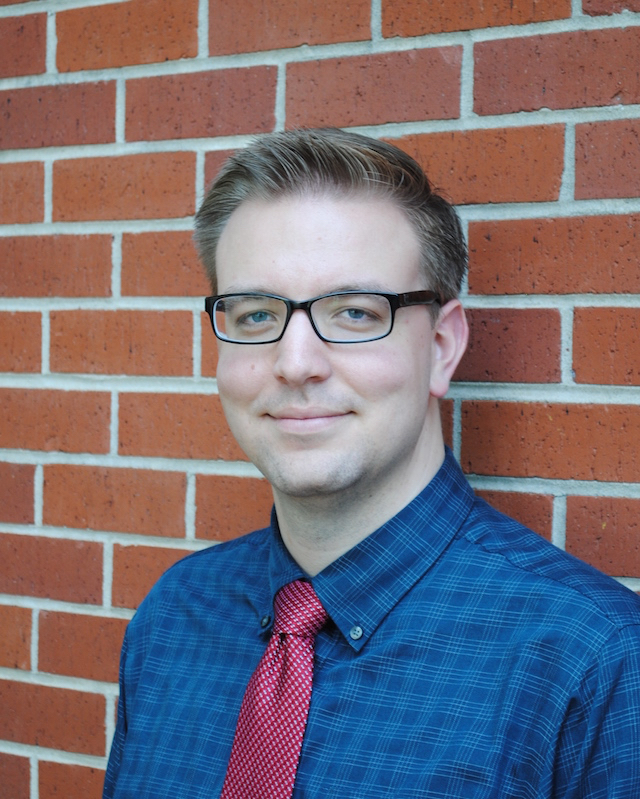
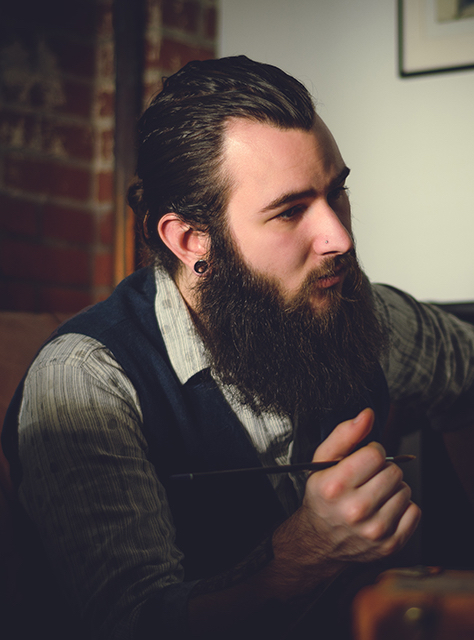
JMARIA_HeadshotJames Maria a nationally exhibiting and award-winning watercolorist. He completed a BFA and a BS in Art Education at Kutztown University’s College of Visual and Performing arts, where he concentrated in painting with specific attention to watercolor. Since graduating in 2012, James has participated in various international juried exhibitions as well as producing two solo shows in Lancaster and Scranton, Pennsylvania. James now continues to diligently maintain his studio practice at the Goggleworks center for the arts, in Reading, Pennsylvania, where he also offers private and group instruction in drawing and watercolor technique.

JMaria_Studioshot

jamesmaria.com

All images copyright of the artist and used with their permission.  
Posted in Drawing, Watercolor | Tagged , , , , | Leave a comment

Carlos Franco – Sauce, Canelones, Uruguay

"Waiting" Oil on Linen 24" x 36" 2014

“Waiting” Oil on Linen 24″ x 36″ 2014

Briefly describe the work you do.

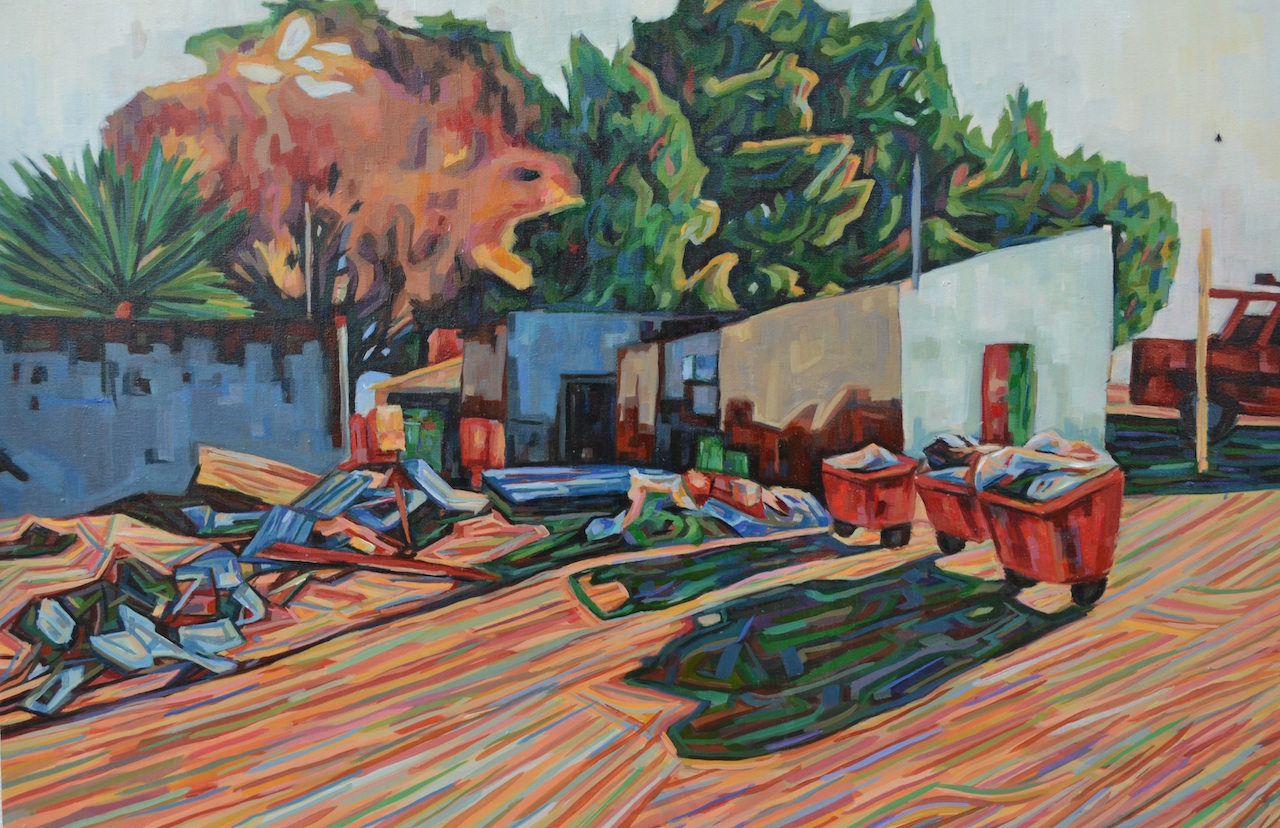
I would describe my work, as a study of ignored moments. All the images that I base my work on share the same theme. Many are busy intersections in the city, a municipal dump, and now working on the flow of water in the surrounding area of my town. My paintings share the idea, that what is being painted has been overlooked by the layman and transformed through abstraction into a new idea of what is truly in front of us. I use my paintings as a way to express the beauty that I see in what I experience in my daily life.

Tell us about your background and how that has had an influence on your work and on you as an artist.

I was born on September 23, 1987 in Managua, Nicaragua, as a year old, my father brought me to the United States as many Central American families did during the 80’s escaping the many wars tearing their countries apart. I grew up in Miami, Fl and during high school was selected to attend South Miami Senior High School for their Commercial Art Magnet program. When I graduated I was interested in world events and was looking to different avenues for a degree. I would attend Miami Dade College and there would slowly begin to be interested in art and continue my education at the University of Miami.

When I transferred to the University of Miami, I began to look for my own voice, how to express who I am as a person through my work. As I researched images and ideas, I was influenced by my trips to Nicaragua a few years earlier, remembering how I wanted to that scenery that I recall during my summer with my grandparents. I began painting images found through books and google, the biggest influence at this time was the book “The places we live” by Jonas Bendiksen whose images of slums around the world reminded me of many areas I would see in my native country.

The work I created during my time in college continues to show and be developed into what I am working on now, that features more of where I live now, working from images that I shoot rather than images from the internet. The influence of my background and culture still comes out strong in the color choices I make within my work.

"Detached" Oil on Linen 24" x 36" 2015

“Detached” Oil on Linen 24″ x 36″ 2015

The concept of the artist studio has a broad range of meanings in contemporary practice. Artists may spend much of their time in the actual studio, or they may spend very little time in it. Tell us about your individual studio practice and how it differs from or is the same as traditional notions of “being in the studio.”

My studio routine is mainly waking up at 6 am for some coffee before I get to some painting from 7 am – 8am. At 8am the day starts, many things that need to be done during the day, such as cleaning, errands and manual work on the farm. Most of my meaningful production comes after 8 pm when my daughter is put to sleep. Without any distraction of the day, I can truly focus on what is in front of me.  I am currently using one of the rooms in my house as a studio, most the room is filled with boxes of books but I am able to make a space for myself.  

I think the notion of “being in the studio” is basically an area where you can hide and make work, free of distractions and the problems of the outside world, the only things that matter is the work. The studio is where I do all of my thinking and writing, I’ve tried other areas of the house but they never seem to work. The comfort of the studio works best to get into my creative frame of mind.

What roles do you find yourself playing that you may not have envisioned yourself in when you first started making art?

When I first started making art, I would never thought I would be more hands on with materials, but with time I have found how essential it is to stretch my own canvas and prepare it for new work. I would think that I would just go to the store and pick out the size of canvas I wanted. But the biggest role I never envisioned is a manager, I need to manage multiple things, from writing proposal, researching open calls and managing my own time. I would detest writing, I felt that my ideas are straight forwards that they did not require more than a few sentence to get to the point. But I know now that I was wrong to think that way, researching and writing about my own work only helped clarify the ideas I have about the work.I remember being in High school and the beginning of college thinking that all I would need to do is create good work and things will start coming around.  That was naïve of myself, two years ago I moved to Uruguay. Not knowing anyone it is difficult to exhibit anywhere, I began to reach out to local galleries and present myself, the work I created in Miami and how it represented me as an artist. Through this I was able to have my first solo exhibition this year. Now looking towards next year, I am constantly entrenched online looking for open calls in Uruguay and Argentina for possibilities to show next year. Which many ask for detailed account of my work and ideas, thinking that writing wasn’t important I have found that to be wrong and now working hard to improve this weakness.

When do you find is the best time to make art? Do you set aside a specific time everyday or do you have to work whenever time allows?

I think the best time to make art would be between 12-4 pm, is when I have the best lighting in the studio.  Most of the time I dedicate every night to painting or working on something that would help build an artistic career. I mainly paint for an hour in the morning 7am- 8am then at night 8pm -12am. That is my set schedule for making work. Only during rainy days do I paint during the afternoon.

"Overgrowth" Oil on Linen 24" x 36" 2014

“Overgrowth” Oil on Linen 24″ x 36″ 2014

How has your work changed in the past five years? How is it the same?

2011 was the last semester at the University of Miami, I would spend countless hours in the studio, making work like a mad man, spending days and days pulling all nighters alone just to get as much work out before I finished school and would no longer have a space to paint in. That would be the time I would paint in that manner. From summer 2011-2014, I would become busy with life, everything else go in the way of creating art. I would do doodles and small linocut but nothing serious. I would say Fall 2014 is when I began to get serious about my work, after speaking with the owner of Roggia Galerie and the promise of a solo show fall 2015. My recent works, builds upon the work of slums that I made while in college but improved in technique and execution. I would say the biggest difference is my dedication and focus towards creating, there are moments that I give myself a few nights without painting but soon after my anxiety hit me and the need of creating over takes me.

How have people such as family, friends, writers, philosophers, other artists or even pop icons had an impact on the work you do?

My wife has had the biggest impact on my work, since she is always pushing me to be the best I can. Always supporting me to achieve my dreams when they seem farfetched. Friends have had an impact on my work, more than the work is the work ethic. Throughout the years, I had the opportunity to have friends that are there to constantly push me to be the best, a sense of friendly competition to achieve success in the same field.A few artist to had impact on my work are Alex Kanevsky, Brett Amory and Kim Cogan, these have been the biggest influences in painting. I have looked at their distinctive style and admire their work to this day enjoying their development. In school we learn about the greats, but sometimes those that impact the most are those we find for ourselves.

Have you ever been pulled in the direction of a pursuit other than being an artist? What are your other interests?

For a moment, I was thinking of doing police academy to become a cop, it was momentary because I was looking for a stable career when I felt jobs were scarce in Miami. Soon after we began the work to move to Uruguay and that became a distant memory.

About 

Carlos Franco-Ruiz (°1987, Managua, Nicaragua) is an artist who mainly works with painting. Graduated with a Bachelor of Fine Arts from the University of Miami. By taking daily life as subject matter, he explores the lost spaces of our surrounding. His paintings reference recognizable landscapes transmuted into a color field through the abstractions of hues. The result is a deconstruction of an environment ignored.By exploring the concept of landscape in this fashion, his images become a moment of extraction and addition, created through the layering of varnish as the painting progresses. His works explore to challenge conceived notion that everyday existence is mundane. Carlos Franco currently lives and works in Sauce, Uruguay.

DSC_0528

franco-ruiz.com

All images copyright of the artist and used with their permission.  


Posted in Painting | Tagged , , , , | Leave a comment