Kyle Van Heck – Chicago, Illinois

Intervention

“Intervention,” Newspaper collage with spray paint and oil paint, 24×36″, 2011

Briefly describe the work that you do.

I work in a multimedia collage format.  My work is largely composed of old re-purposed newspapers, but can also include other elements such as spray paint, oil paint, electrical wire, book pages, pamphlets and anything else that may come my way.

At what point in your life did you decide to become an artist?

I never set out to be an artist by trade, but when I was younger I was amazed my grandfather’s drawing skills, and tried to emulate his styles in my own drawings.  As I grew older, I became interested in comic books and the different artistic styles they presented.  I filled many sketchbooks when I was a teenager, but it wasn’t until I was at college that people began to ask me to make art work for them based of the few pieces I had already made.

Tell us a little about your background and how that influences you as an artist.

I suppose that growing up with a dad who is a janitor and would frequently save and re-use old pieces of furniture and electronics as a kid, I was predisposed to reusing the things that came across my path as well.  I quickly realized that oil paints and other art supplies could be quite expensive, and began to wonder if there was a way around the high cost and sometimes low return of being an artist.  After I had collaged my whole bedroom wall as a teen, and then had to take it down to move to college, I realized that I could recreate the same effect on canvas and take it with me.

Blood Money

“Blood Money,” Newspaper collage with oil paint and spray paint, 48×72″, 2013

What types of conceptual concerns are present in your work? How do those relate to the specific process(es) or media you use?

The conceptual concerns and topics covered in my work focus on major social and political issues inside the United states, and as such are directly influenced by the media I have chosen to use.  While a painter can go out and buy or mix any color he or she would like, my work is guided by what is printed and readily available to me in major media sources.  Needing red, means I need to source out  pictures of fires or flames, which can be difficult due to the high cost of printing in red ink as opposed to black.  The topics themselves are as diverse as our country’s issues:  Oil Spills, Murder, Financial Crises and so on, but not all pieces will have a political focus.

Bleeding From the eyes

“Bleeding From the eyes,” Newspaper collage with oil paint and spray paint, 2013

We once heard Chuck Close say he did not believe in being inspired, rather in working hard everyday. What motivates you in your studio practice?

I am motivated by the desire to be more than just another person in this world who goes to work every day and goes out on the weekends.  There has to be something more than simply filling a role.  That’s where creativity comes in, and allows me to express ideas, feelings and concerns that I would never be able to tackle from a “normal” point of view at an everyday nine to five job.  I also really enjoy creating my own works, and am sad when I have to see them leave my studio.  I create the pieces for myself based on what I see out of the images I use.  If people choose not to like it that’s ok with me, but when someone wants to take a piece home with them, that’s an added bonus.

IMG_4179

Studio

Influences:  I am attracted to and enjoy making larger pieces and collage work, in part, thanks to the work of James Rosenquist who makes gigantic, sometimes hundreds of feet long, oil paintings based on collages which he lays out in his studio or sketch book.  The political side of it really comes from society as a whole and the influence of pop culture.  Although, I would be lying if I said I didn’t draw some influence from Shepard Fairey & The Obey campaign.

When you are not making art what types of activities and interests do you engage in? 

Other interests aside from art include listening to, collecting and cataloging music & attending live concerts

head shotAbout Kyle Van Heck

If all stories have a beginning and an ending, you will find me somewhere in the middle, constantly creating the role of the lead character who will allow the others to see who they truly are inside. Our world has become overrun with images and information, all of it passing before our eyes which can only absorb the smallest fraction of data, process it, and delete it in order to make room for so…mething else. However, within the overflow of information that we have created and which we now live, there is ample opportunity for education, transformation and realization. In reality, things are never as they seem, nor as we intended them to be.

The mediums in which I create my work, were never intended to be used as such, yet almost as soon as newspapers were printed they were being used for purposes other than that which was intended. Not only does this process re-purpose old material, but it takes original images or pieces of images intended to make a certain message and turns them upside-down or into something else entirely, creating a message built out of small pieces of pop culture than says something infinitely larger as a whole. Still even seen as a whole, the process by which my art is created allows the individual to break down the piece into its original components and draw further meaning from their own point of view. In the end what is created is a work of art with a specific message that can still be interpreted in as many different ways as there are people who view it.

Through the use of news paper as a medium and the addition of other materials such as oil paints, spray paints, old books, electrical wire, plastics, children’s toys, and other recycled, re-purposed or reused materials, it is possible not only to create art, but further to create something out of that with was once rendered as nothing. Order from chaos, a puzzle from the pieces, a message from the fragment, a key to the cipher…

http://www.kylevanheck.com/p&c.html

All images copyright of the artist and used with their permission. 

Posted in mixed media | Tagged , , , , | Leave a comment

Christopher Willey – Milwaukee, Wisconsin

Huginn & Munin

“Huginn & Munin,” digital projection, 2012

Briefly describe the work you do.

I wear a couple hats: artists, lecturer, author, and sometimes curator. Concept is centrally important to my practice. I attempt to infuse meaning into my work by material, process, and form. I try to follow the work, rather than force it into a specific methodology. I am currently researching the intersection of innocence and disaster.

Tell us a little about your background and how that influences you as an artist.

I grew up in Kansas and was constantly playing by creek beds as a child.  I am so fond of the beautiful elements found from this time in my life that I often rely on these natural forms today in the studio.  During graduate school I started thinking about cosmology much more; I find the audacity of humanity to cut up space with our mythologies fascinating.  I find our simultaneous preciousness and insignificance simply awe inspiring.

The concept of the “artist studio” has a broad range of meanings, especially in contemporary practice. The idea of the artist toiling away alone in a room may not necessarily reflect what many artists do from day to day anymore. Describe your studio practice and how it differs from (or is the same as) traditional notions of “being in the studio.”

Look, I love ‘being in the studio,’ (as in the brick and mortar sense), but my artistic practice is so much more than just making.  As a lecturer, the artist-instructor continuum is a part of my practice.  The reason I am here, as in on planet Earth, is to help people share their visual stories.  No matter the level (I have taught children and grandmas.  Scholarship hopefuls, and graduates on full scholarship) – I want to share in their creativity.  I bring all of that into the studio with me.

I should say that pretty much everything I do, on some level is mediated through technology.   To that end my studio has been my conch and collectivo coffee!

plateaus

“plateaus,” graphite, ash, 7’ x 28’, 2012

What unique roles do you see yourself as the artist playing that you may not have envisioned yourself in when you first started making art?

Lately, I’ve been writing a text book and last year I co-curated an exhibition with Nirmal Raja (http://www.nirmalraja.com/index.php).  I consider both of those as non-traditional notions of creativity, but honestly never saw myself as an author or curator.  Additionally, when I started making work I focused on earth-art materials, now I mix in a lot of technology.  Also, I never thought I would be the “tech” guy that I am.  I tell my students that I am 1/2 hippie.  1/2 geek.

When do you find is the best time of day to make art? Do you have time set aside every day, every week or do you just work whenever you can?

I find the best time to make art is during residencies.  A dedicated two-four week period of intense focus is awesome!  But let’s be realistic those art vacations are few and far between.  These days I have to carve out time in my schedule to be in the studio, and that happens whenever I can.   

How has your work changed in the last five years? How is it the same?

In 2009 I was just finishing my graduate studies. While in graduate school I was looking closely at shifts in scale, bringing the human scale to the cosmos and vice versa. Think spirals of shells and the spirals of the Milky Way galaxy. My work still has a nod to larger stars, but is digging deeper into the idea of the dis-aster. “Ill omened stars.”

Today, I am focuses on the intersection of tragic events that I feel embarrassment and shame over. Occurrences senseless school shootings and public bombings that are happening on an almost weekly/daily basis. The stars fit in as dis-asters.

i.e.d. dreamcatcher

“i.e.d. dreamcatcher,” jute, staples, 10’ 8” x 14’ 9”, 2012

Are there people such as family, friends, writers, philosophers or even pop icons that have had an impact on the work you do?

Where would I be without my lovely partner, Tonia Klein (www.toniaklein.com)? Everyday we make something together, and every experience we share impacts the way I see and think about the world. She is my muse.

There are so many people who inspire me, but recently of note are:

Nathaniel Stern (http://nathanielstern.com) continues to push boundaries technologically, and has taught me an incredible amount conceptually.

Shana McCaw and Brent Budsberg (http://www.mccawbudsberg.com) for their craft and self propelled mythologies.

Jon Horvath (http://www.jonhorvath.net) for his serious play with images.

There are dozens of contemporary and modern artists in my pantheon (No particular order.):

Ann Hamilton, William Kentridge, Julie Mehretu, Maya Lin, Louise Bourgeois, Martin Puryear, Janine Antoni, Sally Mann, Cindy Sherman, Kara Walker, Kiki Smith, Leonardo Drew, Anselm Kiefer, Jim Campbell, and Sarah Sze.

If you had an occupation outside of being an artist, what would that be and why?

Cosmologist.  (But I would have to be much better at Physics and Math.)  Looking at the heavens is like going to church for me.  I am constantly fascinated at the unfathomable.  Being part of the search for life outside of what we know would be exciting.  Seriously, I watch the movie Contact at least once a year.

willey_headshot_webAbout Christopher Willey

Christopher Willey earned an MFA in New Genres at the San Francisco Art Institute, and his BFA in Drawing at the Milwaukee Institute of Art & Design. During this time he studied abroad at the Studio Art Center International in Florence, Italy, and at the Burren College of Art, in County Clare, Ireland.

In 2013, he co-curated a national exhibition called Chasing Horizons at the Villa Terrace Decorative Arts Museum, in Milwaukee, WI. Additionally he traveled to Wuhan, China to develop an articulation between the Hubei University of Technology and the Peck School of the Arts. In 2012, Willey participated in residencies at the Vermont Studio Center, Johnson, VT, and at the Interlochen Center for the Arts, Interlochen, MI. In 2011, he was a lead artist on two temporary public art projects as part of In:Site’s “On and Off Capital,” campaign.

Willey has exhibited both nationally and internationally. His national solo shows include: “Exit Music,” at the Dow Center for the Arts Gallery, Interlochen, MI. “Beasts of Burden” at the Frank Juarez Gallery, Sheboygan, WI. “Frontier” at the Prairie Street Gallery, Rockford IL. “Community” at the Northern Clay Center, Minneapolis, MN. Willey has been awarded two Mary Nohl Export Suitcase Grants to install work in Zurich, Switzerland, and Rockford, IL.

Selected national group shows include: To Here Knows When, at Untitled Gallery in Sausalito, CA; BULK with Tony Labat at Queens Nails Annex in San Francisco, CA, and the 25th National Print Exhibition at the Silvermine Arts Guild in New Canaan, CT. His work can also be seen in New American Paintings, issue #65.

Willey is a Lecturer at University of Wisconsin- Milwaukee’s Peck School of the Arts, and a Visiting Lecturer at the Hubei University of Technology, in Wuhan, China. He lives and works in Milwaukee, Wisconsin.

www.christopherwilley.com

All images copyright of the artist and used with their permission. 

Posted in Installation, mixed media, Video | Tagged , , , | 1 Comment

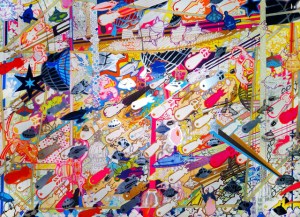
CJ Hungerman – Chicago, Illinois

BA KA MONO Cosmo Robotic Kaotica

“BA KA MONO Cosmo Robotic Kaotica,” painting,
44″ x 60″, 2013

Briefly describe the work that you do.

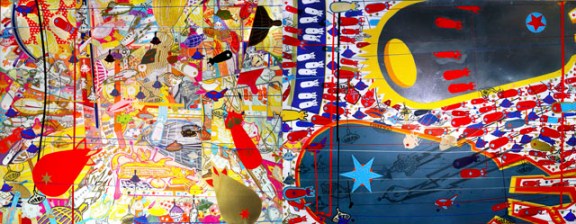
The series Random Robot Attacks is composed of patterned kinetic color chaos interwoven with personal iconic images that represent humans and human emotions.  The hope is that the individual viewer will become lost in the labyrinth of vibrant color patterns evoking an explanation of the art inherent only to that viewer.

At what point in your life did you decide to become an artist?

I have been producing art since I was very young and it has always been a part of my life.

Tell us a little about your background and how that influences you as an artist.

I have had many tedious, unsatisfying, and painstakingly monotonous jobs which has brought me to the point of creating art for the masses to loose themselves in and forget about the grind of their day.

What types of conceptual concerns are present in your work? How do those relate to the specific process(es) or media you use?

I create my work because I must and it is done to keep myself in balance.  I use all of the techniques I have acquired throughout the years, as precis as I can, which makes the process of creating the art important and satisfying to me.

Cosmo Bomb-Rotica

“Cosmo Bomb-Rotica,” painting, 38″ x 100″, 2013

We once heard Chuck Close say he did not believe in being inspired, rather in working hard everyday. What motivates you in your studio practice?

I am in my studio which has no ventilation, no heat, and no windows everyday for 50 to 80 hours a week.  It is dedication, working hard in terrible conditions, and then inspiration that produces the art.  An artist must have some kind of work ethic instead of just creating art when they feel like making art.

What artists living or non-living influence your work?

My influences of historical artist are Warhola, Terry Winters, Gordon Dorn, Ben Mahmoud.  Personal artists that have been by my side and influenced me in every aspect of my life are B.C. MacEachran, John Ronge, Dominic Sansone, Jeff Todd Smith.

Cosmo Bomblastica Reaper Mastica

“Cosmo Bomblastica Reaper Mastica,” painitng, 38″ x 100″, 2013

When you are not making art what types of activities and interests do you engage in? 

I have no job and a family to support so all I do is make art all day…. every day…unending….

hungerman_headshotAbout CJ Hungerman

CJ is originally from Pittsburgh. He attended West Liberty State College and West Virginia University. Upon completion of each undergraduate college he received a B.S. in Graphic Design and a B.F.A in Painting, respectively.

CJ went on to graduate school at Northern Illinois University receiving his Masters in Painting studying under Gordon Dorn, Josh Kind, and Ben Mahmoud.

He has completed many public art projects in Chicago such as one of the 2012 Ryder Cup large-scale golf balls displayed on Michigan Avenue and two five foot Chicago Fire Hydrants currently being displayed at various fire houses in Chicago. Recently he has collaborated with INDIE WALLS for two fantastic public art projects in Chicago. One of CJs pieces won the Alice & Arthur Baer Award in October 2013.

New works can be seen through out the year at FM Gallery, Chicago.

Studio Pics

https://hungerman.see.me 

All images copyright of the artist and used with their permission. 

Posted in Painting | Tagged , , , , | Leave a comment

Fawn Atencio – Denver, Colorado

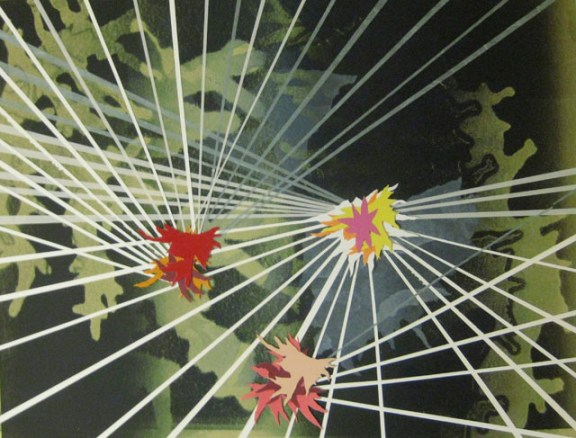
Delta I: Paths of Least Resistance

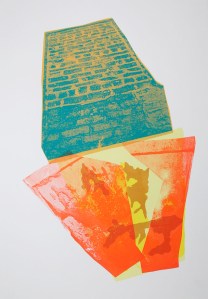
“Delta I: Paths of Least Resistance,” Collograph, Digital Cut Paper, 22”x30”, 2013

Briefly describe the work you do.

I used to make prints. Recently, printmaking is one layer in making other hybrid installation and collage work.

Tell us a little about your background and how that influences you as an artist.

I grew up in Denver, Colorado.  I am an artist and an educator, but most recently took a break from teaching to focus on my own work and to travel with my partner.  I have lived in Asia and Africa for short amounts of time. It was during my travels that I felt a deep motivation for making art again. Perhaps because my experiences were so varied from month to month, I wanted to respond to what I was seeing.

The concept of the “artist studio” has a broad range of meanings, especially in contemporary practice. The idea of the artist toiling away alone in a room may not necessarily reflect what many artists do from day to day anymore. Describe your studio practice and how it differs from (or is the same as) traditional notions of “being in the studio.”

I collaborate with many artists these days. That sometimes happens in a traditional print studio,  an installation space, back and forth via long distance, or a combination thereof. I think tradition is meeting hybrid experiences, and these experiences are leading to a richness in contemporary printmaking.

Delta III :Paths of Least Resistance

“Delta III :Paths of Least Resistance,” Collograph, Digital Cut Paper, 22”x30”, 2013

What unique roles do you see yourself as the artist playing that you may not have envisioned yourself in when you first started making art?

I began curating an annual print exchange last year, which had great success. I was able to oversee this huge project and have it come to fruition. I am presently receiving prints for the second exchange, entitled Westbound to Paradise which will be shown at Tyler School of Art in the Fall and California in March, among four other places. It feels good to see groups of printmakers share and exchange their work, and I have seen some really interesting prints the last few years up close, which is such a different experience than seeing it digitally. It’s a lot of work, but it is really rewarding.

When do you find is the best time of day to make art? Do you have time set aside every day, every week or do you just work whenever you can?

In the morning. I work whenever I possibly can.

Delta I: Paths of Least Resistance

“Delta I: Paths of Least Resistance,” Collograph, Digital Cut Paper, 22”x30”, 2013

How has your work changed in the last five years? How is it the same?

That’s a good question. I wasn’t able to afford print time for many years and this was hard on me in a lot of ways. I think if you are an artist and you cannot make work it is like taking a fish out of water. So, I began drawing and painting instead. The hiatus was actually very good for me in terms of growth as an artist. How is it the same? I think my art is always changing and never really the same.

Are there people such as family, friends, writers, philosophers or even pop icons that have had an impact on the work you do?

? I love Judy Pfaff’s work and always have. There are a lot of writers I find inspiration from, and many artists….but mostly these days I enjoy working without too many censors or influences.

If you had an occupation outside of being an artist, what would that be and why?

I can’t think of anything I would rather be doing. I would however, like to have a few assistants, unlimited grants and a huge space in which to work, if that could be arranged.

1_fawn_headshotAbout Fawn Atencio

Fawn Atencio was born in Denver, Colorado. She studied at the University of Northern Colorado’s School of Art and Design where she earned a Bachelor of Arts degree in Art with a minor in Environmental Studies, graduating with honors. She continued her education in Printmaking and Drawing at Washington University in St. Louis, Missouri. With an interest that went beyond academic courses, Fawn assisted master printer Maryanne Ellison-Simmons at Washington University’s Island Press http://www.kemperartmuseum.wustl.edu/islandpress/ on a number of print projects for various guest artists from 1998-2000. She completed her MFA in 2000.

Fawn’s work has been shown internationally in New Zealand, Korea, Ireland, Germany, Italy, Argentina, Mexico and Canada. In addition, her work has been shown across the U.S. in states which include Hawaii, California, Nevada, New Mexico, Arizona, Idaho, Ohio, Iowa, Oregon, Texas, St. Louis, Pennsylvania, and New York. Prior to devoting herself to being a full time artist, Fawn took a sabbatical to travel, photograph, and live abroad for a year, backpacking through cities and towns in Egypt, Morocco, India, China, Macau, Hong Kong, Spain, Gibraltar, and Thailand. Before her year of travel, Fawn worked as an educator. Her work is exhibited internationally and is held in private and public collections. She currently works as a full time studio artist in Denver, Colorado.

www.songlinespress.com

Fawn in the studio

Fawn in the studio


All images copyright of the artist and used with their permission. 

Posted in Installation, mixed media, Printmaking | Tagged , , , , | Leave a comment

DM Witman – Rockland, Maine

DM Witman

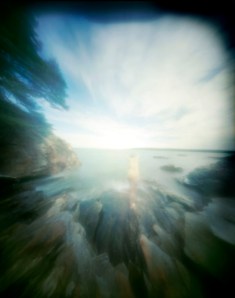
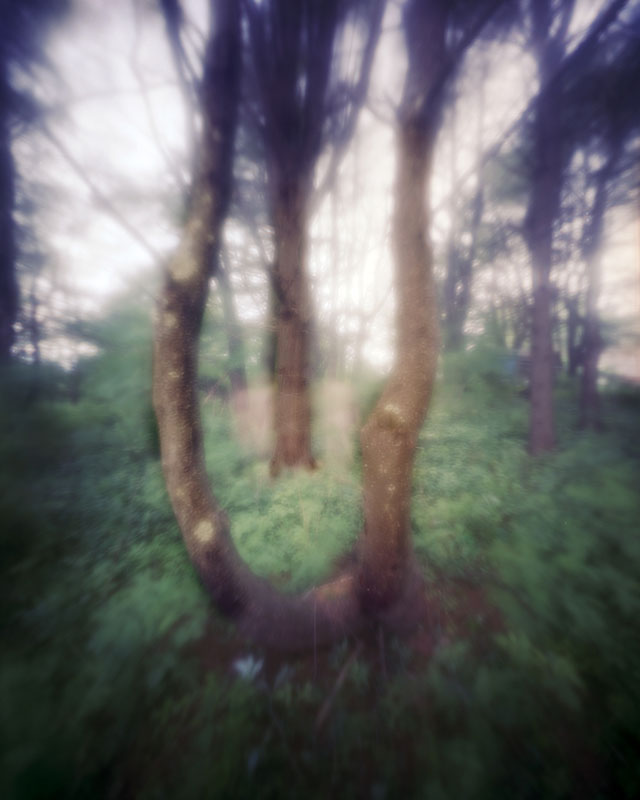
“untitled,” 2012; archival pigment print; 17 x 22 inches; from large format pinhole negative

Briefly describe the work you do.

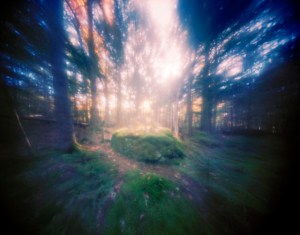
My creative work resides primarily in the realm of lensless photographic works. I am interested in time and its multiplicities; the poetry of space and being, and experience. I work with both long term and short term projects. One of my long term projects Ways of Being is a body of work begun in 2006 in which I use a large format pinhole camera.

I am also very much interested in cross-disciplinary approaches to art-making such as the sciences and art. A recent project (Supercluster Arion and Other Phenomena) gravitating in areas of connections and time, I worked with slugs on silver gelatin photographic paper to create nebulae like images in my darkroom.

Tell us a little about your background and how that influences you as an artist.

I have always been motivated and driven from internal influences. I like to be in motion, to  be working with my hands and doing. I have an undergraduate degree in Environmental Science and and MFA in Photography. I worked as a a field biologist for a number of years before undertaking my graduate work and professional creative practice. Inquiry, discovery, and exploration all permeate throughout my life. I can’t differentiate the wanderer in the woods looking looking for slugs from the image-maker, they are one and the same.

DM WItman

“untitled,” 2013; archival pigment print; 22 x 17 inches; from large format pinhole negative

The concept of the “artist studio” has a broad range of meanings, especially in contemporary practice. The idea of the artist toiling away alone in a room may not necessarily reflect what many artists do from day to day anymore. Describe your studio practice and how it differs from (or is the same as) traditional notions of “being in the studio.”

I maintain a very active studio practice. I set aside time each day to address the business aspects: email, inquiries, submissions, etc, etc. I am surrounded by my creative practice- experience, ideas, materials, ideas for materials. I attempt to tie my internal and the external worlds together to communicate something. When I am in the physical act of making, I prefer to work alone without distractions.

When do you find is the best time of day to make art? Do you have time set aside every day, every week or do you just work whenever you can? 

Any time that I can carve out is the best time.

How has your work changed in the last five years? How is it the same?

I embrace discovery and play more than I did five years ago. Both are natural extensions of my nature, and it permeates into creating. And I’ve learned to accept that not every creative act undertaken becomes something more.

DM Witman

“untitled,” 2012; archival pigment print; 17 x 22 inches; from large format pinhole negative

Are there people such as family, friends, writers, philosophers or even pop icons that have had an impact on the work you do?

Over the course of my life many have inspired me in as many different ways: family who encourage me; mentors in my professional life, and friends to share life with. Of course there are writers, painters, photographers, sculptors whose work I admire- those who have stayed with me, and those who come and go.

I have always been interested in magical realism and Romanticism… and philosophy, ideas of time, experience in nature, the cross over of the arts and sciences. Mary Oliver, Jeanette Winterson, Italo Calvino, Marquez, Dr. Alan Lightman, Joseph Campbell- these are all writers I admire. As for impacts on my work, I leave it to others around me to discern that.

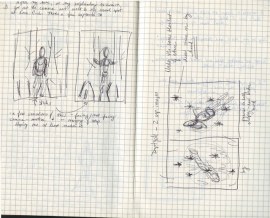
Sketchbook

Sketchbook

If you had an occupation outside of being an artist, what would that be and why?

I’ve had many occupations, but none have been as rewarding or satisfying as the life of making and teaching. My favorite beyond these was when I worked as a field biologist looking for wildlife and hunting rare plants in the woods and in swamps. I romanticize it all now, but it was generally a very physically demanding job working in all sorts of conditions- thunderstorms, snow, heat, poisonous plants, insects… you name it. I also feel that work in the natural environment contributed to me as a person and is as much about my curiosity, discovery, and experience that is part of my creative practice.

DM Witman  Photo by Robert Davis

DM Witman
Photo by Robert Davis

About DM Witman

Deanna is an award-winning visual artist working primarily in photographic media. Artist, teacher, and explorer, she has been creating innovative work since receiving her MFA from Maine Media College in 2009. As a teacher she seeks to share her passion for learning & discovery, expression, and developing vision. Deanna’s work has been published and exhibited nationally and internationally, and is held in many private collections. In 2013 her work was published in Lenscratch, BETA, and Le Journal de la Photographie, as well as an exhibition catalog for her solo exhibition Supercluster Arion and Other Phenomena which includes an introduction by Dr. Alan Lightman. Deanna currently teaches at Unity College, Maine Media Workshops + College, and the Farnsworth Art Museum. DM is represented by Susan Maasch Fine Art, Portland, ME.

http://www.dmwitman.com/

All images copyright of the artist and used with their permission. 

Posted in Photography, Uncategorized | Tagged , , , , | 2 Comments

Victoria Martinez – Chicago, Illinois

90s Pilsen, screenprint, 12”x17”, 2012

“90s Pilsen,” screenprint, 12”x17”, 2012

Briefly describe the work you do.

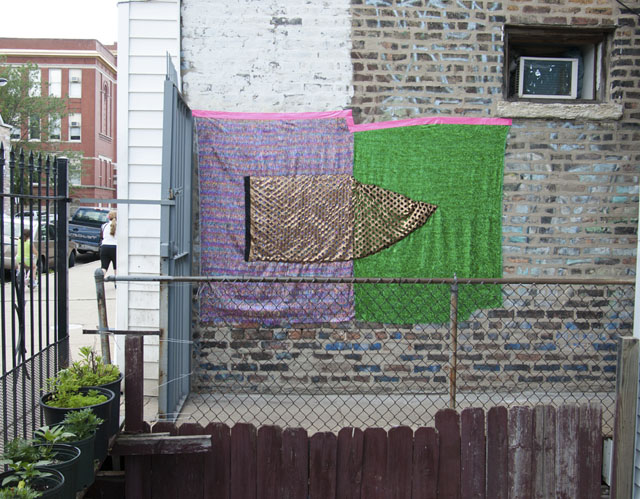
I am an interdisciplinary artist who sews textiles and items such as flowers, sequins, hand painted grocery store posters and lace. I photograph what excites me about the urban environment for example the glistening of ice and snow, factory structures, rope, clothing, abandoned spaces, kitschy dollar store arrangements and college the documentation into screen prints and installation.

Tell us a little about your background and how that influences you as an artist.

I grew up in Pilsen, a predominately Mexican neighborhood on the south side of Chicago. This community is heavily influenced by my heritage where you will experience colorful murals, street vendors such as fruit carts, and elotero/as (people who sell spicy corn on a cob) and community events where there is dancing and live Mexican and house music created by talented artists. I am also drawn to architecture and street geometry such as train tracks, fences and scaffolds.  My work relates to nostalgia. After graduating from college and returning to Pilsen, my thoughts rewind to certain memories around the neighborhood and I wonder how I can honor “home” by using my skills as an artist.

The concept of the “artist studio” has a broad range of meanings, especially in contemporary practice. The idea of the artist toiling away alone in a room may not necessarily reflect what many artists do from day to day anymore. Describe your studio practice and how it differs from (or is the same as) traditional notions of “being in the studio.”

I treat every walk as research and pay attention to details such as sirens, flowers, wind, vibrant gasoline stains, CTA trains, lights, hand painted signs, decaying buildings, etc. I document these moments by videotaping, photographing, and ideating in my sketchbook. I also collect scraps of fabric, newspaper, parade streamers, shattered glass, pieces of wood and take everything to my studio to reflect and play.

21st Place mural

“21st Place mural,” repeated revelations, dimensions variable, site-specific installation, 2013

What unique roles do you see yourself as the artist playing that you may not have envisioned yourself in when you first started making art?

I am currently a teaching artist, assistant and mentor. I absolutely love these roles because I get the opportunity to share my insights and techniques with youth. I have the honor of building friendships with young people and watching them grow as they are discovering their artistic identity. It’s one of the most fulfilling experiences as an artist and I hope to become a professor one day.

When do you find is the best time of day to make art? Do you have time set aside every day, every week or do you just work whenever you can?

I love working on art at night. I tend to be more focused and my creative energy urges me to produce. However, I create whenever I can and my goal is to work in my studio or home at least four times a week.

Flores para la frozen city

“Flores Para la Frozen City,” dimensions variable, site-specific intervention, 2009

How has your work changed in the last five years? How is it the same?

I was living in Minneapolis five years ago where I first created a participatory fabric installation beneath a bridge. Then I traveled to Guatemala and led a mural project at an elementary school and tutored children. Following that experience, I moved to Baltimore to serve as an AmeriCorps member where I taught art and created installations in abandoned spaces near schools I worked at. My work is different now because I am living in Chicago so the materials and location are different. My practice is the same because I am still inspired by city life and dedicated to the advancement of art education.

Are there people such as family, friends, writers, philosophers or even pop icons that have had an impact on the work you do?

I have an older brother who decided to become a gang member at the age of thirteen. I saw him get arrested a few times and get into trouble around the neighborhood. He would always listen to 2PAC and ghetto house music, break girls’ hearts, write gang graffiti in his secret sketchbooks and store oil markers inside of cigar boxes next to his gin. He is a wild soul and told me to stay in school. So I did.

Victoria working

Victoria working

If you had an occupation outside of being an artist, what would that be and why?

I would love to be an ecologist and be knowledgeable of every flower species. I imagine it would transform my art practice into creating large-scale floral projects that would beautify and benefit abandoned spaces in Chicago, Baltimore and abroad. I envision these projects to be in collaboration with youth, artists, and urban planners.

headshotAbout Victoria Martinez
Victoria Martinez is an interdisciplinary artist from Chicago who received her BFA from the Minneapolis College of Art and Design. Her focus includes soft sculpture, installation, printmaking and collage. Martinez has exhibited at the National Museum of Mexican Art, The Center for Advanced
Hindsight at Duke University, Mission Cultural Center For Latino Arts, Katherine E. Nash Gallery at the University of Minnesota, and The Minneapolis Institute of Arts. Upcoming projects include presenting a flag for the Temporary Allegiance project at Gallery 400 at the University of Illinois at Chicago and an exhibition at Columbia College.

Victoria in the studio

Victoria in the studio

www.victoria-martinez.com 

All images copyright of the artist and used with their permission. 

Posted in Installation, mixed media, Printmaking | Tagged , , , , | Leave a comment

Xia Zhang – Morgantown, West Virginia

Briefly describe the work you do.

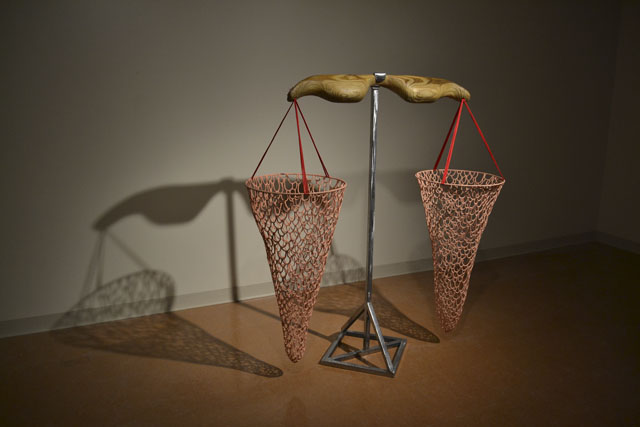
1.“Shelters” ceramic, photograph 2013

“Shelters”
ceramic, photograph
2013

I make repetitive objects that are the physical representation of some small yet concrete memory that consumes me. That makes me have these conversations with my past self. I am on that search for understanding why things are the way they are. Often times I concentrate my work on my struggles with personal and impersonal relationships. I am searching for contentment through my work. But what really is contentment but an inconsistent ephemeral moment?

Tell us a little about your background and how that influences you as an artist.

I was born in rural Southern China and moved to suburban Maryland when I was six. My background and observations of two vastly different cultures heavily influences me as an artist, as I recall and use objects from my past that hold deeper meanings to me. My work is full of symbolism deriving from Chinese culture, American culture, and my personal past.

The concept of the “artist studio” has a broad range of meanings, especially in contemporary practice. The idea of the artist toiling away alone in a room may not necessarily reflect what many artists do from day to day anymore. Describe your studio practice and how it differs from (or is the same as) traditional notions of “being in the studio.”

My studio practice is very much still in essence the “idea of the artist toiling away alone in a room”. My work is very much process oriented and to reach a satisfactory result, I work and make until I find what my subconscious is looking for. I find working in the studio endlessly to be a relief from everyday tasks and interactions. It is my time to replay and examine those interactions. I work my neuroticism into my work through repetitive motions and decisions.

2.“Anchored” mixed media, performance 90” x 25” x 48” 2013

“Anchored”
mixed media, performance
90” x 25” x 48”
2013

What unique roles do you see yourself as the artist playing that you may not have envisioned yourself in when you first started making art?

When I first started making art, I had never envisioned using myself as part of a piece. I was first introduced to visual 3-D art through ceramics and my love for the materials is still constant. However over time, I learned how to incorporate other materials and then ways of creating into my concepts. Recently I have started incorporating performance into my work. Personally, I think it is important to keep an open mind to trying new materials and mediums to revolve around the concept, and not vice versa.

When do you find is the best time of day to make art? Do you have time set aside every day, every week or do you just work whenever you can? 

I am currently a graduate student, so I have to find time to make work around my other responsibilities of going to class, teaching class, studio duties, and other assistantship needs. I work best at night when there are less people and distractions around me. When I work, I typically have goals in mind of what I wish to achieve that day, and that time is usually after my day’s obligations.

“To Alleviate” mixed media 58” x 36” x 24” 2013

“To Alleviate”
mixed media
58” x 36” x 24”
2013

How has your work changed in the last five years? How is it the same?

My work has always been focused around my personal memories and interactions. That concept will most likely be a constant in my work for as long as I am privileged to make art. My work has become more diverse in the ways that I produce my work. I was shy about incorporating myself previously, but I think that has opened up new doors in the way that I approach creating.

Are there people such as family, friends, writers, philosophers or even pop icons that have had an impact on the work you do?

My family and friends, and even people that I interact with at Lowes have an impact on my work. The work that I do is essentially a regurgitation of my previous, present, and sometimes future interactions.

If you had an occupation outside of being an artist, what would that be and why?

I would be an archeologist without a doubt, but an archeologist like Indiana Jones where I get to travel, explore, find ancient relics, go on adventures, and have showdowns with villains.

About

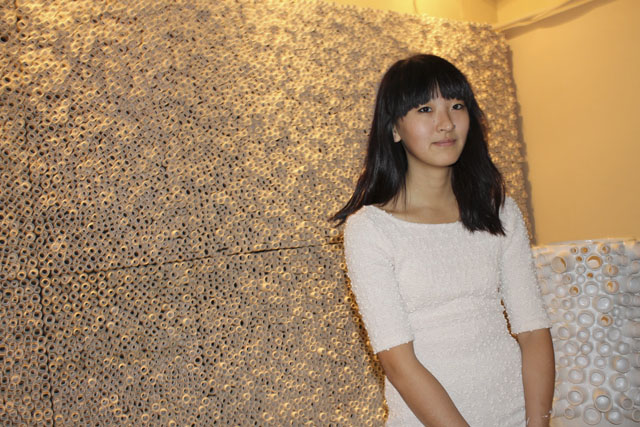
365headshotXia Zhang is a Chinese American artist who moved from Guangdong, China at a very young age. Growing up in suburban Maryland in an immigrant family heavily influences the work that she creates. Xia received her BA from Slippery Rock University of Pennsylvania and is currently working on her MFA at West Virginia University.

In front of her work

In front of her work

www.xiayzhang.com

All images copyright of the artist and used with their permission. 

Posted in Uncategorized | Tagged , , , , | Leave a comment

Nina Lawrin – Chicago, Illinois

Mykolas, 2012 (2) burlap, wool, wood 1’ x 3’

Mykolas, 2012 (2), burlap, wool, wood, 1’ x 3’

Briefly describe the work you do.

I create experimental paintings by creating my own natural pigments and dyes that come from specific locations and experiences. I view my work as a collective documentation of a relationship and social exchange. Formally, the palette is earth-bound, and speaks toward the surface of the painting. I de-weave then reweave into the surface, creating lines of color, texture, and pattern. 

Tell us a little about your background and how that influences you as an artist.

I started off studying Biology in MI and then was going to move to Florida in pursuit of a Marine Biology degree. I have an intense love and connection to the ocean. It sis not feel quite right though and a dropped the degree and moved to Chicago my junior year of college. It was at Columbia College when I found my balance of intellectual exercises with the Cultural Studies program and then a release of all the information swarming in my head in the Fine Arts Department. A year ago I started working with a Geologist and soon a Marine Biologist to further my research of natural pigmentation and self-sustainable art making. I think my background in Biology has not only informed my work, but also gave me the discipline to work consistently. When I dropped the Bio degree, I thought, what would happen if I used all this time I use to study and applied it to a topic/practice I love?  Four years later, I am still engaged and loving every second of it!

The concept of the “artist studio” has a broad range of meanings, especially in contemporary practice. The idea of the artist toiling away alone in a room may not necessarily reflect what many artists do from day to day anymore. Describe your studio practice and how it differs from (or is the same as) traditional notions of “being in the studio.”

My studio practice is a mixture or reading, spending time out in the world exploring and talking to people, and then reflecting in the studio. When it comes to my studio time, I usually listen to music- Cesaria Evora is a favorite, or pop on some documentaries to listen to while I create my weavings. This time is incredibly meditative and calming for me. It is essential to my daily balance. When creating the natural dyes, much of the work is done in the kitchen. In regards to “traditional” studio practice, I enjoy being alone and not having multiple distracting factors, however, this practice can be done in a social setting as well. A lot depends on my mood and how chaotic the day has been.

Ubuntu, 2013 (I Am Because You Are) (Site) Maputo, Mozambique burlap, wood, wool, soil 6’ x 6’

Ubuntu, 2013, (I Am Because You Are), (Site) Maputo, Mozambique
burlap, wood, wool, soil, 6’ x 6’

What unique roles do you see yourself as the artist playing that you may not have envisioned yourself in when you first started making art?

Some unique roles that I did not expect I would take on as an artist was that of researcher. My background in Biology for instance has played an interesting role, both in my artwork and now in my work with NonToxic Print.  Storyteller and even bridge-builder has been something that my practice presents as well. I enjoy learning about others and challenging stereotypes in hopes to present a commonality among us all. Embracing our differences, but underlining our humanity is something that I think about. 

When do you find is the best time of day to make art? Do you have time set aside every day, every week or do you just work whenever you can? 

The best time of day to make my art is around 6 or 7 pm. When I can I usually dedicate entire days (if possible) to my artwork. It is an incredibly slow, methodical process, but incredibly fulfilling! I have set periods of time set aside weekly, however I try to work as much as possible so squeeze in as much as I can on a daily basis. Some days I am successful, but some days work and other responsibilities need to be attended to. 

How has your work changed in the last five years? How is it the same?

Green Process

Green Process

I started off as a realistic, figurative oil painter. So, five years ago, you would not catch me creating anything abstract, however, you probably would have found me frustrated in that I wanted to express an emotion, a feeling, but was unsuccessful. I kept thinking, there has to be more than skimming the surface, I wanted to dig in. That’s when I started to pull fabric (burlap) and start inserting memory and stories within. So in a sense, I started off with people and now am still with people, just my means of expression has changed. 

Are there people such as family, friends, writers, philosophers or even pop icons that have had an impact on the work you do?

I have been blessed to have many inspiring and loving people in my life that motivate me daily. Since I was young my family has been my biggest cheerleaders. I am forever grateful to have such a wonderful, supportive family. As of late my Bynia has been a huge support, which helps me create my work more fluidly. I have also been blessed to have dear friends and mentors which have drastically inspired me. These people include Prexy Nesbitt, Michael Paxton, McArthur Binion, Friedhard Kiekeben, Carol-Haliday McQueen, Mario Castillo, Rachel Rynolds, Michelle Grabner, Haluna Cicuruk, and Marta Zubar. My studies in African histories and culture has influenced me a great deal. Reading about (and later visiting numerous countries) revolutionaries such as Toivo ya Toivo and SWAPO in Namibia, Madiba and Oliver Tambo with the ANC in South Africa, Amilcar Cabral in Guinea, Ruth First, Samora Machel, Graca Machel, Che Guevara, Fred Hampton, Fidel Castro, Taras Shevchenko, and Joe Slavo among others have inspired the background and thought process that leads to the development of my work. Kathe Kollwiz, John Muafangejo, Frida Kahol, and William Kentridge are among my favorite artists. I see research as essential to my practice, however, when looking at the pieces, it is not necessary that all this information be illustrated, just perhaps hinted at. 

If you had an occupation outside of being an artist, what would that be and why?

If I had an occupation outside of being an artist, I would love to either become a baker and open up my own shop or become a political scientist. Cooking and baking has been a love of mine that started when I was young and my mama would teach me and my sister all the family recipes–we’d spend the whole day cooking/baking and laughing. One of my favorite recipes is a layered walnut, apricot torte. A few years ago I found a love for history and putting together “the pieces” of international relationships to try and better understand the world we live in today. I’m interested in why things happen or play out the way they do? I’m starting to see an undeniable pattern, especially in regards to US relations abroad. I believe that every person has a responsibility to one another, but if we do not understand a past, how can we build a future? Who knows, maybe that is what my future holds along with being an artist!

About 

NinaHeadshotCapeTownNina Lawrin is a native Michigander who moved to Chicago three years ago in pursuit  of a degree in Fine Art with a minor in Cultural Studies. Nina has had the privilege to travel extensively within the last few years to further her research in natural pigmentation and become enwrapped with the learning of different cultures, customs, and traditions. Nina is primarily interested in why people live their lives the way they do and how we as people interact with one another despite or perhaps because of these differences. Nina has traveled to Rocca Imperiale, Italy; Maputo, Mozambique; Sao Paulo, Brazil; and throughout South Africa. All of these experiences play a vital role in her work and understanding of others as well as herself.

To grasp and pull while twisting, pinching, spreading, crushing and massaging; clenching the very innards of an objects. Knowing full well that by ripping out what was once there and replacing it with a foreign object may cause it despair. Yet it heals, and becomes something more beautiful that I could ever imagine. The subtle scars of the process that had taken place is all that is left. To challenge myself to see I could nurture foreign ideas, people, customs, traditions, taboos into my own life is an everlasting challenge. Can I be compassionate enough to try and understand? To re-work prejudice and thoughts of what life “should” be? To try to be open enough to let new ideas flow, letting them shape to whatever form it may be. Perhaps resulting is something more beautiful that i could have ever imagined. Ripping, pulling, spreading, shoving, crushing and massaging though: creating scars of past memories and growth.

Untitled, 2012  (4) (Site) Rocca Imperiale, Italy,  burlap, wood, wool, rocks  12” x 12”

Untitled, 2012 (4)
(Site) Rocca Imperiale, Italy,
burlap, wood, wool, rocks
12” x 12”

This project is partially supported by a grant from the Albert P. Weisman Award, a private trust affiliated with Columbia College Chicago.

www.ninalawrin.com

All images copyright of the artist and used with their permission. 

Posted in Uncategorized | Tagged , , , , | Leave a comment

Calvin Whitehurst – Milwaukee, Wisconsin

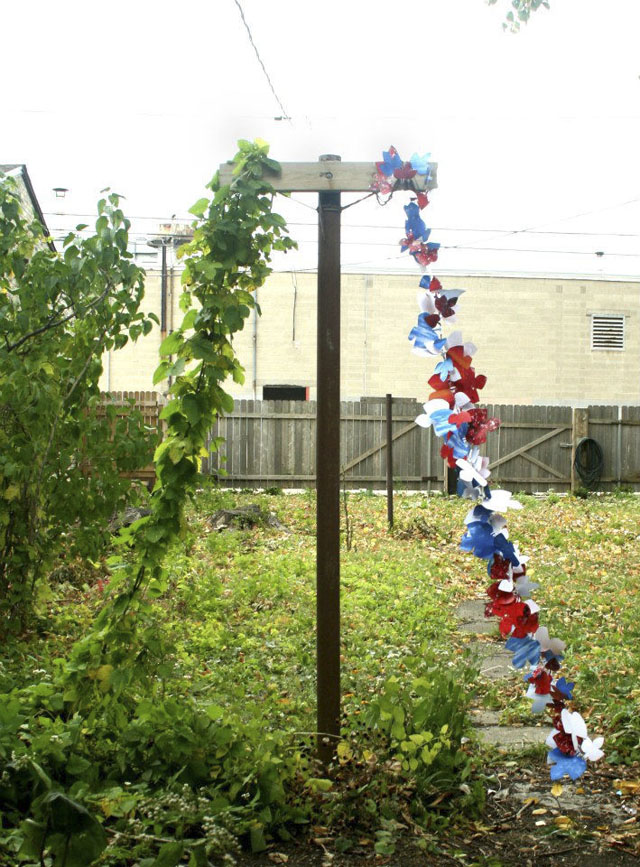
"American 2012 (Pyramid Without a Capstone)", 2012, Found paper images, wooden laundry pole, cascade hops vine, aluminum wire, and nylon string, sizes variable

“American 2012 (Pyramid Without a Capstone)”,
2012, Found paper images, wooden laundry pole, cascade hops vine, aluminum wire, and nylon string, sizes variable

Briefly describe the work you do.

I always describe myself as a collage artist to those who ask what my medium is. However I come from a drawing and painting background.  I really don’t have a medium as of now and I am more interested in breaking boundaries with whatever I can explore.  I’m not interested in creating what has already been done but rather explore elsewhere.  Subjects that always seem to keep coming up are satire and sarcasm. If I can imitate or mock what I don’t like in art, politics, and religion I feel very comfortable. Overall I think I am trying to question those in charge.

At what point I your life did you want to become an artist?

Since the beginning, ask my relatives.  When you were a little kid and your parents or teachers asked you what you wanted to be when you grew up I ALWAYS said artist.  My parents used to put a sticker or a stamp in the left hand corner of an 8 by 10 inch piece of paper so I could then redraw it bigger.  There was a brief time when I was child that I wanted to be a pest exterminator but thats just because one came over to my friend’s house and gouged a huge hole in their wall just to shoot a bunch of poison foam inside of it (how is that not art?).

Tell us a little about your background and how that influences you as an artist.

For about the past ten years I would say that I was very used to seeing the art in Waukesha and Milwaukee and seeing the art in history books and comparing the differences.  What influences me is the extreme dichotomy between these points of view.  Essentially I feel that we as Midwestern artists can be ourselves in a non-cliche way and show the world what we have to offer.  This is a constant influence in my work.  If I can’t shock people with how different my work is at least I can tell people in my peer group that we aren’t trying hard enough and that we have a lot of work left to do in order to make ourselves known.

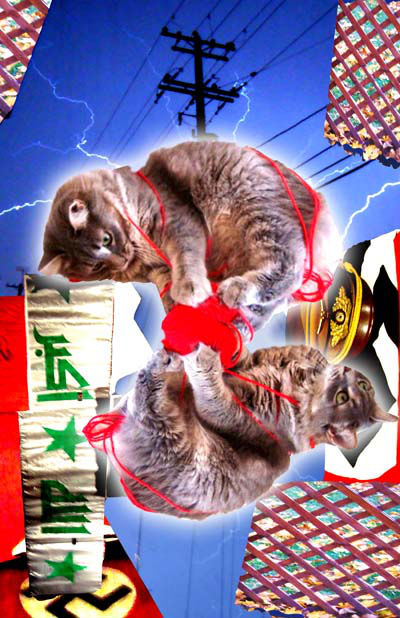
"Dehr Fuerer's Kitteh {(Propaganda Animation) Make You Think Things You Ain't Never Did Think}", 2012, Digital archival print with original photography, 24" by 36"

“Dehr Fuerer’s Kitteh {(Propaganda Animation) Make You Think Things You Ain’t Never Did Think}”, 2012, Digital archival print with original photography, 24″ by 36″

What types of conceptual concerns are present in your work? How do those relate to the specific process(es) or media your use?

Collage is unique because it can use almost any material.  Its also my favorite because it is so fast to use as well.  That being said it is the art medium of our culture, it is constantly changing and malleable. If I use imagery from the past and reference the present with collage I am always creating things that are aware of the time they are born in. We live in a world that is working towards some sort of climax.  If you look throughout history you will find that this doesn’t happen much, only once in a great while.  I think that the time that we now live in is fundamentally perfect for this type of work, a progressive form that is well aware of its year, date, and time.  I make things that comment on this truth through my own paradigm.

We once heard Chuck Close say he did not believe in being inspired, rather in working hard everyday. What motivates you in your studio practice?

I tend to agree with him, especially because I know his paintings require a lot of endurance on his part.  If I am not making something or working towards some goal I am completely lost creatively.  I will say that the mundane inspires the ideas behind most of my projects.  There is the everyday collage that I make that requires no inspiration other than the need to create but my long term projects come from just everyday boring.  I can’t explain to you where ideas come from but I know they come when I’m not looking for them. I make art every day but once and a while a day is different where I just come up with something that sounds ridiculous.  Usually this is the space where I come up with a substantial project.

What artists living or non-living influence your work?

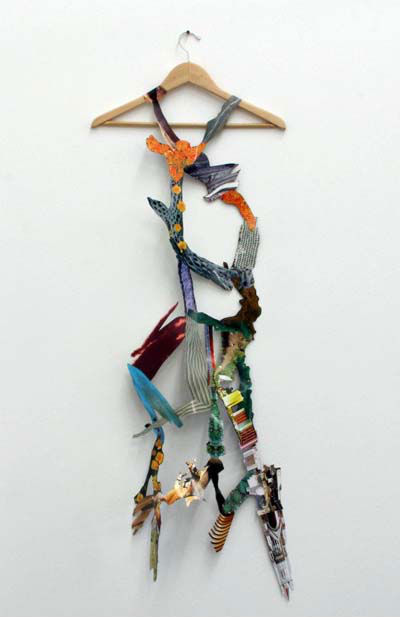
"Fashionably High (Art)" 2012 Found paper images and wooden clothes hanger. approx. 20" by 54"

“Fashionably High (Art)”, 2012
Found paper images and wooden clothes hanger,
approx. 20″ by 54″

Can I say none/all?  I have a thousand favorite artists and a thousand hated artists in my head. All of them influence me equally if that makes any sense. If I had to pick any one artist it would probably have to be Bruce Nauman because he is just completely beyond any classification. I love  how his work is usually a riddle with no answer and that even now in his older years he is still “making” work that is just as cutting edge and aloof.

When you are not making art what types of activities and interests do you engage in?

For the longest time, and I mean almost my whole life, I never had any hobbies. Art was always what I have focused on but within the last year or so I have forced myself to find an actual hobby, which is homebrewing beer.  Its fun because I look up recipes to brew and I just follow them.  Somebody gives me the directions and I just brew, plain and simple.  Some creative decisions are inevitably made but I like being given simple instructions rather than always having to reinvent the wheel.  However I will say that every batch I make is different and in that way I’m just doing the same thing as before. (Sigh) I’ll probably never have a real hobby.

About 

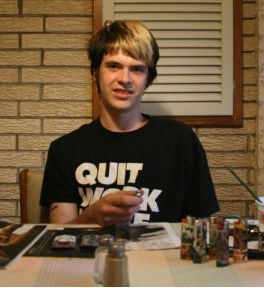
calvinwhitehurst1Calvin Whitehurst is an artist from Waukesha, WI who lives and works in Milwaukee.  Whitehurst attended the Milwaukee Institute of Art and Design. He graduated in 2011 with a Bachelor’s Degree of Fine Arts focusing on painting and sculpture.  Whitehurst has since shown his artwork in various group shows, galleries, and educational institutions in south eastern Wisconsin. Among these are UW Milwaukee, Cardinal Stritch University, The Green Gallery West, The Jackpot Gallery, and others. 

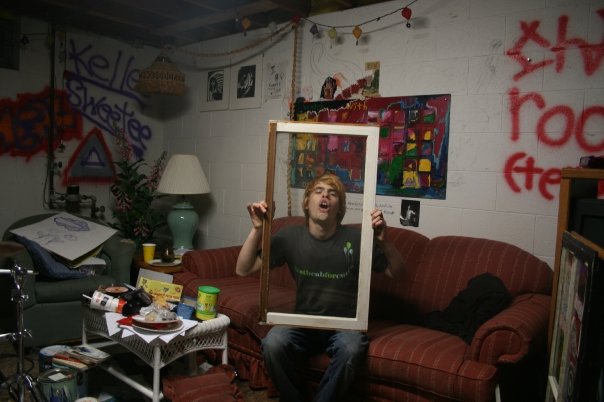
The Studio

The Studio

www.calvinjwhitehurst.com

All images copyright of the artist and used with their permission. 

Posted in Uncategorized | Tagged , , , , | Leave a comment

Taryn Wells – Medfield, Massachusetts

Briefly describe the work you do.

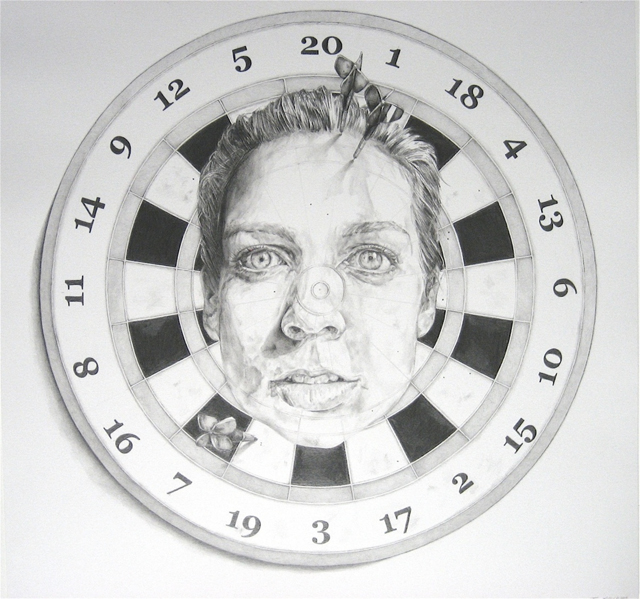
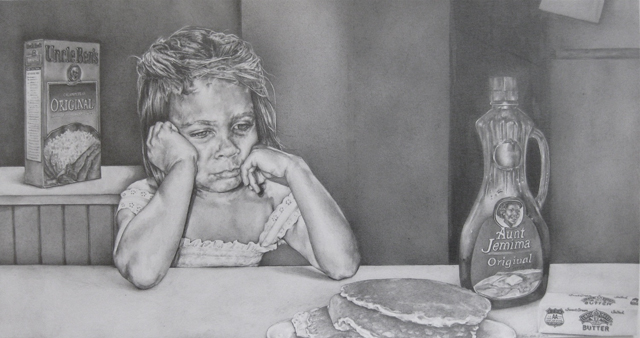
Right Between the Eyes, graphite, 23" x 23", 2009

Right Between the Eyes, graphite, 23″ x 23″, 2009

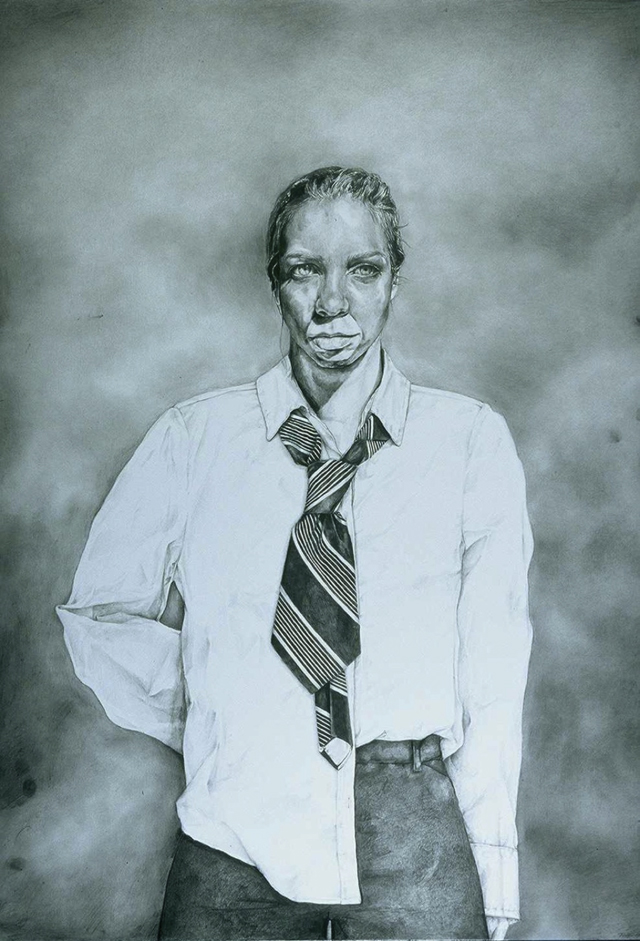
My work explores racial classification in the modern age and how it pertains to that of previous generations.  I work mainly in graphite (on smooth bristol) so as to mimic the black/white theme of my work and to convey the gritty subject matter.

Tell us a little about your background and how that influences you as an artist.

Growing up biracial in a predominantly white town was the basis and starting point of my creative movement as an artist.  I had many emotions and experiences that I wanted to relay to anyone willing to listen, not only as something cathartic for myself, but also to see if there were others like me with similar experiences.

The concept of the “artist studio” has a broad range of meanings, especially in contemporary practice. The idea of the artist toiling away alone in a room may not necessarily reflect what many artists do from day to day anymore. Describe your studio practice and how it differs from (or is the same as) traditional notions of “being in the studio.”

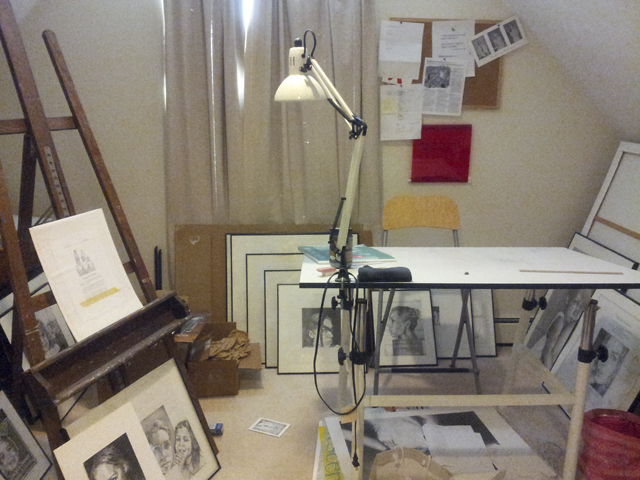
My studio practice is pretty consistent in terms of the time at which I work, but I have the tendency to work in two different locations – my actual studio and the floor of the family room of my house.  Depending on the mood I am in, I work in my studio when I need absolute isolation, with no interruptions, and complete focus.  I work on the floor when I want to be at one with my piece and get a little more “in it;” the energy of my surroundings when in the family room can also help in my creative process.

The Clown, graphite, 34" x 26", 2005.

The Clown, graphite, 34″ x 26″, 2005.

What unique roles do you see yourself as the artist playing that you may not have envisioned yourself in when you first started making art?

I had no idea how much business would be involved when I made the initial decision to become an artist.  It was, and can still be, a daunting subject.  I was accustomed to focusing on the creative aspect of my work rather than the marketing and promotions that are necessary to be seen and heard in the art world.

When do you find is the best time of day to make art? Do you have time set aside every day, every week or do you just work whenever you can? 

The best time for me is during the day.  Not only is that my favorite time for light and contrast, but it is also when I am at my most creative.

How has your work changed in the last five years? How is it the same?

Product Placement, graphite, 14" x 23", 2010

Product Placement, graphite, 14″ x 23″, 2010

Essentially, my work has not changed that much – I focus on the same subject matter, I use the same mediums (most of the time), and my theme is virtually unchanged.  On the other hand, I am more bold and no longer fearful when I approach a new piece.  I am also more willing to push the boundaries.  Things I would have never thought I would broach are now at the forefront of my pieces.  When dealing with the subject of racism and racial classification, you never know how it will be received because it is often the “elephant in the room.”  I knew that if I wanted my message to be heard, I needed to make people listen.

Are there people such as family, friends, writers, philosophers or even pop icons that have had an impact on the work you do?

My family has definitely had an impact on my artwork seeing as they are the basis of my theme.  Not only has my family been my number one support system, but they have also raised me with the strength to tackle such a daunting subject.  If I did not have the upbringing that I did, I do not think that I would have the courage to be an artist, and especially one that confronts racism.

If you had an occupation outside of being an artist, what would that be and why?

It would probably be something food-related.  I love food – eating it, cooking it, learning about it, etc..  It is also an occupation where I get to reach a broad audience with something that I have made, that comes from my heart and hands, and I find such gratification in that.

About 

Wells_headshotMy artwork is a dialogue that explores the complicated world of racial identity and the desire to find my place within it as a multiracial individual. The basis of the series
emanated from my need to examine the dualities and dark truths of America. My distinctive perspective on a hidden history manifests itself through art that is sometimes sardonic, sometimes somber, but always compelling. I see a parallel with today’s perception of race and yesterday’s reality.

Taryn Wells was born in Massachusetts in 1981. She received a B.A. in Studio Art from Boston College in Chestnut Hill, Massachusetts.

The Studio

The Studio

www.tarynwells.com

All images copyright of the artist and used with their permission. 

Posted in Drawing, Painting | Tagged , , , , | Leave a comment