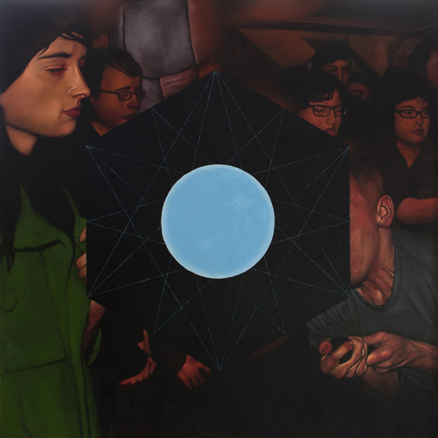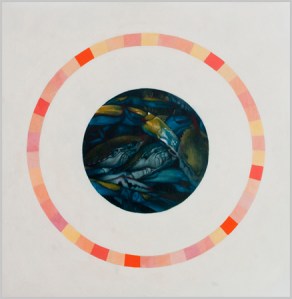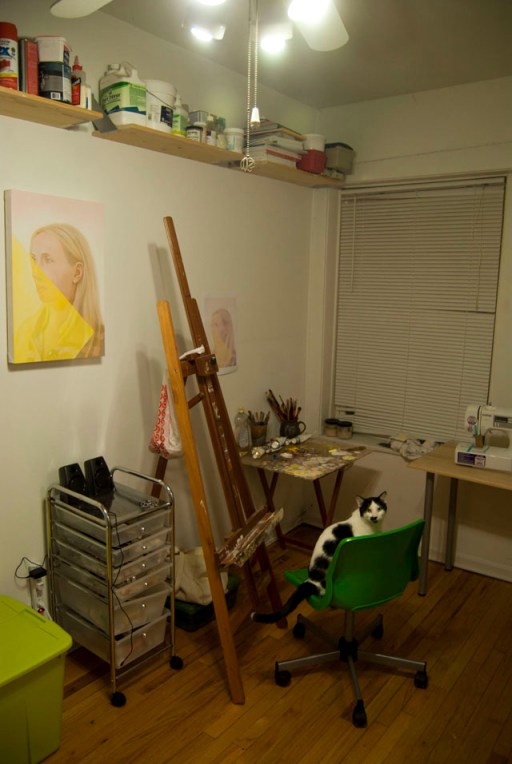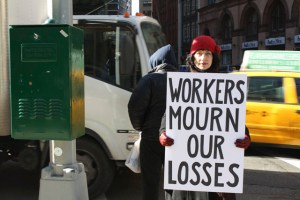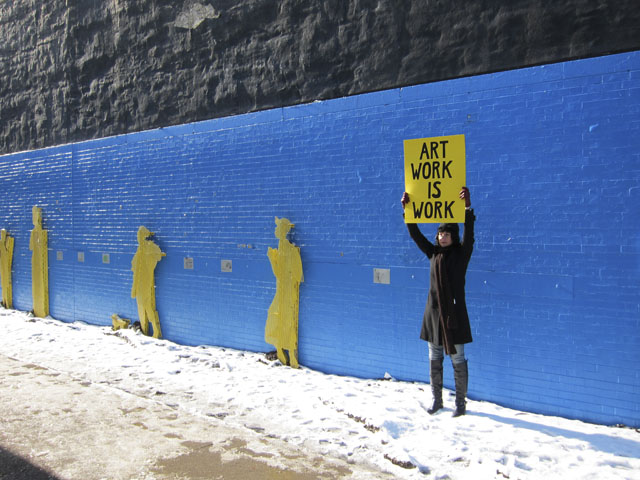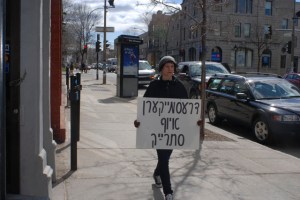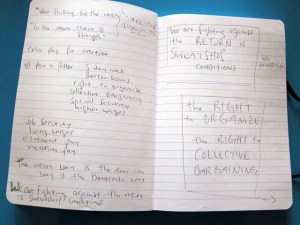
Abraham Ferraro – Albany, New York

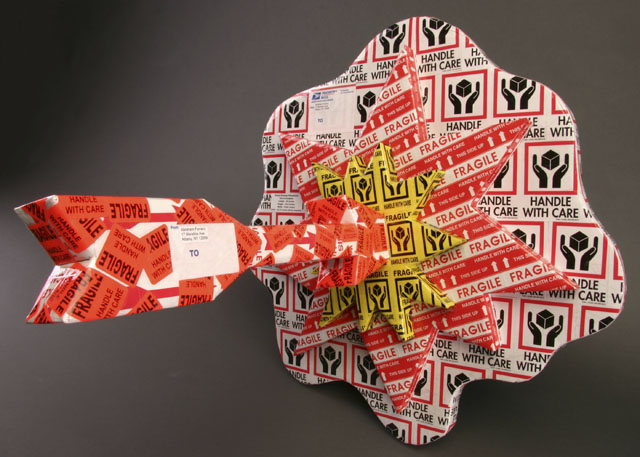
Explosion

“Explosion,” recycled cardboard, tape, packing labels, postal service, 25 X 25 X 22″, 2013

Briefly describe the work you do.

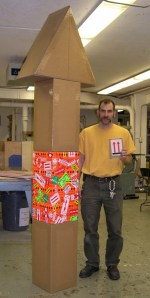
My performance based work is Art about Art. Through real sweat, my performance / installation Art details the struggles, trials, and tribulations that artists undergo to create Art. Whether I am getting punched in the face by my contraption, climbing an endless Sisyphean treadmill, or cranking my way up a 20 foot tall Pencil my Art depicts the artist in the midst of creation and each performance yields a piece of Art as a byproduct.

My Mailable Art pieces are structurally engineered sculptures that are sent to the gallery via postal service as seen/exhibited complete with addresses, postage, and fragile stickers. Sculptures are made in parts (based on Postal size limits), mailed, and then reassembled at the gallery. The pieces are made with recycled cardboard boxes that were previously shipped.

Directions is a long term ongoing installation project separate from my other mailable sculptures. Directions is an ever growing series of Mail-able Sculptures complete with mailing address, postage, shipping labels, and installation directions on them. Every time the Directions piece is shown new pieces are added and mailed individually to the new venue while the older Directions are delivered by the artist, so process is evident and traceable by the viewer to the extent that the viewer may figure out exactly when and where the piece traveled. Directions is not only about how Art gets from A to B, but also about the conceptual process that takes place in Art as ideas or bodies of work change over time.
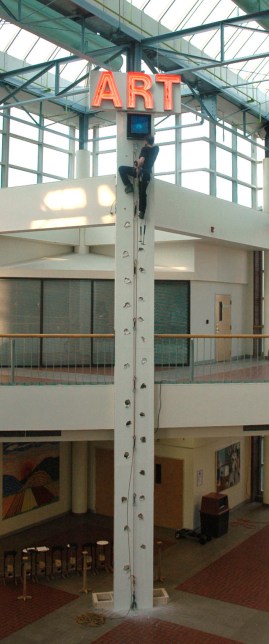
Art Climb

“Art Climb,” installation/performance, 40 X 5 X 2 1/2′, May 2009

Tell us a little about your background and how that influences you as an artist.

As a child I was always tinkering and taking apart objects…I was fascinated by how things worked.  In my performance based work I often borrow mechanical ideas lifted directly from things around me: bike brakes, ratchets, and garage doors.  I also had every construction toy there was to have like legos, Lincoln logs, and erector sets, but my favorite was my wooden blocks.  When I was age 7 I would build wood block towers from floor to ceiling that were over 8’ feet tall by stacking chairs on top of my dresser.  My mailable and Directions series utilize standardized junctions so the parts are interchangeable like legos.

The concept of the “artist studio” has a broad range of meanings, especially in contemporary practice. The idea of the artist toiling away alone in a room may not necessarily reflect what many artists do from day to day anymore. Describe your studio practice and how it differs from (or is the same as) traditional notions of “being in the studio.”

Most of my studio experiences have been in the social constructs of academia (either through being schooled or teaching) and I’ve been both the midnight loaner hiding away in the studio pulling all nighters with my performance based work to making work intermittently throughout the day with the ability to start a piece in 1 location and finish it in another place altogether with my mailable series. I have come to really enjoy working amongst my students, sharing my process with them, and found these teaching moments that happen outside of class to be most effective in expressing what Art is all about. I feel the best way to produce work is deadline orientated with extended periods of concentration and uninterrupted studio time…I like to refer to them as Art benders.

Directions

“Directions,” recycled cardboard, tape, packing labels, postal service, 15 X 30 X 15′, March 2013

What unique roles do you see yourself as the artist playing that you may not have envisioned yourself in when you first started making art?

While my work focuses on and addresses various issues surrounding the practice of being an artist and making Art which speaks directly to other artists…I really enjoy engaging the non-artist with my large scale mechanical pieces or the unsuspecting audience like the Postal Employees who get to handle my artwork.

When do you find is the best time of day to make art? Do you have time set aside every day, every week or do you just work whenever you can?

That has changed as my situation has changed over the years, but generally I like to work in the evenings…in grad school I used to work much later than I do now.  I tend to procrastinate until I have a looming deadline and then I work really intensely, but generally I work a little bit on my sculptures almost everyday. 

How has your work changed in the last five years? How is it the same?

It has changed rather dramatically in that I have been exclusively working in cardboard and mailing my pieces for the last 2 1/2 years…where as before it was predominately performance works in steel and wood.  The mailable works were a solution to the difficulty of installing the heavy, large scale performance pieces, but similar because I still relied on many small parts fitting together to construct a larger installation.
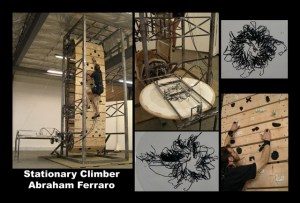
Stationary Climber Postcard

Stationary Climber Postcard

Are there people such as family, friends, writers, philosophers or even pop icons that have had an impact on the work you do?

My parents have always encouraged my artistic practice in so many different ways, but I gain inspiration from the community of artists that I have surrounded myself by.

If you had an occupation outside of being an artist, what would that be and why?

I enjoy teaching Sculpture at The College of St. Rose and being in a creative environment where people are exercising their creative muscles.

photo credit Erin Philaja

photo credit Erin Philaja

About 

Ferraro is a graduate of SUNY Fredonia (BFA) and SUNY Albany (MA & MFA). He has exhibited internationally and extensively in New York State, including solo performance / exhibitions at Artists Space in New York City, Fulton Street Gallery in Troy, Time & Space in Hudson, and Rochester Contemporary Arts Center. He is in Art collections at the Albany Institute of History & Art, the University Art Museum, Monroe Community College, SUNY Fredonia, and Paul Hobart.  He was a resident artist at Sculpture Space in 2006.  Ferraro was awarded Best in Show at the Schweinfurth Memorial Art Center’s Made In NY exhibition 2010 & 2012 and was named Best Performance Artist in the Capital Region by Metroland 2012.  Articles on his Art have appeared in international magazines and books: Climbing, UK’s Climb Magazine, Hyperdrawing: Beyond the Lines of Contemporary Art (published by UK University Loughborough School of Art and Design).  Ferraro’s Art has been featured on Youtube.com, WNYT-TV Channel 13 News, Utica’s TV show Explore!, and WXXI TV Channel 21.  Abe works at the College of St. Rose as the Sculpture Technician and teaches 3D Concepts, Sculpture 2, and Advanced Sculpture.
www.abeZart.com

www.youtube.com/abeZart

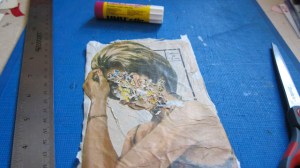
Studio (Working on the "MEGA Arrow")

Studio (Working on the “MEGA Arrow”)

All images copyright of the artist and used with their permission. 

Posted in Sculpture | Tagged , , , , | Leave a comment

Tom Berenz – Milwaukee, Wisconsin

5th Birthday Cake

“5th Birthday Cake” 64×70″, acrylic and spray paint on canvas, 2013

Briefly describe the work that you do.

I use the motif of depressive disasters to examine my life experiences through painting.

At what point in your life did you decide to become an artist?

In 2010, 10 years after my freshman year of college, 2 years after a Masters of Arts program, and another 2 years of teaching at the college level, I learned I needed to be an artist. It took 10 years of rigorous investigation and a lot of sacrifices to know that I was an artist and needed to dedicate my life to it. I had little exposure to culture and art growing up. From the age of 5 I knew I wanted to be an artist, but I told everyone I wanted to be a professional basketball player because, somehow, that seemed more socially accepted.

Tell us a little about your background and how that influences you as an artist.

My childhood inspires me; I grew up on a lake in central Wisconsin surrounded by woods and I return to this lake as much as possible. I think about this place, the people in my life and past experiences often. Falling tree forts, broken windows, cutting off my brothers finger, going to the emergency room, a car accident, and getting lost in the woods are just a few moments that can be found at the heart of my paintings. Inspiration for my paintings comes from within and from the world around me. Every element in my paintings discuss personal, sociopolitical, environmental and ideological issues.

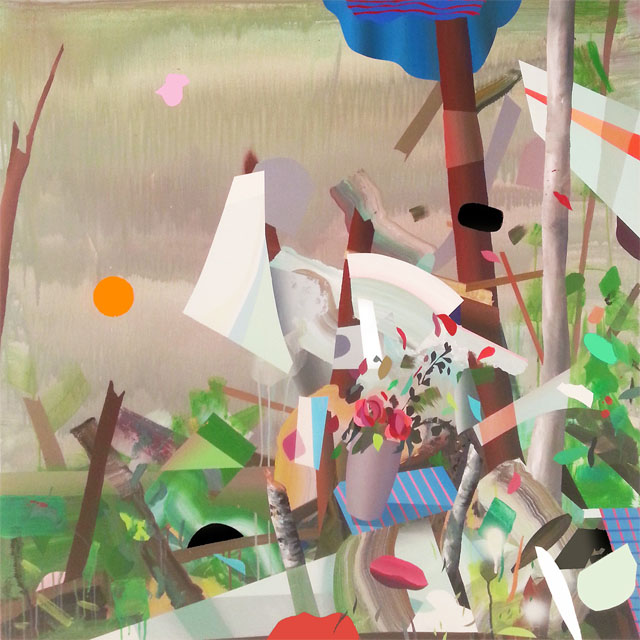
Bloom

“Bloom” 48×48″, acrylic and spray paint on canvas, 2013

What types of conceptual concerns are present in your work? How do those relate to the specific process(es) or media you use?

My paintings are about my relationship to the world around me; cerebral and physical, intellectual and visceral. I use the disaster motif as a metaphor to discuss personal, sociopolitical, environmental and ideological issues. Through the motif of disaster, I explore the existential self and examine personal narratives, with some being more literal and others more enigmatic. Notions of loss, place, memory, space and time are central as I reexamine personal experiences from my past and present. The imagery is in constant flux, but always returns to a pile. A pile is everything and it is nothing. It is a mound that once was and now isn’t; a mass of information, both physical and metaphysical, organized and chaotic. These works emphasize form over narrative. I inject painterly gestural forms with flat edited down shapes. This results in a striking dichotomy between the strong emotional subtext of the work and the stark rigidity of its execution.

The paintings are about an investigation of unlimited possibilities, applications, and styles within a painting. I am interested in expanding the vocabulary within each painting and within the group. The work is ultimately about two-dimensional space, the language of painting, and the way an aftermath site is transformed into a painting. I am interested in blurring the lines between realism and abstraction, life and death, beauty and horror, devastation and sublime. Everything we live with as Americans is delicately balanced – the cars (magic carpets/ death traps), houses (castles/ prisons), and wilderness (paradise/oblivion). I examine contradictions within the idiom of painting by responding to the outside world. By reestablishing a different logic within the painting itself, I investigate how a painting can sit in a place that can only happen in two-dimensional space. I explore the in-between space that is neither real nor artifice, still-life nor landscape, natural nor artificial, messy nor clean, flat nor deep, and dynamic nor static.

Flight

“Flight” 62×72″, acrylic and oil on canvas

We once heard Chuck Close say he did not believe in being inspired, rather in working hard everyday. What motivates you in your studio practice?

I know I have bad, average and good ideas. I make bad paintings (well, I think they are bad and only about 50% of the paintings that I make will ever leave the studio) after I take a long break. It seems that the more consistently I work, the better my ideas are and the better the paintings are. I need to be in the studio often; working, researching and thinking about my paintings to keep things fresh and moving forward. I try not to take long breaks and get into the studio as much as possible. The longer the break, the more the ideas build and that becomes problematic.

What artists living or non-living influence your work?

T.L Solien, Dana Schutz, Kristine Moran, Paul Wackers, Jose Lerma, Trudy Benson, Jonas Wood, Julie Mehretu, Mickalene Thomas, Kerry James Marshall, Lari Pittman, Lisa Sanditz

When you are not making art what types of activities and interests do you engage in? 

I enjoy road trips — long road trips. I am interested in the collapse of time, form and space while driving long distances. For about a year, I have been thinking about a series of paintings that are based on a road trip, which will probably be a body of work in a few years. Every summer my wife and I take a 2-3 week trip somewhere across the country. I love trout fishing and being out in nature, or just being outside. I am an Assistant Professor at the University of Wisconsin-Parkside, and I am trying to be a great educator as well as a successful painter.

headshotAbout

Tom Berenz was born in Fond du Lac, Wisconsin in 1981. He is a painter and Assistant Professor at University of Wisconsin-Parkside. His paintings have been exhibited nationally from San Francisco to New York City and featured in multiple publications; most notably, New American Paintings and Huffington Post. He is represented by Mirus Gallery in San Francisco, CA and Circuit 12 Contemporary in Dallas, TX. He works and lives in Milwaukee, Wisconsin.

www.tomberenz.com

Studio

Studio

All images copyright of the artist and used with their permission. 
Posted in Painting, Uncategorized | Tagged , , , , | Leave a comment

Megan Mosholder – Brooklyn, New York

Megan working on the "Delineations" installation at the OAL Gallery in Columbus, OH, 2013.

Megan working on the “Delineations” installation at the OAL Gallery in Columbus, OH, 2013.

Briefly describe the work that you do.

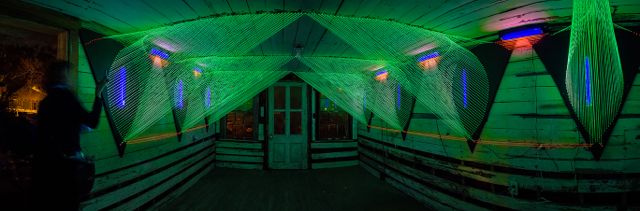
I am a site-responsive artist. My process involves the use of simple, temporary materials that evolve into sculptural work that largely depends on a moment in time. With twine and often blacklight, I make three-dimensional drawings to emphasize obscured elements within recognizable objects and correlate the symbolic with lived experience. My work is multi-sensory and requests participatory involvement: lines expand and contract in space in a visually manipulative manner to engulf the visual senses. I create a kinetic and relational art experience that reawakens for a moment the simple intrigue of looking and encourages the appreciation of spaces for what they are while also examining their hidden meanings. Inspired by both interior and exterior spaces, I look for sites where nature has been permeated by manufactured elements or ways in which structures can communicate certain particulars about the current human condition. Both natural and synthetic light is used as a drawing medium to bring my sculptural installations to life, the lines becoming ethereal elements that establish otherworldliness and invoke curiosity as they expand and contract in space

At what point in your life did you decide to become an artist?

I have always been an artist. My parents tell stories about how nothing in the house was ever safe because I considered everything to be an art supply. As early as three I was complaining that adults did take me seriously as an artist. 

Tell us a little about your background and how that influences you as an artist.

I grew up in Columbus, Ohio mainly around musicians and graffiti artists. I was always inspired by my friends but lacked the confidence they had in their ability. My first studio was in an old downtown warehouse divided into artists’ workspace and practice/recording space for bands. Working there made me feel a part of a community. The bands I worked around had a huge influence on me and I painted numerous band member portraits.

I initially lacked the confidence to be a professional artist and decided to use my BFA to return to school and become certified to teach high school. I taught at an urban public high school for four years but never lost my ambition for the arts. In 2010, I left my hometown to attend the Savannah College of Art and Design. There I had opportunity to study in Lacoste, France where I met and worked with artist Teresita Fernandez who encouraged me to work larger and with alternative media. Teresita agreed to intern me at her Brooklyn studio in April 2012 and I finished my degree remotely in New York City. 

My need to maintain a studio practice has also augmented my process of creation. These days I am nomadic, traveling between residencies and exhibitions. This is an expensive evocation one that is difficult to fund without full-time employment. The use of string grew out of my need to make large works of art on a very tight budget. 

A Tale of Two Bridges, twine and blacklight, 2012.

A Tale of Two Bridges, twine and blacklight, 2012.

What types of conceptual concerns are present in your work? How do those relate to the specific process(es) or media you use?

Recently I have been working to communicate my three-dimensional ideas two-dimensionally. In July 2013 I began a new series of paintings while at the Wassiac Project that I call negative space paintings. I took a shape from a simple installation based off a parabolic curve and repeated the shape over and over again on linen canvases with white and iridescent white acrylic. I have also been embroidering the canvases, a way to directly incorporate the line from the installations into the painting. The stitching is my conceptual comment on painting itself: the literal deviation of the grid with the line.

The installations themselves are a spatial explorations partially inspired by Gaston Bachelard’s Poetic of Space. My visual research is an attempt to communicate ideas about current events such as social injustice and financial segregation utilizing the bridge metaphor as a way to encourage communication between the elite, middle and lower classes. The symbolic nature of a bridge is one that can take on multiple meanings such as the multitude of ways we become connected/disconnected from one another. Encountering a multi-sensory installation can have the power challenge preconceived notions of social order.

We once heard Chuck Close say he did not believe in being inspired, rather in working hard everyday. What motivates you in your studio practice?

I would have to agree with Chuck Close. Often I don’t have time to feel inspired to make work. Rather, I am simply reacting to various opportunities whether it’s a proposal, grant or residency application. I believe one of the keys to a success as an artist is always say yes to an opportunity no matter how big or overwhelming. Everything always seems to work out in the end.

Megan working onsite at "Gossamer" installation on Hilton Head Island, SC, 2013.

Megan working onsite at “Gossamer” installation on Hilton Head Island, SC, 2013.

When artists living or non-living influence your work?

Teresita Fernandez had a huge influence on me. Working in her studio as an intern allowed me to see the day-to-day of a professional artist. It helped me to understand the business side of things. A few of my other art heroes are Ai Weiwei, Andy Goldsworthy, Katharina Grosse, Eva Hesse, Robert Smithson, James Turrell, Richard Serra, Gerhardt Richter, Mark Rothko, Christo and Jeanne-Claude and Agnes Martin. 

When you are not making art what types of activities and interests do you engage in? 

These days, I feel as though I am constantly making art. Everyday I wake up, sit at my desk and look at my list of upcoming deadlines. I work down the list, cross off the completed proposal/application/research subject and move on to the next. Often I divide the day in half: mornings are spent writing whereas afternoons and evenings are spent making. It is never ending: the writing influences the making and visa versa. I try and get daily physical exercise as it burns off the anxiety. I also love cooking, gardening and watching any kind of live music.

About 

image001Megan Mosholder, born in Columbus, Ohio, is a conceptual artist that operates in the real-world setting of the social-political landscape through site-responsive, sculptural installations. She is a recent graduate from the Savannah College of Art and Design where she developed her thesis body of work, A Tale of Two Bridges (2012), an exhibition that explored old conversations about city planning, race and power, older histories, and the more current social and political climate in Savannah, GA. Her exhibition history includes an installation in Lacoste, France, a body of work that speaks of the lasting impression a place of beauty can leave on an individual. She has authored five successful grant applications, including one from the Foundation for Contemporary Arts and her work has been published several times internationally in magazines and periodicals such as the Huffington Post and Hi-Fructose. Presently, Megan is attending multiple artist residencies including a fellowship at The Wassaic Project and the Vermont Studio Center where she has been developing a new body of work.

the studio

the studio

www.meganmosholder.com

All images copyright of the artist and used with their permission. 

Posted in Sculpture | Tagged , , , , , | Leave a comment

Anna Valdez – San Francisco, CA

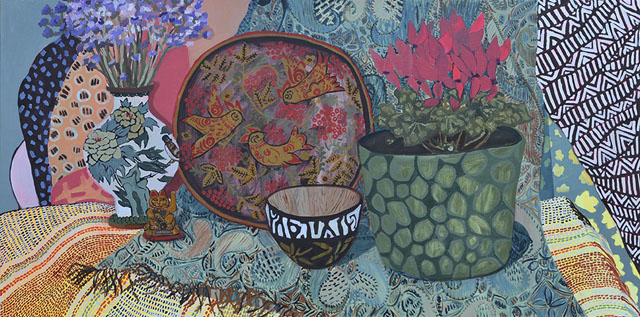
Cultivating Domesticity

“Cultivating Domesticity” oil on canvas, 36×48″, 2013

Briefly describe the work that you do.

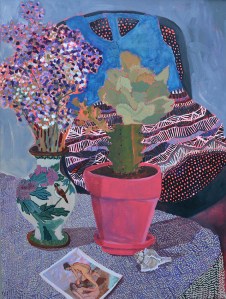
My work is comprised of painting, drawing, printmaking, collage, animation, and digital media.  The prominent presence of patterns and textures in my art references physical associations, as well as memories. Recently, many of my pieces have been still lives. The set-ups for these have been composed of various household items such as my clothes, quilts, scarves, blankets, houseplants, drawings, paintings, books, records, and vessels. These items exist as a part of my domestic environment, and I have put them in my paintings as forms of self-representation.

I use various media to explore concepts and to see how each idea is expressed. My process is to work with the same image over and over yet using diverse media.

At what point in your life did you decide to become an artist?

My mother is a crafter and quilter. I grew up making things. However, as a little girl I only remember envisioning myself as one day becoming an archaeologist. Ironically, while working as an archaeologist at the age of 22 I somehow decided that I was actually an artist. Art as a career never occurred to me until about eight years ago during my field studies in archaeology while working on a historical site in Ireland. When learning how to properly excavate a site, the program director noticed that I kept a sketchbook, and encouraged me to work on creating maps and scaled drawings using assorted measuring devices. While conducting this architectural analysis in my spare time, I found myself constantly drawing these abandoned spaces, and like a good archaeologist I created a story that interpreted the data gathered from the site. I realized I felt more comfortable with the idea of a loosely based interpretation rather than something set in stone or a textbook. I am not currently an archaeologist. But this knowledge and training still lingers, and I find myself noticing similarities between the practice of art and archaeology.

Artifacts

“Artifacts” oil on panel, 24×48″, 2013

Tell us a little about your background and how that influences you as an artist.

The desire to make stuff was inherited from my parents. My mother surrounded us with craft supplies instead of toys. And my father was always telling us stories of his life on the farm.

I grew up in Sacramento, CA. Demographically, Sacramento is a diverse city and I felt that my neighborhood was a good sample of a typical lower-middle class urban neighborhood. Most of my childhood friends were not born in this country. Their identities were deeply rooted in specific cultures, languages, and religions that formed an extra community. I noticed this formation at an early age and it caused me to feel left out. I only spoke English. And we did not attend church. I can remember 90% of the time upon meeting someone new they would ask me, “What are you?” or “Where are you from?”.  I was always embarrassed when I had to admit that I was just American with Spanish and Basque heritage, and unable to provide context to what that meant. Mostly everyone thought I was Latina, because of my last name and slightly dark complexion, and they expected me to act as such.

I have no doubt that this experience has shaped who I am regarding my interest in anthropology, and the themes that continue to develop in my work.

What types of conceptual concerns are present in your work? How do those relate to the specific process(es) or media you use?

I use ­­various media, depending on what I think is appropriate for the image at the time. For example, In addition to painting I work on my computer, making animations and videos.

Media indecisiveness is due to my curiosity about different painting techniques. I make most of my paint from raw pigment and linseed oil. I also love working in egg tempera because it merges the kitchen with my studio. Surfaces are very important to me. I think I spend an equal amount of time preparing my surfaces as I do in actually painting.

Good vs. Evil

“Good vs. Evil” GIF animation, 2014

We once heard Chuck Close say he did not believe in being inspired, rather in working hard everyday. What motivates you in your studio practice?

Curiosity, discovery, and pleasure motivate my studio practice. There are so many variants that prompt an idea for a painting, drawing, or animation. Most of the time my purpose for creating is to answer a question that I might have about myself regarding a thought or action. I think it can be said that most artists create work that is reflective of their personal experience or mindset. I tend to draw from everyday experiences such as my domestic environment, conversations with friends, and questions regarding identity.

What artists living or non-living influence your work?

This is a difficult list to compose, as every day I am exposed to new work either through galleries, museums or the Internet. But here are a few names that instantly come to mind:

Joan Brown, Matisse, Bonnard, Vuillard, Bacon, Munch, William Scott, Guston, Morandi, Goya, Henry Darger, Gauguin, George Tooker, Mu Xin, Charles Burchfield, Grandma Moses, Charlotte Salomon, Akira Kurosawa, Sergio Leone, Chris Marker, Federico García Lorca, Charles Garabedian, Hockney, Allison Schulnik, Dana Schutz, Amy Silman, Mamma Andersson, Nicole Eisenman, Katherine Bradford, Elena Sisto, Anne Sofia Meldgarrd and Lisa Sanditz.

When you are not making art what types of activities and interests do you engage in?

In a way I feel that everything I do is centered on making something. Whether it’s functional or purely visual.

Preparing food tends to take up a large part of my day: I cook, bake, ferment, brew, and cure foods. Living in Northern California—especially the central valley—has made it very easy to access fresh quality foods. Horticulture is a very important element in my life. My father was raised as a tomato farmer. Thus, agricultural knowledge in the form of tending to a small garden was always a feature of weekend family time. Having a garden whether small or large has therefore always been a priority to me. Working with foods that my community has grown makes for a nourishing experience and a happier me.

 DSC_1834 copyAbout 

Anna Valdez is a visual artist living in Northern California. Her interest in pursuing the fine arts took root during her undergraduate studies in Anthropology at UC Davis. She graduated from Boston University in 2013 with an MFA in Painting. She currently works primarily as a painter and animator in San Rafael, CA

http://annavaldez.com

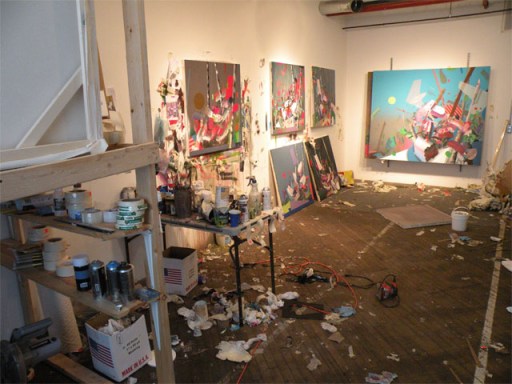
Studio

Studio

Posted in Drawing, mixed media, Painting | Tagged , , , , | Leave a comment

Adrienne Der Marderosian – Boston, Massachusetts

Portrait of a Moment, no. 1., 9 in x 12 in, Mixed Media, 2010

Portrait of a Moment, no. 1., 9 in x 12 in, Mixed Media, 2010

Briefly describe the work that you do.

My work has been shaped by my interest in human behavior particularly in “identity” and “collective memory.” Using found images, photography, paint, graphite and thread these works on paper are richly textured and layered much like our own personal histories.” Small in scale, these intimate pieces are meant to draw the viewer in to examine and reflect on his or her own life path or journey.

At what point in your life did you decide to become an artist?

As a child I had a fascination with drawing and collage and was encouraged to experiment with my materials. I visited the Museum of Fine Arts in Boston, MA where I developed an appreciation for art and art history. By the time I attended college, I pursued studio art an psychology. Upon graduation, I began exhibiting professionally in national, regional and local shows. However, it took the encouragement of a professor from the School of the Museum of Fine Arts for me to make a conscious decision to identify myself as “an artist” and that moment changed everything for me: it felt totally right.

Ballad of Reason, 9 x 12 in., Mixed Media, 2010

Ballad of Reason, 9 x 12 in., Mixed Media, 2010

Tell us a little about your background and how that influences you as an artist.

I grew up in a suburb near Boston, MA that offered me a rich cultural life. The Museum of Fine Arts, the Peabody Museum and Symphony Hall were nearby and I have vivid recollections of visits to these venues. Inspired by music and art, I was encouraged to study both at a young age.

At the same time, I was fascinated by human behavior and wanted to learn and understand how people tick. I was curious about collective memory: that is how memories are shared or recollected by a group. As a person of Armenian descent, I heard stories about the Armenian Genocide of 1915 from my relatives. My grandmother often told me to never forget what happened to the Armenians and to keep that memory alive. Also, I was interested in autobiographical memory:
which are episodes recollected from an individual’s life. So upon entering college, I studied psychology and the visual arts. As my work in fine art evolved, my collective history led me to investigate questions of identity, memory and other psychological principles.

Tattoo Trails No. 1., 9 x 12 in., Mixed Media, 2010

Tattoo Trails No. 1., 9 x 12 in., Mixed Media, 2010

What types of conceptual concerns are present in your work? How do those relate to the specific process(es) or media you use?

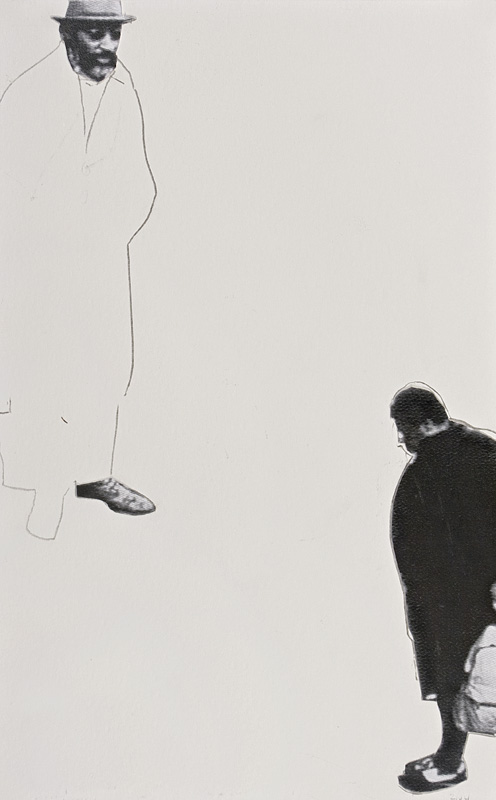
In my current series, entitled Tattoo Trails, I examine the relationship between motivation, destiny and collective memories. I wonder what sustains us during the most challenging of times?   By exploring this question, I seek to establish a dialogue with the viewer about our collective life experience and how we navigate our lives.

In creating Tattoo Trails, I was inspired by a photograph taken at a performance piece by David Hammons in 1983.  I deconstructed the image and reconstructed my own narrative often using maps as a metaphor to represent a passage of time or sense of place. In several pieces, I have retraced parts of the map to indicate how we sometimes revisit our past to understand our present. Like tattoos, these recollections of time, place and experience remain permanently with us.  They serve as a gentle reminder of our life’s journey. 

We once heard Chuck Close say he did not believe in being inspired, rather in working hard everyday. What motivates you in your studio practice?

I like to work in series, investigating my ideas and then pausing to  reflect on the body of work. Then, I continue to develop the images over time until their finished. Studio time alternates with periods of investigation and inspiration. Often I attend museum exhibitions, artist talks and gallery openings. Also, I have a community of artists to exchange ideas with. This has been an invaluable piece of my artist practice.

What artists living or non-living influence your work?

Marlene Dumas, Kiki Smith, Jenny Saville, Ann Hamilton, Alfred Jaar,Richard Lagasse, Robert Siegelman, Ilona Anderson and Barnet Rubenstein…to name a few.

When you are not making art what types of activities and interests do you engage in? 

I enjoy listening to music, gardening and spending time with family and friends.

About 

head shotAdrienne Der Marderosian explores themes of memory, gender and identity in her work.  She received her Bachelor’s Degree from Tufts University in Medford, MA and has studied at the School of the Museum of Fine Arts in Boston, MA.  Her work has been widely exhibited in both national and regional exhibitions in museum, gallery and university venues.  Select exhibitions include Off The Wall, Danforth Art, Framingham, MA; Drawing Out Of Bounds, Wheaton College, Norton, MA; Fragile Navigation, Danforth Art, Framingham, MA and The 2nd Annual Art Competition, Hammond Museum, North Salem, New York.  She is the recipient of numerous grants including a Massachusetts Cultural Council Professional Development Grant as well as multiple Local Cultural Council awards.  The artist’s works can be found in both public and private collections.

The Studio

The Studio

All images copyright of the artist and used with their permission.
Posted in Drawing, mixed media, Painting | Tagged , , , , | 1 Comment

Matt Maniscalco – Chicago, Illinois

Andy

“Andy”
16×24″
Oil on Canvas

Briefly describe the work that you do.

Once I have a solid concept down I go through the process of building and priming a canvas.  I roughly draw out the image on the canvas and start applying layers of paint.  The first layer is always a neutral acrylic, for faster drying time.  I slowly build the painting through thin layers of opaque and transparent glazes.

Lately, I’ve been combining realism with geometric design elements stemming from patterns found in nature. I’m trying to balance the cleanliness of graphic design with the occasional overwhelming complexity that realism brings.  I tend to work back and forth between achieving aesthetic goals and creating more symbolic imagery.

At what point in your life did you decide to become an artist?

When my sister and I were about 7 or so, my parents started taking us to the local art center where they had art classes for children.  I was about a Junior in high school when I decided I wanted to go to art school.  I was always encouraged by my parents to pursue an artistic career.  It’s sometimes hard now as an adult to justify spending so much time on artwork that might never make it out of your studio, but I can’t see myself living without painting.

Tell us a little about your background and how that influences you as an artist.

Growing up in rural Michigan, the outdoors were a source of influence because I was constantly out in nature, and my love of wildlife (unsurprisingly) found itself in my work.  I also helped (or just watched) my Dad with his wood working projects. My appreciation for the use of materials came from those experiences.

When I started painting, I gravitated towards surreal images and used a more spontaneous approach. I was greatly influenced by Dali and Tanguy so I would emulate their styles.  I slowly moved away from surrealism after I started learning more traditional painting practices in the college courses I took.

As a result, my location-based notions of the outdoors and nature collided with my painting preferences.

White Walls

“White Walls”
36×36″
Oil on Canvas

What types of conceptual concerns are present in your work? How do those relate to the specific process(es) or media you use?

Lately I’ve been trying to hone my technical skills and create balance in every composition through the use of figures, line, and shape.  Even though balance can be considered a formal element, I’ve always had a fascination with it as it relates to nature.  

We once heard Chuck Close say he did not believe in being inspired, rather in working hard everyday. What motivates you in your studio practice?

I can’t see how Chuck Close has never been inspired by anything or anyone; come on Chuck!  I have to be motivated to work hard every day and sometimes that takes more than just telling myself to get in the studio and paint.  I love going to museums and openings to get the creative flames burning.  Seeing great live musical performances also pushes me to set ideas in motion.  If I ever come to a creative road block, one way I’m able to work out the problem is by going for a really long bike ride or run.  Anything physical and repetitive enables my mind to work through any creative kinks.

Blue Crabs

“Blue Crabs”
24×24
Oil on Canvas

What artists living or non-living influence your work?

Gerhardt Richter, Odd Nerdrum, Walton Ford, Beth Cavener Stichter

When you are not making art what types of activities and interests do you engage in? 

I’ve recently have become rather obsessed with cycling and plan to start riding competitively this spring.  I plan on riding a 200 mile bike ride in July with my girlfriend and competing in several criterium races, where you ride around in a loop several times with approximately 50 other riders.  Basically like Mario Kart except without the turtle shells.

It’s been hard to get in the studio in the spring and summer, so I usually dedicate the colder months to art-making.

ProfileAbout 

Matt Maniscalco is a painter, illustrator and graphic designer living and working in Chicago.  He was born in 1984 and lived in Michigan until moving to Chicago in 2010.  Matt received his B.F.A. in Illustration from Kendall College of Art & Design in Grand Rapids, Michigan.  Matt has been in many exhibitions and sold his work worldwide.  He helped run Black Cloud Gallery in Chicago and worked on a freelance basis with RR Donnelly, JW Marriott Hotels and Bentley Motors.  He currently works as a full-time illustrator at P.S. Greetings and paints during the nights and weekends.

http://www.mattmanart.com

Studio

Studio

All images copyright of the artist and used with their permission. 

Posted in Painting | Tagged , , , , | Leave a comment

Maureen Fritchen – Racine, Wisconsin

Six Hundred [Stir Sticks]

“Six Hundred [Stir Sticks]”
2012
latex paint, stir sticks
H45″xw24″

Briefly describe the work that you do.

I collect, cut, saw, arrange, glue, nail, rearrange, paint, sand, wax, heat, rearrange, paint and edit, edit, edit

At what point in your life did you decide to become an artist?

I never made a conscious decision to become an artist. From as early as I can remember I’ve been making art.

Tell us a little about your background and how that influences you as an artist.

Some of my earliest memories are of watching my mother paint set designs for local theatre productions. I was enthralled with the scale and the feel of being able to walk into a painting. I was 14 when I was invited to help. Being the second of eight children I’d squirrel away to the quiet of the outdoors to explore and draw. My work still draws from these early connections with the nature world and the wonder of it all, big and small. The photos in National Geographic magazines were a preteen influence [obsession?] I spent years on pen and ink drawings of under-water universes and microscopic organism.

All The Time

“All The Time”
2013
mixed medium: collage, oil, encaustic on wood panels
triptych each panel H36″xW9″

What types of conceptual concerns are present in your work? How do those relate to the specific process(es) or media you use?

The finite I encounter every day is the subject of my work and can best be explained by three simple wabi-sabi realities: nothing lasts, nothing is finished, and nothing is perfect.

The beauty of imperfection lies in my choice of materials. I have no control over what I’m drawn to. Just like I can’t explain why I prefer butter pecan ice cream over strawberry, I can’t explain why I’m drawn to random things that are marked by the passage of time. It is this reliance on chance encounters with found objects for inspiration and assemblage material that spark discoveries of new combinations of forms, textures and colors that excites me. Using natural material that will decompose sooner than I’d like doesn’t stop me from using materials that tug me to do so.

I work in an interchangeable format. The collage element is but one. After creating many pieces I assemble multiple pieces/panels to create a larger piece. All pieces are dependent on the others for a cohesive balance [for their very survival, less they get painted over!] Knowing when a piece is done is a delicate balancing act; when I can no longer add or subtract anything without weakening the whole, the piece is done. Or so I think. I find myself editing and repainting well after I’ve declared a piece finished.

Time and Again

“Time and Again”
2013
mixed medium: collage, oil, encaustic on wood panels
triptych each panel H36″xW12″

We once heard Chuck Close say he did not believe in being inspired, rather in working hard everyday. What motivates you in your studio practice?

Firstly, if I wasn’t inspired everyday I wouldn’t be creating. It takes both inspiration and hard work.

I collect nuggets: bits and pieces of scrap paper, weathered wood, peeling paint, rusted metal, beach combing treasures. Most of my motivation happens outside the studio.

When I find my responses dulling or the work becomes too predictable, it’s time for a change. Working as I do in mixed mediums, exploring new materials propels discoveries which keeps me challenged and engaged. There are times when interest wanes but I look forward to these lulls; a few weeks vacation from the studio allows me to disengage and return with a fresher eye to re-evaluate my direction. Looming deadlines are always an incentive. And when all else fails, clean the studio.

What artists living or non-living influence your work?

Early on Edward Hopper’s strong geometric compositions and his concern with light and shadow to create mood influenced me. Later it was Richard Diebenkorn’s use of line and division of space in his Ocean Park Series. Most recently, I’ve been influenced by Mark Bradford’s large multi-layered collaged paintings.

When you are not making art what types of activities and interests do you engage in? 

Dumpster diving is definitely at the top as well as late chats/drinks with fellow 16th St. Studio artists.  It’s hard to separate art making and my activities and interests. When I’m not making art, talking about art or going to gallery openings I’m busy promoting the arts regionally. I am on the Racine Arts Council board and gallery chair. I organize six exhibits a year with the focus on emerging artists.  Four years ago I co-founded the get bEHIND the aRTS Studio Tour, a self guided tour of over 75 artist’s creative spaces in Racine and Kenosha and I help organize the annual December open house at 16th St. Studios where I have a studio

MFritchen 2013 Head shotAbout 

Education:
1999/00/05/06 University of WI-Parkside, Kenosha, WI
2000/01/03 University of WI, Pigeon Lake, Summer Studio Program
1998 Irish School of Landscape Painters, Ireland
1979-80 Boise State University, Boise, ID
1976-78 University of WI-Whitewater
1974-76 American Academy of Art, Chicago, IL

Solo Exhibitions:
2011 Anderson Art Center, Kenosha, WI, 3-D Gallery,
2008 716 Fine Art, Racine, WI,
2007 Anderson Art Center, Kenosha, WI,
716 Fine Art, Kenosha, WI,

Selected Exhibitions:
2014 Museum of Wisconsin Art, Wisconsin Artist Biennial
The Fine Art Gallery. Milwaukee, WI
Frank Juarez Gallery, Time Share, Sheboygan, WI
365 FJ Gallery & Grey Matters
2013 University of Wisconsin-Parkside, 4-Person Show
Alverno Collage, Wisconsin Visual Artists, Milwaukee, WI
Racine Art Museum’s Wustum Museum, Racine Art Guild, Racine, WI
Kenosha Public Museum Wisc. Visual Artists, Kenosha, WI
Cigar Box Project, traveling exhibit, Libraries As Incubators
2012 Blutstein Brondino Fine Art, Invitational
ArtBook Milwaukee Magazine, Featured Artist
B4S Gallery, Racine, WI
Black Eyed Press & Gallery, Racine, WI
2011 Racine Art Museum’s Wustum Museum, Racine & Vicinity Show, Racine, WI
Black-Eyed Press, Racine, WI, 2-Person Show
2010 Artworks, Kenosha, WI, 4-Person Show
Artmail: Milwaukee, Featured Artist
B4S Gallery, Racine, WI, Invitational
Racine Arts Council, Show, Racine, WI, 2-person
2013/10/09/06/05/03/02 Anderson Art Center, Kenosha, WI
2009 Wisconsin Arts Board Gallery, Madison, WI, 2 Person Show
Racine Art Council Gallery, Racine, WI, 2-Person Show
Artworks, Kenosha, WI

Selected Awards:
2011 RAM’s Wustum Museum, Racine And Vicinity Show, Merit award
2010 RAM’s Wustum Museum, RAG Show, Merit Award
2009 Artworks, Curators Choice Award
2007 Anderson Art Center, Solo Show Award
2000 Charles Allis Museum, Curators Choice Award

Collections
AT&T
Burlington Railroad
Clarkwood Limited, Chicago, IL

Community
Volunteer of the Year Award-Arts & Culture, Racine, WI, 2010
Racine Arts Council Board Member and Gallery Chair 2009-current
get bEHIND the aRTS Studio Tour-Racine & Kenosha Founder & Chairperson 2010-current
16th St. Studios Open House committee

www.maureenfritchen.com

MFritchen Studio shot me sm875All images copyright of the artist and used with their permission. 

Posted in mixed media | Tagged , , , , , | Leave a comment

Carrie Kaser – Albuquerque, New Mexico

 Policy Makers (Tuesday, June 26), 2012

“Policy Makers (Tuesday, June 26),” 2012, Ink Pen on Paper
30 X 22 Inches

Briefly describe the work you do.

I was trained in printmaking, but I also love drawing and painting. Some of my recent work explores ideas related to technology, media, and the changing perception of time..

Tell us a little about your background and how that influences you as an artist.

I grew up in western Colorado, and I now live in New Mexico.  I think that growing up in an environment closely connected to nature influenced my fascination with the world of fast-moving information that is becoming more and more a part of our lives.

The concept of the “artist studio” has a broad range of meanings, especially in contemporary practice. The idea of the artist toiling away alone in a room may not necessarily reflect what many artists do from day to day anymore. Describe your studio practice and how it differs from (or is the same as) traditional notions of “being in the studio.”

My studio is my home, so being at home and being at the studio are the same thing. I like that. My studio practice tend to involve a fair amount of research and narrowing down ideas (my sketchbook is mostly idea mapping) followed by intense periods of making. I like to know all about an idea and create work that is generated by learning.

Winning Your Vote (McCain/Obama)

“Winning Your Vote (McCain/Obama),” 2012, Acrylic Paint on Panel, 12 X 16 inches

What unique roles do you see yourself as the artist playing that you may not have envisioned yourself in when you first started making art?

I wanted to be an artist from the time I was a small child. I have always loved the freedom of drawing, creating, and inventing without any rules. I am sure I didn’t envision the nuts and bolts practicalities — keeping thing organized, meeting deadlines, taxes. Another role I play as an artist is that of a teacher. It was not until quite recently that I began to understand how important teaching is to my art practice.

"Daily Document (No. 1 - 7),"

“Daily Document (No. 1 – 7),” 2011, Ink Pen on Paper, 72″ X 13″ each

When do you find is the best time of day to make art? Do you have time set aside every day, every week or do you just work whenever you can? 

Mid-morning is the best time of day for me to make art. It would be great if every day could begin slowly, making art through the middle part of the day and winding down in the evening. But my reality is much busier, so I try to fit it in when I can.

How has your work changed in the last five years? How is it the same?

My work is evolving right now. I recently moved back to New Mexico after being away for a couple of years, and there is something quite unique and powerful about the landscape and nature here. I’m still figuring out where I’m going with it, but my focus is shifting away from the buzz of information, politics, and technological saturation which has been my focus for the last few years.

Sketchbook

Sketchbook

Are there people such as family, friends, writers, philosophers or even pop icons that have had an impact on the work you do?

My parents deserve a lot of credit for always supporting and encouraging my creativity. When I was young, they had a dedicated kid’s art room with a large table for creating art and plenty of art supplies. I remember it as a sunny kid-only space where we could go to make things. I think this has a lot to do with my interest in art.

If you had an occupation outside of being an artist, what would that be and why?

I love making art, but I also really enjoy teaching. Outside of being an artist my other occupation is teaching. I love sharing knowledge and encouraging others to be creative.

kaser_square www.carriekaser.com

All images copyright of the artist and used with their permission. 


Posted in mixed media, Painting | Tagged , , , , | Leave a comment

Lisa Vinebaum – Chicago, Illinois

new Demands?

“new Demands?”
Performance, New York City, 2013
In commemoration of the 1910-1911 Shirt Waist Strikes and the 1911 Triangle Shirt Waist Factory Fire In collaboration with Grace Exhibition and Performance Space
photo credit: Amber Lee

Briefly describe the work you do.

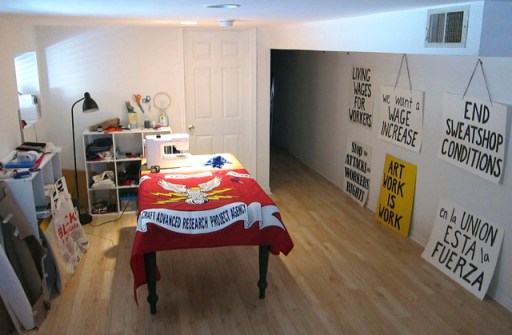
My work combines performance, sited interventions, fiber, and protest tactics. I’m interested in labor struggles past & present, modes of collective organizing, politics, and identity. More recently, I’ve also begun to explore issues of artistic production and artistic labor. My work often explores the construction and performance of identity, and contemporary Jewish identity formations in particular. For the past five years or so, I’ve been working primarily in performance. I do a lot of site-specific walking performances that explore labor issues, and that seek to call attention to escalating attacks in the USA and elsewhere on workers’ rights, wages, and especially, organized labor and collective bargaining rights. Since 2011 I’ve been performing New Demands?, an ongoing series of performances using placards inscribed with slogans from past labor struggles to draw attention to the fact that so many of the rights that were fought for and won during the first part of the 20th century — for example, the right to the regulated work week, pension benefits, paid overtime, the right to join a union — are being eroded today, and so the slogans remain relevant. My performances seek to engage viewers in dialog and conversation on issues that can be contentious and contested — for example, what’s going on in Israel and Palestine.

I also have a critical writing practice. I write about fiber, textile histories, and collaboration, as well as globalization in the garment industry, and how artists are using textiles or fiber to protest abusive working conditions in the textile industry or to create alternatives to these systems of exploitation. I’m especially interested in histories of collaboration in textiles such as sewing and quilting bees, and their connections to today’s participatory and socially engaged art practices.

Tell us a little about your background and how that influences you as an artist.

I grew up in Montreal in a very traditional and insular Jewish community. That experience has really influenced my practice in large part because I’ve spent most of my adult life redefining my own version of what it means to be Jewish: I don’t practice any religion, and I’m not a Zionist, so I’ve had to find ways of being Jewish that don’t revolve around religious rituals or the state of Israel. I’m more interested in diasporic Jewish culture and in histories of Jewish activism and radical politics. Growing up, I wasn’t taught much about Jewish activism in the labor movement — they were central in fighting for workers’ rights, and winning many gains, especially in the garment industry. Almost everyone in my family has worked in the garment industry in one way or another: my grandparents, parents, cousins, great aunts and uncles… my great-grandfather was a serious Communist, yet my grandparents and parents were really anti-union. I spent a lot of time with my grandmother as a kid, she was a factory worker and later a seamstress and tailor — so maybe that’s where my interest in fiber and textiles and even labor comes from. I grew up in Montreal (Quebec), where there was and still is a huge amount of racism and antisemitism, so I’m also quite tuned in to issues of power/privilege/discrimination, and that carries over into my art and writing. I always did a lot of art as a kid, and I read a lot of history books (I was an odd kid), and I’m still doing much of the same today, reading and making art.

Before becoming an artist I did a lot of activist work, and that has definitely played a huge role in my work as an artist and scholar. I still explore some of the same themes as I did as an activist, especially the Israeli Occupation. ACT UP was a huge influence, bridging art and activism, and that model has inspired me as an artist, especially since so many of its members went on to successful careers as artists and academics who continue to take on political themes in their work.

new Demands?

“new Demands?” Performance, Chicago 2013
As part of 2nd Floor Rear Festival of Art in Itinerate Spaces
Photo credit: Kenny Smilovitch

The concept of the “artist studio” has a broad range of meanings, especially in contemporary practice. The idea of the artist toiling away alone in a room may not necessarily reflect what many artists do from day to day anymore. Describe your studio practice and how it differs from (or is the same as) traditional notions of “being in the studio.”

I don’t have a traditional studio practice at all. I have a home office, and I have a home studio. I tend to work on writing projects or art projects, but I find it hard to do both at the same time because they each require very different kinds of attention. That said, there is a lot of overlap between the studio work that I create, and the writing I do — both draw on labor histories and histories of collaboration in politics and art.  When I write, I do tend to work by myself in a room. When I research specific performances, I also tend to be alone, however the performances themselves are very public and I want them to involve as much dialog and interaction with viewers as possible. I’ve also started a series of more participatory sewing projects — here again, the research and conceptualization is a solo endeavor but the execution is public and participatory. I also work collaboratively on writing and editing projects.

The idea of “artist’s studio” for me is very broad: it incorporates traditional forms of making but also writing, research, and collaborations that are often long-distance and so cannot be bounded by traditional spaces — many take place over digital spaces. I like having the option of working at home so that I can work whenever I want. The studio can be the office, or the sofa, or the dining room table, or the actual studio… Perhaps that’s where my practice differs — I’m rarely “in the studio” in a more traditional sense. Of course if my work was much larger or messier I’d get a more traditional studio.

new Demands?

“new Demands?”
Performance, Montreal, 2012
In commemoration of the 1937 Dressmakers’ Strike The Yiddish text on the placard reads “Dressmakers on Strike” In collaboration with Articule Gallery
photo credit: Vincent Lafrance

What unique roles do you see yourself as the artist playing that you may not have envisioned yourself in when you first started making art?

Probably as an educator. And doing more public and participatory work, which is not something I conceived of when I first started making art.

When do you find is the best time of day to make art? Do you have time set aside every day, every week or do you just work whenever you can?

I am not a morning person… aside from that I try to work whenever I can. I have a full time teaching job, so my own works takes place when I’m not at my day job. I often work to deadline — having a text due, or an upcoming performance, or a conference paper to write, or an exhibition project to complete. I can be a bit of a workaholic, but I also require time away from my work, time to think through ideas or just have some downtime, especially when I’m writing, because it can be so intense. I also do a lot of research all the time… I’m constantly downloading and collecting and reading articles and making lists of books to get a hold of for teaching or future projects — I guess it’s all connected.

sketchbook

sketchbook

How has your work changed in the last five years? How is it the same?

It’s changed in that I’ve started doing more public projects, and more participatory work… I’m just starting a series of sewn banners that will be used in future performances and that can also be exhibited. I am being asked to do more and more writing, editing, peer reviewing… and so I do much more of that now than five years ago. But my work is the same in that I’m still working on walking performances with placards, and I’m still exploring the same themes around labor, history, the Israeli occupation of Palestine, Jewish identity, etc.

Are there people such as family, friends, writers, philosophers or even pop icons that have had an impact on the work you do?

My work has always been connected to history and politics, and so I draw inspiration from the labor movement and other activist and protest movements – ACT UP has had a substantial impact on my work. So has feminisms and gender politics, and having been an activist. I read a lot of Judith Butler’s writings on Jewish ethical philosophy and analyses of the conflict in Israel-Palestine, and the war on terror. The artist Sharon Hayes also influenced my work, and earlier on I looked to artists like Martha Rosler and Adrian Piper and Lorna Simpson. Janis Jefferies is an artist and theorist who provided a model for being both an artist and a scholar AND working with textile materials and discourses in conjunction with progressive politics and theory. Finally, my grandmother has had a huge impact on the work I do – she was a seamstress, factory worker, and fierce independent thinker. I learned a lot from her about speaking your mind and not being afraid to stand up for who you are.

If you had an occupation outside of being an artist, what would that be and why?

I have no idea. Maybe a documentary film maker… I’d still be doing a lot of research into the issues that are interesting to me. And I love documentaries.

headshotAbout 

Lisa Vinebaum is an interdisciplinary artist, critical writer, and educator. Her art practice incorporates performance, public and site specific interventions, installation, textiles, video, photography and protest tactics to explore the construction and performance of identity and subjectivity — often enacted in response to attempts at erasure and elision — with a focus on contemporary Jewish identity formations. Current research and artistic investigations explore labor, performance and collectivity in the larger context of economic globalization and cutbacks to workers’ rights. She also writes about the social histories of textiles and their connections to contemporary fiber and socially engaged art.

Her creative work has been included in exhibitions and festivals internationally, including Rapid Pulse International Performance Art Festival, Brave New Art World, and 2nd Floor Rear Festival of Art in Itinerant Spaces (Chicago), Performance Studies International 19 (Stanford University, CA), Open Engagement: Art & Social Practice (Portland State University, Portland OR), Nuit Blanche and La Centrale (Montreal), the Centre Pompidou (Paris), the UCLA Hammer Museum (Los Angeles), Lincoln Center (New York NY), , and the European Media Art Festival (Osnabruck, Germany), and in conjunction with Grace Exhibition and Performance Space (Brooklyn), and Articule Gallery (Montreal).

Lisa Vinebaum’s scholarly work has been published in academic journals and edited anthologies, including the Journal of Modern Craft online, Art Textiles of the World: Canada (Telos Art Publishing, 2009), Emergency Index (Ugly Duckling Press, 2012), and Shifter. She is co-editor of “Crafting Community: Textiles, Public and Social Space”, a special issue of Textile: The Journal of Cloth and Culture (Bloomsbury, 2015) and the anthology Material Matters: The Politics of Making and Materials, in process. Forthcoming chapters in edited volumes include “Performing Globalization” in Textile: The Handbook of Cloth and Culture (Bloomsbury 2015), and “Victoria Stanton’s Transactional Performance” in Caught in the Act: An Anthology of Performance by Candadian Women, Volume II. She has lectured and presented papers at conferences internationally, most recently at the College Art Association Annual Conference (New York 2013), Performance Studies International 18 (University of Leeds UK 2012), Textile Society of America Biennial Symposium (Washington DC 2012), Dis/Locations: Being Out of Place (Concordia University, Montreal 2011), the Festival of Other Theatre (University of Toronto 2011), and Radical Intersections: Performance Across Disciplines (Northwestern University, Chicago 2009). She will co-chair a panel on the theme of textiles and collaboration at the upcoming College Art Association Annual Conference in Chicago in 2014.

Lisa Vinebaum holds a PhD in Art from Goldsmiths, University of London (UK); an MA in Textiles also from Goldsmiths, and a BFA from Concordia University in Montreal. She is an Assistant Professor in the department of Fiber and Material Studies at the School of the Art Institute of Chicago.

www.lisavinebaum.com

Studio

Studio

All images copyright of the artist and used with their permission. 

Posted in mixed media, Performance | Tagged , , , , | Leave a comment

Ted Tollefson – Chicago, Illinois

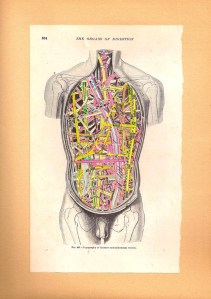
Map of the Human Body

“Map of the Human Body,” Collage on Book Cover – 8.5 in. x 11 in. – 2013

Briefly describe the work that you do.

My work is done entirely with cut and paste collage. I collect old papers, magazines, images, antique photos, maps, coasters, street trash and whatever else I can find and repurpose it into art. Every piece is made depending on the materials I can find, creating a diverse range in my works. One piece can have precise and intricate cuts, while the other can have torn and glued paper fragments.

At what point in your life did you decide to become an artist?

I have wanted to be a artist ever since I was 7 years old, when my grandma taught me to paint and have become a more serious artist over the past couple years. I have been doing graphic design as a profession for almost nine years and decided to get back into traditional art a few years ago, painting, drawing and then collage. A friend and I started off making collage by doing mail art. We would each make starts for each and finish through the mail, he being in Minneapolis and I was living in Omaha at the time.

Tell us a little about your background and how that influences you as an artist.

I have a diverse background in art since childhood. Practicing art in all different mediums, as well as graphic design, has shaped and molded me into the artist I am today. In college I had the opportunity to take various art instruction courses giving the knowledge needed to not be afraid to incorporate other mediums into my college. Also, as a child I would make huge collages on the walls of my bedroom, from wrestling magazines, which I had collected. There never was a bare spot on the wall and my parents would just shake their head and say, “thats Teddy for you.”

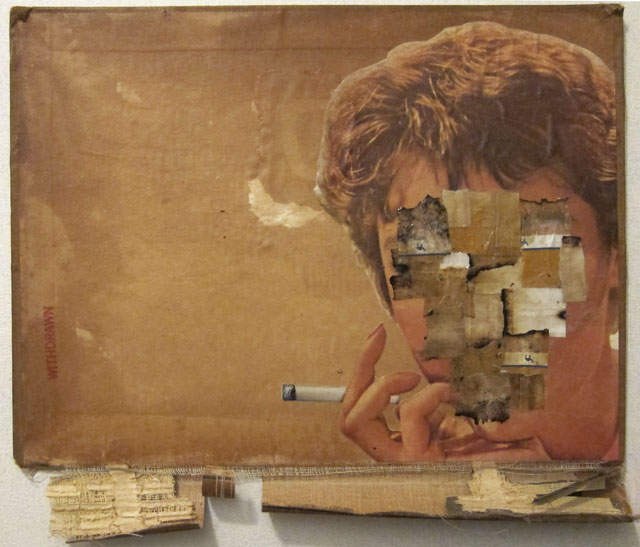
 Non Sex Appeal

“Non Sex Appeal” Collage with cigarette butts on book cover – 10.5 in. x 11.75 in. – 2013

What types of conceptual concerns are present in your work? How do those relate to the specific process(es) or media you use?

Media has a huge influence of the conceptual part of each piece. This is what creates such a variety in my works and work styles as it depends on what materials I have found and what is available at the time. I always try to play with different concepts, techniques and experiments to get different results. Collage is the same as any other medium it can be applied and manipulated in different ways to get different results. I think I have done more failed experiments than successful, but it’s all part of the process.

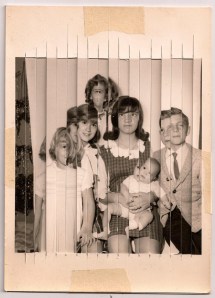
Family Photo

“Family Photo,” Decollage with overlaid photos – 6.75 in. x 5 in. 2013

We once heard Chuck Close say he did not believe in being inspired, rather in working hard everyday. What motivates you in your studio practice?

I have a deep respect for Chuck Close and have been a fan for years. I totally agree with his idea, being a artist is very time consuming and a there is more to it than just the production. I most certainly have to put in studio time daily and when I’m not making art, I am thinking about art. I spend a lot of time just good ole fashioned, thinking. Most of my thinking is when I lay down to go t sleep. I just can’t seem to shut off the brain, making it a perfect time to think and conceptualize mentally. Honestly, I think every art class should start out with thinking and planning in your head.

What artists living or non-living influence your work?

Man Ray has had a big influence on me personally. When I started college I wanted to take my art into a different direction and struggled with it very much at first. I was watching Man Ray: Prophet of the Avant Garde with a friend over a couple beers one night. While he was being interviewed he was asked, how does he make his art original? He relied with, oh that is easy, just gotta be myself. Something just clicked in my head when he said that. I told my friend, “thats it!” From the next day on I was never short of a idea, in fact I had “Ted’s Idea Book” which I wrote down ideas.

When you are not making art what types of activities and interests do you engage in? 

I enjoy spending time with friends and family, local gallery shows, listening to music, movies and of course enjoy a few cold beers.

headshotAbout 

Ted Tollefson, is a Midwestern based, American artist, growing up in Tama/Toledo, Iowa where he started making art at a young age. In 2008 received BA at Upper Iowa University, in graphic design and studio art, continued education in video production and graphic design at Creighton University, Omaha, NE until 2011. Ted currently resides in Minneapolis, MN and continues as a freelance artist, designer and illustrator. He has created collages since early childhood but gained more serious interest in 2012. Current works take on a playful notion, with elements of cut and paste typography, images from books and magazines, antique photos and other paper materials. The future looks bright for Ted as collaborations continue and subject matter and ideas for new work are never a shortage as well as large scale collage coming soon. In addition, he plans of sharing work in upcoming shows around the globe, as being main focus for the future.

Studio

Studio

http://ted-tollefson.tumblr.com/

All images copyright of the artist and used with their permission. 

Posted in mixed media, Uncategorized | Tagged , , , , | Leave a comment