Tay and Val – Singapore and Seattle, Washington

Dream Mural @BELLINGHAM

“Dream Mural @BELLINGHAM,” Photography, 90×20″, 2013

Briefly describe the work you do.

“If you can be whoever you want to be, if you can do whatever you want to do, if there are no limits – What is your dream?”

Our art is an anthology of answers to the above question, presented through photos, videos, and interactive public art pieces. Whilst most people would associate art with communicating a message through expression, we differentiate our works in their intentions to “listen”.

In this unique “listening” process, both subjects and viewers are listening to what others have to say. But more importantly, they inevitably listen to their own innermost feelings. And in recognizing another’s possibility possibly as one’s own, we hope that every participant involved realizes – their dreams can become their realities.

Once in a while we stumble upon a story that forever changes our lives and transforms the way we perceive, relate and live. As artists, we seek to be graceful channels that allow these stories to be told effortlessly through our films, photos and installation pieces. Every piece of art we create, each story we tell, we intend it to be an opening, a mirror – from which the viewer recognizes oneself. It is our greatest hopes that through contemplating on one’s observations, the viewer evolves.

Tell us a little about your background and how that influences you as an artist.

Val: Being brought up by my Grandmother has taught me the importance of intentions: Always remembering why I do what I do; and having that drive everything else I create.

Tay: Growing up in Singapore where the media plays a huge role in shaping the country’s political, social, cultural and economical landscape, I recognized its power quickly. This recognition that the media can shape thoughts, perspective and impact lives has always reminded me to create art that will inspire others and make positive impacts to our world.

The concept of the “artist studio” has a broad range of meanings, especially in contemporary practice. The idea of the artist toiling away alone in a room may not necessarily reflect what many artists do from day to day anymore. Describe your studio practice and how it differs from (or is the same as) traditional notions of “being in the studio.”

Tay: I am a traveling film maker/storyteller. The world is my studio. Human beings are the subjects of my art, therefore every interaction with them is an opportunity for creation. And then these creations return to the community in a form of a film. I am the medium through which one human being’s story inspires another. So, being in this “world studio” seemed to have unlimited the space constraints of the traditional notions of “being in the studio”. In my unlimited “world studio”, I seemed to have broaden my perspective on what I can create and how I can create them.

Val: I agree with Tay on the above. In addition, beside using the world as my canvas, I also value the traditional notions of “being in the studio”. “Being in the studio” means being in a space where I can be with myself, and my work. It is a practice of self-awareness in that alone time. That is when I make sense of the interaction I have had, integrate the experiences and then turn them into meaningful creations for my audience. Mindfulness and meditation are instrumental in my studio.

Luo Pa, The Most Important Man in The History of Dreams

“Luo Pa, The Most Important Man in The History of Dreams,” Film 4min 23 secs, 2014

What unique roles do you see yourself as the artist playing that you may not have envisioned yourself in when you first started making art?

Val: The role of creating and holding safe space for each individual to share their authentic self. The role of allowing myself to be seen so that others can see possibilities for themselves.

Tay: I never envisioned myself to come out from behind the camera to become the ‘subject’ of my films. I never thought that I would one day be sharing my personal stories as a source of inspiration for others.

When do you find is the best time of day to make art? Do you have time set aside every day, every week or do you just work whenever you can? 

Val: For me, there is no “best” time to make art. I just have to be present and show up at every opportunity. I make a choice to be present so that I can recognize these windows of creativity and make good use of it to create my art.

Tay: I am creating art every moment. I am constantly thinking about new ideas, looking out for great subjects, sharing my films with others, talking about it, etc. It has become a way of life just like drinking, eating and sleeping.

“WHY?” – Tay and Val at TEDxWWU

“WHY?” – Tay and Val at TEDxWWU, LIVE storytelling, 18mins, 2013

How has your work changed in the last five years? How is it the same?

Val: I have always been a performer. The last five years, I have begun to work behind the lens as well. The intention has remained the same: To evoke, mirror and inspire through my art.

Tay: I used to only work in traditional television media. The last five years, my world has exploded into mixed media – live oral storytelling, digital videos, photographs, illustrations, animation, films and online social media. My intentions have never changed: to tell stories of love, life and hope.

Are there people such as family, friends, writers, philosophers or even pop icons that have had an impact on the work you do?

Val: The people around me, the things they do, the environment, everything brings inspiration to my creations. The one thing that has impacted and defined all of my works is the endeavor to stay true to myself, regardless of the form or expression of the work.

Tay: Val has been and still is a huge impact on the work I do. She constantly challenges me to put out works that brings out the best of me. She constantly challenges me to tell a better story.

If you had an occupation outside of being an artist, what would that be and why?

Val: To me, an artist’s job is to create. And every occupation requires you to create – there is art involved in every job (at least to me). Therefore, there is no occupation outside of being an artist.

Tay: If I am not an artist, I will be a mum. Because it is a role that nurtures and inspires the next generation to be the best of who they can be.

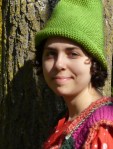
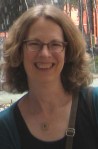
Val left and Tay right

Val left and Tay right

About 

Multiple-award-winning film-makers, inspirational storytellers and invited TEDx speakers Tay and Val, are living examples of dreamers who left Singapore in March 2010 and cycled and travelled across the globe on project www.ibelievethatdreamscancometrue.com.

With the intention “One Dream Shared, Millions Inspired”, their multimedia storytelling exhibit has engaged countless people at hundreds of events, and each person inspired and empowered – to do the things they truly want to do and be the person they truly want to be.  Some of their accolades include the New York Festivals Gold award, CINE Golden Eagle award and the Webby Awards (Oscars for the internet).

Committed to reaching all 50 States of the USA, the duo is working to inspire others to pursue their passion and follow their dreams through a multimedia book, full length documentary, workshops and public speaking; but really, they want to create a global movement of dreams inspiring dreams…and YOU are invited to be part of it: #mydreamis

www.ibelievethatdreamscancometrue.com.

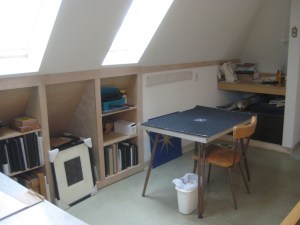
At work in our world studio

At work in our world studio

All images copyright of the artist and used with their permission. 
Posted in Uncategorized | Tagged , , , , | Leave a comment

Ted Lott – Murray, Kentucky

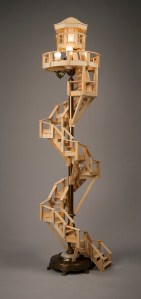
Keeper

“Keeper,” Pine, Found Object, 62x16x19″, 2013

Briefly describe the work you do.

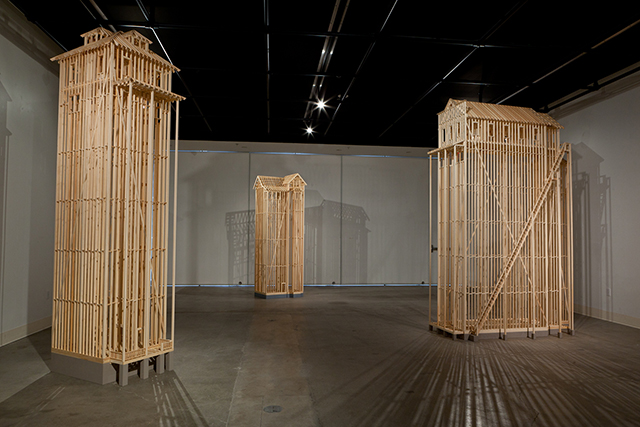
I make sculpture that utilizes the tools, techniques and materials of craft and fine woodworking with a historical approach to material culture and design, often incorporating objects or artifacts into an architecturally influenced visual vocabulary.

Tell us a little about your background and how that influences you as an artist.

Growing up we lived in and around cities (Chicago, pop. 2 million) and in a small town (population under 400). So I was lucky to be exposed to culture and also have the experience of living around nature and agriculture, a lucky combination of urban and rural. That tension between those two environments has continued to be a source of fascination, from the greater concentration of wealth in cities, to the differences, and similarities in the built environments and everyday lives of people who reside there.

The concept of the “artist studio” has a broad range of meanings, especially in contemporary practice. The idea of the artist toiling away alone in a room may not necessarily reflect what many artists do from day to day anymore. Describe your studio practice and how it differs from (or is the same as) traditional notions of “being in the studio.”

Insofar as where I produce the actual objects, I am a studio-artist. I require a certain amount of relatively non-portable tools and electricity, etc. to make my work. I can certainly on occasion fit neatly into the mold of the grumpy and insular sculptor, especially when something isn’t working the way I had imagined. However no system can survive in isolation, and the ideas, objects and materials of my practice all depend deeply on the knowledge and observation of the greater human environment. Objects tell stories, and every good story has its foundation in the real world, no matter how far out the tale takes us.

Left to Right "Foursquare," 129x32x39" 2011 "Ell-House" 124x30x29" 2010 "False-Front," 124x30x84" 2011

Left to Right “Foursquare,” 129x32x39″ 2011
“Ell-House” 124x30x29″ 2010
“False-Front,” 124x30x84″ 2011

What unique roles do you see yourself as the artist playing that you may not have envisioned yourself in when you first started making art?

My approach to making art has always been to follow the thread. One idea leads to the next, to the next, etc. So I can’t say I ever envisioned myself in the future as being anything. However, when I first entered Art School, after a period of travel and general wandering in my early twenties, it was born from an interest in blacksmithing and metal work. I guess I have always viewed my work through the lens of a craftsperson, one that specifically engages with materials on a very intimate level. It took me a while to discover this, and even longer to accept it considering the hostility to this mode in the greater art world. Now I consider it to be something that sets my work apart. I am not an evangelist, and I enjoy looking at and am influenced by all kinds of work, but knowing what drives me has allowed a much greater understanding and facility in my process.

When do you find is the best time of day to make art? Do you have time set aside every day, every week or do you just work whenever you can?

I work during the daylight hours; I find it is necessary for me to set aside blocks of time or whole days to work. The nature of my process does not lend itself well to working an hour here and there. Focus and the ability to concentrate is key.  

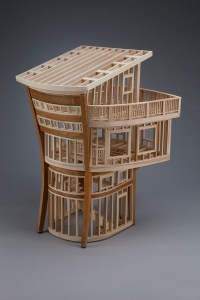
Habitation #2

“Habitation #2,” Pine, Found Chair, 27.75″ x 32″ x 37″

How has your work changed in the last five years? How is it the same?

In the past five years I have discovered and begun to explore the body of architecturally influenced work that I am currently involved in. During this time there have been many changes in form, scale and content, but the basic processes/materials have remained the same. It is amazing to me that there is so much to discover with a limited palette.

Are there people such as family, friends, writers, philosophers or even pop icons that have had an impact on the work you do?

Jim Harrison, the novelist, is one of my favorite writers. There’s a feeling to his best work that I would love to have my objects convey. I also like Italo Calvino, and John Berger, but more his short stories/ novels than his famous “Ways of Seeing”. I also read a lot of historical biography and such. I don’t avoid philosophy or art criticism per-se, but I find persons and subjects outside the realm of visual art to be much more interesting.

If you had an occupation outside of being an artist, what would that be and why?

I always wanted to be a wilderness guide, taking people out hiking, canoeing, sailing. In many ways I see it as similar to being an artist. Directing people to experiences that they haven’t had before, places outside of the everyday.

OLYMPUS DIGITAL CAMERAAbout 

Ted Lott is a sculptor, designer and artist who works primarily in wood. He received his M.F.A. from the University of Wisconsin-Madison and his B.F.A. from the Maine College of Art. Born and raised in the Upper Midwest, Lott has travelled extensively throughout the country, living in ten different states and visiting every one but Alaska. He has been an Artist-in-Residence at Arrowmont School of Arts & Crafts, Anderson Ranch Arts Center, Haystack School, Indiana University of Pennsylvania, as well as other locations. He is currently a Lecturer in Woodworking & Furniture Design at Murray State University, in Kentucky. His work; encompassing sculpture, architecture, furniture, and public art has been exhibited in museums and galleries across the country.

www.tedlott.com

From Untitled (current work-in-progress) Pine, Ebonized Oak, Electrical, 2014

From Untitled (current work-in-progress) Pine, Ebonized Oak, Electrical, 2014

All images copyright of the artist and used with their permission. 
Posted in Sculpture | Tagged , , , , | Leave a comment

Giovanni Giacoia – Cambridge, Massachusetts

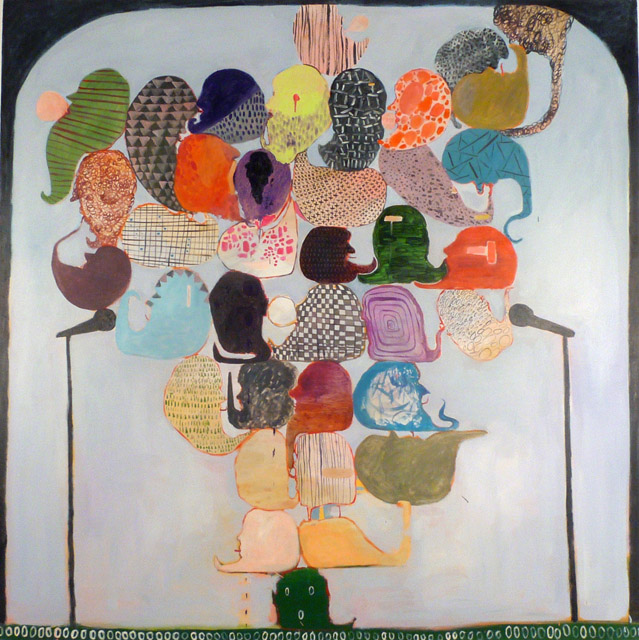
When in Rome...

“When in Rome…,” Oil on Canvas, 6ft x 5ft, 2014

Briefly describe the work that you do.

In two months, I will finish my MFA studies at Boston University. I work primarily with drawing, painting and printmaking. My older paintings were more figurative; I was interested in creating images of people as performers of bizarre social interactions. During my MFA coursework, I moved more and more away from figuration and certain ways of thinking about figuration towards semi-abstraction. I also moved away from intimate scale to large sized canvas, which I was encouraged to pursue as a challenge. I could say that my most recent work is informed by three main ideas: my interest in the concept of humor; my own private narrative; and my interactions and reflections on history and history of art. Formally, this translates into an investigation of the relationships between line, color, and scale.

At what point in your life did you decide to become an artist?

At the age of seven I realized I could make exact copies of my subjects, it felt like having magic powers. In a way, it allowed me to own any object or animal I wanted. From reality to imagination the step was quick: observation, imagination, and invention are all part of the drawing process. Drawing allowed me to make sense of the world around me. It allowed me to simplify reality. Growing up, drawing gave me a copying system for my daily life. I never pursued art as a career until I turned thirty, then I asked myself: what can be my contribution to this world? That is when I started studying art at The Glasgow School of Art in Glasgow, Scotland.

Tell us a little about your background and how that influences you as an artist.

I am originally from Basilicata, in Southern Italy. I moved to England and then Scotland in my late twenties; I lived there for almost twelve years. I started studying art when I was thirty, I earned my BA in Painting and Printmaking from The Glasgow School of Art (in my third year I also spent a semester studying in Brittany, France due to an Erasmus scholarship). After I completed my degree I was in Florence, Italy for four months with the John Kinross Scholarship (awarded by the Royal Scottish Academy). Before dedicating myself full time to art I studied Economics in Rome, I also did various jobs, such as waiter, receptionist and night-duty manager in hotels and more recently, I worked part-time in a museum while keeping a studio practice in Glasgow until I moved to Boston two years ago (in 2012) to study for an MFA in Painting at Boston University.

My private narrative certainly feeds into my work. In fact, painting is the primary way through which I explore my own visual relationships to the societies and cultures, which have contributed to my personal formation. It becomes a way to ask myself questions about identity, displacement, and the disconnection between being and appearing. Painting becomes this funny place where two histories meet, your own history and history of painting. It is the arena where you can move and shift constantly. It’s problematic, scary, and exciting. In an interview Dexter Dalwood described being an artist as “dragging a trolley of cans behind you – the everyday, history, and all the things you like”.

(Dexter Dalwood interview with Cherry Smith in Kaleidoscope magazine, issue 8 (http://kaleidoscope-press.com/issue-contents/dexter-dalwood-interview-by-cherry-smith/), last accessed on March 12th, 2014.)

O O O

“O O O,” Oil on Canvas, 6×6 ft, 2013

What types of conceptual concerns are present in your work? How do those relate to the specific process(es) or media you use?

Painting is for me both a document of movement and physical presence, it is able to generate images of an increasingly indecipherable world; images of the world’s superficial appearance and its deep political and social contradictions. For this reason the formal issues and dilemmas intrinsic to painting (for instance line and color; figure and ground; and the physical and the optical) become, for me, metaphors to reflect on deeper social issues. For instance: sexuality and gender; the conflation between public and private; and surveillance and forms of social control.

We live in a world where information moves really fast, everything is accelerated and consumed quickly. I believe painting operates in a very poetic and slow mode and that it is able to create a pause in life. It is during this moment of pause, when real life is put on hold, that the viewer can understand the painter’s worldview. The viewer has the time and a reason to feel an emotion, which can bring a new level of clarity, empathy and understanding. In this sense I use painting because it allows slowness and freezes both my psychological (mind) and physical movement (hand); it allows my ideas and mistakes to overlap and exist on top of each other on the same surface; it reflects the experience of its own creation and it can time travel because it is constantly present. I remember Leidy Churchman, an artist which I really respect, saying something along the lines: you can never turn a painting off.

(Leidy Churchman in Conversation with Amy Sillman, BUAG at Stone Gallery, Tues Sept 24th, 2013.)

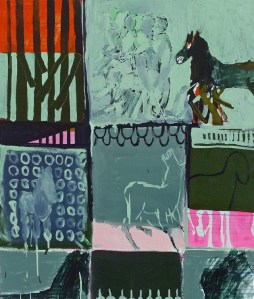
The Horse and the Horseness

“The Horse and the Horseness,” Acrylic and Oil on Canvas, 30×24

We once heard Chuck Close say he did not believe in being inspired, rather in working hard everyday. What motivates you in your studio practice?

I must agree with Chuck Close. The ritual in the studio and being in the studio is what make things happen for me. It can be reading, drinking a coffee, thinking, listening to the radio but it must happen in that very specific space in order to become something else. Probably the biggest motivation is the excitement about the unknown, about what it might happen during every day of work in the studio. I mean the excitement about the possibilities and little discoveries that painting can achieve only by doing. There is a subtle link and shift from the imagination to formal invention, which I believe can only take place through the motion of the hand on the canvas. Jerry Saltz during a recent lecture at BU said something along the line: artists, unlike people in more regular jobs, are different because they wake up in the morning with one idea and by the end of the day they have changed that idea many times.

(Jerry Saltz and Roberta Smith in Conversation at BU College of Fine Arts, February 24th, 2014.)

What artists living or non-living influence your work?

Alberto Giacometti and Edgar Degas are two artists I have always found very interesting for the performative aspect of their work. More recently, I have been looking at the work of Raoul de Keyser, Thomas Nozkowski, and Norbert Schwontkowski. Babar’s illustrator Jean de Brunhoff, Persian Miniatures, and Early Renaissance artists from Siena such as Pietro and Ambrogio Lorenzetti have also been a big influence in my most recent work.

When you are not making art what types of activities and interests do you engage in? 

I love cinema, and I try to go and watch as many movies as possible at the movie theatre. Living really close to the Harvard Film Archive has been a great advantage. I enjoy going to gigs and concerts; practicing yoga; and cooking. But most importantly I love being a Flâneur in cities.

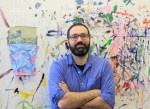
4. Giovanni Giacoia, mugshotAbout 

Born: Basilicata, Italy. He graduated from The Glasgow School of Art with a First Class BA Honors in Painting and Printmaking. Currently lives and works in Boston, USA, where he is a 2014 MFA candidate in the School of Visual Arts at Boston University.

In 2011 Giovanni was invited to take part in the Biennale nel Mondo, part of the 54th Venice Biennale. Most recent exhibitions include: Just Like a Washing Machine: Think Pure Thoughts (BU Commonwealth Gallery, Boston MA); House Rabbet Society (LAP Gallery, Waltham, USA); The World that is Full of Anything (Sherman Gallery, Boston, USA); Boston Young Contemporaries 2013 (808 Gallery, Boston, USA), and Resident 13 (Royal Scottish Academy, Edinburgh, Scotland). Giovanni is the recipient of numerous awards; among the most recent are: the Howard Gotlieb Archival Research Center, BU, Rare Books Prize, the Boston Young Contemporaries 2013 Jury Prize, and the Constantin Alajalov Scholarship 2013. His work is held in both private and public collections, such as the Howard Gottlieb Archival Research Center (Boston, USA) and the Royal Scottish Academy and Richard de Marco’s Archive (both in Edinburgh, Scotland).

www.giovannigiacoia.com

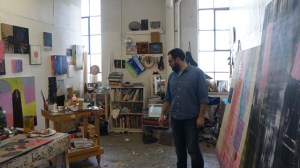
5.Giovanni in the Studio

All images copyright of the artist and used with their permission. 
Posted in Uncategorized | Tagged , , , , | Leave a comment

Rebecca Barfoot – Durango, Colorado

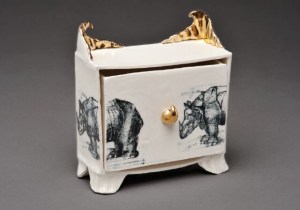
Rhino Reliquary

“Rhino Reliquary” hand-built porcelain paperclay, lithographic image transfer, gold luster, 6″x5″x2″, 2012

Briefly describe the work that you do.

I am artistically ambidextrous in that I work in a variety of media and refuse to confine myself to a single mode of artistic expression or expertise. I came to art long ago as a functional potter working in porcelain. This eventually led to more sculptural explorations, representational painting, mixed media art and works on paper – finally arriving at nature-based installations and continually broadening conceptual concerns.

At what point in your life did you decide to become an artist?

Like most artists, the creative obsession was clearly there from an early age. I didn’t grow up in an environment that supported this though, so it took me some time to come around to trust that art could be my homing beacon; that art would support me in becoming authentic and voiced in this world. I’m there now though, and nothing can steer me off course! I’m extremely driven and focused in my work, and I think this has a lot to do with having been so terribly repressed as a young person.

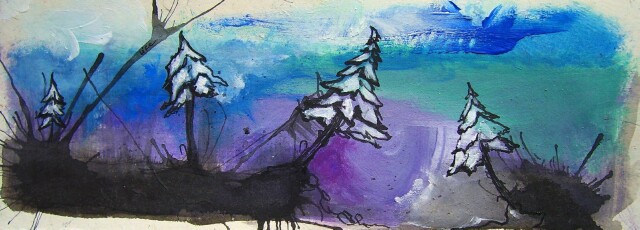
Northern Nightscape Forest Magic

“Northern Nightscape Forest Magic”, ink and acrylic on tree-free paper, 4.5″x12″, 2014

Tell us a little about your background and how that influences you as an artist.

I have no professional degrees, just a deep passion for what I do that’s always kept me on track. I’ve been extremely creative in how I’ve chosen to live as well as work, and have always investigated alternative models for living and occupying the world around me. I spent my twenties living in a rural intentional community and that’s very much shaped my adult values. I’m currently living off-grid, and that again is a reflection of cares and concerns reflected in my studio work.

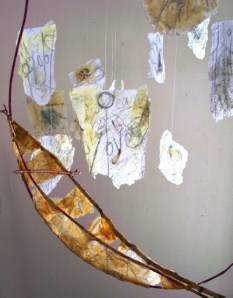
Earth/Ice Listening

“Earth/Ice Listening”, aspen and red osier dogwood with discarded paper products, charcoal, pen, beeswax, xerox transfer, damar resin, variable sizes, 2014.

What types of conceptual concerns are present in your work? How do those relate to the specific process(es) or media you use?

My work over the last couple of years is engaged with concerns about land, environment, connection to earth, biodiversity, ecological footprint, and celebration of life. I’m increasingly interested in exploring what I call “low impact” art, such as non-fired (non-carbon emitting!) sculpture and works created from natural materials, or man-made/discarded materials and unconventional reclaimed objects like tea bags or paper napkins. An example of this would be my work with making recycled paper from all my old To-Do lists, then using it as the base for collage and mixed media pieces with the addition of found paper ephemera, pen/ink, paint – and as few conventional art supplies as possible!

We once heard Chuck Close say he did not believe in being inspired, rather in working hard everyday. What motivates you in your studio practice?

Initially I was driven to create art because I needed – desperately – to heal and to express myself. Now approaching mid-life, I’d say my motivation is more holistic and far-reaching. My artistic ambition is fueled by an unquenchable desire to touch this world in some way, to leave it a better place than how I found it.

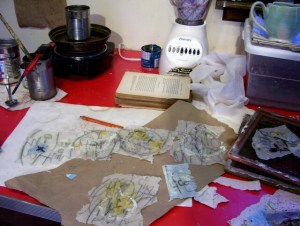
Mixed media work in progress

Mixed media work in progress

What artists living or non-living influence your work?

I think that not coming out of a traditional academic/art background has given me the freedom to explore obscure artists and be true to my own predilections. I admit I have always been moved by the work of Francesca Woodman and I adore the work of Beth Cavener Stichter. Nature is truly my greatest inspiration though, and I’d call her my main artistic influence!

When you are not making art what types of activities and interests do you engage in? 

My true loves: mountain biking/bike-packing, long distance thru-hiking, kayaking… you get the idea! My quiet intellectual side is stimulated by diving in deep to obscure topics like Arctic lichens, boreal forest ecology and researching the alchemy of paperclay or alternative photographic processes. I also have a strong dharma/spiritual practice and am interested in how personal healing relates to healing our planet.

RBarfoot HeadshotAbout

Rebecca Barfoot is a multi-media studio artist with a serious crush on the Far North. Her recent work explores the confluence of art and earth, creativity and biodiversity. Equal parts backcountry enthusiast and wilderness advocate, Rebecca traveled to Arctic Greenland recently for an art expedition related to climate, culture, and changing landscapes. Her journey culminated in a series of work in both painting and sculpture called Last Places: A Love Letter, which has been shown in the Southwest most recently at Diane West gallery and at Telluride Mountain Film in Colorado.

A fellow of Guldagergaard Ceramic Research Center in Denmark, Rebecca has also been a ceramics resident at Women’s Studio Workshop in New York and received multiple painting fellowships at Anderson Ranch in Snowmass Village, CO. Her work has been featured at the Houston Center for Contemporary Craft, BoxHeart Gallery in Pittsburgh, Woman Made Gallery in Chicago and internationally in Denmark, Norway, and Canada. Also an arts educator, Rebecca is adjunct faculty at New Mexico School for the Arts in Santa Fe. She is currently living off-grid in a remote corner of southwest Colorado, working on a rewrite of humanity’s current script.

Her next project, a continued exploration of Last Places: A Love Letter, will take her to northern Canada’s Yukon Territory this summer where she will be a guest artist at the Klondike Institute of Art and Culture in Dawson City. Of the Yukon, she says, “I haven’t gotten to meet her yet, but I already know I’m in love.”

Rebecca is also a passionate and patient observer of the natural world, inspired by forests as much as ice and glaciers. When not making art, she favors long distance bike-packing, back-packing, dharma practice, and sitting under tall trees at night, feeling the pulse of the planet.


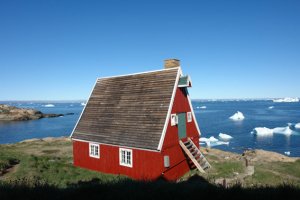
Most unusual studio location to date in arctic Greenland

Most unusual studio location to date in arctic Greenland

www.rebeccabarfoot.com

All images copyright of the artist and used with their permission. 
Posted in Painting, Sculpture | Tagged , , , , | Leave a comment

Heather Hartman – Knoxville, Tennessee

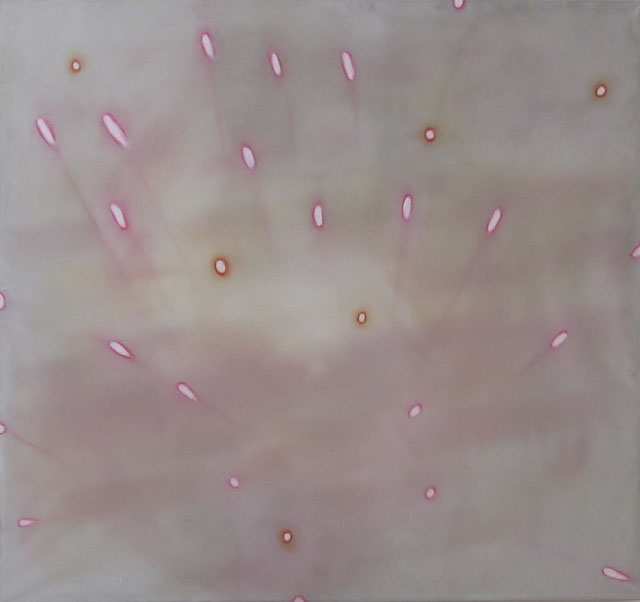
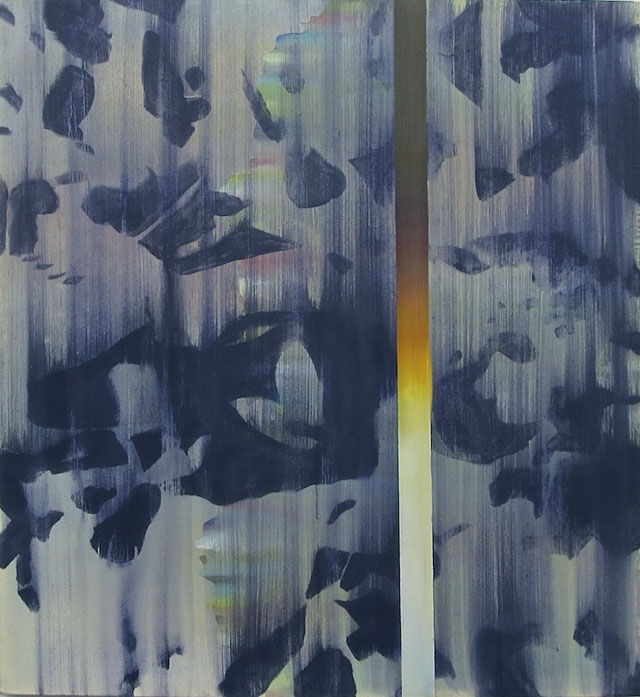
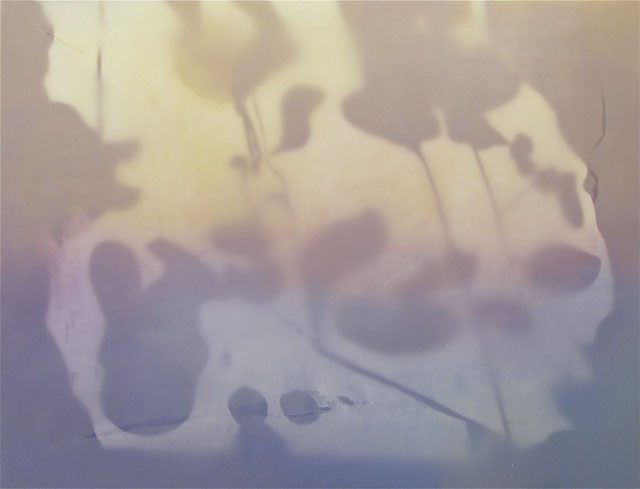
Burst II, 30”x 32”, Water-soluble oil, acrylic, and gouache on paper and stretched polyester mesh, 2013

Burst II, 30”x 32”, Water-soluble oil, acrylic, and gouache on paper and stretched polyester mesh, 2013

Briefly describe the work that you do.

My work explores atmosphere, light, and spatial illusion through a materialistic painting process. I am interested in the constant flux of the visual world, and our temporary space within it. Through reductive abstraction I synthesize memories and photographs I have taken into multilayered compositions. 

At what point in your life did you decide to become an artist?

As far back as I can remember, I have wanted to be an artist. When I was a child I would spend hours painting and drawing. I was fascinated by colors, and obsessed with how to portray on paper, what I saw in the world around me. Once, when I was about 4 years old, I went through an entire pad of paper trying to correctly draw my canary sitting on his swing. Fortunately, I have two very supportive parents who provided me with a steady supply of materials to learn and experiment with. I am forever grateful to them for their encouragement and for never questioning my need to make art. 

Tell us a little about your background and how that influences you as an artist.

As a child, I was surrounded by creativity on a daily basis. I was raised by a singer- songwriter and a recording engineer. When I was 6 we moved from Los Angeles to the Nashville area in order for my parents to pursue their musical careers. Nothing could have prepared me for the culture shock and dislocation that resulted. The area we moved to was a relatively undeveloped, and I was fascinated by the nature in my new home. Sadly, however, in the coming years I watched the open fields transform into tightly packed suburbs. This has had a huge impact on my understanding of how human beings interact with the landscape. I have also always lived in places that have spectacular sunsets, usually the result of air pollution. My memories of what these places used to look like, are now over-layed with the existing realities. This sense of never quite being able to locate oneself, in an ever-shifting landscape is present in my work today. 

Crash, 23” x 20”, Water-soluble oil, acrylic, and gouache on paper and stretched polyester mesh, 2013

Crash, 23” x 20”, Water-soluble oil, acrylic, and gouache on paper and stretched polyester mesh, 2013

What types of conceptual concerns are present in your work? How do those relate to the specific process(es) or media you use?

My work deals with the boundaries between abstraction and representation. I am interested in how representational images can become abstracted through distortions of light and space. The visual world is in constant flux, and the struggle to capture something just on the edge of perception is what drives me to paint. Because I work somewhat reductively, materiality has become a very important part of my paintings. In recent years I have developed a very specific process that involves painting on multiple layers of paper and translucent polyester mesh. This process allows me to explore

illusionism both in paint and in actual space. The resulting images are a combination of blurry, atmospheric forms and distorted shadows that lie beneath washes of color, and intense passages of light. 

We once heard Chuck Close say he did not believe in being inspired, rather in working hard everyday. What motivates you in your studio practice?

I have always worked rather cyclically in the studio. I go through periods in which I can’t seem to stop the flow of ideas, and then others where going to the studio can feel almost daunting. I do believe that showing up is half the work. For me it is important to go to the studio even when I am not in a period of high production. Although these times can be difficult, staying visually alert is helpful and necessary. I am also highly motivated by the materiality of my processes. I usually spend my slower periods experimenting with new techniques. Therefore, I have to physically get my hands on things to start solving problems. I am also very lucky to have fantastic and supportive studio mates. Being a part of a great community of artists is incredibly motivating. 

Pool II, 44”x 50”, Water-soluble oil, acrylic, and gouache on paper and stretched polyester mesh, 2013

Pool II, 44”x 50”, Water-soluble oil, acrylic, and gouache on paper and stretched polyester mesh, 2013

What artists living or non-living influence your work?

I am very influenced by the paintings of William Turner. I love the way that atmosphere and light become vehicles for abstracting the landscapes in his work. I am also fascinated by the way that atmosphere and light often overshadow the disturbing events that lie just beneath them (think “The Slave Ship”). When I was in graduate school I visited Dia:Beacon and it changed my entire perspective on art. I had unexpectedly strong perceptual reactions to the works of Sol LeWitt and Agnes Martin that are housed there. It was a pivotal moment in my development as an artist. I am also very interested in the work of contemporary artists such as Katharina Grosse and Prudencio Irazabal. I make it a point to see as much art in person as I possibly can. There is always something new to learn from the work of others. 

When you are not making art what types of activities and interests do you engage in? 

I teach at several locations at this point in my career, so that takes up a good deal of my time. However, teaching is for me a natural extension of my studio practice, and I greatly enjoy that aspect of my work. I also enjoy reading, gardening in the East Tennessee soil, practicing yoga, the company of my loved ones and my two awesome dogs. 

About 

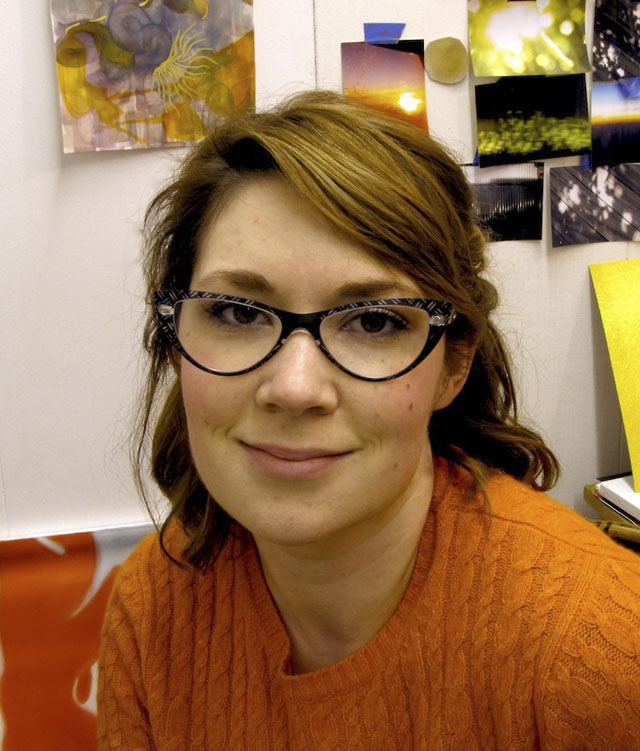
Hartman_HeadshotHeather Hartman was born in Los Angeles, California in 1983. In December of
1989 her family moved to Tennessee, and Hartman was deeply impacted by the atmosphere, weather, and constantly changing skies in her new home. She attended Auburn University and received her Bachelors of Fine Art in 2005. She earned a Master of Fine Art with a concentration in Painting and Drawing at the University of Tennessee in 2009. Her work has been featured in shows throughout the country. She recently won an Honorable Mention at the Knoxville Museum of Art’s Artist on Location Exhibition. Her work has been written about by Dr. Jerry Cullum of Art Papers, and is in the collection of Auburn University. She is a member of the Vacuum Shop Artists Collaborative in Knoxville. Hartman teaches at Walters State Community College, Roane State Community, and will begin teaching at Carson Newman University in the Fall of 2014. Hartman lives and works in Knoxville, Tennessee. 

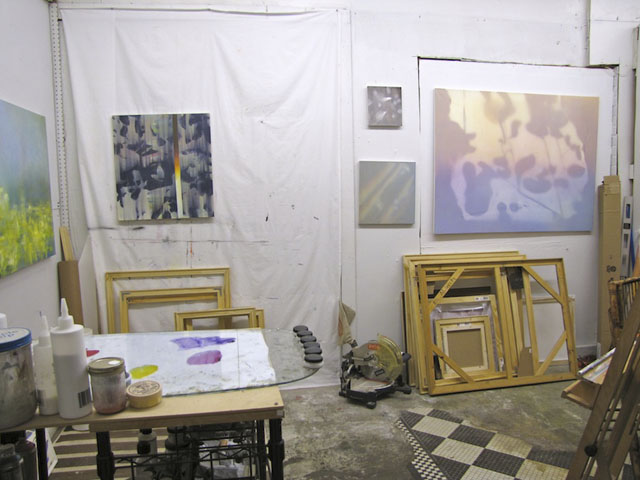
The Studio

The Studio

www.heatherhartmanart.com 

All images copyright of the artist and used with their permission. 

Posted in Uncategorized | Tagged , , , , | 1 Comment

J Myska Lewis – Madison, Wisconsin

Scar in the Air,Monoprint: Paul Celan’s poem To Stand, toner transfer, and graphite on paper, scratched plexiglass, 38” x 50”, 2013

Scar in the Air,Monoprint: Paul Celan’s poem To Stand, toner transfer, and graphite on paper, scratched plexiglass, 38” x 50”, 2013

Briefly describe the work you do.

I use a variety of printmaking techniques and craft based processes (embroidery and crochet) to create two dimensional works and installations. At the core of my work is an investigation into how we read and how reading affects us – not only how we read and understand text, but also how we read, consume, and understand common everyday objects. My work also often addresses human desires for comfort, sustenance, and intimacy.

Tell us a little about your background and how that influences you as an artist.

I grew up in a household full of Legos, Lincoln Logs, popsicle sticks, pipe cleaners, finger paint, yarn… I received a sewing machine for my 9th or 10th birthday… my parents definitely encouraged my brothers and I to be creative, and I definitely think that played an important role in compelling me to become an artist in the first place. I also grew up reading a lot and many different types of texts, and I think that has shaped the way I view literature now and fostered my appreciation for the subtleties of the written word. I see how my upbringing has influenced how I equate reading with making, and thus I hold both as priorities in my role as an artist. 

You Don’t Need a Solution, Installation: drypoint on Kozo (text from Maggie Nelson’s book Bluets), wheatpaste, Approximately 10’ x 8’ x 10’, 2012

You Don’t Need a Solution, Installation: drypoint on Kozo (text from Maggie Nelson’s book Bluets), wheatpaste, Approximately 10’ x 8’ x 10’, 2012

The concept of the “artist studio” has a broad range of meanings, especially in contemporary practice. The idea of the artist toiling away alone in a room may not necessarily reflect what many artists do from day to day anymore. Describe your studio practice and how it differs from (or is the same as) traditional notions of “being in the studio.”

I have a traditional studio space, but I also consider the library and my reading chair at home to be part of my studio. I have a few methods of working, each of which require me to think in a very different way, and so I have found that I need to establish distinct spaces for each of these ways of thinking and working. I go to the library when I need to do research or collect samples of text. I do the bulk of my work in my studio – experiment with materials, fail a lot, figure things out, conceptualize projects, and finally actually produce completed pieces. At home, I either read and organize found texts or work on smaller tedious tasks that I am able to bring home from the studio. I love to constantly be working, so I do most of my crochet or embroidery work from home while “relaxing.” 

to scale the walls, Installation: thousands of cut shapes, Xerox on vellum, approximately 8’ x 6’ x 8’, 2013

to scale the walls, Installation: thousands of cut shapes, Xerox on vellum, approximately 8’ x 6’ x 8’, 2013

When do you find is the best time of day to make art? Do you have time set aside every day, every week or do you just work whenever you can? 

Constantly – I try to incorporate my work into as many aspects of my life and my daily routine as possible. I do set specific times in my schedule to actually go and be in my studio; I have found that the more consistent I am in keeping studio hours, the more I treat it almost as a “real job,” the more productive and driven I am. On the days I don’t have to go to my “real job,” I get to the studio around 7 or 8am and try to stay until 5pm. Then I usually migrate home where I continue working on the less messy parts of my studio practice.

How has your work changed in the last five years? How is it the same?

Both visually and conceptually my work is completely different today than it was five years ago. The only element of my work that has not changed over time is my use of text, repetition or serial forms, and a tendency to work within some sort of system or set of guidelines.

Are there people such as family, friends, writers, philosophers or even pop icons that have had an impact on the work you do?

I think whatever I have recently been looking at or experiencing has an impact on the way I think about and approach my work. Lately I have been looking at a lot of work from Christopher Wool, Zarina Hashmi, Lawrence Weiner, and Joseph Kosuth. I also have been reading a lot of Kurt Vonnegut and Charles Bukowski and listening to Ayn Rand audiobooks and the “This American Life” podcast.

If you had an occupation outside of being an artist, what would that be and why?

I always joke that I would probably love to work on an assembly line. My studio work includes many tedious and repetitive tasks and those tasks are usually my favorite part of being in the studio. 

About 

JML_headshotJ. Myszka Lewis received her BFA from the University of Wisconsin-Milwaukee. She has exhibited throughout the Midwest, in New York City, and in Australia. From 2010-2011, she was a co-founder and curator of the The Parachute Project, a mobile arts organization in Milwaukee, WI. Lewis is currently a MFA Candidate at the University of Wisconsin-Madison and is an assistant to the Master Printers at Tandem Press.

JML_04

All images copyright of the artist and used with their permission. 

Posted in Uncategorized | Tagged , , , , | Leave a comment

Paul Behnke – Brooklyn, New York

Lochinvar, 2013, acrylic on canvas, 50x48 in.

Lochinvar, 2013, acrylic on canvas, 50×48 in.

Briefly describe the work you do.

I’m a painter. I make non-objective/ abstract paintings with and emphasis on intense color and bold forms.

These elements jostle and compete with one another for dominance within off kilter compositions.

At times the combination can be garish and unsettling and at others it may seem to reference the graphic or decorative- often in the same work.

At what point in your life did you want to become an artist?

From a very young age I was interested in art and showed some talent. But it wasn’t until later, as a young adult, that I decided to focus all my energies on painting and, somehow, having a career as a fine artist.

In my early twenties I was busy with a lot of creative endeavors (music, writing, acting, and painting). At some point it became very apparent that I couldn’t continue to divide my efforts and expect to do anything well.

When I went to a museum or worked on a painting I got a feeling that I didn’t get from any of my other outlets. I quickly decided that that passion should be nurtured and followed. 

Tell us a little about your background and how that influences you as an artist.

I grew up in Memphis, TN and there wasn’t much opportunity to see great art. I didn’t know anyone personally who lived their life as an artist.

Luckily my family valued art and my interest in it. My mother in particular was very supportive and encouraged me to pursue it.

The first art I remember being exposed to as a child were reproductions of religious paintings by the old masters. I came across these in a large picture Bible that belonged to my grandmother.  Aside from the drama and grandeur of the work it also dawned on me that Art was something people did! It could be a career or vocation. People devoted their lives to making paintings.

Pink Ant Man, 2014, acrylic on canvas, 50x48 in.

Pink Ant Man, 2014, acrylic on canvas, 50×48 in.

What types of conceptual concerns are present in your work? How do those relate to the specific process(es) or media you use?

My work isn’t conceptual in that way.  I deal mainly with the desire to make a strong visual statement.  I’m mostly working with the problems of spatial relationships and color interactions. My forms and compositions are very much “arrived at”.  Often after the fact the whole painting or specific forms may remind me of a memory or experience but I don’t believe naming that would be useful to the viewer and even if it were, that’s not a level of exposure I’m interested it. It’s not something I’m interested in sharing.

The fact that I use acrylic paint has nothing to do with conceptual concerns.  Acrylics best suit my impatient personality and I prefer their flat, artificial surface, and versatility to oils.

Bobbie's Bluing, 2014, acrylic on canvas, 50x48 in.

Bobbie’s Bluing, 2014, acrylic on canvas, 50×48 in.

We once heard Chuck Close say he did not believe in being inspired, rather in working hard everyday. What motivates you in your studio practice?

He’s right. Work comes from work. There’s no such thing as inspiration. That’s for amateurs. It actually kind of annoys me when I hear artists talk about inspiration. I tend to not take them very seriously.

I’m motivated to paint by seeing great paintings in museums, galleries, and my friends’ studios.

I’m motivated by competition. I want to make better work than my peers and heroes.

Talking about painting with other painters over drinks recharges me.

Having my own work around to look at and learn from also motivates me.  I’ve yet to make a great painting. I’ve made some bad ones and a few good ones. Living with my own work reminds me of that and helps push me on.

Ego is also a motivating factor. I want my efforts to be seen and acknowledged and to have my vision and passion communicated.

What artists living or non-living influence your work? 

Right now I’m interested in: the German Expressionists, Bob Thompson, Hans Hofmann, Jack Kirby, Giotto, Nicholas Krushenick, Allen Jones, Saul Bass, Gwen John, John Hoyland, Albert Irvin, Fred Pollock, Bridget Riley, Eva Hesse, Sandra Blow, Tess Jaray, John McLean and Elvis.

When you are not making art what types of activities and interests do you engage in?

I enjoy looking at and arguing about painting. I like to visit friends’ studios and go for walks around the city. I also like watching almost any old movie made before 1960. It helps if it’s in black and white.

About

Paul Behnke 2014. Photo by Robin Stout

Paul Behnke 2014. Photo by Robin Stout

Paul Behnke was born in Memphis, TN and graduated with a BFA in painting from the Memphis College of Art in 1999.

Behnke’s paintings have been included in group shows and one-person exhibitions throughout the United States and abroad.

Recently his work was on view in the solo exhibition, An Awful Rainbow and in the curatorial effort, Eight Painters – both held at Kathryn Markel Fine Arts in Manhattan.

In 2014 Behnke was selected as one of the Sam & Adele Golden Foundation’s 2014 Artists in Residence and will attend in the month of October.

He current lives and works in New York City.

Working in the studio. Photo by James Panero

Working in the studio. Photo by James Panero

www.paulbehnke.net

All images copyright of the artist and used with their permission. 

Posted in Uncategorized | Tagged , , , , | Leave a comment

Bonnie Stipe – Albuquerque, New Mexico

The Petrified Forest Oil and Mixed Media on Panel 24" x 36" 2013

The Petrified Forest
Oil and Mixed Media on Panel
24″ x 36″
2013

Briefly describe the work you do.

As an artist, I find myself continually interested in the notion of beauty. My work is concerned with societal visualizations of gender roles and whether our preconceived notions of beauty come from biological sources or are fashioned through ever changing cultural expectations. 
 
Many of my works question this very paradox. Are we influenced through advertising, or is it our innate human nature that forms the violent, sexual, and even humorous imagery that flood our media? Choosing imagery and materials based on color alone, I allow the imagery to be from a wide and varied cross-section of photographic and contemporary media. Materials come from a variety of sources: Teen Vogue, the New Yorker, Better Homes and Gardens, the Cosmopolitan, National Geographic, historical painting, and craft materials. The combination allows for landscapes and figures of unknown gender and physical characteristics to take shape, born out of chaos. Is this a constructed beast or is it built out of natural human desires?

Tell us a little about your background and how that influences you as an artist.

I am a native of the midwest, born and raised in Massillon, Ohio. Five years ago I came to the southwest for graduate school and fell in love with New Mexico. The landscape and culture are so different from where I spent most of my life. The boldness of the light found in the southwest has affected the aesthetic of my work. I feel attached to bold and bright colors, much like you will see in New Mexico on a hot, cloudless day. 

The Galaxy Oil and Mixed Media on Canvas 18" x 24" 2013

The Galaxy
Oil and Mixed Media on Canvas
18″ x 24″
2013

The concept of the “artist studio” has a broad range of meanings, especially in contemporary practice. The idea of the artist toiling away alone in a room may not necessarily reflect what many artists do from day to day anymore. Describe your studio practice and how it differs from (or is the same as) traditional notions of “being in the studio.”

Most of my work is made in a traditional studio setting. The pieces that I make are very time consuming. I use traditional processes, including oil painting, that require long dry times and layering of materials. That being said, most of my work begins outside of my studio. Photography is integral in my creative process. Much of the inspiration for my current pieces comes from nature. I spend a lot of time hiking, and taking images of the landscape. 

What unique roles do you see yourself as the artist playing that you may not have envisioned yourself in when you first started making art?

I see myself as an inventor and sometimes scientist. Experimentation plays a big role in my practice. When I first started making art, I just wanted to know the ‘right’ way to do things. I didn’t understand that the most exciting part of art was inventing my own way to create things. A scientist, in the broadest sense, is one who engages in a systematic activity to acquire knowledge. I feel a true artist is one who creates a practice through which knowledge is the ideal goal.

You Eat What You Are Oil and Mixed Media on Panel 24"x 18" 2013

You Eat What You Are
Oil and Mixed Media on Panel
24″x 18″
2013

When do you find is the best time of day to make art? Do you have time set aside every day, every week or do you just work whenever you can? 

I try to keep myself on a set schedule. I think one of the hardest things about being an artist is not losing the momentum that you have when you are creating. When I get out of the practice of making art, it can sometimes be difficult to get started again- sort of like exercise. I feel better when I am creating.

How has your work changed in the last five years? How is it the same?

Over the past five years, I have experimented with a lot of different materials. I have always had an interest in mixed media, and in the past year I have learned to embrace it. Conceptually, my work has also taken a turn in the last year. As a young artist and woman, I was interested in depictions of the body, and how our culture defined femininity and beauty. In recent years, my interest has shifted. I am still interested in definitions of beauty, but I am thinking about it in a broader sense. I am exploring the complicated relationship we have with beauty, both in nature and in the figure. 

Are there people such as family, friends, writers, philosophers or even pop icons that have had an impact on the work you do?

A writer who has continually influenced my work is Ariel Levy. Her work, exploring sexuality in American culture and its effect on the identity of young women, inspired much of my early paintings. Her insights on modern feminism and the exploitation of the female body are what made me explore the definition of femininity in my work.
 
My family has always been my biggest supporters as an artist. They have always believed in my abilities and talents. Without them I may not have had the strength to follow my dreams. In addition, I have been blessed with a amazing circle of friends from whom I am continually inspired.

If you had an occupation outside of being an artist, what would that be and why?

I do have an occupation outside of being an artist, and it is that of an educator. I feel that education and creativity go hand in hand. I am continually inspired by my students and their work. I teach at a local community college, and my students are a variety of ages with an array of backgrounds and experiences. Often I find myself discussing an issue with a student and from that my work is directly influenced.  

About 

IMG_1584Bonnie Stipe is a native of the Midwest. Born in Massillon, Ohio she attended the University of Akron’s Myers School of Art, graduating with a BFA in painting and drawing, and a BA in art education. Following her studies, she then travelled to Albuquerque, New Mexico where she received her MFA in Studio Arts from the University of New Mexico. 
Bonnie has exhibited in galleries through the Midwest and Southwest, as well as working on projects abroad. Bonnie has traveled to Pylos, Greece to work as an illustrator for the King Nestor’s Palace Archeological Project; Kastorlee Belgium, to collaborate with students from St. Luke’s University, Brussels, for the Fran Masereel Printmaking Residency; and Venice, Italy, as a delegate to the Venice Biennale for the Myers School of Art. 
Bonnie currently lives in Albuquerque, New Mexico where she is a faculty member at Central New Mexico Community College.
DSC_0066

www.bonniestipe.com

All images copyright of the artist and used with their permission. 

Posted in Uncategorized | Tagged , , , , | 3 Comments

Anja Notanja Sieger – Franklin, Wisconsin

Personal Space

“Personal Space” Razor Cut Chabori Paper, 14×21″ 2013

Briefly describe the work you do.

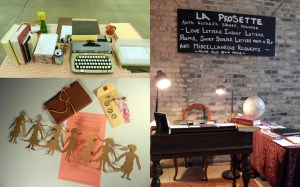
2013 was spent cutting dragon thoughts out of paper, traveling to outer space to capture the culture there, messing with shadow puppetry and regularly appearing at many Milwaukee locations as “La Prosette,” a public therapy service where I type on-demand orders for love letters, poetry, pet greetings, poetry, stories, letters of recommendation and more for clients from my typewriter. This year I’m participating in more collaborative projects… and mystery.

Tell us a little about your background and how that influences you as an artist.

Much of what I’ve been taught as an artist can be traced to my mother. My mom was an elementary school art teacher and filmmaker. She quit those things after I was born to take my brother and me on as her full time students. We were always drawing from life at the zoo, festivals, concerts, and attending art shows as a family. To this day I delude myself into thinking of Dali as my other father, the man whose picture I talk to when I have an art problem.

The concept of the “artist studio” has a broad range of meanings, especially in contemporary practice. The idea of the artist toiling away alone in a room may not necessarily reflect what many artists do from day to day anymore. Describe your studio practice and how it differs from (or is the same as) traditional notions of “being in the studio.”

I work mostly from home, but I also have a studio in downtown Milwaukee where I can make stuff in private. I find inventing my work in front of a live audience the most invigorating way to make stuff. I have two kinds of work: the work I carefully make in private and later fling on an unsuspecting audience, and the work I happily slop together for a line of customers in a public space.

What unique roles do you see yourself as the artist playing that you may not have envisioned yourself in when you first started making art?

Good art is divine. It is always smarter than the artist and comes from somewhere else to heal both the artist and the viewer. When I was younger I didn’t think my role was to be an accidental wisdom conduit, but now I certainly do. The more art I make, the more I feel it heals all who have anything to do with it.

Anatomy of a Dragon

Shot of a wall from the “Anatomy of a Dragon” show at Gallery 2622, Wauwatosa, WI, October 2013

When do you find is the best time of day to make art? Do you have time set aside every day, every week or do you just work whenever you can? 

I’ve given up most of my adult independence to make my art all day. I currently live with my parents in the middle of suburban nowhere without a car; but I also have the art & writing portfolios to show for it. At this phase of my life I think about sculptor Mary Nohl who was able to create all day because of her parents. My brain is constantly winding around projects I’ve got to manifest, but at 10PM I get an urge to dance really hard for about eighteen minutes and that is all I care about.

Dragon's Desire

“Dragon’s Desire,” Scissor Cut Paper, 30×40″ 2013

How has your work changed in the last five years? How is it the same?

None of the mediums I am currently working in existed in my life five years ago. Back then I was re-writing the Odyssey, book binding, crocheting hats, serving as a puppetry intern and a college printmaking student. If I could be told now the projects I’ll have in 2019, I’d want to change my plans, because I prefer surprises. Only my approach of surprises and improvisational creation remains constant in my practice.

Are there people such as family, friends, writers, philosophers or even pop icons that have had an impact on the work you do?

I have to be as flexible as a melting clock because I’ve taken Dali as my father, but maybe I’m wrong and it was actually Cocteau or John Cage. Maira Kalman is my long lost aunt who I was never told about till I was 23 or so. I am still trying to figure out exactly how I am related to that muppet named ‘Animal,’ Lotte Rieniger, Roz Chast and my favorite living artist, NINA KATCHADOURIAN.

If you had an occupation outside of being an artist, what would that be and why?

If I weren’t an artist of some variety I would have the occupation of a 10 x 10 foot (or smaller) cell somewhere if I would be alive at all. Deeeeee end.

headshot by treeAbout 

Anja Notanja Sieger received her BFA in printmaking and creative writing from Kansas City Art Institute in 2009. After graduation she worked for a year building puppets at Paul Mesner Puppets in Kansas City. Her live stories have won Milwaukee area slams held by Ex Fabula and the Pfister Hotel. She served as an arts administration protégée for the Milwaukee Artist’s Resource Network’s 2011-12 season. Her performance writing art service “La Prosette” has been featured on the front page of the Milwaukee Journal Sentinel, USA Today Online, MSN Hotmail News and Yahoo News. Sieger has written about art online for All Creativelike, Library As Incubator and the Cowbird Daily Story. She is currently an artist-in-resident at In Tandem Theatre and a writer-in-residence at Renaissance Theaterworks, Milwaukee. Milwaukee’s Tenth Street Gallery, Narthex Gallery and Gallery 2622 all hosted varied solo shows of Sieger’s work in 2013.

www.anjanotanja.com

www.laprosette.com

La Prosette Public Headquarters set up at Renaissance Theaterworks, Milwaukee

La Prosette Public Headquarters set up at Renaissance Theaterworks, Milwaukee

All images copyright of the artist and used with their permission. 

Posted in Uncategorized | Tagged , , , , | Leave a comment

Paula Schulze – Shorewood, Wisconsin

Star Drawing #8

Star Drawing #8, 2011, charcoal on paper, 41 3/4″ x 29 1/2″

Briefly describe the work you do.

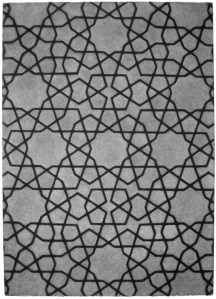
I create drawings and prints that use pattern and ornament to organize space. I’m inspired by architectural ornament, early and pre-Renaissance art, and Islamic geometry.

Tell us a little about your background and how that influences you as an artist.

I grew up in Beloit, Wisconsin. My mother was a nurse, and my father worked in construction and engineering. He was a fan of Frank Lloyd Wright, and I remember making the family pilgrimage to Taliesin, Wright’s home and studio. I experimented with arts and crafts through my local 4-H, and I had my first try at printmaking at summer art camp in high school. I had the opportunity to study in Mexico when I was in college and was exposed to pre-Columbian and contemporary traditions in the visual arts. I was an art major for a while in college, but I didn’t begin to seriously pursue art until I moved to Milwaukee in my 20s. I began taking classes as a special student and made the commitment to studying printmaking in graduate school. I worked as an audio-visual technician at the Milwaukee Art Museum. This, and other museum jobs that followed, gave me a daily education in art and art history with valuable exposure to art, artists, lectures, and film.

The concept of the “artist studio” has a broad range of meanings, especially in contemporary practice. The idea of the artist toiling away alone in a room may not necessarily reflect what many artists do from day to day anymore. Describe your studio practice and how it differs from (or is the same as) traditional notions of “being in the studio.”

Most of my studio time is spent alone working on my prints and drawings. This time is often satisfying and meditative. Other times it is just about doing the work. I’ve also had experiences with public art and installations that have taken me outside the traditional studio space and challenged me in terms of scale and collaboration.

Pattern

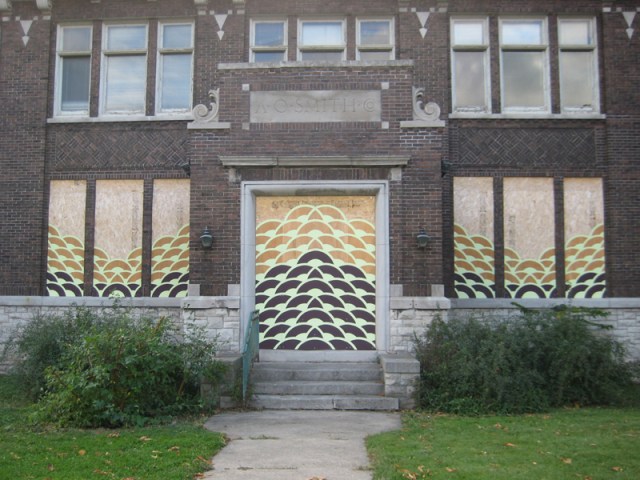
“Pattern” (detail), 2010, stain and house paint on plywood, dimensions variable

What unique roles do you see yourself as the artist playing that you may not have envisioned yourself in when you first started making art?

I wouldn’t have envisioned myself working on a large scale in a public space or in a collaborative setting. It also surprises me that I am still discovering how art has the ability to interact in a meaningful way with so many other disciplines.

When do you find is the best time of day to make art? Do you have time set aside every day, every week or do you just work whenever you can? 

Late morning and early afternoon are my best times. I have scheduled studio time into my work week pretty consistently for many years. I’m not always as productive as I would like to be, but the commitment to the studio as part of my routine has helped me to continue to make work and grow as an artist.

Circles and Stars

“Circles and Stars,” 2012, mezzotint, 3 3/4 x 3 3/4″

How has your work changed in the last five years? How is it the same?

For many years I worked primarily as a printmaker on a small scale. In the past five to seven years, I’ve expanded the range of my work to include more drawing and some large scale projects. Opportunities to work on temporary public art through the organization IN:SITE helped me to realize work in a context outside the printmaking studio. My larger scale works utilize themes found in my prints, but they require new media, new approaches to planning and implementation, and the surrender of control and the need for perfection.

Are there people such as family, friends, writers, philosophers or even pop icons that have had an impact on the work you do?

Artists as diverse as Agnes Martin, Frida Kahlo, and the Guerrilla Girls have had an impact on my work over the years. My family has always been supportive. I am lucky to have friends who have pursued their own art for many years, sometimes with little outside encouragement. They inspire me to continue my work as an artist.

If you had an occupation outside of being an artist, what would that be and why?

Like most of the artists I know, I have an occupation outside of being an artist. I’ve been fortunate to hold a variety of arts-related jobs over the years, including several museum positions, fine art framing, print editing and design, and my present work in web design and development. If I hadn’t pursued the arts, I imagine myself working in archaeology or historic preservation, or maybe as a librarian.

pschulze_headshotAbout 

Paula Schulze is an artist who works primarily in drawing and the printmaking technique of mezzotint. She has a BA in anthropology and Ibero-American studies from the University of Wisconsin-Madison and a MFA in printmaking from the University of Wisconsin-Milwaukee. She has participated in residencies at Anchor Graphics in Chicago; Hamilton Wood Type and Printing Museum in Two Rivers, Wisconsin; Scuola Internazionale di Grafica in Venice, Italy; and Fundación Valparaíso in Mojácar, Spain. She has also collaborated on temporary public art projects with the organization IN:SITE in Milwaukee. She lives in Shorewood, Wisconsin.

www.paulaschulze.com

studio

Studio

All images copyright of the artist and used with their permission. 

Posted in Uncategorized | Tagged , , , , | 2 Comments