Mary Bucci McCoy – Boston, Massachusetts

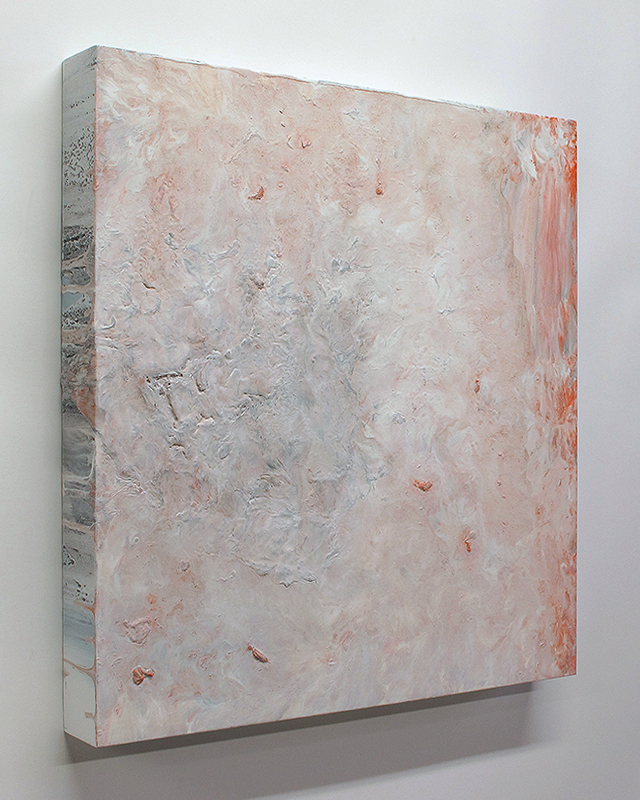
Anamnesis, acrylic on panel, 16 x 16 x 1.75", 2014

Anamnesis, acrylic on panel, 16 x 16 x 1.75″, 2014

Briefly describe the work that you do.

I make intimate, abstract acrylic paintings on rectilinear and vertical oval panels that synthesize oblique references to the body and the landscape on both macro and micro levels through form, color, and material. My poetic material language negotiates and exploits the opportunities and exigencies of the paint and is increasingly informed by my early experience with the materials, processes, and techniques of ceramic sculpture. Over the past few years I have gradually expanded my practice from a process of slowly building paintings over time by the deliberate situating of painted marks on a monochromatic ground, to include the possibility of working in a very immediate, improvisational way, with an entire painting occurring simultaneously in the still-liquid matrix of the ground. I am interested in paintings that take chances, paintings that surprise me, paintings that may even feel transgressive within the scope of my practice, paintings that change me. I don’t necessarily know where a painting will go when I begin, and often I have one chance at a painting before it’s arrested by the paint drying — I love the risk, that it can be all or nothing, and that I can’t necessarily see how a painting will ultimately resolve until it has dried completely.

At what point in your life did you decide to become an artist?

I can’t remember a time when I didn’t love making things, including art, or a time when I didn’t take that seriously. But I would date my intention to become an artist in the sense of art as a life and a profession to art classes I took on Saturday mornings for six years at a local art association, beginning when I was seven. The classes were taught, or faciliated, in an open studio format in a former one room school house by two artists, a painter and a sculptor. The class included students from elementary school age through high school. There were no class assignments; each student worked on projects of their own choosing and interest, at their own pace. Our teachers supported and respected us.

Tell us a little about your background and how that influences you as an artist.

The five year BA/BFA program at Tufts University and the School of the Museum of Fine Arts, Boston forced me to navigate two profoundly different, even contradictary cultures, and to negotiate the relationship of academic disciplines to art-making. While this gave me an understanding of the possibilities for interaction between art and other disciplines, more importantly it gave me an appreciation for the unique position of art as a means of accessing, investigating and articulating things that can’t be done in any other way. Art is often valued by institutions as a support for or appendage to other disciplines, but I experience it as a primary discipline that is valid and complete in its own right. This is utterly fundamental to my work as an artist.
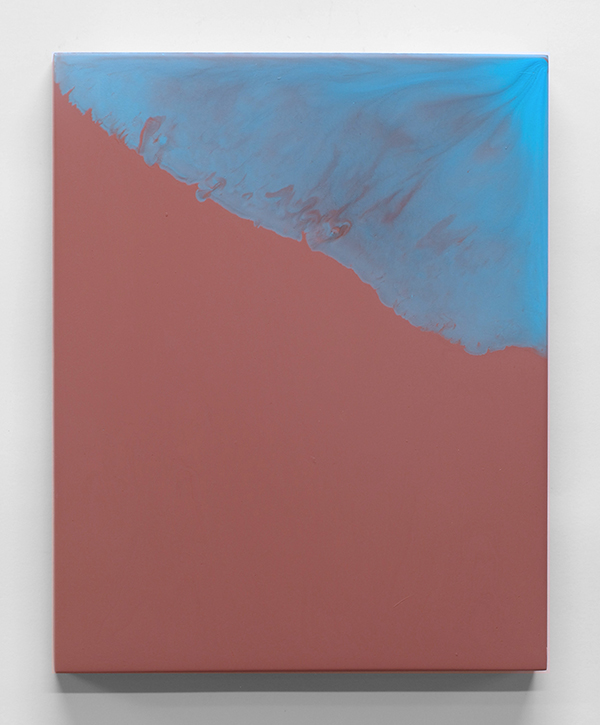
Sanctuary, acrylic on panel, 10.5 x 8.5 x 1", 2014

Sanctuary, acrylic on panel, 10.5 x 8.5 x 1″, 2014

What types of conceptual concerns are present in your work? How do those relate to the specific process(es) or media you use?

I think about the simultaneously residual and latent qualities of the hand made art object — its double role as the record of the maker’s experience and the basis for the viewer’s experience — and the continuing relevance (or even possible radicalness) of that in technologically-mediated contemporary life. What does it mean to be painting, to be making unique artworks in an era of digital imagery and replication?

Creating a visual illusion is rarely a foregrounded consideration for my work, and I am interested in paintings which, although not dependent on illusion, read nonetheless as paintings and not objects. The locus of the effect of the work is within the viewer, not the painting: the exposed directness of my painting corresponds to the immediacy of the viewer’s connection with the work. The direct, sensual intimacy of the material, the marks and the facture of my work invite the viewer into that experiential dialogue. I am more interested in the internal scale of the viewer’s experience than the physical scale of the work.

We once heard Chuck Close say he did not believe in being inspired, rather in working hard everyday. What motivates you in your studio practice?

Chuck Close also said, “All the best ideas come out of the process; they come out of the work itself,” and that really sums up my motivation: I have a need to find things out, to see where things lead, to dig deeper, and then to transmit that into the world.
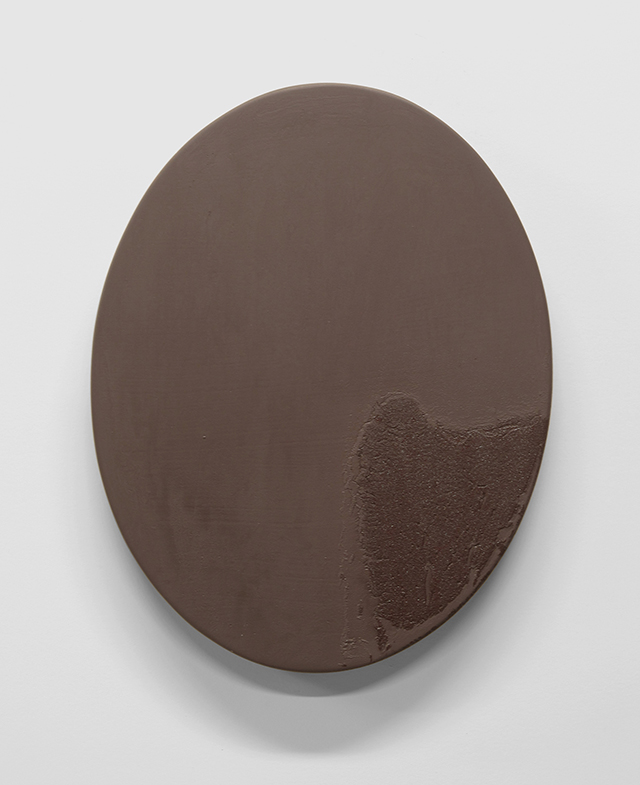
Crux, acrylic mixed media on plywood, 9 x 7 x 1", 2013

Crux, acrylic mixed media on plywood, 9 x 7 x 1″, 2013

What artists living or non-living influence your work?

What is really interesting to me, regardless of discipline, is work that reframes and reinvigorates my work, and opens up new territory in my mind, my eye, or my work in some way. A few things that have done that for me in the past year, in no particular order:

• revisiting the paintings by Chaim Soutine at the Barnes Foundation in Philadelphia.

• Simon Blackmore’s “Weather Guitar” in Simon Blackmore: Three Sound Works at the Aldrich Contemporary Art Museum in Ridgefield, CT.

• Karlheinz Stockhausen interviewed by Hans Ulrich Obrist in Obrist’s book A Brief History of New Music.

• the Museo Archeologico Nazionale d’Abruzzo in Chieti, Italy, in particular the pre-Roman Penna Sant’Andrea funerary stele and “Warrior of Capestrano,” displayed in a room designed for it by Mimmo Paladino.

  • Gutai: Splendid Playground at the Guggenheim Museum, NY.

When you are not making art what types of activities and interests do you engage in? 

Two of my lifelong passions, which also inform my studio practice in different ways, are reading, and spending time in nature — walking, camping and watching natural processes. 

My husband and I have lived in the coastal town of Beverly on Massachusetts’ North Shore since 2001. There are two libraries a few blocks from our home: the public library and the library at Montserrat College of Art, which is open to the public. While much of what I read relates to art in some way, I enjoy a wide array of both fiction and non-fiction. 

As Gary Snyder wrote in The Practice of the Wild, “Each place is its own place, forever (eventually) wild. A place on earth is a mosaic within larger mosaics — the land is all small places, all precise tiny realms replicating larger and smaller patterns.” We are located within the Salem Sound watershed — it’s about a half-mile walk to the beach from our home and studio — in the post-glacial Southern New England Coastal Hills and Plains ecoregion. Looking at the ocean throughout the year, I watch the way it changes in different light and weather conditions, and the nuance of that. And by walking the same trails year round, visiting the same places, I see how things change through the seasons and over time. The ocean and the landscape train my eye. 

About 
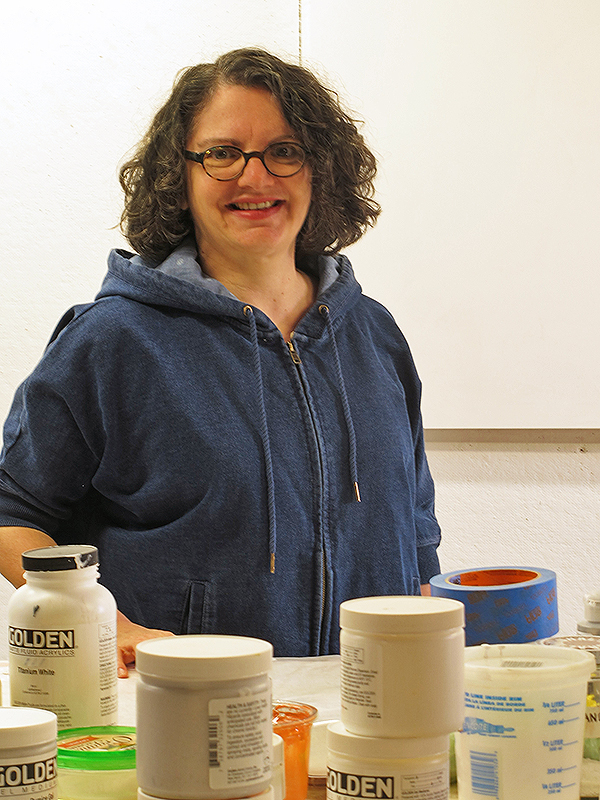
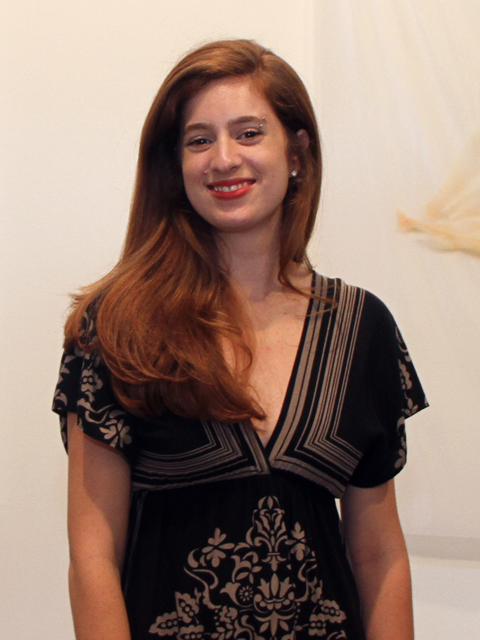
BucciMcCoy_portrMary Bucci McCoy grew up in the greater Philadelphia area and now lives and works on the North Shore of Massachusetts. Recent honors include a 2012 Massachusetts Cultural Council Painting Fellowship, nomination for the 2013 Brother Thomas Foundation Fellowship, and selection for the White Columns Curated Artist Registry. She has exhibited at venues including Kingston Gallery, Boston, MA; Rhode Island College, Providence, RI; the Artists Foundation, Boston, MA; Montserrat College of Art, Beverly, MA; Salem State University, Salem, MA; Tiger Strikes Asteroid, Philadelphia, PA; AG Gallery, Brooklyn, NY; Southern New Hampshire University, Manchester, NH; Art Complex Museum, Duxbury, MA; Merrimack College, Andover, MA; and Emmanuel College, Boston, MA. Her work has been reviewed in publications including The Boston Globe, Art New England, The Providence Phoenix, and the Providence Journal. She holds a BFA from Tufts University/School of the Museum of Fine Arts, Boston and a BA in English from Tufts University. She has also studied ceramic sculpture at l’École des Arts Decoratifs in Geneva, Switzerland (now Haute École d’Art et de Design Genève). 
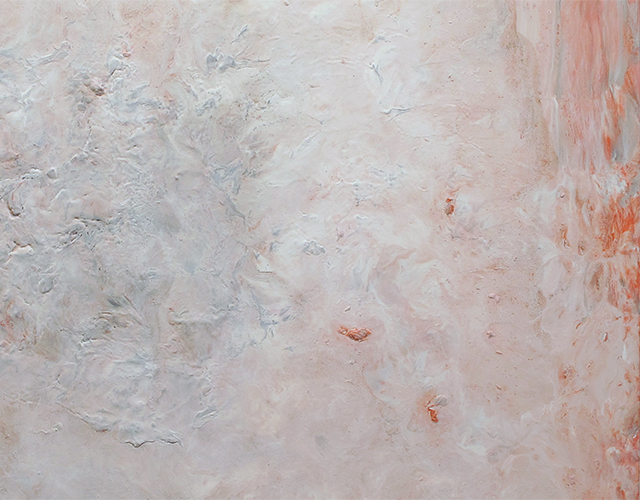
Anamnesis (detail), acrylic on panel, 16 x 16 x 1.75", 2014

Anamnesis (detail), acrylic on panel, 16 x 16 x 1.75″, 2014

www.buccimccoy.com

All images copyright of the artist and used with their permission. 

Posted in Uncategorized | Tagged , , , | Leave a comment

Lauren Brooke Miller – Richmond, Virginia

Living Vessel, ceramic, succulents, 9"-5"-4", 2013

Living Vessel, ceramic, succulents, 9″-5″-4″, 2013

Briefly describe the work you do.

I work to create a visceral sensation that narrates my bodily space.  The human vessel, or in particular “my body” can be portrayed as a complex, grotesque, and yet wonderfully beautiful set of systems.  How a bodily experience translates into objects or interacts with materials is my guide to discovering visual imagery.  My practice acts to weave together concepts regarding personal space, investigating ideas pertaining to the bodily vessel in a variety of physical, psychological, and metaphysical aptitudes. 

Tell us a little about your background and how that influences you as an artist.

I was born and raised in the suburbs of Columbus, OH where I completed my BFA with a focus in Ceramics at Ohio State University in 09’.  I spent a year studying, teaching, and soaking up New Mexico before completing my MFA with a focus in Ceramics from Virginia Commonwealth University in 13’.  I have always enjoyed an intellectual approach to art and culture, and perhaps studied theory a bit too seriously throughout my academic career.  I find that what influences my work recently is a parallel daily practice of self-care.  I have been dedicated to developing a yoga practice, and spend quite a bit of energy studying and applying various healing arts such as acupressure, deep tissue massage, Alexander technique, reiki, aromatherapy and various other simple holistic cures to my daily life. I feel that the language and visualization involved with these practices can often mirror things I think about in the studio.

Subduer, Mixed Media Installation, 2013

Subduer, Mixed Media Installation, 2013

The concept of the “artist studio” has a broad range of meanings, especially in contemporary practice. The idea of the artist toiling away alone in a room may not necessarily reflect what many artists do from day to day anymore. Describe your studio practice and how it differs from (or is the same as) traditional notions of “being in the studio.”

There is something cathartic for me about feeling material move through my hands.  I enjoy crafting objects.  However, I began to understand during my graduate studies that my practice was rooted in the experiential.  I had been creating situations and documenting them for sometime, so turning to my interest in clay and using my body as a site, that dramatically changed how I view the studio.  While I still make objects, I feel most of my work can and should be executed out of the traditional artist studio.  Working outside or in a more intimate setting changes the energy of working and the acts themselves take very little time.  Researching, planning and preparation take the majority of my time.

What unique roles do you see yourself as the artist playing that you may not have envisioned yourself in when you first started making art?

I think one of the invigorating things about a contemporary practice is embracing how open the field is.  I am intrigued by the growing connection between art and health.  It has taken time to recognize patterns in my studio practice, and I feel that exploring the body and our personal awareness of our own body is something I have long attempted to voice in my work.  My work felt very abstract to me for quite awhile.  It is only recently that I began to really connect self-healing techniques with work I was creating in the studio.  The possibility of creating a conversation regarding self-awareness in a gallery space is very exciting for me.

Megan, Peel, Interaction documented B&W film, Hahn Muhle paper mounted on 1/2" beveled gator board,15”-9.5”-.5” 2013

Megan, Peel, Interaction documented B&W film, Hahn Muhle paper mounted on 1/2″ beveled gator board,15”-9.5”-.5” 2013

When do you find is the best time of day to make art? Do you have time set aside every day, every week or do you just work whenever you can? 

I tend to really enjoy working in the mornings, but if I am in the middle of a project I work whenever I possibly can.  It has been a year since I have graduated, and am still learning to create a balanced, active studio practice.   A friend kindly gave me the wisdom recently to just relax, work slows down dramatically beyond the vigor of a masters program.  I also count reading, researching, applying to shows…all of this is part of a practice.  

How has your work changed in the last five years? How is it the same?

That’s an interesting question since the last five years have been quite full with the completion of formal academia, and shifting landscapes.  I know that a blessing of going through a masters program is learning a certain level of language regarding art and culture.  It has been amazing to travel as I have seeing art, learning, sharing ideas, and meeting interesting people.  The learning curve was pretty steep for me, and I feel like the journey is just beginning.  These last five years helped establish a portfolio and working knowledge of why I do what I do.  One of the most significant realizations has been that my undergraduate professor Steve Thurston was correct.  We keep making the same things.  I come back to the same early catalysts that inspired me probably when I was 3 creating the watercolor that still hangs matted and framed on my Aunts wall.  It is a pretty amazing feeling recognizing patterns in your own work.  

Are there people such as family, friends, writers, philosophers or even pop icons that have had an impact on the work you do?

I definitely feel that relationships play a big role in my life and practice.  My family has been a huge influence in my thinking and growth as an artist.  There has been a host of friends that have encouraged and inspired me, and I also have been fortunate to study with some amazing artists.  There was a good chunk of time I spent live music bartending in my hometown.  Music and musicians I met through the job really helped shape me creatively.  There is something I really deeply respect about live performance.   

If you had an occupation outside of being an artist, what would that be and why?

I feel that my personal life and studio practice enmesh in many ways.  The holistic path has always intrigued me.  It is my goal to weave together my passion for art and healing arts for a career.  It has occurred to me that the bottom line for me is live as creatively as I can on a daily basis, and do my part in sharing what I have learned along the way.

About 

lbmheadshot2Lauren Brooke Miller (b Columbus, Oh) is a visual artist working to create interactions between the body and a variety of materials and objects.  She weaves together concepts regarding our individual space, investigating internal space in a variety of physical, psychological, and metaphysical aptitudes.  Lauren earned her MFA in Ceramics from Virginia Commonwealth University.  She holds her BFA focused in ceramics from the Ohio State University.  She was also fortunate to spend a year teaching and studying at the University of New Mexico.  Lauren currently lives and works in Richmond, Va.

In Process

In Process

www.laurenbmiller.com

All images copyright of the artist and used with their permission. 

Posted in Uncategorized | Tagged , , , , | Leave a comment

Matthew Woodward – Chicago, Illinois

Untitled (Brooklyn) 59''x 45'' Mixed-Media on Paper 2013

Untitled (Brooklyn) 59”x 45” Mixed-Media on Paper 2013

Briefly describe the work that you do.

The work I do is mixed-media based. I would lean toward calling them drawings but lately I think that I might be approaching Painting through a backdoor while it sleeps. In the past I made drawings with traditional materials and techniques -graphite on tiled paper, etc- they were then and still are remarkably tedious renderings of architectural details. However, rather than allow the image its responsibility as ‘drawing’, I’ve begun to bury it under a host of materials, I’ve distressed it, and circumvented the privilege of the image by spreading the act of drawing itself away from it and over the entire surface. 

At what point in your life did you decide to become an artist?

I really like this question. It’s slippery. I think getting an education is a lot like getting married, in that you deliberately enter into an obligation that binds you with some greater goal which will, essentially, benefit you for as long as you are alive and trying. Getting a degree is no less supposed to do this, and choosing what you go to school for and where is as important a decision as picking someone with whom to spend the rest of your life. You are installing something inside of yourself to live and grow with. And if you do indeed eventually regret it, you will not be able to erase one or the other from your mind any more than you can snip a memory from your heart. 

But whereas getting engaged implies that you’ve chosen the person you want to marry, getting a degree in art-making doesn’t necessarily notarize your decision to become an artist upon the moment of graduating. I think that decision process happens long before you’re aware what an artist may or may not be, and continues to happen long after you have any idea that that might be what’s happening. 

Tell us a little about your background and how that influences you as an artist.

I’m from outside of Rochester, New York. A little pivot town along The Great Rust Belt. My mother, who is from Chicago, was tremendously musical and hung all over the walls dozens of cold and carved-out Andrew Wyeth prints. November looking handsome things. These starkly fortuitous and small lead prints. As a kid I thought they were dead family members, fathers gathering apples, in repose elsewhere, they were people somehow connected to my life but in their night time. I’d try to make out who they were, when all of this could have happened. I gave them lives. 

I asked one day and someone told me they weren’t of anyone and right then all of this living that I had invented fell away, everything in my mind changed. I had been looking at art, at painting, but fixed it still as something else, I had trained my mind on some other quality that wasn’t there. After that, when I got to making my own art, it was as if I was recovering that experience, retracing it. It was like I was remembering to forget that those people had lived at all. 

Untitled (Brooklyn) Detail 59''x 45'' Mixed-Media on Paper 2013

Untitled (Brooklyn) Detail 59”x 45” Mixed-Media on Paper 2013

What types of conceptual concerns are present in your work? How do those relate to the specific process(es) or media you use?

Getting back to what I was saying earlier about drawing, I think the act of making drawings, insofar as drawing is bridging what it is we are seeing with the way we see the world, is central to my work, it’s the lynch-pin. And there, at this lynch-pin, drawing arises an impasse that lives between the memory of something and the perception of it. My work uses drawing to point at this crisis, at this opposition. Memory, in my work, both collective and personal, is a function upon which it is increasingly problematic to appeal. Furthermore, the thing about the materials I use is that material has no inborn genre, there is nothing anymore latent in oil paint than there is in spackle to keep either from eventually becoming something else. The images I borrow from, these architectural ornaments, are prepackaged with a library of assumptions, but so is the spackle. In this way, where the two meet on the surface, as referents, they confound each other, and their effect is both spatial and social. 

Architecture, for me, has always had this bizarre feeling to it, you cannot really put your finger on where the architecture starts and the building stops. The two make up a built environment, they are insolubly confected of one another, and the differences between them become much more ambient the more you try to separate them. There is a skin, of course, a screen, that the building hauls into behavioral space and there you know that you are looking at architecture, it effects you and changes the air. But regardless, it is a collection of intelligible forms, and so it is also reproducible. And often it is reproduced, at least as ornament. This has profound consequences. Again, the ornament I use in my own work refers to whatever building I took it from, (you don’t really have to know which building that might be, I think this kind of ornament is weirdly familiar everywhere) it continues to signal the building, and since it is generally Revivalist ornament, it also signals an event. And although the building is no longer visible, nor the event fresh, it is still very present, if only in our memory. With my new work I’ve gotten into conversation with this action of mechanical reproducibility, I’ve adopted it and applied it to my own work. And with that I’ve created some strange problems.

Wabansia (For R) 88x86  Graphite on Paper  2012

Wabansia (For R) 88×86 Graphite on Paper 2012

We once heard Chuck Close say he did not believe in being inspired, rather in working hard everyday. What motivates you in your studio practice?

I like that, I like that Chuck Close said that. Who knows what he could have been getting at there. I’ve only seen a few of his paintings in person, there is an incredible sadness to them, they are overwhelmingly physical things because of it, however, there’s also a kind of light-hearted quality to the spectacle of their scale. And for someone who doesn’t believe in being inspired his work is certainly focused on articulating such a plaintive notion urgently. Chuck Close was making gorgeously painted, yet often deadpan paintings of peoples faces at a time when an era of human history and art making was allegedly ending and like any era ending, it there opened up into a psychological gulf.

There really is nothing funnier than unhappiness.

I think what motivates me most in my studio process is the last work I made, and building from that piece toward another. I’ve tried to incorporate into my work materials that are otherwise better suited for some other task, so that, like collage, the work ends up with components that are recognizably out of context. Things like painters tarp, or laundry detergent, or wood putty. Unmistakable stuff that we encounter almost daly. However here, in my work, as recontextualized materials, they become a kind of building device that brings up all kinds of tectonic problems that, moreover, overlap with their previous functions. For me this is an inherently architectural move, and something endlessly challenging. 

What artists living or non-living influence your work?

Claire Sherman lately, and Allison Schulnik. I think there’s some obvious parallels to Kiefer. There is a certain immutable celebrity to people like William Kentridge and Judy Pfaff and Antonio Lopez Garcia, and that’s fine with me, I’ll take them.

When you are not making art what types of activities and interests do you engage in? 

When I’m not making art I’m a barista, and an adjunct professor of art. At least currently. I walk a lot, I walk everywhere. It’s how I’m in love with the world. I also sing in a noise punk band, so there’s that also. 

About 

HeadshotMatthew Woodward was born in Rochester New York in 1981. He was educated at the School of the Art institute of Chicago (BFA 05) and the New York Academy of Art (MFA 07). He is a Professor of Art at Dominican University and has given numerous lectures throughout the United States,

Currently, Woodward lives and works in Chicago. He is represented at Linda Warren

Projects. Exhibitions at The Comfort Station and Columbia College are scheduled for later this year in October. 

The Studio

The Studio

www.mattwoodwardart.com

All images copyright of the artist and used with their permission. 

Posted in Uncategorized | Tagged , , , , | Leave a comment

Ripley Whiteside – Montreal, Quebec

At the Littoral Zone Walnut ink on paper 89 x 59 in. 2012

At the Littoral Zone
Walnut ink on paper
89 x 59 in.
2012

Briefly describe the work you do.

I make drawings and paintings that scrutinize our conception of nature. Sometimes this involves ‘unnaturalizing’ the natural world and articulating the distance that we put between ourselves and nature. I’m drawn to the fact that nature is something that we are a part of, yet simultaneously we are capable of seeing it as something outside of ourselves. The word has many definitions for many people, and has both potent literal and figurative meanings. Sifting through all these definitions is at the core of my art practice.

For the drawings, I use a brush and ink, including a lot of homemade walnut ink. I like the activity of big, labor-intensive drawing.

Tell us a little about your background and how that influences you as an artist.

I grew up around Chapel Hill, North Carolina. My family comes from the rural south and I feel like that region is present in a lot of what I do, what with all the hot overgrowth. Moreover, my family is full of amateur naturalists, birdwatchers, gardeners, farmers, etc. I always liked to draw. Out of high school, I studied agriculture and worked on a pig farm. That did not stick, but I learned an enormous amount and gained a deep appreciation for the complexity of land management. I have also worked as a cook, cashier, dishwasher, flower deliverer, artist assistant, census-taker (an incredible experience), and dog walker, among other odd and unglamorous jobs. These jobs often took me places I did not expect to be, I think that is pretty valuable.

The concept of the “artist studio” has a broad range of meanings, especially in contemporary practice. The idea of the artist toiling away alone in a room may not necessarily reflect what many artists do from day to day anymore. Describe your studio practice and how it differs from (or is the same as) traditional notions of “being in the studio.”

I actually toil away, alone in a room. I try and get to the woods as often as possible. Other than that, an expansive definition of my studio would include frequent long walks and reading.

How to Know the Birds Walnut ink on paper 59 x 72 in.  2013

How to Know the Birds
Walnut ink on paper
59 x 72 in.
2013

What unique roles do you see yourself as the artist playing that you may not have envisioned yourself in when you first started making art?

I am not sure I was anticipating the ins and outs of entrepreneurship that is part of becoming an artist.

When do you find is the best time of day to make art? Do you have time set aside every day, every week or do you just work whenever you can? 

At this point I work full-time, so weekends are usually my best times to grab a solid day of drawing. Nights, mornings if I can get up for it. Other than that, I like to have areas of a drawing that I can work on for brief moments (textures, etc) that I can hop into without thinking too much about it.

Egg Beach Walnut and India ink on paper 89 x 59 in. 2012

Egg Beach
Walnut and India ink on paper
89 x 59 in.
2012

How has your work changed in the last five years? How is it the same?

I think my work has changed considerably in the last five years. Going back to school was really helpful for me. Five years ago I wasn’t entirely sure what direction I was headed in, and I decided to focus on drawing and painting. This was in some ways at the expense of other interests, but I’m happy with that decision. Looking closely at the natural world and an interest in detail have been there since all this started.

Are there people such as family, friends, writers, philosophers or even pop icons that have had an impact on the work you do?

I am lucky in this respect, there are a lot of them. My family and friends have been continual sources of support and encouragement. Within that lot, there are a number of artists who have been important role models. My wife Katarina has an extremely good eye and throwing ideas around with her is extremely valuable. In college, I learned a great deal about drawing and painting by working for Michael Brown, a muralist and sign-painter in Chapel Hill. I am often thinking about conversations with my professors Joan Linder, Adele Henderson, and Reinhard Reitzenstein. And I’ve got a cadre of artists, musicians, and writers that I treasure. It includes John Cage, Vija Celmins, Robert Smithson, John J. Audubon, Frederic Church, Toba Khedoori, Breugel the elder, Durer, Amy Cutler, Charles Burchfield, David Hockney, Roger Tory Peterson, Kent Monkman, Catherine Murphy, Lynette Yiadom-Boakye, Raymond Pettibon, Rackstraw Downes, Tacita Dean, Phil Ross, The Mustard Seed Garden Manual of Painting (not a person per se), Walter T. Foster, Henry Thoreau, John McPhee, William Cronin, Borges, Nick Cave, and Joni Mitchell.

If you had an occupation outside of being an artist, what would that be and why?

I’d be a small forward in the NBA. And since we’re in fantasyland, I’d be Kevin Durant. I believe Dave Hickey was correct when he said basketball is “civilized complexity incarnate”.

About 

photoRipley Whiteside was born in North Carolina. He lived in a number of corners of that state prior to graduating with a BFA from UNC-CH in 2008. In 2012, he completed an MFA at SUNY-Buffalo. He lives and works in Montreal.

www.ripleywhiteside.com

The Studio

The Studio

All images copyright of the artist and used with their permission. 

Posted in Uncategorized | Tagged , , , , | Leave a comment

Erin Castellan – Asheville, North Carolina

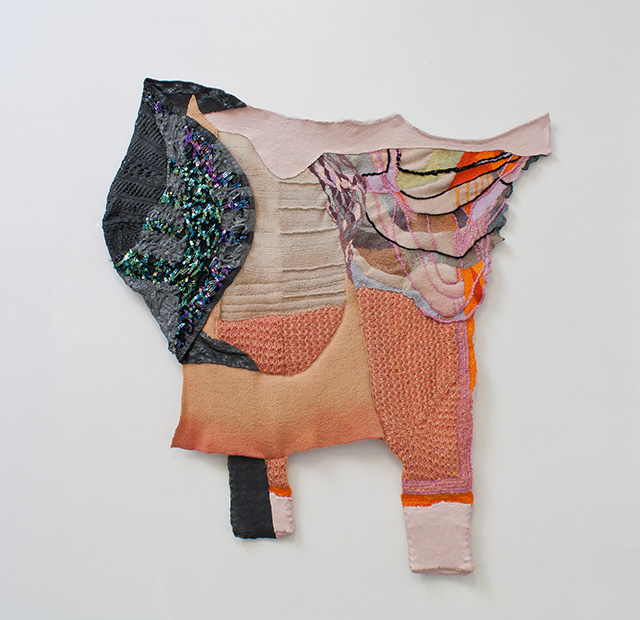
Auguri Auguri, ping pong ping pong, Acrylic/latex paint, thread, yarn, sequins, 37” x 36”   , 2013

Auguri Auguri, ping pong ping pong, Acrylic/latex paint, thread, yarn, sequins, 37” x 36” , 2013

Briefly describe the work that you do.

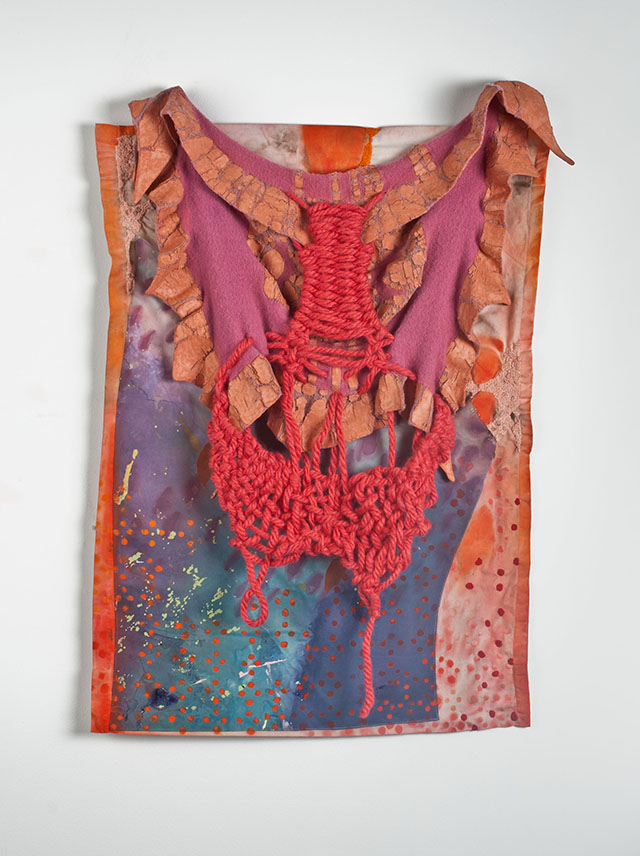
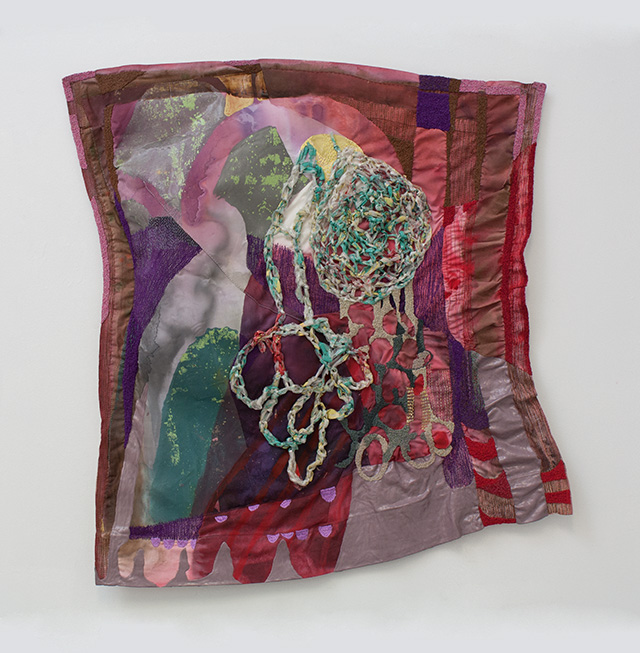
My current body of work is constructed from yarns, threads, fabrics, and thick applications of paint. Most of my studio time is devoted to hand-embroidery and stitching together various collaged materials. Compositions are never planned. Rather, they develop slowly over time through a process of arranging, looking, rearranging, and looking again. As I work, I am searching for tactile combinations and optical illusions that capture attention, rouse sensations of curiosity or wonder, and cause the viewer to linger.

At what point in your life did you decide to become an artist?

I don’t recall ever deciding to be an artist.  I was a maker as a child and just never stopped.  When I was 18 I decided to go to art school, but I majored in Textile Design and thought I would pursue a career in the textile industry afterwards.  I discovered along the way that I was happiest tinkering with materials and ideas rather than worrying about pleasing a client or creating a product to sell.  

Tell us a little about your background and how that influences you as an artist.

I grew up in WV.  My earliest childhood memories are of playing in the woods with my older sister and neighborhood friends.  Hours were spent constructing houses out of sticks or concocting “stews” out of leaves, berries, and other natural materials.  I suppose these are common childhood activities, but I relate this type of play to how I work in the studio today.  I don’t seek out extravagant supplies.  Rather, I make do with the materials I have at hand.  There are no rules or proper steps to follow.  I combine materials based on gut impulses and let a loose plan develop as I work. 

Corporeal, Acrylic/latex paint, thread, yarn, fabric, 31” x 22.5”, 2013

Corporeal, Acrylic/latex paint, thread, yarn, fabric, 31” x 22.5”, 2013

What types of conceptual concerns are present in your work? How do those relate to the specific process(es) or media you use?

In today’s digital age, we quicken pace, span great distances, and become “friends” with people like never before.  But in our desire to be faster, go farther, and have numerous contacts, we often fail to fully connect, or actively engage.  I consider visual experience and the role slow seeing plays in connecting us to our world and to our sense of physical presence.  The images, materials, and processes I work with require us to slow.

While working in the studio I make every effort to return to a world that precedes language and knowledge.  I rely heavily on chance material manipulations and inventive construction methods to transform common materials into images that refuse to be named, identified, or fully understood.  To be defined once and for all, to name, is to erase all desire.  When something can be named, we move from point A to point B as quickly and efficiently as possible.  When something is unnamable, or when the familiar is made mysterious or indefinable, it yields a continuous potential of meaning and stimulates a desire to keep searching.

I use time-intensive fiber processes such as embroidery, knitting, and crochet to influence both the length and the quality of a viewer’s perceptual involvement. Viewers become entangled in visually picking apart the minute details of these accumulative processes, but I believe their captivation also stems from a human desire for the intimacy, connection, and human interaction that is embodied in each stitch.

Bruised Plum, Acrylic/latex paint, thread, plastic, fabric, polyfill, 28” x 26”, 2013

Bruised Plum, Acrylic/latex paint, thread, plastic, fabric, polyfill, 28” x 26”, 2013

We once heard Chuck Close say he did not believe in being inspired, rather in working hard everyday. What motivates you in your studio practice?

I love the uncertainty of the search.  I slowly and steadily toil away.  I spend many months on each piece, and never know if the hours of stitching will amount to anything.  Making art the way I do is a challenging puzzle whose solution always seems to be just beyond reach.  When a piece does finally reach a point of resolution, there’s a satisfactory high, but I never stop searching.  I always work on multiple pieces simultaneously so there is never any down time in the studio.  I suppose I’m addicted to the cycle.

What artists living or non-living influence your work?

There are many artists that influence me for many different reasons.  I may be drawn to a particular artist for material reasons, their use of color, their conceptual ideas, or maybe a combination of all three.  The list grows regularly.  To name a few: Sheila Hicks, Josef Albers, Karla Black, Robert Irwin, Sati Zeck, Fabienne Lasserre, and Iris Eichenberg.

When you are not making art what types of activities and interests do you engage in? 

The two activities that fill my studio time – making and observing – also fill my leisure time.  I love being productive and working with my hands.  I cook and bake, sew clothes for myself from thrift store finds, and play around on my knitting machine designing items for erineleanor, a small business that I run.  I also love feeling connected to the surrounding physical world.  I hike in the woods or wander my neighborhood for miles.  My only goal on these long walks is to be attentive, to observe my surroundings with all of my senses, and to notice things that would otherwise go unnoticed.  

About 

Castellan_headshotErin E. Castellan received her MFA in Painting from Indiana University’s Henry Radford Hope School of Fine Arts and her BFA in Textile Design from the Rhode Island School of Design.  Following a 2004 Post-Graduate Apprenticeship at the Fabric Workshop and Museum, Erin resided in Philadelphia for six years where she maintained a studio art practice and founded erineleanor, a knitwear company specializing in colorful hats, scarves, and gloves.  From 2012-2013, Erin was an Artist-in-Residence at Arrowmont School of Arts and Crafts in Gatlinburg, Tennessee.  Her interdisciplinary work incorporating painting and fiber media has been exhibited in museums and galleries across the country.  She currently lives in Asheville, North Carolina.

In the Studio

In the Studio

www.erinecastellan.com

All images copyright of the artist and used with their permission. 

Posted in Uncategorized | Tagged , , , , , | Leave a comment

Skye Livingston – Kansas City, Missouri

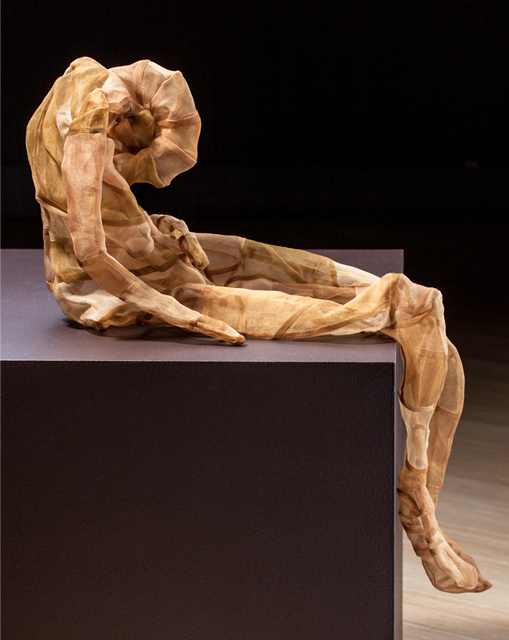
MAL Figure No. 1, hand-dyed silk organza, 18” x 8” x 4”, 2012

MAL Figure No. 1, hand-dyed silk organza, 18” x 8” x 4”, 2012

Briefly describe the work that you do.

Using a wide variety of materials and processes I create images and objects dealing with the concepts of healing and nourishing oneself. This often includes parallel explorations of cataloguing a multi-faceted and changing identity. Recently I’ve become more interesting in creating experiential exhibitions that include specific food and drinks for the viewers to consume while observing the work.

At what point in your life did you decide to become an artist?

I’m lucky to have been raised in a creative household. Both of my parents studied art and always encouraged me to be creative when they recognized my interest. So I really always intended on becoming an artist, but as a child interested in everything, I always specified, “ artist plus environmental scientist” or “artist plus fashion designer” or “artist plus writer.” It never occurred to me to not become an artist, and I’ve kept the mindset that I can pursue art in addition to other endeavors.

Tell us a little about your background and how that influences you as an artist.

My family has had a surprisingly large impact on my work, but I’ve actually only come to this realization in hindsight over the years. My extended family can be categorized into three career types: creative, health care, and teaching, so in addition to creative predilection, I have a strong concern for others in my blood. However, depression also affects many of my family members, so I’m fascinated by the struggle and balance of caring for others, but at times being less able to care for oneself. We’re also a family of wanderers, each of us bucking the homestead tradition and venturing out on our own paths. So all of these qualities that I share with my family actually show up in my work, albeit subtly. All of the ideas I choose to present as universal and accessible concepts (self-reparation, self-sustenance, faceted and changing identities) stem from my personal experiences, who I am as a person, and how I interpret the world around me.

Homebones, 500 drawings (graphite, marker, milk, flour and cornstarch on paper), size varies, 2014

Homebones, 500 drawings (graphite, marker, milk, flour and cornstarch on paper), size varies, 2014

What types of conceptual concerns are present in your work? How do those relate to the specific process(es) or media you use?

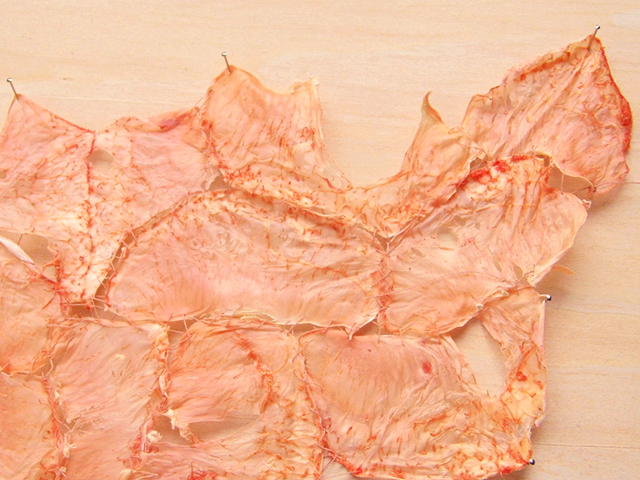
I am interested in the idea of a self-sustaining entity, and focus on depicting the specific elements of self-reparation, nourishment, and identity within this overarching theme. I consider healing to be a process of continuous changes, and an integral part of developing ones identity through the psychological shedding of skins, as each person decides which facets and characteristics of their identity they want to discard and which they want to nourish. Therefore skin, both as a physical material and psychological symbol, is an important concept in my work. Therefore I choose materials that look like skin or can function as a skin—through holding contents or covering a surface—including silk organza, handmade paper and grapefruit skins. Because many of these materials are delicate, I often have to use delicate processes, most notably hand-sewing, which is found throughout much of my work. To address the concept of nourishment, I often incorporate sensorial materials that appeal to the viewer’s sense of smell or taste, or are recognized as food substances. These have included a variety of grapefruit edibles, spices, flour, and milk.

Buckskin, digital print on fabric, 72” x 72”, 2013

Buckskin, digital print on fabric, 72” x 72”, 2013

We once heard Chuck Close say he did not believe in being inspired, rather in working hard everyday. What motivates you in your studio practice?

I am motivated by curiosity. I have a hard time planning my pieces because I prefer to allow a rigorous practice of trial and error, sample-making, and experimentation dictate the direction of my work. Materials are very important to me, and I love pushing their physical boundaries to discover new and exciting ways of working with them. I also have to admit that I do somewhat “keep up with the Joneses.” All of my friends are talented artists, so whenever they accomplish something, I tend to spend more time looking for new opportunities. We all push each other to be better artists.

What artists living or non-living influence your work?

Wolfgang Laib, Ann Hamilton, Do-Ho Suh, Janine Antoni, Susie MacMurray, Berlinde de Bruyckere, Robert Ryman, Susan Rothenberg, Kiki Smith, Zarina, Magdalena Abakanowicz, Egon Schiele, Joseph Beuys, and Lucian Freud. I also love looking at Native American art and objects, historical medical and anatomy illustrations, and researching Scythian art and culture.

When you are not making art what types of activities and interests do you engage in? 

Cooking, baking and eating are some of my favorites. Also yoga, hiking, internet-browsing, drinking with friends, making excuses to avoid cleaning, traveling, making Vietnamese coffee, and playing with my cat.

About 

SLivingston HeadshotSkye Livingston was born and raised in Dallas, TX. She completed her BFA in 2012 at the Kansas City Art Institute where she double majored in Fiber and Art History. She has received several awards for her work including Best of Show in the Kansas City Art Institute BFA Exhibition, an award juried by the director of the Nelson-Atkins Museum Julián Zugazagoitia, and internationally renowned artist Andres Serrano. She has exhibited in group shows nationwide, completed several solo and two-person shows, and has participated in the Grin City Emerging Artist Residency and the Urban Culture Project studio residency program. At the moment, she lives and works in Kansas City.

Grapefruit Conversation detail

Grapefruit Conversation detail

www.skyelivingston.com

All images copyright of the artist and used with their permission. 

Posted in Uncategorized | Tagged , , , , | Leave a comment

Tommy Taylor – Raleigh, North Carolina

Yourself/Myself”, Enamel, Photograph, 60” x 36”, 2010

Yourself/Myself”, Enamel, Photograph, 60” x 36”, 2010

Briefly describe the work you do.

I use a variety of different images from my experiences, paint them, scan them, print them, stitch them, and paint them again to reflect on the world and how we might see ourselves in it.    

Tell us a little about your background and how that influences you as an artist.

I’m part of a nomadic generation that pursued graduate degrees for a better future but now that I’m working three low wage part time jobs to live, I have to say, this effects me the most as an artist. 

The concept of the “artist studio” has a broad range of meanings, especially in contemporary practice. The idea of the artist toiling away alone in a room may not necessarily reflect what many artists do from day to day anymore. Describe your studio practice and how it differs from (or is the same as) traditional notions of “being in the studio.”

I’m very fortunate at the moment to have gotten a temporary studio residency to construct work, which is big, but the work doesn’t develop in a bubble. I’ll reflect on whatever is going on in my life and the world and filter through images on my computer of my experiences. This could be going through thousands of images to find a few so that only then I might begin to materialize a series.

“It’s A Sort Of Fairy Tale With You So Dance Me To The End Of Love”, Oil, Digital Prints on Cotton, Thread, 72” x 54”, 2013

“It’s A Sort Of Fairy Tale With You So Dance Me To The End Of Love”, Oil, Digital Prints on Cotton, Thread, 72” x 54”, 2013

What unique roles do you see yourself as the artist playing that you may not have envisioned yourself in when you first started making art?

I don’t think any artist anticipates how much time and work goes into everything around making art when they first start. Even if you were lucky enough to be born a rich artist, and fewer still, then came to develop strong work there will always be a to do list of administrative tasks and time suck life changes to actually get recognition. Even if adjuncts aren’t paid a living wage for the work we do I’m still lucky enough to have the personality and love for doing it. I think it should be said that you’re…let’s say misguided if you go into making art for money. 

When do you find is the best time of day to make art? Do you have time set aside every day, every week or do you just work whenever you can? 

When I remember first developing my art I worked best where I lived after waking up and in the slow moments at night. Now I drive to work in a studio whenever I’m able and not exhausted.

“Childhood”, Enamel, Resin, Photograph, 19” x 15”, 2010

“Childhood”, Enamel, Resin, Photograph, 19” x 15”, 2010

How has your work changed in the last five years? How is it the same?

I have always had the opposite problem from most of the artists I’m around. Of course in art school work changes a lot and frequently as usually it should but my work has had have a major shift on average every six months for 10 years now. Whether it’s a new material, process, or perspective on my praxis altogether I can’t seem to get away from the draw of something ‘new’.

Are there people such as family, friends, writers, philosophers or even pop icons that have had an impact on the work you do?

Aside from student loans, the past and present history of contemporary art, a certain sensibility, and friends and family there’s nothing else that’s been more central to the development of my work than my relationships.

If you had an occupation outside of being an artist, what would that be and why?

I have no idea what other occupation I would or could enjoy doing. All my major life decisions have been steered by my dream to become an art teacher making art since I discovered it was a possibility…is winning the Powerball jackpot with ultimate judicial powers while traveling as an altruistic ninja an option?

About 

Tommy Taylor headshotBorn in Jackson, Tennessee, Tommy Taylor moved near Nashville and then to Knoxville before moving to Iowa City then London and now Raleigh. While he continued to develop his work at Goldsmiths University, and acclimating to London life, he quickly traveled throughout Europe and Asia. Tommy Taylor has a history of exhibitions in the USA and London as an emerging artist. While teaching part time at the University of Iowa he presented at AERC in Chicago but chooses for the moment to teach, work, and write in North Carolina.

In the Studio

In the Studio

www.TommyTaylorArt.com

All images copyright of the artist and used with their permission. 

Posted in Uncategorized | Tagged , , , , | Leave a comment

Aaron Coleman – DeKalb, Illinois

“The Vulture Eats Between Its Meals”, 12 Color Lithograph, 30in x 44in, 2014

“The Vulture Eats Between Its Meals”, 12 Color Lithograph, 30in x 44in, 2014

Briefly describe the work that you do.

I am a fine art printmaker. .  My work is motivated by political, social and religious current events and the effects those events have on minority groups.  I smash together religious iconography and comic book imagery to create likenesses of the heroes and hypocrites of our contemporary society.  I usually begin by creating a collage of hand drawn elements and found images.  The collage is then meticulously drawn by hand on a prepared slab of limestone or engraved by hand into a copper plate.  In either scenario I am creating an original image on a matrix that can be inked, run through a press, transferred to a sheet of paper and reproduced in a limited edition.  Every part of what I do is labor intensive and time consuming but will yield results unattainable in any other medium.  Occasionally I dabble in screen-printing, woodcuts, and digital collage.

At what point in your life did you decide to become an artist?

I came up as a graffiti writer.  I painted murals on walls and trains with my friends.  At some point I had to admit to myself that I didn’t possess the “I don’t give a f*ck” mentality necessary to excel in graffiti. I wish I did.  It started out as a fun way to spend the day with the homies but it really jump-started my desire to create.  Hip-Hop culture has always been a major influence in my life (literally since I was a little kid).  I was part of a couple Hip-Hop groups as a young adult.  We tended to focus on political and social commentary.  I’m attracted to the powerful images that lyrics can paint in my mind, the emotions I feel when listening to the message, the sincerity of an emcee spilling his/her guts and the music’s power to bring together like-minded people.  I want to make art that does those same things.

Tell us a little about your background and how that influences you as an artist.

I was born in Washington D.C. and raised in Waldorf, Maryland.  I have a very diverse family with 8 siblings.  My father, born in 1938, is African American and my mother, born in 1949, is Caucasian.  They didn’t have it easy growing up. My mother was extremely poor and my father grew up through segregation.  My parents are both extremely hard working people and raised me to be as well.  They are also the two most giving and open-minded people I’ve ever known.  They taught me at a young age to treat people equally and what it meant to truly be a good person.  They have instilled in me their values of helping others in need and judging people only by their character.  The art I create now pushes those same values.  

“The Flight Of A Torn Kite”, 5 Color Lithograph, 12in x 16in, 2014

“The Flight Of A Torn Kite”, 5 Color Lithograph, 12in x 16in, 2014

What types of conceptual concerns are present in your work? How do those relate to the specific process(es) or media you use?

My current body of work “Heroes & Hypocrites” is an examination of the roll of religion in contemporary political society.  It exposes, in particular, what I perceive to be the misinterpretation of the bible and the misuse of its ideals.  It is hard for me to understand that in 2014 people are still discriminated against due to aspects of their humanity that they can’t control.  I’m speaking of the unfair treatment of the gay, lesbian, bisexual and transgender communities across the world.  Growing up as a minority has gained me a “zero tolerance” stance when it comes to discrimination.  My work responds to the current events involving politicians and religious extremists, who wish to segregate, discriminate or spread hatred toward the LGBT communities. 

I pair imagery from comic books and stained glass as a way to comment on the warped and twisted reality we seem to exist in. Villains and heroes from the comics take on roles of politicians and saints and echo the idealized figures found in Christian imagery.  The generalization and simplification of characters in the stories depicted in stained glass mimic the harsh graphic qualities of the comics.  Violent explosions taken from the comic books are used as a vehicle to describe the volatile nature of bigotry and hate and create a jarring experience when combined with saturated color and meticulously detailed embellishments.  Printmaking has played an important roll in the creation and distribution of political propaganda.  The ability to create multiple images from a single matrix makes mass-production a possibility.  This enables printmakers to get their art or message into the hands of the masses at a relatively low cost if necessary.  My work isn’t necessarily propaganda…maybe…but it is intended to make people think about the society we live in and printmaking allows me to put an image in multiple places at once making my message much more effective.

The work I make consists of multiple time consuming and labor intensive processes.  Graining stones, rocking copper plates, drawing, scraping, burnishing, etching, inking, printing…more printing…even more printing.  All of these steps give me time with my work.  The slow process allows me to live with the work in its various stages of completion.  Once I begin creating a piece I really have to believe in its purpose in order see it through to the end.  The matrices I develop are permanent. There are no re-do’s, no mulligans, if I screw up…it is pretty much the end for that particular print. I think this makes my decisions more deliberate and my message much more powerful and sincere.

“Bundle Of Joy, Bundle Of Sticks”, Mezzotint, Aquatint, 4 Color Lithography, Chine-collé, 12in x 16in, 2013

“Bundle Of Joy, Bundle Of Sticks”, Mezzotint, Aquatint, 4 Color Lithography, Chine-collé, 12in x 16in, 2013

We once heard Chuck Close say he did not believe in being inspired, rather in working hard everyday. What motivates you in your studio practice?

I am a serous workaholic.  No one was ever shy about telling me how hard it is to “make it” as an artist.  This seems to be the case for anything I’ve ever wanted to pursue. Music, graffiti, art…you have to bust your ass to get to the top in any of these fields.  For the most part, luckily, I have been surrounded by people who want to be the best at what they do.  They’re hungry.  They keep me motivated.  I also have a ridiculous support system of family and friends behind me.  I work hard so they know that not just my efforts, but theirs too, are worth it.  I think I get that from my parents as well.

What artists living or non-living influence your work?

Michael D. Barnes, Ahsley Nason, Ashley M. Coleman, Michael Weigman, Curtis William Readel, Amory Abbott, Jason Profant, Oscar Jay Gillespie, Andy and Kathryn Polk, Dave Kinsey, Shepard Fairey, Pose, D*Face, a whole mess of printmakers and street artists, Goya, Caravaggio, Dürer, and most of all Gustave Doré.

When you are not making art what types of activities and interests do you engage in? 

I like to eat food with my wife. We have “Fat Friday” every Friday night, which consists of eating whatever we want and watching our stories.  I like chillin’ with my dog, Poe.  I really love listening to music…it transports me away from all stress.  Everyone should listen to Bonobo at some point.  It’s like magic.  But really, if I’m not making art…I’m preparing to.

About 

HeadShotAaron S. Coleman is an artist and educator living in Dekalb, Illinois.  He received his Master of Fine Arts degree from Northern Illinois University in the spring of 2013.  Aaron is a mixed media printmaker utilizing mezzotint, lithography, intaglio, relief and serigraphy to create works focused on political and social commentary.  He combines imagery from comic books and stained glass windows to raise questions concerning misconstrued belief systems and twisted moral values in our society. 

 Aaron is an adjunct instructor at Northern Illinois University where he teaches various printmaking courses.  He also teaches traditional stone lithography at the Chicago Printmakers Collaborative and drawing at Elgin community College.  Aaron stays in tune with the printmaking community, organizing portfolio exchanges and exhibiting both nationally and internationally.  In 2012 he organized an international mezzotint exchange titled “Both Sides Of The Brain” which hosted 17 artists from 6 different countries.  The portfolio was exhibited across the U.S. at several universities and galleries.

He has exhibited at the Liu Haisu Art Museum in Shanghai, China and was invited to participate in the 6th and 7th International Printmaking Biennial of Douro in Alijo, Portugal.  Aaron’s work can be found in the collections of The University of Colorado, Wichita State University, the Ino-cho Paper Museum in Kochi, Japan and the University of Tennessee Knoxville’s Ewing Gallery Collection.

Aaron is a husband, a dog lover and a workaholic.

In the Studio

In the Studio

www.aaroncolemanprintmaking.com

All images copyright of the artist and used with their permission. 
Posted in Uncategorized | Tagged , , , , | Leave a comment

Lindsey Beal – Providence, Rhode Island

“Transmission: Neisseria gonorrheae”, 2012, petri dish containing an embedded cyanotype in resin, displayed in a shadowbox with brass name plaque, 8"x8"(Petri Dish: 4”)

“Transmission: Neisseria gonorrheae”, 2012, petri dish containing an embedded cyanotype in resin, displayed in a shadowbox with brass name plaque, 8″x8″(Petri Dish: 4”)

Briefly describe the work you do.

I am a photographer.  I use a combination of analogue, digital and alternative process photography to make my work.  The photo object is very important to me and I try to make the work three-dimensional, while still using traditional photography techniques.  I usually

incorporate artist books, handmade paper or printmaking and try to take an untraditional approach in housing or installing the work.  I use historical photo processes, such as tin-type or cyanotype, as a way to add to or give a historical basis to the content of my work which is historical and contemporary women’s lives and feminism.  Since my processes vary from project to project, it’s important to me that the method matches the project.  I don’t want to create a body of work using salt prints for example, if that method of printing does not add to the content.

Tell us a little about your background and how that influences you as an artist.

I grew up in Portland, Maine, Southern Minnesota and the Twin Cities.  I think a part of me has always felt I am from both New England and the Midwest, never quite fitting in to either but also being very much a part of both, if that makes sense.  I get this same feeling within my mediums as well.  I straddle photography, printmaking and the book arts (especially papermaking), feeling very rooted in all three but also not totally fitting into one medium.  But in both cases, it’s you that connects all three and make it unique. 

My art has also been highly influenced by both my undergraduate and graduate school settings.  As I mention later, my liberal arts undergraduate program at St. Olaf College influenced my work in its content, references and the way in which I approach my work.  My MFA in Photography and Graduate Certificate in Book Arts from the University of Iowa have both influenced my work in terms of my mediums.  I entered school doing traditional film photography and got interested in printmaking and book arts while at Iowa.  I found myself spending most of my time in both departments, learning other ways to make or present photographic images that aren’t “traditional” photography.  Although I always wanted to learn historical photography processes, my experiences in printmaking and book arts prepared me for alternative photography processes, as well as made me open to combining digital and analogue photography with artist books, handmade paper, sculpture and installation.  

"Intimate Appliances: The Polar Cub", 2013, union case (interior with scalloped matte), Half-Plate

“Intimate Appliances: The Polar Cub”, 2013, union case (interior with scalloped matte), Half-Plate

The concept of the “artist studio” has a broad range of meanings, especially in contemporary practice. The idea of the artist toiling away alone in a room may not necessarily reflect what many artists do from day to day anymore. Describe your studio practice and how it differs from (or is the same as) traditional notions of “being in the studio.”

You caught me at a unique time in my studio practice!  I’m about to start setting up my own alternative processes darkroom a few months from now so my studio will soon change drastically.  But for the last few years, I print and process film in the only community darkroom in Rhode Island.  After graduating from grad school and moving to Providence, I joined AS220, an arts non-profit.  There, I volunteer hours by maintaining and monitoring the darkroom and in return, use it to create my work.  So my studio practice differs from a traditional darkroom in that I use a communal space and sign up for blocks of time to go print my work.  Sometimes it can be challenging to not have your own space set up how you would want it, but a huge plus for me is that there are always people around and you avoid that loneliness of the stereotypical artist toiling away (in this case) in a dark room!  In addition to the darkroom, I work in my apartment, either editing images, printing negatives, designing & binding artist books or finalizing my prints in various ways.  For example, right now I am waxing prints, but I have also mounted them into union cases or shadowbox–it’s constantly changing, which makes it exciting for me.

What unique roles do you see yourself as the artist playing that you may not have envisioned yourself in when you first started making art?

I have been compared to a librarian or a scientist in the way that I work—I guess it is pretty academic.  I take a subject I am interested in; do a lot of research on it, let the information germinate and then share my “findings” through the work I create.  I often convey the information through an accompanying artist book.  For example, for my “Transmission” series, I was curious about various bacterial STDs that stemmed from an earlier project on STD-prevention methods.  I researched the bacteria and created a body of work presenting the STDs to the viewers in an aesthetically pleasing yet menacing manner of embedding cyanotype prints of each bacterium in open Petri dishes.  I created a handmade book in the style of old medical pamphlets to accompany the work that informed the viewer on each infection.  I didn’t expect when I started out that my photography would end up being a way to educate myself and others about various topics.  Since I’m not a photojournalist or a documentary photographer, I am surprised that this educational aspect has crept in but am happy with it. 

“The Venus Series: Figure #1”, 2010, ambrotype (wet plate collodion on black glass), 3.25"x4"

“The Venus Series: Figure #1”, 2010, ambrotype (wet plate collodion on black glass), 3.25″x4″

When do you find is the best time of day to make art? Do you have time set aside every day, every week or do you just work whenever you can? 

Right away in the morning.  This can be a little impractical when I need to squeeze in making art any time I can make it.  But if the day has progressed far enough, there are multiple distractions that can add up and make it really hard to focus in the studio.  I’m pretty self-disciplined so I will work whenever and wherever I can!  I am very strict about protecting my days off and keeping them as my studio days.  These are the days that I get to printing in the darkroom right away and will spend all day there.  When I work at home, I pretty much work any and all the time.  When I work at home though, it can be hard to step away and take a break.  I’ve definitely learned the pluses and minuses of having a studio at home and in a separate location these last few years!

How has your work changed in the last five years? How is it the same?

It has changed a lot in the last five years because in that time I went to graduate school and then post-graduate years!  My constant has been my focus on feminist subject matter, using photographic means to explore these ideas and creating non-traditional ways in which to experience the images, often sculptural.  It’s always been important to me to create a way in which to get the photographs off the wall or create photo objects or installations to view the work.  So moving into historical and alternative photographic processes and incorporating the book arts made sense to me.  I used to shoot portraits and nudes with 35mm black and white and medium-format color film in studio, either creating silver or digital prints.  Your work changes a lot during school and mine might have been the most drastic among my classmates.  I used found objects and subjects to create images through high-resolution scanners and large-scale prints to envelope the viewers’ sight.  I then switched to using digital negatives and printing them with cyanotypes, an early form of the blue print that was used to catalogue collections.  I returned to the camera and began to shoot actual collections, both my own handmade paper sculptures, and others’ with my 4”x5” camera using antique processes such as wet-plate collodion (think Civil War photography) and ziatype (a contemporary version of platinum printing).  I am again using digital negatives with abstracted cell phone photos and printing them as cyanotypes.  Regardless of how the images are captured, returning to the darkroom four years ago and getting to use my hands and chemistry again, has been a wonderful change that will remain in my work for the next five years!

Are there people such as family, friends, writers, philosophers or even pop icons that have had an impact on the work you do?

I think often partners of artists do not get acknowledged as much as they should—they have incredible influence on artists.  My husband is a large influence—we met on the first day of college, so it would be hard to not have an influence on each other, let alone as I transitioned from art student to professional artist.  He is not an artist but appreciates and understands art and is great for bouncing ideas off of.  I saw my work change unconsciously as he began his education in medicine; my work explored sexuality through a medical lens, such as contraception or STD-prevention and my newest interests, historical OB/GYN and midwifery tools. 

Another influence is a wide range of authors and books.  I read a lot—I was a voracious reader growing up and studied English in undergrad.  I have and still work in a bookstore so what I read has a huge impact on my work.  I know photo theory and love photo history, and as I mentioned, I read a lot when I research my projects, but the books and writers that have a huge impact on my work is often contemporary fiction and non-fiction.  I have favorite books and authors, but it is often a small detail or occurrence that happens in a random book or article I happened to pick up that has more impact on my work.  

If you had an occupation outside of being an artist, what would that be and why?

I’ve created a way to incorporate other areas of interests into my work.  It stems from my liberal arts background. My first photography professor suggested I bring other areas of interest (or at the time my other majors or classes I was taking in undergrad).  I obviously took that suggestion to heart because I still use it today!  In my work, I get to become an amateur in everything.  Any occupation I could possibly want to practice, I get to have a basic grounding in and than use that knowledge into my work.  For example, I have studied archeology, art history, the classics, theology, medicine and sexual health, naturopathy—the list continues!  Any occupation I would like to do outside of art, I am able to incorporate into my work, so I still get to fulfill that dream of becoming something else.  

About 

headshotLindsey Beal is a photo-based artist in Providence, Rhode Island where she teaches at AS220 and Rhode Island College. She has an M.F.A. in Photography from the University of Iowa and a Certificate in Book Arts at the University of Iowa’s Center for the Book.

Her work focuses on historical and contemporary women’s lives and feminism. She combines traditional photography (analogue, digital and historical processes) with installation or sculpture to create non-traditional photographic work.  This work often includes papermaking, printmaking and artist books.

Her work has been shown at national universities and galleries and is included in various public and private collections.  She recently received an Honorable Mention for emerging American photographers by the Magenta Foundation.

She is represented by Boston’s Panopticon Gallery.  Her work can be found at www.lindseybeal.net.

studioimage1

In the Studio

www.lindseybeal.net

All images copyright of the artist and used with their permission. 

Posted in Uncategorized | Tagged , , , , | Leave a comment

Aaron Treher – Shepherdstown, West Virginia

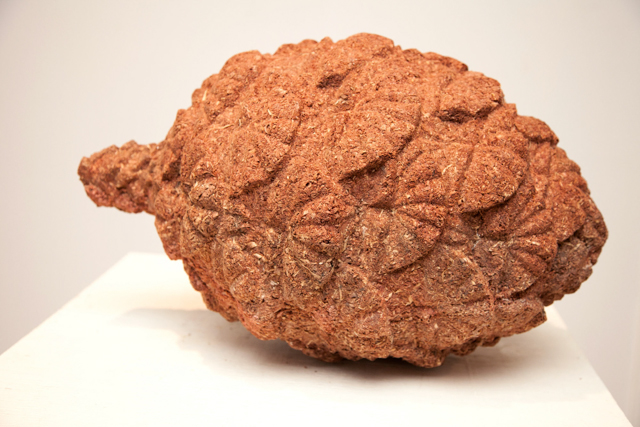
Giant Sequoia, red cedar wood chips and adhesive, 20 in. x 15 in. x 15 in., 2013.

Giant Sequoia, red cedar wood chips and adhesive, 20 in. x 15 in. x 15 in., 2013.

Briefly describe the work you do.

As a contemporary artist, I create artwork as a means of expression and introspection. A way to understand hidden truths and communicate my perspective of the world. The act of making artwork, the labor and manipulation of the materials, moves my work forward.

My process often involves an investigation of materials, objects, and forms. I dissect, recontextualize, and juxtapose these elements to dramatically change whatever object I began with. This stems from my urge to broaden my own perception of an object and ultimately learn more about the world. New themes, patterns, and metaphors evolve through this process as well. I then use these visual devices like puzzle pieces, building and creating new work, piecing together a more complete picture of how I see reality.

The result of this exploration often expresses, sometime ironically, two dominant themes: the anthropogenic landscape and the natural world. My work involves examining reclaimed or recycled objects, objects which are part of the anthropogenic landscape but sometimes derived from the natural world. 

Tell us a little about your background and how that influences you as an artist.

I am from Pennsylvania. I grew up in the Cumberland Valley which lies within the Appalachian Mountains. Much of my inspiration, even as a young artist, comes from this region and its mountains. The Appalachian Mountains have experienced great change since industrialization. More recently, the Appalachians have seen rapid growth of gas wells, commercial warehouses, and commercial farms. This growth has left parts of the landscape and environment poisoned, bare, and in some cases completely uninhabitable. Directly and indirectly, I have watched many changes locally and globally. My work interprets these anthropogenic landscapes and changes to the natural landscape.

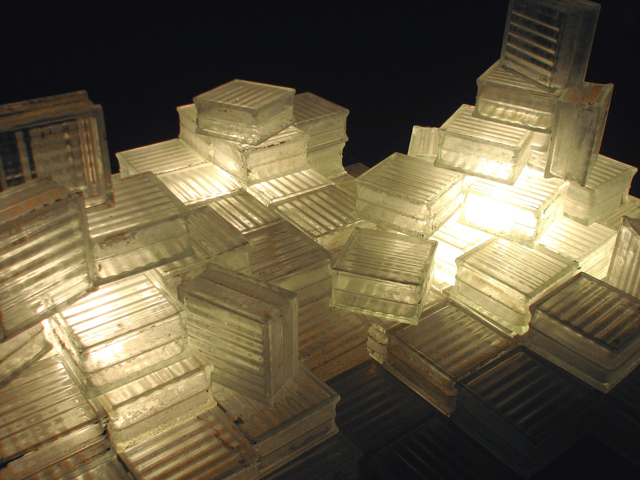
Unnatural Ice, glass mason block, light bulbs, and electrical components, dimensions vary, 2011

Unnatural Ice, glass mason block, light bulbs, and electrical components, dimensions vary, 2011

The concept of the “artist studio” has a broad range of meanings, especially in contemporary practice. The idea of the artist toiling away alone in a room may not necessarily reflect what many artists do from day to day anymore. Describe your studio practice and how it differs from (or is the same as) traditional notions of “being in the studio.”

Currently my studio also functions as a classroom. I teach high school students various sculpture techniques by morning and work on my own sculptures in the afternoon and evening. The space is part of an Artist-in-Residence program offered at a public school. In some ways my studio time has become a kind of laboratory study. It can look and feel scientific in the sense that people observe and study what I do. 

What unique roles do you see yourself as the artist playing that you may not have envisioned yourself in when you first started making art?

I see myself as an advocate for the environment. More often I take a hard stance on what I feel needs to be highlighted with conservation of our natural resources and environment. When I first began making art, I saw myself making drawings on a street, being lifted away by some town in Europe or the Appalachian Mountains. Which I did try to some degree as a young artist: practicing this romantic sense of what it means to be an artist. But now that magic has kind of changed and turned into this urge to understand and analyze aspects of global atrocities especially related to the environment. 

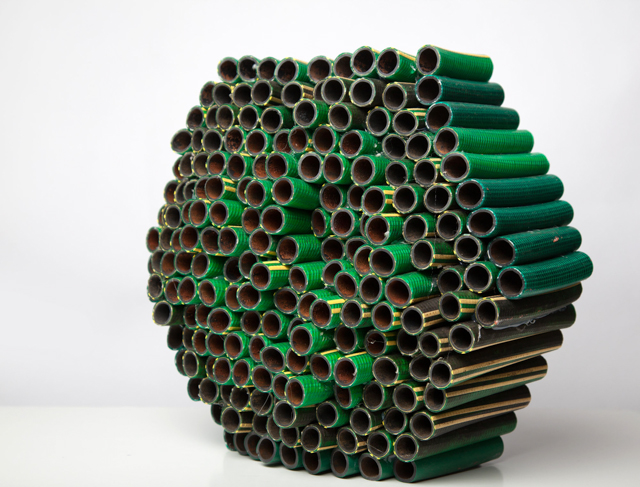
he Hive, garden hose and adhesive, 16 in. x 16 in. x 7 in., 2013

he Hive, garden hose and adhesive, 16 in. x 16 in. x 7 in., 2013

When do you find is the best time of day to make art? Do you have time set aside every day, every week or do you just work whenever you can? 

Anytime of the day. I was once told by my former professor that being in the studio is a chance and opportunity to capture something. Being in your studio gives you a chance to capture an idea as it hits you and see it to fruition. For that reason, I always carry a sketchbook and draw ideas out as soon as I think of them. I might even scribble down thoughts on post-it notes on the way to work. 

How has your work changed in the last five years? How is it the same?

My work has grown in size and I use a greater diversity of mediums. This shift happened because of my ability to make large scale works at a rather large arts center I co-founded in Pennsylvania. I have also changed why I make work. Many of my installations that investigate the anthropogenic landscape, which thematically dominate my portfolio today, have come about because of my ability to travel and witness what is happening around the world. Most notably is Giant Sequoia, which was inspired by seeing the Giant Sequoias in person. 

Are there people such as family, friends, writers, philosophers or even pop icons that have had an impact on the work you do?

Yes, my parents and siblings are the largest and most influential. As a child, they encouraged me to make art, sculpt and draw, every chance I had. Currently, I look to artist such as Tara Donovan, Sara Sze, Ai Wei Wei, and Tony Cragg as inspiration and a source of

motivation. My former professor, Dr. Jim Nestor, has been a world of influence on me as an artist. Without his insight and understanding of what I was making and how to speak about it, I would not be the same artist and person I am today. A good friend and colleague, Ernest M. Garcia, pushed me to keep making work and submit pieces to exhibitions and he is still a source of inspiration and motivation. 

If you had an occupation outside of being an artist, what would that be and why?

I would probably be a geologist. I have a very sincere appreciation for the processes that go into the creation of a mountain and why they look the way they do presently.

About 

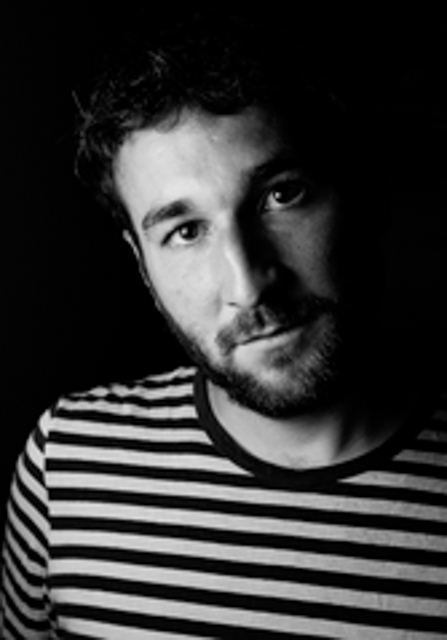
Aaron Treher Head ShotAaron Treher is a sculptor and installation artist based out of Shepherdstown, West Virginia. Treher began his fine art studies at Indiana University of Pennsylvania. While there he participated in a bilateral student exchange with the Academy of Fine Arts, Zagreb. After graduating with honors, Treher returned home to Shippensburg where he began working with various art council groups and non-profit galleries. After several years of coordinating with community members he then co-founded a contemporary arts center. Treher’s objective in founding the center was to develop and promote art and culture in rural Pennsylvania. Currently, Treher is participating in a year long Artist-in-Residence program at Tuscarora School District in Mercersburg, Pennsylvania where he is focusing on installation art, sculpture and development of public art projects. 

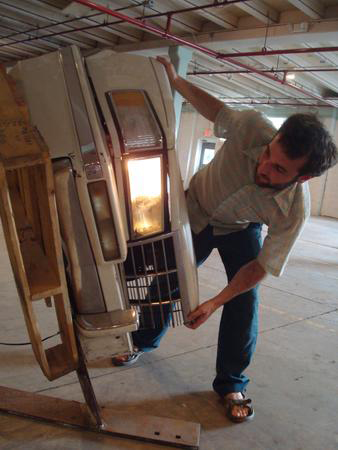
Aaron Treher with his exhibit at The Thought Lot(Public Opinion/Vicky Taylor)

Aaron Treher with his exhibit at The Thought Lot(Public Opinion/Vicky Taylor)

www.aarontreher.com

All images copyright of the artist and used with their permission. 

Posted in Uncategorized | Tagged , , , , | Leave a comment