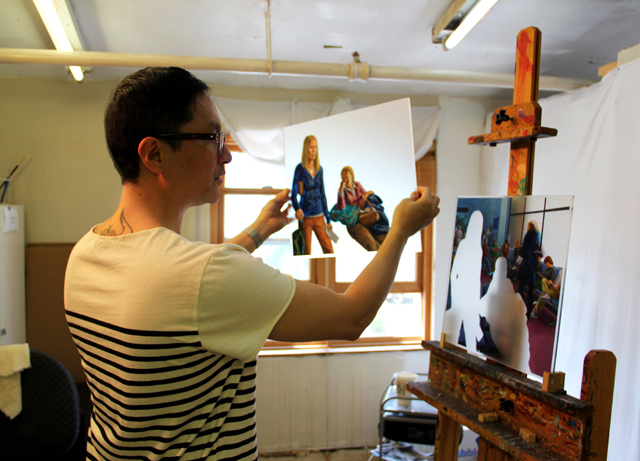
Coorain Devin – Jamaica Plain, Massachusetts

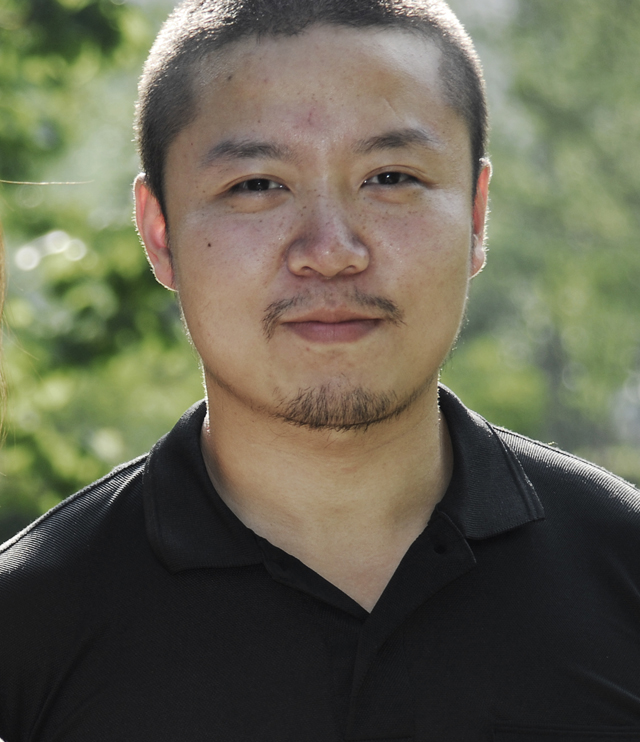
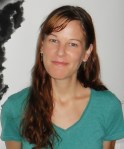
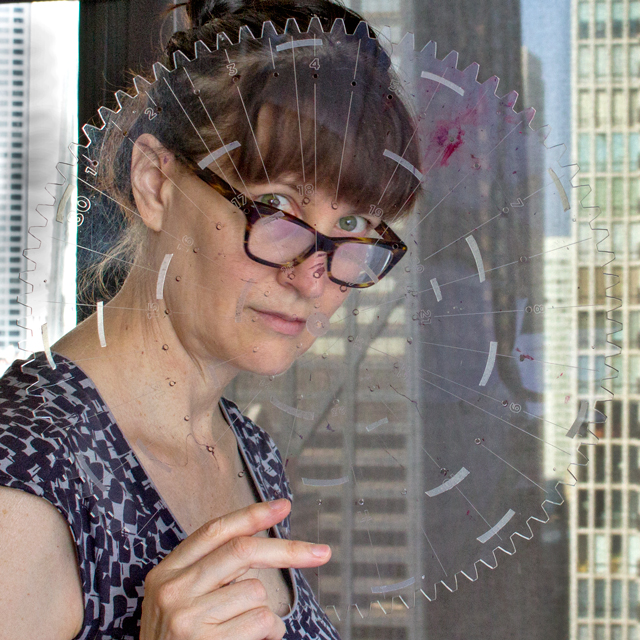
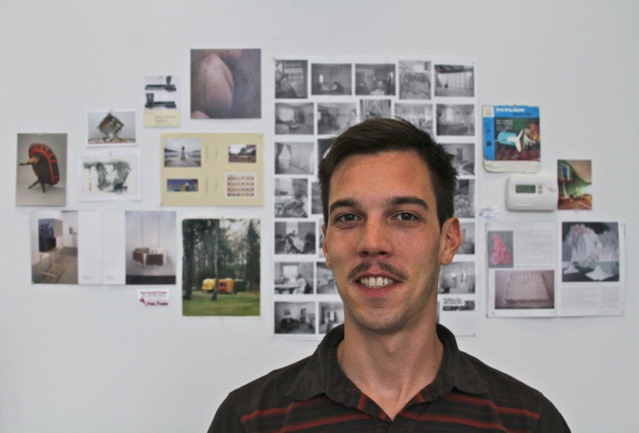
coorain headshot

Photo by Samara Pearlstein

Briefly describe the work you do.

First and foremost, I think critically about the world. I spend much of my time reading essays and trying to engage with as much material as I can. My work is partially my fantasies brought to life and partially my critique of the world. My hope is that there is a balance between the fantasy and critique. Too much fantasy and I feel complacent; too much critique and no one wants to listen.

Tell us a little about your background and how that influences you as an artist.

I think my parents gave me two things that are indispensable to who I am as an artist and as a person. Firstly, they just believe I can do anything and that has really boosted my self confidence. Secondly, they exposed me to different alternative culture. They really don’t have much interest in the mainstream, which pushed me to look deeper to find what interested me. Thanks to them, I know I like “Space Disco,” which is musical genre as almost as ridiculous as I am.

The concept of the “artist studio” has a broad range of meanings, especially in contemporary practice. The idea of the artist toiling away alone in a room may not necessarily reflect what many artists do from day to day anymore. Describe your studio practice and how it differs from (or is the same as) traditional notions of “being in the studio.”

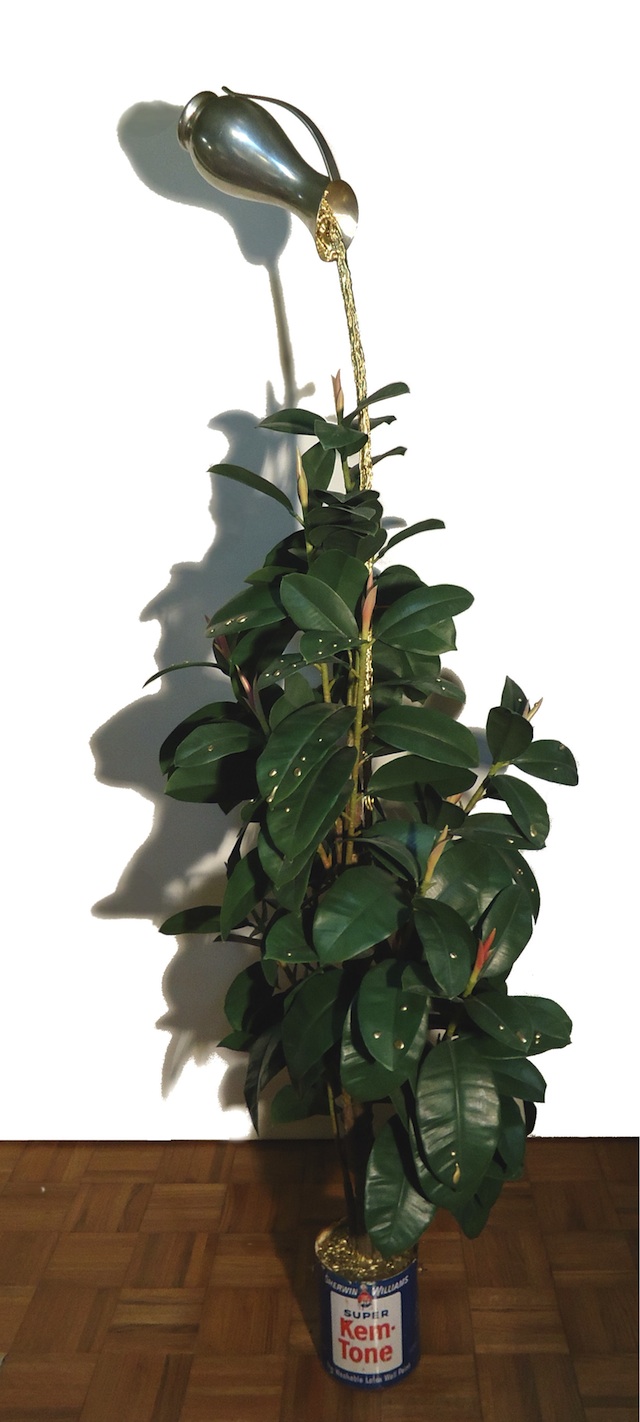
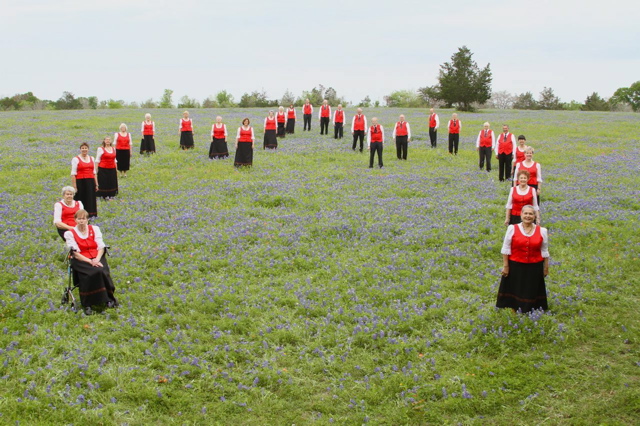
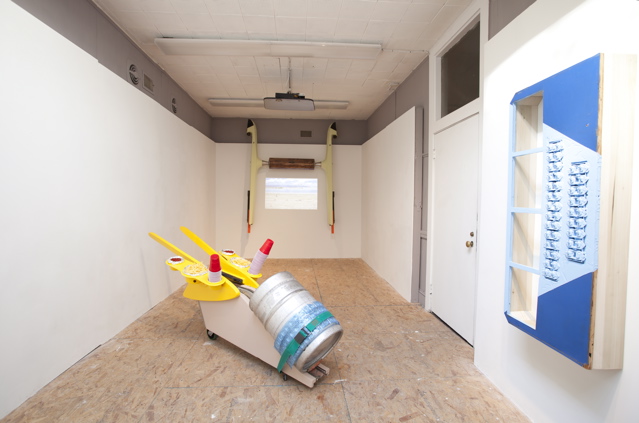
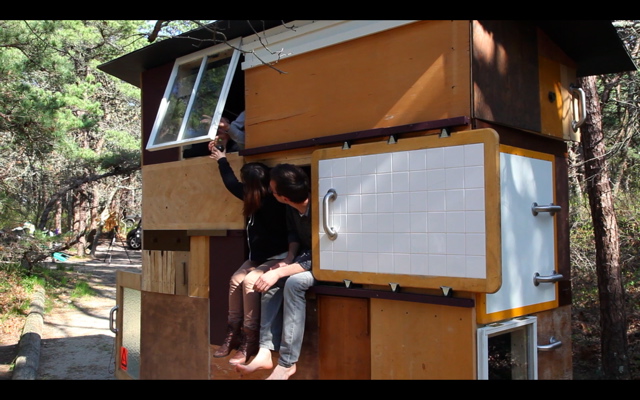
Well, this actually relates to a project I’m working on, called “Coloring Coorain.” One part of it is that I have a television show built around this persona I’ve created, but I really want to expand the project to include product lines, modeling shoots, essentially I’m creating a celebrity personality as an art project. In a lot of ways, I’m taking inspiration from Kim Kardashian. Obviously a traditional studio doesn’t have room for this kind of art, where I’m making things about 20% of the time and otherwise the art is a personality.

The other big projects I’m working on, Salad Magazine, and Queer Dreams, are both collaborations with other artists. With both projects there is a business side that can’t take place in a studio.

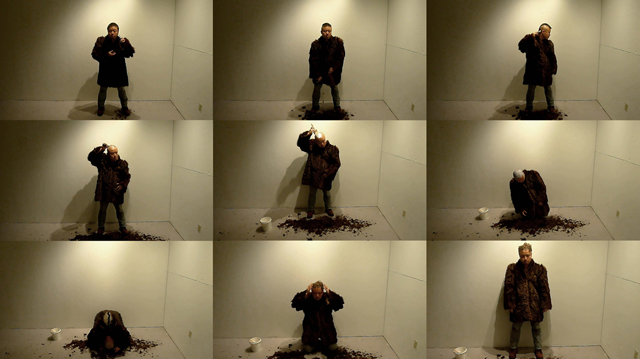
Video still from "Coloring Coorain" video, 2014

Video still from “Coloring Coorain” video, 2014

What unique roles do you see yourself as the artist playing that you may not have envisioned yourself in when you first started making art?

Well I certainly never thought I’d need business cards! But really and truly I never realized how much business I would be doing. For Salad Magazine, I’ve had to do so many tax forms! I also never thought I’d have to buy so much gelatin. Seriously, if Jell-O ever starts a grant for artists, I will probably have funded myself.

I never considered making art a public act, which looking back is extraordinarily naive. In many ways, I think that I am still naive.  But what separates artists from people who make art is that they share their work with a public.

When do you find is the best time of day to make art? Do you have time set aside every day, every week or do you just work whenever you can? 

It depends on what you are working on, but I find myself most efficient during the morning. I have  a couple small collage and embroidery projects I try to work on whenever I have free time, but for my larger projects, I try to set aside one day a week when I can really get into the studio and make things happen.

How has your work changed in the last five years? How is it the same?

Wowza, my work has changed so much! I’ve really loosened up and become much more honest with my artwork. I’m no longer embarrassed to take inspiration from celebrity culture.

I’ve really stopped thinking about mediums in art as anything more than tools to send a message. To that end, I don’t really consider myself tied to any particular medium, although I do identify collage the technique I most often employ, but not necessarily in the traditional sense. One thing that hasn’t changed is that I collage ideas together, so even when it doesn’t look like a collage, I think every work I’ve ever made is really, at it’s heart, a collage of different things.

Video still from "Coloring Coorain" video, 2014

Video still from “Coloring Coorain” video, 2014

Are there people such as family, friends, writers, philosophers or even pop icons that have had an impact on the work you do?

Well, I have a bachelor’s degree in philosophy, so that list could go on for a while, but to keep it short, Ludwig Wittgenstein and Stanley Cavell. Looking to pop culture, it hurts a little to say, but I cannot deny Paris Hilton and Kim Kardashian have made more than a small impression. Apart from that, I’ve been heavily influenced by film, especially John Waters, Todd Haines, and Douglas Sirk.

If you had an occupation outside of being an artist, what would that be and why?

Since being an artist isn’t financially viable, I’ve actually worked in various libraries in some capacity for the passed 7 years. Being a librarian is one of the few vocations that really allow you to be interested in everything, and I do truly love reading and thinking about problems.

About

Born in Australia, Coorain studied at Tufts University and the School of Museum of Fine Arts, receiving a BA in Philosophy and a BFA in Fine Arts respectively.

www.coorain.com

All images copyright of the artist and used with their permission.


Posted in Uncategorized | Tagged , , | Leave a comment

Tuo Wang – New York, New York

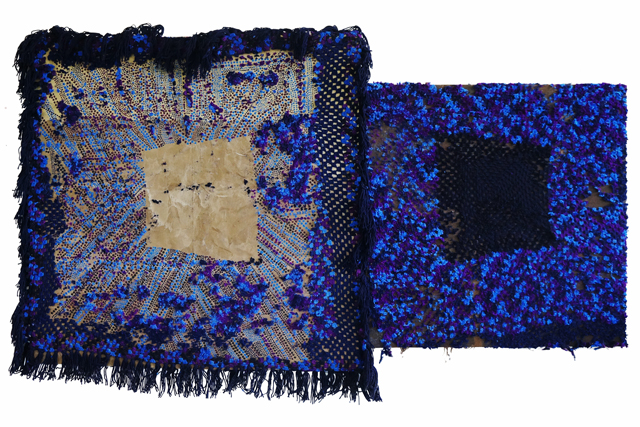
Mistaken for strangers 2_diptych acrylic and textile on canvas_52 x 93.5 inches_2013

Mistaken for strangers 2_diptych acrylic and textile on canvas_52 x 93.5 inches_2013

Briefly describe the work you do.

Through research and investigation of the documents of visual art, literature, politics and history, my work attempts to examine the unreliable relationship between cultural archive, myth and the contemporary human status. I employ various mediums to create multi-narrative spectacle, whilst layering painting, photography, sculptural objects and text amongst video installation through a manipulated and performance-like process. By constructing all-encompassing environments where fiction and reality interweave, I expose dramatic and often humorous as well as absurd aspects of the concept of society. I’m especially interested in how to set up a connection between the trace of modern life and the memory of human heritage through interdisciplinary combinations of media.

Tell us a little about your background and how that influences you as an artist.

I was born and raised in China, and moved to the U.S. in 2012, working on my MFA in painting at Boston University. I feel the biggest advantage of living in China is that I habituate myself to doubt about everything. Having the attitude of doubting has been benefitting me a lot as being an artist. When you are making things balanced between questioning yourself and being narcissism, you are actually making art. Before I became an artist, I’d earned my bachelor degree in Biology in 2007. Working for another two years in science after graduated, I realized that art could be the best way to utilize all my knowledge and abilities. The experience in science gave me methodologies of focusing on research and an attempt to see things through.

The concept of the “artist studio” has a broad range of meanings, especially in contemporary practice. The idea of the artist toiling away alone in a room may not necessarily reflect what many artists do from day to day anymore. Describe your studio practice and how it differs from (or is the same as) traditional notions of “being in the studio.”

I always believe studio functions as a secure space for the artists to concentrate on their work. In this sense, anywhere could be my studio as long as it makes me feel safe and comfortable. Due to the nature of my art practice, I often need to stay out of my studio, engaging myself in different environments and conditions, talking and interviewing people, as well as shooting and recording video footages and sound records via a performance-like process. This kind of social intervention is parts of my work. With all the materials I’ve collected outside, I come back to my studio or find a comfortable place to accomplish the final work.   

'Trinity part 1', single channel video,3'06''

‘Trinity part 1’, single channel video,3’06”

What unique roles do you see yourself as the artist playing that you may not have envisioned yourself in when you first started making art?

I’ve never envisioned before that one day I could be an artist. After all the effort I’ve been making, I eventually became an artist. One of the purposes of being an artist is to make yourself become someone you’ve never envisioned before. The meaning of the role as being an artist has been changing all the time. With the accumulation of experience and ambition, artists need to continuously breakthrough their comfort zones and limits in order to touch the boundary of personal artistic practice.

When do you find is the best time of day to make art? Do you have time set aside every day, every week or do you just work whenever you can? 

I love working at night, which is the best time for me to collect all my energy and concentrate on my creation. I am normally very productive at night. I often work several days in a row without any distraction.

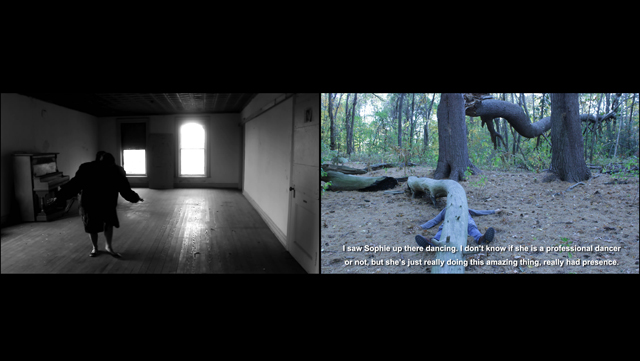
Vanitas - Two Trapped Bears (2013-2014) two-channel HD video (Lbw, Rcolor, sound), 8'30

Vanitas – Two Trapped Bears (2013-2014) two-channel HD video (Lbw, Rcolor, sound), 8’30

How has your work changed in the last five years? How is it the same?

The changes have happened to me dramatically. I started my artistic path as a painter five years ago, making big expressionism and abstract paintings. At that time, canvas was the surface where I could experiment my complex thoughts with simple tools, as well as an exit to let myself off. When I paint, all the fascinating and ambiguous moments and narrative make me drown in deeply. Later on, I adjusted myself slightly to focus on the exploration of the process of painting. In those paintings, viewers can get a clue from the final image that I present, and trace the previous process which is always narrative. Following with this methodology, I made several projects consisting of two elements: performance and painting. Recently my projects are all performance and archive based through interdisciplinary combinations of medias, where I’m investigating a process balanced between performance art and documentary genre. My work eventually investigate the methodology in art creating and also reveal how present ideology derives from its cultural memory.

Are there people such as family, friends, writers, philosophers or even pop icons that have had an impact on the work you do?

I like Zach Galifianakis. I learned from his talk show which consists of a series of typical interview questions, building up a structure that cope with shifting events by sticking to a fundamental principle. I like Guy Debord. I attempted to utilize his concept of “Spectacle” in a positive way to construct a system that everything functional in its own space. I like Bertolt Brecht. His “Alienation Effect” helps me preserving and establishing a distance that estranges and separates the audience from the actual artwork. This provides audiences a strong consciousness of that they are watching an illusion.

If you had an occupation outside of being an artist, what would that be and why?

I wish to be a comedian if I have the gift. I would like to make some art just like Between Two Ferns. When I’m doing art, I always feel it’s tough to be seriously humorous. Wonderful humor is something I always want to chase in my work.

About

Tuo Wang HeadshotBorn and raised in Changchun, China, Tuo Wang currently works and lives in New York. His practice is interdisciplinary and involves many disciplines including video, performance, photography, painting and drawing. 

He has an MFA (2014) from Boston University, USA, an MA in painting (2012) from Tsinghua University, China and a Biology of Science (2007) from Northeast Normal University, China.

Tuo Wang is a recipient NYFA Mentoring Program, NYC (2014), S10 VIDEOFOCUS Video Biennial special featured artist, EU (2014); Howard Gotlieb Archival Research Prize, Boston (2013), the Constatin Alajalov Scholarship, Boston (2012, 2013) and Bronze Award “2012 Annual Nomination Exhibition for Young Contemporary Artist,” Today Art Museum, Beijing, China (2012) amongst others.

He has exhibited in China and United States at venues such as 808 Gallery, Boston, Sherman Gallery, Boston, Commonwealth Gallery, Boston, Today Art Museum, Beijing, Rongcheng Art Museum, Chengdu, Fareast Art Museum, Changchun. Wang’s work has been reviewed by many various publications such as Boston Globe, Big Red&Shiny and VIDEOFOCUS.

The Studio

The Studio

www.tuo-wang.com

All images copyright of the artist and used with their permission.


Posted in Uncategorized | Tagged , , , , | Leave a comment

Renee Couture – Glide, Oregon

There are no Edens (unactivated), old pillowcase, artist’s hair, vinyl 28” x 32” x 2” 2014

There are no Edens
(unactivated),
old pillowcase, artist’s hair, vinyl
28” x 32” x 2”
2014

Briefly describe the work you do.

My work explores the various relationships between capitalism, the environment, and one’s community. Through the lens of postmodern environmentalism and bio-regional ethics, my work considers the interdependence between people and nature. My practice is project-based, conceptual in nature, and moves fluidly between sculpture, photography, and installation. I see my art practice as an investigative process. 

Tell us a little about your background and how that influences you as an artist.

I spent my younger years in mid-west suburbia running around outside playing tag, active in sports, and waterskiing. I think playing sports and learning foreign languages helped give me discipline. When I became involved in visual art I found similar characteristics were involved – discipline, practice, improvement – but with the added bonus of exercising creativity. For about four years I ended up living abroad and traveling extensively. I think this made me aware of my surroundings, interested in learning about cultures, and appreciative of the work which occurs within communities. Currently, I live in a small mountain community on seven acres in a historically timber dependent area. Much of my work now revolves around learning about the place where I currently live.  

The concept of the “artist studio” has a broad range of meanings, especially in contemporary practice. The idea of the artist toiling away alone in a room may not necessarily reflect what many artists do from day to day anymore. Describe your studio practice and how it differs from (or is the same as) traditional notions of “being in the studio.”

Within my studio practice, I try to work hard and enjoy myself. The “toiling” comes in if there’s a big deadline or when I need to acquire new technical skills for a project (which is often because I don’t chain myself to one particular media). I also read and write a lot, and I go for walks in the mountains. Sometimes I just lay on the floor and stare at the ceiling.   

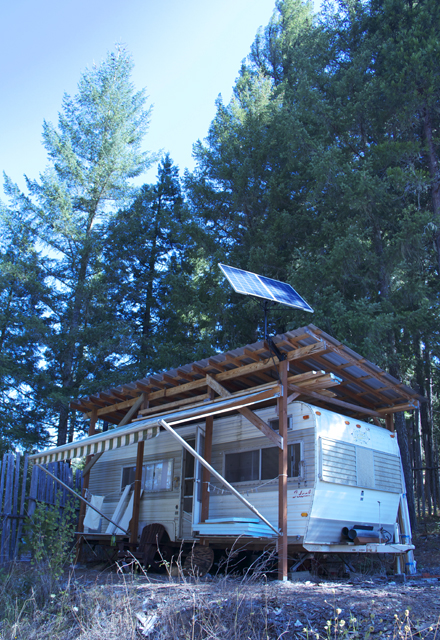
My studio is not a stereotypical “big space with white walls”, nor a “small desk in the corner”. I live in the mountains. My studio is in a retro-fitted 20 foot camper/travel trailer. It’s located in my garden and is surrounded by trees and piles of wood used to heat my home. Where I live and how I live has an influence on my work. 

To The Rumored Garden (no. 4) archival pigment print of digital collage 44” x 44” 2013

To The Rumored Garden (no. 4)
archival pigment print of digital collage
44” x 44”
2013

What unique roles do you see yourself as the artist playing that you may not have envisioned yourself in when you first started making art?

The county where I live is “ground zero” for environmental debate surrounding the extraction timber from the federal land in the surrounding mountains. I often think of my work is an attempt to make sense of a history from which I was absent as a means of understanding my own present and the place where I live. As an artist, I am able to “hijack” the timber debate from environmental activists, politicians, and the timber industry through my work, something I never saw myself doing. I think as an artist I am able to offer a unique perspective to this decades old debate.  

When do you find is the best time of day to make art? Do you have time set aside every day, every week or do you just work whenever you can? 

I am disciplined when it comes to my studio practice. I schedule a certain number of hours per week on “all things pertaining to art”. This includes not just studio work, but also research, writing/sketching/note taking about my work, finding materials, applying for grants/residencies/exhibitions. 

I do different activities at different times of day. I like to complete difficult readings in the early morning over coffee; meanwhile I work in studio or work on applications in the mid-morning through afternoon; any writing/sketching/note taking about my work happens in the evening. What I end up doing depends on deadlines, project development, and/or my job schedule.  

A Vast New Wilderness of Glass  particle board, plexiglass, bolts, furniture grade maple 84” x 48” x 30” 2012

A Vast New Wilderness of Glass
particle board, plexiglass, bolts, furniture grade maple
84” x 48” x 30”
2012

How has your work changed in the last five years? How is it the same?

A lot has changed since I finished grad school in 2010. In grad school, you are bombarded with critical feedback and there is an expectation of production – your whole process is on hyperdrive. Now that I am no longer in grad school, I have come to the simple conclusion that work needs time. I am starting to feel comfortable giving my process the time it needs. As a result, my production has slowed because I give myself more time to read, more time to write, more time to draw, more time to plan work and variations of work   

In terms of content there has also been a shift. Since 2010, my work shifted to articulating the complexity and range of the public’s relationship with their surrounding landscape. My work it is now rooted firmly in what it means to live in a rural community in the Pacific Northwest timber country. I use whichever media and/or mode of working most appropriate to express my ideas. I began re-appropriating and re-contextualizing everyday materials and/or imagery while in grad school and continue to do so. While I make distinct bodies of work each body of work is tied conceptually. 

Are there people such as family, friends, writers, philosophers or even pop icons that have had an impact on the work you do?

In grad school, I read a lot of philosophical writings about labor and “the everyday”. While these writing still influence my work, I’ve added writings about “place”. Over the past few years I read just about everything Wendell Berry has written, plus works by Gary Snyder and Alain de Botton; most recently I’ve recently added John Brinckerhoff Jackson and Yi-Fu Tuan. Art historical writers I enjoy are Helen Molesworth, Julia Bryan-Wilson, and Miwon Kwon. 

I talk a lot with my husband about issues surround land use management practices and forestry practices. I also have a couple artist-friends with whom I discuss my work and about ideas surrounding “place”. They ask me tough questions and offer insights that help me see and think about my own work more deeply. 

If you had an occupation outside of being an artist, what would that be and why?

I teach, which I actually see as being an extension of my studio practice. Sometime the modes I’m working in within my personal studio practice find their way into assignments for my students, and vice versa. 

Outside of those activities (teaching, making art), I would want to run a small gallery space or run the gallery at the community college where I currently teach. Running a gallery space would give me the opportunity to add to the arts conversation in my area, support artists, and use all the skills I learned in grad school in a different context. I think it would be an interesting and exciting challenge. Or I would be an organic farmer.

About

Renee Couture’s work examines the complex relationships between capitalism, the environment, one’s community.  Her practice involves moving fluidly between sculpture, photography, and installation. She uses both formal and conceptual strategies in creating her work. 

Couture graduated from Buena Vista University (Storm Lake, IA) with a BA in Studio Art and Spanish in 1999. She spent the next four years traveling throughout the United States and South America. Couture has taught a range of art courses in children’s camps in the United States and abroad. She earned her MFA in Visual Art from Vermont College of Fine Arts in Montpelier, VT, in 2010. Her work has exhibited nationally. 

Couture lives on seven acres in the mountains of rural southern Oregon with her husband, two dogs and two cats. When she’s not in her studio working, she’s in her garden growing food. Couture is currently adjunct faculty in the Fine Arts Department at Umpqua Community College. 

The Studio

The Studio

www.rcoutureart.com 

All images copyright of the artist and used with their permission.


Posted in Uncategorized | Tagged , , , , | Leave a comment

Helena Hsieh – Boston, Massachusetts

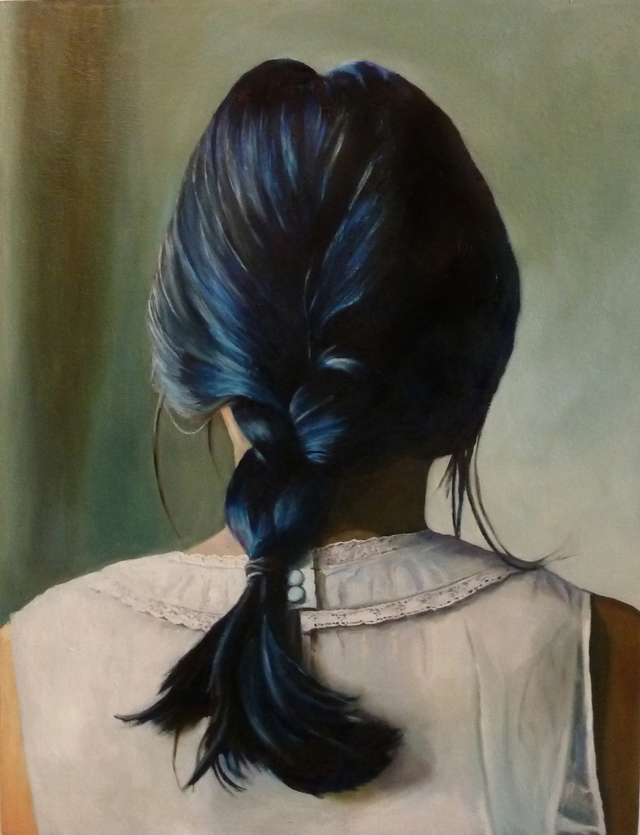
Braid 26” x 20” Oil on canvas

Braid
26” x 20”
Oil on canvas

Briefly describe the work you do.

My work is composed of psychologically and/or emotionally charged paintings of a female figure in different spaces. I love painting the figure, and painting myself felt different than painting other people. It is much more personal and introspective. I deliberately don’t paint my face so it is less about making a self-portrait and more about expressing a feeling using my own body. This is why I use myself as the model in my personal narratives.

At what point I your life did you want to become an artist?

When I was a child I was always drawing everywhere for hours. When I grew up I thought I would do commercial art and become a graphic designer. Two years into working as a graphic designer I felt depressed and unfulfilled, so I took a few night and Saturday art classes at the city college. I realized how much I missed and loved making paintings and drawings. I knew I would regret it if I did not try to be an artist. If I failed at least I knew I tried rather than not at all. So I quit my job after getting into art school, moved to a new city and have never looked back.

Tell us a little about your background and how that influences you as an artist.

I was an English Literature major in college and have always loved stories. As I make paintings I’m always thinking about the life of the figure in the painting. As I work I imagine what were they doing right before the captured moment and what will happen after. I’m always using myself as the subject matter. It’s always in the back of my mind because it’s not something I can get away from, as a female and a Chinese-American. It’s part of my identity, which is why I paint myself over and over, coming to terms with who I am in this society—whether it’s as a painter, an observer or a culture maker.

Blank Canvas 48” x 60” Oil on canvas

Blank Canvas
48” x 60”
Oil on canvas

What types of conceptual concerns are present in your work? How do those relate to the specific process(es) or media you use?

Most of my work is comprised of oil paintings and drawings that address the quiet, the silence, the intimacy and the immensity of a single point in time. I capture a fleeting moment with my camera and further pause and extend that moment in time by painting it. The use of painting as a medium to capture this pause is particularly appropriate in that the process can be slow, methodical and oftentimes labor intensive. I’m always drawn to the most ambiguous moments from cinema, photography and life; instances that make you think twice about what you are seeing. There is a quiet simplicity at first glance, and yet a second look beneath the image’s exterior reveals much more depth and possibility. It is this mysterious and elusive quality that I seek to capture in my work. A majority of the paintings from this series is set in the domestic space, which becomes the backdrop for psychological drama. I explore and reenact my anxieties, fears and desires within this space.

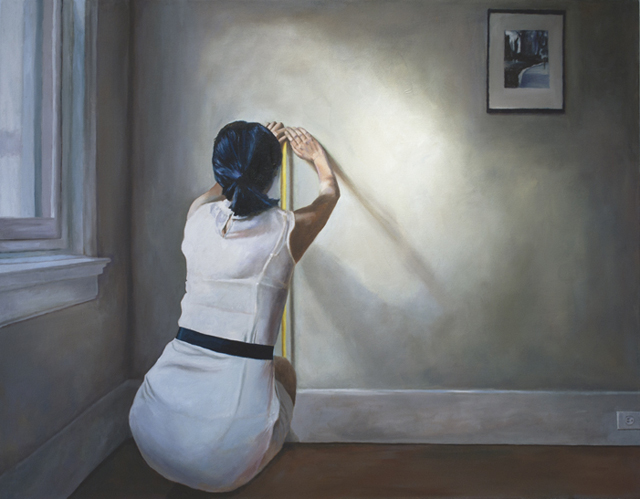
Measuring 34” x 44” Oil on canvas

Measuring
34” x 44”
Oil on canvas

We once heard Chuck Close say he did not believe in being inspired, rather in working hard everyday. What motivates you in your studio practice?

Sometimes just getting to the studio and being there is just as important as making the work. If I don’t get to my studio or work on my art enough I feel discontented. I’m often working outside of the studio, doing research on my computer, taking photos, thinking and reading. All of these activities feed into my work, even if I am not physically in my studio. I am constantly thinking about my work.  

What artists living or non-living influence your work? 

I am influenced by the painters Johannes Vermeer, Vilhelm Hammershoi, and Edward Hopper. Photographers who have affected me are Cindy Sherman, Jeff Wall and Thomas Struth. I am also very stimulated and moved by cinema and directors such as Sofia Coppola, David Lynch and Wong Kar-Wai.

When you are not making art what types of activities and interests do you engage in?

I love to read fiction books, watch movies and television. I also love travel, walking and taking pictures of things I see, as well as eating and trying new restaurants.

About

HeadshotHelena Hsieh was born in Long Beach, California. Hsieh earned her BA in English Literature from the University of California, Los Angeles, BFA in Painting from the San Francisco Art Institute and MFA from the School of the Museum of Fine Arts, Boston/Tufts University. She was chosen by SMFA to be their student speaker at the 2012 commencement. Hsieh has received a number of awards and recognition including being selected as one of 30 artists in the “30 Under 30” Exhibition at the Arsenal Center for the Arts, Boston Young Contemporaries, and receiving a Montague International Travel Grant to Paris and Berlin as well as a post-graduate teaching fellowship at SMFA. She has exhibited nationally and her work has been featured in Art Business News, Studio Visit Magazine and New American Paintings. She currently lives and works in Boston, MA.

Studio

Studio

www.helenahsieh.com

All images copyright of the artist and used with their permission.

Posted in Uncategorized | Tagged , , , , | Leave a comment

Mary Wagner – Chicago, Illinois

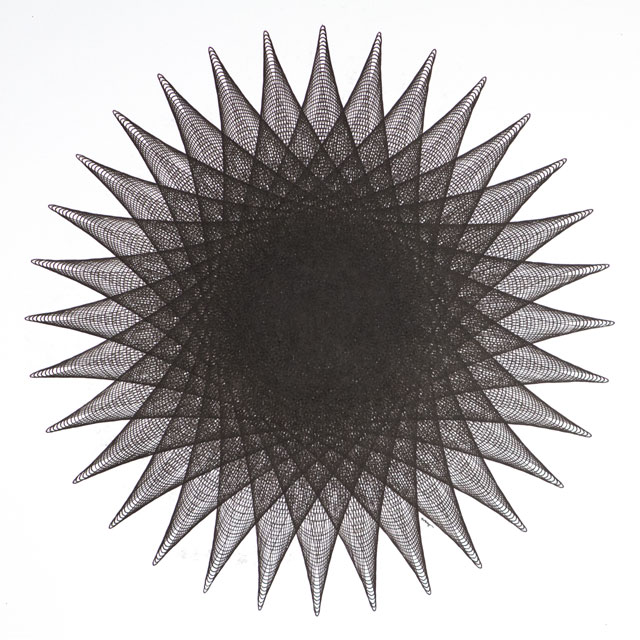
“Untitled Figure”, 2014 india ink on bristol board 20 x 20 inches

“Untitled Figure”, 2014
india ink on bristol board
20 x 20 inches

Briefly describe the work you do.

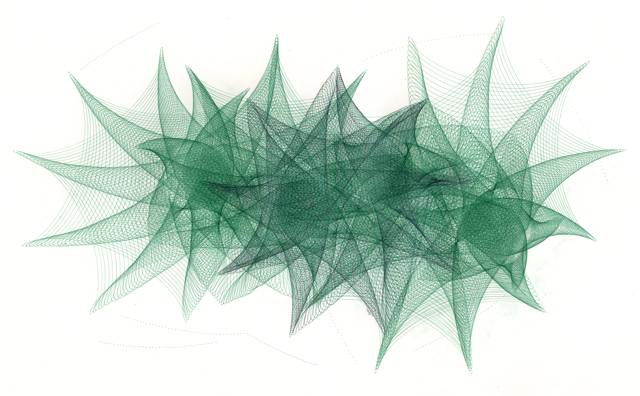
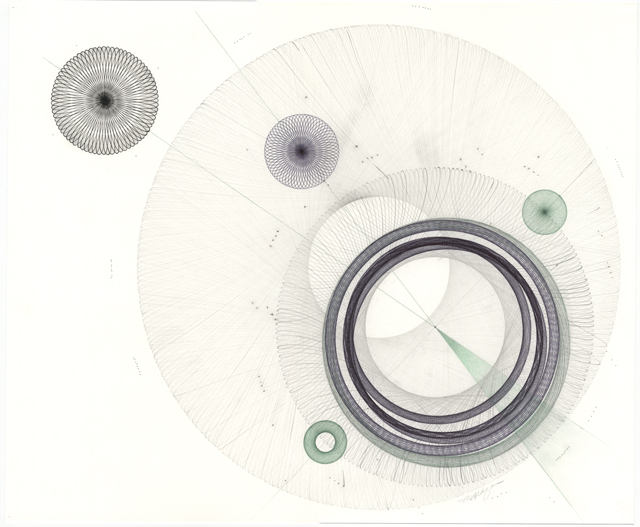
I make machines to help me make drawings… gears moving inside gears help guide my pen. My drawing process is fluid, and the individual curves are deceptively simple, but the drawings warm and complicated through repetition. Patterns pile on top of each other becoming value shifts and texture, dimension and movement. Sometimes the motion of the pen becomes less about any definite path and more about the disappearance of paper. I can geek out about the mathematics all day long if you’d like. 

I want my art to appeal to a broad spectrum of viewers. There is a simple, optical pleasure in the work if you’d like to stop there. Beyond that I try to instill connections to repetitive devotional practice, meditation, a touch of the baroque, a nod to Op art, and pop art, and conceptual drawings, and even the folk art made by contemporary doodle tops and commercial drawing toys.

Tell us a little about your background and how that influences you as an artist.

I grew up in a maker family. Mom crafting and sewing. Dad woodworking and mechanics. Everyone in my family of thirteen siblings did arts and crafts. Drawing and doodling developed instinctually, becoming a lifelong pursuit. I was also fascinated by math and science…dad had piles of Scientific America and Popular Mechanics. I even went to a few state math competitions in high-school. My university plan was an engineering degree, following in the steps of my oldest brother. Half way through the art and creativity won out instead. After a BFA and a career in marketing and graphic design, I’m back at the math and geometry from an artistic angle.

“Whirling Dervish”, 2013 black and green ballpoint pen on bristol board 22 x 32 inches

“Whirling Dervish”, 2013
black and green ballpoint pen on bristol board
22 x 32 inches

The concept of the “artist studio” has a broad range of meanings, especially in contemporary practice. The idea of the artist toiling away alone in a room may not necessarily reflect what many artists do from day-to-day anymore. Describe your studio practice and how it differs from (or is the same as) traditional notions of “being in the studio.”

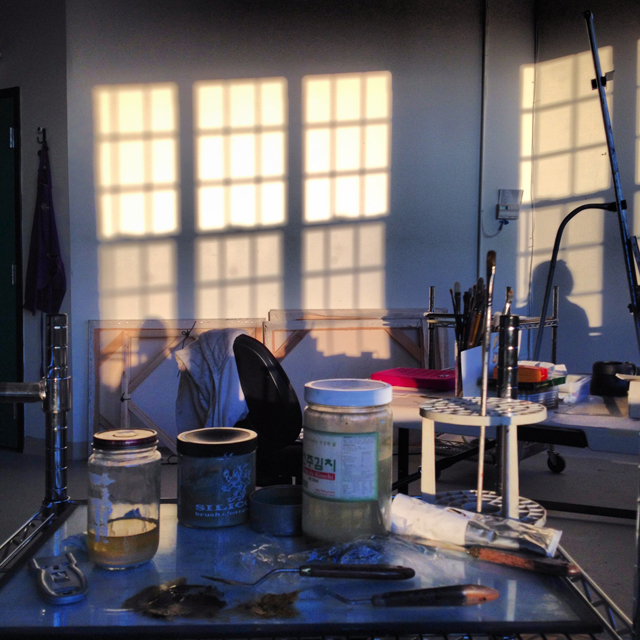
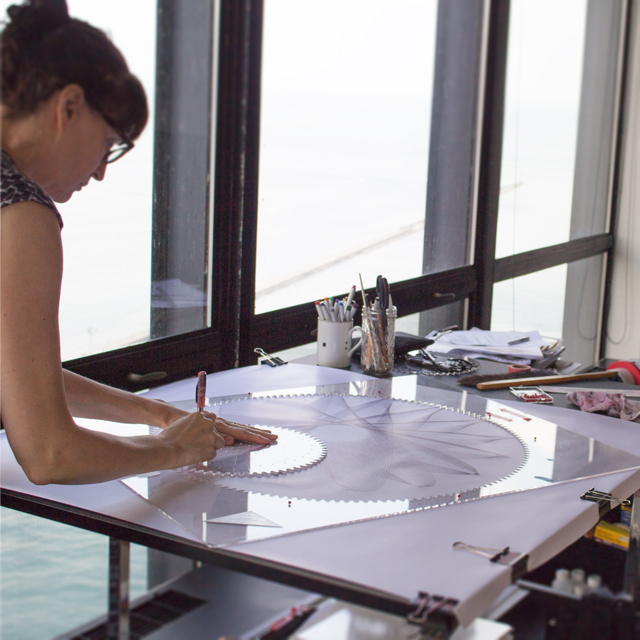
My studio is in my home, and is also the locus of my freelance design work. It gets a bit chaotic with my art spilling over into every room in the apartment. I’m hard at work most of the time; switching from design work to drawing and back again…avoiding stepping on the larger-scale drawings in the middle of the living room floor–which sometimes take a couple of weeks to complete.

What unique roles do you see yourself as the artist playing that you may not have envisioned yourself in when you first started making art?

None. I like to do this. I want to do this. I never envisioned a “role” I was playing as separate from my own curiosity. Perhaps, on occasion when others see me drawing and become mesmerized by the hypnotic repetition of it, I become a performer, that is unexpected.

When do you find is the best time of day to make art? Do you have time set aside every day, every week or do you just work whenever you can?

I’m a workaholic. I draw, sketch or work up plans for drawings most days. It seems I’m always scribbling notations or ideas on scraps of paper. When I’m in ‘the zone’ I’ll draw ten to twelve hours straight with a few breaks to stretch and quiet my rumbling stomach. When working on large scale pieces I have to pace myself, drawing in six-foot wide circles can be physically demanding, doing a few hours a day, over the course of a few weeks to complete a drawing.

“Paradox”, 2014 ink, ballpoint pen, pencil, marker on bristol board 14 x 17 inches

“Paradox”, 2014
ink, ballpoint pen, pencil, marker on bristol board
14 x 17 inches

How has your work changed in the last five years? How is it the same?

My art has taken it’s greatest leaps in recent years. I moved from surrealism and subjective drawing to abstract minimal drawing which I call my ‘circle phase’ to designing and making my drawing machine. My current body of work consists solely of this new form of drawing. I’ve abandoned all other art forms except for bookbinding, I’m currently planning an artist book with my drawings.

Are there people such as family, friends, writers, philosophers or even pop icons that have had an impact on the work you do?

Of course. Too many to count, let alone name. In addition to Sol Lewitt, and Bauhaus artists of record, random magazine illustrations, or a glance out the window, can have an accidental profound effect on creative output.

My strongest influences though are those most personal to me. My husband, David Pickert, is a rigorous and enthusiastic architect, who’s work is closer and more personal to him than the work of many artists to their art. His methodical, thoughtful approach, has a great impact on my work. My brother, Mark Wagner, and I have spent years questioning, encouraging, and supporting each other’s creative work. And I find continual inspiration in the lush art he creates.

If you had an occupation outside of being an artist, what would that be and why?

Like most artists, I do have an occupation outside of being an artist. Like most artists, I’d rather ignore that and talk more about my art.

About

MaryWagner_HeadshotMary Wagner hails from rural Wisconsin, the ninth of Roman and Hazel’s thirteen children. Along with making things, a favorite childhood activity was playing on the merry-go-round. Apparently she still has a fondness for going round-and-round as it is the central principal and action of her drawing practice. Mary earned a BFA from the University of Wisconsin Milwaukee. She lives, draws, and plies her trade as a graphic designer in Chicago. Her work has been exhibited throughout the midwest and is in private collections around the world. She relaxes with puzzle solving and organizing. Her current “to read” stack includes books on George Washington, Ciphers and Codes, Moholy-Nagy, and Burnham’s Celestial Handbook.

In the Studio

In the Studio

marywagner.com

All images copyright of the artist and used with their permission.

Posted in Uncategorized | Tagged , , , , | 2 Comments

Betsy Lundquist – Sterling, Colorado

Ceremonial Collar on Stand  2013  steer horns, metal, foam, wood, paint, rubberized paint, fiberglass, trolling line  73" x 32" x 18"

Ceremonial Collar on Stand
2013
steer horns, metal, foam, wood, paint, rubberized paint, fiberglass, trolling line
73″ x 32″ x 18″

Briefly describe the work you do.

The main area of my practice is sculpture, with a secondary focus on other visual media and writing. My focus is on reinterpretation of symbolic object tropes with an eye towards unsettling and removing their recognizable narrative qualities. This is done in order to leave only a strange and hard to articulate experience with the object; one that is meant harken back to the basic quality of the transcendent experience that spiritual symbolism is employed to translate and represent.

Tell us a little about your background and how that influences you as an artist.

I grew up in rural Colorado. My childhood home was situated where a dirt road intersected a paved road; neighbors were few and far between. I’ve never been a country girl at heart, growing up in the countryside felt like doing hard time in the most spacious jail imaginable. The prairies of Colorado are vast, beautiful but lonely landscapes that strike two big notes of mostly flat land and wide open blue skies. That sense of simple beauty on a grand scale, a paradoxical sense of confinement in an expansive place, and sense of a vast idyllic loneliness has had a lasting and discernible effect on my writing practice.

The visual art component of my practice has been more influenced by exposure and escapism to where I wasn’t at the time, through reading, junkie levels of TV consumption, encounters with art, design and objects.

The concept of the “artist studio” has a broad range of meanings, especially in contemporary practice. The idea of the artist toiling away alone in a room may not necessarily reflect what many artists do from day to day anymore. Describe your studio practice and how it differs from (or is the same as) traditional notions of “being in the studio”
 
I tend to be very prolific in very concentrated bursts of activity, but spend very little time in a formal studio space. My current “studio” is just a jam packed garage warehousing my materials. Works in progress are brought into my house so I can wrestle and live with them intensively. Most of the time put into my practice is spent between my ears or out in the world, scouring antique shops, junk piles, auctions and all manner of stores to find materials for work in progress or to inspire new work.

Blue Angel (Air Show Disaster)  2013  metal, plastic, fiberglass, rubberized paint, leather  human scale

Blue Angel (Air Show Disaster)
2013
metal, plastic, fiberglass, rubberized paint, leather
human scale

What unique roles do you see yourself as the artist playing that you may not have envisioned yourself in when you first started making art?

I don’t know that its changed for me. I’ve been following the same folly for longer than I can remember, my first step was in all likelihood taken towards it . I suppose it’s not really about roles per say, it’s more about figuring out what must be done to make what has taken hold of my imagination a reality. That’s always changing from piece to piece, and the actions are so transitory as not to become proper roles. As the process of getting there isn’t based in repetition or following one identifiable process, it still feels like being along for a very exciting and entertaining ride.

When do you find is the best time of day to make art? Do you have time set aside every day, every week or do you just work whenever you can?

My work gets made when its urgent, not based on deadlines but on a overwhelming need to see it through. I love working at night because everything is so quiet and there’s no one and nothing else demanding my attention. When I work, I work until I completely physically exhaust myself. The concept of a regimented work day schedule is still alien and probably forever unattainable to me.  

The Golden Tree  2013  plastic, metal, paint, plaster  6’ 5” x 24” x 24”

The Golden Tree
2013
plastic, metal, paint, plaster
6’ 5” x 24” x 24”

How has your work changed in the last five years? How is it the same?

It’s become far more goofy and cartoonish in nature. A sense of looming discomfort has always been a part of the work, but the means by which this is achieved has changed. There’s far less death and sex and far more bonkers cartoon style sight gags installed in their stead. About 4 years ago I started operating on the premise that making work that was happier & brighter is likely more unsettling & jarring than employing a direct tactic with objects that are already loaded and unsettling (out of the context of the work).
 
Most of the work is still referential to the human form, but now more so as a symbolic object of agency, or as a reference point that scales the cultural and ritual artifact to the human experience. The undercurrent of humor, unsettled whimsy, and material qualities remain largely the same. My general area of research is unchanged, but the facets I explore within that territory is constantly changing.

Are there people such as family, friends, writers, philosophers or even pop icons that have had an impact on the work you do?

The formative influence on the object balance that goes into my work is owed in large part to the elderly ladies that I’d visit as a child. They had such amazing curated collections of things amassed over their lives. It made me want to be them, to the degree that a great deal of my playtime was spent dressing in makeshift costumes and pretending to be the elderly ladies I knew. Their aesthetic was a balance of qualities best summed up by mid century plastic flowers, a beautiful colorful fantasy with notes of a vile but still endearing cheapness. My work has long since moved on from an old lady aesthetic, but I still love using materials that have an unresolved stature that mirrors this specific range of competing qualities.

Other than that, Jung specifically has had a large influence on my work. I’m voracious when it comes to writings and interviews about exploring the contextual and philosophical framework of spiritual and transcendent experiences. I could name few, but many who wrestle with the big questions in this area have influenced my work immensely. I’ll just cite it here as Krista Tippett et al. to cover a wider (yet still very incomplete) territory.

If you had an occupation outside of being an artist, what would that be and why?
 
This is it for me really. There are many other passions in my life, but none that raise to the level of a palatable occupation. I’d say theoretical physicist, but really, that’s just my nerdy version of a rock star fantasy.

About

betsylundquisthsBetsy Lundquist is a Colorado based artist, working primarily with sculpture and installation. She holds an MFA from Goldsmiths: University of London (2009), and a BFA from University of Colorado at Boulder (2006). She co-founded Misery Connoisseur magazine, a London based art and literary magazine. Lundquist has worked with the London based collective GANDT, and P.A.S.T. Projects among others. Some of her of works are currently represented by Ian Kennedy of Ruby+George of Denver.

IBEW  (detail view)  2013  wood, metal, rubber, corrugated plastic, fabric, fiberglass  human scale

IBEW
(detail view)
2013
wood, metal, rubber, corrugated plastic, fabric, fiberglass
human scale

www.betsylundquist.com

All images copyright of the artist and used with their permission.

Posted in Uncategorized | Tagged , , , , | Leave a comment

Joe Joe Orangias – Wellington, New Zealand

aengerfest Arch 1881 (video still), In collaboration with the Houston Liederkranz and Houston Saegerbund, made in part with support from the Galveston Artist Residency, Ryan Hawk, and Jesse Cline, 14:30 minutes, 2014

aengerfest Arch 1881 (video still), In collaboration with the Houston Liederkranz and Houston Saegerbund, made in part with support from the Galveston Artist Residency, Ryan Hawk, and Jesse Cline, 14:30 minutes, 2014

Briefly describe the work you do.

Making art is a way of understanding and communicating how people relate to places and times. Working through history, collaboration, and local resources, I make site-specific projects to engage local communities with certain social and environmental issues. Finished projects range from critical writing, to drawing, to mobile architecture, to performance, to video installation; however, I primarily consider myself a sculptor. The physicality and transformability of sculpting are essential in that my goal is to demonstrate and share agency in shaping the constructed, but malleable, world that embodies us.

The aesthetics of my projects are realized through a process of research, conversation, and access to sites. Through this process, I repurpose social objects and replicate structures to propose more harmonious and diverse futures for places. The narratives I create strive toward social, economic, and environmental progress that is equitable and sustainable.

Tell us a little about your background and how that influences you as an artist.

As a child I made utopian drawings of houses and places I wanted to build when I grew up. Aside from bizarre and (now) out-of-date mechanical functions, the dwellings had space for intellectual and physical activities that I currently practice to balance my life as an artist and use to adapt to places. Through my studies and professional opportunities, I began traveling extensively and developed my identity as a global citizen, humanitarian, and queer. These traits specifically ground me during travel, and influence my perception of inclusivity within local and public places. I’ve always been an artist in that I’ve always considered and proposed ways places can be designed or reformed to better include people and advance cultural activity.

Pink Dolphin Monument (statue), Dedicated to gender and sexual minority communities in collaboration with writer Sarah Sloane and scientist Frank Pega, made in part with support from the Galveston Artist Residency, Galveston Commission on the Arts, Galveston Park Board of Trustees, and the Pink Dolphin Tavern: Home of the Pink Posse, cement, mixed media, sandstone, steel, and text, 36’’ x 16’’ x 66’’, 2014. The base plaque holds the poem: “∩ The path that led you here through giant gold headdresses shaking in the wind below a long calligraphy of stars – finds you standing in R.A. Apffel Park lit by dreams of dolphins rising pink arches in the dark ∩”

Pink Dolphin Monument (statue), Dedicated to gender and sexual minority communities in collaboration with writer Sarah Sloane and scientist Frank Pega, made in part with support from the Galveston Artist Residency, Galveston Commission on the Arts, Galveston Park Board of Trustees, and the Pink Dolphin Tavern: Home of the Pink Posse, cement, mixed media, sandstone, steel, and text, 36’’ x 16’’ x 66’’, 2014. The base plaque holds the poem:
“∩ The path that led you here through giant gold headdresses shaking in the wind below a long calligraphy of stars – finds you standing in R.A. Apffel Park lit by dreams of dolphins rising pink arches in the dark ∩”

The concept of the “artist studio” has a broad range of meanings, especially in contemporary practice. The idea of the artist toiling away alone in a room may not necessarily reflect what many artists do from day to day anymore. Describe your studio practice and how it differs from (or is the same as) traditional notions of “being in the studio.”

This is an excellent thought for me right now. Firstly, through residencies and travel grants, I have been working at different places around the world for the last couple years, and I am currently between studios in Wellington, New Zealand as an alumni Traveling Fellow of the School of the Museum of Fine Arts, Boston. This nomadic period gives me a diverse understanding of how the studio can be considered. Secondly, I often work on-site through participatory processes and public installations. This experience physically extends traditional notions of the studio in that I work outdoors. Lastly, reading and writing are integral to my practice. I often discuss and collaborate on theoretical ideas with people, which happen in numerous places, including virtual space.

The studio is essential to my work. My studio is a flexible place that constantly changes according to what it takes to realize a project. Whether carving sandstone in a large room naturally lit through windows, shooting a video in a field of Texas Bluebonnets, salvaging materials from a condemned bowling alley, or writing an article in an airport, my studio is a place of thinking through and working toward visual and spatial progress, wherever that happens to be.

What unique roles do you see yourself as the artist playing that you may not have envisioned yourself in when you first started making art?

I am very interested in adaptation and knowledge exchange through my work. I consider this not only for the integrity of my discourse, but also for the social contexts in which I work. With that said, I fulfill many roles in order to engage with communities and challenge their greater social contexts. Aside from the obvious, I have been an activist, biker, choreographer, cinematographer, composer, Deputy Member of the Pink Posse, general contractor, league bowler, lumberjack, scavenger, spokesperson, subway passenger, urban farmer, and water cultist. My intention is not to master or mimic these roles, but to engage with a diverse range of people and exchange knowledge through unique methods of cultural interaction.

When do you find is the best time of day to make art? Do you have time set aside every day, every week or do you just work whenever you can?

I’m currently working full time. I typically have months of reading, writing, and sketching, then months of physical production. There are times when I am excited about my work to the point of insomnia. These nights are when ideas and forms flow most fluidly. Furthermore, many ideas best solidify while in transit.

nstallation view of exhibition “Lucky Strike” (Mobilized Concession for Post-Bowlers, Murphy Bench, and Switch Board) at the Howard Art Project in Boston, photo by Suzi Grossman, 2013

nstallation view of exhibition “Lucky Strike” (Mobilized Concession for Post-Bowlers, Murphy Bench, and Switch Board) at the Howard Art Project in Boston, photo by Suzi Grossman, 2013

How has your work changed in the last five years? How is it the same?

During the last five years, the conceptual basis of my work has grown to function within larger social movements, including decolonization, queer theory, and sustainable development. My work is now dependent on history and collaboration, and I understand social context a medium, as opposed to my previous reliance on Modernist notions of mediums. My finished work is active research, or a solution, that foresees future projects and innovation. In the next five years, I envision my projects to grow in scale, collaborative capacity, and through critical writing. 

If you had an occupation outside of being an artist, what would that be and why?

I would be an art-architecture historian. This is actually my next academic pursuit, while continuing my art practice. I would also like to be a professor in the near future and continue curatorial projects. I’ve been very inspired by the exhibition I’m currently co-curating with curator Max Fields titled “Public Communication: Performing Knowledge of the Body” that opens in January 2015 at BLUEorange Contemporary in Houston, Texas. 

About

4_HeadshotJoe Joe Orangias is a visual artist who intersects fine arts, architecture, and critical theory. He holds an MFA from the School of the Museum of Fine Arts, Boston in partnership with Tufts University, and a BFA from the Savannah College of Art and Design. His work has been exhibited at galleries and on-site in America, France, Germany, Hong Kong, and Scotland. Orangias received an Art School Alliance Visual Arts Fellowship from the Hochschule für bildende Künste Hamburg, where he worked with the Design for the Living World Studio; and residencies at ART342 Foundation in Fort Collins, Colorado; Atelier OPA: Original Products & Architecture in Tokyo; and the Galveston Artist Residency on Galveston Island, Texas, where he realized the Pink Dolphin Monument that permanently resides in R.A. Apffel Park. He is currently developing a project in Wellington, New Zealand as a 2014 SMFA Traveling Fellow.

ideo shoot of Capsule Camping, video in collaboration with Leah Craig, Jay Critchley, Bug Davidson, and Jonathan Lizcano, sculpture Capsule Hotel was installed for camping at the Dunes Edge Campground in Provincetown, MA and included in Appearances: Green Arts Festival, 2012

ideo shoot of Capsule Camping, video in collaboration with Leah Craig, Jay Critchley, Bug Davidson, and Jonathan Lizcano, sculpture Capsule Hotel was installed for camping at the Dunes Edge Campground in Provincetown, MA and included in Appearances: Green Arts Festival, 2012

www.joejoeorangias.com

www.pinkdolphinmonument.com

All images copyright of the artist and used with their permission.


Posted in Uncategorized | Tagged , , , , | Leave a comment

Bryce Willem – Portland, Oregon

 "CCLXXI / CCLXIX / CCLXVII, NANDINA DOMESTICA" from Binarium, Archival pigment prints from digital scan file, 2013

“CCLXXI / CCLXIX / CCLXVII, NANDINA DOMESTICA” from Binarium, Archival pigment prints from digital scan file, 2013

Briefly describe the work you do.

My artistry is somewhat multidisciplinary. Outside of writing, I primarily use music, dance and photography to explore notions of symmetry, pattern, order, and form. As a practice, I unconditionally cater to letting ideas take shape, unfold and distill themselves organically. To me, formal relationships are more inherently something to be discovered rather than preconceived. Beyond the umbrella of formalism and natural order, my work predominately explores our relationships between Nature and technology, feedback between deconstruction and reconstruction, as well as the line between analog and digital.

At what point in your life did you want to become an artist?

My very first dream job was actually to become a movie director. I must have been around 9 or 10 when I first saw cinema’s transformational ability to conduct emotions and ideas. I didn’t know at the time, but my desire to shape experiences would slowly boil down to becoming an artist. The decisive moment wasn’t truly until my first term, freshmen year of undergrad. Ty Warren, a dear professor whom I am eternally grateful to, showed me the infinite potential of Art. She advised me to “join the Darkside,” and I did.

"No. 2” from Currence I, Archival pigment prints from digital scan file, 2014

“No. 2” from Currence I, Archival pigment prints from digital scan file, 2014

Tell us a little about your background and how that influences you as an artist.

I grew up in Oregon and was extremely fortunate that my parents were passionate to travel so much. From before I can even recall, they were busy instilling a keen sense of adventure in me; it seems my whole childhood was spent camping, hiking, canoeing, and endlessly exploring some new frontier with them. The presence of nature and natural order in my art is an unmistakable reverberation of this.

I’ve recently began realizing how much of current process can be traced back to instances in my childhood. For example, like I mentioned, my practice is highly reactive; I’ve simply never had the ambition to undertake a process of preconception, execution and actualization. For me, it’s a matter of learning with my work rather than trying to teach it to behave – repeatedly allow the last step to inform the next. I connected the dots that this mechanism most definitely stems back to my early Lego days. It was much the same constructive process then as it is now – only it used to be a matter of brick by brick. Suppose it’s just how I operate.

What types of conceptual concerns are present in your work? How do those relate to the specific process(es) or media you use?

I’m very careful, particularly with visual projects, to keep my conceptual concerns embedded within my process. I should preface that none of my work is achieved through Photoshop to this effect. For instance, with Binarium and Currence, I use a flatbed scanner to warp and abstract my subjects. Over the course of a flatbed scan, I choreograph movements and intervals of rest with the given subject. As the scanner’s interface assembles time and energy into still image, this methodology enables me to sculpt digitally dependent forms from the analog input. Doing so not only resolves to suspend each image between realistic fidelity and the abstracted performance, but it allows the forms to inhabit a fractural space between the physical and digital worlds. Particularly, in Binarium, I use this framework as a platform to explore the complex relationship we are conducting between nature and our technology. When a subject (in this case, a plant specimen) is in motion during a scan, the limitations of the scanner’s RGB optical channels are consequently exposed (see the detail image). This creates divisible breakdowns and acts as a conceptual catalyst to the work.

Currence is the natural progression from Binarium and aims to break this scanning methodology down another level. I use a squared piece of pine as the subject (twenty-four inch length, half inch sides). Essentially, this project is an attempt to distill the entire creative process down to its fundamental ingredients: order and energy.

"DCCXIX, EUPHORBIA POLYCHROMA” from Binarium, Archival pigment prints from digital scan file, 2013

“DCCXIX, EUPHORBIA POLYCHROMA” from Binarium, Archival pigment prints from digital scan file, 2013

We once heard Chuck Close say he did not believe in being inspired, rather in working hard everyday. What motivates you in your studio practice?

I agree that inspiration, in this sense, is certainly not something to be waiting around for. Being idle can quickly spiral into being lazy, so I do my best just to stay as physically and mentally active as can be. The equation is simple: greater input = greater output, so traveling and woods time is a surefire way to clear the air and gain a fresh pair of eyes when I find myself stagnated on a piece too long. In fact, my process has become completely dependent upon my ability to waver back and forth between these modes. I suppose the real answer here boils down my own relationship to nature though. It’s a simple compulsion that motivates me to create things in dialog to this relationship, so I suppose I can say that nature is what inspires and motivates me the most.

What artists living or non-living influence your work?

My friends will chuckle at this, but the band Animal Collective has profoundly influenced my outlook on art more than anyone else (in other words, all my favorite humans are in Animal Collective). To me, the level of intricacy and complexity they can draw into their music and their sound’s ability to submerge you – in terms of form and natural order – is the bar. I’ll stop myself before this questionnaire becomes 7 parts art practice, 100 parts love for Animal Collective…

I’m also compelled to mention James Turrell here. I revere the sheer scale of his practice and unwaveringly look up to the way he has navigated a presence within “art world proper”. Bottom line: he changed the way I look at light.

When you are not making art what types of activities and interests do you engage in?

I really just do as much hiking, camping and traveling that my schedule can allow. I also am a keen concertgoer, reader and movie watcher in my down time. And of course, all the above is best practiced in good company!

About

BryceWillem HeadshotBryce Willem was born in Fort Collins, Colorado in 1990. His family moved to Corvallis, Oregon when Bryce was only 3. He later attended University of Oregon and graduated with a Bachelor of Science in Digital Arts and a minor in Music. Bryce currently resides in Portland, OR.

www.brycewillem.net

Detail shot: "MCCCXL, BRUNNERA MACROPHYLLA” from Binarium, Archival pigment prints from digital scan file, 2013

Detail shot: “MCCCXL, BRUNNERA MACROPHYLLA” from Binarium, Archival pigment prints from digital scan file, 2013

All images copyright of the artist and used with their permission.


Posted in Uncategorized | Tagged , , , , | Leave a comment

Sammy Chong – Boston, Massachusetts

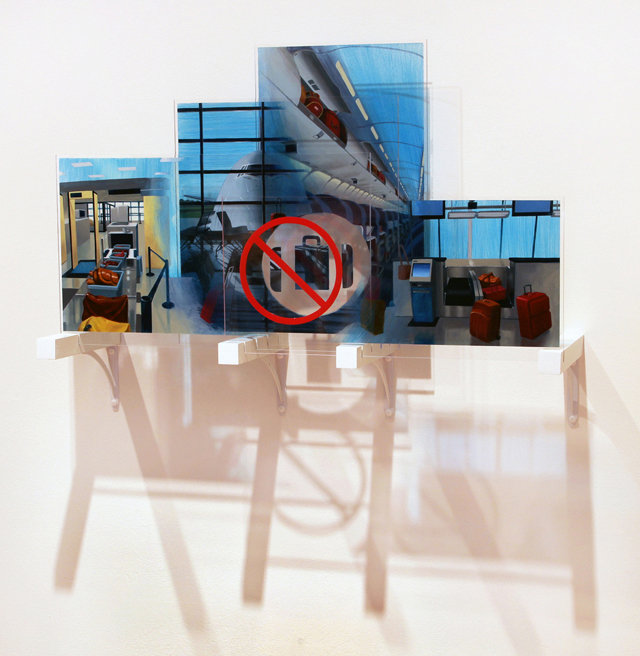
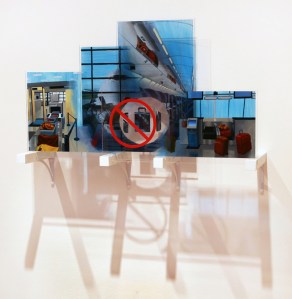
Checked, 2012. Mixed media on plexiglass, four panels, 23” x 38” x 11”

Checked, 2012. Mixed media on plexiglass, four panels, 23” x 38” x 11”

Briefly describe the work you do

I develop my work one collection at a time, based on empirical experiences. My observations—both internal and external—are examined within specific conceptual frames. Though my pieces hone in on intimate scenes, I expect the final work to transcend itself. It is important that what I make is as universal as possible, that it is inclusive and accessible. I craft objects that speaks to a wide range of people, from the refined art connoisseur to the person on the street.

As I make art I create my own narrative, which allows me to grasp realities that otherwise would pass by undiscerned or even noticed. Just like art helps me to find meaning and be aware of my surroundings, I expect my work to nudge viewers to be conscious of theirs. My work functions as a catalyst for social experiences when it builds bridges where they have been severed. I feel accomplished when onlookers react to my installations by reflecting on their own experiences that they articulate and exchange with others. Their stories then become part of a meta-narrative that is new and transformative.

At what point in your life did you want to become an artist?

I have been making images since I was very young. Despite having a number of artistic family members—a musician and a sculptor, among others—I never considered making a living from art. I knew I wanted a future that would be meaningful, fulfilling, and have an impact, so I pursued a teaching career. I studied and eventually taught both philosophy and theology. Throughout those years, I developed as a self-taught visual artist in my spare time. I learned to paint by looking at art books and scrutinizing techniques. Since then, art has served me as a suitable vehicle to express and communicate otherwise abstract concepts. My training in the MFA program at the Museum School reinforced my skills, as well as broadened my vision of the role of an artist in today’s world. The challenge for artists is not much different from many academic disciplines that pursue making sense of the world. Now I am engaging in both endeavors: I make art and teach studio art at Boston College.

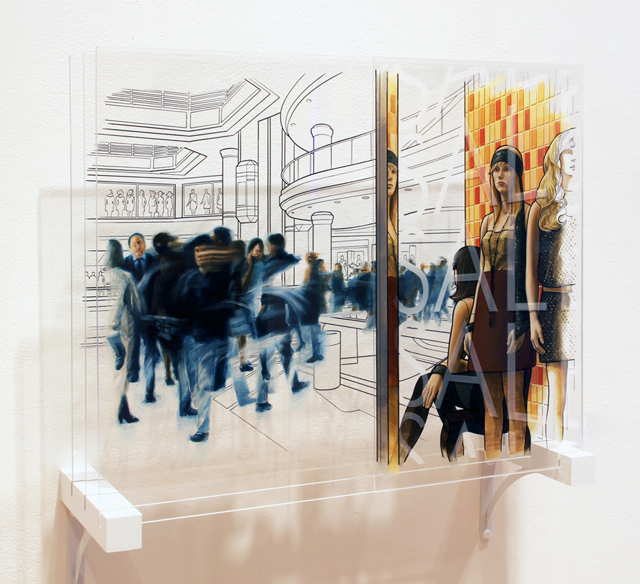
Golden Calf, 2012. Mixed media on plexiglass, three panels, 20” x 24” x 9”

Golden Calf, 2012. Mixed media on plexiglass, three panels, 20” x 24” x 9”

Tell us a little about your background and how that influences you as an artist

Questions about social identity are intrinsic to who I am as a person. Being Chinese from a South American country prepared me well to face being a foreigner here in the US. Since I arrived in 2001 I have noticed a dichotomy in people’s behaviors—including my own. We might be physically present as we pass through malls, train stations, supermarkets, airports, and so forth, while emotionally and psychologically we are absent. I thought at first that my experience was conditioned by my “alien” status in American soil. However, after doing research and interviewing different social groups—nationals and internationals, male and female, young and old—I have come to the conclusion that my experience of aloofness in public spaces is a global phenomenon linked to modern societies. In this I found a meaningful and vast resource for my work.

In tandem with my cultural background, my academic one is always present in my art practice. I have a Master’s degree in philosophy and theology; they have predisposed me to question and be critical of reality. It is natural then to correlate my personal experiences with notions I have gathered in those disciplines. I usually toy around with Heidegger’s understanding of experience of being, Nietzche’s description of eternal recurrence, and Tillich’s view of the situation of our times. These might not be explicit in my artwork, yet they heavily inform it. For instance, having Hegel’s dialectical method in mind, in my painting I juxtapose warm vs cool palettes, vigorous moments vs quiet ones, interiors vs exteriors, traditional vs inverted perspectives, and so forth. My goal is to expose viewers to these contrasts and dissonances. It is up to them to make a synthesis, to use Hegel’s nomenclature.

What types of conceptual concerns are present in your work? How do those relate to the specific process(es) or media you use ?

My current work elaborates on issues of identity as a social construct. Our sense of individual is formed by the interactions with other people and the spaces we inhabit. We are not beings in a vacuum, but rather in milieus of shared experiences and narratives within a specific context and time. As we build our identity in post-modern settings, many factors and filters are at play. Social status, political ideologies, gender, religious beliefs, and ethnicity are some of the social paradigms through which we reach out or alienate others.

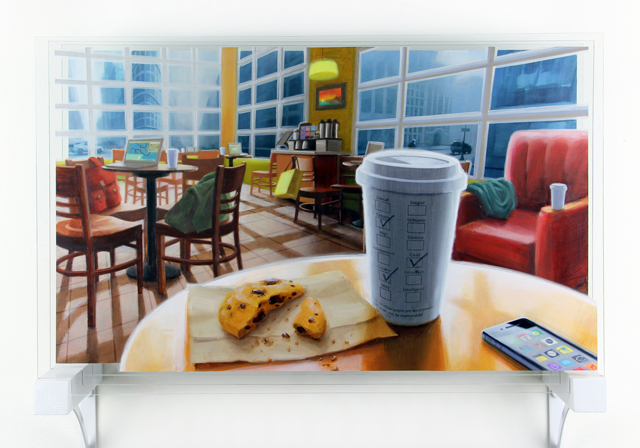
I recently developed a collection based on plexiglass. Many public spaces feature plexiglass in the form of windows, wall separations, advertising panels, shop displays, and signs. I use this material to metaphorically represent the reality that it creates by stressing what it signifies. While it is employed to organize and divide spaces, its transparency in my work connotes the invisible filters that mediate our social behaviors and interactions.

The visual information offered fragmented on multiple layers of plexiglass urges onlookers to make meaning of the whole. Different views provide juxtapositions of figure and ground, flatness and depth, while simultaneously highlighting the physical emptiness between surfaces. By depicting seemingly banal scenes on plexiglass, I encourage viewers to reflect upon the multiple levels of meaning often overlooked as we navigate an increasingly complex modern world.
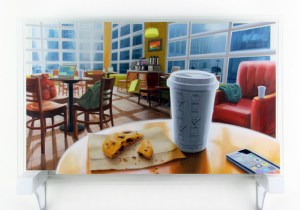
Still, Life, 2013. Mixed media on plexiglass, three panels, 17” x 25” x 9”

Still, Life, 2013. Mixed media on plexiglass, three panels, 17” x 25” x 9”

We once heard Chuck Close say he did not believe in being inspired, rather in working hard everyday. What motivates you in your studio practice?

Prior to committing to a collection of work, I discern through and through what I want to explore. In order to make sense of my surroundings I distill my thoughts, intuitions, and eureka moments. I do so by writing down a torrent of unsorted ideas and sketching vignettes in quick drawings. This documentation will be the foundation of the finished products on canvas, paper, plexiglass, wood, etc. This conceptual process can take months to settle and usually runs simultaneous to the execution of other projects.

The physical execution of my artwork is long and time-consuming. Regarding my plexiglass artwork, it takes me several weeks to finish each piece, given the multilayer aspect of my installations and the details I bring in. I treat each plexiglass panel as a painting itself. In my art making I notice a pattern: I start each project very energized, towards the middle comes tedium, and near the end I am excited to see the final realization of my ideas and efforts.

I tackle my studio practice with a method similar to when I used to work on long papers. The discipline and endurance gained during my academic years serves me well in my art making today. In the past I invested so much time researching and writing to learn and get good grades; now I spend at least eight hours a day when I am in my studio. In the end, I am driven by my desire to reach out and communicate. Those who believe that making art is fun—a self-indulgent nice “hobby”—know little about art.

What artists living or non-living influence your work?

During my self-taught period as an artist I was drawn to the Surrealists, especially De Chirico and Max Ernst, and German Expressionists Ensor and Kirchner. I was struck by how their strong visuals reflect their historical moment. Since then I have gone through different phases, when I have been attracted to different formal features related to painting. I have been fascinated by Jenny Saville’s physical handling of oil medium and the sheer format of her canvas. On the other end, l praise the line work and attention to detail in Shahzia Sikander’s early miniature work. I also gravitate towards artists who are grounded in traditional techniques and adapt them to our times. At the top of this list are John Currin and Odd Nerdrum, who embrace Renaissance and Baroque techniques respectively. I especially gravitate towards Nerdrum for the philosophical ideas unveiled in his enigmatic pieces. For the most part, I identify with artists who address social and cultural issues in their work, like Zhong Biao in his view of East meets West, and Laylah Ali with her whimsical paintings to address ugly and violent events.

When you are not making art what types of activities and interests do you engage in?

I find in movies not only relaxation and escapism, but also a correlation with my work. Though I have a keen eye for the cinematographic aspect of movies (photography), I pay close attention to their plots. Lars von Trier, David Fincher, and Wes Anderson are great story tellers. Along these lines I also listen to music. While I like classical to heavy metal, I am very fond of opera and some Broadway musicals because of their stories and how they develop musically and lyrically. I read novels—Gillian Flynn has my attention lately after finishing all the books in the A Song of Ice and Fire saga. In addition l appreciate graphic novels, especially those in which the color palette is limited or purely black and white. Though all these activities are gratifying in their own way, there is nothing I value more than conversing and sharing with my few close friends about life in general.

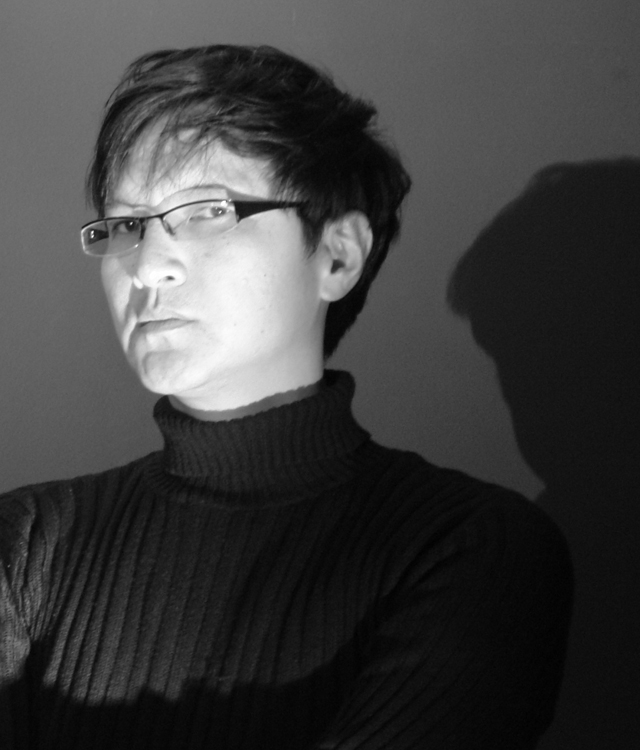
About
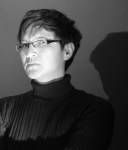
SChong_HeadshotSammy Chong is a first-generation Ecuadorian from Guayaquil; he comes from a large artistic family of Chinese descent. In his early adulthood, Chong began a career in Graphic Design, working in an international advertising firm. However, after a near-fatal car accident, he became more aware of, and sensitive to, larger transcendental issues. He then studied philosophy and theology at Universidad Javeriana, in Bogota, and earned a Master’s Degree from Boston College. Throughout his studies, Sammy developed as a self-taught artist, eventually developing a portfolio based on the labyrinth, and other mythological and spiritual themes. After teaching at the university level in Ecuador, Chong completed the MFA program at the School of the Museum of Fine Arts, Boston. He is currently a Visiting Professor in the Fine Arts Department at Boston College. He keeps a studio in Jamaica Plain, Boston.

Chong is an interdisciplinary artist who practices in drawing, painting, and installation. The following are solo exhibitions of Chong’s work: Far Away, So Close, Gallery 263, Cambridge (2013); Amidst, Bapst Gallery, Boston College, Chestnut Hill (2013); Labirintos, Fundacion Caspicara, Quito, Ecuador (2009); and Life as a Canvas, Episcopal Divinity School, Cambridge (2003). A selected list of recent exhibitions in which his work was shown includes: 102nd Exhibition, Connecticut Academy of Fine Arts, Mystic, Connecticut (2013); New England Collective III, Galatea Gallery, Boston (2012); Profiles of the [Dis]Connected, Emerson College, Boston (2011). Chong is the recipient of the following honors and awards: Marie Perry Award, The Bristol Art Museum, Bristol, RI (2014); Dana Pond Award in Painting, School of the Museum of Fine Arts (2012). Chong’s work can be seen in the upcoming solo shows: Asterion, the Milton Art Museum, Canton; [in]terim, the Carney Gallery, Regis College, Weston; and Surrounded, ArtSpace Gallery, Maynard.

In the Studio

In the Studio

www.sammychong.com

All images copyright of the artist and used with their permission.


Posted in Uncategorized | Tagged , , , , | Leave a comment

Lauri Hopkins – Chichester, United Kingdom

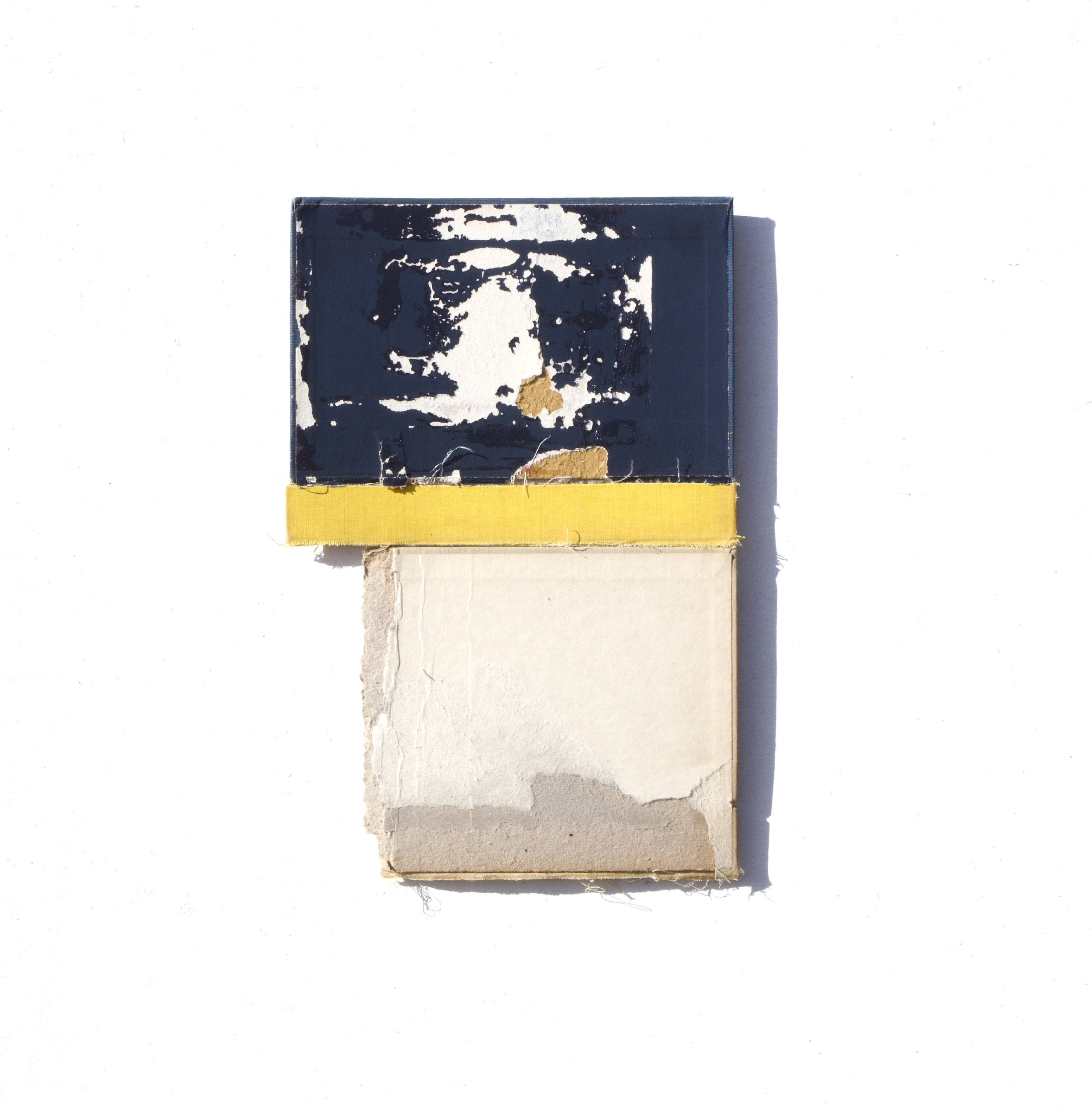
 Rorschach, 2014, 8 x 11.5 inches, book covers on birch ply.

Rorschach, 2014, 8 x 11.5 inches, book covers on birch ply.

Briefly describe the work you do.

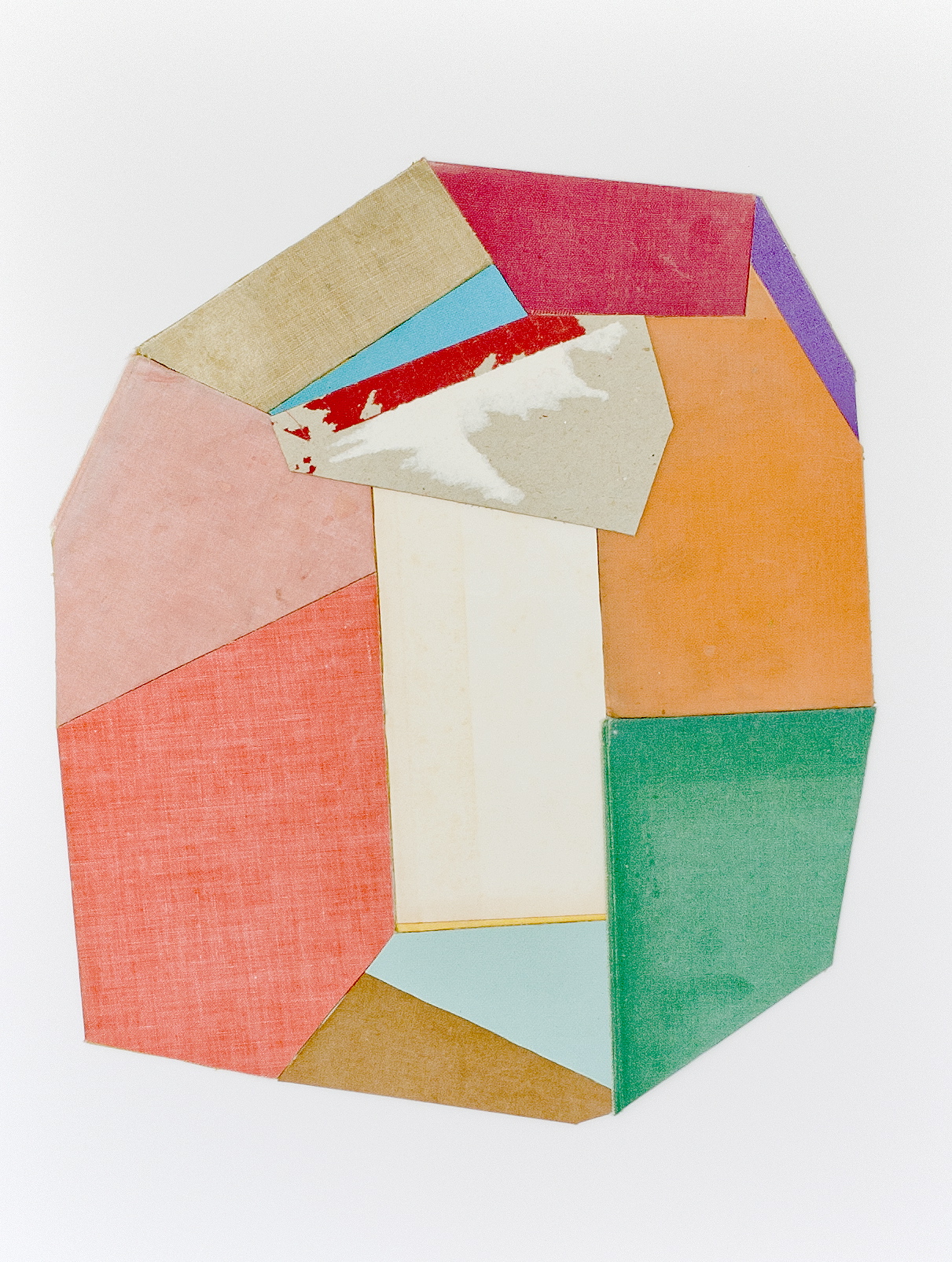
I make abstract, geometric paintings and low-relief constructions; these often include materials that have fallen out of use such as water-damaged book covers or the parquet flooring of a derelict school.

At what point in your life did you want to become an artist?

I’ve never wanted to become an artist so much as just ‘make art a lot’. I remember just really loving drawing or rearranging objects to make a pattern. I got told off a lot for constant doodling at school so I suppose it has just always been a default setting of mine. I try and make a lot of room for it now, because I’ve realised how important and investigative all that drawing, note-jotting and experimentation really is.

Tell us a little about your background and how that influences you as an artist.

I grew up in an ex-council house on the South Coast of England with no money. This was great as we, (my brother, sister and I), had to be pretty creative in the absence of that conveyer-belt of plastic toys and computer games that a lot of kids have. For a while we had no phone, no car and no television licence but we always had lots of books and lots of kids to play with. I would make dens, draw, read and swim in the Sea in the summer. This kind of childhood definitely informs the work I make now. When I got to Chichester to study a BA in Fine Art, I found myself continually manipulating and reconfiguring materials that nobody else had noticed or wanted, and photographing objects or buildings that had an incidental patina or geometry, which I think came from a deeply felt appreciation for what was already around me.

August in London, 2013, 16 x 20 inches, book covers.

August in London, 2013, 16 x 20 inches, book covers.

What types of conceptual concerns are present in your work? How do those relate to the specific process(es) or media you use?

I would say that my practice is located somewhere between a lament and a celebration. This is expressed through my use of nostalgic materials, my use of colour and in the titles of the works. I use combinations of colour and texture in an intuitive, unfolding fashion. Usually I’m listening to music in the studio and a work will start to look like that song sounds, or it will remind me of a building or a person, a texture or memory of a particular summer, or the feeling of being submerged in water. It’s all pretty fluid and personal, but hopefully taps into something wider than that.

Shanty Town, 2014, 19 x 16 inches, book covers on birch ply.

Shanty Town, 2014, 19 x 16 inches, book covers on birch ply.

We once heard Chuck Close say he did not believe in being inspired, rather in working hard everyday. What motivates you in your studio practice?

I wouldn’t normally use this word, because it’s not very British, but I think I definitely experience periods of ‘flow’ in the studio when time becomes this gelatinous thing. However, I find you do actually have to turn up to work consistently to give yourself a good chance of this happening. I’m fortunate in that I feel quite restless when I haven’t been able to make work for a few days, so that’s a natural motivator.

What artists living or non-living influence your work? 

Matisse, Ben Nicholson, Louise Bourgeois’ fabric works, Chris Johanson, Katja Strunz, I really like Vincent Hawkins’ finely judged use of meagre materials, Lygia Pape for her ‘Book of Time‘; there are so many.

When you are not making art what types of activities and interests do you engage in?

Visiting exhibitions, listening to music, watching films is a big one; recent favourites are Short Term 12 and Boyhood. Cycling to the woods near our house, Swimming in the Sea.

About

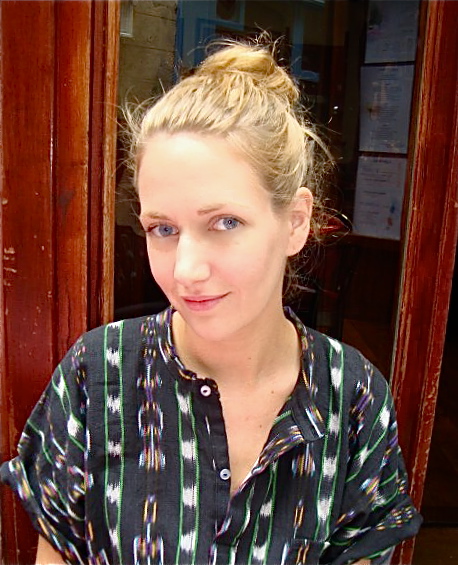
lauri_2011Lauri Hopkins (b.1984) is a British Abstract Artist, living and working in Chichester in the UK.

Her work crosses disciplines but primarily involves painting, collage and the re-assembling of defunct materials. Inspiration is often drawn from music, mid-century Architecture and Design, the history of Abstract Art, objects that have fallen out of use and childhood memories.

Lauri has exhibited internationally since completing a BA in Fine Art from The University of Chichester in 2012. Her work has been selected for numerous National Art Competitions and has appeared in shows across the UK, Europe and the US. She has won awards for Best Exhibitor at Palace Art Fair, exhibited alongside artists such as Sean Scully, Luke Frost, Warren Isensee, Anna Kunz and Julie Torres. Avenir Magazine recently described her work as “timeless, elegant and unspeakably mesmerising”, citing Lauri as “one of the young rising stars of the contemporary art world”.

Lauri_studio_1

The Studio

http://laurihopkins.com/

All images copyright of the artist and used with their permission.


Posted in Uncategorized | Tagged , , , , | Leave a comment