Chris Lampton, Jr – Milwaukee, Wisconsin

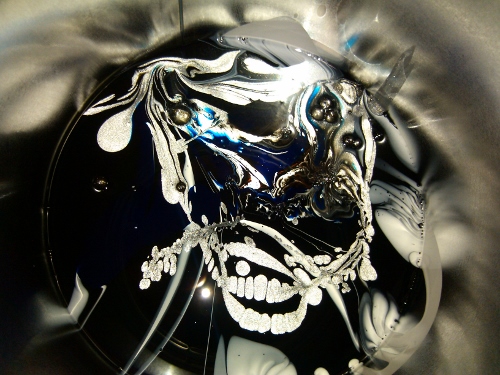
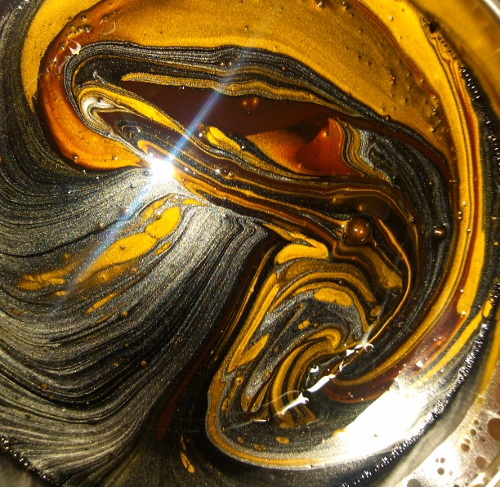
the snake (500x487) 415

the snake

Briefly describe the work you do.

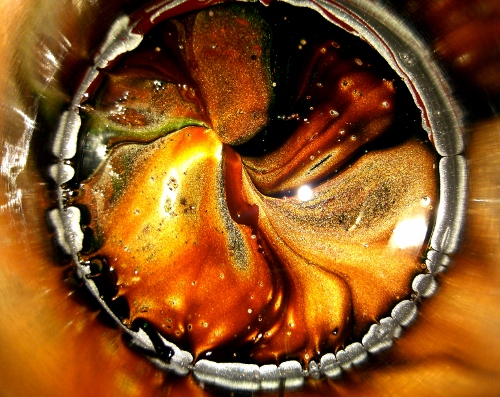
On the surface, and simply put, what I do is mix auto paint and take pictures of the paint as it begins to blend. Over the years, I have learned that paint had different densities. Once I learned this, I learned how to manipulate the paint, just like a coffee barista After a couple years and a lot of trial and error, I found the perfect way to take the picture. And then I had to find the perfect photo paper.

When you physically see the photographs, you will not believe your eyes on how deep and vibrant they look and the prints are not photo shopped or tampered with in anyway, except cropping.

Art is in the eye of the beholder. There are many different images one can perceive in each print. WHATS YOURS?

One day, I started taking pictures of the paint. People were laughing at me, rolling their eyes, saying I was wasting my time. Well I didn’t think so, because, like you said, art is in the eye of the beholder. People weren’t able to see what I was seeing yet. My work is like an ink-blot test. There is no wrong or right perception, what you see and what you believe it that it is, it is. And each print is individually unique, due to the fact that each pour is different and can NEVER be recreated.

pirate

pirate

Tell us a little about your background and how that influences you as an artist.

I have been in the automotive paint industry for 33 years, mixing colors for cars and painting cars. As I poured I started seeing things take shape in the cans, so I learned how to manipulate the paint and make designs.

Describe your studio practice and how it differs from (or is the same as) traditional notions of “being in the studio.”

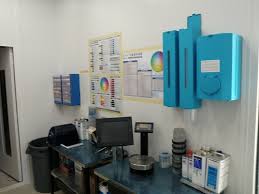
The concept of the “artist studio” has a broad range of meanings, especially in contemporary practice. The idea of the artist toiling away alone in a room may not necessarily reflect what many artists do from day to day anymore. My studio is my mix/paint room or any shop that I have to go to show people how to mix paint. When I start mixing I pull out my camera and start snapping pictures. I love pouring because you never know what you’re going to get until you begin to pour.

What unique roles do you see yourself as the artist playing that you may not have envisioned yourself in when you first started making art?

I never envisioned myself as an artist. I thought I was just doing my job and having fun drawing in paint and smelling it lol, until one day someone had called me an artist (I just laughed and said ok) but then it hit me, I am an artist. Now I find myself looking at everything in everyday life as art. Even the sky and clouds.

When do you find is the best time of day to make art? Do you have time set aside every day, every week or do you just work whenever you can?

Every day I wake up, I don’t know what’s in store for me. Some days I can mix 30 paints some days I won’t mix any. I never have a set time, it just happens when it happens, sometimes out of them 30 pours I won’t get anything you just never know how the paint will treat you that day..

solar ejecta

solar ejecta

How has your work changed in the last five years? How is it the same?

Throughout the course of time, I have seen my work change drastically. I look at my first pours and cringe, because I had yet to find the way to perfect the picture taking process and to be able to show others what I was seeing. And of course, the paper used to print it out makes so much of a difference. Without the proper printing, it can look dull and lackluster.

Are there people such as family, friends, writers, philosophers or even pop icons that have had an impact on the work you do?

I have been supported very much by my entire family (including cousins). They are the ones that have convinced me that I am an artist and I should start acting like one, look beyond the normal realm of “me” and create and sell my work. I love doing this, if I could just give these away I would. Without all of my family I wouldn’t be where I am today. THANK YOU FAMILY, I LOVE YOU ALL.

If you had an occupation outside of being an artist, what would that be and why?

My occupation is what started all of this. I am still working in the automotive industry, going throughout the Midwest, showing people how to mix paint and paint cars. I hope to someday travel solely for my art, possibly open my own gallery someday. Keep your eyes peeled soon you will see CHEMICAL BARISTA EVERYWHERE……..

About

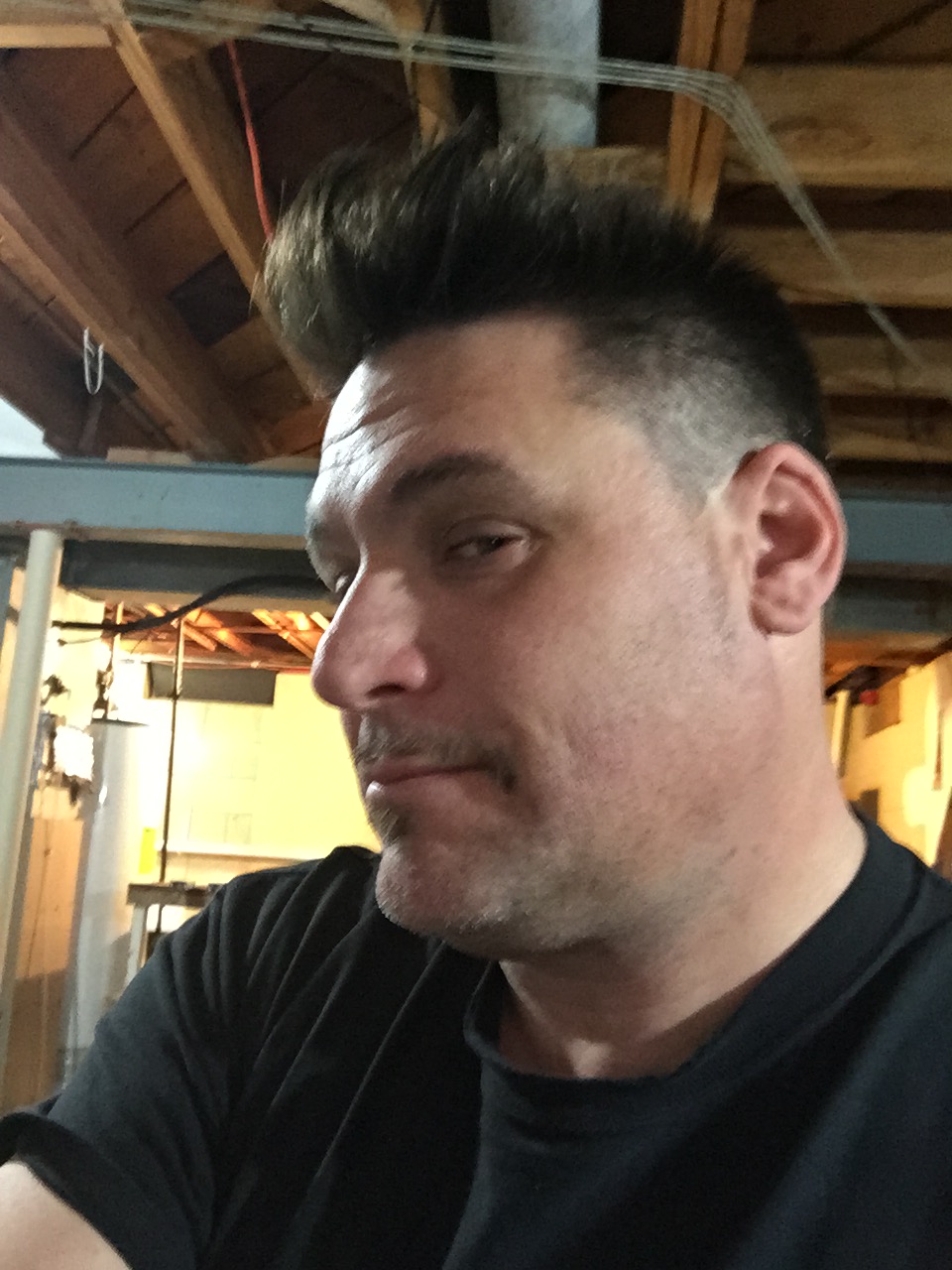
nov 2014Chris Lampton Jr aka Chemical Barista was born and raised in South Milwaukee WI. While he was a teenager he was a participant at South Milwaukee High School until 1989 where he majored in study hall and in school suspensions, as Chris was majoring in in school suspensions he minored in comedy securing even yet more in school suspensions.

The studio

The studio

facebook.com/chemical barista

All images copyright of the artist and used with their permission.   

Posted in Photography | Tagged , , , | Leave a comment

Venetia Norris – London, United Kingdom

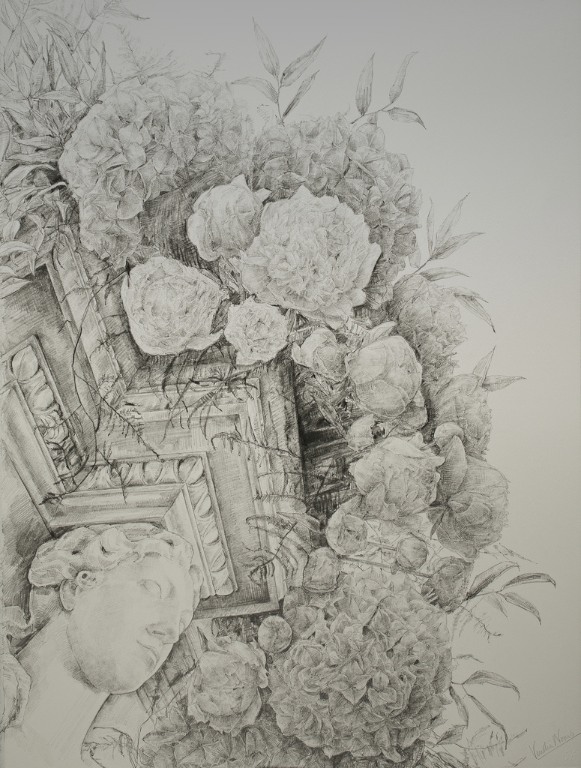
Drawing inspired by Adam fireplace 2, Croome Court, Pencil on paper, 76 x 57cm, 2012

Drawing inspired by Adam fireplace 2, Croome Court, Pencil on paper, 76 x 57cm, 2012

Briefly describe the work you do.

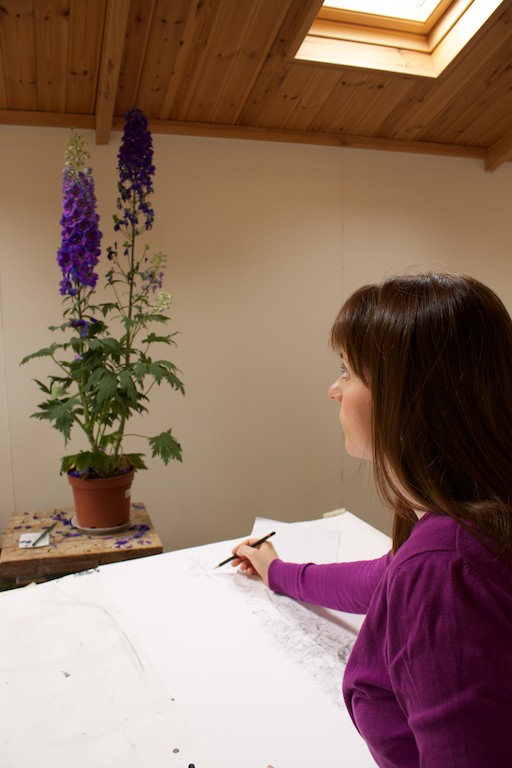
I create drawings inspired by nature.  I love using graphite, pen, ink, paint, charcoal and gouache to create marks on a surface.  I am fascinated by the natural world – the dramatic curve of a stem, a collection of petals or lush leaves compel me to pick up a pencil.

Tell us a little about your background and how that influences you as an artist.

I was born in England and spent my childhood in the country a few hours south of London.  I grew up in an artistic family, my father is a sculptor and my grandparents were architects.  I have a clear memory of my father taking me to see a big exhibition at the National Gallery as a young child and finding the preliminary sketches far more exciting than the finished paintings.  They harnessed a raw energy, liveliness and expression that only a line can convey.  This had a profound impact upon me.  My love of drawing has been a thread throughout my life and I only feel that I fully understand something if I have drawn it.  I am fascinated by the process of making a mark, the sound of a pencil on paper, building up layers of lines, the connection between myself and the subject and view it as a sculptural process on paper.

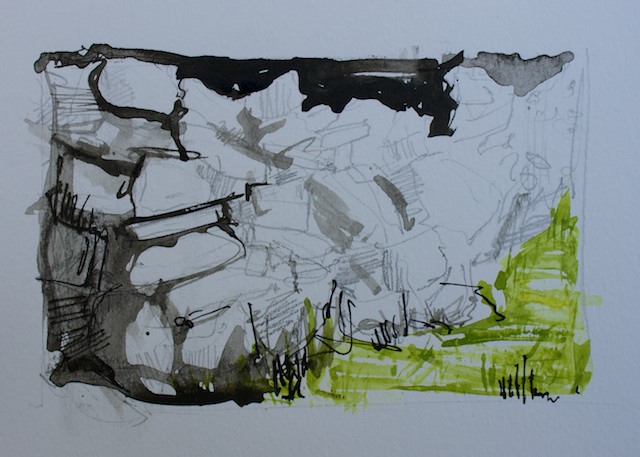
Movement 2,  Mixed Media:  pencil, ink & gouache on paper, artwork 8x12cm, paper 13x18cm, 2014

Movement 2, Mixed Media: pencil, ink & gouache on paper, artwork 8x12cm, paper 13x18cm, 2014

The concept of the “artist studio” has a broad range of meanings, especially in contemporary practice. The idea of the artist toiling away alone in a room may not necessarily reflect what many artists do from day to day anymore. Describe your studio practice and how it differs from (or is the same as) traditional notions of “being in the studio.

My studio is located at the end of a London garden.  Time away on a recent Fellowship with Ballinglen Arts in Ireland inspired me to take my studio outside.  Drawing in the open air, hearing the wind rage through the plants and seeing the movement of the grasses helped me to free up my work.  No longer was I drawing a still life and I could not approach my work in exactly the same way.  I feel less chained to my studio.  I have been drawing flower stalls and markets across London.

What unique roles do you see yourself as the artist playing that you may not have envisioned yourself in when you first started making art?

I think being an artist today encompasses so much more than simply creating artwork.  I never expected to attend lectures on networking, social media, how to write an application or bookkeeping.  Creating your own opportunities as well as applying for existing ones takes a lot of time.  I never thought I would teach art but I really enjoy it.  Recently I ran a Big Draw event at Clifton Nursery, London where over a hundred members of the local community created a collaborative drawing.   

When do you find is the best time of day to make art? Do you have time set aside every day, every week or do you just work whenever you can? 

I am most productive in the morning.  I enjoy the feeling of having the whole the day in front of me.  A bit of pressure and a deadline helps to keep me focused.  I try to work on my computer in the afternoon/evening.

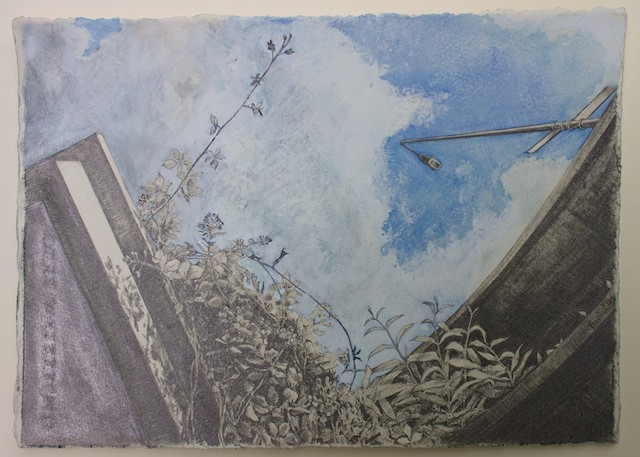
Putney Bridge 2, Mixed media, Image size 22x31cm, Framed size 34.2x42.2cm, 2014

Putney Bridge 2, Mixed media, Image size 22x31cm, Framed size 34.2×42.2cm, 2014

How has your work changed in the last five years? How is it the same?

Five years ago I think I was set in my ways.  I now feel more realistic, open to external factors and willing to experiment.  My fascination with nature continues. The context of the subject interests me.  For example, at Covent Garden Flower Market the flowers are in boxes, carefully wrapped and look completely different.  I am slowly introducing colour into my work but I find this challenging because I love graphite drawings.

Are there people such as family, friends, writers, philosophers or even pop icons that have had an impact on the work you do?

I am constantly inspired by numerous sources.  I have been looking at Leonardo da Vinci’s notebooks and find the colours of the faded ink marks interesting.  I heard one of my favourite artists Bridget Riley give a talk a few years ago at Freeze.  I was interested to learn that observational drawing continues to be the foundation of her work.  I like going to lectures at the Royal Geographic Society.  I was fascinated to see photographs of frozen grass that Tim Cope shared during a lecture on his adventure across Mongolia.

If you had an occupation outside of being an artist, what would that be and why?

Landscape architecture because I have a natural feeling for the soil and the sculptural quality of being able to form the landscape appeals to me.

About

Venetia Norris 1Venetia Norris, b. 1981.  After leaving school I studied art in Florence, Italy at the British Institute (1999) before completing a foundation year at Chelsea College of Art (2000), then graduated with two Bachelor of Arts’ degrees from the London College of Fashion (2003) and Sir John Cass Art School (2009).  I remain fascinated by the process of making a mark and create mixed media drawings inspired by nature.  My work has been exhibited in many group shows including the Affordable Art Fair (2010) and in Christies, London (2013).  To date I have had four solo shows, the most recent was held at National Trust’s Fenton House, Hampstead (2012).  I was awarded an Artist Fellowship with the Ballinglen Arts Foundation, Ireland (2014 & 2016) and an Artist Residency at the Tyrone Guthrie Centre, Ireland (2015).  I live and work in South West London.  My studio is located at the end of a long, narrow garden that provides escapism from my urban surroundings.  

Venetia Norris 5

venetianorris.com

All images copyright of the artist and used with their permission.  

Posted in Drawing, mixed media | Tagged , , , , | Leave a comment

2014 Artist Spotlight – Lisa Vinebaum

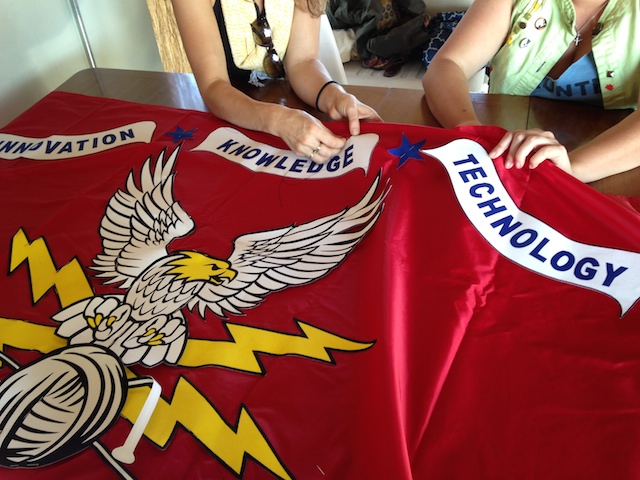
"CAPRA flag" Sewing workshop, 2013

“CAPRA flag”
Sewing workshop, 2013

Have there been new developments in your work since your 365 interview?

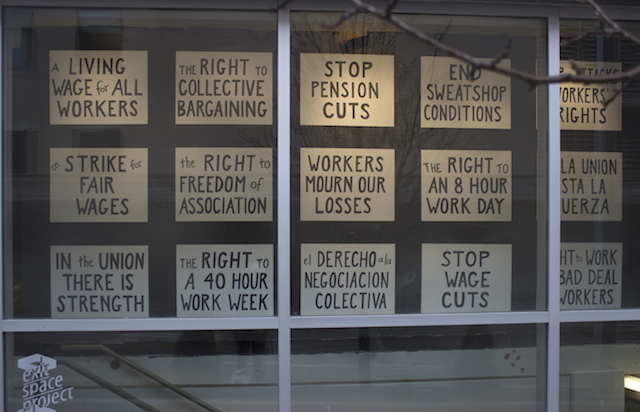
I’ve had two opportunities to exhibit the performance placards I’ve been making and using in New Demands? which is an ongoing series of public walking performances exploring historical and contemporary working conditions. The placards are all hand made and they reproduce or adapt historical slogans used by workers in their struggles for better working conditions. So for example, I made placards calling for the right to collective bargaining, for a regulated 40 hour work week, for an end to sweatshop conditions, and for pensions and benefits. All the slogans are still very relevant today despite the fact that some of them come from actions waged over 100 years ago. Fifteen placards in total were exhibited at the Urban Institute for Contemporary Art in Grand Rapids, Michigan, and at the Center for Labor Generosity and Uniforms in Long Beach, California. Some had been used in performances, some had to be recreated (my performance placards are often ruined by weather), and some were newly made based on additional research I’ve been doing. It was very interesting to see them exhibited as performance ephemera of sorts… and to see them all together, operating very much as a larger message or warning about contemporary labor, as opposed to being deployed one at a time.

In my last interview I talked about creating cloth banners, and I have since made a couple of prototypes that I’m hoping to finalize and exhibit this year. I’m also developing a funding proposal to help support a future performance involving more participants. I have some research funding to travel to the International Ladies Garment Workers Union archives at Cornell, where I hope to see some actual banners from the early 20th century.

Something that the 365 Artists project has us thinking about is the power of collaboration. Are you involved in any projects with other artists or within your community?

Collaboration is becoming more important to me, and I’ve also been thinking a lot about community. I tend to do a lot of solo work, especially writing (which can be really isolating, it’s not like you can easily have someone come in for a studio visit), and I’m really grateful to have a community of colleagues and peers that I can talk to when it comes to figuring out problems or challenges in teaching, in the studio, or in stuff that I’m writing.

"New Demands?" Performance placards at Exit Space, Urban Institute of Contemporary Art, Grand Rapids MI, 2014

“New Demands?”
Performance placards at Exit Space, Urban Institute of Contemporary Art, Grand Rapids MI, 2014

In terms of collaboration, it takes many forms in my practice. Right now I’m working on a collaborative editing project with a friend and colleague in Canada, we’re editing a journal issue that looks at collaboration and participation in projects that bridge fiber and social practices — very appropriate subject matter. As part of that project we’re collaborating with other artists and writers across the US and Canada. We’re in the initial stages of mapping out a book proposal, and we co-Chaired a conference panel last year for CAA. I do a lot of writing that’s partly collaborative — I say “partly” because the writing is ultimately up to me, but I don’t feel comfortable writing about other artists’ work without having ongoing conversations about their work, getting their input on the direction of the text, having them read it before it goes to publication, etc. I’m not into being a detached “critic” in that sense, it’s much more important for me to have insight into the artist’s ideas, motivations, concepts, etc. So maybe it’s not the most traditional kind of collaboration. I also tend to write about artists’ work in a fairly focused way —starting out with a conference paper or shorter essay, and then developing it into a longer book chapter or catalog essay. Which also means having more extended and in-depth conversations with the people whose work I write about over time. I’ve become friends with many artists I’ve written about, so those connections have become more ongoing as well. Because I write about and teach classes on collaboration it’s important to also enact that knowledge, creating real life community and support systems. I teach a social practice class and each year the class collaborates locally to do a participatory project — in 2013 we collaborated with the Chicago Torture Justice Memorials, and this semester we’ll be collaborating with other SAIC students and faculty on issues of adjunct faculty labor, student debt and working conditions for emerging artists.

What advice can you give to those who are just starting out in the arts? What do you wish you would have known when you set out on this path?

Always have a good community of people around you, even if it’s just a small number of people you can really trust. Make sure to have real, in-person connections and conversations. Also, don’t compare yourself to other people or to other people’s accomplishments. Be generous when you have success, and try to make time for people. Shannon Stratton of Threewalls Gallery wrote a wonderful piece that everyone should read: http://www.chicagoartistsresource.org/articles/little-things?20Little+Things

As for the second part of the question, I’m not sure that there’s anything I wish I’d have known. When I was doing my PhD I spent a lot of time stressing out about my future career and worrying about things beyond my control. I could have used that time on my own work. So I guess I wish I had known that I’d actually end up getting a job.

Are there any upcoming shows or projects that you would like to talk about?

Since last year, I wrote two book chapters and a catalog essay, and they are all due to be published in 2015. I’m finishing up co-editing a journal issue with a colleague and that should also be out this year. I’m working on developing those banners, and in the very early stages of co-editing a book with a colleague of mine. I’m also doing some research for another book chapter that I have to finish over the summer. And I have work in a show at the Portland Museum of Contemporary Craft next fall.

Read Lisa Vinebaums 365artists365days interview here.

Posted in Performance, Uncategorized | Leave a comment

Brittney Williams – Chicago Illinois

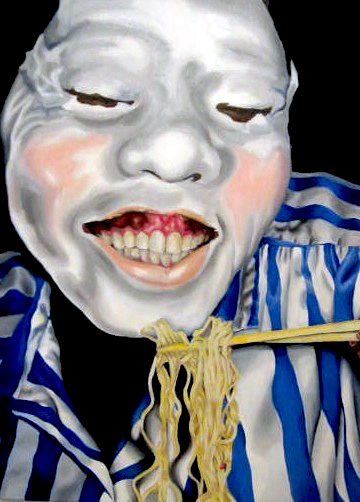
Noodles Oil Paint on Canvas 30 x 40 2011

Noodles, Oil Paint on Canvas,         30 x 40, 2011

Briefly describe the work you do.

In my work, I’m interested in addressing the various aspects of identity—race, gender, and spirituality. I am driven by personal self-exploration, balanced with who I am in relation to my surroundings. Delving into the nuances of my identity causes a constant cycle of observing this internal and external relationship. My work embodies these ideas and observations. 

Tell us a little about your background and how that influences you as an artist.

I was born and raised in an African American  household in Los Angeles, California. Due to my mother’s strong urging, I ended up attending a Chinese school in Alhambra, California for my educational upbringing. I was constantly challenged with emotions of being the “other” or “outsider” and had interesting outlooks on attraction and beauty because of my schooling. I adopted many culturally Chinese traditions and followed a great deal of Chinese pop culture. This, I believe, was a major influence in my personal paradigm of the world. Being completely immersed in a different culture, while coming home to the dynamic of my family, created an internal dialogue about identity and bred a love for racial liaisons. Since those elementary years and still to this day, I have been very concerned with ideas about identity, while finding myself migrating from one culture dynamic to the next with great ease and an incredible ability to have cultural exchanges. I love seeing one cultural dynamic sustain its richness. Observing and even experiencing the pride, traditions, and rituals within a culture enraptures me. On the other hand, due to passion, leading and facilitating eye -opening dialogue on how to receive or even perceive other cultural dynamics is a daily occurrence. Reflecting back, I see how  my elementary years truly formed the foundation of a great deal of my work, and built a love for the identity of an individual.

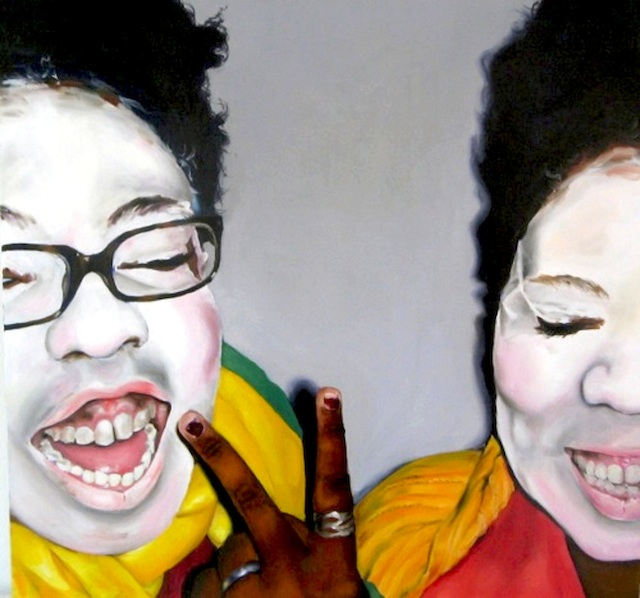
Peace Signs and Smiles, Oil Paint on Canvas, 30 x 30, 2011

Peace Signs and Smiles, Oil Paint on Canvas, 30 x 30, 2011

The concept of the “artist studio” has a broad range of meanings, especially in contemporary practice. The idea of the artist toiling away alone in a room may not necessarily reflect what many artists do from day to day anymore. Describe your studio practice and how it differs from (or is the same as) traditional notions of “being in the studio.”

My studio is rooted within my home. I live with two other artists, and we have made our studio a major part of our home. Our house is filled with materials strewn over desk tops, photography gear tucked under chairs, and canvases tilted against hallway walls and base boards. To say the least, our studio is a welcome space for creativity. But what truly invites me to sit and paint is the sense of community. I’m extremely community driven. Though I have yet to see great examples of a social studio space, I am in the process of spearheading what my studio practice looks like to me. The days filled with  a roommate working at her desk editing photos  the other tucked in a corner on the floor working with fibers, while Beyonce competes with the three of us laughing, are the best days. I know there are dynamics to that electric and lively atmosphere that motivates my art making. The laughter leads to deep conversations of relativism or feminism and almost always a much needed critique, all of which, are refining. Literally, are studio often becomes conceptual painting parties.  When socializing, painting flows with ease, and art-making seems incredibly enriching and freeing, rather than taxing or even task- driven. As I continue to develop and mature in my art- making, it is integral  I develop and mature in social aspects within my studio space or my artwork will suffer. 

What unique roles do you see yourself as the artist playing that you may not have envisioned yourself in when you first started making art?

I never envisioned myself as an artist that would have a foot in commercialism as well as conceptual art. Attending an art college set me up for the insane idea that I would “just make it”. 

That nebulous idea, held so much weight to me, and haunted me for a good two years after college. . “To make it” meant to make it my way without any compromise and any hard work. My idea of success was that it would just happen to me. 

But now, as a full-time freelance artist, it’s a requirement that I create work for the client, while still creating work within my studio that is fully inspired by me. My job is rooted in giving what the client wants. Some projects go against my paradigm or ideology, and other projects seem so far from the richness of making work to address identity, etc. But, it has struck me that freelance is an entitlement, and if I  can adopt the challenge of making work within limits and boxes that still look aesthetically valuable, I get the privilege of evolving. The safety of a style or personal idea can be a silent strangler.  Instead of being repulsed by the opportunity, I’ve come to harmonize with freelance endeavors. With that in mind, I feel very privileged to call freelance art my occupation, and hold no regret in the duality of my work. 

When do you find is the best time of day to make art? Do you have time set aside every day, every week or do you just work whenever you can?

I feel very much inspired in evenings and into the late night. Because I am a freelance artist, I have been more disciplined in working throughout the day, but my tendency is to work in the evenings.

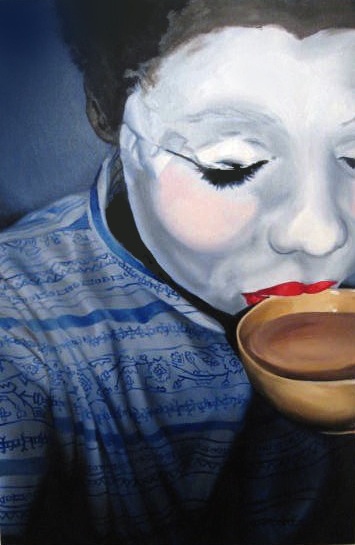
Tape and Tea, Oil Paint on Canvas, 24 x 36, 2011

Tape and Tea, Oil Paint on Canvas, 24 x 36, 2011

How has your work changed in the last five years? How is it the same?

My work has evolved, along with my self-exploration. My priority in my earlier work was solely addressing race. I would say it was slightly obsessive. In this current series of work being developed in my studio, I am addressing spirituality. Inspired by a difficult and existential period of life, I began the series as a means of having visual documentation of my spiritual inquires. The paintings act as abstract prayers, mournings, and spiritual encounters in two dimensional forms. While these paintings are new territory for my studio practice, in a linear fashion, all my works are self-portraits or some sort of self-reflection. I’ve always been inspired by the compartmentalized pieces that make me—me. The tug of war with spirituality is currently my muse.

Are there people such as family, friends, writers, philosophers or even pop icons that have had an impact on the work you do?

When first developing my love for aesthetics, I was enraptured by Monet’s lilies. I remember the gestural mark making and the reflective water was so breathtaking to me. As a nine year old girl, I would continuously scan over large, heavy Monet books purchased by my mother as Christmas presents. His lilies and haystacks moved me with their color and composition. But, as concept began to hold as much weight as aesthetics, I fell in love with Iona Rozeal Brown and Kara Walker. Connecting with their forms of visual exploration, both women, gave me permission to be provocative and dramatic. I then attended a show opening of Cindy Sherman which was key to my work. Sherman birthed the desire to use my body as a vulnerable vessel. My body, face, hands, and hair became all so very accessible and controllable. Since that inspirational revelation, my form shows up in a great deal of my work. 

HeadshotIf you had an occupation outside of being an artist, what would that be and why?

Growing up in a social justice-driven home, I believe “helper”is written into my DNA. My father was incarcerated at an early age, which loomed as a dark cloud over the duration of his life. 

Towards the end of his life, he became very involved in a half-way house helping parolees adjust back to everyday life. My mother, my hero in many ways, got a Masters in Gerontology and continues to run after hope for the elderly within housing avenues. As a little girl, stories of bringing home homeless men, feeding the elderly for Thanksgiving, and hugging tatted and pierced parolees run through my veins. These stories and memories are grafted into my being and I find myself drifting to want to be a helper. Advocacy and activism inspire and compel me. I don’t believe art and advocacy are mutually exclusive, but if art wasn’t my occupation, I would be some sort of helper to people experiencing oppression.

About

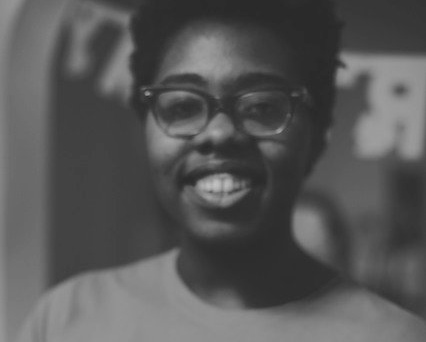
Originally from Los Angeles California, Brittney Leeanne Williams is now a Chicago-based studio artist. Her work addresses identity. Confronting her personal identity as well as humanities identity, she uses various mediums and platforms in search of answers. Charged by unresolved questions, Williams seeks some sort of balm for these overwhelming issues rooted within the lack of not knowing ones self. Her works dialogue with ideas of Blackness, femininity, and spirituality. 

brittneyleeannewilliams.com

All images copyright of the artist and used with their permission.  


Posted in Painting | Tagged , , , , | Leave a comment

Devin Balara – Knoxville, Tennessee

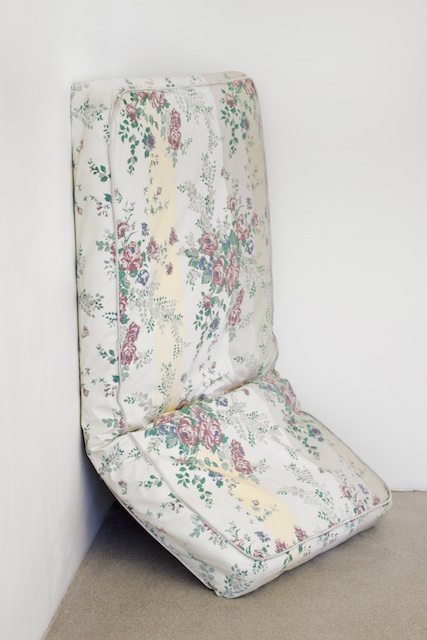
Title: Never Stop Improving Medium: mattress, latex paint in 6 most popular shades of optical white sold at Lowes Size: 6' x 4' x 1' Date: 2014

Title: Never Stop Improving
Medium: mattress, latex paint in 6 most popular shades of optical white sold at Lowes
Size: 6′ x 4′ x 1′
Date: 2014

 Briefly describe the work you do.

My work is mixed-media, sculpturally-minded and is inspired by everyday indicators of humankind’s deeply humorous tendency toward sameness. Lately, the word of the day has been “domestication”, thinking in terms of landscapes, spaces, objects etc. as things to be trained or reformed to fit a certain standard or taste. Currently in my material arsenal: lots of fake nature, remnants from home improvements, art that’s already done for me (compositions of bushes in grassy medians) and really good pens.

Tell us a little about your background and how that influences you as an artist.

I am an only child who had a large amount of time alone with my imagination. I’d do ridiculous things – the weirdest perhaps was the stretch of time where every day after school I’d rollerblade around the parking lot of my mom’s workplace collecting the license plate, make, model and color of every car parked there. I had a meticulous log of this, but never could keep up a diary. I won’t try to unpack that too much. Anyway, I was a weird kid growing up in the suburbs in Florida, and have always been involved in creative pursuits. I played in the band, was a dancer, always illustrated the posters for class projects, but never got formally involved in visual art until freshman year at the University of North Florida. I was so lucky I fell into a great group of amazing creative, collaborative friends, fellow weirdos, and the momentum from those days hasn’t ceased.

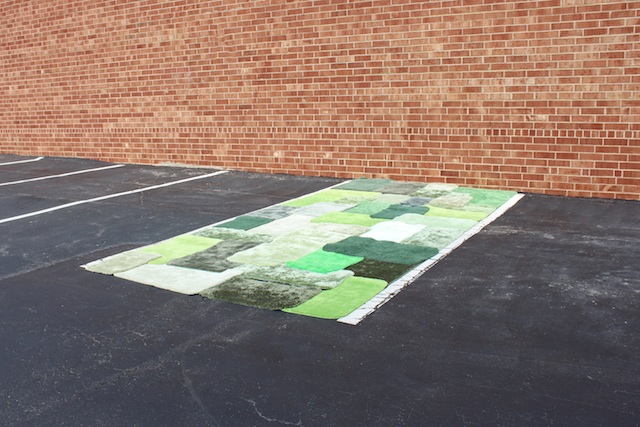
Title: Greening Medium: $1000 worth of green rugs, purchased, installed, documented, returned, refunded Size: Variable Dimensions Date: 2014

Title: Greening
Medium: $1000 worth of green rugs, purchased, installed, documented, returned, refunded
Size: Variable Dimensions
Date: 2014

The concept of the “artist studio” has a broad range of meanings, especially in contemporary practice. The idea of the artist toiling away alone in a room may not necessarily reflect what many artists do from day to day anymore. Describe your studio practice and how it differs from (or is the same as) traditional notions of “being in the studio.

I am currently working on establishing a studio with two fellow artists in my fairly new home of Knoxville, TN. Currently the only toiling has been with drywall, lighting and other logistics, which is still great fun. It has been interesting, though, in the past months of not having a studio, seeing where my “practice” ends up happening (i.e. making things that I can make sitting in bed watching movies.) I can answer this question with my reason for wanting a studio space to begin with and that is to have a place to store things, compose things, and most of all to LOOK at those things. This is essential to me because I work best when I can collage in a blank space with a combination of found and fabricated objects. I need a space just for them to exist against a nice white wall and be tinkered with at a moment’s notice. I’m also thrilled about the dynamic of sharing the space with two artists that I like and admire (see next question.)

What unique roles do you see yourself as the artist playing that you may not have envisioned yourself in when you first started making art?

I have become very dedicated to the idea of being a facilitator of the vision of fellow artists. This manifests in a variety of ways including education, assistantships, curatorial projects, collaboration, but especially through pure communication and just being a willing ear/eye to artists in my community. I’ve been adamantly learning about various models for an individual artist practice and found that I personally really thrive in a community of constant exchange – of ideas, tools, materials, books, opportunities, etc. I got into art because of the compulsion to create things and self-examine, but, looking back now I can see that I have stayed for the people and for the challenge of nourishing our common goals.

When do you find is the best time of day to make art? Do you have time set aside every day, every week or do you just work whenever you can? 

 I absolutely work best at night. There’s definitely a romantic aura about pushing yourself through the sleepiness in addition to the heightened sense of isolation. But it could just be that I’m not a morning person. Post-graduate school, I’m still feeling out my ideal working style. I can definitely say that I feel any free moment in the day is best spent working – though I’m also still figuring out what “work” means. It’s a lot of reading, looking, wandering around, paying attention. The formal work tends to come in bursts when I know I have a good stretch of time to focus. I like to think that artists are always on, always working in some way.

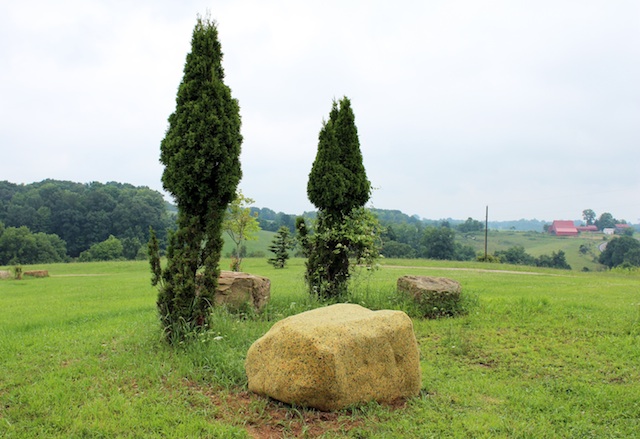
Title: Soft Rock Medium: boulder, custom slip cover made from carpet padding foam taken out of adjacent house Size: 3' x 3' x 3' Date: 2014

Title: Soft Rock
Medium: boulder, custom slip cover made from carpet padding foam taken out of adjacent house
Size: 3′ x 3′ x 3′
Date: 2014

How has your work changed in the last five years? How is it the same?

My work has proven to be very adaptable which is reassuring considering the many different circumstances I’ve encountered both within and without academia. I have made work that is highly dependent on space and funds and then there is the work I made with the green rugs (buying them from big-box stores, installing and documenting them and then returning them) when I had no studio or money at all. So I can say that a constant thread in my work has been the need for it to happen. Somehow. I can endure the most tedious of processes to make it real and often my ideas are born of such obstacles. Formally, all of my work is linked by very repetitive elements or processes. I work best when I create my own media – that is when I make a large amount of something from some raw material and only when I have a large pile do I think of a response. The compulsion to be almost maniacally engulfed in a process is something that I imagine will stay the same while I always welcome a change in environment/circumstance as inspiration.

Are there people such as family, friends, writers, philosophers or even pop icons that have had an impact on the work you do?

I am a genuine fan of so many of my friends and mentors working in all corners of the visual arts. They such are hard-working smart and silly people. My family has been extremely supportive, as well,  by always asking the best questions. I’m inspired by artists who have multi-faceted practices as writers, activists, educators, curators, etc. Books and films are always around. Right now I’m reading Rebecca Solnit, George Saunders, David Robbins and absolutely devouring every laugh I can get my hands on, most of which are provided by my number one hero, Tig Notaro.

If you had an occupation outside of being an artist, what would that be and why?

I have fantasized that the ideal use for my steady hands, good vision and strong capacity for tedium would make me a great surgeon. But I also have to wonder if my brain could have handled everything you have to go through to get to the point with a scalpel in your hand. I wonder if a surgeon has ever thought to call on an artist to make a particularly delicate incision. I’d give it a shot.  

About

DBalara HeadshotDevin Balara (b. 1988) hails proudly from the aggressively pastel suburbs of Tampa, FL. She received a BFA in sculpture from the University of North Florida in Jacksonville, FL and an MFA in sculpture from Indiana University in Bloomington, IN. She is a recipient of the 2014 Outstanding Student Achievement in Contemporary Sculpture Award, a full fellowship to the Vermont Studio Center residency program, a residency at 8550 Ohio, and a curatorial assistantship at Elsewhere Museum in Greensboro, NC. Recent exhibitions include Grounds for Sculpture (NJ), MOCA Jacksonville (FL), Manifest Gallery (OH), Public Space One (IA) and the Indianapolis Art Center (IN). Devin currently works as the 3D Shop Technician at the University of Tennessee in Knoxville, TN. 

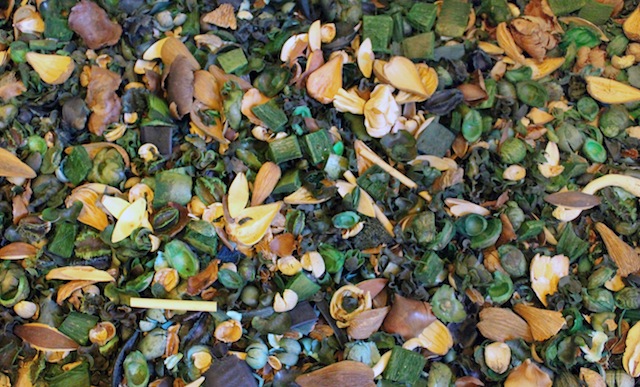
Title: Nature Calls Medium: ocean breeze and forest fresh potpourri, bathtub Size: 6' x 3' x 3' Date: 2014

Title: Nature Calls
Medium: ocean breeze and forest fresh potpourri, bathtub
Size: 6′ x 3′ x 3′
Date: 2014

www.devinbalara.com

All images copyright of the artist and used with their permission.  

Posted in Sculpture | Tagged , , , , | Leave a comment

Mikey Kettinger – Logan, Utah

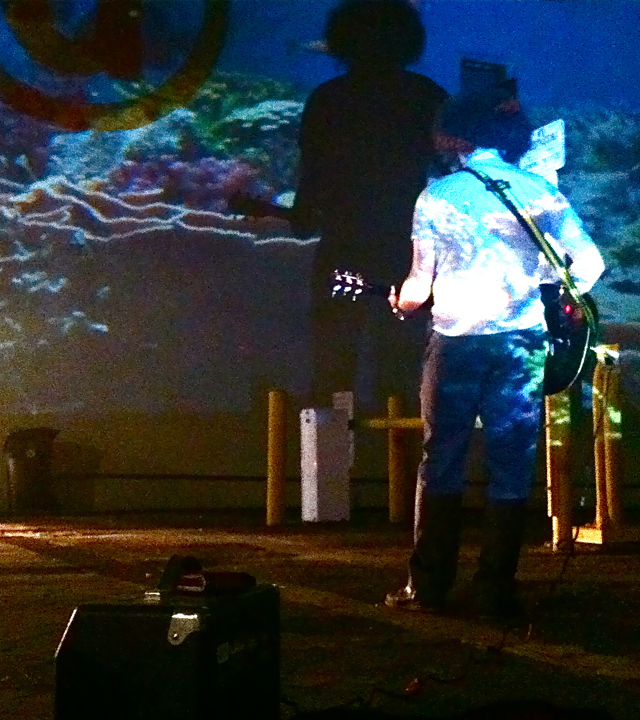
Text Message Generation Video and Sound Performance, 2014

Text Message Generation Video and Sound Performance, 2014

Briefly describe the work you do.

I work with a range of materials, but I commonly use sound/music, video, and installation to produce socially engaged artworks.  Anytime someone asks, “why is this art?” I smile.

Tell us a little about your background and how that influences you as an artist.

My father’s occupation caused my family to move a few times as a child. This allowed me to learn a lot about the sects of American culture and the relationships of the American people with each other and themselves.  I always found this fascinating, and now I allow that to drive my artistic concepts.

The concept of the “artist studio” has a broad range of meanings, especially in contemporary practice. The idea of the artist toiling away alone in a room may not necessarily reflect what many artists do from day to day anymore. Describe your studio practice and how it differs from (or is the same as) traditional notions of “being in the studio.”

My studio serves as a place where I produce artwork, but it also simply comforts me.  Regardless of the anxiety or trouble in the rest of my life, my studio seems to consistently welcome me and inspire me to do what makes me feel good: make art.

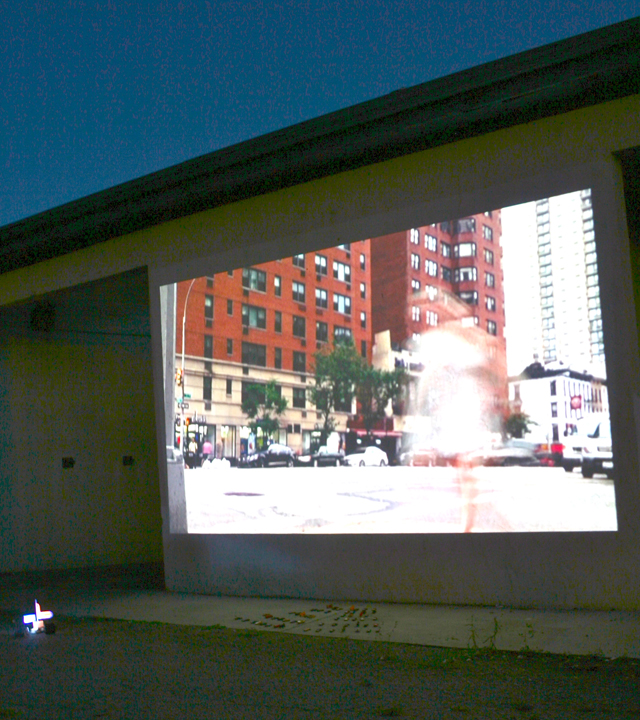
Drive In Video_Installation at Abandonded Car Wash, 2014

Drive In Video_Installation at Abandonded Car Wash, 2014

What unique roles do you see yourself as the artist playing that you may not have envisioned yourself in when you first started making art?

I have deliberately changed my role as an artist because I want to make art that “adds to the conversation rather than simply reiterating what’s already been said.”  My mentor Mark Lee Koven gave me that advice and I revisit it all the time.  I want my art to make people think about how they interact with themselves and those around them, so I research sociology, ethnography, ecology, and socially engaged art.  Ever since I made a conscious decision to stop trying to make art for rich people to buy, I have been so much more excited about my results and potential.

When do you find is the best time of day to make art? Do you have time set aside every day, every week or do you just work whenever you can? 

One of my mottos is “Make art every day”.  I also love Chuck Close’s quote, “Inspiration is for amateurs.  The rest of us show up and get to work.”  I create art every day, whether it’s sketching, practicing guitar, or re-visiting old concepts and projects.  If I don’t do something creative every day I will feel useless.

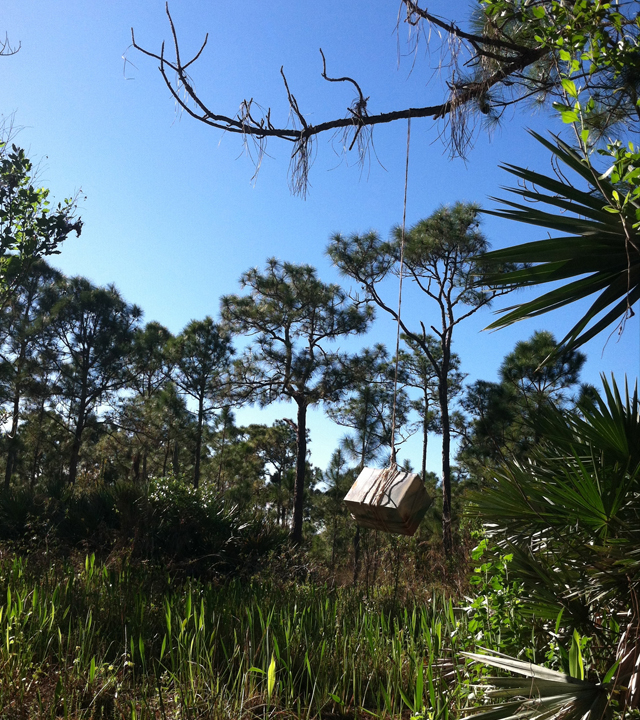
Welcome Home Listen_Hear Box, Repurposed box with sound, 2014

Welcome Home Listen_Hear Box, Repurposed box with sound, 2014

How has your work changed in the last five years? How is it the same?

My work has developed into being experiential and interactive, where it was mostly two dimensional five years ago.  The potential I have to create something fresh through my knowledge of music and visual art excites me much more than the thought of limiting myself to art that is readily recognizable as such.  While I am experimenting with interaction and social practice, I still refer to the elements of art and principles of design, and the themes that exist in my work are similar to my older work.

Are there people such as family, friends, writers, philosophers or even pop icons that have had an impact on the work you do?

Mark Lee Koven is a brilliant teacher who I was fortunate to have at Florida State, and now at Utah State.  He convinced me that my potential is best if I emphasize my unorthodox approach to problem-solving.  

I love stories of unconventional artists finding success, even though they were probably accused of being talent-less by a bunch of idiots.  Harmony Korine, Chris Johanson, and David Choe come to mind.

If you had an occupation outside of being an artist, what would that be and why?

I used to be an elementary and middle school art and P.E. teacher.  I could see myself working at a music venue or studio as an audio engineer.    

About

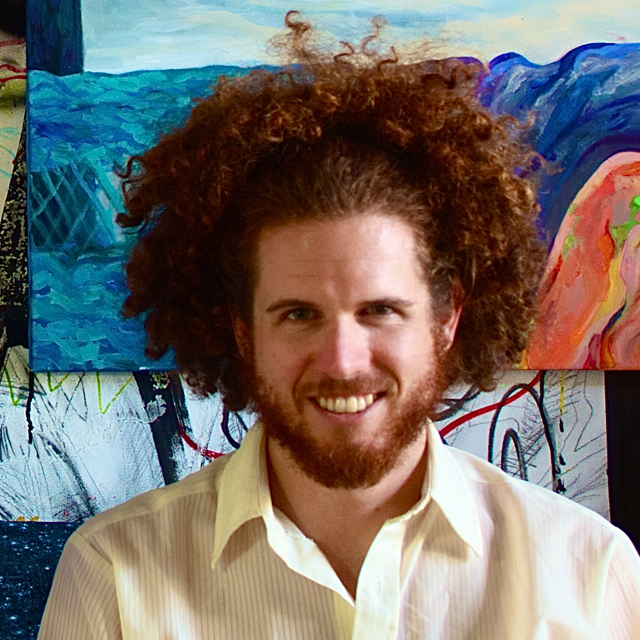
MikeyKettingerHeadshotI am an interdisciplinary artist who emphasizes the creation of experiences over art objects. My life experience has allowed me to travel and live in a wide range of locations, within a variety of cultures.  Born in Miami in 1986, I also lived in Southern California, Chicago, North Carolina, and the border of Florida and Alabama when I was a kid.

My academic background includes credits from the School of the Art Institute of Chicago, University of Denver, and Florida State University.  I am currently pursuing an MFA from Utah State University.

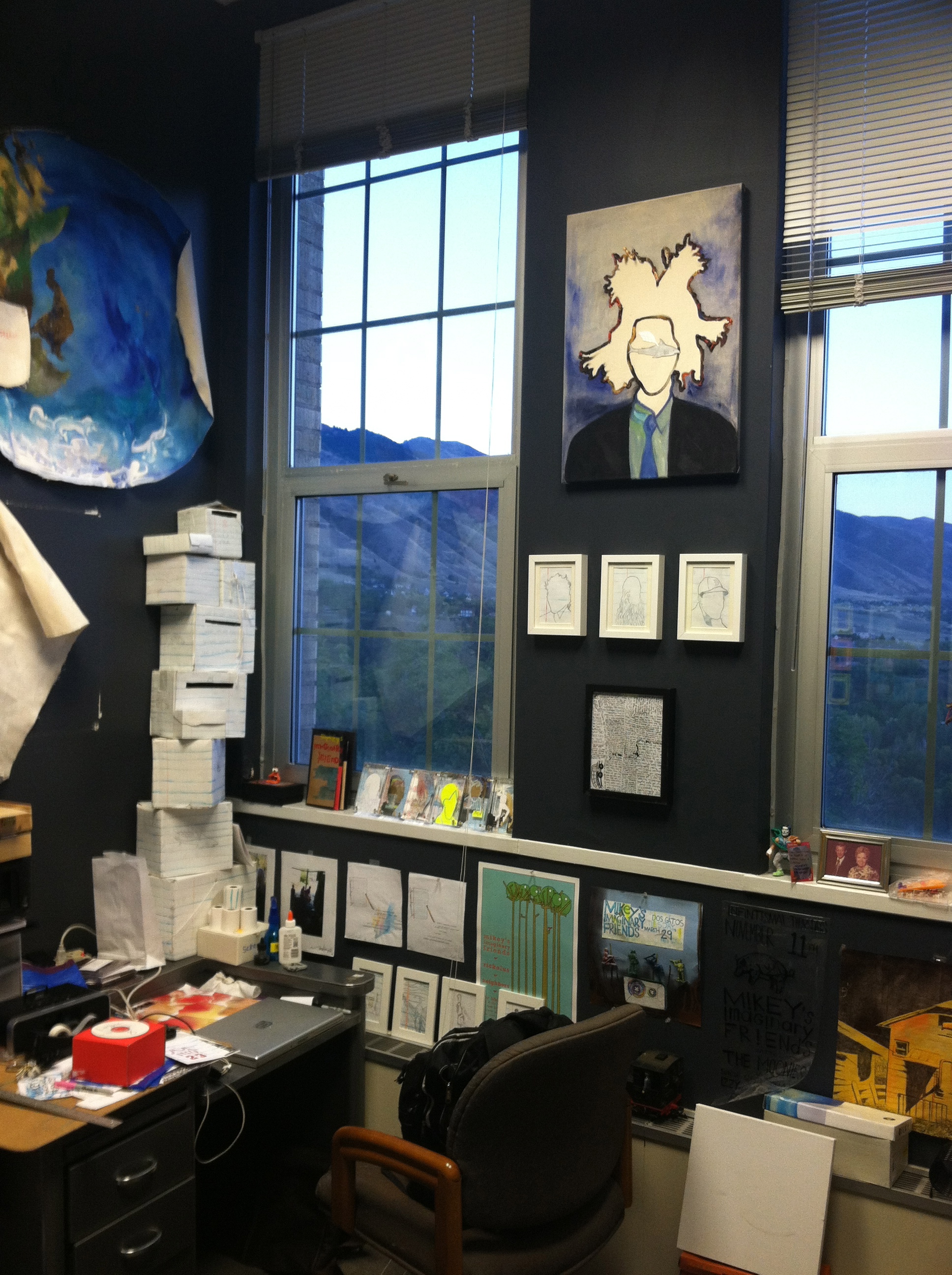
MikeyKettingerStudio

MikeysImaginaryFriends.com

All images copyright of the artist and used with their permission.  


Posted in Video | Tagged , , , , | Leave a comment

Kristin Bauer – Tempe, Arizona

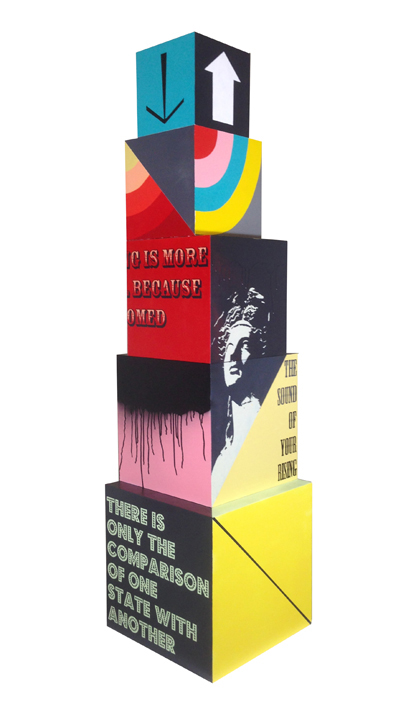
"The Light And The Shadow" acrylic and aerosol on wood 16” x 16” x 58” 2014

“The Light And The Shadow”
acrylic and aerosol on wood
16” x 16” x 58”
2014

Briefly describe the work you do.

My artwork consists of installations, sculptures, paintings and work in other media inspired by the combination of word and image in communication and meaning-making.  More specifically I am influenced by a huge spectrum of fields and interests: psychology, Social Influence Theory, propaganda, modern advertising practices, Classic literature, silent films, pop culture, Renaissance art history, Greco-Roman history, and so on.  This seemingly disconnected slew of influences is sort of mirrored in my work.  I combine numerous references and stylizations that may seem unrelated and assemble them in a manner that threads a loose thematic continuum, forms a dialogue between them.  Bringing these different elements together into a whole is somewhat like composing notes in music.  It feels a lot like writing a poem, especially working on my sculptures or installations.  Each image or text reference functions like a symbol.  How each viewer puts the puzzle of symbols together is where the works breathe and become their own living whole.  Overall, you could say my work is a colorful long-form study of modern communication and meaning-making amidst the poetry of movement in space. 

Tell us a little about your background and how that influences you as an artist.

My background is diverse but all the areas somehow inform the hows, whats and whys in my studio.  I have written poetry since a young age and spent several years recently as a contributing arts writer for several publications and art sites.  Though the nature of how I have approached poetry and arts writing doesn’t relate to the content of the text I choose in my text based art work, I have a strong disposition towards good editing, the placement of words, negative space in composition of text and the importance of rhythm and “what’s missing” in the text realm that relates to my interest in poetry.

Additionally, I have my Masters in Counseling and Art Therapy, which has a direct impact on the content of my work, the combination of word and image in meaning making.  I chose not to move forward with a career in Art Therapy, beyond facilitating workshops and consulting for a couple of years.  Rather, my education and training in cognition, identity, the power of word and image and the formation of the psyche influenced my work as an artist and shifted me into new artistic thematics.

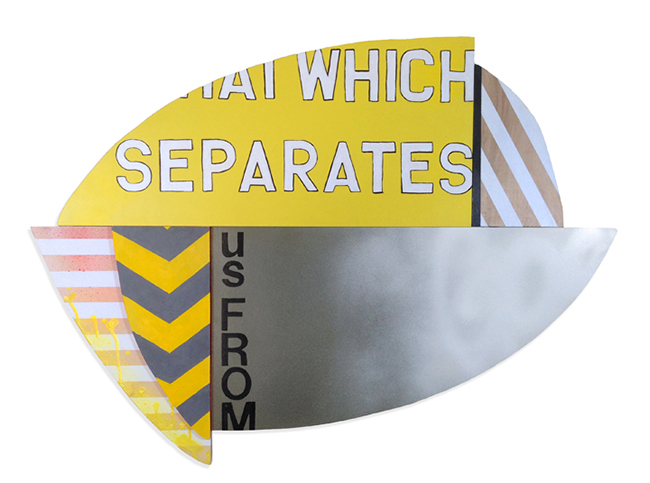
"That Which Separates Us" acrylic, aerosol, ink and panels 26" x 24"  2014

“That Which Separates Us”
acrylic, aerosol, ink and panels
26″ x 24″
2014

The concept of the “artist studio” has a broad range of meanings, especially in contemporary practice. The idea of the artist toiling away alone in a room may not necessarily reflect what many artists do from day to day anymore. Describe your studio practice and how it differs from (or is the same as) traditional notions of “being in the studio

For me being in the studio is a combination of time spent viewing, inspecting and researching things that inspire me, time spent taking those components and studying how they interact together on my computer or within my sketchbook and then time spent creating fragments or a finished piece with them.

The acts of free flow writing, listing words, making lines with tape and staring at the ceiling considering something are equally important to me as the physical act of pushing paint around on a panel.

I often make small painting fragments on panels and then rearrange them with each other until a whole composition emerges.  The separate components and surfaces I work with always feel as if they could move and be rearranged so it’s important for me to spend time in the studio doing this and making it an essential part of my process.

What unique roles do you see yourself as the artist playing that you may not have envisioned yourself in when you first started making art?

I have found that I love bringing art into public spaces, whether through city commissioned public art work, murals or spontaneous site specific installations.  Art outside of designated art spaces excites me in a very different way.  Painting a mural and having UPS drivers and moms with strollers pull up and holler “awesome!” or give you thumbs up feels better than most museum pats on the back.  Art is for everyone.

When do you find is the best time of day to make art? Do you have time set aside every day, every week or do you just work whenever you can?

After my kids are off to school in the morning and I’ve had a couple cups of strong coffee early is generally the best time to get to work.  But sometimes inspiration and motivation hit in the evening on a Friday and you just roll with it and get going.

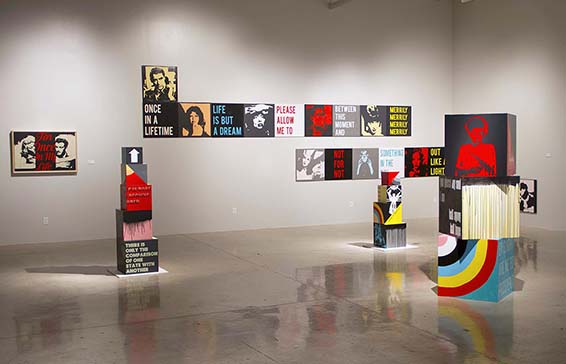
Installation Shot of Exhibition "The Give And Take" at Joseph Gross Gallery at University of Arizona 2014

Installation Shot of Exhibition “The Give And Take”
at Joseph Gross Gallery at University of Arizona
2014

How has your work changed in the last five years? How is it the same?

Five years ago I was getting ready to finish my MA and I made my first text-based pieces and site-specific installation.  That series was a collection of works examining White Noise, or cognitive dissonance in specific people who participated.  Since then my work has become extremely colorful, more sculptural and has taken shape in text based paintings and site-specific installations.  It was also over these years that my daughters learned how to read and learned how to construct phrases and decipher the meaning of words.  This played a huge impact on the development of my work.

Are there people such as family, friends, writers, philosophers or even pop icons that have had an impact on the work you do?

My husband, Emmett Potter, is a huge influence and great source of inspiration.  He is an artist, we share studio space and exhibit together frequently.  His and support and understanding of the way I work has been invaluable and I am so tremendously lucky to be side by side with him in our journey as artists.

My children also inspire me to enjoy the simple beauty in making art and never take for granted the tactile magic of pushing pure white gesso across a smooth sanded surface.

As I draw from so many different genres of pop culture and literary and art history, I can’t list all of my influences but top of the list would be silent film actresses from the 1920’s, Lou Reed, James Gleick and his book “The Information,” Carl Jung and Patti Smith. 

I’m also grateful to every single second wave feminist artist who did the hard work they did so I can do what I do.

If you had an occupation outside of being an artist, what would that be and why?

I would either be a florist or a gardener in a coastal town because I could never be unhappy in the 24/7 company of flowers and growing things.

About

headshot_lowresKristin Bauer is a multimedia artist that lives and works in Tempe. Over the years she has exhibited extensively in galleries and museums in the region, including The Arizona Biennial at Tucson Museum of Art, Phoenix Art Museum and Mesa Arts Center, and has participated in group exhibitions in Los Angeles, Santa Fe and New York. She has been a guest speaker at numerous college courses and in a panel at Phoenix Art Museum’s Contemporary Forum, where she also received an artist grant in 2012. She exhibits frequently with her husband, Emmett Potter, with whom she shares studio space. Bauer and Potter have collaborated on murals in Phoenix and for the Indy 500.

Bauer’s background in the arts includes curating exhibitions, running a pop-up gallery with Potter, PR consulting for LA galleries, and arts writing for Beautiful/Decay, JAVA, FFDC and TONE. She obtained her BFA in Painting from ASU and an MA from Ottawa University and has two daughters who make life extra sparkly and interesting.

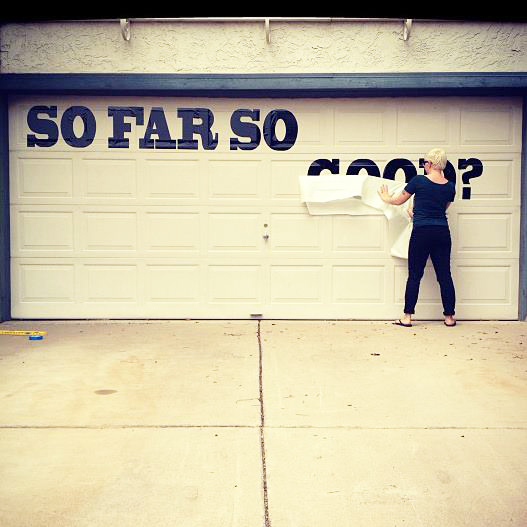
SoFarSoGood_Installing

kristinbauerart.com

All images copyright of the artist and used with their permission.  


Posted in Conceptual Art | Tagged , , , , | Leave a comment

Tatiana Stadnichenko – Russia

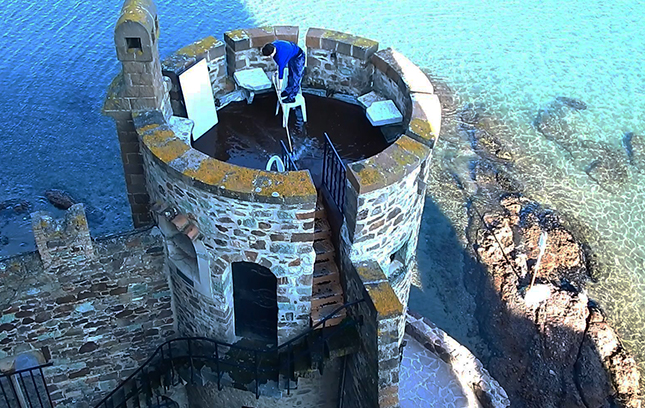
Washing up my studio_France, La Napoule, Today I`m a king, tomorrow a slave, perfomance, 2014

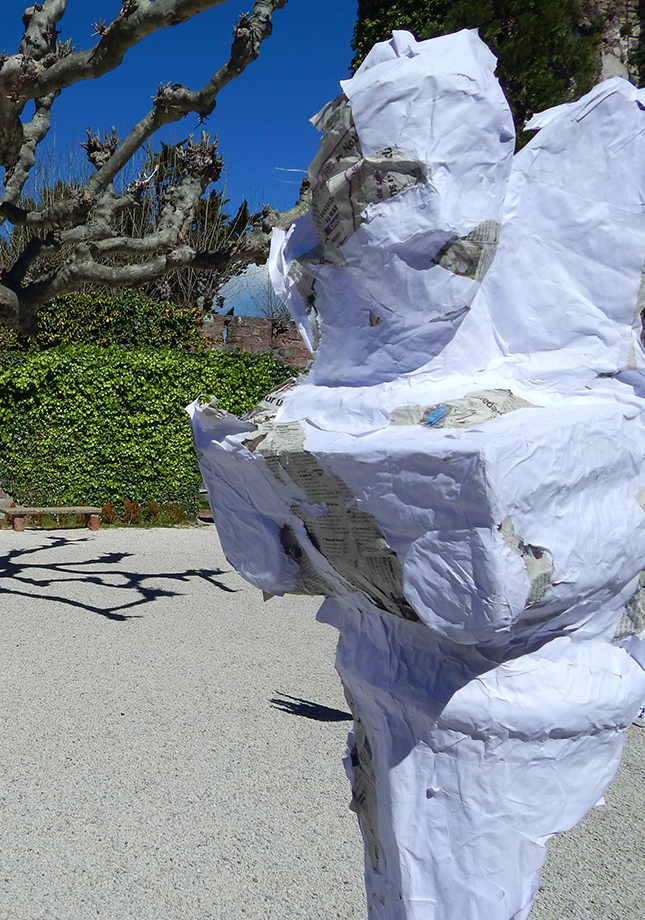
Washing up my studio_France, La Napoule, Today I`m a king, tomorrow a slave, perfomance, 2014

Briefly describe the work you do.

My work is the air between the temporal architecture and artistic philosophy with the theme of instability and rethinking of the urban space and human actions there. One of my theses for research is «How does an increase in the speed of life and perception of human information on memory and other vital processes» and «What happens in the moment when form ceases to be form and becomes space». Last 2 years I`ve been working a lot with public-art with an aim of Reassessment of the spaces. I`m interested in the idea that a huge volume can be occupied by something which has effectively no weight

Tell us a little about your background and how that influences you as an artist.

I was born in a little city in the Siberia and since childhood I used to live in a huge vast. With my grandfather in the summer we walked in the endless fields and forests. May be that`s the one of reasons why I prefer to work with a big spaces or on the streets and public spaces with a nature.

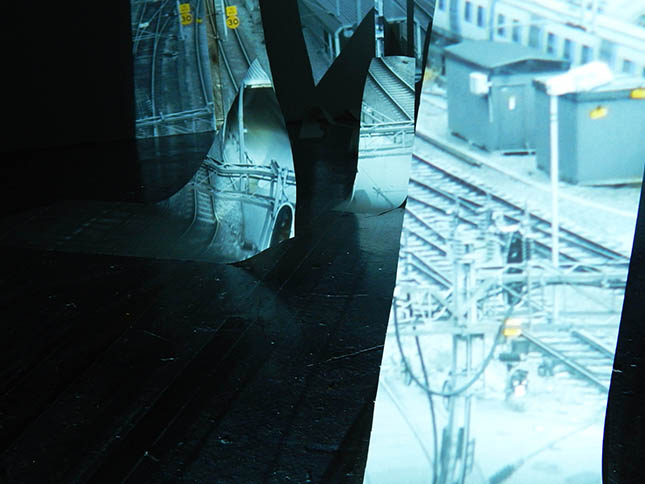
Liquid architecture, 2014, Video-installation

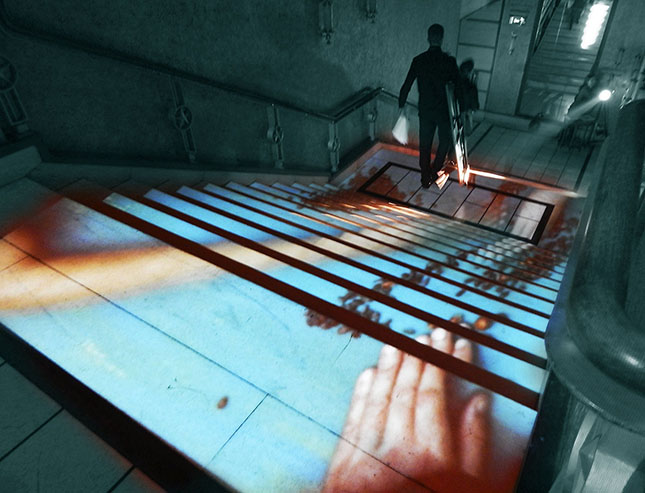
Liquid architecture, 2014, Video-installation

The concept of the “artist studio” has a broad range of meanings, especially in contemporary practice. The idea of the artist toiling away alone in a room may not necessarily reflect what many artists do from day to day anymore. Describe your studio practice and how it differs from (or is the same as) traditional notions of “being in the studio.

I have a quite nomadic lifestyle. Last year I changed my country 3 times (with some residences). Now I`m doing MFA in the Bergen Art Academy and Royal Institute of Art in Stockholm. The studio space for me just a place for to make sketches and reading a books, it`s good for to focus.

What unique roles do you see yourself as the artist playing that you may not have envisioned yourself in when you first started making art?

The artist for me it’s not just a creator – it`s a person, who can make a difference in the environment, who can change the areal of his habitat through the some dialogue with people.

I like to measure the depth of human perception there are a lot of layers of meanings, in the every my work. I try to dip myself and people to unusual environment, for expose some factors which is not possible to see in everyday life.

When do you find is the best time of day to make art? Do you have time set aside every day, every week or do you just work whenever you can? 

I prefer wake up early for to catch some fresh air and ideas. It`s easy for me in the morning to read conceptual books, which inspired my ideas for projects. And I love quiet and dark evenings for sketches and practical work.

The shadow collection_Paper, glue, France, 2014

The shadow collection_Paper, glue, France, 2014

How has your work changed in the last five years? How is it the same?

Last 2 years I worked a lot with public-art and temporal installations. Now I started to use more video-projections, it`s new tool for my space-transformative ideas.

Are there people such as family, friends, writers, philosophers or even pop icons that have had an impact on the work you do?

Contemporary philosophy and sociology is the base for my projects. In my last works I worried about speed of information, and an increase speed of life, which transforms our reality. The books for inspirations was «Liquid modernity» by Z. Bauman, «The visual machine» by Paul Virilo and some books of A. Bergson

If you had an occupation outside of being an artist, what would that be and why?

I would like to work with music and sounds. I don`t want to have the classical music education, but I love to feel and improvise. I`m enjoyed to work in collective, with collaborations with another people, what is quite difficult when you are an artist.

About

Tatiana_StadnichenkoTatiana Stadnichenko is a Russian artist, currently residing in Stockholm, Sweden (MFA). She has 2 lines in her art practice now. The first one is a work in the public space, and the second is installations from temporal materials with video-projections.

It doesn’t really matter where you showed your art-works. It`s more important who you are like a person and how do you share your inner wisdom.

limits_video_art installation, Bergen, 2014

limits_video_art installation, Bergen, 2014

cargocollective.com/windincherry

All images copyright of the artist and used with their permission.  

Posted in Installation, Video | Tagged , , , , | Leave a comment

Patricia Miranda – New York, New York

Detail of glass separatory funnel with oak gall ink dripping on scroll

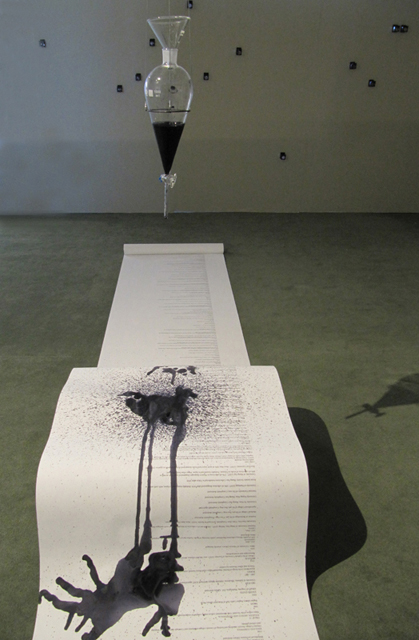
Detail of glass separatory funnel with oak gall ink dripping on scroll

Briefly describe the work you do.

As an artist, educator and curator, I maintain an expanded multidisciplinary practice, with projects that make visual connections between art, science, history and culture. My workencompasses a diverse mix of making and collaborating, from painting, sculpture, and installation, to curatorial and educational as well as social practice. Materiality, the physicality of the world, informs my content- how meaning appears through articulation in material form, and how context and history further deepen content. 

Recent projects integrate raw materials as medium and content, using the language of scientific, artistic, and historical archive and display. Often interactive, these projects engage the audience in making, using an artistic action as a way to connect to cultural narratives. Collaboration allows me to combine my artistic, educational, and historical expertise in bringing artist and community together. For a recent project supported by a grant, I brought together 10 artists to collect oak galls (wasp nests historically used to make ink) from nature centers and private land around the country, culminating in a collaborative drawing exhibition. Satellite collaborations have popped up with artists who were far flung, and I hope to continue that collaboration this year.
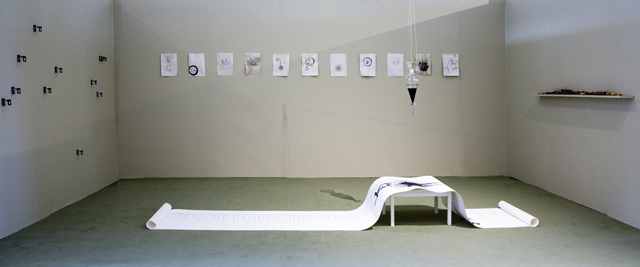
Full Installation

Full Installation

Tell us a little about your background and how that influences you as an artist.

I have a background of research in a wide range of historic and contemporary artistic technologies, the methods and materials which humans have used to make art. I lecture and teach about this, but it also informs my connecting art, history, science and creativity within studio projects. I consider how we perceive ourselves as separate from the nature and physical world, and yet we are intrinsically incarnate, embedded within it. Material has agency, a nature of its own, with a distinct history. It is a silent but indispensable participant in that history, and can reveal a complex political and social context when considered itself as content. We think of technology only as modern, such as computers, but I try to expand that into a less binary notion of old and new. Technology in essence is how we transform the material world into tools that serve our needs. This was no different in ancient times than now. An innovation in any area had scientific, artistic, political, and social consequences that impacted communities and history. I am interested in having that conversation through the language of art.

I have also always been interested in artist-run culture. Making space for artists to create, exhibit and collaborate reflects my commitment to artistic community. I developed a collaborative workspace residency program at MAPSPace, the project space I founded, and am always looking for innovative ways for artists to work together in their own capacity, and to take control over the ways their work is produced, shared and supported. I am also involved in the Maker movement, which is an inspirational community of passionate makers. Their philosophy- that we can be creators rather than merely consumers, no matter who we are, resonates deeply for me. This has influenced my curatorial and educational work, bringing me into the dialogues around STEM to STEAM in education and contemporary art, and engaging me in new modalities for learning and teaching. I developed an educational program to put my artistic and educational ideas into action called Alchemical Tech, bringing this to spaces of all kinds, from schools, museums, to community.

The concept of the “artist studio” has a broad range of meanings, especially in contemporary practice. The idea of the artist toiling away alone in a room may not necessarily reflect what many artists do from day to day anymore. Describe your studio practice and how it differs from (or is the same as) traditional notions of “being in the studio.”

Although my focus is my studio, since I work in an expanded practice I am in often in different places. I’m in my studio, curating in my space or others, working in museums or schools, or teaching in different places from college to K-12. My work also involves research, so I am reading, or on the computer. So I could be painting, drawing, making video , sculpture or collaborating. Like most artists, I have an enormous library, and am always finding new sources of study and inspiration. My studio is in an adjacent space to the project space, so I work fluidly between the roles. It means diligence when I have a focused project, but openness to having to at times move between roles from moment to moment. In terms of medium, this also is fluid, as the project may dictate what form I work in. Some projects are more research-based, culminating in an installation with various elements from 2d, 3d to video, others are more discreet object-based, making paintings or sculptures. Often it’s a combination, and that seems to be the direction I am moving.

What unique roles do you see yourself as the artist playing that you may not have envisioned yourself in when you first started making art?

When I was young I had no idea what an artist’s life looked like. (There were no professional practice courses such as the ones I teach today.) I just knew that three things were non-negotiable for me, one, that I wanted to be in my studio in my day to day; two, to work with and be around artists; and three, to work with original art. Everything else grew, slowly, out of that commitment. I started a business not long after undergrad, taught myself how to run it, to support my studio and my work. This eventually grew into a gallery, which became an aspect of my art practice itself. I started teaching and found that I had an ability to communicate, and was passionate about art’s importance in culture and about each person’s creative abilities. All these things today are intertwined branches of my work. This led to collaborations, and collectives, and my continuing curating of exhibitions in my space and others. My studio practice is the heart, and everything grows outward from there.

As founder and director of an artist-run gallery and project space, I believe that artists are vital, and they can create active, sustainable, art communities through a hyper-local, grass roots model. I implemented a collaborative workspace residency program, this falls was the fifth cycle. Residencies have ranged from a month of social practice events including a micro-grant dinner; avant-garde theater for young audiences; an environmental installation; and an interactive installation using massage and the kneading of bread as a theme for human connection from an artist who emigrated from Iran.

When do you find is the best time of day to make art? Do you have time set aside every day, every week or do you just work whenever you can? 

Since I work in so many different ways, it varies greatly from day to day, month to month. I might be in the studio, curating, teaching, at a residency, then in the studio again. Most of my time is spent in the studio, even when I am working on other projects. So it always changes. I’ve never been comfortable with singular routines. I suppose this feeds my curious nature, I am always learning something new, seeing new work, meeting new artists, thinking about how art impacts my life and the life of others. I teach college, as well as develop curriculum-based programming for K-12 and museums, so I am always thinking about pedagogy, about the role of art in community.
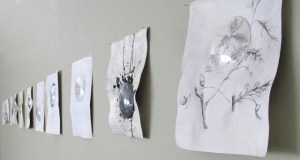
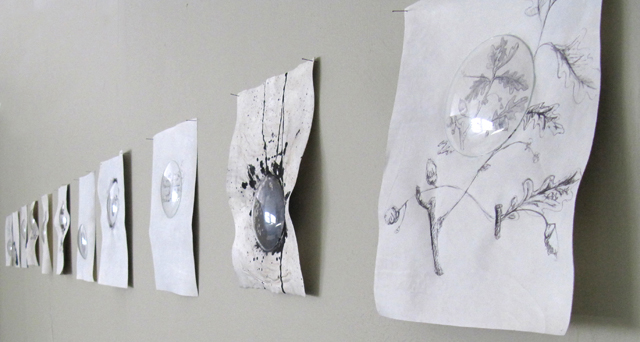
Detail of group of 11 oak gall ink drawings on torah calf-skin vellum with glass roundels, entomology pins

Detail of group of 11 oak gall ink drawings on torah calf-skin vellum with glass roundels, entomology pins

How has your work changed in the last five years? How is it the same?

My work has changed a lot- it seems to change from project to project! I started in sculpture in undergrad, then worked primarily two-dimensions for years, although my work always maintained a sculptural quality in its materiality. I’ve always been interested in materials, how they communicate content and bring their own language to everything you make. Recently I have begun to bring my research in art technologies more explicitly into my work, and have become more interested in collaborative and interactive work. This means the work became more installation, such as recent projects around oak gall ink and cochineal dye, both of which are rich in history and science. It has also recently become important to me to express a more outwardly political perspective in my work, and am still finding ways to do that. I’ve always been political in my personal life, and it influenced my work, but it feels more urgent to make it more directly visible in the work.

Are there people such as family, friends, writers, philosophers or even pop icons that have had an impact on the work you do?

Too many to list! I’m a little obsessive about reading across many subjects- art, science, philosophy, politics, history and culture from different places and time periods. Close artist friends in particular, as well as students I teach, always impact my thinking about my work, making me question and push further. We form a creative community, sharing the challenges and joys of being an artist. My husband is an artist, we support each other’s work in a myriad of ways both personally and professionally. Being in partnership with an artist means that art is intertwined into every aspect of my life. Mostly it’s artists- I’m surrounded by artists! And, my five sisters, who are not artists, are always an inspiration.

If you had an occupation outside of being an artist, what would that be and why?

I cannot remember a time in my life when I did not want to be an artist or imagined being anything else. I think that I’d love to be a scientist, but being an artist means that I can work with science and scientists, I can explore the questions that science asks, but I can posit them in the questioning language of art, which doesn’t require answers but a more poetic response. And of course, more questions.

About
05_MIRANDA_PATRICIA_HEAD SHOTPatricia Miranda is an artist, educator, and curator, using interdisciplinary and interactive exhibitions and projects to make connections between art, science, history and culture. She is founder and director of MAPSpace, miranda arts project space in Port Chester, NY, a gallery and collaborative art space in Port Chester NY, where she instituted a collaborative workspace residency program. She has been visiting artist at Vermont Studio Center, the Heckscher Museum, and the University of Utah, and been awarded residencies at Weir Farm, Julio Valdez Printmaking Studio, and Vermont Studio Center. She has been the recipient of grants from ArtsWestchester and New York State Council on the Arts, and an NEA grant working with homeless youth. She is currently visiting assistant professor at Lyme Academy College of Fine Arts of University of New Haven. Miranda develops education programs for museums, community institutions, college and K-12 schools, including the Solomon R. Guggenheim Museum, the American Museum of Natural History, and the Smithsonian Institute. She has exhibited at Wave Hill, Bronx, NY; the Cape Museum of Fine Art, Cape Cod MA; the Belvedere Museum, Vienna Austria; Metaphor Contemporary Art, Brooklyn, NY; and Kenise Barnes Fine Art, Larchmont, NY.
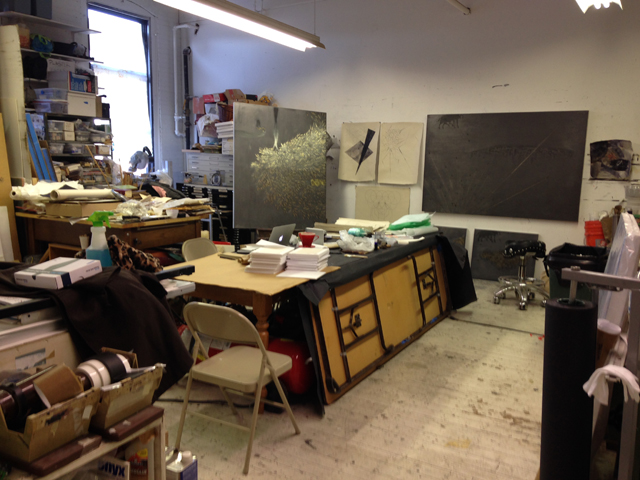
04_MIRANDA_PATRICIA_STUDIO

 www.patriciamiranda.com

 www.mirandaartsprojectspace.com

All images copyright of the artist and used with their permission.  

Posted in Installation, Sculpture | Tagged , , , , , | Leave a comment

Kelli Washington – Chicago, Illinois

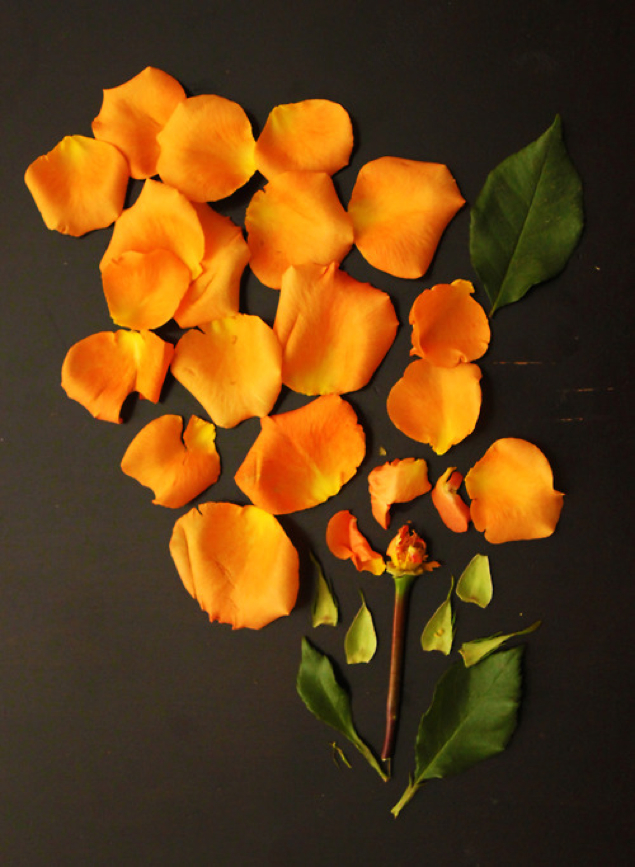
Rose De-Reconstruction

De/Re Construct: Roses, Digital Media, 24” X 36”, 2011

Briefly describe the work you do.

Although I identify with being a photographer (I work mostly with digital media), I try not to limit my abilities into one category for I thoroughly enjoy other mediums such as Ceramics, Painting, and Drawing. As of late, the work that I have completed for the past 5 years have been digital collages. Most of the collage works have developed into series for I appreciate the development of my concepts, and the challenge to produce more impersonations of my original subjects. Through manual and digital reworking, my work creates new narratives for the initial subject matter; these narratives usually range from being astute, elegant, tense, or playful. Outside of the narrative, color is a very important concept. I have always been one that prefers vibrancy in colors which I believe is prevalent in most of my collages. There is always a conscious thought to use bold colors that provoke the most responses amongst the viewer for each series.

Tell us a little about your background and how that influences you as an artist. 

I was born and raised in Chicago IL by a father who was a drummer in his own band, a mother who was a self proclaimed interior designer and floral arranger, and a host of creative brothers and sisters. Most of my siblings drew, painted, and played an instrument or all of the above! Growing up in such a household, I was always exposed to the arts. At the tender age of 4, I attempted to show my parents my skill by using Crayolas to redefine the off-white painted walls throughout our household. As a result of my artistic mischief, my parents gave me different outlets to be creative: my father began teaching me how to play the piano by the age of 5, and my mother enrolled me in dance by the age of 6 (tap, jazz, and ballet). As I grew older, I continued to explore more mediums: drawing, music (the Drums, and eventually the Clarinet), and even painting. I started with my mother: I greatly admired my mother’s skill for creating custom made furniture (which of course I really didn’t appreciate until I was older). She also took pride in adorning our living room table with her personal floral arrangements with flowers picked right from her garden. Her fabrics and floral arrangements were always elegant, and beautiful. Then I had my father: a man who was not only a talented musician, but who was also fascinated with film. Watching him compose his own music made me want to create my own masterpiece. His music always evoked some type of strong emotion, whether it was happiness, sadness, or anger. Although I experimented a lot, and some things stuck (such as dance, the piano, and drawing), I still experimented.

I knew Photography was my choice of medium when I found that every aspect intrigued me. I went from finding comfort in taking the image (by using a simple Kodak “Throw Away” camera), to wondering how does this process work? How are images developed? Which images were my favorite and why? Then I took a digital turn and learned about apertures, white balance, and shutter speeds out of curiosity. As I continued to “experiment,” I began capturing pictures that I really liked. The more I liked the outcome, the more I wanted to create.

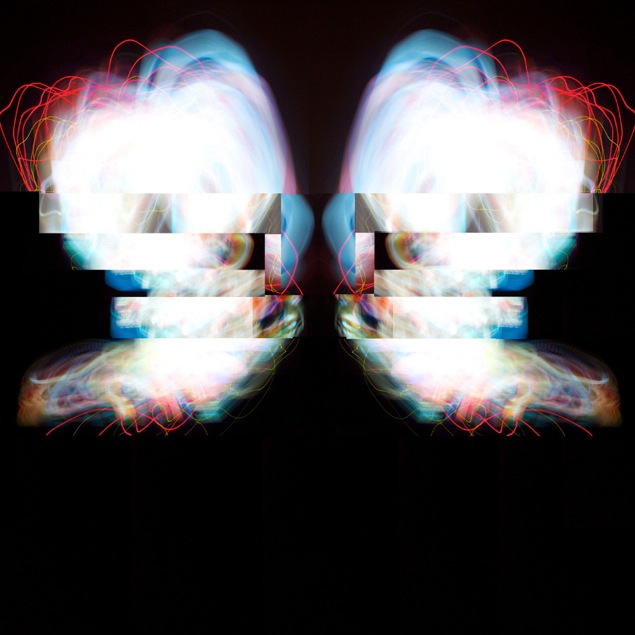
Body Ray: Two Fetuses, Digital Media, 34” X 34”, 2013

Body Ray: Two Fetuses, Digital Media, 34” X 34”, 2013

The concept of the “artist studio” has a broad range of meanings, especially in contemporary practice. The idea of the artist toiling away alone in a room may not necessarily reflect what many artists do from day to day anymore. Describe your studio practice and how it differs from (or is the same as) traditional notions of “being in the studio.”

My process definitely does not fall under the tradition notions of being in a studio. Most of my thinking is done on my commute to work, while watching a film, or even while looking through magazines and blogs. Once I conceive an idea, I quickly will jot down my idea or sketch it quickly within my sketch book or the item that is at my disposal at that time (sticky notes on my laptop, reminders through my iPhone). I don’t necessarily have a specific area in which I create the work, just the important components such as my laptop, my camera, sketchbook, etc. What really matters is my state of mind; usually the physical location is changed to reflect that energy of what it is I am working on at that moment and time.

What unique roles do you see yourself as the artist playing that you may not have envisioned yourself in when you first started making art?

To be honest, I have recently accepted the fact that I am an Artist. Before, I just knew myself as a girl that liked to make things. Whether it was a charcoal drawing, or a photograph, I felt I didn’t really amount to the title of an “Artist.” Now that I have accepted that role in itself, I believe I have taken on the role of an Author. A Poet. A Storyteller. I never really anticipated the amount of engagement that develops once that concept is discovered. It honestly allows me to stay disciplined into reading contemporary theory for I truly like to stay in engaged in the current conversations going on in the art world. Since I have paid closer attention to my interests, and have investigated them fully, I have realized that I have my views. My beliefs. My theories. There is a huge chasm to cross between feeling something and describing it, and this is followed by the chasm between describing it and presenting it through incidents, action, and dialogue.

When do you find is the best time of day to make art? Do you have time set aside every day, every week or do you just work whenever you can? 

It definitely varies for me. When I attended U of I, I spent most of my time creating work on the weekends; it was the only time I had since I was going to school full-time and also working part time at about 20 hours per week. Once I started attending graduate school at MICA, it was the opposite. I didn’t designate my weekends anymore but usually made my digital collages after my day was done. I would go to work, then go to class for a certain portion of the day, and was awake for a few hours making new collages. Now that school is no longer a factor, I juggle making art with volunteering at a non-profit organization and work. Originally, I told myself I would keep the same system of working at night once my day was complete. This proved to not work as efficiently after a year in. Now I don’t put a time on it. By allowing myself to work when I feel the most inspired, I feel my creations are more authentic. I find myself creating more in that aspect.

Seen and Unseen: The Diving Bell, Digital Media, 24” X 36”, 2012

Seen and Unseen: The Diving Bell, Digital Media, 24” X 36”, 2012

How has your work changed in the last five years? How is it the same? 

When I was a teenager taking photographs, my subject matter composed of candid images of my family and friends mixed with a lot of nature/landscape shots. When I began studying at the University of Illinois at Urbana-Champaign, I chose to do more collages and capture images of subjects where I felt I had the most control in the manipulation. As I focused on that subject matter, I grew uncomfortable photographing people for
I hardly took images that I liked. I wanted them to have more of a documentary style, images that told a story. Even though it wasn’t my preferred subject matter, I still forced myself to do it anyway. I spent time at different social events to overcome my fear which ironically was the only thing I shot when I was a young. As I grew more acquainted with this, I decided to study at the Maryland Institute College of Art’s Business program which was geared specifically towards artists with specific trades. After completing the program, I grew more comfortable with my work; enough where I began my own photography business providing supportive digital media for fellow creative professionals. Through it all, I continued to do my collages which is the aspect of my work that did not change. I just continued with my desire to master a more documentary style of photography.

Are there people such as family, friends, writers, philosophers or even pop icons that have had an impact on the work you do?

One of my favorite artists is Dganit Blechner. I first saw her work on a trip to SOFA Chicago (an art fair dedicated to Sculpture, Objects, Functional Art and Design). Her prints are vivid, cheerful, and bright and result in extraordinary compositions. She has a very interesting way of using urban life to express a new perspective which is also what I aim to do with my collages. Another who really inspires me is Saul Bellow. His writings are motivational, and speak to the ability of humans to overcome their frailty and achieve greatness. My favorite quote of his is,“Art has something to do with the arrest of attention in the midst of distraction.”

If you had an occupation outside of being an artist, what would that be and why?

This one is tough; I could see myself being in several occupations: Marine Biologist. Peace Corps Member. Travel blog writer. Winery Owner. Yoga Instructor. Author. Interior Designer. Art Therapist. I’m so curious about a lot of things that I would choose each profession if I could. Any role that allows me to travel and be a part of a creative process would be ideal.

About

KayeWashKelli Washington is a Visual Artist born and raised in Chicago, IL. Kelli recently received her MPS in the Business of Art & Design from the Maryland Institute College of Art. Prior to receiving her Master’s degree, she obtained her BFA in Photography from the University of Illinois at Urbana – Champaign. Much of Kelli’s work stems from her life-long fascination with collages. She remembers finding great fulfillment as a child in taking magazine clippings to create a new image. It is in that spirit that Kelli began creating collages but by using photography as a tool for experimentation while including mixed media. Currently, Kelli lives and works in the United States in Chicago. Outside of satisfying her severe case of wanderlust and creating personal projects, she also operates a photography business, DUB Photostudio, where she offers supportive digital media for creative professionals in the Chicago-land area.

Workplace

www.cargocollective.com/

KelliWashingtonPhotography

All images copyright of the artist and used with their permission.  
Posted in Photography | Tagged , , , , | Leave a comment