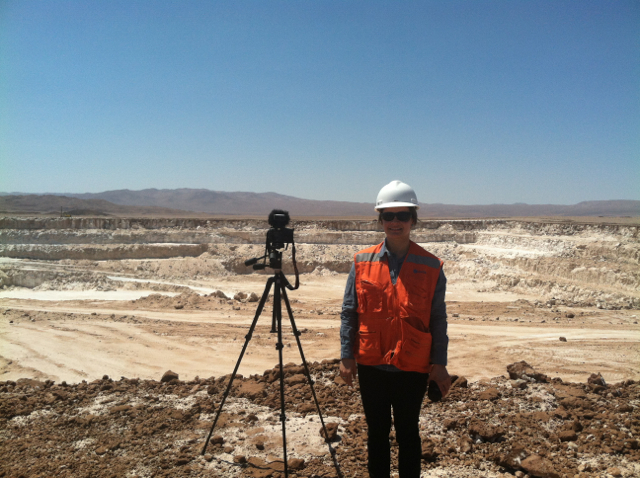
Stacey Alexander – Pasadena, California

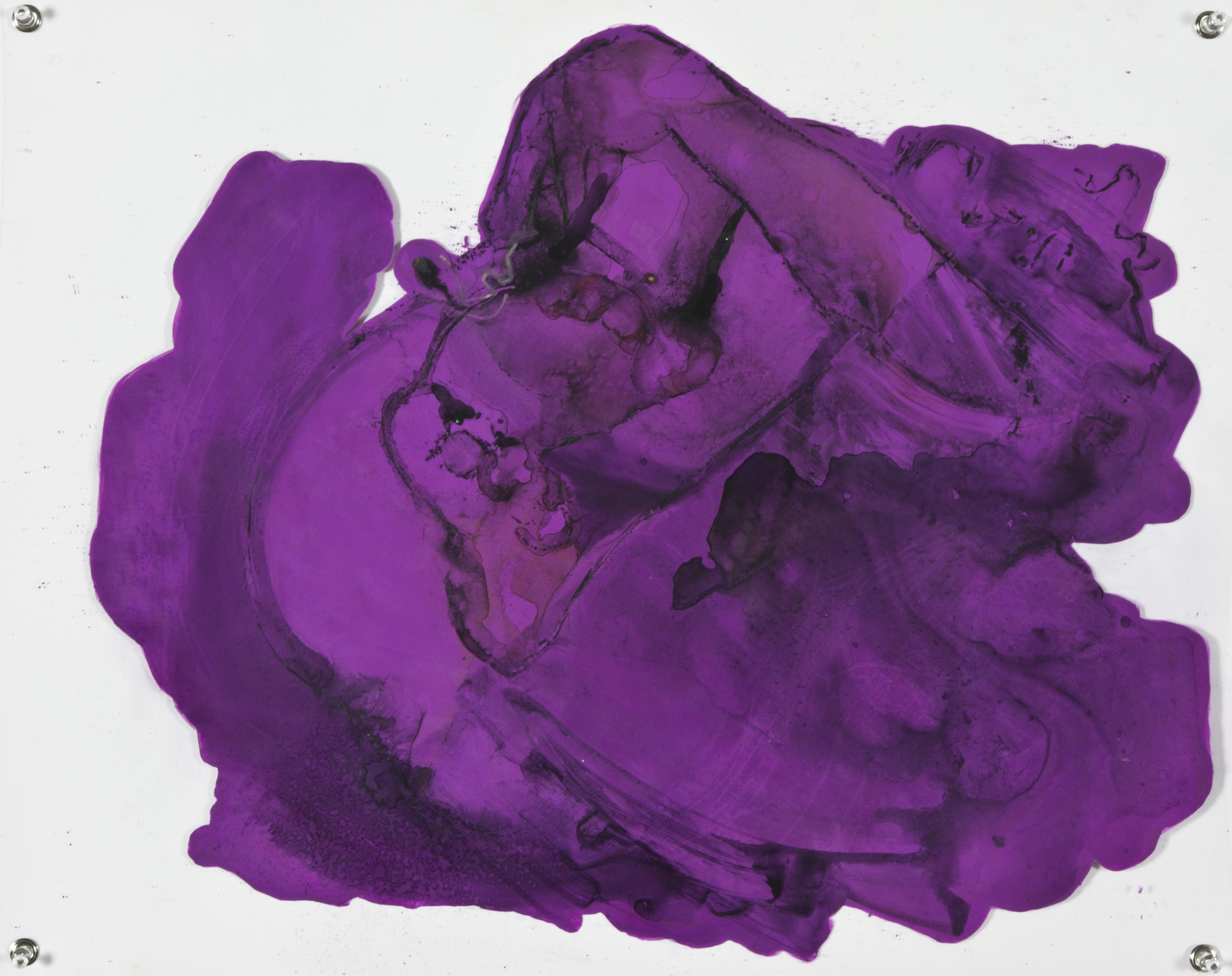
Catch Me, Graphite and Ink, 20"x16", 2015

Catch Me, Graphite and Ink, 20″x16″, 2015

Briefly describe the work you do. 

There is a moment right before falling asleep that reality and imagination are completely indecipherable. I tend to go back and forth between reality and almost dreaming, this state of mind is so interesting to me. It is the same feeling that can come with meditation in its various forms. My drawings are about the melding of reality and the imagined world in our minds. I utilize rendered figures along with abstract patterns and shapes to blend these mindsets together. My work has a lot of negative space giving my figures a quiet aloneness for introspection.

Tell us about your background and how that has had an influence on your work and on you as an artist.

I have lived in Southern California my whole life, I love spending time outside- camping, hiking, bike riding, laying out at the beach. There is a definite influence of nature in my work. A lot of the figures I use are referenced from people at the beach where there is a simple kind of freedom that comes from laying in the sand doing almost nothing and being completely satisfied.

Mirror, Graphite, 16"x20", 2015

Mirror, Graphite, 16″x20″, 2015

The concept of the artist studio has a broad range of meanings in contemporary practice. Artists may spend much of their time in the actual studio, or they may spend very little time in it. Tell us about your individual studio practice and how it differs from or is the same as traditional notions of “being in the studio.”

My studio is a section of my apartment. I do my drawing on a drafting table which is the greatest thing I found being thrown away. I spend several hours a day working on art things, usually it is physically working on drawings or sketches but somedays it is sifting through old photos, reading art magazines, or computer work such as statements, archiving work, etc. I suppose thats all basically a standard notion of an artists studio beside the fact that I also live with my work 5 feet from my bed. It can get a little distracting having access to all my things at once but I generally enjoy that I can bounce around from task to task without much effort. Plus my fiancé works from home so I always have a break buddy!

What roles do you find yourself playing that you may not have envisioned yourself in when you first started making art?

I think starting out as an artist all I wanted to do was the sexy part- working in my studio whenever I wanted until the wee hours of the night making creative, glorious work. The reality is that being an artists is like running your own small business. There is a lot more logistical work than most people think. I also never thought I would work a regular schedule but having specific hours set aside for art making has really helped my practice.

When do you find is the best time to make art? Do you set aside a specific time everyday or do you have to work whenever time allows?

I set aside several hours in the afternoon for making art. I try to treat it like any other job and stick to it as much as possible. If I decide I just can’t work in those hours a specific day I trade off for another time during the week. More often I have the opposite problem and want to continue to work- at this point I remind myself to treat it like a job and try to have a balanced life.

Untitled Marc, Graphite and ink, 16"x20", 2015

Untitled Marc, Graphite and ink, 16″x20″, 2015

How has your work changed in the past five years? How is it the same?

I graduated with my BFA 3 years ago. While I was in school I made large mostly abstract paintings, then I graduated and had to find a space to put all of them. So I decided to try to work small which was actually the point I transitioned from painting to drawing and felt like my work gained a lot of clarity. My large thick abstract marks were traded for small clean abstract patterns I currently use in my work. I have also put more constraints on myself as far as materials and a visual repertoire which is actually liberating. Making some rules for my own work has be quite helpful.

How have people such as family, friends, writers, philosophers, other artists or even pop icons had an impact on the work you do?

I worked as a studio assistant for Mindy Shapero for about a year, in one conversation she mentioned that she liked work that was silly in some way. I had been drawn to work that had a lightness but I was surrounded by other artists whose work was so heavy in emotional or political tone I felt inadequate if my work was about something fun or silly. Hearing a successful professional artist appreciate this about artwork gave me confidence that this aspect in art is valid. Which freed me to embrace fun in own art.

Some artists that have influenced me are Kiki Smith, James Jean, Alice Neel, Mark Ryden, Frida Kahlo, and Nathan Oliveira.

Have you ever been pulled in the direction of a pursuit other than being an artist? What are your other interests? 

I can’t see myself pursuing any other career. When I started college I intended to work towards graphic design or something that was more of a regular job in the arts but it was clear early on that I was a fine artist. It’s a gut feeling that can’t be ignored. I have taught some kids art classes and really enjoy teaching.

My other interests include traveling, cooking, anything with animals, and I have been teaching myself ukulele.

About

Alexander_HeadshotStacey Alexander is a fine artists living in Los Angeles, Ca. She has a Bachelors of Fine Arts in drawing and painting from Cal State University Fullerton. Her work has been shown in various galleries in Orange County, Los Angeles, San Diego and Seattle.

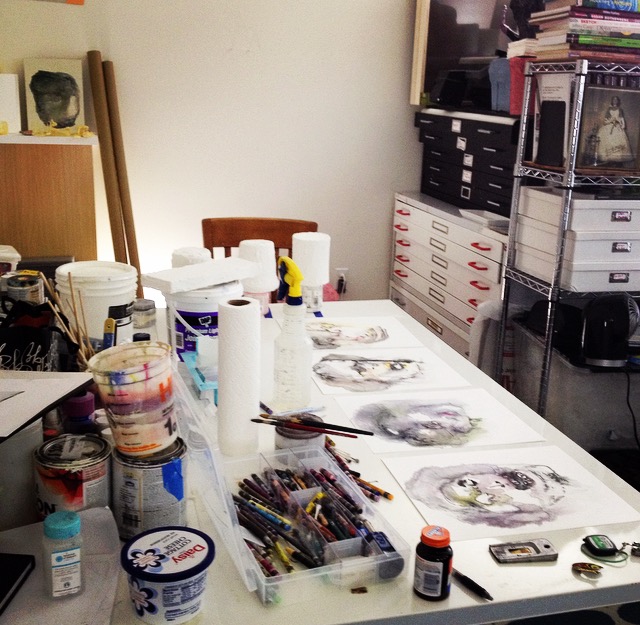
Alexander_Studio

staceyalexander.net

All images copyright of the artist and used with their permission.
Posted in Drawing, mixed media | Tagged , , , , | Leave a comment

John Michael Byrd – Lititz, Pennsylvania

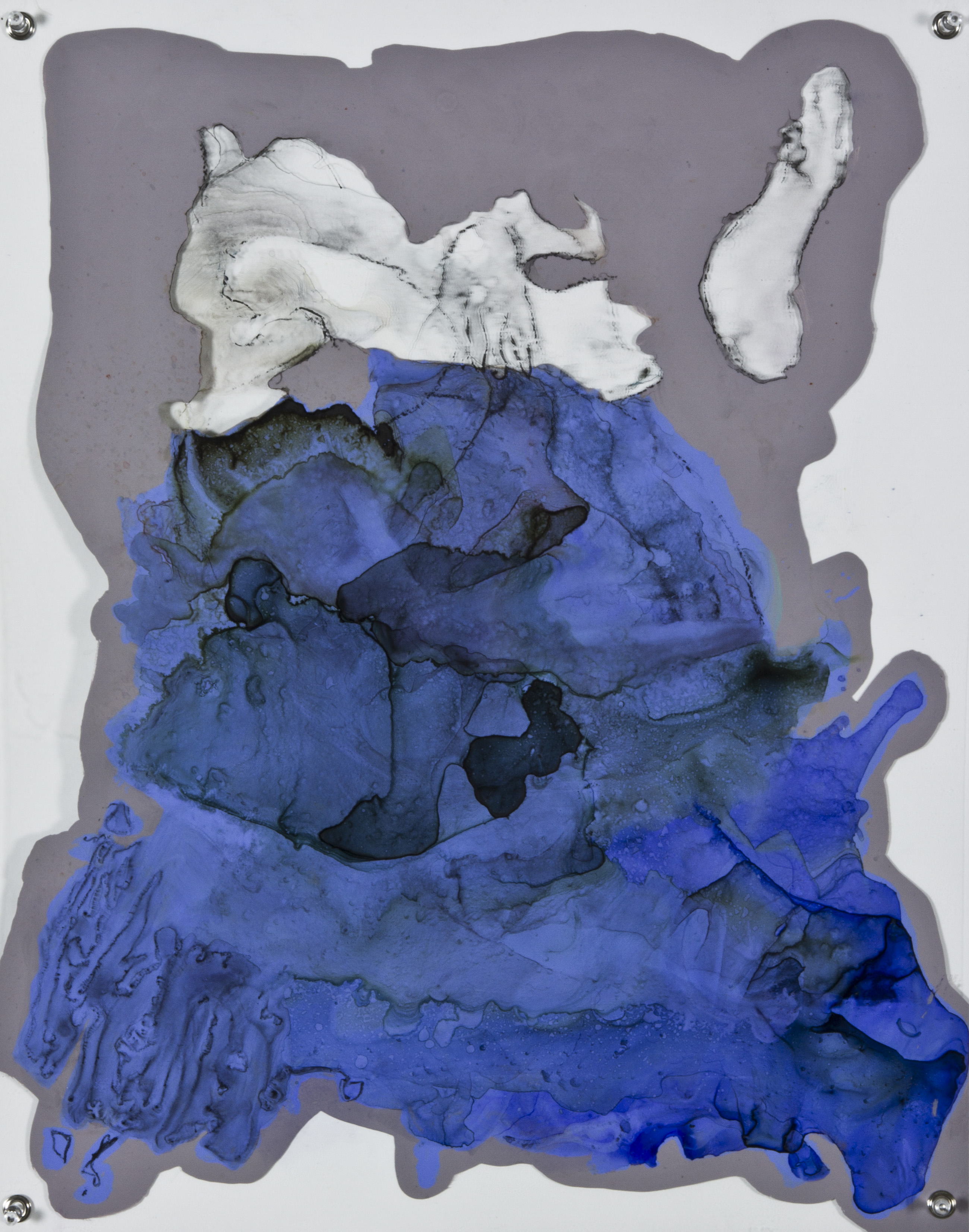
Buried in Oblivion, 2014, watercolor and acrylic on grommeted mylar, 18x24”

Buried in Oblivion, 2014, watercolor and acrylic on grommeted mylar, 18×24”

Briefly describe the work you do.

The nature of my work is in the conjured, the collected, and the uncanny. My images and objects are a face for an open exploration of multiple realities, energies, atmospheres and unconventional encounters.I really am exploring what it means to have a body on one plane, a mind on the other and the many combinations and preconceptions that collide there in. I appropriate found images and tear them apart, trying to find a nugget of something that rings true to my experiences being a southern boy, somewhat displaced in a very different kind of space. I look at a lot of media: coloring books, cartoons, arts and craft, pornography, art history, popular media.

Tell us about your background and how that has had an influence on your work and on you as an artist.

I grew up in the shadows of voodoo, Caribbean mysticism and Catholic iconography near New Orleans. This is where theatrical metaphysical states, symbols and cultural representations of the human body permeated my art making practice.Also, I have created art practically my whole life. It is as much a part of me as my name and I don’t remember a time before it. It is part of my lineage like my mother before me her mother before her; we all spoke similar languages of images, yearning and inventing.I think it is difficult to grow up in the Southern United States and not be surrounded by storytelling, a sense of history and an embedded thread of magical thinking.

Dismantled Almosts, 2014, watercolor and acrylic on grommeted mylar, 18x24”

Dismantled Almosts, 2014, watercolor and acrylic on grommeted mylar, 18×24”

The concept of the artist studio has a broad range of meanings in contemporary practice. Artists may spend much of their time in the actual studio, or they may spend very little time in it. Tell us about your individual studio practice and how it differs from or is the same as traditional notions of “being in the studio.”

I am always thinking about my practice in the studio but also when I travel, when I’m reading, or even when cooking. I’m thinking about how all these activities affect my making. I have days where I am just in the studio. However, I may not pick up a brush at all. It is just important to me that to be physically in there. I like the aloneness and quietness that manifest while I’m in this space. It helps me work out not just my work but also problems in my personal life. I identify completely as a studio artist even while I am collaborating with others on work it all comes together within these four walls.

What roles do you find yourself playing that you may not have envisioned yourself in when you first started making art?

Teaching is probably that roll for me. My students play such a huge part in my life and I feed them and they feed me. I never imagine that I would be love teaching so much as I do. It has become an critical part of my work and how I think.

When do you find is the best time to make art? Do you set aside a specific time everyday or do you have to work whenever time allows?

I try to work everyday but I’m not ridged about it. I like mornings or early afternoon but sometimes when I can’t sleep I slip into the studio and try to hammer away at something. I work in little pockets of time. I’m not really one to work 8 hours straight without a break. It’s like a dance for me. I do a few things, stop, look and let things meld then work a bit more. Then repeat.

How has your work changed in the past five years? How is it the same?

It has definitely gotten more colorful for one. And I have experimented with a lot more materials and surfaces. Also the scale shifts a lot from really small to big back to small. I’ve also been a lot more interested in writing about my work and connecting it to history that wasn’t always clear to me.Also moving from the South to the Northeast really changed how I perceive my identity, which has really shifted some of the imagery and process. I’m so much more confident in my voice than ever before. It is a pretty magical feeling.

A Single Mouthful of Air, 2014, watercolor and acrylic on grommeted mylar, 18x24”

A Single Mouthful of Air, 2014, watercolor and acrylic on grommeted mylar, 18×24”

How have people such as family, friends, writers, philosophers, other artists or even pop icons had an impact on the work you do?

I really get ideas and talk about my work with almost everyone in my life. I run ideas by friends or my partner. I ask for critiques from my mother and mentors. I talk out ideas with my students. I think the philosophy I take is by hook or by crook I figure the problems out to continue to make. It is very cathartic in that way.What I really love is when someone that doesn’t know anything about my work gives me feedback. The UPS man or the plumber who sees the work in my home or studio and responds in a natural way it is the best feedback.

Have you ever been pulled in the direction of a pursuit other than being an artist? What are your other interests?

I think many artist think about what life would be like if you weren’t making art. I was always really interested in literature, philosophy, and comparative religion.

About

John Michael Byrd headshot 2015-1John Michael Byrd holds an MFA in Interdisciplinary Studio Arts from the University of Massachusetts-Amherst and is also an alumnus of Louisiana State University with a BFA in Painting and Drawing. He is primarily a painter, but has also worked in drawing, video, objects, performance and printmaking. Byrd’s two-dimensional work compels viewers with a vibrating, sensual use of color and line, and transports us to a realm somewhere between reality and artificiality, what is familiar and what we fear. John Michael’s work has been featured in numerous regional and national exhibitions and competitions. Also, he has been awarded several grants and scholarships including the J. Kenneth Edmiston Memorial Scholarship and the Carl M. Thorp Memorial Art Scholarship.

John Michael Byrd Studio

johnmichaelbyrd.com

All images copyright of the artist and used with their permission.
Posted in Watercolor | Tagged , , , , | 1 Comment

Tamar Zinn – New York, New York

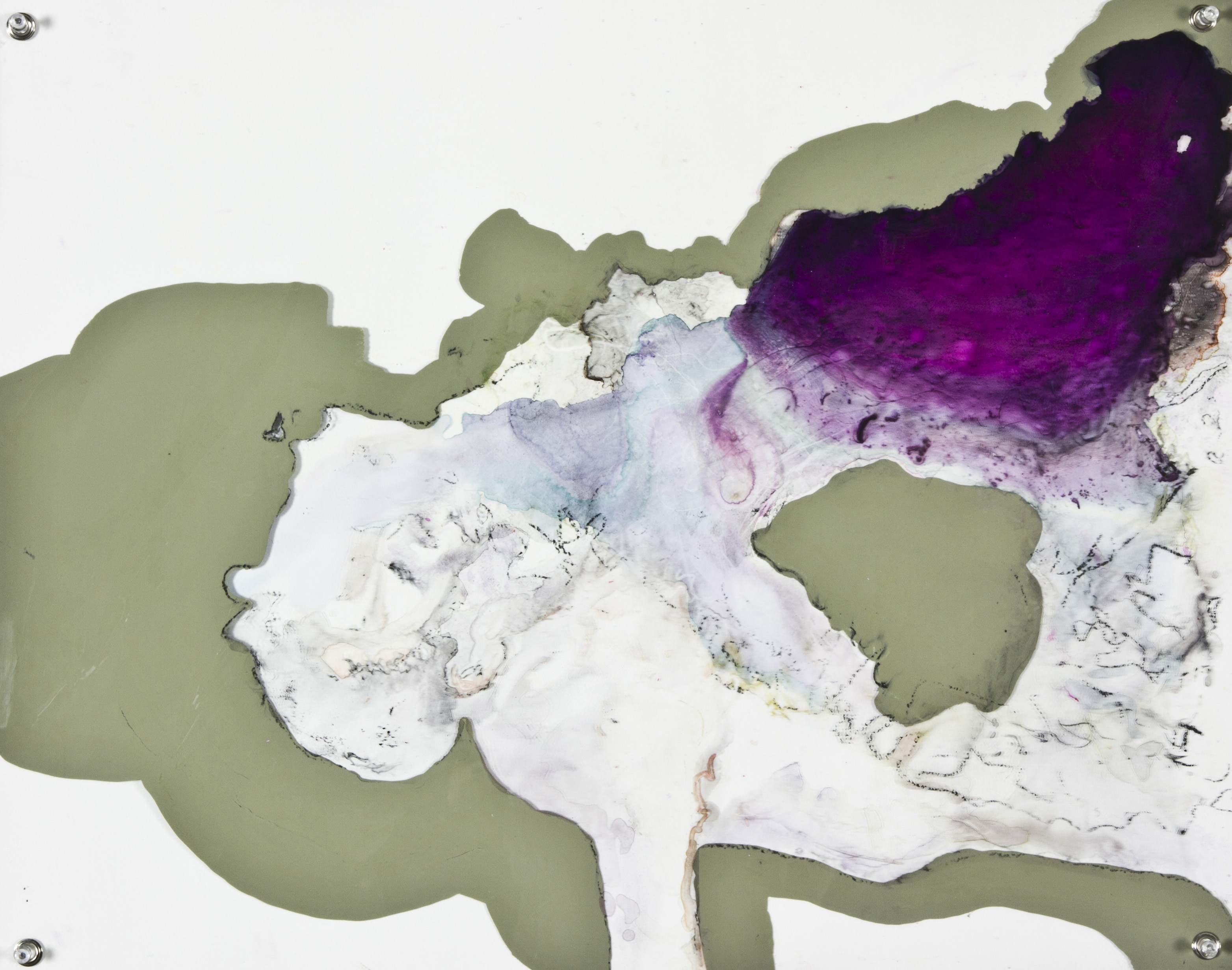
Blacks and Whites 28, oil and oil pastel on paper, image: 19 x 15” on 24 x 20" paper, 2014

Blacks and Whites 28, oil and oil pastel on paper, image: 19 x 15” on 24 x 20″ paper, 2014

Briefly describe the work you do. 

My work reflects a preoccupation with spatial ambiguity, whether informed by geometry or line. Recently, my gaze has shifted away from rhythmic complexity towards compositions that are increasingly spare and contemplative.  While relationships between forms remain central to my work, I now seek to do more with less — to suggest spatial tension by using a limited number of elements, as well as a palette reduced to blacks, whites and occasional reds.  My painting process often balances the accumulation of layers with vigorous attention to revealing what lies beneath.

Tell us about your background and how that has had an influence on your work and on you as an artist.

Music, dance, and visual art have been present in my life for as long as I can remember. In elementary school, weekday afternoons were filled with violin lessons and classes in music theory. Saturday mornings were spent at modern dance class, with painting classes at the Art Students League in the afternoon.  I didn’t know any adults who had careers in the arts and I had no expectation that the classes would lead to a profession. These creative pursuits were simply something I did because I enjoyed them.

I remained passionately committed to both music and art through the first two years of college — carrying my violin in one hand and a portfolio with etching plates in the other.  Oddly enough, although I never felt the inclination to work with three-dimensional forms, I was in a sculpture class when I realized that the visual arts would be my life’s work.

Music and dance still play prominent roles in my life—in the studio, listening to music, often jazz, helps me transition from the busy-ness of the outside world into the mind space I need for work; and dancing around the studio energizes my day. 

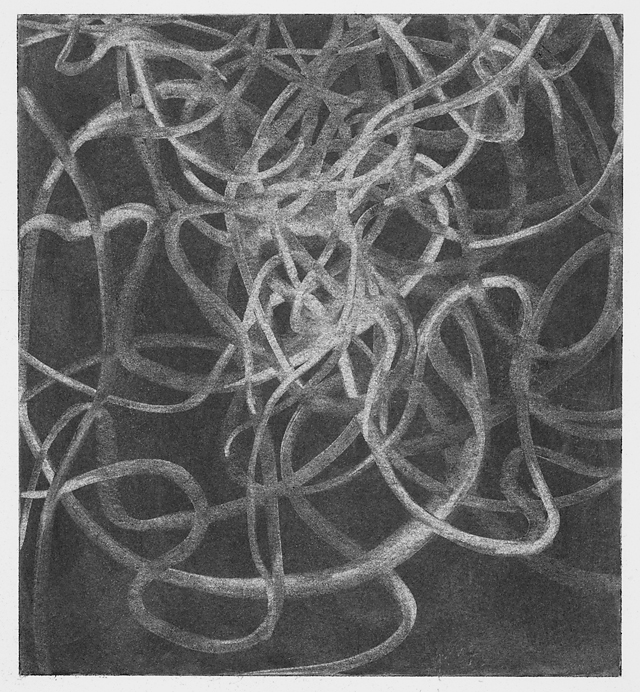
Tangle 34, charcoal on paper, image: 8.5 x 7.75" on 13.5 x 10.75" paper, 2014

Tangle 34, charcoal on paper, image: 8.5 x 7.75″ on 13.5 x 10.75″ paper, 2014

The concept of the artist studio has a broad range of meanings in contemporary practice. Artists may spend much of their time in the actual studio, or they may spend very little time in it. Tell us about your individual studio practice and how it differs from or is the same as traditional notions of “being in the studio.”

‘Being in the studio’ encompasses so much more than being physically present in the studio and making the work. My studio practice includes writing about art, both to clarify my understanding of the work of other artists and to gain new insight into my own work. It includes reading books and articles by/about other artists, and books about creative practice. It also includes a lot of looking: visits to museums and galleries. And finally, it includes having conversations with other artists. Doing the work is certainly the most intense part of being in the studio, but it is very much informed by all the rest.

What roles do you find yourself playing that you may not have envisioned yourself in when you first started making art?

When I was in school, it was taboo even to suggest that being an artist entailed anything beyond making the work and being part of a community of artists. The advice was to just stick with it, find your voice, and everything (!) would fall into place. Of course, that approach is rather naïve.  In addition to working outside the studio so I can pay my bills, my current job description as an artist includes:  marketer, researcher, semi-skilled user of software programs, blogger, occasional woodworker, packager, and maker.

When do you find is the best time to make art? Do you set aside a specific time everyday or do you have to work whenever time allows?

The demands of daily life outside the studio mean that the best time to make art is whenever I am in the studio. Of course I would prefer a predictable schedule filled with long and frequent studio days, but I have adjusted how I work so I can be intensely productive in brief bursts.  

Blacks and Whites 33, oil and oil pastel on paper, image: 19 x 13” on 24 x 20" paper, 2014

Blacks and Whites 33, oil and oil pastel on paper, image: 19 x 13” on 24 x 20″ paper, 2014

How has your work changed in the past five years? How is it the same?

The most significant change in my work has been to fully embrace paring down. Over the years, I have periodically explored more reductivist compositions and palette—but each time I retreated because it didn’t feel like there was enough going on. After my exhibit in 2013, I began a year of experimentation, doing more with less. My work now has a much richer surface texture and increased spatial uncertainty, but at the same time it is compositionally restrained and executed with a very limited palette.  Another noticeable change is that I am actively engaged in two distinct bodies of work at the same time—the compositionally austere Blacks and Whites series (oils and oil pastel on paper) alongside the compressed energy of the Tangle series (charcoal drawings). While the paintings are built over an extended period of time, in which I repeatedly layer, sand and adjust the forms and surface, the charcoal drawings are executed in a single work session using a process that does not allow for any modifications.

The constant that unites both bodies of work is my process. In each series, I establish parameters to guide my exploration and then develop my vocabulary.  But after that initial exploration I go where the work leads me, manipulating the vocabulary in successive iterations through a process that is intuitive, rather than planned.  I seek to pose questions, rather than offering up answers. I am always open to ‘accidents,’ fully aware that those moments often make a piece sing.    

How have people such as family, friends, writers, philosophers, other artists or even pop icons had an impact on the work you do?

Most everything I encounter has the potential to impact my work in some way—the exposed layers of ripped billboards, a phrase in a novel, the pattern of windows on old brick buildings. When I’m feeling stuck, I often reread Gary Snyder’s translation of HanShan, Cold Mountain Poems (which I became acquainted with through the work of Brice Marden), along with Wallace Stevens’ Thirteen Ways of Looking at a Blackbird.  The artists I turn to for sustenance are numerous, but here are just a few:  Myron Stout, Helmut Federle, Suzan Frecon, Stanley Whitney, Richard Diebenkorn, Manet and Velasquez. But above them all stands Morandi, whose work can bring me to tears. I become engrossed in the subtle conversations between forms, the just-right arrangement of objects, his obsessive revisiting and reworking of the same territory.  Finally, along with looking at the work of other artists, historic and contemporary, ongoing conversations with artist friends help me through the uncertainties and fears that accompany the creative life.

Have you ever been pulled in the direction of a pursuit other than being an artist? What are your other interests? 

When I was around ten years old, I briefly entertained the notion of becoming an archaeologist. Although I would have been well suited to patiently revealing what is hidden beneath the surface, I abandoned that idea when I realized that it was primarily about uncovering what other people made.  I have always been a maker and inclined towards going my own way, so while there are many things I do for pleasure—reading, listening to music, cooking, gardening, being politically active—I can’t imagine spending so much of my time doing anything other than being in the studio.

About

TZ headshotTamar Zinn is a visual artist and blogger who lives and works in New York City. She has shown nationally for the past thirty years. Recent exhibits include her 2013 solo “Still/Dancing” at Markel Fine Arts in NYC, and group exhibits include The Last Brucennial, NYC; Navigation Puzzle, Delaware Center for Contemporary Arts; and No Chromophobia, OK Harris, NYC.  Her work is represented in private and corporate collections across the U.S., including Fidelity Investments, McKinsey & Co., Pfizer, and IBM. She has completed commissions for medical centers including MD Anderson Cancer Center, Texas; and Mt. Sinai Hospital and New York-Presbyterian Hospital, both in NYC.  Her work has also been selected for the Arts-in-Embassies program of the US Department of State.  Zinn is represented by Markel Fine Arts in New York and blogs at tamarzinn.blogspot.com

TZ studio shot

All images copyright of the artist and used with their permission.
 

Posted in Painting, Works on Paper | Tagged , , , , | 1 Comment

Faisal Ahmed – Riyadh, Saudi Arabia

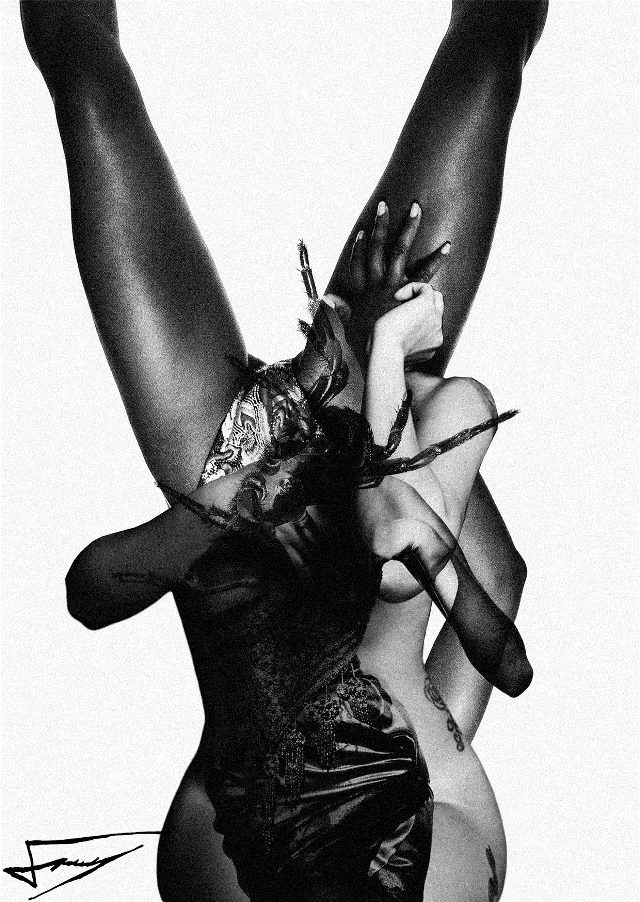
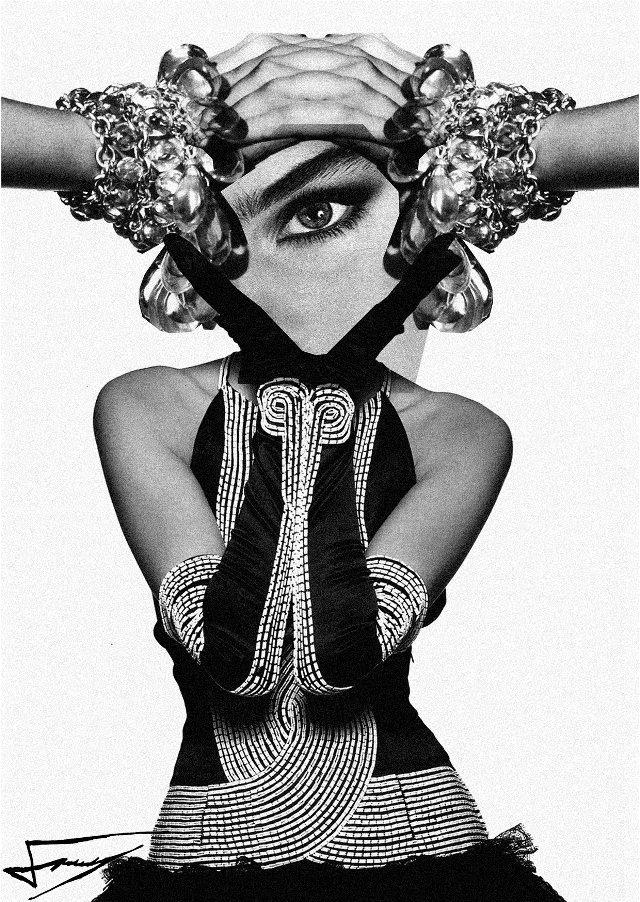
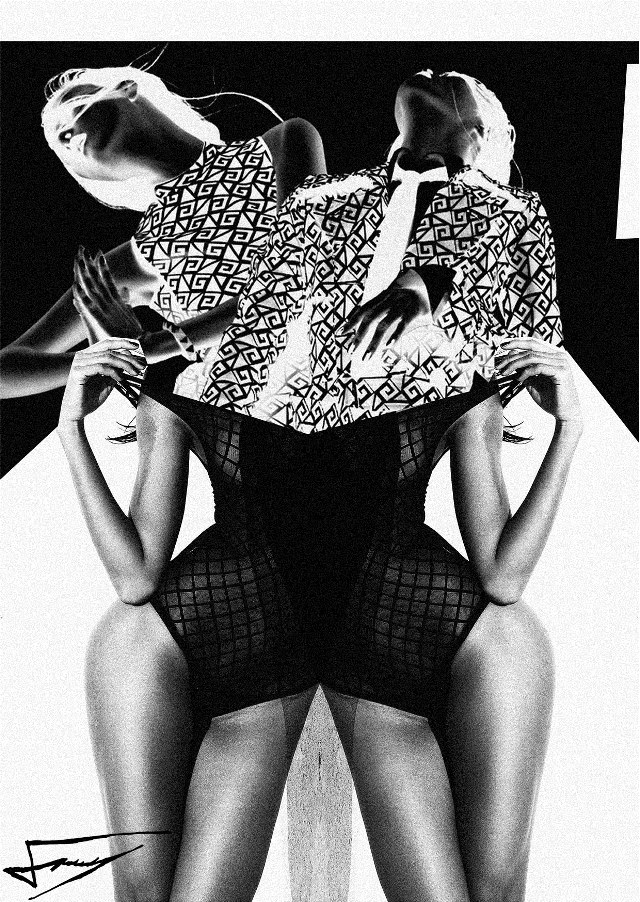
digital collage, 2015

digital collage, 2015

Briefly describe the work you do.

I’m a visual artist and I have been experimenting a lot in the past 2 or 3 years in different mediums and techniques but I started with the detailed art in the beginning since I didn’t have any resources or a space to begin with. Photoshop had everything for me. My artworks in the beginning were very basic in terms of the ideas and the execution. They were mostly about some of my favourite personalities. In the beginning I didn’t think about sharing my artwork or do something with them because I did them “just for fun”. Then it got a little more interesting when I discovered a couple of websites that print your artwork into products so I was more exited to do more “ Commercial” artworks to be printed on totes bags and throw pillows. I started doing that under the name FA23 and opened an Instagram account and people started following me which was weird for me in the beginning because I would never think that people will love anything that I do.

In the last year I tried to focus a little bit on more professional kind of work and pause the “Commercial Pop Art  ” designs, so I started buying books and read more about my favourite thing in the whole world, which is collaging. I started doing digital collaging using Photoshop then I would print them on Stretched Canvas or sometimes I would frame them. In the same time I started working on traditional collages which is more valuable and interesting  for me, and this year I planning to participate in an group exhibition. I’m planning to do a collage using Photoshop then I will screen print them which is going to be very exciting for me since they gonna be first screen print.

Edrea - 2015 - digital collage

Edrea , digital collage, 2015

Tell us about your background and how that has had an influence on your work and on you as an artist.

I’m from Saudi Arabia so there’s a lot of things to influence me specially that I’ve lived in a very interesting era the 90s  ( I was born in 1989 ). In my childhood I was mostly by myself or with my mom and her friends , my father was going thru hard times so he wasn’t around me that much. I was spending my days as a child either in front of TV, which really shaped my interests now or sitting around dreaming with my headphones on.  My teenage years were a little hard on me in many ways, but I learned a lot and it really changed me. In the 7th grade my parent transfer me to a public school, which was like a culture shock for me because it was a whole different community than my old school. It was a  little bit hard in the beginning, but I got used to it and it made me learn how to have a flexible personality. Living in Saudi Arabia has influence me a lot since there is hundreds of different cultures and tradition and the way the Saudis have changed is something amazing because a have noticed the change from my generation to this one and how the standers are different than 10 years ago.

The concept of the artist studio has a broad range of meanings in contemporary practice. Artists may spend much of their time in the actual studio, or they may spend very little time in it. Tell us about your individual studio practice and how it differs from or is the same as traditional notions of “being in the studio.”

I live in a small room so there’s not that much space to create a permanent space to work in, but the studio definition or me is anywhere that I can get comfortable in and get inspired from and since I work with my laptop so it’s easy to move my “studio” with me and for my traditional collages I do them in a canvas panel so I don’t really have to use a table for that so do them in my bed actually. For me wherever I feel comfortable and I can be myself and think clearly it will be a “Being in the Studio” kind of a thing. It will be nice to have a big space that I can work in and call it my studio but for now I guess I’m using the resources that I have very well.

What roles do you find yourself playing that you may not have envisioned yourself in when you first started making art?

As I mentioned in the beginning I was doing something that I didn’t know what it was. I liked it but I didn’t know what it was at that time with my little knowledge with art and designs world because we don’t have art schools for boys in Saudi Arabia they are few but girls only. With time I thought to myself that what I was doing was more commercial digital artworks that didn’t have any meaning although the people liked them printed on products, but this is not what I wanted to “pop art icons portraits “ was fun in the beginning, but it became boring then so I took the decision to stop doing that and plan any artwork that I’m going to do in a more professional  way and do something with an Idea.

When do you find is the best time to make art? Do you set aside a specific time everyday or do you have to work whenever time allows?

It depends on many factors, but I find the most time that I will be active on is when I feel bad about myself so I just grab my laptop and start doing art and sketches, or when I want to apply for an exhibition and they have a certain theme or the request something that I haven’t shown before so I start to do new stuff . I may plan to do 4 artworks, but I end up doing 10 or more. In that time that I’m not working you will find me looking for inspiration reading and practicing on something because I always have that fear for doing something not perfect or complete or people will hate it or judge it.

The Ekekiela In Me, digital collage, 2015

The Ekekiela In Me, digital collage, 2015

How has your work changed in the past five years? How is it the same?

It really changed in many ways in terms of the technique and concept and the way I do stuff. I think the change came alongside with my own growth and knowledge. Although the way I do my artwork changed, the topics and the inspirations had stayed the same, which I’m okay with because I like the topics that drive my artistic style.

How have people such as family, friends, writers, philosophers, other artists or even pop icons had an impact on the work you do?

I don’t have a specific person that impacted my work I would say that there’s an era’s that impacted me and my work I would say they are the 80s (music, movies, photography, and fashion ), the 90s, Japanese culture and Arabian old movies. I have some artist that I really love and look up to in terms of their personality and style, but they are using totally different mediums than the one I’m using which a good thing so I don’t copy their style unconsciously, I really admire Takashi Murakami’s work and how he has everyone get addicted to his work (I’m one of them) , Frida Kahlo and Jean Michel Basquiat.

Have you ever been pulled in the direction of a pursuit other than being an artist? What are your other interests?

I‘ve graduated last year with a bachelor of Business administration, after that I wanted to take some time to focus on myself and travel and create more artworks after a year ( it was the best year in my life so far), I got a job in a consultant company, which I needed to accept that job because I had some financial issue and wanted more money to be able to produce more artworks because it’s just about doing an artwork on my laptop it will take a good amount of money to print and frame this Artwork and ship it internationally if the exhibition is abroad. It’s really frustrating how everything cost something , but so far I pushed myself to work more on my artwork after my day job even if I’m tired or having a social event that I have to go to I would cancel it just to be able to create more artworks.

About

New Faisal AhmedFaisal Ahmed, self taught Saudi Arabian artist born in January of 1989. Faisal’s artworks are majorly collaged that he creates either digitally or in the traditional way. He participated in 3 art exhibitions in Saudi Arabia and several Art & Designs Events. follow Faisal’s Instagram for his dairy post and inspirations @fa23_a.

image2

In the Studio

fadesgin.tumblr.com/

All images copyright of the artist and used with their permission.
Posted in Collage | Tagged , , , , | Leave a comment

David Matteson – Orlando, Florida

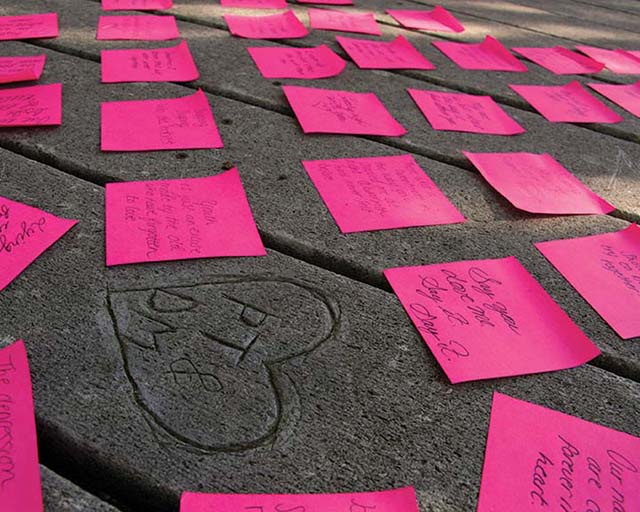
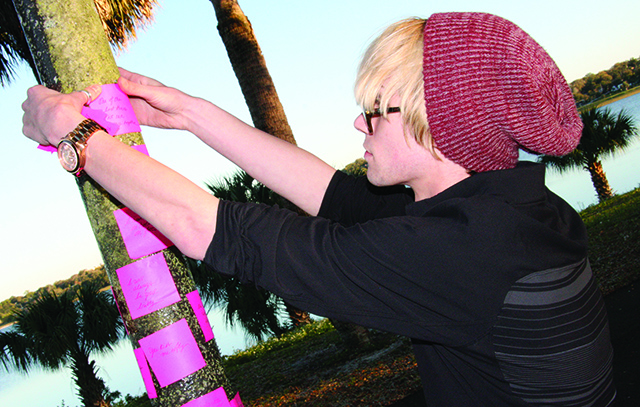
A Loving Memory Revisited: “Bok Tower Gardens,” intervention preserved through photography, post-It notes, February 14, 2015 at 4:20 pm.

A Loving Memory Revisited: “Bok Tower Gardens,” intervention preserved through photography, post-It notes, February 14, 2015 at 4:20 pm.

Briefly describe the work you do. 

My work analyzes structures of identity through a confessional methodology. By drawing upon experiences traditionally thought of as personal/private and exposing them publicly, I consider issues of exploitation and exhibitionism. I have analyzed various cultural constructions through the use of narratives; my most recent work analyzes love and romance through a dissection of the couple.

Tell us about your background and how that has had an influence on your work and on you as an artist.

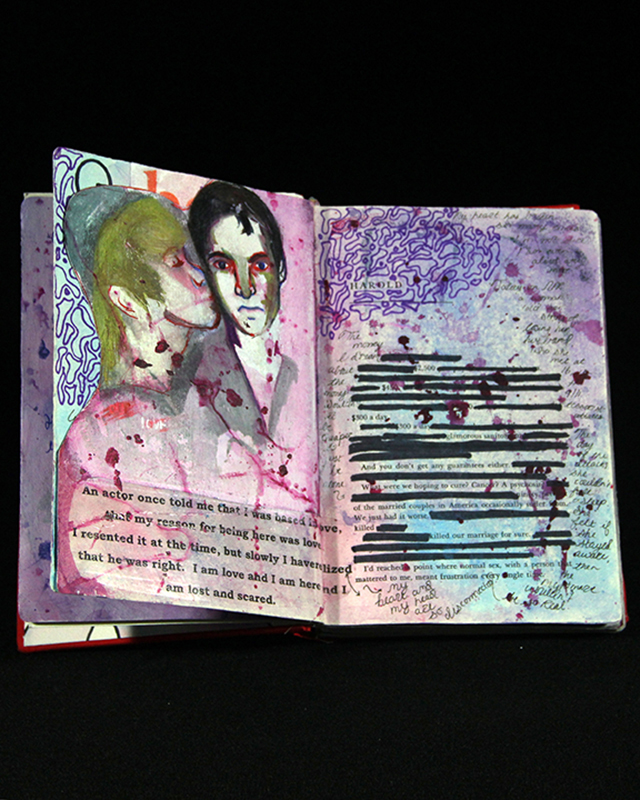
I am a printmaker and book artist who is greatly influenced by narratives. I find solace in the expression of the told story, seeking meaning and connection through the experiences I share with others. My background as a sex columnist has greatly influenced my work. By writing a column, I have learned to utilize a confessional voice, which has carried over to my art practice. My most recent work, The Couple, is an example of this use of the confessional narrative. The Couple is an altered book of a text by the same name published by Masters and Johnson in 1971—it is the story of a husband and wife who underwent extensive sexual therapy to save their failing marriage. Through the alteration process, I connect my own struggles with love and coupledom to their original story. Overall, the work analyzes the monogamous-model, posing the question: is this form of relationship truly the most fulfilling?

The Couple (detail), mixed media drawings in altered book, 9”x12”x2.5”, 2014.

The Couple (detail), mixed media drawings in altered book, 9”x12”x2.5”, 2014.

The concept of the artist studio has a broad range of meanings in contemporary practice. Artists may spend much of their time in the actual studio, or they may spend very little time in it. Tell us about your individual studio practice and how it differs from or is the same as traditional notions of “being in the studio.”

My practice utilizes both a traditional studio in addition to creating work outside in other settings through the form of interventions. As a printmaker, I require access to various tools and presses to create fine artwork. Through interventions, or the placing of a work in an untraditional art setting, I question the necessity for a “studio” or “gallery”—perhaps offering a commentary on contemporary artwork. An example of a recent intervention is the series, A Loving Memory Revisited—on Valentine’s Day 2015, I travelled across the state of Florida to post a series of love notes and poetry written on 554 pink post-it notes in locations that I had vivid memories of falling in love with my former partner. The number of notes directly corresponded to the number of days that he and I were together, and the project was a means of exerting my agency within these spaces. I preserved this intervention through photography; however, the creation process of releasing these post-it notes was the actual artwork.

What roles do you find yourself playing that you may not have envisioned yourself in when you first started making art?

The creation of The Couple, pushed me to consider forms of publishing that I never thought would happen in my emerging artist career. The joy of digitally reproducing the work and self-publishing has allowed the original artwork to reach a larger audience. As a printmaker, I understand the role of prints as a creation of multiples to reach a greater number of viewers; however, acting as both publisher and promoter of this book has been a fascinating growing experience. Like artist books themselves, I am learning to navigate the liminal space between book and art world.

When do you find is the best time to make art? Do you set aside a specific time everyday or do you have to work whenever time allows?

I currently spend around twenty hours a week creating in some way. I do have set studio time on weekends, and I utilize these days efficiently to create as much work as possible. I’m a morning person, and so I tend to work early in the day, often beginning my studio sessions with work in my journal or sketchbook. Self-reflection and goal-setting are two routines that prove necessary to my practice.

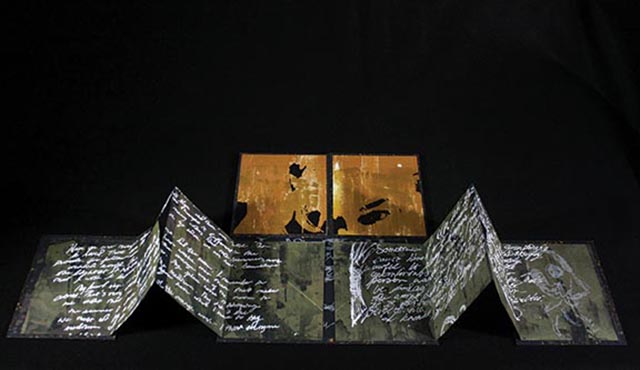
Self-Portrait (2014), artist book of screen-prints on French Paper, 22”x17”x1/2”, 2014.

Self-Portrait (2014), artist book of screen-prints on French Paper, 22”x17”x1/2”, 2014.

How has your work changed in the past five years? How is it the same?

The consistent thread that connects my studio works is a love for narratives. In college I majored in both Studio Art and English, and the latter has left me with a complete love for literature and story telling. This passion works its way into my art practice in obvious ways—through both the use of text as image and the medium of artist books. While my work continues to hinge on this dedication to narratives, the concepts I analyze in my practice have varied greatly within the past few years. Earlier works analyzed addictions and compulsory behavior, while my most recent body of work questions love and coupledom (arguably another form of addictive behavior). In spite of this difference in themes, I continue to define my identity through the creation of artwork.

How have people such as family, friends, writers, philosophers, other artists or even pop icons had an impact on the work you do?

I am greatly influenced by established contemporary artists such as Tracey Emin, Sophie Calle, and Jenny Holzer. Emin in particular provides a context for my artwork—her confessional works stand as the genesis for current neo-confessional artists and writers. Throughout college, I studied queer theory as a lens for understanding my artwork—Lauren Berlant and Michael Warner were two writers who I was particularly interested in. In Orlando, I am surrounded by other artists who continue to inspire me—Betsy Johnson, Rachel Simmons, and Kyle McCoy are all artists I turn to for constant critique and support.

Have you ever been pulled in the direction of a pursuit other than being an artist? What are your other interests? 

In addition to my studio art practice, I am a working graphic designer. Fulfilling the visions of my clients is a practical application of the skills I learned through my art education. I continue to identify myself as both an artist and writer—publishing and writing are certainly passions of mine.

About

HeadshotDavid Matteson is an artist and writer based in Orlando, FL.  He graduated with his BA in Studio Art and English from Rollins College in 2015.  In 2015, he released his first book, an altered book named The Couple which is a compilation of both mixed media drawings and confessional writing.  His artwork has been featured in the Cornell Fine Arts Museum in Winter Park, FL.

Studio (Working) Photo

davidmatteson.net

All images copyright of the artist and used with their permission.
Posted in Book Arts, Printmaking | Tagged , , , , | Leave a comment

Giang Pham – Gainesville, Florida

GiangPhamWork01Briefly describe the work you do.

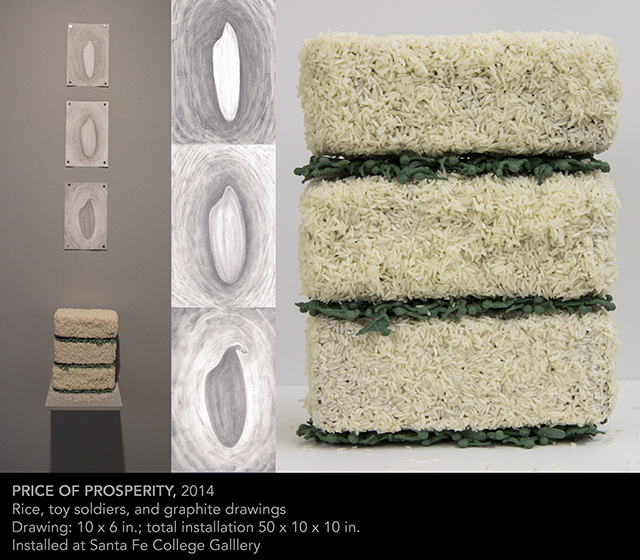
In my current body of work, Price of Prosperity, I create visual arguments on the theme of loss, pain, and growth with the use of digital media, drawing, altered and found images, and sculpture. I construct these arguments by borrowing the language of cultivation (rice farming) and compare it with the language of war and conflict. My installations serve as a reminder of the spiral of growth and destruction that a society seeks in order to grow and prosper. The context of my work is woven through an individual narrative that is made political through these visual arguments.

Tell us about your background and how that has had an influence on your work and on you as an artist.

I grew up in post-war Vietnam, and have experienced extreme hunger and poverty with my family. My family worked in the rice fields, which was enough for only the food on our plate. I was seven when we moved to the United States, where my family faced a whole other side of poverty. The experiences I had growing up in Vietnam then in the US define my appreciation for food, the objects I consume in my daily life, and the state of the body. My art practice stemmed from this appreciation and these experiences.

GiangPhamWork03

The concept of the artist studio has a broad range of meanings in contemporary practice. Artists may spend much of their time in the actual studio, or they may spend very little time in it. Tell us about your individual studio practice and how it differs from or is the same as traditional notions of “being in the studio.”

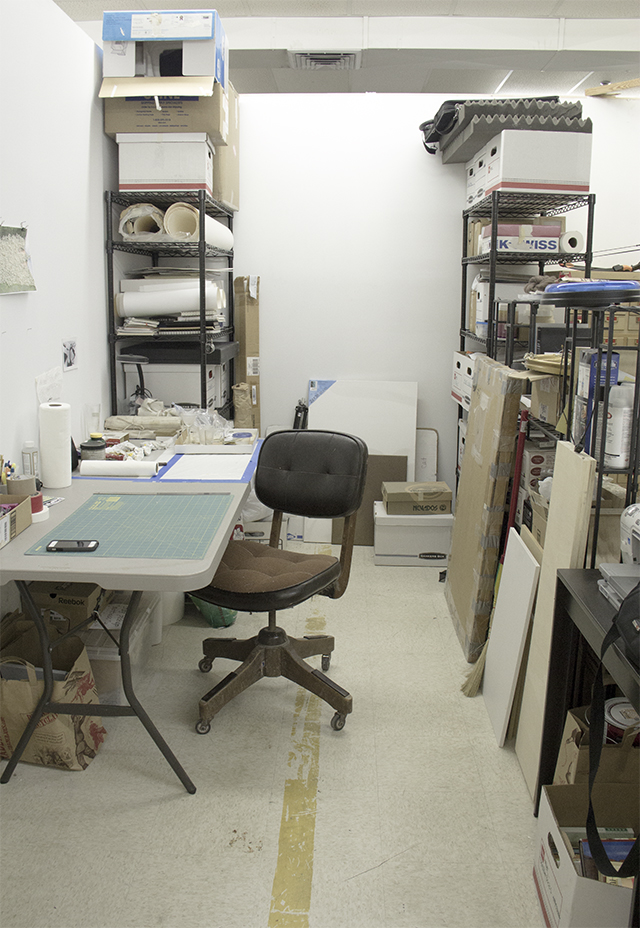
I have a very small studio space that I share with my roommate (about 84 square feet for each of us), but I only visit it if I know exactly what I’m doing in the studio. Most of my studio time is spent in my head, grappling with issues of identity politics and trying to figure out how the visual art can be used to convey these complex issues. Unfortunately, the road map for identity issues in visual art is always a breath away from disappearing. Because of who I am and the subject matter of my work, I have to spend a lot of time finding and constructing the right wheels to travel on barely visible roads.

I realized early on that in order to make challenging and purposeful works that do not perpetuate stereotypes, I have certain responsibilities as an artist. These responsibilities include: having processed and understood the issue at hand through research and reflection, devising effective strategies to visually communicate and contextualize the idea without simply illustrating it, and having worked out at least three possibilities on how I can go about acquiring, constructing, and arranging the necessary visual elements to convey the idea. After this initial work, I spend the remaining 10% of my studio time in my physical studio experimenting with materials and constructing the work.

What roles do you find yourself playing that you may not have envisioned yourself in when you first started making art?

I used to think that I could draw, paint, and make any and all types of art. But I was wrong. The visual culture doesn’t need me to arbitrarily draw or paint another flower, focus on a specific art technique or style, make meta-art, or even convey issues in my work that anyone else could without the context of being an Asian-American woman. I leave those topics to my more privileged peers. Now I play the role of the critical artist. I’m not afraid to make art that challenges the viewer. I’m in love with the visual art because I can make something so attractive yet so difficult to spend time with.

When do you find is the best time to make art? Do you set aside a specific time everyday or do you have to work whenever time allows?

Due to my studio practice, the best time for me to make art is after I’ve contextualized the idea through the rigorous process of research, reflection, strategizing, and acquisition of materials. The work is nothing without context. This means that most of my time is spent in a state of funk. I call it funk because I’m always chewing on unpalatable issues and trying to figure out how they all fit with the big picture. Once I’m finished with this funk, I can move to the fun part of constructing objects, images, and spaces for the idea.

GiangPhamWork02How has your work changed in the past five years? How is it the same?

I used to dance around difficult ideas because I lacked the visual and verbal vocabulary to voice them. Five years ago, I was making art that utilizes the strategy of substitution too often – using stuffed animals to create commentary. But I was still too young to know how to effectively and critically accomplish this. I floundered because I didn’t know of any role models and didn’t have teachers that could mentor me through this process. Grad school was a necessary meat-grinder because of this lack of preparation. I had to chart my own path and learned through trial by fire. Now that I’ve paid my dues to the devil and survived, my work has more cohesive metaphors and it’s more deliberate in its execution.

How have people such as family, friends, writers, philosophers, other artists or even pop icons had an impact on the work you do?

I’m very fortunate to have my transgendered artist roommate, Oliver, who does privilege workshops. Oliver and I bounce ideas off each other and even collaborate. We’re very honest if an idea sounds like it’s co-opting someone’s space, perpetuating stereotypes, further marginalizing a group, or if it’s just plain dumb. We both work very hard together and separately to build the necessary art network for each of us to survive. We recently had the pleasure of hosting and learning from artist Kenya Robinson, who uses privilege as a plastic material and carries a white man in her pocket. For me, painters Michael Dixon and Beverly McGiver serve as role models who produce and introduce often-eclipsed narratives into our visual culture. Artists Doris Salcedo, Do-Ho Suh, Binod Shrestha, and Janine Antoni also serve as signposts for topics and approaches I’m interested in and pursuing. Seeing and being around similar minded folks help me feel not so lonely in less charted territories.

Have you ever been pulled in the direction of a pursuit other than being an artist? What are your other interests?

I try to balance all three of my passions: art, teaching, and plants.

I’m currently teaching art at two separate higher institutions and conducting my art research at the same time. I love to teach because it challenges me to always be authentic. I also use teaching as a medium to communicate the importance of mindful contributions to the visual culture.

My orchid and succulent collections calm me through the care and the slow rate of growth for plants. They’re a necessary balance to our speed-of-thought society and our digital gadgets at the moment. I would have gotten degrees in botany and horticulture if visual art hadn’t swooped me off my feet. I would have been happy with either outcome because I know that either path would have led me to a place of criticality.

About

GiangPhamHeadshotGiang Pham (pronounced yangfam) lives in Gainesville, FL, where she teaches art at the University of Florida and Santa Fe College. Giang received a Master’s of Fine Art in Sculpture from the University of Florida and a Bachelor’s of Fine Art in Painting and Printmaking from the University of Tulsa, OK. Giang’s practice spans a wide breadth of mediums. Currently, Giang is investigating issues of loss, pain, and growth in relation to food and the body.

GiangPhamStudio

altimablossom.net

All images copyright of the artist and used with their permission. 
Posted in Installation | Tagged , , , , | Leave a comment

Rachel Eng – Boston, Massachusetts

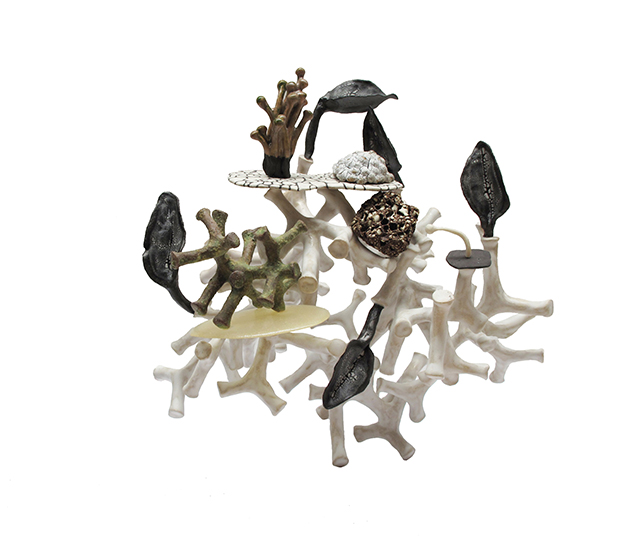
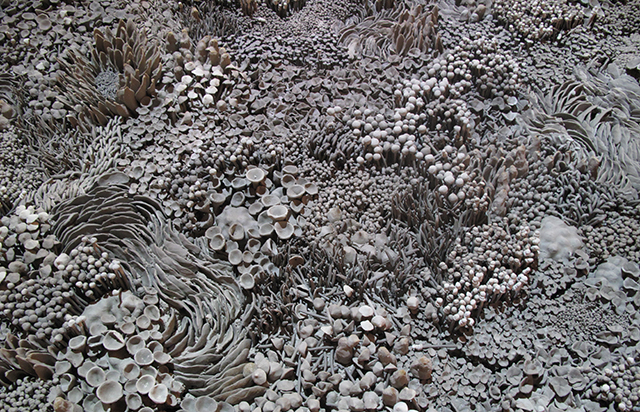
Plexus, Ceramic, glazed scoria, resin, 11’’ x 11’’ x 8’’, 2014

Plexus, Ceramic, glazed scoria, resin, 11’’ x 11’’ x 8’’, 2014

Briefly describe the work you do.

When I search the word “small” in the thesaurus many words associated with insignificance and being inappreciable come up. Why is something that is described as small associated with being unimportant? I think the opposite; the small parts are most significant to the whole, whether in an ecosystem, a sentence, or what affects our experiences. My work focuses on drawing attention to the complexity in the overlooked and unseen and making them monumental.

Tell us about your background and how that has had an influence on your work and on you as an artist.

During graduate school one of my professors suggested Bourriaud’s The Radicant and I found it has helped me become more attuned to my identity as an artist. I had never heard of the word radicant before this book. A radicant is a plant that sends out multiple roots while growing (like ivy) versus a radical, which has one root (a tree).

Sometimes living in transition feels like being a radicant. When you are always adapting to your surroundings or the changes in ones environment. There isn’t always one particular moment you are reacting to, but instead propelling yourself forward in order to continue to develop versus being in a state of stillness. Does a radicant ever settle permanently or do they continue to uproot the rest of their lives and have ties allover? When I first began making art I struggled understanding what an artists style meant, was there a certain type of work I was going to make that would be my “style”? As I made and looked at more art I felt more comfortable not settling on creating one type of work but enjoy not knowing the answer and the ability to experiment. Bourriaud also speaks of disintegrating the boundaries that can sometimes be put up around cultures. I associated that to being a metaphor for artists and the overlaps between disciplines as well as ideas. I have found other artists to be greatly influential and the open exchanges between one another makes a thoughtful community. We are an ecosystem that is constantly growing together.

I grew up in Rochester, NY where it snows a lot, and I think is beautiful in all seasons. I spent my summers playing in the woods and sifting through creeks and starring at deciduous trees.

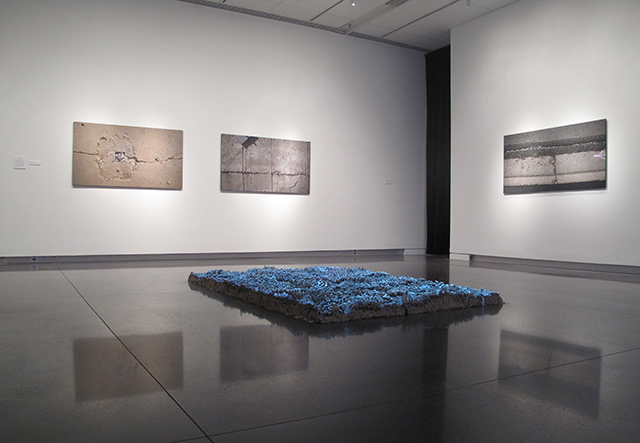
Stay on the Path (Installation View), Unfired clay, video projection, 4’’ x 66’’ x 102’’, 2013

Stay on the Path (Installation View), Unfired clay, video projection, 4’’ x 66’’ x 102’’, 2013

The concept of the artist studio has a broad range of meanings in contemporary practice. Artists may spend much of their time in the actual studio, or they may spend very little time in it. Tell us about your individual studio practice and how it differs from or is the same as traditional notions of “being in the studio.”

My practice has adapted to changes in my life and the process for some of my projects involves me working wherever I can carry a lump of clay around, ie: at home, on a bus, or at a movie. These projects allow mobility in the process, however the finished pieces are in a static setting. I adapted this process in relation to grief work, where there is a relief and mediation drawn from keeping my hands busy.

What roles do you find yourself playing that you may not have envisioned yourself in when you first started making art?

I never thought that I would be working with clay. When I started making art I focused on painting and drawing. Since taking an introduction class during college, I have loved the versatility and experimentation in form and surface that ceramics allows.

When do you find is the best time to make art? Do you set aside a specific time everyday or do you have to work whenever time allows?

The quietness of the morning means a lot to me. I run at least an hour everyday and it is a time where I can think or not think. Sometimes I work through project ideas and other times I just

listen to my breathing or the sound of my feet. This time in the morning is mentally as well as physically refreshing with the morning light, air, and absence of traffic. Running helps me focus my mind for when I work in the studio. When I work at studio depends on each day because my work schedule fluctuates. The time also changes depending on the project, some projects I need a large span of time to complete in one day, versus a longer project I can break up into weeks or months.

How has your work changed in the past five years? How is it the same?

Making work that exists outside of a white space. Before, I solely installed work in a conventional exhibition space, but now I can see a crevice in the sidewalk or a break in the horizon as a site for a specific piece. Five years ago I used the figure for metaphor, the figure has completely left my work but my sensitivity to creating immersive environments is still present.

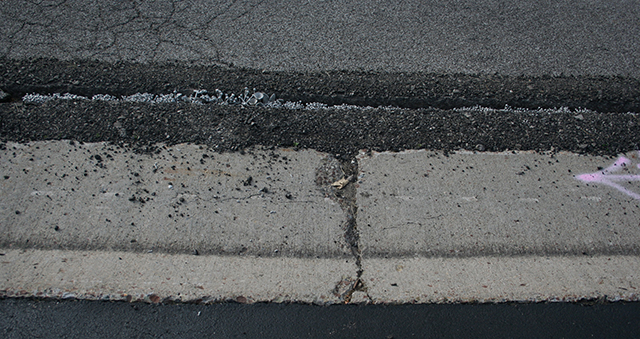
A Line, Digital Print, 36’’ x 44’’ x .25’’, 2013

A Line, Digital Print, 36’’ x 44’’ x .25’’, 2013

How have people such as family, friends, writers, philosophers, other artists or even pop icons had an impact on the work you do?

During undergrad I found a copy of The Sea Around Us being thrown out and took it home. The author, Marine Biologist Rachel Carson encapsulates how much life is in the liquid film around a grain of sand as becoming an ecosystem where “ insects and the larvae of certain infinitely small worms — all living, dying, swimming, feeding, plants, water mites, shrimp like crustacea, breathing, reproducing in a world so small that our human senses cannot grasp its scale, a world in which the micro-droplet of water separating one grain of sand from another is like a vast, dark sea.”1 I love how this quote transports me to another world and thinking about all the life concurrently existing that cannot be seen by the naked eye.

My friends, family, professors, and strangers that talk to me have all had a great impact as well.

Have you ever been pulled in the direction of a pursuit other than being an artist? What are your other interests?

I thought I would be a marine biologist because my fascination with the ocean. I am glad I can still explore this fascination in my practice along with new and old interests: exploring parts of the country that are still wild, running, reading, and watching Parks & Recreation and cat videos.

About

Rachel ERachel Eng holds an MFA from The University of Colorado at Boulder and a BFA from The Pennsylvania State University. Her work has been shown nationally, most recently at the Carbondale Clay Center and she is a part of Hyperlink, a mobile artist collective presently based out of Chicago. Currently she is the year-long resident artist at Mudflat Studios in Somerville.

Stay on the Path (detail), Unfired clay, video projection, 4’’ x 66’’ x 102’’, 2013

Stay on the Path (detail), Unfired clay, video projection, 4’’ x 66’’ x 102’’, 2013

racheljeng.com

All images copyright of the artist and used with their permission. 
Posted in Ceramics, Collage, Installation | Tagged , , , , | Leave a comment

Cassie Marie Edwards – Madison, South Dakota

Two Islands, Oil on Panel, 8” round, 2014

Two Islands, Oil on Panel, 8” round, 2014

Briefly describe the work you do.

My recent studio work centers on a series of still life paintings done in oil that are intended to explore the boundaries of representational art. The paintings feature small-scale sets that contain ceramic figurines and hand constructed landscapes that are painted from life.

Tell us about your background and how that has had an influence on your work and on you as an artist.

As a kid, my family moved a lot.  Art was a source of stability and a way for me to meet and connect with people.  It was also a great way for me to deal with the disconnect I sometimes felt when trying to assimilate into a new place.  Both of my parents worked, and I had the luck of spending a lot of time with my grandparents who encouraged our creativity – we would play outside, make sculptures out of scrap wood, and take sewing lessons with my Grandma. I was taught by my Grandpa how to draw at a young age and was further encouraged by my art teachers in each of the places we lived.

The concept of the artist studio has a broad range of meanings in contemporary practice. Artists may spend much of their time in the actual studio, or they may spend very little time in it. Tell us about your individual studio practice and how it differs from or is the same as traditional notions of “being in the studio.”

When it comes to the practical side of art making, I’m a fairly meticulous planner, and have a constant to-do list of both physical work (painting, drawing, framing, building canvases), and paperwork (proposals, grant writing, taxes,etc.).  I think that sometimes people imagine artists as constantly painting or drawing in their studios, that the business end just magically gets done.  One of the reasons I’ve started blogging and sharing my work via social media is to show all aspects of what I do from the magic of working in the studio to the nuts and bolts of building canvases.  Being an artist is hard work, and  being self employed is even harder – I think when people see that firsthand they are less likely to brush off what you are doing as an artist as a hobby, or as something they can easily devalue.  

There are many times when creativity doesn’t come easy, and I need to get out of the studio and look at art, or go to the thrift store, or get outside and go for a run.  Sometimes ideas strike at strange times – in the middle of a long run, sitting by a bonfire, or talking with friends. I always have my sketchbook, or my phone with me so I can jot down ideas and concepts at a moments notice.  I’ve stopped mid-run to write down notes for a painting.

I don’t really draw too many lines between my art-making time and my non-art making time.  My studio is a bedroom in my house, so it makes it easy to access on a whim.  I can also pull out a drawing and work on it on my porch if I want to too – I’ve found having my studio adjacent to my living space has really increased the time I spend working on my studio work.

Three Mountains, Two Clouds, Oil on Canvas, 31x30”, 2014

Three Mountains, Two Clouds, Oil on Canvas, 31×30”, 2014

What roles do you find yourself playing that you may not have envisioned yourself in when you first started making art?

Blogger and skill sharer.  I was 10 when we first got a computer with internet connection and it was a game changer for me.  I could research things that I never had the opportunity to see or experience in the small rural towns we grew up in across Wisconsin and Minnesota.  I always had a passion for DIY culture and an insatiable curiosity for how things work, so surfing the internet for tutorials and inspiration became second nature fairly quickly.  

I really enjoy sharing the things I’ve learned with others, and think that’s a characteristic a lot of artists possess.  It may also come from being an educator the last 7 years.  On my blog, I post a lot of tutorials and tips for artists along with sharing both my triumphs and failures.  Everyone needs a support system (especially when living in a somewhat isolated area), and I’ve found a lot of mine online via blogging and social media.

When do you find is the best time to make art? Do you set aside a specific time everyday or do you have to work whenever time allows?

I look at my schedule each week and decide which evenings I’m going to spend in my studio working and put them in writing on my calendar. I like to work in long stretches in my studio.  I tend to start at about 4pm and work straight through until about 2am.  This works well with the way I paint because I can get one layer painted over the whole surface in that time.  I don’t work well when I’m working in tiny chunks of time – I feel like it takes me a little while to find a rhythm with my painting sessions.  

I love working late into the night.  I’ve never been a morning person – I don’t think it is part of my genetic makeup.  There is nothing better in my mind than a cup of hot tea, total quiet, and the stillness after about 11pm.  There is something about those magic twilight hours that make the brush move much more easily across the surface.

Lightning, Oil on Panel, 12x12”, 2015

Lightning, Oil on Panel, 12×12”, 2015

How has your work changed in the past five years? How is it the same?

Five years ago, I’d just finished grad school at Northern Illinois University  and I moved from DeKalb, Illinois to Madison, South Dakota, where both my husband and I currently teach.  My work really shifted after my MFA work – I’d been working on a project where I renovated a dollhouse into my dream mid-century modern home – documenting the entire process from start to finish with drawings, photographs, and gouache paintings.  It was a project that had a definite ending.

After the dollhouse series was completed, I took some of the elements I’d enjoyed from that process like staging and lighting photographs of miniatures, and started to make small staged pieces involving figurines and hand-built landscape elements.  I switched from working with photography to painting – working directly from life, and became more interested in pushing and exploring the space between the genres of still life, landscape, and portraiture.  

How have people such as family, friends, writers, philosophers, other artists or even pop icons had an impact on the work you do?

I think my artist, musician, and writer friends, along with my former teachers, really have had the most impact on my work.  I’ve been so lucky to have such great mentors and peers throughout my schooling and my art career – I think their encouragement paired with many bouts of tough love have really pushed me through a lot of tough times and struggles as an artist.  When I’m talking with my current students, I always make sure to point out that I’m tough on them because I care about them.  One of my professors in grad school told me that and it was one of those moments that really stuck with me and propelled me to take more risks and commit to pushing myself harder.

Living in South Dakota for the last five years has also been a game changer.  We knew no one when we first came here, but we quickly made strong friendships with some driven and talented artists who really cared about their communities.  Because of there being fewer venues and fewer artists coming through, I couldn’t just cherry-pick the exhibits I went to based on what I already like.  It pushed me to attend virtually everything, and give things a chance that I might have previously pass on. I’ve found some inspiration in some really surprising places and gotten to have experiences I’d have never imagined being a part of because of this.  We’re now picking up and moving again this summer – this time we’ll be going back to Oshkosh, Wisconsin – and I’m sure it will be a whole new adventure.  

Teaching at the college level has also profoundly transformed my work and the way I think about my studio work.  Thinking about how students learn effectively and trying to craft lectures and assignments that encourage students to take risks and find their voices has also helped me clarify the things that really excite and interest me as an artist.  In my classes, I really try to get students to rely on each other and to see each other as collaborators in their education even when they are working on independent projects.  Whenever possible, I try to jump into collaborations with other artists.  For me it has led to some really important breakthroughs with my studio work and has connected me with some excellent artists.

Lastly, having a musician/educator for a spouse is really great.  We’ve been together for almost 15 years, and through that time have taken turns supporting each other through our educations and our professional and creative careers.  We occasionally collaborate, but always make time in our lives for our creative endeavors.  Most of our vacations are planned around travel mini music tours or art exhibitions.  Having someone who understands the demands and strains of creative work can be such a huge relief and support.

Have you ever been pulled in the direction of a pursuit other than being an artist? What are your other interests?

I’ve wanted to be an artist for as long as I can remember.  I started out getting my BFA in Art Education, but promptly switched to studio art after deciding I wanted to either be a full time artist or teach at the college level.  I’ll pick up freelance photography gigs and work on illustrations and commissioned pieces from time to time, but thus far I’ve been pretty happy working directly in my field.

My other interests outside of art making are fairly varied.  I love cooking and growing my own food – I’ve got a massive garden that grows larger every year.  I could spend my entire summers outdoors camping, fishing, running, and hiking.  I’m a completely curious person, and love learning new things too – over the years I’ve picked up knitting, sewing, restoring furniture, photography, and filmmaking.  I’m all for learning new things and engaging outside interests – things I learn on a whim always have a way of sneaking themselves into my studio work.

About

image001Cassie Marie Edwards is a Painter and Educator based in Madison, SD.  She holds a Masters of Fine Arts degree in Painting & Drawing from Northern Illinois University, and a Bachelor of Fine Arts Degree in Painting & Drawing from the University of Wisconsin-Oshkosh.  She works part-time as an Adjunct Professor at Dakota State University teaching in the Digital Art and Design program.  Prior to teaching at Dakota State University, she was an Instructor of Record at Northern Illinois University.

Her paintings have been exhibited in New York, Los Angeles, Chicago, Miami, Las Vegas, Milwaukee, Minneapolis and Sioux Falls.  Regionally, her work has been exhibited at the South Dakota Art Museum, the John A. Day Gallery at University of South Dakota, the Visual Arts Center at the Washington Pavilion, The North Dakota Museum of Art, The Dahl Arts Center, and the Isaac Lincoln Gallery at Northern State University.

image003

cassiemarie.com

All images copyright of the artist and used with their permission. 


Posted in Painting | Tagged , , , , | Leave a comment

Justin Kim – Long Island City, New York

Deep Springs Valley V (Full Moon), mixed media on paper, 44 x 60", 2013

Deep Springs Valley V (Full Moon), mixed media on paper, 44 x 60″, 2013

Briefly describe the work you do. 

I paint large, mixed media landscapes on paper. The subjects are specific sites from my personal history and travels.

On a formal level, I’m trying to do two things: 1. Mix different styles and approaches within each picture (showing how our perception of the world is constantly shifting). 2. Maintain a sense of illusion and deep space by establishing a physical point of view. These goals are potentially incompatible, but it keeps things interesting.

Tell us about your background and how that has had an influence on your work and on you as an artist.

I’m mixed race. My father is first generation patrician Korean-American and my mother is second generation working-class Italian-American. I’m gay (and have been out for over 20 years). I’m also the kind of person who seeks out interesting experiences – living in different communities, meeting different kinds of people, working in different environments. From all of this, I’ve gained the ability to see things from a range of perspectives. It also makes me a person who looks for connections between things that seem completely unrelated.

In my work I’m incorporating lots of  elements into one piece and one point of view. Is it possible to create connections that didn’t exist before? Is it possible for different elements to coexist?  In my life and in my artistic practice I’m trying to bring unexpected and unrelated things together – integrating them to make the whole far greater than the sum of its parts.

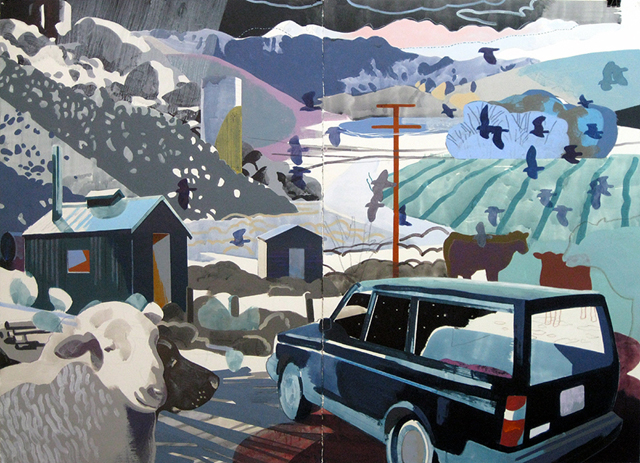
Deep Springs Valley VIII (Water Truck), mixed media on paper, 44 x 60", 2014

Deep Springs Valley VIII (Water Truck), mixed media on paper, 44 x 60″, 2014

The concept of the artist studio has a broad range of meanings in contemporary practice. Artists may spend much of their time in the actual studio, or they may spend very little time in it. Tell us about your individual studio practice and how it differs from or is the same as traditional notions of “being in the studio.”

My studio practices is pretty traditional—lots of work building up an image, Lots of staring at the image and intuiting what to do next. The landscapes are definitely studio paintings (and not plein air). I construct them using a combination of sketches, reference photos and images projected onto the surface. At any given time I have between 5 and 10 pieces in process. When I reach an impasse with one, I put the painting away until I can approach it with a fresh pair of eyes. This works especially well in my current studio which is, to put it mildly, “spatially-challenged.”

What roles do you find yourself playing that you may not have envisioned yourself in when you first started making art?

I can’t really think of anything specific in terms of a role. Painting has forced me to be more resourceful, flexible and generous with myself than I’d imagined. It also gets more complex the more you do it.

When do you find is the best time to make art? Do you set aside a specific time everyday or do you have to work whenever time allows?

I’m a morning person. Between 9 AM and 3PM (with a decent breakfast and 2 cups of coffee) I can get a lot done. Occasionally I find my second wind in the evening, but this is rare.

Deep Springs Valley VII (Green Shed), mixed media on paper, 44 x 60", 2014

Deep Springs Valley VII (Green Shed), mixed media on paper, 44 x 60″, 2014

How has your work changed in the past five years? How is it the same?

It’s changed a lot. I’ve given myself more permission to experiment, try different techniques and approaches and worry less about consistency or how things look. By opening up, I’ve found a process that reflects much more of who I am and what interests me. If any aspect of the work is the same it’s how I draw. I tend to drag the brush across the surface, using friction to guide my hand. I’m most comfortable using a range of thickness of line and brushstroke, but I’m also constantly experimenting with this.

How have people such as family, friends, writers, philosophers, other artists or even pop icons had an impact on the work you do?

Here’s who / what has influenced me most over the past few years:

Writings: Schopenhauer, J.M. Coetzee

Artists: David Hockney, Sol LeWitt, Julie Mehretu. I interned with David Hockney while I was in college. Besides learning about the culture of the art world I got to watch him at work, which was incredible.

Pop Culture: I listen to podcasts while I’m working: Radio Lab, WTF, Invisibilia, etc. Some of this definitely gets absorbed into my consciousness. For example: Kathy Griffin talking about the long hard slog of finding her place in the world of comedy (to paraphrase): “Having a career is possible, but you have to stick to who you are and what you have to offer.

Have you ever been pulled in the direction of a pursuit other than being an artist? What are your other interests? 

When I reach an impasse with the paintings or feel bogged down, I ask myself, “Do you really want to keep doing this? Do you want to commit to being a painter or not?” I’ve always answered yes, but by asking myself this question, I’m making a definitive choice instead of sticking with painting “because there’s nothing better to do.”

About

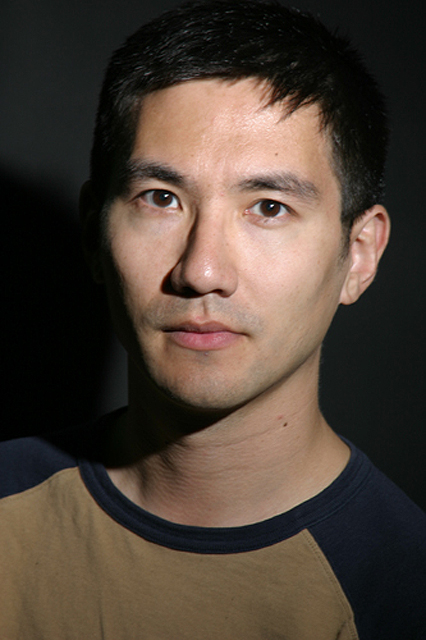
headshotBorn in Hartford, CT, Mr. Kim received a B.A. from Yale and an MFA from the American University in Washington, D.C. While at Yale, he worked as an intern for the artist David Hockney.

He has exhibited across the Northeast including: Denise Bibro, Brenda Taylor and Bowery Galleries in New York City, B.J. Spoke in Huntington, NY, The Oxbow Gallery in Northampton, MA, Manifest Gallery in Cincinnati, Jannotta Gallery at Smith College and Beard & Weil Galleries at Wheaton College in Norton, MA. Recent grants and awards include a Working Artist Grant (2014) and Best in Show Award by Andrew Russeth, Senior Editor at the New York Observer for the Art of the Northeast Competition. His work has been included in Studio Visit and Fresh Paint Magazines. He was also one of 20 artists selected to represent New York City in Artist Portfolio Magazine, Issue 15: LA vs. NY.

Mr. Kim has taught at Yale, Dartmouth, Smith College and Deep Springs College in CA.

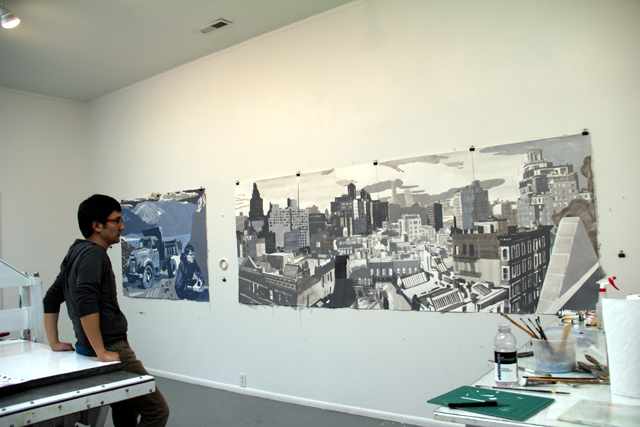
studio image

justinethankim.com

All images copyright of the artist and used with their permission. 
Posted in mixed media | Tagged , , , , , | Leave a comment

Allison Cekala – Boston, Massachusetts

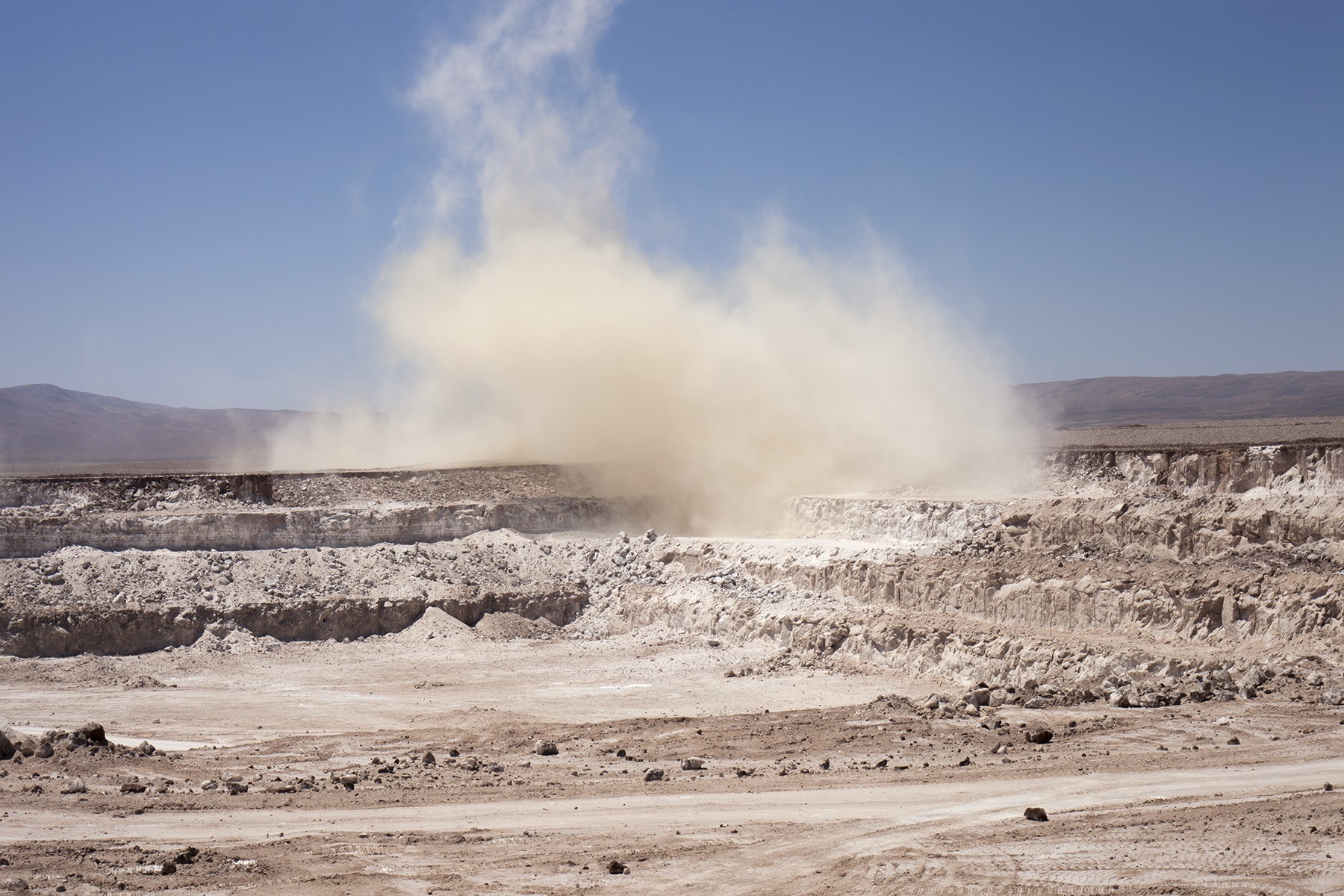
Video still (Great Salar de Tarapacá, Chile) from Fundir, 2015

Video still (Great Salar de Tarapacá, Chile) from Fundir, 2015

Briefly describe the work you do.

Most of my work stems from direct observations within my immediate environment. I understand the work as an investigation of nature—a documentation of the way in which humans move, shape, and transform their surroundings.  I frame the landscape to uncover stories that may be overlooked at first glance, whether it be defunct landfills that are now public parks or the unpacking of the intricate story behind Boston’s road salt, my most recent project.

Tell us about your background and how that has had an influence on your work and on you as an artist.

I was a double major in Environmental Studies and Photography as an undergraduate at Bard College (‘06).  At the time, the Fresh Kills landfill on Staten Island had recently closed, so New York City was exporting their trash on barges to other states.  Shocked by this fact, I began researching the history of solid waste management in New York City, to try to figure out how this happened. Both my artwork and my academic research began to intertwine.  I worked for the Sanitation Department of New York as a summer intern and I began to understand how the city undertook the immense task of getting rid of their trash, a system that was largely unknown and un-phased by the average New Yorker.  My environmental studies work was a written paper about the economics, politics, and history of the New York City waste management system, while my photography work explored one aspect of it—covered, out-of-use landfills.  I photographed numerous areas in New York City that had once been trash landfills and the project expanded landfills across the country.  I wanted to show the idea that trash was everywhere and still continues to shape our landscape.  Fast-forward nine years and my current work is still exploring how humans affect the landscape. I am still finding myself working within urban systems and public works departments.

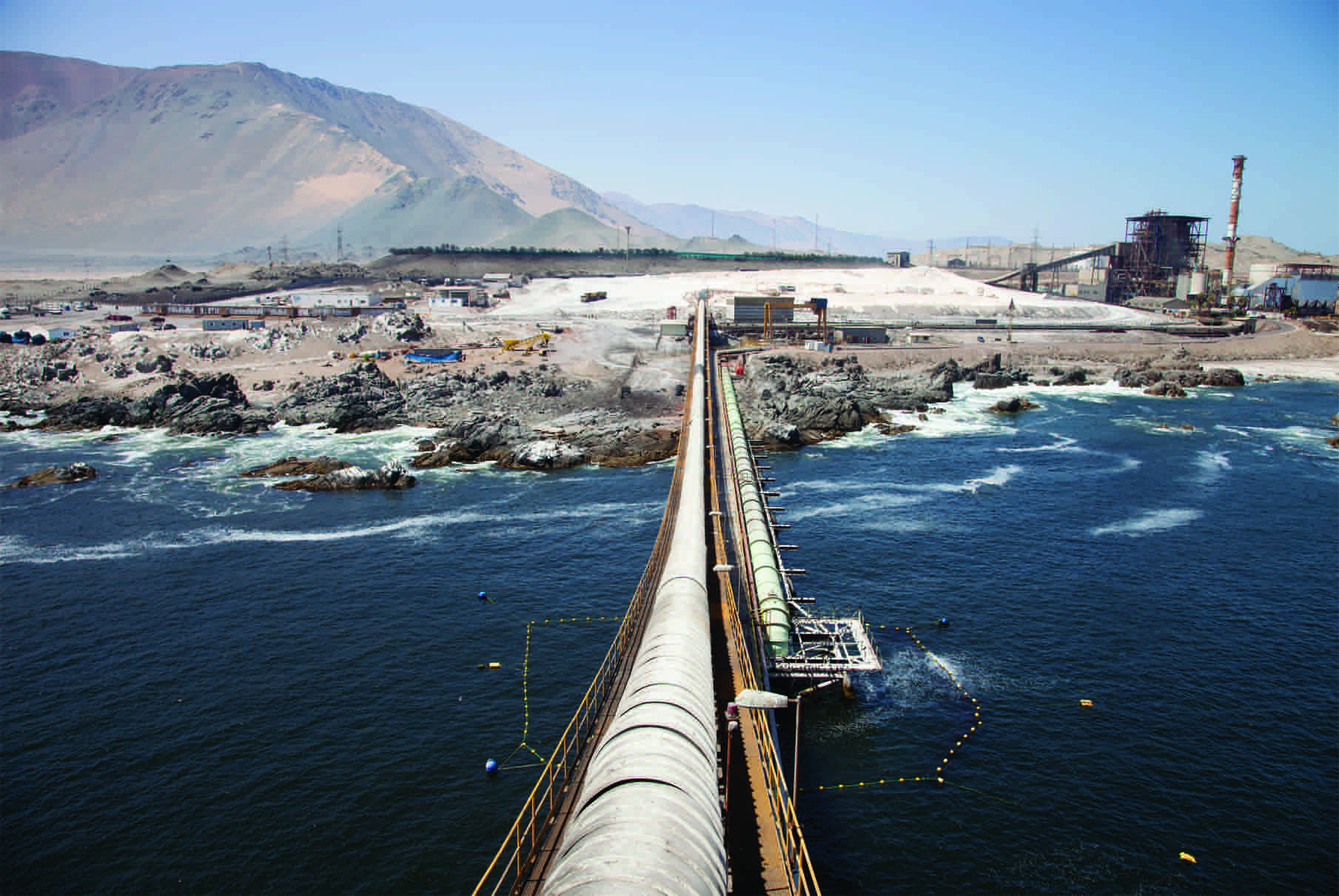
Video still (Port of Patache, Chile) from Fundir, 2015

Video still (Port of Patache, Chile) from Fundir, 2015

The concept of the artist studio has a broad range of meanings in contemporary practice. Artists may spend much of their time in the actual studio, or they may spend very little time in it. Tell us about your individual studio practice and how it differs from or is the same as traditional notions of “being in the studio.”

For me, the studio is essentially an office that I can escape to—a clean space where I answer emails, coordinate logistics, and edit film and photographs.  I go through phases where I will be primarily shooting in the field, then phases where I am editing constantly.  These phases can last several months.

What roles do you find yourself playing that you may not have envisioned yourself in when you first started making art?

I spend a significant amount of time on the computer, sometimes making artwork, but always managing logistical details related to my artwork. I’m coordinating my next shoot, doing research, working on applications, entering submissions, or writing emails. I never envisioned myself spending so much time in front of a screen, though it has become a necessary evil that also enables me to create and share my work.

When do you find is the best time to make art? Do you set aside a specific time everyday or do you have to work whenever time allows?

This is a tricky question since I am transitioning out of graduate school, but having a morning routine has always helped my self-discipline, productivity, and focus. Currently, I am part of an Ashtanga yoga community that practices early each morning. The yoga practice facilitates a daily routine of movement and meditation that prepares me for the day and alleviates the adverse effects the computer work has on the mind and body.

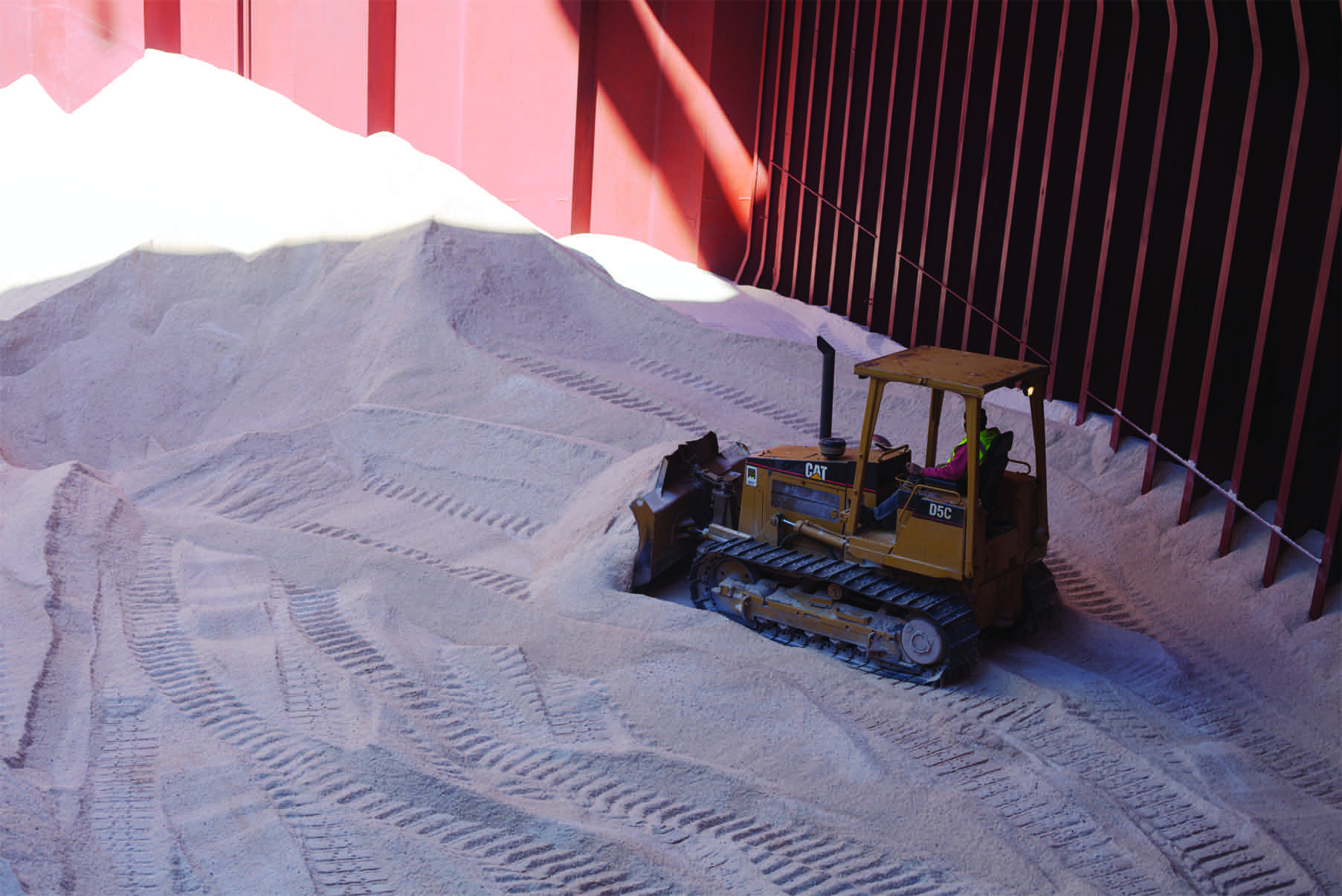
Video still (Port of Chelsea, MA) from Fundir, 2015

Video still (Port of Chelsea, MA) from Fundir, 2015

How has your work changed in the past five years? How is it the same?

Five years ago I was working on an organic farm in the Rio Grande in northern New Mexico.  At that time, I had a photography practice, but those photographs felt more like a documentation of my life, rather than my artwork.  After undergrad, I took many years off from making artwork seriously, living in different places, taking a variety of interesting short-term jobs—something I do not regret.

How have people such as family, friends, writers, philosophers, other artists or even pop icons had an impact on the work you do?

Highly Influential: “How Crayons Are Made” Sesame Street, Edward Byrtinsky photography and film, Ben Rivers’ films, everything by Mierle Laderman Ukeles, Berndt and Hilla Becher’s “Water Towers,” Werner Herzog’s “Lessons of Darkness,” the writings of Robert Smithson, Hokusai’s “36 Views of Mt. Fuji,” my family, and my fairy-godmother Susan.

Have you ever been pulled in the direction of a pursuit other than being an artist? What are your other interests?

YES, definitely.  I love learning about how things work and about being a human.  Before going back to graduate school I learned how to grow food, help women deliver babies, and teach kindergarten, among other things, all of which have been valuable in my personal development.  

About

cekala_allison_headshotAllison Cekala is a filmmaker and photographer currently based in Boston, MA. She holds a BA from Bard College in Photography and Environmental Studies (2006) and an MFA from the School of the Museum of Fine Arts, Boston and Tufts University (2015). Her work is an investigation of nature, a documentation of the way in which humans move, shape, and transform their surroundings. Recent solo shows include, Road Salt: A 4500 Mile Journey, at the Museum of Science, Boston, and Salt Mountain at the Howard Art Project, Boston.  Her work has been reviewed in the Boston Globe, WBUR’s Artery, among others. She is currently a teaching fellow at the School of the Museum of Fine Arts, Boston. 

Studio Shot

Studio Shot

allisoncekala.com

All images copyright of the artist and used with their permission. 

Posted in Photography | Tagged , , , , | Leave a comment