Jane Ryder – Bussey, Iowa

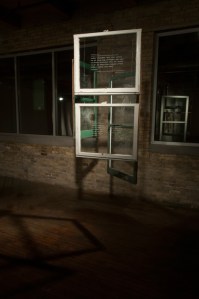
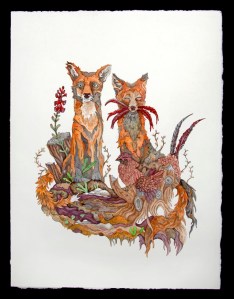
Marysville

“Marysville,” 23 X 18, gouache on paper, 2013

Briefly describe the work that you do.

My paintings are a right-brained approach to observing, dissecting, and recording the objective subject matter found in the lakes, rivers, prairies, and forests of south central Iowa. As my intimacy with the land surrounding me evolves, so do my approaches for depicting the complexities of varying terrains and the plants and animals that occupy them.

Each of my gouache painting is a fictitious ecosystem that has been broken down into a series of vignettes. Each vignette describes the decay, growth, and interaction between the flora and fauna of that imagined place. Although bold colors, repeating patterns, and flattened space make the paintings appear fantastic in nature, each scene is based off an observation.

At what point in your life did you decide to become an artist?

My mother is a gifted artist, teacher, and designer. My father is a pianist and designer turned businessman. The artistic temperament runs in my family and being a creator is just something I am. I can’t pinpoint a time where I thought,

“I’m going to be an artist when I grow up.”

I always knew that I was an artist but it has taken a lifetime to figure out what that means. It basically boils down to this: If I don’t take the time to nurture my need to create I become depressed and miserable. I am at my best when I am painting, printing, or building. I am at my worst when I am wallowing in self doubt.
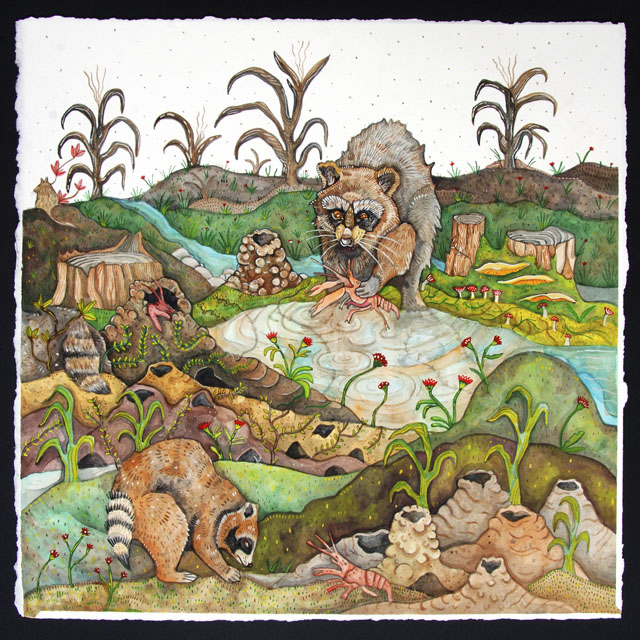
Chimney Lagoon

“Chimney Lagoon” 19 X 19, gouache on paper, 2013.

Tell us a little about your background and how that influences you as an artist.

I’ve always been fascinated by animals. Their behaviors, social structures, and aesthetics were a driving force in my work for a long time. After graduate school, I moved to a rural area. A lot of my leisure time is spent exploring the great outdoors and I’m finding myself fascinated by the trees, plants, and landscapes that surround me. My work is less about the animal as an individual and more about the role of each creature in a functioning (and imagined) ecosystem.

My change from an urban setting to a rural one has influenced my work in many ways. The most profound change has been the way I get my information. Before, all of my information about came from books or the internet. My visual references were usually googled and my color choices were based off of colors I was into at the time.

Now, my content is informed by my experiences in the “wilderness” of Iowa. I shoot my own visual references and my color palettes are usually informed by the seasons combined with colors that I’m currently into.
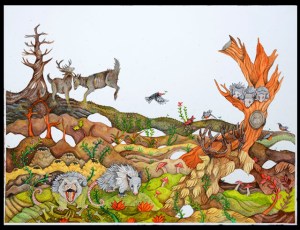
Possum Kingdom

“Possum Kingdom,” 29 X 17, gouache on paper, 2013

What types of conceptual concerns are present in your work? How do those relate to the specific process(es) or media you use?

My work is very much about growth and decay and that’s evident in the content of my paintings. I like to have a nice balance of the macabre and the divine. Color affects the mood of each piece. Even if the content is rather dark, the colors and humor lighten the mood significantly.

My work is also about observation. I like to engage the viewer in the content of the piece by giving them a lot of information to process. So, I’d say one of my conceptual concerns is forcing people to observe and make their own connections and narratives
throughout the piece. It’s important to entertain the viewer. I love hidden imagery and smooth compositions. It’s my goal to get everyone to look at each painting for over a minute.

We once heard Chuck Close say he did not believe in being inspired, rather in working hard everyday. What motivates you in your studio practice?

Mr. Close has a valid point, especially for artists that no longer exist in academia. If I waited for inspiration to hit I would never get anything done. I was in denial about this and it took a long time to learn how to balance a 9-5 workday with a 6-8 studio day.
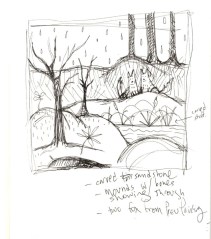
Sketchbook

Sketchbook

What motivates me as a non graduate student? Deadlines and goals. I always have a show or a print exchange that I need to prepare for and that keeps me honest with studio time. If I work for two hours a day I can get a lot done. Because I have less time to work with I treat each minute seriously. This is not a trait I was born with so it’s been an interesting and frustrating ride.

I don’t have the luxury of time but I do have the luxury of determination…and I’ll always have the weekends. I get a ton of work done on the weekends.

What artists living or non-living influence your work?

Josh Keyes, Albertus Seba, Audubon, Gregory Euclid, Stacey Rozich, all the artists at Western Exhibitions (in Chicago), Martina Nerling, Oscar Gillespie, Michael Barnes, Ashley Nason, Ann Coulter (my professor from Bradley University), and Denis McNett. I could go on for hours.

I also have to give a big shout out to all of my friends from undergraduate and graduate school. You know who you are and my life is better because of each of you. You guys have made the biggest impact on me by far. You taught me how to critique my own work, get over artistic blocks, curate shows, and manage my personal/studio time.

When you are not making art what types of activities and interests do you engage in? 

I have become quite the outdoorsman. When the weather is lovely, I am usually outside. I like to collect fossils and look for arrowheads; my collection is getting pretty massive (you can check out my blog if you’re interested in how I find the fossils and arrowheads).

I enjoy time with my dog and family (funny how I say dog first) and we’re working on teaching the dog new tricks. He’s recently mastered “roll over.” Antiquing is still a hobby/passion and I like taking road trips to indulge my inner hoarder.

Other than that, I’m just working on appreciating life. I’m a pretty happy human.
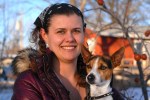
Jane and Mudd bestAbout 

Jane Garrett Ryder was born and raised in the fine state of Illinois. In 2005 she received her BFA from Bradley University and went on to earn her MFA at Northern Illinois University four years later. In 2009 Ryder moved to from Northern Illinois to South Central Iowa where she can be found tromping through various, muddy environments in search of fossils, arrowheads, and new artistic content. Her change from an urban environment to a rural setting has influenced her paintings in many significant ways. A deeper understanding of the interactions between man, animal, plant, dirt, water, and sun have affected the content and compositions Ryder’s new body of work.

For anyone interested in learning more about how a rural environment can affect the content of contemporary artwork check out Jane Ryder’s blog, “Flux Biota” at http://fluxbiota.blogspot.com/.
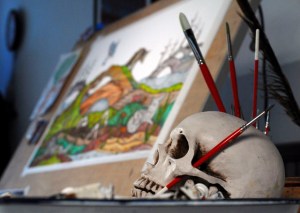
Studio

Studio

www.janeryder.com

All images copyright of the artist and used with their permission. 
Posted in Drawing, mixed media, Painting | Tagged , , , | Leave a comment

Cassandra Ott – Chicago, Illinois

Opera

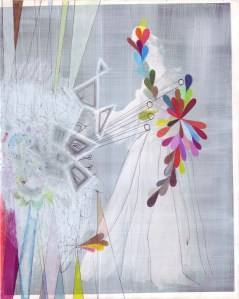
“Opera” Colored pencil, ink, and acrylic on vintage photograph, 2013, 8″ x 10″

Briefly describe the work that you do.

My current body of work uses vintage photographs purchased from antique stores and flea markets as a foundation for drawing. I find these images intriguing because their abandoned histories are so disconnected from the people and memories that gave them their original and personal value. By reclaiming and intuitively marking upon the photographs, I construct my own compositions, blurring history and memory with color and organic forms. Themes of time, distance, and family histories are juxtaposed with my corresponding interests in color, structure, and formal design. The resulting work merges repetitive marking and pattern-based aesthetics upon ephemeral records created by unknown photographers.

At what point in your life did you decide to become an artist?

I’ve always been interested in making art, but it was not until I first took a black and white darkroom class as a teenager that I felt I had a unique perspective to express and share. Developing my own film, processing and printing my own photographs, and learning how to visualize the world in my own way all provided me with the curiosity, satisfaction, and confidence to pursue art-making as a way of life.

5/52 Project: week 10

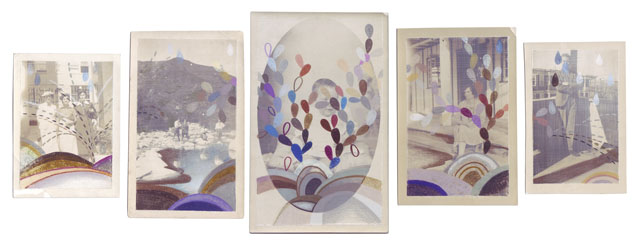
“5/52 Project: week 10” Colored pencil and acrylic on vintage photographs, 2013, 6”x15.5”

Tell us a little about your background and how that influences you as an artist.

My mother took me to the Carnegie Museum in Pittsburgh almost daily throughout my childhood, especially during the summer months because the large, old building was nice and cool inside. I would spend hours in the hall of gems, studying the varying structures, shapes, and textures of all the stones and minerals. I loved all of the rich colors and the seemingly endless forms of the crystals mesmerized me. My mother owned a weaving store at the time and I also enjoyed investigating her pattern and costume history books and baskets full of colored yarn and threads.

My father is an architect so I grew up studying his more composed vison of form, design and structure. At his office they had tile, paint, and fabric swatches and an endless array of Prismacolor markers that I played with for hours on end. Starting around the age of eight my father and I began to take art classes together; watercolors, figure drawing, black and white photography, jewelry making, etc. I particularly loved the chemistry aspects of the photography classes. Watching images emerge in a darkroom was a magical experience for me.

My current work reflects aspects of all of these influences: the organic forms and repetitive structures of crystals, the rich woven patterns, the design elements of architectural frameworks, all work with my strong interest in the process of photography and its role in documenting family histories.

5/52 Project: week 13

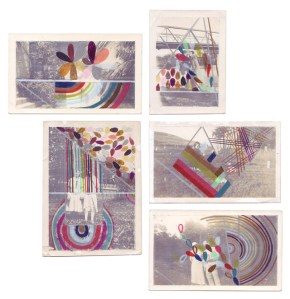
“5/52 Project: week 13” Colored pencil and acrylic on vintage photographs, 2013, 10”x 10.5”

What types of conceptual concerns are present in your work? How do those relate to the specific process(es) or media you use?

My conceptual concerns address order, balance, organization, growth, and self-imposed limitations. I’ve always been drawn to photography’s inherent characteristics, particularly the way the frame produces a specific perspective, editing our conception of the larger world, while simultaneously providing a clean method with which to present this interpretation. I find the repetitive nature of pattern extremely satisfying and I also enjoy the way in which a free-hand drawing, when repeated, naturally grows into larger structures.

I’ve learned (especially in the last few years since having a child) that I really like order and organization. I’ve worked in different media over the years, but have always liked establishing a set of parameters and seeing the range of images that can emerge from those boundaries. With the 5/52 Project, I am investigating ways to have found-images make sense together as part of a larger whole. By adding repeated color and form, the photographs begin to talk to each other creating a new dialogue over the original memories.

We once heard Chuck Close say he did not believe in being inspired, rather in working hard everyday. What motivates you in your studio practice?

studio_desk_sm

Studio

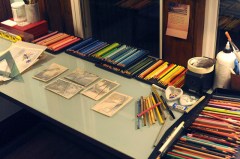
I have an Andy Warhol quote hanging over my studio desk that echoes Close’s work ethic. He said: “Don’t think about making art. Just get it done. Let everyone else decide if it’s good or bad, whether they love it or hate it. While they are deciding, make even more art.”

I started the 5/52 Project as a way to get back into a regular art making practice. The goal is to make 5 small pieces of art (from a collection of vintage photographs) every week for one year, hence the 5/52 Project. Creating this set of boundaries is helping me immensely to be accountable as it defines a limit for completion so I can (or must) move on to the next set. Sustained creative production helps me in all aspects of life and makes me a happier person. I’m excited to see this body of work taking shape and it is already fueling new projects to come.

What artists living or non-living influence your work?

Helen Frankenthaler, Gerhardt Richter, Judy Pfaff, Sebastian Bremmer, Thomas Nozkowski, Lena Wolf, and Kirra Jamison, to name a few. I’m loving what April Deacon is doing with vintage photographs as well.

When you are not making art what types of activities and interests do you engage in? 

Chasing my kid around, cooking and baking, pattern design, hanging out on the beach at Lake Michigan

Cassandra_headshot_smAbout 

Originally from Pittsburgh, Cassandra has always been fascinated with art and photography. She was fortunate enough to have parents who were artistically inclined and they recognized Cassandra’s interests as more than just a passing phase, encouraging her genuine talents. Cassandra took art and drawing classes with her father throughout adolescence and found unfailing support and inspiration from her mother, a weaver. Since 2001, Cassandra has worked with both of her parents as part of the family business, Riverside Design Group, where she applies her many art, design, and photography skills.

Cassandra advanced her keen eye while studying photography at the University of Cincinnati. Her plate designs generated from her work at Riverside have graced tables from four-star hotels, the Getty Museum Cafe and homes around the country. Cassandra’s photography and her signature designs have played a vital role in developing Riverside’s brand, securing its design-forward identity. Cassandra’s passion and involvement in the arts and design communities provides her with endless creative ideas and opportunities. She currently lives in Chicago with her husband Aaron, son Silas, and Hopper the cat.

www.cassandraott.com

All images copyright of the artist and used with their permission. 
Posted in mixed media | Tagged , , , , | Leave a comment

Peter Bonde Becker Nelson – Northfield, Minnesota

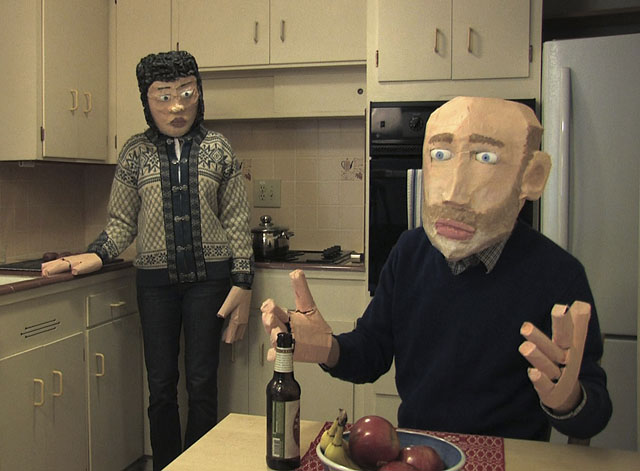
"On Dying" (Video Still), Audio Recordings, Digital Video, 8:28 min, 2008 https://vimeo.com/3749640

“On Dying” (Video Still), Audio Recordings, Digital Video, 8:28 min, 2008
https://vimeo.com/3749640

Briefly describe the work you do.

Most of my work involves interviewing my friends or family, asking them about their relationships, personal experiences, and quirky perspectives on life. After the initial in-depth interview (often 2-3 hours long), I edit the text or audio to the most germane information and then pair it with a visual. Sometimes it’s photography, mostly it’s video.

Tell us a little about your background and how that influences you as an artist.

I grew up in a small town in rural Minnesota. My parents were music teachers and devout Lutherans. I am the middle child, with an older sister and younger sister. I have always been overly sensitive. I’m a pretty good listener. I’m not an actor and have no training, though I spent a lot of time in front of the mirror as a child. All of these characteristics directly shape the work I make.

The concept of the “artist studio” has a broad range of meanings, especially in contemporary practice. The idea of the artist toiling away alone in a room may not necessarily reflect what many artists do from day to day anymore. Describe your studio practice and how it differs from (or is the same as) traditional notions of “being in the studio.”

My “studio” is the people around me, an audio recorder, a video camera, and my laptop. I still seem to toil away alone a lot, especially when editing (I think I spend an extraordinary amount of time editing), but my work relies heavily on the outside world and the people around me.

"Mr. and Mrs. Nelson" (Video Still), Audio Recordings, Digital Video, Vocal Performance, 14:34 min, 2010 https://vimeo.com/75879494

“Mr. and Mrs. Nelson” (Video Still), Audio Recordings, Digital Video, Vocal Performance, 14:34 min, 2010
https://vimeo.com/75879494

What unique roles do you see yourself as the artist playing that you may not have envisioned yourself in when you first started making art?

Though my work is deeply personal, I hope to provoke a lot of questions in each individual viewer. I want my work to challenge established mindsets/preconceived notions. Not necessarily in a huge world-altering way, just on a daily or personal level, especially in regards to the way we think about ourselves and others and how that shapes our relationships. I didn’t initially set out as an artist with these goals, but they’ve developed over time.

My Former Best Friends

“My Former Best Friends” Composite of Video Stills, Audio Recordings, Digital Video, 11:08 min, 2013

When do you find is the best time of day to make art? Do you have time set aside every day, every week or do you just work whenever you can? 

I wish I had a best time to work… and I wish I could set aside a regular schedule. Some artists are so good at that. I make work pretty sporadically. Often a concept sits with me for a long time before actually taking action on it. It’s so cliché, but deadlines are the best motivation for me.

How has your work changed in the last five years? How is it the same?

I think the same basic principles still guide my work — questioning and exploring personal relationships, personal viewpoints, etc. In the last five years I’ve become more and more interested in cinematic techniques. I’m no auteur, but my work now relies more on the visuals and camera techniques of cinema than it used to.

Behind the scenes images during the shooting of "My Former Best Friends"

Behind the scenes images during the shooting of “My Former Best Friends”

Are there people such as family, friends, writers, philosophers or even pop icons that have had an impact on the work you do?

My main artist influences have been Gillian Wearing, Cindy Sherman, Candice Breitz, Rineke Dijkstra. My family and friends have been influential, as they have directly been a part of my work. Former professors at St. Olaf College, especially Meg Ojala and Pat Kelley, and Paul Berger at the University of Washington have played a big role as well.

If you had an occupation outside of being an artist, what would that be and why?

I always wondered if I should have pursued Sociology in some way. Luckily, my profession as an art professor complements my profession as an artist.

01_nelson_headshotAbout Peter Becker Bonde Nelson

Peter Bonde Becker Nelson received his BA in Studio Art from St. Olaf College in 2004 and his MFA in Interdisciplinary Visual Arts at the University of Washington in 2010. From 2010 to 2013, Peter taught at St. Lawrence University in Northern New York. He currently teaches at St. Olaf College in Northfield, MN.

Nelson has exhibited in such places as the Corcoran Gallery, Washington D.C.; The Henry Art Gallery, Seattle, WA; The University of Virginia, Charlottesville, VA; The College Art Association Conference, New York, NY; Minnesota Museum of American Art, St. Paul, MN; and the Pingyao International Photography Festival, Pingyao, China. Nelson was the recipient of the Graduating with Excellence Award from the University of Washington School of Art in 2010 and has received grants such as the 4Culture Individual Artist Project Grant, the Minnesota State Arts Board Artist Initiative Grant, and faculty development grants at St. Lawrence University. His work has been reviewed in national and international publications.

Examining themes of gender, aging, class, and identity, Nelson records and interprets the personal narratives of his friends, family, and self. As one reviewer recently wrote, “His work delves into the nuances of human connection — love, friendship, intimacy, frustration and loss.”

In addition to art, Peter sings and plays the mandolin with the indie-folk duo Jayber Crow.

Behind the scenes during the shooting of "My Former Best Friends"

Behind the scenes during the shooting of “My Former Best Friends”

www.beckernelson.com

All images copyright of the artist and used with their permission. 
Posted in Video | Tagged , , , , , | 1 Comment

Suzanne Torres – Madison, Wisconsin

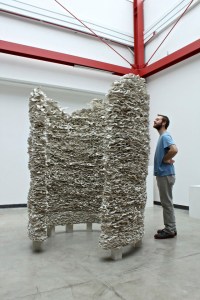
Stacked

“Stacked” 2012, clay slip, fiber insulation, cement, metal rods, 87 x 63 x 63 in.

Briefly describe the work you do.

My work borrows elements from our constructed and natural surroundings and reinterprets them through scale and abstraction. I reference geological and architectural decomposition to create large-scale sculpture and installation utilizing unfired clay and common building materials. Channeling polar forces of structure and collapse, I create work that exists in a state of flux – conjuring notions of transformation and evolution. Often exceeding human scale, the work has a physical presence that translates as a spatial experience for the viewer.

Tell us a little about your background and how that influences you as an artist.

My family spent several summers travelling the United States by car, camping in notable and obscure National and State Parks across the country. The landscapes of Acadia, the Badlands, Yellowstone, Glacier National Park, Yosemite, and more, instilled in me a deep love for nature and feeling of absolute freedom that only an open sky can induce. My love for natural environments and an active childhood is inexorably linked to the themes and elements I currently engage in my work. I often make work that is much larger than myself, which is a problem-solving
challenge and physical feat to execute. I see my work as a solo performance, much like a child in solitary play. I’m constantly pushing myself to my physical limits where I find a sense of solace in the physicality of making.

The concept of the “artist studio” has a broad range of meanings, especially in contemporary practice. The idea of the artist toiling away alone in a room may not necessarily reflect what many artists do from day to day anymore. Describe your studio practice and how it differs from (or is the same as) traditional notions of “being in the studio.”

In my case, the antiquated idea of studio fits just so. I won’t be found in my studio when I am working on the computer (most of the time) or out purchasing supplies, but when it is time to work that is where you’ll find me. As a graduate student at the University of Wisconsin-Madison I am very lucky to have others working around me, and with that, plenty of welcome distractions. Working in the studio can become very lonesome at times and I feel grateful for some occasional diversion and good music of course.

Flipside of a Dream

“Flipside of a Dream”
2013, recycled wood, rebar, recycled clay, 89 x 133 x 96 in.

What unique roles do you see yourself as the artist playing that you may not have envisioned yourself in when you first started making art?

The role of an artist is so much more than I imagined it to be – granted, when I was starting off I didn’t really know what it was that an artist did all day besides make art. There are many other facets to being an artist than the ‘making’ aspect. In a way, an artist is like a ‘one-person team’. You’re in charge of marketing and promoting yourself, executing work, shipping and handling, documenting work, networking, writing grants and proposals, being tech-savvy, and much more that I am forgetting to say. The life of an artist is much more entwined in that of an entrepreneur than I imagined it to be.

When do you find is the best time of day to make art? Do you have time set aside every day, every week or do you just work whenever you can? 

I would love to answer this and say the morning. I secretly aspire to be a morning person, but it is very much against my nature to be so. I love the night. There is a sense of urgency for me late at night. I know I only have however many hours to work on whatever it is I’m working on, and that suggestion of a deadline helps me focus and work toward a goal- that goal usually being to finish the task at hand or go to sleep. During the day I know that I have all day to accomplish a task, which makes it hard sometimes to actually do it – the later it gets a familiar sense of
desperation helps keep me concentrated.

"Solitary Skin" 2013 rebar, reclaimed porcelain slip, 51 x 96 x 256 in.

“Solitary Skin” 2013 rebar, reclaimed porcelain slip, 51 x 96 x 256 in.

How has your work changed in the last five years? How is it the same?

It’s changed in the sense that I have a better understanding of what it is I’m doing. The more work I’ve made, the more the puzzle pieces find their place on the board. I waffled on my identity as a young artist and doubt was my constant companion. Now, doubt is still my companion, but I at least have a sense of where I’m headed. I’m very excited about the direction my work is taking right now. I have some big projects I’m currently working on which will be on exhibition in March in conjunction with the 2014 NCECA conference.

Are there people such as family, friends, writers, philosophers or even pop icons that have had an impact on the work you do?

All the ‘makers’ and ‘wonderers’ in my family have undoubtedly influenced my approach to making work. If there was an adage for our household it would be that ‘idle hands are the devils playground’. My Dad was constantly working on a project – refinishing furniture or stripping our front porch (which he did every year!). My Mom was an avid gardener and cook and our house was filled with fragrant smells of plants and meals to be eaten. My grandfather, a runner, loved the outdoors and could skillfully identify birds without hesitation. My grandmother, made sure us kids werefed and loved and could whip up a ‘meat and potato dish’ like no one’s
business.

They have had the biggest impact on my work because, through their example, I was taught to be self-trusting and not dependent on others for something I could figure out on my own. They let me be wild and curious and would teach me to make and learn with my hands and heart.

If you had an occupation outside of being an artist, what would that be and why?

That is a tough question since I never seriously imagined myself doing anything else. I guess I would be a ‘wilderness-adventure-guide’ and trek the world eating exotic bugs and sleeping under a blanket of stars!

torres_headshot2About Suzanne Torres

Suzanne Torres (b.1982, New Jersey) received her BA in Art from Monmouth University in 2008 and was a Post-Baccalaureate student in sculpture at the San Francisco Art Institute. She participated in additional studies at the Studio Arts Center International in Florence, Italy and the Metáfora International Workshop in Barcelona, Spain as a yearlong resident. Most recently she participated in the Open Studio Residency at Haystack Mountain School of Crafts and received a full fellowship to the Vermont Studio Center for the summer of 2014. She has exhibited her work nationally and internationally. Torres is a second-year Ceramics graduate and MFA candidate at the University of Wisconsin-Madison.

Suzanne working in her studio.

Suzanne working in her studio.

www.suzannetorres.com

All images copyright of the artist and used with their permission. 
Posted in 3D, Ceramic, Sculpture | Tagged , , , , , , , | Leave a comment

John Henry Blatter – Richmond, Virginia

Simulcast

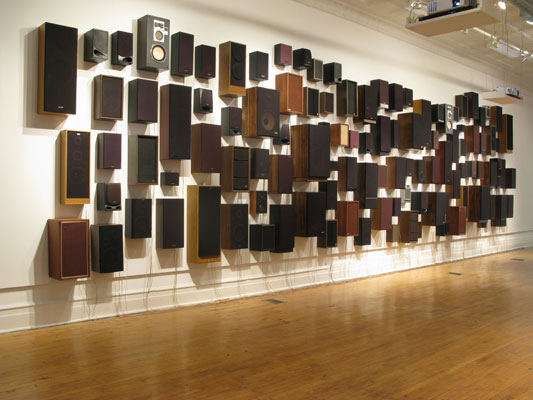
“Simulcast,” 2007, 6 channel audio installation, Size variableSimulcast is an audio recreation of the 1973 Triple Crown races with the Art World in mind. Who will win the Derby, Nam June Paik, Laurie Anderson or maybe Matthew Barney. Can Jerry Saltz beat out Clement Greenberg to take the Belmont Stakes? Will Mary Boone be the reigning champion at the Preakness? 

Briefly describe the work you do.

Over time it has become harder to pin down what my work actually is. In it’s more common manifestation, it exists as sound and/or video installation. As I create, it is my intention to create experience and/or affect the viewer.

Tell us a little about your background and how that influences you as an artist.

Looking back, I would say my family has had a great influence on my artistic practice. Growing up I was exposed to my mother’s and father’s creative passions, interior design and farming respectively, that they have pursued throughout their lives. Being surrounded by such dedication to ones interests has instilled in me, the ability to change, adapt and choose to follow my dreams, whatever they might be.

The concept of the “artist studio” has a broad range of meanings, especially in contemporary practice. The idea of the artist toiling away alone in a room may not necessarily reflect what many artists do from day to day anymore. Describe your studio practice and how it differs from (or is the same as) traditional notions of “being in the studio.”

I would consider “being in the studio”, the same as “being with myself”. Over time, my studio practice has become evermore theoretical in nature. As the studio has expanded to include writing, curating and collaboration in addition to making, I consider many of my favorite activities as part of the studio practice and I use them to mine and shape ideas as well as balance my life. For example, after a prolonged period of writing or sound editing, I will work on the house or build some furniture to unwind; in that intense period just before an exhibition opens, I will franticly organize to let the ideas and thoughts gel in my head or escape them all together for a moment; I will listen to podcasts in my spare time to let my mind wander or for research; hanging out with friends affords an occasion to talk about my thoughts and to hear them aloud; collaboration is a chance to learn something new, to work outside of my comfort zone or the opportunity to work on something larger than myself.

What unique roles do you see yourself as the artist playing that you may not have envisioned yourself in when you first started making art?

When I first started, I never really thought of the artist as communicator, as having a larger voice or the ability to affect others. As the years have passed and I continue to work, I have begun to see it as a way to affect the viewer, not just to share my experiences but also to create a collective shared experience.

Moments

“Moments,” 2009-10, Audio/Video Installation , Size variableMoments is a 44 channel audio installation constructed from stories collected. Each story evolves around a moment in which the storyteller felt a moment of pause and singularity brought about from an intense experience, emotion or thought. 

When do you find is the best time of day to make art? Do you have time set aside every day, every week or do you just work whenever you can? 

As my studio practice has grown to involve so much, I do not have any specific time that I work. Generally, I do things that I enjoy, listening to podcast, talking to friends, building (whether it be making furniture or remodeling a kitchen), all of it impacts the final product. A studio practice in the traditional sense tends to happen in very intense short bursts and usually under pressure. The deadline motivates and forces resolution.

How has your work changed in the last five years? How is it the same?

Over the years, the work has not necessarily changed, but grown. Through my experience in grad school, being involved in the greater art world and surrounding myself with some really great artists, my interests and work has grown to include collaboration, critical writing, curating, etc… While I have not totally abandoned myself as content and performer in the work, I do tend to seek out opportunities to work with others with greater frequency.

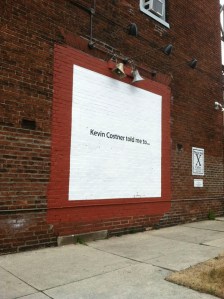
Kevin Costner told me to…,

“Kevin Costner told me to…,” 2012 Sound Installation, Size variable
Collaboration w/ Sarah Rebekah Byrd MizerKevin Costner told me to… is a two channel installation constructed entirely from audio samples appropriated from Costner’s films. 

Are there people such as family, friends, writers, philosophers or even pop icons that have had an impact on the work you do?

Like a lot of other artists most everything I do has some influence on what I make. While I can’t think of any one writer, person or artist that has had a direct impact, I am a huge fan of John Baldessari, Bruce Nauman, Matthew Barney, Janet Cardiff and Ragnar Kjartansson to name a few. I also love to while away the time with some Radio Lab or any number of podcasts. More than that, I would say that my experience in grad school and the friends I keep have had the most impact on my work.

If you had an occupation outside of being an artist, what would that be and why?

If I were not an artist I would still be a maker, building really puts me at ease and is really satisfying. I could be a furniture maker, a contractor or an investor who is flipping houses. Even now, I find myself getting lost in Real Estate, HGTV or reverse engineering a Mid-Century chair.

Blatter_HeadshotAbout John Blatter

John Henry Blatter currently resides in Richmond where he maintains a studio and works at Virginia Commonwealth University. Blatter’s audio/video installations and collaborative works have been exhibited in New York, Miami, Washington DC, Philadelphia, Cincinnati, Omaha, Pittsburg as well as internationally in British Columbia, Basel and Istanbul.

John's studio

John’s studio

http://www.johnblatter.com

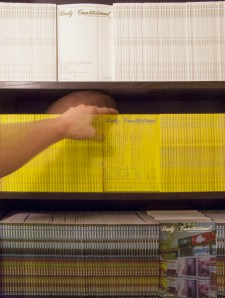
http://www.dailyconstitutional.org

All images copyright of the artist and used with their permission. 
Posted in 3D, Installation, mixed media, Video | Tagged , , , , | Leave a comment

Erin Smego – Chicago, Illinois

Untitled

“Untitled”; october 2013; cardboard, gouache; approx. 5″ x approx. 5″

Briefly describe the work you do.

I create abstract paintings and drawings, artist books, and installations. These works serve as layer of communication that I feel is often missing between the world and myself; a disconnect which I sometimes struggle to bridge.

Tell us a little about your background and how that influences you as an artist.

I graduated from the School of the Art Institute of Chicago in 2011 with a Bachelor of Fine Arts. Currently, I work and reside in Chicago. What’s amazing about Chicago is its accessiblility to contemporary art and friendly community of artists.

The concept of the “artist studio” has a broad range of meanings, especially in contemporary practice. The idea of the artist toiling away alone in a room may not necessarily reflect what many artists do from day to day anymore. Describe your studio practice and how it differs from (or is the same as) traditional notions of “being in the studio.”

My studio practice is currently traditional and solitary. I like making things, painting, drawing, creating artist books, cutting shapes out of cardboard on a dropcloth that also happens to be my bedroom. I’m constantly inventing shapes in my sketchbook or in my head, even if I’m not physically in the studio. Although, I’ve recently started to push my work toward more sculptural and installations which would most likely lead to more collaborations with other artists, and potentially change my work and my studio practice.

Untitled

“Untitled (layout sketch for untitled cardboard cut-outs);” october 2013; cardboard, gouache; each approx. 5″ x 5″

What unique roles do you see yourself as the artist playing that you may not have envisioned yourself in when you first started making art?

I’m not sure exactly what I envisioned. I like to go with the flow and see what feels right for myself. I usually go about doing things intuitively without being illogical.

When do you find is the best time of day to make art? Do you have time set aside every day, every week or do you just work whenever you can? 

I’ve always been a night owl, and am the most productive later at night. I joke that the sunlight is judging me! I’ve finally learned to work during the daytime as well even though the nighttime is preferred. I don’t work on a set schedule, however, I’m constantly making work.

Untitled

“untitled (layout sketch for untitled cardboard cut-outs);” october 2013; cardboard, gouache; each approx. 5″ x 5″

How has your work changed in the last five years? How is it the same?

My work has changed drastically in the past five years. Now I consider myself almost exclusively an abstract artist, whereas that wasn’t the case prior. Also, I used to solely make paintings and drawings, and in the last year I’ve integrated sculpture and installation into my body of work.

Are there people such as family, friends, writers, philosophers or even pop icons that have had an impact on the work you do?

My mom has definitely impacted my use of color! My parents built our house, and have always done everything themselves, which I greatly admire. When I was younger, my mom used to take me as a second opinion to look at paint samples (for house paint) for hours! It made me really aware of color, which I’m so thankful for now. My dad consistently teaches himself how to do and make new things constantly which is a mentality I try to live by.

I live to look at other artists’ work, whether it’s on the internet or in person. Artists that continue to impact my work include friends, former professors, local artists and some artists I’ve never met! Jessica Calek, Dan Streeting, Caitlin Mattia, Steve Juras, Melissa Urbonas, Jenn Smith, Veronica Bruce, Judith Geichman, Dana DeGiulio, Molly Zuckerman-Hartung, Dan Devening, Erin Washington, Antonia Gurkovska, Sabina Ott, Eva Hesse, and Richard Tuttle.

If you had an occupation outside of being an artist, what would that be and why?

Anything that would allow me to have enough free time to continue to be an artist.

Smego headshotAbout Erin Smego

Smego graduated from the School of the Art Institute of Chicago in 2011 with a Bachelor of Fine Arts. She currently works and resides in Chicago with plans to eventually receive her MFA. Erin Smego is an abstract artist who engages with her imagination. Her mediums consist either painting and drawings, art books, or more recently cardboard cut-out installations. She also works in oil on canvas. Recently her paintings and drawings have utilized alternative materials such as cardboard, caulk, and sandpaper as well as marker, watercolor, and gouache drawings on paper. She has shown work in Chicago, San Diego, and Berlin.

Erin Smego in her studio

Erin Smego in her studio

www.erinsmego.com

All images copyright of the artist and used with their permission. 

Posted in mixed media, Painting | Tagged , , , , | Leave a comment

Peter Morgan – Philadelphia, Pennsylvania

All Aboard

“All Aboard” (Overview), Low-fire Ceramic and Wood, 47 x 204 x 84”, 2012

Briefly describe the work that you do.

I create brightly glazed ceramic sculptures with a focus on understanding our world through examining perception, representation, and location.  The pieces frequently take the form of animals, but also draw from, food, landscape, and the world around us.

At what point in your life did you decide to become an artist?

As a kid I was always interested in art, and making things, but I don’t think that it was until my sophomore year in college when I decided that art would be my “career.”   I almost became a history major due to my disdain of  “Introduction to Drawing” but I found myself drawn to ceramics and sculpture and the rest was history.

Tell us a little about your background and how that influences you as an artist.

I grew up in a small town called Abingdon, VA, which is in the mountainous southwestern corner of the state. Growing up, my mother was a hand weaver, so I was raised with an appreciation for hand made goods, and working with your hands.

Since 2001 I have lived all over the county. I was interested in the Funk movement, which brought me to the Bay Area in the fall of 2001. The funny thing was that when I arrived there everyone was wondering what the hell I was doing, and I realized I was 20 years to late. Ever since then, I have not made a huge effort to move to places where I felt that my work would “fit in”.

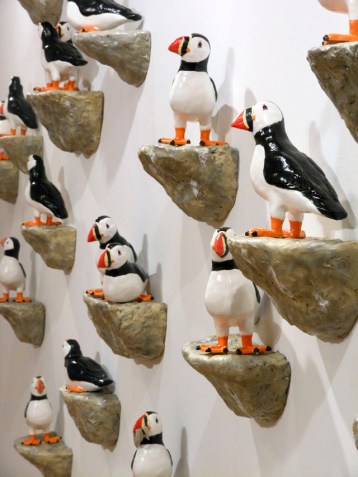
I Think There’s a Puffin Among Us

“I Think There’s a Puffin Among Us”, Low-fire Ceramic and Sound, Dimensions Variable (puffins are approximately 10” x 10” x 6”), 2012

What types of conceptual concerns are present in your work? How do those relate to the specific process(es) or media you use?

I am interested in how things are represented, throughout culture and how that influences our view of the world.  Probably 95 percent of my work is ceramic, and ceramics has a very lengthy and colorful history.  What I like about ceramics it that it gives the work a since of “democracy” meaning that clay is a pretty accessible material.   People have often made something with clay, or have a lot of ceramic objects around them. There are not a lot of “tricks” to what I do, so it is usually fairly clear how I made the objects, for me that can be a point of access into the work.  As I have been working with ceramics for over fifteen years, there are some material subtleties, which come into play such as my use of glaze, and layering different commercial products.   Some of these are readily apparent, yet others are more subtle things that probably only people with a ceramics background would appreciate.

We once heard Chuck Close say he did not believe in being inspired, rather in working hard everyday. What motivates you in your studio practice?

I am interested in the completion of the “big idea.”  Many times I have the idea for the finished product, and it is a process of completing it.  Of course things change along the way through the working process.  A lot of the time the “idea” emerges from the process of working in the studio, and/or that idea extends from one piece to the next one.  I do find inspiration from a lot of things outside of the studio, be it art, music, popular culture, or the outside world

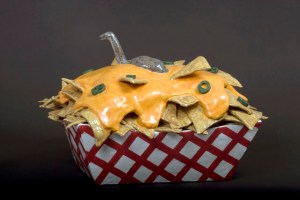
The Nacho-mess Monster

“The Nacho-mess Monster,” Low-fire Ceramic, 18.5 x 27 x 21”, 2010

What artists living or non-living influence your work?

Clayton Bailey, Bruce Nauman, Andy Warhol, John James Audubon, Stuart Davis, and Gregory Blackstock

When you are not making art what types of activities and interests do you engage in?

I am an avid birdwatcher.  I run marathons and ultra-marathons, and am preparing to defend my title at the Sole Challenge 24 hour race, in Fayetteville, PA this May.  When I am not doing those things I enjoy fly-fishing, Twins Baseball, and Ravens Football.  I am also considering becoming a NFL coach.  

Peter Morgan Headshot 1About 

Peter Morgan is a native son of Virginia holding a BA in from Roanoke College, a BFA from the California College or Arts and Crafts, and a MFA in Ceramics from the New York State College of Ceramics at Alfred University. 

Currently Peter is a resident artist the Clay Studio in Philadelphia where he maintains his practice, and in 2012 was the Clay Studio’s Evelyn Shapiro Foundation Fellowship recipient. He is a founding member of an artist run space in Philadelphia called Practice, which focuses on performance, participation, and experimentation.

Peter has taught at California State University: Long Beach and Gettysburg College. He has exhibited across the United States and Europe, with notable exhibitions including his 2012 Evelyn Shapiro Foundation Fellowship exhibition at the Clay Studio and the 67th Scripps Ceramics Annual. His work is in the permanent collections of the Shine Joseph International Museum of Ceramic Art, the California College of the Arts, and the Archie Bray Foundation.

Peter has given lectures on his work at a numerous institutions including Louisiana State University, Penn State University, the Kansas City Art Institute, and the Central Academy of Fine Art, Bejing. He has completed residencies at the Archie Bray Foundation in Helena, MT and the Belden Brick Factory in Sugar Creek, OH.
When Peter is not working in the studio, he is an avid bird watcher, runs marathons and ultra-marathons, and enjoys home brewing and fly-fishing.

www.petergmorgan.com

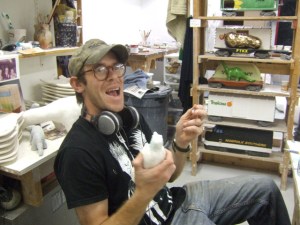
Peter Morgan in the Studio

Peter Morgan in the Studio

All images copyright of the artist and used with their permission. 

Posted in 3D, Ceramic | Tagged , , , , | Leave a comment

Lindsey Wolkowicz – Brooklyn, New York

excerpt from 99 Lines

Excerpt from “99 Lines,” 2011, site specific installation/ 4-hour durational performance

Briefly describe the work that you do.

The center of my work is drawing. Generally, within the drawings an architecturally based space is constructed through line and flat areas of color. The space that is created is then either occupied by the figure or is explicitly absent of it. When the body is present in a drawing it is both supported and interrupted by the structure it occupies producing an interdependent relationship between body and architecture. The two central elements work to express intangible conditions of being. These concepts naturally extend out into sculpture that is usually generated in part from architectural cast-offs, allowing the viewer to take the role of figure in the work. And in the last four years, I have begun working with my partner, artist and dancer Dillon Paul, who brings a very different perspective and approach to the figure in space. Our ongoing collaboration, “Movement + Stillness,” has enabled me to move my work into the realms of video and performance installation while also opening up my individual practice in the studio.

At what point in your life did you decide to become an artist?

Like so many of us makers I was always “the artist” in my family. As a kid this began with the influence of my mother who applied her own art practice to her work as a Montessori school teacher and, as a mother, was committed to taking her two daughters to museums, theater, galleries, etc. As an adult there have been a series of moments where I have been called to a kind of confirmation, a sort of statement of faith in continuing my own practice. In terms of a specific moment of knowing… When I was eight I saw “Excavation” by DeKooning and literally fell on the floor. I remember very clearly knowing that I wanted to do whatever he had done to make me feel so much.

Tell us a little about your background and how that influences you as an artist.

I was born and raised just outside of Detroit’s city limits. The visual and visceral power of that city is a very real thing. And when you are raised with consistent exposure to this place, full of dying streets, the residue of past grandness, and buildings now empty except for all of the memories they hold you cannot help but be influenced. It set up a love for architecture in me and it made buildings feel like people with a past – palpable sadness, hopes, loss, potential, stories that can only be uncovered through the investment of time.

When I was a teenager, I trespassed… a lot. Being alone in spaces so vast, often so unstable, surrounded by debri and mystery, the fear in that, the ability to connect in that… spaces that embody both strength and vulnerability and by occupying them you have a heightened awareness of those two qualities in yourself as well.

A specific memory I have from when I was quite small is standing outside of the Masonic Temple downtown and looking across the street at a home that had been burned out. I could see straight through to the back stairwell where three saplings grew, each on their own step. There are a million stories you could write, or paint, about images like that. A house, opened up to the sky and the elements. You can easily put yourself inside of a space like that.

Press

“Press,” 2013, graphite and acrylic on paper, 38 x 50″

What types of conceptual concerns are present in your work? How do those relate to the specific process(es) or media you use?

My work examines the relationship between architecture and the body, whether constructed or felt. It explores the ways we build and occupy space through memory, perspective, relationship and psycho-dynamics. When drawing, figure, surface, lines, geometry and color interrupt and support one another. Within three-dimensional space, objects and architectural surrounds are constructed to promote a physical and evocative connection with the body of the performer and/or the viewer. The work is not about representing a location but instead about presenting what is found there. Intersecting lines, partial views and planes of dislocated material produce windows into an experienced place.

We once heard Chuck Close say he did not believe in being inspired, rather in working hard everyday. What motivates you in your studio practice?

I am motivated by fear. Joking… sort of.

I am a Midwestern gal at heart. I like work. I don’t feel good if I am not working. I find that if I take care of my work it takes care of me. If I show up for it, prove its value by spending time, I always have it even when I have had very little else. And it is a tangible thing. You do have to pay attention, feed yourself with information outside of the studio to keep the practice moving. For me those things tend to be architecture, music, watching dance or film, and reading even more than looking at others work (though looking is very important). And those outside influences help keep your mind going, especially in the moments where self-generating ideas is more challenging. But for me the most important aspect of maintaining a studio practice is simply consistently putting physically yourself in the space to work in order for the act of making to be possible. Inspiration is more often found, from my perspective, on the backside of making. In terms of the fear part… I have a healthy anxiety about working to meet my potential with the time I have.

What artists living or non-living influence your work?

Julie Mehretu, Gordon Matta Clark, Helena Almeida, Swoon, Margaret Kilgallen, Agnes Martin, Willem DeKooning, Doris Salcedo, Arakawa/ Gins, Louise Bourgeois, Martin Puryear, the films of Julian Schnabel, Wim Wenders… just to name a few…

It’s not my fault (I grew up in the suburbs)

“It’s Not My Fault (I Grew Up in the Suburbs),” 2013, concrete, cabinet face, Synlawn, wallpaper

When you are not making art what types of activities and interests do you engage in?

We have a four year old daughter so time with my family is very important. I love to cook for them, make the house beautiful, draw with her, have dance parties… and through our daughter I have a constant reminder about the importance of play. As I mentioned before, I am also big on music, seeing dance and performance, I have a deep love of documentaries…

I am also the Assistant Director of International Admissions at Pratt Institute. So when I am not in my studio I am able to spend time discussing the act of making with young artists and designers from all over the world. Through this position, I have traveled to eleven countries in the last year, which is an opportunity I feel very grateful for and one that provides exposure to sights and smells and interactions that you cannot help but be influenced by.

4.) headshot WolkowiczAbout 

Lindsey A. Wolkowicz was born in 1981 and raised in the Detroit area. She moved to Milwaukee, WI to attend Milwaukee Institute of Art & Design where she received her BFA in Painting. Wolkowicz remained in Milwaukee until 2007 as an active participant in the arts community then, after a year long stint in Portland, Oregon, moved to Brooklyn, NY. She completed her MFA in Painting/ Drawing at Pratt Institute in 2009 where she now works as the Assistant Director of International Admissions. Wolkowicz has exhibited nationally/ internationally and, in the coming year, will be a participating artist in the Dashboard Co-Op in Atlanta, GA. Wolkowicz lives in Brooklyn, NY with her partner/ collaborator Dillon Paul and their daughter Maeve and continues to make work in her studio in the Brooklyn Navy Yard.

www.lindseyawolkowicz.com

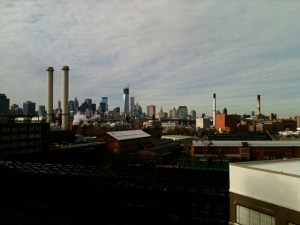
View from Lindsey's studio

View from Lindsey’s studio

All images copyright of the artist and used with their permission. 

Posted in Drawing, Installation, Uncategorized | Tagged , , , , , | Leave a comment

Matthew Keeney – Poughkeepsie, New York

Hangout: Part 5

“Hangout: Part 5,” 2013-present, video still

Briefly describe the work you do.

In my work, I look to the people, cultures, and structures within my environments to generate the content I work with. I use these elements to create work that draws attention to the relationships between them, and the high level of participation found within our contemporary society.

Tell us a little about your background and how that influences you as an artist.

Throughout my early years of being an artist, I traveled extensively and in many cases had to move often; thus working with my environment while using as few materials as possible become a large part of my practice. Working directly with public space and the people in it led me to branch out into the internet as a forum for engaging my audience.

The concept of the “artist studio” has a broad range of meanings, especially in contemporary practice. The idea of the artist toiling away alone in a room may not necessarily reflect what many artists do from day to day anymore. Describe your studio practice and how it differs from (or is the same as) traditional notions of “being in the studio.”

I feel a major part of my practice is collaboration, whether it is with people or my surroundings. Thus my “studio” can take on my many different forms from a social networking site to a street corner. Working in these different ways pushes me to keep an open mind when it comes to the creative process, as well as helps the work to continue to develop.

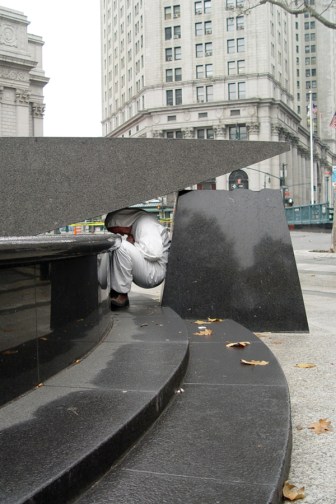
Found Space: Court House

“Found Space: Court House,” 2005, digital print

What unique roles do you see yourself as the artist playing that you may not have envisioned yourself in when you first started making art?

When I began making art I was interested in working with materials and the craftsmanship that went into creating objects. As I left college, my ability to work in such a way was impaired by other factors in my life. While attending a low-residency graduate program, I had to learn to work more efficiently and with less material, which has helped to shape my current practice.

When do you find is the best time of day to make art? Do you have time set aside every day, every week or do you just work whenever you can?

For myself, I ideally find the beginning of the day to be the best time for me to think creatively and get the most done. It is rare however that I find long or regular times within the day to work. Quite often a new idea will pop into my head when I least expect it. Therefore, much of my brainstorming results in brief notes that pile up on the corner of my desk, which I investigate further when time allows.

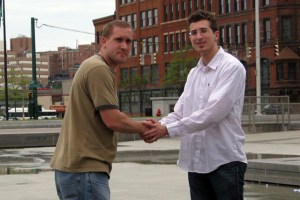
The Waiting Project

“The Waiting Project,” 2007-2008, image from performance

How has your work changed in the last five years? How is it the same? Though my subject has remained the same over the last five years, I have begun to see more integration between how I work with the built environment and my work online. By developing my profile online, I have been able to create more potential for interaction with my audience.

Are there people such as family, friends, writers, philosophers or even pop icons that have had an impact on the work you do?

Throughout my pursuit of art, I have had incredible support from my friends and family. As my career as progressed, I have met many people along the way that have been incredible inspirations with their knowledge and passion for art. Another large part of my development has come through my love of sports, as an avid fan and someone who plays sports recreationally, I have looked for ways to incorporate this other passion of mine into my work.

If you had an occupation outside of being an artist, what would that be and why?

Outside of art I have also worked for the last ten years as an educator. Working with groups of students from K-12 to the college level. I find working with students and the connections that I make with them to be very inspirational. Understanding the different ways of thinking that students have pushes me to rethink my own approach and practices

keeney_headAbout

Matthew received his MFA from the Maryland Institute College of Art, and his BFA from the State University of New York at Fredonia. He has also had additional studies at the Lorenzo de’ Medici School of Arts and Languages, as well as the European Ceramic Work Centre. Over the years, Matthew has participated in a variety of residencies, and presented lectures at numerous institutions. Matthew has exhibited and performed throughout the United States, Mexico, and Europe, and has shown at the Arts Club of Washington (Washington, DC), Savannah College of Art and Design (Atlanta, GA), the CUE Foundation (New York, NY), and is also included in The Drawing Center’s Viewing Program (New York, NY).

www.matthewkeeney.com

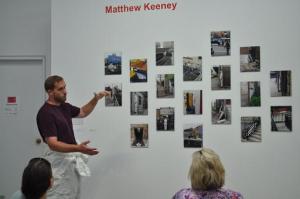
Mathew Keeney artist lecture

Mathew Keeney artist lecture

All images copyright of the artist and used with their permission. 

Posted in Uncategorized | Tagged , , , , | Leave a comment

Laci Coppins – Milwaukee, Wisconsin

Lapsed Time III

“Lapsed Time III”, Archival Pigment Print, 16 x 20, 2012

Briefly describe the work you do.

My name is Laci Coppins and I am a photographic, mixed media, and installation artist working primarily with themes related to faith, family, and intergenerational connections.

Tell us a little about your background and how that influences you as an artist.

I received my first camera when I was about seven from my grandmother. My education and background is primarily in the field of literacy and education. While always creating, the notion to pursue art as an option of study did not emerge until adulthood. Choosing to leave my position as an elementary school principal, I moved to Florence, Italy for about a year to formally study art. This experience has greatly influenced my overall determination to continue with my career in the arts.

The concept of the “artist studio” has a broad range of meanings, especially in contemporary practice. The idea of the artist toiling away alone in a room may not necessarily reflect what many artists do from day to day anymore. Describe your studio practice and how it differs from (or is the same as) traditional notions of “being in the studio.”

In the past I have shared large, warehouse style studio spaces with any where from four to 16 artists at one time. The benefits to a space like this are the inspiration and discussions that emerge when working around artists that have the same or a different medium. In addition, it is rare that everyone is in the space at the same time, so the chance encounters bring a social time to the space.

Currently, my studio is in my home. And while this does lend itself to toiling away alone, I find I am able to complete projects in a concentrated amount of time. Further, I invite other artists to join me for Creative Collective sessions periodically. The Creative Collective brings art making and social time together. Outside of these sessions, I make work independently in my studio space; although some larger pieces find themselves developed in other parts of my home.

Quenched

“Quenched”, Archival Pigment Print, 24 x36″, 2013

What unique roles do you see yourself as the artist playing that you may not have envisioned yourself in when you first started making art?

As an artist, you want to focus on making the work; however, you quickly realize it goes beyond this. At times, you feel like the Little Red Hen—make the work, market the work, show the work, sell the work and repeat. The challenge emerges when adding a full time job, family, other obligations, etc into the rotation. Being an artist is not for the lazy or weak at heart; you must have tenacity.

Freedom

“Freedom”, Mixed Media Installation, dimensions varied, 2012

When do you find is the best time of day to make art? Do you have time set aside every day, every week or do you just work whenever you can? 

The best time of the day for me to make art, is anytime of the day. I tend to find inspiration all around me and continuously take photos with my phone. The phone photos become a note or the start of a sketch for a larger idea. At times, I go through “creative bursts,” when I will work several nights in a row until the early morning; another benefit of having an at home studio. I work daily—studying, experimenting, editing, tweaking, reviewing artists’ opportunities, or simply cutting paper. For me, it is important to keep my hands busy.

How has your work changed in the last five years? How is it the same?

Laci Coppins working

working

As a photographer, the process has changed over the years through the use of digital media. The same is true for me. Initially, I only worked in analogue processes, but as communal dark rooms became less available, I started experimenting with alternative processes and mixed materials. This led to text embedded in the image or as a part of the image. Further, I expanded the printing from solely photographic paper to hand made paper, plexiglass and mesh vinyl. I have moved from documentary style photography, to a more focused narrative style of showcasing the image. The loss of my maternal grandmother and father within a year of each other has had the largest impact upon my work to date. From this experience, I started working more with installation, but at times still including the use of text with my work and the photographic image. I continue to show case the photographic image in isolation; however, these images are now placed in conversation with installation and mixed media pieces.

Coppins sketchbook

Sketchbook

Are there people such as family, friends, writers, philosophers or even pop icons that have had an impact on the work you do?

Photographic Media reveals the universal understanding of one’s personal connections to life and loss. Family and my faith remain strong themes in my work and as so an influence in my work. Nevertheless, the losses of my grandmother and father within a year of each other have had the largest impact upon my work to date.

If you had an occupation outside of being an artist, what would that be and why?

I am fortunate to work full time in the arts, not only as an artist, but also as a museum educator. Another possible career choice would be a writer (putting my BA in English to work), but considering this is a second career, I will stick with this one.

Laci CoppinsAbout Laci Coppins

Laci Coppins is a photographic, mixed media and installation artist working primarily with themes related to faith, family, and intergenerationa

l connections. Born in Tucson, Arizona she received her BA from Fisk University in English, a Post Baccalaureate in Fine Arts with an emphasis in Photography from Studio Art Centers International, and both a Masters and Doctorate in Education from Trevecca Nazarene University. In conjunction with special programs, Coppins has participated as a guest artist and lecturer with Alverno College, the Milwaukee Art Museum, Marquette University and Northwestern University. She was an artist in residence with REDLine, Milwaukee and has exhibited in multiple cities across the United States and Italy. Coppins’ work is in several public collections including Fisk University, REDLine, Milwaukee, the University of Wisconsin Milwaukee, and numerous private collections.

Studio

Studio

www.lacicoppins.net

All images copyright of the artist and used with their permission. 

Posted in Installation, mixed media, Photography, Uncategorized | Tagged , , , , | 5 Comments