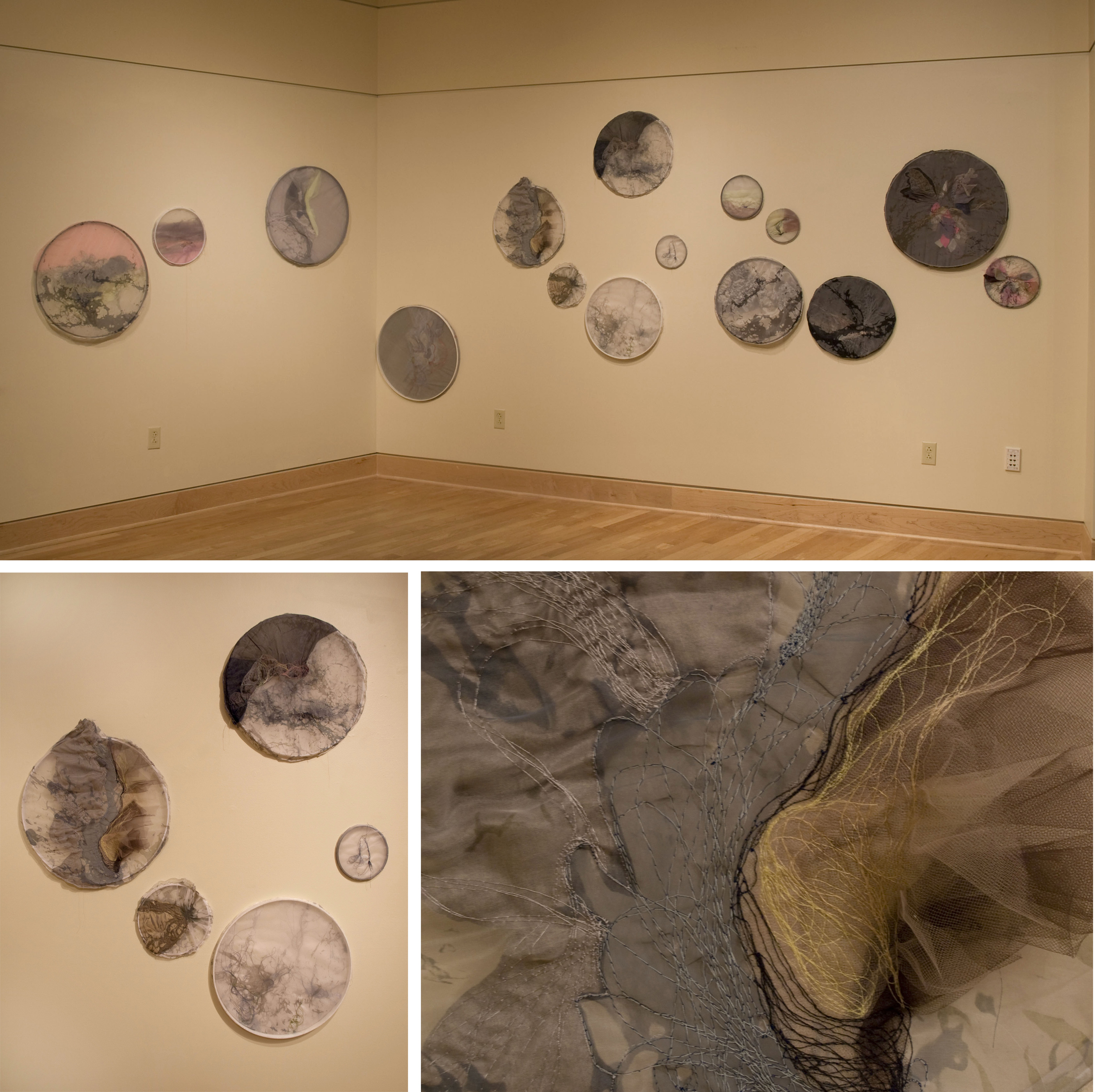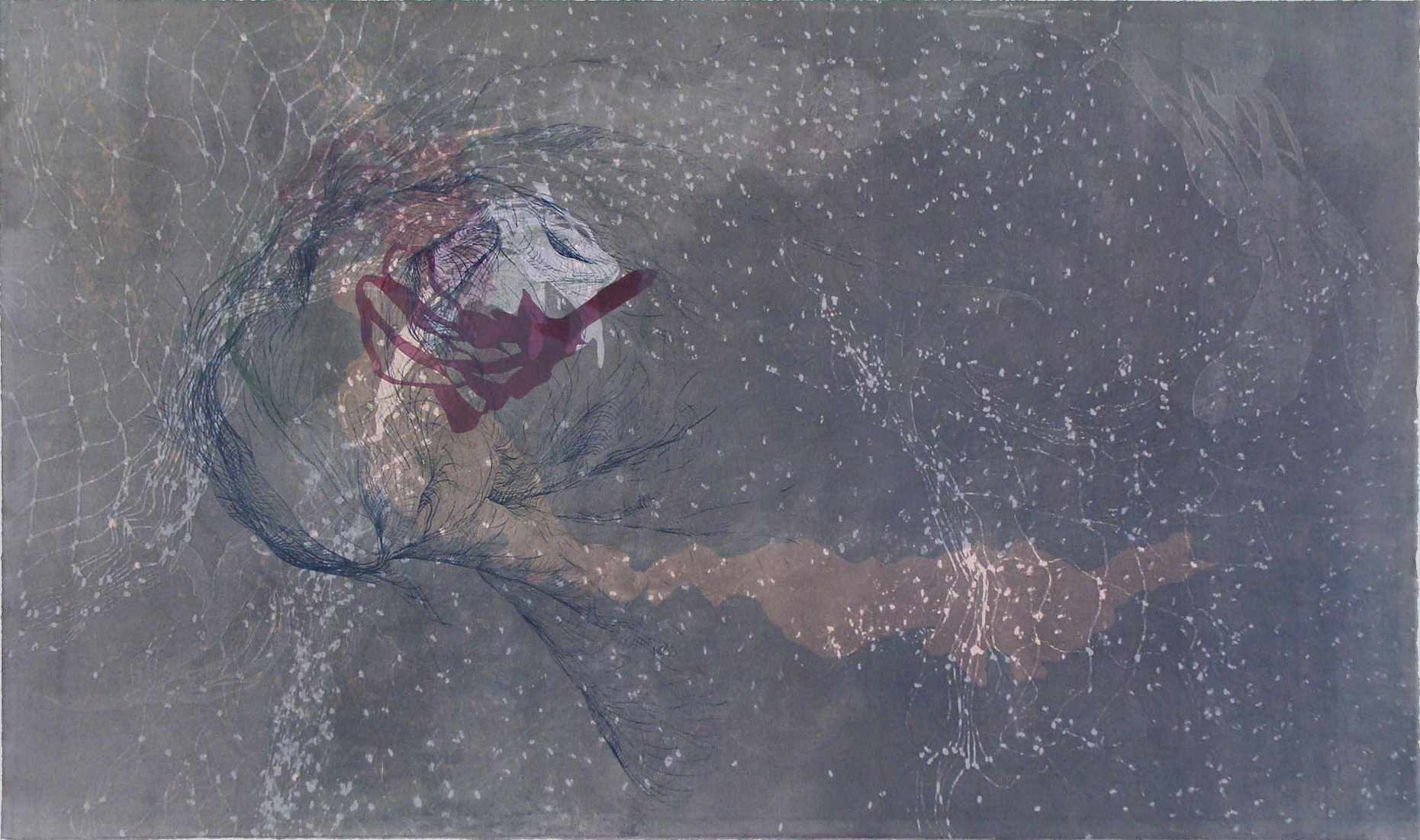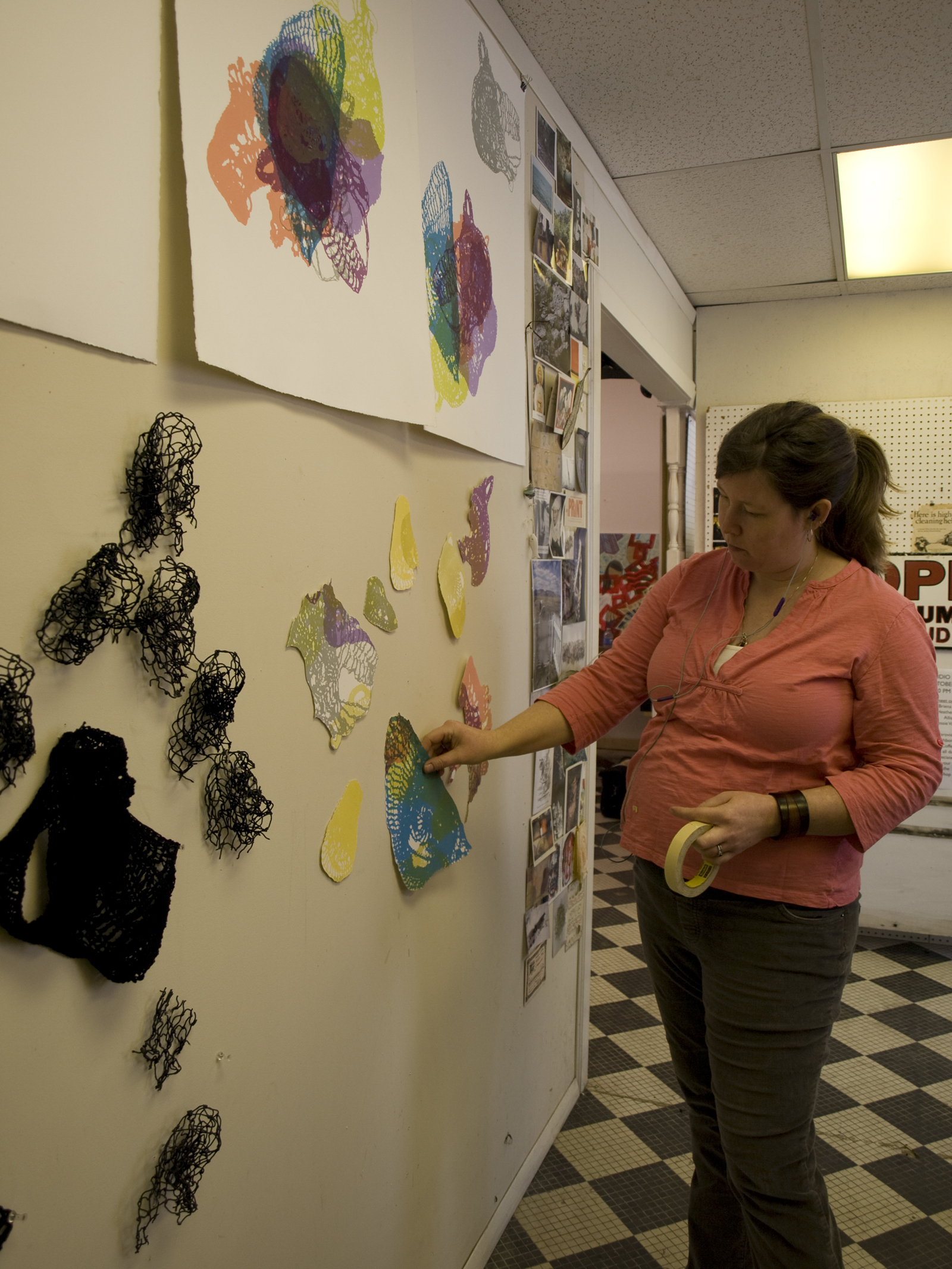
Delaney Smith – Houston, Texas

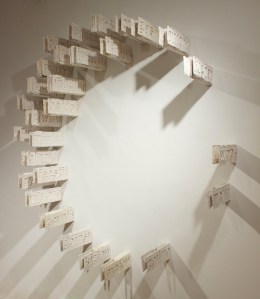
Knebix

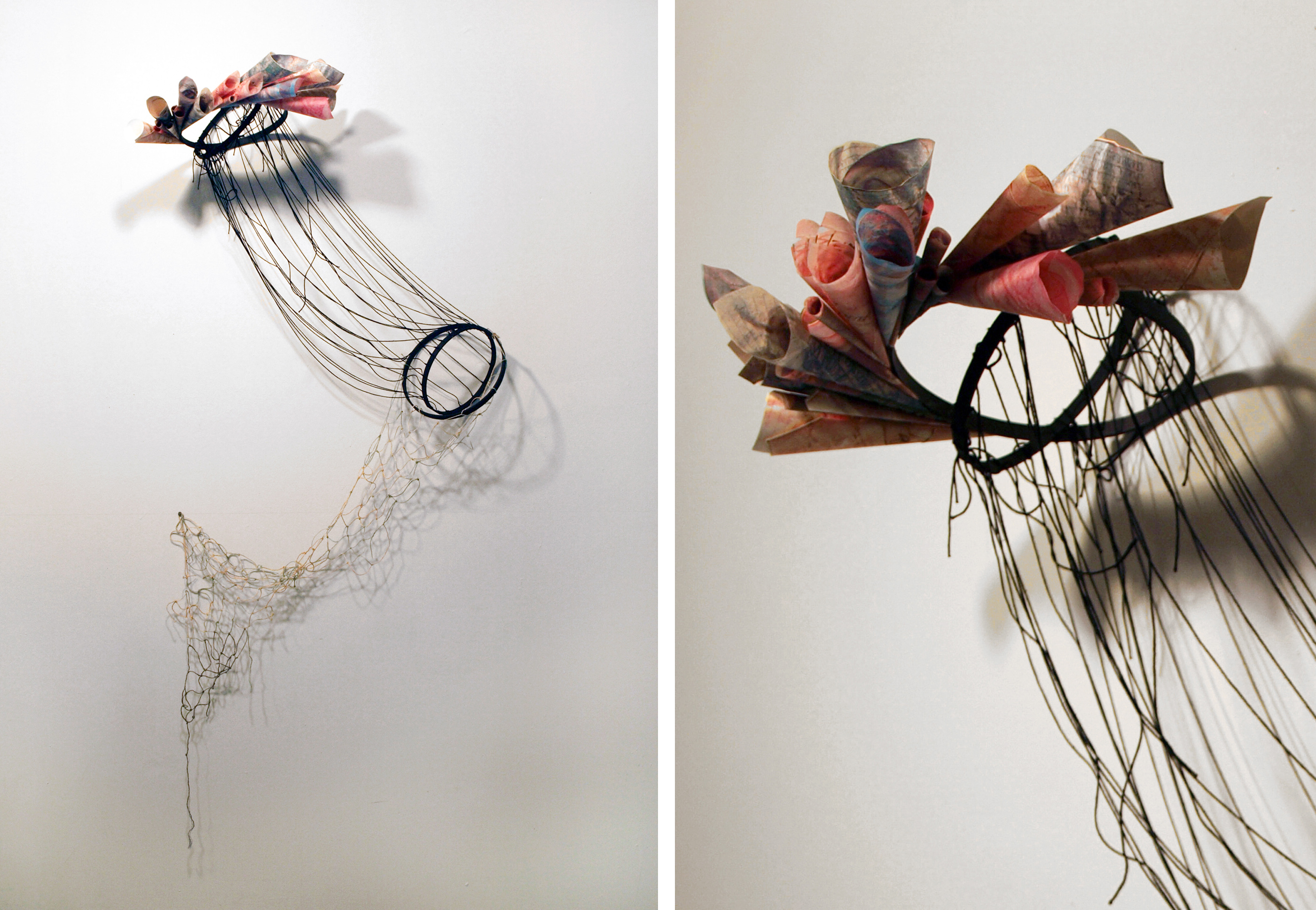
“Knebix” 2013, cast repurposed paper, 72x74x13″

Briefly describe the work you do.

Currently I am working in two directions: I create installations and sculptures from altered and handmade paper, and I make interactive books that contain instructions for the viewer to complete. I am inspired by the way people perceive or navigate the form of a book.

Tell us a little about your background and how that influences you as an artist.

I fell in love with paper while earning my undergraduate degree in Graphic Design at the University of Southern Mississippi. My professor shook a piece of paper in the air, and the sound of it was so lovely. Between graduation and taking a job as a graphic designer, I worked full time at Avalon Sewing Company in Hattiesburg, MS, making draperies and soft furnishings for the home. Working there gave me solid foundational skills in sewing and working with large amounts of material. I find myself reincarnating movements and methods I used at Avalon in my current work.

Because I grew up in a rural part of south Mississippi, I cultivated an active imagination in order to stay entertained. Even at a young age, I noticed subtle details in my surroundings. I would find myself being very still in order to become aware of the slight movement of the pine tree branches, or the sounds of the neighbors cows through the woods. My work has an abundance of texture and a limited color palette, reflecting the quiet and meditative experiences I had as a child.
Signatures

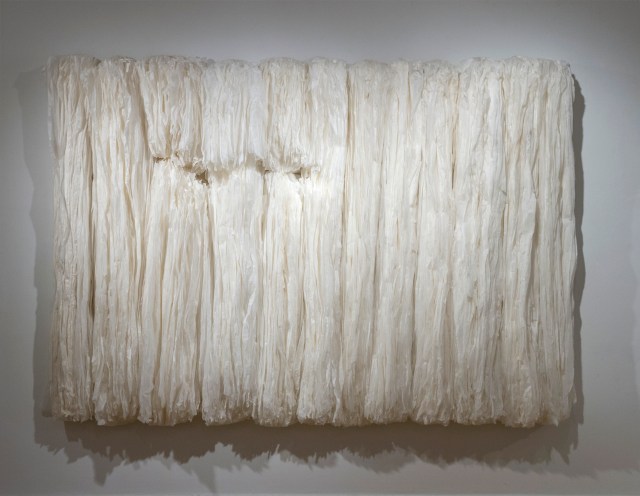
“Signatures” 2013, paper
Photo by Matt Golden

The concept of the “artist studio” has a broad range of meanings, especially in contemporary practice. The idea of the artist toiling away alone in a room may not necessarily reflect what many artists do from day to day anymore. Describe your studio practice and how it differs from (or is the same as) traditional notions of “being in the studio.”

I am lucky to have an open studio at the Houston Center for Contemporary Craft until August 2014. This dynamic is perfect for my interactive work, which can unfold naturally and unexpectedly in this kind of environment. I’m already planning on how I can continue the unpredictability and openness of my workspace after I finish my residency here.

What unique roles do you see yourself as the artist playing that you may not have envisioned yourself in when you first started making art?

When I was younger, I would never have imagined myself relating to the craft world so intimately. Also, it wasn’t until later that I realized how rewarding and exciting it is to be a facilitator for creativity. One of the motivations to create my interactive books is to create an opportunity for other people to experience art in a different way than expected.

Also, Art Handler/Shipper. To be honest, it’s kind of fun to prepare art to be shipped, but it is nerve racking as well.
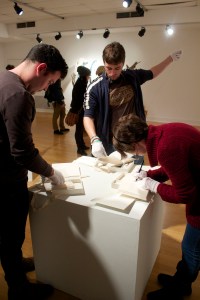
Installation view of "Mark the Loss," 2013, set of three books enclosed in cases, photo by Lauren Well

Installation view of “Mark the Loss,” 2013, set of three books enclosed in cases, photo by Lauren Well

I find that early in the morning and late at night are my best times to create. The hours in the middle of the day get muddied with distractions and sinking levels of caffeine. I teach at two community colleges during the day, and have open studio hours in afternoons and both weekend days. I make time outside of my open studio hours to create without interruption.

How has your work changed in the last five years? How is it the same?

My work has become more distilled and focused, but it still is rooted in an excitement for tactile experiences. Over the past few years, my work has incorporated performance, whether the action involves the viewer or myself. I am working to document these moments more thoroughly.

Are there people such as family, friends, writers, philosophers or even pop icons that have had an impact on the work you do?

It would take a long time to list the people who have impacted my life, but the ones who stand out are Lhay Thriffely, my sewing guru; Ann Hamilton, artist; and the young ones in my life, such as my nieces and nephews, who remind me to keep a fresh perspective.

If you had an occupation outside of being an artist, what would that be and why?

I would probably be a seamstress or professional server. These are both jobs I’ve had in the past that I really enjoyed and miss at times. They both have unexpected elements that keep the work interesting, and are satisfying.

AdSmith_headshotbout
Delaney Smith is a visual artist working primarily with paper and bookmaking to create sculptures and interactive books. With a focus on aligning process and inherent qualities of material, she explores the ideas of accumulation, transformation, and duality. Her interactive books develop as the viewer alters the pages, creating a unique story of marks and questioning expectations of how one should approach a book.

Delaney received her BFA in Graphic Communications from the University of Southern Mississippi in 2007. During and after school, she was a seamstress Avalon Sewing Company in Hattiesburg, MS, where she created soft furnishings and window coverings.  In 2008, she took a position as a graphic designer in New Orleans, LA. Two years later,  she arrived in Denton, TX, to earn her MFA in Fibers from the University of North Texas. Her work has recently been selected for Materials: Hard and Soft 2014 and is part of the permanent collection at Texas Women’s State University. Currently Delaney is an artist-in residence at the Houston Center for Contemporary Craft. 
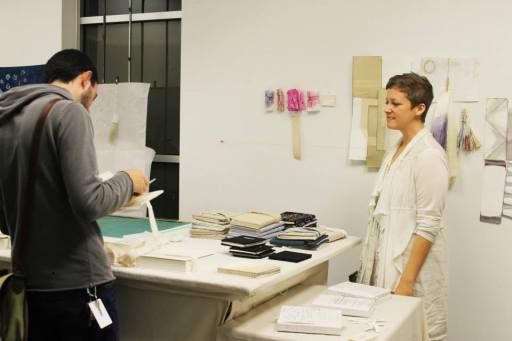
www.delaneysmithstudio.com

dSmith_studioAll images copyright of the artist and used with their permission. 

Posted in 3D, mixed media | Tagged , , , , | Leave a comment

Stefani Quam – Milwaukee, Wisconsin

Qualia Archetype #1

“Qualia Archetype #1,” Charcoal on paper, 6″x6″, 2013

Briefly describe the work that you do.

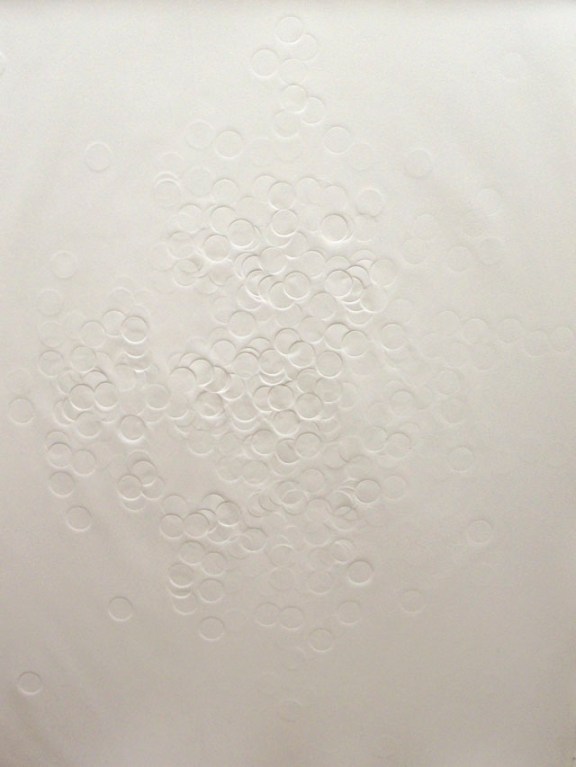
My work highlights the shape of the circle. For me, the circle symbolizes the process, pattern, routine, cycles reoccurring in nature and the lived experience. I utilize the circle in a variety of media – varying the process, the pattern, while the shape remains true to itself. But within the process of each work, lies an element of chance. The placement of every circle is not planned out. The final product is often discovered through its creation.

At what point in your life did you decide to become an artist?

I was twelve when I started challenging myself with drawing still lifes just for fun. Then I got a book that “taught you how to draw” which I quickly mastered and it just sort of steam rolled from there.

Tell us a little about your background and how that influences you as an artist.

My work, like many artists’ is an effort to try and make sense of the world as I know it. I’ve always been a big fan of having a plan. I like to be prepared. I like to anticipate what is going to happen and be ready to make decisions accordingly. So when there seemed no rhyme, reason, or logic behind events and patterns occurring within my life, I had to go back to the drawing board. Literally. Every day, I have to come to terms with the lack of control I have over chance.

My work provides me with the opportunity to control the majority of variables within a project, while allowing raw chance to take its course simultaneously…. a self-constructed simulation if you will.

Silhouette #1

“Silhouette #1,” Paper embossing, 22″x30″, 2013

What types of conceptual concerns are present in your work? How do those relate to the specific process(es) or media you use?

Perception. We as humans bring our personal experience to every new experience as a means of understanding. Furthermore, our personal experience is made up of what we remember. Hence, our perception of “reality” is unique unto ourselves. Somehow though, we find empathy for one another in the narratives we tell about our reality.

The result of my work has no representational or narrative references, leaving the viewer’s perception open to interpretation.

We once heard Chuck Close say he did not believe in being inspired, rather in working hard everyday. What motivates you in your studio practice?

I talk a lot about being a by-product of my generation. I grew up in the 90’s, will forever remember 9/11, live with the repercussions of a war that still doesn’t feel like it has ended, get to see the first African American to become President, only to watch the market crash right before entering the working world, and the Tea Party do everything possible to preserve the legacy of Milton Friedman.

Ellipses

“Ellipses,” 100 small graphite drawings, 42″x42″, 2013

I am a peon on this planet, with far fewer problems than many, but I have to find my way and my voice in the world I live in. My studio is my safe place; my laboratory for figuring out how to do that.

What artists living or non-living influence your work?
William Kentridge
Anne Hamilton
Tara Donovan
Jacob Hashimoto

When you are not making art what types of activities and interests do you engage in? 

West Coast Swing Dance
Snuggling my Cocker Spaniel, Junior
Eating at delicious independent restaurants
Traveling as much as possible

About 

HeadshotAs a graduate of Syracuse University’s School of Visual and Performing Arts’ Transmedia Department, Stefani’s concentration has been audio/visual production, including the history of time-based media formats, their social/political influence, and the psychology behind their consumption. With the exponential growth of technology, so changes the face of contemporary craft: New technology is now being incorporated into, or used in conjunction with, craft and art practices. As an inter-disciplinary artist with formal training in both digital and fine arts, making the leap to combine media using installation is the next target for her practice.

www.stefiq.wordpress.com

Stefinherstudio

All images copyright of the artist and used with their permission. 
 

Posted in Drawing | Tagged , , , , | Leave a comment

Steve Snell – Hastings, Nebraska

Installation View: M.F.A. Thesis Quest, HUB-BUB Showroom Gallery, Spartanburg , SC, July  2011

Installation View: M.F.A. Thesis Quest, HUB-BUB Showroom Gallery, Spartanburg , SC, July
2011

Briefly describe the work you do.

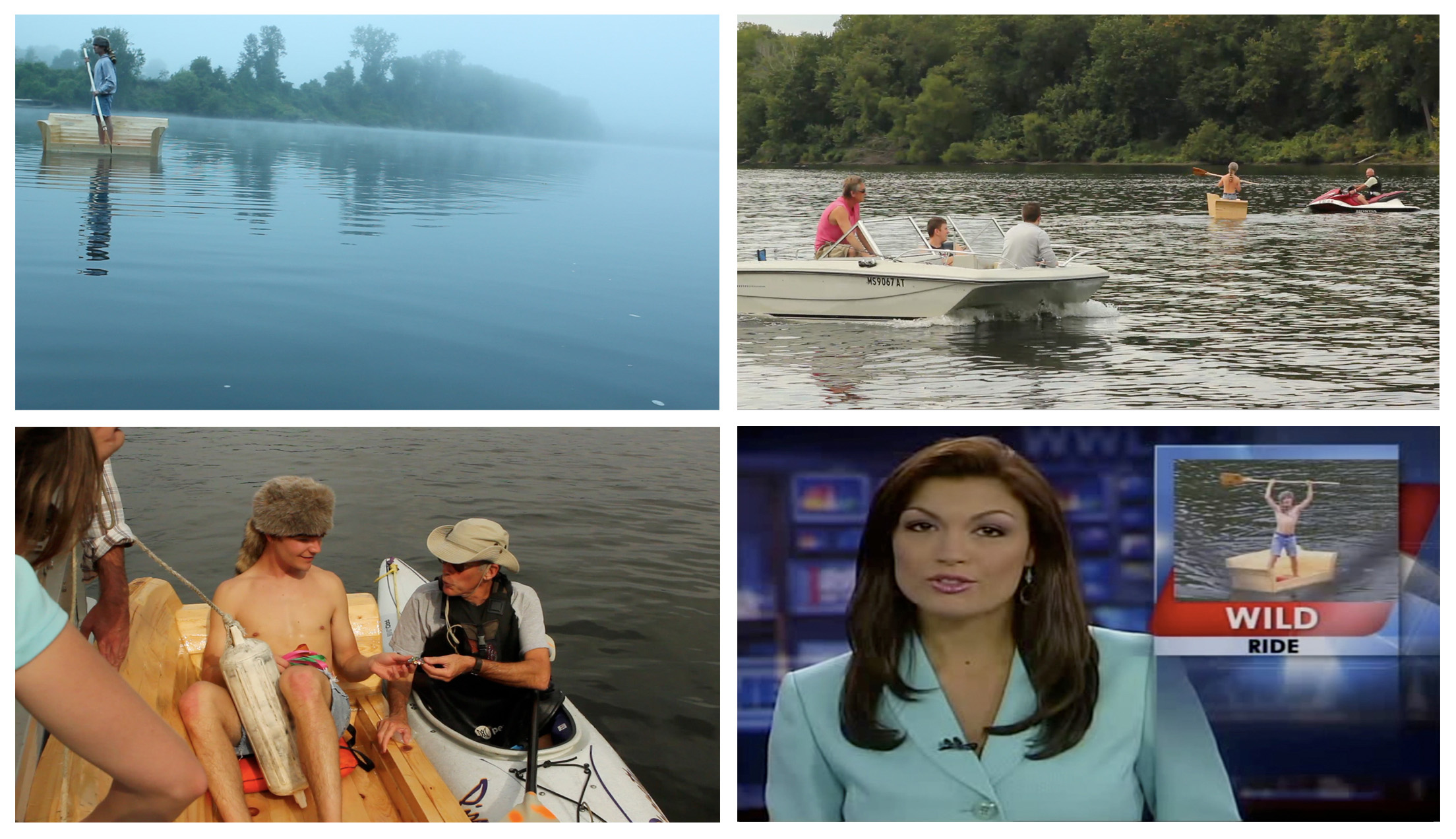
I like to call my art practice adventure art. I use the term to describe a performance-based action of adventure, in which I (or someone else) use creativity and imagination to have an exciting and remarkable experience.  These adventures are then transformed and perpetuated through popular, social, and artistic media, resulting in a larger network of newspaper articles, TV spots, drawings, oil paintings, assemblage sculpture, video installations, and good old-fashioned storytelling.

Tell us a little about your background and how that influences you as an artist.

I watched a lot of good television and movies growing up.  Specifically, cowboy Westerns and adventure films like Indiana Jones. I think my fascination with popular culture and specifically the male hero/celebrity comes from this.  I never really considered myself an artist at the time, but movie watching definitely influenced my imagination and in turn inspired me go on trips into ‘the wilderness’.  Now, I don’t see a big difference between hanging out in the woods as a kid and going on adventures under the pretext of art as an adult.

M.F.A. Thesis Quest Adventure-Art Performance, Mt. Greylock to Amherst, MA, October 15-22nd, 2010  Digital Video: 15:12 min.

M.F.A. Thesis Quest,
Adventure-Art Performance, Mt. Greylock to Amherst, MA, October 15-22nd, 2010, Digital Video: 15:12 min.

The concept of the “artist studio” has a broad range of meanings, especially in contemporary practice. The idea of the artist toiling away alone in a room may not necessarily reflect what many artists do from day to day anymore. Describe your studio practice and how it differs from (or is the same as) traditional notions of “being in the studio.”

My studio practice probably both confirms as well as differs from the stereotype of the artist toiling away along in the studio.  I’d say that the majority of the time, being alone in the studio is the case.  Besides going on adventures, I paint a lot and edit videos.   And I like to be alone when I do this, usually listening to podcasts.  On the other hand, the source material for much of my painting and video work comes from the much more social and public nature of my adventure-art practice.  I think that it is a good balance for me.

King of the River Adventure-Art Performance, Connecticut River, September 22nd, 2010

King of the River,
Adventure-Art Performance, Connecticut River, September 22nd, 2010

What unique roles do you see yourself as the artist playing that you may not have envisioned yourself in when you first started making art?

Four years ago, I never would have imagined some of the roles I have taken on in my adventure-performance work.  I can be outgoing, sometimes, but usually only around friends.  The adventures have forced me out of my comfort zone and challenged me to engage strangers with my artwork, ideas, and stories.  I never would have thought that I could facilitate so many experiences for others through my art practice.  I figured I would always have the curtain to hide behind, like a painting or something, in my interaction with the audience.

When do you find is the best time of day to make art? Do you have time set aside every day, every week or do you just work whenever you can? 

I work whenever I can, but I almost always do a little work on weekday mornings, before heading off to school.  I find that I get my best ideas before breakfast while drinking coffee.  I also usually ‘hole-up’ on the weekends and spend all day in the studio.  I’m not very good at working at night.  I usually get distracted and want to do something more passive, like watch a good movie.   The adventures themselves are an all day for multiple-days type thing. 

How has your work changed in the last five years? How is it the same?

My work has changed in that my whole concept and identity with adventure art developed roughly four years ago.  It came about after being challenged to insert my own personality into the popular culture that I have often critiqued or used as source material in my paintings and videos.  It is the same in that I still paint on a regular basis, using popular culture and American mythology as inspiration.  The main difference is that I would say that it now has a lot more of ‘me’ in it.

Are there people such as family, friends, writers, philosophers or even pop icons that have had an impact on the work you do?

Lots of people have had an impact on the work I do.  I owe a lot to friends as well as strangers who have helped me out and participated with various projects.  Artists, like Joseph Beuys and Errol Morris as well as celebrities like Alec Baldwin, Sylvester Stallone, and the wildlife filmmaker, Marty Stouffer, have also had an impact on my art. 

If you had an occupation outside of being an artist, what would that be and why?

Well, I’m an art teacher as well.  I very much identify with my occupation of teaching.  Before becoming a professor, I taught K-12 in Alaska.  I loved that.  I think it is good for me in that it forces me outside of my sometimes self-centered art practice.

About 

06_stevesnellSteve Snell (b. 1983) grew up in the suburbs of Columbus, Ohio where he watched a ton of great television and often rode his bike to Taco Bell. He graduated from Miami University in 2006 with a B.F.A. in Painting and a B.S. in Art Education. In 2011, Steve received his M.F.A. in Studio Art from the University of Massachusetts Amherst, where he was a recipient of the Dean’s Dissertation Fellowship. He has been an Artist-in-Residence at the HUB-BUB in Spartanburg, South Carolina and most recently at the Wassaic Project in Wassaic, NY. Steve is currently on the faculty at Hastings College in Hastings, Nebraska, where he teaches painting, art history, and adventure-art. His work has been shown in galleries and film festivals throughout the United States.

In the Studio

In the Studio

www.steve-snell.com

All images copyright of the artist and used with their permission. 

Posted in Uncategorized | Tagged , , , , | Leave a comment

Neal Calvin Peterson – Minneapolis, Minnesota

"Period", Album Cover, 2013

“Period”, Album Cover, 2013

Briefly describe the work you do.

For me, concept always supersedes medium. As a result, my work has included a variety of audio, video, projection, graphic design, and a bit of traditional media. I strive for different and beautiful—beautiful being a very subjective term.
Tell us a little about your background and how that influences you as an artist.

The fact that I don’t know where I/we came from inspires me to try and understand why I/we am/are here. Cliche as it sounds, becoming an artist is a journey not a destination. I believe that to evolve as an artist is to pour everything about yourself into a funnel to see what comes out the other side. 

The concept of the “artist studio” has a broad range of meanings, especially in contemporary practice. The idea of the artist toiling away alone in a room may not necessarily reflect what many artists do from day to day anymore. Describe your studio practice and how it differs from (or is the same as) traditional notions of “being in the studio.”

I’m inspired by everything all of the time so I like to think that my studio is wherever. I’ve never had a traditional studio space, but it’s something I’d like to consider someday—not necessarily as dedicated area to actually create art, but a unique space to hang out and talk about creating art.

"Pencils", Dropping 1 of 1,000 custom pencils at The John Lennon Wall in Prague, 3.25" each, 2013

“Pencils”, Dropping 1 of 1,000 custom pencils at The John Lennon Wall in Prague, 3.25″ each, 2013

What unique roles do you see yourself as the artist playing that you may not have envisioned yourself in when you first started making art?

1. Awkward conversationalist at social gatherings. 
2. Mailman.

When do you find is the best time of day to make art? Do you have time set aside every day, every week or do you just work whenever you can? 

I work just about everyday at random times. I track my hours as either creative art making or logistical B.S..  If the latter is greater than the former, it’s time to adjust. 

IR Sketchbook Censored web

IR Sketchbook Censored web

How has your work changed in the last five years? How is it the same?

A couple years ago I stopped worrying about what other people were doing or thinking and everything has been a lot more fun since then. I still think too much.

Are there people such as family, friends, writers, philosophers or even pop icons that have had an impact on the work you do?

Absolutely! 

If you had an occupation outside of being an artist, what would that be and why?

A foreign diplomat for an island nation in the South Pacific from one of the following countries: Austria, Liechtenstein, or Switzerland.

About 

Neal-Calvin-Peterson-72dpi-RGBNeal Calvin Peterson is an artist and musician based in Minneapolis. 

www.nealcalvinpeterson.com

All images copyright of the artist and used with their permission. 

Posted in Uncategorized | Tagged , , , , | Leave a comment

Jessie Van der Laan – Knoxville, Tennessee

disguise installation view and detail screenprint on paper, handmade net, wood, string 48”x24”x8” 2011

disguise,
installation view and detail,
screenprint on paper, handmade net, wood, string, 48”x24”x8”,
2011

Briefly describe the work that you do.

My work embodies transition, in subject and form. I work interchangeably between drawing, printmaking, fiber sculpture, and installation, using repetition to build form and a sense of time. My materials are selected based on tactile qualities, to which I make a combinantion of cognitive and emotive decisions in response. I embrace moments of ambiguity and uncertainty, as they relate to the precipice between memory and hope. I tell a story of attachment and loss by creating landscapes that transcend physicality to describe an inner, imagined spaces. I evoke the physical and emotional nature of reverent places that can be solitary, communal, natural, constructed, remembered and imagined. Tangled nets become topographic contours; seams define the meeting of two edges or two moments. Rock cairns and lighthouses are markers of paths, remnants of history; abandoned barns and small, mountain cemeteries are shadows of lives, relationships and families. Holes, cavities, and absence implies presence. I consider that as destruction can lead to reconstruction, mourning leads to celebration of life lived. Within the subtle, liminal, and bittersweet, I contemplate the sentiment of the past, and the potency of a hopeful future. 

At what point in your life did you decide to become an artist?

I don’t remember making a conscious decision to become an artist. Making art has always been a part of my life, and I’m not sure I really ever considered being anything else. 

Tell us a little about your background and how that influences you as an artist.

I grew up in Colorado and I continue to refer to the landscape and memories of spaces visited in my childhood. My parents have been a huge influence on my work. My mom resists referring to herself as an artist, but is an incredible artisan, expert seamstress, weaver, knitter, and an ultimate respository of knowledge. My father studied art history, and greatly influenced my early art making. The loss of my father, to a heart attack, my first year in college reinforced my drive to make art, and impacted the focus of my work. My work is not always directly about my father, but relationships, loss, and memory are at the center of my work. 

cumuli rising installation view and details mixed fabrics and stitching dimensions variable 2013

cumuli rising,
installation view and details mixed fabrics and stitching, dimensions variable,
2013


What types of conceptual concerns are present in your work? How do those relate to the specific process(es) or media you use?

I’m working on some new pieces that are in their fledgling stage. The current pieces are a mixture of crocheted sculptures and their translations into screenprint. I’m thinking about these pieces as a mixture of shadows and fossils. At this point it’s too early to tell where these pieces will lead. I started making the crocheted pieces intuitively. I don’t use a pattern, but just make stitches and build the form. I then expose the crocheted piece to a screen, and create monotype screen prints from those shapes. I envision them evolving into a larger installation. 

We once heard Chuck Close say he did not believe in being inspired, rather in working hard everyday. What motivates you in your studio practice?

I have learned over the years that I can only make work when I get to the studio on a consistent basis. Much of my work happens as I work with materials, print, draw, cut things apart, sew them back together and move them around the wall. I rarely have a firm plan of how a piece will end up when I start it, and my best work evolves over time. Not every day in the studio is quantifiably productive, but I realize when I miss studio time how valuable and necessary it is for me to get there, even if it’s just to putter around. My current studio is in a space shared by seven other artists, who are all incredible artists. Having a studio with people I respect also motivates me to get into my space. 

incidentalis major: penumbra i monoprint on paper 28” x 47” 2012

incidentalis major: penumbra i,
monoprint on paper, 28” x 47”,
2012

What artists living or non-living influence your work?

Louise Bourgeois, Ernesto Neto, Julie Mehretu, David Altmejd, Kiki Smith, many other artists that intertwine mediums and build space in unusual ways. There are also moments of art throughout history that influence me, or spark ideas. For instance, I love the portraits of women from the Northern Renaissance, by Robert Campin and Rogier van der Weyden. The veils and head scarves, matched with the tiny pins that hold them in place have shapes and ideas that linger in my mind. 

When you are not making art what types of activities and interests do you engage in? 

When I’m not making or teaching art, I spend time with my husband, our dog, and cat. We try to get into the mountains as much as possible, which is sadly not as much as we would like. I love cooking, and feeding my friends and family. My art is often introspective, so cooking something feels creative and giving. I’m also expecting my first baby, so currently I am engaging in lots of research and daydreaming about babies, baby accessories, and life as a parent. 

About 

VanderLaan_04Jessie Van der Laan is an interdisciplinary artist living and working in Knoxville, TN. She received her B.F.A in Printmaking and Drawing from Washington University in St. Louis, and her M.F.A in Studio Art from the University of Tennessee, Knoxville. Her work is informed by her training as a printmaker, and a childhood spent knitting, sewing, drawing, and daydreaming. Van der Laan was raised in Denver, CO, whose landscape continues to lend form and color to her work. She is currently an adjunct faculty member at Pellissippi State Community College, and the Printshop Technician at the University of Tennessee. She has shown her work in numerous regional and national exhibitions, including a recent solo show, exhibited at both Lindenwood University and Moberly Community College. In the fall of 2013, she presented a paper at the SECAC conference on the broad definition of contemporary drawing. She is a co-founder of the collaborative studio space, the Vacuum Shop Studios, where she makes her work. 

OLYMPUS DIGITAL CAMERA

In the Studio

www.jessievanderlaan.com 

All images copyright of the artist and used with their permission. 

Posted in Uncategorized | Tagged , , , | 1 Comment

Patrick Earl Hammie – Champaign, Illinois

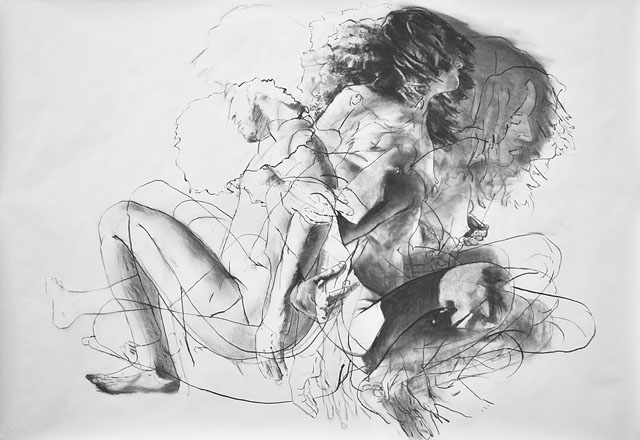
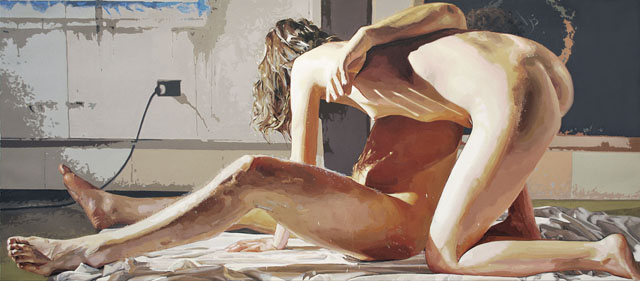
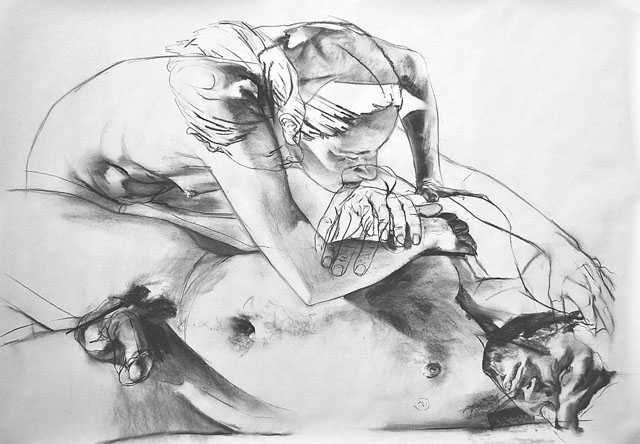
Untitlted (Study)_2013_charcoal on paper_42x60 inches

Untitlted (Study)_2013_charcoal on paper_42x60 inches

Briefly describe the work you do.

Perhaps more than any other form of image-making, figurative painting has often been interpreted as a reflection of the values of period in which it is produced. My work investigates the expectations built into this canonical genre, probing and dismantling the idealizing impulses that have historically shaped it. I focus specifically on constructions of gender and race, putting pressure on these categories as a means of expanding understanding of identity. I investigate how male artists have imagined and visually formulated the nude figure in the history of Western art, and have spent the past several years using the pictorial traditions of the Old Masters, body language, and narrative to reconfigure inherited conceptions of ideal beauty and heroic nudity. In my practice, painting the figure entails encountering and interrogating the heroizing, idealizing tradition of the nude in Western Art in which black and brown male bodies have been objectified and dehumanized. Representing the black male nude by making my own body the subject of monumental canvases that play on effects of distortion and masculine prowess, I remake what the nude does and how it produces meaning.

Tell us a little about your background and how that influences you as an artist.

I was born 1981 in New Haven, CT. I was raised in West Haven, CT but moved back and forth between there and Hartsville, SC until graduate school. When I was younger, I studied martial arts, played baseball and football, and sang in concert choirs. These experiences informed my personality, and developed the discipline and work ethic that I pull from today. I earned my BA from South Carolina’s Coker College and my MFA in Painting from the University of Connecticut. Before graduate school, most of my works were drawings that explored intimations of my current practice. Artist like Sidney Goodman, Käthe Kollwitz, and Charles White influenced me. During graduate school I moved toward painting as my main medium, and was drawn to artists such as Francis Bacon, Renee Cox, Lucien Freud, Leon Golub, and Barkley L. Hendricks.

Labor III_2012_oil on linen_42x96 inches

Labor III_2012_oil on linen_42x96 inches

The concept of the “artist studio” has a broad range of meanings, especially in contemporary practice. The idea of the artist toiling away alone in a room may not necessarily reflect what many artists do from day to day anymore. Describe your studio practice and how it differs from (or is the same as) traditional notions of “being in the studio.”

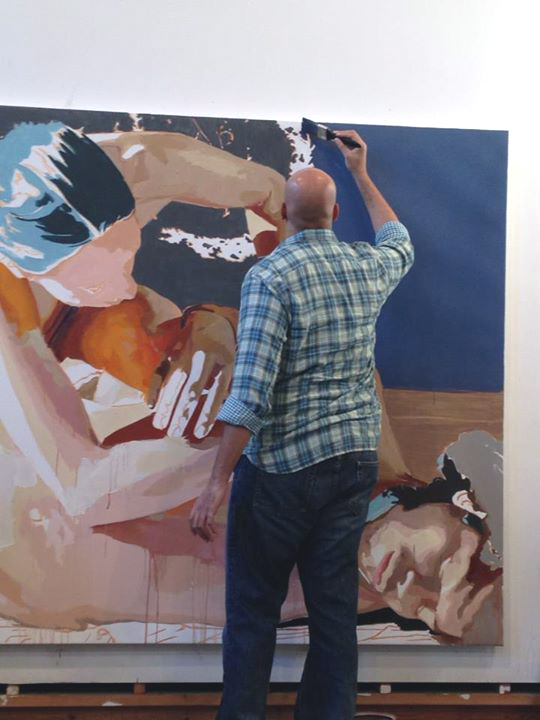
I feel my studio routine is pretty traditional. When I walk into my studio, I turn on music; nothing happens in the studio without music. Next, I look at the works in progress and plan for the day, while I check my email and social media. Then, I mix the colors that I need, lay out my materials, and paint. Before I leave I clean up. I try to keep a clean studio so I have more permission to make a mess when I’m working. During studio visits people sometimes comment on my palette being immaculate (paint is usually in a grid). I assure them that it’s only that way when I’m not actually painting.

When do you find is the best time of day to make art? Do you have time set aside every day, every week or do you just work whenever you can? 

I usually work on my paintings and drawings in the studio from about 12 – 6pm every weekday. From 7 – 9pm I work on other studio business—emails, essays, lectures, website, etc. On Saturdays, it’s an all day affair.

Study for Aureole_2013_charcoal on paper_42x60 inches

Study for Aureole_2013_charcoal on paper_42x60 inches

How has your work changed in the last five years? How is it the same?

My previous projects put my un-idealized body in conversation with the idealized male form and represent myself perched atop precarious pedestals, visualizing an effort to reshape myself and confronting impressions of the objectified black body. My recent project, Significant Other, represents a shift in my practice, as a female figure becomes a predominant agent of content. It presents a female and a male figure locked in a physical dialogue, hefting weight, and relocating the perceptions of ruined and objectified bodies that recall and carry on complex legacies of suffering and struggle. Informed by historical representations of Otherness and recent shifts that locate women and people of color as central influencers of culture and politics, this series reorients inherited expectations and makes room for these bodies to populate new stations. Drawing on the emotive qualities of Romanticist painting and its use of heroic proportions to engage with political and humanistic expression, I imagine bodies as occasions for us to encounter difference toward considering their capacity for establishing new narratives.

More examples of my work can be viewed here: http://patrickearlhammie.com/portfolio/project/significant-other/

If you had an occupation outside of being an artist, what would that be and why?

I’d probably write fiction. I might still do that.

About 

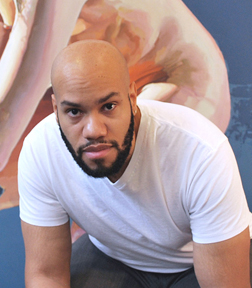
HeadshotPATRICK EARL HAMMIE is an artist best known for his monumental portraits working primarily with themes related to identity, history and narrative. He received his BA from South Carolina’s Coker College and his MFA in Painting from the University of Connecticut. Hammie is currently an assistant professor at the University of Illinois at Urbana-Champaign, and has lectured at Purdue University, University of North Carolina, and the Wadsworth Atheneum Museum of Art in Connecticut. In 2008, he received the Alice C. Cole ’42 Fellowship through Wellesley College, and in 2011, was an artist in residence at the John Michael Kohler Art Center. He has exhibited in galleries throughout the U.S. and abroad including Ruchika’s Art Gallery in Panjim Goa, Kunst in der Carlshütte in Büdelsdorf, the Painting Center in New York, and the Indianapolis Art Center. His work is in several public collections including the Kohler Company, the Kinsey Institute at Indiana University, and the William Benton Museum of Art. Hammie has received awards from the Tanne Foundation and the Alliance of Artist Communities with the Joyce Foundation, and an Arnold O. Beckman Research Award. 

In the Studio

In the Studio

www.patrickearlhammie.com

All images copyright of the artist and used with their permission. 

Posted in Uncategorized | Tagged , , , , | Leave a comment

Ellen Greene – Chicago, Illinois

Wife

Wife

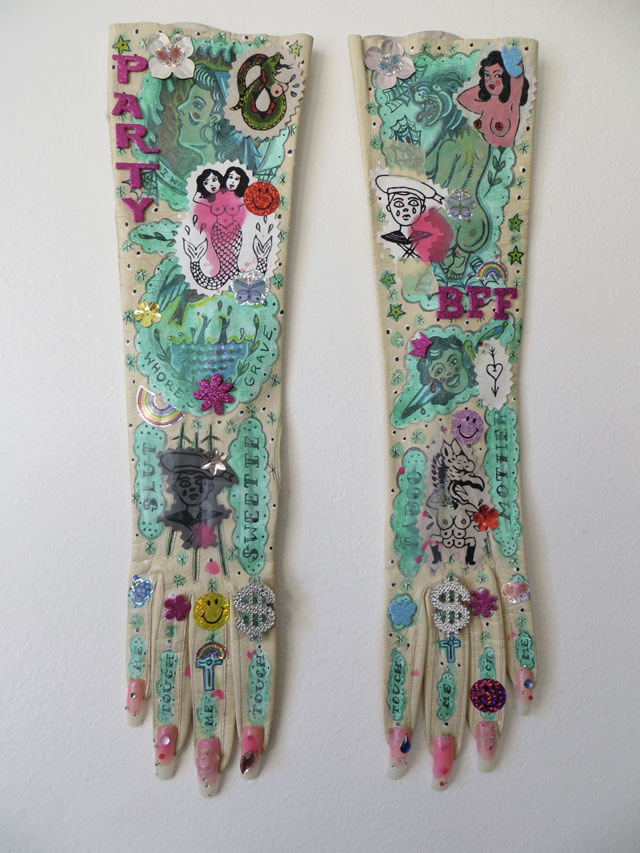
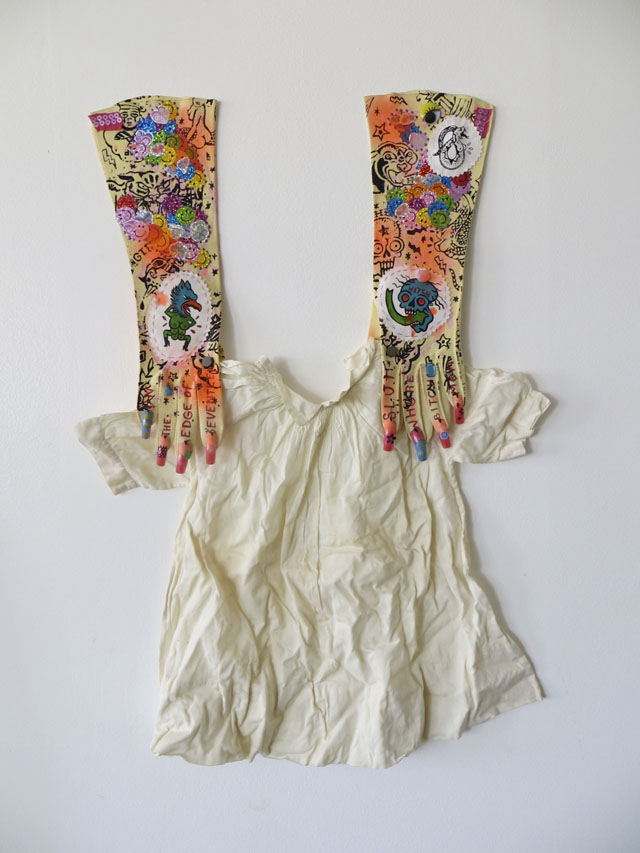
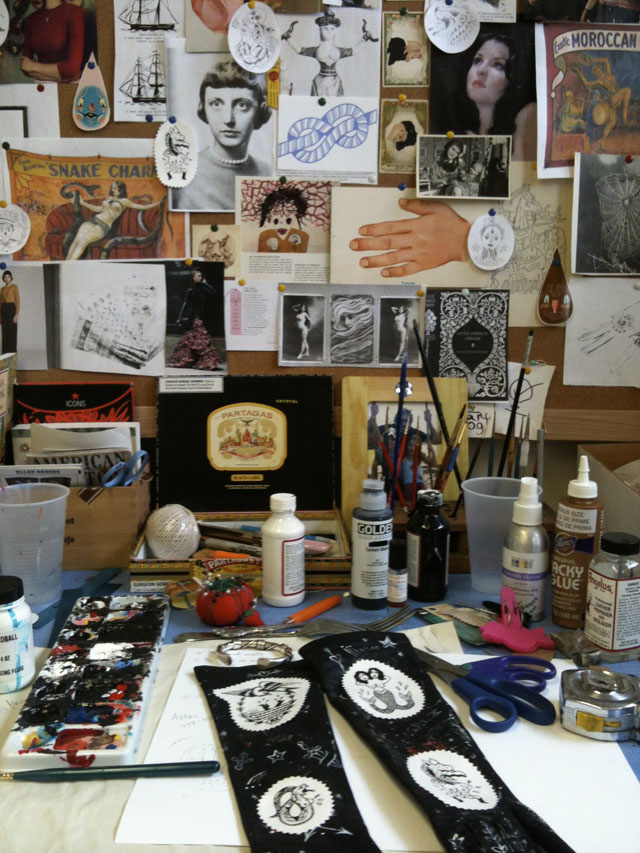
I am hesitant to describe anything I do with too much specificity because I hate to pigeon hole the work I do. I am most well known for the painted “tattooed” vintage women’s gloves. I see myself as a painter as well as an illustrator, I work with fabric and I use photography as well. So mixed media/artistic mag pie would be the best over all description of the medium.

As for the subject matter, I am usually working through some sort of visual or emotional tension. Either finding a harmony or sitting with discordant or tense imagery. With the work on vintage gloves there was a tension created by the contrast between aggressive masculine tattoos and the feminine gloves. I was trying to find a balance point between the two to better express my own feelings around sex, death, love, motherhood- big life themes.

My latest work is purposefully playful and rough around the edges. I am trying to sit with a more free form space. The gloves as a metaphor for feminine expectations are still a part of work but I have put them within a larger story of objects. I am still working with a lot of tattoo symbolism but again- breaking them apart from their original contexts and putting them into larger mixed media spaces. Its all about trying to find balance between too much too little. Its all about the midlife as a place to explore conceptually. 

Tell us a little about your background and how that influences you as an artist.

I come from a small university town in Kansas. Its where William Burroughs lived and died. Its not far from where the right wing fundamentalist bigots of the West Borough Baptist church have their headquarters. Its a place full of contradictions where these artsy progressive academic counterculture types live within a larger culture that is pretty conservative. So I was really influenced by the whole freak scene of my town. The contrasts and tensions there. Folk art, diy, punk, punk feminism all set in stark contrast to the bible thumping fundamentalism. It made me a bit of a hell raiser to grow up there. 

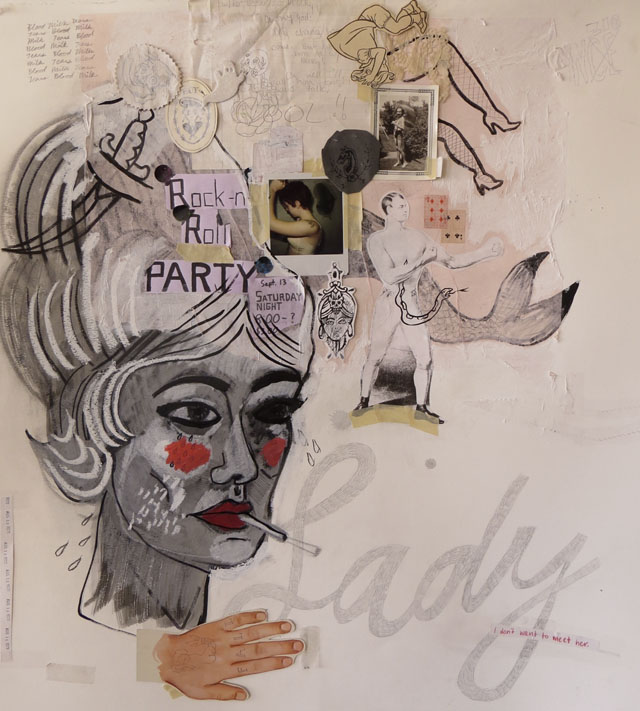
Lady

Lady

The concept of the “artist studio” has a broad range of meanings, especially in contemporary practice. The idea of the artist toiling away alone in a room may not necessarily reflect what many artists do from day to day anymore. Describe your studio practice and how it differs from (or is the same as) traditional notions of “being in the studio.”

Its pretty traditionally studio time. I think one thing that sets it apart is that I usually have to balance the studio time with motherhood, work and home life so the studio is still a very sacred and alone space. Its where I meet myself and work through thoughts and emotions that I pick up from “regular” life. 

What unique roles do you see yourself as the artist playing that you may not have envisioned yourself in when you first started making art?

I am a shy person. Making small talk and social chit chat is not my cup of tea. So to show my work is a way that I connect. I find that when I am speaking my truth- even if it seems to be embarrassing or weird or that voice in my head says “who do you think you are?” that if I am brave enough to put it out there that someone will connect to it on a personal level. And when someone sees your work and connects to its honesty it allows the viewer to be more brave and honest with themselves. Artwork is powerful medicine and images can set you free. I don’t care about the “art world” or status or money. I do it so that I can be a better human being and inspire others. I didn’t realize that when I began. 

Mother and Daughter

Mother and Daughter

When do you find is the best time of day to make art? Do you have time set aside every day, every week or do you just work whenever you can? 

I love getting to it first thing in the morning. I usually take whatever I can get but first thing is best- fresh full of coffee and sunlight. 

How has your work changed in the last five years? How is it the same?

My work is always changing. I am always changing. If one body of work was super colorful the next one I may strip it all down to black and white. I am always trying to keep things fresh and moving- willing to break it all down and build up again.

Things that have not changed are that I have been a mother, wife and tattooed woman through the last five years. Those are some characters or ideas that move through time into various pieces even if they are address with a different medium. Its a challenge for me to keep consistent, its to a fault that I change so much- I always am seeking grounding. 

Are there people such as family, friends, writers, philosophers or even pop icons that have had an impact on the work you do?

My daughters and my husband have to be the largest impact on my work because they are what consumes my life outside of the studio. My mother is important because she was the first person to champion me as an artist and believe I could do it. Family is a big one because they keep me grounded.

Its hard to say wether I love pop culture or history more. I feel like I am influenced by so much imagery and ideas from the turn of the century as in 1900’s and that time period in tattoo imagery as well. I love myths and really old folk art and general history nerd stuff like those ken burns documentaries.

I also live with two young girls who are constantly exposing me to girl culture, so there has been a lot of barbie, disney princess and such in my world that if I did not have

children I may have not been exposed to that aesthetic. So it is a mix of these influences that I really play with in my work. Alicia Eler, Peregrine Honig, Kate Durbin, and Cori Winrock are all contemporary ladies who are really honing in on a particular style of writing and making artwork that feels like a sisterhood of sorts. The internet has been crucial as a tool to connect with each other. 

If you had an occupation outside of being an artist, what would that be and why?

Right now I am a mother, that is my other occupation. I have also been in fashion retail, worked with my husband on his design business and for a few years I home schooled my kids.

I am looking to go back to work in retail as we speak. I love retail, I love a store and I love new challenges so I am excited to put back on my career lady shoes and hit the sales floor again. It also appeals to the fashion hound in me- I am a sucker for pretty clothes. No matter what though, the art is there- it will always need its pound of flesh from me. 

About 

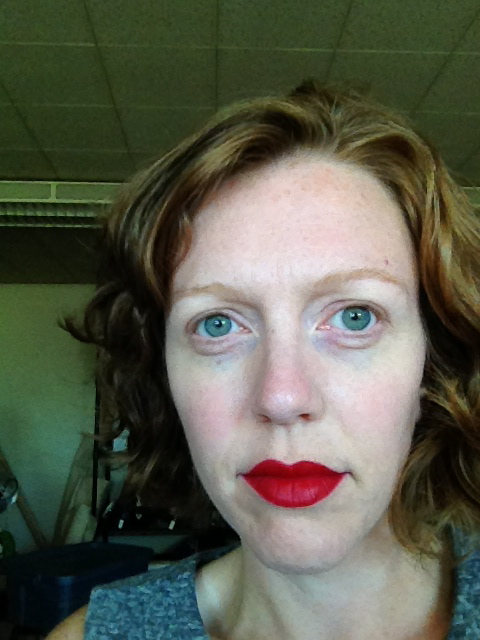
IMG_2799Ellen Greene was born and raised in Lawrence, Kansas, a town full of contradictions. A mad mix of frat boys, Christian evangelists, ex-hippie hobos, punks and professors all called Lawrence their home. Drawing compulsively from an early age, Ellen was influenced by 80‘s pop culture, small town art scene and the colorful characters of her town. Folk art from found objects, DIY fashion and tattoo culture each inspired the red- headed girl who always felt strange in her small town surroundings.

After graduating from the Kansas City Art Institute she embarked for Chicago where she now runs her art studio. Her work is still infused with the same compulsive intensity instilled in her childhood; a quirky Americana aesthetic born out of contrasts, grown in the Midwest.

Her studio artwork has been shown extensively in solo and group exhibitions throughout the Midwest, United States and abroad. 

The Studio

The Studio

All images copyright of the artist and used with their permission. 

Posted in Uncategorized | Tagged , , , , | Leave a comment

Heather Oelklaus – Colorado Spring, Colorado

Briefly describe the work you do.

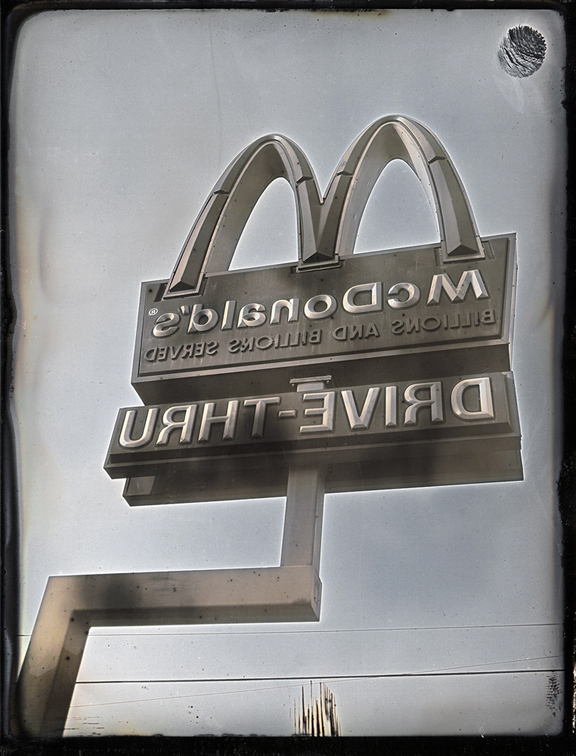
Drive-Thru, Daguerreotype, 4"x5", 2012

Drive-Thru, Daguerreotype, 4″x5″, 2012

Experimentation with alternative process is a key element in my photographic art. I incorporate contemporary concepts and iconic imagery with early photographic techniques such as Daguerreotype, wet plate collodion, lumen prints, pinhole photography, chemigrams, instant film, various cameraless photography, and traditional silver printing. Balancing the conceptual and the technical aspects of my work is important to me.

Tell us a little about your background and how that influences you as an artist.

Art has always been present in my life. My father designed and built our home while my mother enjoyed flower arranging. With my parents interested in artistic expression, there was no surprise that I too had the love of art and of expressing myself through various avenues. My high school art teacher, Willis Hildebrandt, was instrumental in my early years with art. He saw that I had a drive for investigation and he encouraged me to put together a darkroom in the classroom.  Ever since then every place I have lived has had a darkroom.  Looking back, I see how the encouragement I received from elementary and high school teachers gave me the confidence I needed as a young artist. In turn, I too, find it rewarding to help younger artists along their path.

The concept of the “artist studio” has a broad range of meanings, especially in contemporary practice. The idea of the artist toiling away alone in a room may not necessarily reflect what many artists do from day to day anymore. Describe your studio practice and how it differs from (or is the same as) traditional notions of “being in the studio.”

I believe that I am capable of art making in any circumstance but I do adore having my traditional studio as my refuge. I collect objects that inspire my art making and I place them in my line of sight in my studio. These antique and sometimes quirky objects may stay on the shelf for years before the right idea comes in play. My studio has a darkroom, a dry room where I sort and view my negatives, a larger area for matt cutting and print storage, and a light studio for indoor shooting. The studio gets reorganized and transformed depending on the work I am creating. Right now I have blacked out all the windows and have installed safelights in each room so I may work with mural sized photographic paper for contact printing and developing.

House, 5'x 10' consisting of Eighty-four 8"x10" Silver Gelatin Prints taken with my Pinhole Camera Truck, 2013

House, 5’x 10′ consisting of Eighty-four 8″x10″ Silver Gelatin Prints taken with my Pinhole Camera Truck, 2013

What unique roles do you see yourself as the artist playing that you may not have envisioned yourself in when you first started making art?

When I first started working with photography I was only interested in the end result of having produced a beautiful silver print. Now that I work with antiquated techniques and learn the intricate details of each process, I feel as if I am an ambassador for the history of photography.

Little Miss Sunshine.(Me next to my 1977 Chevy Pinhole Camera Truck, this truck produced the above image "House")

Little Miss Sunshine.(Me next to my 1977 Chevy Pinhole Camera Truck, this truck produced the above image “House”)

When do you find is the best time of day to make art? Do you have time set aside every day, every week or do you just work whenever you can? 

I am in “art mode” every day. But when the light is right I must take advantage of that time and take my 14-foot pinhole camera truck, lovingly named Little Miss Sunshine, out for a shoot. Depending on how bright the sun is shining, she requires exposures ranging from 14 minutes to 40 minutes.

How has your work changed in the last five years? How is it the same?

For the last five years I have worked in the Art Department at Colorado College as the Print Workshop Supervisor. Printmaking has opened my mind to new possibilities for artistic expression and to ways of approaching photographic techniques that I have known for 25 years. Being introduced to zinc plate etching while experimenting with chemigrams in the darkroom seemed to be fate. This openness toward new ideas while working on mastering a familiar technique is an energy that I hope I carry with me throughout my life.

Are there people such as family, friends, writers, philosophers or even pop icons that have had an impact on the work you do?

My fourteen year old daughter, Cyan, has been my patient muse. I do not believe I would have made the work I love the most if it were not for her presence in my life. She has given me an immeasurable perspective towards family, life, loss, world events, learning, love, and myself. I can only wish to be as big as an artistic influence in her life as she has been in mine. Sometimes I daydream about my Great Great Grandchildren hanging my art on their walls. I wonder if they will get a sense of the kind of person I am and if they will create stories behind my images.

If you had an occupation outside of being an artist, what would that be and why?

I would want to be a surfer. Even though I have never surfed or been in the ocean for more than ten minutes, I most definitely would be a surfer. They seem to have such passion and respect for surfing. They are driven to go after that “feeling” that cannot be described unless you do it yourself.

About 

Oelklaus headshotHeather Oelklaus (1972, LeGrand, Iowa) is the Print Workshop Supervisor at Colorado College in Colorado Springs. Her photographic art has one foot in the darkroom and the other in alternative processes. Heather utilizes historic techniques such as Daguerreotype, wet plate collodion, instant film,  cyanotype, salt prints, pinhole photography, mordancage, lumen,  and chemigram. Experimentation within these processes is a foundation for her work. Tongue in cheek humor is a common thread throughout her art.

In 1991, Heather attended the Kansas City Art Institute where she majored in sculpture. She moved to Colorado Springs in 1997 with her husband, Jeffrey Oelklaus.

Heather is preparing work for her upcoming show “One of a Kind” at the Colorado Springs Fine Arts Center this summer. The work will include abstract and experiment photography.

In the Studio

In the Studio

www.camerakarma.com

All images copyright of the artist and used with their permission. 

Posted in Uncategorized | Tagged , , , , , | 1 Comment

Andrea Beiko – Toronto, Ontario

OOPS!, 2010, Acrylic paint, tiles, CRUSH bottle, 12”x12” (base) x40”

OOPS!, 2010, Acrylic paint, tiles, CRUSH bottle, 12”x12” (base) x40”

Briefly describe the work you do.

I have always been intrigued by the unnoticed; things that most people overlook, ignore, or are oblivious to. I am constantly wondering why these intricate items are where they are, what their purpose is, and I wonder why nobody else acknowledges them the way I do. I am constantly absorbing and observing the area around me in order to discover new items and add to my ‘collection’ of unnoticed items.  

My work revolves around the use of multiples, typologies, patterns, everyday objects, logos, commercial products, Pop Culture, and the idea of minimalism where appropriate.  Having an eye-catching piece for the viewer to be drawn to is my ideal goal and purpose with my art; creating something they can connect with, recognize, and hopefully enjoy its’ aesthetic qualities. 

Tell us a little about your background and how that influences you as an artist.

My interest in art began at a very young age.  As most children do, I drew small landscape scenes and was so proud of colouring in the lines.  It was in middle school when I realized just how much I enjoyed art class; always bringing an artsy angle to school projects, wherever possible.  I took art and photography all throughout high school and continued into my post-secondary career as well.  The past few years of my academic career have focused on photography in both studio and academic forms. 

I began studying at the University of Toronto (UofT) in 2006, graduating in 2010 with an Honours Bachelor of Arts specializing in Art and Art History.  This program allowed me to create my own work while studying the great masters at the same time.  In 2011 I was accepted into Ryerson University’s Graduate Studies program, Photographic Preservation and Collections Management.  Graduating this past year (2013), I have now concluded my formal academic career and have begun to focus on solely my art career. 

Having been in school for so long, it has greatly influenced the way in which I create art today; with my education focusing on photography for so long, the medium itself is now my favourite.  I see the world through a camera lens and capture as much of it as possible.

Then & Now (series), 2012, Digital Photograph, 24” x 36” (each separate), 48” x 36” (both together)

Then & Now (series), 2012, Digital Photograph, 24” x 36” (each separate), 48” x 36” (both together)

The concept of the “artist studio” has a broad range of meanings, especially in contemporary practice. The idea of the artist toiling away alone in a room may not necessarily reflect what many artists do from day to day anymore. Describe your studio practice and how it differs from (or is the same as) traditional notions of “being in the studio.”
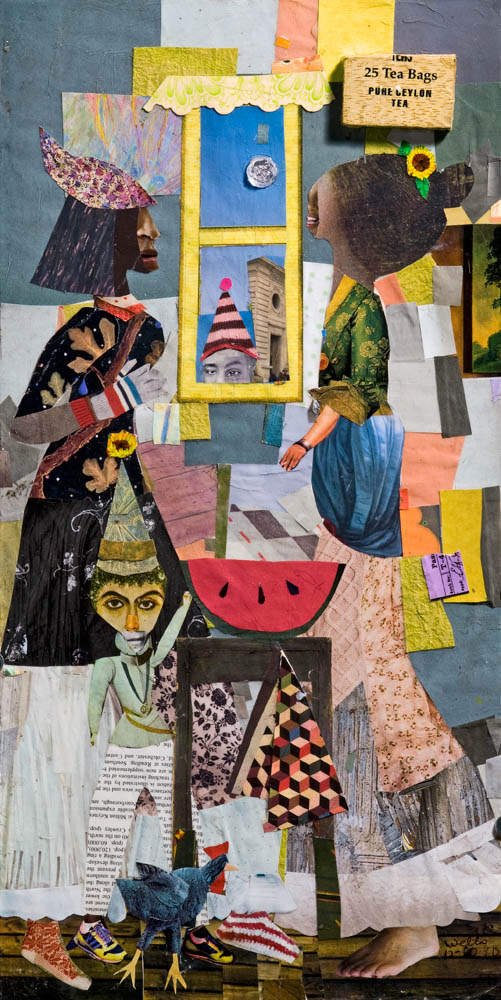
Seeing as most of my art is in the form of photography, as cliché as it sounds, the world is my studio.  I am constantly traveling and searching for interesting images to either begin new projects or continue with ongoing ones. 

When I do create art other than photography, I typically work in my bedroom or basement with my television and computer nearby.  I do not like to be in silence when painting, sculpting, etc.  When I was studying at UofT, we were provided shared mini studio spaces in which I spent a lot of time in.  Having other students working within the area helped motivate and inspire me.  Now that I am working out of my home, I often ask friends and colleagues for a mini critique when I can.

I Am Pop Art (self-portrait), 2013, Digital Photograph, 12” x 12”

I Am Pop Art (self-portrait), 2013, Digital Photograph, 12” x 12”

When do you find is the best time of day to make art? Do you have time set aside every day, every week or do you just work whenever you can? 

I tend to work in phases; I will begin a project and be so involved in it, I want nothing but to work away and complete it.  Outside work and life tend to get in the way of the project at one point and it does typically take me some time to get back into completing the project.

When it comes to photography, as mentioned earlier, I am constantly creating and working with PhotoShop and other editing programs.  I do not set time aside for my photography; it somehow finds its way into my every day.

How has your work changed in the last five years? How is it the same?

For five years in my undergraduate degree, I made art all the time.  I had projects, exhibitions, and critiques constantly.  Upon graduating and beginning Graduate school, it unfortunately left my life temporarily.  Being in an extremely academic program prevented me from having extra time to devote to my art.  I missed it dearly for the entire two years.  It wasn’t until recently that I was able to bring it back into my life.  I am now exhibiting again and making new projects on a regular basis.  I feel as though I have gone full circle, and it feels so fulfilling.

The work itself has changed, as I am now mostly doing photography; before I was working with print media, painting, sculpture, and projection art.  I do have several projects currently planned including painting and sculpture and am excited to see where they will take me.

Are there people such as family, friends, writers, philosophers or even pop icons that have had an impact on the work you do?

During school, friends and teachers were a huge influence on my work.  They helped shape specific pieces and their inspiration was irreplaceable.  Now I am still in touch with a great deal of my past classmates and I like to think we do still inspire one another.

Although inspired by friends and professors, my real inspiration has come from past artists; specifically, Pop Artists such as Roy Lichtenstein, Claes Oldenburg, and James Rosenquist.  But no artist, past or present, has influenced myself and my art the way Andy Warhol has done.  For as long as I can remember I have been fascinated (some might say obsessed) with celebrities and pop culture icons.  I love brand names, logos, and consumerism also.  Essentially everything Warhol based his art around, I have adored since before making art or even knowing who Warhol was.

If you had an occupation outside of being an artist, what would that be and why?

It is still hard for me to think of myself as an artist, as I labelled myself as an ‘art student’ for so long.  But recently I have realized that I am indeed an artist and it feels empowering, satisfying, and just feels right. I know that I am most definitely in the right field of work and will always be an artist. 

If I wasn’t an artist, I’m not quite sure what I would be…..I would definitely still be doing something within the Arts – whether it be teaching, or practicing another craft within the arts, such as acting.  It’s hard to think about that world/life, as this one feels so right.

About 

BEIKO.HEADSHOTThose who know me well, know that photography is an enormous part of my daily life; both taking photographs, and admiring others creations. Having studied and practiced photography for years now, I am finally attempting to make a living from my craft. 

Born and raised in Toronto, Canada, I have loved making art as long as I can remember.  Exhibiting since 2007 in cities across North America, I hope to one day soon expand my art and my business to further regions.  

www.andreabeiko.com

All images copyright of the artist and used with their permission. 

Posted in Uncategorized | Tagged , , , , | Leave a comment

Della Wells – Milwaukee, Wisconsin

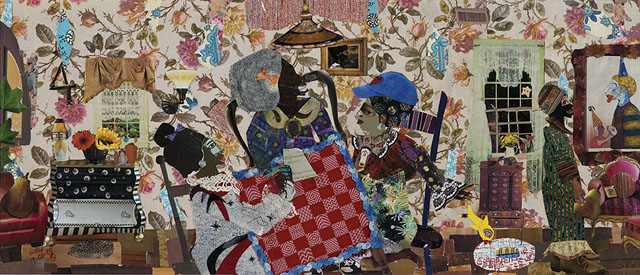
The Melon Sharers_2012, Media Collage.

The Melon Sharers_2012, Media Collage.

Briefly describe the work that you do.

I am a visual story teller. 

At what point in your life did you decide to become an artist?

To be honest with you, I never gave much thought to being an artist. It was something I could do. There was always someone trying to convince me to do it, throughout my life. Finally after two years of artist Evelyn Terry trying to get me to create art, l went into Evelyn Terry’s studio and created three artworks. I have been doing it ever since. At the time it was very therapeutic for me.
Tell us a little about your background and how that influences you as an artist.

I grew up with a lots of books and my mother had a mental illness. Because of books, cartoons and my mother’s stories I became interested in story telling. When I was a child I wanted to write fiction.

Girlfriend Night, 2012, Media, Collage

Girlfriend Night, 2012, Media, Collage

What types of conceptual concerns are present in your work? How do those relate to the specific process(es) or media you use?

 I am sorry I don’t have an answer to that question. I know most people expect an artist to have an answer but I don’t.

We once heard Chuck Close say he did not believe in being inspired, rather in working hard everyday. What motivates you in your studio practice?

 Life? 

Git Em Bunnies Outta Here Ida Mae, 2010, Media Collage

Git Em Bunnies Outta Here Ida Mae, 2010, Media Collage

What artists living or non-living influence your work?

Romare Bearden, Van Gough Kerry James Marshall, Picasso, Matise, Jeff Koons, Bettye Saar, Edward Lear and Jacob Lawrence.

When you are not making art what types of activities and interests do you engage in? 

Reading and spending time with my grandchildren and my niece and nephew. 8. Please list stop tags for your posts, location, medium, etc. I will be 63 this year and I don’t care about such things. 

About 

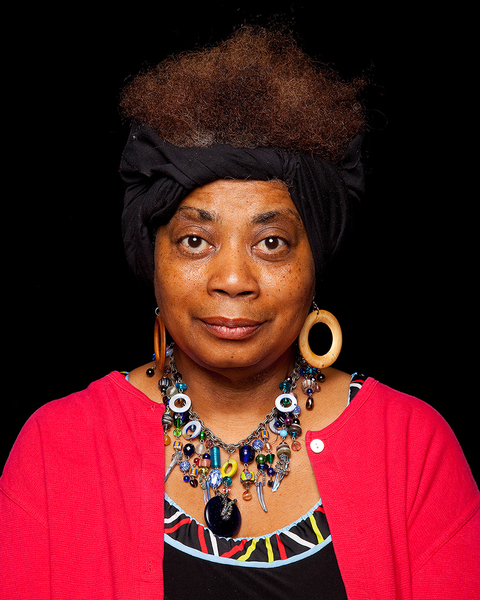
28007169_dellaportraitDella Wells was born in 1951 in Milwaukee, Wisconsin and is a  self-taught artist. As a child, she made up stories and characters, many based on her mother’s recollections of growing up in North Carolina during the 1920’s, 1930’s and 1940’s. Wells used these stories to escape the madness of her mother’s mental illness and her father’s rage and eventually used them to inspire the collage art she creates today.

Wells feels strongly that “being a master of your spiritual self does not come until you understand from where you came from.” She incorporates her own folklore in her work which often has subtle symbols from the civil rights struggle. Wells’ work has appeared in various publications including Self Taught, Outsider and Folk art Guide to American Artists, Locations and Resources by Betty-Carol Sellen and Cynthia J. Johnanson.

In 2010 “Don’t Tell Me I Can’t Fly” written by Y York and commissioned by First Stage Children’s Theater was selected to be workshopped and read at The Kennedy Center in Washington, D.C. Productions of the play have been done in Milwaukee Wisconsin, Nashville Tennessee and Charlotte North Carolina. Her work was also included as an  illustration for a book published by National Geographic. Wells’ work is exhibited in Europe, British Columbia and throughout the United States in folk art and outsider galleries from coast to coast.

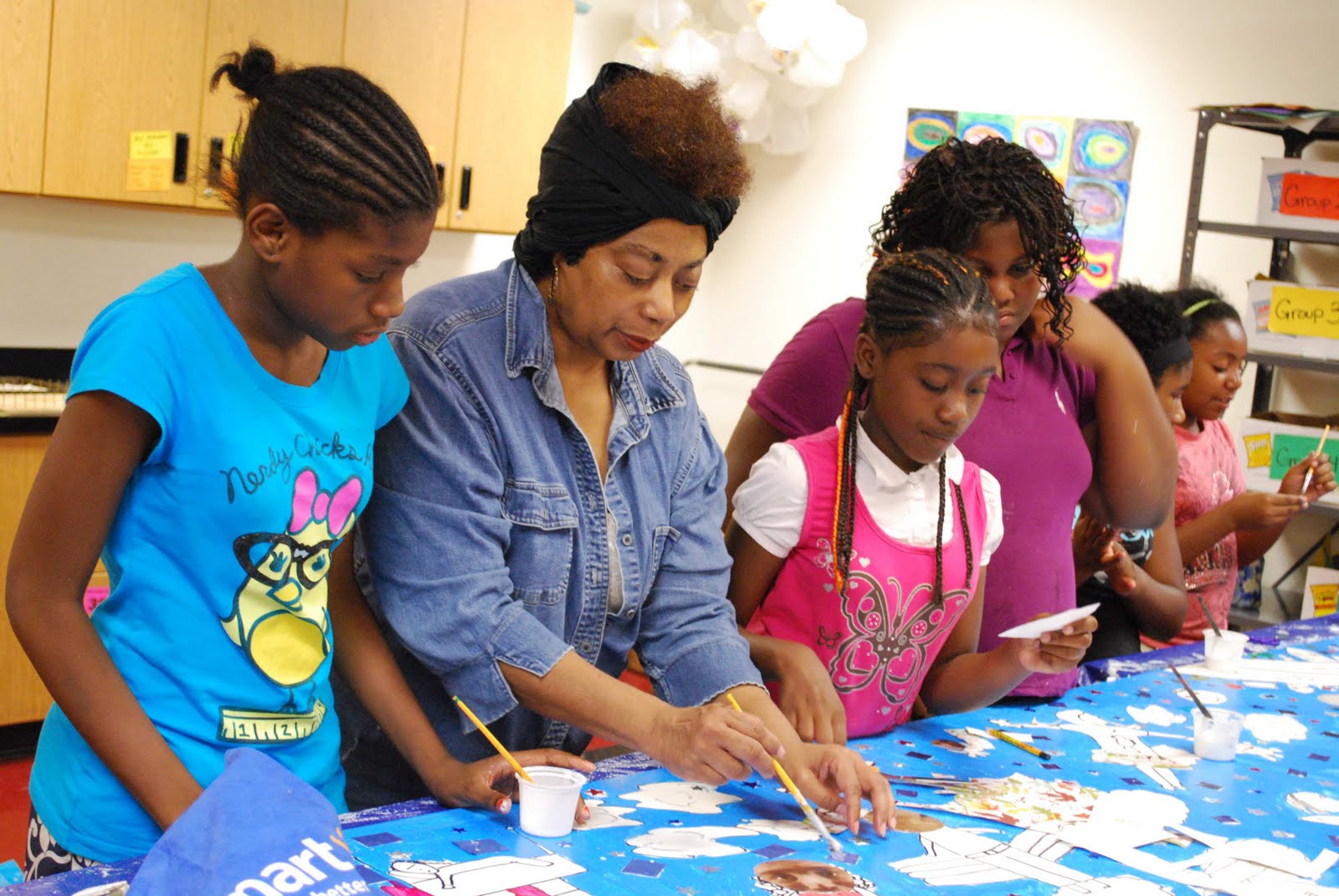
Della and girls

Della and girls

www.redpianotoo.com/Featured-Artist/

All images copyright of the artist and used with their permission. 

Posted in Uncategorized | Tagged , , , , | Leave a comment