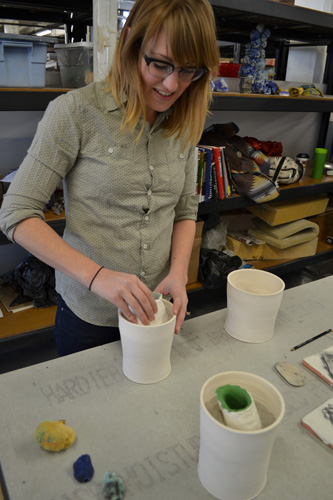
Genevieve Jaying Pan – Seattle, Washington

a detailed shot of my most recent sculpture/installation, Impatience (2013), acrylic plastic, 5ft x 4ft

a detailed shot of my most recent sculpture/installation, Impatience (2013), acrylic plastic, 5ft x 4ft

Briefly describe the work that you do.

My work largely focuses on the process, the materials, and how someone could identify with the finished product. I aim to combine fine art and design by applying design modeling to the artwork, or by creating designs from a sculptural standpoint.

At what point in your life did you decide to become an artist?

I’ve always wanted to work in a creative environment. My mother has encouraged my creativity since I was a child. She noticed I would copy anything she scribbled on paper, and used that as a way to introduce me to writing and drawing when I was only a couple years old.

It wasn’t until early high school that I truly decided that I wanted to be an artist. I began developing my photography skills throughout high school, and that was when I realized that it was actually possible turn a hobby into a career. It wasn’t until my early college years that I realized my creativity can also function as a designer.

Tell us a little about your background and how that influences you as an artist.

I was born and raised in Seattle. My parents have always encouraged and supported my artistic qualities, which propelled me to pursue my talents without hesitation. However, some of my relatives and others around me were not as understanding. Growing up, I’ve dealt with a number of mental and emotional issues that were triggered by family and peers. These issues developed into a form of anxiety for me. This anxiety has built up over the years and often shows up in my work. 

When making art, I am more focused on the process. My personal connections with anxiety directly influence me to endure exhaustive projects. I’m more interested in the process of creating complex visualizations because the process of creating time-consuming projects actually help alleviate my anxiety. Nearly all of my projects concentrate on my infatuation with high complexity and meticulous details.

Solitary #1 (part of series) (2011), digital photograph

Solitary #1 (part of series) (2011), digital photograph

What types of conceptual concerns are present in your work? How do those relate to the specific process(es) or media you use?

My work deals with the boundaries between fine art and design. Exploring materials plays a significant role in my work. Having the additional mindset of a designer, I tend to think about what materials I can innovatively utilize in my designs. I subsequently transfer this process into my fine art practices as well. I’m constantly trying to find ways to connect art and design. For example, I would make use of design modeling processes when creating sculptures or simply create designs from a more artistic, sculptural point of view. Currently, I’m interested in utilizing 3D printing processes as an art form rather than just a prototyping service.

Cnidaria Lamp (2013), 3D printed plastic, aqua EL wire, white LED strip, 9in x 9in x 7in

Cnidaria Lamp (2013), 3D printed plastic, aqua EL wire, white LED strip, 9in x 9in x 7in

We once heard Chuck Close say he did not believe in being inspired, rather in working hard everyday. What motivates you in your studio practice?

Truthfully, it takes a while to get me going on a new project! I’m the kind of person that needs to start building upon an idea immediately or else my motivation decreases quickly. However, I’m always keeping notes on any concepts that randomly come to mind on a daily basis. I can be inspired at any time, but I have to work hard at staying inspired enough to keep the creativity flowing.

What artists living or non-living influence your work?

Bruce Nauman, Tara Donovan, Ronan and Erwan Bouroullec, Olafur Eliasson

When you are not making art what types of activities and interests do you engage in? 

I am a huge thrill-seeker, health and fitness addict, and music enthusiast!

About 

HEADSHOT_GenevievePanGenevieve Jaying is an interdisciplinary artist based in Seattle, WA. She is primarily a sculptor, product designer, and photographer. Her artistic endeavors began with photography, but she has since expanded her art practice into other mediums. Her work often exhibits highly complex structures and meticulous details. Exploring materials also plays a great role in her art making process. She received her BFA from the School of the Art Institute of Chicago in December 2013, and has participated in the recent group show, the Fall BFA Thesis Exhibition, at the SAIC Sullivan Galleries. She currently lives and works in Seattle, WA.

Sand Castle Tool (2012), plywood, 12in x 9in x 8.5in

Sand Castle Tool (2012), plywood, 12in x 9in x 8.5in

www.genevievejaying.com

All images copyright of the artist and used with their permission. 

Posted in Uncategorized | Tagged , , , , | Leave a comment

Stacy Streeter – Jacksonville, Florida

015_Streeter

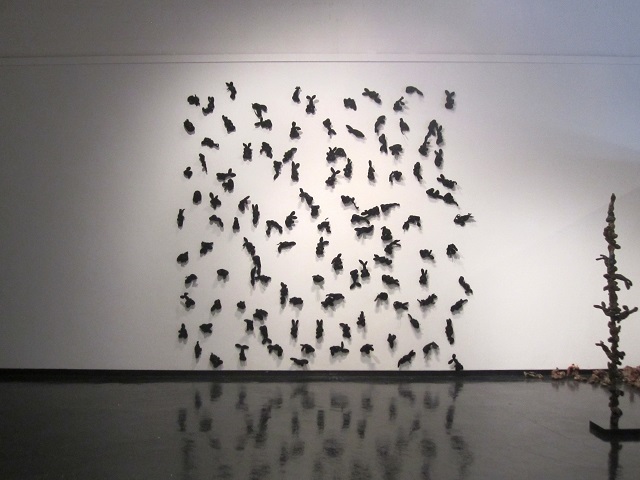
Bunny 7, wax and stuffed toy, 2in x 2in x4in, 2012

Briefly describe the work that you do.

My work tells a personal narrative about loss and grief. I use printmaking, sculpture, and video to explore the pain.  I am an object maker as well as an image maker: I make objects that I can play with, touch, group and hold. Materials such as wax, ink, childhood stuffed bunnies in my work reference disease, the body, and adolescence.

At what point in your life did you decide to become an artist?

Looking back on my life I have always been creative. When I entered college I was undecided on my major. It wasn’t until I learned that I could take art classes for credit I seriously thought about a career in the art field.  I fell in love with art after taking my first Art History and 2d Design course. From that moment I knew that I always wanted to be surrounded by art.  As I got more involved with art I knew that my ultimate goal would be to teach and share my knowledge and love of art with others.

Tell us a little about your background and how that influences you as an artist.

I lost my father to cancer when I was 16 years old. Since the death of my father I have always struggled to find ways to deal with the loss and pain of that event.

01_Streeter

Frozen, ink and stuffed toy bunnies, 10ft x 14ft. 2012

What types of conceptual concerns are present in your work? How do those relate to the specific process(es) or media you use?

Disease, Loss, Grief, Childhood and Pain.  I use stuffed plush bunnies to represent childhood. The bunny itself is a play on the idea of “multiplying like rabbits” and the bunnies “multiply like cancer cells” in my work.  The violent actions that I have used on each bunny represent my frustration with loss in my life and the physical disease.

018_Streeter

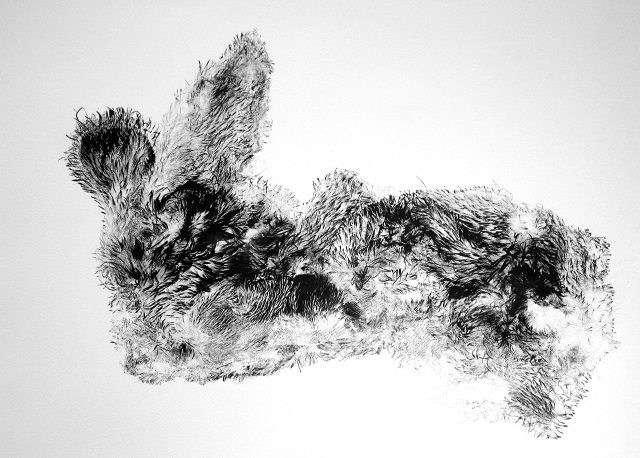
Untitled 1, monoprint, 2011

We once heard Chuck Close say he did not believe in being inspired, rather in working hard everyday. What motivates you in your studio practice?

The idea of “play” motivates me in my studio. I constantly have ideas and write them into a journal. But I always try and make time to bring them to life. If I ever feel that I am stuck I ask myself “what if”… What if I change the color? What if I change the size? What if I make this a print? I play with my ideas. They keep me entertained and motivated.

What artists living or non-living influence your work?

I have been influenced by the works of Kiki Smith through her storytelling, use of the human body and her studio practice. I also look at Louise Bourgeois for how she uses a complex autobiography in her work.

When you are not making art what types of activities and interests do you engage in? 

I love to travel! When I am not making art I am always planning my next trip. I have been to numerous places in Europe and Asia.

About 

StacyStreeterStacy Streeter is a Jacksonville based artist, who creates work about a personal narrative that deals with loss and grief. She uses multiple media such as printmaking, video, and sculpture to convey her ideas. Stacy went to the University of Central Florida (Orlando, Florida) were she earned her Bachelor of Arts degree in Studio Art in 2009. In May of 2012 she completed her Master of Fine Arts degree from the School of Art and Art History from the University of Florida (Gainesville, Florida). She currently works at Flagler College in St. Augustine where she teaches Visual Culture and Digital Photography.

019_Streeter

Detail: Untitled 1, monoprint, 2011

www.stacystreeter.com

All images copyright of the artist and used with their permission. 
Posted in Uncategorized | Tagged , , , , | Leave a comment

Brenton Hamilton – Rockport, Maine

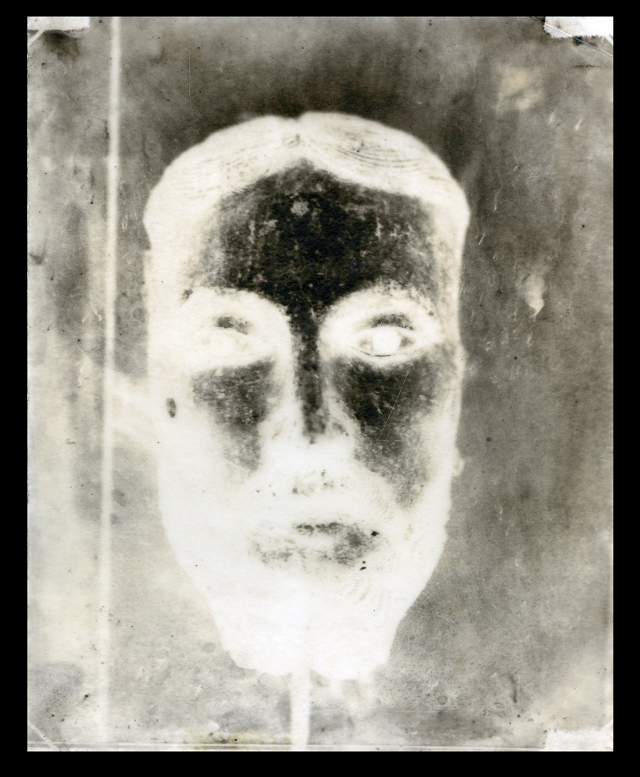
Untitled, Calotype paper negative 2013 approx 10x8 inches

Untitled, Calotype paper negative 2013 approx 10×8 inches

Briefly describe the work you do.

I work with photography – especially the historical processes from the 19th century. The cyanotype, platinum, French paper calotype especially.

At what point I your life did you want to become an artist?

At some point in undergraduate school the idea sized me and woulden’t let go……

Tell us a little about your background and how that influences you as an artist.

I am from Maine – and spent a lot of childhood on a small island with my parents. The solitude and quiet, the water and the horizon were all early influences that I realized later on….

What types of conceptual concerns are present in your work? How do those relate to the specific process(es) or media you use?

I’m a revisionist…..I reassemble images via collage and create new associations and new possible stories are posed. My interest in historical process is an embrace of the beauty of marks and sometimes accidents; both accidental marks and odd wonder. I coat light sensitive materials onto fine watercolor papers. I’m a storyteller, spinning yarns.

Sketchbook

Sketchbook

We once heard Chuck Close say he did not believe in being inspired, rather in working hard everyday. What motivates you in your studio practice?

I seem to work in cycles of rest and then great intensity. New possibilities really engage me – the studio is an exciting place, a certain balance of risk and failure and astonishment.

What artists living or non-living influence your work? 

Wm. Talbot, Man Ray, F. Picabia, Alison Rossiter, Anselm Keifer

When you are not making art what types of activities and interests do you engage in?

I collect antique fragments, I’m a foil fencer, Speed walking

About

HeadShot_Hamilton_640pxRaised in Maine, Brenton Hamilton is an educator and working studio artist living in Rockport. Hamilton’s earliest years were growing up on the Maine coast on Clapboard island near Falmouth, Maine. Brenton attended the University of Maine and Maine Photographic Workshops completing studies in 1985 and later earned a baccalaureate degree from LaGrange College in Design, Magna Cum Laude in 1990 and an MFA in Photography from the Savannah College of Art & Design in 1992.

Hamilton has lead classes at Maine Media Workshops for 19 years and his specialty areas include the history of photography, B&W darkroom craft and historic processes. Brenton’s lectures widely both in Maine and nationally about contemporary issues in photography, it’s history and other subject area interests within the medium and contemporary trends. He is also on the adjunct faculty at the International Center of Photography in New York City and teaches many historic process courses at The Center of Alternative Processes also in New York. Brenton is a contributing writer and president of Obscura founded in 2009. A non profit organization devoted to the progress of youth education in photography and books.

His work is represented at TILT Gallery in Phoenix, Arizona and in Maine at Susan Maasch Fine Art Portland, Maine. Hamilton’s photographs are held in permanent collections at the Farnsworth Museum of Art, Portland Museum of Art and many significant private collections nationally. His first monograph was published by Obscura Press in 2010: The Blue Poet Dreams.

In the Studio

In the Studio

www.brentonhamiltonstudio.net

All images copyright of the artist and used with their permission. 
Posted in Uncategorized | Tagged , , , , | Leave a comment

Rachel Bruya – Madison, Wisconsin

Skyscraper, Lithograph & Mixed Media, 10” round

Skyscraper, Lithograph & Mixed Media, 10” round

Briefly describe the work you do.

My artwork is about the built environment. I’ve spent a lot of time studying cities; how they are built, why they are built, why they change, etc. I think they reflect social and economic pressures as well as design aesthetics, continually changing, constantly providing new and fresh ideas for my research. I create two-dimensional work that is usually printmaking-based and explores myriad issues of cities. Additionally, I create small cities in a lot of different places – borrowed, forgotten spaces, hidden spaces I reveal, and spaces I create within a gallery setting. My work fuses the “real” environment with the an imagined one. I strive to freeze the viewer in a state of inquiry.

Tell us a little about your background and how that influences you as an artist.

I spent 8 years working for architecture firms in San Francisco. That time and place very much influences the work I do now. I develop what I call “building personalities”, using anthroporphization as a means to convey emotional responses. I also draw a lot upon William Whyte’s (urban planner) ideas about what creates great public spaces and how art can play a role in that creation.

The concept of the “artist studio” has a broad range of meanings, especially in contemporary practice. The idea of the artist toiling away alone in a room may not necessarily reflect what many artists do from day to day anymore. Describe your studio practice and how it differs from (or is the same as) traditional notions of “being in the studio.”

What I love most about making art is….it feels great! Working with your mind and body in tandem is a very powerful feeling, much like an athlete. I was a very serious athlete well in to my 20’s and see a lot of parallels between the two disciplines. Being in the studio is one of my favorite times – I get to be with just myself and to put to use all of the things I’ve read, seen, experienced and thought about. Activating the creative parts of my brain to create something real and contemporary is my favorite part of the process of artmaking. I believe art to have an underlying goal of improving the world and making it a better place – that idea really keeps me going when I get discouraged.

Humans are social creatures, so I balance my studio time with more socially outward activities. I meet monthly with a group of artists whose mission it is to improve the arts in the city in which we live (Madison, WI). I also started something called the Little Galleries. They are miniature galleries that sit at the sidewalk. We do 6-7 shows in each gallery a year and have two up and running. It’s a fun, interesting, constantly changing project, and I collaborate with two other artists to build and run them. I also get to meet a lot of terrific artists to show in the spaces. And most importantly it is using art to improve the world and make it a better place.

Wonderworld 3, Lithograph & Mixed Media, 18” x 18” x 18”

Wonderworld 3, Lithograph & Mixed Media, 18” x 18” x 18”

What unique roles do you see yourself as the artist playing that you may not have envisioned yourself in when you first started making art?

I’d always wanted to do something art-related in my yard or in my home, and it all just seemed to come together with the Little Galleries. I think of the project as being public art and as a way for people that don’t seek out art to discover work that is of a smaller scale and not weather-proof (as is typical to a lot of public art). I’ve still been surprised at how many people we’ve been able to reach that don’t visit museums, galleries or art events. Most find the work approachable and are comfortable asking questions and expanding their definition of art.   In ways, the project is very much about building community and neighborhood and getting to know people, as much as it is as promoting art as a valuable part in creating a vibrant place.

When do you find is the best time of day to make art? Do you have time set aside every day, every week or do you just work whenever you can? 

I prefer to work 9-5, but lots of other things often get in the way. I do get some large chunks of time, but I also steal away any time I can get. Because my studio is now at home I can slip downstairs for as little as 15-30 minutes and get a little work done….but the small bits of time also means my studio is usually pretty messy!

Somewhere Inbetween (Pink), Lithograph & Mixed Media, 12” round x 4”

Somewhere Inbetween (Pink), Lithograph & Mixed Media, 12” round x 4”

How has your work changed in the last five years? How is it the same?

I strive to fuse drawing, photography and printmaking to engage with the viewer as an object and/or an experience. This idea drives most of the work I make. I think with each passing year my improves. I more art you make, the better you get making it. I have distilled my goals for pieces to be more simple. I’m often simply trying to capture a certain emotion/time/experience using the vocabulary I’ve developed over years. For example, I had a serious concussion last year and in response I created a chaotic environment and blanketed a veil of quiet over it. There was a lot of tension and balance in the piece.

Are there people such as family, friends, writers, philosophers or even pop icons that have had an impact on the work you do?

My sister used to watch Fraggle Rock and I would sneak in and watch it with her. I recently started re-watching it and re-discovered the Dozers, the little guys that build structures in the middle of Fraggle Rock. Their structures are also a food source for the Fraggles. The Dozers don’t want the Fraggles to stop eating their structures because it would mean they would run out of room and would have to stop building. That got me thinking about our own cycles of construction/deconstruction a little differently.

If you had an occupation outside of being an artist, what would that be and why?

I really enjoy the anonymity of being an artist, and although it isn’t the easiest career it is pretty awesome in most ways. But I often think that if I had made different decisions, I probably would be doing set design for theatre or own a bakery (yep, I love the process of making bread).

About

RachelBruya_HeadshotRachel Bruya works in a range of media including drawing, printmaking, photography and sculpture.  She spent eight years working for architecture firms, which has an undeniable influence on her work.  Her prints are in the permanent collection at Madison Museum of Contemporary Art, Los Angeles Center for Digital Art, Target Corporation and the University of Wisconsin Union.  Rachel earned an MFA from the University of Wisconsin-Madison in 2007 and a BFA from the University of Washington (Seattle) in 1998.  She has taught at the University of Wisconsin-Madison, City College of San Francisco and the Milwaukee Institute of Art + Design.

In the Studio

In the Studio

www.rachelbruya.com

All images copyright of the artist and used with their permission. 

Posted in Uncategorized | Tagged , , , , | Leave a comment

Grant Stoops – Brooklyn, New York

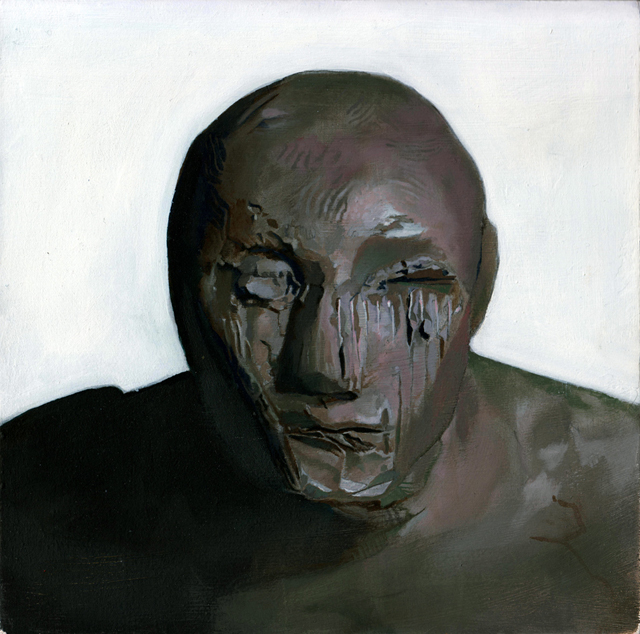
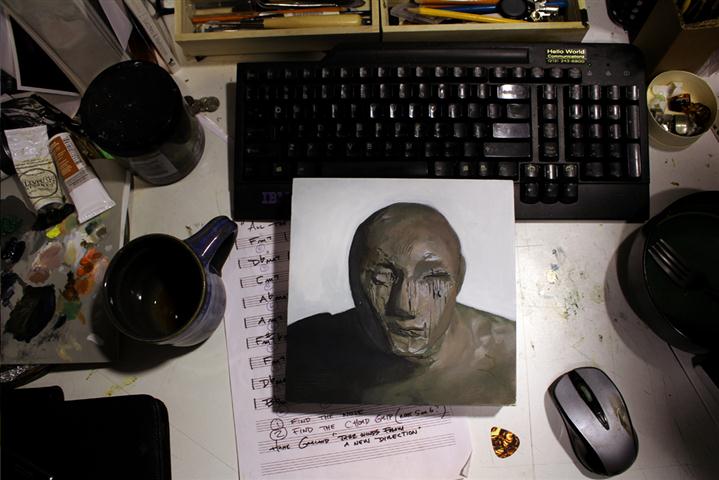
Homunculus 4, oil on board, 8 x 8 inches, 2014

Homunculus 4, oil on board, 8 x 8 inches, 2014

Briefly describe the work you do.
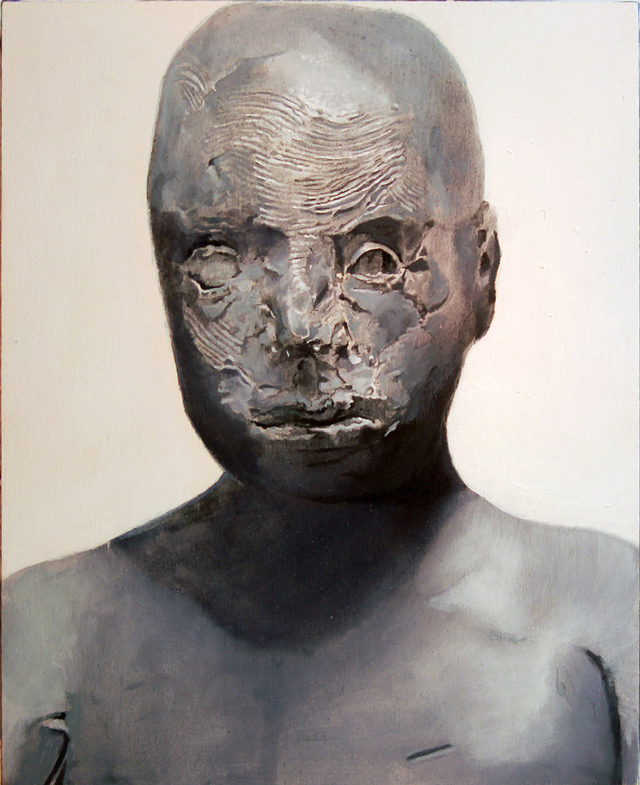
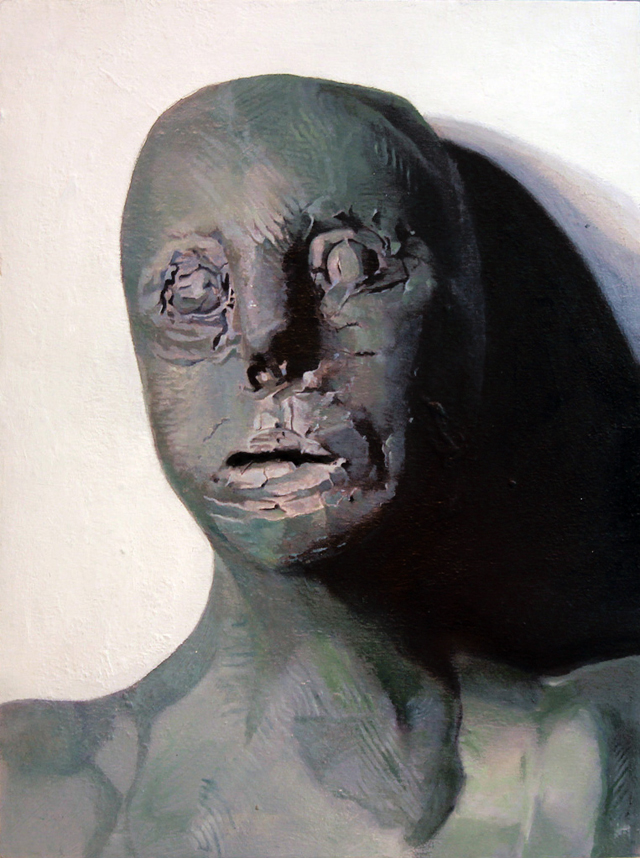
I’m a painter. In the past year I’ve been making paintings that are based off of small clay figures.

At what point I your life did you want to become an artist?

Like a lot of artists, early successes and a slathering of praise in childhood left me convinced by middle school that it was fate.

Tell us a little about your background and how that influences you as an artist.

I was born in Kansas, and grew up mostly in Indiana. My parents used to farm. My family is very liberal and intelligent in a land that is mostly not and if I had to psychoanalyze myself then maybe that is what made me enough of an outsider to pursue such a line. More than that, I lucked into a few good teachers early on.

What types of conceptual concerns are present in your work? How do those relate to the specific process(es) or media you use?

Everybody loves painterly, humanist, figurative paintings, even if they can’t admit it. But it’s rare as hen’s teeth finding anyone really good at it, because it’s such a deep abiding mystery as to why it works. I’m trying to figure it out by trimming, distilling and burning away anything that distracts me from that mystery. I’ve even taken actual human beings out of the equation. These paintings are all based on these small oil-based clay figures- I’m not using paint to effect some craggy, uneven surface, it’s all already there. It’s all just the light, the surface, and limits of my abilities with clay and paint. The funny thing about it, however, is that the narrative elements creep right back in, without my permission. You can’t put a human face on a rock without the viewer trying to read it’s mind, and you can’t place three figures in a room without the viewer inventing a story around it. 

Homunculus 2 (One-Ear), oil on board, 8 x 11 inches, 2014

Homunculus 2 (One-Ear), oil on board, 8 x 11 inches, 2014

We once heard Chuck Close say he did not believe in being inspired, rather in working hard everyday. What motivates you in your studio practice?

I remember reading some advice on songwriting that I’ve always thought applied to painters too. The advice was to create, in your mind, a famous record that doesn’t exist, and to put it on your imaginary turntable and play it, and whatever came out of the speakers in your head was the song to write, right? I try to work the same way- I can always envision the painting long before it begins. It always becomes it’s own thing, but if I can’t see it in my minds eye beforehand, I won’t do it.  I’m sure it’s different for Chuck Close. Some artists can turn that part of the brain on and leave it on all week like a chrome faucet. I’m more of a spasmodic geyser.

Homunculus 1, oil on board, 9 x 12 inches, 2013

Homunculus 1, oil on board, 9 x 12 inches, 2013

What artists living or non-living influence your work? 

Merlin James, Siobhan Mcbride, Gerhardt Richter, Anselm Kiefer, Goya, Freud, Bacon, Rembrandt, and those Bantu Nkisi nail fetishes. 

When you are not making art what types of activities and interests do you engage in?

I work as an artist assistant full-time, so it’s likely that when I’m not painting for myself I’m painting for someone else.  Beyond that- reading, studying music, constant worry, commuting, eight cups of coffee.

About

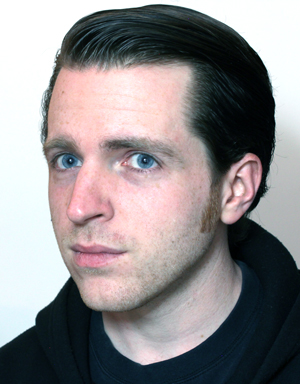
headshotgrantGrant Stoops (b. 1985 in Kingman, Kansas) is a New York City based figurative painter. He studied painting at the Milwaukee Institute of Art and Design in Wisconsin and the School of Visual Arts in New York.  

In the Studio

In the Studio

www.grantstoops.com

All images copyright of the artist and used with their permission. 


Posted in Uncategorized | Tagged , , , , | Leave a comment

Michelle Wilson – Oakland, California

Fragment, Linoleum blocks on handmade papers in triptych format, 9" x 30", 2014

Fragment, Linoleum blocks on handmade papers in triptych format, 9″ x 30″, 2014

Briefly describe the work you do.           

My work fluctuates between contemplative activism and personal narrative. It takes the form of handmade papers, prints, artist books, sculptures, installations and social practice interventions.

In the nonlinear narratives I present, landscape and location play a role. They are more than setting; they are characters and catalysts for transformation. The exterior landscape depicted is an embodiment of an interior landscape explored, a manifestation of my cognitive environment. Much of my work concerns the crossroads of human political actions and ecological systems, and how social and environmental justice often go in unison. Many of the narratives I explore have a duality or interconnection of ideas: the crossroads of politics and the environment, colonialism and natural history, wordplay, migration, vegetation, and the loss of diversity.

Tell us a little about your background and how that influences you as an artist.

I grew up in Central Pennsylvania, a rural and fairly conservative part of the country. My family didn’t travel much, although when we did, my parents made sure to take us to museums. However, much of the art I was exposed to as a child was children’s picture books, where both image and text contribute to the narrative. Since then, narrative is always an integral part of visual art.  

True North, Collage of handmade papers, found and printed matter, 9" x 24", 2013

True North, Collage of handmade papers, found and printed matter, 9″ x 24″, 2013

The concept of the “artist studio” has a broad range of meanings, especially in contemporary practice. The idea of the artist toiling away alone in a room may not necessarily reflect what many artists do from day to day anymore. Describe your studio practice and how it differs from (or is the same as) traditional notions of “being in the studio.”

As part of my papermaking practice, I harvest invasive plants to California, such as French Broom, Pampas Grass, even Ice Plant.  These plants serve as a base fiber for paper. Invasive plants tend to take over the ecosystem, creating monocultures and driving out native plants, which are often the basis for the food web. When the foundation for the food web falls apart, it creates a domino effect to other participants in the system. So a part of my practice takes place outdoors, as a means of clearing space for native vegetation.

The handmade papers made from these plants are more than just substrates. They are a signifier for the content, documentation of place and history, and embodiments of site-specificity.  Currently I am working on an artist book about endangered languages, which will be printed on papers made from invasive plants. In that work, these plants, which are also aggressive colonizers, serve as a metaphor for colonialism and the loss of diversity.

What unique roles do you see yourself as the artist playing that you may not have envisioned yourself in when you first started making art?

As a young artist, I never imagined myself doing interventions or performative actions. I was a naturally shy, awkward person, I never saw myself having the confidence, and I always saw myself as working on images that would be hung on the wall because I thought that was what Real Art was supposed to be. Yet now I see such interventions as creating a narrative in real time, and they make sense to me. My practice has opened me up to so much possibility. Who knows what’s ahead?

Frieze Detail

Frieze Detail

When do you find is the best time of day to make art? Do you have time set aside every day, every week or do you just work whenever you can?

For the first time in my professional career, my studio is outside of my home. Keeping it in my home felt right for financial reasons, and while I loved being able to do my work in my pajamas sometimes, I’ve noticed that when I go to my new studio, I get to work as soon as I enter the door. I was always afraid that if my studio was outside of my home, I wouldn’t be able to justify the cost with the amount of time I spent there. So this has become a motivator for myself – I have to go there enough to justify the expense. As a high school teacher, I make a point of swinging by the studio after school most days working for an hour or two. I also usually spend one of my weekend days there doing the more focused, time-consuming work, such as printing a large edition or pulling sheets of handmade paper.

How has your work changed in the last five years? How is it the same?

I recently realized that I go through certain behavior patterns in the work I make. These patterns usually take place over the course of months, where the work swings between being very precise, minimal and distilled, which actually is more time-consuming, such as my series, “Corn, Incorporated.” After the year I spent making that, without thinking about it, my work shifted to a series of collages that came together quickly and are more heavily detailed, layered and complex. Looking back, I think these behaviors were always present, but have become more pronounced as the work has become more exacting. After I dedicate myself to a conceptual and technical challenge, I need the release of simple cutting and pasting.

Are there people such as family, friends, writers, philosophers or even pop icons that have had an impact on the work you do?

Where to begin? I was fortunate to attend a both an undergraduate and graduate school program with several people who I admire: Amanda D’Amico (http://www.tinyrevolutionarypress.com/), Sun Young Kang (http://www.sunyoungkang.com/), Mary Tasillo (http://www.citizenhydra.net/), Marie Elcin (http://colored-thread.blogspot.com/), to name a few.  My first printmaking teacher, Shelley Thorstensen, (http://printmakersopenforum.org/) also had a large part in me becoming the artist I am.

Another influence has been ecological philosophers, starting with Aldo Leopold of early and mid-twentieth century, to more contemporary luminaries such as Joanna Macey, Edward O. Wilson and Glenn Albrecht.

I listen to a lot of podcasts, particularly NPR’s “On Being,” (http://www.onbeing.org/), which I would describe as interviews with people who are trying to understand the nature of the universe, whether it be science, religion, poetry, art, history, or how these fields overlap. The ideas presented there are also shaping my practice as an artist.

A final influence is poetry, particularly that of Rainier Maria Rilke, Pablo Neruda and most of all, Mary Oliver. Without their words, I would be a different person.  

If you had an occupation outside of being an artist, what would that be and why?

I think I would study the possibilities of solar energy. There is some amazing science developing right now in that field, and I think it will prove to be some very necessary innovations in the future. As global warming increases, who wouldn’t want to be part of the solution?

About

Michelle Wilson HeadshotMichelle Wilson is a papermaker, printmaker, book, installation, and social practice artist. She is also one-half of the ongoing collaborative political art team BOOK BOMBS. Her works are in various collections, including Yale University (New Haven, CT), the National Museum of Women in the Arts (Washington, DC), and the Bibliotheca Alexandrina, in Alexandria, Egypt.

She is a past recipient of grants from the Puffin Foundation, the Pennsylvania Council on the Arts, and the Artist-Investigator Project from San Francisco’s Triangle Arts Lab, an a previous resident of the David and Julia White Colony in Ciudad Colon, Costa Rica, and the Jentel Artist Residency Program, in Banner, Wyoming.

Her extensive teaching experience includes San Francisco State University, Bryn Mawr College, Moore College of Art and Design, the Kala Art Institute, the San Jose ICA Print Center, and Magnolia Editions. In addition, she served as a hand papermaking consultant to Signa-Haiti, a NGO in the process of developing a sustainable and bio-dynamic economy in Haiti. She currently teaches Sculpture and Design through the Summit Public Charter School System, and printmaking and collage classes at the Berkeley Art and Design Extension.Wilson has a BFA from Moore College of Art and Design, and an MFA from the University of the Arts, both located in Philadelphia, PA. She currently lives in the San Francisco Bay Area. 

 Frieze, Woodblock on handmade abaca paper, 12" x 42", 2014


Frieze, Woodblock on handmade abaca paper, 12″ x 42″, 2014

www.michellewilsonprojects.com

All images copyright of the artist and used with their permission. 
Posted in Uncategorized | Tagged , , , , | Leave a comment

Marcy Rosenblat – Brooklyn, New York

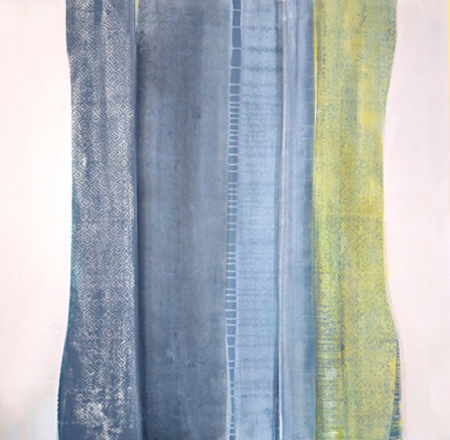
 "Column", Acrylic on canvas,  48"x48"  2013

“Column”, Acrylic on canvas, 48″x48″ 2013

Briefly describe the work that you do.

These paintings are essentially process paintings that bring to mind aspects of concealment and revelation. The subject is left intentionally ambiguous in order to initiate associations of what it means to cover or uncover, to feel familiar or to feel remote. The familiar is embedded in the painting by using the pattern of a household paper towel, both as part of the process and metaphorically. For the most part, the pattern functions as a structural devise, a curtain situated between the viewer and the subject.  I’m interested in the tension between photographic illusion and abstraction and believe that our understanding of either is fleeting and that what is imagined or seen may be about the subjectivity we place on any given event, including painting itself.

At what point in your life did you decide to become an artist?

 I wanted to become an artist very early on. It’s hard to remember an exact time.

Tell us a little about your background and how that influences you as an artist.

 My education as an artist was primarily painting through observation and I am still very influenced by the things around me. My work reflects my surroundings at any given time, whether that be the light, the location of my studio or an event. Although, I am particularly interested in things that are covered or draped, for instance the shape a bridge assumes when under construction or a motorcycle with it’s cover on it. I  A shape derived from obscuring a form is provocative to me.

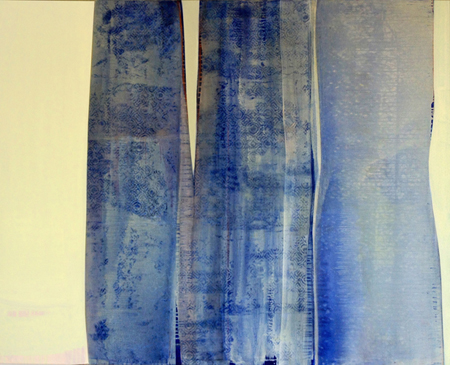
"Untitled Blue ", Acrylic on linen, 48"x 60"  2013

“Untitled Blue “, Acrylic on linen, 48″x 60” 2013

What types of conceptual concerns are present in your work? How do those relate to the specific process(es) or media you use?

In addition to being drawn to layers that both reveal and cover, I’m intrigued by the transformative quality of paint. I purposely use common paper towels to print a pattern onto  my paintings. This process takes away the mark of my hand  which in turn allows the paint to speak without  my interference. The towel also provides a pattern that most people take for granted and re-contextualize it. For me that’s the magic of painting.

"Yellow Weave" Acrylic on linen, 48"x48", 2012

“Yellow Weave” Acrylic on linen, 48″x48″, 2012

We once heard Chuck Close say he did not believe in being inspired, rather in working hard everyday. What motivates you in your studio practice?

 I agree with Chuck Close.

When artists living or non-living influence your work?

Really, there are too many to list. A few are Piero Della Francesco, Morandi, Gary Stephen, Moira Dryer and many of my artist friends.

When you are not making art what types of activities and interests do you engage in? 

I enjoy looking at art, films, walking my dog and being with my family and friends nothing terribly unusual

About 

DSC_0108 copyMarcy Rosenblat was born in Chicago Illinois and lives and works in Brooklyn, New York. She received her B.F.A. from Kansas City Art Institute and her M.F. A. from Vermont College of Fine Arts. Selective exhibitions include: Fordham University, The Rawls Museum, Galerie Berlin am Meer, Smith College, Oresmon Gallery, Nelson Atkins Museum of Art, Kouros Gallery, Salisbury University, Frumkin Gallery, Metaphor Contemporary, Morehead Gallery, Richard Anderson Fine Arts, and The Painting Center. Ms. Rosenblat is currently an Adjunct Professor of Fine Arts at The Fashion Institute of Technology.

The Studio

The Studio

www.Marcyrosenblat.com

All images copyright of the artist and used with their permission. 
Posted in Uncategorized | Tagged , , , | Leave a comment

Pamela Anderson – Milwaukee, Wisconsin

Untitled Abstract XVIII, Acrylic Oil Pastel on Infrastructure Canvas, 36 in x 60 in, 2014

Untitled Abstract XVIII, Acrylic Oil Pastel on Infrastructure Canvas, 36 in x 60 in, 2014

Briefly describe the work you do.

I am an modernist abstract expressionist painter. My work relates to the great abstract expressionists but my work is created in bold vibrant saturated colors.  

At what point I your life did you want to become an artist?

I love to tell the story about how I realized at a young age of 4  that working with color, form intrigued me. I would sit on our back stoop of our home in Kenosha, WI and would look at the large elm trees blowing in the wind and color for hours. I had a large repurposed Ice Cream bucket filled with crayons. Each fall my mom would take me to the store to buy a new box of crayolas. I would buy the biggest box with the most colors. Color has always inspired me. It felt as natural to me then as it does now to create. 

Tell us a little about your background and how that influences you as an artist.

I am a self taught artist. I have studied at times at MIAD, The Minneapolis Institute of Arts, MAM taking classes. I also studied in the studio of Terrence Coffman. An artist never stops learning. Each day brings new ideas to your practice and evolution of your work. 

Untitled Abstract 65, Acrylic on Infrastructure Canvas, 84 in x 54in, 2013

Untitled Abstract 65, Acrylic on Infrastructure Canvas, 84 in x 54in, 2013

What types of conceptual concerns are present in your work? How do those relate to the specific process(es) or media you use?

I don’t have conceptual concerns. I love trying new materials, processes. The best “accidents” have created new techniques in my process.  

We once heard Chuck Close say he did not believe in being inspired, rather in working hard everyday. What motivates you in your studio practice?

I create to make myself happy, productive, honoring my process, my growth as an artist. My happiest moments are when a viewer appreciates my work, acknowledges that I have created my own identity and that they recognize the work as mine before they see a signature or label. That to me is success. This is a mark of success to me. I might not paint everyday but I believe that there are so many different processes that are involved in developing a creative practice. The very process of activating your brain, thinking of the simplest actions, visioning your work is “working”.  

Untitled Abstract 16, Acrylic on Canvas, 36 in x 48 in, 2013

Untitled Abstract 16, Acrylic on Canvas, 36 in x 48 in, 2013

What artists living or non-living influence your work? 

Kandinsky, Picasso, Kline, Pollack, Frankenthaler, DeKooning, Gorky…. I love studying the greats from all movements, eras. It’s the mark making that intrigues me. I love studying prehistoric marks that have been made in caves, runes, marks made by children. Children have the purest sense and freedom with mark making. It all inspires me. 

When you are not making art what types of activities and interests do you engage in?

Reading, Walking, Gardening, Cooking & Baking with my husband and sons. They are all amazing chefs. Spending time with family  and friends. I work hard and I play hard. Although the “work” that I do does not feel like work. It’s more like play. I just had a great conversation with a fellow artist, Clive Promhows last night about this very subject!  I work and being an artist is a job. I honor that I can make a living with my creativity because I develop my practice and believe in myself. 

About

pamela headshotKnown for her bold, colorful strokes and gestural movement, Milwaukee, WI – based artist, Pamela Anderson, brings a modern dimension to Abstract Expressionism. Working with large brushes, spatulas and rags, she applies paint to the canvas in vibrant colors, allowing the image to emerge spontaneously as her imagination wanders, experimenting with expressive strokes, perspectives and angles. Leaving her work untitled, Pamela allows her work to be experienced without judgment and is therefore open for interpretation at will by each individual that encounters it.  She leads the viewer into a dimension where their mind can imagine emotions and experiences through windows of negative-space, motion and color. She is a full time artist, an Affiliate of Plaid Tuba and a two-time finalist for the Artist-in-Residence Program at the Pfister Hotel in Milwaukee, Wisconsin. Pamela’s work is included in many collections both private and public, including five pieces recently acquired by Northwestern Mutual.

Pamela is also President/Lead Designer of Contemporary Pull, a high design cabinet hardware company newly launched in 2014, learn more at contemporarypull.com. Additionally, as an exhibiting artist and strong advocate of the arts, she is active in local and state organizations including Milwaukee Artist Resource Network (MARN) where she holds the Executive Position of President.

In the Studio

In the Studio

www.paintmysky.com

All images copyright of the artist and used with their permission. 

Posted in Uncategorized | Tagged , , , , | Leave a comment

Ben Grant – Madison, Wisconsin

Briefly describe the work you do.

Untitled #43, Acrylic, Automotive Paint, Enamel, Flashe, Metal flake, and Spray Paint on Panel, 72 x 38 x 9”, 2012

Untitled #43, Acrylic, Automotive Paint, Enamel, Flashe, Metal flake, and Spray Paint on Panel, 72 x 38 x 9”, 2012

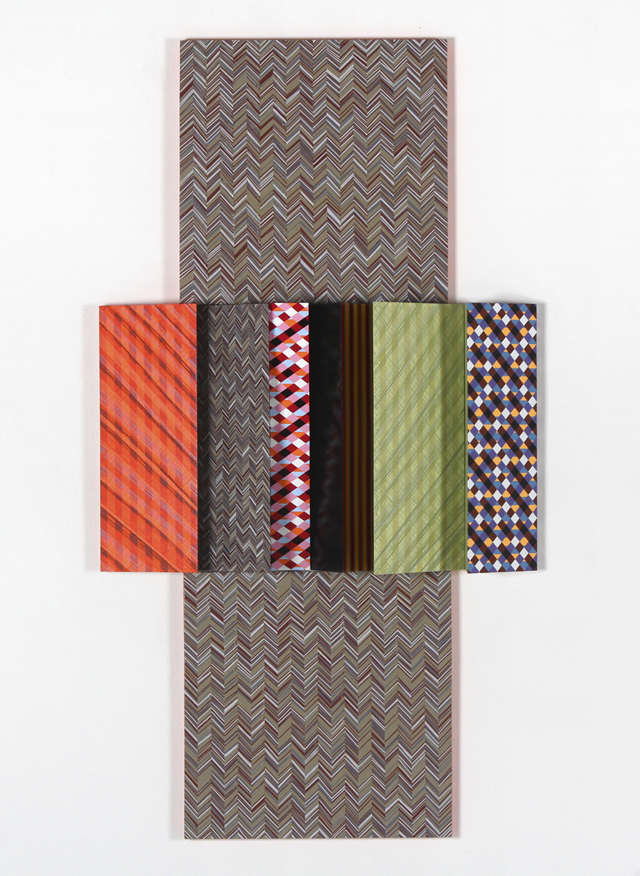
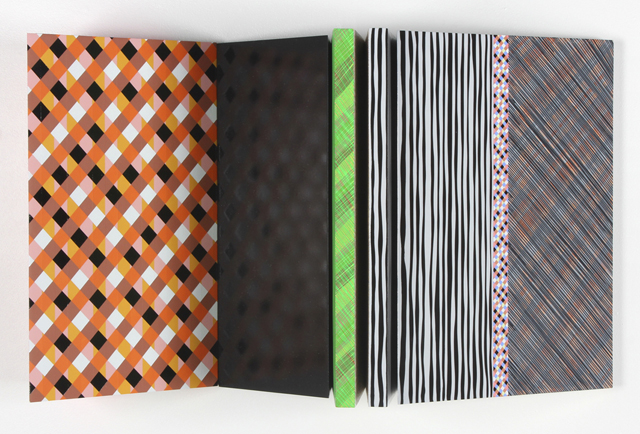
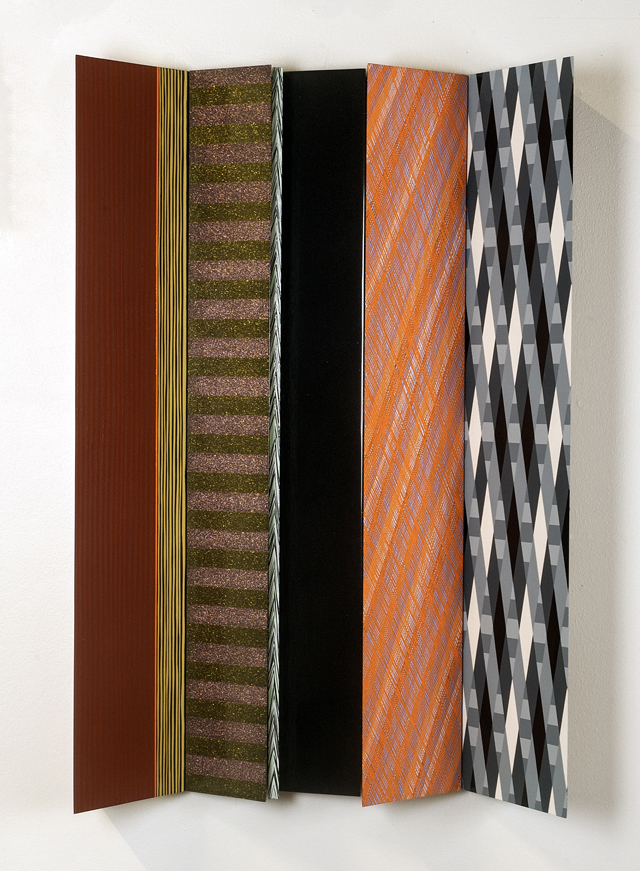
My paintings explore the potential for meaning in simple, bold, and colorful combinations of shape and dimension.  I look at my paintings as an evolving whole whose constituent components will continue to shift, drop out, or be added to as I explore the boundaries of my process.  I paint the modular units that make up the pieces separately and then combine them in the studio to create strings of information that take on the form of a visual syntax.  As I combine the elements of my pieces, I am building relationships that speak not only to the internal logic of the single piece, but also to the larger structure of the abstract language that is present in the whole body of work. 

Tell us a little about your background and how that influences you as an artist.

I have worked a lot of different jobs in my pursuit of a career in the arts.  I have bartended, bussed tables, worked in a bookstore, painted houses, made archival enclosures for books, worked in a hardware store, been a studio assistant, taught high school kids, worked in a neon lab, and painted some more houses.  I believe that by struggling to make a living while at the same time finding space for my painting practice, I have had to really focus on what is most important to me about painting.  Many of the repetitive actions that produce my paintings are a crucial part of my formal and conceptual framework. I can now see that they have arisen partly as a kind of antidote to the pressures of a working life and as an extension of the repetitive gestures that were central to my daily routines as a house painter.

The concept of the “artist studio” has a broad range of meanings, especially in contemporary practice. The idea of the artist toiling away alone in a room may not necessarily reflect what many artists do from day to day anymore. Describe your studio practice and how it differs from (or is the same as) traditional notions of “being in the studio.”

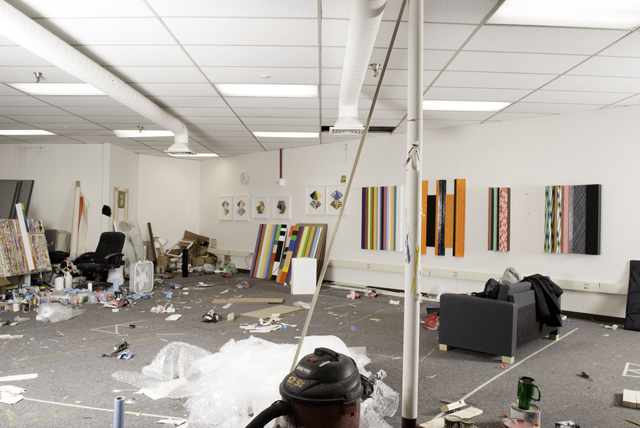
Unlike the prevailing wave of “post-studio” artists, I find that the physical place where I make my work is absolutely integral to my painting practice.  For me the studio is a refuge; it allows me to build, paint, nap, and to think.  I look at my studio as a laboratory where I can experiment with different processes without worrying about their application and explore what it means to make paintings.  My studio practice has given me discipline and it has given me a space within which to inspect myself and the world around me.  As an educator, I feel that the most important thing I can give my students is a desire to get into the studio and make work.  

Untitled #44, Acrylic, Automotive Paint, Enamel, Flashe, Metal flake, and Spray Paint on Panel. , 24 x 38 x 10”, 2013

Untitled #44, Acrylic, Automotive Paint, Enamel, Flashe, Metal flake, and Spray Paint on Panel. , 24 x 38 x 10”, 2013

What unique roles do you see yourself as the artist playing that you may not have envisioned yourself in when you first started making art?

As a younger, more headstrong artist, I believed that success meant bursting onto the New York art scene at a young age.  I felt that success was linked to a large life, a life that took on the art world head on.  As an artist now, I try to live a small life and believe that making my mark is much less important than discovering the intricacies of painting and passing on my love for the medium to my students. 

When do you find is the best time of day to make art? Do you have time set aside every day, every week or do you just work whenever you can? 

I work around my teaching schedule.  The days that I teach are dedicated only to teaching, the other days of the week are dedicated the studio.  I work in the studio from around 10:00 AM to 8:00 PM.  I find that after 8:00 PM I lose focus.  For me being an artist requires a large amount of discipline and I find that by making myself dedicate as much time to the studio as I can, the greater the chances are that I will make something worthwhile.

Untitled #59, Acrylic, Automotive Paint, Enamel, Metal Flake, and Spray Paint on Panel, 36 x 24”, 2013

Untitled #59, Acrylic, Automotive Paint, Enamel, Metal Flake, and Spray Paint on Panel, 36 x 24”, 2013

How has your work changed in the last five years? How is it the same?

My work has undergone quite a transformation over the past five years.  I received my MFA last spring from UW Madison and my three years there really changed my perspective on what my paintings can be.  Being at UW gave me the opportunity to work with an amazing group of professors who helped me to focus my energy on a formal and conceptual trajectory that has led me to where I am now.  My current paintings seem to me to be a distilled version of their predecessors.  In my earlier work there was always a vestige of figuration underlying the largely abstract compositions.  This has completely disappeared from the paintings I am now producing.  They contain the processes (repetition, combination, precision, experimentation, etc.) that my paintings have always had, but they deploy these processes in a much more direct and simplified manner.  Rather than feeling restricted by the simplification that has overtaken my work, I feel that it has helped to open up a much larger group of concerns that will provide fodder for future paintings.

Are there people such as family, friends, writers, philosophers or even pop icons that have had an impact on the work you do?

My family has been crucial to my development as an artist; they have always supported my artistic endeavors and helped me to be persistent in my pursuit of painting.  I also have to acknowledge an interest in and a debt to semiotics, particularly to the work of Ferdinand de Saussure.  As for writers, while I do not consciously include any references to the authors’ work that I read, I have a sneaking suspicion that the constant flow of trashy mystery audiobooks that I listen to is slowly influencing the work I make.  

If you had an occupation outside of being an artist, what would that be and why?

When I was in the third grade I wanted to either be an artist or a heavy metal guitar player.  I can’t play the guitar at all but what the hell, heavy metal guitar player for sure.

About 

bg head shotBen Grant was born in Canton, NY in 1980.  He is a painter and a Lecturer in Painting and Drawing at University of Wisconsin Madison.  Ben’s paintings have been included in exhibits across the country including Wisconsin, Chicago, and New York.  Most recently his work has been included in The Wisconsin Triennial at The Madison Museum of Contemporary Art and at Tory Folliard Gallery in Milwaukee Wisconsin.  He is represented by Tory Folliard Gallery in Milwaukee and lives and works in Madison, Wisconsin.

The Studio

The Studio

www.bengrantart.com

All images copyright of the artist and used with their permission. 

Posted in Uncategorized | Tagged , , | Leave a comment

Jamie Bates Slone – Kansas City, Missouri

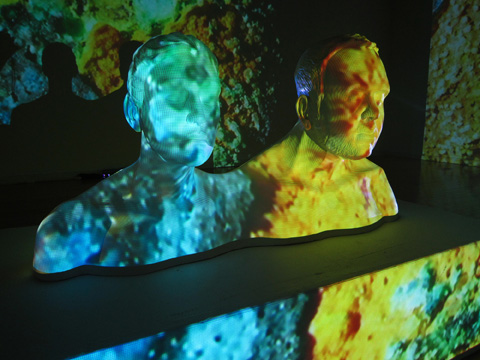
Protastatic Homeostasis, Coil built white earthenware clay and digital video projection, 17.5"x36.5"x13", 2013

Protastatic Homeostasis, Coil built white earthenware clay and digital video projection, 17.5″x36.5″x13″, 2013

Briefly describe the work you do.

The focus and significance of my work lies in the state of the human condition, the delicacy and fragility of the human construct in an emotional and physical sense. My experience is that of being part of an extended family that has endured a history of cancer and high mortality rate. As I have become more aware of my family’s history with illness through the examination of my memories, I have become wary of the future and empathetic of the past. I often find myself attributing to others my own unease in relation to cancer. This projection of my anxieties onto others acts as cancer does in metastasis, spreading from one location to another. My work is an examination and reflection of the memories, emotions, and anxieties caused by my family’s history with cancer with an emphasis on the relationship between human biology and human emotion.

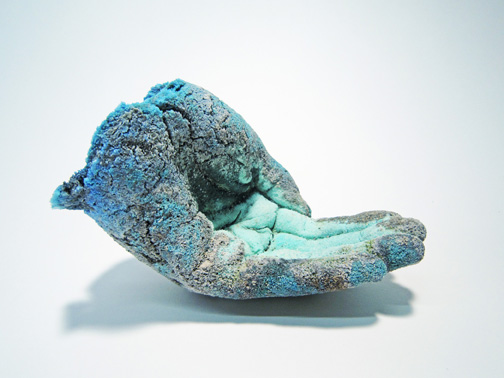
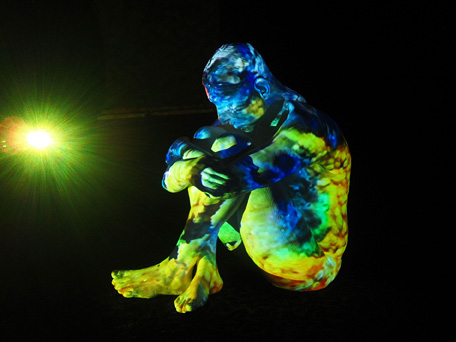
I have developed a process utilizing my knowledge of various casting methods and glaze chemistry to create forms made entirely glaze. The color and texture is appealing and repulsive at the same time. When viewed through a magnifying glass the surface resembles Scanning Electron Micrographs of cancer cells. The fragile and fleeting appearance of these pieces symbolizes the transient nature of human life. Projected onto life size, coil built figures, are a series of macro images of my casted work. The projections engulf and overwhelm the figures, as do my anxieties and fears for my health, the health of loved ones and cancer itself.

Tell us a little about your background and how that influences you as an artist.

I was born and raised in a small town in Missouri. I received my BFA in Studio Art at the University of Central Missouri and shortly after attended graduate school in Lawrence, Kansas and received my MFA in ceramics. It is funny to look back on what might have led me to where I am today. As a young child I was always drawing or creating. I loved drawing portraits of others, which I feel fully, translates into the work I make today. As I grew older I became more and more drawn to the sciences. I desperately wanted to become a biologist or a doctor of some sort. Human biology and life science were my favorite subjects and I knew every single bone and muscle in the human body. In high school I fell in love with psychology and thought that was going to be my path. I began my college career as a psychology major and after a few changes became a studio art major. Although I am not a doctor today I still find my work has so much to do with human biology and psychology. My family’s history with illness is a huge conceptual influence in my work. Not until I had spoken with others about my family’s medical history had I known that the amount of death and illness had been perhaps abnormal. I had begun investigating my memories as well as the affect that these instances have had on me psychologically. 

PhenotypeVII, Cast ceramic glaze, 6" x 3.5" x 3.5", 2014

PhenotypeVII, Cast ceramic glaze, 6″ x 3.5″ x 3.5″, 2014

The concept of the “artist studio” has a broad range of meanings, especially in contemporary practice. The idea of the artist toiling away alone in a room may not necessarily reflect what many artists do from day to day anymore. Describe your studio practice and how it differs from (or is the same as) traditional notions of “being in the studio.”

I have worked in both private studios and communal studios and I find both to have their advantages and disadvantages. In my private studio I was allowed to truly make a mess, close my door, and play my music as loud as I wanted. This is great for a certain amount of time but I need some sort of human contact to give myself a break and to be sane. The communal studio is great when is comes to having human contact and being able to ask for feedback on the spot, but you must always be conscious of others and your surroundings. I suppose being in a communal space forces me to clean up after myself, which is never a bad thing.

BIO, Coil built white earthenware clay and digital video projection, 34" x 22" x 70", 2012

BIO, Coil built white earthenware clay and digital video projection, 34″ x 22″ x 70″, 2012

What unique roles do you see yourself as the artist playing that you may not have envisioned yourself in when you first started making art?

I feel that I have become a bit of a therapist for others. Because of the concepts I deal with in my work people often want to tell me their story. I absolutely love this aspect of my work. I am allowing myself to be vulnerable and express my fears and so it makes others examine how they might feel. Everyone has had an encounter with cancer, illness, and loss at some point in their life and for some reason viewers want to speak to me about their experiences. Perhaps they find it therapeutic. Whether they do or not it makes me feel better to know I am not alone. 

When do you find is the best time of day to make art? Do you have time set aside every day, every week or do you just work whenever you can? 

I would love to be in the studio everyday. Unfortunately this is not possible at the moment. I do have entire days where I can set aside a large chunk of time to work, but mostly I just work whenever I can. I have never been a 9 to 5 person. My best working time is between Noon and 10 pm. That is when I find myself really wanting to do nothing but make work without any distraction.

How has your work changed in the last five years? How is it the same?

It has changed so much. I just finished graduate school less than two years ago. It was time to experiment and discover new ways to work. I began school working with the figure and dealing with a lot of the same conceptual ideas that I am now. At some point I realized I wasn’t ready to address these ideas yet so I began another body of work that was almost a way for me to ignore these issues. At one point I was growing grass on organic clay forms and making hints at the human form without replicating it. It wasn’t until my third year of graduate school that I had begun the kind of work I am making now. One of my thesis committee members even drew a diagram of how I had come full circle in my graduate career to make a point in a meeting!

Are there people such as family, friends, writers, philosophers or even pop icons that have had an impact on the work you do?

My family obviously has a huge impact on the work I do. My husband is my rock. He balances me out and allows me to spend long hours in the studio with no complaints. My fellow art colleagues are my motivators. Seeing them do well only makes me work harder. Books such as “Autobiography of a Face” by Lucy Grealy and “The Anatomy of Hope: People Prevail in the Face of Illness” by Jarome Groopman have influenced my work greatly on speaking about the psychological effects of illness and loss. And the more fact based book “The Emperor of All Maladies: A Biography of Cancer” by Siddhartha Mukherjee keeps me in check when speaking the more scientific aspects cancer and illness. 

If you had an occupation outside of being an artist, what would that be and why?

Like I said before, I left high school wanting to be a psychology major. I think I could see myself somewhere in that field. Perhaps helping people who have experiences with great loss in their lives. I find the way the brain and human body work to be fascinating!

About 

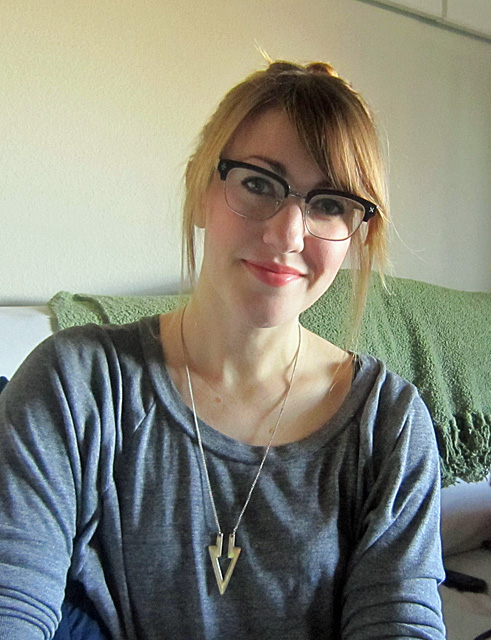
jamiebatesslone-april-portraitJamie Bates Slone is a ceramic artist known for her figurative work in clay paired with with projected imagery as surface as well as her experimental work in the casting of ceramic glazes. Her most recent work addresses the fragility of the human spirit in the midst of illness and loss in relation to her family’s history with cancer. Jamie earned her MFA with honors in Ceramics at the University of Kansas in Spring of 2012 where she received the Professional Development Assistance Award. She earned her BFA in Studio Art with and emphasis in Ceramics in 2008 at the University of Central Missouri. Jamie is currently a Foundation Resident Artist at Red Star Studios in Kansas City, Missouri and adjunct faculty in ceramics at Park University in Parkville, Missouri. Jamie has exhibited work in galleries throughout the U.S. including the Spencer Art Museum in Lawrence, Kansas, Jacob Lawrence Gallery in Seattle, Washington, First Street Gallery in New York City, New York, and the St. Petersburg Clay Company in St. Petersburg, Florida. She most recently won first place at the Clay3 National Juried Exhibition juried by Kurt Weiser.  

In the Studio

In the Studio

www.jamiembates.com

All images copyright of the artist and used with their permission. 

Posted in Uncategorized | Tagged , , , , | Leave a comment