Scott Epeseth – Madison, Wisconsin

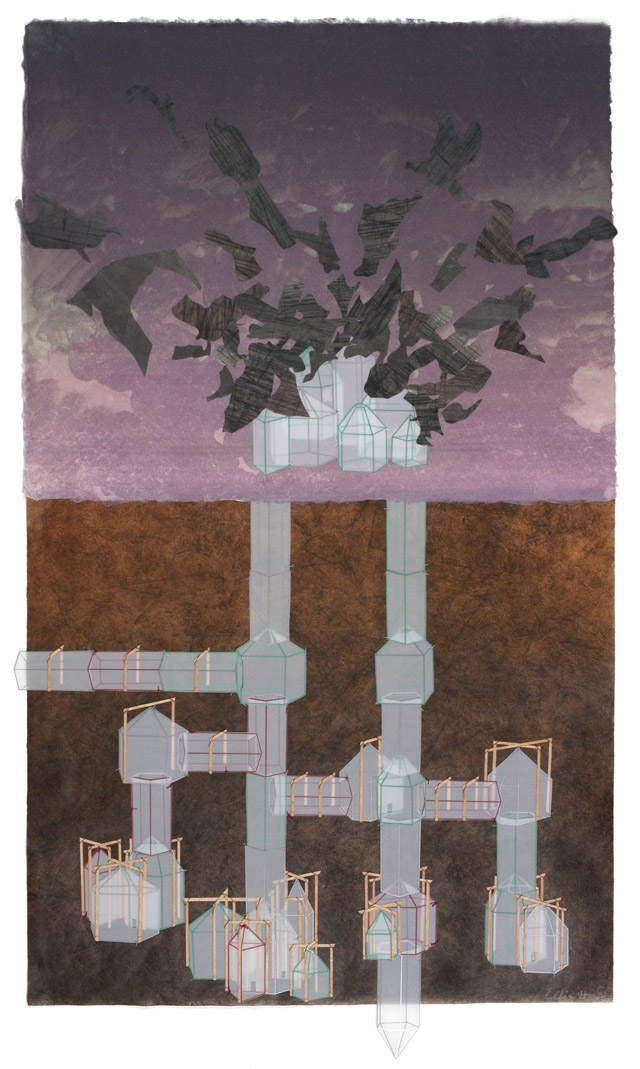
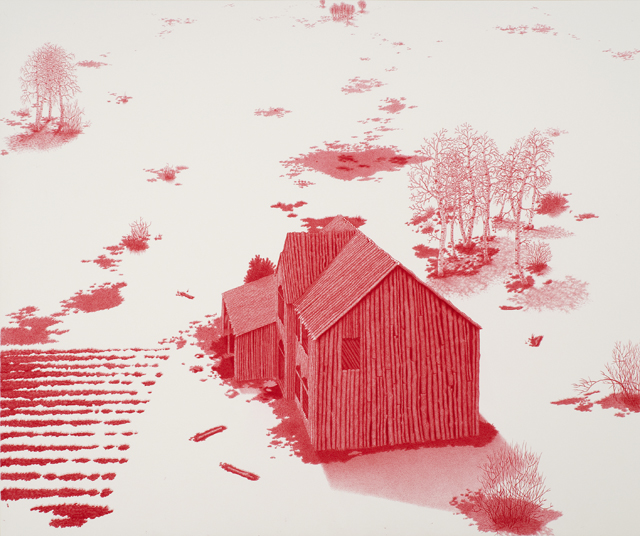
"House of Sticks" Ballpoint Pen on Paper 23" x 28" 2013

“House of Sticks”
Ballpoint Pen on Paper
23″ x 28″
2013

Briefly describe the work you do.

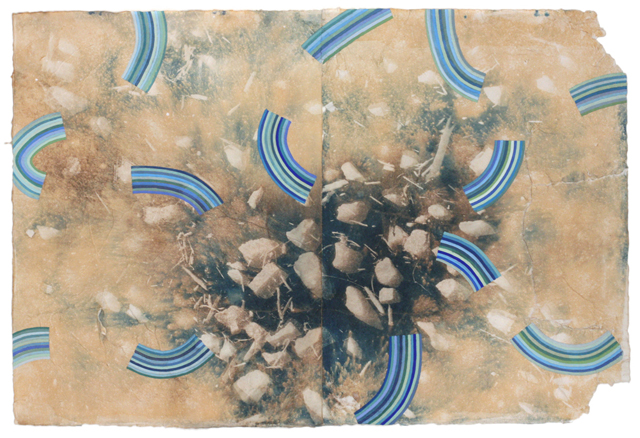
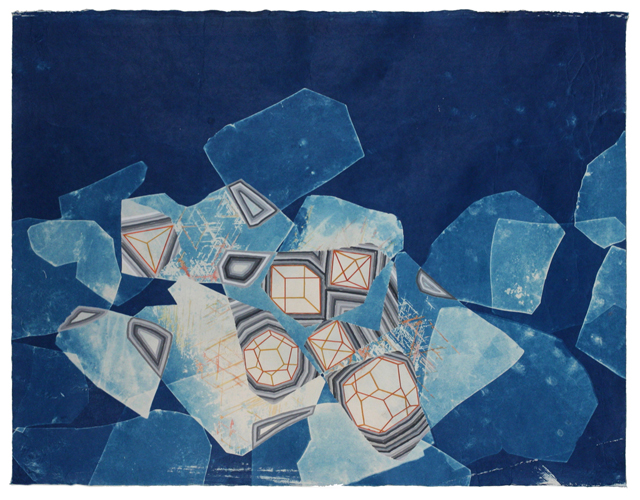
I make obsessively finished drawings depicting familiar spaces charged with a sense of dark presence, or other instances where planes of existence clash: the future sending messages to the past, memory intruding upon the present, or the subconscious bleeding into consciousness. These drawings have been described as having a “clairvoyant” quality.  I work in various media, always in a manner that is simple and direct.

Tell us a little about your background and how that influences you as an artist.

I grew up in the suburbs during the 1980s, and I continue to draw from the kind of mytho-folkloric themes found in much of the pop culture of the times, such as Star Wars and Steven Spielberg movies. I currently live in the upper-midwestern United States, and the expansive landscape with bleak winters often shows up in my drawings. I also had day jobs for years that revolved around light construction and house painting, and this has caused me to pay undue attention to mundane architectural details.

The concept of the “artist studio” has a broad range of meanings, especially in contemporary practice. The idea of the artist toiling away alone in a room may not necessarily reflect what many artists do from day to day anymore. Describe your studio practice and how it differs from (or is the same as) traditional notions of “being in the studio.”

My studio practice largely adheres to the traditional model, only because I have kids, I don’t get large chunks of time to work. My studio is in my basement, and this is essential because I can pop in for an hour here or there when the opportunity arises. Once I am there, I am basically alone in a room, hunched over a drafting table drawing, and listening to podcasts.
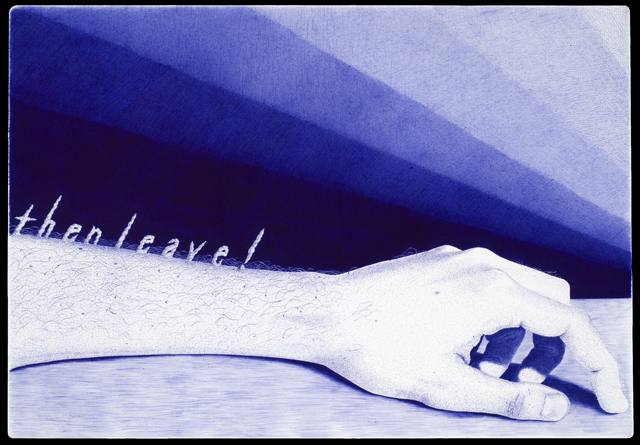
"Then Leave!" Ballpoint Pen on Paper 12.5" x 18" 2011

“Then Leave!”
Ballpoint Pen on Paper
12.5″ x 18″
2011

What unique roles do you see yourself as the artist playing that you may not have envisioned yourself in when you first started making art?

I have learned that I need to pay serious attention to ergonomics in my studio. Before I had adequate light and properly arranged workspace, it really began to take a toll on me physically. It never occurred to me when I was in school that I could hurt myself while drawing.

When do you find is the best time of day to make art? Do you have time set aside every day, every week or do you just work whenever you can? 

I work whenever I can, but when I have the choice I work when I am at my best, which is in the morning and late evening. When the world around me has quieted down, there are fewer distractions.

How has your work changed in the last five years? How is it the same?

I tend to work in discrete series, often connected through media, scale, or subject. I keep going until it gets played out. Over the last five years I have worked in different series, but the atmosphere of the work stays largely unchanged. I am also beginning to stray from working in such strict series. It can be limiting at times.
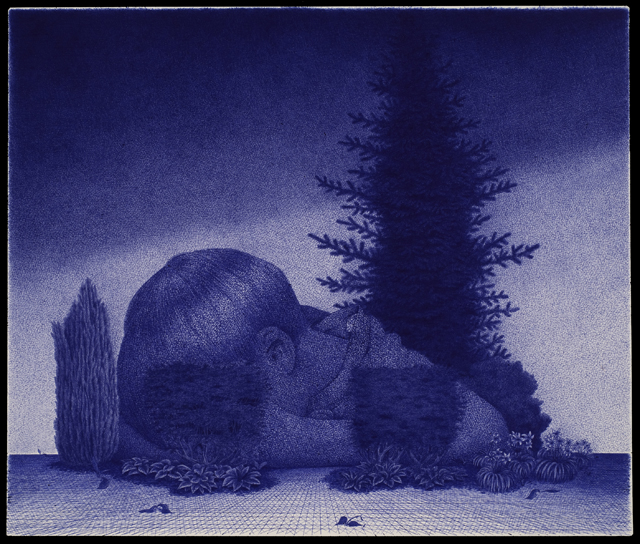
Untitled  Ballpoint Pen on Paper 14.4" x 17" 2013

Untitled
Ballpoint Pen on Paper
14.4″ x 17″
2013

Are there people such as family, friends, writers, philosophers or even pop icons that have had an impact on the work you do?

I am fortunate to have had many excellent teachers, and they have all left their mark on me. There have also been some that have presented a model of what to avoid. My Dad was not an artist, but I often think of how he accomplished various projects around the house. He never had good tools or much time, but he would chip away at stuff on the weekends, and it would eventually get done. That has proven to be a valuable example.

If you had an occupation outside of being an artist, what would that be and why?

Probably something crafty, especially if I could work outside and meet interesting people. I could always go back to house painting.

About
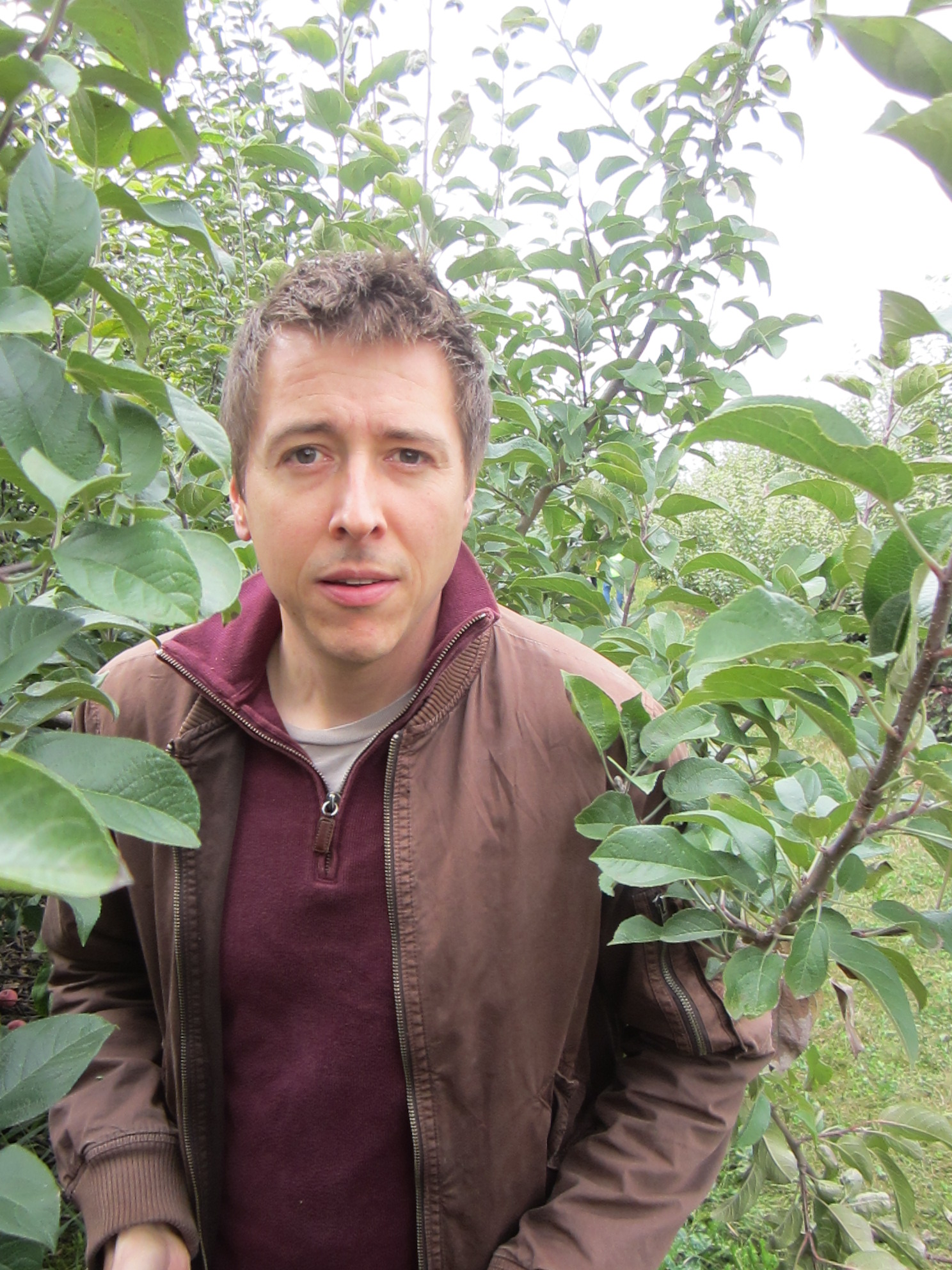
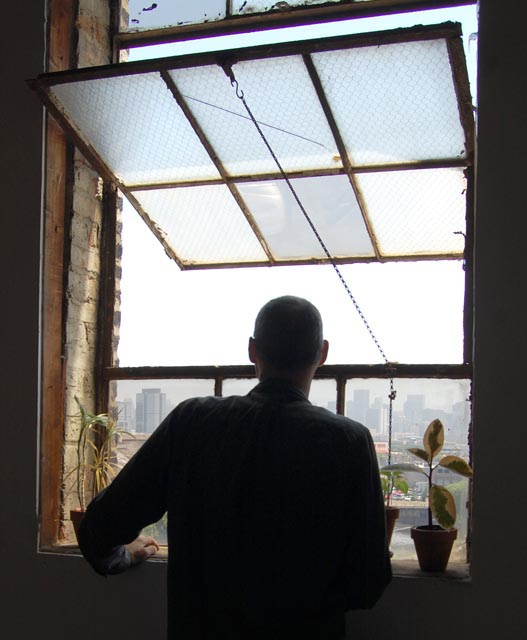
headshot_365Scott Espeseth was born in 1975 in the sprawling suburb of Bowie, MD, in the Washington D. C. metropolitan area. Always prone to drawing, he studied art at West Virginia University, where he earned a BFA in 1997. He was later lured to Madison, WI to study printmaking at the University of Wisconsin, where he worked with storied print artists such as Frances Myers and Warrington Colescott, and where he remains to this day. His work has since evolved to focus mainly on drawing, usually with commonplace media such as graphite pencils and ballpoint pen. His drawings have been described as “clairvoyant,” often depicting familiar spaces charged with a sense of dark presence, or other instances where planes of existence clash: the future sending messages to the past, memory intruding upon the present, or the subconscious bleeding into consciousness. Scott has had exhibitions extensively in the Midwest as well as nationally, and is represented by Dean Jensen Gallery in Milwaukee and Schema Projects in Brooklyn, NY. He has been on the faculty of Beloit College in Beloit, WI since 2002.
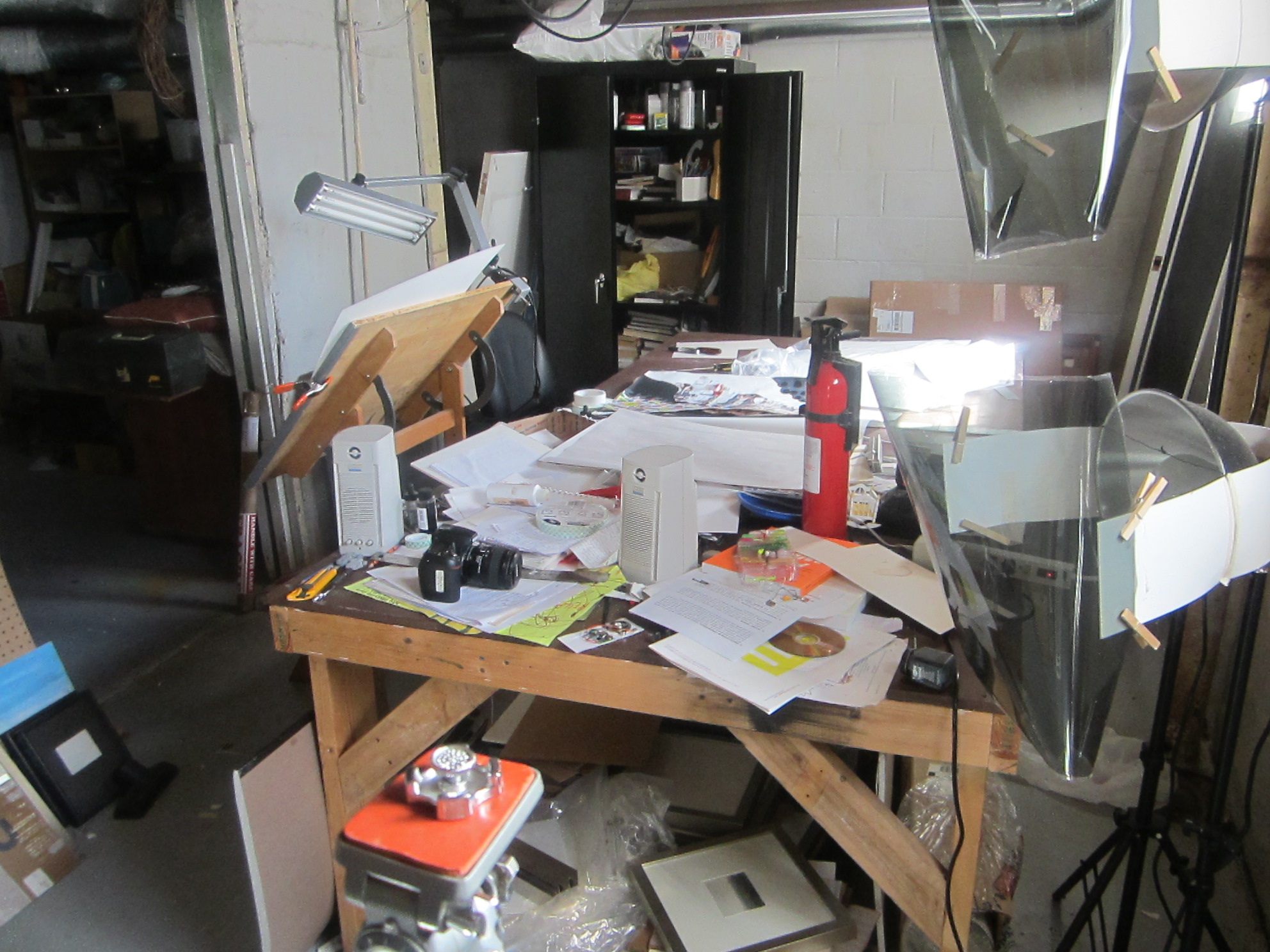
The Studio

The Studio

www.scottespeseth.com

All images copyright of the artist and used with their permission. 

Posted in Uncategorized | Tagged , , , , | Leave a comment

Sara Parent-Ramos – Austin, Texas

Amassing Presence # 2, Stoneware, glaze, house paint, rope, metal, string, wax, plastic and wood, 10ftx8ftx5ft, 2013

Amassing Presence # 2, Stoneware, glaze, house paint, rope, metal, string, wax, plastic and wood, 10ftx8ftx5ft, 2013

Briefly describe the work you do.

I am interested in creating visual and physical manifestations of the rules, scaffolds and supports that underpin human existence. I focus on making invisible scaffolds explicit by highlighting the importance of corporeal scaffolds in my sculptural work. I see a direct allegorical relationship between the scaffolded scenarios I create and the biological, social and psychological processes that are the invisible scaffolding supporting human functioning.

People are bad at paying attention to the unrecognized factors that guide our actions in our daily lives. For instance, we are more likely to understand another person’s behavior as resulting from internal characteristics than resulting from a particular situation. Why did that person litter? Maybe they are slovenly pigs, or maybe the overflowing trashcans and dirty courtyard told them on an implicit level, “It’s ok, go ahead, others have done it.” These mental, physical and social scaffolds can have innocuous, comic, and sometimes even grave repercussions.

At what point I your life did you want to become an artist?

When I was in the third grade I took classes with a local Washington D.C. artist. By high school I was helping her with her studio practice and classes. Around the same time that I was introduced to art I was diagnosed with dyslexia. As I progressed into grade school, the range of spatial possibilities that each letter retained wreaked havoc with my ability to read and write. My early experiences as a dyslexic lead me to be interested in the hidden forces that guide our behavior on a day to day basis (social influences, neuronal architecture, learned behaviors, etc.) 

After graduating from Swarthmore College with a B.A. in psychology, I taught students with learning differences at the American School in Casablanca, Morocco while simultaneously exploring Moroccan ceramic traditions. In 2006 I was awarded a Fulbright Postgraduate Fellowship to conduct neuropsychology research on dyslexia with a prominent scientist in Milan, Italy.  While conducting this research I also enrolled at Accademia di belle Arti di Brera in Italy. While taking classes and making work at Brera, I began to seriously contemplate pushing my artistic work full time.

However, It was not until 2008, after conducting psychology research in the US for two years, that I made the decision to become an artist. I came to the realization that it was through art and not psychology that I wanted to explore the intangible forces that scaffold human behavior and thought. I graduated from New York State College of Ceramics at Alfred University with an MA in 2013. I am currently teaching sculpture at Saint Edwards University in Austin, Texas.

Amassing Presence # 1, Stoneware, glaze, house paint, unfired clay, rope, string, wax and wood, 5ftx9ftx6ft, 2013

Amassing Presence # 1, Stoneware, glaze, house paint, unfired clay, rope, string, wax and wood, 5ftx9ftx6ft, 2013

Tell us a little about your background and how that influences you as an artist.

When I was a child I spent many summers in Rome and in Tuscany, the places where my mother grew up before emigrating to the United States from Italy in the late 70s.  On walks with my grandmother in Rome, I could not help but notice the visual layering of centuries of history.  One could see medieval churches covered in baroque adornments, wedged in between fading 1970s apartments.  Since childhood, I have traveled extensively, living for extended periods of time in Italy, Paris and Morocco, witnessing first hand how architecture and the accumulation of every day debris can lend a physical presence to history.  In my work, I draw upon this awareness, recombining recognizable cultural, architectural and historical imagery from different eras and cultures.  In this manner, the layering of visual information becomes a stand-in for the temporally fleeting passage of human events. 

What types of conceptual concerns are present in your work? How do those relate to the specific process(es) or media you use?

My work originates out of a cyclical process of accumulation and synthesis. I make sense of information first by arranging the objects I create and then assigning them a meaning through organization.  I then obscure the categories I have created through recombination, which enables me to endlessly play with the objects’ associative meanings.

Using space and physical objects as a shorthand for my thoughts has been something I have done since childhood.  Instead of writing down homework, I would choose a rock in the school courtyard and strategically place it in a pocket of my backpack to help me remember assignments. By endowing objects with meaning and situating them in space, I figure out what I deem important. Thus my work stems from a materially and spatially based system of grappling with information.  With visual information ever more accessible, due to digital technology, I see the digestion of information, not the gathering, as the challenge of my particular socio-cultural moment.

I both relish and resist the onslaught of visual information, taking pleasure in the transition from reduction to synthesis and back again.  This journey enables me to appreciate the micro and macro simultaneously, reaching an intuitive understanding of the whole work as well as its component parts through accumulation and synthesis.  This experience is similar to examining a human hair under a microscope.  Looking through the eye piece the hair is full of bumps, imperfections and accumulated segments, while viewing it with the naked eye one sees a smooth, whole filament.  Through the process of amassing detailed parts, my finished piece allows me to see both the whole and the elements that create the whole.

We once heard Chuck Close say he did not believe in being inspired, rather in working hard everyday. What motivates you in your studio practice?

I find inspiration through exploration. I try to travel as much as possible and I am a voracious reader. I relish encountering and grappling with new processes, materials and ideas. I enjoy exploring new visual/conceptual territory by bringing together previously dispirit images and concepts. For me there is nothing better then the process of drawing ideas or objects together, making connections and creating a whole that is greater that the sum of its parts. 

What artists living or non-living influence your work? 

The artists that have influenced my artistic development are Tim Roda, Heringa/Van Kalsbeek and Tatiana Trouve (living) and Pina Bauch, William Blake and Eva Hess (nonliving).

When you are not making art what types of activities and interests do you engage in?

When I am not making art I like to take walks, read, dance and watch peoples interactions.  

About

Sara Parent-Ramos_HeadshotBorn in Washington, DC to Italian/Canadian parents, Sara Parent-Ramos’s work stems from her international background and her work experience in the field of psychology. Since graduating from the New York State College of Ceramics at Alfred University, she has been the recipient of a State University of New York Thayer Fellowship and a Cite International des Arts, Paris Residency Fellowship. Sara received a Fulbright scholarship to Italy in 2005 and a Graduate Student Fellowship from the National Council on Education in the Ceramic Arts in 2013. Most recently she has participated in exhibitions at the Museum of Fine Arts in Houston Texas, the San Angelo Museum of Fine Art, San Angelo,TX and the Society for Contemporary Craft in Pittsburgh PA. She is in currently a Visiting Assistant Professor in Art at Saint Edwards University, in Austin Texas. 

The Studio

The Studio

saraparentramos.com

All images copyright of the artist and used with their permission. 

Posted in Uncategorized | Tagged , , , , | Leave a comment

Jason Ruhl – Madison, Wisconsin

Thirteen Tales From Urban Bohemia #7 (vol. 2), 2013, collage and digital, 12” x 9”

Thirteen Tales From Urban Bohemia #7 (vol. 2), 2013, collage and digital, 12” x 9”

Briefly describe the work you do:

I work primarily in print-based media, often cutting and collaging my prints. Currently I am working on a project that started in April of 2012. Once a year I mail 13 individuals a letter requesting a list containing 5 songs. I inform the recipients that I will create a collage inspired by one song from their list. Each month I mail a 12” x 9” collage to an individual, and at the end of the year I send each participant a letterpress box set containing 7” x 5” reproductions of all 13 images.

Tell us a little about your background and how that influences your work:

I attended graduate school at the University of Wisconsin-Madison from 1999 – 2002.While there I took a class in Print Production focused on incorporating digital printmaking into your work. I taught myself how to use Adobe Illustrator and Adobe Photoshop, and the use of these programs has been a part of my work ever since.

The concept of the “artist studio” has a broad range of meanings, especially in contemporary practice. The idea of the artist toiling away alone in a room may not necessarily reflect what many artists do from day to day anymore. Describe your studio practice and how it differs from (or is the same as) traditional notions of “being in the studio.”

I work at Tandem Press so I consider my day job to be an aspect of my studio practice. In the print shop, especially during an artist’s visit, there is an intense amount of collaboration. During this process I have discussions, formal and conceptual, that I keep in my head and reference in my own work. When I am producing in my studio I am alone in a room with a pair of headphones on and I really enjoy the solitude.

Thirteen Tales From Urban Bohemia #12 (vol. 2), 2014, collage and digital, 12” x 9”

Thirteen Tales From Urban Bohemia #12 (vol. 2), 2014, collage and digital, 12” x 9”

When do you find is the best time of day to make art? Do you have time set aside every day, every week or do you just work whenever you can? 

I am in my studio in the early evening Monday – Thursday. I also try to spend time there on Saturday and Sunday as well. Lately I have found that if I wake up at 5 am and cannot get back to sleep I will head down to the studio. I end up producing some of my best images in the early morning. I feel like the left side of my brain is still asleep and doesn’t get in the way of the right side.

How has your work changed in the last five years? How is it the same?

About 5 years ago I decided to stop painting and focus on collage and printmaking. In 2010 I started creating work with the idea of mailing it to individuals, which has evolved into my current work of creating collages from participants’ song lists.

Thirteen Tales From Urban Bohemia #7 (the b - sides), 2014, collage and digital, 12” x 9”

Thirteen Tales From Urban Bohemia #7 (the b – sides), 2014, collage and digital, 12” x 9”

Are there people such as family, friends, writers, philosophers or even pop icons that have had an impact on the work you do?

I am influenced by everything in this question. One recent instance that stands out is the novel The Wasp Factory by Iain Banks. I was making a piece for a show about the U.S. Presidents and was given Woodrow Wilson. My first idea was too clunky and not going to work. I came upon a line in the novel about people being like sheep and it sparked an idea that I ended up creating the image around.

If you had an occupation outside of being an artist, what would that be and why?

As clichéd as it sounds, I have no idea. Maybe a food critic but that would entail writing, which I am terrible at. I also don’t like white condiments so I feel like I might be too picky for that profession.

About

headshotJason Ruhl works primarily in print-based media, often cutting and collaging his prints.  Much of his work revolves around reducing, or simplifying, images to what he deems are the essential components.  The result is a progression that obscures the “original” but leaves enough of its history to give the viewer a connection to the image.  He received his MFA from the University of Wisconsin-Madison and his BFA from Minnesota State University, Mankato. His work has been included in group exhibitions nationally and internationally in Chicago, Los Angeles, New York, Venice, and Berlin, among others. He currently lives in Madison, WI where he is a Master Printer at Tandem Press.

The Studio

The Studio

www.jasonruhl.com

All images copyright of the artist and used with their permission. 

Posted in Uncategorized | Tagged , , | Leave a comment

Thomas Hellstrom – Milwaukee, Wisconsin

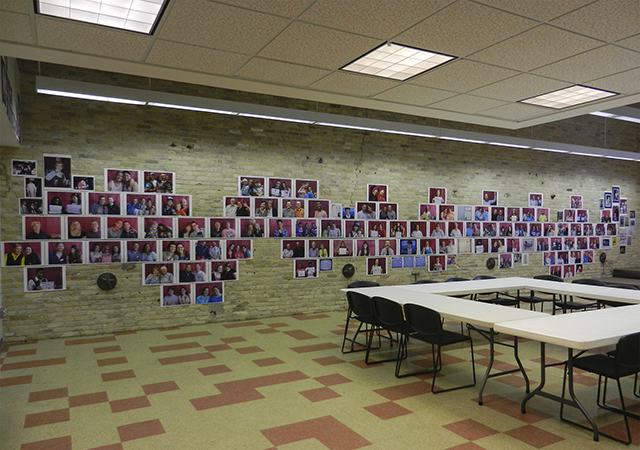
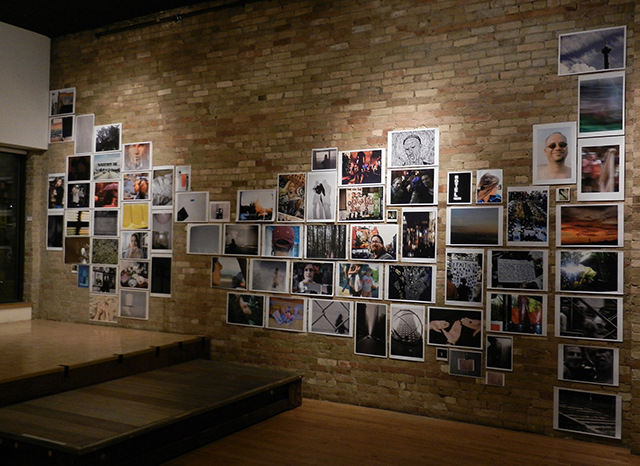
Thomas Hellstrom Installation view: Xeno:Reno Photo installation, 10 x 70 feet ArtSpace, University of Nevada, Reno, 2013

Thomas Hellstrom
Installation view: Xeno:Reno
Photo installation, 10 x 70 feet
ArtSpace, University of Nevada, Reno, 2013

Briefly describe the work you do.

I work with images. I make large scale photo installations engaging place and community in addition to online projects. Working in photography since 1989 I’ve amassed a 25 year archive: SUGAR IS COMBUSTIBLE: Photo Diary 1989-2014 http://thomashellstrom.blogspot.com/ . Containing over 20,000 images that collapse all genres of photography the archive documents the revolutionary development of photo  technology from film to early digital cameras to smartphones, forever changing the notion of ‘photographer’. My projects respond to this condition. How do people make and use images to form community online? What is the nature of the new visual literacy the internet produced?

Tell us a little about your background and how that influences you as an artist.

After 18 years working in New York I relocated to Milwaukee. My work shifted from a market based practice to a social practice actively soliciting community participation. The work’s focus is now the fundamental exchange between the artist and the viewer. In 2013 I launched two exhibition programs engaging community and place. The ‘Xeno’ program (English translation of Greek ‘stranger’) resulting in exhibitions in Reno and Milwaukee and ‘LM:+43-87’ an ongoing study of Lake Michigan photographed at Milwaukee’s GPS coordinates.  

Considering my unfamiliarity with the storied American West Xeno:Reno  took the form of ongoing correspondence prior to the exhibition at the University of Nevada, Reno. Casting an open call to Renoites I requested photos of the region to which I responded individually and archived online http://xenoreno.tumblr.com/ . Upon arrival a photo installation responding to the Sierra Nevada landscape was constructed from the archive while meeting my collaborators and seeing the West for the first time. The exhibition transformed  a tumblr photo-wall into physical space.  

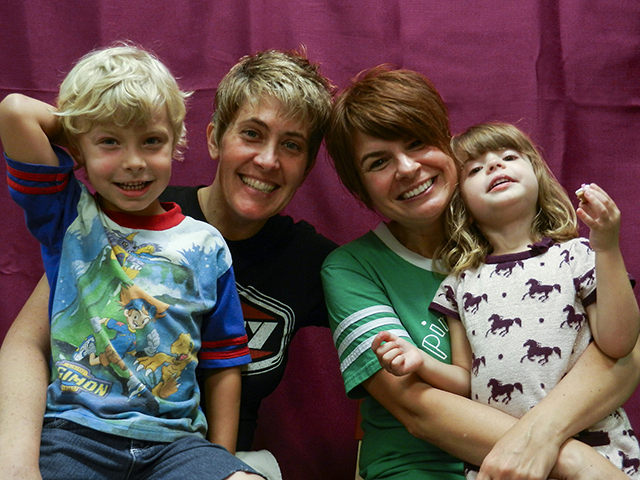
Xeno:Mke 2013-2023 simultaneously occurred at the Milwaukee LGBT Community Center,  featuring historical documents from the University of Wisconsin, Milwaukee Library’s LGBT Archives Collection, the photo archive from Milwaukee’s oldest LGBT cocktail lounge This Is It! (est. 1968) and over 100 portraits produced in a free portrait studio throughout the city. The contents of the exhibition were conceived as a time capsule to document a historic year for LGBT rights. Unexpectedly couples who sat for portraits were married in Wisconsin June 2014 completing, in the future, the historical significance of the project.  http://xenomke.tumblr.com/

Installation view: Xeno:Mke 2013-2023 Photo installation, 12 x 120 feet MKE LGBT Community Center, Milwaukee, 2013

Installation view: Xeno:Mke 2013-2023
Photo installation, 12 x 120 feet
MKE LGBT Community Center, Milwaukee, 2013

The concept of the “artist studio” has a broad range of meanings, especially in contemporary practice. The idea of the artist toiling away alone in a room may not necessarily reflect what many artists do from day to day anymore. Describe your studio practice and how it differs from (or is the same as) traditional notions of “being in the studio.”

Contemplating how images travel online I am experimenting with Facebook as an exhibition platform. Part of the research for Xeno:Mke 2013-2023 involved sourcing photos from the Facebook page of Milwaukee’s oldest LGBT cocktail lounge This Is It! http://www.thisisitbar.com/ Facebook suddenly became essential to the work. I conceived a simultaneous project documenting the summer sky daily from Memorial Day to Labor Day as my Facebook status. What could be more universal than the sky? Also it stood as a metaphor of ‘the cloud’ where we communicate.    

Last January I launched FB: 365/2014.  I post images daily to Facebook to create an indexed archive of 365 images to be exhibited in 2015. The only criteria is the image is made on the precise day, documenting the quotidian. The aim of the project is to test the limits of the photography. What will the images mean? How do images prompt memory and meaning? How will that meaning change?

For FB: 365/2014 the studio is nowhere and everywhere. For installation works I prepare prints in a small office. Since relocating to the Midwest the studio has been the exhibition venue. I  install extemporaneously activating both the architecture and the viewers physical response to the work.

What unique roles do you see yourself as the artist playing that you may not have envisioned yourself in when you first started making art?

As an art student I never envisioned collaborating with the public. The ‘Xeno’ projects facilitate social interaction.  In this respect I see my unique role bringing people together to make something. During the  opening receptions  there’s been sense of celebration among the participants, a sense of belonging to something  greater. Art has always facilitated communal experience however ‘Xeno’ makes this sense of connection the subject of the work.

Installation view: SUGAR IS COMBUSTIBLE: BCC MKE Photo Diary 1989-2012 Photo installation, 17 x 30 feet Milwaukee Gay Arts Center, 2012

Installation view: SUGAR IS COMBUSTIBLE: BCC MKE Photo Diary 1989-2012
Photo installation, 17 x 30 feet
Milwaukee Gay Arts Center, 2012

When do you find is the best time of day to make art? Do you have time set aside every day, every week or do you just work whenever you can?

Working with unconventional online platforms like Facebook opened my work to instant, global communication. Lately I don’t know when I am not working.

How has your work changed in the last five years? How is it the same?

In the summer of 2012 I produced a survey exhibition: SUGAR IS COMBUSTIBLE: BCC MKE Photo Diary 1989-2012 at the Milwaukee Gay Arts Center. Consisting of a 17×30 foot installation containing over 100 images I hosted weekend evenings, inviting passersby into the gallery for a beer. It was a revelation. Viewers of all sexual orientations found their own stories within my images: a biker found the image of perfect happiness, a Jewish man texted his friends the Israeli contingent in NY’s Gay Pride parade, a woman fled the gallery in tears seeing an image of an unmade, empty bed. Ultimately it was not my images but the exchange of stories that became the content of the exhibition. The next logical step was to make that exchange the subject of my work, hence the ‘Xeno’ projects. Working with images for 25 years has lead me to this moment of conversing with people through images.     

Are there people such as family, friends, writers, philosophers or even pop icons that have had an impact on the work you do?

Without doubt the French filmmaker Chris Marker (1921-2012). Active in France from the 1950s into the 21st century, Marker invented the film essay form. His 1982 masterwork Sans Soleil influenced how I consider images, history, memory and time itself.  I learned he died en route to Chicago during my exhibition SUGAR IS COMBUSTIBLE: BCC MKE Photo Diary 1989-2012. In the exhibition I titled a 10 hour video work  ‘The First Image He Told Me About’ after the first line of dialogue spoken in Sans Soleil. That evening I sat alone in a South Side Chicago bar photographing the London Olympic Games from television as Marker photographed the Tokyo Games for his 1967 film Le Mystere Koumiko.

If you had an occupation outside of being an artist, what would that be and why?

The ‘Xeno’ program can be tailored to most any community or audience. Upcoming collaborations are planned with a National Multicultural Gay Men’s Organization and the Shambhala Meditation Center, a Buddhist community in Milwaukee. My desire for engagement with people and my intellectual curiosity wouldn’t  be satisfied doing anything else.

About

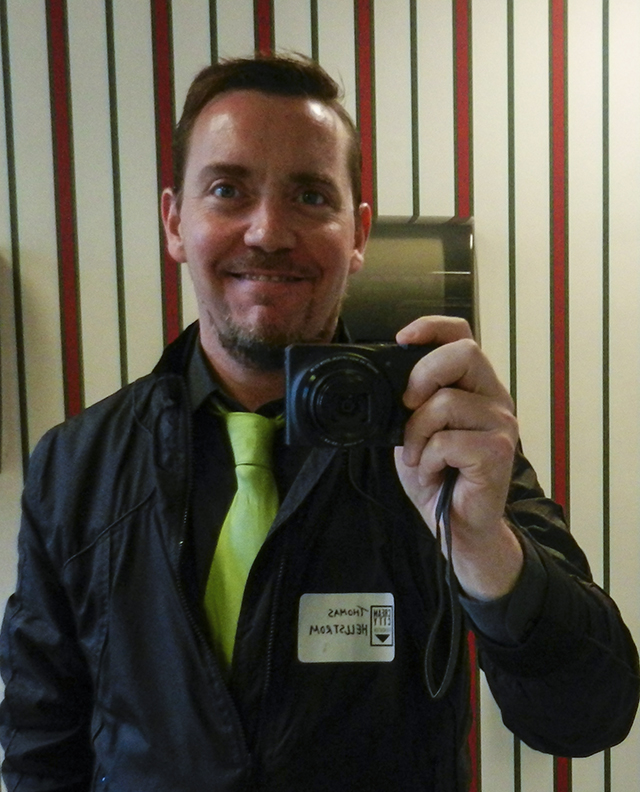
Hellstrom_Thomas Head ShotThomas Hellstrom, born USA 1969, has been featured in solo and group exhibitions throughout North America, Europe and Asia garnering the attention of The New York Times, reFRESH (UK) and Camera Austria.  To follow FB: 365/2014 please friend Thomas on Facebook to observe the work develop daily throughout 2014. At the time of writing 175 images are archived. Please feel free to contact Thomas regarding the ‘Xeno’ exhibition project. Eager to expand the project globally Thomas seeks new communities and collaborators. thomashellstromnyc@gmail.com

detail XENO MKE 2013 2023

detail XENO MKE 2013 2023

All images copyright of the artist and used with their permission. 

Posted in Uncategorized | Tagged , , , , | Leave a comment

Barbara Schreiber – Charlotte, North Carolina

“Welcome Wagon”, acrylic on paper, 22” x 30” , 2014

“Welcome Wagon”, acrylic on paper, 22” x 30” , 2014

Briefly describe the work you do.

My paintings are the products of a difficult world filtered through my genetically sunny disposition. I sometimes see them as dispatches from the borderland between happy denial and grim reality.

Much of my work is about the collision of the built and natural worlds, about conflicts in which outcomes are uncertain. These paintings use humor to variously address threats presented by development, natural and human-made disaster, greed or obliviousness.

I am sometimes perplexed by the number and intensity of animals in much of my recent work. I don’t think of myself as an animal person, but have concluded that on some level I must identify with animals, particularly small wild ones—adorable, understood by few and ultimately alone in a complex, fast-moving world.

 Tell us a little about your background and how that influences you as an artist.

I grew up in a modest, slightly out-there household in Baltimore, with artists scattered throughout my extended family. We started out as Orthodox Jews, but by the time I was five or six, my parents drifted to—well, I’m not really sure what they drifted too. It wasn’t agnosticism, probably more like don’t-bother-me-I’m-trying-to-read-this-book-ism.

The notion of feeling too odd to be conventional yet too conventional to be odd probably began here, and has pervaded pretty much everything I do. It made me a perpetual outsider, an observer and misinterpreter of idioms, cliches and customs.

The concept of the “artist studio” has a broad range of meanings, especially in contemporary practice. The idea of the artist toiling away alone in a room may not necessarily reflect what many artists do from day to day anymore. Describe your studio practice and how it differs from (or is the same as) traditional notions of “being in the studio.”

Well, I make paintings that result from stories concocted in my head; you can’t get more “in the studio” than that. I also do a lot of research of the sort that used  to occur in libraries, but most of that now takes place in the studio as well. Otherwise, I am an aimless stroller—not quite a flaneur—and see the world as my studio and research field.

“Crop Dusters”, acrylic on paper, 22” x 30”, 2012

“Crop Dusters”, acrylic on paper, 22” x 30”, 2012

What unique roles do you see yourself as the artist playing that you may not have envisioned yourself in when you first started making art?

I did not anticipate writing about art. I still don’t anticipate it, but somehow it keeps happening. I write for the local paper once or twice a month and for national or regional publications on rare occasion.

When do you find is the best time of day to make art? Do you have time set aside every day, every week or do you just work whenever you can? 

At the moment, I’m working in my studio several hours a day most days, until my hand cramps or some other body part gives out. Mornings are best; it’s when I’m most alert and the light is good.

“The Road to Yakima” , acrylic on paper, 22” x 30”, 2013

“The Road to Yakima” , acrylic on paper, 22” x 30”, 2013

How has your work changed in the last five years? How is it the same?

For years, I did miniscule works in sets and series, creating piles of individual pieces per year. But when the economy tanked, my vision turned into inventory—work went out to exhibitions and it all came back. So I began doing larger, more labor-intensive paintings that take about two months each to complete. The work has also become more heavily patterned, which I think is the result of living for the past decade in the Carolinas, with their rich craft and textiles traditions. Right now, I’m trying to loosen up.

Whatever the format, my work is always about pretty pictures and ugly subjects.

Are there people such as family, friends, writers, philosophers or even pop icons that have had an impact on the work you do?

I am inspired by authors who write about people in places where they have no business being. Peter Mattheisson’s At Play in the Fields of the Lord and Paul Bowles’ The Sheltering Sky are very much on my mind right now.

But wandering here and there is an even  bigger influence. Also plants. I am a cheerful, semi-competent gardener and tend my tiny intown yard only to have it assaulted every few weeks by weather, drunks and dogs. But birds love it and visit all day; I like them so much better than people, except when they are attacking each other.

If you had an occupation outside of being an artist, what would that be and why?

Perhaps something having to do with ornamental horticulture or clinical psychology. I hope the reasons are evident in my work.

About

Schreiber headshotBarbara Schreiber makes pretty paintings that examine large issues through a small, domestic lens.

Barbara’s exhibitions include PS 1, the High Museum of Art, Southeastern Center for Contemporary Art, SPACE Pittsburgh, the Weatherspoon Museum of Art, Atlanta Contemporary Art Center, the Museum of Contemporary Art of Georgia, Telfair Museum of Art, American Academy and Institute of Arts and Letters, Barbara Archer Gallery, Atlanta, Joie Lassiter Gallery, Charlotte, and other venues.

In addition to her work as an artist, Barbara can sometimes be pestered into writing about visual art. Her reviews, articles and navel staring have appeared in Art Papers, Metalsmith, Sculpture Magazine, Creative Loafing Charlotte, The Charlotte Observer and other publications.

Barbara was born in Baltimore MD and earned a BFA from the Maryland Institute College of Art. After a significant amount of time in Atlanta GA, she wound up in Charlotte NC in 2004. She is thinking about the next place to land.

“Competitive Edge” (detail), acrylic on paper, 22” x 30”, 2012

“Competitive Edge” (detail), acrylic on paper, 22” x 30”, 2012

barbaraschreiber.com

All images copyright of the artist and used with their permission. 

Posted in Uncategorized | Leave a comment

MIchael Banning – Chicago, Illinois

"View toward Basilica, Minneapolis", 2014, oil on panel, 18" x 24"

“View toward Basilica, Minneapolis”, 2014, oil on panel, 18″ x 24″

Briefly describe the work you do.

I am a realist painter. For the past 10 years my work has mostly focused on images of the urban landscape. Having lived in Minneapolis, Milwaukee, and now Chicago, I’m particularly interested in the former industrial corridors of these Midwestern cities and how they have either prevailed or changed through re-use or decay.

At what point I your life did you want to become an artist?

It’s difficult to pinpoint a specific moment when I knew I wanted to be an artist. My mother is an artist, so I grew up surrounded by art and creativity as a normal activity within the home. In high school and college I was a pretty serious musician and although I initially majored in architecture and business in college, I switched to art after taking the required drawing class for the major. I think I believed that being an artist offered a kind of absolute freedom and this was something I wanted.

Tell us a little about your background and how that influences you as an artist.

I was born in Boulder, Colorado but grew up in both Colorado and Missouri as a child. When I think back, I have very strong associations with the landscape in both of these places. In Colorado there were always the mountains that one could look down from toward the city and plains. In Missouri, the house where I lived was surrounded by deep woods that were a constant source of mystery and a destination for exploration.

In my current work I think these formative experiences translate into my tendency to seek out undefined and empty kinds of spaces. Within the city these are usually either the edges of industrial corridors or blighted spaces where nature is taking over again. I want to feel like I’m firmly within and surrounded by the city but also somewhat away from it and able to see it from a distance. I see this as a metaphor for the artist in general. In order to communicate an experience or vision that others can relate to you have to be able to be a part of a culture and experience it fully yourself, but you also need to be able to separate yourself from it in order to have perspective.

"View toward Chicago River and Skyline from Mendell Street studio, Chicago", 2013, oil on panel, 9.6" x 20.75"

“View toward Chicago River and Skyline from Mendell Street studio, Chicago”, 2013, oil on panel, 9.6″ x 20.75″

What types of conceptual concerns are present in your work? How do those relate to the specific process(es) or media you use?

I’m interested in creating work that engages with how we see our surroundings and understand them. In my recent work this interest has focused on documenting post-industrial urban landscapes. In addition to literal documentation I am also interested in trying to “re-present” these familiar kinds of landscapes in new ways. More specifically, I usually either focus on a subject that is viewed as banal or abject in an effort to find richer meaning within it, or conversely focus on a subject that has nostalgic or romantic connotations in an effort to see it more neutrally.

Examples of the first kind of strategy would be paintings that focus on the hyper-observation of often unnoticed details of alleys, empty lots, garbage, and the behind and underneath spaces of structures like billboards and bridges. The selective focus of painting can breath life into and compel consideration of what we usually disregard as a “blind-spot”.

Representing the more typically romanticized imagery is difficult because I’m certainly not immune to its allure. I can’t deny the emotional connections I have with images of skylines, bridges, and factory ruins, but when I’m painting them I try not to paint them in such a way that they seem romantic, I just stick with the visual facts. I see it as a kind of tension between how we want to (and have been conditioned to) perceive these kinds of images and how they really look. I choose dramatic views, often in dramatic lighting conditions, but try to paint them in such a way where I’m not giving into the heightened sentiment with the paint. When this works I think an interesting and specific kind of tension is created, when it doesn’t, I get a somewhat romantic feeling image.

I’m also very interested in processes of observation, perception, and interpretation. These nuts and bolts processes of drawing or painting something that looks “real” are always challenging and I’m probably involved with trying to suggest color relationships, create depth and space, and find a believable quality of light, as much as I am with conceptual concerns.

In relation to drawing and painting, processes of perception and observation are necessarily central to how I work – either from direction observation over a series of sittings, or from photographs, or from both. Working from photographs allows for an ultimately stable subject but forces a disconnection from the original inspiration. When working from direct observation, understanding the subject is more intuitive, but the instability of light and space are much more difficult to work with.

Documentation is also a central and basic concern of my work. Many of the spaces I’ve painted over the last 10 years have changed drastically from the way they are depicted in my paintings. Buildings have been razed, bridges destroyed and rebuilt, fields have been turned into parks, and strip malls have replaced 19th century factories and mills. Although photography can document the buildings and objects that occupied these spaces, the selective focus of painting adds the dimension of time, and lived experience to marginal and otherwise forgotten views.

"View toward Wrigley Billboard from Mendell Street studio, Chicago", 2013,  oil on panel, 11.5" x 15.25"

“View toward Wrigley Billboard from Mendell Street studio, Chicago”, 2013, oil on panel, 11.5″ x 15.25″

We once heard Chuck Close say he did not believe in being inspired, rather in working hard everyday. What motivates you in your studio practice?

The process of making a painting does start with inspiration but usually quickly turns into a prolonged effort of work. The inspiration involves finding an image or scene that I want to work with. Sometimes this initial inspiration can be something very particular and possibly ephemeral, like a certain quality of light or unusual juxtaposition of elements in the landscape. However, more often than not, it’s something that I’ve experienced many times over and over again during the routine of traveling through the city that finally makes an impression on me. Turning this memory and image into a painting that feels real but also carries some kind of psychological or conceptual charge is the challenge – and a time consuming one. I would say my process is 10% inspiration and 90% work.

What artists living or non-living influence your work? 

I’m interested and influenced by artists that work solely from direct observation (although I only do this some of the time): Within this category Rackstraw Downes, Catherine Murphy, Andrew Lenaghan, Antonio Lopez Garcia, and Chicago artist Andy Paczos come to mind.

Also, I’m very influenced by artists that work within the general boundaries of realism but are able to transcend the real into a psychological, narrative, or conceptual space: With this in mind, Edward Hopper, Vija Celmins, Giorgio Morandi, Villhelm Hammershoi, and Minneapolis artist Michael Kareken are all artists that have influenced me quite a bit.

When you are not making art what types of activities and interests do you engage in?

Honestly, other than working as an art lecturer, I’m usually making art. In addition to my studio work, I also spend a lot of time studying figure drawing and anatomy. On a personal note, I enjoy traveling, film, and cooking with my wife who is also a painter.

About

Banning - HeadshotMichael Banning was born in Boulder, Colorado in 1966 and received his BFA from the University of Colorado, Boulder and his MFA from the Minneapolis College of Art and Design.

Banning’s oil paintings and drawings of contemporary American urban, industrial, and domestic landscapes have been exhibited in solo exhibitions in Denver, Minneapolis, and New York, as well as in group exhibitions at the Minnesota Marine Art Museum, The Rockford Art Museum, The Wright Museum of Art, The Kohler Art Center, The Charles Allis Museum, The South Bend Regional Museum of Art, the Walker’s Point Center for the Arts, and the Fort Wayne Museum of Art, among others. In 2014 he will be exhibiting a new series of urban landscapes at the Harold Washington Library in Chicago.

Between 1995 and 2006, Banning lived and worked in Minneapolis and was the recipient of grants from the Minnesota State Arts Board and a Jerome Foundation Travel and Study Grant to study fresco painting in Detroit. Banning has also received grants from the City of Chicago where he currently lives with his wife, artist Melanie Pankau. He teaches drawing and painting at the University of Wisconsin, Whitewater.

Michael Banning is currently represented by the Groveland Gallery in Minneapolis where he has exhibited since 1998.

In the Studio

In the Studio

www.michaelbanning.com

All images copyright of the artist and used with their permission. 

Posted in Uncategorized | Tagged , , , , | Leave a comment

Ellie Honl – Bloomington, Indiana

Head in the Sand, 34"x21", screenprint, collagraph, drypoint, collage, sewing, wood

Head in the Sand, 34″x21″, screenprint, collagraph, drypoint, collage, sewing, wood

Briefly describe the work you do.

Much of my artwork has investigated one’s emotional state and the effect that has on perception.  Currently, my artwork is about the human desire to find stability in an unsteady present and unpredictable future.  Although these subjects might be considered dark territory, the details, surfaces, and playful colors of the art lure the viewer into accessing the work and subsequently contemplating its message. Utilizing printmaking techniques along with photographic and time-based media, my images are constantly influenced by my love of geometry, nature, and color.

At what point I your life did you want to become an artist?

I thought about being an artist as a child.  My mother is an art teacher, so growing up there was always a constant supply of art materials as well as art instruction and encouragement.  In high school, I loved science and I planned to become a psychiatrist or an architect.  It wasn’t until my junior year at St. Olaf College that I finally decided on pursuing studio art full time.  Even though I liked a lot of different subjects, art was the one thing I kept coming back to and that truly made me happy.

Tell us a little about your background and how that influences you as an artist.

Growing up, my family lived in an area where there weren’t many other children, and my brother and I spent a lot of time entertaining ourselves.  I was always teaching myself things like calligraphy, needlepoint, and jewelry making.  As an artist, this history of exploration and independence has given me the confidence to learn complicated techniques and technologies such as stop-motion animation and copper plate photogravure.

My history as a printmaker has also impacted the way I work as an artist.  Printmakers usually work in communal spaces with shared equipment.  Because of this unique experience, I am energized by collaborating with other artists and my work is influenced by the free-flow of ideas and communication that can happen in a shared space.

Outgrowth, toned cyanotype, gouache, 2014

Outgrowth, toned cyanotype, gouache, 2014

What types of conceptual concerns are present in your work? How do those relate to the specific process(es) or media you use?  

My artwork often explores people’s perceptions and how those are related to their past experiences.  The saying, “If you knew all, you would understand all,” is often present in my mind.  I think by making, so creating artwork for me is a way to understand present concerns. Printmaking’s unique ability to retain the original image helps me create variables that grow organically into a larger body of work, including sequential print series and installations. It also allows me to combine and alter visual elements using a wide variety of media. This layering, warping, and re-presenting information reflects my research in how people process what they see and experience.

We once heard Chuck Close say he did not believe in being inspired, rather in working hard everyday. What motivates you in your studio practice?

Becoming, cyanotype, gouache, colored pencil, 2014

Becoming, cyanotype, gouache, colored pencil, 2014

I whole-heartedly agree with him.  I am motivated in my studio practice by the chance to discover something new – whether that be in composition, technique, concept, or presentation.  I allow myself to play and experiment in the beginning stages of a series then spend the rest of the time finding solutions to make it work.  I love the problem solving and challenge of this.  I am also motivated by goals I set for myself as well as deadlines!

What artists living or non-living influence your work? 

I have been inspired by artists such as Christian Marclay, Tim Hawkinson, William Kentridge, Ann Hamilton, Gregory Euclide, Susan Chrysler White, Anita Jung, and Misako Inaoka because of their integration of new technologies and fearlessness in thinking outside the box.

When you are not making art what types of activities and interests do you engage in? I enjoy gardening, cooking meals with my fiance, exploring new places, and checking out what other creative people are making.

 About

ellie head shot smallEllie Honl received her BA in Studio Art from Saint Olaf College and MFA in Printmaking 
with a minor in Intermedia from the University of Iowa, where she graduated with honors.  

Currently a Visiting Professor at Indiana University, she has previously taught at Arizona State University, University of Wisconsin-Stevens Point, and University of Wisconsin-Eau Claire, as well as courses at Frogman’s Print Workshop, Seattle Center for Book Arts, and the Kala Art Institute. Her artwork has been widely exhibited across the United States.

In the Studio

In the Studio

www.elliehonl.com

All images copyright of the artist and used with their permission. 

Posted in Uncategorized | Tagged , , , , | Leave a comment

Niya Lee – Silver City, New Mexico

transformation-botanical-skull-1-earthenware-acrylic-paint-varnish-gold-leaf-8-75-in-x-8-in-x-7-in-2014

transformation botanical skull, earthenware, acrylic paint, varnish gold leaf, 8.75 in x 8 in x7 in, 2014

Briefly describe the work you do.

Seeking rich abundance and relation with the natural world that is seemingly at conflict with our culture, I have been working on a series of sculptures depicting humans that are colonized by other life forms and natural elements. Alluding to symbiosis and the web of life, hair is made up of birds, honeycomb, flowers, pine cones, and various other flora and fauna. Birds roost on shoulders, and a scattered continuation of growth occurs on the sculptures’ bodies. These sculptures act as memories of the past, storied accounts of when the sky ran black with passenger pigeons, streams ran thick with salmon, and forests loud with birdsong. They are sorrowful; an expression of what is missing, yet, also hopeful, asking what might we recover?

I have also been working on a series of animals skulls.  In death, energy does not vanish, but is transformed.  As a meditation on this concept, I have been transforming the antlers or horns of these sculpted skulls into a colorful display of life, of botanical growth. This cyclical and interconnected process where decay leads to new life returns to the overarching aim of all my work to reveal some of the intricate relationships that occupy our world.

Although ceramic sculpture is where I have been placing most of my creative energy at this time, I also make useful pottery, and form experimental narrative clay installations that tell stories through their changing form.

Tell us a little about your background and how that influences you as an artist.

It is only in the last few years that I have really recognized how much my childhood shaped me as a person, and, in turn, influenced my art.  I grew up roaming the meadows and forests nearby our various homes in the wet, Willamette Valley of Oregon.  My mother always encouraged exploration and engagement with the natural world.  We ate wild strawberries, fed raccoons, hiked amongst bears, canoed lakes, and felt at home in nature.  This sentiment led me to feel a deep appreciation and awe at the natural world, internalizing the interconnection that occupies all of life, and a desire to preserve and protect what I can, while influencing the substance and narrative of my art.  

dissolution-wet-clay-installation-clay-sand-water-drip-line-size-variable-2012

dissolution wet clay installation , clay, sand, water drip line, size variable, 2012

The concept of the “artist studio” has a broad range of meanings, especially in contemporary practice. The idea of the artist toiling away alone in a room may not necessarily reflect what many artists do from day to day anymore. Describe your studio practice and how it differs from (or is the same as) traditional notions of “being in the studio.”

Although my artist studio has fluctuated a great deal in the past year or so, from a shed to a more communal space to where I am currently working, a trailer, I do certainly fall into the more traditional notion, spending the bulk of my time laboring away in wonderful seclusion as I create.  I am, no doubt, most absorbed in my work when I am alone, although I break the silence often with audiobooks or podcasts.  I also spend time researching for my projects, often on the internet, but sometimes out in the real world.  One of my installation projects, Transient Animals in Clay, a public ephemeral art project installed in Albuquerque, NM, took me to Armendaris Ranch with a conservation biologist and a fellow artist, to see firsthand the conservation projects in process there and to see species of concern such as the Northern Aplomado Falcon, in person, that I was sculpting for this work.  

What unique roles do you see yourself as the artist playing that you may not have envisioned yourself in when you first started making art?

Gift-giver, activist, salesperson, etc.  

I carried out one particular project that involved gifting my art to strangers, but I also have the compulsion, often, to gift my work, to find homes for my art, without regard to tangible compensation; and, really, the act of gifting becomes its own kind of intangible reward. 

My activism is mostly a quiet one that embodies my lifestyle, bike-commuting and walking, supporting sustainable and local agriculture, etc, but I do try to infuse these concerns and energy into my artwork where I can.  Currently I am making bee-inspired pottery and small sculptural works where 10% of the proceeds are donated to support research and protection of these important beings.  I also have been involved in installation work that acts as an homage and representation of vanishing and/or diminishing species. 

I am not a natural salesperson.  This role makes me rather uncomfortable, and, when placed in this position, in person, I often do myself a disservice, giving away too much for too little, however I am working on this.  Aside from spending energy applying to juried shows, seeking galleries, etc., I also have an etsy shop where I sell my pottery and smaller sculptural works on-line.    

Flock (She Who Hears the Song), Earthenware, Terra Sigillata, Oxide wash, Acrylic paint, Gold Luster, Varnish, 19 in. x 16.25 in. x 11.75 in., 2013.

Flock (She Who Hears the Song), Earthenware, Terra Sigillata, Oxide wash, Acrylic paint, Gold Luster, Varnish, 19 in. x 16.25 in. x 11.75 in., 2013.

When do you find is the best time of day to make art? Do you have time set aside every day, every week or do you just work whenever you can? 

My art-making schedule fluctuates a good deal.  At times, I will get really immersed in a project and work obsessively on it, and then I will need some recuperating time where I will put my energy into less intensive efforts… putting finishing touches on sculptural work, taking photographs of finished pieces, uploading items to my etsy shop, catching up in my garden, and so on.  My studio is not insulated and I have no climate control so I am very conscious of the weather and what time of day I work is often dependent on this.  On cooler days, I wait until mid-afternoon or so for it to warm up and I hotter days, I choose to work in the morning and evening. 

How has your work changed in the last five years? How is it the same?

My underlining interests have remained the same, but my work has changed a great deal.  This is mostly because I went to graduate school at University of New Mexico starting in 2009 allowing for me to really focus and explore creatively.  This concentration on my personal body of artwork, not only, improved my technical ceramic skills, allowing for me to better actualize my creative visions, but also stimulated more complex and involved works of art.

Are there people such as family, friends, writers, philosophers or even pop icons that have had an impact on the work you do?

I could compile an endless list of inspiration and influences, in part, because so much motivates and inspires me, but also, recognizing the intrinsic interconnection of life, I see a spiraling network of muses and random ahahs.  Of course family holds a strong influence on where I am and what I do.  My mother exposing me to many wilderness experiences helped shape the content and concepts behind much of my work, and her endless support gave me a foundation to stand on.  My spouse has, also, had a huge impact.  Although his vocation is in medicine now, when we first met he spent much of his energy and time on his music and I learned discipline from watching him.  He has also acted as a strong, encouraging support beam. 

Poets such as Linda Hogan, Mary Oliver, Carolyn Forche, Wendell Berry, and e.e. cummings have all been quite influential in their own ways as have nature writers such as David Abram and Annie Dillard, and philosophers such as Henry David Thoreau. 

If you had an occupation outside of being an artist, what would that be and why?

I have taught ceramics as an adjunct in the university environment and in small workshops and both were a pleasure, and I anticipate returning to that, again, at some point.  I am, also, planning to attend a yoga teacher’s training retreat soon and I hope to balance my art-making practice with yoga teaching.  I am an avid gardener and have worked on farms and at farmer’s markets in the past, and if I was not a ceramicist, I would likely seek out a livelihood that involved sustainable agriculture in some form.

About

HeadshotNiya Lee is a ceramic artist whose work includes ceramic sculptures, functional pottery, as well as ephemeral and public art installations. She recurrently references both interior and exterior biological morphology, with a present emphasis on narrative figurative sculpture and vanishing fauna. Raised in the wet, green hills of Oregon, she now lives in the strikingly different, sun-laden desert of New Mexico.  Niya Lee received her BFA in Painting & drawing with honors from Oregon State University and her MFA with distinction in Ceramics from University of New Mexico. She received a provost fellowship during her MFA studies at University of New Mexico. In addition, she has been granted numerous scholarships and awards, such as the Phyllis Muth Scholarship for Fine Arts, Clyde & Elizabeth Hill Fine Art Scholarship, and the Takami Memorial Art Scholarship. She is forever striving to catch up with all the ideas running around in her head and currently lives and works in Silver City, NM. 

In the Studio

In the Studio

 http://www.niyalee.com

All images copyright of the artist and used with their permission. 

Posted in Uncategorized | Tagged , , , , | Leave a comment

Rachel Herrick – Raleigh, North Carolina

herrick-work-01Briefly describe the work you do.

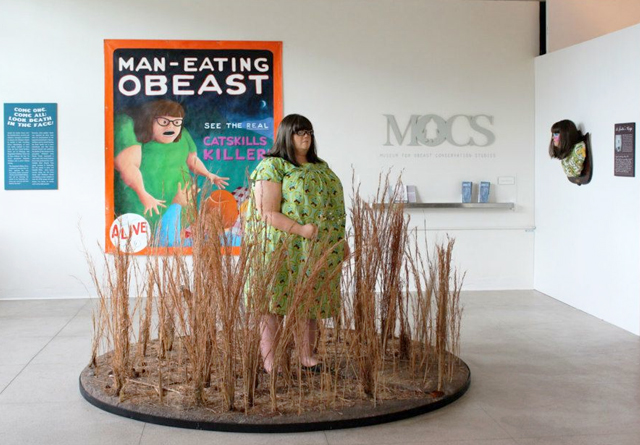
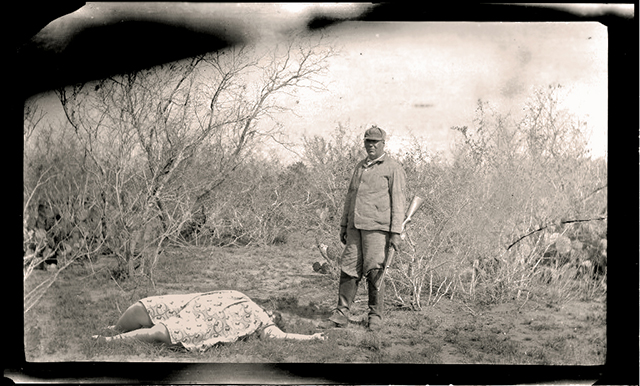
The simplest way to explain what I do is that I make up absurd lies that I then try to convince people are true by making all kinds of believable evidence (ceramic artifacts, documentaries, tintype photos, scientific charts, life size natural history dioramas, scholarly articles, press releases, etc.) to support them. I do this because I’m interested in how people consume information and how every day facts (some of which are actually lies) get perpetuated and legitimized by cultural institutions like the sciences, the media, museums, and so on.

My main absurd lie involves an endangered animal called the North American Obeast, which I perform by donning a muu-muu. Obeasts are studied by an scientific organization called the Museum for Obeast Conservation Studies (MOCS), which does travelling natural history museum exhibits around the world to teach the public about obeast conservation efforts.

Tell us a little about your background and how that influences you as an artist.

I grew up on a farm in an economically poor part of Maine. As a result, I spent a lot of time working with and thinking about plants and animals. The folk science of farming was fascinating to me. My favorite childhood activity was making detailed worlds out of sticks, rocks, mushrooms, hay bales and other unmissed farm items. I would observe any overnight changes or damages to the scene as evidence of inhabitation by little people (who I wasn’t interested in except sort of forensically). So, I think my artistic orientation toward facts, science, and world-making have straightforward origins in the years spent alone in barns, pastures and woods.                                          

The concept of the “artist studio” has a broad range of meanings, especially in contemporary practice. The idea of the artist toiling away alone in a room may not necessarily reflect what many artists do from day to day anymore. Describe your studio practice and how it differs from (or is the same as) traditional notions of “being in the studio.”

I have two modes that are equally essential (though I still struggle with that well-loved fallacy that the making is the part of art that counts). The first is to act as a sponge and soak up the parts of the world I find interesting; during this part of the process I don’t really go into my studio much. Instead I read, go on field trips, and generally pursue whatever is on my mind as far as I can. At some point my brain sponge reaches capacity and then it’s time to return to the studio to squeeze it out in some useful way.

herrick-work-03

What unique roles do you see yourself as the artist playing that you may not have envisioned yourself in when you first started making art?

I am sometimes asked to take a more activist role in relation to the ideas that I’m exploring, especially fat stigma. I think people assume that since I make the kind of work I make, there must be important social wrongs I want to right, or that the work is just a preamble to what I want to say. It isn’t. The art is how I communicate my thoughts and observations; I have nothing to add to what I’ve put into the work. So I guess I find myself defending artistic autonomy from the issues I explore, which I can’t say I never envisioned myself having to do when I first started making art.

When do you find is the best time of day to make art? Do you have time set aside every day, every week or do you just work whenever you can?

I sort of touch on this in an earlier answer. My actual studio making happens in cycles, but when it happens I find that my best studio days are when I start first thing in the morning and keep at it uninterrupted for 6-8 hours. The other half of my creative work (the research, observations etc) happens all the time. I couldn’t shut it off if I tried.

herrick-work-02How has your work changed in the last five years? How is it the same?

With the MOCS project, I have put myself physically in the work in a way that I never thought I would. But it fits the project, so I do it. As far as similarities, I find that I am ongoingly interested in how people communicate and the role of anxiety in the production of facts and self narratives. I’m not sure most people know who they are without something to worry about or fuss over; controlled worries are a great way to feel like one is in control of things.

Are there people such as family, friends, writers, philosophers or even pop icons that have had an impact on the work you do?

Good grief, yes. Who can honestly answer no to this question?

My husband Carl has probably the biggest daily influence on my work. He’s a fellow egghead (and an intellectual historian to boot) so we have great conversations. I am obsessed with popular depictions of science—so anything on the Discovery channel gets me going. (I am almost a little embarrassed to admit the major impact that Whale Wars had on my art.) David Attenborough’s enthusiasm his work touches me deeply. John Cage’s 10 Rules for Students & Teachers is tacked up in my studio and serves as a compass for my whole approach to art.

If you had an occupation outside of being an artist, what would that be and why?

A farmer. I love the headspace that goes with being a farmer. The challenges are tangible and the work is cyclical with definite outcomes. You make a product and stand behind it.

About

herrick-headshotRachel Herrick (b. 1979) is a multi-media artist best known for her detailed travelling Museum for Obeast Conservation Studies (MOCS) installations. This work has been the subject of activist and academic writing in the US, Canada, England, and Australia. In 2013, Publication Studio (in conjunction with the ICA in Portland, Maine) published Herrick’s A Guide to the North American Obeast, a two-volume book set that elaborates on the obeast narrative and contextualizes the art project within a cultural and scholarly framework.

Herrick grew up on a subsistence farm in the hills of central Maine and relocated to North Carolina in 2004. She earned an MFA from the Maine College of Art in 2011 and a BA in Creative Writing from Methodist University in 2002. Herrick has been the recipient of several grants including a United Arts Regional Project Grant and a Puffin Foundation Grant.  MOCS is currently on exhibit at Science Gallery in Dublin, Ireland, through June 29 and will then travel to the University of Lethbridge in Alberta, Canada.

In the Studio

In the Studio

www.rachelherrick.com  

All images copyright of the artist and used with their permission. 

Posted in Uncategorized | Tagged , , , , | Leave a comment

Sarah Pollman – Boston, Massachusetts

After Sherrie Levine, After Walker Evans, 1981, 2013, Archival inkjet prints, 7.5 x 9.5 inches and 9 x 11 inches

After Sherrie Levine, After Walker Evans, 1981, 2013, Archival inkjet prints, 7.5 x 9.5 inches and 9 x 11 inches

Briefly describe the work you do

I work in and around photography, concerned primarily with its history and theory, and how we use it to document our lives. My projects range across platforms and media, including photography, moving images, painting, installation and performative impulses. I’m also fascinated by systems of image distribution: how have these changed over the years, and how have our consumption of photographs likewise shifted?

Tell us a little about your background and how that influences you as an artist.

My background is that of a typical, middle-class American. I grew up in a small town in New Hampshire, but very early on was lucky to have a supportive system of teachers, peers and family that encouraged my artwork. I’ve lived all of my adult life in Boston: I love how intimate the arts community is here, and that has allowed me to make so many important connections and be involved with many great organizations.

Beyond that, I resist my biography being the dominating factor in the reading of my work: I believe that my interests stem from a deeper engagement with history and theory that functions at an academic level. That said, my work is often a critique of American culture and I can’t deny that my personal experiences have influenced that. Why would I be so fascinated by the middle-class production of imagery if I wasn’t a part of that production?

The concept of the ‘artist studio’ has a broad range of meanings, especially in contemporary practice. The idea of the artist toiling away alone in a room may not necessarily reflect what many artists do from day to day anymore. Describe your studio practice an how it differs from (or is the same as) traditional notions of ‘being in the studio’.

Being rooted in photography, my practice is not always studio-based and often requires engagement with the outside world: I rarely photograph within my studio. But once the images are made, I edit them and print them in my workspace, often proofing images and pinning them to the wall to see them in physical form. I also spend time sorting through piles of anonymous photographs to find source material and making books and oil paintings. Additionally, I use my space as an office and can be found writing in it (such as at this exact second), reading texts and applying to opportunities.

Lastly, I’m part of the Howard Art Project, an amazing artist community, and I’m often having conversations with my studio mates while I’m working.

Photographs Purchased on eBay, 2013, Oil on Panel, dimensions variable

Photographs Purchased on eBay, 2013, Oil on Panel, dimensions variable

What unique roles do you see yourself as the artist playing that you may not have envisioned yourself in when you first started making art?

I began some fifteen years ago as a painter, only moving into photography after I realized that I painted in an attempt to mimic photos. I never anticipated that initial move away from painting, nor my eventual move back into it.

In the beginning, I also viewed academia as being separate from artmaking and segregated my love of language from my visual production. I have been pleasantly surprised to find how easily the two integrate into one another and now consider myself as much of an academic and a writer as I do an artist.

When do you find the best time of day to make art? Do you have time set aside every day, every week or do you just work whenever you can?

Having a less traditional studio practice, I spend time shooting images, dropping film off to be developed, scanning negatives, going to the library and framing and delivering work to shows, in addition to time spent within my four studio walls. I try to work as much as I can and this varies week to week depending on my other commitments (writing, teaching and curating). Sometimes, I work around needing to shoot at a precise time of day (such as the golden hour) and other times I am more flexible to create when I am well rested and clear-headed. When I am painting, I am in the studio more than when I am shooting. But I am constantly working and thinking, even in my dreams: some of my best projects have risen from these fugues. 

I love my studio at night when it is filled with the life of my studio mates. I have always been a night person, glad to stay awake long past when everyone else is sleeping and find I can get an amazing amount of work done in the small hours of the morning. But, I also love my studio in the mornings: the sun comes through my window and everything is quiet and peaceful.

Father and Mother 5, 2013, Archival inkjet print, 16 x 20 inches

Father and Mother 5, 2013, Archival inkjet print, 16 x 20 inches

How has your work changed over the last five years? How is it the same?

Going to graduate school shifted my perceptions, opening me up to concepts, theories and ideas that I would have never previously considered. I have been able to think more broadly about artmaking, letting go of the label photographer in exchange for the labelartist. In graduate school, I was able to distill my interests, naming them and couching them in the broad array of theory that was fed to us. Now, I feel more literate and more confident, creating work in a more involved and informed manner than before.

But, despite this education, my basic interests have not wavered. My first oil painting fifteen years ago was of a cemetery, and now I am shooting anonymous grave markers in garden cemeteries in New England. I also remember a moment in high school when I re-painted an anonymous family photograph in oil, but then threw the painting out because I couldn’t explain to anyone why it was so important. In the same spirit last year, my project Photographs Purchased on eBay translated anonymous domestic images into oil paint on panel.

Are there people such as family, friends, writers, philosophers or even pop icons that have had an impact o the work you do?

All of my teachers over the years have influenced me greatly and I am constantly seeking new art world idols. I get extremely excited when I see good artwork or have an awesome conversation and I want to internalize the information and translate it into my own work. I am acutely aware of my many influences, most likely as an offshoot of my interest in historiography, and something that one of my most recent series, Love Notes, explores. This series pays homage to artists that have inspired me, including Sophie Calle, Sherrie Levine, Walker Evans, Jim Dow and Stephen Shore.

And, of course, there are others. I try to visit as many galleries and museums as I can and often troll photography blogs late at night, looking at the infinite amount of fantastic contemporary work. Lately, I’ve also been obsessed with Villem Flusser and I’ve been reading a lot of articles from October magazine. My influences are many and varied and everyone whom I come in contact with (directly or overtly) plays a role in how I view the world.

If you had an occupation outside of being an artists, what would that be and why?

This is a trick question! I think many artists have a separate occupation, a day-job, a money-maker and an engagement with the world outside the studio. Since my undergraduate days I have been involved in various capacities with arts administration, working primarily at nonprofit art centers. Currently, I am an arts educator, a free-lance writer and an independent curator. I see all these jobs as feeding into a larger practice and allowing me to stay attuned to current trends within the artworld. These jobs keep me sharp and prevent me from working within a vacuum.

About

Pollman_headshotSarah Pollman holds a BFA (2007) and MFA (2014) from the School of the Museum of Fine Arts, Boston and Tufts University. Pollman is a 2013 recipient of the Art Writing Workshop from the AICA-USA and Creative Capital/Warhol Foundation Arts Writers Grant Program and a 2014 Curatorial Opportunity Program curator at the New Art Center in Newton. Recent exhibits include an upcoming solo show at the Danforth Museum of Art (Framingham, MA) and Of Memory Bone and Myth (Rourke Art Museum, Moorhead, MN), Emerging Photographers’ Auction (Daniel Cooney Fine Art, NYC, NY) and New England Photography Biennial (Danforth Museum of Art, Framingham, MA). Currently, Pollman is faculty at the School of the Museum of Fine Arts, Boston.

In the Studio

In the Studio

www.sarahpollman.com

All images copyright of the artist and used with their permission. 
Posted in Uncategorized | Tagged , , , , | Leave a comment