Kate Carr – Santa Fe, New Mexico

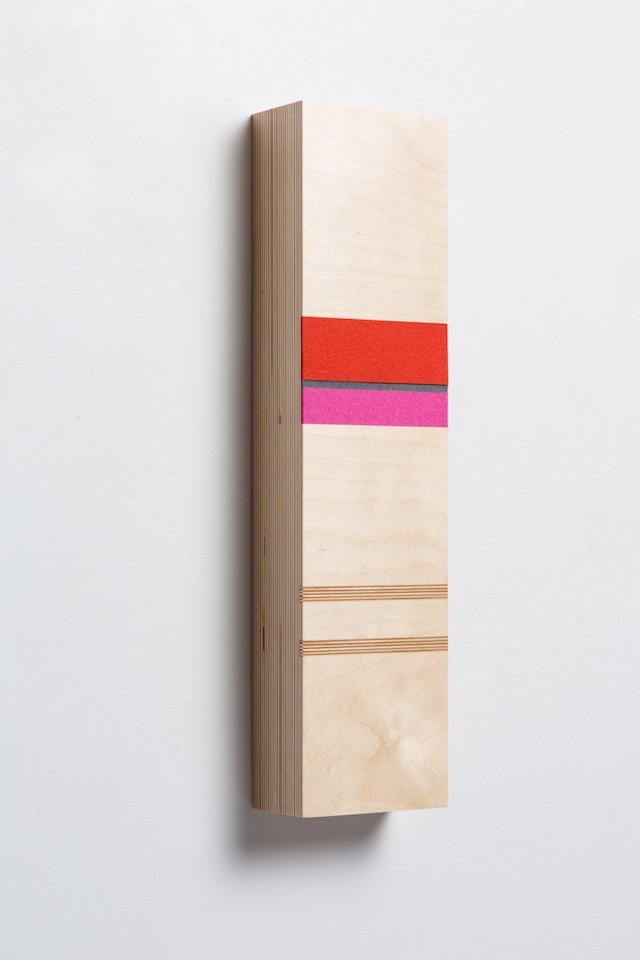
"Block D," 2012, Baltic Birch Plywood, Wool Felt, 5"x20"x3"

“Block D,” 2012, Baltic Birch Plywood, Wool Felt, 5″x20″x3″

Briefly describe the work you do.

I explore material through the making of objects. Currently the materials that interest me most are wood, especially Baltic Birch plywood, and wool felt. I create pieces where these two materials co-exist together, support each other to create a unified whole.

Tell us a little about your background and how that influences you as an artist.

I was born and raised in Anchorage, Alaska. It is a very beautiful, extreme, and remote place to grow up. When you leave Alaska it is called “going outside.” I knew from a very early age that I wanted to “go outside” and live and experience other places. I have always been drawn to intense landscapes ever since I left Alaska. I lived on the coast of Maine, in rural Iowa, and now I live in the high desert in Santa Fe, New Mexico. These kinds of landscapes are all different but they have a spacious quality that I find soothing. I also think that living in spaciousness was part of the development of my aesthetic. I want to leave space in my work for things to occur. Though my work is abstract, I want to make things that feel expansive like those landscapes. I am always looking for the small, simple gesture that speaks clearly, meaningfully. I am continually learning how to be brave enough to say the least amount, with the largest impact in my work.

The concept of the “artist studio” has a broad range of meanings, especially in contemporary practice. The idea of the artist toiling away alone in a room may not necessarily reflect what many artists do from day to day anymore. Describe your studio practice and how it differs from (or is the same as) traditional notions of “being in the studio.”

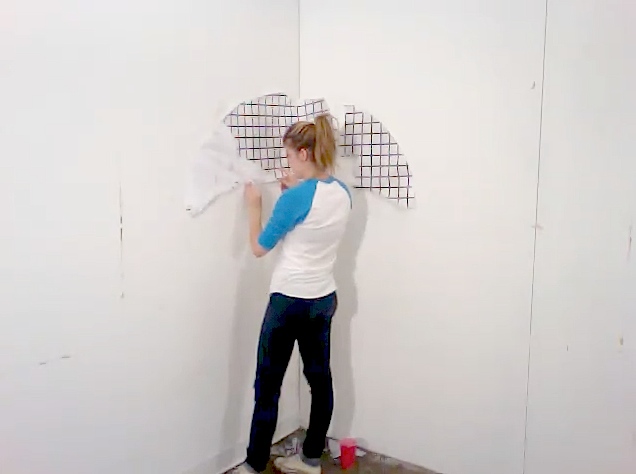
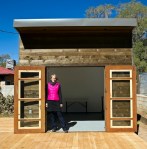
I built my own studio in my backyard. It was designed by an architect friend, Gail Peter Borden, I met on a residency at the MacDowell Colony. With his plans, I built the building with a contractor over the course of eight months. It is one of my biggest accomplishments. I love having access to my work in my daily life. The studio opens onto a deck and is surrounded by my garden. I sit out there a lot watching birds, looking at the plants, daydreaming. Those peaceful in-between moments have become an important part of the way I work. My studio practice depends on what part of my process that I am in. If I am trying to generate new ideas I might be better off taking a hike to clear my head or writing. If I am in the production phase I am alone working in my studio as much as possible.

"Open," 2012, Alder, Baltic Birch Plywood, Wool Felt, 48" x4"x2"

“Open,” 2012, Alder, Baltic Birch Plywood, Wool Felt, 48″ x4″x2″

What unique roles do you see yourself as the artist playing that you may not have envisioned yourself in when you first started making art?

That I would be continually gaining and developing technical skills, learning how to use tools and new equipment, and problem solving.
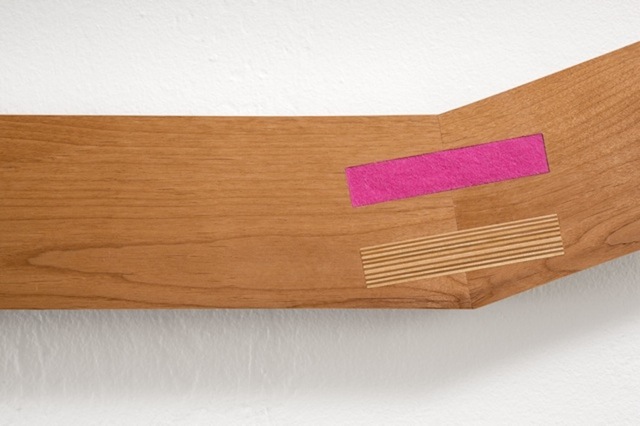
"Open" (detail)

“Open” (detail)

When do you find is the best time of day to make art? Do you have time set aside every day, every week or do you just work whenever you can?

Mid-morning works well for me. 10-4 is a perfect studio workday. I have never worked well at night for some reason. I generally try to have dedicated studio days each week and then just work whenever I can on the other days, even if it is just an hour.

How has your work changed in the last five years? How is it the same?

In the past five years I have fallen in love with wood. I love the transformation of a rough board into a buttery smooth surface. I love the grain, the laminated lines in plywood. Because of working predominantly with wood my craftsmanship has improved and I have learned a lot. With practice and experience I have gotten more skilled. I have also learned how to ask for technical help when I need it.

My ideas and thought process have stayed the same. I am still looking for connections between materials. I am still following line. I am still trying to balance opposites.
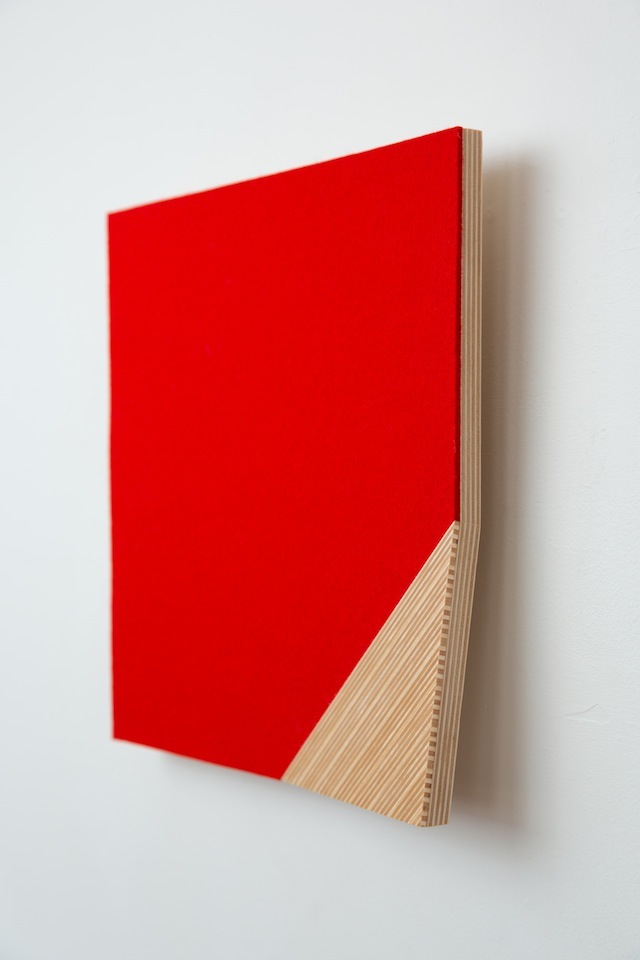
"Corner Fold," 2013, Baltic Birch Plywood, Wool Felt, 11.5" x11.5" x 1/2"

“Corner Fold,” 2013, Baltic Birch Plywood, Wool Felt, 11.5″ x11.5″ x 1/2″

Are there people such as family, friends, writers, philosophers or even pop icons that have had an impact on the work you do?

A lot of people have had an impact on my work. I am fortunate to have a supportive family and friends. But the most consistent impact comes from my partner Jenny. She is a poet, which gives her a wonderfully different perspective. She has seen my work develop over the years and I trust her opinion. I show her everything I make as I am making it until it is finished. She has an intimate knowledge of my creative process and I am grateful for her thoughtful feedback and steady encouragement.

Other influences:
Agnes Martin. Eva Hesse. Dorthea Rockburne. Sheila Hicks. Anne Truitt. Richard Tuttle. Catherine Opie. Ruth Osawa. Charles and Ray Eames. Anni Albers. Alain de Botton. Max Ritcher. Eileen Myles. And probably many others I am forgetting!

If you had an occupation outside of being an artist, what would that be and why?

A Yoga teacher. I would love to make people feel good in a direct way.
Carr StudioAbout

Kate Carr was born and raised in Anchorage, Alaska. She graduated from Marlboro College in Marlboro, Vermont and received an MFA in sculpture from the University of Iowa in 2005. She has completed residencies at the Vermont Studio Center, the Harwood Museum, Jentel, the MacDowell Colony, and the Ucross Foundation. She is also a recipient of a Pollock-Krasner Foundation Grant. Kate has lived in Santa Fe, New Mexico since 2007. Her work explores material relationships through repetition, juxtaposition, and contemplation. Kate shows her work in Dallas, Texas at Galleri Urbane and in New York City at Garvey Simon Art Access.

katecarrart.com

All images copyright of the artist and used with their permission.
Posted in Uncategorized | Tagged | 4 Comments

Steven Silberg – Catonsville, Maryland

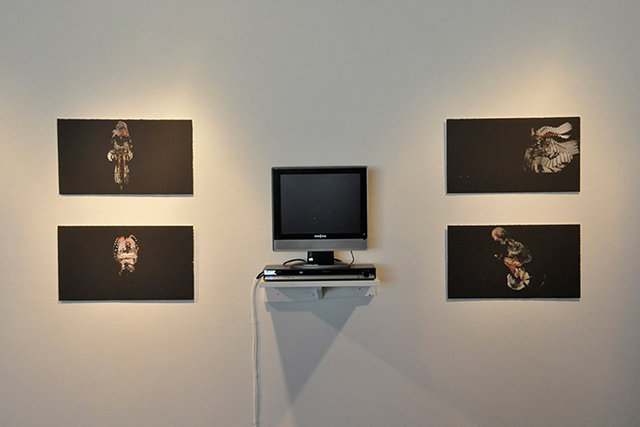
“After Muybridge, After Marey”, Inkjet prints and video, prints: 21”x12” with 19” monitor, 2010

“After Muybridge, After Marey”, Inkjet prints and video,
prints: 21”x12” with 19” monitor, 2010

Briefly describe the work that you do.

My work can range from the experiential and participatory to the passive spectacle. It ranges from historical photographic processes to video projection, from screen-based interaction to flipbooks, and from appropriated source material to curated collections of other’s works.

Earlier this year, I premiered an interactive work called “Mirror Minus” and this past June, I relaunched “Sole Connection”, an online collection of participant submitted images and stories inspired by the concept of “walking a mile in another’s shoes” (http://SoleConection.tumblr.com).

At what point in your life did you decide to become an artist?

Wow. This is a tough question. I don’t know if I’ve ever made the decision to become an artist. If I have, then, it’s only happened within the past few years – long after having attended and completed graduate school. For me, the MFA program was meant to be a means to an end – achieving the credentials to teach photography on the college level. Being an artist snuck up on me when I wasn’t looking.

By contrast, creativity and the arts have always been part of my life. Throughout my youth and in my schooling, arts of all types held equal importance to sports and academics. So, while I can’t say for sure when I decided to become an artist, I’ve never considered not being creative.

Tell us a little about your background and how that influences you as an artist.

The two main components of my work (photographs and computers) have been there as long as I can remember. I have vague recollections of my 126 and 110 cameras and dropping the film off at the Kodak kiosk in the mall. I remember being enthralled with my grandfather’s Polaroid cameras. I received my first SLR during the summer before my 10th birthday and stepped into a darkroom for the first time that summer as well.

Our first computer was a Timex Sinclair 1000. My father’s business had an IBM desktop. We were encouraged to play with both. By the time I was in 3rd or 4th grade, there was an Apple ][ in every classroom. In 6th grade, we were learning to program in BASIC. Eventually my parents bought an Apple ][c for the home.

Though both of these elements were present in my life, I never considered that they could have any connection. I loathed my electronic imaging class in college, convinced that Photoshop was for nothing more than adding filters and effects and anything of substance could be completed in the darkroom. After taking a book arts class, I got a job in the conservation lab at the university library and later went on to manage it. My photographic work started to become more traditional, embracing darkroom techniques. All the while, I was becoming more interested in early social networks and chat rooms. I was exploring web design and some aspects of database programming. The more entrenched I became in each medium, the further apart I kept them.

Shortly before I left for graduate school, the library began exploring digital archiving (i.e. scanning Special Collections materials and making them publically available online). Questions of the stability of digital storage materials were at the forefront of the literature passed around our department. And these questions were still on my mind as I began graduate school. By the end of my first year, I was committed to damaging digital image files in order to present them in the hopes of making a statement about the fragility of data. I found myself falling in love with the underlying construction of the digital image. It is this formal exploration of image construction that has been at the heart of my work for nearly a decade.

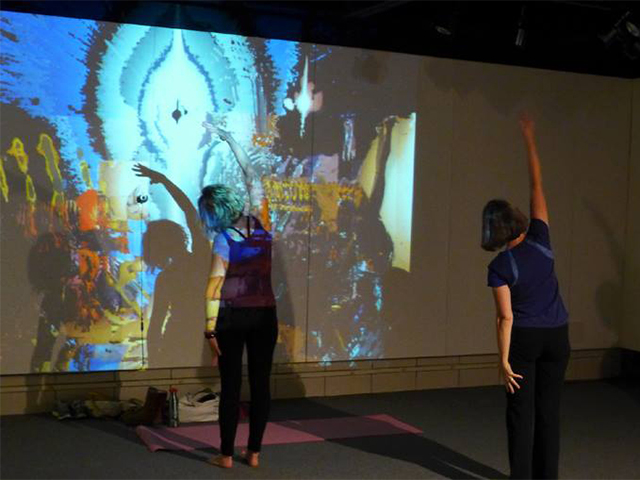
“Mirror Minus” (Yoga in the Gallery, 5/2/14, Rosewood Art Gallery, Kettering, OH), Interactive installation (video projection and camera), 9’x12’ projection, 2014

“Mirror Minus” (Yoga in the Gallery, 5/2/14, Rosewood Art
Gallery, Kettering, OH), Interactive installation (video projection and
camera), 9’x12’ projection, 2014  http://vimeo.com/84082709

What types of conceptual concerns are present in your work? How do those relate to the specific process(es) or media you use?

In his famous article, Art and Objecthood, Michael Fried decried the minimalist movement as one that was principally concerned with the materiality of objects and their relationship to the spaces that they occupy – in other words, objecthood. By contrast, Art, by his definition, required an aesthetic experience where the materials themselves were only the means to the end – the communication of an idea, of a form, of an experience, of beauty. But regardless of their standing as art or object, the minimalist work of these literalists, as Fried termed them, challenged the relationship between the viewer and the art object or at least required the viewer to consider that relationship.

It is the literalist relationship to materiality and the post-digital rejection of the absence of objecthood within artwork that frames my investigations. It is that questioning of construction that opens up a line of communication between that which we take for granted and the means by which it comes into being. I am an educator at heart and an academic by trade. More than digging into something so that I can understand it, I find that I want to know the details of something so that I can share that which I already enjoy, that which I am passionate about.

This pedagogical imperative brings forth the process-oriented elements of my practice. Yet, that process is often a solitary exploration even though the presentation is public. My classroom experiences and engagement in community art activities have reinforced my desire to build community within my practice and has lead to process-based curatorial projects such as Palimpsest and community-building participatory projects such as Sole Connection.

We once heard Chuck Close say he did not believe in being inspired, rather in working hard everyday. What motivates you in your studio practice?

I’ve often been known to say, “creativity breeds creativity.” By being around other artists and around art students, I am able to keep my creative energy flowing even if I’m not putting into my own work.

It’s rare that I can sit down and have a daily practice as an artist. I think it’s a great, in theory; but, for so many of us who divide our time between our own studio practice and another vocation/avocation, it’s not practical. I do the best I can to carve out one day per week (more during the summer) to experiment, make work, apply to exhibitions, and reflect on what I’m creating. My work tends to build from an idea in a previous project or concept I’m lecturing about in class. The most important aspects for my studio practice, then, are keen awareness everyday and reflection upon it.

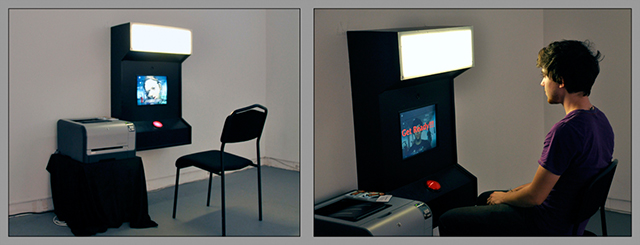
“Pixel-Lapse Photo Booth” (installed), interactive installation, 12”x24”x36”, 2009

“Pixel-Lapse Photo Booth” (installed), interactive
installation, 12”x24”x36”, 2009

What artists living or non-living influence your work?

This really depends on which body of work I’m focusing on. While I was focusing on my “Experiments in Reductive Video”, I found myself influenced by the works of Eadweard Muybridge, Étienne-Jules Marey, and Harold Edgerton. I’m also inspired by the work of Jim Campbell, Paul Demarinis, and Jason Salavon. As I move into my next set of explorations, I find myself thinking about Tim Hawkinson’s machines from the early 2000s.

So much of my work is also about the materiality of the medium that I find myself thinking to the proto-photographers whose explorations into chemistry and light led to the development of photography and to abstract expressionists and minimalists who let their medium dictate the work and our experience with it. I’m also inspired by the history of appropriation within artwork and the importance of building upon that which has come before and that which is culturally relevant. I enjoy reading Cory Doctorow’s writings on BoingBoing.net and support Creative Commons. I look to the traditions of the Dadaists, Raushenberg, Lichtenstein, and Warhol as well as more contemporary mainstays such as Sherrie Levine, Christian Marclay, Barbara Kruger, Craig Baldwin, and Negativland.

When you are not making art what types of activities and interests do you engage in?

I really enjoy the “finer things” in life (when I can) – good food, good wine/beer/bourbon. And because of this, I’m also learning to love the gym. My wife and I are trying to build travel into our lives as well. This past January we spent a week in Iceland. But we also find enjoyment visiting locations within just a couple hours of home.

I enjoy the simple things as well. I take pleasure in mowing the lawn and turning the compost pile. I like lazy Sundays, laying around and petting the cat and contributing far too many pictures and videos of her to the Internet. I enjoy sitting around the fire pit with good friends and hosting gatherings in our back yard.

Of course, most of my time and energy when I’m not making art is devoted to my students. I love sharing my passion for photography, video, animation, interactivity, abstraction, etc with them and helping them get started on their path as professional artists and designers.

silberg-headshotAbout

Steven H Silberg is an image-influenced, material-based, cross-media artist with a background ranging from photography to book conservation. Working in image, video, and interactive installation, he engages each medium as a literalist. For him, the structure and process leading to the image is as important as the composition and content. By highlighting the construction of the image, Silberg allows his viewers to both engage the work aesthetically and engage with the technology creating it.

Created in Baltimore, his work has been enjoyed regionally, at venues including Baltimore’s ArtScape, the University of Maryland, and the Delaware Center for the Contemporary Arts; nationally, at the University of Texas, Dallas, Missouri State University and Orange Coast College in California; and internationally at the Finnish Academy of Fine Art and the Third Beijing International New Media Arts Exhibition and Symposium. Silberg was selected as the Winner of the Washington Post’s 2010 Real Art DC competition and selected as a 2012 Semi-Finalist for the Bethesda Trawick Prize.

Silberg received his MFA from MICA in 2004 and his BFA from the University of Delaware in 1997. He is a Lecturer in Foundations, concentrating in Photography and Video, at UMBC.

http://stevenhsilberg.com

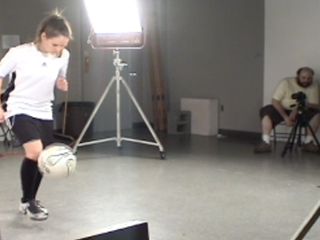
Filming a soccer player for “After Muybridge, After Marey”

Filming a soccer player for “After Muybridge, After
Marey”

All images copyright of the artist and used with their permission.
Posted in Uncategorized | Tagged , , , , | Leave a comment

Charlene Eckels – Wilmington, North Carolina

"Jukumari" acrylic on wood, 48x28", 2014

“Jukumari”
acrylic on wood, 48×28″, 2014

Briefly describe the work you do.

I am a contemporary Bolivian American artist. My goal is to expose Bolivian culture and heritage to a much larger audience through art. This artwork is a visual representation of how the Bolivians express themselves through American eyes.

Tell us a little about your background and how that influences you as an artist.

I am directly influenced by my cultural heritage. am part bolivian(maternal) and part american(paternal). Both connect me specifically with my past and present, therefore I bring to my art a quality which is rooted in the culture of Bolivia and expanded by the experience of being American. Bringing together folklore and historical memory I try and illustrate the complexities of cultural identity, and acknowledge my personal experience of being a hybrid.

The concept of the “artist studio” has a broad range of meanings, especially in contemporary practice. The idea of the artist toiling away alone in a room may not necessarily reflect what many artists do from day to day anymore. Describe your studio practice and how it differs from (or is the same as) traditional notions of “being in the studio.”

I love a good designated area for studio space. I love being surrounded by costumes that I’ve acquired from Bolivia. It is temple for creation, a time for reflection and work, to build on ones beliefs and theories. A time to display ones own philosophies and put them into practice.

"Diablado" acrylic on wood, 48x48", 2014

“Diablado”
acrylic on wood, 48×48″, 2014

What unique roles do you see yourself as the artist playing that you may not have envisioned yourself in when you first started making art?

I always knew I wanted to create art, but what I didn’t know was the path my art would take, and how closely it would relate to my own lineage. I find myself constantly explaining to others what Bolivian American art is. Something that I am constantly in debate over and will ultimately be an endless journey. I think thats the thing that keeps me going is that I know its forever ongoing, and it’s my contribution to the art world.

When do you find is the best time of day to make art? Do you have time set aside every day, every week or do you just work whenever you can?

The best time of day for me to make art would be very late at night. After a full day of activities it is the best time to reflect and react to a day.

"La Diablada" acrylic on wood, 24x24", 2014

“La Diablada”
acrylic on wood, 24×24″, 2014

How has your work changed in the last five years? How is it the same?

In the past five years my work has been more about studying and exploring. I am learning everyday and am constantly figuring out ways to incorporate my knowledge, or my understanding of specific events into my work. I believe in symbolism and spirituality, these things have always stayed the same in my work because I believe them to be important.

Are there people such as family, friends, writers, philosophers or even pop icons that have had an impact on the work you do?

Family is a big part, but I also believe everything I see and being able to travel helps me to absorb and eat everything around me. I am a big Morrissey fan, which I believe correlates in a way with the laments of Bolivia. Raul Lara Torres, is a Bolivian artist who is also very influential to me, he was a bit obsessed with Van Gogh, and would fit him into Bolivian landscapes traveling. I find this both interesting and beautiful.

If you had an occupation outside of being an artist, what would that be and why?

I would do something related to philanthropy. I recently started a non profit organization with my family. Currently a board member to “Salud para Bolivia” (health for Bolivia), it is an organization which giving medical supplies to Bolivia.

HeadshotAbout

Charlene Eckels is a Bolivian/American artist. Born in Jacksonville, NC and raised in Wilmington, NC she aims at promoting a Bolivian agenda that includes social and cultural heritage through art. By demonstrating the themes and stories of the Bolivians she hopes to create a dialogue and give some insight into this latin american culture. Charlene is currently studying at UNCW, but has also taken time out of her formal education schedule to gain life experience. She lived and studied at the National art school in Bolivia, S.A., to experience her Bolivian roots. While there, she taught art to children in orphanages. She even survived a airplane crash in the Amazon jungle. She also lived in London, England, and worked with a British government program to assimilate Muslim women into British culture. Charlene has also travelled to Bahrain. Recently she went on a study abroad program to Ireland. She incorporates her experiences into her artwork. She specializes in Bolivian themes with a rich and brilliant palette in various paint and ink media. She also enjoys showcasing the colors and culture of her Bolivian heritage. Bolivia is a hidden treasure of south america. Even more exclusive is the existence of bolivian artwork being promoted internationally

http://www.charleneeckels.com

Studio

Studio

All images copyright of the artist and used with their permission.
Posted in Uncategorized | Tagged , , , , | Leave a comment

Colleen Keihm – Chicago, Illinois

"Side", Archival Inkjet Print, 2014

“Side”, Archival Inkjet Print, 2014

Briefly describe the work you do.

My attempts to connect to places and people offer a greater understanding of time, care, and the structure that happens in between. Photography is the perfect vehicle to comprehend this. I’m drawn to the structure present in light and in what it illuminates. Through the use of photography, video, and performance, I am also able to analyze and preserve not only what is being illuminated by light, but how.

Tell us a little about your background and how that influences you as an artist.

I was born in Levittown, NY and currently reside in Chicago, IL. Preferring a slowness that allows for time spent and attention given, I use my large format camera or performative actions to evaluate the best way to embody the idea of home, how beliefs arise, and modern familial relationships.

The concept of the “artist studio” has a broad range of meanings, especially in contemporary practice. The idea of the artist toiling away alone in a room may not necessarily reflect what many artists do from day to day anymore. Describe your studio practice and how it differs from (or is the same as) traditional notions of “being in the studio.”

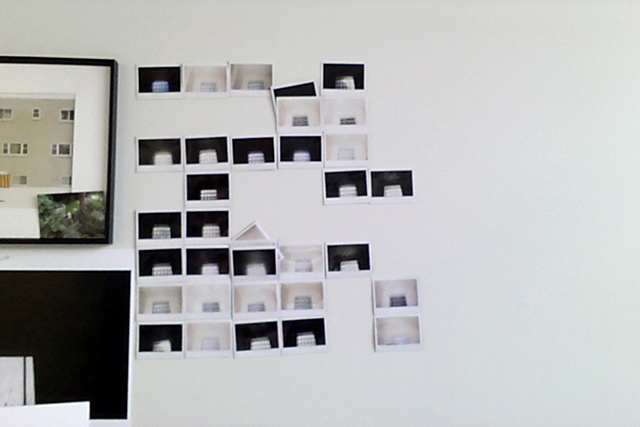
I am easily seduced by light. It draws me into and out of spaces, as its formlessness is something I hope to render, to share. My studio space has documents I’ve made attached to its walls so they may interact with the light that passes through the room each day. I document a window with instant film then tape each to the wall letting them fall if they may. Mine is a studio practice of waiting, of watching, and enjoying what happens without my influence. In these moments of surprise I learn my next move.

"Slit, In Warm Light", Archival Inkjet Print, 2014

“Slit, In Warm Light”,
Archival Inkjet Print, 2014

What unique roles do you see yourself as the artist playing that you may not have envisioned yourself in when you first started making art?

Only recently did I realize how important social interaction was to my work and that producing for seeing isn’t as paramount as sharing the act of looking. Working with the large format camera garners attention, which I’ve learned to relish. Viewing through the back of the camera with someone is a momentary experience that is missed once the shutter is closed but it is also a chance to really stare at something. This is where I begin. The excitement of just looking is what fuels my need for the camera in the first place. If I share that with someone interested in seeing what I’m seeing, then the experience we share is just as important as the document I could make.

When do you find is the best time of day to make art? Do you have time set aside every day, every week or do you just work whenever you can?

Quality of light is often my inspiration to photograph. My favorite time of day is blue time. That’s the 20-40 minutes after the sun sets and we’re in its shadow. Cloudy days are best for photographing but I get my best inspiration from this blue time. And photography is a practice like any other. You improve if you have the camera in your hand every day but what is important to me is to practice looking, really looking, as much of the day as possible.

"Footwashing", Performance, 2014

“Footwashing”, Performance, 2014

How has your work changed in the last five years? How is it the same?

Within the last two years, I’ve expanded my practice to include performance and video. This offers new ways of experiencing and looking. With performance, I generate the work with participants so that we may learn from each other. Video is often the document of this interaction. Both allow me to give a seemingly simple moment greater importance.

Are there people such as family, friends, writers, philosophers or even pop icons that have had an impact on the work you do?

My grandmother influenced me to be an artist. She wore suits to weddings, read Shakespeare and loved Renoir. She taught me to braid my hair and care for others. These were little things with tremendous impact.

If you had an occupation outside of being an artist, what would that be and why?

I really like puzzles so sometimes I think it’s be fun being an electrician or a mathematician. They have the ability to decipher, build and dismantle with their knowledge of the inner workings of things. They are able to find problems and fix them or prove them. Being an artist, I think we do something similar. Our tasks and end game (and our problems) are just different.

keihm_headshotAbout 

Colleen Keihm is an artist born in Levittown, NY. She prefers a slowness that allows for time spent and attention given to things while working with photography, video and performance. Using these media, she evaluates the best way to embody the idea of home, how beliefs arise, and modern familial relationships.

http://colleenkeihm.com/home.html

Studio

Studio

All images copyright of the artist and used with their permission. 
Posted in Uncategorized | Tagged , , , , , | Leave a comment

Ani Rosskam – Roosevelt, New Jersey

1471828_10200840745086888_1584435896_nBriefly describe the work you do.
I would consider myself a mixed media artist. I am always coming across and dazzled by juxtapositions of incongruous objects and materials. Making order and sense out of them is something that evolves as I work, and as the process of painting or assembleing leads me into unknown territories of texture and abstraction. Itʼs a little like free associating with physical material.

Tell us a little about your background and how that influences you as an artist.

I grew up in Roosevelt NJ a community of friends and neighbors that moved here to be part of the agro industrial project the town was built for, along with artists writers musicians and photographers . My parents, both pioneer documentary photographers, came at the urging of their friend Ben Shahn. It was second nature for me to make art
as it was such a normal occurrence by my parents and their friends. My upbringing influenced my world view more than it it did my art. My real influences came after I left and entered the bigger world.

The concept of the “artist studio” has a broad range of meanings, especially in contemporary practice. The idea of the artist toiling away alone in a room may not necessarily reflect what many artists do from day to day anymore. Describe your studio practice and how it differs from (or is he same as) traditional notions of “being in the studio.”

My studio is the place I feel the most at home in. I wouldnʼt consider what I do in it “toiling away alone in a room” although I really cant work in it with other people around or many interruptions as I believe in order to achieve anything
meaningful I need to be by myself. It is the “area” in my life that provides a place to loose a sense of time, and get involved in the process of making art, either physically or
intellectually.

1465251_10200690362967429_346430503_n-1

What unique roles do you see yourself as the artist playing
that you may not have envisioned yourself in when you first
started making art.

My life as an artist is parallel to anyoneʼs life that is forever changing. I have entered many worlds that I would not have had an opportunity to experience if it not for being an artist. In a search of ways to survive as an artist, I found work in Architecture, Design, Theatre and Teaching. Each contributing to a more mature voice as an artist.

1499612_10201017373782495_1780364057_nWhen do you find is the best time of day to make art? Do you have time set aside every day, every week or do you just work whenever you can?

I love working at night, but The reality is that at this point in my life, I will take any opportunity to get into my studio. The clock is ticking.

How has your work changed in the last five years? How is it the same?

I think my work now has become more about the process and the abstraction of elements than it has in the past. It is not so much about an internal narrative as it is about a personal vocabulary of texture and images that evoke a ore universal association.

Are there people such as family, friends, writers, philosophers or even pop icons that have had an impact on the work you do?

Actually there are too many to mention as I admire all kinds of people and characters. There really isnʼt a single person or category.

If you had an occupation outside of being an artist, what would that be and why?

I cant imagine what that would be. Its not really a choice. There are lots of other things I’d like to do as well,and have,but in my opinion you really cant be someone else unless your willing to put in the work.

About

419439_2719168824380_872368465_nAni Rosskam was born in Puerto Rico and came to Roosevelt, a New Deal town, with her artist/photographer parents, Edwin and Louise.

She also grew up among other artists. She then attended Solebury School in New Hope, received a BA from the Tyler School of Art in Elkins Park, Pennsylvania, and moved to Boston.

She attended Les E’coles des Artes in Fountainbleu France, Tanglewood Program in Massachusetts and Skowhegan School in Maine where she met her husband, Bill Leech. She says he is a great painter. He’s a Midwestern, with a dry wit, hysterically funny. and a love for the big sky’s. They decided to move to the New York City area, and like many of the Roosevelt artists before them found that the location provided the opportunity to work in one of the world’s major urban centers as well as live in a rural small town.

Rosskam and her husband work on commercial artistic projects together and through their company, Rosskam & Leech Mural and Blani Image Makers, have worked on projects with Architects and Designers including Michael Graves.

The commercial work includes commissions and historic restoration for individuals and public entities. Among their clients are the New Jersey Office of Legislative Services — for the State House and the State House Annex She did work for Robert Mapplethorpe. custom stenciling for Mike Nichols, Diane Sawyer. She does color consulting. designs and paints murals and surface design, renderings, and (architecture) models, and textile design.

Rosskam says, “When young, Everyone tries on different hats. You have your influences. And it’s a process of elimination until you find our own (voice). Living among artists, I saw people who had gone through the process. For me it was a struggle, but I saw it as normal. Most people take a real risk to leave familiarity, to become an artist. Rosskam had the opposite experience and had to figure out ways to survive outside an artistic community.

Ani still works as a multi media artist and continues to create and exhibit her own work.

1424502_10200840738046712_150506763_n

http://anirosskam.com/

All images copyright of the artist and used with their permission. 

Posted in Uncategorized | Tagged , , , , | Leave a comment

Nathaniel Wyrick – Boston, Massachusetts

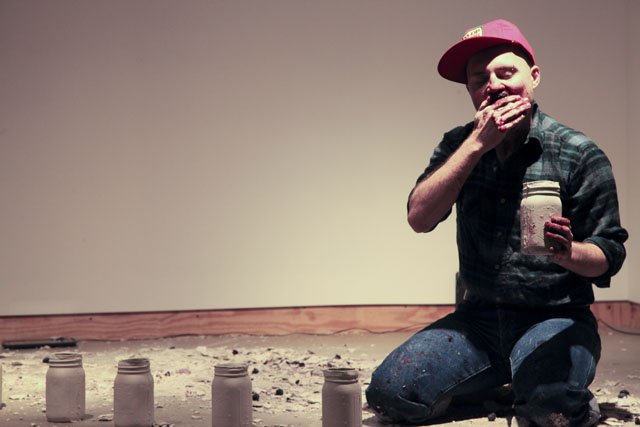
Papaw Passing Time: In Memory, 2013, Performance Video Still, 2 hours and 3 minutes

Papaw Passing Time: In Memory, 2013, Performance Video Still, 2 hours and 3 minutes

Briefly describe the work you do:

I am a multidisciplinary artist that is currently living and working in Boston. I am working with performance, printmaking, photography, and installation. I explore concepts of the fragility and imperfection of memory as it relates to personal history and identity.

At what point in your life did you want to become an artist?:

I think I’ve always been creative and imaginative as a child, but I don’t think art ever became something I was seeking to do as a career until college. I started getting into ceramics and photography more deeply during my undergraduate years. I went to a work college and was already working within higher education in student life positions. It wasn’t until I started both working in the ceramics studio as a studio assistant and simultaneously creating my own work that I realized this was something I could potentially do as a career; it was more wholly satisfying.

Tell us a little about your background and how that influences you as an artist:

I have used a variety of different mediums throughout my artistic journey up to this point. I’ve worked with everything from ceramics and photography to printmaking and performance. Those experiences, both failures and successes, offer me skills and knowledge to draw from when working on ideas and creative projects. I went to a really great liberal arts college where I didn’t major in art or spend my time pouring over art history books and theory (until grad school), so I didn’t ever really feel like I had to just work all my creative process into one medium or subject. It was freeing and afforded me the opportunity to explore my ideas with whatever was and will be the most rewarding and enjoyable. 

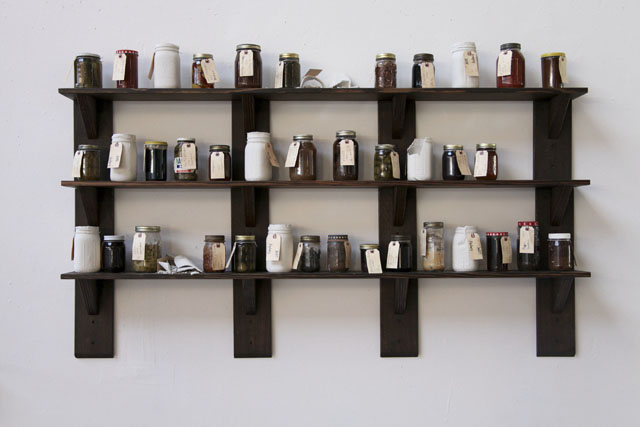
Shelves & Canning Jars, 1982-2014, Installation Piece from Way Back on the Shelf, 6ft x 3ft

Shelves & Canning Jars, 1982-2014, Installation Piece from Way Back on the Shelf, 6ft x 3ft

What types of conceptual concerns are present in your work?: How do those relate to the specific process(es) or media you use?

Much of the work is concerned with the exploration of identity, masculinity, and sexuality, especially in relation to memory. Through this lens I examine the relationships I have established with people and specific locations, usually portrayed through narrative forms. I think my family history, traditions, and upbringing play a huge role in my work. It’s one thing to grow up in East Tennessee; it’s another experience being a queer man raised by a single mother. It definitely gives me a different sort of set of memories to draw from.

We once heard Chuck Close say he did not believe in being inspired, rather in working hard everyday. What motivates you in your studio practice?:

I believe that I’m motivated by excitement and possibility. I’m always looking for opportunities that would motivate me to create something new or put me in a situation that will let me experiment or learn something new from someone. I think when I am working I have to be open to failing. Not everything I come up with is a great idea. I also think I get a lot of motivation and encouragement from my peers. I’ve met some really amazing artists and creatives during my graduate school career. It’s great seeing them create outstanding work and/or performances that end up in galleries, exhibitions, and residencies. Continuing a dialogue of earnest critique and conversation has been helpful for me.

What artists living or non-living influence your work?:

I’m really in love with Ryan McGinley and his photographs. I think they’re gorgeous. Nan Goldin and David LaChapelle were early photographic influences, and Gregory Crewdson’s work. Cornelia Parker and Doris Salcedo are sculptural influences. I studied under Marilyn Arsem, and I think her approach to thinking and speaking about performance art has had a huge impact on the way I approach my performative work. Writing and poetry also influence my work, so I am continually re-reading just about all of Joe Brainard’s writings and also the Dream Songs by John Berryman. I am slowly, but surely, still making my way through the book Art and Queer Culture, and I highly suggest it to those who are interested in the subject.

When you are not making art what types of activities and interests do you engage in?:

I will read, sometimes for pleasure, sometimes for study. I love playing board games and I’m a pretty competitive person when it comes to that. I even made my own screen-printed card game, which unfortunately I don’t always win. I’m pretty addicted to the reality TV show Big Brother. One day you’ll see me on there. I also like traveling, especially visiting friends, so if the opportunity arises, and I have the money, then I am totally up for it!

About

performanceheadshotNathaniel received his undergraduate degree in English/Theatre, and a minor in art, from Warren Wilson College before he pursued his MFA in Studio Art from Tufts University and the School of the Museum of Fine Arts, Boston. He is currently a founding member of the Petrichor Performance Collective in Boston and a Post Graduate Teaching Fellow in screen-printing at the School of the Museum of Fine Arts. He recently received a grant through the Boston Arts Commission for a series of durational public performances that is currently taking place August through September 2014. He always wears hats, is up for playing games, and constantly wishes it were sweater weather.

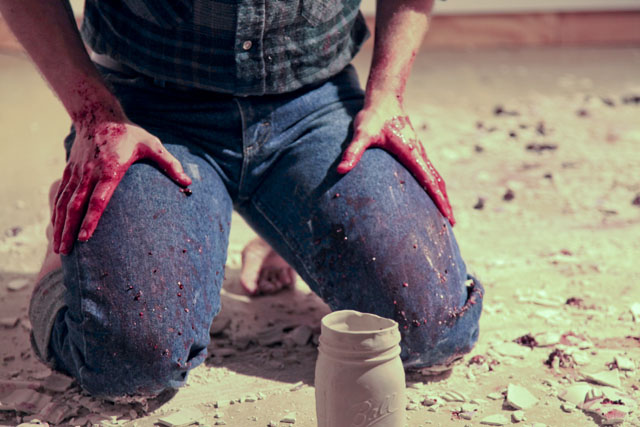
Oh Death, Oh Death, April 2014, Durational Performance Photograph

Oh Death, Oh Death, April 2014, Durational Performance Photograph

www.nathanielwyrick.com

All images copyright of the artist and used with their permission. 

Posted in Uncategorized | Tagged , , , , | Leave a comment

Sarah Morejohn – Eugene, Oregon

OLYMPUS DIGITAL CAMERABriefly describe the work you do.

My work focuses on making a world through an accumulations of marks. I create meditative drawings on paper that simultaneously forms and explores the place of an invented creature or landscape. I am influenced by the relationship of an individual part to the whole, patterns in nature, topophilia (the love of place), and organizational processes in biology.

The drawing process for me is like that of wandering: with each mark of ink I am lost to the path I am making. Each drawing on a piece of paper becomes a place as the marks grow and morph to form complex structures that are reminiscent of landscapes. This wandering process of drawing leads me to familiar and strange places; referential and invented; to eroticism and longing.

From 2011- 2012 I made a series of work called “Pink Swells” that explored creature-like forms and the possibility of a narrative through the variations of form and culmination of drawings. Currently my work still addresses this idea, however I am more interested in pushing the forms into landscapes.

At what point I your life did you want to become an artist?

That is hard to say…I think I always did, I just wasn’t too concerned what that meant.

Tell us a little about your background and how that influences you as an artist?

Growing up in small town (Oakland, Oregon: population 800) gave me the privilege of complete quietness and boredom. My mom that kicked my brother and I outside to play no matter what kind of weather, which gave us time to be inventive with our imaginations. We would make up stories and maps of the surround areas. There were always trees, fields, and muddy creeks to jump into; there was time to watch a snail emerge from his shell or spider make its web. That was instrumental in developing my creativity.

Another main influence comes from my grandpa. He made intricate scientific illustrations. That rubbed off on me, however in a completely different way.

SarahMorejohn_02

What types of conceptual concerns are present in your work? How do those relate to the specific process(es) or media you use?

My interest lies in the transformative process of becoming lost. When I take walks in a forest I become lost in the details of twigs, rocks, leaves, pine needles, etc. I feel at home with the familiarity of these things and yet see the nuance of each individual piece. The big picture concepts follow that feeling.

During my BFA I made a conscious decision to create a drawing process that followed the mark making scientific illustration technique stippling. It was partly a nostalgia for my grandpa and it also fitted what I was trying to think about. I was just introduced and very interested in Neo-minimalism and process art. Processes fully interest me…to focus intently on minuscule decisions holds the key to my understanding, or that I don’t understand; that it is far more then I could imagine.

SarahMorejohn_01We once heard Chuck Close say he did not believe in being inspired, rather in working hard everyday. What motivates you in your studio practice?

I am busy with a couple other jobs besides art: as a volunteer coordinator and a web designer. So at the end of the day it comes down to a deep need; a hand-over-the-pen-and-no-one-gets-hurt need.

I believe in inspiration and I know its important to let it branch out in different ways. Recently I have become quite interested in physics and biology. A few months ago I was invited to visit with professor at the University of Oregon who is a pioneer of zebrafish genetics. We had an informative conversation about developing bone structure in zebrafish larva and I was also able to look at some fish under a microscope. It was quite thought provoking and I could not wait to back to the studio.

Agnes Martin described art making in her writings as an adventure of the mind. I am think of my practice this way. If I thought of it as hard work I would be going about things wrong

What artists living or non-living influence your work?

Agnes Martin, Louise Despont, Terry Winters, Paul Klee, Giorgio Morandi, Nasreen Mohamedi, Sheila Makhijani, Daniel Zeller, Frances Richardson, Laura Vandenburgh, Ryan Sarah Murphy, and Victoria Haven.

When you are not making art what types of activities and interests do you engage in?

I am an avid bicyclist, hiker, and reader. Last year my partner and I went on a 100 mile backpacking trip on the Olympic Peninsula. It was very inspiring since we walked through so many miles of forest there were certain patterns and forms that saturated my mind. Right now I’m reading Aways Coming Home by Ursula Le Guin. It is fantastic book that proposes a archaeology towards the future which imagines a world of differing human cultures living in California.

About

OLYMPUS DIGITAL CAMERASarah is inspired by her own experiences of wandering to rectify internal and external environments. She grew up in the small town of Oakland, OR and currently lives in Eugene. She earned a BFA in painting and drawing from the University of Oregon in 2011.

The Studio

In the Studio

sarahmorejohn.com

All images copyright of the artist and used with their permission. 


Posted in Uncategorized | Tagged , , , , | Leave a comment

Darrell Roberts – Chicago, Illinois

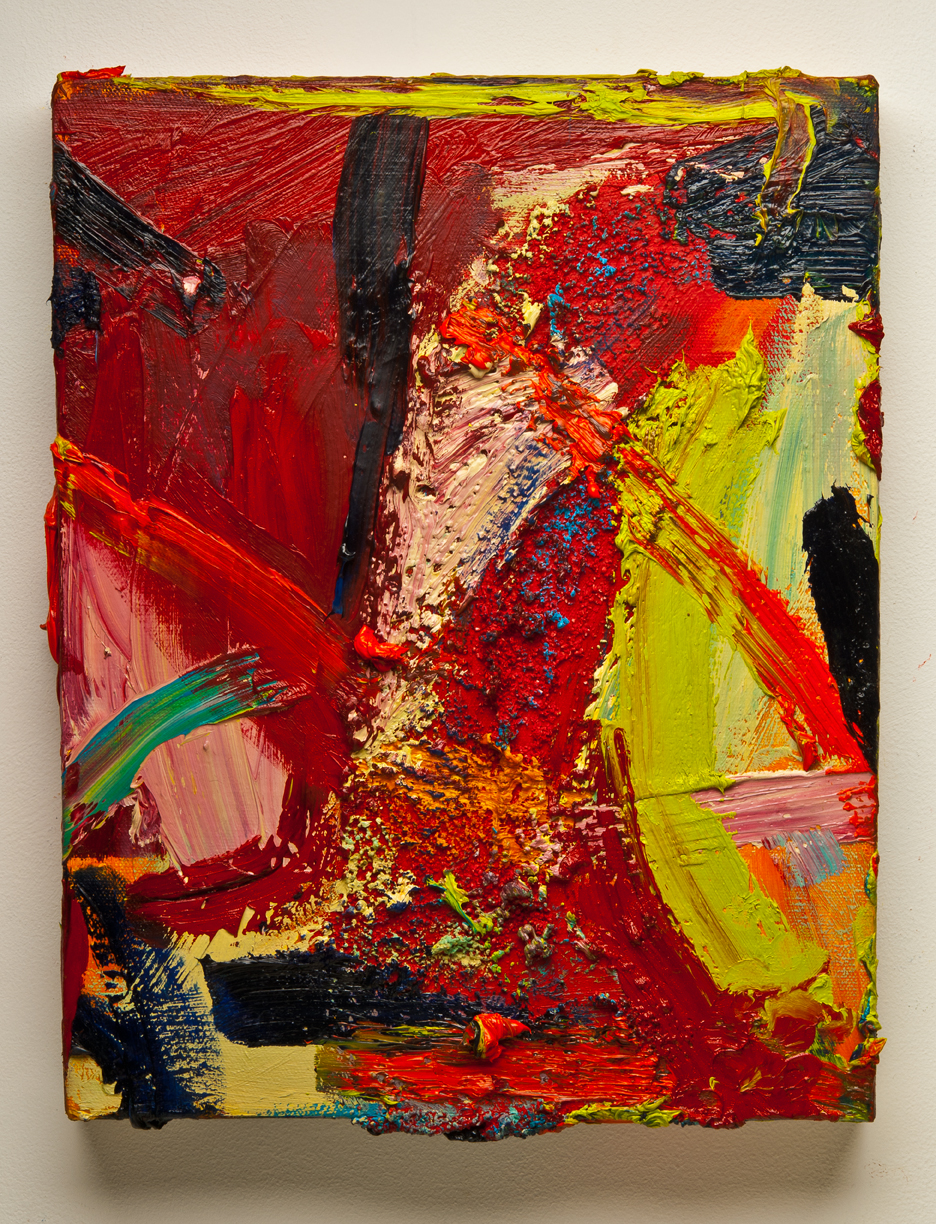
RedFort, oil on canvas, 14x11, 2013

RedFort, oil on canvas, 14×11, 2013

Briefly describe the work you do. 

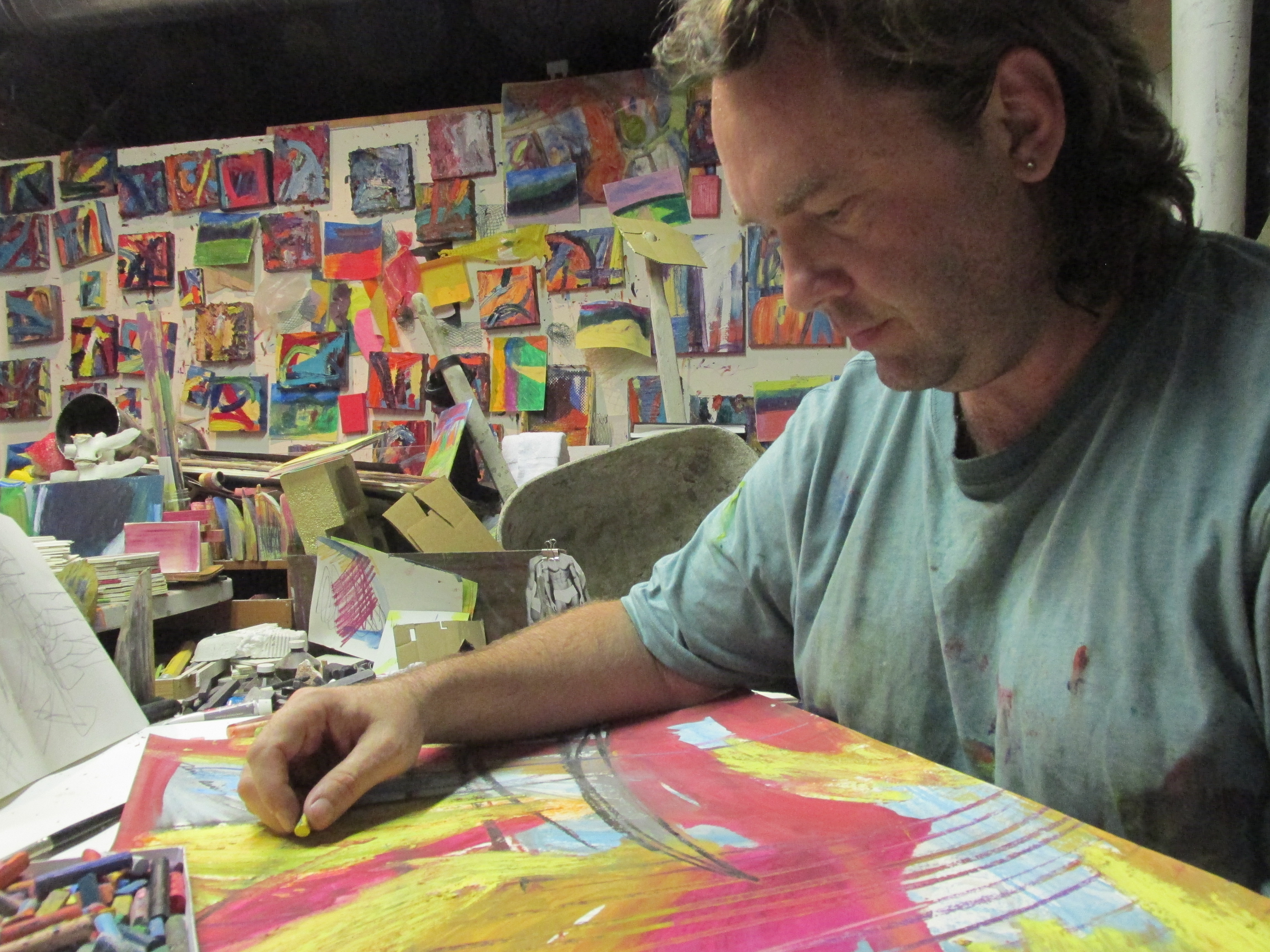
I am an abstract painter. I create small scale works dealing with lots of color and texture based on my experiences of my environments.  In my studio I have five places I work at and and a spot for sitting and observing. One place is dedicated for my oil paint. I have an old window I squirt oil paint on from my tubes. Another table is for mixed media drawing. I love creating hundred of works on paper with gouache, pastel, graphite, oil pastel, watercolor, ink, color pencils, and watercolor crayons. Mark making and layering, I love it. Color too of course. 🙂 Two other areas are used for drawing and working on multiple media projects and one place for working with plaster cast, breaking, assembling and painting them.  

At what point in your life did you want to become an artist?

I always created stuff.  I started taking art classes when I was in high school.  I did not think of art as a career until after I finished my BFA.  I never even knew what a gallery was when I started out. I went on the graduate school for my MFA, it taught me what I was not interested in and what I did not want to be a part of in the art communities. From then on I have stayed true to myself, listening to my inner voice and subconscious while working in the solitude of my studio.

Tell us a little about your background and how that influences you as an artist.

I grew up in rural Iowa. I went on daily walks for hours through the fields and woods. It was there I questioned my meaning and existence in life while growing up.  This deep connection with nature and my surroundings is where I derive my inspiration from in my painting today.

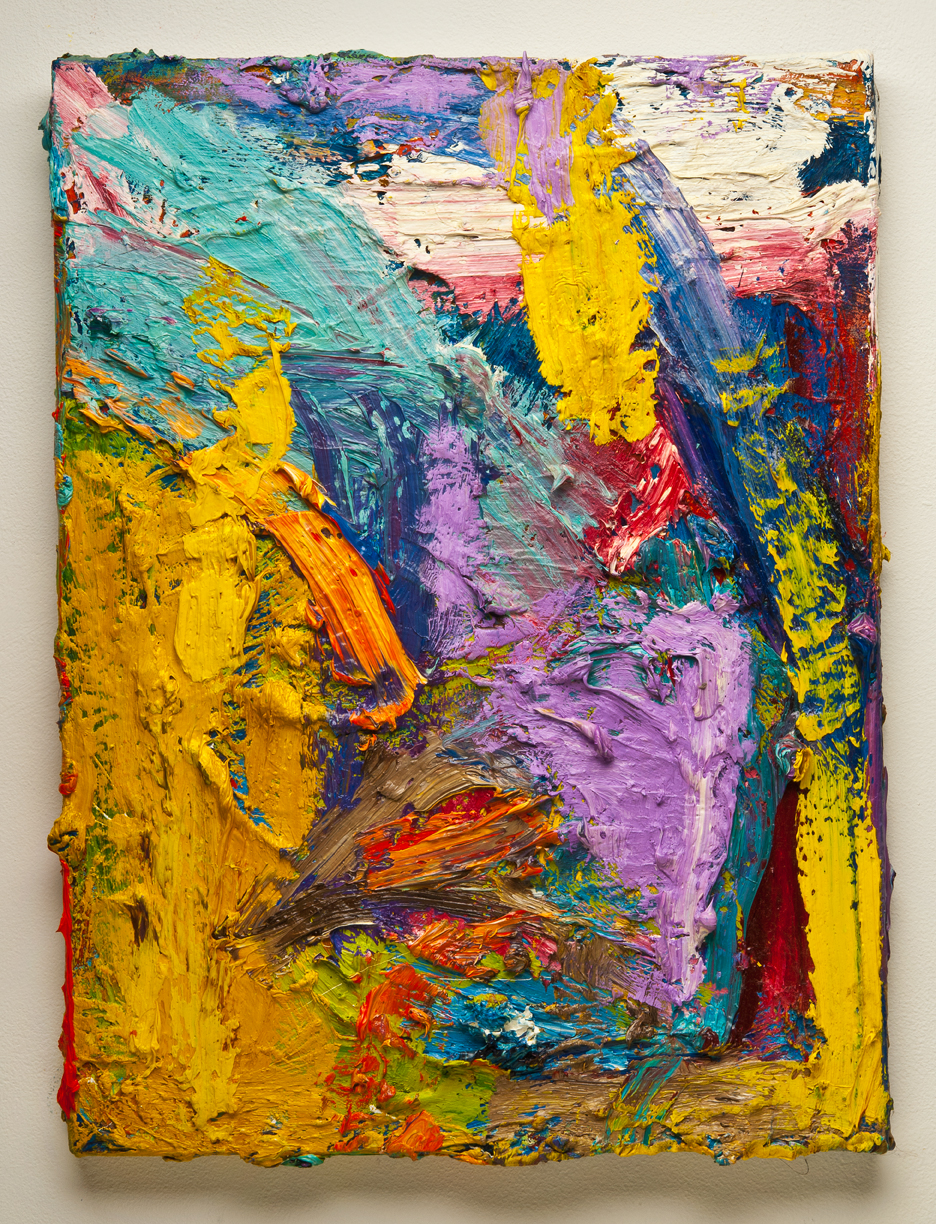
ChawriBazaar(Delhi), oil on canvas, 16x12x1, 2013

ChawriBazaar(Delhi), oil on canvas, 16x12x1, 2013

What types of conceptual concerns are present in your work? How do those relate to the specific process(es) or media you use?

The colors of the oil paints I use reflect the locations and seasons I work in. I am not conceptually concerned. My work is driven by my relationships of color to create beauty. I want my paintings to be beautiful. I get the most vibrant luscious colors by using oil paint.

We once heard Chuck Close say he did not believe in being inspired, rather in working hard everyday. What motivates you in your studio practice?

I believe scientist, artists, performers are born with a genetic code that drives them to submerge themselves in their work.  There is nothing else I can do. I must be in my studio working.  I am driven by the creative need in my hindbrain to make things.

TajMahal, oil on canvas, 16_x12_x1, 2013

TajMahal, oil on canvas, 16_x12_x1, 2013

What artists living or non-living influence your work?

I love Soutine and De Kooning. I rush to look at their genius us of paint and juicy paintings all the time. I think Nicolas De Stael would have been a great influence but I never go to view his paintings in person. I love the California figurative painters, David Park just knew how to paint! Also Frank Auerbach and Leon Kossoff rock my world with their thick textural paintings.

When you are not making art what types of activities and interests do you engage in?

I go for lots of walk. I take many photos and sketch while I am by the lake and traveling throughout the city.  I love the architecture. I also drive around and walk through the countryside taking photos and sketching. I travel a lot too, I love to go to new cities, countries and experience different cultures. I am always making art as these places are where I find more creative energy. I go to art museums and galleries. Other times I watch a few films. I go out to eat and drink with friends and then rush back to my studio to make more art.

About

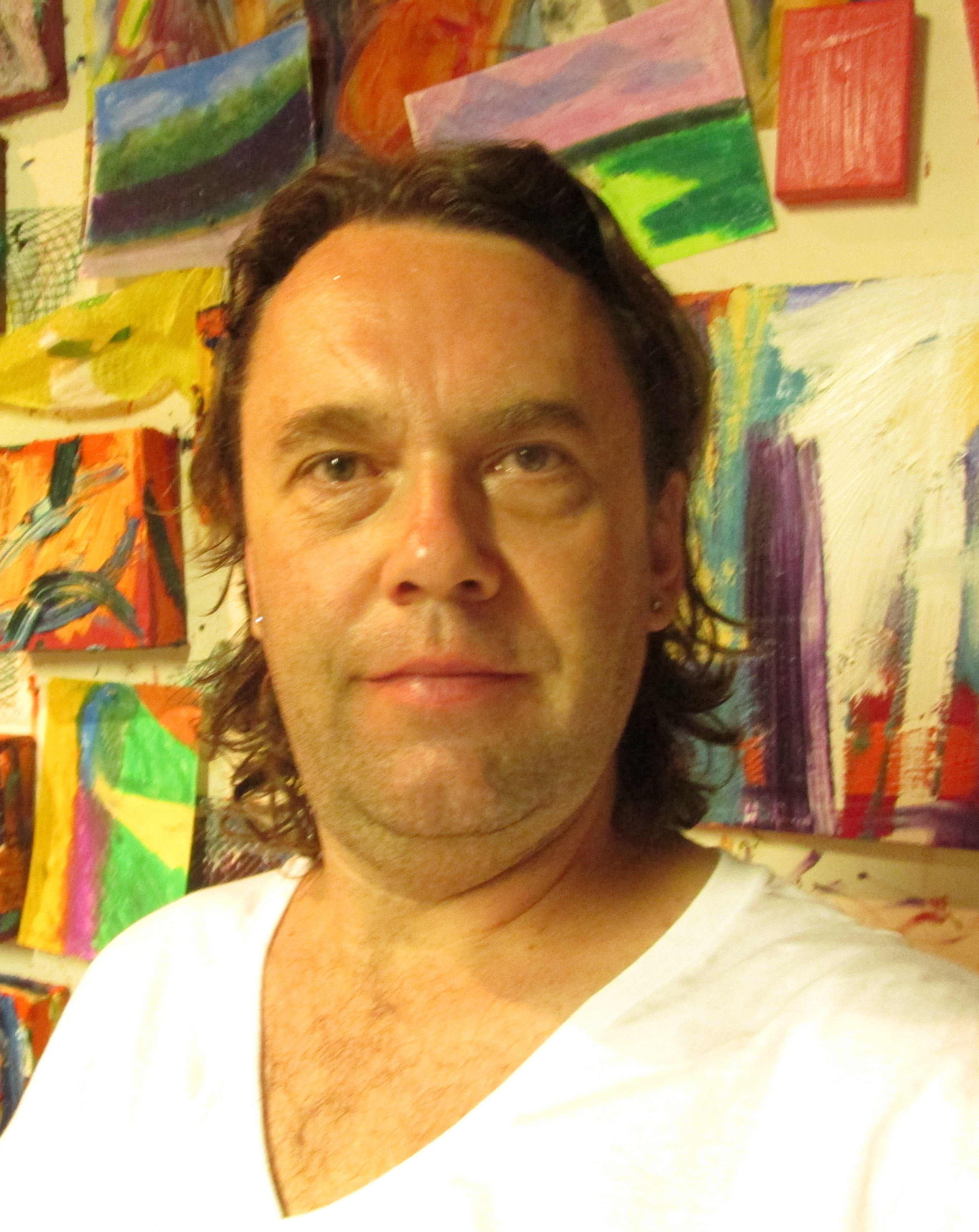
DarrellRobertsheadshotDarrell Roberts MFA and BFA; The School of the Art Institute of Chicago, BA Art History, The University of Northern Iowa.  Darrell has participated in the Leon Levy Archaeology Expedition in Ashkelon, Israel, and artists residencies in Johnson, Vermont, Delhi, India, and Kushtia, Bangladesh. He has been supported by the Dedalus Foundation, Sugarman Foundation, Vogelstein Foundation and Tanne Foundation. He is represented by Thomas McCormick Gallery, Chicago.

In the Studio

In the Studio

http://darrell-roberts.com/

All images copyright of the artist and used with their permission. 

Posted in Uncategorized | Tagged , , , , | Leave a comment

Joshua Willis – Brooklyn, New York

OBLIVION I Oil on panel 23 x 20 inches 2012

OBLIVION I
Oil on panel
23 x 20 inches
2012

Briefly describe the work you do.

My work is the result of sequenced and layered processes that begin with a set of parameters limiting materials, approaches to mark-making and content. At the outset, the parameters are functional, or they serve to define the scope and scale of the works in the series, so I will often limit the number and scale of works, materials, palette, or the amount of time spent working on each piece. At other times, the parameters might serve as a source of content in the work. For example, I decided that the Oblivion paintings would be made using alternating phases of additive and subtractive mark-making, reinforcing the dialectic of growth and decay, which is a major theme in the series. I am interested in the interdependence of intention and chance: steps and cycles are often predetermined on the one hand, but their execution in the moment is imprecise. The resulting images depend a great deal upon the way in which I respond to materials and integrate the effects of chance over time. The images I make always retain traces, residues of the ways in which they were made. As the products of a serialized chain of interactions, the images display their own micro-histories, of which my authorship is authoritative in terms of conception, and self-mechanized in terms of execution.

At what point in your life did you want to become an artist?

I decided to be an artist sometime in my late teens, and like most of the decisions people make at that age, mine was ill-informed. I had no idea what the life an artist was like in contemporary America. All I knew was that DaVinci was a genius and a painter, Van Gogh was a little bit crazy but still a good painter, Norman Rockwell was a good painter and a patriot, and I thought that maybe I had some combination of the attributes that made these people into artists good enough to have books on the shelves of the public library in Hamilton, Ohio. I was somewhat morose as a teenager and liked to spend lots of time drawing alone. I considered myself to be an emotional person and, like most American teens, I thought that the way I saw the world was special, somehow more intense and poignant. But I had no living role models to look up to—art was something magical that other people did in distant, shiny cities—so it would be years before I finished college, moved to the city and realized that much of what I had thought about art as a teenager was simply nonsense. It turns out though that even after most of my misconceptions have (hopefully) been stripped away, I still want to be an artist.

FOREVER OVERHEAD Oil on 25 panels 53 x 43 inches 2013

FOREVER OVERHEAD
Oil on 25 panels
53 x 43 inches
2013

Tell us a little about your background and how that influences you as an artist.

I am originally from a part of the country that is not exactly rural, but not exactly suburban either, which means that there was lots of natural space around, but not enough that I had to worry about bears. As a child I spent most of my free time outdoors, hiking through the woods, building forts, playing sports, etc., and as an adolescent I enjoyed running and cycling through the cornfields that straddled the border of Ohio and Indiana; if I have ever had an experience of a higher power, it was in those fields. The agricultural landscape of the Midwest, and a respect for the land in general, is something that influences many of the formal and conceptual decisions I make in my work, even though I have lived in large urban areas for over a decade.

My grandfather was a mechanic. When I was young, he built his own airplane over the course of seven years and eventually flew it successfully. He passed away in a plane crash in 1990, but I still remember his workshop very clearly: each of his hand-tools had an assigned place in the space around his workbench, power-tools went on the peg board lining the walls of the shop, and large machinery was placed strategically around the perimeter. He was equipped to weld, fabricate his own metal parts, cut wood, etc., so he was able to do most the work on his airplane (and on his farm) by himself. There is something about his self-sufficiency that I admire and try to emulate in my own studio. I fabricate all of my painting supports, crates and frames, document my work photographically, update my website, mix my own paint and clean my own brushes. I know that ‘collaborative’ is a valuable artworld buzzword these days, and I agree that collaboration can be useful and productive, but following my grandfather’s example I try to be as self-sufficient as possible by doing essential studio tasks myself, respecting my tools, and maintaining a working environment that is almost totally private.

What types of conceptual concerns are present in your work? How do those relate to the specific process(es) or media you use?

One of the main conceptual features of my work is that it is palimpsestic: fragmented, densely layered, artifactual. I use painting processes that allow me to preserve or recover the history of my images by building up and then sanding away layers of paint, or to create objects that reference mundane artifacts such as postcards or snapshot photos by using a four-color photomechanical transfer process (however imprecisely), or to complicate meaning by layering and superimposing imagery by cutting several images apart and physically weaving them together.

My work is replete with dualities—growth/decay, urban/rural, craft/art, intention/chance, local/global—that are difficult for me to reconcile, but nevertheless cohere in individual images, series and in my body of work as a whole. Though they make me somewhat uneasy, I embrace these dualities by working with processes that allow for multiple levels of interpretation: for example a painting can be a metaphor for the futility of all effort because it has been laboriously built up and then subsequently destroyed with a palm sander and plunge router, only to be built up and destroyed again, but it can also be a celebration of that wasted effort if the record of alternating accumulation and erosion, the finished painting itself, is beautiful.

WAVES Watercolor on paper 22 x 17 inches 2014

WAVES
Watercolor on paper
22 x 17 inches
2014

We once heard Chuck Close say he did not believe in being inspired, rather in working hard everyday. What motivates you in your studio practice?

I agree that hard work is important, but to forego inspiration over the long term leads to work that is a bland, brick-by-brick recapitulation of itself, kind of like building a suburb; it takes lots of labor, and everyone involved is surely working very hard, but it’s a type of labor that could be done pretty much anywhere and is responsive to nothing. So while I do think that it’s important to work hard in the studio, to put in the hours, to sweat a little bit, to build up the ole’ callouses, it’s equally important to take a step back and reflect on what I’ve done and to allow my responses to my work, along with changes in my emotions, temperament and surroundings, to inspire—for lack of a better term—new projects with concomitant shifts in scale, subject matter, process and duration.

What artists living or non-living influence your work? 

My work is influenced by series- or systems-based painters like Byron Kim, Spencer Finch and Allan McCollum (all living!). I also am inspired a great deal by Courbet, who embraced his working-class origins, refused to be part of any school, and used his own experiences as a lens through which to comment on larger artistic, political and social issues. And like many college-educated Americans my age, I am influenced by the writer David Foster Wallace. In a passage from E Unibus Pluram: Television and U.S. Fiction, which basically sums up my thoughts on artistic integrity, Wallace outlined how sincere and un-cool artists might actually be part of a shifting avant-garde,:

The next real literary ‘rebels’ in this country might well emerge as some weird bunch of anti-rebels, born oglers who dare somehow to back away from ironic watching, who have the childish gall actually to endorse single-entendre principles. Who treat of plain old untrendy human troubles and emotions in U.S. life with reverence and conviction. Who eschew self-consciousness and hip fatigue. These anti-rebels would be outdated, of course, before they even started. Dead on the page. Too sincere. Clearly repressed. Backward, quaint, naïve, anachronistic. Maybe that’ll be the point[…]The new rebels might be artists willing to risk the rolled eyes, the cool smile, the nudged ribs, the parody of gifted ironists, the “Oh, how banal.” To risk accusations of sentimentality, melodrama. Of overcredulity. Of softness.

When you are not making art what types of activities and interests do you engage in?

I have been exercising pretty regularly since I was about 14 or 15 years old. These days, I try to keep in good physical condition by running and lifting heavy weights at the gym; there really is no better antidepressant. Every now and then I entertain the fantasy that I might someday be a troubadour in the vein of Woody Guthrie, playing songs on the guitar, speaking out against war and injustice, fighting the good fight through music. So I play my guitar and try to learn to sing, but for the life of me I simply cannot write a song. And though it makes me angry and sometimes depressed, I read a lot of anti-systemic literature by writers like Immanuel Wallerstein, Wendell Berry and Derrick Jensen.

About

willis_joshua_headshotI spent my childhood and adolescence in southwestern Ohio before moving to Atlanta and then to Brooklyn, where I have lived for almost a decade. I received a BFA in painting and printmaking from Miami University and an MFA in painting and drawing from Brooklyn College, and have been an artist-in-residence at the Misaki-Cho Arts & Crafts Village in Okayama, Japan and the Jentel Foundation in Wyoming. My work has been exhibited nationally at venues including the Carnegie Center for the Arts in Kentucky, Manifest Creative Research Gallery in Ohio, Montclair State University in New Jersey, Harper College and Bradley University in Illinois, and Eastern Michigan University. In New York, my work has been exhibited at the Painting Center, the Katonah Museum of Art and the Pelham Art Center.

In the Studio

In the Studio

www.jwillisstudio.com

All images copyright of the artist and used with their permission. 

Posted in Uncategorized | Tagged , , , , | Leave a comment

Jessica Borusky – Kansas City, Missouri

Briefly describe the work you do.

I am a cultural producer. My aim is to generate thoughtful, creative work and generate a space for discovery utilizing performance, video, curation, writing, and conversation. I am interested in uncovering cultural and personal trauma/stigma through the advent of humorous, topical personae, which reflects social and political conditioning within language.

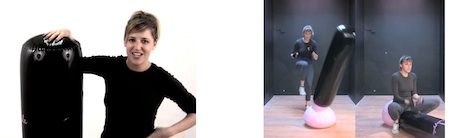
Punching Pillar, 2012, performance and video

Punching Pillar, 2012, performance and video

Tell us a little about your background and how that influences you as an artist.

I am heavily influenced by both the personal and theoretical. Personally, I am influenced by my upbringing, as well as queer and sexual survival strategies.  I am influenced by the brave and incredible people in my life who have also learned to be survivors, I rely heavily on the stories and conversations of my found families in order to help locate and percolate my interests, drives, and methods. Theoretically, I am influenced by cultural criticism, performance theory, and Western queer feminist theory. I am influenced by theories of stigma, non-linear time development as a way to generate narrative, the possibilities and terror of language manipulation. And, lately, I am learning that I am also interested in how corporate language can function as an entry point into an exploration of personal affect and traumatic memory.

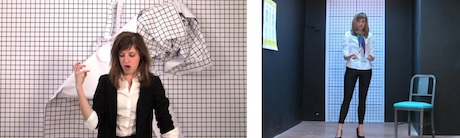
Posture Grid, 2013, performance and video

Posture Grid, 2013, performance and video

The concept of the “artist studio” has a broad range of meanings, especially in contemporary practice. The idea of the artist toiling away alone in a room may not necessarily reflect what many artists do from day to day anymore.Describe your studio practice and how it differs from (or is the same as) traditional notions of “being in the studio.”

3: The idea of the “artist studio” feels dated to me. I have a space where I store things, make my videos, work on the computer, and write on the wall, yet I would not consider myself to relate to this space in any kind of romantically “artistic” way.  For that matter, a static definition of artist is one that ought to be challenged. My studio is my whenever I am reading, thinking, talking about my projects; which, is all the time. Driving to work, socializing, making notes- I am always thinking about what I am curating, who I need to write to, images for videos and performances, theory I am reading, and why I feel it to be relevant to my highly emotional and deeply personal work.  Furthermore, I do not wish to entertain a dichotomy which would suggest that there is a “traditional” notion of being in the studio, for there are myriad avenues by which to produce work, millions of brains and hands by which to make those ideas, and therefore, an incredible amount of paths by which to consider one’s “studio” space. This space may be physical, it may be the computer, a playground, an office cubicle, a notebook, a camera, under a bed, or in the woods.

What unique roles do you see yourself as the artist playing that you may not have envisioned yourself in when you first started making art?

As mentioned in my ideas about the “studio”, I think there are multiple ways to be a creative individual. Currently, I am learning how to contemplate curation as an extension of one’s art practice. I am always investigating the role of academic writing as it relates to artistic production, how these roles can function within an artistic continuum. I am realizing how, through making space for people whose practices are similar to mine, advocating for thoughtful and intelligent artwork, I can expand my personal artistic practice into realms that carry potential and significance. I cannot claim a time where in which I “started” making art, for I have always been curious about ways in which to extrapolate my life experiences into a form and gesture that both abstracts and exemplifies those experiences. However, I can say that there is a lot of potential in being able to position and configure oneself as a cultural producer and linchpin between artistic spaces and those designated as “non-artistic” ones.

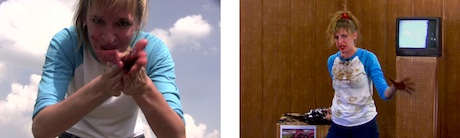
Let's Do This, 2013/14, performance for video

Let’s Do This, 2013/14, performance for video

When do you find is the best time of day to make art? Do you have time set aside every day? Every week? Or, do you just work whenever you can?

I think the best time of day for getting cognitive work done is in the morning, while drinking coffee, eating breakfast, and listening to the news. The best time of day to shoot my videos, where in which I am opening up various emotional portals, is in the evening, when I have spent a day going over my “points” (I improvise everything, and shoot my work in one take) and entering a somber head space.

How has your work changed in the last five years? How is it the same?

What has changed in my work is a growing ability to locate my intuitive moments within greater theoretical and cultural discourses, while at the same time, becoming more and more in touch with, and embracing, my past trauma, my healing, and my catharsis. I still have a vested interest in using language, repetition, and duration as a way to unpack seemingly minimal structures into complex webs of content and affect. Significantly, what has changed is speaking in my work. Five years ago, I would manipulate sound away from the videos so that the viewer could not digest the entire product. At the time, this choice was defended through Kaja Silverman’s text  The Acoustic Mirror, yet now I can understand this choice was motivated by a discomfort in addressing the full spectacle of my performance. And, well, now, I am on a path of connected voice, body, gesture, and content all within the same temporal space- at the discomfort of both my audience and myself.

Are there people such as family, friends, writers, philosophers or even pop icons that have had an impact on the work you do? 

As mentioned, I am extremely influenced by past and my current found family. The intimate relationships of my present and the ghosts of my past profoundly impact my work. I also look toward strong, dynamic female and queer leaders within my community in Kansas City, MO as well as those leaders who have allowed my work within the art community to be possible. My current partner and artistic collaborator, Tim Amundson, plays a tremendous role in my artistic output, and engenders space for me to contemplate all aspects of my work- from inception to installation.  I look toward comedy and the poetics of humor as a device for surviving and healing; and am incredibly impacted by narratives of female, queer and non-traditional relationships. Depending on the project, I may be impacted by a particular history or narrative. Currently, I am reading about the myth of the West, Cowgirls, and how to start an LLC.

If you had an occupation outside of being an artist, what would that be and why

I have many occupations, Artist is simply one of them. Or all of them. I’m unsure at the moment. However, if I were to dedicate my creative energy and resources toward something in a singular way that resided outside of my current tapestry of daily activity, I would want to work within artistic programming and/or direction for a company/non-profit that had a vested interest in artist’s needs, or found a dedicated space to showcase performative and alternative artistic practices within a mid-sized city. In many ways, I feel as though my creative trajectory is leading me to work in this way alongside my personal artistic practice.

About

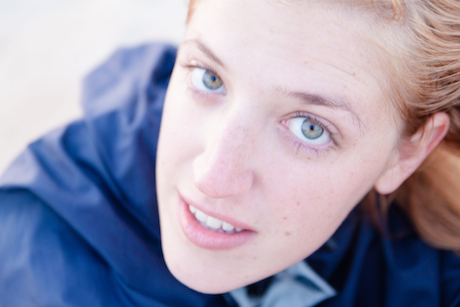
headshot_JessicaBorusky1Jessica Borusky is a artist/educator/curator currently living and working in Kansas City, MO. Drawing from theatrical absurdist tragicomedy, stigmatization theory, performance and queer theory, linguistics and U.S. history, Jessica creates personas through performative actions which showcase these topics, while uncovering cathartic personal narrative and trauma. She received her B.A. from New College of Florida and her M.F.A from Tufts/School of the Museum of Fine Arts. She is currently a resident at the Charlotte St. Foundation in Kansas City. 

In the Studio

In the Studio

www.jessicaborusky.com

All images copyright of the artist and used with their permission. 

Posted in Uncategorized | Tagged , , , , | Leave a comment