Clifton Riley – Houston, Texas

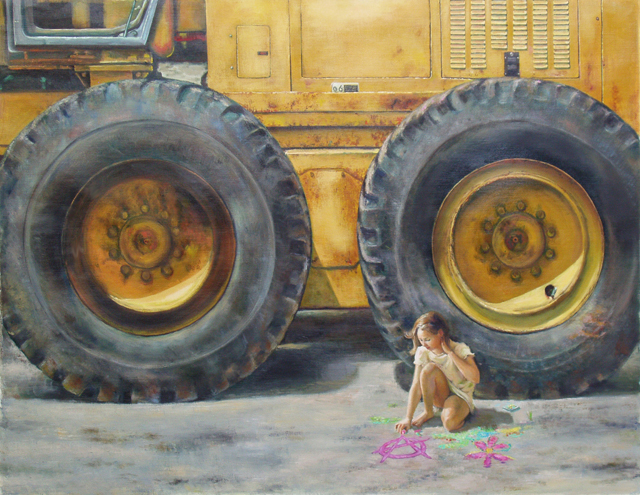
the rising 67 Lithography, Intaglio, Relief 22.5 inches x 29.5 inches 2013

the rising 67
Lithography, Intaglio, Relief
22.5 inches x 29.5 inches
2013

Briefly describe the work you do.

I primarily work in printmaking and drawing however, lately, I have been building small structures that have been finding their way into or influencing my works on paper in various ways. My prints and drawings, and these new structures as well, are informed by how we understand the world around us and what affects the ways we perceive, process, and think about it. We see, hear, and otherwise encounter so much and it is all mitigated by everything from the language we speak to digital technology and I am interested in how we come to form the link between the external, physical world and our internal, mental conception of it.

At what point I your life did you want to become an artist?

I am not sure that I ever made a decision to become an artist. I was always drawing, painting, or making something as I was growing up and it was something that my family encouraged and supported. Maybe I just never made a decision to do something different.

Tell us a little about your background and how that influences you as an artist.

I was always curious about how things work or operate. My father and grandfather put tools in my hands as soon as I could hold them and I was always by their sides wanting to help when they worked on the house, cars, or the lawn mower. As a result, I was always taking apart RC cars, radios, telephones, etc. to figure how they did what they did. I tried to fix broken things, some of which only stopped working after I got a hold of them, and if I could not repair them I would try to build something new out of the parts. Rarely was there a success, but the curiosity to understand how things work and to make things was always there and this interest has suck with me.

26.05.12 (misaligned) graphite 15 inches x 22.5 inches 2012

26.05.12 (misaligned)
graphite
15 inches x 22.5 inches
2012

What types of conceptual concerns are present in your work? How do those relate to the specific process(es) or media you use?

Some of the interests driving my work are the variable nature of information and interpretation, the impact of mass media and technology, and how we as humans make sense of things. I feel that print media has a direct relationship to these concerns. At its roots, printmaking came about from a need to efficiently disseminate information resulting in some manner of its standardization. Furthermore, print media or the multiple has a significant impact on our visual culture and relates to other ideas such as consumerism and authenticity.

While I have a deep appreciation and respect for the history and traditions of printmaking, I am interested in exploring the range of variability possible in print media. In my drawing practice I pare down, degrade, and misalign information and I approach making prints in a similar way. I am interested in creating a certain amount of unpredictability by embracing breakdowns and failures in imaging processes, selective inking and wiping, and manipulating the ink on the matrix. Process, for me, is an integral part of the work. Working within systems of interrelated matrices, accepting the unforeseen, and subverting the traditional approach to printing create a range of combinations that I think speak to the nature of how we interpret the world around us.

the rising 20 Lithography, Intaglio, Relief 22.5 inches x 29.5 inches 2013

the rising 20
Lithography, Intaglio, Relief
22.5 inches x 29.5 inches
2013

We once heard Chuck Close say he did not believe in being inspired, rather in working hard everyday. What motivates you in your studio practice?

I would have to agree. While I do get ideas from books and articles, the experience of my surroundings, and sometimes what seems just out-of-nowhere, they are at best starting points. Most of the progress that happens in my work comes from being in the studio and making things. Whether it’s making bad drawings or prints, figuring out to resolve issues with a process, or sometimes just staring at old work, being active in the studio is when the most evolution happens for me and what I am making.

What artists living or non-living influence your work? 

This would be a huge list, but some of the work I have been looking at most recently is that of Sara Sze, Julie Mehretu, Toba Khedoori, Michael Wesely, and Stephen Talasnik… There is always Piranesi, Tatlin, Atget, and many others.

When you are not making art what types of activities and interests do you engage in?

I like to read quite a bit, be out in nature, and play music. There is also the occasional binge session of Game of Thrones, House, or the Discovery Channel.

About

head_shotClifton Riley was born and raised in the panhandle of Texas and earned his BFA from Texas State University-San Marcos in 2006. Riley interned at Flatbed Press in Austin, Texas during his final semester and was hired as an assistant printer upon graduation where he also taught the Beginning Intaglio course. In 2007, Clifton was the Artist-in-Residence at the Scuola Internazionale di Grafica in Venice, Italy and also cofounded Interbirth Books, a small press dedicated to producing handcrafted books of poetry, prose, plays, and prints. Clifton earned his MFA from The University of Tennessee-Knoxville in May 2013. At UTK, he was a Graduate Teaching Associate and instructed in the Foundations Program and Printmaking Department. During the summer of 2012, Riley traveled to Poland where he was an Artist-in-Residence at the Eugeniusz Geppert Academy of Fine Arts, Wrocław. His work has been shown internationally at locations including Ekaterinburg, Russia; Tokyo, Japan; Wrocław, Poland; and El Minia, Egypt and nationally including New York, NY; Boston, MA; Washington D.C., and Austin, TX. He lives and works in Houston, Texas.

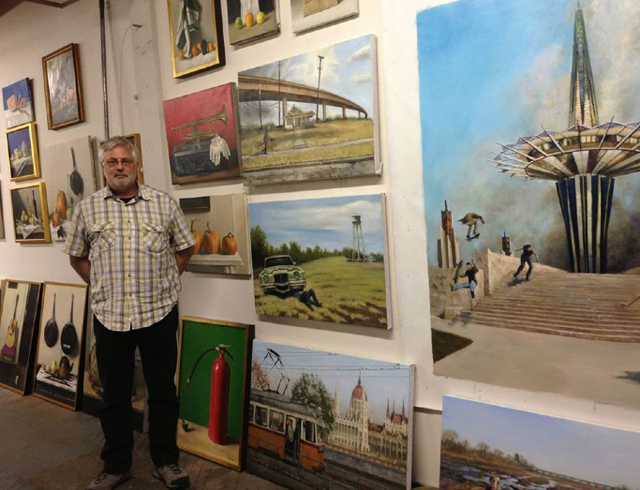
In the Studio

In the Studio

www.cliftonriley.com

All images copyright of the artist and used with their permission.
Posted in Uncategorized | Tagged , , , , | Leave a comment

Sarah McCann – Baltimore, Maryland

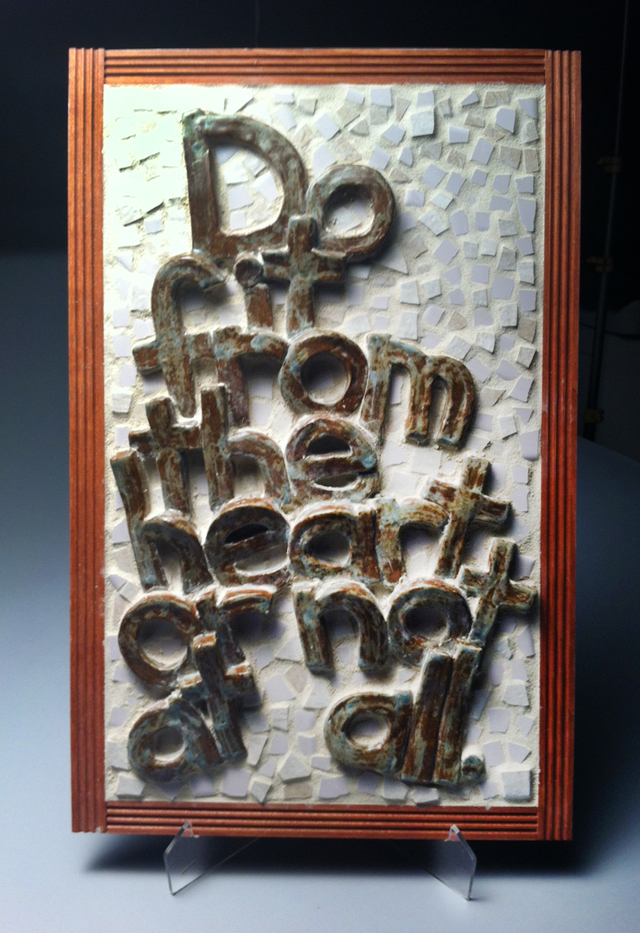
Do it From the Heart or nor at All16” x 24” - 2014

Do it From the Heart or nor at All16” x 24” – 2014

Briefly describe the work you do.

The work I do is a reflection on life, communication, responsibility and love. I appropriate text from music, literature, film, conversations and create visual pieces that capture the heart of what is being said. I also work to question language as a means of communication, how differences in the way that we speak and hear can often challenge true connection.

At what point I your life did you want to become an artist?

I have always wanted to pursue a creative career. Early on it was as a writer, as I got older and found I could draw, it became work in the visual arts. By working with text in a visual form I have found a way to incorporate both my love of words and art into a single process.

Tell us a little about your background and how that influences you as an artist.

I grew up on Long Island, although most people cannot tell as I am missing the accent. My parents ran a group home so we lived in a house with eight developmentally disabled adults. This environment was amazing and I learned a tremendous amount about how people’s experiences of the world are vastly different. It also taught me how beautiful the world is when we are able to embrace difference and act in a way that shares space and power.

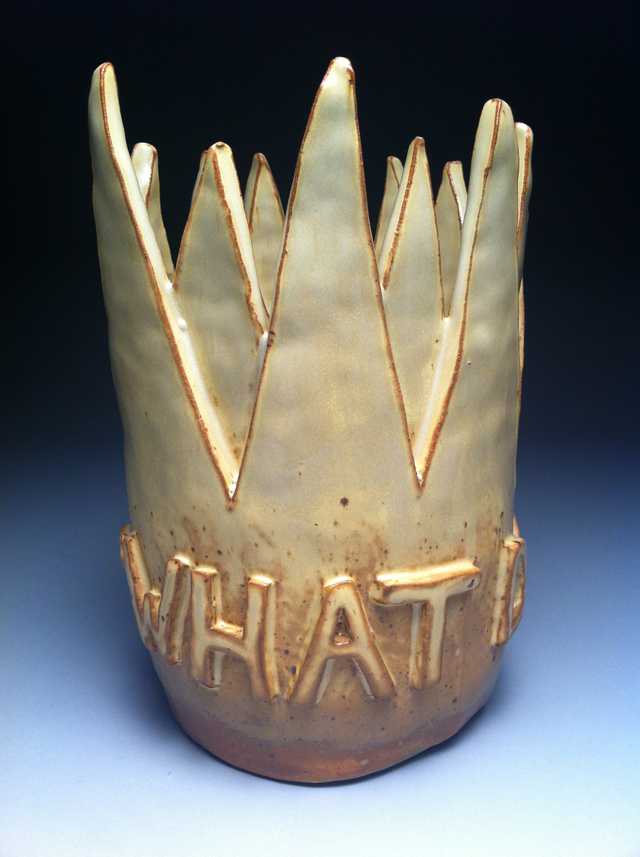
What do You Do? 10” 16” 10” 2013

What do You Do? 10” 16” 10” 2013

What types of conceptual concerns are present in your work? How do those relate to the specific process(es) or media you use?

I have moved through a variety of mediums in my career. In my undergraduate work I began as a photography major, then transferred to the studio program where I painted, took sculpture classes (although most of my sculptures were still flat) and ended up somewhere in between drawing and conceptual work. In graduate school I studied community arts, which turned my focus toward questions of authorship, authority and value in the arts. I remain committed to acknowledging the responsibility of the artist in social change. Many artists are privileged with time, space and support to hone their voices and have what they create put on a pedestal and viewed in a sacred space. How do artists use this experience to create space for others? Especially those who have had their voices silenced?

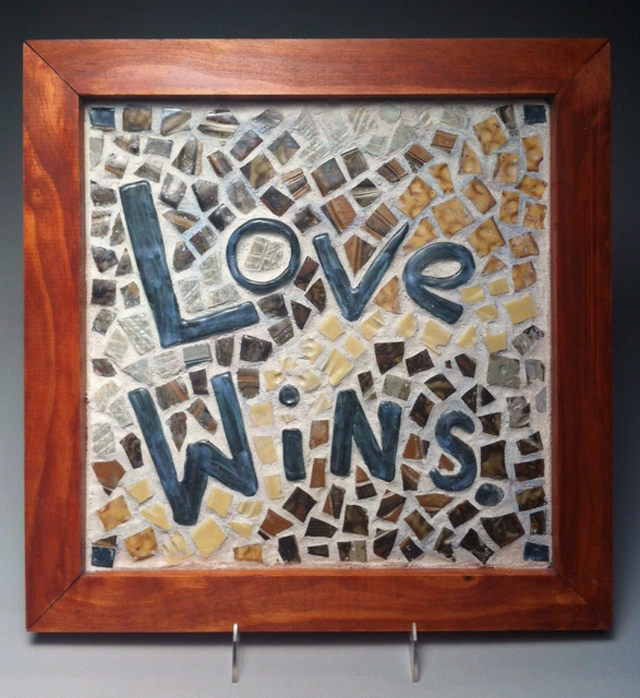
Love Wins, 16”x16” 2014

Love Wins, 16”x16” 2014

We once heard Chuck Close say he did not believe in being inspired, rather in working hard everyday. What motivates you in your studio practice?

I do believe in being inspired. I find inspiration all around me, in books, music, film and in conversation with my colleagues, friends and family. What motivates me to get into the studio is the need to communicate. My creative process is a means of reflection and communication. Creating provides the opportunity to think critically, find meaning in my life and work and express my truth to others.

What artists living or non-living influence your work? 

In addition to making, I also curate. All the artists that have been a part of my exhibitions have inspired me. One of the greatest joys in the work that I do is putting a question into the world through an exhibition proposal and seeing all of the thoughtful, beautiful, creative answers that artists return through their work for the exhibition. Paula Phillips and Colin Campbell are two artists that have participated in many of my exhibitions and who were the inspiration for Baltimore From Many Perspectives that I curated in 2013. Both Paula and Colin as artists and as people are great inspirations to me. Oasa DuVerney is a close friend, collaborator and talented artist who provides motivation, someone to bounce ideas off of and whose incredible drawings, paintings and other work I always find inspiring. Other artists and writers that I have never met, but who provide guidance are: James Baldwin, Bertice Berry, bell hooks, Miranda July, Thomas Hirschhorn, Henry Miller, Alice Walker and so many more I could not possibly fit them all here.

I am also always influenced by the young people I work with in my youth and community work. Their ideas, energy and enthusiasm has had a great impact on my life. They have also been the starting point for projects such as, Ms. Sarah Learns to Step.

I am grateful for all I have worked with.

When you are not making art what types of activities and interests do you engage in?

I really enjoy attending the theater, seeing movies, listening to music. When I find time, I like to swim and be out in the sun.

About

McCann_HeadshotSarah McCann is a Baltimore based community artist and independent curator. She partners with individuals and organizations to facilitate projects that use existing systems of behavior to form deeper human relationships and create opportunities for reflection and growth. She is currently the Executive Director at Baltimore Clayworks. She has taught arts programming with the Creative Alliance, Wide Angle Youth Media and the Youth Dreamers. Her most recent curatorial endeavor Experience Transformation: The Impact of Clay was exhibited at the Creative Alliance in May/June 2014. Sarah has facilitated public and collaborative projects and looks forward to continuing her work in Baltimore and other urban centers.

McCann_Pit Fire

www.sarahbmccann.com

All images copyright of the artist and used with their permission.
Posted in Uncategorized | Tagged , , , , | Leave a comment

Alexandra Silverthorne – Washington, DC

Ten Miles Square, archival inkjet prints on painted mdf, dimensions vary, 2010

Ten Miles Square, archival inkjet prints on painted mdf, dimensions vary, 2010

Briefly describe the work you do.

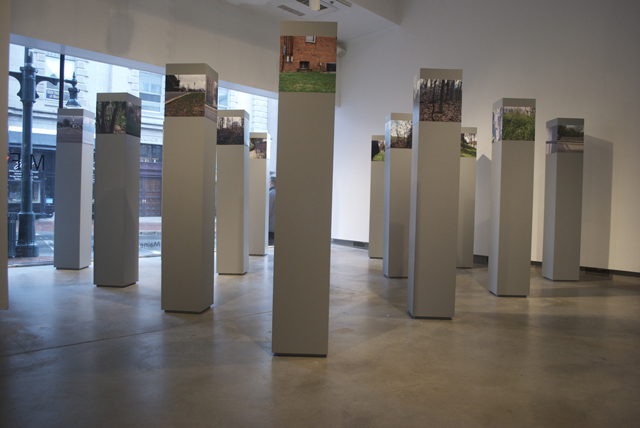
I use the camera as a means to understand space/place and how we interact with it. Sometime this involves working with a pre-determined space, such as the boundary lines of the city of Washington, DC. Other times, it has more to do with my own life, such as a postcard series documenting ceilings from all the different beds that I slept in during the course of a year. Working with both film and digital cameras, my projects always start photographically. That said, I am also often interested in alternative means of presentation. For example, for my MFA thesis project I mounted 12” x 12” photographs onto six-foot tall columns to create a sculptural installation.

Tell us a little about your background and how that influences you as an artist.

I grew up in Washington, DC, left for seven years for school, and then fell in love with the city when I moved back after college. In college, I was a political science major with minors in art and philosophy and thus, DC seemed like the right place to move upon graduation. Needless to say, I never worked in the government, but rather ultimately, focused the political work into my studio practice. I don’t think my more recent work necessarily comes off as political, but social/political theory informs much of my practice.

The concept of the “artist studio” has a broad range of meanings, especially in contemporary practice. The idea of the artist toiling away alone in a room may not necessarily reflect what many artists do from day to day anymore. Describe your studio practice and how it differs from (or is the same as) traditional notions of “being in the studio.”

First off, I don’t shoot “in the studio” – or at least I haven’t yet. Rather, I’m more likely to be hopping fences, wandering through city streets at night, and kayaking across lakes to take my shots. I also don’t have dedicated “studio space” outside of my apartment, but I still spend quite a bit of time on the couch or on the balcony reading, researching, and just letting my mind wander. I’m not necessarily opposed to having a dedicated space, but I also don’t need it.

September 7, 2009, archival inkjet print, 5” x 7.5”, 2008

September 7, 2009, archival inkjet print, 5” x 7.5”, 2008

What unique roles do you see yourself as the artist playing that you may not have envisioned yourself in when you first started making art?

I had always been interested in teaching after college, but for years I didn’t fully pursue it. During grad school I gave a few demos and artist talks to students at other universities and the professors there encouraged me to teach. I was fortunate to start as an adjunct the semester after I graduated and have loved it ever since.  But there’s not really a time when I stop being an artist or start being a professor or anything else. It all just blurs together in a way as I go through life.

When do you find is the best time of day to make art? Do you have time set aside every day, every week or do you just work whenever you can? 

I work best on having several days (or more) in a row to really focus on making art without any huge distractions. There are often periods of time when I’m not making new work, but rather re-visiting older work, reading fiction, going to museums and galleries, following the news, listening to live music, and just soaking up the world around me. I usually travel a few times during the year and often try to start a project during the trip. But it usually doesn’t work that way. I’ll research extensively ahead of time and then shoot very little. Alternatively, most projects come to me at the most random times when I’m just going through my life. The next goal is then to just set aside a few days to get the ball rolling.

Untitled, Silver Gelatin Print, 16” x 20”, 2013

Untitled, Silver Gelatin Print, 16” x 20”, 2013

How has your work changed in the last five years? How is it the same?

I began my MFA program six years ago. For the first year, I experimented with a bunch of different ideas and techniques. Since then I think my work has been pretty consistent. I’ve been exploring the same conceptual ideas and executing them in a variety of ways.

Are there people such as family, friends, writers, philosophers or even pop icons that have had an impact on the work you do?

I wouldn’t even know where to begin listing the people who have influenced my work. By teaching us to love learning, be curious, and ask questions, my parents have certainly had one of the biggest impacts. I was fortunate to work with amazing professors in both undergrad and grad school and continue to work with talented colleagues. And I’m constantly influenced by the work my friends are doing, even when it has nothing to do with art. One of my good friends works for the city of Denver, CO on a team that strives to help make the city work even better for the residents. This ties directly into my conceptual concerns of how we use and interact with space and our conversations often leave me thinking through ideas from a different perspective. Another friend is neuropsychologist working with veterans. Our conversations prompt me to think more about perception and how we relate to the people and world around us. Finally, literature and music also impact my work greatly. For example, when I was working on a project with night shots, I kept coming across various quotes about night and darkness. Each quote prompted me to think about the project in a different way.

If you had an occupation outside of being an artist, what would that be and why?

I love teaching and hope to continue doing that for many years. At various times in my life I’ve considered going back to into more political career work or even law school, but ultimately I opted for art school instead. To be honest, I would like to be contributing more to the city. While I’ve volunteered here and there over the years, I haven’t found a consistent way to be involved, so I would probably be working in some sort of local activism or involvement.

About

silverthorne_photoOriginally from Washington, DC, Alexandra Silverthorne graduated from Connecticut College with a major in Government and minors in Art and Philosophy and holds a Master of Fine Arts from Maine College of Art (MECA).  In 2003, Silverthorne co-founded Panorama Community Arts with the goal of providing art experiences to all residents of DC. Through this she taught workshops in photography, ceramics, and mural painting to youth and elderly in Washington.  Since 2010, she has taught undergraduate darkroom photography courses at American University and the University of the District of Columbia.  She has also taught additional courses through MECA’s Continuing Studies program.  Silverthorne received a fellowship to travel to Hiroshima and Nagasaki, Japan for the 2004 annual World Conference Against A&H Bombs. She has also received several grants from the DC Commission on the Arts & Humanities as well as one from the Puffin Foundation. Her work can be found in the permanent collections of the John Wilson City Hall Building in Washington, DC.

The Studio

The Studio

www.alexandrasilverthorne.com

All images copyright of the artist and used with their permission.
Posted in Uncategorized | Tagged , , , , | Leave a comment

Stacy Isenbarger – Moscow, Idaho

Boundary (Owned) embroidery hook, fabric, string, & bandage material approx. 5ft 8in x 2.5ft x 10in  The word MINE is hand-stitched repeatedly on a blanket to form the facade of a white picket fence.  2014

Boundary (Owned)
embroidery hook, fabric, string, & bandage material
approx. 5ft 8in x 2.5ft x 10in
The word MINE is hand-stitched repeatedly on a blanket to form the facade of a white picket fence.
2014

Briefly describe the work you do.

In recent years, my motivation for creating dialog through imagery and form has shifted from expressing poetic narratives into highlighting perceived boundaries built from one’s cultural environment. Through interplay of media and iconography, I create artworks that allow viewers to consider both the power and shortcomings of these outside dynamics. My work challenges viewers’ assumptions and offers new perspectives of cultural and spiritual judgments.

Tell us a little about your background and how that influences you as an artist.

Growing up as a Southeastern Suburban Catholic, I was raised around Catholic iconography that my Southern Baptist peers thought labeled me as heathen (my family “worshiped statues”). I suspect that this and the other ways in which I learned the power objects have to designate someone as good or bad, right or wrong, rich or poor, etc. have played a roll in my sculptural pursuits. I often use materials from home (upholstery fabric, embroidery hooks, figurines) and a suburban yard (concrete, grass, fences) and mix them with simple sticks and stones to suggest something at odds between human nature and cultural expectations. “Sticks and stones may break my bones, but words will never hurt me,” a popular combative childhood taunt, expresses the desire that labels won’t effect us—but they do and I try to play off of our problematic uses of them throughout my work.

The concept of the “artist studio” has a broad range of meanings, especially in contemporary practice. The idea of the artist toiling away alone in a room may not necessarily reflect what many artists do from day to day anymore. Describe your studio practice and how it differs from (or is the same as) traditional notions of “being in the studio.”

As a sculptor, I am not chiseling away at marble in my studio or seeking a grand, gestural form that stands out on a pedestal in all its glory. Instead I’m usually hovering over the ground playing around with construction materials, dirty & quite content, leaving finished work in more humble viewing plane. I sketch out works by reconfiguring forms in space and photographing them so I can contemplate various poetic narratives accessible to viewers. To get an in-process critique, I often rely on social media connections or bar conversations hovered over my phone’s photo albums to elicit responses from my peers. Much of the physical work I do happens in my studio or the shop, but my studio time exists beyond that; I meet with folks at coffee shops, network online, go on a walk, etc. My practice exists in ways I suspect much of my peers experience; it is negotiated around everyday life in the service a more common experience.

A Matter of Perspective (Canary Mary) painted steel, chuck of asphalt, stick, plaster, & yellow tool dip 5ft10in x 2ft x 10in 2013

A Matter of Perspective (Canary Mary)
painted steel, chuck of asphalt, stick, plaster, & yellow tool dip
5ft10in x 2ft x 10in
2013

What unique roles do you see yourself as the artist playing that you may not have envisioned yourself in when you first started making art?

When I was a teenager, I think I considered an artist to be a true independent—driven to transfer their inner thoughts and turmoil into something provocative or beautiful. Now I value an artist as someone who connects with her community and understands her impact as part of a conversation that is greater than her own. As a collaborator and educator, I try to stay grounded in this idea.

When do you find is the best time of day to make art? Do you have time set aside every day, every week or do you just work whenever you can? 

Keeping my studio schedule flexible each week allows me to do my job and still muscle through my creative processes. As an art professor, you give your creative energy away in the form of shared insight, suggested explorations, and supportive critique and some days after negotiating the dance of it all, there isn’t much left to put into your own practice. But instead of getting frustrated about it, I keep flexible space in my week to “refuel” my inspiration and head to studio when I have enough uninterrupted time to focus on my own creative headspace.

What Man Builds, Man Can Confuse: Limitations wood, steel, string, paint, velvet, stick, stone, yellow tool dip installation view, 12 ft at longest dimension 2014

What Man Builds, Man Can Confuse: Limitations
wood, steel, string, paint, velvet, stick, stone, yellow tool dip
installation view, 12 ft at longest dimension
2014

How has your work changed in the last five years? How is it the same?

Certain materials continue to come back into play in my work: religious figurines, velvet-covered objects from nature, white picket fences, dirt & turf, etc. They are revisited as part of a conversation I have continuously had with myself over the years; where and how are we really grounded into our spirituality and what triggers the lines we draw in our understanding of things? My own answers have shifted as I’ve gained a broader perspective moving to various regions within the United States and interacting with new communities abroad. Even though my portfolio may look different than it did 5 years ago, the heart of what I do remains much the same.

Are there people such as family, friends, writers, philosophers or even pop icons that have had an impact on the work you do?

Shared personal narratives and spiritual perspectives from others challenge the direction of my work & I am especially grateful for the inspiration I’ve gotten working closely with my collaborators in the BASK Collective (Belle Baggs, movement, Alexandra Teague, poetry, & Kristin Elgersma, piano) over the past year. I am also currently obsessed with Maggie Nelson’s Bluets. I want to make work in the way in which that she writes. Her approach to navigating an open-ended question and an understanding of her experience is beautiful. Music also plays a pivotal role in my studio. Pitbull, Whitney Houston and Bluegrass are better than coffee.

If you had an occupation outside of being an artist, what would that be and why?

Since I have always wished I had taken more time to pursue it and they have fewer materials to move around, I would become a poet if their kind would have me. Or maybe I would run a community arts organization in a town looking to celebrate who they are creatively; I feel their collective inspiration would feed me well and make me proud to say “this is home.”

About

StacyIsenbarger_HeadShotStacy Isenbarger’s work simultaneously investigates ideas and materials, transforming the familiar into forms that challenge our assumptions of our environment and cultural barriers we build for ourselves. Stacy lives in Moscow, Idaho, USA and is an Assistant Professor of Art + Design at University of Idaho. Stacy received her MFA at the University of Georgia and her BFA at Clemson University. Stacy is a founding member of the BASK Collective and the President of FATE (Foundations in Art: Theory & Education).

In the Studio

In the Studio

www.stacyisenbarger.com

All images copyright of the artist and used with their permission. 
Posted in Uncategorized | Tagged , , , , | Leave a comment

Colby Jennings – Springfield, Missouri

still from im(pull)se, 18”x24”, 2013

still from im(pull)se, 18”x24”, 2013

Briefly describe the work you do.

The briefest of descriptions would be that I watch, see, listen, record, capture, examine, recreate, collect, and archive. All of my work is inspired by personal anxiety in some manner or form. As those anxieties evolve and cycle so does my work. I currently think of my practice as a form of scientific or anthropological research. I spend a lot of time thinking, reading, sketching, and dreaming before I actually get to the making. When I do get there, it typically involves performance as a method of reenactment or video as a method of collection and archive.

At what point I your life did you want to become an artist?

My first memory of what I wanted to do when I grew up is of being a paleontologist. Not long after that though I switched over to becoming an artist. It’s been pretty consistent ever since. I have always had great support for my creativity from my family. Whether always having an ample supply of arts materials or getting to visit excellent museums and art galleries, many members of my family made sure art was a part of my life.

The biggest struggle in this question came late in high school / early in college. Being a first generation college student, it was incredibly important to make use of the opportunities I had and to do justice for the sacrifices my parents were making. More commercially viable arts were my compromise for a time before a teacher and mentor introduced me to time-based arts. After that, it was clear what I needed to learn and where my work needed to go.

Around the time I was finishing my undergraduate degree I had the privilege to visit a video installation called “Turbulent” by the brilliant Iranian photographer and video artist, Shirin Neshat. If there was any question as to my future before I walked into that room, they were all gone afterward.

lessons (stills from Lesson 01), 24”x36”, 2014

lessons (stills from Lesson 01), 24”x36”, 2014

Tell us a little about your background and how that influences you as an artist.

I grew up in a small farming community, one of the hundreds that dot the landscape of the American Midwest. My appreciation for both the physical and psychological landscape provided a backdrop for my eventual anxieties, confusions, and fascinations. Growing up, many things didn’t make sense for me as I’m sure is the case for most every other young person. Now as something akin to an adult, I’m discovering through my study of Zen philosophy that to try and make sense of these things would be a frustrating and fruitless energy drain. Instead, I’m learning to observe, and all along Art has been my lens to the world. Making is a method of understanding for me which in turn allows me to disarm my anxieties and confusions.

What types of conceptual concerns are present in your work? How do those relate to the specific process(es) or media you use?

Much of what I do revolves around interaction and participation on a variety of levels. Particularly when it comes to my work involving performance, I am interested in endurance on the part of the audience as well as myself. I want my art to be an experience and I have experimented with many different ways of achieving this.

Cultural norms and expectations are something that I’ve spent a fair amount of time investigating. Performances designed for video documentation have been an appropriate practice for these concerns. Costuming, mimicry, and role playing are a part of performance in fine art and theater, but they are also foundational to socially constructed gender roles.

As my body of work has grown I’ve become acutely aware of my archival tendencies, not just as a method of preservation, but as a means of further study and investigation. My videos, photographs, performances, and installation documentations are analogous to a botanists field book or an entomologists case of pinned specimens. They continue to provide new conversations and opportunities for further research.

stills from Balance, 18”x24”, 2014

stills from Balance, 18”x24”, 2014

We once heard Chuck Close say he did not believe in being inspired, rather in working hard everyday. What motivates you in your studio practice?

I’m not sure I believe in inspiration either, at least not the spontaneous kind. But I do believe in intrigue and investigation. That’s where my work thrives. If I go for too long without dedicated studio time I feel disconnected… from myself and just about everything else. Like a dirty window or mirror, I feel that haze blocking my view when I haven’t been able to work through my perplexities.

I have always respected the work ethic of the people I grew up around. In the rural region in which I was raised, agriculture is a, if not the, driving wheel in the economic and cultural machine. In order to survive off the land, you have to work hard and always. Now, I understand that the work I do isn’t the same sort of work, although it too provides a great number of challenges, but I would like to think that I attend to my art with the same dedication and investment as those that till the soil.

What artists living or non-living influence your work?

I am deeply influenced by the art, words, and lives of John Baldessari, Shirin Neshat, Marina Abramovic, and John Cage. In particular, the evolution of John Baldessari’s interdisciplinary approach along with his commitment and work ethic have been a great source of inspiration and motivation in my own studio practice.   The work of Bruce Nauman has also left an impact on me. Everything from his early studio performances to his neons, prints, and installations encourage my productivity and experimentation. For a number of reasons, Nauman’s “Setting a Good Corner”, stands as one of my most favorite works of art today.

William Lamson and his work are an example of a younger, emerging contemporary artist whose work I find absolutely fascinating.   He, much like Baldessari and Nauman, has used performance in and out of his studio along with installation and sculpture to create work that is high quality in terms of both its craft and concept.

There are many others whose work and careers I follow for a number of reasons. That list would include Mark Dion, Jenny Holzer, Francis Alys, Chris Cunningham, William Kentridge, and Christian Jankowski just to name a few. As for list of influential artists no longer living, the short list would include Robert Rauschenberg and Cy Twombly.

When you are not making art what types of activities and interests do you engage in?

I am a husband, father, and teacher as well, so all of the things that go along with those roles keep me more than busy. I also spend time when I can cultivating my mindfulness and ability to remain present in the moment. For someone that deals with anxiety, those are important skills to constantly exercise.

Apart from going to see art when I’m not making I enjoy lots of different outdoor activities, gardening, watching movies when I can, and building the occasional website.

About

Headshot_webGrowing up in a rural farming community in Missouri, I was deeply influenced by the regional culture and landscape. Connections to myth, land, and labor juxtaposed with questions of perception and self formed the foundation upon which much of my work is built. I hold an MFA from Washington State University in Pullman, WA and a BFA from Missouri State University in Springfield, MO. My work has been exhibited both nationally and internationally including the 2012 Human Emotion Project held in Mexico City, Mexico, 2011 Festival Miden in Kalamata, Greece, 2009 22nd Festival Les Instants Vidéo in Alexandria, Egypt, the 2009 Athens Video Art Festival held in Athens, Greece and in 2008 at the Kemper Museum of Contemporary Art in Kansas City, MO. I’m currently an Assistant Professor of Digital Art and Computer Animation at Missouri State University in Springfield, MO.

The Studio

The Studio

www.colbyjennings.com

All images copyright of the artist and used with their permission.
 

Posted in Uncategorized | Tagged , , , , | Leave a comment

Collin Bradford – Grand Rapids, Michigan


Narrow Escape

Narrow Escape

Briefly describe the work you do.

Much of my work grows out of examining and questioning how we conceive of our relationship to the physical world and how we make sense of our place on earth and in space. In it, I explore various ways of thinking about how we relate, in both individual and social ways, to the physical world. My many years of cycling and running have played into a number of works in which I test my body’s endurance at the same time as I perform futile actions, trying to assert volition in absurd ways. A number of other works grow out of my study of language and work as a translator. I’m also interested in volition in this work, in poking and prodding at the ways language is used to coerce and persuade. Although I have been working on these two overlapping bodies of work for some time, it’s also important for me to be constantly experimenting with new ways of thinking and working. Lately I have been thinking about visual rhetoric in ways similar to some of my language work, examining how images are used rhetorically, as persuasion, propaganda, or advertising, and pulling apart that kind of image production. Video and photography are natural tools to use for this work because of video’s durational nature and because of both of their use in mass culture.

At what point I your life did you want to become an artist?

It happened gradually through my late teens and early twenties. Previously I felt pretty certain that I would end up doing more math/science/engineering type stuff, but as I took art classes at the end of high school and early in college I realized that I was far more invested in art than in the other things I was doing. In college I had a hard time settling on one thing to study and eventually chose art because of its radical openness; I could think about and explore anything as an artist, so I didn’t feel like I was closing off any paths. (My other degree, in Spanish Translation, was both a backup way of making money as well as just something I loved and couldn’t give up.) I worked for a while as a legal interpreter, but I knew I wanted to go to grad school for an MFA and make art a long-term commitment.

Eclipsing The Sun, Stills

Eclipsing The Sun, Stills

Tell us a little about your background and how that influences you as an artist.

My family moved around a lot when I was growing up. About as soon as I started to feel like I had figured out my physical and social surroundings we would move, so I was a perennial outsider. I think that has had a lot of influence on how I see the world. Any other attempts to draw lines from things in my past to my work feels like bad amateur psychology. I grew up swimming competitively and spent thousands of hours staring at the black lines that run down the middle of the lanes in pools. That has to have done something to me.

No Exit Strategy

No Exit Strategy

We once heard Chuck Close say he did not believe in being inspired, rather in working hard everyday. What motivates you in your studio practice? 

Hmmm, I don’t have a good answer for that. I only half agree with Chuck Close. I think that the flashes when good ideas come are only possible when you’re working and thinking about your work a lot, but I don’t think they’re just a function of the number of hours you put in.

What artists living or non-living influence your work? 

It’s hard for me to tease out how other artists influence my work. I definitely know artists whose work excites me and who I find myself thinking about frequently. In no particular order: Michael Craig-Martin, Elizabeth Price, Robert Smithson. Some photographers like Richard Misrach and Hiroshi Sugimoto, Artie Vierkant and a lot of others are doing really interesting things with photography now.  I’m a sucker for perceptually focused work by people like Doug Wheeler, Olafur Eliasson, Robert Irwin, etc. But like I said, I don’t know in what ways my interest in this work makes its way into my own work.

When you are not making art what types of activities and interests do you engage in?

Walks/runs/bike rides with my family (I’m married and have two kids),starting too many books and not finishing enough of them, getting in over my head in projects I’m woefully unprepared to take on and googling my way out of it, working on bikes.

About

CB_HeadshotCollin Bradford grew moving up all over the United States, always in suburbs of mid-sized cities. He received a BA in Spanish Translation and a BFA in Painting from Brigham Young University. He worked as a legal translator and interpreter before graduate school at the University of Illinois, where he received an MFA with an emphasis in New Media. He is currently an assistant professor at Grand Valley State University in Grand Rapids, Michigan, where he teaches courses that use video, sound, digital 3D modeling, interactivity, and photography. His work has been exhibited throughout the United States, as well as in exhibits and film and video festivals in Germany, Italy, Ireland, South Korea, and Australia. 

The Studio

The Studio

www.collinbradford.org

All images copyright of the artist and used with their permission.
Posted in Uncategorized | Tagged , , , , | Leave a comment

Kristi Ryba – Charleston, South Carolina

Washing Cup Digital Collage 8” x 12” 2014

Washing Cup
Digital Collage
8” x 12”
2014

Briefly describe the work you do.

I use memory as a resource to explore and reveal my ideas about grief, longing, home, family, motherhood and gender roles. Inspired by vintage photographs from my birth family and vintage objects I collect, I make paintings, photographs and prints, vintage style clothing and stop motion videos.

Tell us a little about your background and how that influences you as an artist.

I was born in California but during my childhood, and my father’s second career as a Presbyterian minister, we moved around Ohio and Southwestern Pennsylvania. Gradually I moved south, first to Virginia and then South Carolina where I now live. After an early marriage, divorce and remarriage I went back to school as a non-traditional student and concentrated on studying art.

While I have always made things and wanted to be an artist, first I married and had children because I wanted to do that too. It is the combination of these two things that is at the center of what I do and make. My life has been rooted in family issues and household concerns. These experiences are what shape my art making as I call into question embedded attitudes, opinions and beliefs regarding the value of woman’s work, the messages and myths regarding family, as well as how longing and nostalgia influence our memory.

The concept of the “artist studio” has a broad range of meanings, especially in contemporary practice. The idea of the artist toiling away alone in a room may not necessarily reflect what many artists do from day to day anymore. Describe your studio practice and how it differs from (or is the same as) traditional notions of “being in the studio.”

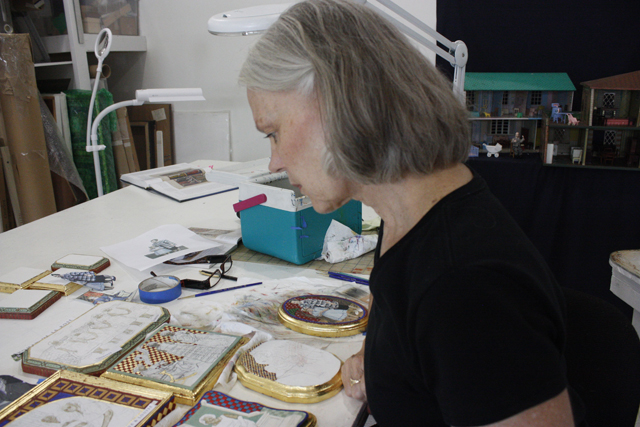
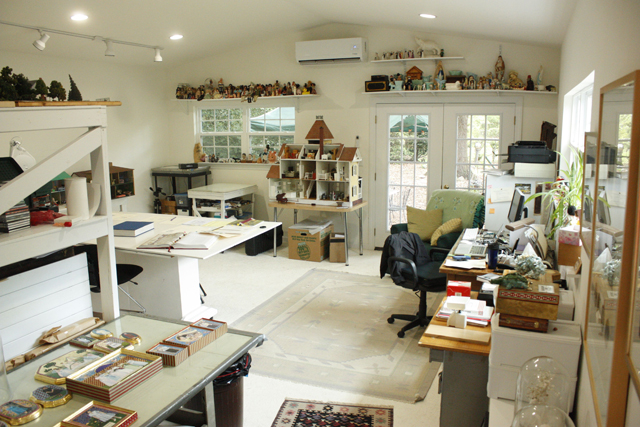
My studio has been at my home for the past 18 years and currently is a building in my back yard. Depending on what I am working on – painting, sewing, printmaking, or video my studio practice is pretty close to the traditional notion of an artist alone in the studio. I begin my day by getting into the studio every morning as early as I can. I exercise, eat and then go to the studio, knock around a bit – check email, do paperwork, etc. and then start to work.

When printmaking or painting, my work begins as I look through my collection of catalogs of Medieval and Renaissance altarpieces and manuscripts and also as I work on the computer by scanning, manipulating and printing from my collection of family photographs. Somewhere in all this an idea or a kind of theme takes hold and then I build an image around it, looking for the right combination of photos and a design that tells “the story,” like a predellas on an altarpiece

Process is an important aspect of my work – when painting I use traditional grounds or vellum, egg tempera and gold leaf. Process is also an important part of printmaking as well as the sewing and video work that I do.

In the digital photo collages I begin by sewing costumes. I research patterns, shop for materials and sew for several weeks, and then friends photograph me in front of a green screen. Using Photoshop and vintage 1940s advertising images or the photographs I take of the interiors of 1940s and 50s vintage metal dollhouses, I insert the images of myself performing traditional household tasks.

The stop-motion video work can take months or even years to complete as I tend to work on these over time breaking and beginning again as time permits. I build miniature landscapes and interior models, sew tiny dolls clothes, collect dolls, furniture and objects and also create the audio component I use in the films.

Significant Moments in the Life of My Mother Egg Tempera and gold leaf on panel 41” x 51” 2010

Significant Moments in the Life of My Mother
Egg Tempera and gold leaf on panel
41” x 51”
2010

What unique roles do you see yourself as the artist playing that you may not have envisioned yourself in when you first started making art?

Initially I envisioned myself as a teaching artist, which I did a little of earlier in my career. However, at this time in my career and life I am primarily engaged in studio practice or household activities. Feeling the sense of time passing I am content with this and to just do the work, “finish my story”, so to speak. Also, in the beginning of my career I thought of myself as a painter/printmaker and never envisioned myself using technology or making videos as I do now.

When do you find is the best time of day to make art? Do you have time set aside every day, every week or do you just work whenever you can? 

Being a morning person, the best time of day for me to work is anytime from 5:00 AM up to about 5:00 or 6:00 PM. This schedule has always been somewhat controlled by other people’s expectations of my time, expectations like caring for children and their activities, preparing dinner, shopping, gardening and laundry, etc. While my schedule is more flexible now old habits die-hard.

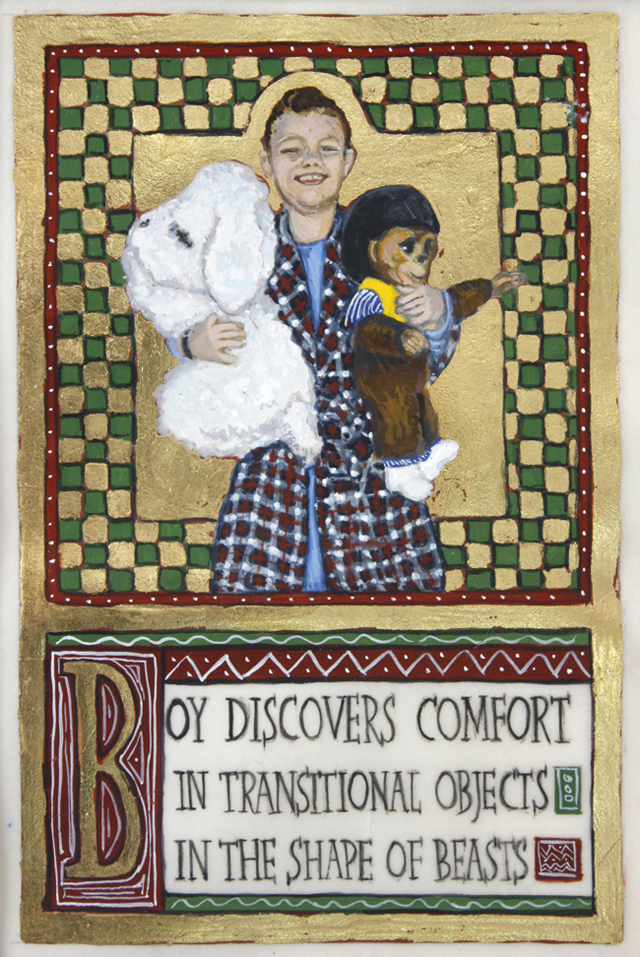
Boy Discovers Comfort in Transitional Objects in the Shape of Beasts Egg Tempera and gold leaf on vellum 8” x 5 5/8” 2011

Boy Discovers Comfort in Transitional Objects in the Shape of Beasts
Egg Tempera and gold leaf on vellum
8” x 5 5/8”
2011

How has your work changed in the last five years? How is it the same?

I was already working from family photos and telling stories within an altarpiece like format, when in 2009 I took a class in Medieval and Renaissance manuscript painting, a combination studio and art history course, and following that a residency at The McColl Center in Charlotte, NC. This combination of new sources of information and materials along with the advantages of limited distractions during a 3-month long residency, initiated a unique direction in my work.

Are there people such as family, friends, writers, philosophers or even pop icons that have had an impact on the work you do?

My family has had the most impact on the work that I do as I have always had an intense longing and nostalgia for family or the idea of family. Both of my parents were only children. We had very few relatives and those we had all lived in Buffalo, NY and we lived elsewhere. Even now my own children live far enough away that I seldom see them or my grandchildren. My siblings are spread out in age, two sisters are 9 years older and 6 1/2 years younger and my mentally handicapped brother is 5 years older. He was always the child with the most significant needs and the reason I started looking so carefully at family photos. I feel inspired by my parents, most specifically by my mother who managed through it all to do her “job” as she described it, and do it well, which is probably why “keeping house,” the value of woman’s work and family has become such a significant theme in my work.

If you had an occupation outside of being an artist, what would that be and why?

I’m not sure what I would do if I was not an artist but it would probably be in some type of service industry like event planning or something related to gardening and landscape. I think that would be creative and allow me the flexibility to move around and keep from sitting at a desk and/or standing or sitting in one place.

About

4.KRyba_HeadShot_365artistsKristi Ryba paints, sews, gardens, photographs, cooks and makes prints and videos in her studio and home in Charleston, South Carolina. Trained as a printmaker and painter Ryba graduated Magna Cum Laude from the College of Charleston in 1988. Ryba received her MFA from Vermont College in 2006, and has participated in residencies at Vermont Studio School in Johnson, Vermont, Studio Camnitzer in Valdotavvo, Lucca, Italy and The McColl Center in Charlotte, NC. In 2012 Ryba was selected as the SC Arts Commission Alternate Visual Arts Fellow. Exhibiting since 1990 Ryba’s. Her video animations debuted at Silo in New York City in 2004 and 2006, Contemporary Charleston in 2004 and have been included in film festivals across the country.   More recently Ryba’s work has been exhibited at ArtFields 2014, 701 Contemporary Center for Art and Columbia College in Columbia, SC; Southern Ohio Museum in Portsmouth, OH; Waterworks Visual Arts Center in NC; The City Gallery at Waterfront Park, Charleston, SC; Sumter Gallery of Art, in Sumer, SC; and Dialect Design in Charlotte, NC. Currently Ryba’s work is included in the Fall Share of the inaugural year of Charleston Supported Art, a platform to connect emerging and established artists and collectors. This fall her work will be exhibited at Gertrude Herbert Institute Of Art in Augusta, GA. In 2016 her work will be included in the exhibit The Red Suitcase, one of 11 artists, whose work will all fit snugly into a red suitcase that becomes the exhibit and travels to various exhibit locations.

The Studio

The Studio

www.kristiryba.com

All images copyright of the artist and used with their permission.

Posted in Uncategorized | Tagged , , , , , , | Leave a comment

Natalie Abrams – Charlotte, North Carolina

untitled 13.08

reef studies: west 82.169 north 23.19

Briefly describe the work you do.

My work is rooted in the concept of systems theory and explores the relationships which develop between species in biodiverse ecosystems and how those relationships are mirrored between people in the urban environment. Furthermore, how both natural and urban systems are affected by external stressors such as climate change, loss of habitat and loss of bio-diversity.

My sculptures consist of vibrant yet unidentifiable creatures and delicate environments created using both organic mediums and man made materials which are new or diverted from the waste stream. Using these different substances, I create playful landscapes which break down to reveal their fragile underpinnings of a system in flux. 

I’m also launching a new project, Define Earth, where my partner and I will sail to different coastal locations experiencing some form of environmental degradation, creating responsive artwork. In each location, we’ll meet with local organizations working to correct the damage, blog about the findings and I’ll create artwork centered around the issues to help draw attention to the challenges they, and we as a planet, face.

Tell us a little about your background and how that influences you as an artist.

I grew up running around outside and exploring everything nature had to offer. My family moved around a lot, so I always had a fresh place to explore. I think that contributed to being abnormally observant. Being fairly introverted, I also spent a lot of time alone and developed a very vivid and active imagination.

I learned about systems theory as a small child, and grew up seeing the relationships which form the structure of our lives. That concept, along with my connection to place and nature, formed the basis for my work.

I have a background in architecture, construction and project management. I find those interests have continued forward into the structure of my work; how I design and build my pieces, as well as how I see environments as urban areas.

creature documentation

Mari Flore Damnatis sp. Mlif-ral Rebeus and sp. Mlif-ral Dura Caerulus

The concept of the “artist studio” has a broad range of meanings, especially in contemporary practice. The idea of the artist toiling away alone in a room may not necessarily reflect what many artists do from day to day anymore. Describe your studio practice and how it differs from (or is the same as) traditional notions of “being in the studio.

For years, I’ve been a very traditional studio based artist although what I used for a “studio” varied. In the good times, I had a dedicated studio to contain my madness. In the bad times, I had a corner of the living room barely larger than the tables I worked on. 

Over the last 15 months, I began to break up that practice by completing three residencies at the McColl Center for Visual Art, Escape to Create and the Sam and Adele Golden Foundation for the Arts. These residencies gave me the space and resources to expand my work beyond the limitations of my small studio. The residencies also enabled me to begin exploring new work and new mediums. I find the change of environment and exposure to artists working in completely different ways to be really stimulating. I mainly focus on my signature body of work in my own studio, but use the time at residencies to really explore new avenues and ideas. These breaks have been particularly important this year as I prepare for huge changes in my “studio” practice. 

At the beginning July this year, I’ve been transitioning from living in an apartment with a studio and wood shop, to living on a sailboat and beginning a multi-year environmental art project, Define Earth. In each location I sail to, I’ll be creating new methodologies of how and where I work, including what mediums I use. Some of the tools and materials will be the same, but I’m learning how to be much more flexible in my practice.

latex_14.01-house_paint_on_panel-30x60x12-2014What unique roles do you see yourself as the artist playing that you may not have envisioned yourself in when you first started making art?

It never occurred to me that, through my artwork, I would become an activist. 

When I first started painting, I envisioned that stereotypical notion of artist. Isolated in a studio creating. The work was mostly non-objective and I maintained a very neutral position within the concepts. 

Over time, and through many conversations with different people, I decided I needed my work to take a stand. To mean something. It is the best means I have of communicating my ideas and fear. I go back and forth about how aggressive to be with my work. In the end, I always come back to building relationships. Establishing a connection between the viewer and those whose lives are falling apart because of our careless decisions. 

When do you find is the best time of day to make art? Do you have time set aside every day, every week or do you just work whenever you can? 

I’m very fortunate in that I’ve been free to focus full time on my creative practice for the last few years. Even with that freedom, my schedule varies. I’ll go for months developing ideas and concepts, conducting research, working on the business side of my practice, etc., but without actually creating work. Once I’ve reached a place where I’m ready and set up for working, I become almost manic and that period itself can last for several months. Residencies have provided a lot of that dedicated time and space to complete work. 

My work habits are still evolving as I transition from the traditional studio format to working from a sailboat in continually changing environments.

How has your work changed in the last five years? How is it the same?

The aesthetic is the same, albeit evolved. The concepts behind the work have completely changed. Where the work had been completely non-objective, once I gave myself permission to be forthright about my interests and intent, everything about my artwork, practice and life changed. While I’m still completely in love with the creation of new work, and the work’s development is just as crucial to me, the information and concepts behind the work have become equally if not more important.

During Define Earth, all aspects of the process will really be exposed. The transition and exploration of new locations and populations, the research end of the project and the creation of the artwork. 

Are there people such as family, friends, writers, philosophers or even pop icons that have had an impact on the work you do?

The people I find most inspiring are those who lead interesting lives. Those who reach beyond their comfort zone to experience new things. Leaders who exhibit grace while standing up for what they believe in. 

My work is more directly influenced by artists and projects that provide tangible links between people and their environment. “Human/Nature: Artists Respond to a Changing Planet”, tasked eight artists to create work after visiting and examining changes in bio-diversity at different locations. Mierle Laderman Ukeles’ “Unburning Freedom Hall” created a personal link between the viewer/participant with ‘unburnings’; pieces which held symbolic representations of what participants wanted to honor and give to the world. Eve Mosher’s “HighWaterLine” and Maya Linn’s “What is Missing?” are subtle artistic works which demonstrate the real effects of environmental degradation and loss of bio-diversity.

There are a number of artists, some I know personally and some I don’t, whose work I really admire. They inspire me to work harder, reach farther, be more than I really ever thought I could or would be.

If you had an occupation outside of being an artist, what would that be and why?

I’ve had a number of different careers outside of being an artist, but I can honestly say what I’m doing now is exactly what I should be doing.

About

Through exhibitions across the country, natalie abramsAbrams’ work has increasingly focused on symbolic use of materials to explore environmental and social issues. Her process utilizes both organic materials such as beeswax and wood, and increasingly inorganic materials otherwise destined for landfill, to create works representing theoretical landscapes.The incorporation of these new materials creates a more thorough representation of the issues Abrams explores, as well as will become the foundation for a long term life-as-art project focused on the parallels of life and viability amongst bio-diverse ecosystems and the urban landscape. In its simplest terms, a circumnavigation exploring environmentally threatened areas and the populations dependent on those areas, with the findings being used to develop site specific installations, exhibitions and publications.

Abrams’ work has been exhibited in national invitationals including the Third Annual Encaustic Invitational, as a highlighted artist at Ball State University with Encaustic Works 07, as well as the 2010 book “Encaustic & Beyond”. “Losing Ground, Gaining Perspective”,Abrams’ first curatorial project, was held at Gallery X at Castle Hill, Provincetown, MA including work by noted artists Laura Moriarty, Lorrie Fredette and Paula Roland and herself. Additional exhibitions include “Dear Nature” at Artspace, Raleigh and “Objects in Perspective” with Aspen Hochhalter at the Gaston County Museum, a solo exhibition “Beneath the Fold” at City Ice Arts in Kansas City, MO and an expanded presentation of “Objects in Perspective” with Aspen Hochhalter at CPCC in 2014. Residencies including the McColl Center for Visual Art, Escape to Create and the Sam and Adele Golden Foundation for the Arts have helped Abrams’ further explore our relationship to our surroundings in the form of multimedia sculptural landscapes and topography.

www.natalieabramsartworks.com

All images copyright of the artist and used with their permission.
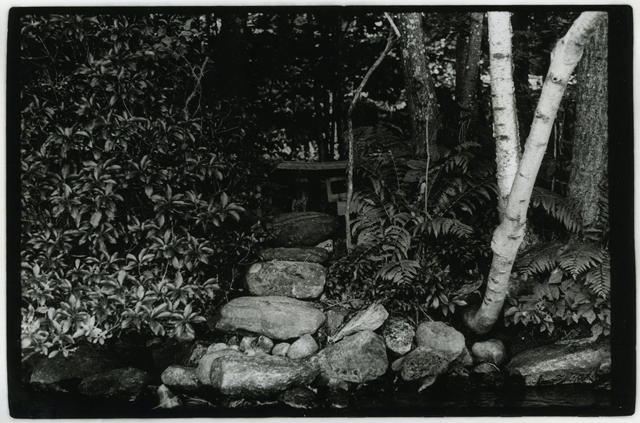
Posted in Uncategorized | Tagged , , , , | Leave a comment

Chris Mortenson – Iowa City, Iowa

1.Dennis Dutton Pigmented Inkjet Print 16x20 2013

1. Dennis Dutton
Pigmented Inkjet Print
16×20
2013

Briefly describe the work you do. 

My work is about the ways that we define our experiences with the natural world through the use of images and the methodologies we use to share these experiences with one another. 

At what point in your life did you want to become an artist?

My work with the landscape goes back to a long interest with natural spaces.  The first time I can remember being truly awestruck with being outdoors was a family trip to the Black Hills in South Dakota when I was around four years old.  The most powerful moment from this trip – and honestly the only thing I actually remember – was leaving.  I remember sitting in the back seat of the van crying because I wanted to stay and I watched out the back window until they completely vanished from view.  That was a turning point and as I grew I wanted to spend as much time as I could outside.  My love for the outdoors permeated my work from an early point in my career as an artist. 

The concept of the “artist studio” has a broad range of meanings, especially in contemporary practice. The idea of the artist toiling away alone in a room may not necessarily reflect what many artists do from day to day anymore. Describe your studio practice and how it differs from (or is the same as) traditional notions of “being in the studio.”

My studio practice is in some ways very traditional and in other ways very untraditional.  I live in Iowa City and teach at two different colleges, which puts me on the road a lot.  One college is about 60 miles away and the other is 25 miles away, which has led to a necessity of being able to consider anyplace a studio.  I have a main studio set up in my basement, which is really a place I can make frames and hang work-in-progress to consider while I am at home.  I also use both of my offices, a design and digital photography classroom, a table in my living room, the couch, and my car to create and contemplate work. 

3.John Morrell Pigmented Inkjet Print 16x20 2013

3. John Morrell
Pigmented Inkjet Print
16×20
2013

What unique roles do you see yourself as the artist playing that you may not have envisioned yourself in when you first started making art?

I never saw myself using digital processes to create work when I began. I was very stubborn and reluctant to work digitally when I was in undergrad.  I learned digital when I was in graduate school and became known for the compositing that I do.  In fact, I used to get in arguments with my father about the merits of digital photography and digital media in general and he still gives me a hard time about how long it took me to start working digitally.

When do you find is the best time of day to make art? Do you have time set aside every day, every week or do you just work whenever you can? 

I work best in the afternoon into the early morning.  Something about the rhythms of production seems to coincide with the day turning into night and beyond.  I have tried to be productive in the morning, and I can get some work made, but I like mornings as a time for reflection, walking, and coffee.  In fact, I recently had a conversation about how 6am to 7am is the best hour of the day.

2.John Engelbrecht Pigmented Inkjet Print 16x20 2013

2. John Engelbrecht
Pigmented Inkjet Print
16×20
2013

How has your work changed in the last five years? How is it the same? 

Five years ago I was a graduate student working like mad to produce my thesis show, teaching, and applying for jobs and I was producing large quantities.  In the time since graduate school, I have worked less on my photographic work, but I have still been able to create work.  I have begun drawing more and worked on a series of drawings that are given away when finished, as they are a practice of staying productive more than work for consumption.  Photography is still an important part of my practice and it has recently started becoming the main medium I use once again, though I don’t really like to define my work in terms of mediums.  I have woven in and out of using different mediums and feel as though my work on a whole, while still maintaining the overall theme of landscape, has become more fluid.

How has your work changed in the last five years? How is it the same?

Early in my studies of art, modernist photographers who showed the power and majesty of the landscape influenced me.  I wanted to photograph in this manner because I loved being in these settings, yet I was never happy with my results.  I realized that the landscape I was moving through wasn’t the landscape I was making work about.  I was living in and visiting a landscape full of tourism, recreation, mineral extraction, ranching, and many other things.  Places like Mt. Rushmore, Wall Drug, and The Six Ton Prairie Dog became influences to my work.  Artist that influence me today are the artists of the New Topographics and Joan Fontcuberta.

Are there people such as family, friends, writers, philosophers or even pop icons that have had an impact on the work you do?

I actually have thought about becoming a glaciologist though it is literally a disappearing profession.  I love the cold and thoughts of climbing around on glaciers doing fieldwork are an exciting prospect.  I recently read the book Cold: Adventures in the World’s Frozen Places and thoroughly enjoyed every minute of it.   

About

HeadshotI am interested in the ways that we define our experiences with the natural world through the use of images and the methodologies we use to share these experiences with one another.

chrismortenson.com

All images copyright of the artist and used with their permission.

Posted in Uncategorized | Tagged , , , , | 1 Comment

Patrick Romine – Brooklyn, New York

Flying Fish 36”h x 22”w, Oil on linen, 2011

Flying Fish 36”h x 22”w, Oil on linen, 2011

Briefly describe the work you do.

I began as a portrait and still life artist in the 1980’s. Portrait painting is probably the hardest and most rewarding genre. Not just getting a likeness, anyone can be trained to do that, but exploring and capturing in paint a sitter’s character and personality. Everybody has a story and asking the sitter questions about their life and getting them to open up is a way of discovering what they’re all about. I preferred asking people to pose for me rather than taking on commissioned portraits because those are all about vanity anyway. I liked to find people who were also artists or musicians because they tended to be more interesting people to spend time in the studio with.

In 2008 I went back to school to get an M.F.A. at the New York Academy of Art. The experience caused me to branch off into new directions. In my new work I’m painting scenes that are based on things I’ve personally witnessed or from childhood memories. I work primarily in oils on either canvas or panels.

This latest body of work involves a lot of photo references. I take random photos everywhere I go. I then piece them together in surprising ways in Photoshop creating a collage of different images. I like to juxtapose contrasting images. It can be disturbing as well as beautiful.

At what point I your life did you want to become an artist?

When I was a teenager I began taking drawing and oil painting classes at a museum school. There was a feeling of community and I was instantly drawn to it. All the instructors were working artists and some taught at a nearby university. On occasion I would visit their home studios and marvel how the rooms were filled with many works in progress. I loved watching these older artists create things out of thin air. A blank canvas would become animated within a short time.

We also had a neighbor that was renting a garage apartment to an abstract painter who went by the name of John Kennedy, this was the 60’s so the irony was not lost on me. He was an eccentric character and gave our upscale residential block a bit of color (literally, his clothes were splattered with paint) and unpredictability. Maybe that had something to do with it too. 

Big Wheel 52”h x 38”w, Oil on linen, 2014

Big Wheel 52”h x 38”w, Oil on linen, 2014

Tell us a little about your background and how that influences you as an artist.

I grew up in Tulsa, Oklahoma. We had two really good art museums and a local music scene. Philbrook Art Center, was in my neighborhood. My family had a membership so I spent a lot of time there looking at everything from Impressionist paintings to Egyptian mummies. I caught the art bug at an early age. I grew up around music. Lots of my friends played in bands. My brother even had a band, still does in fact. And there were great venues like Cain’s Ballroom where local bands could share the stage with everyone from Iggy Pop, the Sex Pistols to country or jazz bands.

What types of conceptual concerns are present in your work? How do those relate to the specific process(es) or media you use?

I am mainly concerned with light and space. For me this is what gives the scene its mystery. My latest body of work involves memories of past experiences as well as personal experiences. I want there to be an almost surreal quality to the scene but still feel tangible and realistic. That is why I use oil paint and work in a traditional manner. It’s still the best way to convey these ideas.

4.Apocalypto 60”h x 54”w, Oil on linen, 2013

4. Apocalypto 60”h x 54”w, Oil on linen, 2013

We once heard Chuck Close say he did not believe in being inspired, rather in working hard everyday. What motivates you in your studio practice?

I think I tend to agree with Mr. Close. You have to show up for work at your studio every day. These paintings don’t paint themselves. Even if you’re going in circles and having a bad day at least you’re going through the process of working out ideas and problems. Eventually something will come together and you will catch that inspiration you’re been chasing. Who knows what inspiration is or where it comes from but you’ve got to put in the hours and the labor to make it happen. Sometimes I will get stuck on a problem with a painting and I find myself sitting there staring at the canvas for hours. Then something happens and maybe I wind up going in an unexpected direction. But that’s part of the process too. 

What artists living or non-living influence your work? 

That list changes over time depending on what I’m doing. Contemporary artists like Vincent Desiderio, Odd Nerdrum and Steve Assael are big influences on me now. I’m also into the late 19th century realists like Joaquín Sorolla and John Singer Sargent who painted with large brush strokes and intense color.

I’m also a bit of a film geek. I watch a lot of movies, new ones as well as classics. Wes Anderson is a current filmmaker that inspires me. That guy can really fill the screen with incredible visual imagery. I’m not always sure what the story is but it’s great to get lost in. 

When you are not making art what types of activities and interests do you engage in?

I watch a lot of movies when I’m at home. I love discovering new directors. Lately, I went through a phase where I watched nothing but Romanian and Czech films. They have a visual sensibility and a humor that I alternately don’t understand yet find fascinating. I travel when I can. These are mostly art pilgrimages to Europe where I visit the great art museums as well as search out small out of the way ones. Every small town has a museum and I can always find a few gems.

About

1. My studioPatrick Romine is a realist artist who works in traditional oil painting methods. He began his career in Tulsa, Oklahoma where he grew up and developed his sense of color, light and space. He moved to New York City to study at the Art Students League in the early 1980’s. During this time he worked as a graphic designer for the New York Shakespeare Festival. He has been represented by galleries in Santa Fe, New Mexico and has exhibited throughout the New York area as well as Vancouver, Canada. He specializes in figurative pieces and still life. He recently received his MFA from the New York Academy of Art and currently resides in Brooklyn and has a studio in the Gowanus area.

In the Studio

In the Studio

www.PatrickRomineFineArts.com

All images copyright of the artist and used with their permission.

Posted in Uncategorized | Tagged , , , , | Leave a comment