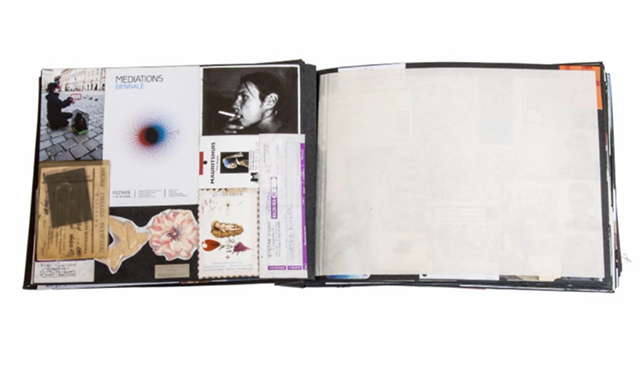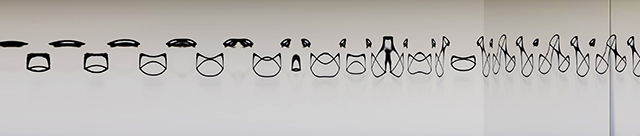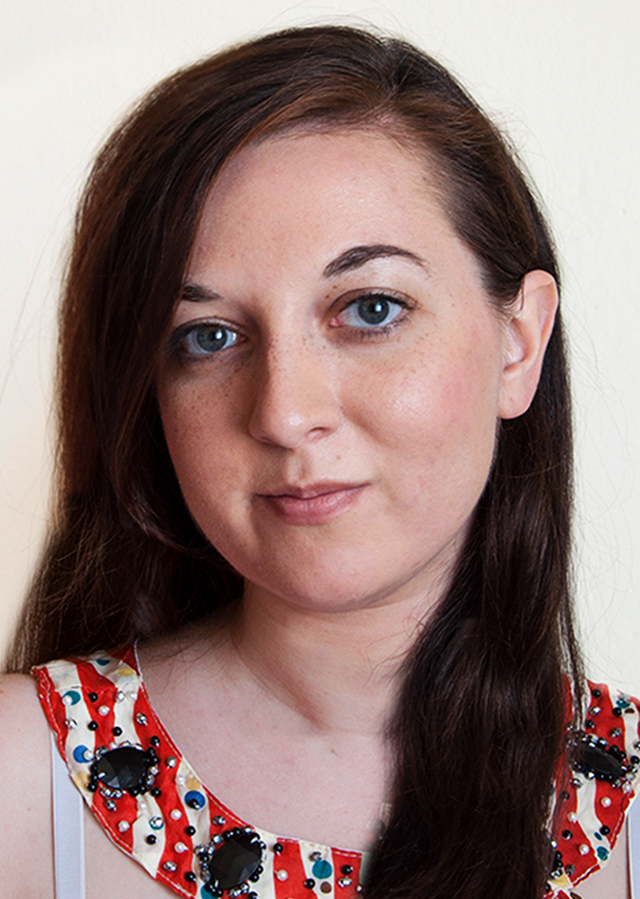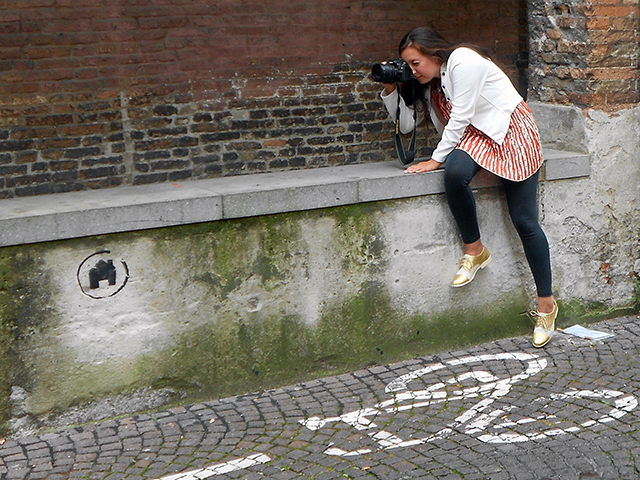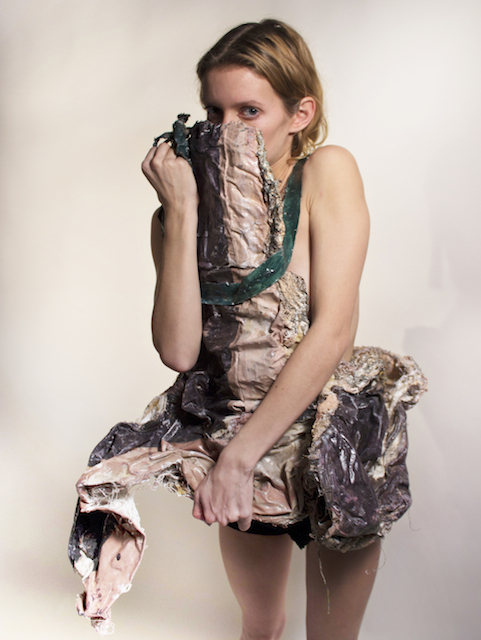
Julia Betts – Pittsburgh, Pennsylvania

Withdraw Digital photograph  2013

Withdraw
Digital photograph
2013

Briefly describe the work you do.

I investigate the idea of transience and self through choices in material and process as part of an interdisciplinary art practice. Impermanent materials such as masking tape, scotch tape, ground digital images act as surrogate for the body. The materials go through stages of accretion, removal and regeneration through both physical intervention and natural degradation. For example, in “Debris,” layered, rolled, then sawed images of the body create stone-like debris. Through these actions, I relate myself to geological processes of erosion and sedimentation. In a related piece, “Detritus,” shredded self-images of the body accumulate into layers of dust. Through grinding images of myself with a grater, the essence of the images is explored and the “body” grows. In both “Debris” and “Detritus”, the colors are incidental to the photographs I use as source material. In these pieces, I am contemplating the daily loss and growth of the body.
Tell us a little about your background and how that influences you as an artist.
As a child, art wasnʼt especially interesting to me. Renaissance and academic art were my only references as to defining art. But, going into college, for the first time, I was exposed to contemporary art. Contemporary art excited me. In contemporary art, I saw limitless possibilities because anything is permissible (if grounded in conceptual or aesthetic reasoning). Parts of my personality that werenʼt being utilized finally found an outlet. My introspectiveness became my interest in self-portraiture. My need for independence became my love for inventing and initiating my own unique processes.
The concept of the “artist studio” has a broad range of meanings, especially in contemporary practice. The idea of the artist toiling away alone in a room may not necessarily reflect what many artists do from day to day anymore. Describe your studio practice and how it differs from (or is the same as) traditional notions of “being in the studio.”
Due to the expense of buying a studio space, I converted a bay of the garage of my home into my studio space. Although I often work there, I can work anywhere because my work doesn’t require heavy, expensive machinery. I carry bits and pieces of my art around with me and I start working whenever I feel the impulse. I love to work anywhere… a park bench, the library, the kitchen, in the grass at a park. Working in public places generates a lot of useful public feedback.
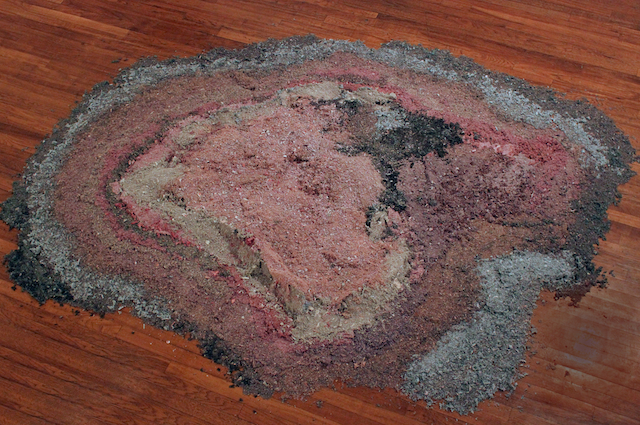
Detritus Ground self-images  2014

Detritus
Ground self-images
2014

What unique roles do you see yourself as the artist playing that you may not have envisioned yourself in when you first started making art?
When I first began to exhibit and do residencies, I didn’t realize the potential impact that artists have in the economic rejuvenation of areas. This is because of the energy and activity that arts bring. I’ve realized that artists often lead the vanguard in rejuvenating communities. Artists take advantage of areas with cheaper rent– galleries that are set up in these areas often helps turn the area around. Recently, I did an artist residency at Second Sight Studios in Columbus, Ohio in an area called Franklinton. I felt like I helped in a small way by just making and showing work and engaging the community in that way. Another burgeoning area that I am showing in is Braddock, Pennsylvania at Unsmoke Systems on September 13th. The goal of Unsmoke Systems is to revitalize the area through the arts. To learn more about my show at Unsmoke Systems, click here: https://www.facebook.com/events/1517910988438951/
When do you find is the best time of day to make art? Do you have time set aside every day, every week or do you just work whenever you can?
I work on art late at night in long spans of time. When i donʼt have time to make art I focus on the business side of art (researching exhibition opportunities, applying to shows). The best time to come up with ideas is in between sleeping and waking. During this time, your mind is flexible and able to make connections easily and quickly.
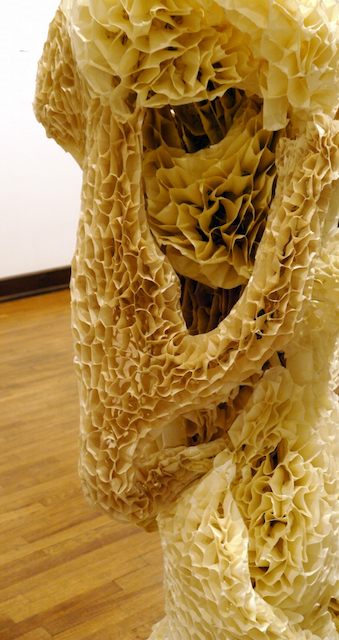
Accretion  Masking tape  2014

Accretion
Masking tape
2014

How has your work changed in the last five years? How is it the same?

Unavoidably, self-portraiture and introspection continue to be at the core of my work. I donʼt intentionally go after these concepts, but they form the core of my body of work. Talking to my professor about this, she said, “You canʼt be anyone else but yourself”. The concepts within my body of work are so deeply ingrained in my personality that I couldnʼt possibly avoid them. Also, more and more, digital seeps into my work. Digital is technically difficult for me, but I try to go towards things that make me uncomfortable.
Are there people such as family, friends, writers, philosophers or even pop icons that have had an impact on the work you do?
Other than Janine Antoni and Eva Hesse, the philosophical ideas of “ontology” and “essence” impact me. Ontological questions the meaning of being, existence, and reality. Searching for the “essence” of materials is also important in my work. Essence is the fundamental characteristics that make an entity what it is.
If you had an occupation outside of being an artist, what would that be and why?I am interested in being an art professor after I get my MFA. Being a professor at a university would give me an automatic community of dedicated, talented peers.
About
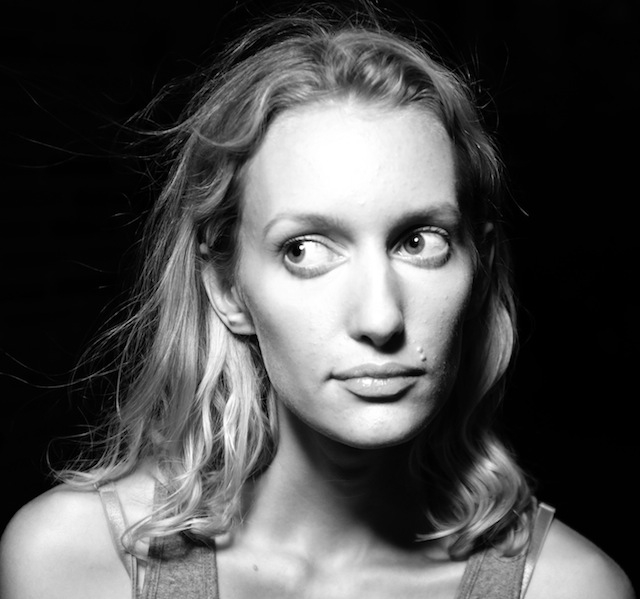
IMAGE 1Julia Betts was born in 1991 in Mechanicsburg, Pennsylvania. In April 2014, Betts graduated from the University of Pittsburgh with a Bachelor of Arts leaving with six awards recognizing potential, leadership, and excellence within the Studio Arts department. Also, she received two Undergraduate Research Grants from the Office of Undergraduate Research. Since graduating, she has shown her work in exhibitions within and outside of Pittsburgh. Betts has exhibited in solo shows at Second Sight Studio in Columbus, Ohio and Unsmoke Systems in Pittsburgh, PA. Her numerous group exhibitions include “Identity Material” in Pittsburgh, “8 Hour Projects: Loss” in Meadville, PA, and “Construct” at Pittsburgh Center for the Arts. This year, she completed an artist-in-residence program at Second Sight Studio and will soon have her next residency at Bunker Projects.
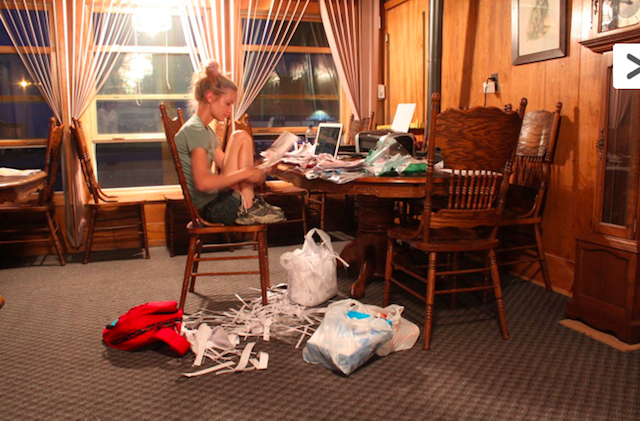
My studio ritual of cutting out pieces of paper prior to grinding images.

My studio ritual of cutting out pieces of paper prior to grinding images.

All images copyright of the artist and used with their permission.
Posted in Uncategorized | Tagged , , , , | Leave a comment

Christina Gregor – St. Louis, Missouri

it’s been so long since we last spoke acrylic and graphite on paper 10”x8.25” 	2013

it’s been so long since we last spoke
acrylic and graphite on paper
10”x8.25”
2013

Briefly describe the work you do.

I’m primarily a pleasure artist, though perhaps a pensive one. In all of the whimsy, the meaning is wholehearted. So even that which is in jest is also genuine. The bodies of work vary in process and form, but there are common aesthetic and conceptual threads. The media ranges from drawing and mixed media on paper to sculpture and installation often utilizing manipulated everyday and upcycled materials.  

The recent drawings are mainly narratives. Both sweet and sad, they focus on the search for identity and belonging. Addressing the security and vulnerability of connection, they straddle the moment when aloneness is broken. The characters are caught in sometimes tragic scenarios in which their desire and hope trumps the fear or anticipation of pain.

The installation work also spawns from the concepts of identity and belonging, but through nesting, domesticity, and home. It stems from how we might identify ourselves through collection, ritual, and routine. Highlighting the importance of place as a definitive component of self.

Tell us a little about your background and how that influences you as an artist.

I was raised to value exploration, curiosity, and innovation. I was also not a stranger to change. Adaptation has been a helpful tool for survival and forward motion. I’m not too inconvenienced by a change in plans. I improvise often.

I was an introverted kid. Though outgoing, I’m still fairly introverted now. I value my solitude and insular forms of entertainment. Those pastimes have included drawing and other forms of crafting in a fairly prominent way for a long time. Going to school for art was a natural trajectory. My emphasis in studio art was printmaking, which I employed most heavily in undergrad. I was drawn to the novelty of process. I still cherish process, but it now manifests itself in an interdisciplinary way.

(detail)  i’ll be rooting fur you cut plastic bags, fused plastic, cardboard, mannequin 2014

(detail)
i’ll be rooting fur you
cut plastic bags, fused plastic, cardboard, mannequin
2014

The concept of the “artist studio” has a broad range of meanings, especially in contemporary practice. The idea of the artist toiling away alone in a room may not necessarily reflect what many artists do from day to day anymore. Describe your studio practice and how it differs from (or is the same as) traditional notions of “being in the studio.”

My studio practices transition in tandem with a fluctuating lifestyle. I try to adjust the work to reflect where I am at any given time. I can’t say any of my rituals are particularly traditional nor particularly curious. Likely they fall somewhere in between. Studio time is typically split between stretches of quiet incubation and marathons of execution. A good deal of energy goes into idea development. Making can feel simple in comparison to refining a foundation for the next new thing. I try to keep a sketchbook on hand always. Like having one foot in the studio. When I have my hands in the thing that will be a finished product it is a little different. If I’m installing, I do as much as I can at the space. It differs with each venue. But if conditions allow, I immerse myself entirely in the install during those stretches of time. If I’m working on a drawing or portable work of any kind and I know where I am going with it, I tend to want to work through to completion as quickly as possible.

What unique roles do you see yourself as the artist playing that you may not have envisioned yourself in when you first started making art?

I’m not sure anymore what it was I first had envisioned when I set about on this escapade. Nor do I recall if I had foreseen what kind of artist I might be. I do make an effort to surprise and reinvent myself though. It’s a self-directed metamorphosis from which various roles have emerged. Storyteller. Collector. Nester. And all roles have been honest in life and art. Being an artist is a convenient excuse to explore eccentricities you might otherwise keep contained.

In the beginning, it is also unlikely I had thought thoroughly about the non studio aspects of being an artist. The business side of things is a challenging venture. Marketing and promotion is tough. I have moxy, but I never saw myself as having enough for that. I’ve learned to embrace a certain level of shamelessness. Because the things I do are made to be shared. To be seen. To be enjoyed by others.

When do you find is the best time of day to make art? Do you have time set aside every day, every week or do you just work whenever you can?

In general, the evening hours are my preference and my most fruitful. It’s quiet and private with fewer interruptions and distractions. And I get surges of late night energy. But it depends a great deal on what my schedule allows. Overall, I take what I can get. And those windows of time vary. It also depends on what stage the work is in. If I am working toward a predetermined product, then the time matters less. If I am still working out the process or the concept, I need more peace.

when i was lost and looking down acrylic and graphite on paper  18”x27” 	2013

when i was lost and looking down
acrylic and graphite on paper
18”x27”
2013

How has your work changed in the last five years? How is it the same?

Storytelling has become a focus. I’m using more representational imagery. I’m less apprehensive to make work that might at first glance appear too precious, sweet, or sentimental. Titles and text have become more vital components. It is an opportunity to give the viewer extra insight or shift the context. In the case of the narratives they are usually a prologue or epilogue to the story. Overall, there is a level of expressiveness, intense energy, and awkward play that have been present in almost everything for a long time. But the nuances are constantly shifting. I change media, format, and process fairly often.

Are there people such as family, friends, writers, philosophers or even pop icons that have had an impact on the work you do?

As far as friends and family, where their influence starts and stops would be a hard line to draw. But I know I owe a great deal to all those past and present players. I am constantly seeking their insight. It is important to have extra eyes. And getting feedback from people who know me is invaluable. It helps with self awareness and forces a certain amount of objectivity.

I have my pool of favorite artists. Lygia Clark. Jessica Stockholder. Erwin Wurm. Sophie Calle. There are many others, but those sit high on my list. So many influences not necessarily author specific, but objects or images that resonate. Children’s books. Old cartoons. Kitschy animal portraiture. Mid century dinnerware patterns. I also love film. Noir to contemporary cerebral; Billy Wilder to Spike Jonze. I also binge watch tv series. So undoubtedly that stuff seeps in.

If you had an occupation outside of being an artist, what would that be and why?

I also teach art in higher education. I suppose that isn’t a hypothetical, but I love it. It has been a huge influence on me as an artist. I’m given the opportunity to share my passion with a group of people who are often similarly passionate. It’s fabulously enriching in a multitude of ways. And it is one scenario in which my potent opinions and brutal honesty are called for. I wouldn’t want to give it up any more than I would want to give up being an artist. Teaching has taught me a ton. I’ve also intermittently worked as a caretaker and companion to the elderly and disabled. While taxing, it satisfied a need to nurture. Both in caretaking and the classroom, it is about putting the needs of someone else first. And I enjoy that role.

Being involved in animal rescue would be great. Art therapy is something I have also considered. Or some other branch of social psychology. Academic writing would be fun. Probably centering on art theory and education. Or perhaps freelance lover letter writing.

About

headshotMade in the midwest, Christina Gregor was born in Park Ridge, IL in 1982. In 2004, she received her Bachelor of Fine Arts in studio art with an emphasis in printmaking from Webster University in Webster Groves, MO. Gregor went on to complete her Master of Fine Arts in studio art from Northern Illinois University (Dekalb, IL) in 2007. She has since continued making things, exhibiting nationally, and teaching studio arts at the college level. She currently lives and works in St. Louis, MO.

your whispers tickle  installation detail with melted plastic bottles  2011

your whispers tickle
installation detail with melted plastic bottles
2011

www.chrisgregor.com

All images copyright of the artist and used with their permission.
Posted in Uncategorized | Tagged , , , , | Leave a comment

Plantbot Genetics – Canada and United States

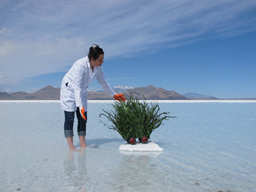
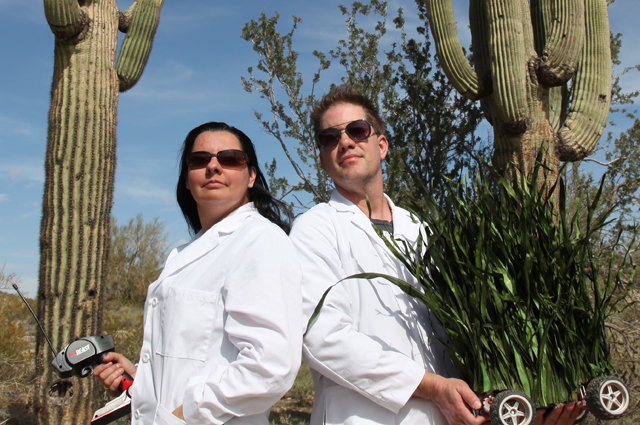
PlantBot Genetics Co-Founder Wendy DesChene with Monsantra PlantBot at Great Saltt Lake in Utah

PlantBot Genetics Co-Founder Wendy DesChene with Monsantra PlantBot at Great Saltt Lake in Utah

Briefly describe the work you do.

The collaborative team of Wendy DesChene (Canada) + Jeff Schmuki (USA) form PlantBot Genetics and link the environmental and social costs of bioengineered crops to a diverse array of creative operations and tactics. PlantBot Genetics parodies and satirically comments on the aggressive and misleading practices commonly employed by the biotech sectorWe can only guess what will happen to the world’s food supply after subsequent generations of genetically modified organisms (GMOs) and other transgenic modifications are inserted into food crops.  In answer to this, PlantBot Genetics Inc. grafts plants onto remote controlled robotic bases to become organisms with no clear heritage and no clear future. 

Tell us a little about your background and how that influences you as an artist.

Wendy and Jeff both hold MFA’s from prestigious universities. Wendy holds an MFA in Painting from Tyler School of Art and Jeff earned an MFA from the New York State College of Ceramics at Alfred University.  What influenced them to move beyond the limitation of making art in their concentration was an interest in art’s ability to generate dialogue. Both realized that art making that transpired in public spaces and involved the community created a more lasting impact than any single exhibition.  Inspiring a community to engage issues became paramount to making nice tidy objects that fit into the expected and often prescribed models. 

Our goal is to motivate the public to question current environmental systems while offering sustainable alternatives to industrial food and energy production. Those visiting our exhibitions, lectures, and workshops hopefully come away empowered and think differently about the natural environment.  

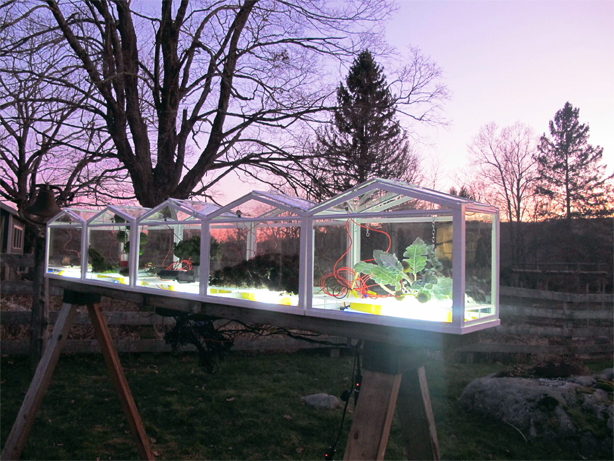
PlantBot Incubators, Refashioned commercial products, off grid pushbutton interactive research during  I-Park Residency, East Haddam, Connecticut.  2012

PlantBot Incubators, Refashioned commercial products, off grid pushbutton interactive research during I-Park Residency, East Haddam, Connecticut. 2012

The concept of the “artist studio” has a broad range of meanings, especially in contemporary practice. The idea of the artist toiling away alone in a room may not necessarily reflect what many artists do from day to day anymore. Describe your studio practice and how it differs from (or is the same as) traditional notions of “being in the studio.”

Our team uses the world as its studio and projects are designed to be mobile. We began with one remote controlled robo-plant and the second we took it to the street we realized we were in our studio. People came up to us to interact with the work and we soon realized the power in delivering a message with humor.  If we had stood on the soapbox and lectured, everyone would ignore us or cross to the other side of the street. We had discovered that by making people laugh, they would be curious, feel at ease, and come talk to us!

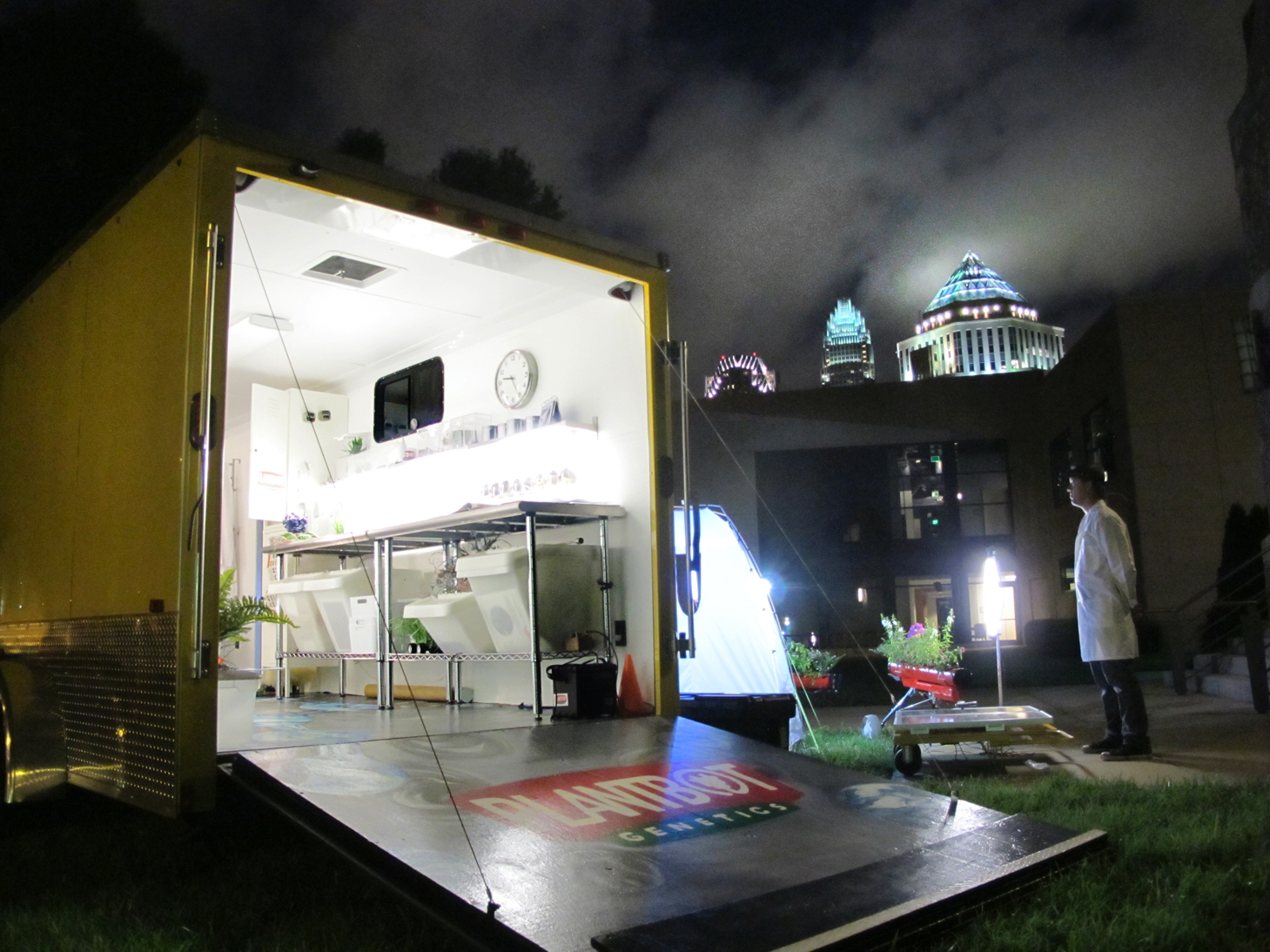
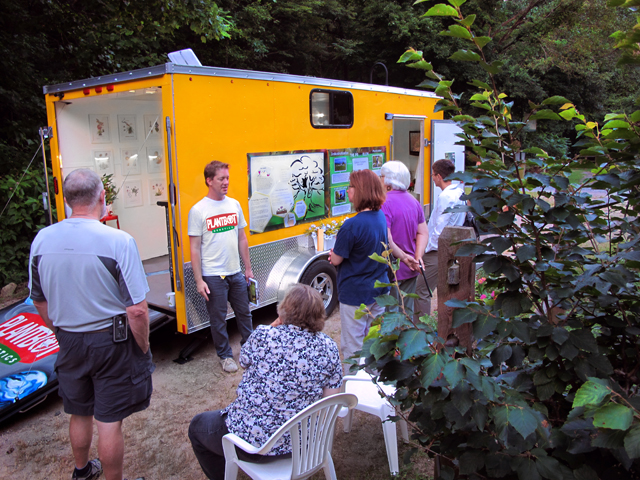
This removed all social and political boundaries that an art institution often has to grapple with. Our studio could literally interact with anyone from any background and culture.  In traveling around the world, the French, Koreans, Italians, and others all laughed and related to our PlantBots despite language barriers. As the project grew and the conversations became more complex, our studio evolved to keep pace.  Today, an 18’ off-grid trailer or ArtLab continues the street based experience. Painted bright yellow, a color that captures the dichotomy of caution and fun, the ArtLab can deploy in 15 minutes. Videos, computer art, interactive sculptures and drawings are found alongside a library of helpful information on food, gardening, composting, pollinators etc. that people can take.  Parking lots, festivals, schoolyards, street corners, forests and roads to anywhere can all be transformed into activated discussion spaces for the public.

What unique roles do you see yourself as the artist playing that you may not have envisioned yourself in when you first started making art?

Activism is a significant aspect of our practice. It is quite difficult for any beautiful, well-crafted and thoughtful art object to directly impact social justice issues when sitting in a gallery or a collector’s home. In fact how can anyone change the way society thinks about an issue without huge amounts of money?  A biased news corporation or a lobbyist with a multi million dollar company behind them can easily manipulate social thought, but what can an unfunded artist do? We both began our careers making well-crafted objects, but drifted away to this place we find more important that tries to answer these questions. History shows us that change can begin with one person and art that is interventionist and active has to power to try to generate positive cultural movement on issues.

Jeff lost his home, studio, community and teaching position during Hurricane Katrina and was treated poorly by the large insurance companies.  In the aftermath,  it was necessary for him to re-think and recreate who he was.  Although Wendy did not have anything as devastating happen, it was always clear to her that a painting had a very limited audience and if she really wanted to bring art to communities, she had to get it out of the art world and redefine it. 

ArtLab in Charlotte, North Carolina, 2013

ArtLab in Charlotte, North Carolina, 2013

When do you find is the best time of day to make art? Do you have time set aside every day, every week or do you just work whenever you can? 

Unfortunately we are workaholics.  We are partners in life as well as collaborators in art so our biggest challenge is slowing down to have a date night.  Also we are both academics as well as full time art makers and in order to do this well, we have given up much. Free time to be a normal couple is the thing we sacrifice the most and it seems we are always working and that there is very little time for anything else. It’s our hope that one day we can be in a place where this is not the case.

How has your work changed in the last five years? How is it the same?

We began working together in 2009, 5 years ago. Although we both had a fair amount of success on our own, our environmental collaborative work was suddenly doing really well. Our first video “Monsantra” took off and was displayed in several international film festivals months after we completed it.  This was a movie that we created in an hour and it was doing as well as work we had spent years on. That’s when we realized we had something and should really break down why it was working well. The entire PlantBot Genetics project boiled down to what made that first video successful and from there we kept building.  For Wendy it gave her a place to continue to play with the myth making of arts and artists in the project and also allowed her subversive tactics like street interventions to continue. Jeff was keenly interested in keeping elements of his garden lost to the storm along with the portability from becoming nomadic in the aftermath. For both of us, these familiar elements kept it exciting and moving forward.

In addition, one of the benefits to a creative collaboration is we do not have to shoulder the project all alone.  Together we both bring completely different skill sets and attitudes to the table.  Our personalities push the work to different areas and make it more complex. For example Wendy is more playful and optimistic, which helps balance out Jeff’s love of chaos and dissonance. Creating discussion is extremely important for it encourages a desire for knowledge and action.  PlantBot Genetics urges others to read up on current farming practices, GM products, pollinator decline, and to decide for themselves.  We know from experience the more we know about how our food is produced, the more we are called to action. 

Are there people such as family, friends, writers, philosophers or even pop icons that have had an impact on the work you do?

Environmental/Activist artists and scientists influence us, but more importantly we were influenced by the way we were raised. Both Wendy and Jeff spent much time outdoors as children. Jeff grew up in the Sonoran Desert on a gentleman’s farm. goats, snakes, drought and a harsh climate where a big part of his childhood. Wendy was raised at the center of the Great Lakes, and her dad built an off grid cabin in the woods on a lake when she was five. Every year her family spent all summer without plumbing or electricity in this beautiful spot. Both spent as much time as possible as children in these extremely different natural places.  Our work grows out of respect to the environment that formed us.  How can anyone turn his or her back on such an important influence when it is in trouble?

History proves change in our community, our country, and the world can begin with one person.  Change begins with a conversation that can lead to action and policy.  Recently in the US, the beef based food additive or “pink slime” was blogged on by one person. Sweeping changes resulting in the product being pulled from many food stores resulted.  The American public had unknowingly consumed this product for the last 20 years since it legally constituted up to 15% of ground beef without additional labeling. With regard to GMOs, I would say we need more transparency.  Label the foods that contain GM products and let the consumer decide, let the market decide. It is fair and right that we all know what is in our food

If you had an occupation outside of being an artist, what would that be and why?

This is a question every artist who is having a dry spell asks. We all have days when we dream of greener pastures. We think an artist who doesn’t dream about these things once in a while really isn’t putting it all out there.  If Wendy did become a baker or interior decorator, she would still be environmentally and community conscious. If Jeff was a carpenter or mechanic, he would still be socially aware and goal oriented. Bottom line no matter what job, we would be authentic, only the material of how we express ourselves and call ourselves to action would change.

About

1_jeffandwendy3smallPlantBot Genetics has exhibited and/or completed projects at the Pulitzer Foundation for the Arts in St. Louis, Missouri.Carnegie Museum of Art in Pittsburgh, the Goethe Institute of Cairo, Egypt, and the Bach Modern of Austria. In 2010, a significant contribution to their body of work was produced at the American Academy in Rome as visiting artists. Recent exhibitions include Foodture at the Elaine L Jacob Gallery of Wayne State University in Detroit, Michigan and PlantBot Genetics: a Critical Contact Exhibition Series at the Cafritz Foundation Arts Center in Takoma Park, Maryland, and artist lectures and studio visits at Long Island University in Brookville, New York.  Public projects while artists in residence at The Hafnarborg Art Center and Museum in Iceland and the McColl Center for the Arts in Charlotte, North Carolina has gained invitations to the Landscape Laboratory at Buitenwerkplaats‏ in the Netherlands, the KulttuuriKauppila Art Center in Il, Finland as well as the Studio’s of Key West Florida.

Art Lab

Art Lab

 www.monsantra.com

www.wendydeschene.com

jeffschmuki.com

All images copyright of the artist and used with their permission.
Posted in Uncategorized | Tagged , , , , | Leave a comment

Skye Gilkerson – Brooklyn, New York

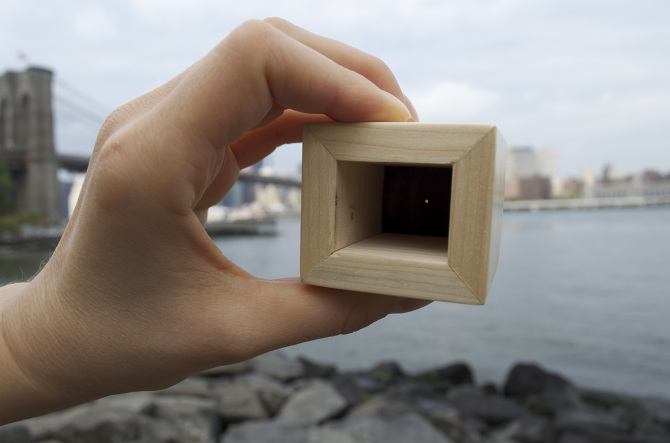
Pale Blue Dot Viewfinder (for Carl Sagan) wood, plexi, paper, ink, landscape 1 1/2" x 2" x  2 1/2"

Pale Blue Dot Viewfinder (for Carl Sagan)
wood, plexi, paper, ink, landscape
1 1/2″ x 2″ x 2 1/2″

Briefly describe the work you do.

Through location-specific installation, video and works on paper, I combine divergent elements from the places I have lived, exploring the social implications and possibilities of these relationships, as well as our relationship to nature. Having lived most of my life in the big-empty-quiet of rural, central United States, I am drawn to the potential of open spaces. I look for abandoned structures, overlooked regions: the places in the periphery that are unmonitored and less defined, or so common we forget to see them at all.
 
I use subtle interventions, constructed from ordinary, often ubiquitous materials, to unfold our awareness of our surroundings and destabilize familiar structures. Space, time, light, and language, as well as architecture, landscape, and changes in the weather all become the materials for this exploration. 

Tell us a little about your background and how that influences you as an artist.

My upbringing on a farm in South Dakota has a significant influence on my work. This was the actual setting of Little House on the Prairie–though I lived there 100 years later, the reference is not so far off. My upbringing involved a lot of self-sufficiency and making things by hand. There was something simultaneously magical and excruciating about the disconnect from pop culture in this setting. 

I’ve made a few pieces that address the prairie landscape directly, and I think that all of my work has some sense of the openness, emptiness, and quietness that is characteristic of that part of the world.

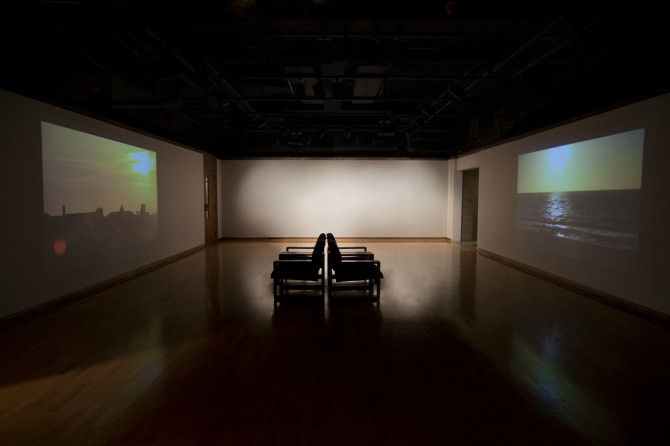
Unending dual channel video, each recorded at the same time on opposite sides of the earth size variable with installation 2013

Unending
dual channel video, each recorded at the same time on opposite sides of the earth
size variable with installation
2013

The concept of the “artist studio” has a broad range of meanings, especially in contemporary practice. The idea of the artist toiling away alone in a room may not necessarily reflect what many artists do from day to day anymore. Describe your studio practice and how it differs from (or is the same as) traditional notions of “being in the studio.”

The way I’ve managed to nurture my work is by cultivating a nomadic existence: piecing together different cities, jobs, communities, and especially art residencies. As a result, the physical space of my studio changes often. I’ve been moving and traveling quite a bit, which has helped me to develop a body of work exploring landscape and place.

I have such gratitude for these adventures, and now I am interested in the depth available through roots and stability and structure, although the particulars have yet to unfold.

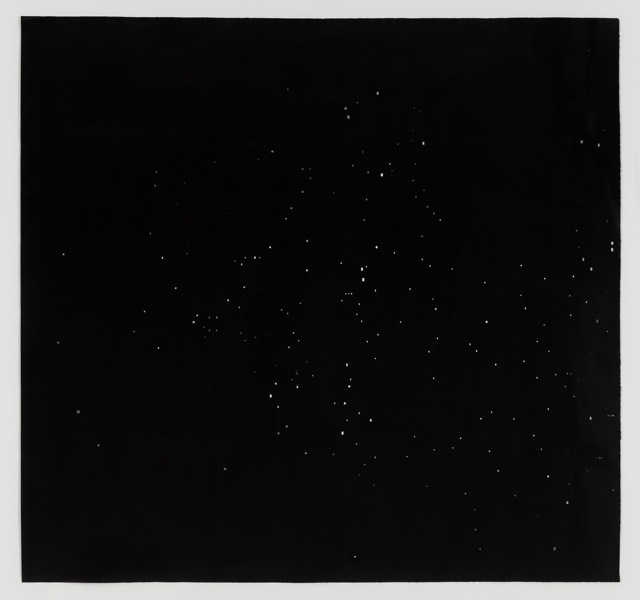
Wounded in West Texas unfolded page of the New York Times with punctuation removed, ink 22" x 24" 2013

Wounded in West Texas
unfolded page of the New York Times with punctuation removed, ink
22″ x 24″
2013

What unique roles do you see yourself as the artist playing that you may not have envisioned yourself in when you first started making art?

I suppose when I first started making art I was a child and didn’t see beyond the pleasure of making a line on paper or in the sand. Since then, I have been discovering the ways that art is connected to other disciplines, and how artists can serve broader culture in our efforts to make meaning.

When do you find is the best time of day to make art? Do you have time set aside every day, every week or do you just work whenever you can? 

Years ago I read an interview with Nick Cave (the singer, not the sculptor) in which he said that he goes to an office everyday and writes songs 9-5. I loved imagining a singer with that much passion and dark energy going to work like a business man. It seems counter-intuitive because we are in love with the romantic image of the artist as untethered to this world. But actually its another side of human nature that passion and creativity deepen with that kind of discipline and especially limitations. In addition to my art practice, I do a lot of freelance projects which mean my schedule tends to shift, but I aspire to be a 9-5er. As it is now, I work on the fringes of my days and weeks, maybe like young Nick Cave?

How has your work changed in the last five years? How is it the same?

The form of my work changes quite a bit from project to project because I use different materials and media for different ideas, but actually over the span of 5 years a certain continuity emerges. Regarding content, 5 years ago my work was more often focused on architecture and interior space, and over time the focus has shifted toward exterior space and landscape.

Are there people such as family, friends, writers, philosophers or even pop icons that have had an impact on the work you do?

Many of my favorite humans and dearest friends are writers, and I would be lost without our weekly talks about this tangle of life we’ve gotten ourselves into. I am also in debt to writers because the most effective way to get myself primed for the studio is by reading, especially books on architecture and landscape. I hang on every gorgeous word of The Timeless Way of Building, Poetics of Space, A Field Guide to Getting Lost
 

If you had an occupation outside of being an artist, what would that be and why?

Can I have two? I would definitely be a writer, and also a scientist. A writer because I adore language. A scientist because I come from a family of scientists and I think at their best, science and art are beautifully connected pursuits of the unknown.

About

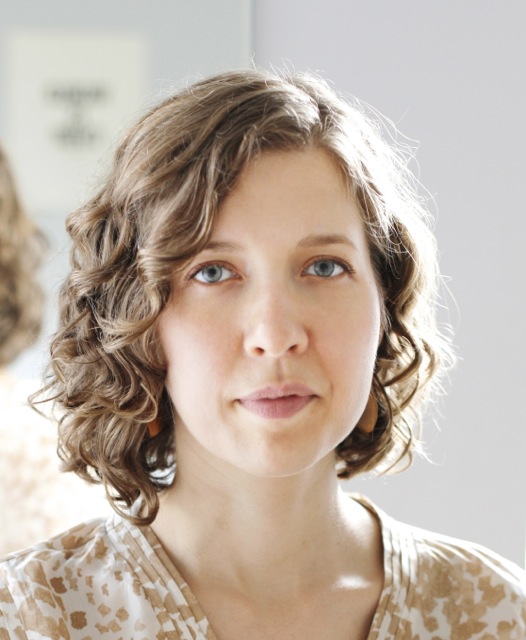
Studio and head shot photo credit: Larkin Clark

Studio and head shot photo credit: Larkin Clark

Skye Gilkerson’s work has been shown in solo, two person, and group exhibitions in museums and galleries across the US including the Contemporary Museum in Baltimore, the Temple University Gallery in Philadelphia, and the Dumbo Arts Festival in New York. Skye was a 2011 and 2012 Trawick Prize Finalist, and she was awarded a Pollock-Krasner Foundation Grant, a Joan Mitchell Foundation Grant, a Smack Mellon Studio Fellowship, and Artist Residency Grants with the Vermont Studio Center, the Detroit Symphony Orchestra, the Anderson Ranch Arts Center and the La Napoule Art Foundation. Her work is featured in Learning to Love You More by Harrell Fletcher and Miranda July, and is in the Robert F. Pfannebecker Collection, the Notre Dame of Maryland University Collection, and many personal collections in the US and Germany. Skye received her MFA in 2009 from Cranbrook Academy of Art.

Studio and head shot photo credit: Larkin Clark

photo credit: Larkin Clark

www.skyegilkerson.com

All images copyright of the artist and used with their permission.
Posted in Uncategorized | Tagged , , , , | Leave a comment

Erik Benjamins – Los Angeles, California

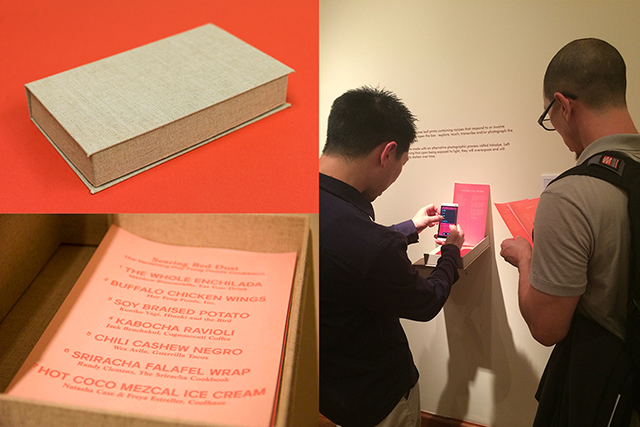
Project 3: Searing Red Dust (The Vanishing Huy Fong Foods Cookbook), Unique cookbook of unfixed Inkodye prints within custom-made clamshell box, 6.25" x 10.5" x 1.25", 2014.

Project 3: Searing Red Dust (The Vanishing Huy Fong Foods Cookbook), Unique cookbook of unfixed Inkodye prints within custom-made clamshell box, 6.25″ x 10.5″ x 1.25″, 2014.

Briefly describe the work you do.

I work across the visual, performing and culinary arts to explore how our comforts and expectations shift as we move between home and away places. I’ve recently made a vanishing cookbook, a trio of custom fragrances, and a pocket-sized travel memoir. 

Tell us a little about your background and how that influences you as an artist.

I was raised near the beach, which has influenced my vernacular. I studied across the Communication Studies and Studio Art departments, which has influenced my enthusiasm in disciplinary flexibility. In grad school I studied performance art, which has influenced my practice that is grounded in liveness and the (undervalued) sensing body. I have amazing parents, which continues to influence my every-day optimism. 

The concept of the “artist studio” has a broad range of meanings, especially in contemporary practice. The idea of the artist toiling away alone in a room may not necessarily reflect what many artists do from day to day anymore. Describe your studio practice and how it differs from (or is the same as) traditional notions of “being in the studio.”

Only recently have I begun to embrace and respect a more traditional idea of a “studio practice,” though I spend a substantial amount of time working outside the studio, mostly reaching out to professionals outside of the art world with research questions or invitations for collaboration.

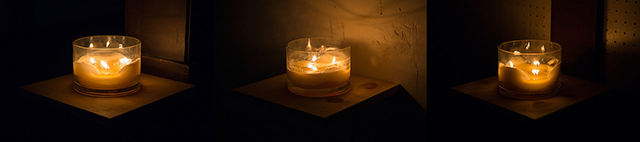
Project 2: Slow Smoke, Slow Soap (Olvera Street Documentation), with Ashley Kessler and David Whitaker, Custom-scented candles, vessels, bi-lingual printed matter, 2013–'14.

Project 2: Slow Smoke, Slow Soap (Olvera Street Documentation), with Ashley Kessler and David Whitaker, Custom-scented candles, vessels, bi-lingual printed matter, 2013–’14.

What unique roles do you see yourself as the artist playing that you may not have envisioned yourself in when you first started making art?

I’m practicing being a patient communicator for a community of inpatient viewers. 

When do you find is the best time of day to make art? Do you have time set aside every day, every week or do you just work whenever you can? 

As long as I have something to write with and write on, any time is the best time to (art) work. I have a full-time job, which determines when I can sneak into the studio… or not. Sometimes writing for thirty minutes at a cafe or going on a walk is as productive as being in the studio for hours. 

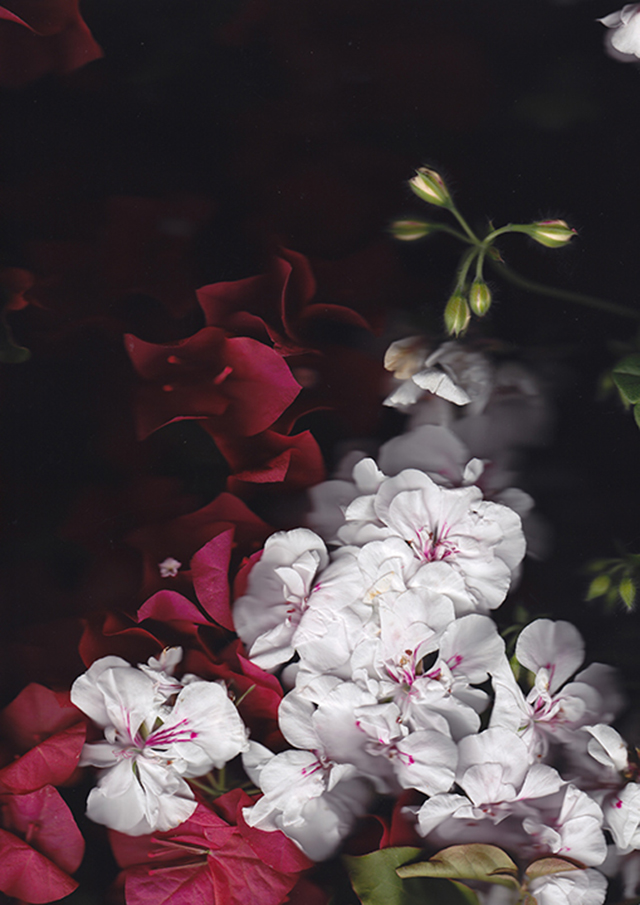
Project 1: Bougainvillea at Magic Hour, Contact-scan photographs, 8.3" x 11.7", 2013–Ongoing.

Project 1: Bougainvillea at Magic Hour, Contact-scan photographs, 8.3″ x 11.7″, 2013–Ongoing.

How has your work changed in the last five years? How is it the same?

In the past five years, my work has changed in my abandonment of a faithfulness to a single material. What has resoundingly remained is my role as a director.

Are there people such as family, friends, writers, philosophers or even pop icons that have had an impact on the work you do?

Cookbooks are tools for instruction, objects for the home, precursors in sharing a meal with another, and invitations to honor a cultural history with the gut. Cookbooks continue to have a profound impact on my intentions as a maker. 

If you had an occupation outside of being an artist, what would that be and why?

I have an occupation outside of being an artist: a full-time college professor. And it’s the most difficult thing I’ve ever done. Eventually, I’d like to try other occupations: a food and travel writer or sound producer perhaps.

About

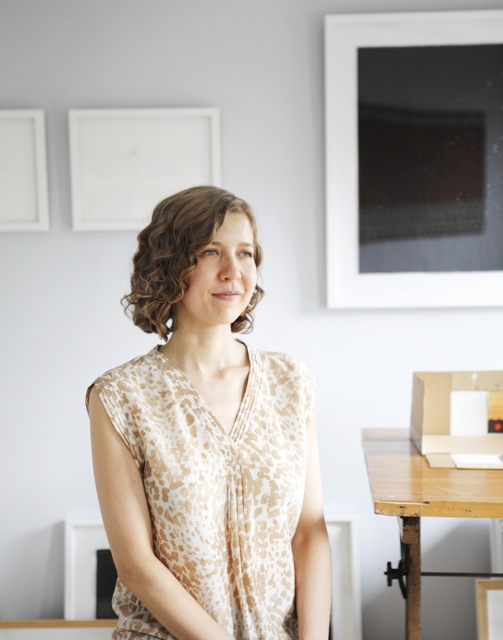
EB-Headshot2Erik Benjamins has recently collaborated with a classically trained perfumer, husband-and-wife vocalists, and a few nationally-acclaimed chefs. Lately, he’s found great inspiration from the home place, the away place, language, the color orange, and the sensing body. Erik received his MFA from the School of the Museum of Fine Arts, Boston/Tufts University and his BA from Loyola Marymount University in Los Angeles, CA. He is a member of ABC [Artists’ Books Cooperative], an internationally-based cohort of artists working in and around printed matter. Erik has exhibited in some museums, galleries, art book fairs, alternative art spaces, and a restaurant. 

The Studio

The Studio

erikbenjamins.com

All images copyright of the artist and used with their permission.
 

Posted in Uncategorized | Tagged , , , , , | 1 Comment

Angela Carbone – Laredo, Texas

1)Guilt, 2012, slip cast earthenware and decals, 48” x 13” x 6”

1) Guilt, 2012, slip cast earthenware and decals, 48” x 13” x 6”

Briefly describe the work you do.

My artwork embodies my personality by offering a fun exterior visual impression in an effort to obscure a darker inner narrative stemming from personal experiences. I am fascinated by pop art and its tongue and cheek sarcasm. I employ this aesthetic as a means to express emotions about my deficiencies, fears, and shortcomings by poking fun at societal ideals.

My most recent work reflects upon the idea of multiple intelligences and childhood experiences while subversively exposing cultural norms. As I discovered my creative interests, I began to understand my artistic role, talents, and intelligence.

Tell us a little about your background and how that influences you as an artist.

I grew up in a small town called Titusville, which is located in historic Washington Crossing, NJ along the Delaware River.   I was fascinated with the history and the antique environment I was immersed in. My parents instilled the importance of a strong work ethic and receiving a good education. One area I excelled at as a child was working with my hands, this led me to discover art.

There is a direct correlation between my upbringing and my individual experiences that has influenced my identity as an artist and my work.   In graduate school, I began to confront darker memories and experiences I had tucked away, focusing specifically on personal relationships. At the time I was concentrating on Trompe l’oiel and illusionism. Mementos from my childhood became the springboard for the concepts of my present practice.

3)TAMIU Studio Art Faculty Show, Gallery Installation- Greed Stars and Stripes Greed, 2011, slip cast earthenware, 6’ 7” x 5’ 7” x 3”  	Stars and Stripes, 2011, slip cast earthenware, 7’ x 5’ x 3”

3) TAMIU Studio Art Faculty Show, Gallery Installation- Greed Stars and Stripes
Greed, 2011, slip cast earthenware, 6’ 7” x 5’ 7” x 3”
Stars and Stripes, 2011, slip cast earthenware, 7’ x 5’ x 3”

The concept of the “artist studio” has a broad range of meanings, especially in contemporary practice. The idea of the artist toiling away alone in a room may not necessarily reflect what many artists do from day to day anymore. Describe your studio practice and how it differs from (or is the same as) traditional notions of “being in the studio.”

 The traditional notions of “being in the studio toiling away” directly, reflect my studio practice.  

My studio practice by nature takes a great deal of time. When making plaster molds I plan to be in the studio all day, this takes a great deal of “toiling.”   I usually slip cast consistently for about two months, scheduling it around teaching and general life events.   Once I begin surfacing the work and preparing for installation the practice slows down. I reorganize my thoughts and reflect on the final outcome.

What unique roles do you see yourself as the artist playing that you may not have envisioned yourself in when you first started making art?

As an artist I never envisioned myself playing the role of the activist. Contemporary art as a catalyst of change is used as a mode of confronting personal, social or political issues through criticism of what the world might be. It mirrors contemporary culture and society, offering a rich resource through which to consider current ideas or rethink the familiar.

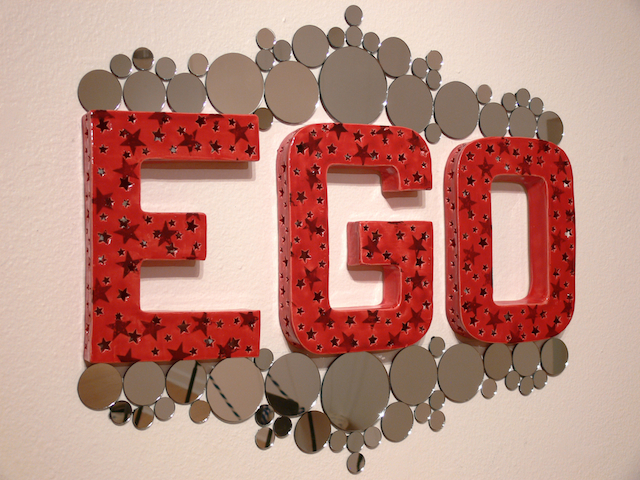
EGO, 2014, slip cast earthenware & mirrors, 28” x 2” x 24”

EGO, 2014, slip cast earthenware & mirrors, 28” x 2” x 24”

When do you find is the best time of day to make art? Do you have time set aside every day, every week or do you just work whenever you can?

The best time of day to make artwork is when I feel the most inspired, which comes randomly to me. I love waking up early, when it is quite in my house and in the world, working in my pajamas while drinking coffee. Lately I have been working for longer periods of time. Intensely producing for about 3 months than taking time off to reflect. The reflection phase is imperative to my process; it is when I have my most inspirational moments.

How has your work changed in the last five years? How is it the same?

In the past 5 years my work and process of making has changed a great deal. While in graduate school I was producing work at a faster pace, not concentrating as much on the final installation. Now I allow myself more time to play, slowing down the making and letting the work breathe. I have taught myself to work backwards focusing on the installation process first. In terms of content, the work has been consistently evolving from the same thread.

Are there people such as family, friends, writers, philosophers or even pop icons that have had an impact on the work you do?

Yes of course, there are many people that have impacted my work. The concepts presented in On Longing by Susan Stewart have heavily influenced me. She examines the ways in which souvenirs are objects mediating experience in time and space. Also my family members, specifically my mother and father are huge sources of inspiration. As far as pop icons, I adore Bob Dylan’s poetic style and find great inspiration from his music.

If you had an occupation outside of being an artist, what would that be and why?

The occupation I would pursue outside of being an artist or an art educator would be a nutritionist. I believe in taking care of one’s body, forming health habits, and practice a healthy life style.

About

headshotpicAngela is a ceramic sculptor based in Laredo, Texas. A native of New Jersey, Angela holds an MFA from Rhode Island School of Design and BFA from Green Mountain College. She received a Sheridan Teaching Certificate from The Harriet W. Sheridan Center for Teaching & Learning at Brown University.   Angela has extensively shown her artwork regionally around Texas. Recently, she won 2nd Place at the Hard Ware, 2013 National Ceramics Exhibit in Ingram TX.   She participated in the 19th and 20th San Angelo National Ceramic Competition at the San Angelo Museum of Fine Arts.   Angela has also participated as an Intern at Greenwich House Pottery in NYC and at Frog Hollow Vermont State Craft Center in Middlebury VT. Currently, Angela is an Adjunct Art Professor at Texas A & M International University, where she teaches foundation design and ceramics courses.

365 Studio Shot

www.angelacarbone.com

All images copyright of the artist and used with their permission.
 

Posted in Uncategorized | Tagged , , , , | Leave a comment

Joanna Bonder – Wroclaw, Poland

Rope, video, 1h14min, 2013

Rope, video, 1h14min, 2013

Briefly describe the work you do.

My projects are carried out through multimedia pictures and photography, combining traditional and modern techniques. I am trying to avoid labelling my works so I move beyond established regularities of each media. I often refer to the conceptual solutions. My works may be seen as universal, simultaneously they refer to my personal experiences.

Tell us a little about your background and how that influences you as an artist.

It is difficult to distinguish one source of inspiration or influence for my works. My work is mostly influenced by everyday life and my previous experiences. Sometimes I just walk the streets and take pictures of things that interest me. Another times nature is the inspiration. I may also be a good book I read or some feeling I find deep inside me.

Scrapbook, video, 4min, 2014

Scrapbook, video, 4min, 2014

The concept of the “artist studio” has a broad range of meanings, especially in contemporary practice. The idea of the artist toiling away alone in a room may not necessarily reflect what many artists do from day to day anymore. Describe your studio practice and how it differs from (or is the same as) traditional notions of “being in the studio.”

My studio is much different than traditional. There are no easel, brushes and paints in it. Rather electronic devices and a lot of cables. Arrangement of the studio must suit the way artist creates. It has to fit his or hers needs, so that you don’t waste time looking for required materials. You just focus on creating. Another important thing is atmosphere. Studio must me a place where artist feels well and can concentrate.

What unique roles do you see yourself as the artist playing that you may not have envisioned yourself in when you first started making art?

I changed the way I see the world. I had to learn a lot of things, but other came to me by themselves. For sure I found in myself some “humanistic” part I had no idea about before. I also started seeing connections between things that earlier looked unrelated.

Digits, video, 5min38s, 2013

Digits, video, 5min38s, 2013

When do you find is the best time of day to make art? Do you have time set aside every day, every week or do you just work whenever you can?

It is hard to give specific time of the day. More important is peace, quiet and right temperature. It can’t be too hot nor cold. And I have to be well slept.

How has your work changed in the last five years? How is it the same?

Last five years was primarily the time of experiments with different techniques and subjects. During that time I found some that I would like to continue and develop further. I must say that the beginnings of my work were closely related to photography. Fortunately, I studied Media Art and naturally I was able to fulfill myself in photography, in the course of time, however, I became interested in other media such as video and multimedia installation.

Are there people such as family, friends, writers, philosophers or even pop icons that have had an impact on the work you do?

I was, and still am, strongly influenced by people that appear in my life. It is very important for me that my family accepts and supports me in what I do. I had also a lot of luck if it comes to teachers. I learned a lot of valuable things from them. If I am to point some artist whose output is important to me I would go for Robert Mapplethorpe, Hiroshi Sujimoto, Christian Boltanski and polish videoartist Zbigniew Rybczyński.

If you had an occupation outside of being an artist, what would that be and why?

I would be a mathematician, in fact Before I started my sudies at The Universityof Arts, I had studied mathematics for a short time. It is the second area of my interests. Topic of figures as well as other mathematical issues appear from time to time in my works.

About

joanna bonder portraitJoanna Bonder born in 1987 in Wrocław, Poland. MA in faculty of Graphic Arts and Media Arts at The Academy of Art and Design in Wroclaw. In 2012, Joanna was awarded with the scholarship granted by the President of Wroclaw City and by the Academy’s Chancellor. Creative output of Joanna is formally linked to popular idea of conceptuality, however themes are within several different areas. One of the them is popular image of deconstruction and reflecting upon perception of modern human. Another area, which is explored by Joanna is mortality, time passing, memory and even occultism and mysticism which are not as popular among new media artists.

working

www.joannabonder.com

All images copyright of the artist and used with their permission.
Posted in Uncategorized | Leave a comment

Sarah Hill – Austin, Texas

I'm Fine, Le Lieu, centre en art actuel Unspeakable Truths, Québec, Canada photo by Patrick Dubé, 2013

I’m Fine, Le Lieu, centre en art actuel Unspeakable Truths, Québec, Canada photo by Patrick Dubé, 2013

Briefly describe the work you do.

My video practice is rooted in the idea of painting as an expanded field. I started making videos about four years ago and quickly learned that I enjoyed the process of nonlinear narrative construction. I shoot video with whatever I can get my hands on including the i phone, go pro, and photo booth.  I am also a performance artist and I recently finished an animation using video documentation from a performance entitled I’m Fine that was performed at Le Lieu, centre en art actuel in Québec, Canada. It took me approximately three hours to animate five seconds. The documentation is 24 frames per second and is 8 minutes and 45 seconds long, a total of 507 seconds, and 12,168 drawings. The animation took me a year to complete.  

Tell us a little about your background and how that influences you as an artist.

I usually start by researching the topic that I am interested in such as hysteria, the rest cure and early-twentieth-century queer novels. This process involves reading texts, watching films (reverse storyboarding) and other visual research. Once I have done a fair amount of research I begin the process of storyboarding. My storyboards are usually text based not image based.  Along with reading theoretical texts such as Feeling Backwards by Heather Love. I find that reading fiction informs how I construct images. Dorothy Allison says it better than I can, “Behind the story I tell is the one I don’t. Behind the story you hear is the one I wish I could make you hear.”

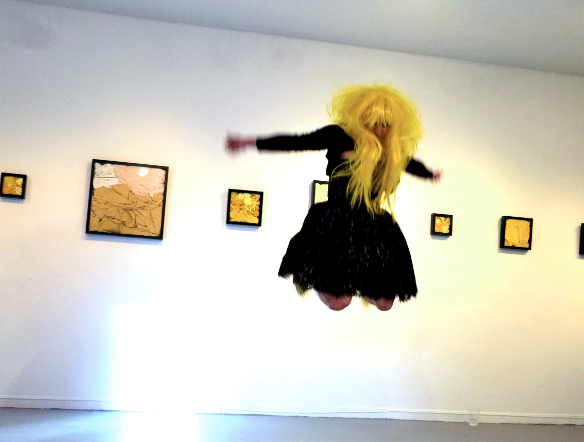
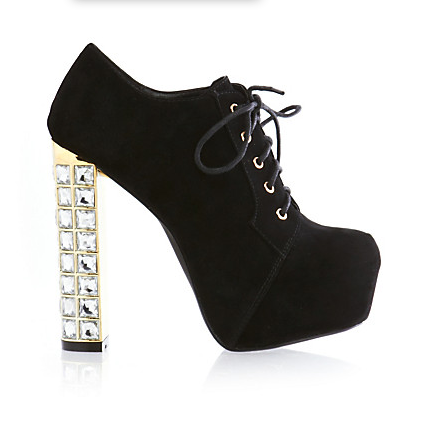
The shoes that I jump in for I'm Fine.

The shoes that I jump in for I’m Fine.

The concept of the “artist studio” has a broad range of meanings, especially in contemporary practice. The idea of the artist toiling away alone in a room may not necessarily reflect what many artists do from day to day anymore. Describe your studio practice and how it differs from (or is the same as) traditional notions of “being in the studio.”

I don’t have a studio, even when I had a studio in grad school I found that I rarely used it. 

What unique roles do you see yourself as the artist playing that you may not have envisioned yourself in when you first started making art?

When I first started making art I identified as a painter. However I did not want to get an MFA in painting. I was fortunate enough to attend a graduate program that allowed me to work interdisciplinary, study critical theory, performance art, and video. When I first got to graduate school I decided that I would take the class that scared me the most, which was performance art. Most everything that I produce has some sort of performative element. 

 It's Ok, 2014 Hand drawn animation still of I'm Fine Performance from Le Lieu.

It’s Ok, 2014 Hand drawn animation still of I’m Fine Performance from Le Lieu.

When do you find is the best time of day to make art? Do you have time set aside every day, every week or do you just work whenever you can? 

Everyday, All day. You better work! Being an artist is a job! When I am not making work I am thinking about making work. Your artistic practice does not have to put food on the table, unfortunately that means that you have to work twice as hard.  

How has your work changed in the last five years? How is it the same?

I never thought I would be working with computers or technology. I think that you could look at my work and see that I was once a painter. Sometimes I still make secret paintings. 

Are there people such as family, friends, writers, philosophers or even pop icons that have had an impact on the work you do?

Adrian Piper (cornered), Pipilotti Rist (i am not a girl who misses much),  Omer Fast (CNN), Natalie Bookchin (Mass Ornament) Zackary Drucker, Rhys Ernst,  Julie Tolentino, Ron Athey,  Heather Cassils, Sandy Stone, Amelia Jones, Anna Gaskell, Marilyn Minter, Dare Wright, Michelle Handelman (Dorian, a Cinematic Perfume) Mika Rottenberg, and Daisies 1966 Czechoslovak film written and directed by Vera Chytilova.

If you had an occupation outside of being an artist, what would that be and why?

NEVER! I have no choice! “No one has ever written, painted, sculpted, modeled, built, or invented except literally to get out of hell.” ~ Artaud

About

Head Shot_HillSarah Hill lives in Austin, Texas. They had their first international solo show at Le Lieu, Center en art Acuel, Canada. They have performed at the following places, International Performance Platform Festival in Lublin, Poland at Gallery Labirynt. And at Performatorium 2014: Festival of Queer Performance Regina, Saskatchewan, Canada.Sarah received their MFA from the Museum School in partnership with Tufts University, Boston. They have studied with Black Market International at the Festival of live Art in Glasgow, Scotland. They have performed at Mobius, Proof Gallery and Anthony Greaney in Boston, Grace Exhibition Space in New York, and at little berlin in Philadelphia. They have screened videos in Melbourne Australia, Scotland, Canada, Miami and New York. Sarah has worked on projects with William Pope. L (Cusp) and Roderick Buchanan (Swim). 

After Performance

After Performance

sarahhill.org 

All images copyright of the artist and used with their permission.
Posted in Uncategorized | Leave a comment

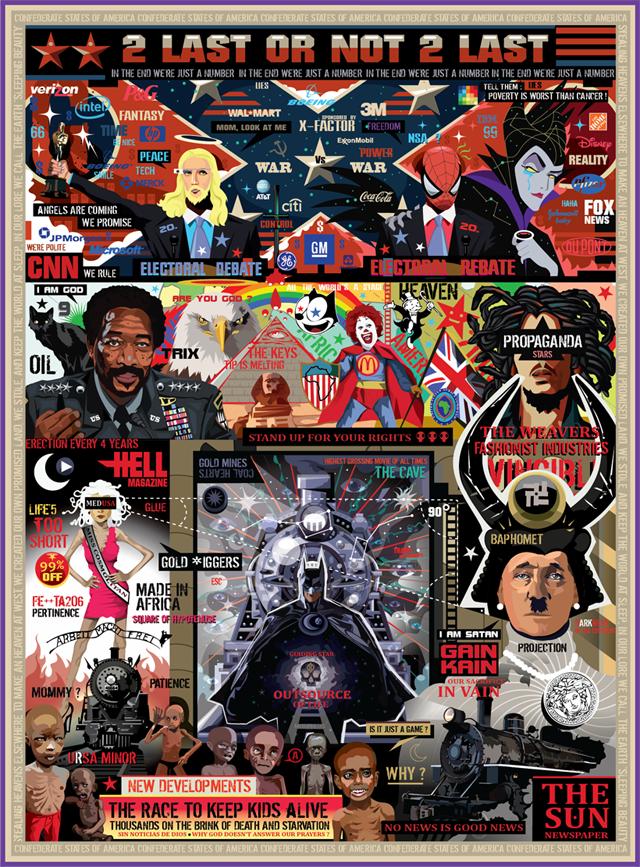
Kazu Livingstone – Malaysia

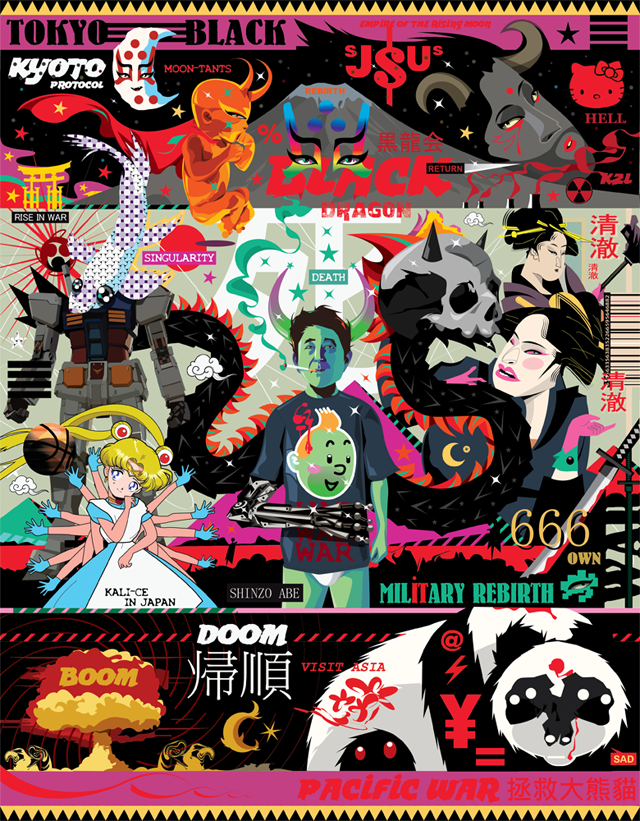
Senkaku islands , vector, 2014

Senkaku islands , vector, 2014

Briefly describe the work you do.

I’m a political satirical artist. I try to make people think out of the voting box. I like to call what I do: Unpopular art, coz I’m definitely not wanting to be a pop artist.

Tell us a little about your background and how that influences you as an artist.

I’m an Eurasian artist who loves to play with puns and who is not afraid not to play by the rules. I have been a poet since the age of 17, and decided to study art later in life, which I did by myself. Now I’m versed into graphics and I am a digital revolutionary.

The concept of the “artist studio” has a broad range of meanings, especially in contemporary practice. The idea of the artist toiling away alone in a room may not necessarily reflect what many artists do from day to day anymore. Describe your studio practice and how it differs from (or is the same as) traditional notions of “being in the studio.”

I travel when I can in South East Asia, I know all the small towns of South Thailand, Indonesia, West Malaysia. I love to discover, to feel lost. This is my studio when I travel using my laptop ! Otherwise I reside in Malaysia, I love its diversity, there are quite a few different cultures side by side. This is the background of my artistry day to day job. I love trees very much. Much of my art is made to tell the bad guys to stop being so bad. I fight for a less judgmental  world, and many pieces I’ve done are anti-war satires   

The Red Heifer, vector, 2014

The Red Heifer, vector, 2014

What unique roles do you see yourself as the artist playing that you may not have envisioned yourself in when you first started making art?

I want to save the world. But my vision is not really to tell people what to do, and give any solution to problems of our time. I have one thing that is becoming important to me though, it is “non-action”. I want for people to do less, and create less crazy technologies and modified organisms, I want people to spend less time chasing money, and sell their souls to the devil in order to making it. I would like to influence people with art, and I think I can.

Morpheus X , vector, 2014

Morpheus X , vector, 2014

When do you find is the best time of day to make art? Do you have time set aside every day, every week or do you just work whenever you can? 

From 6PM to 2AM. But I do start at 11AM and work till 6AM. Lol.

How has your work changed in the last five years? How is it the same?

Before I made a lot of cartoons, and drew for children and teens. Now I’m all about making a change, and “neutralize” left and right. It is very different than 5 years ago.

Are there people such as family, friends, writers, philosophers or even pop icons that have had an impact on the work you do?

Women. My mom. My future ex-girlfriend. I don’t know; intelligent thinkers don’t make me want to work hard, women are the reason why I breathe (I came out from one), so they fascinate me, I want to be with the love of my life.

If you had an occupation outside of being an artist, what would that be and why?

Be an actor, a comedian, a singer.

I draw, I am a poet, a novel writer, and I’ve had some good shots with photography. I want to do everything. I want to impress someone. I’m not there for the money, I want to tell my best friend (a girl) that I want to stay with her forever and that I’m the one.

About

Kazu Livingstone 1Kazu Livingstone is an graphic artist who has exhibited pieces in Europe, North America, South-East Asia, Eastern Europe, and South America. He has collaborated with Nike, and Kult magazine. Exhibited at group exhibitions in the ArtScience Museum in Singapore, Espace Cardin in Paris, the University Science Malaysia, the Museum of Odessa, Ukraine; in Kiev, with controversial artworks. He has made flyers and posters for different activist events, including making a poster campaign for a movie festival at the The Texas Theater, which gained historical fame in 1963, for being the place where Lee Harvey Oswald was arrested. He has collaborated with numerous artists around the world. He had worked with American hip-hop/rap artists such as Yung Nation, Yarrow Slaps, Enon Phenomenon, etc. He presented his video-portfolio to the Behance Reviews Portfolios (Penang) as an invited speaker. He is also a poet; he was published in an American poetry anthology, and was named as its favorite poet/poem by a literary critic in a Texan newspaper.

Kazu Livingstone

newworldangle.daportfolio.com

All images copyright of the artist and used with their permission.
Posted in Uncategorized | Tagged , , , , | Leave a comment

Amanda Mulcahy – Chicago, Illinois

Meteorology – Artist Book - 11" H x 6" W x 1" - 2013

Meteorology – Artist Book – 11″ H x 6″ W x 1″ – 2013

Briefly describe the work you do.

This encyclopedia collection stands as a record of my travels in the form of sculpted books. In Meteorology, I have torn the pages of this book to create the shape of a thunderstorm moving over a prairie. The beginning pages reference the building storm and then climax as the thunderhead breaches the troposphere. Denouement shapes mimic the dissipating storm. I pierce pages to describe northern hemisphere constellations that I observed over the summer in Cosmology. The pages begin with the first stars that appear, like the summer triangle. Soon the pages fill with holes creating a textured map of the night sky. In the end, the holes subside as stars disappear in the morning. Geology features ink striations on paper and torn pages evoke rock formations. Movement through the book resembles the process of excavation or passage through a cave.

At what point I your life did you want to become an artist?

If you ask my relatives, you’ll hear about the times that I drew on the walls, my little sister, and my dog when I was a child. I didn’t think seriously about being an artist until I was out of high school and working as a graphic designer. Painting was my real creative outlet where I could work beyond the constraints of client deadlines and the limitations of fussy printers. In fiber and material studies, I could dig into the rich concepts latent in evocative materials. Working with artists books introduced sequential images and time to my work.

Tell us a little about your background and how that influences you as an artist.

My background is in mechanical drafting and graphic design for print. Aside from making me a better draftsman, drafting definitely got me to look critically at the structure of objects. My design experience included time researching and developing new processes. This sparked a compulsion in me to constantly learn new techniques, and made me think critically about what a process added conceptually to a project.

Cosmology – Artist Book - 11" H x 6" W x 1" - 2013

Cosmology – Artist Book – 11″ H x 6″ W x 1″ – 2013

What types of conceptual concerns are present in your work? How do those relate to the specific process(es) or media you use?

I have a profound respect for the wilderness and natural ecosystems. I am curious about the interaction between these pristine environments and the encroachment of human stuff. It is inevitable that this would spill into my art practice. Beyond documenting my time out in nature as well as my natural habitat (Chicago), I also look at the environmental impact of products that are amassing their own landscape. I am currently working on a series, Plastic Deposits on the Fossil Record, that looks at current geological processes that are occurring as a result of consume-and-dispose culture in combination with materials engineered to last infinitely longer than lifetimes of the users and objects they purchase. Plastic debris breaks down and is washed to the sea where ocean currents corral the floating bits together. Making up massive gyres, the plastic continues to degrade into smaller particles. Tiny pieces of broken-down plastic wash ashore, and with heat, combine with naturally occurring rock to create strange formations. Here we find people involved in creating geological features instead of passively observing them. Each rock fossilizes the layered history of thousands of strangers who share little more than the gesture of innocently tossing away refuse. I begin by photocopying plastic containers I have used to make collage materials. I repeatedly break apart, mix, and layer these pieces in a process akin to my source material to make final images. These images are screen printed onto felt made of recycled plastic bottles. I use heat press dyes to create layers of hyper color strata, and suede base in plastic colors.

Geology – Artist Book - 11" H x 6" W x 1" - 2013

Geology – Artist Book – 11″ H x 6″ W x 1″ – 2013

We once heard Chuck Close say he did not believe in being inspired, rather in working hard everyday. What motivates you in your studio practice?

I constantly have ideas that need to be realized. My hands work tirelessly to bring my ideas into physical existence.

What artists living or non-living influence your work? 

It changes by the minute! I go to local shows as often as I can, as well as scour the internet for artists who are really trying new things. At the moment, I am pretty crazy about Dana DeAno’s collages, Alexis Rockman’s storm paintings, and Tara Donovan’s everything.

When you are not making art what types of activities and interests do you engage in?

I love simply walking around outside, especially if I happen to wander into a museum or two. I take a sketchbook with me everywhere I go. I also collect bits of debris like a bird. They end up in my work, and they are a small effort to clean up litter.

About

AMulcahy_headshotAmanda Mulcahy is a Chicago native who fancies herself an urban naturalist, collecting and documenting the minutiae of city life for further studio study. She begins many projects in locations as varied as Lakeview alleyways or Pictured Rocks rock faces. She documents her observations as both an urban apartment dweller, and National Park enthusiast. Although she employs a variety of materials (such as rag paper, bed linens, old text books, Polaroids, and crochet), she approaches her practice from a painter’s perspective.

AMulcahy_working

amandamulcahy.com

All images copyright of the artist and used with their permission.
Posted in Uncategorized | Tagged , , , , | 1 Comment