Brian Hitselberger – Athens, Georgia

"Untitled (Tzvi)." Graphite, chalk, oil paint on found surfaces. 10 5/8" x 15 5/8". 2013-2014.

“Untitled (Tzvi).” Graphite, chalk, oil paint on found surfaces. 10 5/8″ x 15 5/8″. 2013-2014.

Briefly describe the work you do.

I make paintings, drawings, and works on and out of paper that operate slowly and emphasize materiality. I work with a range of subjects in groups or series, exploring content that is more or less a reflection of my thoughts or research at the time of making. I also make prints and artist books.

Tell us a little about your background and how that influences you as an artist.

I came from an artistic family – my mother had gone to art college and worked as a painter and printmaker, and my older brother is a talented draughtsman. Our house had their work throughout, and I remember feeling like they were both capable of magic when I was a kid. Both of my brothers are musicians, which is how I identified myself for the first part of my life.

In fact, growing up I really desired to make and write music more than anything. I’ve begun to realize how important this has been to my development as a visual artist. I was not a kid who spent all his time drawing or painting – although I was crafty and loved making things with my hands. I did spend a huge amount of time playing piano, and the experience of spending focused time alone, expressing myself with my hands helped me transition naturally to the study of art when I began studio classes in college, which I essentially fell into. Once I began I just didn’t stop. Like a lot of artists, I was an awkward kid that had difficulties relating to other people – music was my preferred method of communication. Visual art, by the time I found it, offered new possibilities to me, as well as a community of like-minded makers, and I threw myself into it with verve.

But going back to the piano for a second — so much of my work now is really related to very specific surface qualities. I am always thinking about touch – my own touch when I am making the piece, the way the piece “touches” an viewer, the perceived surface that touches the eye…. All of this relates back to the piano for me, which is an instrument based entirely on touch.
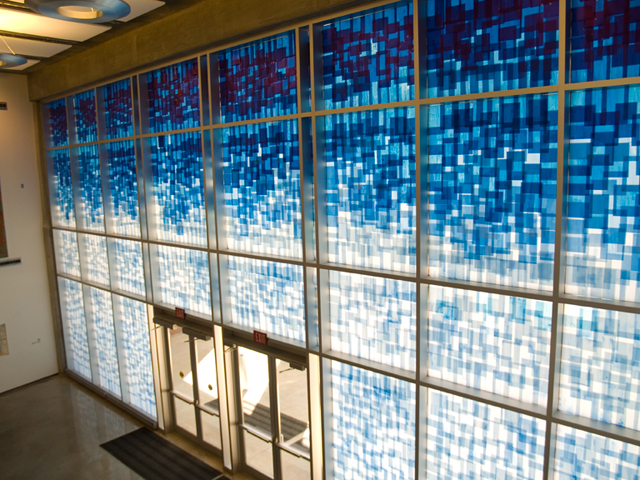
"End of Silence," Ink, dispersion on hand cut mylar, 28' x 50'. 2010

“End of Silence,” Ink, dispersion on hand cut mylar, 28′ x 50′. 2010

The concept of the “artist studio” has a broad range of meanings, especially in contemporary practice. The idea of the artist toiling away alone in a room may not necessarily reflect what many artists do from day to day anymore. Describe your studio practice and how it differs from (or is the same as) traditional notions of “being in the studio.”

A lot of my practice falls right in line with those traditional notions. I have a studio in my home that is very conventional in its layout and design – I spend a lot of time in it working with pencils, paper, oil paint, canvas, panels, brushes….. These things still hold enormous potential and fascination for me. I see myself very much a part of long and ongoing history of people working quite seriously with them to turn the contents of their mind into physical objects, as a means of making sense of the world.

I’m fortunate enough to teach at a college that has wonderful facilities, and make use of them to create my own work as well. All of my print work happens in the shop at school, and I made use of the large tables and drying racks recently to dye a huge batch of mulberry paper. Working in this shop is a very different studio experience – like all print shops in schools, it’s a public space that is shared by artists. This context can be a great foil for me, as it gets my out of my home studio and interacting with other people in relation to the work. My students are great for getting feedback as well – I work with them everyday, and have a very thorough understanding of what their sensibilities are.

But I’m also interested in changes of scenery or working environments as a way of changing up the work itself. I try to take work with me wherever I go, and draw and paint when I’m on the road visiting friends or family. Although the specifics of a place don’t necessarily end up in a piece, the energy of the place can.

"Untitled (Back)." Graphite, chalk, oil paint on found surfaces. 9 1/2" x 13 1/4". 2014.

“Untitled (Back).” Graphite, chalk, oil paint on found surfaces. 9 1/2″ x 13 1/4″. 2014.

What unique roles do you see yourself as the artist playing that you may not have envisioned yourself in when you first started making art?

I believe it’s the artist that enlarges our ideas of the possible in every aspect of lived experience. On some level this is what makes us tick – it’s a shared commonality of thought and an important role. It’s sounds so silly and naïvely romantic to say, but there you have it.

In my experience, artists tend become comfortable with nonlinear thinking early on, which contributes substantially to the above. Most artists I know are also suspect of immediate solutions, slogan culture, groupthink, neo-tribalism….. the list goes on. It’s a deeply political way to live one’s life, when you get right down to it. So many of the logistics of being an artist (lack of money, time spent alone, notions of success) are so contrary to the conventionalities of society that to do it at all is in essence an exercise in resistance. This resistance, or “pressing back on reality” as Wallace Stevens would say, becomes the artist’s reality.

When do you find is the best time of day to make art? Do you have time set aside every day, every week or do you just work whenever you can? 

This is a question that I feel like I will answer differently every, week, month and year of my life. But the short answer is this: I figured out long ago that the only way I could really do this was to work everyday. “Work” may vary greatly from moment to moment, but I stick to that no matter what.

During the summers, I fall quite nicely into a routine of getting into the studio mid-morning, and working through into early evening. And I could do that daily for the rest of my life – I’m someone who really works well with a routine. I used to work a lot at night, but mostly I’m a day painter now.

"Untitled (Back)." detail

“Untitled (Back).” detail

During the school year is another story, and I continue to work daily, but whenever I can. Weekends of course are prime studio days for me. I find that I begin and finish work on the weekends when I have long stretches of time, and keep the work moving along during the week in the afternoons or evenings. The quality of work time is also dependent on whether I’m drawing, painting, or assembling a larger piece – I’ve become very good over the years at making the work in between the necessities of life.

I should mention that I teach 5 days a week at a college an hour away, and although I do have lighter days on campus than others, 2 hours of every day are spent in the car. Mercifully, my commute is low-stress and I’m able to get a lot of thinking done about the work during my drive, which has kind of become a studio in and of itself. I always keep a sketchbook with me for those inevitable flashes of insight that happen– I make a lot of notes and quick drawings in the car. Recently I’ve been bringing small drawings, with me wherever I go, and working on them in odd moments. Office hours, over lunch, even during my classes if my students are fully engaged with their own projects. I just recently finished some drawings I started on a camping trip earlier this year, and I painted in my hotel room while staying in Paris last May on a school trip. I’m an every day kind of maker.

How has your work changed in the last five years? How is it the same?

5 years ago I was in my second year of graduate school, so my work was changing quite a bit.

The work has become quieter in a lot of ways, less personal, more poetic, more abstract. I used to make large assemblage paintings about really specific personal experiences – now I feel that I’m working more with the essences of those experiences. The work I’m making right now touches on privacy, anonymity and intimacy, but my interest in those ideas came out of a personal uneasiness with social media. I don’t know that that corollary is visible in the work, but I’m not certain that it needs to be.

I made a large installation piece, End of Silence, that was really a watershed piece for me – it was the first time I’d explored subtlety on an epic scale, and although my intentions behind it were personally driven, they were explored in a way that was so much more evocative than descriptive. Everything changed after that. The work became leaner, “slower,” as I like to think of it. The figure has crept back in this past year, but won’t stay for long.

Are there people such as family, friends, writers, philosophers or even pop icons that have had an impact on the work you do?

I have a lot of artist friends I’ve met over the years, whose work I admire and whose opinions I take seriously. I try to be active in critique groups to keep a structured dialogue going outside of an academic setting. My best friend is a writer and works in nonprofits completely outside the visual arts, but we’ve been close friends for almost fifteen years. She knows my mind and my work better than anyone, and she’s a great sounding board for ideas – we’re on the phone twice a week, at least. I also still keep in close contact with some former professors of mine.

I read a lot, and I gain a lot of energy from writing that attempts to articulate unnamable or fuzzy states of being– Virginia Woolf does this, and the amazing Brazilian writer Clarice Lispector. Some others: Wallace Stevens, Marilynne Robinson, Annie Dillard, Wislawa Szymborska, Mary Ruefle, Jorge Luis Borges, Federico Garcia Lorca.

If you had an occupation outside of being an artist, what would that be and why?

I’m sure I’d be making music.
Head ShotAbout

Brian Hitselberger (b. 1982) is an artist living and working in Athens, Georgia.

His work has most recently been exhibited in group exhibitions at ATHICA in Athens, Georgia, Dalton Gallery of Agnes Scott College in Decatur, Georgia, Barbara Archer Gallery in Atlanta, Georgia, The Contemporary in Atlanta, Georgia, and Cabinet in Brooklyn, New York. In 2012, his solo exhibition Many Times But Then was exhibited at Greenville Technical College in Greenville, SC. He has held residencies at the Elsewhere Artists Collaborative, the HUB-BUB Arts Initiative, and the Hambidge Center for the Arts. He received a BFA in Printmaking from Tulane University in 2005, and an MFA in Painting from the University of Georgia in 2010. He is currently Assistant Professor of Painting and Printmaking in the Art Department of Piedmont College.

In addition to his studio practice Brian maintains Two Steps Press, an artist/writer collaborative imprint producing chapbooks and limited editions.
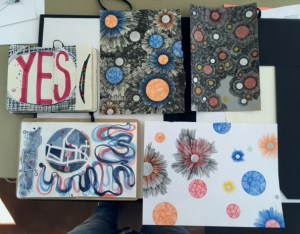
 

In progress stetchbooks

In progress stetchbooks

www.brianhitselberger.com

All images copyright of the artist and used with their permission. 

Posted in Uncategorized | Tagged , , , , | Leave a comment

Caroline Golden – New York, New York

Woman on Green, 2012, paper, acrylic paint, and oyster shell, 10 x 7 inches. From series The Atlanteans.

Woman on Green, 2012, paper, acrylic paint, and oyster shell, 10 x 7 inches. From series The Atlanteans.

Briefly describe the work you do.

I am a collage artist.  I explore the transformative qualities of paper piecing together seemingly disparate visuals to create new environments. Entering my studio you will find over one thousand magazines, old books and found objects that are all part of my palette. These are supplemented by my own photography and painting to create my work. For the past several years my work has been focused on the narrative, primarily fairy-tales with a special interest in Alice in Wonderland.  

Tell us a little about your background and how that influences you as an artist.

My art education was focused more on commercial applications; graphic design and illustration were my primary interests. I started working in advertising agencies as a paste-up and mechanical artist and later as an art director. Those years of experience in that industry directly informed my eye and how I approach the narrative in my work as well as the technique for what I do now.

The concept of the “artist studio” has a broad range of meanings, especially in contemporary practice. The idea of the artist toiling away alone in a room may not necessarily reflect what many artists do from day to day anymore. Describe your studio practice and how it differs from (or is the same as) traditional notions of “being in the studio.”

I suppose I fit the more traditional notion of an artist working alone in a room, though I have never thought of myself “toiling away” while there. I have a studio I commute to daily and the biggest challenge I face in my studio in reality, is disconnecting from the many daily distractions and devices. Once I am able to fully focus on my work my studio actually becomes my sanctuary.

Bluebird of Happiness, 2014, paper collage, 20 x 24 inches

Bluebird of Happiness, 2014, paper collage, 20 x 24 inches

What unique roles do you see yourself as the artist playing that you may not have envisioned yourself in when you first started making art?

In the past year or so, I have been called on to talk about my career, specifically the combination of my commercial experience and fine art to college students as well as to work with them on their projects and portfolios. 

I have also been invited to speak on the subject of the fairy-tale and the role such tales have played in my work. I have done extensive research over the years on the fairy-tales and related narratives. I never thought a childhood love would figure so dominantly in my life as a grown woman!

Rabbit House, 2011, mixed media construction, 19 x 14.5 x 10.5 inches

Rabbit House, 2011, mixed media construction, 19 x 14.5 x 10.5 inches

When do you find is the best time of day to make art? Do you have time set aside every day, every week or do you just work whenever you can? 

I work in my studio full time at least five days a week. I’m really not a morning person so often I don’t hit my stride until later in the afternoon into early evening.

How has your work changed in the last five years? How is it the same?

My collages have gradually leapt little by little, off the 2-dimensional plane. I work in a raised relief technique as it very important to me that the viewer be able to visually “step into” my work. During the last five years I have been creating 3-dimensional collaged-constructions that not only invite the viewer in, but to circle around as well.

Are there people such as family, friends, writers, philosophers or even pop icons that have had an impact on the work you do?

There is certainly a long list of those who have influenced my work but I would have to say that Lewis Carroll’s Alice has had a major impact on my work, not only as subject matter but also the way I approach my work. I was very young when first met Alice in Carroll’s “Alice’s Adventures Underground.” Alice found herself within – a dark, nightmarish and, at times fantastic layer, not far from the surface of what we would term as normal.  Logic and meaning had no place there but she defiantly refused to accept the upside down world for what is truly was. Throughout the her journey she never seemed to doubt she would survive her trip down the rabbit hole and I admire her bravery and perseverance, while maintaining an appreciation for the absurd.  

If you had an occupation outside of being an artist, what would that be and why?

Actor. The process of “collaging” life experiences together to create a character on stage is a dream of mine.

About 

Caroline Golden HeadshotCaroline Golden is a collage artist. Her collages and constructions are made of found imagery and objects, including her own painting.  The theme of her work centers around fairy tales and Lewis Carroll’s, Alice’s Adventure’s Underground. Memory and narrative play an important role in her compositions. Golden has lectured about the importance of fairy tales and the many ways they can be interpreted. Her work has been shown in multiple solo and group exhibitions, including a one woman exhibition in Israel, and has been acquired for private and corporate collections. She will be exhibiting some of her latest pieces in an upcoming exhibit of contemporary collage at St. John’s University in New York. Caroline lives and works in New York City.

Golden Studio Shot

www.carolinegolden.com

All images copyright of the artist and used with their permission. 

Posted in Uncategorized | Leave a comment

Samuel Davis – Kansas City, Missouri

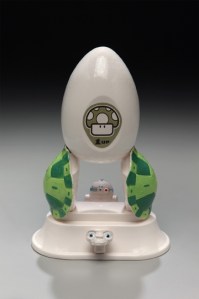
"1up," Porcelain, 9.5” h x 6.5” w x 5” d, 2008.

“1up,” Porcelain, 9.5” h x 6.5” w x 5” d, 2008.

Briefly describe the work you do.

I make slip cast and assembled sculptures using porcelain and mixed media. I use kitsch and ceramics as a vocabulary and platform that is universal, but through its construction and relationships it can speak specifically to one person or a larger understanding. I use campy humor and novelty to undermine the works integrity while attracting the viewer. I want the work to give an impression of environmental factors that shape the experience and expectations of contemporary man. Selecting or inventing objects of various materials, they are transformed into porcelain, altering their value. Many of these objects have a previous identity. In adding gaudy and attention-grabbing stimuli to refined surfaces, I foolishly attempt to bestow a higher status on each piece. In this way, the work parallels the condition of a middle-class life and the value of upward mobility.

Tell us a little about your background and how that influences you as an artist.

I grew up on a small farm in Tennessee, working in the garden, riding horses and tending to goats, llamas and sheep. Animals are honest and I think they taught me how to see things from a point of view of psychological essentialism. This gave me plenty of inadvertent practice spending a great deal of time communicating and being understood using primarily nonverbal communication. This has helped my work as I am commonly trying to evoke a specific feeling or understanding through visual language. Also farm chores help your work ethic.

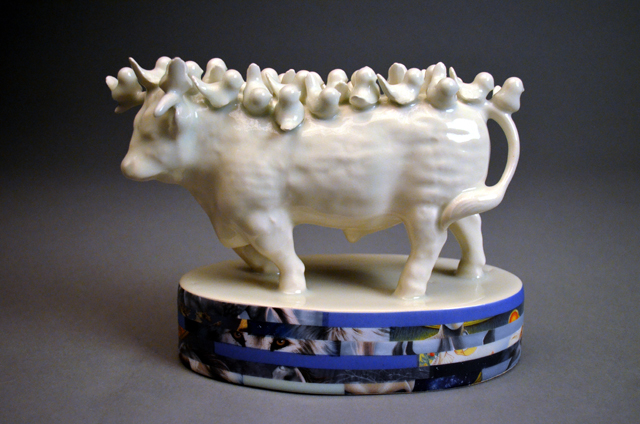
"Fight or Flight," Porcelain and vintage ceramic decals, 8” h x 12” w x 4” d, 2014.

“Fight or Flight,” Porcelain and vintage ceramic decals, 8” h x 12” w x 4” d, 2014.

The concept of the “artist studio” has a broad range of meanings, especially in contemporary practice. The idea of the artist toiling away alone in a room may not necessarily reflect what many artists do from day to day anymore. Describe your studio practice and how it differs from (or is the same as) traditional notions of “being in the studio.”

Well, I was always attracted to the romantic sort of notion of the artist working alone in the studio and have always enjoyed working that way. That being said, having recently moved to Kansas City has greatly altered my studio practice. I’ve gone from doing the traditional home studio thing in Tennessee to living in an apartment and primarily working in a group studio setting in a visiting artist sort of way. I work in the art department of a local college and make most of my work in my office studio connected to the main ceramic studio on campus. I find it is often harder to get into a rhythm now with others about. But I enjoy the energy of it and I am learning to adjust to that as of this writing.

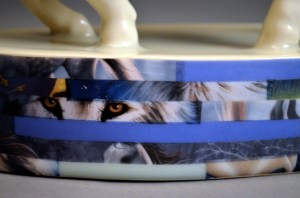
"Fight or Flight," detail

“Fight or Flight,” detail

What unique roles do you see yourself as the artist playing that you may not have envisioned yourself in when you first started making art?

Probably adult. I’ve always been committed to art education and enjoy learning from others, but it has been interesting to now be teaching all manner of folk what can be learned through art. Being on both sides of mentorship has been a source of satisfaction.

When do you find is the best time of day to make art? Do you have time set aside every day, every week or do you just work whenever you can? 

Morning and early evening seem to be the times of day when my brain is at it’s most active. I like to start things early with a clear head, let them sit through the afternoon and revisit them later on in the day. However, the nature of working in ceramic dictates that certain things need to be done when the materials insist. When I was in graduate school, I found late nights very productive, but not as much anymore, sadly.

How has your work changed in the last five years? How is it the same?

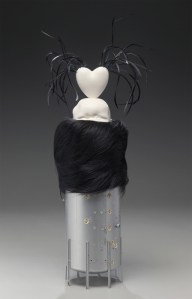
"Love Nest," Porcelain, fur muff, swan feathers and plastic, 26” h x 10” w x 7” d, 2009.

“Love Nest,” Porcelain, fur muff, swan feathers and plastic, 26” h x 10” w x 7” d, 2009.

Really the last five years have been about refining the practice and becoming confident in the work. I have two bodies of work, the mixed media sculpture and vessels. Vessels are what initially attracted me to ceramics and to art in general. I was trained as a functional potter through the majority of my schooling. After being able to complete an artist’s residency in Asia in my last year of graduate school, the work changed dramatically in a more sculptural direction. But the fondness for formal exploration of the vessel remains. I spent a while attempting to reconcile the two bodies of work before becoming comfortable with their being two separate but equally important endeavors in conversation with one another.

Are there people such as family, friends, writers, philosophers or even pop icons that have had an impact on the work you do?

Pee Wee Herman, Dolly Parton and “The Macho Man” Randy Savage made impressions to my young mind, as far as choosing an artistic identity and really running with it. Now it’s authors like Albert Camus and Hermann Hesse or science writers like Paul Bloom for more informative thought. More direct visual art influences include Ron Nagle, Mark Burns and Adrian Saxe. I’ve been lucky to have a great many teachers, including my mentor Mike Vatalaro. My friends and family have always been so supportive and sources of inspiration.

If you had an occupation outside of being an artist, what would that be and why?

If I had any kind of musical talent, I’d go for that. Currently, I want Anthony Bourdains‘ job, traveling to fabulous cities, eating and drinking and then talking about it.

About 

Samuel Davis was born in Knoxville, Tennessee in 1982 and is living and working in the Kansas City area. He earned his BFA in Visual Arts from the University of Tennessee in 2006 and his MFA in Visual Arts from Clemson University in 2009. His work has been shown regionally and nationally. In 2008, he completed an Artist’s Residency at Tainan National University of the Applied Arts in Tainan, Taiwan and also studied abroad in Japan, learning from various artists and craftsmen in Kyoto and Mashiko. He is currently preparing for an upcoming solo show in the Kansas City Crossroads.
www.samueldavisart.com

All images copyright of the artist and used with their permission. 

Posted in Uncategorized | Tagged , , , , | Leave a comment

Veronique Gambier-Davis – Brooklyn, New York

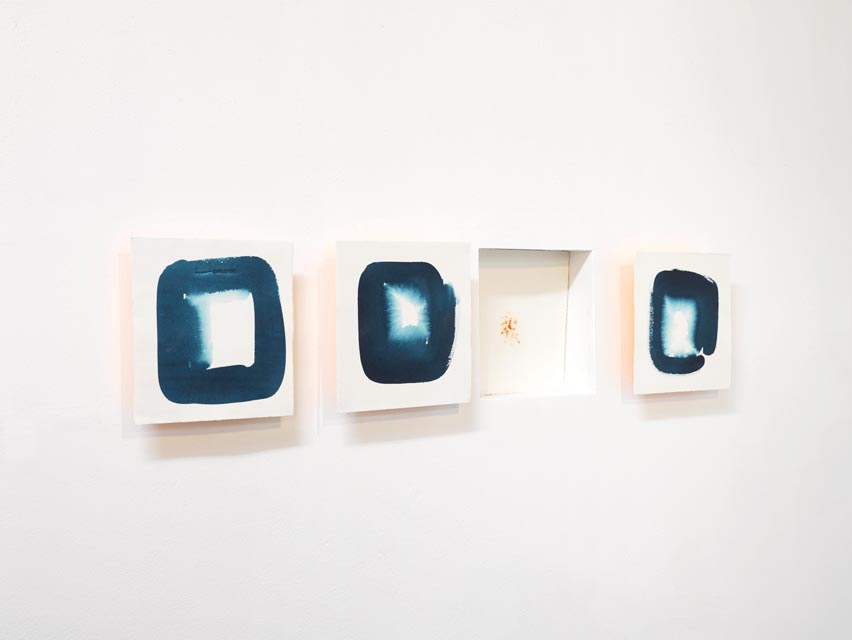
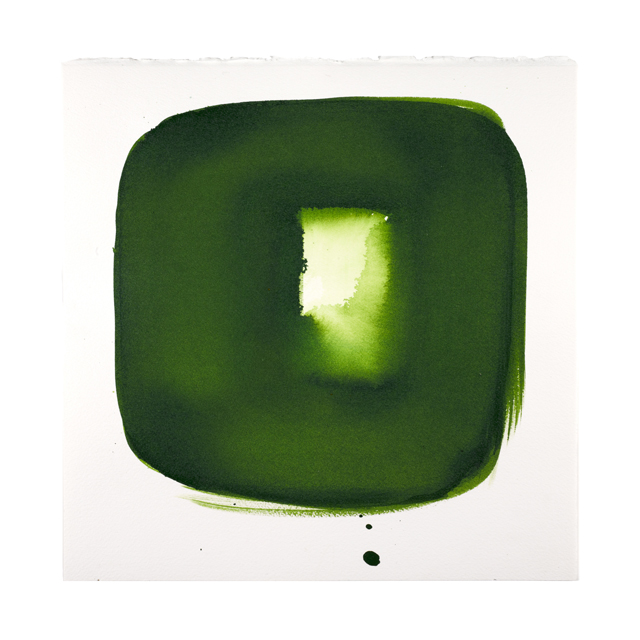
Aperture in Sap Green II 2013 11 ¼ x 11 ¼ inches acrylic on watercolor paper

Aperture in Sap Green II
2013
11 ¼ x 11 ¼ inches
acrylic on watercolor paper

Briefly describe the work you do.

I construct most of my work using over diluted acrylic, ink or watercolor on paper. The surface lies horizontally during the process of painting and drying to avoid the effects of gravity. My entire body, arm, hand and brush flow in a continuous motion to produce my work.

I am inspired by the contradistinctive values of the medium I am using and search for the tension within one color. I strive to create a sense of fluidity and solidity by creating within one image autonomous effects; the directness of my brushstroke against the rushing and gradual fading of the color towards the white of the background.

I seek to express tension in harmony, movement in stillness.

Tell us a little about your background and how that influences you as an artist.

My work is inspired by the opposite values of my subject or by the medium I am using. My childhood triggered physical and emotional experiences with opposing extremes; I grew up in the south of France where there is a strongly pronounced contrast between light and shadow. With a bipolar Mother, I was constantly exposed to the relationship between the polarities within myself and learned to question the authenticity of what appeared as face value and to look beneath the surface.

The concept of the “artist studio” has a broad range of meanings, especially in contemporary practice. The idea of the artist toiling away alone in a room may not necessarily reflect what many artists do from day to day anymore. Describe your studio practice and how it differs from (or is the same as) traditional notions of “being in the studio.”

My studio practice could be considered traditional in the sense that when I am painting it is a very solitary process. As my final image is the product of one single brushstroke, I need to create a silent space around me, no music, no phone, no interaction. It is essential that I stay fully focused.

Once I have produced my artwork, the documentation — which is as important — differs drastically from the process of painting and reconnects me to the world: bringing my artwork to be photographed, naming it, cataloging with the help of an assistant, and finally using networking to promote it.

Exposed Square II 2014 installation of floating apertures and exposed figment acrylic on watercolor paper with wood mount and sheetrock 7 x 33 inches

Exposed Square II
2014
installation of floating apertures and exposed figment
acrylic on watercolor paper with wood mount and sheetrock
7 x 33 inches

What unique roles do you see yourself as the artist playing that you may not have envisioned yourself in when you first started making art?

Originally, I was only involved and interested in the process of painting and never imagined that my work would evolve into something more dimensional. The further I push the concepts of my vision, the quicker my work develops behind the frame of my artwork. In my last solo show I literally opened the walls of the Gallery to create a sense of depth. I am now able to work with sheetrock and plaster, something I would have never imagined doing.

When do you find is the best time of day to make art? Do you have time set aside every day, every week or do you just work whenever you can? 

Morning is the best time of day for me and especially to work. I like the freshness of the air and the light. I set aside time everyday to work on my artwork — either to research, to promote or document it — and I always set aside time every week to paint.

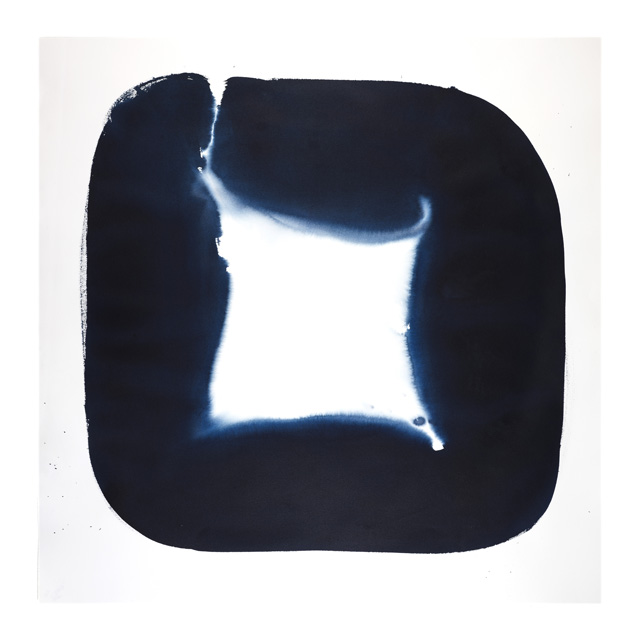
Aperture in Oxford Blue & Indigo I 2014 42 x 42 inches acrylic on watercolor paper

Aperture in Oxford Blue & Indigo I
2014
42 x 42 inches
acrylic on watercolor paper

How has your work changed in the last five years? How is it the same?

My work began as very expressive, and still is but, over time became something much more contained. My focus began to shift to the fluid movement of the brushstroke and the specificity of color, which is what I am continuing to develop today.

Are there people such as family, friends, writers, philosophers or even pop icons that have had an impact on the work you do?

Becoming a mother had a strong impact on my work. It also helped me understand and soften my relationship with my mother.
Lately, I have found inspiration from the colors of the Italian Renaissance paintings, as opposed to the painters themselves. This has been especially true as I have become more nuanced in my color palette as my work has evolved.

If you had an occupation outside of being an artist, what would that be and why?

I have spent over a decade working in fashion and graphic design before dedicating my time to my artwork. But if I were to be anything other than an artist at this point of my life, I would be a chef. There is a similar creative energy between painting and cooking, I would not be a baker — though!
 

About 

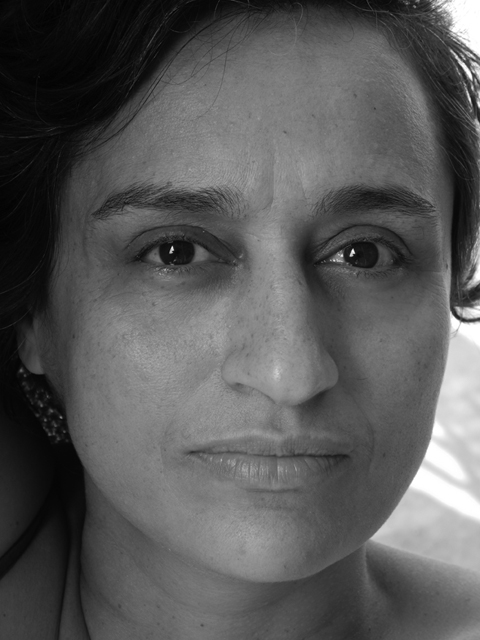
VeroniqueGambier-HeadshotBorn in the south of France, Véronique Gambier started to paint on large scale canvases at the age of 12 under the guidance of French Master Pierre Pallut, developing a strong sense of color and abstraction. She attended L’école des Beaux Arts de Toulon (College of Fine Art of Toulon) and L’école des Beaux Art de Luminy (Luminy College of Fine Art) in Marseille. 

Always drawn towards texture as well as color, Gambier chose to pursue a career in Fashion which lead her to Paris, London and then New York. After working in Fashion, then as a Graphic Designer, Gambier is now committed on a full time basis to her artwork and has exhibited in the New York area.

Gambier’s creative process is inspired by the contradistinctive values of the medium she is using. She employs a whole-body approach to apply her saturated colors. She moves over and around the square format painting while working with highly diluted acrylic. She strives to create a sense of detachment from her subject, which ultimately leads to a “repossession” through the deconstructing and reconstructing of a painting. She may achieve by cutting and reassembling, for example, or by using four separate paintings to create a single work.

Gambier seeks to express tension rather than harmony, movement rather than stillness. “For me, balancing light and dark is the pure essence of imagery”.

Gambier lives in Brooklyn, NY.

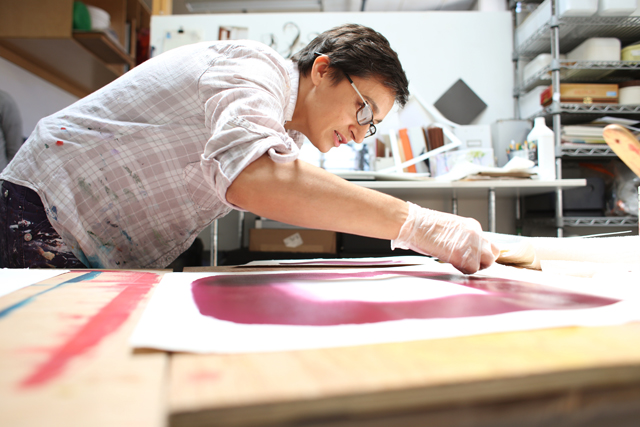
In the Studio

In the Studio

www.veroniquegambier.com

All images copyright of the artist and used with their permission. 

Posted in Uncategorized | Tagged , , , , | Leave a comment

Susan Rochester – Sutherlin, Oregon

The foolishness of the chase ached her heart      2014     20" x 16"     Archival Pigment Print

The foolishness of the chase ached her heart
2014
20″ x 16″
Archival Pigment Print

Briefly describe the work you do.

I’m primarily a photographer, interested in the relationships between human life and wildlife, and the boundaries between our habitats and pathways and theirs. In my current work, I create dream-like photographs of taxidermied animals, comfortable in human spaces. I push the content of these images so they verge on the anthropomorphic, thus challenging the viewer to decide whether the subjects are alive or dead.

Tell us a little about your background and how that influences you as an artist.

I’ve lived in the rural west for nearly my entire life, with ready access to deserts, forests, mountains, rivers, and the Pacific Ocean. From my earliest memories, I’ve had an affinity for animals, whether pets, strays, wild, or mounted in a museum diorama. This has all led to a life-long amateur study of natural science. I navigate these studies through the lenses of cameras and the pages of sketchbooks.

I took the scenic route through my undergraduate studies, eventually latching onto Art History as having the balance between academics and studio practice I was searching for. In both undergraduate and graduate school, I spent a lot of time researching Northern European Still Life traditions. Along the way, I developed side interests in cabinets of curiosities, early museums, and the history of taxidermy. 

There is a wonderful call and response between art and science that fuels my imagination. I have more ideas than I think I’ll ever be able to follow through on, and I cannot wait to see what happens next in my work. 

It was a testimony of good faith     2014     16" x 20"     Archival Pigment Print

It was a testimony of good faith
2014
16″ x 20″
Archival Pigment Print

The concept of the “artist studio” has a broad range of meanings, especially in contemporary practice. The idea of the artist toiling away alone in a room may not necessarily reflect what many artists do from day to day anymore. Describe your studio practice and how it differs from (or is the same as) traditional notions of “being in the studio.”

My studio is my refuge, my secret clubhouse, a room of my own. It is essential to my mental well-being, and I’m very protective of what and who I allow to cross the threshold. This is my thinking space, my sketching and planning space, and the place where I can spread out projects, make a mess, and do whatever work needs to be done. 

My studio has flat white walls with plenty of linear feet for pinning up work in progress. I have the best work table ever, gifted to me by a friend. A window gives copious amounts of natural light and a street view, which I can block with blinds if I need to cocoon myself off from the outside world. I prefer working alone, but do like to have natural light and a sense of connection with the outside world.

I’m fortunate to have studio space within a brisk ten minute walk from home. My studio space is a nice size, allowing me to have several zones, each dedicated to a specific activity. In addition to photography, I paint, draw, and work in book arts. If I get stuck while working on a project, turning my attention to something completely different helps me work through to a solution. The key is to show up, and I try to do that at least five days per week. 

The outdoors also serves as a studio, and exploring the natural world is essential for me. I use game cameras to follow the movements of the bobcats, deer, foxes, and other critters that inhabit the woods near where I live. I take walks to look for tracks, and to seek inspiration in natural materials. Skeletons, rocks, plants, and moss covered sticks find their way into my interior studio space, often ending up in images or providing raw materials for my work.

What unique roles do you see yourself as the artist playing that you may not have envisioned yourself in when you first started making art?

I used to view my art as the end point–the image in the frame was the goal. Now, I hope my work causes people to pause, to look closely, and then go out into the real world and do the same.

Men have forgotten this truth     2014     20" x 16"     Archival Pigment Print

Men have forgotten this truth
2014
20″ x 16″
Archival Pigment Print

When do you find is the best time of day to make art? Do you have time set aside every day, every week or do you just work whenever you can? 

I teach full time, so I have to fit my studio schedule in around my teaching schedule. I try to get into the studio at least five days per week. I love working in the morning–there’s so much promise in the light and in the time that stretches before me. But if work and other obligations keep me away until evening, I’ll take that time. It’s wonderful whenever it occurs. Because my studio is so close, it’s easy to grab several brief bits of time over the course of a day. All those little pieces add up.

How has your work changed in the last five years? How is it the same?

Moving my studio from home to a separate space has had the biggest impact on my work. Paying money for that space and having to make a point of going to it has made me more disciplined and more productive. My work has become bigger, and I think my ideas have likewise become more expansive. 

Are there people such as family, friends, writers, philosophers or even pop icons that have had an impact on the work you do?

I’m a constant, voracious reader, especially nature/environmental writers such as Edward Abbey, Terry Tempest Williams, David Quammen, David Roberts, Marc Reisner. Naturalists, especially those with an eye towards illustration, also inspire me. Hannah Hinchman is amazing for her ability evoke a sense of place. The interplay between text and image is perfection in her work.

Keeping a sketchbook is essential to my practice, and I love to see other artists’ sketchbooks. I’m in awe of those kept by artists such as Gwen Diehn, Tommy Kane, Andrea Joseph, and Danny Gregory. Whenever I’m feeling uninspired, I am revived by looking at the way these talented folks get to work, every day, and can create magical images from the quotidian world.

My husband and extended family are supportive to a fault, although sometimes I don’t know that they always understand my fascination with dead creatures. And, of course, I’m inspired by the critters in my life, from my cats and horses, to those just passing through.

If you had an occupation outside of being an artist, what would that be and why?

LIfe is too short to do all the things I dream of doing! First of all, I have a great gig as a full time art professor. If I had to choose something else, I think I would be happiest as a naturalist, or a paleontologist. Or an explorer of the desert regions of the world, which hold immense fascination for me. I’d love to train horses and rescue animals and write books and make maps. I enjoy a great deal of autonomy in my life right now, so any alternative occupation would need to ensure I could maintain my independence. 

About

1SusanRochesterBorn in the Los Angeles area, Susan Rochester moved to Oregon with her family as a child. Rochester has been a photographer for most of her life, and worked commercially before turning exclusively to fine art pursuits fifteen years ago. 

She received both her Bachelor and Master of Art degrees (Art History) from the University of Oregon. These studies helped refine her vision, and are an integral part of her studio practice today. While her work is primarily based in photography, including historic and alternative processes, Rochester also works in mixed media and book arts.

Rochester is an Associate Professor of Art, Gallery Curator, and Chair of Fine and Performing Arts at Umpqua Community College in Roseburg, Oregon. She teaches analogue, digital, and historic photographic processes, Art History, film history, and painting at UCC, and is active in the local art community. 

Rochester is the recipient of several grants and fellowships. She was named a National Endowment for the Humanities Summer Scholar in 2012, traveling to New Mexico to participate in studies of Georgia O’Keeffe and the New Mexico landscape tradition. In 2013, Rochesterwas granted a sabbatical during which she traveled to Ukraine and Eastern Europe to concentrate on personal photography projects. In 2014 she was an Artist in Residence in Nova Scotia. Her most recent body of work, Trespasses, has been exhibited regionally and in New York City, Colorado, and San Francisco.

Rochester lives in the small community of Sutherlin, Oregon with her husband, two cats, an Icelandic horse, and a Shetland pony who is smarter than all of the other five, combined.

5PhotographingatDuchessSanctuary

susanrochester.com

All images copyright of the artist and used with their permission.


Posted in Uncategorized | Tagged , , , , | Leave a comment

Jessica Teckemeyer – Dubuque, Iowa

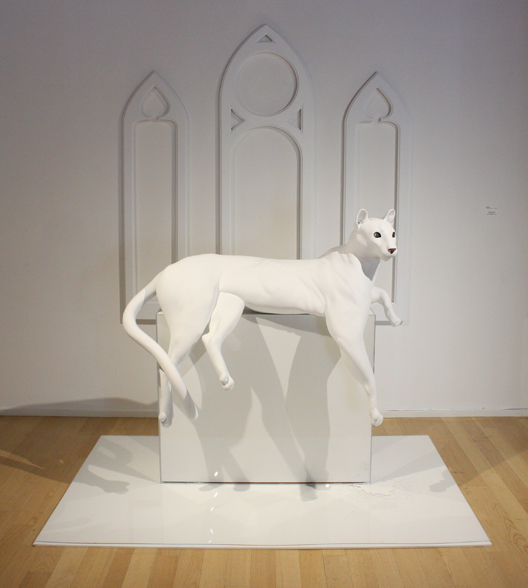
Apparition, 2012 mixed media | feline: 36" h x 52" w x 24" d “We Are Animal” series

Apparition, 2012
mixed media | feline: 36″ h x 52″ w x 24″ d
“We Are Animal” series

Briefly describe the work you do.

The unreal becomes tangible through my sculptural forms. My interests include rare phenomenon, ancient mythology, monster theory, and spirituality. Based on research into these topics and observation of human behavior, concepts evolve into animal sculptures. Over the last four years, the work has focused on the dark and light side of personality. Human behavior is complex because it is driven by both instinct and cultural influences. As social creatures, instinctual forces are derived from our primal selves, while cultural influences stem from the history, religion, science, media, and literature of the place we live. Therefore, humans are domesticated animals. Each artwork utilizes human-like eyes and smooth skin to provide viewers with clues to the introspective nature of my ideation. I am interested in the ways our social, creative, and psychological development relates to animals. The sculptures represent archetypes.

Tell us a little about your background and how that influences you as an artist.

After completing my BFA degree at Minnesota State University Moorhead, I moved to Minneapolis, Minnesota to pursue artistic employment. Within two weeks I was working at “Tivoli Too” a three-dimensional design and fabrication shop. The first couple of weeks consisted of working several days in each department. Soon my time was dedicated to the mold making area. Under the direction of Professor Martin Meersman at MSUM, I had learned to make relief, box, and brush-on molds. I utilize these processes constantly to create sculptures. In fact, this skill set has led to many employment opportunities for myself, so I have dedicated my Sculpture III and Ceramics III curriculum to students learning mold making and casting.

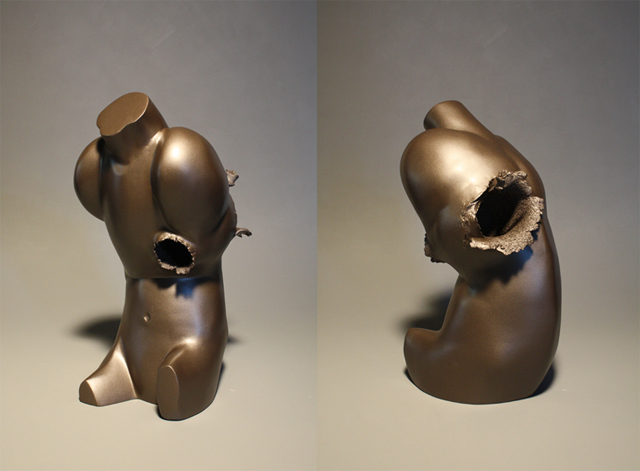
Impact (38 special), 2014  clay, polyurethane, paint  |  18.5” h x 7.5” w x 11” d “Meeting Our Shadow” series

Impact (38 special), 2014
clay, polyurethane, paint | 18.5” h x 7.5” w x 11” d
“Meeting Our Shadow” series

The concept of the “artist studio” has a broad range of meanings, especially in contemporary practice. The idea of the artist toiling away alone in a room may not necessarily reflect what many artists do from day to day anymore. Describe your studio practice and how it differs from (or is the same as) traditional notions of “being in the studio.”

A year ago I received an Iowa Art Council grant supported by the National Endowment for the Arts. It supported experiments to shoot clay with a variety of bullets to see the projectile effect. Expanding my studio practice to the firing range was exciting. Watching the clay burst and expand as it reacted was heart pounding. Otherwise, my practice requires traditional spaces from a sculpting area to a woodshop for crate building.

What unique roles do you see yourself as the artist playing that you may not have envisioned yourself in when you first started making art?

When I began making art my goals included providing viewers with sensory experiences through interactive sculptures. The artworks were activated with tactile materials or soundscapes. This work was focused on notions of fantasy. Now, my work is a blend of fantasy and reality. It focuses on the complexity of human behavior driven by both primal instincts and evolved socialization. Some sculptures feature mutations or blurred motion. Most recently, studio experiments have focused on current issues. Over the past thirty years, twenty-one mass shootings have occurred in the United States. These shocking one-day events have death tallies ranging from eight to thirty-two individuals according to CNN. Recent events include the movie theatre shooting in Aurora, Colorado; the gunning down of twenty-six people in Newtown, Connecticut; and the Washington Navy Yard killings. This string of violent events resulted in the desire to create sculptures that would represent the shock felt when one hears the news. Plus, question the mass murder’s motivation and how these individuals can be helped before more tragic events occur. Several clay torsos were sculpted and transported to a firing range. A rifleman then fired a variety of bullets from handguns and assault weapons at the objects. The resulting forms record the effect of the projectile. One of these sculptures is titled “Impact (38 special).”

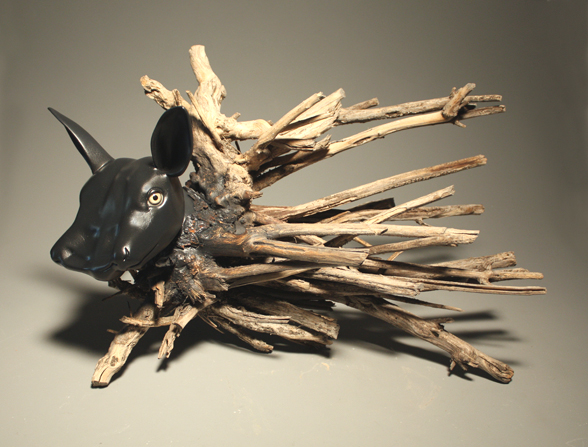
Chaos, 2014 mixed media | 16" h x 26" w x 16" d "Creation" series

Chaos, 2014
mixed media | 16″ h x 26″ w x 16″ d
“Creation” series

When do you find is the best time of day to make art? Do you have time set aside every day, every week or do you just work whenever you can? 

My sculptures are labor intensive and most take months to create. During summer months and holiday breaks, I dedicate weekdays. As deadlines approach my hours extend accordingly. During the academic calendar, I typically work nights and long weekend hours to create new work.

How has your work changed in the last five years? How is it the same?

I have developed three series of works: “We are Animal,” “Meeting Our Shadow,” and “Creation” in the last five years. Each addresses different concepts. The “We are Animal” series began with investigating current spiritual beliefs and the lineage to ancient religions. I have utilized technology in some sculptures to create unexpected encounters. “Apparition” is a life-sized mountain lion lying on a pedestal. The large cat cries physical tears. Wooden church window frames are hung behind on the wall. These works vary greatly in physical form from those in the “Creation” series, which began in 2013 on a whim. Resulting artworks have stemmed from mythology, which has led to general wonderment regarding rare phenomena. What discovers will be made in the next century? “Chaos” questions what we know to be “true” as the combination of forms violates the rules of nature. These sculptures combine natural plant and tree life with animals. The overall style of my work remains sleek. The animal sculptures have smooth surfaces relating to skin and human-like eyes.

Are there people such as family, friends, writers, philosophers or even pop icons that have had an impact on the work you do?

In 2009, I was hired to create commissions for internationally known artist Siah Armajani. Since, Armajani has become a mentor. He attended the reception for my Master of Fine Arts exhibit at the University of Minnesota – Twin Cities and followed up with a one-on-one critique. Each time we meet at his studio or talk on the phone, Siah always has words of wisdom to foster my career. On a recent visit, Siah said, “Tell yourself everyday the work you make is important, everyday!”

If you had an occupation outside of being an artist, what would that be and why?

When I began undergraduate school at MSUM I was interested in pursuing either a fine arts or chemistry degree. Being a chemist requires higher-order thinking and problem solving skills. The most engaging courses in high school included physics, psychology, and mathematics. Luckily, as a three-dimensional artist and professor, I utilize knowledge of these subject matters often. Since then, I have also thought a career in forensic science would have been very engaging.

About 

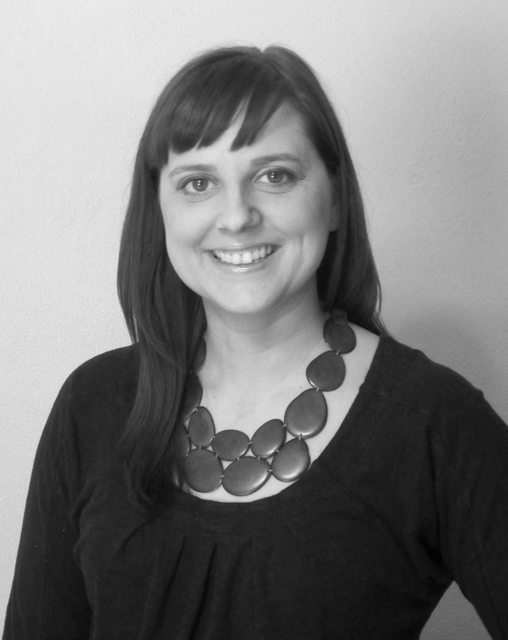
Teckemeyer_headshot_72Jessica Teckemeyer maintains an active studio practice and is an Assistant Professor at Clarke University in Dubuque, Iowa. She received her Master of Fine Arts degree from the University of Minnesota – Twin Cities in May 2010. Teckemeyer’s artworks have been featured in six solo exhibits and shown in over forty group exhibitions. Viewers in many cities have experienced the work, including: Monoco, France; Montevideo, Uruguay; New York, NY; South Orange, NJ; Santa Ana, CA; Baltimore, MD; Chicago, IL; Tallahassee, FL; Cincinnati, OH; Minneapolis, MN; and Des Moines, IA.  Recently she has received Second Prize at the “Tallahassee International” hosted at the Florida State University Museum of Fine Arts, the Three-Dimensional Award at the “36th Annual Rock Island Fine Arts Exhibition” at the Augustana College Art Museum, and two Iowa Arts Council Grants supported through the National Endowment for the Arts.

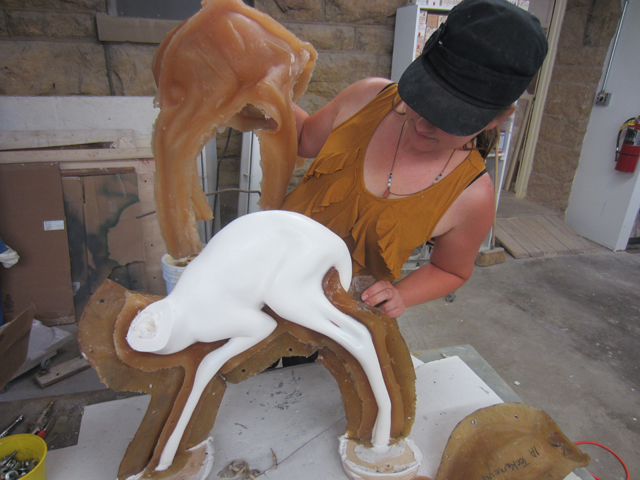
Teckemeyer has fabricated sculptures for internationally known artist Siah Armajani since 2009. Prior to graduate school, Teckemeyer worked in the sculpting, mold making, and painting departments at “Tivoli Too” a 3D design and production studio located near Minneapolis, MN. She earned her Bachelor of Fine Arts degree at Minnesota State University Moorhead in 2004. 

In the Studio

In the Studio

www.jteckemeyer.com.

All images copyright of the artist and used with their permission. 
Posted in Uncategorized | Tagged , , , , | Leave a comment

Kate Castelli – Cambridge, Massachusetts

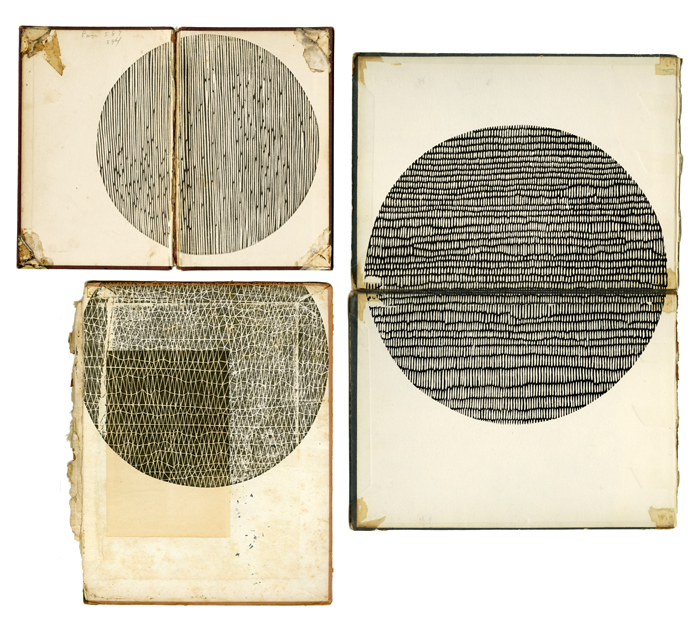
Woodblocks on 19th century book covers dimensions range from 9x12" to 12.25x18" unique impressions  2013

Woodblocks on 19th century book covers
dimensions range from 9×12″ to 12.25×18″
unique impressions
2013

Briefly describe the work you do.

My work is an intersection of prints, books, and works on paper that explores poetic and formal juxtapositions in order to connect what cannot be connected.
At the root of it all is the idea that paper has a memory and a history. Much of my work explores how I can edit, alter, or add to that history. There are threads that run throughout my work: traveling and the desire to be elsewhere, cities, fragments of literature and art history, small moments that need to be recorded or remembered. They all get layered on top of each other to weave something new out of something old. There is a subtle poetic tension in that, something mysterious and lingering. Someone once described my work as “Sherlockian,” and that has always seemed very accurate.

Tell us a little about your background and how that influences you as an artist.

I grew up going to museums and galleries, traveling, and spending a lot of time with my nose in a book or with a crayon in my hand. My parents have always been extremely supportive of my artistic endeavors and they fostered my curiosity and creativity from an early age. They are both public school teachers, and my father is a photographer, so it is really no surprise that I am an artist and a professor. 

The concept of the “artist studio” has a broad range of meanings, especially in contemporary practice. The idea of the artist toiling away alone in a room may not necessarily reflect what many artists do from day to day anymore. Describe your studio practice and how it differs from (or is the same as) traditional notions of “being in the studio.”

Where I work depends largely on what I am working on. I tend to work on projects in stages. I use a lot of ephemera and found paper, so a vital part of my process is sourcing material. I wander around used bookstores and antique shops. My printing surfaces and grounds take time to prep and the prints need to dry longer because of the nature of the surfaces. Books and mixed media work gets developed in layers. I like to have a lot of space to spread out on (aka create a large mess) and I use every available flat surface. I have a large oak table that my father made to fit my workspace in my apartment. I’m also a big fan of working on the floor. My woodblock prints are small in scale but very intense. They can take 8 to 12 hours to carve, so I work on a few of them at a time and print them in batches or series. As faculty, I’m lucky to have access to the print shop and other studio facilities. So I take full advantage of that workspace in addition to the space I have set up in my apartment.
woodblocks on vintage paper and ephemera dimensions range from 7x9.5” to 10x14” unique impressions 2014

woodblocks on vintage paper and ephemera
dimensions range from 7×9.5” to 10×14”
unique impressions
2014

What unique roles do you see yourself as the artist playing that you may not have envisioned yourself in when you first started making art?

You get the privilege of being the architect of your own life. But that also means wearing many hats and switching gears a lot. You have to be a maker, a critic, an editor, and a savy self-promoter. But above all you have to be resourceful.

When do you find is the best time of day to make art? Do you have time set aside every day, every week or do you just work whenever you can? 

I have more of a weekly routine. It depends on my teaching schedule but I generally have one full day in the studio and several afternoon/evenings a week. I work best anytime after 2 pm, although rarely very late a night. I’ve never pulled an “all nighter” in my life. I can’t seem to work in the studio in the morning so after my daily trip to Starbucks I take that time to email, research, document work, and update my website and social media.

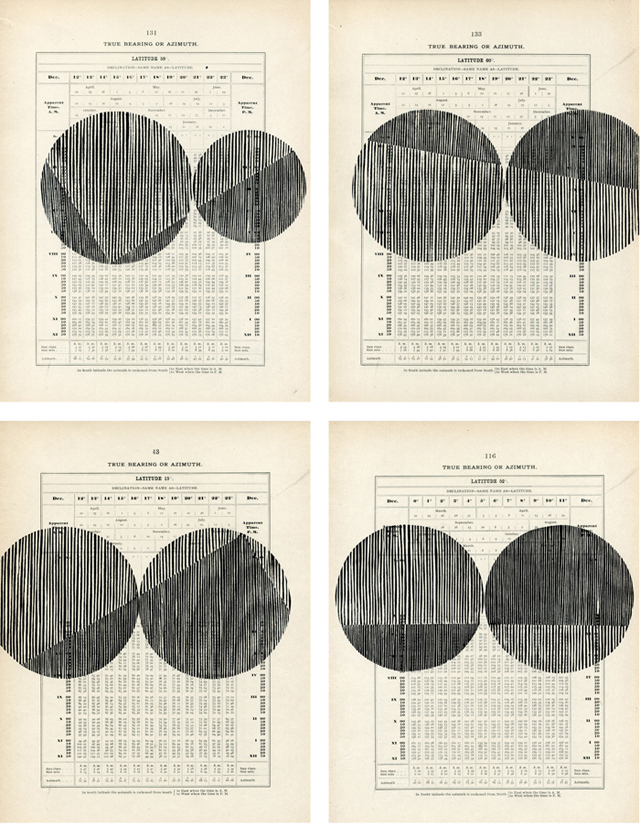
“Tiny Little” series pairs of woodblocks on 1920s navigational charts 8.75 x 11" each, unique impressions 2014

“Tiny Little” series
pairs of woodblocks on 1920s navigational charts
8.75 x 11″ each, unique impressions
2014

How has your work changed in the last five years? How is it the same?

I have a background in illustration and design, and after earning my BFA I was interested in working in the book and publishing industry. Things did not work out quite as planned and my work evolved away from illustration and client based projects. I’d always been interested in print based work and printmaking techniques, but I never considered myself a printmaker. When I decided to go back and pursue my MFA, I focused on printmaking and bookmaking. 

Are there people such as family, friends, writers, philosophers or even pop icons that have had an impact on the work you do?

I’ve loved Alexander Calder since I was very small and frequently visited the monumental “Steggy,” in Hartford CT. 
The range of William Kentridge’s work and his multifaceted process is fascinating to me. Most people know him for his animations and performances, but I love his prints and works on paper.
The Rolling Stones have always been a soundtrack to my life.

If you had an occupation outside of being an artist, what would that be and why?

A flâneur: an urban explorer with a passport, plenty of time, a blank sketchbook, and good food. Somehow I would be paid to just live like this.

About 

photo credit: Ashley Wood

photo credit: Ashley Wood

Kate Castelli is an artist living and working in Boston. She earned her BFA from Lesley College of Art and Design (formerly the Art Institute of Boston) where she is currently an assistant professor teaching in the Illustration program. She received her MFA in printmaking and book arts at the School of the Museum of Fine Arts, Boston. She is the blog editor and a member of the Board of Directors for Glovebox, a non-profit organization created to enable greater awareness of the art of emerging and established artists in Boston. When not making or thinking about art, Kate can be found happily wandering the city. She is rarely without a sketchbook, frequently haunts used bookstores, and is hopelessly addicted to Starbucks.

castelli_process

www.katecastelli.com

All images copyright of the artist and used with their permission. 
Posted in Uncategorized | Tagged , , , , | Leave a comment

Yvette Mayorga – Chicago, Illinois

Jose, 2014 (6ft x 2ft) 50 Million M&M’s, Frosting, Acrylic, Glitter, Bows, Sprinkles, Rhinestones, Found Objects, Foam

Jose, 2014 (6ft x 2ft)
50 Million M&M’s, Frosting, Acrylic, Glitter, Bows, Sprinkles, Rhinestones, Found Objects, Foam

Briefly describe the work you do.

I make sculptural towers made out of frosting and found objects that stand as monuments of immigrants. They are monuments to transnational bodies that have been covered in the sweetness of the American dream.

Tell us a little about your background and how that influences you as an artist.

I am a Mexican American, my parents are immigrants from Mexico that came to the U.S. in the 1970’s. My background as being a daughter of immigrants who have faced struggles crossing into the U.S. and adjusting to the culture have really influenced my work. I think that hearing stories of my family struggling to come to the U.S. has made immigration close to my heart, a border will always separate me from my family members. My Mexican identity always shows up in my work, it’s a part of me. Through color, iconography, and materials the Mexican in me always comes out in my paintings and sculptures.

The concept of the “artist studio” has a broad range of meanings, especially in contemporary practice. The idea of the artist toiling away alone in a room may not necessarily reflect what many artists do from day to day anymore. Describe your studio practice and how it differs from (or is the same as) traditional notions of “being in the studio.”

My studio practice is similar to traditional notions of “being in the studio” and also unconventional at the same time. I have specific days where its just me and my materials in my studio and I’m making work alone consuming the colors and the music in my ears. I think its important to have some sort of moment where its just you in your studio making work. I also do social work outside of the studio which to me, its also studio work, because it informs it as much as my materials do. I teach art classes to young Mexican/Americans and I learn a lot about them and I get different stories and narratives of identities which I think is very influential to the work I make.

La Muchacha de $2.99, 2014 (5ft x 3ft) Mixed Media on Paper

La Muchacha de $2.99, 2014 (5ft x 3ft)
Mixed Media on Paper

What unique roles do you see yourself as the artist playing that you may not have envisioned yourself in when you first started making art?

I see myself more political than I could have ever imagined. When I first started making work, I was interested in making political work but I never pushed myself to do it. I was afraid of painting or talking about hard subjects that are politically charged, such as the U.S./Mexico border. As the years have gone by I feel as though it is my obligation to bring awareness to these subjects through making.

When do you find is the best time of day to make art? Do you have time set aside every day, every week or do you just work whenever you can? 

For me, the best time to make art is after 5pm. After a long day of teaching or class, the first thing I want to do is head to my studio and make crazy colorful work! I try my hardest to be in the studio every day. Even if it’s just me reading in the studio, it’s important for me to be in there and consume everything around me.

Maria, 2014 (3ft x2ft) Frosting, Acrylic, Hair, Roses, Glitter, Candles, Sprinkles, Rhinestones, Found Objects, Foam

Maria, 2014 (3ft x2ft)
Frosting, Acrylic, Hair, Roses, Glitter, Candles, Sprinkles, Rhinestones, Found Objects, Foam

How has your work changed in the last five years? How is it the same?

In the last five years I wasn’t making sculptures let alone using frosting. So I would say it’s different in the choice of materials that I know am constantly using. I would also say that it’s the same in terms of my work always being about my identity as a Latina artist.

Are there people such as family, friends, writers, philosophers or even pop icons that have had an impact on the work you do?

My family and their personal narratives have heavily influenced my work, they are so inspiring to me. In terms of writers, Gloria Anzaldua has also had a large impact on my work. Her book, “Borderlands/La Frontera: The New Mestiza,” has opened me to understand my own identity in such a fruitful way. After reading her book I began to gain a better sense of why I work the way I do and why my heritage is so engrained in me. It was a beautiful moment for me.

If you had an occupation outside of being an artist, what would that be and why?

I would be a stunt woman, sounds crazy right? I am fascinated with the idea of being a powerful woman who jumps off buildings and gets paid for it, what’s more great than that?

About 

HeadshotYvette Mayorga (b. 1991) is a Mexican/American artist known for her sculptural work that is situated within the idea of the “American dream,” and how it has been perpetuated through culture—the white picket fence and sold through the popular media. Yvette’s current project, the Borderland Series (2014), utilizes confection, industrial materials, and the American board game Candy Land as a conceptual framework to juxtaposition with the U.S. and Mexico borderlands. This juxtaposition relates to the artist’s Latina identity as she constructs imagined places which mirror her position between the U.S. and Mexico borderlands. She received her BFA from University of Illinois at Urbana-Champaign and is currently an MFA candidate at The School of the Art Institute of Chicago.

Jose's X-RAY, 2014 (19in x 24in) Inverted photograph of detail of Jose

Jose’s X-RAY, 2014 (19in x 24in)
Inverted photograph of detail of Jose

www.yvettemayorga.weebly.com

All images copyright of the artist and used with their permission. 
Posted in Uncategorized | Tagged , , , , | Leave a comment

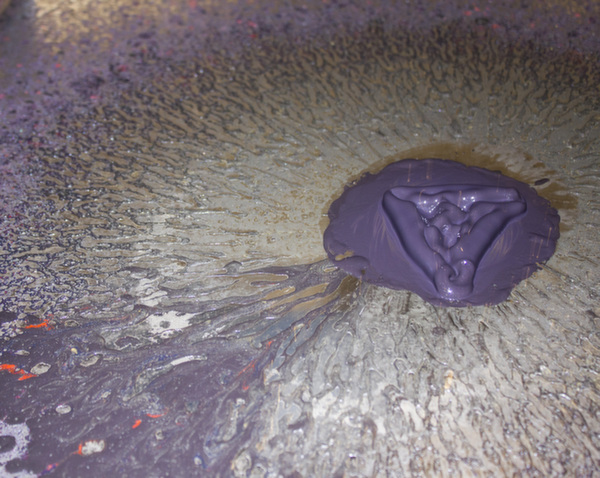
Bass Structures – Milwaukee, Wisconsin

Bass _1 "48 Hz" Oil and Acrylic on Plexiglas, 24" x 24" 2011

Bass _1 “48 Hz” Oil and Acrylic on Plexiglas, 24″ x 24″ 2011

Briefly describe the work you do.

We harness the power of sound to arrange paint on canvas.  This is done through a visual and audial experience, in which Bass Structures will sometimes collaborate with musicians and/or other sound artists.   The paintings then, are a visual record of that experience.

Tell us a little about your background and how that influences you as an artist.

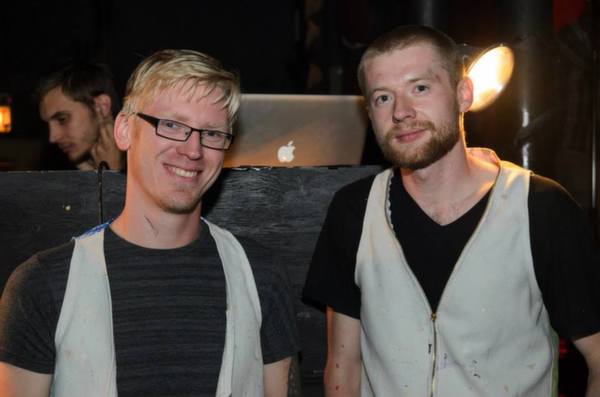
We met at the Milwauee Institute of Art and Design and started working together in 2010.  We went through a year of research and development before our first show of frequency based studies.  It has been a wild ride since.  We are both painters, sculptors, and musicians with an eclectic taste for life.  

The Wassilys (our music composing robots) only talk in bleeps and waoums, but we imagine that they have lovely things to say about their short lives.  

The concept of the “artist studio” has a broad range of meanings, especially in contemporary practice. The idea of the artist toiling away alone in a room may not necessarily reflect what many artists do from day to day anymore. Describe your studio practice and how it differs from (or is the same as) traditional notions of “being in the studio.”

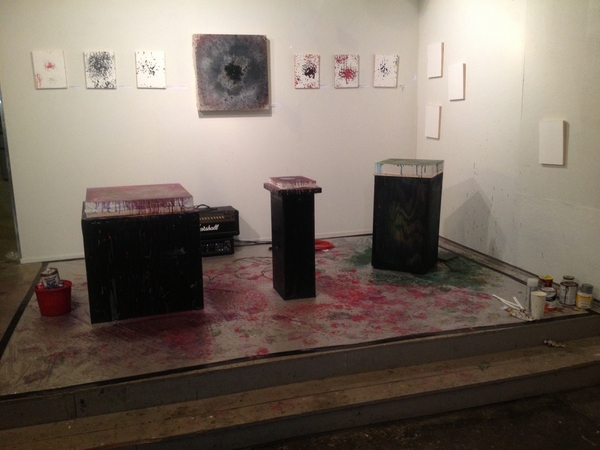
The thing that is really unique about Bass Structures is that the WAY that the work is created.  So, we try to include the audience in that process as much as possible.  The majority of our new paintings have been made in a gallery or collaborative setting with musicians.  The rest are results of our solitary “studio practice” of equipment creation and other various experimentations.

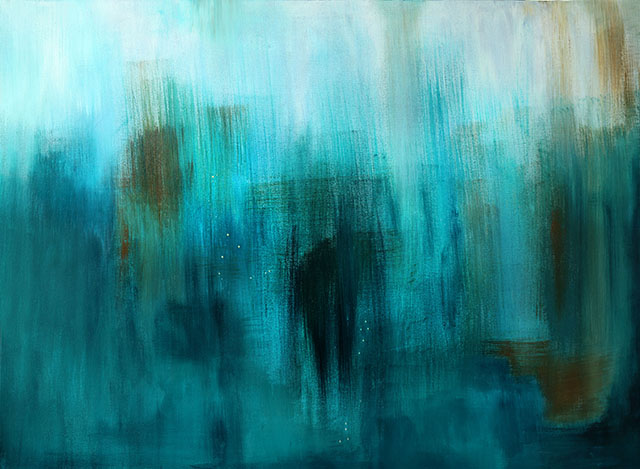
Bass_2  "Still from the creation of 38 Hertz,"  Oil and Acrylic on Plexiglas, 24" x 24" 2012

Bass_2 “Still from the creation of 38 Hertz,” Oil and Acrylic on Plexiglas, 24″ x 24″ 2012

What unique roles do you see yourself as the artist playing that you may not have envisioned yourself in when you first started making art?

Pseudo Scientist/Inventors.  We both thought that a pursuit of fine art would involve painting on stretched canvas in the studio, and had absolutely no idea we would end up messing with physics and programming robots.  

When do you find is the best time of day to make art? Do you have time set aside every day, every week or do you just work whenever you can? 

Art creation has been synonymous with sleep deprivation since we were both studying at MIAD. So, our answer is going to have to be “that magic time somewhere between midnight and sunrise.” This is when all of the course changing ideas have come around.  But really, any time of the day or night is enjoyable. 

Bass_3 Still from the creation of 34 Hertz", Oil and Acrylic on Plexiglas 24” x 24” 2012

Bass_3 Still from the creation of 34 Hertz”, Oil and Acrylic on Plexiglas 24” x 24” 2012

How has your work changed in the last five years? How is it the same?

In the last 4 years we have gone through 9 separate sound transferring systems, over a dozen materials used as the “canvas,” and we’re not entirely sure how many combinations of paint and particles have been experimented with to form the imagery.  We have collaborated with a wide variety of bands and musical sources ranging from classical to heavy metal.  We’ve used atmospheric sound sources and constant sources (i.e. Hertz wavelengths), and we have programed music composing robots (something we call the Wassily Collective).  We are constantly searching for something new.  Throughout this, though, there has been the striking constant of fractal like forms.  We take this to mean that sound has a shape, and all of our variables are merely distortions.

Are there people such as family, friends, writers, philosophers or even pop icons that have had an impact on the work you do?

All of our friends and family have been extremely supportive and helpful in this.  This phenomenon that we are capturing has a way of sparking some very deep philosophical discussions, which is very fulfilling and is a great inspiration in our search for distortion.  We owe a lot to Ernst Chladni, who is credited as the pioneer in studying the effect of sound on the physical world.  Something that is broadly referred to as cymatics.  We have affinity with contemporaries such as Evan Grant, Sonic Water Laboratory, Bartholomäus Traubeck, Neil Harbisson, and John Mueller.

If you had an occupation outside of being an artist, what would that be and why?

Astronauts.  In part, because we want to test Bass Structures in zero gravity… we may be working on trying to convince NASA to have us be their first Artist in Residence that actually goes into space….

About 

collin_and_emmanuelBass Structures: the Mark of Sound is a collaborative body of work between artists Emmanuel Fritz and  Collin Schipper. They use sound to arrange paint into geometric and/or fractal-like patterns.  This happens in both the pigments and the 3-dimensional space that the paint occupies.  The patterns are subject to several factors.  The note/frequency that is pulsing through the system reacts uniquely to the types of materials used in the process. The chemical make up of the paint and surface, the shape of that surface, as well as environmental factors of temperature/humidity/etc… all have a part in the equation that makes the piece what it is.

Started as an observational exploration of the effects of sound on materials, this body of work is based on research surrounding cymatics. They have made the decision to keep a portion of our portfolio dedicated to this observation.  However, they have also begun to go beyond observing/recording the effect of a single note over time.  They create experimental music using frequency generated sounds, instrumental sculptures, and self programed synths; as well as collaborations with other musicians and musical groups, to observe what their sounds look like. 

From the opening reception at Var Gallery and Studios 2013

From the opening reception at Var Gallery and Studios 2013

emmanuelfritz.com

All images copyright of the artist and used with their permission. 
Posted in Uncategorized | Leave a comment

Sanja Hurem – New York, New York and Berlin, Germany

Through, Acrylic on Canvas, 30x40'', 2014

Through, Acrylic on Canvas, 30×40”, 2014

Briefly describe the work you do.

My work is primarily engaged in a process of translation, dealing with the question of how we perceive similar states of mind through a variety of media. I initially started out as a lens-based artist and later moved towards working with a variety of media, including installation and painting.

Tell us a little about your background and how that influences you as an artist.

I think that my background as a photographer has strongly influenced my work, because light and composition, the most important elements in photography, are also the most important elements in my other pieces. In addition, having lived in quite diverse and international environments has allowed me to delve into the topic of translation- what is translatable and what is not? What’s the common ground and what are the areas of difference? Is a shared language possible? All of these are questions that apply to cultures and languages, but they also apply to how artists create across media and to the ways an audience experiences moods and qualities across art pieces.

The concept of the “artist studio” has a broad range of meanings, especially in contemporary practice. The idea of the artist toiling away alone in a room may not necessarily reflect what many artists do from day to day anymore. Describe your studio practice and how it differs from (or is the same as) traditional notions of “being in the studio.”

The studio to me is more a mental space than a physical one. Being in the studio just means being engaged with your own creative process. This can happen in the four walls of my physical studio or it can happen in my kitchen or on the road. Quite frequently it happens in interaction with someone, where new ideas are sparked for my practice and then automatically start to shape my next steps. Looking at it this way, I don’t think it’s ever possible to leave the “studio space”.

Dream Materialized 1, Installation, size variable, 2014

Dream Materialized 1, Installation, size variable, 2014

What unique roles do you see yourself as the artist playing that you may not have envisioned yourself in when you first started making art?

I frequently find myself playing the role of a researcher. I remember when during college I would take a required classes, and the research for papers was the hardest part because I didn’t have much motivation other than the external need to complete the module. Nowadays, on the other hand. I find myself constantly learning and researching, motivated by an intrinsic desire to know more. 

Overall, I think that artists are asked to make sense of what they see in the world and place their own work within that context. I don’t know if there’s one specific word for that activity, but whatever it’s called there’s definitely a lot more of it than I anticipated.

Dream Materialized 2, Installation, size variable, 2014

Dream Materialized 2, Installation, size variable, 2014

When do you find is the best time of day to make art? Do you have time set aside every day, every week or do you just work whenever you can? 

Afternoons and evenings are a good time for me, but generally I work whenever I get the chance.

How has your work changed in the last five years? How is it the same?

My work has changed because it is no longer tied to photography alone, so I am able to play with abstraction and reduction more than before. Photography can be an abstract medium, but for me it has always been more literal and direct. Developing my practice throughout other media over the past years has allowed me to think in different “languages”.

Are there people such as family, friends, writers, philosophers or even pop icons that have had an impact on the work you do?

With regards to family and friends, I think it’d be difficult to understand where exactly the influence begins and where it ends- to a certain extent we’re all outcomes of our environment. Listing all the writers and philosophers that have shaped my work would probably lead to a very long list. On a very fundamental level, their questions about the individual’s role in society and subsequently about art’s role for the individual are the same mysteries that drive me to make work. 

If you had an occupation outside of being an artist, what would that be and why?

If I had an occupation outside of being an artist it would most likely writing. My interest in language goes back to my school years, so working with the written (and spoken) word would seem like a natural step for me. 

About

headshotSanja has lived between Europe, US and South America. Her education includes programs at Northwestern University, the International Center of Photography and Plymouth University (UK). Initially trained as a photographer, her work spans several media including painting and installation. She has exhibited in the US, Canada and Europe, as well as having completed artist residencies internationally. Her current practice focusses on the fusion of two and three-dimensional pieces. Sanja lives and works internationally with a year-round base in Berlin.

detail shot of Dream Materialized 1

detail shot of Dream Materialized 1

www.sanjahurem.com  

All images copyright of the artist and used with their permission.
 

Posted in Uncategorized | Tagged | Leave a comment