Greg Lookerse – Boston, Massachusetts

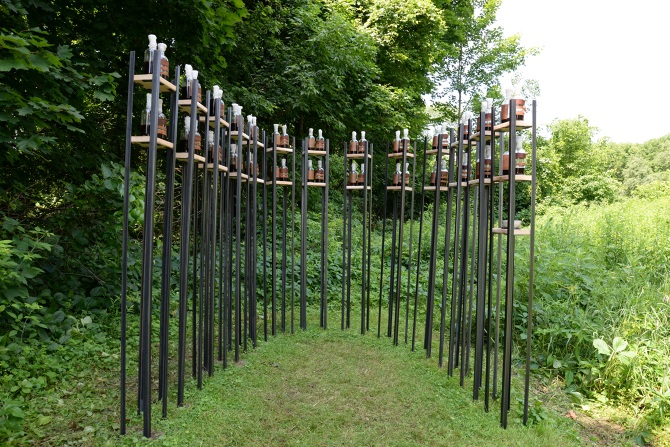
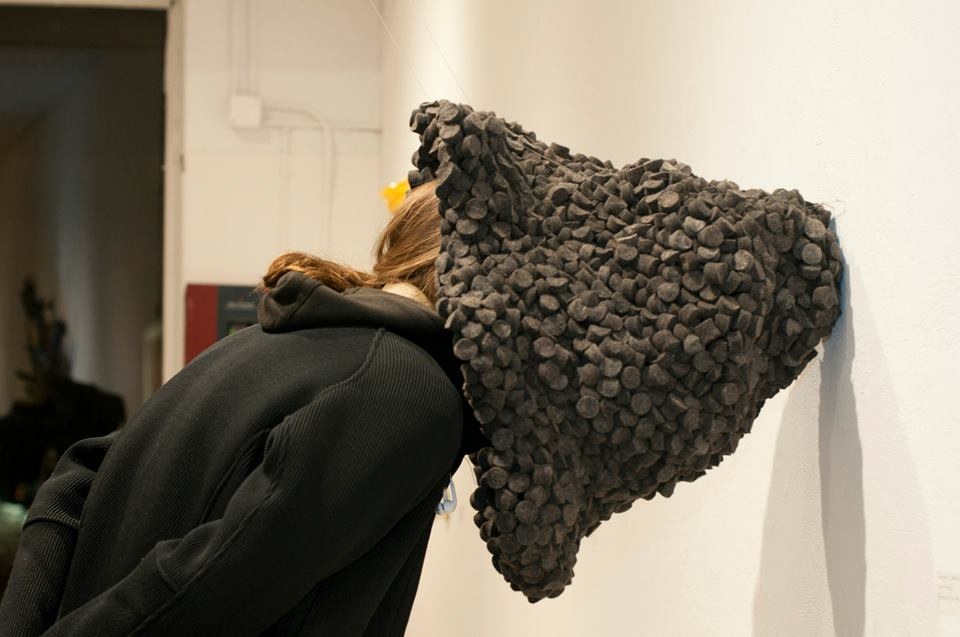
Rockport Mass Communion Wafers, Birds, Icon of St. Francis of Assisi  One Hour Long 2014

Rockport Mass
Communion Wafers, Birds, Icon of St. Francis of Assisi
One Hour Long
2014

Briefly describe the work you do.

I am an interdisciplinary artist working primarily in video, sculpture and performance. My work revolves around the incongruities of the physical and the metaphysical. Like Kierkegaard, I am interested in the absurdity of faith and faith based actions. I explore the vast depth of faith beyond just religious faith into what I consider realms of faith that are taken for granted; for example faith that mud on a canvas can depict something other than mud on a canvas.

Tell us a little about your background and how that influences you as an artist.

My working background is as a graphic designer. This has influenced the way I work by introducing me to typography which has grown my appreciation for the written word. I am heavily influenced by the way typography looks and by the things we take words to mean.

The concept of the “artist studio” has a broad range of meanings, especially in contemporary practice. The idea of the artist toiling away alone in a room may not necessarily reflect what many artists do from day to day anymore. Describe your studio practice and how it differs from (or is the same as) traditional notions of “being in the studio.”

I think of my studio as a place for me to explore. Most of my studio work is not toiling away but rather experimenting and getting to know materials. In the studio mistakes are made and hopefully some little gem is found. Once I find these gems I develop finished pieces in a more traditional manner. My practice has waves of really knowing what I am going for and then times when I am just confused as hell.

Searching for a Honey Tree with Fear and Trembling Honey, Back Brace, A Chair from a Catholic School, and Johannes de Silentio’s Fear and Trembling 10’x8’x8’ - Six Days Long 2014

Searching for a Honey Tree with Fear and Trembling
Honey, Back Brace, A Chair from a Catholic School, and Johannes de Silentio’s Fear and Trembling
10’x8’x8’ – Six Days Long
2014

What unique roles do you see yourself as the artist playing that you may not have envisioned yourself in when you first started making art?

I experience censorship for the first time in Rockport, MA this August. I found myself between conservative catholics and two great people, Bob and Jill Armstrong of iArtcolony, in Rockport. I found myself in the role of satisfying those who were angry and still maintaining my artistic integrity. This lead me to make two works in response, Rockport Mass and “…in a drifting boat with a slow leakage” – T.S. Eliot. 

When do you find is the best time of day to make art? Do you have time set aside every day, every week or do you just work whenever you can?

I work best when I am rested. This usually means late morning and early afternoon. I have several days a week that are my studio days.

Father Abraham had Two Sons An english translation of the Quran and an english translation of the Bible 2”x10”x12" 2014

Father Abraham had Two Sons
An english translation of the Quran and an english translation of the Bible
2”x10”x12″
2014

How has your work changed in the last five years? How is it the same?

Grad school definitely changed the specificity of my work and pushed me more in the direction of performance. I remain attached to objects and things but before I never considered myself a performance artist.

Are there people such as family, friends, writers, philosophers or even pop icons that have had an impact on the work you do?

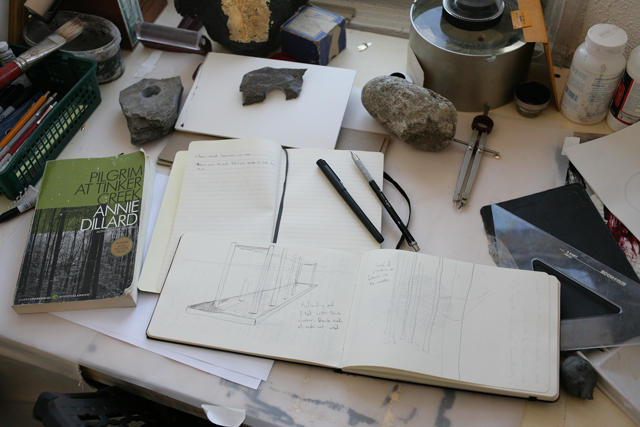
I draw influence from many writers and artist. Recently the most impactful have been Ann Hamilton and Annie Dillard. Dillard especially has such a wonderful voice that is wistful and wandering while heavy as the Old Testament. Another great poet that I love is Wendell Berry. Anyone who sees mystical meaning in physical objects will find that i am a fan of their work.

If you had an occupation outside of being an artist, what would that be and why?

I dream of being in a position like Bill and Malinda Gates. I would love to have a ton of money to give to people who are doing amazing things for the betterment of humankind and this planet. I am not sure what the job title would be, something like International Not for Profit Researcher and Grant Giver. 

unnamed-4About

Greg is an interdisciplinary artist who has been working since 2009. He received his MFA from Tufts University in conjunction with the School of the Museum of Fine Arts Boston in 2014. Originally from California he works in Boston and the New England area while exhibiting his work around the world. 

unnamed-8

All images copyright of the artist and used with their permission. 

Posted in Installation, Photography | Tagged , , , , | 2 Comments

Shane Rodems – Champaign, Illinois

1945 Farmall International A, good tin, good paint, 4 new tines  media 47” x 36”

1945 Farmall International A, good tin, good paint, 4 new tines
media
47” x 36”

Briefly describe the work you do.

Basically I have a happening in my studio by myself. I photograph the results for prosperity and documentation. I enlarge the photos then place an actual artifact on top of the enlargements to make a painting.

Tell us a little about your background and how that influences you as an artist.

My background is in painting, I have an MFA from Indiana University in painting. I’ve also been working on golf courses for years. Since golf is a business I have learned to be creative in my problem solving in order to save money. While I’m working on artwork I resuscitate this creativity not for monetary reasons but because its natural.

The concept of the “artist studio” has a broad range of meanings, especially in contemporary practice. The idea of the artist toiling away alone in a room may not necessarily reflect what many artists do from day to day anymore. Describe your studio practice and how it differs from (or is the same as) traditional notions of “being in the studio.”

I go into my studio, crack open a beer, out on some music (right now it’s usually something like Bill Laswell or Devandra Banhart on Pandora), then I get lost in the studio. Over time I’ve collected enough junk or “things” as I like to call them to be a hoarder. I play with these things arrange them and paint them and unpaint them and put glitter on them. Then maybe I find a new straightforward thing to do. My studio is full of great distraction so I love to get lost there. Usually I leave and finish that cracked beer, but now it’s warm.

Four Winds Hurricane 34B__2007 3 Slides, bunk bed, pay what I owe  media 23.5” x 35”

Four Winds Hurricane 34B__2007 3 Slides, bunk bed, pay what I owe
media
23.5” x 35”

What unique roles do you see yourself as the artist playing that you may not have envisioned yourself in when you first started making art?

Since I am a father I see myself being very serious about what I love to do. I want them to also love what they choose so leading by example I suppose it will rub off on them.

When do you find is the best time of day to make art? Do you have time set aside every day, every week or do you just work whenever you can?

I work when I can but it’s always at night or early early in the morning.

Parker Gravity Wagon w. Gehl  media Variable/ 72” x 48”

Parker Gravity Wagon w. Gehl
media
Variable/ 72” x 48”

How has your work changed in the last five years? How is it the same?

Hopefully my work changes everytime I go into the studio. I see myself with a wider lens these days so I make whatever I need to make. Before I was more structured, in a classroom it’s difficult grasp the scope of what you can actually do.

Are there people such as family, friends, writers, philosophers or even pop icons that have had an impact on the work you do?

Not especially anyone in particular.

If you had an occupation outside of being an artist, what would that be and why?

Since I have had many occupations outside of being an artist I’m pretty sure there is nothing else I’d rather do. Well maybe I’d be a fireman or politician. A fireman because all they really do is help people, unconditionally and a politician because that would be pretty exciting I suppose.

About

????????Shane Rodems is a Midwestern artist working in many processes. He loves the color that paints make and he loves the surfaces he gets out of photographs covered in varnish or resin.   He graduated from Indiana University with an MFA in painting and from Eastern Illinois University with an MA in painting as well. He holds down a job working for his family’s golf management company but really wants to be an art educator. He loves to be outside whenever possible chasing around his two kids Ike and Lulu. Every once in a while he is lucky enough to have a date night with his wife Kathy. He likes music and dancing and fall leaves and deep snow and pizza…mmmm. He drives a little car and rides his bike often. In the next ten years hopefully he will be teaching at a great place with tons of bright eyed art students.

????????

shanerodems.com

All images copyright of the artist and used with their permission. 

Posted in Painting | Tagged , , , , | Leave a comment

Dominic Lippilo and Mark Schoon – Starkville, Mississippi and Atlanta, Georgia

Hallway, 30x40", Inkjet Print, 2014

Hallway, 30×40″, Inkjet Print, 2014

Briefly describe the work you do.

We create photographs wherein images of two separate homes are brought together to create the illusion of a singular place.  We begin the process by photographing our own homes separately and post-processing our own images.  Once an individual image is completed we email it to the other whereupon he will make a complimentary and compatible image. The original image coupled with the second is printed as a single print to create the illusion of a singular space.

Tell us a little about your background and how that influences you as an artist.

We met in 2006 in graduate school at Ohio University. We were both interested in aspects of the domestic, but for completely different conceptual ideas. In our MFA thesis work, Mark was photographing Midwestern domestic interiors from the perspective of an observer and Dominic was photographing the house he lived in and his parents’ house from the prospective of a witness. With that said, we often would make compositions that looked similar to one another’s even though we were not aware of the imagery the other was making. We decided to share gallery space for our MFA exhibitions and a really interesting mirroring effect occurred with the imagery. It expanded our conversation about domesticity and the representation of space and place in photographs. Our MFA show was in the spring of 2009 and our first collaborative project, Anti-Local, started in the spring of 2010.

The concept of the “artist studio” has a broad range of meanings, especially in contemporary practice. The idea of the artist toiling away alone in a room may not necessarily reflect what many artists do from day to day anymore. Describe your studio practice and how it differs from (or is the same as) traditional notions of “being in the studio.”

Our practice is different than traditional studio practices because we are working together, yet remotely. As photographers, the act of photographing for our collaborative work is not that different than if we were to make imagery independently. The process of making an image, sending it to the other via email, talking via yahoo chat, email, telephone, and Facebook has expanded the studio in many ways. When we started our collaborative work, Mark was living in Queens, NY and Dominic was living in Youngstown, OH. There was about 1,000 miles between us, but the only time that really came into consideration was when we had to physically get something to the other. That’s when the distance was felt.

Rocker, 30x40", Inkjet Print, 2013

Rocker, 30×40″, Inkjet Print, 2013

What unique roles do you see yourself as the artist playing that you may not have envisioned yourself in when you first started making art?

When we first stated making art we both envisioned ourselves creating work independently. We each thought that making photographs would be a solitary act, and while the individual images that we make are created independently, the work is not complete until they are matched up with their companion images. We were always under the impression that photography was something done alone at each stage – but suddenly it wasn’t.

When do you find is the best time of day to make art? Do you have time set aside every day, every week or do you just work whenever you can? 

We each try to block out at least one day a week to work on our projects. That is harder to do during the academic year. Besides being artists we are also Assistant Professors. The demands of teaching can easily eat away at studio time, as does being a husband and a father. It is a constant struggle to find a balance between everything in life. May – August is usually really productive; we shoot a lot and edit the images. During the academic year we are not as concerned with making new images but creating matches and making prints. This allows us to really consider the individual images as we shoot for the appropriate match and prepare for exhibitions.

Patched Wall, 30x40", Inkjet Print, 2014

Patched Wall, 30×40″, Inkjet Print, 2014

How has your work changed in the last five years? How is it the same?

In 2009 we were making imagery about domesticity by ourselves. Now, in 2014, we are making imagery about domesticity together. We both still maintain solo art practices too. The collaborative work allows us to fulfill one conceptual interest and one photographic interest. We’ve found that now we’re each more experimental in our solo work and willing to take risks.   The collaborative work has allowed us breathing room for the solo ideas to develop and relieved some pressure to get the work into the art world as quickly as we might otherwise have felt.

Are there people such as family, friends, writers, philosophers or even pop icons that have had an impact on the work you do?

Since we are working collaboratively, yes, we greatly influence each other. Since we are photographing in our own homes, perhaps our families influence what we photograph or don’t photograph. Anthony Vidler’s book, “The Architectural Uncanny”, was a big influence on both of us, and the way we think about domestic space. Also, photographers like Moyra Davey who approach making images of their own living space.

If you had an occupation outside of being an artist, what would that be and why?

Mark: Documentary Filmmaker. It is a beautiful way to engage with the world. Dom: Musician. Like visual art it is an expressive form of communication to engage an audience.

About

headshot_lippilloheadshot_schoonDominic Lippillo and Mark Schoon earned their MFA’s in Photography from Ohio University in 2009. Working independently with lens‐based media they soon realized they had a shared interest in the domestic. Although they approach their solo work differently, a common sensibility could be recognized in the earlier work of both artists leading to the creation of their first collaborative effort, Anti-­local. Selections from their collaborations are included in the permanent collection of The Museum of Photographic Art; The Museum of Fine Arts, Houston; The University of Alabama, Tuscaloosa; the Journal Exposure, and in the supplement of images accompanying Bruce Warren’s textbook Photography: The Concise Guide (2nd Edition March 2011). Lippillo is an Assistant Professor of Art at Mississippi State University. Schoon is an Assistant Professor of Art at The University of West Georgia.

Working_in_studio_1

Working_in_studio_2

lippilloschoon.com

All images copyright of the artist and used with their permission. 
Posted in Collaboration, Photography | Tagged , , , , | Leave a comment

Coe Lapossy – Boston, Massachusetts

Thank You For Saving me Acrylic and paper on canvas 36"x32" 2012

Thank You For Saving me
Acrylic and paper on canvas
36″x32″
2012

Briefly describe the work you do.

I’m interested some of the challenges that have become part of living in the twenty-first century in relation to art, spirituality, and pop culture.

Tell us a little about your background and how that influences you as an artist.

I grew up in rural Ohio. When I was very young my family was somewhat isolated in our home, but when I was about seven years old, Armstrong cable company installed a line down our street.  This altered my very quiet childhood and I became infatuated with pop culture.  I was a fast convert to early MTV and still love music videos.  Both of those viewpoints are given equal weight in my work.  These two characters: the hermit and the pop culture fanatic are duking it out.  One is still living in the woods looking for truth, and the other craves pop culture references.  

The concept of the “artist studio” has a broad range of meanings, especially in contemporary practice. The idea of the artist toiling away alone in a room may not necessarily reflect what many artists do from day to day anymore. Describe your studio practice and how it differs from (or is the same as) traditional notions of “being in the studio.”

I have a studio space that I enjoy being in.  It’s important for me to be around other artists and hear about their work and ideas.  Right now my studio space is shared with five other artists.  I became used to sharing space while I was in a large graduate school program and I discovered that I prefer activity around me at times.  Teaching, curating, and other jobs are facets of my art practice as well.  The vast majority of my work is done in various locations: at my desk at home, right before bed, and while I’m getting paid to do other jobs.  I am obsessive and my projects permeate most of my day to day activities.  

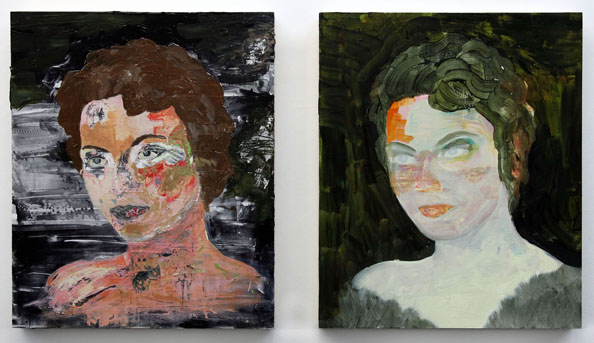
Zombie Mom, Ghost Mom #1 and #2 acrylic on panel 19"x14" 2013

Zombie Mom, Ghost Mom #1 and #2
acrylic on panel
19″x14″
2013

What unique roles do you see yourself as the artist playing that you may not have envisioned yourself in when you first started making art?

I am collaborating much more then I ever thought I would.  It’s a wonderful surprise to find people to work closely with.  

When do you find is the best time of day to make art? Do you have time set aside every day, every week or do you just work whenever you can?

I wish I had a schedule, it seems like such a good idea!  Yet, I know that I would immediately rebel from it.  Over the years I have discovered that I need room for whim in my practice.  I need rewards, and I need other people involved.  All of this has become the unruly standard for me.  

How has your work changed in the last five years? How is it the same?  

Stylistically the work looks very different, yet it is about the same things.  I’m still chasing the same things, trying to figure it out. Matthew McConaughey would relate.

Detail of 'Get In The Pit and Love Someone (advice from Alice Sebold and Kid Rock)

Detail of ‘Get In The Pit and Love Someone (advice from Alice Sebold and Kid Rock)

Are there people such as family, friends, writers, philosophers or even pop icons that have had an impact on the work you do?  

For Sure!  The short list is: My parents are wonderful weirdos (a big help when choosing a career for the love, not the money), Future Idea Group (FIG), Marla Greenman, Andrea Champlin, Bug Davidson, Jonathan Franzen’s essay ‘Liking Is For Cowards. Go For What Hurts.’, Beth Ditto’s ‘Coal to Diamonds’, Roseanne Barr, Piers Anthony, Tig Notaro, Kanye West, Chuck Klosterman, J. Jack Halberstam, and Tina Fey.  

I am a bit of a sponge and my work traffics in pop culture references so I have to show some restraint here, yet I should mention that I became a painter because in 2001 I came across Vitamin P : New Perspectives in Painting by Barry Schwabsky.  I was 21 and had never seen contemporary painting before. It blew me away. I am grateful to have found that resource at a pivotal moment in my life.  

If you had an occupation outside of being an artist, what would that be and why?

Magician’s assistant, I already know the job.

About

365 Coe Lapossy HeadshotCoe Lapossy’s work investigates the relationship between how we construct our self-image through popular culture and a yearning to find greater authenticity. Coe Lapossy lives, works, and fights apathy in Boston, MA. She receive her MFA from the School of the Museum of Fine Arts, Boston, and Tufts University. In 2012 she co-curated the “Liking Is For Cowards. Go For What Hurts” show at the Museum of Fine Arts, Boston.  Her current project looks at her relationship to imagery taken from movies that she watched repeatedly growing up.  High Spirits, Prelude To A Kiss, and The Last Unicorn all focus on telling the story of romantic love outside the confines and limits of the human body. Lapossy reinterprets these images with a new cast of characters, through painting and sculpture.  

365Coe Lapossy at dune shack

www.coelapossy.com

All images copyright of the artist and used with their permission. 

Posted in Uncategorized | Tagged , , , , | Leave a comment

Sarah Bouchard – Portland, Maine

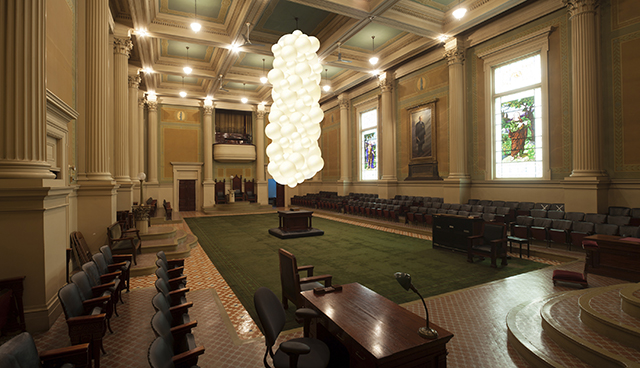
Corinthian Hall Mock-Up. Digital Image with Photoshop Collage of Proposed Installation. Dimensions Variable. 2014.

Corinthian Hall Mock-Up. Digital Image with Photoshop Collage of Proposed Installation. Dimensions Variable. 2014.

Briefly describe the work you do.

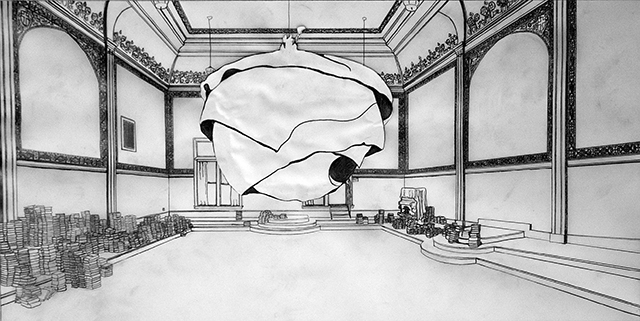
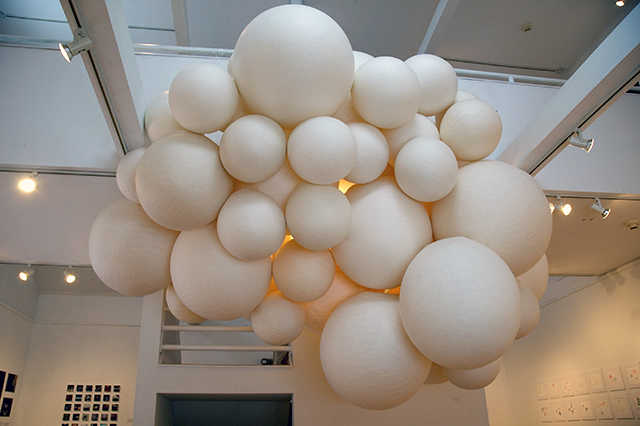
I am currently the Artist-in-Residence at an Masonic Temple in downtown Portland, Maine. I am working on a massive sculptural installation that explores the influence of the feminine within the Masonic Order, as it intersects specifically with the architecture and history of the Congress Street Temple. For this project, I am creating hundreds of handmade, translucent orbs that will be suspended throughout key ritual rooms of the Temple. I am also sculpting a 20-foot-diameter bees nest to be suspended in the Eastern Star Hall, the former ritual room of the “women’s strain” of the Masonic Order.

Tell us a little about your background and how that influences you as an artist.

I was born in Portland, Maine, but lived in many different parts of the United States before returning to make Maine my home. I was raised without much money, but my parents consistently encouraged me to find and pursue that which really activated my passions. I was also taught to follow my own path, regardless of outside influence or opinion. For the moment, this has led me to set up a residency program in a Masonic Temple where I often find myself the only person working within the secluded Temple of an ancient secret society.

The concept of the “artist studio” has a broad range of meanings, especially in contemporary practice. The idea of the artist toiling away alone in a room may not necessarily reflect what many artists do from day to day anymore. Describe your studio practice and how it differs from (or is the same as) traditional notions of “being in the studio.”

I actually AM that solitary artist toiling away in my studio, as often as I can afford to be! The enormity of my current project also has me working from home quite a bit, writing grants, working with images, and conducting research. I’ve had to develop a strong working relationship with the members of the local Masonic Order, which has been an interesting departure from my previous practice. I also find myself doing significantly more busy-work than would be romantically envisioned. Securing funding, writing about the work, researching different conceptual paths, working with city officials, … these are all essential aspects of the studio process that have very little to do with the actual physical act of making “in the studio.”

Eastern Star Hall with Nest Component. Graphite on Vellum. 12” x 17”. 2014.

Eastern Star Hall with Nest Component. Graphite on Vellum. 12” x 17”. 2014.

What unique roles do you see yourself as the artist playing that you may not have envisioned yourself in when you first started making art?

I feel particularly responsible for doing something in my life as an artist that ensures other artists have it easier than I feel I do/did. It can be a real struggle to consistently make and fund work. In the most basic way, most people work to make money. Artists have to make money to work. I find myself trying to figure out ways to challenge the system and structures through which art is created and shared. That passion for altering the current ‘set-up’ came initially as a surprise, but is now something I feel very deeply.

Orbs. Architectural Tracing vellum, water, Elmer’s glue. 24” – 52” diameter (50 orbs pictured). 2014. Installation view at the University of Maine at Farmington Art Gallery.

Orbs. Architectural Tracing vellum, water, Elmer’s glue. 24” – 52” diameter (50 orbs pictured). 2014. Installation view at the University of Maine at Farmington Art Gallery.

When do you find is the best time of day to make art? Do you have time set aside every day, every week or do you just work whenever you can? 

Inevitably, I make the best work in the morning, before I allow all the other demands of the day to take over. That being said, I work fairly consistently, around the clock, whenever I can manifest time. The challenge is that most of my work these days involves writing for grants, research and what feels like a bizarre amount of administrative tasks. I literally dream of the days when I can just sit down with an inspiring set of materials and create.

How has your work changed in the last five years? How is it the same?

The last five years have brought about an intense shift in my work from photographic pieces to massive, intensely researched and thought-through installations. I’ve also gone from working very privately to engaging hundreds of people just to get a piece made. Within that shift in practice, the concepts I’m exploring have deepened, remaining “the same,” but pushing further.

Are there people such as family, friends, writers, philosophers or even pop icons that have had an impact on the work you do?

Yes. (Please don’t make me list them.)

If you had an occupation outside of being an artist, what would that be and why?

I’ve been the executive director of a non-profit fine arts foundation for the past seven years. I am the President of another newly founded non-profit organization that will promote and preserve the work of brilliant, yet underrepresented artists. I’m involved in this work because I’m invested in helping other artists succeed.

About

unnamedSarah Bouchard is a multidisciplinary artist and curator. My artwork spans the mediums of photography, painting, film, sculpture, installation, and collage. I am currently the artist-in-residence at an active Masonic Temple in downtown Portland, Maine, where I am creating a large multi-media installation that explores the presence of the feminine within the Masonic Order, as it intersects specifically with the architecture and history of the Congress Street Temple. I have a Master of Fine Arts degree from Maine College of Art, a BA in Studio Art from the University of Maine at Farmington, and a BA in Writing from the Johns Hopkins University.

As an artist, I am concerned with exploring and reviving neglected entities, whether they be psychological spaces, human beings, or the crumbling aspects of material reality. I find meaning and intrigue in overlooked places. I am primarily an introspective artist, working with my own inner realm as inspiration and guide through the process of making. I am thoroughly taken with anything involving the use of my hands, making materials integral to anything I do. I am moved by texture and pattern, as well as subtle shifts in color, light and sound. I am equally invested in unlikely juxtapositions that bring about a shift in perception. 

Other than my favorite chair (pictured in the head shot), … my favorite place to hang out in my studio is on the roof.

Other than my favorite chair (pictured in the head shot), … my favorite place to hang out in my studio is on the roof.

mahatma-projects.com

All images copyright of the artist and used with their permission. 


Posted in Uncategorized | Tagged , , , , | Leave a comment

Jeremy Kiracofe – Brooklyn, New York

This Much ( 2014 ) Dimensions variable. Steel, bronze, acrylic, wood, wax, alphabet soup, screen, ceramics, paper and pencil.

This Much ( 2014 ) Dimensions variable. Steel, bronze, acrylic, wood, wax, alphabet soup, screen, ceramics, paper and pencil.

Briefly describe the work you do.

My work is driven by irrational, personal necessities and ideas. The sort of pure ideas that have nothing to do with external realities and often nothing to do with anything. In fact, much of my work is concerned with the function and value of nothing. If something functions just to function, what is its value? My physical work is an attempt at creating valuable objects and installations whose purpose is to exist as a functioning entity. Often, I utilize archival practices in order to allude to or distribute importance. Another outlet that I frequent is making performance objects, most of which function with no universally valuable outcome ( function just to function. )

Tell us a little about your background and how that influences you as an artist.

My introduction to the idea of making anything was probably through drawing and Legos. Drawing was extremely important to me as a kid and for the longest time I was positive I would spend my life as an illustrator. Looking back on that time, however, I think the form of making that was most influential today was inventing games with my brother. We would scramble around looking for tubes and rolls and pipes to make mini-golf courses or really long Hot Wheels tracks. We had a trampoline at that time, which was a creative haven for game making as well.

This type of thinking is much different than of illustration. An idea requires the aid of physical objects and the repurposing of the objects to complete a function: game idea + ( tennis ball + carpet roll ) = fun. Whereas with illustration, I was following an internal, more bodily idea, which would continue with me through high school and most of college.

Much ( 2014) Dimensions variable. Wax, copper, steel, glass bottles, leather, tar, coffee, wood and concrete.

Much ( 2014) Dimensions variable. Wax, copper, steel, glass bottles, leather, tar, coffee, wood and concrete.

The concept of the “artist studio” has a broad range of meanings, especially in contemporary practice. The idea of the artist toiling away alone in a room may not necessarily reflect what many artists do from day to day anymore. Describe your studio practice and how it differs from (or is the same as) traditional notions of “being in the studio.”

I hold very little attachment to the concept of the “studio” and yet, practice is an all-encompassing concept that I hold onto dearly. You could say that I have a studio, but it’s also where I sleep, eat and live. But neither is it my apartment. I can’t quite put a name to it, which is what makes it exciting to me. It’s a basement space, which creates a dark, brooding environment that one may relate to the diluted image of the “lone artist,” but there is also a backyard, where I do most of the dirty work. Much of my physical work involves metal, which I either fabricate in my room or at my boss’s fabrication studio ( GOSPAD inc. ), depending on the nature of the work.On the other hand, many of my ideas are developed while I’m walking around or lying down and have little to do with my location. When I’m not thinking about immediate problems, I’m working out ideas. I’ve always romanticized about the idea of a definitive “studio space,” where you walk in, put down your stuff and engage; however, I’ve learned to accept that my brain doesn’t have an off switch.Therefore, I just live in it and try to make the best out of it.

What unique roles do you see yourself as the artist playing that you may not have envisioned yourself in when you first started making art?

As of the past year, I’ve been working with a good friend of mine on a flexible entity called United Projects. United Projects exists to encourage the exchange of information and ideas through sharing open discussions, project development, resources, space and skills. Much of this exchange is done through the curation of group shows that present and rely on a latent concept. I’ve always been a heavy proponent of collaboration as a necessity, but was never drawn to curating. It’s becoming more clear to me that curating a group show could function to propose or investigate and idea, just as putting materials together to create a sculpture or installation can. The advantage that curating has on studio work is, being that your materials are people with ideas of their own, you can create a context and guidelines, but you have limited control over what comes out. I think you learn a lot from rolling the dice in this way.

When do you find is the best time of day to make art? Do you have time set aside every day, every week or do you just work whenever you can?
I find that my most irrational ideas come between 3 – 6 a.m. If I can lie down and focus on nothing, without falling asleep, I can usually work out some satisfying stuff. I definitely have much more trouble working out ideas midday. That’s why I usually do more manual labor during the day: making stuff, experimenting with materials, walking around and/or finding places to purchase materials or seeing new / old work.
I work a super flexible job; around one to three days a week, depending on how strapt I am. It’s a pretty lucky situation, because it gives me the vast majority of my waking time to be thinking and making stuff. I set time aside from my personal work in order to work for money.
Pack ( 2013 ) Dimensions variable. Steel, rope, acrylic, wax, latex, concrete, table and chairs ( built then burnt) four steel plaques ( 401 743 7343, 401 743 7342, 401 855 5477, 401 835 4907 ).

Pack ( 2013 ) Dimensions variable. Steel, rope, acrylic, wax, latex, concrete, table and chairs ( built then burnt) four steel plaques ( 401 743 7343, 401 743 7342, 401 855 5477, 401 835 4907 ).

How has your work changed in the last five years? How is it the same?

I’m learning to accept the reality that my work will never physically look similar for very long. Five years ago, I was studying classical composition. At that time, I adamantly thought that composition wasn’t supposed to be driven from external factors. Even when I was writing for video or dance, ideas would come this bodily place and I would write what felt right until things started to feel forced or cerebral.I took this same approach when I switched my focus to painting. I would build a canvas of irrelevant size ( usually horizontal ) and apply paint, remove paint, apply paint, remove paint until it felt right. However, no matter how many mediums I burned through with this approach, I always got bored. It was my last term in school when I finally took a sculpture class. This is where I was reintroduced to the game making sort of mindset of my brother and I as kids. The more head-heavy mindset of discovering how best to complete and represent an idea. I believe that this mindset is more natural when your media starts to envelope most possibilities. One idea can manifest in an infinite amount of ways, or not at all, which is a way of its own. You pinpoint what it is that is most confusing or inspiring, the place where ideas come from and through the use / combination of objects, languages and/or outlets, you create a unique thing that functions idiosyncratically. Much of my practice today is about finding the balance between these two approaches: the bodily and the cerebral.

Are there people such as family, friends, writers, philosophers or even pop icons that have had an impact on the work you do?

The people who have the greatest impact on my life are the people who are genuinely interested in discussing work and, therefore, life, with me. It is through long-winded, open discussion that I continuously learn new ways to explain the ever-elusive purpose behind making work. Gabriel Weinstock is a conceptual artist, co-founder of United Projects, full-time collaborator ( The BTTAA ) and my left hand when it comes to these sort of discussions. His work and ideas have an ever-continuing impact on my own. My father’s practice of Scrimshaw, a historical maritime art form, and his love of antiques has had full control of my aesthetic decisions and inspired my draw towards the archive. My mother’s devotion to psychotherapy, spiritual direction, writing, teaching and practice of mindfulness has largely shaped myself as a thinker. Kristen Schrijver ( Ceramicist ), William de la Motte ( Guitarist / Composer ) and Benjamin Kiracofe ( Brother / Writer / Photographer ) are people whose uniquely dedicated discussion I could not function without.

If you had an occupation outside of being an artist, what would that be and why?

I would most likely be facilitating an organization like United Projects, where I could be producing art events, workshops, residencies, lectures and curating shows. I know this is kind of a cop-out, because I believe that individuals who do this sort of work have a very substantive art practice ( as much as and often more so than studio artists. ) I guess I could see myself being some sort of traveling archivist as a private contractor, for museums and for personal collections or something. That’s a really hard question. Sometimes everything sounds worthwhile to me and sometimes nothing makes sense.

About

Born 4.26.1991, Rhode Island. Studied music composition and sculpture at Bennington College ( Vermont ).

Jeremy Kiracofe Studio

cargocollective.com/jeremykiracofe

All images copyright of the artist and used with their permission. 


Posted in Uncategorized | Tagged , , , , | 1 Comment

Jill Christian – Albuquerque, New Mexico

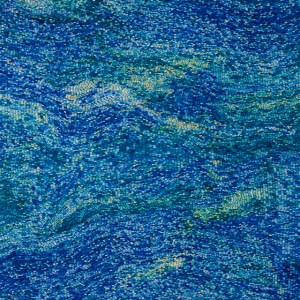
"Dark Blue Sea," 2012, oil on panel, 36”x36”

“Dark Blue Sea,” 2012, oil on panel, 36”x36”

Briefly describe the work you do.

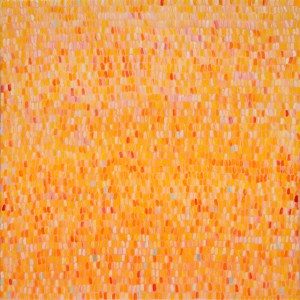
For the past few years I have been making paintings about repetitive mark making and color. My inspiration most often comes from observations of light and color – in the sky and landscape of my daily environment. After developing a color palette, I typically apply the brushstrokes one after the other, left to right like writing. I allow intuition to determine which color follows the next. As I work, patterns emerge, which suggest the flickering colors and movement of water and sky as well as the warp and weft of fabrics and textiles. I recently began a series that isolates the color in particular impressionist paintings, and reassembles these colors in a new way. My hope is that my paintings will invite a meditative experience for people looking at them.

Tell us a little about your background and how that influences you as an artist.

I grew up in a suburb of Boston–Concord, Massachusetts. I was fortunate to have a lot of exposure to art and culture as a child. The school system was excellent and had a good art program. My parents also made sure there were always art materials in the house and extra lessons when they were able. In middle school, I was selected to be part of a program for visually gifted students called Project Art Band. Each week I took a bus to the studio of a fiber artist. It was an incredible experience to have that kind of mentorship and role model of a working artist at such a young age.

Though I always took art classes, I never seriously considered getting a fine arts degree until my second shot at an undergraduate degree (I took a break from college after two years at American University in Washington, DC). I transferred to University of Massachusetts Amherst to study Comparative Literature, and my first semester I took a painting class. The professor suggested I apply for an art minor, which I did. I heard back that I’d been accepted as a minor, but that the committee would also accept me as a major if I wanted. I immediately said yes. I think having such encouragement along the way has helped me continue making art, even through the detours I’ve taken in my career (I received an MBA in 2002, and an MFA in 2012).

Growing up in Concord, I was exposed to transcendentalist ideas (Ralph Waldo Emerson and of course Thoreau). I spent a lot of time outdoors, and my father was an avid fisherman and boater. I feel these early exposures encouraged in me an interest in being in and closely observing nature, as well as a spiritual view of nature that informs my current work.

"Lux," 2014, oil on panel, 43” x 43”

“Lux,” 2014, oil on panel, 43” x 43”

The concept of the “artist studio” has a broad range of meanings, especially in contemporary practice. The idea of the artist toiling away alone in a room may not necessarily reflect what many artists do from day to day anymore. Describe your studio practice and how it differs from (or is the same as) traditional notions of “being in the studio.”

Right now I have a fairly conventional studio practice that consists of painting and drawing. I rent a space at an art center and have a small workspace/office in a spare room at home. I definitely fit the mold of the artist working alone in the studio. And I like the solitude of my space, which creates a kind of cocoon in which I can work uninterrupted. At the same time, I have begun expanding my activities in the past couple of years: teaching a class; getting involved with an “art as business” focused organization; virtually co-mentoring/critiquing with a small group from my MFA program; and weekly co-coaching/critiquing with an accountability partner who is a painter in California.

What unique roles do you see yourself as the artist playing that you may not have envisioned yourself in when you first started making art?

I would not have seen myself making slow, repetitive, meditative paintings earlier on. Hearing someone say that they get lost or entranced in the colors of my paintings is very gratifying in that I had a hand in creating a contemplative space for someone.

When do you find is the best time of day to make art? Do you have time set aside every day, every week or do you just work whenever you can? 

I have a set schedule that I established while I was in my low-residency MFA program at Lesley University College of Art and Design. I have a day job that I work Monday through Thursday. Every Friday I am in the studio all day, from 8:00 am to 5:00 or 6:00 pm. I also work in the studio two nights a week from 5:30 to 10:00. My weekend work time varies, but I try to get in a minimum of two 6 hour weekend days a month. With family obligations, this can be a challenge. But I’ve found having these regular studio hours are essential to getting anything done. Without that commitment, it’s too easy to give in to being tired or to other things that inevitably come up. I also found that for me 20 hours a week is a magic number when things begin to happen in the studio. Fewer than that and it feels more difficult to establish a flow. I also make sure that every week I put aside a few hours for marketing or administrative work. I am a natural night owl, but working at night doesn’t fit into the rest of my life right now.

"Anatole 8," 2013, oil on canvas, 12”x12”

“Anatole 8,” 2013, oil on canvas, 12”x12”

How has your work changed in the last five years? How is it the same?

Five years ago, in 2009, I began a low-residency MFA program. Going into the MFA, I was making gestural paintings based on the figure and on still lifes and was very influenced by abstract expressionist painters like Joan Mitchell and Willem de Kooning. I was challenged to question the all-over quality of my painting and how I was organizing my paintings in patches of color, often with similar size brush strokes. That led me first to making small, pared down paintings of still lifes constructed out of sticks and branches I found on walks in the Bosque along the Rio Grande. I became interested in discovering what makes individual marks expressive and thinking more constructivistically and systematically about how I made my paintings. I started looking at artists like Alma Thomas and Bradley Walker Tomlin on the one hand and artists related to Minimalism and Post-Minimalism on the other. In my final semesters, I made a series of black and white paintings consisting of brushstrokes applied one after the next. I’ve continued this exploration ever since, more recently re-introducing color. Even though my work is now more regulated and structured (and a bit obsessive), it is still concerned with expression and feeling in reaction to the natural world. The gesture and materiality of the brushstroke is still important as well as my interest in color relationships. Now I have a system and structure that allows me to explore color and brushstroke in a different way.

Are there people such as family, friends, writers, philosophers or even pop icons that have had an impact on the work you do?

The biggest impact has been from my family. The time and perseverance required to regularly paint in the studio would be difficult to keep going without their support, understanding, and encouragement. My artist friends and mentors – particularly the artists who mentored me during my MFA program – have been wonderful in terms of both support and pushing me to work out of my comfort zone. Annie Dillard is a writer who comes to mind as an early influence in observing and finding inspiration in nature.

If you had an occupation outside of being an artist, what would that be and why?

There are so many other occupations I’d like to experience if there were infinite amounts of time and energy. Other occupations that intrigue me are writing, filmmaking, biology, ecology, landscape architecture/urban planning, and psychology. I’ve also fantasized about opening a gelato shop – it would be great to feel like you’re giving people a little happiness every day. Since time is limited, I am very happy that I am able to paint and vicariously fulfill my other interests through lots of reading. I also want to incorporate teaching into my practice, either privately or at the university level.

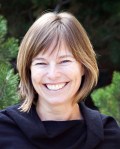
ChristianJill-HeadshotAbout 

Jill Christian is a visual artist working in Albuquerque, New Mexico. Having spent time on the water growing up in Massachusetts, she finds parallels between the ocean and the great expanses of distance and sky in New Mexico. She holds an MFA from Lesley University College of Art and Design (Boston) as well as a BFA from the University of Massachusetts at Amherst and an MBA from the University of New Mexico. She was a recipient of a 2011 Creative Albuquerque/Albuquerque Arts Business Association Emerging Creatives Award. Her work has been published in New American Paintings West (2014) and Studio Visit Magazine and has been shown in a number of group exhibitions, including 516 ARTS’ New Mexico Showcase (2012).

www.jillchristian.com

All images copyright of the artist and used with their permission. 

Posted in Uncategorized | Tagged , , , , | Leave a comment

Elizabeth Amento – San Francisco, California

"Just one more, I promise," found image and gouache on paper, 11"x14", 2014

“Just one more, I promise,” found image and gouache on paper, 11″x14″, 2014

Briefly describe the work you do.

The focus of my work for the past few years has consisted of images found in and cut out of vintage magazines. I position these people, primarily women, and collage them on Stonehenge paper. Then I paint using gouache, creating shapes with a small Sable brush.

I enjoy many things about the vintage magazines I source from, the anonymity, the flat representation of the figure, the black and white or warm colors, their eerie enthusiasm. I feel I am empowering them somehow by providing them this new abstract and sarcastic experience.

I mix colors, paint lines, fill in shapes, layer them all, and sometimes movements emerge. I am particularly fond of gouache after all these years, because it is finicky and demands control. It can be flat and yet very painterly. I can create small amounts of slightly different colors and return to the same palette.

I began this body of work on a smaller scale, partially due to space, partially, I realize now, to be able to work out ideas while learning these mediums and their relationships. I have recently been expanding back a to larger format.

Tell us a little about your background and how that influences you as an artist.

My parents are both from the East coast, we moved to the San Francisco Bay Area when I was 4. My biggest influences have been the teachers in my life. Beginning with my parents, I saw my dad as capable of following his dreams, as well as being able to fix anything. My mom taught me how to look at and respect the work artists do, as well as introduce me to a fearlessness for all kinds of materials. I am grateful to my high school art teacher Cayewah Easley for noticing and encouraging my love for painting. I moved back to the East coast for college and found many supportive environments. From Sheila Gallagher at Boston College who challenged me to create my own art community there, to the Post-Baccalaureate studio intensive program at Brandeis that pushed my studio practice skills, to SMFA where I honed my ability to communicate about my work in any form it took.

Now, I look back at my teachers and realize the wealth of resources they have provided me when I am stuck in the studio or in life.
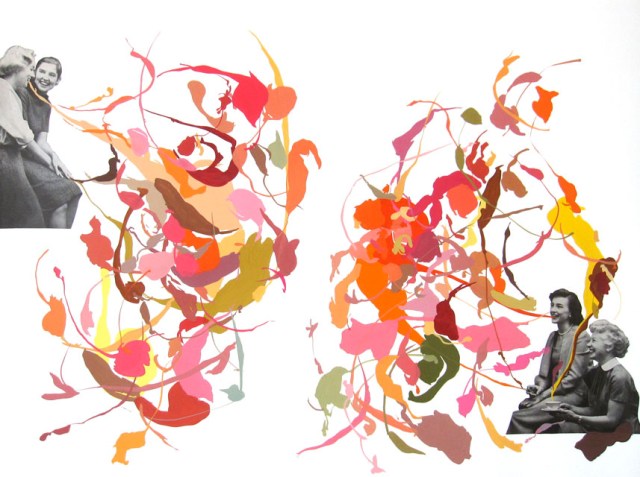
"She told me that we wouldn’t end up like them," found image and gouache on paper, 18"x24", 2012

“She told me that we wouldn’t end up like them,” found image and gouache on paper, 18″x24″, 2012

The concept of the “artist studio” has a broad range of meanings, especially in contemporary practice. The idea of the artist toiling away alone in a room may not necessarily reflect what many artists do from day to day anymore. Describe your studio practice and how it differs from (or is the same as) traditional notions of “being in the studio.”

My studio practice is pretty traditional. My studio time has been serious for as long as I have had projects to work on. In my current set up, I have a desk and wall space. My studio takes up about half my room and is well integrated. I do miss having a separate studio space to be messier and work larger, but am also comfortable living and creating in the same space because I don’t see them as that different.

When I finished grad school I was grateful for the appreciation that as an artist, I have many creative outlets, it’s about perspective and balance. I remember to take the time to plant, cook, make messes in the studio, enjoy the company of friends, observe my surroundings and have adventures.

What unique roles do you see yourself as the artist playing that you may not have envisioned yourself in when you first started making art?

When I started making art, I saw it as the dedication to painting and sole pursuit of showing in museums. But as an artist I am a lot of things. I am a problem solver who is able to work towards the greater goal, while taking care of all the pieces that make it happen, and that doesn’t only have to happen in the studio. I wasn’t, and am still not really, sure what “I wanted to be when I grew up.” To the same degree, I struggled for much of my artistic career as to what to paint. I ultimately keep working at it, at attempting to pursue my passions and be genuine. I feel fortunate that people are responding to my work that has grown organically in my practice. The opportunities that social media has provided for people to see my work is something I didn’t imagine when I first started painting.

When do you find is the best time of day to make art? Do you have time set aside every day, every week or do you just work whenever you can? 

The best time of day for me to make art is in the evening. I definitely get a second wind and feel more comfortable as the sun goes down. Even if I have a whole day committed to the studio, I will likely fill the beginning portion with preparation, observation, or research.

Due to my schedule, I paint after I come home from work, make food and relax a bit. I listen to music, podcasts or have a show on in the background as I work. I set aside at least 2 evenings a week and an afternoon on the weekends. I definitely go through phases where I am more productive then others. When I paint too much, I do not have enough inspiration to bring to the table and may overwork pieces. I need time to stand back and look at the work, or leave altogether and resolve the composition based on the image I have in my head, and then return to make my next move. I do love producing and get antsy if I haven’t painted in days, so I often at my desk working away.
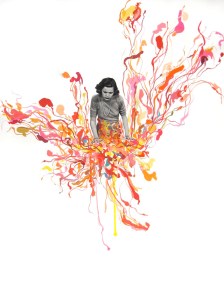
"Maybe you don't worry enough," found image and gouache on paper, 18"x24", 2014

“Maybe you don’t worry enough,” found image and gouache on paper, 18″x24″, 2014

How has your work changed in the last five years? How is it the same?

Five years ago I had just arrived in San Francisco after finishing grad school. I was primarily recovering from my exploration of mediums and disassembly of the figure in my work. I was still attempting to synthesize my work in different contexts. I was creating soft sculpture installations using fleece pillows that resembled my painted shapes in color and form. The shapes I had created through painting exploration and consisted of abstracted imagery based on recalling my memories.

My work has evolved and yet still remains very similar, at least to me. I do not experiment with different mediums as often to express my ideas, but have been able to refine my skills with gouache, focus on my shapes, color combinations and compositions. A lot of new elements have evolved organically, but the captured movement I have been able to create with flatness has been the most exciting.
The found image element has been a rewarding discovery. Representing the figure through relationships and attempting to express emotions has been a goal of my work. I thought I had lost the visual representation of the figure as I was experimenting with the abstraction of energy. The combination of my mediums has allowed the flat figure to finally be finally harmonious with the abstracted painting.

Are there people such as family, friends, writers, philosophers or even pop icons that have had an impact on the work you do?

Early influences were the abstract expressionists, MTV, and my mom telling me that, “Only boring people get bored.” I was very inspired by the creative woman throughout my life, and the feminist literature I was exposed to in grad school definitely made me question and find strength in my representation of the female form. Early I was drawn the colors and patterns of the late 60s, particularly to psychedelic posters.

If you had an occupation outside of being an artist, what would that be and why?

I do have an occupation outside of my artwork. I work for a fashion start up in San Francisco. I began doing production and now I do inventory management, quality control and procurement. It is very rewarding and challenging. It fulfills a lot of my skill sets. I am thankful for the experiences I had as a teaching and artist’s assistant, exploring different mediums in my work, and also for my parents insisting I get a liberal arts background, as I am capable of and able to bring my skills in creative problem solving, research, communication, and organization to the table.
ElizabethAmento_Headshot_Photocredit_Lean TimmsAbout 

Elizabeth Amento was born in Boston, Massachusetts and raised in the San Francisco Bay Area. She moved back to Boston, where she attended Boston College for Studio Art and Psychology, Brandeis University for a Post-Baccalaureate in Studio Art, and the School of the Museum of Fine Arts/Tufts University for her Masters in Fine Arts. After being awarded honors and included in shows in Boston, as well as Florida, Arizona, and Korea, and attending The Homestead Residency in Alaska, Elizabeth ventured back to the San Francisco Bay Area and found her colorful palate at home in the Mission District of San Francisco. There she has been carefully composing and displaying her collages for 5 years. She was recently interviewed by Frankie Magazine in Australia and published in Barcelona based Index Book’s Cut out for Collage.

http://elizabethamento.com

All images copyright of the artist and used with their permission. 

Posted in Uncategorized | Tagged , , , , | Leave a comment

Rachel Hibbard – Portland, Oregon

"Tower"

“Tower”

Briefly describe the work you do.

I’m interested in repurposing images, making commentaries about our world.

The work shown here are part of “Calendar for a new century, 365 Days” which is a panoramic landscape, a world-scape; The series refers to the Gregorian calendar, but its order becomes irregular. This calendar is not a seasonal progression; days cluster into months and move through the color spectrum. In each grouping imagery combines into visual constellations with recurrent images acting as refrains.
Each month/monthesque, is named for a common object. The days’ names are common actions. If one was to use this system in speech it would sound like…Paying the 2nd of Chair or Getting the 14th of Spoon.

Months:
1.Chair; 2.Plane; 3.TV; 4.Spoon; 5.Table; 6.Car; 7.Hall; 8.Heater; 9.Boat; 10.Refrigerator; 11.Pants; 12.Bed.
Days: Paying; Watching; Filling; Putting; Getting; Moving and Laying;

Materials:
It is important to me that I am not adding many more things to the world. Each page has existed in a book, I overlay and reconfigure them, very much as an editor might have done before me.

"Tower" detail

“Tower” detail

Tell us a little about your background and how that influences you as an artist.

The Pacific Northwest is very much a part of my makeup is an artist.

The concept of the “artist studio” has a broad range of meanings, especially in contemporary practice. The idea of the artist toiling away alone in a room may not necessarily reflect what many artists do from day to day anymore. Describe your studio practice and how it differs from (or is the same as) traditional notions of “being in the studio.”

I open the door to my studio and inevitably I feel excited and lucky. That being said; looking and thinking is as much a part of what I do as the studio time. However without the time in the studio, where things are processed, not much would come into being.

What unique roles do you see yourself as the artist playing that you may not have envisioned yourself in when you first started making art?

Earlier on my work was focused around an interior psychology, now I find myself looking outward.

"Calendar Boat"

“Calendar Boat”

When do you find is the best time of day to make art? Do you have time set aside every day, every week or do you just work whenever you can? 

I work regularly but in sporadic outpourings. Once I start any time I can get in the studio is a good time to work, I like working all day and then going back and night.

How has your work changed in the last five years? How is it the same?

I hope it’s gotten better.

Are there people such as family, friends, writers, philosophers or even pop icons that have had an impact on the work you do?

I am inspired by anybody who’s really at the top of their game.

If you had an occupation outside of being an artist, what would that be and why?

I think I was born to make things. But I’ve always wanted to be a zoologist or botanist.

Rachel head shotAbout 

Rachel Hibbard’s thematically based work explores systems such as, the weather and consumer goods; currently she is investigating struggle as a force in the world using three-dimensional collage and photography. She has exhibited nationally in venues including The Chicago Cultural Center, the State of Illinois Gallery, the Betsy Rosenfield and Kline Galleries, the Detroit Building, Maryhill Museum, and the Portland Institute of Contemporary Art and Blue Sky, Center for Contemporary Photography.

http://www.rachel-hibbard.net

Studio

Studio

All images copyright of the artist and used with their permission. 
Posted in Uncategorized | Tagged , , , , | Leave a comment

Corynn Larkin – West Chesterfield, New Hampshire

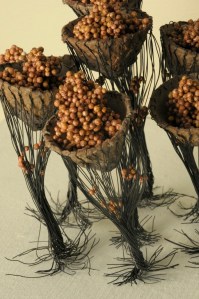
"Sperma Virosa." 2013. Wire, Paper pulp, Foam 2"-7"

“Sperma Virosa.” 2013. Wire, Paper pulp, Foam 2″-7″

Briefly describe the work you do.

I consistently explore and work to find methods that transform ordinary man-made materials into forms that convey and embody organic growth and change. The materials are reconfigured but still hold their original identity. There is a linear component as well as an intuitive physicality to the forms I create by using material such as wire. Although my forms are mostly created through the process of instinct and play, I choose wire to build skeletal and structural elements for most of my work. I research and look at books revolving around Botany, Mycology, and plant anatomy for inspiration.

I have a goal to create my own world that viewers can explore the different visions of my biomorphic abstractions. I combine materials to create repetitive versions of organisms that will continuously evolve, because I see endless possibilities. I am experimenting with the power of growth that happens in changes of process, scale, space and interactivity with the work I am developing.

Tell us a little about your background and how that influences you as an artist.

Growing up my family has had a huge impact on who I am, and how I got to be where I am. I am lucky to be surrounded and supported by such talented and intelligent individuals. I look up to my parents more than anything. My father is a carpenter and my mother is a painter and creator. They surrounded my three younger siblings and me by creativity and encouragement that we could be anything we wanted. Aside from my artwork, I work for a jewelry designer in Salem, MA, and she has been one of my biggest inspirations. I have acquired a work ethic, learned many techniques and she has been a huge supporter of mine since I interned for her a little under 4 years ago. I love being in creative atmospheres.

Environment is significant to my work. I have had the experience of growing up on both sides of the country. Born and raised in California until the age of twelve, then moved to New Hampshire where my family has been for the past ten years. It was a change of surroundings and has been a rollercoaster to say the least. This is where my sculpture work stems from.
I am driven by the experience of instillation. I am interested in the emotion, sensation and curiosity that come from an interaction between the viewer and the environment that surrounds them.

"Untitled." 2013. Felt, Wire 53"x40"

“Untitled.” 2013. Felt, Wire 53″x40″

The concept of the “artist studio” has a broad range of meanings, especially in contemporary practice. The idea of the artist toiling away alone in a room may not necessarily reflect what many artists do from day to day anymore. Describe your studio practice and how it differs from (or is the same as) traditional notions of “being in the studio.”

I have had three studio experiences; not having a studio, a studio in a group of 45 communal studios, and lastly a studio space that I am alone in. I worked differently in each setting so it is a mixture of both traditional and non-traditional.

When I first started creating art I never really knew what having my own space could do for myself as an artist and how it improves the work I create with no limitations on my process. Being able to leave my studio in a mess and come the next day to jump right back into a project puts my mind at ease. Not having a studio cut off my exploration of material, which is important to my process.

Communal studios are spaces where connections and collaborations with peers come to life. I appreciated having an open studio next to other artists. It gave my work the extra push needed by small critiques, and socially talking amongst each other about our art helped to improve my artistic dialect. Although, I found myself only creating art when I was alone and the building was silent.

In my current studio, I try every week to have long traditional workdays because that’s when I get my best work done. My studio is also mobile. The time I spend in a sketchbook, the time I spend researching my subject matter, and the time I spend looking and applying to shows is the work that can be done outside of the studio.

To be comfortable in the workspace is important to my artwork; by comfortable I mean creating an environment that I can draw inspiration from. It’s necessary for my materials to surround me.

In result, it is important for my work to have my own space.

"Ipomoea." 2014. Tracing Paper, Wire, Felt, Methyl Cellulose 50"x54"x60"

“Ipomoea.” 2014. Tracing Paper, Wire, Felt, Methyl Cellulose 50″x54″x60″

What unique roles do you see yourself as the artist playing that you may not have envisioned yourself in when you first started making art?

I never really thought of roles outside of being an artist working to show in galleries. At Penland School of Crafts I never pictured myself being able to stand in front of a large group of extremely talented people and present my artwork.

Being told by someone that they are inspired by my artwork is something I only daydream about and is motivational to create the best work I can.

When do you find is the best time of day to make art? Do you have time set aside every day, every week or do you just work whenever you can? 

When I first started to work in a studio, that I could call my own, it was in a building with 45 or so other studios. I found, during that time, I created my best work late at night into the early morning. It was a completely different, and silent, space to work in.

In my studio now, however, I have a room all to myself. I do my best to set time aside everyday dedicated to working in my sketchbook. When I am working in the studio it needs to be for long period of time. I go through what I call experimentation warm up of ideas with different materials to develop a stronger form. After that process I begin to build a piece.

How has your work changed in the last five years? How is it the same?

Well, in the last five years my work as drastically changed. I went into art school trying to find myself as an artist. I assumed coming from high school I would be a painter; little did I know I would fall for sculpture. I improved most when I received my first studio. My earlier work lacked concept, and I struggled with that for a while until one day I looked at all my structures and saw the connection that carried from piece to piece. Which was the destruction and reconstruction to abstractly transform objects and materials to look organic. The next issue I faced was that I couldn’t break past my comfort zone and constructing pieces that were the same size. My work evolved when I had a space to build larger structures. My process of creating has been the only thing to stay the same.

Studio

Studio

Are there people such as family, friends, writers, philosophers or even pop icons that have had an impact on the work you do?

Absolutely!

Family, friends, as well as past professors, all make a huge impact on my work. I don’t know where I would be without these relationships. I have been introduced to things I may have never known about. In fact a friend of mine looked at my art and said, “Hey! You would love Ernest Haeckel,” and what do you know, one of the biggest influences for my artwork are the prints of Ernest Haeckel in Art Forms in Nature. It changed my world. Many artists like Eva Hesse, Eliana Heredia, Mary Button Durell and Tara Donovan inspire me, and are great influences for the way that they transform material.

If you had an occupation outside of being an artist, what would that be and why?

I would want to be a geologist who specializes in mineralogy. I would also enjoy the study of gemology!! As a kid I collected books on minerals and gemstones, finding these forms to be the most fascinating shapes and incredibly beautiful colours. I used to beg my parents to buy me crystallization kits from the toy store. “Discover” rocks and fossil kits were also a favorite; I was so entertained chipping away at the hardened sand to dig out objects. I have a fascination with discovery and I see that now with the process in creating my sculptures. I would love to start working with the structures minerals have in my current work.

headshotAbout

Corynn Larkin (b.1992 San Jose, CA) is currently living and working in southern New Hampshire. May 2014, Larkin graduated from Montserrat College of Art in Beverly, MA with a Bachelor of Fine Arts in sculpture. While attending school she studied abroad summer of 2013 in Viterbo, Italy. Larkin received the William and Ruth Fusco Prize to Encourage Artistic Achievement, awarded to one student out of the graduating class.

She was juried into a two part show at the Arsenal Center for the Arts in Watertown, MA called “30 under 30,” Larkin was chosen to exhibit in the second show “Spotlight Six,” which takes a closer look at six out of the thirty participating artists. Since graduating, she was a studio assistant at Penland School of Crafts for artist Elizabeth Alexander and she has been actively working in her studio.

www.corynnlarkin.com

All images copyright of the artist and used with their permission. 

Posted in Uncategorized | Tagged , , , , | Leave a comment